PART 2: I Cut the Chain From a Pregnant Dog Left to Die in the Forest—Minutes Later, Seven Tiny Lives Changed Us Forever
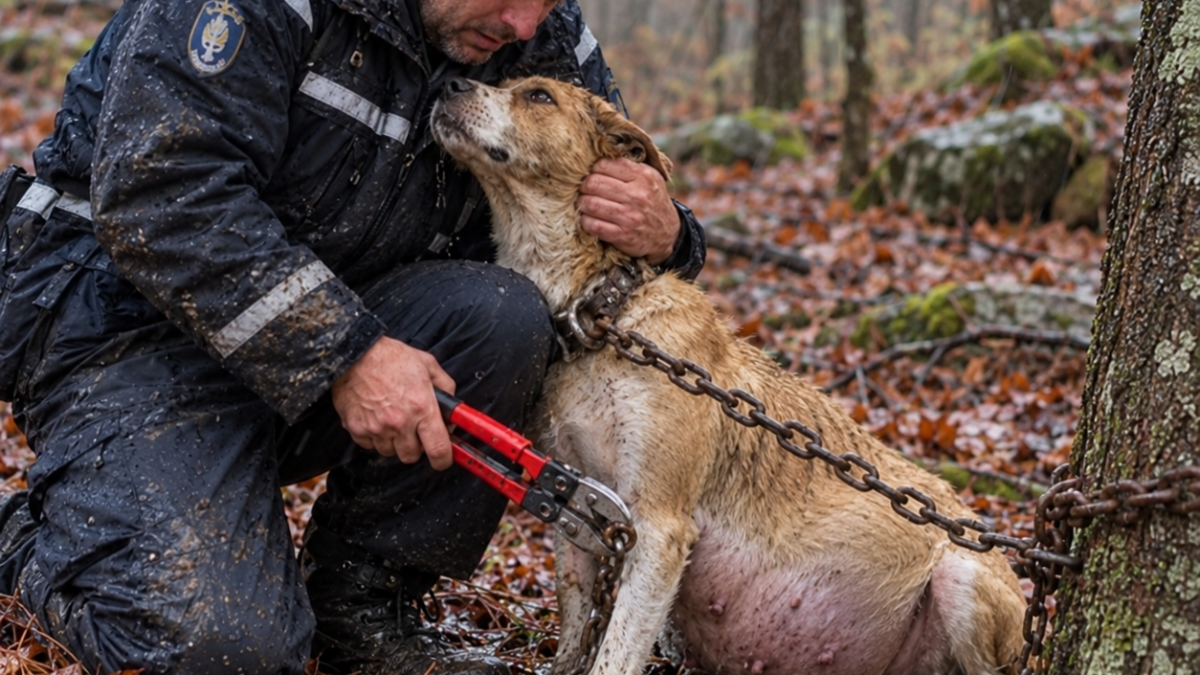
The pregnant dog had been chained so tightly to a pine tree that she couldn’t even lie down when the contractions started.
Less than a minute after I cut her free, she pressed her head against my knee, shuddered from nose to tail, and looked at me as if I were the last person left in the world she could trust.
I thought rescuing her from that forest would be the hardest part of the morning, but I had no idea what was about to happen in the back seat of my patrol vehicle.
My name is Julien Morel. I was forty-two then, fifteen years into my job with a small rural gendarmerie unit in Burgundy, surrounded by villages where people knew the baker, the mail carrier, and usually every dog that belonged on every farm.
I knew the forests too.
A gate moved overnight.
Fresh tire tracks on a closed logging road.
A fire pit still warm when nobody should have been camping.
After enough years patrolling the countryside, you learned to notice when something didn’t fit.
That morning, what stopped me wasn’t something I saw.
It was a sound.
A whimper.
So faint I almost blamed the wind moving through the pines.
I stopped the vehicle beside a muddy track in the Morvan and listened.
There it was again.
I followed it downhill between wet trees until I saw her.
She was light tan, some kind of mastiff mix, with a white chest and a dark patch around her left eye.
And she was enormously pregnant.
Her belly hung low enough to brush the damp pine needles, but above it her ribs stood out beneath her coat.
A rusted chain ran from her collar to a pine tree.
It was so short she could barely circle the trunk.
There was no bowl.
No shelter.
No blanket.
No water.
Nothing that suggested whoever had left her there planned to return soon.
She saw me and tried to wag her tail.
One weak movement.
Then her entire body stiffened.
She groaned and tried to lower herself.
The chain pulled tight.
She couldn’t lie down.
“Easy, girl.”
I don’t know whether I said it for her or for myself.
I radioed the station, requested another officer, and contacted Claire Martin, a veterinarian who handled half the rural emergencies in our district.
“Pregnant female,” I told her. “Very thin. Chained in the woods. Weak.”
“How close is she?”
Before I could answer, the dog’s hind legs spread slightly.
Her stomach tightened like a knot beneath her skin.
She looked straight at me.
Fear.
Exhaustion.
Nothing dramatic or human about it.
Just an animal that had reached the point where she had no strength left to solve her own problem.
“Claire,” I said quietly, “I think it’s starting.”
Her voice changed instantly.
“Cut the chain. Keep her warm. Put me on speaker, and Julien—don’t pull on anything unless I tell you.”
I ran back for bolt cutters, towels, gloves, and an emergency blanket.
When I returned, the dog was still standing because standing was almost all the chain allowed her to do.
I knelt beside the tree.
She watched my hands carefully.
Not aggressively.
Suspiciously.
The way an animal watches hands that haven’t always brought kindness.
I positioned the cutters around one rusted link.
Squeezed.
Nothing.
I changed my grip and tried again.
The metal snapped.
The chain dropped into the wet needles.
For several seconds, she didn’t move.
She was free but didn’t seem to understand freedom yet.
Then she stepped toward me.
Once.
Twice.
And lowered her head against my shoulder.
Her whole body trembled through my jacket.
“It’s over,” I whispered. “You’re not staying here.”
I still believed I had time to drive her to Claire’s clinic.
I spread a blanket across the back seat and helped her inside.
She turned once, settled heavily onto her side, and released a long breath.
Then she cried out.
I froze.
Something small appeared beneath her tail.
My phone was still connected to Claire.
“Julien?” she said. “Tell me exactly what you see.”
I stared into the back of my patrol vehicle as rain tapped softly against the roof.
“A puppy,” I said.
And before Claire could answer, I realized the rescue in that forest had just become something much bigger.
PART 2
“Don’t touch it yet,” Claire said.
I had one knee on the wet ground and both hands braced on the edge of the rear seat.
The puppy was still partially inside its mother, enclosed in a thin translucent membrane.
Everything inside me wanted to reach in immediately.
Training is a strange thing. Fifteen years in law enforcement had taught me how to approach armed people, car crashes, domestic disputes, fires, and frightened witnesses.
None of it had prepared me for delivering puppies in a patrol vehicle.
“She’s pushing,” I said.
“Good. Let her.”
The dog grunted.
Her back legs tightened.
Then the puppy slid onto the blanket.
For one terrifying second, nothing happened.
The mother looked backward but seemed too exhausted to move.
“Claire?”
“Open the membrane around its face.”
I tore it gently with my fingers and wiped the tiny muzzle with a towel.
Still nothing.
“Rub it.”
I began rubbing.
Harder than felt natural.
The puppy’s body was warm, slippery, impossibly small.
“Come on,” I whispered.
The mother lifted her head.
That was when the puppy moved.
A twitch first.
Then its mouth opened.
A squeak filled the vehicle.
I have heard adults scream in wrecked cars.
I’ve heard radios explode with voices during emergencies.
I’ve stood beside church bells during village celebrations.
I don’t think any sound ever affected me quite like that tiny squeak.
The mother’s ears lifted.
She tried to rise.
“No, no. Stay down.”
She ignored me completely, crawled forward, and began licking the puppy.
Something changed in her face.
Maybe that’s the wrong way to say it.
Dogs don’t suddenly become human because humans want a beautiful story.
But exhaustion disappeared behind instinct.
For the first time since I found her, she looked purposeful.
She knew exactly what that little body meant.
Claire stayed on the phone.
“Any more contractions?”
I watched the dog’s abdomen.
“Yes.”
“How far apart?”
“I have absolutely no idea.”
Claire laughed once.
It was the first ordinary sound I’d heard in what felt like an hour.
“Then start paying attention, Officer Morel.”
I looked at my watch.
Less than six minutes later, another contraction came.
By then, headlights were bouncing between the trees.
My colleague, Marc Delorme, pulled up behind the patrol vehicle.
Marc was fifty-three, broad-shouldered, permanently skeptical, and famous at the station for claiming he didn’t like animals because they “shed on everything.”
He got out, took three steps toward me, and stopped.
“What happened?”
“She’s giving birth.”
“In the car?”
“Yes.”
Marc looked at the vehicle.
Then at me.
Then back at the vehicle.
“That car was cleaned yesterday.”
“Get towels.”
He disappeared without another word.
The second puppy arrived twelve minutes after the first.
This time the mother opened the membrane herself.
Marc returned carrying every towel from his vehicle, two bottles of water, and a first-aid kit.
He crouched beside me.
“That’s very small.”
“Apparently they’re born that way.”
He gave me a look.
“I know puppies are small, Julien.”
“Then why did you say it?”
“Because I needed to say something.”
That was Marc.
A man who could walk into an ugly situation without blinking and become deeply uncomfortable when emotion entered the room.
The second puppy began nursing.
Then the mother’s contractions slowed.
Claire was still giving instructions through my phone.
“We need to move her,” she said. “If there’s a problem with another puppy, I need her at the clinic.”
“We’re twenty-five minutes away.”
“Drive carefully. Marc follows you.”
I looked at the mother.
She looked back.
We needed to transfer her without separating her from the puppies, but she had finally settled.
I slid the emergency blanket beneath them as gently as possible.
Marc helped me lift the corners, forming a makeshift sling.
The mother growled.
Not loudly.
Just a warning.
Marc immediately froze.
“She’s protecting them,” I said.
“I gathered that.”
I talked to her while we repositioned the blanket.
“Easy. We’re helping you.”
She stared at our hands.
Then, slowly, she lowered her head.
She let us do it.
I climbed behind the wheel.
Marc leaned into the passenger window.
“You want me to drive?”
“Why?”
“You’ve got blood on both hands.”
I looked down.
He was right.
“I’ll manage.”
“Your phone?”
“Still connected.”
Claire’s voice came through the speaker.
“I can hear both of you, by the way.”
Marc bent toward the phone.
“Good morning, Claire.”
“Get in your car, Marc.”
“Yes, doctor.”
We left the forest.
I drove slower than I had ever driven during an emergency.
Every pothole suddenly felt personal.
I kept looking in the mirror.
The mother lay around her puppies, her body curled protectively despite her exhaustion.
Five minutes into the drive, she began panting again.
“Claire.”
“I hear her.”
Another contraction.
Then another.
“Keep driving unless she starts delivering.”
I made it another three kilometers.
She started delivering.
I pulled onto the shoulder beside an old stone wall.
Marc stopped behind me.
The third puppy came quickly.
Too quickly.
It emerged completely limp.
The mother licked it.
Nothing.
I rubbed the puppy with a towel.
Nothing.
“Claire, it’s not breathing.”
“Clear its mouth. Rub firmly.”
I did.
No response.
I could hear Marc breathing behind me.
“Come on,” he whispered.
I rubbed harder.
The puppy’s head rolled slightly in my palm.
“Claire—”
“Keep going.”
Ten seconds.
Twenty.
Thirty.
It felt endless.
Then the puppy coughed.
Once.
A tiny burst of fluid came from its nose.
It inhaled.
Marc turned his face away.
I looked at him.
“You all right?”
He cleared his throat.
“Rain.”
We were standing beneath a clear patch of sky.
I didn’t mention it.
We got moving again.
Claire met us outside the clinic wearing green scrubs under an old waterproof jacket.
Her assistant, Sophie, had already prepared an exam room with heating pads.
We carried the mother inside with all three puppies.
The moment Claire touched her abdomen, her expression changed.
“How many?” I asked.
“At least two more.”
“At least?”
“Possibly more.”
The dog’s gums were pale.
Claire checked her temperature, listened to her heart, then examined the puppies.
“She is dehydrated, underweight, and severely depleted. I’m surprised she’s still standing.”
“She wasn’t standing by choice.”
Claire looked at the rusted chain I’d thrown into the footwell of my vehicle.
“You kept that?”
“Evidence.”
Her face hardened.
“Good.”
Another contraction began.
The fourth puppy was born at the clinic.
Then the fifth.
The fifth was tiny.
Much smaller than the others.
Claire worked over it for almost three minutes.
The mother whined every time the puppy made a sound.
Finally Claire placed it beside her.
“There.”
I counted.
Five.
Marc counted too.
“Five puppies.”
Claire kept one hand on the mother’s abdomen.
“No.”
Another contraction.
The sixth came nearly forty minutes later.
A tan female with a white nose.
The mother cleaned her immediately.
Six puppies.
I thought that was the end.
Claire didn’t.
She frowned.
“What?”
“Something’s still there.”
She performed an ultrasound.
A shape appeared on the screen.
One more.
But its heart rate was dropping.
Claire moved fast.
“We may need surgery.”
The room changed instantly.
Sophie prepared equipment.
Marc backed toward the door.
I stayed beside the mother’s head.
Her eyes followed Claire.
Then me.
She was exhausted again.
Completely empty.
“Come on, girl,” I said. “One more.”
Claire administered medication to help strengthen the contractions, but only because she had already confirmed there wasn’t an obstruction that would make it dangerous.
We waited.
The dog’s muscles tightened.
She pushed.
Nothing.
Again.
Nothing.
Claire watched the monitor.
“Heart rate’s lower.”
She reached for what she needed.
“If we don’t get this puppy now, we’re going to surgery.”
The dog pushed once more.
A dark shape appeared.
“That’s it,” Claire said. “Good girl.”
I don’t know why humans say “good girl” to animals during moments they didn’t choose and can’t understand.
Maybe because language is sometimes the only thing we can offer.
The puppy emerged.
Claire caught it.
No movement.
No sound.
The mother lifted her head.
Claire cleared the airway.
Rubbed.
Stimulated.
Nothing.
One second became five.
Five became fifteen.
Marc stood absolutely still near the wall.
Sophie handed Claire another towel.
I watched the mother’s face.
She knew something was wrong.
I am certain of that.
She tried to get up.
“Stay,” Claire murmured.
Then—
A sound.
Weak.
Almost no louder than air leaving a balloon.
But it was there.
The seventh puppy breathed.
Claire smiled.
“Seven.”
I looked down at the dog.
She had closed her eyes.
For the first time since I found her, she seemed able to rest.
Seven puppies.
Seven living puppies.
And one mother who had almost been left to deliver them alone on a chain in a forest.
That should have been the ending.
For us, it was only the beginning.
We found the first real clue that afternoon.
Marc and I returned to the pine tree with an evidence technician from a neighboring unit.
Rain had complicated everything.
The road surface was soft, tire impressions partly washed away, and the forest floor had been trampled by us during the rescue.
Still, whoever abandoned the dog hadn’t been careful.
About six meters from the tree, Marc found a torn corner from a bag of livestock feed wedged beneath a branch.
Farther toward the road was a cigarette butt protected from the rain beneath a fallen log.
We photographed both.
There were vehicle tracks too.
A van, likely.
One rear tire had an unusual tread defect: a repeated gap along the outer edge.
“Could be useful,” Marc said.
“Could be nothing.”
He looked toward the tree.
The severed section of chain was gone because I had taken it as evidence.
A bare circle remained around the trunk where the dog had paced.
Round.
And round.
And round.
The needles had been worn down to mud.
Marc stood there longer than necessary.
“She must’ve been here a while.”
“Yes.”
“How long?”
“Claire can’t say yet.”
He shoved his hands into his jacket pockets.
“Find whoever did it.”
It wasn’t an order.
It sounded more personal than that.
“We will.”
At the clinic, Claire had estimated the mother was three to four years old.
No microchip.
No tattoo.
No collar identification.
The collar itself was cheap nylon, badly frayed beneath the chain clip.
There were old sores around her neck.
Some were healed.
Some weren’t.
That mattered.
It suggested the chain in the forest wasn’t the first time she’d been restrained for long periods.
There were calluses near her elbows.
Her claws were overgrown.
She also had evidence of at least one previous pregnancy.
That changed the investigation.
“This may not be somebody panicking because their dog got pregnant,” Claire told me.
“What are you thinking?”
She hesitated.
“Breeding.”
The word sat heavily between us.
Illegal breeding operations weren’t unheard of in rural areas. Most were small and crude rather than sophisticated—dogs kept in sheds, barns, garages, old kennels, bred repeatedly, puppies sold through cash advertisements or informal networks.
“Can you prove it?”
“No. Not from her alone.”
“But?”
Claire looked through the glass toward the mother.
“But I’d ask where her previous puppies went.”
We needed a name for her.
Official paperwork listed her as “unidentified female canine.”
Nobody at the clinic called her that.
Sophie suggested Hope.
Marc rejected it immediately.
“Every rescued animal gets called Hope.”
“Then you name her,” Sophie said.
Marc stared through the glass.
The dog was sleeping while seven puppies pressed against her belly.
“She was tied to a pine.”
Sophie waited.
“So?”
Marc shrugged.
“Pine.”
“You want to call her Pine?”
“No.”
“Then what?”
He thought for several seconds.
“Juniper.”
I laughed.
“There wasn’t a juniper tree anywhere near her.”
“Sounds better than Pine.”
And somehow it stuck.
Juniper.
Within two days, everyone called her Juni.
Marc claimed this was ridiculous.
He also arrived at the clinic the next morning carrying a bag containing a soft washable dog bed.
“I happened to pass a store.”
Claire examined the enormous orthopedic bed.
“You happened to pass a pet store forty kilometers from your house?”
Marc ignored her.
Juni watched him place the bed down.
She hesitated.
Then climbed onto it.
Marc looked absurdly pleased.
He scratched the side of his nose.
“See? Practical.”
The puppies were temporarily given colored collars for identification.
Red.
Blue.
Green.
Yellow.
Purple.
Orange.
White.
Marc objected to this too.
“They need proper names.”
“You said names create attachment,” I reminded him.
“That was before.”
“Before what?”
He looked at the puppies.
“Before they needed names.”
The smallest puppy—the fifth—was the one we worried about most.
She wore the purple collar.
She struggled to compete with her brothers and sisters for milk, so the clinic staff supplemented her with bottle feedings.
Marc named her Violet.
Nobody pointed out that this was far more sentimental than Hope.
We valued our lives.
Three days after the rescue, our investigation went public.
Not because we announced it.
Because someone had seen our vehicles in the forest and posted a photo online.
The local newspaper called.
Then a regional station.
We gave almost nothing.
A pregnant dog had been found abandoned and chained.
She and seven puppies were alive.
An investigation was underway.
That was all.
The story spread anyway.
People wanted to donate blankets.
Food.
Money.
One retired teacher offered to foster all seven puppies until we explained they would remain with their mother for weeks.
Then something useful happened.
A woman named Élodie Perrin contacted the brigade.
She lived approximately eighteen kilometers from where Juni was found.
“I think I’ve seen that dog,” she said.
We showed her a photograph.
She stared at it for less than five seconds.
“Yes.”
“Where?”
“At a property outside Saint-Brisson.”
My pulse changed.
“Whose property?”
“I don’t know his full name. People call him Rémi.”
“What did you see?”
“Dogs.”
“How many?”
“At least eight or ten.”
She explained that she delivered home medical equipment and had accidentally turned into the wrong driveway about six months earlier.
She saw kennels behind an old farmhouse.
Large dogs.
Several females.
A man came outside and ordered her to leave.
“What made you remember this dog?”
“The eye.”
Juni’s dark patch.
Élodie tapped the photograph.
“I remember that marking because she was standing against the fence watching me.”
“Was she pregnant?”
“Not then.”
“Did she seem injured?”
“No.”
“Thin?”
Élodie thought.
“Not like this.”
That distinction mattered.
We identified the property owner as Rémi Lavigne, thirty-eight.
He had prior citations for unregistered commercial animal sales.
No major criminal convictions.
His official occupation was listed as construction laborer.
His social media accounts were mostly private.
But older public posts showed dogs.
Large mixed-breed dogs.
Puppies.
Advertisements.
“Family-raised guardian pups.”
“Excellent bloodlines.”
“Cash only.”
The postings stopped eight months earlier.
Marc and I sat in front of the station computer reading them.
“There.”
He pointed.
A photograph from the previous year showed a litter of six puppies in front of a shed.
Behind them, partly visible through wire fencing, stood a light-tan female.
White chest.
Dark patch around the left eye.
Juni.
We enlarged the image.
Not enough for legal certainty by itself.
Enough for us.
“Get the warrant,” Marc said.
We took everything to the prosecutor.
Photographs.
Veterinary findings.
Witness statement.
Prior sales.
The abandoned dog’s distinctive markings.
The chain.
The feed bag.
The tire pattern.
By evening, we had authorization to search the property.
We went the next morning.
I expected barking.
I expected animals.
Instead, the place was nearly silent.
The old farmhouse sat beside three outbuildings.
One barn.
Two sheds.
Rémi Lavigne opened the door wearing work pants and an expression that changed the moment he saw our vehicles.
“Problem?”
“We have authorization to search the property.”
“For what?”
“Animals.”
His jaw tightened.
“I don’t have animals.”
Marc looked toward a muddy run beside the barn.
There were paw prints everywhere.
“No?”
“Not anymore.”
That answer was worse than denial.
We entered.
The first shed was empty.
Recently emptied.
Wire kennels had been dismantled and stacked against the wall.
The concrete floor was still marked with rectangular stains where enclosures had stood.
Water buckets were piled outside.
Some had dog hair stuck to their rims.
The smell remained too.
Old waste.
Disinfectant.
Damp straw.
The second building contained feed.
Dozens of bags.
Same brand as the torn corner we’d found near Juni’s tree.
Not proof by itself.
But useful.
Then Marc called my name.
He was crouched beside a workbench.
A coil of chain lay underneath.
Rusty.
Same approximate size as Juni’s.
Beside it was a box of identical snap hooks.
Rémi appeared behind us.
“Farm equipment.”
“You don’t have livestock,” Marc said.
“I had dogs.”
“Where are they?”
“Sold.”
“All of them?”
“Yes.”
“When?”
“Different times.”
“Records?”
He smiled without humor.
“I’m not running a business.”
I watched him while Marc spoke.
People often think policing is about catching lies.
Usually it’s about letting someone speak long enough to build a structure around themselves.
“What about this dog?”
I showed him Juni’s photograph.
His eyes moved to it.
Then away.
“No.”
“You don’t recognize her?”
“No.”
“We have a photograph of her here last year.”
His expression changed for perhaps half a second.
“Lots of dogs look alike.”
“With the same dark patch?”
“Maybe.”
“Same chest?”
“Maybe.”
I put the photograph down.
He folded his arms.
“You found some abandoned dog and now you want somebody to blame.”
“We want whoever chained her to a tree.”
“Not me.”
Marc stepped closer.
“Then you won’t mind explaining your van.”
Rémi’s eyes shifted toward the driveway.
A white panel van sat beside the barn.
The right rear tire had a damaged outer tread.
A repeated gap.
Exactly where the forest impression showed it.
We photographed it.
Measured it.
Compared it.
Rémi stopped talking.
The search continued.
In a locked cabinet, we found notebooks.
That was where the case changed.
Dates.
Female dog descriptions.
Breeding cycles.
Numbers of puppies.
Sale amounts.
Initials.
Payments.
Juni wasn’t listed by name.
She was “F3.”
Female three.
The description beside it:
Tan/white.
Eye patch.
One line appeared every several months.
Six pups.
Five pups.
Seven expected.
Then the last entry.
F3 weak.
We stared at those two words.
F3 weak.
Marc turned a page.
Nothing after it.
No sale record.
No veterinary visit.
No placement.
Just—
F3 weak.
And seven expected.
“You knew,” I said.
Rémi said nothing.
“You knew she was pregnant.”
Silence.
“You knew she was weak.”
His lawyer would later tell him he should have remained silent from the beginning.
He didn’t.
“She wasn’t worth the vet bill.”
Marc’s head turned.
Slowly.
I’ve worked beside him for years.
I knew that movement.
It meant anger had arrived and was being forced into a very small box.
I stepped slightly between them.
Rémi continued.
“She stopped eating. Couldn’t sell her like that.”
My voice sounded strangely calm.
“So you chained her in the forest?”
“I didn’t say that.”
“You just gave us a motive.”
His face changed.
He realized it too late.
We seized the notebooks.
The chain.
The hooks.
Electronic devices.
Sales records.
And the van.
But we still had a problem.
Where were the other dogs?
Rémi insisted they’d been sold.
Some probably had been.
Not all.
A notebook listed four adult females and two males only two weeks before Juni’s abandonment.
One female was crossed out with the word “gone.”
Three remained.
No sale amounts.
No buyer initials.
Nothing.
We searched the entire property.
Empty.
Marc stood in the yard looking toward the road.
“He moved them.”
“Yes.”
“When?”
“Probably after the rescue became public.”
“Then somebody helped him.”
That became our next lead.
Phone records ultimately gave it to us.
Rémi had called his cousin, Damien Vautrin, eleven times in two days.
Damien owned a small disused cattle property about thirty kilometers north.
We obtained authorization.
This time, we heard the dogs before we reached the house.
Barking erupted behind a sheet-metal barn.
Inside were six dogs.
Three adult females.
Two adult males.
One adolescent.
Their conditions varied.
None were as close to death as Juni had been.
But they were living in filth.
Cramped cages.
Dirty water.
No proper bedding.
One female had an untreated skin infection.
Another had swollen mammary glands.
The adolescent male was so frightened he pressed himself against the farthest wall and urinated when we approached.
Damien stood outside shouting that the animals belonged to his cousin and had only been there “for a couple days.”
That statement helped us more than he understood.
It placed Rémi in control of them.
And proved he had moved them immediately after Juni was discovered.
All six dogs were removed.
The operation was over.
Or so I thought.
Then Claire called me.
“Julien, you need to come to the clinic.”
Her tone made me stand immediately.
“Juni?”
“The puppies are okay.”
“What happened?”
“Come here.”
Claire was waiting in the examination room.
Juni stood beside her.
She had gained a little weight.
Not much.
But enough that her spine no longer looked razor-sharp beneath her coat.
She wagged when she saw me.
A real wag this time.
Several movements.
I knelt.
“Hey, girl.”
She walked straight to me and pressed her head into my chest.
That had become her greeting.
Claire held something in her hand.
“What?”
She opened her palm.
A tiny object.
Dark gray.
Irregular.
“A pellet.”
I stared at it.
“From what?”
“Air rifle, most likely.”
“Where?”
“Under the skin near her rear leg. I found it while examining a swelling.”
My stomach tightened.
“Old?”
“Probably months.”
“Could be accidental.”
“Yes.”
“But you don’t think it was.”
“I can’t tell you intent from a pellet.”
She paused.
“There are two more on the X-ray.”
Three pellets.
All old.
All embedded in Juni’s body.
We documented them.
They strengthened the cruelty case.
But for me, something changed emotionally that day.
Until then, I had treated Rémi Lavigne as I treated any suspect.
Evidence first.
Facts.
Procedure.
Control.
That is how the system works.
It has to work that way.
But I stood beside Juni and imagined her chained somewhere on that property, repeatedly pregnant, reduced in a notebook to F3, carrying old pellets beneath her skin.
Then abandoned when the cost of helping her exceeded what someone believed she was worth.
I wanted him to understand what he’d done.
Not physically.
Not through threats.
I wanted the truth displayed so clearly in court that there would be nowhere left for him to hide behind phrases like “just a dog” or “farm animal” or “not worth the vet bill.”
That became my version of revenge.
Not rage.
Evidence.
Every receipt.
Every photograph.
Every veterinary report.
Every advertisement.
Every witness.
Every line in those notebooks.
If he had spent years reducing animals to numbers, then numbers were going to help convict him.
Juni remained at Claire’s clinic for twelve days before moving into foster care.
Guess who volunteered.
Marc.
He denied volunteering.
According to him, the arrangement happened because “the department needed somebody reliable.”
His wife, Isabelle, told a different story.
“He called me from the clinic,” she said, “and asked whether the guest room was warm enough for newborn puppies.”
Marc glared at her.
“That conversation was private.”
We had brought Juni and the puppies to their house in two crates.
Their kitchen became a nursery.
Marc built a low wooden barrier across one side of the room.
He bought washable mats.
A digital scale.
Heating pads.
Milk replacer.
Seven tiny identification collars.
“You’re running a maternity ward,” I told him.
“Temporary.”
“Of course.”
Juni entered the house cautiously.
Hard floors confused her.
She stopped at the doorway.
Marc sat on the floor several feet away.
Didn’t call her.
Didn’t reach.
Just waited.
Juni looked at him.
Then at Isabelle.
Then at the room.
Finally she stepped inside.
One paw.
Another.
Then all four.
She sniffed the kitchen table.
The cabinets.
The puppy enclosure.
Then she walked toward Marc.
He looked at me.
I looked away to give him whatever dignity he still thought he had.
Juni rested her head on his leg.
He put one hand gently behind her ear.
“Temporary,” I said.
“Leave.”
The puppies grew.
That was perhaps the strangest and most healing part of the entire case.
Law enforcement usually sees moments after something has gone wrong.
A broken door.
A wrecked car.
A bruised face.
An empty house.
We document damage.
We preserve evidence.
We try to establish what happened.
But with those puppies, we watched the opposite.
Every week, something improved.
Eyes opened.
Legs strengthened.
Tiny crawling bodies became clumsy walking bodies.
They learned to bark.
They discovered toys.
They discovered that Marc’s shoelaces were better than toys.
Violet, the smallest, remained behind the others.
Claire worried initially.
Then Violet apparently decided she’d had enough of being considered fragile.
By five weeks, she was the first puppy to escape the enclosure.
Marc found her under the kitchen table proudly chewing one of his slippers.
He sent the station a photograph.
Caption:
CRIMINAL APPREHENDED.
Someone printed it.
It remained on our notice board for years.
Juni changed too.
Slowly.
She gained weight.
Her coat improved.
She stopped flinching whenever somebody lifted an object near her.
The first time Marc picked up a broom, she flattened herself to the floor.
He immediately put it down.
For two weeks, he cleaned around her with a handheld brush because he didn’t want to scare her.
“Temporary foster,” I reminded him.
“I will arrest you.”
“You need grounds.”
“I’ll find them.”
She learned that food came twice a day.
Then she learned it would still be there even if she didn’t inhale it immediately.
She learned sofas.
This discovery nearly destroyed Marc’s remaining authority.
“No dogs on the sofa,” he announced.
Juni climbed onto it.
“No.”
She circled once.
Lay down.
Marc stared at her.
Isabelle raised one eyebrow.
Marc sighed.
“Fine. That corner.”
Within three days, the corner became half the sofa.
Within two weeks, the entire household belonged to Juni.
We all knew how that story was going to end.
Marc was the last person to admit it.
The investigation lasted months.
Cases involving animal cruelty can appear simple from the outside.
Someone sees a chained dog.
Police identify an owner.
Court happens.
Reality is slower.
Ownership had to be established.
The defense challenged the identification of Juni.
So we obtained veterinary testimony comparing markings and scars visible in Rémi’s old photographs.
The defense argued the tire match was inconclusive.
True.
Tire impressions are rarely magic.
So we didn’t rely on them alone.
We had location data.
Phone records.
The feed packaging.
The chain components.
Witness testimony.
The breeding ledger.
The veterinarian.
The moved dogs.
The timing.
And then we got something unexpected.
A buyer contacted us.
His name was Laurent Beaudry.
Two years earlier, he had purchased a puppy from Rémi.
He still had the messages.
In one, Laurent asked to see the puppy’s mother.
Rémi sent a photograph.
Juni.
Same eye patch.
Same white chest.
The photograph showed her standing inside a wire kennel.
That tied her directly to his breeding operation.
More buyers came forward once the investigation became known.
One remembered seeing Juni pregnant the previous year.
Another had been told that “the mother produces large litters.”
One man still had a handwritten receipt.
Every small piece tightened the case.
But the most important witness turned out to be Rémi’s former girlfriend.
Her name was Anaïs Berger.
She contacted us through an attorney.
She had lived at the property for eleven months.
She described the breeding operation.
Dogs were bred whenever Rémi believed a litter would sell.
Veterinary visits were avoided unless absolutely necessary.
Animals that couldn’t reproduce were given away, sold cheaply, or “removed.”
That word came from her.
“What does removed mean?” I asked.
Anaïs looked down.
“I never asked.”
“Why?”
“Because I was afraid of the answer.”
She knew Juni.
Not Juni.
“Fawn.”
That had once been her name.
The first real name we ever found for her.
Fawn.
Anaïs showed us photographs.
There she was two years earlier.
Heavier.
Healthier.
Standing in grass with a red rubber ball.
One image showed Anaïs crouched beside her.
“She used to follow me everywhere,” Anaïs said.
“What happened?”
“When I left Rémi, I couldn’t take the dogs.”
Her voice broke.
“I tried to take her.”
“Why didn’t you?”
“He said he’d report me for theft.”
She wiped her face.
“I should’ve done it anyway.”
I let the silence sit.
People carry enough guilt without police officers inventing extra weight.
“Tell me what happened before she disappeared.”
Anaïs swallowed.
“Rémi called me.”
“When?”
She gave us the date.
Two days before I found Juni.
“He was angry. Said Fawn was sick and wouldn’t eat. He asked whether I wanted her.”
“What did you say?”
“I said yes.”
My hand stopped over my notebook.
“He offered her to you?”
“Yes.”
“And then?”
“I told him I could come Saturday.”
“What did he say?”
“He said that was too late.”
The room became very quiet.
“What exactly did he say?”
Anaïs looked directly at me.
“He said, ‘By Saturday she won’t be my problem anymore.’”
That statement became central.
He knew she was sick.
He knew someone was willing to take her.
And instead of waiting two days, he drove her into the forest.
We later reconstructed the timeline using his phone location and traffic cameras.
Thursday evening:
Rémi’s van left his property.
A camera in a nearby village captured it heading toward the Morvan.
His phone disconnected from the network for thirty-seven minutes in the forest area.
Then it reconnected while returning home.
Friday morning:
I heard the whimper.
There was no longer much mystery.
Only accountability remained.
By the time the case reached court, all seven puppies had survived.
Red became Hugo.
Blue became Marcel.
Green became Olive.
Yellow became Biscuit.
Purple remained Violet.
Orange became Roux.
White became Luc.
Each had been adopted through carefully screened homes.
The applications were overwhelming.
Hundreds.
People had followed their recovery through official shelter updates.
We refused offers from anyone who seemed interested only because the dogs had become locally famous.
The adopters had to want a dog.
Not a story.
Hugo went to a retired couple with a fenced garden.
Marcel joined a young veterinarian and her older Labrador.
Olive went to a forestry worker who hiked every weekend.
Biscuit joined a family with two older teenagers.
Roux went to a farmer who promised—and proved—he believed dogs belonged indoors at night.
Luc was adopted by Claire’s assistant Sophie.
And Violet?
Marc insisted he wasn’t taking a puppy.
“I already have the mother.”
That was the first time he accidentally admitted Juni was staying.
I noticed.
So did Isabelle.
Neither of us said anything.
Three days before Violet’s scheduled adoption meeting, Marc announced there had been “a change.”
“What kind of change?”
“The adopter reconsidered.”
“Really?”
“Yes.”
I later asked Sophie.
“The adopter didn’t reconsider.”
“So what happened?”
“Marc called her and spent twenty minutes asking whether she had secure fencing, pet insurance, emergency veterinary savings, a backup caretaker, non-slip floors, and experience with neonatal puppies.”
I stared at her.
“She already passed your screening.”
“I know.”
“What did the adopter do?”
“She laughed and told him to keep Violet.”
So Marc adopted Violet too.
He pretended this outcome had been forced upon him.
Nobody believed him.
Juni and Violet slept together on the sofa every night.
Rémi entered court with an attorney and a dark jacket that didn’t quite fit him.
The courtroom wasn’t dramatic.
Real courtrooms rarely are.
No sudden gasps every five minutes.
No last-second witness crashing through the door.
Mostly paper.
Procedure.
Questions.
Waiting.
But there are moments when facts accumulate until they become heavier than theater.
Claire testified about Juni’s condition.
Severe malnutrition.
Dehydration.
Old wounds.
Embedded pellets.
Late-term pregnancy.
The danger of delivering while restrained.
The likelihood that prolonged neglect contributed directly to her weakness.
Rémi’s attorney asked whether Juni might technically have survived in the forest without our intervention.
Claire looked at him.
“Possibly.”
The attorney paused, almost pleased.
Then Claire continued.
“Animals sometimes survive extraordinary mistreatment. Survival doesn’t make the treatment acceptable.”
The courtroom stayed silent.
Anaïs testified next.
Her phone records confirmed the call.
Her messages confirmed that she had offered to collect Juni.
Then came the ledger.
F3.
Six pups.
Five pups.
Seven expected.
F3 weak.
I watched Rémi while those entries were read.
He looked down.
For the first time, the numbers didn’t belong only to him.
Everyone could see what they meant.
The prosecutor displayed the photograph Laurent had saved.
Juni behind wire fencing.
Then photographs from the forest.
Same dog.
Same markings.
Different body.
Different condition.
One year apart.
The contrast was brutal without anyone needing to exaggerate it.
My testimony came near the end.
I described the sound.
The tree.
The chain.
The absence of water.
The contractions.
The cut link.
The way Juni couldn’t lie down.
Then the prosecutor asked a question I hadn’t expected.
“What happened when you cut the chain?”
I looked toward the judge.
“She didn’t run.”
“What did she do?”
“She came toward me.”
“And then?”
I remembered the wet pine needles.
The trembling body.
Her head against my shoulder.
“She leaned against me.”
“Why is that significant?”
The defense objected.
Interpretation.
The judge allowed me to answer only from observation.
So I did.
“I can’t tell the court what she thought. I can only say she had the ability to move away, and instead she moved closer.”
That was enough.
Rémi was convicted on multiple animal cruelty and neglect charges, as well as offenses connected to the unregistered breeding and treatment of the other seized dogs.
The court prohibited him from owning or breeding animals for an extended period, imposed financial penalties and restitution associated with veterinary and shelter costs, and ordered additional sanctions under the applicable animal welfare provisions.
Damien, his cousin, faced separate consequences for his role in hiding the dogs and maintaining them in improper conditions.
Some people wanted harsher punishment.
Others believed the judgment was excessive.
That’s the nature of court cases.
Everyone outside the room imagines a sentence that would perfectly balance harm.
There is rarely such a thing.
For me, the most important moment came after the ruling.
Rémi passed us in the corridor.
Marc was beside me.
Rémi stopped.
“You happy now?”
Marc’s face hardened.
I answered before he could.
“This was never about making us happy.”
Rémi looked at me.
I continued.
“You left her tied to a tree because you decided she wasn’t worth helping.”
His attorney touched his elbow.
“Rémi.”
But he kept staring.
I didn’t raise my voice.
“Seven puppies survived. She survived. The other dogs survived. And now everybody knows exactly what happened.”
He said nothing.
Then he walked away.
That was enough.
Not because he was destroyed.
Not because we had humiliated him.
Because the system had taken what he tried to hide in a forest and placed it in daylight.
Sometimes that’s the only revenge worth wanting.
A year after I found Juni, Marc invited the entire brigade to his house.
He claimed it was a barbecue.
It was actually a birthday party.
Juni’s puppies were turning one.
All seven families agreed to come.
I arrived early.
Marc had built temporary fencing around part of the garden because, according to him, “seven one-year-old mastiff mixes constitute a public-order concern.”
Isabelle had ordered a dog-safe cake.
Marc denied knowing anything about it.
Then the cars started arriving.
Hugo first.
He jumped out of the back seat looking twice as large as I remembered.
Then Olive.
Then Biscuit.
Marcel.
Roux.
Luc.
Finally Violet came racing from inside the house as if she had personally organized the reunion.
For several minutes, the garden became chaos.
Dogs running.
People laughing.
Water bowls overturning.
Marc shouting useless commands.
Juni stood near the patio.
She watched them.
Every single one of them.
Her puppies were almost as large as she was now.
Healthy.
Strong.
Loved.
One by one, they went to her.
Maybe they remembered her scent.
Maybe they didn’t remember anything.
I won’t pretend to know.
But they gathered around her anyway.
Seven dogs.
Seven lives that had started on blankets in my patrol vehicle and Claire’s clinic.
Juni sniffed each one.
Then she sat down in the middle of them.
Marc came to stand beside me.
Neither of us spoke for a while.
Finally he said, “Car still smell?”
The patrol vehicle had been professionally cleaned twice.
“Yes.”
He nodded.
“Good.”
“It doesn’t actually.”
“I know.”
We watched Violet roll onto her back while Luc tried to steal a toy from her.
Marc folded his arms.
“You remember the third one?”
“The one who wasn’t breathing?”
“Yes.”
“Roux.”
“No. Third was Marcel.”
I looked at him.
“You remember the birth order?”
He seemed offended.
“Of course.”
“All seven?”
“Obviously.”
I smiled.
He caught me.
“Don’t.”
“I didn’t say anything.”
“You were going to.”
“What?”
“Something sentimental.”
“I wasn’t.”
“You were.”
We stood there until Isabelle called us to help with food.
Before I moved, Juni walked across the grass toward me.
Older scars still showed faintly beneath the fur around her neck.
The marks would never disappear completely.
She stopped in front of me.
Then she did what she’d done in the forest.
She leaned her head against my leg.
No trembling now.
No chain.
No contractions.
Just weight.
Warm, calm weight.
I scratched behind her ear.
“You did all right, girl.”
Her tail thumped once against the grass.
The rescue changed our brigade in ways I didn’t expect.
At first, it was small.
A donated water bowl outside the station.
Then a box of spare leashes.
Then Claire offered to teach us basic animal first aid.
Marc insisted everyone attend.
“Rural officers encounter animals constantly,” he said.
He was right.
So we learned.
How to approach frightened dogs.
How to recognize heatstroke.
How to transport injured animals.
What to do during difficult births until a veterinarian could take over.
How to scan microchips.
How to document neglect properly so evidence could survive legal challenges.
Other units heard about the training.
They wanted it too.
Within two years, Claire was teaching sessions across the district.
Our station developed an emergency animal-response kit.
Blankets.
Slip leads.
Collapsible bowls.
Protective gloves.
Basic first aid.
Microchip scanner.
Bolt cutters.
Marc personally checked the bolt cutters every Monday.
Nobody asked why.
A regional animal welfare association later created a foster network with local police, firefighters, veterinarians, farmers, and volunteers.
It wasn’t named after Juni.
We deliberately avoided turning her suffering into a slogan.
But everyone knew where the idea had started.
With a dog chained too tightly to lie down.
The puppies changed lives too.
Sophie, after adopting Luc, eventually left the clinic to help manage a rescue organization.
Olive’s adopter began volunteering for wildlife and domestic-animal transport.
The retired couple who adopted Hugo became foster carers for senior dogs.
Biscuit’s family raised funds for emergency veterinary care.
Marcel became a blood-donor dog once he was old enough and medically cleared.
Roux spent most of his time asleep beside a farmhouse stove and seemed to consider this an appropriate reward for surviving his first morning.
Violet grew into the smallest of the litter.
She also became, by universal agreement, the bossiest.
And Juni?
Juni became Marc’s shadow.
At the station Christmas dinner, Isabelle showed us a photograph of him asleep on the sofa.
Juni was stretched across his chest.
Violet was on his legs.
His mouth was open.
The photograph circulated through the brigade within minutes.
Marc threatened legal action.
Nothing came of it.
Three years later, I returned to the same forest.
Not because of an emergency.
I was driving nearby and realized where I was.
So I stopped.
The logging road looked smaller than I remembered.
Maybe frightening places always do once the fear is gone.
I walked between the trees.
It took me a few minutes to find the pine.
The marks around the trunk had disappeared.
Rain and seasons had repaired the ground.
Fresh needles covered the place where the chain once lay.
I stood there listening.
Wind.
Birds.
Nothing else.
For years, I had remembered that place through sound.
The whimper.
The snap of metal.
Juni’s first cry during labor.
A newborn puppy taking its first breath.
But standing there again, what struck me most was the silence.
The forest had moved on.
Nature usually does.
People have more trouble with that.
We replay things.
The moment before.
The thing we could have noticed sooner.
The turn we almost didn’t take.
I often wondered what would have happened if I had kept driving that morning.
The answer isn’t pleasant.
Juni might have delivered while chained upright.
One or more puppies could have died.
She might have died.
Nobody might have discovered her until days later.
I don’t think about that possibility often anymore.
Because it isn’t what happened.
I heard her.
I stopped.
The chain was cut.
That’s the part worth remembering.
My phone rang while I stood beside the tree.
Marc.
“What?”
“Where are you?”
“Forest.”
“Which forest?”
I looked at the pine.
“You know.”
He was quiet.
Then:
“Juni’s at the veterinarian.”
My chest tightened.
“What happened?”
“Nothing dramatic. Routine check.”
“You could’ve started with that.”
“She has arthritis.”
I exhaled.
“How bad?”
“Manageable. Claire says medication, weight control, shorter walks.”
“How old is she now?”
“Probably seven or eight.”
We had never known exactly.
“You bringing her home?”
“Obviously.”
I smiled.
Marc hesitated.
“You at the tree?”
“Yes.”
Another pause.
“Don’t get sentimental.”
“Wouldn’t dream of it.”
“Good.”
He ended the call.
I touched the rough bark once before leaving.
There was no plaque.
No memorial.
Nothing to show what had happened there.
It didn’t need one.
The proof was elsewhere.
Seven grown dogs sleeping in seven safe homes.
A mother dog sleeping on a sofa she had once been forbidden to use.
Six other breeding dogs removed from filthy cages and eventually rehomed.
Officers carrying animal-rescue equipment in their vehicles.
Veterinarians teaching police recruits how to recognize suffering before it became fatal.
People who had never met Juni donating to emergency veterinary funds.
A chain had fallen into the mud.
And something much larger had begun.
Juni lived four more years after that.
Her muzzle slowly turned white.
Arthritis shortened her walks.
Violet learned to stop charging down the hallway whenever her mother was sleeping there.
Marc installed carpet runners across the house so Juni wouldn’t slip.
Then a ramp beside the two steps leading into the garden.
Then another ramp into the car.
“Temporary modifications,” he called them.
By then, none of us bothered teasing him.
He loved that dog.
Completely.
There was nothing funny about it anymore.
One autumn afternoon, he called me.
His voice told me before his words did.
“Claire says it’s time.”
I closed my eyes.
Juni’s health had declined over several months.
Pain medication helped less.
She struggled to rise.
Eating had become difficult.
That morning, she’d refused even chicken from Isabelle’s hand.
“Where are you?”
“Home.”
“I’m coming.”
Claire came too.
Juni didn’t spend her last hour in a clinic.
She lay on her favorite blanket in Marc and Isabelle’s garden.
The weather was cool.
Sunlight moved through the apple tree.
Violet lay nearby.
Marc sat on the grass with Juni’s head in his lap.
I sat on her other side.
She looked old.
Not tragic.
Old.
There is a difference.
Her body carried scars.
Her joints hurt.
Her face had gone gray.
But she had also spent years on sofas, in gardens, beside fireplaces, walking village roads, stealing bread when nobody watched, and sleeping every night inside a house where two people loved her.
Claire gave her the first medication.
Juni relaxed.
Marc bent over her.
“You’re a good girl.”
His voice cracked.
I looked toward the garden fence.
Some things deserve privacy even when you’re sitting right beside them.
Juni’s breathing slowed.
Marc scratched beneath the collar around her neck.
Not the old frayed collar.
A soft red one Isabelle had bought years earlier.
There had never been another chain attached to it.
Juni opened her eyes once.
Looked at Marc.
Then toward me.
Maybe she recognized us.
Maybe she simply saw familiar shapes.
I don’t need to know.
Her tail moved once against the blanket.
Very faintly.
Then she was gone.
Marc kept his hand on her head.
Nobody spoke.
Claire cried quietly.
So did Isabelle.
I did too.
Marc didn’t for several minutes.
Then he lowered his forehead against Juni’s.
The man who once told everyone he didn’t like animals because they shed on everything sat in the grass and wept into the fur of an old dog he’d sworn he was only fostering temporarily.
Violet moved closer and lay against Juni’s side.
The four of us stayed there until the sun began disappearing behind the trees.
Later, Marc buried Juni beneath the apple tree.
No chain.
No concrete.
No elaborate memorial.
Just a small stone.
JUNI
And beneath it:
SHE CAME HOME.
Several weeks later, something arrived at the brigade.
A package.
Inside were seven photographs.
One from each puppy’s family.
Hugo beside his elderly owners.
Marcel lying in a veterinary clinic after donating blood.
Olive standing on a mountain trail.
Biscuit asleep between two teenagers on a couch.
Roux beside a farmhouse stove.
Luc sitting beside Sophie at her rescue center.
Violet underneath the apple tree at Marc’s house.
There was one final photograph underneath them.
The photograph had been taken at the first birthday reunion.
Juni sat in the garden.
Seven grown puppies surrounded her.
Her ears were relaxed.
Her mouth slightly open.
Her old scars were barely visible.
On the back, someone had written:
Seven puppies were born the day her chain was cut.
But eight lives were saved.
I stared at that sentence for a long time.
Then Marc came into the room.
He picked up the photograph.
Read the back.
“Eight?”
“The puppies and Juni.”
He shook his head.
“That’s not right.”
“What do you mean?”
He looked at the picture.
Then around the station.
At the animal-response kit by the door.
At the emergency contact sheet Claire helped us build.
At the photograph of Violet as a puppy still pinned above the desk.
At officers who now carried slip leads beside traffic cones and first-aid packs.
Marc placed the photograph back in my hand.
“More than eight.”
Then he walked away before I could answer.
He was right.
The day I cut that chain, I thought I was freeing one frightened dog from one pine tree.
Then seven puppies arrived.
Then six more dogs were found.
Then a breeding operation ended.
Then families opened their homes.
Then officers learned new skills.
Then volunteers built a network that kept helping animals long after Juni’s case disappeared from the newspapers.
Years later, people still occasionally ask me what I remember most.
They expect me to say the court case.
Or the seven puppies.
Or finding Rémi’s ledger.
I don’t.
I remember the second after the chain broke.
Juni could have gone anywhere.
There was open forest behind her.
Mud beneath her feet.
No fence.
No one holding her.
For probably the first time in a very long while, nobody controlled where she stood.
She stayed still.
Then she took one step toward me.
Then another.
And rested her head against my shoulder.
That was the moment everything changed.
Not when the suspect was convicted.
Not when the puppies were adopted.
Not when our brigade created new procedures.
It changed when a dog who had every reason to fear human hands decided to trust one again.
Sometimes people ask whether rescuing animals becomes easier after you’ve done it enough times.
It doesn’t.
You simply become better at carrying the difficult parts.
You learn that you can’t save every animal.
You learn that some cases don’t end the way you want.
You learn that justice rarely repairs what happened before it arrived.
But you also learn something else.
Sometimes you arrive in time.
Sometimes the bolt cutters work.
Sometimes the puppy starts breathing.
Sometimes seven tiny lives that should have begun in cold mud instead begin on warm towels surrounded by people refusing to give up.
And sometimes a dog once written down as nothing more than “F3 weak” gets years of being called by a real name.
Juni.
A name spoken across a kitchen.
Across a garden.
From a sofa.
At a veterinary clinic.
By officers who stopped by only to “check on the puppies” and stayed for an hour.
By the man who insisted he wasn’t keeping her and then rearranged his entire house when her joints became painful.
Rémi had looked at her weakness and decided she had no value left.
He was wrong.
He was wrong seven times before lunch that first day.
And he remained wrong every day afterward.
Because Juni’s worth was never measured by the puppies she could produce.
It wasn’t measured by what someone would pay for them.
It wasn’t measured by whether she could guard a property, breed again, or earn money.
Her life mattered because it was hers.
That lesson sounds simple.
Maybe it should be.
But I have worked long enough to know how often people forget it.
The last photograph of Juni still hangs in our brigade.
Not the forest photograph.
We never wanted that to be the image that defined her.
We chose the birthday picture.
Juni in sunlight.
Seven healthy dogs around her.
No rope.
No chain.
No cage.
No frightened eyes.
Only an old scar around her neck if you look very closely.
Underneath the photograph is a small piece of rusted metal sealed behind glass.
One link from the chain I cut that morning.
Marc originally objected.
“Why keep the ugly part?”
I told him because sometimes people need to see what changed.
Years later, I think he understood.
The chain isn’t displayed as a symbol of what was done to Juni.
It’s there because it broke.
And every time I pass it on my way out the station door, that’s what I remember.
Not the man who abandoned her.
Not the cruelty.
Not the courtroom.
The sound.
Clac.
Metal falling into wet pine needles.
A frightened dog realizing she could finally lie down.
Seven puppies taking their first breaths.
And a life that, after everything humans had taken from her, finally belonged to her again.
:::