PART 2: I Cut the Chain Expecting Him to Run—Instead, the Exhausted Dog Lay Down and the Whole Street Went Silent
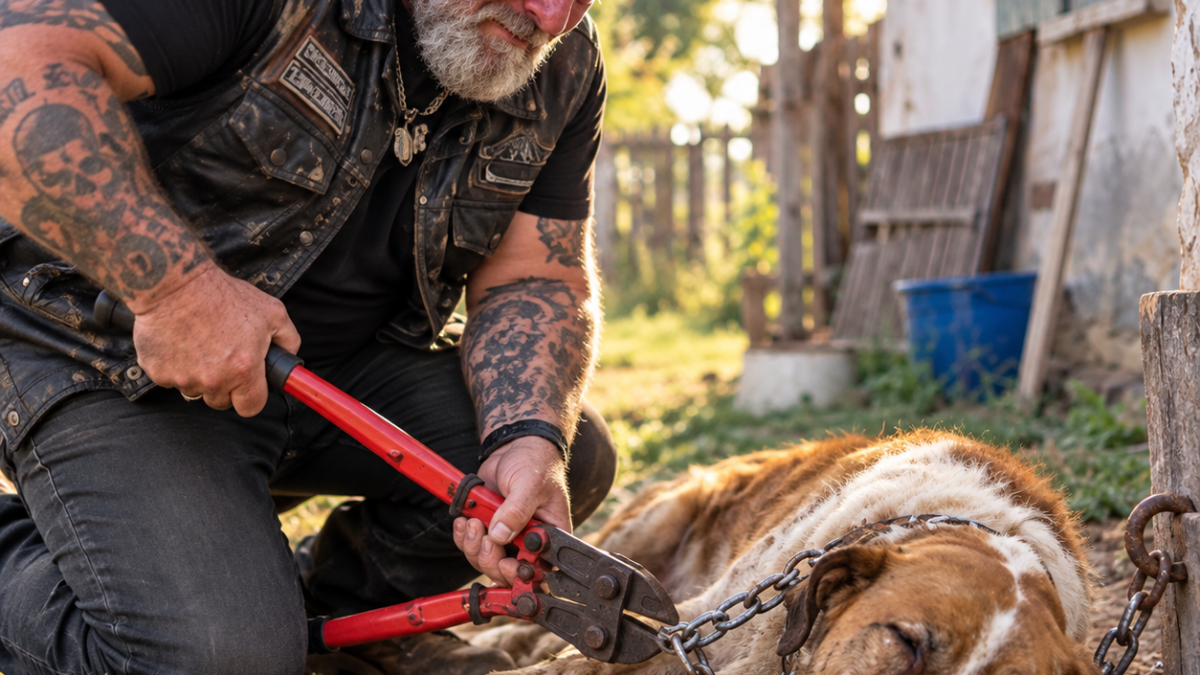
I thought the moment I cut that chain, the dog would run as far from that house as his legs could carry him. Instead, he took two trembling steps, folded into the dirt, and released a long breath that sounded less like exhaustion than surrender. And when the neighbors began coming out of their houses one by one, I realized the chain around his neck was only the beginning of what that street had been pretending not to see.
“Easy, big guy. One more second.”
The metal groaned between the jaws of my cutters.
Then the link snapped.
The dog stepped forward.
Once.
Twice.
I moved aside, expecting him to bolt toward the road, the fields, anywhere beyond the ruined little house behind him.
He didn’t.
His front legs began shaking so badly that I instinctively reached for him, but before my hands got there, he lowered himself slowly onto the hard ground.
His belly touched the dirt.
His chin settled between his paws.
His eyes closed.
Then he sighed.
Not a whine.
Not a cry.
A deep, exhausted breath from an animal who seemed to have finally been given permission to stop standing.
My name is Gerard Lemaire. I was fifty-six that year, gray-bearded, shaved head, old tattoos on both arms, and built like the kind of man strangers usually decide things about before I say a word.
Former military.
Motorcycle rider.
A little too good at fighting when I was younger.
These days, most of my weekends were quieter. That Saturday in September, I had been helping friends deliver donated blankets and clothes to a local shelter outside Lyon.
I was riding home on a small departmental road when I saw the dog.
Brown and white.
Medium-sized.
Drooping ears.
At first, I assumed he belonged to a farm.
Then I saw the chain.
It ran from his collar to a porch post beside an old house with weeds climbing the steps and rotting boards stacked against one wall.
The chain was so short he could barely move.
A plastic water bowl lay overturned about six feet away.
He couldn’t reach it.
A strip of shade from the roof fell across the dirt farther back.
He couldn’t reach that either.
But what made me stop were his paws.
They were swollen.
Spread awkwardly against the baked ground.
He watched my motorcycle pass without barking.
Without standing.
Without even lifting his tail.
I stopped twenty yards down the road.
A dog that barks still has energy to warn you.
A dog that wags still has hope you might come closer.
This dog did almost nothing.
He simply waited.
I parked beside the ditch and went through the gate.
“Hey, big guy.”
His tail moved once.
Only once.
He tried to approach.
The chain snapped tight immediately.
His collar pulled hard against his neck.
He stopped.
That was when I noticed how automatically he had stopped.
No surprise.
No struggle.
He knew exactly how far the chain allowed him to go.
I crouched just beyond that limit.
“You know every inch of this thing, don’t you?”
He stared at me.
His ribs showed beneath his coat.
Flies moved around a sore near his neck.
I looked toward the house.
“Hello?”
Nothing.
I knocked.
No answer.
The dog attempted another step toward me.
The chain tightened.
This time I heard a small sound escape him.
Pain.
I moved closer instead.
He smelled of dirt, infection, and old rain.
The collar had rubbed the fur away around part of his neck.
Under it, the skin looked raw.
I reached carefully.
He flinched, then froze.
“No one’s hurting you.”
His eyes stayed on mine.
I found an empty container near the porch and filled it from the water bottle I carried on my motorcycle.
The dog drank so desperately that I had to slow him down.
“Easy.”
He tried to keep drinking.
That frightened me.
Then a woman across the street opened her window.
“Sir?”
I turned.
“Is this your dog?”
Her face changed.
“No.”
“How long has he been chained here?”
She hesitated.
Too long.
I could see the answer before she spoke.
“A while.”
“How long?”
She looked at the dog.
Then at the house.
“Almost two years.”
I stood.
“Two years?”
She lowered her voice.
“The owner comes and goes.”
I looked back at the swollen paws, the empty bowl, the chain worn shiny where it scraped the post.
Then I asked the question that made the woman go completely silent.
“When was the last time anyone actually fed him?”
PART 2
The woman did not answer immediately.
That silence told me more than any sentence could have.
I crossed the road and stood beneath her window.
“I’m not asking when somebody threw him scraps. I’m asking when he had a proper meal.”
She swallowed.
“I don’t know.”
“You live directly across from him.”
“I know.”
“Then you must have seen something.”
Her eyes dropped.
“Sometimes the owner comes at night.”
“How often?”
“Not much anymore.”
The dog behind me scraped weakly at the dirt.
I turned instinctively.
He was still watching.
Still lying exactly where the chain had allowed him to lie.
The woman continued.
“I put bread over the fence a few times.”
“Bread?”
“And leftovers.”
“Water?”
“When I could.”
I looked at the overturned bowl.
“When you could?”
She became defensive.
“It isn’t my dog.”
I had heard that sentence before.
Not my dog.
Not my house.
Not my problem.
Those four words have probably killed more animals than outright cruelty ever has.
I took a breath because anger would not help the dog.
“What’s the owner’s name?”
“Thierry.”
“Full name?”
She told me.
“Phone number?”
She did not know.
I called the local gendarmerie and an animal welfare group I knew through the shelter where I had dropped off donations that morning.
The dispatcher asked whether the dog was in immediate danger.
I looked at him.
Swollen paws.
Severe weight loss.
No accessible water.
Open wound beneath the collar.
Unable to stand for long.
“Yes.”
They said someone would come.
I hated that phrase.
Someone would come.
How long?
Twenty minutes?
Two hours?
Tomorrow?
The dog had already been waiting years.
I went back through the gate.
“Hey.”
He lifted his head.
I brought the water closer.
This time I gave him small amounts, pausing between them.
He looked at the bowl when I pulled it away.
“I know.”
Another small amount.
His tongue moved slower than before.
Then he rested his chin again.
I sat in the dirt beside him.
At first, he kept his body rigid.
Then after several minutes, one shoulder leaned against my boot.
Barely.
I did not move.
A man from two houses down came outside.
Then another woman.
Then a teenager.
The street had apparently contained people all along.
That bothered me.
One of the men approached.
“He’s always been like that.”
I looked up.
“Always?”
“Well, chained.”
“How long?”
“Since he was young.”
“Two years?”
“Maybe longer.”
“Anybody call anyone?”
The man rubbed his neck.
“I thought somebody had.”
I almost laughed.
Not because it was funny.
Because there it was again.
Somebody.
The invisible person everyone assumes exists until a living thing dies waiting.
Another neighbor spoke.
“The owner said he was aggressive.”
I looked at the dog pressed weakly against my boot.
“Has he bitten anyone?”
“No.”
“Attacked anyone?”
“No.”
“Then what made him aggressive?”
“He barked.”
“He was chained outside a house.”
The man shrugged.
“I’m just telling you what Thierry said.”
The dog’s ears lifted when the name was spoken.
That hurt.
Even now, he knew his owner’s name.
Still connected.
Still waiting.
A car eventually turned onto the street.
Not the authorities.
A white van.
It stopped in front of the house.
The driver climbed out.
Mid-forties.
Work clothes.
Heavy boots.
He looked at me, the neighbors, then the dog.
“What is this?”
I stood.
“Are you Thierry?”
“Yes.”
“This your dog?”
He glanced at the chain.
“Obviously.”
“What’s his name?”
“Rex.”
Rex.
The dog’s ears moved again.
There was the confirmation.
“How old?”
“Three. Maybe four.”
“How long has he been chained here?”
Thierry frowned.
“What business is that of yours?”
“Right now, a lot.”
He stepped toward the gate.
Rex tried to stand.
The effort shocked me.
He had barely moved for me.
For Thierry, he pushed himself upright.
Tail moved.
Weakly.
Once.
Twice.
Thierry ignored him.
I watched Rex’s face.
That is something I never forgot.
The dog still loved him.
Or trusted the old pattern enough to respond.
Whatever word you use, it made what followed worse.
“Why does he have no water?”
Thierry looked at the bowl.
“He knocks it over.”
“Why is it out of reach?”
“He moves things around.”
“Why are his paws swollen?”
“I don’t know.”
“When did he see a veterinarian?”
“He doesn’t need one.”
I looked at Rex.
“You’re telling me that dog doesn’t need a vet?”
Thierry’s jaw tightened.
“He’s fine.”
The neighbors shifted.
Now that someone else was confronting him, courage had become contagious.
The woman across the street called out, “He can barely stand.”
Thierry looked at her.
“You stay out of this.”
She closed her window halfway.
I hated seeing that.
People retreat fast when accountability becomes personal.
Thierry turned back to me.
“Get off my property.”
“I will when the authorities arrive.”
His expression changed.
“You called them?”
“Yes.”
“For what?”
“Neglect.”
He laughed.
Actually laughed.
“He has food.”
“Where?”
Thierry pointed toward the porch.
There was an empty sack.
“That?”
“I fill his bowl.”
“What bowl?”
No answer.
Rex lowered himself again.
His legs had given out.
Thierry saw it.
Still nothing.
I walked toward the post.
The chain was fastened through a heavy steel ring.
The clip at Rex’s collar had rusted almost shut.
I looked at Thierry.
“I’m taking the pressure off his neck.”
“You touch that chain and I call the police.”
“Please do.”
He stepped closer.
I am not proud of everything I did when I was younger.
There was a time when that tone would have ended differently.
But I had learned something with age.
Being physically intimidating is useful only if you never have to prove it.
I stood between Thierry and Rex.
Did not raise my voice.
“Back up.”
He looked at me.
Then at the neighbors.
Then at the motorcycle.
Maybe he saw what people had seen my whole life.
Gray beard.
Tattooed arms.
Leather vest.
Old soldier posture.
He stopped.
Good.
A second vehicle finally arrived.
Animal welfare volunteers.
Behind them, minutes later, the gendarmes.
Once uniforms appeared, Thierry’s confidence shifted.
The officers photographed everything.
Chain length.
Water bowl.
Ground.
Rex’s body.
Neck wound.
Paws.
Shelter conditions.
There was a broken wooden doghouse behind the post, but the entrance was partly blocked by scrap wood.
Rex could barely get inside.
One officer asked Thierry when he had last fed him.
“This morning.”
The neighbor across the street opened her window again.
“No, you didn’t.”
Everyone turned.
Thierry’s face hardened.
She continued.
“You weren’t here this morning.”
“Shut up.”
The officer stepped between them.
“Sir.”
Another neighbor spoke.
“He wasn’t here yesterday either.”
Then another.
“I haven’t seen the van since Wednesday.”
The dam broke.
People who had watched in silence suddenly remembered everything.
No food for days.
Water bowl often empty.
Winter nights outside.
Summer heat.
Barking that gradually stopped.
Chain never changed.
A teenage boy said quietly, “I used to give him water after school.”
His mother grabbed his shoulder.
Thierry looked around at the street.
“This is ridiculous.”
One welfare volunteer knelt beside Rex.
She ran her hands carefully over him.
Her face tightened.
“We need a vet now.”
The gendarme looked at Thierry.
“Will you surrender the dog voluntarily pending investigation?”
“No.”
That surprised even me.
“You just said he’s fine,” I said. “Then let a veterinarian confirm it.”
“He’s mine.”
There it was.
Ownership.
Not affection.
Mine.
A word people use when responsibility disappears but control remains.
The officer explained the situation.
If Thierry refused, procedures could still be initiated based on immediate welfare concerns.
It might take longer.
Rex lay panting.
Time mattered.
Thierry looked around.
Everyone watching.
The welfare volunteer said, “If you sign surrender, he gets treatment immediately.”
“How much?”
“What?”
“Treatment.”
“You wouldn’t be paying us.”
His eyes changed.
That was the first moment I understood something ugly.
Money had mattered more than the dog.
He sighed.
“Fine.”
The paperwork came out.
He signed.
No goodbye.
No touch.
Rex watched him.
That was the worst part.
The chain still connected dog and post.
The welfare volunteer tried the clip.
It would not open.
Bolt cutters came from their vehicle.
Thierry suddenly spoke.
“Don’t cut it.”
Everyone looked at him.
“The chain?”
“It’s mine.”
The gendarme stared at him.
Then at Rex.
I almost lost control.
Years later, that absurd detail was what people remembered.
Dog collapsing.
Skin infected.
Owner worried about chain.
The officer said flatly, “You surrendered the dog and attached restraint. Step back.”
Thierry muttered something.
I did not hear it.
I was already beside Rex.
The volunteer handed me the cutters because I had the better angle.
I knelt.
“Easy, big guy.”
Metal between jaws.
Pressure.
The old link resisted.
I repositioned.
“Another second.”
Snap.
The chain fell.
The sound was small.
The silence afterward was enormous.
Rex stood.
Step.
Another.
Then collapsed into the dirt.
Not from injury caused by the cut.
From exhaustion.
He simply had nothing left.
The whole street went quiet.
Even Thierry.
I expected relief to look like freedom.
Instead, freedom looked like rest.
I crouched.
Rex’s eyes closed.
He sighed.
The volunteer touched my shoulder.
“We need to move him.”
A stretcher came out.
Rex did not resist.
That frightened me.
A dog his size should have protested.
Instead, he allowed us to slide the fabric beneath him.
When we lifted, his head rolled toward me.
I put one hand against his cheek.
“Stay with us.”
His tail moved against the stretcher.
One soft tap.
We loaded him into the van.
I climbed in without thinking.
The volunteer looked at me.
“You coming?”
“Yes.”
“My motorcycle—”
A neighbor called, “I’ll watch it!”
I nodded.
The doors closed.
Rex had left the yard.
For the first time in years.
During the drive, he watched the rear windows.
Just like so many animals leaving neglect, he did not understand we had saved him.
He thought we had taken him away from everything he knew.
I hated that.
The veterinary clinic was twenty-five minutes away.
We called ahead.
When the stretcher rolled in, staff moved immediately.
Temperature.
Heart.
Blood.
Fluids.
Paws.
Skin.
The collar came off only after they softened the crusted material beneath it.
The wound around his neck was worse than we had seen.
Chronic friction.
Infection.
Part of the fur embedded with dried discharge.
I stood near the wall.
A veterinarian named Dr. Morel examined him.
“How long chained?”
“Years.”
“Nutrition?”
“Unclear.”
“Water?”
“Inconsistent.”
He looked at me.
“Owner?”
“Former owner.”
Good.
Former.
Dr. Morel ran a hand over Rex’s side.
The dog flinched near the hips.
“Pain.”
“From what?”
“Could be joints. Could be muscle wasting. Could be both.”
Blood was drawn.
A scale used.
The number made everyone quiet.
Rex was dramatically underweight for his frame.
Not skeletal enough to be at immediate organ-collapse threshold, but severe.
Bloodwork showed dehydration, anemia, elevated infection markers, low protein, and evidence of prolonged nutritional deficiency.
His swollen paws had multiple causes.
Cracked pads.
Inflammation.
Long periods standing on hard packed soil.
Possible infection between toes.
One nail had grown abnormally and curled into tissue.
That alone must have hurt with every step.
Dr. Morel looked at me.
“He has been suffering for a long time.”
I felt sick.
“Can he recover?”
“Yes.”
The answer came quickly.
I almost did not believe it.
“Yes?”
“He’s sick, weak, neglected. But I don’t see anything yet that says recovery is impossible.”
I leaned against the wall.
“Then do it.”
Dr. Morel smiled faintly.
“That’s the plan.”
Food had to be gradual.
Again, something I had never thought about before.
Rex was hungry enough to swallow anything.
Giving him unlimited food immediately could make him very ill.
So the clinic calculated small meals.
Fluids first.
Electrolytes.
Pain control.
Antibiotics when indicated.
Paw treatment.
Neck wound cleaning.
Parasite management.
Then rest.
Actual rest.
A room.
Soft bedding.
No post.
No chain.
The first night, Rex refused the bed.
He lay beside it on the floor.
The nurse moved the blanket under him.
He shifted off.
She tried again.
He moved.
Eventually, she stopped.
“Let him choose.”
That became the philosophy.
He had spent years without choice.
We would not turn rescue into another form of forcing unless medically necessary.
I visited the next morning.
Rex was awake.
I entered.
His tail moved once.
“You remember me?”
Another movement.
I sat on the floor.
No reaching.
After several minutes, Rex shifted closer.
Barely.
His nose touched my boot.
Same place he had leaned against me in the yard.
I smiled.
“Yeah.”
He slept.
I stayed.
The next several days were not dramatic.
They were repetitive.
That is what recovery usually is.
Food.
Medicine.
Bandage.
Rest.
Paw soak.
Rest.
Tiny walk.
Rest.
Bloodwork.
Food.
Repeat.
But underneath the repetition, Rex changed.
Day two, he ate all of a small meal.
Day three, he stood without immediate collapse.
Day four, he wagged twice when a nurse entered.
Day five, he growled during a painful paw cleaning.
Everyone celebrated.
The nurse laughed.
“Good. Tell me when you’re mad.”
A dog with enough strength to object is stronger than one who lies silent.
We respected the warning.
Adjusted handling.
Rex learned that growling did not make people hurt him.
That matters.
A growl is communication.
Punish it and you teach a dog to skip the warning next time.
By day six, he walked fifteen feet down the clinic hall.
Slow.
Careful.
I walked beside him.
No leash pressure.
Harness only.
Rex reached the end.
Stopped.
Looked at me.
“Turn around.”
He did.
Halfway back, his legs shook.
We rested.
The nurse brought a mat.
Rex lay down.
I rubbed his shoulder.
“You did more than yesterday.”
He closed his eyes.
I began measuring everything against yesterday.
Bad habit.
One morning, he walked less.
Panic.
Dr. Morel reminded me:
“Recovery is not a straight line.”
I nodded.
The phrase irritated me because it was correct.
Rex developed a mild fever during the second week.
The neck infection had not fully resolved.
Medication adjusted.
Culture.
More cleaning.
Two days of reduced appetite.
I barely slept.
I had become attached faster than I wanted to admit.
My friends noticed.
One called.
“You keeping the dog?”
“He’s not mine.”
“Sure.”
“He belongs to the rescue.”
“Gerard.”
“What?”
“You have visited him eight days in a row.”
“That proves nothing.”
“You bought him a blanket.”
“He needed a blanket.”
“The clinic has blankets.”
I hung up.
He texted:
YOU’RE KEEPING THE DOG.
I did not answer.
Because I did not know.
Rex’s legal case continued.
The welfare group asked for statements.
Neighbors cooperated now.
Funny how brave people become after the dog is gone.
Still, evidence is evidence.
Photos.
Dates.
Videos.
One teenager had filmed Rex drinking from a bottle months earlier.
Another neighbor had messages where she complained to Thierry about the empty bowl.
His reply:
HE’S FINE.
That sentence became important.
It showed awareness.
Not ignorance.
Another message:
STOP FEEDING HIM. HE’S SUPPOSED TO GUARD, NOT GET FAT.
I stared at it.
Rex had been underweight even then.
Anger burned through me.
The investigation documented chronic neglect.
Failure to provide adequate food and water.
Failure to seek veterinary care.
Inappropriate long-term tethering conditions.
Exposure.
Untreated wounds.
Local law would determine exact charges and penalties.
I wanted everything.
Maximum fine.
Ban on ownership.
Public shame.
Then I went to the clinic and saw Rex sleeping.
He did not care about my anger.
His priorities were simpler.
Breakfast.
Pain relief.
Soft floor.
Someone coming back.
So I kept returning.
On day ten, Rex did something new.
He greeted me.
Not merely tail movement.
He stood.
Slowly.
Walked to the kennel door.
His tail moved three times.
I stopped.
“Hey.”
Rex lowered his head.
I opened the door.
He pressed his forehead against my thigh.
I froze.
The nurse saw.
“That’s new.”
“Is it?”
“He doesn’t do that with everyone.”
I pretended not to be affected.
Failed.
I sat.
Rex leaned.
All thirty-something kilos of underweight dog against me.
When healthy, he would weigh more.
A lot more.
I put both arms around his shoulders.
He sighed.
This time, the sigh sounded different.
Not collapse.
Comfort.
The name Rex bothered me.
Not because there is anything wrong with it.
Because Thierry said it.
Every time I used it, I saw the chain.
The rescue team asked whether we should keep it.
Changing names can be easy for dogs if paired with positive associations.
I thought about it.
“What would you call him?” someone asked.
I looked at the brown-and-white coat.
The patient face.
The dog who had survived two years on six feet of chain.
“Atlas.”
“Why?”
“He carried too much.”
The nurse smiled.
“Atlas.”
The dog looked.
Probably tone.
Still.
“See?”
So Rex became Atlas.
Not officially immediately.
We transitioned.
“Rex—Atlas.”
Then “Atlas.”
Within days, he responded.
Food helped.
Everything works faster with food.
The old name faded.
That felt right.
Not erasing history.
Reclaiming it.
By week three, Atlas could walk around the clinic courtyard.
That was the first time I saw him on grass without restraint limiting his radius.
The gate closed safely.
Harness loose.
Long line dragging only as backup.
Atlas stepped onto grass.
Stopped.
Sniffed.
Then walked exactly six feet from me.
Stopped.
I noticed.
The therapist noticed.
He looked back.
Then moved another foot.
Stopped.
Another.
He had learned the chain’s length so deeply that freedom required relearning distance.
That destroyed me.
I sat in the grass.
“Go.”
Atlas looked.
“Go.”
He sniffed another patch.
Ten feet.
Fifteen.
Twenty.
His tail lifted.
Then he suddenly turned and hurried back to me.
Not running.
But faster.
He pressed against my leg.
“Okay.”
I rubbed his chest.
“You can go far and come back.”
That became a lesson.
Freedom does not mean losing safety.
You can leave the circle.
People remain.
The next day, Atlas went farther.
By the end of the week, he explored the whole courtyard.
A tree.
Bench.
Flowerbed.
Drain.
Every ordinary object became interesting.
He had spent years seeing the same patch of dirt.
Smell alone must have felt like a new language.
His paws healed.
Swelling decreased.
The ingrown nail area closed.
Pads softened with treatment.
The neck wound developed clean new tissue.
Hair began growing around the collar line.
Weight increased gradually.
Muscle returned.
His hips remained mildly arthritic from chronic inactivity and poor condition, but manageable.
Dr. Morel said:
“He may always need joint support.”
“Fine.”
“Controlled exercise.”
“Fine.”
“Weight management once he reaches normal.”
“Fine.”
“You’re answering like you’re his owner.”
“I’m not.”
Dr. Morel raised an eyebrow.
I hated everyone in that clinic.
Atlas loved them.
A month after rescue, the legal hearing happened.
I attended.
Thierry did too.
He looked smaller indoors.
Less certain.
The prosecutor presented photographs.
Atlas at the post.
Empty water bowl.
Chain length.
Neck wound.
Paws.
Veterinary records.
Neighbor statements.
Thierry argued the dog had refused food.
Dr. Morel’s report contradicted that.
Atlas ate consistently once provided appropriate meals and medical care.
Thierry argued he could not afford veterinary treatment.
The court noted that inability to afford care does not justify leaving an animal untreated indefinitely without surrendering or seeking assistance.
He argued Atlas was aggressive.
No documented bites.
No attacks.
Clinic behavior records showed fear and pain but no pattern of dangerous aggression.
The judge asked:
“Why was the chain so short?”
Thierry answered:
“So he stayed near the entrance.”
“Why was the water outside the chain radius?”
“He knocked it over.”
“Why was no second container provided?”
Silence.
“Why was there no usable shelter from heat?”
“He had the porch.”
“He could not reach the shaded portion at the time officers documented conditions.”
Another silence.
For once, silence worked against him.
The final penalties were not cinematic.
Legal processes rarely are.
There were fines.
Costs.
Restrictions on future animal ownership.
A formal finding of neglect based on the evidence.
Was that enough?
Nothing could restore two years.
But one sentence mattered.
The judgment recognized Atlas had been subjected to prolonged inadequate care.
Officially.
Not opinion.
Not social media.
Record.
Thierry left angry.
I watched him.
He never asked how Atlas was.
Not once.
That answered everything.
Outside the courthouse, the woman who had thrown bread over the fence approached me.
“How is he?”
“Better.”
“Can I see a photo?”
I showed her one.
Atlas in the courtyard.
Healthy weight beginning.
Standing under a tree.
She covered her mouth.
“He looks different.”
“He feels different.”
She started crying.
“I should have called.”
“Yes.”
I said it gently.
Not cruelly.
But I did not absolve her.
Regret needs honesty.
“I thought someone else would.”
“I know.”
“I gave him food.”
“I know.”
“It wasn’t enough.”
“No.”
She nodded.
“I know.”
Then she asked something unexpected.
“Can I help?”
I gave her the rescue’s number.
She began volunteering months later.
That mattered.
Not forgiveness purchased through labor.
Responsibility turned into action.
She helped with food drives.
Transport.
Winter shelter checks.
The teenager who had given Atlas water joined too when old enough.
One neglected dog changed the street.
Not magically.
Through discomfort.
People saw themselves in the story.
Not as villains.
As witnesses who waited too long.
That can be harder to face.
Two months after rescue, Atlas left the clinic for a foster home.
Not mine.
I insisted.
My friend laughed when I told him.
“Scared?”
“Practical.”
“You’re scared.”
The foster family had a fenced yard, quiet house, no other dog initially, and experience with neglected animals.
Perfect.
I helped drive Atlas there.
He entered cautiously.
Floors confused him.
Tile.
Wood.
Rugs.
At the old house, he had known dirt.
He stepped onto a rug.
Stopped.
Sniffed.
Walked around it.
Later, he lay on it.
The foster had an orthopedic bed.
Atlas ignored it.
Of course.
Slept beside the back door.
Old guard instinct.
The first week, every vehicle sound made him stand.
Every knock moved him toward the entrance.
He had spent years believing his purpose was to monitor arrivals.
The foster never encouraged guarding.
Instead, when someone knocked, she called Atlas away and rewarded him for settling on a mat.
Slowly, door sounds stopped meaning work.
The first time a delivery driver came and Atlas stayed lying down, the foster sent me a video.
Caption:
OFF DUTY.
I watched it four times.
That phrase became our private joke.
Atlas, off duty.
No post.
No chain.
No entrance to protect.
At three months, his coat shone.
The ribs disappeared.
His eyes looked brighter.
He developed a ridiculous habit of carrying one slipper around the house.
Never chewing.
Just carrying.
Always the left slipper.
The foster sent photos.
I pretended not to care.
Visited every weekend.
Atlas greeted me harder each time.
Tail.
Body wiggle.
Forehead against chest.
One Saturday, I sat in the yard.
Atlas came over.
Dropped the slipper beside me.
I laughed.
“You brought me treasure?”
He lay down.
I rubbed his neck.
No collar wound now.
Only a thin line of missing fur.
My friend called later.
“You’re taking him.”
“I am not.”
“When adoption opens?”
“We’ll see.”
“You’re taking him.”
I hung up again.
Adoption applications began.
That made me furious.
I knew how irrational that was.
Rescue exists to find homes.
Atlas deserved one.
Still, strangers applying for him offended me on principle.
One application wanted an outdoor guard dog.
Immediate no.
Another wanted him on a rural property with “ample tethering space.”
I nearly drove to their house to deliver a lecture.
The coordinator stopped me.
A third family had small children and no experience with fearful dogs.
Not necessarily bad people, but not ideal.
Then a retired couple applied.
Excellent home.
Fenced yard.
Quiet.
No chain.
Good veterinary history.
I read the form.
Hated them.
Because they looked good.
I visited Atlas after work.
He greeted me.
I sat.
“People want you.”
Tail wag.
“Unbelievable.”
He leaned into me.
“You could go live with nice retired people.”
Atlas put his paw on my boot.
Manipulative.
I sighed.
The foster laughed from the porch.
“You know this is getting stupid.”
“What?”
“You.”
“I’m evaluating options.”
“You have spent three months pretending you’re not his person.”
“I travel sometimes.”
“You already canceled two motorcycle trips for him.”
“Coincidence.”
“You bought a dog ramp for your house.”
“That was on sale.”
She stared.
I looked at Atlas.
He looked at me.
“Fine.”
I filled out the adoption paperwork myself.
My friends celebrated like I had announced an engagement.
I threatened all of them.
Atlas moved in with me one week later.
The first night, he inspected every room.
Then chose the rug near the front door.
Of course.
I let him.
At two in the morning, I woke and found him sitting upright.
Listening.
I sat beside him.
“You don’t work here.”
Atlas looked at me.
“No guarding.”
He lowered his head.
“You’re retired.”
Eventually, he lay down.
It took months before he chose to sleep farther from the entrance.
First halfway down the hall.
Then near the sofa.
Then beside my bed.
The first night I woke and found him there, I smiled in the dark.
Off duty.
Atlas learned motorcycles.
At first, the engine frightened him.
So I never forced proximity.
I would start the bike outside while he remained indoors.
Treat.
Engine off.
Later, window open.
Then yard.
Eventually, he associated the sound with me leaving and returning.
The first time I came home and Atlas trotted toward the gate wagging, I almost cried.
A motorcycle had once brought me past his chain.
Now its sound meant his person came home.
That reversal mattered.
I also stopped riding as much.
People teased me.
The truth?
I preferred walking Atlas.
Age does strange things.
At twenty-five, I wanted open roads.
At fifty-six, apparently I wanted to watch a dog sniff the same bush for six minutes.
Atlas taught patience through inconvenience.
His walks were slow initially.
Then longer.
One kilometer.
Two.
Never forced.
His joints limited him.
But he loved fields.
The first time we took him to a wide meadow outside town, I used a long line.
Twenty meters.
Atlas stepped into the grass.
Stopped.
Looked at me.
Then went.
Farther.
Farther.
The line remained loose.
At twenty meters, he reached the end.
Felt tension.
Froze.
My stomach dropped.
I immediately moved closer so the line loosened.
“No.”
I unclipped it inside a fully fenced training field later that month.
No tether.
Atlas stood.
I expected running.
Again.
Just like the day I cut the chain.
He did not run.
He walked.
Slowly.
Sniffed.
Then lay in the middle of the grass.
That was Atlas.
Freedom never made him frantic.
It made him peaceful.
He had spent enough life being forced to stand.
What he wanted most was permission to rest wherever he chose.
That became the image I loved.
Atlas sleeping in open spaces.
Field.
Living room.
Porch.
No tension.
No metal.
No duty.
The street where I found him changed too.
Thierry moved away within a year.
Maybe because of reputation.
Maybe unrelated.
The house sold.
New family.
They removed the porch post during renovation.
A neighbor sent me a photo.
I stared at the bare spot.
No ring.
No chain.
Good.
The woman across the street later fostered an elderly dog.
She sent me updates.
The teenage boy became a veterinary assistant.
That surprised me.
He once told me:
“I kept thinking about his water bowl.”
He had been fourteen when Atlas was chained.
Old enough to understand something was wrong.
Too young to feel powerful enough to act.
After the rescue, he decided next time he would know what to do.
That is how change works sometimes.
Not through dramatic guilt.
Through one unresolved image that follows you.
Atlas became known at the shelter where I volunteered.
Not as a rescue celebrity.
Just Gerard’s dog.
He came on donation days.
Lay under a table.
Accepted attention selectively.
Children loved his droopy ears.
Adults asked about the thin line around his neck.
I told the truth briefly.
“He used to be chained.”
“Poor thing.”
“He’s not poor now.”
That became my answer.
I did not want pity to become his permanent identity.
Atlas had survived neglect.
Then he became a dog.
That was the goal.
He learned toys late.
Balls confused him.
Fetch insulted him.
Throwing away an object and expecting him to retrieve it seemed stupid in his view.
Rope toys interested him mildly.
Stuffed animals?
Ignored.
Cardboard box?
Shredded.
Apparently destruction was a hobby.
My living room began looking like a recycling plant after storms.
One evening, I came home to cardboard everywhere.
Atlas sat in the middle.
I looked at him.
He wagged.
“Did you do this?”
Wag.
“Terrible guard dog.”
Wag.
“Outstanding criminal.”
He sneezed.
Normal.
Beautifully normal.
His first winter with me was difficult emotionally.
For me.
Not Atlas.
Cold arrived.
I bought an absurdly expensive orthopedic bed.
He used it.
Good.
Then I bought another for the bedroom.
He used that too.
My friends mocked me.
Former soldier.
Motorcycle jacket.
Two luxury dog beds.
Life had become strange.
One snowy morning, Atlas stepped outside.
Snow touched his paws.
He stopped.
For a second, I imagined those years at the post.
Cold ground.
No shelter.
Chain.
Atlas turned.
Walked back inside.
That was it.
He chose warmth.
I laughed.
“Smart man.”
He slept until noon.
Choice is the opposite of neglect.
Not luxury.
Choice.
Inside or out.
Walk or rest.
Near me or alone.
Atlas spent years with none.
I built his new life around it where possible.
Even his collar was different.
Soft.
Loose.
Mostly identification.
Walks used a harness.
Anything tightening around his neck made his body tense.
No need to challenge that.
Some scars deserve accommodation.
He also hated metal clinking near him.
Chain sounds.
Keys sometimes.
I began carrying keys differently.
Not because he would collapse.
Because why make his day harder?
Small kindnesses are often invisible.
They still matter.
A year after adoption, Atlas returned to Dr. Morel for a major check.
Bloodwork excellent.
Weight healthy.
Joints managed.
Paws healed.
Neck scar stable.
The doctor stepped back.
“He looks like a different dog.”
I shook my head.
“Same dog.”
Dr. Morel smiled.
“You’re right.”
That distinction mattered.
We say rescue transforms animals.
Sometimes it does.
But often the animal was always there.
Pain simply covered them.
Atlas had always contained this version.
The dog who carried slippers.
Ignored balls.
Liked fields.
Hated snow.
Leaned against me during coffee.
Neglect had hidden him.
Care uncovered him.
The legal penalties against Thierry eventually ended.
Ownership restriction remained for the period ordered.
Financial fines were paid.
People asked if I was satisfied.
No.
Yes.
Both.
No consequence could equal suffering.
But I stopped wanting equivalence.
Pain should not be balanced by more pain like an accounting sheet.
What I wanted was prevention.
No new dog chained there.
That happened.
No Atlas returned to Thierry.
That happened.
Neighbors learned to call sooner.
That happened.
Atlas lived.
That mattered most.
One afternoon, more than a year after rescue, I saw Thierry.
Pure accident.
A gas station outside Lyon.
I was filling the motorcycle.
Atlas was not with me.
Thierry recognized me.
I recognized him.
He walked over.
“You’re the biker.”
“Gerard.”
“Whatever.”
I kept fueling.
“How’s the dog?”
That was the first time he had ever asked.
“Good.”
“He still aggressive?”
I looked at him.
“He was never aggressive.”
Thierry shrugged.
“He used to bark at people.”
“He was chained to a post.”
Silence.
Then:
“You kept him?”
“Yes.”
Thierry laughed once.
“Why?”
One word.
Why.
I stared at him.
“Because he’s a good dog.”
“He’s useless for guarding now.”
There it was again.
I almost smiled.
“You know what’s funny?”
“What?”
“He doesn’t guard anything.”
Thierry shrugged.
“Exactly.”
“And he gets fed anyway.”
Thierry’s expression changed.
“He sleeps inside.”
No response.
“He has two beds.”
His face tightened.
“He goes to the vet.”
I continued.
“When he’s tired, he rests. When he doesn’t want outside, he stays in. When somebody comes to the door, half the time he doesn’t even get up.”
Thierry looked away.
I finished:
“And somehow the world keeps turning.”
He muttered something about wasting money.
I put the fuel cap back.
Then he asked:
“Does he remember me?”
That question surprised me.
Not does he hurt?
Not is he healthy?
Remember me?
I said:
“Probably.”
His face shifted.
I added:
“But he doesn’t wait for you.”
Then I put on my helmet and left.
That was the only revenge conversation I ever needed.
No threat.
No punch.
Young Gerard might have chosen differently.
Older Gerard knew better.
The man who had kept Atlas chained wanted to know whether he still occupied space in the dog’s mind.
Maybe he did.
But memory had lost authority.
Atlas had moved on.
That was enough.
Years passed.
Atlas aged.
His history made exact age uncertain.
Maybe six when I found him.
Maybe five.
By our fourth year together, gray appeared around his muzzle.
His joints worsened.
Walks shortened.
We adjusted.
The dog once denied shade now had a cooling mat in summer.
The dog once denied water had bowls in three rooms.
The dog once slept on dirt had more beds than I owned mattresses.
Ridiculous.
Perfect.
Atlas became famous among my motorcycle friends.
Not online.
Within our group.
Hard men in leather jackets stopping by my house and immediately dropping voices an octave higher:
“Hey, buddy.”
Atlas loved one named Luc.
Luc was nearly six-foot-four and covered in tattoos.
Atlas climbed onto his boots every visit.
One day I caught Luc feeding him cheese.
“Veterinarian said limit that.”
Luc looked offended.
“It was tiny.”
“Everything is tiny according to you.”
Atlas stared at me.
Traitors.
My biker friends started organizing an annual donation ride for local animal shelters.
Atlas became the unofficial mascot.
He did not ride motorcycles.
Absolutely not.
He stayed at the shelter with volunteers and accepted visitors.
The first year raised enough for medical care for several animals.
Second year more.
Someone printed shirts with a stylized broken chain.
I was not sure I liked turning his story into a symbol.
Then proceeds paid emergency veterinary bills.
Fine.
Atlas did not care.
He wanted snacks.
At one event, a man asked me:
“Would you ever chain a dog?”
I answered:
“A temporary tether under supervision can be a tool. A life on a short chain is something else.”
Nuance mattered.
Not every leash is abuse.
Not every outdoor dog neglected.
The issue was duration.
Care.
Movement.
Social contact.
Shelter.
Water.
Health.
Choice.
Atlas lacked all of it.
I wanted his story to teach accurately, not become slogan-only anger.
Our group began helping owners build fenced runs.
Sometimes people kept dogs tethered because they could not afford fencing.
If they loved the animals and accepted help, we built.
No shame.
Better conditions.
One elderly farmer cried when volunteers completed a safe enclosure for his dog.
“I never wanted him on the chain.”
That stayed with me.
Not every chain has the same story.
Atlas taught us to ask before assuming.
But when neglect was clear?
Act.
That distinction made our work better.
By year five, Atlas could no longer walk long distances.
Arthritis.
Age.
Old muscular damage.
Hydrotherapy recommended.
Atlas hated water.
Apparently all my rescue animals eventually did.
We tried.
He stood in the pool glaring at me.
I laughed.
“Enemy of medicine.”
The therapist moved him gently.
Atlas tolerated three minutes.
Next session, five.
Never loved it.
We found alternatives.
Short walks.
Massage.
Joint medication.
Weight control.
His comfort remained good.
One evening after therapy, Atlas lay beside my motorcycle in the garage.
I sat on a stool.
He rested his head on my boot.
I remembered our first contact.
Same place.
Different body.
Then: starving, dirty, chain tight.
Now: healthy, gray, free.
I scratched behind his ear.
“You know you ruined my reputation.”
He sighed.
“My friends think I’m soft.”
Tail thump.
“Your fault.”
Another.
I smiled.
Good.
Let them.
A year later, I retired from my job.
Atlas and I became two old men with too much time.
Morning coffee.
Slow walk.
Nap.
I did not nap.
Atlas did.
Usually.
Some days I did too.
We visited fields.
Sat near rivers.
He never became a swimmer.
We went to cafés with outdoor terraces where dogs were welcome.
Atlas lay under my chair.
Children asked to pet.
I always let him choose.
If he moved forward, yes.
If away, no.
His body belonged to him now.
That rule was absolute.
Once, a man grabbed Atlas’s collar without asking.
Atlas froze.
I removed the hand immediately.
“Don’t.”
The man said, “He’s friendly.”
“That doesn’t make his neck public property.”
He thought I was overreacting.
Maybe.
I did not care.
Atlas had spent years with control attached to his neck.
He would not spend retirement being handled casually there.
People sometimes call accommodation “letting trauma win.”
I disagree.
If a dog can live a full life without someone grabbing his collar, why force it?
Healing is not performing normality for humans.
It is comfort.
Atlas had that.
At around ten or eleven years old, he developed a heart murmur.
Mild.
Monitoring.
Then kidney values changed slightly.
Age.
Nothing immediate.
I became unbearable.
Every cough.
Every slow morning.
Phone call to vet.
Dr. Morel eventually said:
“Gerard, Atlas is aging.”
“I know.”
“You behave as if age is a medical error.”
I frowned.
“He survived too much to get old.”
Dr. Morel smiled sadly.
“He survived so he could get old.”
That sentence stopped me.
Yes.
Old age was not failure.
It was the reward.
The chained dog got to become a gray old man who complained about stairs.
Exactly what we wanted.
I built a ramp.
Of course.
Atlas refused it for a week.
Then used it when he thought I was not watching.
Stubborn.
He stopped jumping into the car.
I lifted his back end gently.
The first time, he looked embarrassed.
“Relax. I’m old too.”
He licked my hand.
Maybe agreement.
One winter, Atlas slept through a delivery person knocking.
I laughed.
Complete retirement.
The dog once purchased to guard a property could not be bothered to open one eye.
I sent the video to my friends.
Caption:
BEST SECURITY SYSTEM IN FRANCE.
They responded with applause.
That became my favorite kind of revenge.
Uselessness celebrated.
Atlas had value independent of service.
That is something too many animals never receive.
We love them for what they do.
Guard.
Hunt.
Breed.
Compete.
Entertain.
Then bodies fail.
What remains?
The animal.
That should have been enough from the beginning.
Atlas taught me that more clearly than anyone.
At eleven or twelve, he began having occasional accidents indoors.
Nothing major.
Once near the door.
He looked ashamed.
That broke my heart.
I cleaned it.
“No.”
He lowered his head.
“No shame.”
I took his face gently in my hands.
“You hear me?”
Tail barely moved.
“This house is yours even if you ruin every rug.”
He never ruined every rug.
But he did ruin one.
Fine.
I bought another.
Old bodies require forgiveness.
Just like young ones.
His appetite remained strong until his final year.
That made the first skipped meal terrifying.
Atlas ignored breakfast.
I tried chicken.
He ate a little.
We went to the vet.
Kidney disease had progressed.
Heart stable enough.
Arthritis worse.
Medication adjusted.
Fluids.
Special diet.
Atlas improved.
Several good months.
Then winter.
More slow days.
He still enjoyed short walks.
Sniffed grass.
Liked lying near my chair.
Good quality.
We tracked.
Good days.
Mixed.
Bad.
I had learned enough from rescue not to use one terrible morning as the whole picture.
But I also promised I would not keep Atlas alive only because I could not stand another broken chain.
The chain was gone.
My responsibility now was different.
One afternoon, Atlas struggled to rise.
I helped with the harness sling.
He stood.
Walked three steps.
Stopped.
Looked at me.
I saw fatigue.
Not pain exactly.
Tiredness.
We rested.
The next morning, better.
A week later, worse again.
Dr. Morel came to the house.
He examined Atlas on his bed.
Heart.
Joints.
Abdomen.
Blood.
We talked outside.
“Where are we?”
“Close.”
I knew what he meant.
“Days?”
“Maybe weeks.”
“Can we make him comfortable?”
“Yes.”
“For now?”
“Yes.”
I nodded.
“Then for now.”
Atlas had another month.
A good month mostly.
Short walks.
Chicken within dietary limits.
Friends visiting.
No big event.
I did not want a bucket-list circus.
Dogs do not need our need to make endings cinematic.
Atlas liked routine.
So we kept routine.
Coffee.
Walk.
Nap.
Door ignored.
Dinner.
Bed.
One morning, he refused to stand.
Not could not physically.
Refused.
I sat beside him.
“Outside?”
No response.
“Chicken?”
His ears moved.
Good.
He ate a little from my hand.
Then rested.
Dr. Morel came.
This time, examination made the answer clearer.
Kidneys worse.
Pain harder to control.
Weakness.
Could hospitalize.
IV fluids.
More tests.
Possible temporary improvement.
I looked at Atlas.
He hated clinics by then.
Not fear exactly.
Fatigue.
He wanted home.
“What would you do?”
I asked.
Dr. Morel answered carefully.
“If he were mine, I would think about whether one more hospitalization serves him or me.”
I had heard that kind of sentence before while volunteering.
It was different when it was your dog.
My throat closed.
“I promised him he could rest.”
Dr. Morel nodded.
I looked at Atlas.
The first day flashed back.
Chain cut.
Two steps.
Collapse.
That sigh.
Permission to rest.
I had not realized that promise would return at the end.
We scheduled a home goodbye for the next afternoon.
I called my closest friends.
Not everyone.
Atlas did not need a crowd.
Luc came.
The foster woman who had cared for him came briefly.
The teenager, now a young veterinary assistant, stopped by.
He knelt.
“Hey, man.”
Atlas wagged faintly.
The young man cried.
“I used to give you water.”
I looked at him.
He continued.
“I should’ve done more.”
I put a hand on his shoulder.
“You do more now.”
He worked at an emergency clinic.
He had become exactly the “somebody” he once assumed existed.
That mattered.
The woman across the street came too.
Older.
She brought no bread.
She sat beside Atlas.
“I’m sorry.”
Atlas sniffed her hand.
Then slept.
Maybe forgiveness.
Maybe indifference.
Either was acceptable.
By evening, only me and Atlas remained.
I slept on the floor beside him.
At some point, his paw rested over my wrist.
I woke but did not move.
Morning light entered.
Atlas opened his eyes.
Tail tapped once.
“Morning.”
I made coffee.
He ate a little chicken.
We went outside with the support sling.
Not far.
Front yard.
Grass.
Atlas sniffed.
Then lay down in the sun.
No chain.
No fence radius except the safe boundary of my property.
I sat beside him.
A motorcycle passed in the distance.
His ears moved.
I smiled.
“Remember?”
Impossible to know.
But I did.
That road.
That Saturday.
That dog at the post.
Another thirty seconds and I might have kept riding.
I put my hand on his shoulder.
“You changed my life, you know.”
Atlas closed his eyes.
“Terrible inconvenience.”
Tail thump.
We stayed outside until he wanted in.
I did not decide.
He did.
Choice to the end.
Dr. Morel arrived at two.
Atlas lay on his favorite bed in the living room.
Not by the door.
That mattered.
He had stopped sleeping there years before.
I sat on the floor.
Atlas put his head on my thigh.
Dr. Morel explained each step.
I knew already.
Still listened.
Luc stood near the window.
Crying openly.
Biggest man in the room.
Good.
No shame.
I touched the thin scar around Atlas’s neck.
Fur mostly covered it.
You had to know where to feel.
“Remember this?”
Atlas breathed slowly.
“I do.”
I looked at the harness hanging by the door.
No chain anywhere in my house.
Never had been.
Dr. Morel gave the sedative.
Atlas relaxed.
His body grew heavy against me.
I whispered:
“Off duty.”
Luc turned away.
I kept talking.
“You don’t have to guard anything.”
Breath.
“You don’t have to stand.”
Another.
“You don’t have to wait for food.”
I felt tears.
“You don’t have to be useful.”
Atlas’s tail moved once.
“You can rest.”
The same thing the chain had denied him for years.
Rest without danger.
Rest without heat.
Rest without hunger.
Rest without a collar pulling at his throat.
The final medication went in.
Atlas breathed slowly.
I held his face.
“Good boy.”
Breath.
“Good man.”
Another.
Then nothing.
His head remained on my thigh.
Heavy.
Warm.
I sat there.
No dramatic sound.
No long final sigh like the first day.
He had already learned rest years earlier.
This was simply deeper.
Afterward, Dr. Morel removed the catheter and left us time.
Luc sat beside me.
Neither spoke.
Eventually he said:
“You okay?”
“No.”
“Yeah.”
We stayed.
Atlas had spent years at the end of a chain with nobody sitting beside him.
He would not spend the final minutes after death alone either.
We had him cremated.
I kept the ashes for a while.
Then one spring, I took part of them to the field Atlas loved most.
Not the old house.
Never the old house.
That place did not deserve him.
The field was wide.
Open.
Grass moving.
I scattered some beneath the tree where he liked to sleep.
No chain.
No marker.
Nothing to tie him there.
Then I walked away.
That felt right.
The rescue kept one photograph.
Atlas in the clinic courtyard during week three.
Standing farther than six feet from any person.
Looking back.
Under it:
ATLAS — OFF DUTY.
People asked about him.
We told the story.
Not as revenge fantasy.
Not as “evil owner defeated by hero biker.”
Life was more complicated.
Neighbors failed too.
Systems failed through delay.
I had almost ridden past.
The lesson was not that one bad man existed.
The lesson was how many people can see suffering and assume someone else will act.
Thierry faced consequences.
Good.
But Atlas’s real victory had nothing to do with Thierry’s misery.
It was this:
He learned food was guaranteed.
He slept indoors.
He crossed fields.
He ignored doors.
He carried slippers.
He hated snow.
He grew old.
He became expensive.
He became inconvenient.
And every time his needs increased, nobody threw him away.
That was revenge against the logic that had chained him.
The logic said:
You exist to guard.
His second life said:
You exist because you exist.
The logic said:
Food depends on usefulness.
His second life said:
Breakfast is at seven regardless.
The logic said:
Your movement stops where the chain stops.
His second life said:
Walk until you’re tired.
The logic said:
When you become weak, you become worthless.
His second life said:
When you become weak, we help you stand.
That is the answer I would choose every time.
A few months after Atlas died, I drove the old road again.
I had avoided it.
Then one Saturday, without planning, I turned that way.
The old house was different.
New paint.
Cleared yard.
Porch repaired.
The post was gone.
A family lived there.
Two children played near the gate.
A dog was in the yard.
Loose.
Healthy.
Water bowl under shade.
I stopped across the street.
The woman who had once lived opposite recognized me.
She came outside.
“Gerard?”
“Hi.”
She looked at my motorcycle.
Then behind me.
“Atlas?”
I shook my head.
Her expression fell.
“When?”
“Few months ago.”
“Oh.”
She covered her mouth.
“I’m sorry.”
“He got old.”
That sentence felt good.
Not starved.
Not chained.
Old.
“He had good years?”
“The best.”
She smiled through tears.
“I’m glad.”
I looked at the new dog.
“He okay?”
“Very.”
The family noticed us.
The father waved.
The dog trotted over to the fence.
Tail wagging.
I almost laughed.
Same property.
Different life.
The woman said:
“People here still talk about Atlas.”
“Good or bad?”
“Both.”
She paused.
“Mostly because nobody wants to be the person who saw and did nothing again.”
That stayed with me.
The street had learned.
Maybe not perfectly.
But enough.
I started the motorcycle.
Before leaving, I looked at the spot where the post had been.
Grass covered it.
No worn circle.
No bare dirt.
Nothing marking the radius of Atlas’s old world.
Good.
Some things deserve to disappear.
I rode home.
My house felt empty.
No Atlas at the door.
That remained difficult.
For months, I still opened the door carefully expecting his head behind it.
Still looked at the bed.
Still found myself filling two water bowls before remembering.
Grief is habit with nowhere to go.
I kept volunteering.
More than before.
One day, the rescue brought in another chained dog.
Younger.
Healthy enough.
Different case.
A volunteer asked whether I wanted to help cut the tether.
I hesitated.
Then said yes.
The dog exploded forward when freed.
Ran circles inside the safe enclosure.
Everyone laughed.
I did too.
Not every dog lies down.
Not every rescue repeats itself.
Good.
The volunteer looked at me.
“Thinking about Atlas?”
“Yes.”
“What would he do?”
“Sleep.”
She laughed.
Exactly.
Atlas’s story became part of how I trained new volunteers.
I told them:
Do not mistake silence for okay.
A barking dog gets attention.
A quiet one can be worse.
Check water.
Check reach.
Check shelter.
Check body condition.
Do not assume ownership equals care.
Do not trespass recklessly if there is time to involve authorities.
Document.
Call.
Stay.
And most importantly:
Do not let “someone probably already reported it” become your excuse.
Make the call yourself.
Duplicates are better than silence.
That was Atlas’s biggest lesson.
Years later, people still asked me about the moment I cut the chain.
“Wasn’t it amazing?”
Yes.
But not how they imagine.
They expect a dog running into freedom.
Atlas did not.
He collapsed.
At first, I thought that made the moment sadder.
Now I think it made it truer.
Freedom is not always excitement.
For someone exhausted by survival, freedom may look like sleep.
Safety may look like dropping your guard.
Love may look like no longer needing to prove you are useful.
Atlas did not need fields first.
He needed rest.
Then food.
Then medicine.
Then trust.
Then fields.
We often want rescue stories to leap directly from suffering to joy because that is easier to watch.
Real healing moves slower.
Sometimes two steps.
Then collapse.
Then tomorrow, three.
That is still progress.
I still ride motorcycles.
Still have the tattoos.
Still look like the sort of man certain people clutch bags around in bakeries.
I do not mind.
One afternoon, a woman at a shelter asked:
“Why animals?”
I answered:
“They don’t care what I look like.”
She laughed.
But it was true.
Atlas never knew my history.
Former soldier.
Fights.
Mistakes.
He knew voice.
Smell.
Hands.
Routine.
Whether I came back.
Animals reduce us to behavior.
That is clarifying.
Are you safe?
Do you feed me?
Do you listen?
Do you return?
Everything else is decoration.
Atlas made me want better answers.
After his death, I started helping with outreach specifically for tethered dogs.
Not to steal animals from owners.
To improve lives where possible.
Some owners accepted longer tethers temporarily while fences were built.
Some accepted insulated shelters.
Some allowed vet visits.
Some surrendered voluntarily.
Others required enforcement.
Every case different.
But I always looked at paws.
Atlas’s paws had stopped me.
Swollen.
Spread.
Silent evidence.
I never forgot.
Once, we visited a property where a dog had clean water, shade, proper shelter, regular exercise, and was tethered only for short periods because the fence was damaged.
A volunteer whispered:
“Is this abuse?”
“No.”
“How do you know?”
“Context.”
That mattered.
Atlas’s story could have made me see every chain as identical.
Instead, it taught me to look closer.
How long?
How short?
What conditions?
What alternatives?
What body condition?
What care?
What choice?
Good advocacy needs accuracy.
Otherwise anger becomes noise.
Atlas had enough noise around him after rescue.
He deserved truth.
The annual motorcycle donation ride eventually became known unofficially as the Atlas Run.
I resisted the name.
Lost.
The first year under that name, we raised funds for emergency veterinary treatment and fencing support.
Someone asked if we should use a broken chain as the logo.
I said no.
We used a sleeping dog.
That confused people.
I explained:
“The chain is not the point.”
The point is rest.
Safety.
A life not organized around survival.
The logo showed a dog asleep under a tree.
Open field.
No collar visible.
That was Atlas.
Not prisoner.
Retired.
The funds helped dozens of animals over the years.
Again, not magic.
One dog’s story motivating people.
People donating.
Volunteers working.
Systems improving.
That is how legacy actually functions.
No halo.
No destiny.
Behavior spreading.
One summer, the teenage boy from Atlas’s street—now a full veterinary nurse—joined the ride.
He came to me afterward.
“I still feel guilty.”
“For what?”
“I watched too long.”
“You were fourteen.”
“I knew.”
“Yes.”
He looked down.
“I just didn’t know what to do.”
“Now you do.”
He nodded.
“Does that fix it?”
“No.”
He looked at me.
I added:
“It changes what happens next.”
That is all we get.
No one can fix yesterday.
You can only make tomorrow less likely to repeat it.
Atlas could not get the chained years back.
But other dogs might never lose theirs.
That is meaningful.
Sometimes enough.
I keep one of Atlas’s old tags on my key ring.
Not his collar.
The collar felt too much like restraint.
The tag just says:
ATLAS
and my phone number.
The edges are worn.
I touch it sometimes.
Metal sound used to frighten him.
Funny.
Now a small piece of metal reminds me of him.
Meaning changes.
Like names.
Like doors.
Like fields.
Like rest.
If I could go back to that first Saturday, I would still stop.
Obviously.
But I would do one thing differently.
I would not expect him to run.
I would cut the chain.
Step back.
And when Atlas lay down, I would understand immediately.
I would know he was not giving up.
He was experiencing something he had been denied for years.
A moment where nothing pulled.
Nothing demanded.
Nothing required him to stay awake.
The chain hit the ground.
The world became bigger.
And Atlas’s first use of freedom was to rest.
There is something beautiful about that.
People who have never been trapped sometimes imagine freedom only as movement.
Go.
Escape.
Run.
But freedom is also the right not to move.
The right to stop.
The right to say enough.
The right to sleep without guarding the entrance.
Atlas spent the rest of his life teaching me that.
He never became a dramatic dog.
No athletic transformation.
No heroic rescue work.
No viral tricks.
He liked slow walks.
Food.
Slippers.
Grass.
Me.
That was enough.
More than enough.
The last time I saw him alive, his body was old and failing, but his neck was soft beneath my hand.
No pressure.
No chain.
I told him:
“You can rest.”
Years earlier, cutting metal had given him that right for the first time.
At the end, love gave it to him one final time.
And that is how I choose to remember Atlas.
Not as the dog chained outside a broken house.
Not as the dog whose neighbors waited too long.
Not even as the dog I rescued.
I remember an old brown-and-white dog asleep in the middle of my living room while someone knocked at the front door.
He heard it.
Opened one eye.
Decided it was none of his business.
And went back to sleep.
After years of guarding a place that never protected him, Atlas had finally learned that someone else could answer the door.








