PART 2: I Cut a Tire From a Dog on an Empty Road—Then He Turned Around and Did Something I’ll Never Forget
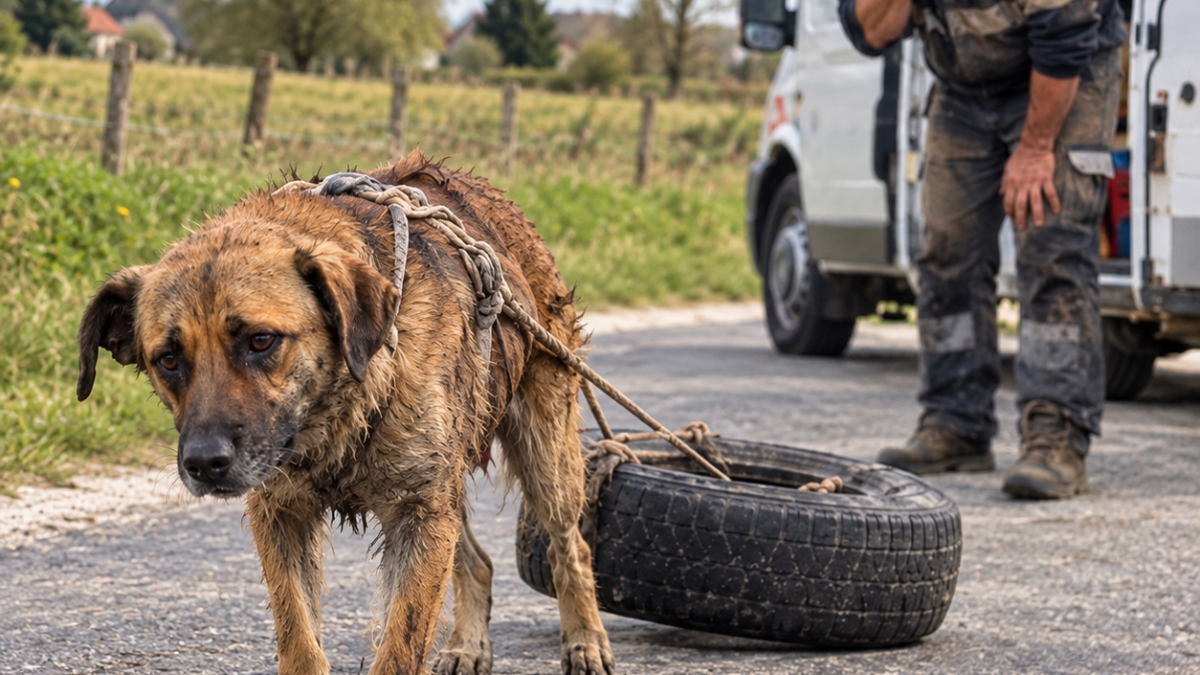
The dog had a tire tied to his body and was dragging it down the middle of an empty country road, one exhausted step at a time.
When I cut the final knot loose, I expected him to run as far from humans as his legs could carry him—but instead, he stopped, looked back at the tire, and then looked straight at me.
What he did next kept me standing motionless in the road, because it told me this dog had not forgotten what a human hand was supposed to feel like.
My name is Julien Moreau.
I was forty-six then, with more than twenty years of roadside recovery work around Limoges, France.
I had seen just about everything people manage to lose on a road.
Bumpers.
Mattresses.
Toolboxes.
Furniture.
Once, an entire couch sitting almost perfectly across the center line.
So when I saw a black tire a few hundred yards ahead on that quiet departmental road, I assumed it had fallen from a trailer.
Then the tire moved.
Not rolled.
Moved.
A short jerk toward the shoulder.
Then came the sound of rubber scraping asphalt.
I slowed my tow truck.
That was when I saw the dog.
He was a shepherd mix, tan with dark ears and a white patch on his chest. His amber eyes looked far older than the rest of him.
A thick rope was wrapped around his body.
The other end had been threaded through the tire.
Every time he moved, the tire followed.
Or fought him.
He tried another step.
The tire caught in a crack.
The rope snapped tight.
His front legs buckled.
His head lowered.
Not like a dog resting.
Like a dog who had run out of ideas.
I stopped my truck at an angle, turned on the hazard lights, and got out.
A gray car approached behind me.
The woman driving slowed.
She saw the dog.
Her hand went to her mouth.
For a second, I thought she would stop.
Then she carefully drove around us and disappeared.
I don’t tell that part to judge her.
I tell it because suffering survives that way every day.
Someone sees.
Someone feels terrible.
Then someone assumes the next person will stop.
I walked slowly toward the dog.
He froze.
His entire body began trembling.
The rope had rubbed the fur from parts of his ribs. The skin underneath was angry and red, but I could not see major bleeding.
He mostly looked exhausted.
Completely exhausted.
“Easy, buddy.”
One dark ear moved.
The tire shifted behind him.
He flinched violently.
That reaction told me almost as much as the rope did.
This was no accident.
Dogs do not tie two tight knots around themselves.
Ropes do not thread themselves through tires.
Somebody had done this.
Maybe to stop him from wandering.
Maybe as punishment.
Maybe because somebody thought it was funny.
I didn’t know.
But I knew the dog expected my hands to hurt him.
I crouched.
He flattened himself against the asphalt.
No growl.
No bark.
Just surrender.
That was worse.
I pulled my work knife from my belt.
His breathing became faster.
“I’m not hurting you.”
I slipped two fingers beneath the rope so the blade could never touch his skin.
The rope was tighter than I expected.
I cut the first strand.
Then the second.
The dog shook against my hand.
A crow called from the fence in the field beside us.
Otherwise, the road was silent.
For those few seconds, it felt like there was nothing in the world except that dog, that tire, and a knot somebody had probably intended to make his problem forever.
I cut the last section.
The rope dropped.
The tire settled onto the road.
The dog didn’t move.
One second.
Two.
Then he took a step.
Nothing followed him.
He took another.
Then a third.
He stopped.
Turned.
Stared at the tire.
I thought he was making sure it really was gone.
Then he looked at me.
His body was still shaking.
I expected him to run.
Instead, he walked back.
Slowly.
He lowered his head.
And pressed his forehead against my knee.
I forgot how to breathe.
This dog had every reason to fear human hands.
But after what someone had done to him, he had decided to trust one more.
I put my palm gently against his neck.
His eyes closed.
And right there on that empty road, I made him a promise I had no idea would pull me into the most complicated rescue of my life.
“Whoever did this to you,” I whispered, “is not getting you back.”
PART 2
For several seconds, neither of us moved.
The dog kept his forehead pressed against my knee.
I had one hand resting lightly against his neck, and I could feel the tremor running through his whole body.
He smelled like wet dust, old grass, and something sour from a coat that had gone too long without care.
The rope lay on the road behind him.
The tire sat exactly where it had fallen.
It should have been the ugliest thing in the scene.
It wasn’t.
The ugliest thing was how prepared that dog had been for me to hurt him.
I had seen frightened animals before.
Dogs that barked.
Dogs that snapped.
Dogs that ran.
This one had simply flattened himself against the pavement when I reached toward him.
As though resistance had become pointless.
That stayed with me.
I crouched lower.
“Okay.”
The dog lifted his head.
“You don’t know me.”
His amber eyes watched my face.
“But you came back anyway.”
His tail moved once.
Barely.
I smiled despite myself.
“Bad judgment.”
Another tiny movement.
I looked down the road.
No houses close by.
Fields on both sides.
A line of trees in the distance.
The nearest village was several miles away.
Where had he come from?
More importantly, how long had he been dragging that thing?
The pads of his paws gave me part of the answer.
They were worn raw in places.
His nails were scuffed.
There were abrasions along his right shoulder and ribs where the rope had shifted.
The tire itself had fresh scrape marks.
Not one or two.
Dozens.
The sidewall had been worn flat along one edge.
He had dragged it a long way.
I stood slowly.
The dog immediately lowered himself again.
“Sorry.”
I stopped.
“All right. We do this your way.”
I opened the passenger door of my tow truck.
Inside, behind the seat, I kept bottled water, a first-aid kit, gloves, ratchet straps, and enough snacks to survive the kind of workday where lunch becomes something that happens at four in the afternoon.
I grabbed a bottle and an old plastic container.
The dog followed me with his eyes.
I poured water.
Placed it on the road.
Then backed away.
He stared at it.
“Go ahead.”
Nothing.
I sat down on the step of the truck.
After maybe thirty seconds, he approached.
His walk was stiff.
He sniffed the container.
Then drank.
Too fast.
I slid it away slightly.
He looked at me as if I had committed a personal betrayal.
“Slow.”
His tongue hung from his mouth.
“You throw that up, we’re both going to be disappointed.”
I gave him more a minute later.
Then again.
By the third time, he slowed himself.
Good.
He could learn.
That mattered.
I found half a ham sandwich wrapped in paper.
Not ideal dog food, but better than nothing.
I removed most of the bread and tore the meat into small pieces.
He ate from the ground.
Not my hand.
I didn’t ask him to.
Trust is a strange thing.
People often think earning it means getting closer.
Sometimes earning trust means proving you know when not to.
After he ate, I looked at the rope again.
Two knots around the dog.
One knot through the tire.
No fraying that suggested it had accidentally tangled.
This had been deliberate.
I took pictures before moving anything.
Twenty years dealing with crashed vehicles had taught me something basic.
Photograph first.
Touch later.
Tire.
Rope.
Knots.
Abrasions.
Road position.
Then I noticed something on the sidewall.
White paint.
Not lettering from the manufacturer.
A hand-painted number.
**17**
Below it, nearly worn away, were two letters.
**BM**
Maybe nothing.
Maybe everything.
I photographed that too.
I called the gendarmerie.
The dispatcher transferred me to a local unit.
I explained.
There was a pause.
“You’re saying the dog was tied to a tire?”
“Yes.”
“Could it have become tangled?”
“No.”
“How can you be sure?”
“Because I’ve spent twenty years tying loads. Those are intentional knots.”
Another pause.
“We’ll send someone.”
I looked at the dog.
“Good.”
He had sat beside my truck.
Not under it.
Not twenty feet away.
Beside it.
The officer arrived thirty minutes later.
Young man.
Late twenties.
Name tag read **BENOÎT LAROCHE**.
He stepped from the patrol car.
The dog immediately moved behind me.
That answered another question.
Uniform?
Male stranger?
Vehicle?
Something frightened him.
Benoît stopped.
“Does he bite?”
“I don’t know.”
“Comforting.”
“He hasn’t tried.”
Benoît stayed several yards away.
Smart.
I showed him the photographs.
He examined the tire.
Then the rope.
His expression changed.
“You’re right.”
“I know.”
“I had to ask.”
“I know.”
He crouched by the tire.
“Seventeen.”
“And BM.”
“Could be a farm mark.”
“Could be a garage.”
“Could be nothing.”
“Also true.”
He looked at the dog.
“You taking him somewhere?”
“Vet.”
“There’s an animal clinic in Saint-Léonard.”
“I know it.”
“You want animal control?”
The dog pressed closer to my leg.
“No.”
Benoît noticed.
“You keeping him?”
“I found him twenty minutes ago.”
“That isn’t a no.”
“It isn’t a yes.”
Benoît smiled.
“I’ll log the complaint.”
“Cruelty?”
“If we can prove intent and identify whoever did it.”
I pointed at the knots.
“He didn’t tie himself.”
“No.”
“That enough?”
“To prove someone tied him? Probably.”
“To prove who?”
“No.”
That was the first time I felt the anger sharpen.
Somewhere nearby, a person knew exactly why that tire had been attached to this dog.
And at that moment, they were continuing their day.
I looked at the dog.
He was staring at Benoît but leaning into my leg.
“What happens if we find the owner?”
Benoît gave me a careful look.
“Depends.”
“On?”
“Ownership. Circumstances. Evidence. Veterinary findings.”
“So they could ask for him back?”
“They could ask.”
“That wasn’t my question.”
“Julien.”
I hadn’t given him my name.
Then I remembered the company logo on my truck.
He continued.
“If cruelty is established, things change.”
I looked down.
The dog’s ears had lowered.
“I meant what I said.”
“What?”
“He’s not going back to whoever did this.”
Benoît stood.
“Then help me prove who did it.”
That gave my anger somewhere useful to go.
I loaded the dog into my truck.
Or tried.
He stopped at the open passenger door.
Looked inside.
Backed away.
I immediately wondered if vehicles were part of whatever had happened.
“Okay.”
I climbed in first.
Sat sideways.
Waited.
He stared.
I patted the floor.
“No pressure.”
Five minutes passed.
A delivery truck went by.
The sound frightened him.
He moved closer to mine.
Then placed his front paws on the step.
Stopped.
Climbed in.
I did not touch him.
He stood awkwardly in the passenger footwell.
Then curled into the smallest shape his body could make.
I closed the door gently.
Benoît watched from the road.
“You’re definitely keeping him.”
“Shut up.”
He laughed.
The veterinary clinic was twelve minutes away.
The dog spent the entire ride watching my right hand.
Not my face.
My hand.
Whenever I shifted gears, his body stiffened.
Whenever I reached toward the dashboard, his eyes followed.
Somebody’s hands had taught him something.
I hated that.
Dr. Claire Dubois examined him.
She was fifty, sharp-eyed, practical, and absolutely unimpressed by my attempts to minimize my own concern.
“Name?” she asked.
“Don’t know.”
She looked at the dog.
“Dog’s name.”
“Still don’t know.”
“So he’s ‘Dog’?”
“For now.”
“That’s terrible.”
“You name him.”
She examined the white patch on his chest.
“Patch?”
“No.”
“Lucky?”
“Absolutely not.”
“Victor?”
“Too formal.”
She stared at me.
“You’re criticizing names for a dog you don’t own.”
“I’m providing quality control.”
The dog looked from her to me.
Claire smiled.
“What about Milo?”
I looked at him.
“Milo.”
One ear lifted.
Claire raised an eyebrow.
“Well.”
I tried it again.
“Milo?”
The dog looked directly at me.
“Either that was coincidence or he approves.”
Claire wrote **MILO — temporary ID** on the chart.
Temporary lasted about six minutes.
Milo was underweight.
Not dangerously yet.
Dehydrated.
Abrasions from the rope.
Bruised shoulder.
Mild inflammation in his paws.
No broken bones.
No microchip.
No tattoo.
Estimated age: three to four.
Then Claire found something else.
She ran her fingers gently under the fur around his neck.
“Julien.”
“What?”
“Come here.”
There was a narrow band of hair loss.
Old.
Healed.
Around the neck.
“Collar?”
“Possibly.”
She moved farther back.
Another scar.
Thin.
Linear.
Across the upper hind leg.
“Wire?”
“Maybe.”
Her expression grew grim.
“This isn’t necessarily the first time he’s been restrained badly.”
I felt heat rise through my chest.
“Can you document everything?”
“Already am.”
“Photographs?”
“Yes.”
“Written report?”
“Yes.”
Claire looked at me.
“This is for police?”
“Yes.”
“Good.”
Milo stood on the table, trembling.
Claire stopped examining him.
She gave him a piece of soft food.
He hesitated.
Then ate.
Another.
He ate that too.
“You know what bothers me?” she said.
“Many things.”
“The fact he isn’t defensive.”
“That bothers you?”
“In this context.”
She looked at Milo.
“He expects handling to be unpleasant, but he’s not fighting it.”
“What does that mean?”
“It can mean he’s naturally gentle.”
“And?”
“It can mean he learned fighting doesn’t help.”
That sentence followed me home.
I had not planned to take Milo home.
My life was not set up for a dog.
I lived alone in a small house outside Limoges.
My hours were terrible.
Roadside calls came at midnight.
At three in the morning.
Christmas.
Sundays.
Dogs required routines.
I had none.
The shelter could take him.
That was the sensible answer.
So naturally, I drove him home.
“Temporary,” I told him.
Milo sat in the passenger seat now.
Claire had given him a padded harness because she didn’t want anything rubbing against the rope wounds.
“Until they figure out what happened.”
Milo looked out the window.
“You understand temporary?”
His ear twitched.
“Good.”
I had owned a dog once.
Rex.
A black Labrador who had been with me for fourteen years.
He died six years earlier.
I had never gotten another.
Not because I didn’t like dogs.
Because losing Rex had been enough.
People tell you grief gets easier.
That is inaccurate.
Grief gets familiar.
There is a difference.
My house still had one of Rex’s old ceramic water bowls in the shed.
I washed it.
Filled it.
Milo drank from it.
That hurt more than I expected.
I put an old blanket beside the kitchen radiator.
Milo ignored it.
He chose the floor beside the back door.
Fine.
I made dinner.
He watched.
I dropped a piece of chicken accidentally.
He stared at it.
Then at me.
“You can have that.”
He didn’t move.
“It’s yours.”
Nothing.
I stepped away.
Only then did he eat.
That told me something.
Food had rules in his previous life.
Bad rules.
I pretended not to notice.
At 10:30 that night, I stood.
Milo jumped.
His body flattened.
I froze.
“All I did was stand up.”
His eyes stayed on me.
I slowly sat again.
He relaxed.
We repeated that exercise five times.
Stand.
Sit.
Nothing bad happens.
By the fifth time, he only lifted his head.
Progress.
At midnight, I found Milo still by the back door.
“You’re allowed to sleep.”
He watched me.
“You do remember how?”
Apparently not.
I went to bed.
Twenty minutes later, I heard claws on the hallway floor.
Slow.
Pause.
Slow.
Pause.
Milo appeared in the bedroom doorway.
He did not enter.
I pretended not to look.
Five minutes later, he lay down there.
Threshold.
Halfway between staying and escaping.
That was where he slept.
At 6:12 the next morning, my phone rang.
Benoît.
“We may have something.”
I sat up.
Milo’s head lifted instantly.
“What?”
“The tire marking.”
I was awake now.
“BM?”
“Bousquet Matériel.”
“Never heard of it.”
“A small agricultural equipment yard about six kilometers from where you found him.”
“And seventeen?”
“They number used tires before disposal.”
I looked at Milo.
“How many places buy from them?”
“Not sure yet. But the owner says tire seventeen was sold as scrap two months ago.”
“To who?”
“A man named Alain Mercier.”
I went very still.
“Address?”
“Farm outside Moissannes.”
“How far from the road?”
“About four kilometers.”
Milo stood.
Maybe it was my voice.
Maybe coincidence.
“What does Mercier say?”
“Haven’t talked to him.”
“I’m coming.”
“No.”
“Benoît.”
“You’re a witness, not an investigator.”
“I know roads. I know farms. I know—”
“You know how to get yourself charged with interfering.”
“I’m not interfering.”
“Good. Stay home.”
He hung up.
I stared at the phone.
Milo looked at me.
“Well.”
His tail moved once.
“I don’t like him.”
Two hours later, Benoît called again.
His tone had changed.
“We found something.”
“What?”
“Mercier says he never owned the dog.”
“And?”
“There’s a kennel behind his barn.”
My hand tightened around the phone.
“Empty?”
“Yes.”
“Anything in it?”
“Rope.”
I closed my eyes.
“Same kind?”
“Looks similar. We’re collecting it.”
“What did he say?”
“Says it’s farm rope. Everybody has it.”
“He’s not wrong.”
“No.”
“Anything else?”
“His wife says they had a dog named Max.”
I looked down at Milo.
“What?”
“Alain interrupted her before she could say more.”
“Max.”
The dog looked toward me.
I said it aloud.
“Max.”
Nothing.
“Milo?”
His ears lifted.
Interesting.
Maybe he had never been Max.
Or maybe he preferred the new name.
Benoît continued.
“We’re checking records.”
“What about veterinary records?”
“Already requested.”
“Neighbors?”
“Julien.”
“What?”
“You really want my job?”
“No.”
“Then stop doing it.”
“Call me.”
“I just did.”
“No. When you know.”
He sighed.
“I will.”
By noon, he knew more.
Alain Mercier had owned a shepherd mix.
Purchased as a puppy from a local informal breeder three years earlier.
The veterinary record called him **Rex**.
That name made my chest tighten.
Of course.
The dog I had lost had been Rex.
The dog in my kitchen might have been Rex too.
I refused it.
“Milo,” I said firmly.
The dog looked at me.
“Definitely Milo.”
The vet record included photographs.
Tan.
Dark ears.
White chest.
Amber eyes.
Same dog.
Same fold at the tip of the left ear.
Alain Mercier had lied.
That mattered.
Why lie if the tire had been an accident?
Police returned.
This time with more questions.
Mercier changed his story.
He admitted owning the dog.
Claimed Milo was “impossible.”
Ran away.
Chased livestock.
Ignored commands.
According to Mercier, the tire was used as a “drag weight” during training.
My hand tightened so hard around my coffee mug I nearly cracked it.
Training.
He said he tied the tire to Milo occasionally so the dog would “learn not to bolt.”
On the morning I found him, Mercier claimed Milo must have slipped through a gate while attached to it.
Benoît repeated this carefully.
As if speaking slowly could make it less infuriating.
“Did he admit tying it around his body?”
“Yes.”
“So cruelty.”
“That will be evaluated.”
“Evaluated?”
“Julien.”
“He dragged a tire four kilometers!”
“We need medical evidence.”
“Claire documented it.”
“I know.”
“He lied first.”
“I know.”
“He left rope burns.”
“I know.”
“What else do you need?”
“Proof of the circumstances.”
I stood.
Milo flinched.
I immediately sat back down.
There.
That was why anger could not run the case.
My anger had frightened the dog who had already been frightened enough.
I lowered my voice.
“Sorry.”
Milo watched me.
Benoît heard the change.
“You okay?”
“No.”
“Good.”
“What?”
“If you were okay with this, I’d worry.”
He paused.
“We found another thing.”
“What?”
“A neighbor has video.”
My heart changed rhythm.
“What kind?”
“Security camera aimed at his machinery shed.”
“And?”
“It covers part of the lane.”
“Benoît.”
“I’m sending it to investigators now.”
“What does it show?”
Silence.
Then:
“Mercier tying the tire to Milo.”
I stood again.
Milo flinched again.
I forced myself to breathe.
“When?”
“Morning you found him. Around 6:20.”
“What happens after?”
“Milo is tied near the barn. Mercier leaves.”
“With the tire?”
“Yes.”
“Then?”
“Dog panics when a tractor starts nearby. Pulls loose from whatever he’s tied to.”
“And runs.”
“With the tire.”
Four kilometers.
I pictured every scrape on the rubber.
Every raw place on Milo’s paws.
Every moment the rope tightened.
“What does Mercier do?”
“Nothing visible.”
“Did he search?”
“He says he did.”
“Video?”
“Doesn’t show that.”
“Did he call anyone?”
“No.”
“Shelter?”
“No.”
“Police?”
“No.”
“Vet?”
“No.”
Another silence.
“He went to work.”
I looked at Milo.
The dog was lying by the back door.
“He went to work.”
“Yes.”
That sentence made the entire case feel colder.
Not because people are not allowed to go to work after accidents.
Because this wasn’t one.
Mercier had tied a heavy object to an animal as punishment.
The dog escaped while dragging it.
And the man who owned him apparently went about his morning.
The investigation widened.
Claire’s report described injuries consistent with prolonged friction and physical restraint.
The tire weighed nearly eighteen kilograms.
Milo weighed twenty-six.
He had been dragging something equal to almost seventy percent of his body weight.
The route from Mercier’s farm to the place I found him crossed gravel, grass, and then asphalt.
Investigators found scrape marks.
Rope fibers.
Even a patch of tan fur caught on a wire fence where Milo had apparently squeezed through.
They could trace parts of his escape.
That became important.
Mercier’s attorney argued the tire was a common conditioning method.
Claire nearly exploded when she heard.
“Conditioning?”
We were in her clinic.
Milo lay under a chair.
“It can be done safely in controlled canine sports,” she said. “With specialized harnesses, carefully calibrated weight, short sessions, and healthy trained dogs.”
She pointed toward Milo.
“You do not wrap rope around an animal’s torso, attach a scrap tire, leave him unattended, and call that conditioning.”
“Put that in writing.”
“I already did.”
I smiled.
“I like you.”
“Everyone does.”
Milo sneezed.
“Even he agrees.”
By the end of that week, Alain Mercier formally demanded his dog back.
That nearly broke my self-control.
Benoît told me over the phone.
“He says Milo is his property.”
“No.”
“Legally, ownership records support him unless seizure—”
“No.”
“Julien.”
“No.”
Milo was asleep on the blanket now.
Not at the back door.
The blanket.
Small progress.
Important progress.
“He’s not going back.”
“The prosecutor has requested temporary protective custody.”
“With whom?”
“Technically the shelter.”
I looked down.
“No.”
“You can apply to foster.”
“Do it.”
“That sounded suspiciously like a commitment.”
“It is temporary.”
Benoît laughed.
“Of course.”
The shelter home inspection happened two days later.
A woman named Sandrine entered my house with a clipboard.
Milo disappeared behind the kitchen table.
She did not approach him.
Good start.
She inspected the yard.
Fence.
Gate.
Sleeping area.
Work schedule.
Emergency plan.
“Your hours are irregular.”
“Yes.”
“What happens when you’re on a night call?”
“My neighbor, Paul, can help.”
“Has Paul agreed?”
“Yes.”
“Does Paul know?”
I looked toward the window.
“Probably.”
She stared.
I called Paul.
He lived next door, seventy-one years old, retired school custodian, permanently irritated with everything modern.
He answered.
“What?”
“Can you watch Milo sometimes?”
“Who?”
“The dog.”
“The skinny one?”
“Yes.”
“You keeping him?”
“Temporary.”
Paul laughed so loudly I moved the phone away from my ear.
“Can you help or not?”
“Of course.”
I hung up.
Sandrine smiled.
“Strong support network.”
“He’s unbearable.”
“Still counts.”
Milo became my official foster dog three days later.
That changed almost nothing.
And everything.
Now if Mercier’s lawyer called asking where the dog was, the answer was simple.
Protective foster placement.
Not available.
No contact.
The first week, Milo followed me room to room but stayed six feet away.
The second week, four feet.
By the third, if I sat quietly, he would lie near my chair.
Never touching.
One evening, I fell asleep watching television.
When I woke, something heavy rested against my boot.
Milo’s head.
I did not move.
For nearly an hour.
My leg went numb.
Worth it.
The nightmares were worse.
At least, that was what I called them.
Milo sometimes woke suddenly, scrambling backward as though something had tightened around him.
He hated ropes.
That was obvious.
A garden hose frightened him.
Extension cords made him avoid rooms.
The first time I carried a tire from the shed toward my truck, Milo disappeared.
I found him behind the sofa.
Shaking.
I immediately took the tire outside.
Sat on the floor.
Waited.
Twenty minutes later, he emerged.
I wanted to tell Mercier exactly what he had created.
But healing was more useful than rage.
So I began small.
Harness.
Reward.
No pulling.
Soft leash.
Reward.
If tension appeared, release.
Milo learned that pressure could disappear.
That mattered.
A month after the rescue, I took him to Claire.
He had gained nearly three kilograms.
The rope wounds were closed.
His coat shone.
His paws had healed.
Claire watched him enter.
“He looks different.”
“He steals socks.”
“Excellent.”
“He chewed my work glove.”
“Recovery.”
“He sleeps on my couch.”
“Tragic.”
“I never said he could.”
Claire laughed.
“You were finished the day he put his forehead against your knee.”
“I was not.”
Milo walked directly to her treat jar.
“Manipulative animal.”
“Smart animal.”
Then Claire asked, “Trial date?”
“Next month.”
“You going?”
“Yes.”
“Milo?”
“No.”
“Good.”
I had considered taking him.
Then rejected it.
He did not need to be used as visual evidence.
His medical records could speak.
The photographs could speak.
I could speak.
Milo had nothing to prove.
The hearing took place on a gray Monday morning.
Alain Mercier looked nothing like the villain people imagine.
Forties.
Clean work jacket.
Short hair.
Wedding ring.
Ordinary.
That disturbed me more than if he had looked cruel.
Cruelty often wears ordinary clothes.
His attorney argued that he had been using resistance training to stop Milo from escaping livestock enclosures.
The prosecutor showed the video.
Mercier wrapping rope around Milo’s torso.
Tightening it.
Threading the end through tire number seventeen.
Dragging the tire closer.
Tying Milo to a post.
Walking away.
No harness.
No supervision.
No controlled exercise.
Just restraint.
Then the tractor started.
Milo panicked.
The post tie came loose.
He ran.
The tire followed.
At one point in the video, Mercier reappeared from the barn.
He saw the dog disappearing down the lane.
He took several steps after him.
Stopped.
Raised both hands in frustration.
Then turned back.
That moment mattered.
He knew.
His attorney claimed he intended to retrieve the dog later.
The prosecutor asked:
“Why did he not call animal services?”
No answer.
“Why did he not contact police?”
No answer.
“Why did he not search the public roadway where an animal was dragging an eighteen-kilogram tire?”
Mercier finally said, “I assumed he’d come back.”
I felt physically sick.
Come back.
Dragging the object you tied to him.
Come back to the person who tied it.
Claire testified.
Calm.
Precise.
She explained the injuries.
Weight ratio.
Risk of strangulation if the rope shifted.
Risk of joint damage.
Heat stress.
Road accident.
Dehydration.
She described Milo’s extreme fear response to restraint.
Mercier’s attorney asked whether she could prove the fear came from him.
“No.”
“Then it could have developed elsewhere.”
“Yes.”
“So you cannot say Mr. Mercier caused psychological trauma.”
“I can say the physical condition documented the day of rescue was compatible with the restraint shown in the video.”
The attorney tried again.
“Could dragging resistance be legitimate training?”
“Yes.”
His face brightened.
Claire continued.
“So can running.”
The attorney paused.
“But tying someone behind a vehicle and dragging them down the street would not become legitimate athletic training simply because running can be exercise.”
Silence.
I almost smiled.
The judge did not.
He wrote something down.
My turn came later.
I described the road.
The tire moving.
The dog collapsing.
The knots.
The moment I cut him free.
Mercier’s attorney asked:
“Mr. Moreau, you are not a veterinarian?”
“No.”
“Not a canine behaviorist?”
“No.”
“Not law enforcement?”
“No.”
“So your interpretation of the dog’s condition is personal.”
“My description is personal.”
“And emotional.”
“I found a dog dragging a tire down a public road. Yes. I had emotions.”
A few people shifted.
The attorney continued.
“You now foster the dog?”
“Yes.”
“So you have an interest in the outcome.”
“Yes.”
“You want to keep him.”
I looked toward Mercier.
Then back at the attorney.
“I want him somewhere nobody ties eighteen kilograms of rubber to him again.”
The judge looked up.
The attorney stopped.
Mercier was found responsible under the applicable animal cruelty and welfare provisions.
The court prohibited immediate return of Milo.
Fines.
Veterinary reimbursement.
Probationary conditions.
Temporary ban on owning or keeping dogs.
The related ownership proceeding transferred Milo permanently into shelter custody, making him eligible for adoption.
There were additional consequences.
Mercier lost permission to keep animals under his agricultural operation during the restriction period.
The local farming cooperative suspended him from one program after the case became public.
Some people online demanded he lose his land.
His job.
Everything.
I didn’t.
I wanted one thing.
Milo safe.
The rest belonged to the court.
Outside the courthouse, Mercier approached me.
Benoît noticed and moved closer.
Mercier stopped several feet away.
“You think you know my dog.”
I said nothing.
“I had him three years.”
I still said nothing.
“He was impossible.”
“No.”
“You didn’t live with him.”
“No.”
“He ran.”
“Maybe he had reasons.”
Mercier’s face tightened.
“You’ve had him what, two months?”
“Almost three.”
“You think he’s fixed?”
That word angered me.
Fixed.
As though Milo had been defective equipment.
I stepped closer but kept my voice calm.
“He wasn’t broken.”
Mercier laughed once.
“You’ll see.”
I looked at him.
“No.”
“What?”
“You will.”
His expression changed.
“You’ll see pictures of him healthy. You’ll hear from people who meet him. You’ll know the dog you called impossible learned to trust somebody else.”
Benoît shifted beside me.
I continued.
“That’s enough for me.”
Mercier looked away first.
That was the closest thing to revenge I wanted.
Not his suffering.
His knowledge.
The knowledge that Milo had not failed him.
He had failed Milo.
I returned home that afternoon.
Milo met me at the gate.
He had learned the sound of my tow truck.
The moment I stepped down, his body began wagging.
Not just his tail.
His whole body.
“You have no idea what happened today.”
He ran a circle around me.
“Absolutely no respect for legal proceedings.”
Another circle.
I crouched.
Milo came straight in.
Forehead to my chest.
Exactly like the road.
Only stronger now.
Healthier.
No trembling.
I buried my face in his neck.
“You’re free.”
He licked my ear.
“Legally this time.”
The adoption application was already filled out.
Sandrine pretended to be surprised.
“Temporary?”
“Shut up.”
She laughed.
“Julien Moreau, are you formally applying to adopt Milo?”
“Yes.”
“Say it without sounding angry.”
“Yes.”
“Happy?”
“Yes.”
“Convincing.”
The adoption was approved six days later.
I took Milo to the clinic afterward.
Claire gave him a new tag.
**MILO MOREAU**
My phone number underneath.
I turned it over.
On the back, I had added two words.
**NO WEIGHT.**
Claire stared.
“That’s your sentimental message?”
“I’m practical.”
“You could have written ‘Forever Home.’”
“Too much.”
“‘Safe Now.’”
“Too dramatic.”
“‘Loved.’”
I looked at Milo.
“He knows.”
Maybe he did.
Our life settled.
Or whatever passes for settled when you run a tow truck business and live with a dog who believes 5:40 a.m. is a reasonable breakfast time.
Milo came to work with me sometimes.
Not on highway calls.
Too dangerous.
But he spent mornings at the garage.
Customers loved him.
At first, men in heavy boots frightened him.
Then one mechanic named Karim discovered Milo would sell his dignity for cheese.
Their friendship accelerated.
Milo learned air compressors.
Impact wrenches.
Engines.
Tow chains.
Even tires.
That last one took months.
At first, any tire rolling across the shop floor made him retreat.
So we stopped rolling them near him.
Then one day, Karim accidentally sent a small tire rolling six feet across the floor.
Milo froze.
Everyone froze.
The tire fell flat.
Milo stared at it.
Karim whispered, “Sorry.”
Milo approached.
Slowly.
He sniffed.
Circled.
Then lifted his leg.
I shouted, “Milo!”
The entire garage exploded with laughter.
Milo looked pleased.
Karim leaned against a workbench.
“Therapy complete.”
“Everybody’s a psychologist now.”
From that day, tires lost some of their power.
Not all at once.
Healing rarely works that way.
But enough.
I kept tire seventeen.
That surprises people.
The police returned it after the case.
For weeks, it sat behind my garage.
I hated it.
Every time I saw the white number, I remembered Milo collapsing in the road.
Karim asked why I didn’t throw it away.
“I don’t know.”
“Burn it?”
“No.”
“Dump?”
“No.”
“Then what?”
I had no answer.
Until spring.
I cut one sidewall open.
Cleaned it thoroughly.
Painted over the old marking.
Filled it with soil.
Planted lavender.
Karim laughed for ten full minutes.
“You made a flower pot?”
“Apparently.”
“You?”
“Yes.”
“Lavender?”
“Claire recommended it.”
“This story gets worse.”
Milo ignored the planter for days.
Then one afternoon, he approached it.
Sniffed the flowers.
Looked at me.
Lay down beside it.
I took a photograph.
Not because I planned to show anyone.
Because I needed it.
Same tire.
Different weight.
Once it had been attached to him.
Now it could not move him at all.
That photograph eventually made its way to Benoît.
He sent back:
**Temporary dog?**
I replied:
**Temporary tire.**
He sent three laughing emojis.
A year passed.
Then another.
Milo changed.
He stopped flattening himself when I stood quickly.
Stopped watching every hand.
Stopped sleeping at doorways.
One night, I woke at two and realized he was not in the bedroom.
I found him downstairs.
On the couch.
On his back.
Four legs in the air.
Completely exposed.
Completely asleep.
I stood there longer than necessary.
That posture meant something.
Animals do not sleep vulnerable unless some part of them believes the night is safe.
I quietly took a photograph.
The flash went off.
Milo opened one eye.
“Sorry.”
He closed it again.
That may have been the moment I understood the real ending had nothing to do with court.
Court mattered.
Consequences mattered.
But this?
A dog sleeping without preparing for harm?
That was victory.
Three years after I found Milo, a strange thing happened.
A woman came to the garage.
Late sixties.
Short gray hair.
Nervous.
She held an old photograph.
“Are you Julien Moreau?”
“Yes.”
“Do you own Milo?”
My body tightened.
That question still had power.
“Yes.”
She noticed.
“I’m not here to take him.”
“Who are you?”
“My name is Évelyne.”
She held out the photograph.
It showed Milo as a puppy.
Maybe five months old.
Same ears.
Same white chest.
Standing beside an elderly man.
“My brother.”
“What about him?”
“He had Milo first.”
I stared.
“Mercier bought him as a puppy.”
“No.”
Évelyne shook her head.
“My brother adopted him from a neighbor’s accidental litter.”
“What happened?”
“My brother died.”
“When?”
“Three years before you found Milo.”
I did the math.
Milo had been young.
Very young.
“What was his name?”
“Théo.”
Milo lifted his head from his bed across the garage.
Évelyne’s face changed.
“Oh.”
She crouched.
“Théo?”
Milo stood.
His ears went forward.
He approached.
Slowly.
Évelyne covered her mouth.
“My God.”
Milo sniffed her hands.
Then her coat.
His tail moved.
Not dramatically.
But with recognition of something.
Maybe smell.
Maybe voice.
Maybe nothing more than kindness.
Évelyne started crying.
“I used to walk him with my brother.”
Milo touched his nose to her wrist.
I sat down.
“Tell me everything.”
Her brother had been named Michel.
Retired carpenter.
Widower.
Milo—Théo then—had lived indoors.
Slept beside Michel’s chair.
Walked to the bakery every morning.
After Michel’s sudden death, Évelyne had tried to take the puppy.
Her landlord refused dogs.
A friend of Michel’s arranged what he claimed was a “good farm home.”
That farm belonged to Alain Mercier’s cousin.
From there, the dog apparently ended up with Mercier.
Évelyne had never known where.
“I looked,” she said.
“For how long?”
“Months.”
Her voice broke.
“Then people told me to accept he’d been rehomed.”
Milo leaned against her knee.
She touched his head.
“He used to do this.”
I watched.
For the first time, Milo’s fear of hands made even more sense.
There had been another life before Mercier.
A good one.
Maybe that was why, after I cut the rope, he had returned to me.
Maybe some buried memory still told him hands could be gentle.
I had believed his trust that day was a miracle.
Maybe it was memory fighting its way back.
Évelyne visited often after that.
She never asked to reclaim him.
Never suggested I owed her anything.
She simply wanted to see that he was okay.
Milo liked her.
Sometimes she called him Théo.
He responded occasionally.
Mostly when she had biscuits.
I asked once whether that bothered her.
“That he’s Milo?”
She smiled.
“No.”
“Why?”
“Théo belonged to my brother’s life.”
She looked at him stretched beneath the workbench.
“Milo belongs to yours.”
That felt right.
On the fourth anniversary of the rescue, Évelyne brought me one of Michel’s old belongings.
A red leather dog leash.
Worn soft.
“I found this in a box.”
I ran my fingers over it.
“You keep it.”
“No.”
She shook her head.
“It belongs with him.”
I clipped it onto Milo’s harness that evening.
He looked at it.
Then at me.
We walked the same departmental road where I had found him.
Not because I wanted to force a memory.
Because I wanted one of my own.
I parked safely on a farm turnout.
Milo jumped from the truck.
The road was quiet.
Fields green.
Same fence line.
Same curve.
The exact place where the tire had caught was difficult to identify now.
Road repairs had covered the crack.
I found roughly where it had been.
Milo sniffed the shoulder.
No fear.
No freezing.
He wanted to explore.
At one point, he pulled toward a patch of grass.
I laughed.
“Now you want to pull?”
He looked back.
“Convenient.”
We walked half a mile.
Then turned around.
On the way back, a tractor passed.
Milo watched it.
No panic.
Just a dog beside his person on an ordinary road.
I realized that was all I had wanted for him.
Ordinary.
People underestimate ordinary.
A bowl filled twice a day.
A safe place to sleep.
A walk where nothing hurts.
Hands that mean affection.
A name spoken without anger.
Ordinary is enormous when you have lived without it.
Years passed.
I got older.
Milo did too.
Gray appeared around his muzzle.
His amber eyes softened.
The dark ears stayed almost unchanged, though the folded tip drooped more.
He came to fewer calls.
Preferred the garage.
Then preferred home.
His hips developed arthritis.
Claire gave me medication.
“Shorter walks.”
Milo disagreed.
“Less jumping.”
Milo disagreed.
“Keep him lean.”
Milo strongly disagreed.
One winter afternoon, I found him standing beside the lavender tire planter.
Snow dusted the garden.
The lavender was dormant.
Milo sniffed the rim.
Then looked at me.
I don’t pretend dogs understand symbolism.
That is something humans do because we need stories to have shapes.
Milo probably saw only an object that smelled familiar.
But I saw everything.
A road.
A rope.
A frightened animal flattening himself before my hand.
A knife cutting fibers.
Three free steps.
Then a dog turning around.
Coming back.
Pressing his head against my knee.
That movement had changed both our lives.
People later asked why I stopped that morning.
I always found the question strange.
How could I not?
Then I remembered the gray car.
The woman who slowed.
Her hand covering her mouth.
Then driving on.
I still did not judge her.
Maybe she had children in the car.
Maybe she was afraid.
Maybe she had no idea how to handle a frightened dog.
But I understood something because of that moment.
Rescue often begins before you know what to do.
It begins when you decide the problem has become yours.
You can call.
You can block traffic.
You can stay nearby.
You can find somebody qualified.
You do not have to be heroic.
You just have to refuse to turn suffering into the next person’s responsibility.
Milo taught me that.
The case changed other things too.
Bousquet Matériel stopped selling marked scrap tires without recording buyers.
Not because they were responsible.
Because the owner said he never wanted one of his numbered tires used that way again.
Claire began giving local talks about safe canine conditioning and the difference between proper resistance training and punishment.
Benoît became the officer people called when animal welfare cases came in.
He complained about it.
Then adopted a three-legged spaniel.
I reminded him of this frequently.
Mercier completed his prohibition period.
I heard years later that he never owned another dog.
That was enough for me.
People occasionally asked whether I wanted a harsher ending for him.
I didn’t.
Milo did not need revenge.
He needed distance.
The law gave him that.
Life gave him everything after.
Mercier once tied weight to Milo because he believed control was the same thing as training.
Years later, Milo walked beside me on a loose leash.
No dragging.
No fear.
No force.
He stayed because he wanted to.
That difference meant more to me than any sentence.
Then came the morning I had always known would come.
Milo was thirteen, maybe fourteen.
Nobody could tell exactly.
He had slowed dramatically over the previous month.
Stopped finishing breakfast.
Slept longer.
Claire ran tests.
Cancer.
Advanced.
Spleen and liver.
Surgery might give weeks.
Maybe a few months.
At his age, maybe less.
I sat in the examination room.
Milo’s head rested on my boot.
“How long?”
Claire sat beside me.
“I don’t know.”
“I hate that answer.”
“I know.”
“Pain?”
“Manageable now.”
“Then we manage it.”
“Yes.”
I took him home.
We had forty-one days.
I counted afterward.
Not during.
During, I tried not to.
Milo ate chicken.
Slept in sunlight.
Visited the garage twice.
Karim sat on the floor with him for an hour.
Évelyne came.
She brought Michel’s photograph.
She placed it near Milo.
“Two good men loved you,” she whispered.
I pretended to inspect a toolbox until I could breathe normally again.
Benoît visited.
Claire came to the house twice.
Paul next door pretended Milo’s condition was “nothing” and then cried in my kitchen.
The last week, Milo stopped climbing the stairs.
I slept downstairs.
He had spent too much of his early life alone.
He would not spend the end that way.
On his final morning, rain tapped against the windows.
Just like the morning I found him.
Milo could not stand without help.
Claire arrived at ten.
She gave me time.
No rush.
No white room.
No metal table.
Just his blanket beside the radiator.
Rex’s old water bowl nearby.
The same bowl Milo had first used when I brought him home.
Funny how objects accumulate years.
Milo looked at me.
Amber eyes.
Older now.
Still him.
I knelt.
My knees hurt.
I did not care.
“You remember the tire?”
His ear moved.
“No.”
I smiled.
“You probably don’t.”
I put my hand against his neck.
“No weight now.”
His tail tapped the blanket.
Once.
I laughed through tears.
“Smart dog.”
Claire gave the first injection.
Milo relaxed.
I lay beside him.
His forehead touched my knee.
Exactly where it had touched me on the road.
That nearly destroyed me.
“You did that the first day.”
His breathing slowed.
“You had every reason to run.”
Another breath.
“But you came back.”
I stroked his ear.
“So I stayed too.”
His eyes closed.
“I’m here.”
And I was.
Until the last breath.
After Milo died, I sat beside him for almost an hour.
Claire did not rush me.
When I finally stood, my whole body hurt.
Not just my knees.
Everything.
People who have never loved an animal sometimes say things like, “At least it was only a dog.”
Those people have never understood what a dog becomes when they share your life.
Milo was not my child.
Not my brother.
Not a person.
He was Milo.
That category was enough.
I had his ashes placed in a simple wooden box.
No elaborate engraving.
Just his name.
**MILO**
Beneath it:
**HE CAME BACK.**
That was the sentence I wanted.
Not “rescued.”
Not “survivor.”
Not “best friend.”
He came back.
Because that was the choice that started everything.
Freedom had been three steps away.
He could have run.
Instead, he returned to the first human hand that had given him something without demanding anything in return.
Months passed.
The garage felt wrong without him.
Karim stopped dropping cheese.
Paul kept looking toward my gate.
I kept waking at 5:40 because some part of me expected Milo to demand breakfast.
The lavender planter remained in the garden.
I could not move it.
That summer, it flowered more heavily than ever.
Purple blossoms spilled over the old rubber.
One morning, I carried Milo’s wooden box outside.
Sat beside the planter.
I did not bury him there.
I had considered it.
But I liked having him inside.
Instead, I clipped Michel’s old red leash around the tire.
Loose.
Not tied.
Just resting there.
Maybe sentimental.
Probably.
I had earned it.
A year after Milo died, Benoît called.
“I have a problem.”
“That sounds personal.”
“A dog.”
“No.”
“You haven’t heard the problem.”
“No.”
“Older female shepherd.”
“No.”
“Owner died.”
“Benoît.”
“Temporary foster.”
I laughed.
“No.”
“She’s already in my car.”
“You’re unbelievable.”
“Address hasn’t changed?”
I hung up.
Twenty minutes later, he arrived.
The dog was eight.
Dark coat.
Gray chin.
Terrified.
Her name was Belle.
She stood in my driveway and refused to move.
I looked at Benoît.
“I hate you.”
“I know.”
Belle stayed three nights.
Then a week.
Then a month.
I adopted her in November.
Nobody was surprised.
Not even me.
She was not Milo.
That was important.
She did not replace him.
She had her own fears.
Her own habits.
She loved rain.
Hated thunder.
Slept under the kitchen table.
Ignored tires completely.
The first time she lay beside Milo’s lavender planter, I took a photograph.
Then felt guilty.
As though I were forcing two stories together.
Évelyne saw the picture later.
She smiled.
“Looks right.”
“Why?”
“Because Milo learned people could come after bad people.”
She pointed at Belle.
“Now you learned dogs can come after Milo.”
I never forgot that.
Years after the road rescue, my towing business began using Milo’s story in safety training.
Not marketing.
I refused that.
Training.
When drivers saw animals on roads, the instruction became simple:
Stop safely if possible.
Protect the traffic lane.
Call appropriate services.
Do not chase frightened animals.
Do not assume someone else has reported it.
One new driver asked why the last line was printed in bold.
I told him about the gray car.
He understood.
Eventually, I retired.
Karim bought part of the company.
A younger partner bought the rest.
On my final day, they gave me a framed photograph.
Milo.
Standing in the garage.
Healthy.
Harness loose.
One paw resting on tire seventeen before I converted it into a planter.
I had forgotten the photograph existed.
On the bottom of the frame, Karim had engraved:
**NO WEIGHT. EVER AGAIN.**
I laughed.
Then cried.
Then threatened to fire him even though I no longer owned the business.
Retirement gave me too much time to think.
I started walking Belle along the same quiet departmental roads.
Not Milo’s road at first.
I avoided that one for almost a year.
Then one autumn morning, I drove there.
Belle jumped from the car.
The fields had been harvested.
Fog hung low.
I stood near the spot where I had first seen the tire move.
The road had changed.
New asphalt.
Fresh white markings.
Different fence.
Nothing remained.
That surprised me.
I had carried the scene so clearly for years that some part of me expected the road to remember too.
It didn’t.
Roads do not care.
People do.
I stood there and pictured him.
Thin body.
Rope.
Tire scraping.
Head lowered.
Then the cut.
Step.
Step.
Step.
Turn.
Come back.
Forehead against my knee.
Belle pulled gently on the leash.
I looked down.
“What?”
She wanted to walk.
So we did.
I think that is how grief works eventually.
You return to the place where something changed.
You expect to find the past waiting.
It isn’t.
There is only a road.
A field.
A dog beside you.
And the choice to keep moving.
When people ask me now what happened to the dog tied to the tire, I tell them the legal part quickly.
The owner was identified.
Evidence was found.
He faced consequences.
Milo was removed permanently.
I adopted him.
That is accurate.
But it is not the story.
The story is what happened after the rope was cut.
Because freedom is not simply removing what restrains you.
Freedom is discovering what you can do once the weight is gone.
Milo learned to sleep on couches.
Steal gloves.
Beg for cheese.
Ride in a tow truck.
Walk on a loose leash.
Trust veterinarians.
Recognize friends.
Lie beside a tire without fear.
Grow old.
Be loved.
The man who tied that tire to him may have imagined he was teaching Milo not to run.
He taught him fear instead.
But fear did not win.
That is the part I care about.
Years later, Milo stayed beside me without any rope at all.
No weight.
No knot.
No command.
He could leave.
He didn’t.
That was the most complete answer to everything Mercier had done.
Control can make an animal remain near you.
Only trust makes him choose to.
Milo chose.
Every day.
Until he couldn’t anymore.
Sometimes I look at the photograph from my last day at the garage.
Healthy Milo beside tire seventeen.
Amber eyes.
White chest.
One ear folded.
He looks proud.
There is nothing in the photograph that tells you he once dragged that tire down a road until his legs collapsed.
You would never know.
And maybe that is the ending I wanted most.
The worst thing that happened to Milo eventually became something you had to explain.
It was no longer visible in every movement.
No longer the first thing people saw.
No longer the center of his life.
Just history.
One terrible chapter.
Not the whole book.
I was never supposed to drive that road that morning.
A farmer had called about a stuck van.
I took a shortcut coming back.
A tire moved.
I stopped.
That was all.
No grand plan.
No destiny I can prove.
Just timing.
A frightened dog.
And one decision not to assume somebody else would help.
People like to say I saved Milo.
I don’t think that is completely true.
I cut a rope.
Claire healed wounds.
Benoît built a case.
A judge protected him.
Évelyne brought back part of his first life.
Karim gave him cheese he absolutely did not need.
Paul watched him when I worked nights.
Dozens of small things built his second life.
And Milo did the hardest part.
He trusted again.
That began three seconds after the rope fell.
One step.
Two.
Three.
Freedom.
Then he stopped.
He could have disappeared into the field.
Instead, he turned around.
Came back to me.
Pressed his forehead against my knee.
I remember looking down at him and thinking I was comforting a frightened dog.
Years later, I understood it differently.
Milo was making the first decision of his new life.
The tire was behind him.
The road was open.
And for the first time in who knows how long, nobody was forcing him anywhere.
He chose a person.
He chose to trust.
I spent the rest of his life trying to deserve that choice.
And if I had to reduce everything Milo taught me to one sentence, it would be this:
You can tie weight to a body.
You can frighten it.
Control it.
Make it believe the road will always hurt.
But if somebody cuts the rope and gives it enough kindness, there may come a day when it walks beside you with nothing holding it there.
That was Milo.
No rope.
No tire.
No fear strong enough to own the rest of his life.
Just a dog walking beside me because he wanted to.
And after seeing where his story began, I cannot imagine a better ending.








