PART 2: I Caught the HOA President Living in My Late Grandma’s Mountain Cabin — She Didn’t Know I Controlled the Only Road Out
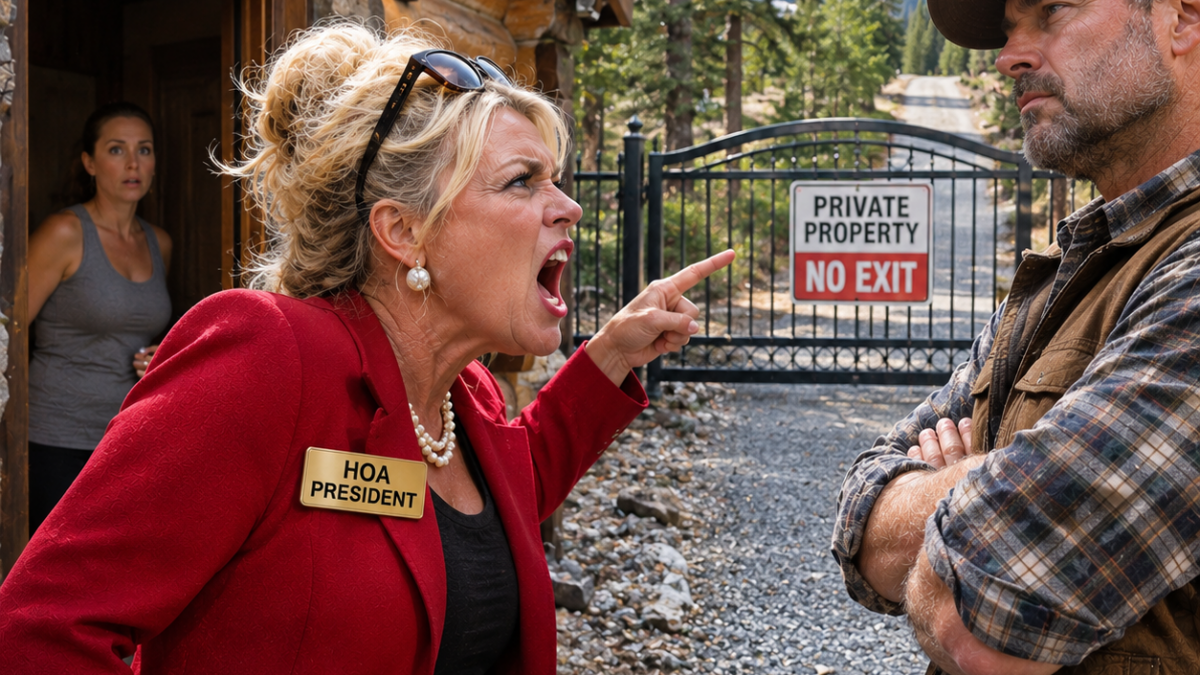
PART 2
## THE WOMAN IN GRANDMA’S BATHROBE
The bathrobe was not Grandma’s.
Thank God for that.
It was fluffy, expensive-looking, and white.
But everything around Brenda belonged to my family.
Grandma’s iron poker beside the fireplace.
Her oak dining table.
The little brass lamp Grandpa had rewired in 1978.
Her pantry.
Her cabinets.
Her walls.
My inheritance.
Brenda stepped farther into the doorway.
“I asked what you’re doing here.”
“I heard you.”
“You can’t just show up.”
That almost broke my brain.
“I own this house.”
She gave me the patient look people use with children.
“That is currently disputed.”
“No, it isn’t.”
“The association has concerns regarding abandonment, unpaid assessments, and property-management authority.”
“You’re living here.”
“I’m supervising the property.”
“In a bathrobe?”
Her mouth tightened.
“This is temporary.”
“Where’s Derek?”
Another hesitation.
“Not relevant.”
I looked past her.
Men’s boots.
A jacket.
Two coffee cups.
Suitcases.
Wine glasses beside the sink.
This was not an inspection.
This was habitation.
“How long?”
Her eyes narrowed.
“How long what?”
“How long have you been living in my grandmother’s house?”
“I reject that characterization.”
That phrase told me everything I needed to know about Brenda Hutchcraft.
She did not deny facts.
She renamed them.
Stealing became management.
Squatting became caretaking.
Extortion became enforcement.
Trespassing became community protection.
I stepped toward the threshold.
She blocked it.
“Do not enter.”
My voice dropped.
“Move.”
Her phone came up.
“I am recording.”
“Good.”
“You’re becoming aggressive.”
“I am standing outside my own house.”
“Which is currently under protective management.”
“Show me the document giving you possession.”
“I don’t have to show you anything while you’re behaving like this.”
There it was.
The circle.
She controlled the property because she said she did.
And because she controlled it, I had no right to see the paperwork proving she controlled it.
I had spent two decades troubleshooting electrical systems.
Circular logic irritated me almost as much as bad wiring.
But anger would not help me.
So I did something Brenda did not expect.
I backed away.
“Okay.”
She blinked.
“Okay?”
“Enjoy your coffee.”
Her confidence returned.
“I suggest you contact the association attorney before coming back.”
“I’ll do better than that.”
“What’s that supposed to mean?”
I smiled.
“Nothing yet.”
Then I turned around.
I could feel her watching me walk toward my truck.
Every step hurt.
Not because I had lost.
Because leaving Grandma’s cabin with Brenda standing in the doorway felt like abandoning her.
I kept reminding myself:
A house is wood.
Stone.
Paper.
The deed did not change because Brenda wore a bathrobe.
I got into my truck.
Started the engine.
And before I drove away, I took one photograph.
Brenda in the doorway.
Timestamp visible.
Address metadata saved.
Then I went home.
## DARLENE—NO, MY LAWYER WASN’T NAMED DARLENE
My attorney was named Noah Beck.
Forty-nine.
Property litigation.
Denver office.
The kind of man who wore hiking boots with suits because he said mountain disputes rarely stayed in conference rooms.
I called him from the bottom of the ridge.
“Jake?”
“I found Brenda.”
“Where?”
“My cabin.”
Silence.
“Inside?”
“Living there.”
Another silence.
“How certain?”
“She answered my door in a bathrobe.”
“That qualifies.”
“She says the HOA has protective management authority.”
“Does it?”
“I’ve never seen anything in the covenants.”
“Don’t go back alone.”
“I wasn’t planning to.”
“Do not change locks.”
“Why?”
“Because right now she is the person who entered without permission. Keep that clean.”
I hated that advice.
Which usually meant it was good.
“I want her out.”
“I know.”
“Today.”
“I know.”
“Noah.”
“We’re going to do this correctly.”
I looked in the rearview mirror at the mountain disappearing behind me.
“Correctly better be fast.”
“It usually isn’t.”
Lawyers say terrible things with calm voices.
## THE FIRST REAL SEARCH
That evening I opened every HOA document I had.
Declaration.
Bylaws.
Rules.
Assessments.
Meeting minutes.
Nothing gave the board authority to occupy a private home merely because it claimed the property looked abandoned.
There was limited authority to address emergencies threatening common infrastructure.
A broken water line.
Fire hazard.
Trees blocking association roads.
Nothing remotely resembling:
**The president may move into your cabin and drink coffee there.**
I called Noah.
“You find it?”
“No.”
“Neither did I.”
“So she invented the authority.”
“Appears that way.”
“Can we remove her?”
“We can demand she vacate and begin the proper process.”
I leaned back.
“Proper process.”
“You’re going to learn to hate that phrase.”
“I already do.”
## THEN THE LAW FIRM LETTER ARRIVED
Forty-eight hours.
Fourteen pages.
Heavy cream paper.
Harrison Blackwell & Associates.
I had never heard of them.
Their stationery wanted me to know I could not afford them.
The letter accused me of harassing association personnel.
Creating a hostile environment.
Interfering with property-protection measures.
Intimidating a female board officer.
Then came the best part.
I was instructed to provide seventy-two hours’ written notice before approaching my own cabin.
I called Noah.
“Did they just tell me I need permission to visit my property?”
“Yes.”
“Can they do that?”
“They can type it.”
“That wasn’t my question.”
“I know.”
## DEREK’S SEPTIC INSPECTION
The same day, county paperwork arrived.
Emergency septic concern.
Possible failure.
Potential environmental hazard.
Estimated correction cost:
Around fifteen thousand dollars.
I stared at the notice.
Then laughed.
Not because it was funny.
Because Grandma’s cabin did not have a conventional septic tank.
It used an older permitted composting and gray-water arrangement that had been documented for decades.
I had helped inspect the electrical components myself.
Derek worked in county planning.
Brenda’s husband.
Coincidence?
Maybe.
I stopped believing in those.
Noah told me:
“Do not accuse him yet.”
“I didn’t say anything.”
“You’re breathing like you’re about to.”
Fair.
## THE SECOND TRIP
I returned to document exterior conditions.
This time Noah knew.
My phone recorded.
I stayed on my own land.
The moment I stepped from the truck, an alarm erupted.
Motion siren.
Loud enough to scare birds out of the pines.
Cameras had been installed around the cabin.
Brenda appeared.
Phone in hand.
“You’re violating the restraining order!”
“There is no restraining order.”
“I have legal protections pending.”
“That isn’t a restraining order.”
Neighbors began appearing.
Mrs. Lucy from down the road.
Colonel Patterson.
Two other residents.
Brenda’s voice changed instantly.
Shaky.
Victim.
“He’s been stalking me.”
I stared.
She continued.
“He’s angry because I discovered problems with the estate.”
Mrs. Lucy looked between us.
“What problems?”
“Tax questions.”
“No tax questions exist,” I said.
Brenda talked over me.
“Thousands in unpaid association obligations.”
“Also false.”
“He has become threatening.”
I looked at the cameras.
Then at the neighbors.
There was nothing I could do there that helped me.
So I raised both hands.
“I’m leaving.”
Brenda smiled faintly.
Colonel Patterson noticed.
I saw him notice.
That mattered later.
## GRANDMA’S PAPERS
Back home, I began going through Grandma’s files.
Nobody kept paperwork like Ethel Riverside.
Receipts from 1974.
Appliance warranties for appliances that had died before I graduated high school.
Handwritten notes about culverts.
Boundary surveys.
Road work.
Tax statements.
Insurance documents.
A file marked:
**ACCESS ROAD — DO NOT THROW AWAY**
Grandma had underlined it twice.
Inside was an easement agreement recorded in 1962.
My first reading gave me a headache.
My second made me call Noah.
He drove over the next morning.
We spread the papers across my kitchen table.
He read slowly.
Then again.
“This is interesting.”
“How interesting?”
“Very.”
The cabin sat at the end of a private mountain road.
Several properties used segments of that road.
But the final access section leading toward Grandma’s parcel had unusual language.
The agreement gave her property broad maintenance authority over the crossing and specified procedures for restricting vehicle access when legitimate repairs or safety work required it.
More importantly, it contained termination language connected to certain abuses of access.
I looked at Noah.
“So I own the road?”
“No.”
“Control it?”
“Not in the way you’re thinking.”
“What way am I thinking?”
“The revenge-movie way.”
I smiled.
He did not.
“Jake, this is not permission to trap somebody.”
“I know.”
“Say it.”
“It is not permission to trap somebody.”
“Good.”
“But if the road needs legitimate maintenance—”
“Then the recorded agreement may allow temporary closure, provided it’s actually necessary and properly handled.”
I looked at the paper.
Grandma had preserved it for sixty years.
Noah tapped the clause.
“Do nothing yet.”
“You lawyers are addicted to that sentence.”
“Because clients are addicted to ruining good facts.”
## THE LIEN
Friday.
Certified mail.
$8,600.
Alleged HOA debt.
Transfer fees.
Late charges.
Snow removal.
Lawn violations during probate.
Tree trimming I had never requested.
Caretaker monitoring.
The line that nearly made me tear the paper in half:
**Emergency Occupancy Monitoring — $3,500**
They were charging me because Brenda was in my cabin.
I photographed everything.
Sent it to Noah.
His response:
**Do not pay this.**
Finally, legal advice I enjoyed.
## FORECLOSURE PAPERS AT WORK
The process server arrived at a job site.
Hard hats.
Cable spools.
Generators.
My crew.
“Jacob Riverside?”
Every head turned.
I signed.
Foreclosure-related proceeding.
My supervisor, Martinez, stood nearby.
After she left, he said:
“Problem?”
“HOA.”
He raised his eyebrows.
“That bad?”
“Worse.”
Contractors are sensitive to money problems.
A man facing liens can become a man nobody trusts with large jobs.
That made Brenda’s strategy more dangerous.
She was not merely attacking my property.
She was attacking my ability to earn.
I went home furious.
Noah came over with a forensic accountant two days later.
That was when the story grew teeth.
## THE HOA BOOKS
Her name was Marissa Chen.
Former auditor.
Zero patience for decorative accounting.
She requested records through the legal case.
Bank statements.
Vendor payments.
Invoices.
Contracts.
Cancelled checks.
We sat at my kitchen table for eleven hours across two days.
Pine Ridge Landscaping.
$15,000.
Family connection.
Trail work supposedly completed.
Colonel Patterson later told me half those trails did not exist.
Snow removal.
$22,000 over three winters.
Odd, considering neighbors had complained repeatedly that the plows barely came.
Maintenance contractors sharing addresses with Brenda’s relatives.
Emergency assessments flowing through poorly documented accounts.
Marissa stopped on one payment.
Then another.
She made a separate spreadsheet.
“How bad?”
“Too early.”
“You know something.”
“I know I don’t like it.”
“How much?”
“I’m not giving you a number until I can defend it.”
She and Noah would get along beautifully.
## THEN SHE FOUND THE MORTGAGE PROBLEM
Public records showed Brenda’s own house was months behind.
Real-estate income had dropped.
Mortgage pressure.
Other debts.
That alone proved nothing criminal.
People struggle.
I knew that better than most.
But then we found short-term-rental listings connected to Brenda’s residence.
Her actual house appeared to be producing income.
Which raised one obvious question.
Where was Brenda living while guests used her home?
We already knew.
My grandmother’s cabin.
The arrangement suddenly made financial sense.
She was using my property as free housing while monetizing hers.
That was not about HOA enforcement.
It was survival built on theft.
## THE ESTATE-SALE RECEIPTS
Those hurt more than everything before them.
A neighbor called.
“Jake, I think you should see something.”
Her name was Mrs. Lucy.
She handed me a photocopy from a local estate-sale company.
Items removed from the Ethel Riverside property.
My stomach turned.
Antique side table.
Cedar chest.
Dining chairs.
Hand-sewn quilts.
Frames.
Boxes of household goods.
Total proceeds:
About $1,800.
I stopped breathing for a second.
“Where did you get this?”
“Friend bought a lamp.”
She looked ashamed although she had done nothing.
“She recognized Ethel’s name.”
Grandma’s quilts.
One had taken her almost a year.
Family pictures.
Grandpa in uniform.
Grandma at nursing graduation.
Their wedding.
People dead forty years whose faces existed nowhere else.
Sold.
No HOA fine had ever made me violent.
That receipt came close.
I drove to Noah’s office instead.
Placed it on his desk.
He read.
Then looked at me.
“Jake.”
“I know.”
“Do not go to the cabin.”
“I know.”
“Promise me.”
I sat down.
“Noah.”
“Promise.”
I hated him.
“I promise.”
## THE ACTUAL RESTRAINING ORDER
Sunday evening.
Sheriff’s deputy.
Apologetic expression.
Temporary order.
I was directed not to approach Brenda or the cabin pending hearing.
My address.
My deed.
Her order.
The deputy looked at the paperwork.
Then at me.
“I’ve been doing this twenty years.”
“And?”
“This is unusual.”
“That’s one word.”
He lowered his voice.
“Bring your documents to court.”
I did.
## THE HEARING
Brenda arrived in a navy suit.
Perfect hair.
Derek beside her.
Lawyer.
She looked like the legitimate property manager protecting herself from a dangerous man.
I looked like an electrician who had slept badly for a month.
Judge Morrison reviewed the allegations.
Then asked Brenda:
“Current residential address?”
She gave the cabin address.
My cabin.
The judge stopped writing.
“Ms. Hutchcraft, you currently reside at 847 Pine Ridge Road?”
“Yes, Your Honor.”
“And you are seeking an order preventing Mr. Riverside from approaching that address?”
“Yes.”
He looked at Noah.
“Ownership?”
Noah stood.
“Clear title in Mr. Riverside’s name following probate.”
Deed.
Probate order.
Tax records.
Presented.
Judge looked back at Brenda.
“Ms. Hutchcraft, what ownership interest do you hold?”
“I’m acting pursuant to association protective-management authority.”
“Where is that authority?”
Her lawyer began talking.
The judge stopped him.
“I’m asking for the document.”
They did not have one.
Because it did not exist.
The temporary order collapsed.
Then Judge Morrison addressed Brenda directly.
“You are not authorized by this court to occupy property merely because your association considers it neglected.”
Brenda’s face changed.
“Your Honor—”
“You will vacate according to the court’s order.”
The gavel fell.
I should have felt victorious.
Instead, I felt Grandma.
The empty chair.
The sold quilts.
The months Brenda had slept under her roof.
Outside the courtroom, Brenda passed close.
Perfume.
Cold eyes.
“This isn’t over.”
I looked at her.
“No.”
For once we agreed.
## THE EMERGENCY HOA MEETING
Brenda responded by attacking publicly.
Flyers.
Email.
“Community safety.”
“Dangerous individual.”
She built a presentation claiming I planned to turn the cabin into a criminal rental property.
At the meeting, she displayed photographs of my truck.
My work trailers.
My crew.
She described me as unstable.
Then she proposed a massive special assessment for private security.
That was when Colonel Patterson stood.
Retired Marine.
Seventy.
Voice like gravel.
“Before we give Brenda another dollar, I’d like to know where the money we already gave her went.”
Silence.
He held up bank statements Marissa had shared through lawful record requests.
“Reserve balance should be significantly higher.”
Brenda’s eyes flashed.
“That’s not on the agenda.”
“It is now.”
Mr. Kowalski stood.
Then Mrs. Lucy.
Then the Johnsons.
Questions came from every direction.
Snow bills.
Landscaping.
Emergency assessments.
Missing reserve funds.
Brenda kept trying to return to her presentation about me.
Nobody cared anymore.
The room had finally discovered a better question.
Where was the money?
## THE FIRST CRACK
Afterward, Colonel Patterson stopped me.
“You knew?”
“Suspected.”
“How much?”
“We’re still verifying.”
He nodded.
“Good.”
“What’s good?”
“You’re not throwing numbers around before you know.”
I liked him.
Then he said:
“Ethel would’ve handled this with a shotgun.”
I laughed for the first time in weeks.
“No, she wouldn’t.”
He smiled.
“No. But she’d have wanted Brenda to think so.”
That sounded more accurate.
## THE TRAIL CAMERAS
With legal advice and while avoiding direct confrontation, I placed cameras on my own land to document unauthorized access.
Not inside the cabin.
Perimeter.
Driveway.
Outbuildings.
Fire pit.
Vehicles.
The footage answered questions quickly.
Different cars arrived.
Couples carrying luggage.
Weekend bags.
Coolers.
Brenda greeting them.
Keys changing hands.
I found online listings advertising an “exclusive historic mountain retreat.”
My grandmother’s cabin.
Two hundred dollars a night.
One video captured Brenda telling guests:
“This property has been in our family for generations.”
I watched that sentence four times.
Our family.
She had changed Grandma’s sheets.
Sold Grandma’s furniture.
Then borrowed Grandma’s history.
That may have enraged me more than the money.
## THE METAL BOX
Thursday.
2:00 a.m.
Motion alert.
Infrared video.
Brenda behind the cabin.
She carried a metal box.
Looked around repeatedly.
Moved near the old fire pit.
Worked for twenty minutes.
Left.
The next morning, acting with my lawyer aware of what we had recorded and preserving evidence properly, we documented the location.
The box contained cash.
Roughly twelve thousand dollars.
And an HOA checkbook.
Noah told me:
“Do not touch anything else.”
Investigators became involved.
The story was no longer HOA drama.
It was potential financial crime.
## THE ESCAPE PLAN
A camera later recorded Brenda talking on the phone outside.
I only heard one side.
Enough.
“The property should bring at least three hundred.”
Pause.
“I have a cash buyer.”
Pause.
“He thinks he’s buying from the estate.”
My stomach dropped.
She was discussing my cabin.
A sale.
A buyer.
The estate.
Grandma’s estate had closed.
I owned the property.
If Brenda intended to market or transfer it by pretending she had estate authority, we were looking at something far more serious than squatting.
I called Noah immediately.
He listened.
Then said:
“Send the recording.”
“What do you think?”
“I think we stop speculating and get this to people who can investigate.”
I hated how often he was right.
## THE REPORTER
Sarah Walsh from the Denver Post contacted me.
She had been looking into HOA corruption cases.
I initially refused.
Publicity felt dangerous.
Noah surprised me.
“Talk to her.”
“You sure?”
“On record only about verified facts.”
Sarah met me at a diner.
No dramatic promises.
She wanted documents.
Perfect.
I had documents.
She read for two hours.
Then closed the folder.
“This is much larger than a property fight.”
“I know.”
“What do you want?”
“My cabin back.”
“That’s all?”
I thought about the Kowalskis.
Mrs. Patterson.
The missing reserve.
“No.”
“What else?”
“I want everybody to know where the money went.”
## GRANDMA’S LOCKED BOX
The deeper easement documents were not in the main filing cabinet.
I found them in Grandma’s workbench.
Metal box bolted inside.
The key taped beneath a drawer inside one of her old grocery lists.
Of course.
She had written:
Milk.
Coffee.
Oatmeal.
Light bulbs.
And wrapped the key inside it.
I laughed.
Then cried.
Grief does that.
Inside were original road agreements.
Survey documents.
Correspondence with neighboring landowners.
Maintenance history.
Noah and I went through everything.
The 1962 agreement was more detailed than our first copy.
Exclusive maintenance responsibilities for the final private-road section.
Temporary closure rights for necessary infrastructure work.
Specific conditions affecting access privileges when those privileges were abused in connection with unlawful conduct.
Noah held the document.
“This matters.”
“How much?”
“A lot.”
“Can I close the road?”
“If it requires legitimate repair, you can carry out legitimate repair according to the agreement and applicable requirements.”
“And Brenda?”
“Jake.”
“I’m asking.”
“You cannot use maintenance as a fake excuse to imprison someone.”
“I know.”
“But if the road needs real work—”
“It does.”
“Then we document it.”
That distinction became everything.
## THE CULVERT
Grandma had complained for years about the creek crossing.
Old metal culvert.
Partially collapsed.
Drainage problems.
Spring runoff chewing at the edges.
Colonel Patterson had complained too.
So had the Kowalskis.
The HOA had postponed repairs.
Repeatedly.
Why?
No money.
Now we knew why the money was missing.
I hired a licensed excavation contractor to evaluate the crossing.
Murphy, the foreman, crouched beside the old culvert.
He poked rusted metal with a tool.
A section flaked away.
He looked at me.
“This needs replacement.”
“Urgent?”
“Before serious runoff gets here? Yes.”
That was all I needed.
Not because it trapped Brenda.
Because it made the project real.
Necessary.
Defensible.
The only kind I wanted.
## THE ACCOUNTANT’S NUMBER
Marissa called.
“Sit down.”
“Why does everybody tell me that?”
“Jake.”
I sat.
“We’ve expanded the review.”
“How much?”
“Documented missing or improperly diverted HOA funds: approximately one hundred twenty-seven thousand dollars.”
I said nothing.
Forty properties.
Mostly retirees.
People paying monthly dues believing roads would be maintained.
Snow removed.
Infrastructure repaired.
$127,000.
Gone or misused.
“What about the culvert?”
She exhaled.
“There should have been more than enough money.”
I stared at Grandma’s maintenance records.
Brenda had told everyone Pine Ridge could not afford to fix the road.
While taking their money.
That made the road repair feel different.
Not revenge.
Restoration.
## INSURANCE FRAUD
Another investigator contacted Noah.
Claims associated with Grandma’s cabin.
Weather damage.
Vandalism.
Equipment theft.
Claims I had never filed.
Total in the tens of thousands.
My property had been used not only as housing and a rental.
It had become a financial tool.
Each discovery seemed impossible until the next one made it look small.
## DEREK CALLS
Unknown number.
“Jake?”
I recognized him.
Derek Hutchcraft.
His voice shook.
“I need to talk.”
“About?”
“Brenda.”
I hit record only after confirming what Noah had advised about preserving communications in our situation.
Derek continued.
“The septic notices were wrong.”
“I know.”
“I pushed them.”
“I know.”
“She said it was temporary.”
“What was temporary?”
“Everything.”
He sounded exhausted.
“The association money. The inspections. She kept saying she would replace it after real-estate commissions improved.”
“How long?”
Silence.
“Years.”
I closed my eyes.
“Why are you telling me?”
“Because investigators contacted my office.”
There it was.
“And?”
“Because she’s planning to leave.”
“When?”
“Soon.”
“How?”
“She’s packing.”
I looked toward the mountain.
The road.
The culvert.
Construction approval already moving.
But I did not feel clever.
I felt afraid.
A desperate person with cash, fraudulent documents, and a plan to disappear is not a game.
I called Noah.
Then investigators.
I did not chase Brenda.
I did not try to physically stop her.
That mattered.
Law enforcement could handle criminals.
I could repair a road.
## THE ROAD NOTICE
The culvert project went forward.
Neighbors were notified.
Alternate arrangements discussed.
Groceries.
Medical needs.
Parking below the closure.
Emergency access planning.
The project would temporarily prevent ordinary vehicle traffic across the crossing.
Everyone understood why.
Mrs. Lucy said:
“I’ve been asking them to fix that thing for six years.”
The Kowalskis thanked me.
Colonel Patterson inspected Murphy’s paperwork as if he had been appointed secretary of infrastructure.
“This legitimate?”
“Very.”
He nodded.
“Good.”
I knew what he was really asking.
Are you doing this because the culvert needs repair?
Yes.
Did I also understand what a lawful closure meant for somebody occupying the cabin and hoping to drive away unnoticed?
Also yes.
Both could be true.
## BRENDA DIDN’T ANSWER HER DOOR
I visited every affected neighbor.
Brenda did not answer.
Smoke from the chimney.
Vehicle behind the cabin.
She was there.
I left formal notice where required and documented delivery.
Then walked away.
No confrontation.
The next phase belonged to time.
## THE CONSTRUCTION STARTED
Heavy equipment arrived.
The old crossing was opened for replacement.
Once excavation began, vehicle passage stopped.
Not because I parked a truck sideways.
Not because I built a barricade to trap Brenda.
Because you cannot drive through a road while a failed drainage structure beneath it is being replaced.
Murphy looked down at the deteriorated metal.
“Good thing you didn’t wait.”
I nodded.
That sentence mattered.
If I had invented the repair merely to strand Brenda, I would have become part of the problem.
The culvert was real.
The work was real.
The closure was real.
And Brenda’s timing was terrible.
## SHE FINALLY SAW IT
Monday morning.
I was down near the work site.
From higher on the road, Brenda appeared.
Coffee cup.
Coat.
She walked toward the excavation.
Stopped.
The cup fell.
Even at a distance, I could see the reaction.
Hands up.
Pointing.
Murphy spoke with her.
She gestured wildly.
He pointed toward the project notice.
Then back toward the machinery.
No road.
No vehicle passage.
She called me.
I let it ring once.
Then answered.
“What did you do?”
“Replaced a failing culvert.”
“You blocked the road!”
“The road is under repair.”
“You did this to trap me!”
“I hired a licensed contractor to replace documented failing infrastructure.”
“I need out.”
“There are lawful pedestrian and emergency arrangements being coordinated. Talk to the contractor or authorities.”
“You cannot keep me here.”
“I am not keeping you anywhere.”
That was the most important sentence in the conversation.
The road was closed.
Brenda was not my prisoner.
If she needed emergency evacuation, nobody would stop her.
If law enforcement directed access, we would cooperate.
What she did not have was the ability to quietly load her vehicle and disappear down the only drivable route before investigators reached her.
Her escape plan had collided with legitimate infrastructure.
Grandma would have appreciated the irony.
## THE INJUNCTION
Brenda tried court.
Emergency application.
Road closure illegal.
False imprisonment.
Harassment.
Judge Morrison saw her again.
This time Noah attended without me.
He called afterward.
“How’d it go?”
“Five minutes.”
“That good?”
“For us.”
“What did he say?”
“Essentially that recorded maintenance authority plus documented failing infrastructure equals a legitimate repair dispute, not false imprisonment.”
“And Brenda?”
“Very unhappy.”
I smiled.
Noah added:
“Do not gloat.”
“I wasn’t.”
“You were about to.”
Correct.
## THE BRIBE
Wednesday.
Unknown number.
Brenda.
Her voice had changed.
No authority.
No performance.
Fear.
“Jake, we need to settle this.”
“What do you mean?”
“Fifty thousand dollars.”
I stayed quiet.
“Cash.”
“For?”
“You stop the legal complaints. You stop this ridiculous construction. Let me stay until spring.”
“Where does fifty thousand cash come from?”
“My savings.”
I looked at the financial spreadsheet beside me.
“Your personal savings?”
“Yes.”
“I’ll have to think about that.”
“Do it quickly.”
The call ended.
I sent the recording to Noah and investigators.
The woman who had once charged me $350 a month for “protective management” was now offering me $50,000 to let her continue occupying the same property.
The numbers had become almost surreal.
## DEREK’S SECOND CALL
“Jake.”
“What now?”
“She’s talking about burning the cabin.”
My body went cold.
“What?”
“She said if everything collapses, she’ll destroy it.”
“Is she serious?”
“I don’t know anymore.”
That answer frightened me more than yes.
I immediately contacted law enforcement.
Then the contractor.
Then security.
Nobody played hero.
Nobody went up there alone.
The goal became preservation of life and property.
Not revenge.
I thought about Grandma’s cedar walls.
Her fireplace.
Pantry marks.
Photographs already sold.
The idea of fire made me physically sick.
## FEDERAL INVESTIGATORS
Agent Martinez contacted me.
White-collar case expanding.
HOA funds.
Insurance claims.
Potential fraudulent property transaction.
Derek’s cooperation.
Digital evidence.
My recordings.
Marissa’s audit.
“We have enough to move.”
“When?”
“Soon.”
I did not ask for operational details.
That was not my job.
He did tell me one thing.
“Do not confront her.”
For once, everybody’s favorite instruction sounded wonderful.
## THE FIRST SNOW
Six inches.
Pines turned white.
Construction paused.
The open crossing remained unusable to vehicles until work could safely resume.
The mountain became quiet.
Too quiet.
I sat in my truck below the work area one evening.
Not guarding Brenda.
Watching equipment.
Drinking coffee.
Snow drifting through headlights.
Above me was Grandma’s cabin.
Occupied by the woman who had spent months pretending ownership could be manufactured through paperwork.
For the first time, I felt no urge to go up.
The property was mine.
I no longer needed Brenda to admit it.
## THE GASOLINE
After Derek’s warning, investigators documented containers and suspicious materials around the cabin area.
I did not retrieve them myself.
That was important.
My earlier trail-camera footage supported the concern.
Once potential arson entered the picture, professionals handled it.
The whole conflict had moved beyond anything an HOA meeting could solve.
## BRENDA’S SOCIAL MEDIA
She created a page describing herself as a victim.
My truck photographed.
My business named.
Claims that I was a “developer” trying to steal mountain land.
I had never developed a property in my life.
One post said:
**Jake Riverside wants to destroy our ancestral community.**
Ancestral.
Brenda had been in Pine Ridge a fraction of the time Grandma had owned the cabin.
Sarah Walsh called.
“Want to respond?”
“No.”
“Nothing?”
“Print the deed date.”
She laughed.
“Good answer.”
## THE BURNING PAPERS
Trail cameras recorded smoke and repeated late-night activity.
Investigators later determined documents had been destroyed.
That sounded disastrous.
Until Marissa called.
“Digital backups.”
“What?”
“She deleted files.”
“And?”
“She doesn’t understand deletion.”
I smiled.
“Recovered?”
“A lot.”
Invoices.
Bank records.
Emails.
Vendor communications.
The physical paper mattered less than Brenda thought.
I remembered Grandma:
**Keep copies in two places.**
Ethel Riverside would have loved computers.
## THE OTHER INSURANCE CLAIMS
The investigation widened beyond my property.
Other mountain homes.
Suspicious claims.
Overlapping contractors.
Inflated losses.
The alleged fraud was no longer local enough to dismiss as HOA chaos.
Every path seemed to circle back to Brenda or somebody close to her.
The more investigators found, the less I needed revenge.
The system had finally woken up.
## BRENDA TRIED TO HIKE OUT
I learned this afterward from witnesses and cameras.
Backpack.
Winter clothes.
Snow.
A woman who hated walking from her driveway to the mailbox apparently decided she could cross miles of mountain terrain.
She returned less than an hour later.
Wet.
Exhausted.
Cold.
I was relieved.
Not disappointed.
Mountain weather kills people faster than pride understands.
I wanted Brenda prosecuted.
Not dead.
That distinction never changed.
## THE LEAK
Someone apparently warned her that investigators were close.
Derek called.
“She knows.”
“Knows what?”
“They’re coming.”
“How?”
“I don’t know.”
Brenda’s posts became more frantic.
Claims of conspiracy.
Threats to expose everyone.
She allegedly said neighbors had accepted kickbacks.
People who had spent years paying dues were suddenly being accused of stealing them.
Classic Brenda.
When facts closed one door, she built another reality.
## HER CALL TO HER MOTHER
A camera microphone captured part of a phone conversation outdoors.
“I’m the victim.”
Pause.
“Jake set this up.”
Pause.
“He manipulated everything.”
I stopped listening.
Not because it was irrelevant.
Because I finally understood.
Brenda would never give me the one thing I had secretly wanted.
Recognition.
She would never say:
I did this.
I hurt these people.
I took what wasn’t mine.
Some people would rather rebuild the entire universe than accept responsibility inside it.
I could stop waiting for her apology.
That felt like freedom.
## MORE SNOW
Eight inches.
The switchbacks disappeared beneath white.
Mountain quiet settled over everything.
Construction remained weather-delayed but secured.
Below the ridge, residents stocked groceries.
Checked on older neighbors.
Shared rides.
Mrs. Lucy coordinated medication pickups.
For years, Brenda had described Pine Ridge as something she alone protected.
Yet the moment she stopped controlling it, the community worked better.
That irony was not lost on anyone.
## THE NIGHT BEFORE
I barely slept.
Not because I expected drama.
Because endings are unsettling.
For months, Brenda had occupied every conversation.
Every stack of mail.
Every weekend.
Every legal bill.
Every thought about Grandma.
If investigators removed her, what remained?
Grief.
The cabin.
My divorce.
My business.
Life.
Revenge can become a distraction from pain.
I realized that sitting alone at two in the morning.
Brenda had invaded Grandma’s house.
But fighting Brenda had also let me postpone mourning Grandma.
Once Brenda was gone, Ethel would still be dead.
That was the part no court could reverse.
I cried that night.
Not much.
Enough.
## MONDAY MORNING
Law enforcement arrived at the lower work area.
Federal agents.
County deputy.
Winter gear.
They could not drive all the way across the active construction zone.
They coordinated their approach appropriately.
I stayed below.
That was important.
This was not my arrest.
Not my victory march.
I had provided evidence.
They would execute lawful warrants.
Neighbors gathered at a respectful distance.
Colonel Patterson.
Mrs. Lucy.
The Kowalskis.
Sarah Walsh and a photographer stayed where authorities allowed.
At 8:15, the agents headed toward the cabin.
Then we waited.
Cold makes minutes feel longer.
Nobody talked much.
Snow creaked under boots.
A machine idled.
Breath hung in the air.
Then Brenda’s voice carried down the ridge.
Loud.
Angry.
“This is illegal!”
Even from far away, you could hear her.
Then:
“I’m the victim!”
Colonel Patterson looked at me.
I looked away.
Twenty minutes later, they appeared.
Brenda between agents.
Handcuffed.
Designer winter boots sliding on packed snow.
Her hair uncharacteristically messy.
Face red from cold and fury.
The woman who had once opened Grandma’s door in a white bathrobe and told me I was trespassing was now walking down the same mountain under federal escort.
I expected joy.
What I felt was exhaustion.
## SHE SAW ME
Our eyes met.
“Jake!”
Agent Martinez kept her moving.
“You did this!”
I said nothing.
“You trapped me!”
Still nothing.
“You stole my life!”
That one almost made me laugh.
Almost.
Then Sarah Walsh called a question from the media area about the allegations.
Brenda turned.
And because Brenda could never resist explaining Brenda, she started talking.
“I served this community for eight years!”
Agent Martinez advised her to stop.
She did not.
“Everything I did was to protect property values!”
More advice to remain silent.
Ignored.
“The assessments were necessary!”
Colonel Patterson muttered:
“Oh, Lord.”
Brenda kept going.
“If people are too stupid to understand how communities work, that isn’t my fault!”
Agent Martinez closed his eyes briefly.
I will never forget that expression.
Professional patience meeting a woman determined to assist her own prosecution.
## THE SUV DOOR CLOSED
No applause.
Not like a movie.
A few people exhaled.
Mrs. Lucy cried.
Mr. Kowalski hugged his wife.
Colonel Patterson put a hand on my shoulder.
“That’s done.”
“No.”
I looked toward the cabin.
“Not yet.”
He nodded.
He understood.
Brenda being arrested did not restore Grandma’s quilts.
Did not rebuild trust.
Did not replace $127,000.
Did not undo years of fear.
Consequences are the beginning of repair.
Not the end.
## I WALKED BACK TO THE CABIN
Later, after law enforcement cleared the property.
My key.
My door.
I stood outside for a long time.
Then unlocked it.
The smell was wrong.
Brenda’s perfume.
Cleaning products.
Other people’s cooking.
But underneath it:
Cedar.
Stone.
Old woodsmoke.
Home.
I walked inside.
Grandma’s chair was gone.
Some pictures gone.
Cabinet rearranged.
My childhood height marks still on the pantry.
I touched them.
Age seven.
Nine.
Twelve.
Grandma had written dates beside each.
At thirteen I had tried measuring myself while wearing boots.
She caught me.
Made me redo it barefoot.
“Truth doesn’t need help,” she had said.
I had forgotten that line.
Standing in the cabin, I remembered.
Truth doesn’t need help.
It needs preservation.
## THE CULVERT
Murphy’s crew finished ahead of the revised schedule once weather cleared.
New box culvert.
Improved drainage.
Reinforced crossing.
A repair that should have happened years earlier.
Mrs. Lucy stopped her truck beside me after the road reopened.
“Smooth.”
“Expensive.”
“HOA should’ve paid years ago.”
“Yes.”
She looked toward the mountain.
“Maybe now it will.”
That was the plan.
## THE TOYOTA
Brenda had left a vehicle near the cabin.
Once authorities and legal procedures allowed, it was removed.
Watching it leave felt more final than watching Brenda in handcuffs.
Vehicles are strange that way.
A person can be gone, but their car makes absence look temporary.
When the tow truck disappeared, the driveway became Grandma’s again.
Mine now.
I was still getting used to that.
## THE CRIMINAL CASE
The evidence was overwhelming enough that the case resolved without a dramatic trial.
Brenda ultimately pleaded guilty to multiple charges connected to the financial and fraud schemes.
The sentence included federal prison time, supervision afterward, and restitution.
Derek received a lesser sentence after cooperating but lost his county career.
I did not attend every hearing.
At first I thought I should.
Then Noah asked:
“Why?”
“To see it through.”
“You’ve seen it through.”
“What if something happens?”
“There are prosecutors.”
I realized I no longer had to manage Brenda.
That was liberating.
## THE $127,000
Restitution orders.
Asset recovery.
Insurance proceeds.
Recovered accounts.
The community clawed back a substantial portion of what had been lost.
Not every dollar came easily.
Not every resident understood every accounting line.
But the feared massive emergency assessment became unnecessary.
That mattered to people like the Kowalskis.
Fixed income.
Medical bills.
They should never have had to finance Brenda’s theft twice.
## PINE RIDGE VOTED
Special meeting.
Packed room.
No Brenda at the front.
No ruler.
No paint chips.
No theatrical threats.
Residents approved governance reforms.
Term limits.
Regular financial reports.
Independent reviews.
Professional oversight for certain functions.
Conflict disclosures.
Multiple approvals for significant spending.
Open record access.
No single officer could control enforcement, money, and information simultaneously again.
That was the system Brenda had exploited.
We dismantled it.
## MRS. LUCY
She became president.
The most reluctant candidate in Pine Ridge history.
When nominated, she said:
“Absolutely not.”
Thirty minutes later:
“Fine. One term.”
She had spent years volunteering with nonprofits.
Understood budgets.
Understood people.
Her first meeting lasted forty-two minutes.
Colonel Patterson complained.
“Too efficient.”
She said:
“Go home.”
I knew we were in good hands.
## THE KOWALSKIS’ LAWN
Spring.
Mr. Kowalski healthy enough to sit outside.
Grass slightly long.
Mrs. Lucy drove past.
Did not stop.
He later joked:
“I’m living dangerously.”
Nobody measured it.
No lawsuit.
No oxygen tank beside a woman holding a ruler.
Normalcy can be a form of justice.
## MRS. PATTERSON’S MAILBOX
Hunter green.
Still hunter green.
Nobody died.
Property values survived.
## THE JOHNSONS’ RV
Three days.
Same driveway.
No $750 fine.
Again, civilization continued.
## GRANDMA’S BELONGINGS
Recovering them became a project.
Some buyers returned items voluntarily after learning they had been sold without authority.
One couple brought back a cedar table.
Would not accept reimbursement.
A woman in Denver returned two quilts.
She had bought them because her grandmother quilted too.
When she unfolded them across my kitchen table, I recognized Grandma’s stitching immediately.
Small uneven loop near one corner.
She always got impatient near the end.
I ran my hand across the fabric.
The woman said:
“I’m sorry.”
“You didn’t know.”
She began crying.
Then I did.
We stood in my kitchen crying over a blanket stitched by a woman neither of us could bring back.
Human beings are ridiculous.
Beautiful too.
## GRANDPA’S PHOTO
That one took months.
Army uniform.
Black-and-white.
Original wooden frame.
Eventually located through the estate-sale company’s buyer records.
The man who had it lived two counties away.
He returned it.
I offered twice what he paid.
He refused.
“My dad served too.”
He handed it over.
“Take him home.”
I barely made it to my truck before losing it.
## THE FIREPLACE CORNER
I restored Grandma’s chair.
Not the original.
That never came back.
I found one similar.
Beside it:
Grandpa’s photograph.
Grandma’s nursing graduation.
One recovered quilt.
Her coffee tin.
No shrine.
Just a corner.
Memory deserves space.
It does not need to consume the room.
## MY BUSINESS
The foreclosure spectacle at work had done damage.
Rumors.
Questions.
Martinez eventually asked me into his office.
I expected concern about finances.
Instead he closed the door.
“I read the article.”
“Great.”
“You could’ve told me.”
“I didn’t want job-site gossip.”
He nodded.
“For what it’s worth, nobody here thinks you’re unreliable.”
“Good.”
“Half the crew thinks you’re some kind of mountain vigilante.”
“Not good.”
He laughed.
“Relax.”
I hated that word after Brenda.
But my business stabilized.
Then grew.
Apparently surviving a divorce and HOA fraud makes ordinary electrical contracts feel manageable.
## SARAH’S ARTICLE
The Denver Post story focused on governance.
Not “Karen gets trapped on mountain.”
I appreciated that.
Financial control.
Abuse of local authority.
Property fraud.
Community oversight.
The photo showed snow-covered Pine Ridge and the construction crossing.
No dramatic handcuff close-up.
Sarah said:
“The story isn’t one woman.”
“What is it?”
“How many people stopped asking questions because asking was expensive.”
That was exactly it.
## THE CABIN RENOVATION
I started where Grandma would have.
Roof.
Not kitchen.
“Pretty doesn’t matter if water gets in.”
Her rule.
Then windows.
Electrical.
Insulation.
Floor refinishing.
I kept the A-frame character.
No luxury transformation.
No quartz waterfall countertops.
No giant glass addition.
Grandma would have haunted me.
The old pantry stayed.
Height marks stayed.
Fireplace stayed.
Creek view stayed.
I did add a better coffee maker.
She could haunt me for that if she wanted.
## THE FIRST NIGHT BACK
Alone.
Snow outside.
Fire.
No cameras alerting me.
No Brenda.
I sat in Grandma’s replacement chair.
I expected peace.
Instead I cried.
Hard.
Divorce.
Grandma.
The cabin.
Months of anger.
Everything came at once.
You can survive a crisis by staying busy.
Healing begins when there is nothing left to do at midnight.
I let it happen.
Then slept ten hours.
## THE ETHLE RIVERSIDE SCHOLARSHIP
Mrs. Lucy suggested it.
I refused.
“No.”
“Why?”
“Grandma would hate attention.”
“She’s dead.”
“Bold argument.”
“She cared about public service.”
That was true.
Nurse.
Volunteer.
Community blood drives.
Meals for sick neighbors.
The association had recovered funds and received additional restitution over time.
Residents voted to establish a scholarship.
Five thousand dollars annually when funds allowed.
Students studying public administration, criminal justice, community planning, public finance, or related fields.
I insisted on one condition.
“Name spelled Ethel.”
Mrs. Lucy stared.
“Obviously.”
“You’d be surprised.”
## THE FIRST RECIPIENT
Maya Torres.
Wanted to study public administration.
Her essay began:
**Trust is infrastructure.**
I stopped reading.
Started again.
She argued that roads, water systems, budgets, and governing institutions all failed the same way.
Small maintenance ignored.
Small warning signs dismissed.
Responsibility concentrated.
Then sudden collapse.
I felt Grandma all over that essay.
Maya had never met her.
That was the beauty.
Legacy does not require direct memory.
## THE TRANSPARENCY FESTIVAL
I hated the name.
Still do.
Pine Ridge Transparency Festival.
Sounds like a conference hosted by accountants.
Residents loved it.
Food.
Music.
Budget workshops.
Road-maintenance demonstrations.
Fraud-prevention speakers.
Kids.
Sarah returned one year to speak.
Colonel Patterson ran the grill like a military operation.
Mrs. Patterson painted a sign.
Hunter green.
I asked whether it complied with HOA standards.
She nearly hit me with it.
## DEREK
He wrote me once from custody.
Not Brenda.
Derek.
Short letter.
Apology.
He said fear of divorce, pension loss, and Brenda’s pressure did not excuse what he did.
That sentence mattered.
No excuse.
Not “I was forced.”
Not “she made me.”
He admitted choice.
I wrote back:
**Tell the truth every time you are asked.**
Nothing more.
## BRENDA NEVER WROTE
Fine.
I stopped needing it.
## THE ROAD AGREEMENT
We modernized the arrangement.
Lawyers.
Neighbors.
Clearer maintenance responsibilities.
Emergency access procedures.
Funding.
Notice.
No sixty-year-old ambiguity.
Grandma’s original agreement had saved us from confusion, but relying forever on a document typed before men walked on the moon seemed irresponsible.
We updated without erasing the historic rights.
I thought Grandma would approve.
Read twice.
Sign once.
## THE CULVERT IN SPRING
Snowmelt arrived.
Creek rose.
Water flowed cleanly through the new crossing.
No washout.
No erosion crisis.
Murphy sent me a photo.
**Told you.**
I forwarded it to Colonel Patterson.
His answer:
**Brenda finally contributed something useful.**
I laughed.
The road repair had cost money.
But it solved a real problem.
That mattered more than its accidental role in Brenda’s downfall.
## THE HOUSE SHE HAD RENTED
Brenda’s former home eventually changed owners through the legal and financial aftermath.
New family.
Two children.
Dog.
Nobody talked about it much.
Pine Ridge had learned something healthy.
Properties outlive scandals.
Communities should too.
## THE CABIN’S FIRST LEGITIMATE GUEST
A couple from Fort Collins.
Booked after renovations.
Paid me.
Signed actual agreement.
Knew who owned the house.
Imagine that.
They left a note:
**Beautiful place. Felt like someone loved it for a long time.**
I kept that one.
Grandma would have liked it.
## I STOPPED RENTING IT OFTEN
Money helped.
But eventually I wanted the cabin more for family.
My daughter visited.
My son brought friends.
Thanksgiving once.
Grandkids later.
The house became loud.
Grandma’s house had always been loud.
That felt right.
## THE FALSE FEES
The $400 inheritance transfer fee?
Rescinded.
Caretaker assessments?
Voided.
Tree work?
Removed.
Improper penalties?
Reviewed.
Residents received credits where records supported them.
It took months.
Boring work.
Spreadsheet work.
The opposite of dramatic revenge.
Also far more important.
## FORECLOSURE DISMISSED
That paperwork that had been served at my job site eventually died under the weight of actual title and financial records.
I saved the dismissal.
Not framed.
I am not that bad.
I did frame one thing.
Grandma’s grocery list that wrapped the easement-box key.
Milk.
Coffee.
Oatmeal.
Light bulbs.
The list that helped unlock the document Brenda never knew existed.
That hangs beside my desk.
## MY DIVORCE
People assume the Brenda fight distracted me enough to heal.
Not really.
Divorce still hurt.
Losing half a business hurt.
Coming home alone hurt.
But the cabin gave me somewhere to rebuild.
Not romantically.
Practically.
Replace a board.
Repair a roof.
Sand a floor.
Stack firewood.
Physical tasks are kind to broken minds.
They end.
## GRANDMA’S HAMMER
I found it after the cabin was cleared.
Old claw hammer.
Wood handle polished smooth.
Her initials scratched near the bottom.
E.R.
I used it during renovation.
My contractor laughed.
“You own fifteen better hammers.”
“Not better.”
He understood after that.
## THE MOUNTAIN COMMUNITY
Brenda had convinced everyone she was indispensable.
Roads.
Snow.
Standards.
Property values.
Safety.
After she left, all those things continued.
Some improved.
That is one of the clearest tests of bad leadership.
A good leader builds a system that works without them.
A bad leader builds one that makes everyone terrified of their absence.
Brenda had done the second.
Pine Ridge survived anyway.
## COLONEL PATTERSON
He became transparency committee chair.
Of course.
His reports were terrifying.
Tabs.
Appendices.
Color-coded findings.
Mrs. Lucy once told him:
“You know this is an HOA, not NATO.”
He responded:
“Fraud doesn’t care.”
Nobody argued.
## MARISSA’S AUDITS
Independent review every two years.
She trained a new firm to continue after she stepped away.
No single accountant dependent on one board.
Controls.
Boring.
Redundant.
Safe.
My electrician brain loved it.
## WHY SYSTEMS FAIL
I started speaking occasionally to other communities.
Not because I became an HOA expert.
I did not.
I told them that explicitly.
My message was simpler.
Do not build a system where one person:
Receives complaints.
Controls records.
Approves vendors.
Influences enforcement.
Communicates with lawyers.
Explains the finances.
And decides what everyone else is allowed to see.
That is not governance.
That is dependency.
## THE MOST PAINFUL THING BRENDA TOOK
Not money.
Not furniture.
Not access.
Grandma’s handwriting appeared on the backs of some family photographs she sold.
Names.
Dates.
Little comments.
**Eddie home from Germany, 1968.**
**My nursing girls, Christmas.**
**Jake pretending he caught this fish by himself.**
Some came back.
Some never did.
Those losses remained.
A criminal sentence cannot restore unique objects.
That taught me an uncomfortable truth.
Justice can be complete legally and incomplete emotionally.
Both things can exist.
## THE FISH PHOTO
One photograph returned years later.
Me at nine.
Holding a trout.
Grandma behind me.
Her handwritten caption:
**Jake caught half. Ethel caught half. Jake claims all.**
I laughed until I cried.
She had been calling me out from beyond the grave.
## THE ONLY ROAD OUT
People fixate on that part when I tell the story.
“Did you really trap her?”
No.
That answer matters.
I did not imprison Brenda.
I did not block emergency evacuation.
I did not create a fake obstacle.
A deteriorated culvert on a private road required legitimate repair.
The recorded agreement gave my property maintenance responsibilities.
The work temporarily stopped vehicle traffic.
Law enforcement knew where she was.
If she had needed medical rescue, she would have received it.
What disappeared was her ability to quietly load a car with cash, records, and luggage and drive away before investigators could act.
That was not a prison.
It was consequences meeting infrastructure at an extremely inconvenient time.
## GRANDMA WOULD HAVE LAUGHED
I know that.
She had a mean sense of humor.
Not cruel.
Sharp.
When somebody created their own problem, she enjoyed pointing out the craftsmanship.
I can hear her:
“So she stole the road money and then got stuck because the road needed repair?”
“Yes, Grandma.”
“That sounds expensive.”
“Yes.”
“Coffee?”
Always coffee.
## THE FIRST ANNIVERSARY
One year after Brenda’s arrest, I woke at the cabin.
Snow.
Same kind of morning.
I walked to the door.
Opened it.
Nobody there.
No federal agents.
No reporters.
No HOA notices.
Creek.
Pines.
Cold.
I made coffee.
Sat on the porch.
The road below was visible through trees.
Open.
Plowed.
Safe.
That mattered.
A road should be a road.
Not a weapon.
Not leverage.
Infrastructure.
## MRS. LUCY CALLED
“Anniversary.”
“Of what?”
“You know.”
“I’m not celebrating arrest anniversaries.”
“Fine. Culvert anniversary.”
“That’s worse.”
She laughed.
“Come to dinner.”
Pine Ridge eventually learned to laugh at itself.
Healthy sign.
## THE NEW HOA PRESIDENT RULE
Presidents served limited terms.
No unilateral vendor approvals.
No personal financial relationships without disclosure and recusal.
No enforcement targeting by a single officer.
Any emergency assessment above a threshold required independent review.
Records online.
Residents could see balances without begging.
Mrs. Lucy said:
“If I steal money, I want you all to catch me quickly.”
Colonel Patterson replied:
“We will.”
She looked offended.
“Thank you for the confidence.”
## PROPERTY VALUES
They recovered.
Improved, according to local assessments.
Ironically, Brenda had justified everything as protecting values.
Transparency did a better job.
Turns out buyers like communities without embezzlement scandals.
Who knew?
## SARAH WALSH’S SECOND STORY
One year later.
Headline focused on reform.
Not Brenda.
I preferred it.
She interviewed Maya, the scholarship recipient.
Mrs. Lucy.
Colonel Patterson.
The Kowalskis.
Me last.
“What changed most?”
I thought.
“People ask to see things now.”
“Financial records?”
“Everything.”
She smiled.
“That sounds exhausting.”
“It’s beautiful.”
## A NEW RESIDENT
Young couple bought a cabin.
First HOA meeting, the husband asked six questions about the budget.
Old Pine Ridge would have called him difficult.
Mrs. Lucy answered all six.
Afterward, Colonel Patterson said:
“I like him.”
That was progress.
## THE STORY GOT EXAGGERATED
Online versions appeared.
Jake built a wall.
No.
Jake chained the road.
No.
Jake trapped HOA Karen with bulldozers.
No.
Jake kidnapped HOA president using property law.
Absolutely not.
The actual truth was more satisfying.
Grandma maintained a document.
I read it.
The road needed repair.
We repaired it.
Brenda’s crimes caught up with her before she could leave.
Reality rarely needs extra explosives.
## THE CABIN TODAY
Same A-frame.
Better roof.
Better insulation.
Safer wiring.
Grandma would approve of the wiring.
I rewired most of it myself.
The creek still runs below.
The pantry height marks remain.
Grandpa’s photo above the fireplace.
Recovered quilt on the chair.
Grandma’s hammer in the workshop.
Sometimes I rent it.
Mostly I don’t.
## A FAMILY THANKSGIVING
All five branches of Grandma’s family came one year.
Too many cars.
Too much food.
Children everywhere.
Somebody broke a lamp.
Someone burned rolls.
Grandma would have called it perfect.
At dinner, my cousin asked:
“So this is where that HOA woman lived?”
I groaned.
My daughter said:
“Dad hates that question.”
“Correct.”
Then one of the kids asked:
“Did Grandpa trap her?”
Everyone laughed.
I pointed at them.
“Your parents are responsible for this misinformation.”
## I TOLD THEM THE SHORT VERSION
“She was doing bad things.”
“Then what?”
“We found proof.”
“Then what?”
“The police came.”
“Then what?”
“We fixed the road.”
The child frowned.
“That’s boring.”
“Exactly.”
One day he’ll understand.
Boring processes save people.
## BRENDA’S FINAL SENTENCE TO THE CAMERA
Sarah once asked if I remembered it.
I did.
Brenda saying every fee and assessment had been for the greater good.
That phrase bothered me.
Greater good.
Power loves vague beneficiaries.
When no specific person can question whether they were helped, almost anything can be justified.
Grandma was simpler.
If you collect money to plow snow, plow snow.
If you collect money to fix roads, fix roads.
If a house is not yours, don’t live in it.
Hard to improve on that philosophy.
## DEREK AFTER RELEASE
I never sought him out.
He apparently moved.
Different field of work.
No planning department.
I hope he learned.
Cooperation after years of helping does not erase participation.
But accountability can include the possibility of becoming better.
Otherwise punishment is just storage.
## BRENDA’S FUTURE
I know very little.
That is intentional.
At some point I stopped searching her name.
That was a milestone.
For months, her name had been a daily task.
Legal database.
Email.
News.
Documents.
The first month I realized I had not thought about Brenda for an entire week, I celebrated by doing absolutely nothing.
Freedom.
## GRANDMA’S NURSING PIN
Recovered from a pawn dealer.
Tiny.
Silver.
I almost missed it.
Now sits in a shadow box beside her graduation photograph.
Maya saw it during a scholarship event.
“She was a nurse?”
“Forty years.”
“That’s public service.”
“Yes.”
“Then scholarship makes sense.”
Exactly.
## WHAT THE CABIN BECAME
Not a monument to Brenda.
I refused that.
No newspaper clippings on walls.
No arrest photos.
No plaque about corruption.
This was Grandma’s place before Brenda.
It is ours after Brenda.
Bad people do not deserve naming rights over the places they harmed.
## THE EASEMENT DOCUMENT
Original preserved professionally now.
Copy in my office.
Digital backup.
HOA has the updated road agreement.
County records clear.
No hidden key required.
Grandma’s secrecy saved me once.
Transparency protects everyone better now.
That is growth.
## NO MORE MADE-UP FEES
Inheritance transfer fees were formally prohibited unless actually supported by recorded governing documents and law.
Caretaker assessments required homeowner consent or genuine emergency authority with documentation.
Vendor invoices published.
Assessment purpose defined.
Again:
Boring.
Beautiful.
## THE ELECTRICAL BUSINESS
Eventually I bought out what remained after the divorce and rebuilt.
Smaller.
Better.
Fewer employees.
Jobs I liked.
I stopped measuring success against my pre-divorce life.
A rebuilt thing does not need to look identical to the original to be good.
That applied to the business.
Cabin.
Community.
Me.
## THE ROAD IN SUMMER
Wildflowers beside it.
New culvert almost invisible.
Cars crossing.
Nobody thinks about what is underneath.
That is successful infrastructure.
I sometimes stop there.
Listen to water.
Remember the excavation.
Brenda shouting.
Agents hiking.
Then let it pass.
## THE KOWALSKIS
Mr. Kowalski died peacefully years later.
Mrs. Kowalski stayed.
At his memorial, she told me:
“He liked you.”
“I liked him.”
“He liked that you made Brenda mad.”
I laughed.
“That sounds like him.”
She squeezed my hand.
“Last years were quieter.”
That meant more than any headline.
## COLONEL PATTERSON’S FINAL AUDIT
He eventually retired from the transparency committee.
At ninety percent completion of what he insisted was his “final inspection.”
Mrs. Lucy said:
“You’re eighty-one.”
“So?”
“You’ve earned retirement.”
“I retired forty years ago.”
“Do it again.”
He did.
Mostly.
Still reads the reports.
## MAYA RETURNS
Scholarship recipient.
Graduated.
Worked in municipal administration.
Came back to speak at the festival.
She held up the original program brochure.
“Trust is infrastructure.”
Her phrase had become unofficial Pine Ridge doctrine.
I told her:
“Still stealing my material?”
She smiled.
“It was mine first.”
Fair.
## MY DAUGHTER ASKED ME ONCE
“Did Grandma know that road agreement would matter?”
“No.”
“Then why keep it so carefully?”
Because Grandma understood something I had not.
You do not preserve documents because you know exactly when you will need them.
You preserve them because future people cannot recover choices you destroyed in the present.
Paper keeps options alive.
## THE SAME IS TRUE OF COURAGE
Wanda—different story, different neighborhood.
I caught myself again.
Funny how these disputes blend in memory once you hear enough of them.
In Pine Ridge it was Mrs. Lucy.
Colonel Patterson.
The Kowalskis.
People had always known Brenda was difficult.
But knowing privately is not the same as acting collectively.
Evidence gave courage somewhere to stand.
## IF I HAD STORMED INSIDE THAT FIRST MORNING
I think about it.
What if I shoved past Brenda?
Changed locks?
Dragged luggage out?
Maybe I would still have been legally right about ownership.
But the story would have changed.
She would have had photographs.
Claims.
Perhaps stronger orders.
Maybe an arrest.
My anger could have become her evidence.
Walking away felt weak.
It was one of the strongest decisions I made.
Restraint is frustrating because it rarely feels like victory when you choose it.
Its value appears later.
## IF I HAD CLOSED THE ROAD FOR REVENGE
Same lesson.
If the culvert had been fine and I had invented maintenance simply to trap her, I would have crossed a line.
Instead, the infrastructure genuinely needed repair.
Contractors said so.
Neighbors had complained for years.
Documents supported it.
The lawful project proceeded.
Brenda’s problem was not that I imprisoned her.
It was that she had built an escape plan depending on uninterrupted access to land she did not own, across infrastructure she had helped starve of funding.
That is a very different thing.
## THE POETRY OF THE CULVERT
She stole from the road budget.
Road deteriorated.
Road required repair.
Repair interrupted her escape.
I did not write that sequence.
Brenda did.
Grandma preserved the paper that allowed us to fix it properly.
Sometimes consequences have excellent structural engineering.
## THE LAST ITEM RECOVERED
One small wooden box.
Grandma kept recipe cards inside.
Apple pie.
Biscuits.
Pot roast.
Peach preserves.
Returned by a woman who had bought it at the estate sale.
Inside was Grandma’s apple pie card.
On the back:
**More cinnamon than recipe says. Don’t tell anyone.**
I laughed.
Then baked it.
Terrible crust.
Filling good.
Mrs. Lucy said:
“Ethel would be disappointed.”
“Get out.”
She took another slice.
## THE TRANSPARENCY FESTIVAL APPLE PIE CONTEST
My fault.
Started as a joke.
Now annual.
I have never won.
This is corruption.
I have filed no complaint.
Growth.
## THE ONLY THING I STILL HATE
The lost photographs.
Some never returned.
Names I can remember.
Faces fading.
That remains.
Not every wound needs a neat ending.
Stories lie when they pretend everything can be restored.
It cannot.
What we can do is protect what remains.
## WHAT REMAINS
Cabin.
Land.
Creek.
Road.
Quilts.
Grandpa’s photo.
Grandma’s nursing pin.
Recipe cards.
Family.
Community.
Myself.
More than enough.
## ONE WINTER MORNING
Years later.
Snow.
I was making coffee when someone knocked.
For half a second my body remembered Brenda.
Ridiculous.
I opened the door.
Maya.
Scholarship graduate.
She had brought a folder.
“What’s this?”
“Draft financial-controls handbook for small HOAs.”
I stared.
“You came to my vacation cabin with homework?”
“Yes.”
Grandma would have loved her.
We spent two hours reviewing it.
That was legacy.
Not revenge.
## THE MOST VIRAL PART OF THE STORY
Everyone wants the road.
“Then what happened when she realized there was no way to drive out?”
Yes, dramatic.
But if you ask me the moment everything actually changed, it was earlier.
The court hearing.
Judge asks her address.
She gives mine.
For months Brenda had survived by keeping stories separate.
Jake is irresponsible.
Cabin is abandoned.
Brenda is only managing it.
HOA has authority.
She is victim.
Then one simple question forced two stories into the same room.
Where do you live?
At the property owned by the man you want banned from approaching it.
The contradictions began collapsing.
Truth often wins that way.
Not through a speech.
Through one question the lie cannot answer cleanly.
## THE SECOND MOST IMPORTANT MOMENT
Colonel Patterson:
“Where did the reserve fund go?”
Another simple question.
No accusation.
No performance.
Just:
Where is the money?
Bad systems hate specific questions.
## THE THIRD
Marissa:
“I can defend $127,000.”
Numbers.
Not anger.
## THE FOURTH
Murphy:
“This culvert needs replacement.”
Physical reality.
Rust does not care about politics.
## THE FIFTH
My pantry wall.
Jake, age nine.
Barefoot because Grandma made me redo the measurement honestly.
Truth doesn’t need help.
I think about that more than anything.
## I AM NOT AN HOA WARRIOR
I get emails sometimes.
People want me to fight their boards.
No.
I am an electrician who inherited a cabin and encountered an extraordinary criminal scheme.
Most HOA disagreements are not Brenda Hutchcraft.
Sometimes your trash cans really are out too long.
Sometimes your fence really does require approval.
Sometimes the board is simply boring volunteers trying to keep common property functioning.
That distinction matters.
If everyone treats every disagreement like corruption, real corruption becomes harder to recognize.
## WHAT MADE BRENDA DIFFERENT
Personal benefit.
Secret control.
False documents.
Money.
Selective enforcement.
Retaliation.
Unauthorized occupation.
Fraud.
Evidence destruction.
Those are not ordinary disagreements.
Those are red flags.
## MRS. LUCY’S FAVORITE LINE
“Show me.”
Someone says there is a rule?
Show me.
Expense?
Show me.
Emergency?
Show me.
Vendor?
Show me.
Simple.
She turned Pine Ridge governance into a culture of receipts.
Grandma would approve.
## THE LAST TIME SARAH INTERVIEWED ME
Ten-year retrospective.
She asked:
“Do you consider what you did revenge?”
I thought for a long time.
“Initially.”
“What changed?”
“Revenge is about Brenda.”
“And?”
“Repair was about everyone else.”
She wrote that down.
Maybe it made the article.
I never read the whole thing.
At some point you have to stop consuming stories about your own life.
## THE ROAD AT SUNSET
From the cabin porch, you can see one curve.
Cars appear.
Disappear.
No gate.
No guard.
No drama.
Just access.
Every time I see it, I remember how close Brenda came to turning a shared necessity into another weapon.
Then I remember:
We fixed it.
Literally.
Sometimes metaphors are kind enough to do the work themselves.
## GRANDMA’S LAST LESSON
She did not leave me instructions about corrupt HOA presidents.
No secret letter.
No cinematic warning.
She left:
A deed.
A road agreement.
Receipts.
Maintenance notes.
A hammer.
A house.
Evidence of a life lived carefully.
That was enough.
Her habits rescued her property decades after she was gone.
That is more powerful than any speech she could have written.
## THE FINAL PIECE OF THE CABIN
I restored the vanity Brenda had covered with makeup.
Same mirror.
Repaired drawer.
Grandma’s silver-backed hairbrush never came back.
I found a simple replacement.
My daughter said:
“Why replace something nobody uses?”
“Balance.”
She smiled.
“You’re getting sentimental.”
“Temporary.”
## I AM OLDER NOW
Divorce long behind me.
Business stable.
Kids grown.
Pine Ridge changed.
Grandma gone longer than I can believe.
The cabin remains.
That is the strange privilege of property.
Things outlive people.
Which means ownership is partly stewardship.
Brenda treated the cabin as something to extract from.
Rent.
Claims.
Sale.
Shelter.
I eventually learned to treat it as something to carry forward.
## ANOTHER WINTER
Snow falls tonight as I write this.
The creek is loud because temperatures warmed yesterday.
The new culvert handles it easily.
I can hear a plow farther down the mountain.
Paid from an HOA account every resident can inspect.
Mrs. Lucy retired.
New president.
Term-limited.
Transparent budget.
No drama.
Grandma’s recovered quilt is over the chair.
Grandpa’s photograph above the fire.
Apple pie cooling in the kitchen.
Too much cinnamon.
As required.
## I THINK ABOUT THAT FIRST MORNING
Brenda at the door.
Bathrobe.
Coffee.
Her saying:
“What are you doing here?”
I wish I could go back and answer differently.
Not angrily.
Not with the deed.
Not with some clever line.
I would simply say:
“Coming home.”
Because that was what the whole fight became.
Not expelling Brenda.
Coming home.
To Grandma.
To family.
To myself after divorce.
To a community after years of fear.
## BRENDA THOUGHT SHE HAD TAKEN THE CABIN
She had taken possession for a while.
That is not the same as ownership.
She thought the HOA title made her authority portable.
It did not.
She thought expensive lawyers could create facts.
They could not.
She thought Derek’s county position could make improper paperwork real.
It could not.
She thought stolen money made her powerful.
It made her vulnerable.
She thought the road would always be available.
Infrastructure disagreed.
## WHAT SHE NEVER UNDERSTOOD
Every abuse created a record.
Every fake charge.
Every invoice.
Every inspection.
Every rental guest.
Every insurance claim.
Every threatening post.
Every call.
Every attempted transaction.
She saw paperwork as weapons pointed outward.
She never imagined documents could point back.
## THAT WAS GRANDMA’S WORLD
Keep everything.
Receipts.
Letters.
Contracts.
Maps.
Never trust memory when ink exists.
As a kid, I thought she was obsessive.
At fifty-something, I realized she had grown up in a world where losing one piece of paper could cost a family land.
She was not paranoid.
She was experienced.
## THE ROAD DID NOT SAVE ME ALONE
People did.
Noah.
Marissa.
Derek, eventually telling the truth.
Sarah.
Agent Martinez.
Murphy.
Colonel Patterson.
Mrs. Lucy.
The Kowalskis.
Buyers who returned family items.
Investigators.
Neighbors willing to ask questions.
Even the judge who looked at two contradictory claims and refused to pretend they made sense.
Stories become dangerous when one man imagines he won alone.
I didn’t.
## MY REVENGE
If you insist on calling it that:
Brenda wanted Grandma’s cabin to finance her escape.
Instead, recovered money helped finance scholarships.
She used HOA dues to enrich herself.
Now the association publishes every meaningful expense.
She used road-maintenance money for other purposes.
Now the road is stronger than it was under her leadership.
She sold Grandma’s belongings.
Many returned because strangers chose decency once they learned the truth.
She tried to erase my family from the property.
Grandma’s name is now attached to an annual scholarship.
She called me a dangerous outsider.
I became closer to Pine Ridge than I had been since childhood.
That is satisfying.
## BUT THE BEST REVENGE WAS SMALLER
Opening the cabin door without fear.
Sleeping there.
Making coffee.
Hearing snow slide from the roof.
Seeing my children use Grandma’s table.
Watching a scholarship student read beside the fireplace.
Leaving for three weeks and returning to find everything exactly where I left it.
No unauthorized caretaker.
No strange luggage.
No makeup on the vanity.
No one else’s smoke from the chimney.
Peace.
## THE ONE-LANE ROAD
Still only one way in by vehicle.
People ask if that makes me nervous.
No.
We have better emergency planning now.
Clear maintenance responsibilities.
Communication.
The road itself was never the problem.
Secrecy was.
Abuse was.
Neglect was.
A road becomes safe when everyone understands who is responsible for it.
Same as an organization.
## THE LAST DOCUMENT IN GRANDMA’S BOX
At the bottom:
A handwritten note.
Not legal.
Just Grandma.
**Jake — if you ever end up with this place, fix the creek crossing before it washes out. Everyone keeps saying they’ll get around to it. They won’t.**
I did not find that note until after construction.
I sat on the basement floor laughing.
Then I cried.
Of course she knew.
Not about Brenda.
About the culvert.
Grandma had been waiting years for somebody to fix that road.
I finally did.
## THAT IS THE ENDING I CHOOSE
Not federal agents.
Not handcuffs.
Not Brenda shouting through snow.
Not the $127,000.
Not the courtroom.
Not the only exit.
Grandma’s note.
**Fix the creek crossing.**
She asked.
I did.
It just happened to take down an HOA president along the way.
## EPILOGUE
One spring afternoon, I sat on the porch while snowmelt ran through the creek below.
A car crossed the new culvert.
Smoothly.
No rattle.
No washout.
The driver waved.
I waved back.
Grandma’s apple tree—barely alive when I inherited the place—had started flowering again near the edge of the clearing.
My daughter was inside going through old recipes.
Somebody had left boots beside the fireplace.
This time they belonged there.
The cabin smelled like coffee, pine, and woodsmoke.
Nothing like Brenda’s perfume.
I thought about the first morning I found her living here and the fury that nearly made me push through the doorway.
If I had, maybe the story ends differently.
Instead, I stepped away.
Read.
Documented.
Waited.
And eventually Brenda built the case against herself faster than any revenge plan I could have invented.
She stole from neighbors.
Occupied property she did not own.
Used her husband’s position to create pressure.
Sold family belongings.
Turned my cabin into an unauthorized rental.
Tried to convert someone else’s inheritance into her own financial escape route.
Then, when consequences finally approached, she depended on one narrow mountain road staying open long enough for her to disappear.
The road needed repair.
We repaired it.
Law enforcement did the rest.
That is an important distinction.
I never needed to become Brenda to defeat Brenda.
I did not forge a document because she forged documents.
I did not steal because she stole.
I did not threaten her because she threatened me.
I did not burn her property because she talked about burning mine.
I did not physically imprison her because she tried to take away my access.
I kept my side clean.
That turned out to be the most powerful revenge available.
Because when the moment came for people to decide who was telling the truth, one side had records.
The other had excuses.
One side had a deed.
The other had a bathrobe.
One side had a legitimate road repair.
The other had a suitcase packed for an escape.
And one side had a ninety-one-year-old woman’s lifetime habit of keeping every important piece of paper where her grandson could eventually find it.
Grandma Ethel never met Brenda Hutchcraft.
But in a strange way, Brenda lost to her anyway.
She lost to Grandma’s deed.
Grandma’s road agreement.
Grandma’s maintenance notes.
Grandma’s filing cabinet.
Grandma’s belief that people should read before they sign and keep receipts after they pay.
She lost to a woman who had been gone for months before the fight even started.
And maybe that is why the ending still makes me emotional.
I thought I had inherited a cabin.
What Grandma actually left me was evidence that she had spent sixty years protecting a place for whoever came next.
That person happened to be me.
So I protected it too.
The cabin is still standing.
The creek still runs.
The road is stronger.
Pine Ridge still exists.
The association still collects dues.
People still argue about snow removal.
Mrs. Patterson’s mailbox is still the “wrong” green.
The Kowalskis’ lawn was never measured again.
And every year, a student receives a scholarship carrying Ethel Riverside’s name.
Sometimes they come to the cabin.
Sometimes they ask me about Brenda.
I usually tell them the same thing.
“The important part isn’t that she got caught.”
They ask what is.
I point toward the road.
“That we fixed what she neglected.”
Then toward the cabin.
“And kept what she tried to take.”
That is enough.
More than enough.
Because the morning I caught Brenda in Grandma’s house, I thought revenge would mean forcing her out.
Years later, I understand the better ending.
She left.
The damage was repaired.
The community changed.
And the place she tried to steal became more alive than it had been before she ever touched it.
That was justice.
That was revenge.
And every time I unlock Grandma Ethel’s front door with my own key, I know exactly which one mattered more.








