PART 2: I Caught Our HOA President Picking the Lock on My Family’s Root Cellar—She Had No Idea What Was Waiting Inside
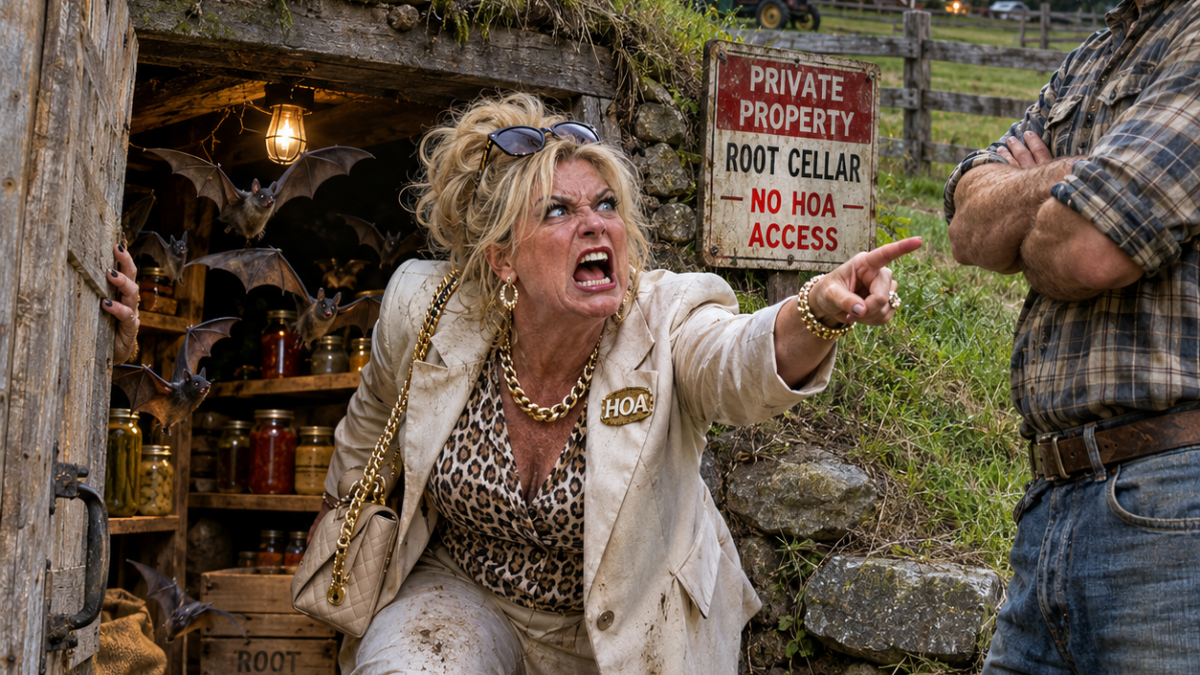
PART 2
I leaned closer to the monitor.
For several seconds, Pamela held the tool near the keyway without moving.
My first thought was that she had finally committed herself.
My second was that I still could not tell exactly what the tool was.
Then she stopped.
She pulled it away, glanced toward the house, and returned it to the bag.
Pamela stood, circled the root cellar once, tested one hinge with her fingers, then walked back toward the fence.
She disappeared into darkness.
I remained in my chair.
The monitor showed an empty yard again.
Only then did I realize I had been holding my breath.
I wrote the time down.
**2:30 a.m. — PT approached with bag. Small metal tool held near lock. No entry. Retreated.**
I sat there another ten minutes.
Nothing.
The reasonable part of my brain told me to call the police.
The angry part wanted to go across the street and demand to know what the hell she thought she was doing.
I did neither.
Not because I enjoyed waiting.
Because I knew Pamela.
Confronting her then would give her another story.
I threatened her.
I followed her.
I misunderstood her.
She was inspecting something for community safety.
She had spent eighteen months making implications look more powerful than facts.
I did not want implication.
I wanted a line so clear nobody could pretend not to see it.
The next morning, I called Dennis.
“I think she brought lock tools last night.”
There was silence.
“You *think*?”
“The camera angle wasn’t good enough.”
“Then don’t call it a lockpick.”
“I didn’t.”
“Good.”
“I said a small metal tool.”
Dennis sighed.
“You’re learning.”
“I hate that sentence.”
“You’re welcome.”
I described everything.
When I finished, he said, “Upgrade your security.”
“That was my plan.”
“Cameras?”
“Inside and outside.”
“Cloud backup.”
“Obviously.”
“And Zach?”
“Yeah?”
“Do not make the cellar easier to enter.”
I frowned.
“Why would I?”
“Because you’re angry.”
“So?”
“So angry people sometimes get clever.”
“I’m not setting a trap.”
“I know. Keep it that way.”
He paused.
“Your job is to secure your property, not invite her into it.”
That distinction mattered.
I installed two cameras inside the root cellar over the next three days.
One was visible if somebody entered and looked toward the upper corner.
The second was hidden behind stacked storage boxes along the opposite wall.
Both uploaded automatically.
I added motion sensors.
Tested night vision.
Checked every angle.
The cellar itself was small.
About twelve feet by fifteen.
Stone walls.
Shelving.
A wine rack.
Old tools.
Boxes of property records.
Nothing Pamela would have found interesting if she were a normal person.
But normal curiosity was not driving her anymore.
She had convinced herself the cellar contained the answer to me.
That was the dangerous part.
Once someone believes you are guilty, privacy starts looking like evidence.
A locked door becomes suspicious.
A refusal becomes proof.
An ordinary box becomes something that must contain a secret.
I had watched Pamela build that logic publicly for months.
Now I was seeing what it looked like privately.
I went back through the timeline.
It had started eighteen months earlier with a $2,500 special assessment for community gate upgrades.
The amount bothered me.
Not because the gate did not need work.
Because the HOA offered almost no supporting financial detail.
I asked for bids.
Pamela refused.
I requested the budget.
Delayed.
I asked whether owners had voted.
She told me the board had authority.
The bylaws said otherwise.
I formally objected.
Two months later, my grass suddenly became a problem.
Half an inch too tall, according to the violation photograph.
I appealed.
The fine disappeared.
Then came my tenants’ parking.
Then rental restrictions.
Then inspections.
Every time one tactic failed, another appeared.
By the time she became interested in the cellar, I already had a thick file.
Pamela thought I was secretive.
The truth was almost the opposite.
I documented everything because I did not trust her to remember events the way they happened.
That habit turned out to be the only reason I stayed sane.
Three days after the security upgrade, another certified letter arrived.
**EMERGENCY PROPERTY INSPECTION REQUIRED**
I almost laughed.
Then I read it.
Pamela cited Article 12.7 of the Maplewood Estates bylaws.
She claimed there were documented safety concerns involving my root cellar and both rental properties.
I had seventy-two hours to permit a full HOA inspection.
If I refused:
Daily fines.
Lien proceedings.
Additional enforcement.
I opened the bylaws.
Article 12.7 did exist.
But it did not say what Pamela said.
The provision applied to verified emergencies involving municipal authorities.
Fire department.
Building inspector.
Code enforcement.
It did not grant the HOA president a master key to private property because she had a bad feeling.
I drafted my answer.
I quoted the actual language.
Attached the old county survey showing the cellar had existed decades before the HOA.
Restated that my rental properties were legally maintained.
Declined entry.
Then I added something Pamela probably disliked more than any refusal.
My fourth request for financial records.
The earlier three had gone unanswered.
I copied the entire board.
Including Ralph Castillo.
Return receipt requested.
Then I waited.
Thursday passed.
Friday.
Saturday.
The seventy-two-hour deadline expired Sunday evening.
Nothing happened.
No new letter.
No security patrol.
No Pamela at my door.
For the first time in weeks, I wondered whether she had finally understood.
That thought lasted until Tuesday.
At 2:23 in the morning, my phone buzzed.
Motion alert.
I was awake already, reviewing an application for one of the rental houses.
I opened the camera feed.
Pamela entered my backyard.
Dark clothes.
Large bag.
Flashlight.
But this time she did not wander.
She did not study the property.
She walked directly to the root cellar.
There was certainty in her body language.
The kind that appears after someone has argued with themselves long enough to make a bad decision feel righteous.
She knelt.
Opened the bag.
Pulled out tools.
And started working on the lock.
My hands went cold.
Not because I was surprised.
Because anticipation and reality are different things.
You can expect somebody to cross a line for weeks.
The moment they actually do, some part of you still thinks:
*Stop.*
Pamela worked for nearly three minutes.
I watched every second.
At 2:26 a.m., the lock gave.
The wooden door moved.
Then Pamela Torres stepped inside my root cellar.
I reached for my phone.
Dialed 911.
The dispatcher answered.
“911. What’s the address of your emergency?”
I gave it.
“There’s a break-in in progress on my property.”
“Are you in immediate danger?”
“No. I’m inside my house.”
“Can you see the intruder?”
“Yes.”
“How?”
“Security cameras.”
“Do you know the person?”
“Yes.”
I swallowed.
“Pamela Torres.”
“Relationship to you?”
“She’s the president of my HOA.”
There was a tiny pause.
Not judgment.
Probably just surprise.
“She picked the lock on an outbuilding behind my house and entered without permission.”
“Do not confront her.”
“I won’t.”
“Officers are being dispatched.”
I stayed on the phone.
Then opened the interior feed.
Pamela’s flashlight swept across the cellar.
Wine.
Shelves.
Tool rack.
Boxes.
She moved immediately toward the records.
That answered one question.
She was not there because she feared structural collapse.
She was searching.
Pamela opened the first box.
Maintenance logs.
She flipped through pages.
Photographed several with her phone.
Next box.
Rental leases.
More photographs.
Then insurance documents.
I felt anger rising.
Those records contained tenant information.
Names.
Phone numbers.
Emergency contacts.
Financial details.
Not secrets.
Private information.
She photographed page after page.
The dispatcher asked what she was doing.
“Going through documents.”
“Is she removing anything?”
“Not yet.”
“Stay inside.”
“I am.”
Onscreen, Pamela moved another box.
Then she stopped.
Her flashlight rose.
She had seen the visible camera.
I watched recognition hit her face.
First confusion.
Then shock.
Then fury.
She stared directly into the lens.
For one moment, Pamela and I were almost looking at each other.
Then she dragged a wooden crate across the floor.
Climbed onto it.
Reached up.
And ripped the camera from the wall.
The first feed went black.
The dispatcher heard me exhale.
“What happened?”
“She found one camera.”
“One?”
“She destroyed it.”
“You have another?”
“Yes.”
“Do not tell her.”
“I’m not talking to her.”
The hidden feed continued perfectly.
Pamela stepped down.
She held the damaged camera in her hand.
Looked at it.
Then dropped it.
Her breathing looked heavy now.
She scanned the cellar.
Searching for another lens.
She did not find it.
For a normal person, discovering that they had been recorded breaking into private property would have been the moment to leave.
Pamela returned to the boxes.
That told me something frightening about her state of mind.
She still thought finding evidence against me could somehow justify what she had already done.
She became faster.
Messier.
Folders opened.
Pages spread across the floor.
Photographs taken.
At 2:41, flashing red and blue light appeared faintly through the open cellar door.
Pamela did not notice immediately.
She was bent over an insurance file.
Then a flashlight swept across the backyard.
She froze.
The expression on her face changed.
That was the first time I saw fear.
Not irritation.
Not wounded authority.
Fear.
She moved toward the door.
Fast.
A police voice cut across the yard.
“Police! Stop! Show me your hands!”
Pamela emerged halfway.
Stopped.
I stepped out through my back door slowly with both hands visible.
An officer near the side of the house gestured.
“Homeowner?”
“Yes.”
“Stay there.”
“I will.”
Another officer focused on Pamela.
“Put the bag down.”
Pamela pointed toward me.
“This is a setup!”
“Ma’am, put the bag down.”
“I have authority to inspect.”
“Bag down.”
“I am the HOA president.”
The officer did not react.
“That does not change my instruction.”
Pamela lowered the bag.
“I have emergency access authority.”
I stayed where I was.
The officer nearest me asked quietly, “Do you know her?”
“Yes. Pamela Torres.”
“She has permission to be on the property?”
“No.”
“Permission to enter the cellar?”
“No.”
“Did you give her the key?”
“No. She picked the lock.”
“You have that recorded?”
“Every second.”
The officer nodded.
“What’s your name?”
“Zachary Adams.”
“I’m Sergeant James Rodriguez.”
He looked toward Pamela.
Then back at me.
“Stay here while we secure the scene.”
Pamela kept talking.
That was her first major mistake after the break-in.
Her second was believing the word *HOA* would impress a police sergeant.
“Article 12.7 gives the association emergency inspection authority.”
Rodriguez asked, “Is there a fire?”
“No.”
“Gas leak?”
“No.”
“Structural collapse?”
“There are concerns.”
“Verified by whom?”
“The HOA.”
Rodriguez stared.
“Did a city inspector authorize you to enter?”
Pamela hesitated.
“No, but—”
“Fire department?”
“No.”
“Law enforcement?”
“No.”
“Did the owner?”
“He refused.”
Rodriguez nodded slowly.
“So you knew you did not have his consent.”
Pamela realized too late where the questions had gone.
“He’s hiding something.”
“That is not what I asked.”
The other officer walked toward the cellar.
Pamela looked at me.
“You did this.”
I answered once.
“You came into my yard.”
“You’ve been baiting me for months.”
“I locked my door.”
“That’s not bait.”
Rodriguez turned toward me.
“Mr. Adams.”
I stopped talking.
He was right.
Nothing useful would come from debating Pamela in my backyard at three in the morning.
The second officer returned holding the broken camera.
“Sergeant.”
Rodriguez looked at it.
“Found inside.”
He turned to Pamela.
“Did you damage this?”
“It was illegally recording me.”
“In his cellar?”
She said nothing.
“On his property?”
Still nothing.
Rodriguez looked back toward me.
“You said there’s a second camera.”
I showed him the phone.
The footage started with Pamela at the lock.
He watched silently.
Lock tools.
Entry.
Document search.
Camera destruction.
Continued search.
After perhaps a minute, he stopped the video.
“That’s enough for now.”
Pamela’s face had gone pale.
Rodriguez asked:
“Mr. Adams, do you want to pursue charges related to the entry and property damage?”
“Yes.”
Pamela snapped:
“You can’t do this.”
I looked at her.
“I didn’t.”
“You planned this.”
“I installed cameras in a building you kept trying to enter.”
“You knew I’d come.”
“I hoped you wouldn’t.”
That was the truth.
People would later assume I wanted the dramatic ending.
I did not.
I wanted her to stop.
If Pamela had never returned to the cellar, I would have been happy to spend the rest of my life with unnecessary cameras recording bottles of wine.
She made the final choice.
The officer placed her in handcuffs while they continued investigating.
Neighbors had begun appearing.
Lights came on.
Doors opened.
Dennis stood near his driveway.
Susan Miller was on her porch.
Ralph Castillo appeared wearing pajama pants and a jacket thrown over a T-shirt.
Pamela saw him.
“Ralph!”
He did not move.
“Tell them!”
He looked miserable.
“Tell them the board authorized inspections.”
Ralph finally spoke.
“We authorized requests.”
Pamela’s expression changed.
“What?”
“Requests, Pamela.”
“We discussed emergency access.”
“We discussed the bylaw.”
“You agreed.”
“No.”
His voice became firmer.
“I agreed we could ask Zach to let an inspector look.”
Pamela stared at him.
“We never authorized you to pick his lock.”
The silence afterward hurt her more than shouting would have.
For years, Ralph had stood beside her at meetings.
Now, in front of police and neighbors, he refused to rewrite history.
Pamela looked around.
The crowd that had once believed her implications was watching her in handcuffs.
One officer opened the bag she had carried.
He inventoried the contents.
Flashlight.
Lock tools.
Phone.
Printed pages about landlord regulations.
Tax rules.
Rental-property requirements.
Then a notebook.
Rodriguez opened it.
His expression changed.
“What is this?”
Pamela said nothing.
He flipped pages.
I could not see them.
Then he looked toward me.
“Mr. Adams, how long has she been approaching your property?”
“Several weeks at night. Harassment generally? About eighteen months.”
Rodriguez looked back at the notebook.
“Dates.”
Another page.
“Times.”
He read silently.
Then asked Pamela:
“Why do you have notes about when Mr. Adams leaves his house?”
Her answer came quickly.
“HOA due diligence.”
Rodriguez’s face stayed neutral.
“What about his tenants’ schedules?”
“Community safety.”
“How often he visits each rental?”
“Compliance monitoring.”
Dennis, standing behind the property line, muttered something I could not hear.
Rodriguez closed the notebook.
“This will be reviewed.”
Pamela’s voice rose.
“I was protecting this neighborhood.”
Susan Miller finally spoke from the edge of my yard.
“No.”
Everyone turned.
Susan stood in a robe with her arms folded.
“You were protecting yourself.”
Pamela stared at her.
Susan did not look away.
“You did the same thing to me.”
“This isn’t about you.”
“It was always about anyone who told you no.”
Pamela laughed harshly.
“You’re still angry about your dogs?”
“I’m angry that you lied.”
Rodriguez stepped between them.
“Everyone needs to give us space.”
Susan stepped back.
Pamela kept talking.
Six years.
Community service.
Property values.
Dangerous landlords.
Uncooperative homeowners.
She repeated the same words she had used in meetings.
But they sounded different beside a broken lock.
Context changes language.
“Community safety” sounds responsible at a podium.
It sounds less responsible when you are holding lockpicks in someone else’s backyard at three in the morning.
The patrol car door eventually closed behind her.
The neighborhood stood silent.
No cheers.
No applause.
Just people looking at one another as if they had all woken up in the same unfamiliar place.
Dennis approached after police finished the first round of documentation.
“You okay?”
“I think so.”
“You look terrible.”
“Three in the morning.”
“That’ll do it.”
I looked at the notebook now sealed as evidence.
“She tracked me.”
Dennis nodded.
“Looks like it.”
“My tenants too.”
“That matters.”
“I knew she watched.”
“Not like that.”
“No.”
Susan joined us.
“I’ll give a statement.”
I looked at her.
“You don’t have to.”
“Yes.”
She spoke quietly.
“I do.”
Three years earlier, Pamela fined Susan $500 over alleged dog-noise violations.
No documented complaints.
No recordings.
No witnesses.
When Susan appealed, Pamela described her publicly as unstable.
Susan eventually won reimbursement through small claims court.
But by then, the neighborhood had absorbed the story.
Susan stopped attending gatherings.
Stopped challenging anything.
“I should’ve spoken sooner,” she said.
“You were protecting yourself.”
“I was hiding.”
“Sometimes those are the same thing.”
She looked toward the departing patrol car.
“Not anymore.”
The next morning, I walked into the cellar.
Police had finished processing the scene.
The lock was destroyed.
Documents lay where Pamela had dropped them.
The visible camera hung broken from its cable.
Wine bottles sat untouched.
I stood in the middle.
Eighteen months.
All that obsession.
All those accusations.
For this.
Paper.
Wine.
Maintenance files.
Nothing dramatic.
That was almost the strangest part.
Pamela had risked everything searching for a secret that existed only because she needed one to exist.
I cleaned slowly.
Every document photographed before I moved it.
Damaged property documented.
Lock replaced.
New camera mounted.
By afternoon, the cellar looked normal again.
The neighborhood did not.
News traveled quickly.
Pamela was released while the criminal case moved forward, subject to conditions keeping her away from me and my properties.
The online community group exploded.
Some people apologized immediately.
Others defended her.
One post said:
**There must be more to this story. Pamela has served Maplewood for six years.**
Dennis sent me a screenshot.
I stared at it.
Then deleted it.
“What did you answer?” he asked later.
“Nothing.”
“Good.”
“Feels strange.”
“What?”
“Not defending myself.”
Dennis leaned back in his chair.
“You have body-camera reports, two security videos, a broken lock, damaged camera, a notebook, and witnesses.”
He smiled.
“You don’t need to win Facebook.”
He was right.
The first emergency HOA meeting without Pamela took place that Saturday.
Nearly sixty residents packed into a room designed for forty.
I sat in the back.
Ralph chaired.
He looked like a man who had slept badly all week.
“I need to start with something.”
The room quieted.
“I failed.”
No one expected that.
Ralph continued.
“I let too many things happen because I told myself staying on the board allowed me to moderate Pamela.”
He swallowed.
“Sometimes it did.”
“Mostly, I think it made me feel better about not opposing her.”
The room stayed silent.
Susan spoke first.
She told her story.
Dog fine.
Appeal.
Retaliation.
Small claims court.
Isolation.
Then a young couple spoke.
Three-hundred-dollar basketball-hoop fine.
They asked to see the rule.
Pamela produced a “clarification” after issuing the citation.
Another homeowner described landscaping penalties.
Another described being threatened with legal action over a satellite dish that was later determined to be permitted.
Howard Prescott stood slowly.
He was in his seventies.
His wife used a wheelchair.
His voice shook.
“My wife needed a ramp.”
Everyone knew the story partly.
Nobody knew all of it.
“Pamela denied it.”
“For aesthetics.”
Howard paused.
“She made my wife climb three steps for almost three months.”
A woman near the front whispered:
“Oh my God.”
Howard continued.
“I threatened legal action.”
“Then suddenly the ramp became acceptable.”
He sat down.
Nobody spoke for several seconds.
That meeting became less about Pamela’s break-in and more about years of accumulated silence.
Each person thought their experience was isolated.
That was her strength.
One target at a time.
One fine.
One whisper.
One insinuation.
Never enough for the whole neighborhood to see the pattern.
Until we compared notes.
Then came the money.
Barbara Hughes, a retired accountant who lived on Elm Court, had volunteered to review HOA records after Pamela’s arrest.
The same records I had requested repeatedly.
Records Pamela always found a reason not to produce.
Barbara stood with a folder.
“I want to be careful.”
That sentence immediately made me trust her.
“These are preliminary findings.”
She looked toward Ralph.
“Approximately forty-seven thousand dollars in spending categories lack adequate supporting documentation.”
A murmur moved through the room.
Barbara raised a hand.
“I am not saying forty-seven thousand dollars was stolen.”
The room quieted.
“I am saying the records currently available do not sufficiently establish where that money went.”
She listed categories.
Legal reserve.
Administrative services.
Special projects.
Consulting.
Then she reached the gate assessment.
The $2,500 charge that had started my conflict with Pamela.
The contractor was owned by Pamela’s brother-in-law.
No competing bids.
Incomplete invoices.
No clear reconciliation between the assessment revenue and final project cost.
I looked at Dennis.
He was already writing notes.
Barbara continued.
“We need an independent forensic review.”
Ralph asked:
“Do we need an attorney?”
Dennis answered from the front.
“Yes.”
“Independent counsel.”
“Not anyone who previously represented Pamela personally or the board under her direction.”
Someone called out:
“Police?”
Dennis chose his words carefully.
“If the financial review establishes evidence of criminal conduct, counsel can advise the board regarding reporting obligations and referrals.”
That was why Dennis was useful.
He never turned suspicion into certainty.
Pamela had spent years doing exactly that.
By the end of the meeting, residents voted overwhelmingly to install Ralph as interim president.
Not because everyone loved him.
Because he admitted his failures.
His first motion was simple.
Release the financial records.
All of them.
Second:
Suspend disputed enforcement actions initiated solely under Pamela’s authority.
Third:
Hire independent legal counsel and a forensic accountant.
Fourth:
Create a temporary committee to review the bylaws for sections that had been repeatedly misused.
The room approved all four.
Afterward, people approached me.
Some apologized.
A man named Greg looked at the floor while speaking.
“I believed her.”
“I know.”
“I told my wife you were probably committing tax fraud.”
I almost smiled.
“Based on what?”
He looked embarrassed.
“The cellar.”
“That was enough?”
“When you say it like that…”
“I’m not trying to embarrass you.”
“No.”
He shook his head.
“I embarrassed myself.”
I held out my hand.
He shook it.
Another woman admitted she had told neighbors my tenants were probably short-term renters.
They were not.
A couple apologized for avoiding the Martinez family.
I accepted each apology.
But I did not tell them everything was fine.
It was not.
Pamela’s arrest did not repair eighteen months of reputation damage.
The Martinez family had considered moving.
Mrs. Martinez told me so when I visited.
“We were afraid she’d keep coming.”
“She won’t.”
“I know.”
She looked toward the front window.
“My kids started thinking we were doing something wrong.”
That hurt.
“You weren’t.”
“We know now.”
“I should’ve protected you sooner.”
“You did.”
“No.”
I shook my head.
“I documented it.”
“That is protecting us.”
I thought about that afterward.
I had spent weeks feeling passive because I did not confront Pamela.
Maybe documentation felt passive because it was quiet.
But quiet is not the same as weak.
Four months passed before the criminal case reached resolution.
The district attorney’s office sent an update through the victim-notification process.
Pamela accepted a plea agreement.
The break-in was treated through the charges supported by the investigation and the evidence.
Criminal trespass.
Criminal mischief related to the damaged camera and lock.
Privacy-related conduct connected to entering the structure and photographing private records.
The resulting sentence did not include prison.
Eighteen months of supervised probation.
A $2,500 fine.
Restitution to me for damaged property.
No-contact conditions lasting years.
One hundred hours of community service.
Anger-management requirements.
Some neighbors thought it was too light.
I did not.
Prison had never been my goal.
I wanted Pamela stopped.
She was.
The more serious financial fallout came separately.
The HOA’s forensic accountant completed the audit.
The final unsupported and misappropriated amount was calculated at $38,500.
Less than the first estimate.
Still significant.
The gate contract was only part of it.
Payments flowed to entities connected to Pamela.
Some “administrative reimbursements” lacked documentation.
Some special-assessment money never reached the projects residents had been told they were funding.
The HOA sued.
The possibility of additional criminal exposure gave Pamela strong reasons to settle.
Eventually, an agreement required repayment over thirty-six months.
She was permanently barred under the settlement terms from holding leadership roles within the association and agreed not to pursue HOA-board service elsewhere as part of resolving the dispute.
And she agreed to sell her Maplewood home.
Sixty days.
Six years of control ended with a moving truck.
I saw it by accident.
Saturday afternoon.
I was collecting mail when I noticed boxes being loaded across the street.
Pamela stood beside her car.
For the first time since her arrest, we were within sight of each other without police, lawyers, or neighbors between us.
She looked at me.
I looked back.
I expected something.
Anger.
A final accusation.
Maybe an apology.
Nothing.
Two seconds.
Then she entered her car.
The moving truck pulled away.
Pamela followed.
I never saw her again.
That should have felt like the ending.
It was not.
The harder work was rebuilding Maplewood Estates afterward.
Ralph ran for president officially.
He won with seventy-eight percent.
Dennis joined the bylaw committee but refused a board position.
“I like sleeping.”
Susan attended every open meeting.
The first time she raised her hand to challenge a proposed rule, the entire room went quiet.
She noticed.
“What?”
People laughed.
Susan smiled.
“You all got used to me being scared.”
Ralph answered:
“Not anymore.”
The revised bylaws took months.
Rental rights were clarified.
Long-term leasing remained legal.
Inspections of private property required consent unless proper outside authorities were involved.
Emergency provisions were rewritten so HOA officials could not reinterpret them as private search warrants.
Financial records were required to be published quarterly.
Independent annual audits became mandatory.
A formal grievance process gave residents a route to challenge board conduct without having to fight the same people who issued the violation.
It was not perfect.
No governing document is.
But it had one important quality Pamela’s system lacked.
Limits.
The HOA finally understood the sentence I had been repeating for eighteen months:
Authority ends somewhere.
My rental business continued.
The Martinez family renewed for two years.
When Mrs. Martinez signed, she looked at me.
“You’re sure the HOA can’t just change its mind?”
“They can propose rules.”
“That’s not what I asked.”
I smiled.
“No.”
“They cannot enter your home because they feel like it.”
She nodded.
“Good.”
My other rental turned over shortly afterward.
The new tenants were a young couple with a toddler.
They knew nothing about Pamela.
I considered explaining the entire history.
Then decided against it.
They did not need to inherit our drama.
They needed a functioning house.
A clear lease.
A landlord who answered maintenance calls.
Sometimes healing means refusing to make new people carry old stories.
Dennis became an actual friend.
Our conversations stopped being entirely about property disputes.
We talked football.
Work.
His daughter’s college applications.
My complete inability to cook anything that required more than one pan.
Susan brought cookies every Christmas.
The first year, I opened the door and said:
“What do I owe you?”
She looked offended.
“Nothing.”
“No special assessment?”
She laughed so hard she nearly dropped the plate.
The root cellar remained locked.
The broken camera was replaced.
I kept the hidden camera too.
Not because I expected another Pamela.
Because after something happens once, a reasonable precaution stops feeling paranoid.
Still, the cellar slowly became ordinary again.
That took longer than I expected.
For months, every time I opened the door at night, I remembered Pamela standing inside.
Every time I saw the shelf where she had searched my documents, anger returned.
Not enormous.
Just a flicker.
My space had been violated.
Legal resolution does not erase that feeling immediately.
One evening in late May, almost a year after the break-in, I walked down with a bottle of wine I had been saving.
No dramatic reason.
It simply felt like the right night.
I opened the door.
Turned on the light.
The cellar smelled like stone and cedar.
Exactly as it had when I was a kid.
My grandparents used to keep potatoes down there.
Apples.
Carrots.
Jars of vegetables.
Grandpa once told me the cellar had saved the family money during a winter when work was scarce.
By the time I inherited the house, its practical purpose had changed.
But I kept it because removing it would have felt like deleting part of the property’s memory.
I poured a glass.
Sat on an overturned crate.
Looked around.
This was Pamela’s obsession.
Twelve by fifteen feet.
Wine.
Paper.
Tools.
An old shovel.
Nothing hidden.
Nothing criminal.
Nothing worth crossing a lawn at 2:23 in the morning with lock tools.
I tried to understand her.
Not forgive.
Understand.
Pamela had probably started with a sincere belief that she was protecting Maplewood.
I think that matters.
Nobody serves six years as HOA president by telling themselves every morning:
*I am going to abuse people today.*
It begins smaller.
Standards matter.
Property values matter.
Rules matter.
Then people praise you for enforcing them.
Neighbors come to you with complaints.
You become the person who fixes things.
Then someone says no.
That no feels less like disagreement and more like disrespect.
So you push.
It works.
Next time you push harder.
Eventually, your position stops feeling like responsibility.
It feels like ownership.
That was Pamela’s mistake.
Maplewood Estates was never hers.
Neither was Susan.
Neither was Ralph.
Neither were my tenants.
And neither was I.
She mistook jurisdiction for possession.
Then mistook suspicion for evidence.
Finally, she mistook her own certainty for legal authority.
The cellar door became the physical version of every boundary she could not tolerate.
Locked.
Private.
Outside her control.
She had to know.
And the more I refused, the more the refusal itself convinced her something was there.
That is why I never considered what happened to be a clever trap.
The cameras did not create Pamela’s obsession.
The lock did not cause the break-in.
The paperwork did not force her hand.
Every step was hers.
That distinction mattered because for months afterward, I heard people summarize the story incorrectly.
“Zach caught Pamela in a sting.”
No.
“Zach set her up.”
No.
“Zach knew she would break in.”
I suspected.
I hoped I was wrong.
There is an important difference.
A trap invites someone toward something.
I did the opposite.
I said no.
Repeatedly.
In writing.
She came anyway.
I finished the wine.
Then looked at one of the boxes Pamela had opened.
Rental records.
I pulled the top folder out.
Martinez lease.
Renewal signed.
Maintenance inspection completed.
Everything ordinary.
I smiled.
Pamela had been right about one thing.
The cellar contained evidence.
Just not evidence of my wrongdoing.
Evidence that I had done things correctly.
Evidence that her accusations had been invented.
Evidence that a landlord she called dangerous kept better records than the association she controlled.
And eventually, the cellar contained evidence of something else.
Her own choices.
I returned the folder to its place.
Closed the box.
Turned off the light.
Outside, the neighborhood was quiet.
Not tense quiet.
Ordinary quiet.
A dog barked.
A garage door closed.
Someone laughed behind an open window.
For almost two years, Maplewood had felt like enemy territory.
Now it felt like a neighborhood again.
That difference was difficult to describe unless you had lived through it.
The new board was boring.
That was a compliment.
Quarterly financial reports arrived by email.
Most people did not read them.
I did.
So did Barbara.
Every annual audit was published.
Disputes still happened.
Of course they did.
Someone complained about a fence color.
Another owner objected to tree-removal rules.
A three-hour meeting about mailbox replacements nearly caused a civil war.
Normal HOA nonsense.
But when somebody asked:
“Where does the board get authority for this?”
Nobody answered:
“Because the president said so.”
They opened the documents.
That was progress.
A year later, Ralph came to my porch.
He held an envelope.
“What’s this?”
“Refund.”
“For?”
“The illegal assessment.”
I opened it.
Part of the gate special assessment had been recovered through Pamela’s repayment and financial reconciliation.
The amount was not enormous.
It mattered anyway.
I looked at Ralph.
“You could’ve mailed this.”
“I know.”
“Why didn’t you?”
He shifted.
“Wanted to say something.”
I waited.
“I’m sorry.”
“You’ve apologized.”
“Not properly.”
He looked toward the street.
“I knew she was pushing boundaries.”
“Yes.”
“I kept telling myself I was moderating her.”
“You were sometimes.”
“Sometimes.”
He nodded.
“Mostly I was afraid if I challenged her publicly, she’d come after me.”
“She did anyway.”
“Exactly.”
His voice lowered.
“I watched her isolate Susan.”
“I watched her start on you.”
“And I told myself staying close to her would let me limit the damage.”
He looked at me.
“That wasn’t leadership.”
“No.”
“I know that now.”
I respected him more for saying it.
Leadership is easy to claim after the danger passes.
Ralph admitted what he had done while everyone still remembered.
“I don’t need you to forgive me.”
“I already did.”
His eyebrows lifted.
“That simple?”
“No.”
I smiled.
“But done.”
He held out his hand.
We shook.
As he left, I remembered Pamela yelling for him to defend her while police stood in my yard.
Ralph’s silence that night had mattered.
His honesty afterward mattered more.
Susan’s transformation was different.
She became one of the most irritating people at HOA meetings.
Again, compliment.
Every proposal got questions.
“Where is that authority?”
“Show me the language.”
“What’s the cost?”
“Who obtained bids?”
One night, Ralph finally laughed.
“Susan, you know we’re not hiding anything.”
She replied:
“Then showing it shouldn’t hurt.”
I almost applauded.
Barbara later joined the finance committee.
Nothing got past her.
A $74 landscaping discrepancy once occupied twenty minutes.
Pamela would have hated her.
That thought made me smile.
Three years after the break-in, I replaced the old cellar doors.
Not because they had failed.
Because the wood had begun to rot near the bottom.
The carpenter asked whether I wanted something modern.
Steel.
Electronic lock.
Remote access.
I considered it.
Then said:
“Wood.”
“Same style?”
“As close as you can.”
He rebuilt them using heavy cedar.
New hinges.
A strong conventional lock.
When he finished, the cellar looked almost exactly as it had in photographs from my grandparents’ time.
Dennis came over.
“You spent all that money and didn’t put in a vault door?”
“No.”
“After everything?”
“I have cameras.”
“You’re insane.”
“Probably.”
He studied the doors.
“They look good.”
“Grandpa would approve.”
We stood there for a moment.
Then Dennis asked:
“Do you ever think about her?”
“Pamela?”
“Yeah.”
“Not much.”
“Really?”
“At first.”
I looked toward the street where her house used to be.
New owners lived there now.
A family with two teenagers.
No connection to what happened.
“For a while I wanted to know whether she regretted it.”
“And now?”
“Doesn’t matter.”
Dennis nodded.
“That’s probably healthy.”
“Don’t sound so disappointed.”
“I prefer dramatic clients.”
“I was never your client.”
“You got free advice.”
“I bought coffee.”
“Exactly.”
A few months later, I received one final document related to Pamela.
Her restitution payment to the HOA had been completed early after the sale of another asset.
Ralph forwarded confirmation.
That was it.
No ceremony.
No courtroom.
No statement.
Just numbers balancing.
The accounting end of a conflict that had once dominated our entire neighborhood.
I printed the confirmation.
Then almost laughed at myself.
“Documentation,” I muttered.
Some habits never leave.
I filed it.
Not in the root cellar.
In my office.
That night I walked outside.
Frost had started forming on the grass.
The same kind of cold night as the first time I watched Pamela approach the cellar.
I stood near the fence.
Looked toward the door.
For a second, memory filled the yard.
Flashlight.
Dark clothes.
A figure crouching at the lock.
Then the image was gone.
Just cedar doors.
Stone.
Moonlight.
I checked my phone.
The camera system was online.
I did not open the feed.
I did not need to.
I went inside.
That might sound insignificant.
It was not.
For months after Pamela’s arrest, I checked those cameras constantly.
Before bed.
After waking.
During dinner.
At work.
Whenever my phone buzzed.
Being watched had taught me to watch back.
That was another thing she had taken from me without realizing it.
Ease.
The assumption that darkness outside your window is just darkness.
Getting that back took longer than any court case.
But eventually, I stopped checking.
The Martinez family stayed another year, then bought a house nearby.
When they moved, Mrs. Martinez hugged me.
“You know what my husband said?”
“What?”
“That Pamela accidentally made us appreciate good landlords.”
I laughed.
“That’s a terrible compliment.”
“It’s true.”
Their son, Mateo, had been nine when Pamela started appearing at their door.
On moving day, he asked:
“Is that the famous cellar?”
I looked at his mother.
She covered her face.
“My husband told him.”
I sighed.
“Yes.”
“What was inside?”
“Paperwork.”
Mateo looked deeply disappointed.
“That’s it?”
“And wine.”
“That’s not scary.”
“No.”
He frowned.
“Then why did she break in?”
I looked toward the cellar.
How do you explain obsession to a kid?
Finally I said:
“She decided there had to be something bad in there.”
“But there wasn’t.”
“No.”
“So she was wrong.”
“Yes.”
He shrugged.
“That’s dumb.”
His mother laughed.
Children are excellent at simplifying adult disasters.
When they drove away, I stood in the empty rental house.
The rooms echoed.
Another family would move in.
Another lease.
Another set of maintenance calls.
Life continuing.
That was the part Pamela never understood.
She saw rentals as threats to community stability.
But the Martinez family had been part of Maplewood.
They attended barbecues.
Their kids played with neighbors.
They collected mail when I traveled.
Ownership status did not determine belonging.
Behavior did.
Pamela owned her house.
And did more damage to Maplewood than any tenant I ever rented to.
That irony stayed with me.
Years passed.
The root cellar remained.
My records gradually became digital, so fewer boxes filled the shelves.
The wine collection grew.
Grandpa would have called that decline.
One evening, Susan brought over an old photograph she found while cleaning.
It showed my grandparents standing near the cellar in the late 1970s.
My grandfather held a crate of potatoes.
Grandma looked annoyed with the camera.
On the back, in her handwriting:
**Frank thinks this cellar will outlast all of us.**
Susan smiled.
“Looks like Frank was right.”
I ran my thumb over the photograph.
“He usually was.”
“You keeping it?”
“Absolutely.”
I framed it.
It hangs in the cellar now.
Near the shelf Pamela searched first.
Not as a statement about her.
As a reminder that the space existed long before she became obsessed with it and remained long after she left.
That is the thing about people who confuse authority with permanence.
They think the current moment belongs to them.
It rarely does.
Pamela controlled Maplewood for six years.
My family’s cellar had stood there since 1943.
It did not need to defeat her.
It just needed to remain.
On the fifth anniversary of the break-in, Dennis remembered the date before I did.
He texted:
**Cellar Day. Wine?**
I replied:
**That is a terrible holiday.**
He came over anyway.
Susan did too.
Then Ralph.
Four of us sat in the backyard.
Nobody discussed Pamela for the first hour.
That felt right.
Eventually, Ralph raised his glass.
“To locks.”
Susan shook her head.
“To cameras.”
Dennis said:
“To legal counsel.”
I looked at all three.
“You people are ridiculous.”
Susan smiled.
“What’s your toast?”
I thought about it.
Then looked at the cellar.
“To people finally minding their own business.”
We drank.
Later, after they left, I carried the glasses inside.
The yard was quiet.
I opened the root cellar one last time.
Not because I needed anything.
I simply wanted to look.
Stone walls.
Shelves.
Wine.
A framed photograph of my grandparents.
A few remaining property files.
Ordinary.
That was the nightmare waiting for Pamela.
Not a monster.
Not a trap.
Not some hidden crime she could expose.
The nightmare was that there was nothing inside capable of justifying what she had done.
Only proof that I had respected the rules while she kept breaking them.
Only cameras recording choices she believed her title protected.
Only documents that eventually showed how far her authority actually reached.
And how far it did not.
I closed the door.
Turned the key.
The lock clicked.
For years, that sound had reminded me of keeping Pamela out.
That night, it meant something simpler.
The cellar was closed because I wanted it closed.
My property.
My choice.
No explanation required.
I walked back toward the house while the porch light cast a narrow path across the lawn.
Behind me stood a root cellar built by my family more than eighty years earlier.
Ahead of me was a neighborhood that had finally learned that community did not mean surrendering every boundary to whoever held a title.
Pamela was gone.
My tenants were safe.
The financial records were public.
The HOA had limits.
And I was still here.
That was enough.
At 11:47 that night, my security monitor lit up and showed Pamela Torres—the woman who had spent eighteen months using our HOA to fine me, threaten my tenants, question my income, and quietly convince half the neighborhood that I was hiding something illegal—moving along my back fence with a flashlight pointed at the ground as she headed straight for the root cellar behind my house. She had already tried inspections, invented violations, special assessments, whispered accusations, and a failed bylaw change designed to push landlords like me out of Maplewood Estates, but watching the HOA president crouch beside a structure my family had owned since 1943 and run her fingers over the lock made me realize that paperwork was no longer enough for her. I stayed in my dark office and watched without confronting her, because the way Pamela examined that door told me she was preparing to cross a boundary she could never explain away afterward.
My name is Zachary Adams, and I own three houses in Maplewood Estates, a quiet subdivision outside Denver.
The house I live in belonged to my grandparents. The other two are rental properties I bought five years ago.
Long-term rentals.
Twelve-month minimum leases.
Licensed.
Insured.
Maintained.
Nothing remotely exotic.
Pamela hated them anyway.
She had been HOA president for six years, and whenever she said the word landlord, she made it sound like she was describing mold.
Her campaign against me started small.
A grass-height fine.
A parking complaint involving one of my tenants.
An inspection request she had no authority to make.
Then came a proposal to limit rentals to ten percent of the neighborhood, a rule that would have forced owners like me into difficult choices if it passed.
It failed.
Pamela did not.
She simply changed tactics.
The strange part was her growing obsession with my root cellar.
It sat behind my main house, partially built into the slope, with heavy wooden doors and stone walls my great-grandparents had put there in 1943 to store vegetables through Colorado winters.
I kept wine down there now.
Tools.
Old family boxes.
And most importantly, organized records related to my rentals—leases, repair logs, inspection reports, insurance paperwork, and copies of correspondence with the HOA.
To Pamela, apparently, that made it sinister.
The first time she asked to inspect it, I said no.
“Why?” she demanded.
“Because it’s private property.”
“If there’s nothing improper inside, why refuse?”
“That’s not how privacy works.”
Her eyes narrowed.
“You’re unusually defensive.”
“I’m unusually familiar with the bylaws.”
That conversation changed something.
Soon neighbors were hearing that I might be operating an illegal business.
Then that I might be hiding rental income.
Then that there were “questions” about what I stored underground.
Nobody ever accused me directly.
Pamela was smarter than that.
She planted an empty space and let people fill it with their own fears.
My neighbor Dennis Bennett, a real-estate attorney who lived two doors away, told me to keep everything.
Every letter.
Every email.
Every photograph.
Every voicemail.
“She thinks her title gives her jurisdiction she doesn’t have,” he told me over coffee. “Eventually, people like that overreach.”
Now I was watching that overreach happen in real time.
Pamela reached the cellar doors.
She tested the handle.
Locked.
She leaned closer.
Her flashlight traced the hinges, the frame, the padlock.
Then she crouched.
For nearly thirty seconds, she studied the lock itself.
My hands stayed still on the desk, but my heartbeat did not.
This was her fourth nighttime visit in two weeks.
The others could theoretically have been explained as trespassing curiosity.
This felt different.
Reconnaissance.
I opened the notebook beside my keyboard.
11:47 p.m. — Pamela Torres. Fourth approach. Cellar lock examined. Attempted entry.
Onscreen, she stood.
Looked toward my house.
For one terrible second, I thought she could somehow see me behind the darkened window.
Then she turned and disappeared beyond the fence.
I did not call the police.
Not yet.
What I had was a pattern.
What I needed was certainty.
Two nights later, at 2:30 in the morning, my motion alert sounded again.
This time Pamela arrived carrying a bag.
She knelt at the cellar door, reached inside it, and brought out a small metal tool.
Then she placed it against my lock.
[END OF FACEBOOK OPENING]
[FULL STORY CONTINUATION]
I leaned closer to the monitor.
For several seconds, Pamela held the tool near the keyway without moving.
My first thought was that she had finally committed herself.
My second was that I still could not tell exactly what the tool was.
Then she stopped.
She pulled it away, glanced toward the house, and returned it to the bag.
Pamela stood, circled the root cellar once, tested one hinge with her fingers, then walked back toward the fence.
She disappeared into darkness.
I remained in my chair.
The monitor showed an empty yard again.
Only then did I realize I had been holding my breath.
I wrote the time down.
2:30 a.m. — PT approached with bag. Small metal tool held near lock. No entry. Retreated.
I sat there another ten minutes.
Nothing.
The reasonable part of my brain told me to call the police.
The angry part wanted to go across the street and demand to know what the hell she thought she was doing.
I did neither.
Not because I enjoyed waiting.
Because I knew Pamela.
Confronting her then would give her another story.
I threatened her.
I followed her.
I misunderstood her.
She was inspecting something for community safety.
She had spent eighteen months making implications look more powerful than facts.
I did not want implication.
I wanted a line so clear nobody could pretend not to see it.
The next morning, I called Dennis.
“I think she brought lock tools last night.”
There was silence.
“You think?”
“The camera angle wasn’t good enough.”
“Then don’t call it a lockpick.”
“I didn’t.”
“Good.”
“I said a small metal tool.”
Dennis sighed.
“You’re learning.”
“I hate that sentence.”
“You’re welcome.”
I described everything.
When I finished, he said, “Upgrade your security.”
“That was my plan.”
“Cameras?”
“Inside and outside.”
“Cloud backup.”
“Obviously.”
“And Zach?”
“Yeah?”
“Do not make the cellar easier to enter.”
I frowned.
“Why would I?”
“Because you’re angry.”
“So?”
“So angry people sometimes get clever.”
“I’m not setting a trap.”
“I know. Keep it that way.”
He paused.
“Your job is to secure your property, not invite her into it.”
That distinction mattered.
I installed two cameras inside the root cellar over the next three days.
One was visible if somebody entered and looked toward the upper corner.
The second was hidden behind stacked storage boxes along the opposite wall.
Both uploaded automatically.
I added motion sensors.
Tested night vision.
Checked every angle.
The cellar itself was small.
About twelve feet by fifteen.
Stone walls.
Shelving.
A wine rack.
Old tools.
Boxes of property records.
Nothing Pamela would have found interesting if she were a normal person.
But normal curiosity was not driving her anymore.
She had convinced herself the cellar contained the answer to me.
That was the dangerous part.
Once someone believes you are guilty, privacy starts looking like evidence.
A locked door becomes suspicious.
A refusal becomes proof.
An ordinary box becomes something that must contain a secret.
I had watched Pamela build that logic publicly for months.
Now I was seeing what it looked like privately.
I went back through the timeline.
It had started eighteen months earlier with a $2,500 special assessment for community gate upgrades.
The amount bothered me.
Not because the gate did not need work.
Because the HOA offered almost no supporting financial detail.
I asked for bids.
Pamela refused.
I requested the budget.
Delayed.
I asked whether owners had voted.
She told me the board had authority.
The bylaws said otherwise.
I formally objected.
Two months later, my grass suddenly became a problem.
Half an inch too tall, according to the violation photograph.
I appealed.
The fine disappeared.
Then came my tenants’ parking.
Then rental restrictions.
Then inspections.
Every time one tactic failed, another appeared.
By the time she became interested in the cellar, I already had a thick file.
Pamela thought I was secretive.
The truth was almost the opposite.
I documented everything because I did not trust her to remember events the way they happened.
That habit turned out to be the only reason I stayed sane.
Three days after the security upgrade, another certified letter arrived.
EMERGENCY PROPERTY INSPECTION REQUIRED.
I almost laughed.
Then I read it.
Pamela cited Article 12.7 of the Maplewood Estates bylaws.
She claimed there were documented safety concerns involving my root cellar and both rental properties.
I had seventy-two hours to permit a full HOA inspection.
If I refused:
Daily fines.
Lien proceedings.
Additional enforcement.
I opened the bylaws.
Article 12.7 did exist.
But it did not say what Pamela said.
The provision applied to verified emergencies involving municipal authorities.
Fire department.
Building inspector.
Code enforcement.
It did not grant the HOA president a master key to private property because she had a bad feeling.
I drafted my answer.
I quoted the actual language.
Attached the old county survey showing the cellar had existed decades before the HOA.
Restated that my rental properties were legally maintained.
Declined entry.
Then I added something Pamela probably disliked more than any refusal.
My fourth request for financial records.
The earlier three had gone unanswered.
I copied the entire board.
Including Ralph Castillo.
Return receipt requested.
Then I waited.
Thursday passed.
Friday.
Saturday.
The seventy-two-hour deadline expired Sunday evening.
Nothing happened.
No new letter.
No security patrol.
No Pamela at my door.
For the first time in weeks, I wondered whether she had finally understood.
That thought lasted until Tuesday.
At 2:23 in the morning, my phone buzzed.
Motion alert.
I was awake already, reviewing an application for one of the rental houses.
I opened the camera feed.
Pamela entered my backyard.
Dark clothes.
Large bag.
Flashlight.
But this time she did not wander.
She did not study the property.
She walked directly to the root cellar.
There was certainty in her body language.
The kind that appears after someone has argued with themselves long enough to make a bad decision feel righteous.
She knelt.
Opened the bag.
Pulled out tools.
And started working on the lock.
My hands went cold.
Not because I was surprised.
Because anticipation and reality are different things.
You can expect somebody to cross a line for weeks.
The moment they actually do, some part of you still thinks:
Stop.
Pamela worked for nearly three minutes.
I watched every second.
At 2:26 a.m., the lock gave.
The wooden door moved.
Then Pamela Torres stepped inside my root cellar.
I reached for my phone.
Dialed 911.
The dispatcher answered.
“911. What’s the address of your emergency?”
I gave it.
“There’s a break-in in progress on my property.”
“Are you in immediate danger?”
“No. I’m inside my house.”
“Can you see the intruder?”
“Yes.”
“How?”
“Security cameras.”
“Do you know the person?”
“Yes.”
I swallowed.
“Pamela Torres.”
“Relationship to you?”
“She’s the president of my HOA.”
There was a tiny pause.
Not judgment.
Probably just surprise.
“She picked the lock on an outbuilding behind my house and entered without permission.”
“Do not confront her.”
“I won’t.”
“Officers are being dispatched.”
I stayed on the phone.
Then opened the interior feed.
Pamela’s flashlight swept across the cellar.
Wine.
Shelves.
Tool rack.
Boxes.
She moved immediately toward the records.
That answered one question.
She was not there because she feared structural collapse.
She was searching.
Pamela opened the first box.
Maintenance logs.
She flipped through pages.
Photographed several with her phone.
Next box.
Rental leases.
More photographs.
Then insurance documents.
I felt anger rising.
Those records contained tenant information.
Names.
Phone numbers.
Emergency contacts.
Financial details.
Not secrets.
Private information.
She photographed page after page.
The dispatcher asked what she was doing.
“Going through documents.”
“Is she removing anything?”
“Not yet.”
“Stay inside.”
“I am.”
Onscreen, Pamela moved another box.
Then she stopped.
Her flashlight rose.
She had seen the visible camera.
I watched recognition hit her face.
First confusion.
Then shock.
Then fury.
She stared directly into the lens.
For one moment, Pamela and I were almost looking at each other.
Then she dragged a wooden crate across the floor.
Climbed onto it.
Reached up.
And ripped the camera from the wall.
The first feed went black.
The dispatcher heard me exhale.
“What happened?”
“She found one camera.”
“One?”
“She destroyed it.”
“You have another?”
“Yes.”
“Do not tell her.”
“I’m not talking to her.”
The hidden feed continued perfectly.
Pamela stepped down.
She held the damaged camera in her hand.
Looked at it.
Then dropped it.
Her breathing looked heavy now.
She scanned the cellar.
Searching for another lens.
She did not find it.
For a normal person, discovering that they had been recorded breaking into private property would have been the moment to leave.
Pamela returned to the boxes.
That told me something frightening about her state of mind.
She still thought finding evidence against me could somehow justify what she had already done.
She became faster.
Messier.
Folders opened.
Pages spread across the floor.
Photographs taken.
At 2:41, flashing red and blue light appeared faintly through the open cellar door.
Pamela did not notice immediately.
She was bent over an insurance file.
Then a flashlight swept across the backyard.
She froze.
The expression on her face changed.
That was the first time I saw fear.
Not irritation.
Not wounded authority.
Fear.
She moved toward the door.
Fast.
A police voice cut across the yard.
“Police! Stop! Show me your hands!”
Pamela emerged halfway.
Stopped.
I stepped out through my back door slowly with both hands visible.
An officer near the side of the house gestured.
“Homeowner?”
“Yes.”
“Stay there.”
“I will.”
Another officer focused on Pamela.
“Put the bag down.”
Pamela pointed toward me.
“This is a setup!”
“Ma’am, put the bag down.”
“I have authority to inspect.”
“Bag down.”
“I am the HOA president.”
The officer did not react.
“That does not change my instruction.”
Pamela lowered the bag.
“I have emergency access authority.”
I stayed where I was.
The officer nearest me asked quietly, “Do you know her?”
“Yes. Pamela Torres.”
“She has permission to be on the property?”
“No.”
“Permission to enter the cellar?”
“No.”
“Did you give her the key?”
“No. She picked the lock.”
“You have that recorded?”
“Every second.”
The officer nodded.
“What’s your name?”
“Zachary Adams.”
“I’m Sergeant James Rodriguez.”
He looked toward Pamela.
Then back at me.
“Stay here while we secure the scene.”
Pamela kept talking.
That was her first major mistake after the break-in.
Her second was believing the word HOA would impress a police sergeant.
“Article 12.7 gives the association emergency inspection authority.”
Rodriguez asked, “Is there a fire?”
“No.”
“Gas leak?”
“No.”
“Structural collapse?”
“There are concerns.”
“Verified by whom?”
“The HOA.”
Rodriguez stared.
“Did a city inspector authorize you to enter?”
Pamela hesitated.
“No, but—”
“Fire department?”
“No.”
“Law enforcement?”
“No.”
“Did the owner?”
“He refused.”
Rodriguez nodded slowly.
“So you knew you did not have his consent.”
Pamela realized too late where the questions had gone.
“He’s hiding something.”
“That is not what I asked.”
The other officer walked toward the cellar.
Pamela looked at me.
“You did this.”
I answered once.
“You came into my yard.”
“You’ve been baiting me for months.”
“I locked my door.”
“That’s not bait.”
Rodriguez turned toward me.
“Mr. Adams.”
I stopped talking.
He was right.
Nothing useful would come from debating Pamela in my backyard at three in the morning.
The second officer returned holding the broken camera.
“Sergeant.”
Rodriguez looked at it.
“Found inside.”
He turned to Pamela.
“Did you damage this?”
“It was illegally recording me.”
“In his cellar?”
She said nothing.
“On his property?”
Still nothing.
Rodriguez looked back toward me.
“You said there’s a second camera.”
I showed him the phone.
The footage started with Pamela at the lock.
He watched silently.
Lock tools.
Entry.
Document search.
Camera destruction.
Continued search.
After perhaps a minute, he stopped the video.
“That’s enough for now.”
Pamela’s face had gone pale.
Rodriguez asked:
“Mr. Adams, do you want to pursue charges related to the entry and property damage?”
“Yes.”
Pamela snapped:
“You can’t do this.”
I looked at her.
“I didn’t.”
“You planned this.”
“I installed cameras in a building you kept trying to enter.”
“You knew I’d come.”
“I hoped you wouldn’t.”
That was the truth.
People would later assume I wanted the dramatic ending.
I did not.
I wanted her to stop.
If Pamela had never returned to the cellar, I would have been happy to spend the rest of my life with unnecessary cameras recording bottles of wine.
She made the final choice.
The officer placed her in handcuffs while they continued investigating.
Neighbors had begun appearing.
Lights came on.
Doors opened.
Dennis stood near his driveway.
Susan Miller was on her porch.
Ralph Castillo appeared wearing pajama pants and a jacket thrown over a T-shirt.
Pamela saw him.
“Ralph!”
He did not move.
“Tell them!”
He looked miserable.
“Tell them the board authorized inspections.”
Ralph finally spoke.
“We authorized requests.”
Pamela’s expression changed.
“What?”
“Requests, Pamela.”
“We discussed emergency access.”
“We discussed the bylaw.”
“You agreed.”
“No.”
His voice became firmer.
“I agreed we could ask Zach to let an inspector look.”
Pamela stared at him.
“We never authorized you to pick his lock.”
The silence afterward hurt her more than shouting would have.
For years, Ralph had stood beside her at meetings.
Now, in front of police and neighbors, he refused to rewrite history.
Pamela looked around.
The crowd that had once believed her implications was watching her in handcuffs.
One officer opened the bag she had carried.
He inventoried the contents.
Flashlight.
Lock tools.
Phone.
Printed pages about landlord regulations.
Tax rules.
Rental-property requirements.
Then a notebook.
Rodriguez opened it.
His expression changed.
“What is this?”
Pamela said nothing.
He flipped pages.
I could not see them.
Then he looked toward me.
“Mr. Adams, how long has she been approaching your property?”
“Several weeks at night. Harassment generally? About eighteen months.”
Rodriguez looked back at the notebook.
“Dates.”
Another page.
“Times.”
He read silently.
Then asked Pamela:
“Why do you have notes about when Mr. Adams leaves his house?”
Her answer came quickly.
“HOA due diligence.”
Rodriguez’s face stayed neutral.
“What about his tenants’ schedules?”
“Community safety.”
“How often he visits each rental?”
“Compliance monitoring.”
Dennis, standing behind the property line, muttered something I could not hear.
Rodriguez closed the notebook.
“This will be reviewed.”
Pamela’s voice rose.
“I was protecting this neighborhood.”
Susan Miller finally spoke from the edge of my yard.
“No.”
Everyone turned.
Susan stood in a robe with her arms folded.
“You were protecting yourself.”
Pamela stared at her.
Susan did not look away.
“You did the same thing to me.”
“This isn’t about you.”
“It was always about anyone who told you no.”
Pamela laughed harshly.
“You’re still angry about your dogs?”
“I’m angry that you lied.”
Rodriguez stepped between them.
“Everyone needs to give us space.”
Susan stepped back.
Pamela kept talking.
Six years.
Community service.
Property values.
Dangerous landlords.
Uncooperative homeowners.
She repeated the same words she had used in meetings.
But they sounded different beside a broken lock.
Context changes language.
“Community safety” sounds responsible at a podium.
It sounds less responsible when you are holding lock tools in someone else’s backyard at three in the morning.
The patrol car door eventually closed behind her.
The neighborhood stood silent.
No cheers.
No applause.
Just people looking at one another as if they had all woken up in the same unfamiliar place.
Dennis approached after police finished the first round of documentation.
“You okay?”
“I think so.”
“You look terrible.”
“Three in the morning.”
“That’ll do it.”
I looked at the notebook now sealed as evidence.
“She tracked me.”
Dennis nodded.
“Looks like it.”
“My tenants too.”
“That matters.”
“I knew she watched.”
“Not like that.”
“No.”
Susan joined us.
“I’ll give a statement.”
I looked at her.
“You don’t have to.”
“Yes.”
She spoke quietly.
“I do.”
Three years earlier, Pamela fined Susan $500 over alleged dog-noise violations.
No documented complaints.
No recordings.
No witnesses.
When Susan appealed, Pamela described her publicly as unstable.
Susan eventually won reimbursement through small claims court.
But by then, the neighborhood had absorbed the story.
Susan stopped attending gatherings.
Stopped challenging anything.
“I should’ve spoken sooner,” she said.
“You were protecting yourself.”
“I was hiding.”
“Sometimes those are the same thing.”
She looked toward the departing patrol car.
“Not anymore.”
The next morning, I walked into the cellar.
Police had finished processing the scene.
The lock was destroyed.
Documents lay where Pamela had dropped them.
The visible camera hung broken from its cable.
Wine bottles sat untouched.
I stood in the middle.
Eighteen months.
All that obsession.
All those accusations.
For this.
Paper.
Wine.
Maintenance files.
Nothing dramatic.
That was almost the strangest part.
Pamela had risked everything searching for a secret that existed only because she needed one to exist.
I cleaned slowly.
Every document photographed before I moved it.
Damaged property documented.
Lock replaced.
New camera mounted.
By afternoon, the cellar looked normal again.
The neighborhood did not.
News traveled quickly.
Pamela was released while the criminal case moved forward, subject to conditions keeping her away from me and my properties.
The online community group exploded.
Some people apologized immediately.
Others defended her.
One post said:
There must be more to this story. Pamela has served Maplewood for six years.
Dennis sent me a screenshot.
I stared at it.
Then deleted it.
“What did you answer?” he asked later.
“Nothing.”
“Good.”
“Feels strange.”
“What?”
“Not defending myself.”
Dennis leaned back in his chair.
“You have police reports, two security videos, a broken lock, damaged camera, a notebook, and witnesses.”
He smiled.
“You don’t need to win Facebook.”
He was right.
Still, the silence cost me.
Two days after Pamela’s arrest, one of my tenants, Carlos Martinez, asked to meet.
He came to my main house alone.
His shoulders were tense.
“I need to ask you something.”
“Go ahead.”
“Is there anything in the cellar that could get us in trouble?”
I stared at him.
“No.”
“Nothing?”
“Wine and property records.”
“That’s all?”
“That’s all.”
Carlos looked embarrassed.
“My wife told me not to ask.”
“You should ask.”
He rubbed his palms against his jeans.
“Pamela kept saying there were tax documents.”
“There are tax records.”
His face changed.
“Normal tax records.”
I smiled.
“I pay taxes, Carlos.”
He finally laughed.
Then became serious again.
“My kids heard neighbors talking.”
“I’m sorry.”
“That’s not your fault.”
“I’m their landlord. When somebody uses my business to frighten my tenants, I take responsibility for dealing with it.”
Carlos nodded.
“We almost moved.”
That sentence hit harder than Pamela’s arrest had.
“Because of her?”
“My wife felt watched.”
“She was watched.”
“I know that now.”
He looked toward the backyard.
“Are we safe?”
“Yes.”
I said it without hesitation.
But that night I lay awake questioning whether I could actually promise it.
Pamela had been restrained from approaching the properties.
Police knew what happened.
Cameras were installed.
Legally, everything pointed in the right direction.
Still, Carlos’s question stayed with me.
Are we safe?
For the first time, I realized this conflict had moved beyond my pride.
I had two families living in homes I owned.
People who trusted me.
Children who had nothing to do with HOA politics.
Pamela had approached them because they were useful pressure points.
If I had surrendered earlier, maybe she would have left them alone.
The thought made me feel guilty.
The next morning I told Dennis.
“That’s exactly what she wanted,” he said.
“What?”
“For you to believe resistance caused the abuse.”
“It escalated after I fought her.”
“No.”
He shook his head.
“It escalated because she chose to escalate.”
“Same result.”
“Not the same responsibility.”
I knew that logically.
Emotionally was different.
Dennis leaned forward.
“If you sold tomorrow, do you think Pamela would become reasonable?”
I did not answer.
“She’d find another target.”
Susan had already proved that.
Ralph too.
Howard Prescott.
The basketball-hoop couple.
I nodded.
Dennis sat back.
“Then stop confusing surrender with protection.”
The first emergency HOA meeting without Pamela took place that Saturday.
Nearly sixty residents packed into a room designed for forty.
I sat in the back.
Ralph chaired.
He looked like a man who had slept badly all week.
“I need to start with something.”
The room quieted.
“I failed.”
No one expected that.
Ralph continued.
“I let too many things happen because I told myself staying on the board allowed me to moderate Pamela.”
He swallowed.
“Sometimes it did.”
“Mostly, I think it made me feel better about not opposing her.”
The room stayed silent.
Susan spoke first.
She told her story.
Dog fine.
Appeal.
Retaliation.
Small claims court.
Isolation.
Then a young couple spoke.
Three-hundred-dollar basketball-hoop fine.
They asked to see the rule.
Pamela produced a “clarification” after issuing the citation.
Another homeowner described landscaping penalties.
Another described being threatened with legal action over a satellite dish that was later determined to be permitted.
Howard Prescott stood slowly.
He was in his seventies.
His wife used a wheelchair.
His voice shook.
“My wife needed a ramp.”
Everyone knew the story partly.
Nobody knew all of it.
“Pamela denied it.”
“For aesthetics.”
Howard paused.
“She made my wife climb three steps for almost three months.”
A woman near the front whispered:
“Oh my God.”
Howard continued.
“I threatened legal action.”
“Then suddenly the ramp became acceptable.”
He sat down.
Nobody spoke for several seconds.
That meeting became less about Pamela’s break-in and more about years of accumulated silence.
Each person thought their experience was isolated.
That was her strength.
One target at a time.
One fine.
One whisper.
One insinuation.
Never enough for the whole neighborhood to see the pattern.
Until we compared notes.
Then came the money.
Barbara Hughes, a retired accountant who lived on Elm Court, had volunteered to review HOA records after Pamela’s arrest.
The same records I had requested repeatedly.
Records Pamela always found a reason not to produce.
Barbara stood with a folder.
“I want to be careful.”
That sentence immediately made me trust her.
“These are preliminary findings.”
She looked toward Ralph.
“Approximately forty-seven thousand dollars in spending categories lack adequate supporting documentation.”
A murmur moved through the room.
Barbara raised a hand.
“I am not saying forty-seven thousand dollars was stolen.”
The room quieted.
“I am saying the records currently available do not sufficiently establish where that money went.”
She listed categories.
Legal reserve.
Administrative services.
Special projects.
Consulting.
Then she reached the gate assessment.
The $2,500 charge that had started my conflict with Pamela.
The contractor was owned by Pamela’s brother-in-law.
No competing bids.
Incomplete invoices.
No clear reconciliation between the assessment revenue and final project cost.
I looked at Dennis.
He was already writing notes.
Barbara continued.
“We need an independent forensic review.”
Ralph asked:
“Do we need an attorney?”
Dennis answered from the front.
“Yes.”
“Independent counsel.”
“Not anyone who previously represented Pamela personally or the board under her direction.”
Someone called out:
“Police?”
Dennis chose his words carefully.
“If the financial review establishes evidence of criminal conduct, counsel can advise the board regarding reporting obligations and referrals.”
That was why Dennis was useful.
He never turned suspicion into certainty.
Pamela had spent years doing exactly that.
By the end of the meeting, residents voted overwhelmingly to install Ralph as interim president.
Not because everyone loved him.
Because he admitted his failures.
His first motion was simple.
Release the financial records.
All of them.
Second:
Suspend disputed enforcement actions initiated solely under Pamela’s authority.
Third:
Hire independent legal counsel and a forensic accountant.
Fourth:
Create a temporary committee to review the bylaws for sections that had been repeatedly misused.
The room approved all four.
Afterward, people approached me.
Some apologized.
A man named Greg looked at the floor while speaking.
“I believed her.”
“I know.”
“I told my wife you were probably committing tax fraud.”
I almost smiled.
“Based on what?”
He looked embarrassed.
“The cellar.”
“That was enough?”
“When you say it like that…”
“I’m not trying to embarrass you.”
“No.”
He shook his head.
“I embarrassed myself.”
I held out my hand.
He shook it.
Another woman admitted she had told neighbors my tenants were probably short-term renters.
They were not.
A couple apologized for avoiding the Martinez family.
I accepted each apology.
But I did not tell them everything was fine.
It was not.
Pamela’s arrest did not repair eighteen months of reputation damage.
The Martinez family had considered moving.
Mrs. Martinez told me so when I visited.
“We were afraid she’d keep coming.”
“She won’t.”
“I know.”
She looked toward the front window.
“My kids started thinking we were doing something wrong.”
That hurt.
“You weren’t.”
“We know now.”
“I should’ve protected you sooner.”
“You did.”
“No.”
I shook my head.
“I documented it.”
“That is protecting us.”
I thought about that afterward.
I had spent weeks feeling passive because I did not confront Pamela.
Maybe documentation felt passive because it was quiet.
But quiet is not the same as weak.
What happened next proved that.
A week after the emergency meeting, Ralph called me.
“I found something.”
“What?”
“Emails.”
“Pamela’s?”
“Board account archive.”
I sat down.
“What kind of emails?”
“About you.”
I waited.
“How many?”
“A lot.”
He sounded sick.
“Come to my house.”
Dennis joined us.
Ralph had printed several messages.
The first was eighteen months old.
Pamela to the board:
Adams’ rental concentration represents a long-term threat to neighborhood owner occupancy. We need to explore every lawful mechanism available to reduce his footprint.
Dennis looked at me.
“Reduce your footprint.”
“Nice phrase.”
The next email was worse.
After my successful grass-fine appeal:
He responds aggressively to enforcement. Future actions need to be coordinated so he cannot challenge them individually.
I read that twice.
Coordinated.
Not random.
Not misunderstanding.
The harassment had been strategic.
Another email followed the failed rental-cap vote.
Pamela wrote:
Direct restrictions may not be politically viable. Increased inspection pressure and compliance scrutiny may accomplish the same objective over time.
I felt something in me go cold.
Dennis read over my shoulder.
“That matters.”
Ralph looked miserable.
“I never saw these.”
“How?”
“She used the president’s admin account for some communications and only copied selected board members.”
“Who?”
“Two former members. Both moved away.”
Dennis pointed at the printouts.
“Preserve the metadata.”
“I already exported everything.”
“Good.”
The final email mentioned the root cellar.
Three months earlier.
Adams maintains a secured auxiliary space inconsistent with normal residential usage. I strongly suspect business records or other materials inside would demonstrate violations if we could gain lawful access.
Then another, sent after I refused inspection:
His resistance confirms the need for access.
I stared at that sentence.
His resistance confirms.
There it was.
The entire logic.
I refused because she had no authority.
She interpreted refusal as evidence that authority was necessary.
Dennis leaned back.
“This is going to help in the civil side.”
“What civil side?”
“You have eighteen months of targeted enforcement, interference with tenants, false accusations, attempted misuse of HOA authority, and now evidence suggesting a deliberate campaign.”
“I don’t want another lawsuit.”
“You may not need one.”
He pointed toward the records.
“But Pamela’s lawyer needs to understand these exist.”
I looked at Ralph.
He nodded slowly.
“She wasn’t enforcing rules.”
“No.”
I folded the emails.
“She was trying to make ownership unbearable.”
That realization affected me more than the break-in.
The break-in was reckless.
Emotional.
Immediate.
These emails were different.
They showed planning.
Pamela had not simply become obsessed one night.
She had spent months constructing pressure deliberately.
The fines.
Inspection demands.
Tenant visits.
Rental-cap proposal.
Whispers.
Each piece had seemed petty alone.
Together they formed a strategy.
That night, I sat in the cellar and reread the emails.
For months I had wondered whether I was being paranoid.
Now I knew I had underestimated her.
I also finally understood why she could not let the cellar go.
She needed proof.
Without it, the campaign looked exactly like what it was.
Personal.
If she found tax fraud, illegal subletting, cash records—anything—then every previous action could be rewritten as justified vigilance.
The cellar was not really about what I stored there.
It was about what Pamela needed to find there to save herself.
And when she could not find it legally, she crossed the final line.
Four months passed before the criminal case reached resolution.
The district attorney’s office sent an update through the victim-notification process.
Pamela accepted a plea agreement.
The break-in was treated through the charges supported by the investigation and the evidence.
Criminal trespass.
Criminal mischief related to the damaged camera and lock.
Privacy-related conduct connected to entering the structure and photographing private records.
The resulting sentence did not include prison.
Eighteen months of supervised probation.
A $2,500 fine.
Restitution to me for damaged property.
No-contact conditions lasting years.
One hundred hours of community service.
Anger-management requirements.
Some neighbors thought it was too light.
I did not.
Prison had never been my goal.
I wanted Pamela stopped.
She was.
The more serious financial fallout came separately.
The HOA’s forensic accountant completed the audit.
The final unsupported and misappropriated amount was calculated at $38,500.
Less than the first estimate.
Still significant.
The gate contract was only part of it.
Payments flowed to entities connected to Pamela.
Some “administrative reimbursements” lacked documentation.
Some special-assessment money never reached the projects residents had been told they were funding.
The HOA sued.
The possibility of additional criminal exposure gave Pamela strong reasons to settle.
Eventually, an agreement required repayment over thirty-six months.
She was permanently prohibited from serving on the Maplewood board again, and the settlement required her to abandon any future attempt to seek HOA leadership within the community.
And she agreed to sell her Maplewood home.
Sixty days.
Six years of control ended with a moving truck.
I saw it by accident.
Saturday afternoon.
I was collecting mail when I noticed boxes being loaded across the street.
Pamela stood beside her car.
For the first time since her arrest, we were within sight of each other without police, lawyers, or neighbors between us.
She looked at me.
I looked back.
I expected something.
Anger.
A final accusation.
Maybe an apology.
Instead, she crossed the street.
I did not move.
The no-contact restrictions had been modified as the cases concluded, but seeing her approach still made every muscle in my shoulders tighten.
She stopped several feet away.
“You got what you wanted.”
Her voice was quieter than I remembered.
“I wanted you to leave me alone.”
“You wanted me destroyed.”
“No.”
“You documented everything.”
“Yes.”
“You installed hidden cameras.”
“After you came onto my property repeatedly.”
She looked toward the cellar.
“I knew you were hiding something.”
“You found it.”
Her jaw tightened.
“You made me look insane.”
“I didn’t make you do anything.”
“That’s easy for you to say.”
“No.”
I surprised myself with how calm I sounded.
“It’s actually the hardest part of this whole thing.”
She frowned.
“What?”
“I kept wanting to believe there was something I had done that caused you to escalate.”
Pamela said nothing.
“Because if I caused it, maybe I could have stopped it.”
Her eyes shifted.
“But I didn’t pick the lock.”
“I didn’t walk into someone else’s building at two in the morning.”
“I didn’t tear down a camera.”
“I didn’t keep a notebook of somebody else’s routine.”
She looked away.
“You humiliated me.”
“You were arrested in my backyard.”
“Exactly.”
“After breaking into it.”
Her eyes flashed.
For a moment, the old Pamela returned.
Then it faded.
She looked tired.
“What was really in those boxes?”
I almost laughed.
“You still care?”
“I want to know.”
“Leases.”
“Maintenance logs.”
“Insurance.”
“Tax records.”
“Receipts.”
“That’s it?”
“That’s it.”
She stared toward the cellar for several seconds.
Then whispered:
“I thought there had to be something.”
“I know.”
Her face changed.
Not remorse.
Something closer to the first glimpse of comprehension.
“You wouldn’t let me see.”
“Because you had no right.”
“That made it worse.”
“For you.”
She nodded almost imperceptibly.
Then looked at me.
“I did care about this neighborhood.”
“I believe you.”
That surprised her.
“You do?”
“Yes.”
“I think somewhere along the way you decided caring gave you ownership.”
Pamela looked toward the moving truck.
Maybe she wanted to argue.
She did not.
Finally she said:
“I hope you’re happy.”
“I hope you stop doing this to people.”
She turned.
Walked back to her car.
The moving truck pulled away.
Pamela followed.
I never saw her again.
That should have felt like the ending.
It was not.
The harder work was rebuilding Maplewood Estates afterward.
Ralph ran for president officially.
He won with seventy-eight percent.
Dennis joined the bylaw committee but refused a board position.
“I like sleeping.”
Susan attended every open meeting.
The first time she raised her hand to challenge a proposed rule, the entire room went quiet.
She noticed.
“What?”
People laughed.
Susan smiled.
“You all got used to me being scared.”
Ralph answered:
“Not anymore.”
The revised bylaws took months.
Rental rights were clarified.
Long-term leasing remained legal.
Inspections of private property required consent unless proper outside authorities were involved.
Emergency provisions were rewritten so HOA officials could not reinterpret them as private search warrants.
Financial records were required to be published quarterly.
Independent annual audits became mandatory.
A formal grievance process gave residents a route to challenge board conduct without having to fight the same people who issued the violation.
It was not perfect.
No governing document is.
But it had one important quality Pamela’s system lacked.
Limits.
The HOA finally understood the sentence I had been repeating for eighteen months:
Authority ends somewhere.
My rental business continued.
The Martinez family renewed for two years.
When Mrs. Martinez signed, she looked at me.
“You’re sure the HOA can’t just change its mind?”
“They can propose rules.”
“That’s not what I asked.”
I smiled.
“No.”
“They cannot enter your home because they feel like it.”
She nodded.
“Good.”
My other rental turned over shortly afterward.
The new tenants were a young couple with a toddler.
They knew nothing about Pamela.
I considered explaining the entire history.
Then decided against it.
They did not need to inherit our drama.
They needed a functioning house.
A clear lease.
A landlord who answered maintenance calls.
Sometimes healing means refusing to make new people carry old stories.
Dennis became an actual friend.
Our conversations stopped being entirely about property disputes.
We talked football.
Work.
His daughter’s college applications.
My complete inability to cook anything that required more than one pan.
Susan brought cookies every Christmas.
The first year, I opened the door and said:
“What do I owe you?”
She looked offended.
“Nothing.”
“No special assessment?”
She laughed so hard she nearly dropped the plate.
The root cellar remained locked.
The broken camera was replaced.
I kept the hidden camera too.
Not because I expected another Pamela.
Because after something happens once, a reasonable precaution stops feeling paranoid.
Still, the cellar slowly became ordinary again.
That took longer than I expected.
For months, every time I opened the door at night, I remembered Pamela standing inside.
Every time I saw the shelf where she had searched my documents, anger returned.
Not enormous.
Just a flicker.
My space had been violated.
Legal resolution does not erase that feeling immediately.
One evening in late May, almost a year after the break-in, I walked down with a bottle of wine I had been saving.
No dramatic reason.
It simply felt like the right night.
I opened the door.
Turned on the light.
The cellar smelled like stone and cedar.
Exactly as it had when I was a kid.
My grandparents used to keep potatoes down there.
Apples.
Carrots.
Jars of vegetables.
Grandpa once told me the cellar had saved the family money during a winter when work was scarce.
By the time I inherited the house, its practical purpose had changed.
But I kept it because removing it would have felt like deleting part of the property’s memory.
I poured a glass.
Sat on an overturned crate.
Looked around.
This was Pamela’s obsession.
Twelve by fifteen feet.
Wine.
Paper.
Tools.
An old shovel.
Nothing hidden.
Nothing criminal.
Nothing worth crossing a lawn at 2:23 in the morning with lock tools.
I tried to understand her.
Not forgive.
Understand.
Pamela had probably started with a sincere belief that she was protecting Maplewood.
I think that matters.
Nobody serves six years as HOA president by telling themselves every morning:
I am going to abuse people today.
It begins smaller.
Standards matter.
Property values matter.
Rules matter.
Then people praise you for enforcing them.
Neighbors come to you with complaints.
You become the person who fixes things.
Then someone says no.
That no feels less like disagreement and more like disrespect.
So you push.
It works.
Next time you push harder.
Eventually, your position stops feeling like responsibility.
It feels like ownership.
That was Pamela’s mistake.
Maplewood Estates was never hers.
Neither was Susan.
Neither was Ralph.
Neither were my tenants.
And neither was I.
She mistook jurisdiction for possession.
Then mistook suspicion for evidence.
Finally, she mistook her own certainty for legal authority.
The cellar door became the physical version of every boundary she could not tolerate.
Locked.
Private.
Outside her control.
She had to know.
And the more I refused, the more the refusal itself convinced her something was there.
That is why I never considered what happened to be a clever trap.
The cameras did not create Pamela’s obsession.
The lock did not cause the break-in.
The paperwork did not force her hand.
Every step was hers.
That distinction mattered because for months afterward, I heard people summarize the story incorrectly.
“Zach caught Pamela in a sting.”
No.
“Zach set her up.”
No.
“Zach knew she would break in.”
I suspected.
I hoped I was wrong.
There is an important difference.
A trap invites someone toward something.
I did the opposite.
I said no.
Repeatedly.
In writing.
She came anyway.
I finished the wine.
Then looked at one of the boxes Pamela had opened.
Rental records.
I pulled the top folder out.
Martinez lease.
Renewal signed.
Maintenance inspection completed.
Everything ordinary.
I smiled.
Pamela had been right about one thing.
The cellar contained evidence.
Just not evidence of my wrongdoing.
Evidence that I had done things correctly.
Evidence that her accusations had been invented.
Evidence that a landlord she called dangerous kept better records than the association she controlled.
And eventually, the cellar contained evidence of something else.
Her own choices.
I returned the folder to its place.
Closed the box.
Turned off the light.
Outside, the neighborhood was quiet.
Not tense quiet.
Ordinary quiet.
A dog barked.
A garage door closed.
Someone laughed behind an open window.
For almost two years, Maplewood had felt like enemy territory.
Now it felt like a neighborhood again.
That difference was difficult to describe unless you had lived through it.
The new board was boring.
That was a compliment.
Quarterly financial reports arrived by email.
Most people did not read them.
I did.
So did Barbara.
Every annual audit was published.
Disputes still happened.
Of course they did.
Someone complained about a fence color.
Another owner objected to tree-removal rules.
A three-hour meeting about mailbox replacements nearly caused a civil war.
Normal HOA nonsense.
But when somebody asked:
“Where does the board get authority for this?”
Nobody answered:
“Because the president said so.”
They opened the documents.
That was progress.
A year later, Ralph came to my porch.
He held an envelope.
“What’s this?”
“Refund.”
“For?”
“The illegal assessment.”
I opened it.
Part of the gate special assessment had been recovered through Pamela’s repayment and financial reconciliation.
The amount was not enormous.
It mattered anyway.
I looked at Ralph.
“You could’ve mailed this.”
“I know.”
“Why didn’t you?”
He shifted.
“Wanted to say something.”
I waited.
“I’m sorry.”
“You’ve apologized.”
“Not properly.”
He looked toward the street.
“I knew she was pushing boundaries.”
“Yes.”
“I kept telling myself I was moderating her.”
“You were sometimes.”
“Sometimes.”
He nodded.
“Mostly I was afraid if I challenged her publicly, she’d come after me.”
“She did anyway.”
“Exactly.”
His voice lowered.
“I watched her isolate Susan.”
“I watched her start on you.”
“And I told myself staying close to her would let me limit the damage.”
He looked at me.
“That wasn’t leadership.”
“No.”
“I know that now.”
I respected him more for saying it.
Leadership is easy to claim after the danger passes.
Ralph admitted what he had done while everyone still remembered.
“I don’t need you to forgive me.”
“I already did.”
His eyebrows lifted.
“That simple?”
“No.”
I smiled.
“But done.”
He held out his hand.
We shook.
As he left, I remembered Pamela yelling for him to defend her while police stood in my yard.
Ralph’s silence that night had mattered.
His honesty afterward mattered more.
Susan’s transformation was different.
She became one of the most irritating people at HOA meetings.
Again, compliment.
Every proposal got questions.
“Where is that authority?”
“Show me the language.”
“What’s the cost?”
“Who obtained bids?”
One night, Ralph finally laughed.
“Susan, you know we’re not hiding anything.”
She replied:
“Then showing it shouldn’t hurt.”
I almost applauded.
Barbara later joined the finance committee.
Nothing got past her.
A seventy-four-dollar landscaping discrepancy once occupied twenty minutes.
Pamela would have hated her.
That thought made me smile.
Three years after the break-in, I replaced the old cellar doors.
Not because they had failed.
Because the wood had begun to rot near the bottom.
The carpenter asked whether I wanted something modern.
Steel.
Electronic lock.
Remote access.
I considered it.
Then said:
“Wood.”
“Same style?”
“As close as you can.”
He rebuilt them using heavy cedar.
New hinges.
A strong conventional lock.
When he finished, the cellar looked almost exactly as it had in photographs from my grandparents’ time.
Dennis came over.
“You spent all that money and didn’t put in a vault door?”
“No.”
“After everything?”
“I have cameras.”
“You’re insane.”
“Probably.”
He studied the doors.
“They look good.”
“Grandpa would approve.”
We stood there for a moment.
Then Dennis asked:
“Do you ever think about her?”
“Pamela?”
“Yeah.”
“Not much.”
“Really?”
“At first.”
I looked toward the street where her house used to be.
New owners lived there now.
A family with two teenagers.
No connection to what happened.
“For a while I wanted to know whether she regretted it.”
“And now?”
“Doesn’t matter.”
Dennis nodded.
“That’s probably healthy.”
“Don’t sound so disappointed.”
“I prefer dramatic clients.”
“I was never your client.”
“You got free advice.”
“I bought coffee.”
“Exactly.”
A few months later, I received one final document related to Pamela.
Her restitution payment to the HOA had been completed early after the sale of another asset.
Ralph forwarded confirmation.
That was it.
No ceremony.
No courtroom.
No statement.
Just numbers balancing.
The accounting end of a conflict that had once dominated our entire neighborhood.
I printed the confirmation.
Then almost laughed at myself.
“Documentation,” I muttered.
Some habits never leave.
I filed it.
Not in the root cellar.
In my office.
That night I walked outside.
Frost had started forming on the grass.
The same kind of cold night as the first time I watched Pamela approach the cellar.
I stood near the fence.
Looked toward the door.
For a second, memory filled the yard.
Flashlight.
Dark clothes.
A figure crouching at the lock.
Then the image was gone.
Just cedar doors.
Stone.
Moonlight.
I checked my phone.
The camera system was online.
I did not open the feed.
I did not need to.
I went inside.
That might sound insignificant.
It was not.
For months after Pamela’s arrest, I checked those cameras constantly.
Before bed.
After waking.
During dinner.
At work.
Whenever my phone buzzed.
Being watched had taught me to watch back.
That was another thing she had taken from me without realizing it.
Ease.
The assumption that darkness outside your window is just darkness.
Getting that back took longer than any court case.
But eventually, I stopped checking.
The Martinez family stayed another year, then bought a house nearby.
When they moved, Mrs. Martinez hugged me.
“You know what my husband said?”
“What?”
“That Pamela accidentally made us appreciate good landlords.”
I laughed.
“That’s a terrible compliment.”
“It’s true.”
Their son, Mateo, had been nine when Pamela started appearing at their door.
On moving day, he asked:
“Is that the famous cellar?”
I looked at his mother.
She covered her face.
“My husband told him.”
I sighed.
“Yes.”
“What was inside?”
“Paperwork.”
Mateo looked deeply disappointed.
“That’s it?”
“And wine.”
“That’s not scary.”
“No.”
He frowned.
“Then why did she break in?”
I looked toward the cellar.
How do you explain obsession to a kid?
Finally I said:
“She decided there had to be something bad in there.”
“But there wasn’t.”
“No.”
“So she was wrong.”
“Yes.”
He shrugged.
“That’s dumb.”
His mother laughed.
Children are excellent at simplifying adult disasters.
When they drove away, I stood in the empty rental house.
The rooms echoed.
Another family would move in.
Another lease.
Another set of maintenance calls.
Life continuing.
That was the part Pamela never understood.
She saw rentals as threats to community stability.
But the Martinez family had been part of Maplewood.
They attended barbecues.
Their kids played with neighbors.
They collected mail when I traveled.
Ownership status did not determine belonging.
Behavior did.
Pamela owned her house.
And did more damage to Maplewood than any tenant I ever rented to.
That irony stayed with me.
Years passed.
The root cellar remained.
My records gradually became digital, so fewer boxes filled the shelves.
The wine collection grew.
Grandpa would have called that decline.
One evening, Susan brought over an old photograph she found while cleaning.
It showed my grandparents standing near the cellar in the late 1970s.
My grandfather held a crate of potatoes.
Grandma looked annoyed with the camera.
On the back, in her handwriting:
Frank thinks this cellar will outlast all of us.
Susan smiled.
“Looks like Frank was right.”
I ran my thumb over the photograph.
“He usually was.”
“You keeping it?”
“Absolutely.”
I framed it.
It hangs in the cellar now.
Near the shelf Pamela searched first.
Not as a statement about her.
As a reminder that the space existed long before she became obsessed with it and remained long after she left.
That is the thing about people who confuse authority with permanence.
They think the current moment belongs to them.
It rarely does.
Pamela controlled Maplewood for six years.
My family’s cellar had stood there since 1943.
It did not need to defeat her.
It just needed to remain.
On the fifth anniversary of the break-in, Dennis remembered the date before I did.
He texted:
Cellar Day. Wine?
I replied:
That is a terrible holiday.
He came over anyway.
Susan did too.
Then Ralph.
Four of us sat in the backyard.
Nobody discussed Pamela for the first hour.
That felt right.
Eventually, Ralph raised his glass.
“To locks.”
Susan shook her head.
“To cameras.”
Dennis said:
“To legal counsel.”
I looked at all three.
“You people are ridiculous.”
Susan smiled.
“What’s your toast?”
I thought about it.
Then looked at the cellar.
“To people finally minding their own business.”
We drank.
Later, after they left, I carried the glasses inside.
The yard was quiet.
I opened the root cellar one last time.
Not because I needed anything.
I simply wanted to look.
Stone walls.
Shelves.
Wine.
A framed photograph of my grandparents.
A few remaining property files.
Ordinary.
That was the nightmare waiting for Pamela.
Not a monster.
Not a trap.
Not some hidden crime she could expose.
The nightmare was that there was nothing inside capable of justifying what she had done.
Only proof that I had respected the rules while she kept breaking them.
Only cameras recording choices she believed her title protected.
Only documents that eventually showed how far her authority actually reached.
And how far it did not.
I closed the door.
Turned the key.
The lock clicked.
For years, that sound had reminded me of keeping Pamela out.
That night, it meant something simpler.
The cellar was closed because I wanted it closed.
My property.
My choice.
No explanation required.
I walked back toward the house while the porch light cast a narrow path across the lawn.
Behind me stood a root cellar built by my family more than eighty years earlier.
Ahead of me was a neighborhood that had finally learned that community did not mean surrendering every boundary to whoever held a title.
Pamela was gone.
My tenants were safe.
The financial records were public.
The HOA had limits.
And I was still here.
That was enough.
[END OF STORY]








