PART 2: I Came to Donate My Dead Cat’s Things—Then an Old Shelter Cat Gave Away Her Only Blanket
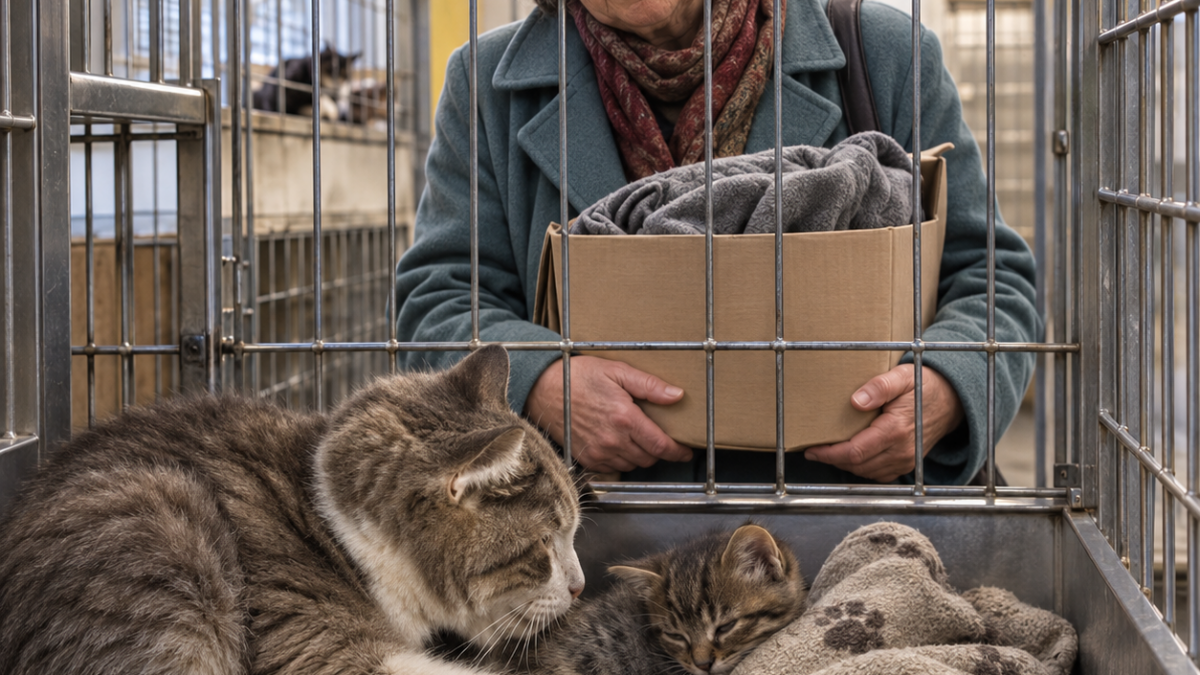
I had gone to the shelter carrying a cardboard box filled with everything that remained of the cat I had loved for sixteen years, telling myself that if I could finally hand over her chipped bowl, her worn toys, and the gray blanket that still held a few strands of her fur, maybe I could stop waking every morning expecting to hear four small paws crossing my bedroom floor.
Instead, at the far end of a cold shelter room, I watched an old, battered cat drag the only blanket she owned toward a trembling kitten so thin I could almost count his ribs, then lie down on the bare floor beside him as if his comfort mattered more than her own.
I was sixty-eight years old, certain I had already made the last difficult decision I was capable of making that day, and I had no idea that one small act of kindness behind a metal cage door was about to force me to question everything I had promised myself after Plume died.
My name is Madeleine Fournier.
I lived alone in a third-floor apartment in Tours, in an old building with narrow stairs, tall windows, and radiators that clicked loudly on winter mornings.
For sixteen years, that apartment had belonged to two of us.
Me and Plume.
Plume was a gray cat with a round belly, stubborn habits, and an extraordinary ability to behave as if I had neglected her for weeks whenever breakfast was three minutes late.
To anyone else, she probably looked ordinary.
To me, she was family.
She came into my life shortly after my divorce.
Back then, my son Julien had just left for university in Lyon, my marriage had ended after twenty-seven years, and I had discovered that silence could be more exhausting than noise.
I would come home from work, set my keys on the kitchen counter, and listen to the refrigerator hum.
That was my evening.
One rainy Tuesday, a coworker arrived with a cardboard carrier and said her neighbor’s cat had produced kittens.
I told her I didn’t want one.
She opened the box anyway.
Plume climbed out, walked directly across my desk, and sat on my paperwork.
That was the beginning.
Over the years, she became part of every ordinary thing.
She waited behind the door when I came home.
She slept behind my knees.
She followed me into the bathroom and complained if I closed the door.
When Julien moved to Nantes for his first job, Plume slept against my chest for three nights while I pretended I wasn’t lonely.
I don’t claim she understood my life.
But she understood when I needed another living thing in the room.
That was enough.
Then one February morning, she refused breakfast.
For Plume, refusing food was practically a medical emergency.
The veterinarian examined her.
Then he sat beside me instead of standing.
I knew before he spoke.
Her kidneys were failing.
We tried medication.
Fluids.
Special food.
Anything that might buy her comfortable time.
But within days, Plume was tired in a way I had never seen before.
On her final morning, she rested her head against my wrist while the veterinarian spoke softly.
I kept one hand on her back.
She was purring.
That nearly destroyed me.
People say animals know when you are helping them.
I hope that’s true.
When I returned home, I carried an empty transport carrier.
I placed it beside the door.
Then I heard nothing.
That was when I discovered a home can be painfully loud even when it is completely silent.
The refrigerator ran.
Cars passed below the window.
Neighbors moved furniture upstairs.
But the one sound I kept waiting for never came.
Four paws on hardwood.
For three months, I still woke at five because that was when Plume demanded breakfast.
For three months, I looked toward her chair by the window and briefly expected to see her asleep.
And for three months, I kept all her belongings inside one cardboard box.
A white bowl chipped along the rim.
A fabric mouse missing most of its tail.
A brush full of gray hair I couldn’t bring myself to clean.
And her old blanket.
One Sunday, Julien called.
“Mom, you can’t keep everything forever.”
“I know.”
“Maybe donate it.”
“To where?”
“A shelter.”
I didn’t answer.
Julien sighed.
“You wouldn’t be getting rid of her.”
It didn’t feel that way.
Giving away Plume’s things felt like erasing her a second time.
But several weeks later, I finally carried the box to my car.
All the way to the shelter, I repeated the same promise.
I would donate the items.
I would leave.
I would never adopt again.
I was too old to start over.
Too tired to reorganize my life around another animal.
And above all, I did not have the courage to survive another goodbye.
The shelter was small, on the edge of town.
A volunteer named Sophie took the box from me.
“Thank you. We really need blankets.”
My hand remained on the cardboard.
For one ridiculous second, I almost took it back.
Then I let go.
Sophie must have seen something in my face.
“You can look around if you’d like.”
“No.”
The answer came too quickly.
She smiled gently.
“No pressure.”
I should have left.
Instead, I heard a kitten cry.
A weak, thin sound from a room at the end of the corridor.
I turned.
“What’s that?”
Sophie hesitated.
“One of our new arrivals.”
I walked toward the sound before I had decided to.
At the final cage, I stopped.
A tiny kitten was trembling in the corner.
Beside him was an elderly female cat with dull brown-and-white fur, one torn ear, and tired green eyes.
The cage held one thin blanket.
Nothing else soft.
The older cat hooked the blanket with her paw.
Pulled.
Rested.
Pulled again.
“What is she doing?”
Sophie came beside me.
The old cat dragged the blanket toward the kitten.
Once.
Twice.
Then finally pushed part of it beneath his shaking body.
The kitten collapsed onto the fabric.
The old cat lay down beside him.
On the cold metal floor.
I stared.
“But that’s her only blanket.”
“I know.”
“She gave it to him.”
Sophie nodded.
The old cat closed her eyes.
The kitten pressed against her.
Something inside me broke open.
Because I had arrived there believing grief had emptied me.
And somehow, an animal who owned almost nothing had just shown me she still had something left to give.
PART 2
I stood outside the cage for so long that Sophie finally brought me a chair.
I didn’t sit.
“What are their names?” I asked.
“The kitten doesn’t have one yet.”
“And her?”
Sophie looked at the old cat.
“Her name is Margot.”
Margot.
The name suited her.
There was something dignified about her, even with her damaged coat and torn ear.
“How old is she?”
“We think thirteen.”
“Think?”
“She was surrendered without complete veterinary records.”
“By her owner?”
Sophie paused.
“It’s complicated.”
I looked at her.
Whenever someone says something is complicated at an animal shelter, it usually means the animal suffered because humans made a simple responsibility difficult.
“What happened?”
“A man brought her in about seven months ago.”
“Seven months?”
“Yes.”
“And nobody adopted her?”
Sophie gave me a sad smile.
“Older cats are hard.”
I knew that much.
“Especially one who looks like Margot.”
I looked back through the bars.
Her coat was thin in several places.
One ear had an old split.
There was a white scar near her shoulder.
But her eyes were calm.
“What do you mean?”
“People want kittens.”
She glanced toward the trembling little one.
“Or younger cats. Healthy cats. Pretty cats. Cats without medical histories.”
“What’s wrong with Margot?”
“Arthritis. Early kidney disease. Dental problems. Nothing impossible. But enough to scare people.”
I swallowed.
Kidney disease.
The words brought me straight back to Plume’s final week.
I almost stepped away.
Margot opened her eyes.
She didn’t look at me.
She looked at the kitten.
The little thing shifted beneath the blanket.
Margot moved closer.
Her front leg curved around him.
“Is that kitten hers?”
“No.”
“What happened to him?”
“Found behind a bakery this morning.”
“How old?”
“Maybe six weeks.”
“Where’s his mother?”
“We don’t know.”
“He’s freezing.”
“We’re warming him gradually.”
I frowned.
“Why put him with her?”
“We didn’t.”
I looked at Sophie.
“She was in the adjacent cage. When we brought him in, Margot wouldn’t stop reaching through the divider.”
“So you moved them together?”
“Only temporarily.”
Margot began licking the kitten’s head.
Sophie smiled.
“She seems to have decided he belongs to her.”
For some reason, that sentence hurt.
I thought about Plume.
How she had chosen me when I had told everyone I didn’t want a cat.
Maybe sometimes animals understand our decisions better than we do.
—
I finally left after nearly an hour.
I did not adopt Margot.
I did not adopt the kitten.
I did exactly what I had intended.
I donated Plume’s belongings.
Then I drove home.
I should have felt relieved.
Instead, when I opened my apartment door, the silence seemed worse.
I put down my handbag.
Took off my coat.
Made tea.
Then sat at the kitchen table.
For twenty minutes, I stared at nothing.
Finally, I called the shelter.
Sophie answered.
“It’s Madeleine.”
There was a pause.
Then amusement in her voice.
“Hello, Madeleine.”
“How is the kitten?”
“He ate.”
“And Margot?”
“She refused her own dinner until we moved the kitten’s bowl beside hers.”
I smiled despite myself.
“Did you give her another blanket?”
“Yes.”
“Good.”
Silence.
Then Sophie said:
“You can come back tomorrow.”
“I didn’t say I was coming back.”
“No.”
She sounded far too pleased with herself.
“I’ll be there around ten.”
—
The kitten was better the next morning.
Still thin.
Still frightened.
But warmer.
A veterinarian had examined him and found dehydration, fleas, and mild respiratory irritation.
Nothing life-threatening.
They named him Milo.
I hated the name.
Then Milo sneezed so hard he fell sideways.
After that, I accepted it.
Margot remained beside him.
I brought a small fleece pad.
Not Plume’s.
I wasn’t ready for that.
Margot sniffed it.
Then sat on it.
I crouched outside the cage.
“Apparently you approve.”
She ignored me.
Milo climbed over her back.
She tolerated it.
He bit her tail.
She turned and gave him a look so severe that even I understood.
Milo stopped immediately.
I laughed.
It was a strange sound in my own ears.
I hadn’t laughed in weeks.
Sophie heard it from the hallway.
She didn’t say anything.
I appreciated that.
—
I started visiting every other day.
Then every day.
I told Julien none of this.
Not because I was hiding something.
Because I knew exactly what he would say.
The shelter staff began letting me sit inside the socialization room with Margot and Milo.
At first, Margot kept her distance.
Milo did not.
Milo had the self-preservation instincts of a potato.
He climbed my trousers.
Bit my shoelaces.
Slept in my handbag.
Once I stood up to leave and nearly took him home accidentally because he had crawled inside my coat sleeve.
Margot watched all of it.
She was quieter.
She moved carefully.
Arthritis made her back legs stiff.
When she jumped from a low chair, she paused afterward.
But she never complained.
If Milo became frightened, Margot appeared.
When he slept, she cleaned him.
When he ate too fast, she pushed him away from the bowl until he slowed down.
One afternoon, Milo attacked a toy mouse.
Margot sat beside me.
Without thinking, I reached out.
She flinched.
Not dramatically.
Just enough.
My hand stopped.
“Sorry.”
Margot looked at me.
I kept my hand where she could see it.
After several seconds, she leaned forward.
Sniffed my fingers.
Then touched her cheek against them.
Once.
That was all.
It felt like receiving a medal.
—
Two weeks later, a family wanted Milo.
I should have been happy.
He was healthy enough to adopt.
A young couple came with their eight-year-old daughter.
The girl sat on the floor.
Milo climbed into her lap.
Perfect.
The parents laughed.
Perfect.
They filled out the application.
Perfect.
Then Milo began looking around.
He left the girl’s lap.
Walked to the door.
Cried.
Margot was on the other side.
Milo scratched beneath the gap.
Margot answered.
The little girl looked at me.
“Who’s that?”
“His friend.”
“Can she come out?”
Sophie opened the door.
Margot entered.
Milo ran to her.
The girl smiled.
“Is that his mom?”
“No.”
“Then why does he love her?”
Nobody had an answer.
The father looked at Margot.
“How old is she?”
“About thirteen.”
He grimaced slightly.
Not cruelty.
Calculation.
The same calculation I had been making.
Age.
Veterinary bills.
Goodbyes.
“We only planned on one cat,” he said.
Sophie nodded.
“Of course.”
The family adopted Milo.
Margot did not go with him.
—
The moment Milo’s carrier disappeared down the hallway, Margot walked back into her cage.
She looked at the empty blanket.
Then lay down.
That was it.
No crying.
No scratching.
No drama.
Somehow that made it worse.
I stayed another hour.
Margot didn’t eat.
The next morning, she still hadn’t eaten.
Sophie called me.
“We’re worried.”
I was at the shelter twenty minutes later.
Margot was curled in the corner.
I opened the cage.
She barely looked up.
“Don’t do this.”
Her ear moved.
“Milo is fine.”
Nothing.
“He has a home.”
Nothing.
I sat down.
“I know what this is.”
That got her attention.
I swallowed.
“Someone leaves, and everyone tells you it’s good because they’re somewhere safe.”
My voice cracked.
“But safe doesn’t mean here.”
Margot looked at me.
I thought of Julien moving away.
My divorce.
Plume dying.
All the times I’d been told to be grateful for what remained.
I took a little food from the bowl and held it toward her.
“Come on.”
She sniffed.
Turned away.
I waited.
Five minutes.
Ten.
Fifteen.
Finally, Margot licked a tiny amount from my finger.
Then another.
Sophie stood in the doorway.
I pretended not to notice her.
—
That evening, Julien called.
“You sound strange.”
“I’m fine.”
“You always say that when you’re not.”
“I’m visiting a cat.”
Silence.
“A cat?”
“At the shelter.”
Another silence.
Then:
“Mom.”
“Don’t start.”
“I wasn’t going to.”
“Yes, you were.”
“Are you adopting it?”
“No.”
“What kind of cat?”
“Old.”
“How old?”
“Thirteen.”
Julien exhaled.
“That is old.”
“I know.”
“Health issues?”
“Yes.”
“Mom…”
There it was.
The tone.
Concern disguised as reason.
“I said I’m not adopting her.”
“Okay.”
“She has arthritis.”
“Okay.”
“And kidney disease.”
“Mom.”
“I know.”
“You just lost Plume to kidney disease.”
“I know.”
“I don’t want you going through that again.”
Something inside me tightened.
“You think I do?”
“No.”
“Then why are you talking to me as if I don’t understand what death is?”
He went quiet.
I regretted it immediately.
“I’m sorry.”
“No, you’re right.”
He sighed.
“I just worry.”
“I know.”
“What’s her name?”
“Margot.”
“Pretty name.”
“Yes.”
“Are you sure you’re not adopting her?”
“No.”
He laughed.
“That’s not an answer.”
—
Margot improved over the next week.
She started eating again.
Milo’s new family sent photographs.
He looked happy.
That helped me.
I’m not sure it helped Margot.
Then something unexpected happened.
The family brought Milo back.
Not permanently.
For a visit.
The little girl carried him into the room.
The moment Margot heard his cry, she stood.
Really stood.
Her entire body changed.
Milo jumped from the girl’s arms and ran toward her.
They collided.
Milo climbed over Margot.
Margot licked his face.
The girl laughed.
Her mother wiped tears away.
“I had no idea.”
Sophie smiled.
“They bonded quickly.”
The woman looked at Margot.
Then at me.
“Would she…?”
I held my breath.
“Would she what?”
“Would she want to come home with us?”
I should have been happy.
Instead, panic rose in my chest.
The mother continued.
“We’ve been thinking about it.”
The father wasn’t there.
That mattered.
“We have space.”
“Do you understand her medical needs?” Sophie asked.
“We talked to our vet.”
My throat tightened.
This was good.
This was exactly what everyone wanted.
Margot and Milo together.
A family.
A child who adored them.
Why did I feel sick?
The woman noticed.
“You’re attached to her.”
“No.”
The answer was absurd.
We both knew it.
She smiled gently.
“I think you are.”
I looked at Margot.
She was cleaning Milo’s ear.
Then she lifted her head.
And looked at me.
Not the woman.
Not Sophie.
Me.
—
The adoption didn’t happen.
Not because of me.
The husband said no.
He loved Milo.
But an elderly cat with ongoing veterinary needs was more than he wanted.
I understood.
I hated understanding.
Margot stayed.
Milo went home again.
This time, Margot ate dinner.
Progress.
Or resignation.
I couldn’t tell.
—
A month passed.
Winter deepened.
I began spending afternoons at the shelter.
Not only with Margot.
I helped fold laundry.
Clean bowls.
Answer phones.
I told myself I was volunteering.
Everyone else knew I was avoiding going home.
One afternoon, a woman entered the shelter carrying a leather handbag and wearing a cream coat that probably cost more than my refrigerator.
She looked around with obvious discomfort.
“I need to speak to whoever handles surrendered animals.”
Sophie approached.
“How can I help?”
The woman lowered her voice.
“I’m looking for a cat.”
“What kind?”
“An older female. Brown and white. Damaged ear.”
My hands stopped folding towels.
Sophie glanced at me.
“Do you know her name?”
“Margot.”
I felt my stomach tighten.
Sophie remained polite.
“And you are?”
“Caroline Delorme.”
Margot was sleeping in the socialization room.
I moved closer.
Caroline looked about fifty.
Perfect hair.
Perfect nails.
Perfect posture.
There was nothing immediately cruel about her.
That almost made it worse.
Sophie asked:
“What’s your relationship to Margot?”
Caroline hesitated.
“She belonged to my mother.”
Belonged.
Past tense.
“What happened to your mother?”
“She died last year.”
I understood immediately.
Margot’s owner had died.
Caroline continued.
“My mother had the cat for years. After she passed, I took Margot temporarily.”
“Then?”
“I couldn’t keep her.”
“Why?”
“My husband is allergic.”
Sophie nodded.
Reasonable.
Too reasonable.
“So you surrendered her?”
“Yes.”
“To us?”
“No. A man helped me.”
“A man?”
“My brother.”
There was something wrong.
Sophie pulled up Margot’s intake record.
“The person who surrendered her listed himself as the owner.”
“My brother lies.”
I almost laughed at the bluntness.
“What do you want now?” Sophie asked.
Caroline looked toward the rooms.
“I want her back.”
My chest tightened.
Sophie stayed calm.
“Why?”
Caroline’s expression shifted.
“My mother’s estate is being settled.”
I didn’t understand.
Then she said:
“There is a trust.”
A trust.
Of course.
Not love.
Money.
—
Margot’s previous owner had been an eighty-six-year-old widow named Elise Delorme.
Elise had lived alone.
Margot had been her companion for nearly fourteen years.
When Elise died, her will contained an unusual clause.
A sum of money—significant money—had been placed in trust specifically for Margot’s lifetime care.
The remainder would pass to Elise’s children only after Margot’s death.
I stared at Caroline.
“So the cat has money.”
Caroline stiffened.
“That’s a vulgar way to describe it.”
“Is it inaccurate?”
She ignored me.
Sophie looked at the record.
“When Margot was surrendered, none of this was disclosed.”
“My brother handled it badly.”
“What does that mean?”
Caroline’s lips tightened.
“It means he wanted the trust terminated.”
My blood went cold.
“How?”
“By proving Margot was no longer alive.”
The room went completely still.
“What?”
Caroline sighed.
“My brother told the trustee Margot had died.”
I looked toward the socialization room.
Margot was asleep in a patch of sunlight.
Alive.
Very much alive.
“Why surrender her if he wanted everyone to think she was dead?”
Caroline looked ashamed.
“He couldn’t bring himself to euthanize her.”
The words hit me like a slap.
Sophie whispered:
“He considered killing a healthy cat for money?”
“She wasn’t healthy.”
“That doesn’t answer the question.”
Caroline looked away.
I stepped toward her.
“What did he do to her?”
“Nothing.”
“Her ear is torn.”
“She had that before.”
“Her coat was filthy.”
“She stopped grooming.”
“She flinches when people reach for her.”
Caroline’s face changed.
“I don’t know what happened while she was with Marc.”
Marc.
The brother.
The man who surrendered Margot.
Caroline lowered her voice.
“My mother left detailed instructions. Margot was supposed to remain in her home with a caregiver.”
“Why didn’t that happen?”
“Marc wanted to sell the house.”
There it was.
Elise died.
The children wanted the estate.
Margot became an inconvenience.
An old animal standing between people and money.
I felt something inside me harden.
“Why are you here now?”
“Because the trustee discovered Margot’s microchip is still active.”
Sophie looked up.
“How?”
“A veterinary database update.”
Our veterinarian had scanned Margot and updated her records.
Caroline continued.
“The trustee contacted me.”
“And now you need Margot alive.”
Caroline stared at me.
I didn’t care.
“Yesterday, she was an inconvenience. Today, she’s evidence.”
“That isn’t fair.”
“No?”
“I did not surrender her.”
“But you didn’t stop it.”
Caroline’s face went pale.
That landed.
Good.
—
The next several weeks became ugly.
Marc Delorme arrived with an attorney.
He claimed Margot had been surrendered by mistake.
He demanded her return.
The shelter refused.
He threatened legal action.
The trust attorney became involved.
Then the police.
Because lying about Margot’s death had not simply been a family disagreement.
Marc had submitted documents.
Signed declarations.
Attempted to accelerate the distribution of trust assets.
Suddenly Margot was at the center of a fraud investigation.
I hated it.
She had no idea.
Every afternoon, she sat in my lap while adults argued about documents worth more than anything she could understand.
She cared about warm food.
Sunlight.
A soft bed.
My coat sleeve.
Nothing else.
—
Then Marc came to the shelter when I was alone in the lobby.
I knew him immediately.
Same family face as Caroline.
But harder.
He was in his late fifties.
Expensive shoes.
Tight mouth.
“Where is she?”
I stood.
“You can’t go back there.”
“I’m family.”
“So was she.”
He frowned.
“What?”
“Your mother.”
His face tightened.
“I don’t know who you are.”
“My name is Madeleine.”
“Do you work here?”
“Sometimes.”
“Then get Sophie.”
“She isn’t here.”
“I’ll wait.”
He sat.
I didn’t.
After several minutes, he looked at me.
“You seem very invested.”
“I am.”
“Why?”
I considered lying.
Instead, I told the truth.
“Because I watched Margot give her only blanket to a freezing kitten.”
His expression barely changed.
“She always was stupidly maternal.”
I stared at him.
“What did you say?”
“My mother used to foster kittens.”
That surprised me.
“Margot helped raise them.”
He leaned back.
“She’d mother anything small enough.”
Suddenly the scene with Milo made sense.
It wasn’t random.
Margot had spent years helping Elise care for orphaned kittens.
Marc continued.
“Mother wasted ridiculous amounts of money on animals.”
I felt anger rise.
“Your mother left money for Margot.”
“Yes.”
“You tried to take it.”
His eyes sharpened.
“Careful.”
“You told the trustee she was dead.”
“You don’t know the circumstances.”
“What circumstances make a living cat dead?”
His jaw tightened.
“You people think you understand everything because you scoop litter and take emotional photographs.”
“You people?”
“The shelter crowd.”
I almost laughed.
“Margot isn’t an obstacle between you and your inheritance.”
“You don’t know anything about my finances.”
“No.”
I stepped closer.
“But I know she was worth killing to you.”
He stood.
“I never touched that animal.”
“Maybe that is the best thing you can say about yourself.”
His face went cold.
Then he smiled.
“Be careful, Madame Fournier.”
“How do you know my name?”
He looked toward the shelter office.
“Public records aren’t difficult.”
That was a threat.
Small.
Polite.
Clear.
He left.
I stood frozen for several seconds.
Then I locked the door.
—
That night, I couldn’t sleep.
At two in the morning, my phone rang.
Julien.
“Mom?”
“What happened?”
“Someone called me.”
I sat upright.
“Who?”
“A man named Marc Delorme.”
My heart dropped.
“What did he say?”
“That you’re interfering in a legal matter.”
“What else?”
“He said you might be financially involved.”
I laughed in disbelief.
“Financially?”
“He implied you’re trying to gain access to the cat’s trust.”
That was almost funny.
Almost.
Julien continued.
“Mom, what is going on?”
So I told him everything.
Margot.
Milo.
The blanket.
The trust.
Marc.
The threat.
When I finished, Julien was silent.
Then he said:
“I’m coming tomorrow.”
“You don’t need to.”
“I wasn’t asking.”
—
Julien arrived from Nantes the next afternoon.
He was forty-three.
Still my child.
Still capable of walking into a room and making me feel both safer and irritated.
He met Margot.
She sniffed his hand.
Then ignored him.
“She likes you,” I said.
“She ignored me.”
“That’s advanced approval.”
He sat beside me.
After a while, he said:
“You’re adopting her.”
“No.”
“Mom.”
“No.”
“You go home every night and worry about her.”
“Yes.”
“You come back every morning.”
“Yes.”
“You bought her a heated bed.”
“It was on sale.”
“You have kidney food in your kitchen.”
“In case she visits.”
“She has never visited.”
“That is irrelevant.”
Julien smiled.
Then his expression softened.
“You’re scared.”
I looked away.
“Yes.”
“Because of Plume.”
“Yes.”
“Because Margot is old.”
“Yes.”
“And because you already love her.”
I didn’t answer.
That was the problem.
I did.
—
A week later, the court issued a temporary order.
Margot could not be returned to Marc or Caroline while the trust dispute was investigated.
The shelter remained her legal custodian.
The trust would pay for her care.
Marc’s attorney called this unnecessary.
The judge disagreed.
Then came the first real piece of revenge.
Not revenge from us.
From Elise.
Margot’s late owner.
Her will contained another clause.
Nobody had mentioned it because Marc had tried to suppress it.
If any beneficiary intentionally misrepresented Margot’s death, abandoned her contrary to the care instructions, or interfered with the trust for personal gain, that beneficiary could be disqualified from receiving the remainder.
I read the clause twice.
Then looked at Sophie.
“Elise knew.”
“She knew her children.”
I almost smiled.
“She planned for this.”
“Yes.”
Marc had spent months trying to get money sooner.
His own actions might cause him to lose it entirely.
Sometimes the cleanest revenge is written in advance.
—
Caroline returned two days later.
Alone.
No lawyer.
No expensive confidence.
She looked tired.
“I need to see Margot.”
Sophie hesitated.
I said:
“Why?”
Caroline looked at me.
“Because I owe her something.”
I nearly refused.
Then I opened the socialization room.
Margot was on her heated bed.
Caroline stopped.
Her face changed.
For the first time, I believed she had actually known this animal.
“Hello, old girl.”
Margot lifted her head.
Caroline crouched.
She didn’t touch her.
Margot stared.
Then turned away.
Caroline began crying.
Quietly.
“I deserve that.”
I stayed by the door.
After several minutes, she spoke.
“My mother loved this cat more than she trusted either of us.”
“That sounds wise.”
She almost smiled.
“I was angry about the will.”
“At Margot?”
“At Mother.”
She looked down.
“I thought the trust was insulting.”
“Why?”
“Because Marc and I had spent years helping her.”
“Did you?”
Caroline closed her eyes.
“Not enough.”
There was the truth.
“My mother knew we were waiting.”
“For her to die?”
Caroline flinched.
I didn’t apologize.
“She knew we were calculating the house, the accounts, the jewelry.”
Her voice cracked.
“She knew.”
“And Margot?”
“Margot wanted nothing.”
Caroline looked at the old cat.
“She just sat with her.”
That was exactly why Elise trusted the cat.
—
Caroline agreed to cooperate with investigators.
That changed the case.
She provided emails.
Messages.
Documents.
One message from Marc read:
**Once the cat is gone, the trustee has no reason to keep holding the money.**
Another:
**Just sign the surrender. Nobody checks shelter records forever.**
Another:
**Mother is dead. Stop acting like the animal matters.**
That one made me physically ill.
It also destroyed Marc’s defense.
The story reached a local newspaper.
Then television.
I hated that part.
Margot became “The Million-Euro Cat” in one headline.
She wasn’t worth a million euros.
The trust wasn’t even close to that.
But facts rarely survive headlines intact.
People began calling the shelter.
Some wanted to adopt Margot.
Suddenly.
After seven months.
A woman who had once been ignored because she was old, scarred, arthritic, and medically complicated became desirable because cameras had arrived.
Sophie rejected dozens of applications.
One man asked whether the trust “came with the cat.”
That call lasted less than thirty seconds.
I became angrier each day.
Margot became more affectionate.
Life has a sense of humor.
—
One evening, I brought Plume’s gray blanket from home.
The one I had never donated.
I had taken it back out of the box before driving to the shelter that first day.
I hadn’t admitted that to anyone.
Not even myself.
It still smelled faintly familiar.
Or maybe I imagined it.
Margot was asleep.
I placed the blanket beside her.
She woke.
Sniffed it.
Then looked at me.
“You can have it.”
She stepped onto the blanket.
Turned in a circle.
Lay down.
Then patted the space beside her with one paw.
Ridiculous.
I sat on the floor.
Margot crawled into my lap.
For the first time, she rested her head against my chest.
I cried.
Not quietly.
Not elegantly.
I cried for Plume.
For Margot.
For Elise.
For myself.
For every stupid promise people make when grief convinces them the only way to avoid pain is to avoid love.
Margot stayed.
She didn’t fix anything.
She didn’t replace Plume.
She simply sat with me while I broke.
That was enough.
—
The next morning, I filled out the adoption application.
Sophie didn’t even pretend to be surprised.
“You finally surrendered.”
“I prefer reconsidered.”
“You’ve been here every day for two months.”
“Coincidence.”
“You bought prescription kidney food.”
“Preparedness.”
“You argued with a lawyer on her behalf.”
“Civic responsibility.”
Sophie smiled.
“Madeleine.”
“What?”
“She already thinks you’re hers.”
I looked at Margot.
She was sleeping on Plume’s blanket.
“I know.”
—
The adoption couldn’t be finalized until the court approved the trust arrangement.
That took three weeks.
During those three weeks, Marc became desperate.
The evidence was piling up.
Caroline had cooperated.
The trustee had frozen distributions.
His attorney had warned him that the estate clause could disqualify him.
Then he did something stupid.
Very stupid.
He tried to steal Margot.
—
It happened on a Thursday evening.
The shelter was almost closed.
I was helping Sophie stack food bags.
A delivery van pulled into the parking lot.
No logo.
A man entered wearing a cap and work jacket.
“I have a pickup.”
Sophie looked confused.
“For what?”
“Cat transfer.”
“We don’t have a transfer scheduled.”
He showed a printed form.
It looked official.
Too official.
Sophie took it.
I saw her expression change.
“What facility?”
“Saint-Pierre Veterinary Center.”
Margot had an appointment there the next week.
Not that day.
Sophie stepped back.
“Who authorized this?”
“Dr. Lambert.”
Our veterinarian.
I knew that was wrong.
Dr. Lambert was a woman.
The man didn’t.
Sophie smiled.
“Give me one second.”
She locked the interior door.
The man realized.
“What are you doing?”
“Calling Dr. Lambert.”
He turned.
Too late.
Julien had just arrived to take me to dinner.
He was standing in the entrance.
The man shoved past him and ran.
A second vehicle waited outside.
It drove away.
Police found the van two hours later.
The driver was questioned.
He wasn’t a professional animal transporter.
He was an acquaintance of Marc.
The false document had been created from a scanned veterinary letter.
Phone records linked the two men.
Marc’s case collapsed completely.
—
When I heard what he had attempted, I expected to feel satisfaction.
Instead, I felt tired.
That surprised me.
I had imagined revenge would feel sharp.
Triumphant.
It didn’t.
Watching someone destroy himself through greed is mostly sad.
The court hearing took place in March.
I attended because I had become Margot’s approved prospective adopter and because I’d witnessed the shelter incident.
Marc sat with his lawyer.
Caroline sat separately.
The trustee testified.
So did Sophie.
So did the veterinarian.
Then the messages were read.
Then the fraudulent death declaration.
Then the attempted removal from the shelter.
Marc’s attorney argued that his client had been under financial pressure.
The judge asked:
“Financial pressure explains why you declared a living animal dead?”
No answer.
Marc tried to speak.
The judge stopped him.
Then came Elise’s will.
The disqualification clause.
The court ruled that Marc had intentionally interfered with Margot’s care and attempted to trigger early distribution of trust assets through false statements.
His inheritance under the residual trust was forfeited.
Caroline’s share was reduced but not eliminated because she had cooperated and had not participated in the false death filing.
A substantial portion of the remainder was redirected, according to Elise’s backup instructions, to animal welfare charities.
Marc also faced separate fraud-related charges.
I looked at him when the ruling was read.
He didn’t look angry.
He looked stunned.
That was somehow more powerful.
He had treated Margot like an obstacle.
In the end, the cat he considered worthless became the reason he lost the money he had been chasing.
Elise had protected her.
Even from the grave.
—
After the hearing, Caroline approached me.
“Will you take care of her?”
I almost laughed.
“I have been.”
She nodded.
“I know.”
For a moment, she looked very much like a daughter who had lost her mother and spent too long confusing grief with resentment.
“She likes chicken.”
“I know.”
“My mother used to roast a little piece separately.”
“I won’t be doing that every day.”
Caroline smiled.
“She’ll convince you.”
“She probably will.”
Then Caroline gave me a small wooden box.
“What is this?”
“Mother’s.”
Inside was a silver tag.
One side read:
**MARGOT**
The other:
**HOME IS WHERE YOU ARE KIND.**
I stared at it.
Caroline wiped her eyes.
“My mother had it made a few months before she died.”
I couldn’t speak.
—
Margot came home with me on a rainy afternoon.
I placed her carrier in the passenger seat.
The exact place where Plume’s donation box had sat months earlier.
For the entire drive, Margot complained.
Loudly.
“You’re going to fit in beautifully.”
She complained again.
When we reached my apartment, I opened the carrier.
Margot stepped out.
She explored the kitchen.
The hallway.
The bedroom.
Then she found Plume’s old chair by the window.
She climbed onto it.
Turned twice.
Lay down.
I stood in the doorway.
For one second, grief stabbed through me.
That was Plume’s chair.
My first instinct was almost anger.
Then Margot looked at me.
And I realized something.
The chair had never belonged to grief.
It had belonged to comfort.
Plume had used it.
Now Margot would.
Love wasn’t being erased.
The room was simply becoming alive again.
—
The first weeks were difficult.
Margot woke me at four-thirty.
Earlier than Plume.
Unforgivable.
She hated one brand of kidney food.
Then another.
Then one day she loved the first brand again.
She refused the expensive orthopedic bed I bought.
She slept in a cardboard box.
She developed a habit of sitting outside the bathroom door.
I laughed the first time.
Then cried.
Some habits return wearing different fur.
Julien visited.
Margot sat on his coat.
“She likes you,” I told him.
“She trapped my sleeve.”
“Advanced affection.”
He looked around the apartment.
“You seem better.”
I became defensive.
“I was fine before.”
“Of course.”
“Don’t patronize me.”
He smiled.
“I missed this.”
“What?”
“You arguing.”
I threw a dish towel at him.
Margot chased it.
—
Milo’s family continued visiting.
Every few months, they brought him.
He grew into a handsome black-and-white cat.
Still ridiculous.
Still convinced gravity was optional.
The first time he entered my apartment, Margot recognized him immediately.
They touched noses.
Milo climbed onto Plume’s chair.
Margot slapped him.
Some relationships mature.
Others remain honest.
The little girl, Emma, loved Margot.
She began calling her “Grandma Cat.”
Margot tolerated this title.
Barely.
—
A year passed.
Then two.
Margot’s kidney disease progressed slowly.
We managed it.
Medication.
Diet.
Fluids when necessary.
Regular tests.
Arthritis treatment.
Warm beds.
She became softer.
Not physically.
Her fur remained patchy.
But emotionally.
She started greeting visitors.
She sat beside Julien.
She slept against my back.
Every night, before settling, she kneaded Plume’s gray blanket.
The first time she did it, I had to leave the room because I was crying too hard.
Eventually, that stopped hurting.
Mostly.
—
Caroline visited once.
She brought flowers.
Not for me.
For Margot.
“I know that’s absurd.”
“It is.”
She set them on the table.
Margot sniffed them.
Then walked away.
Caroline laughed.
“My mother would say that’s exactly right.”
We drank coffee.
She told me Marc had received a suspended sentence combined with financial penalties and restitution related to the false filings and attempted fraud.
He had also lost his position at a property management company after the case became public.
I expected satisfaction.
What I felt was closure.
Not joy.
Not pity.
Just completion.
Caroline said:
“He blames the cat.”
I stared at her.
“Of course he does.”
“He still doesn’t understand.”
“No.”
“What?”
“Margot didn’t take anything from him.”
Caroline looked at me.
“He lost it because of what he did to her.”
She nodded.
That difference matters.
—
Elise’s redirected money funded a new senior-animal program at the shelter.
They named it **The Elise and Margot Fund**.
It covered veterinary care for elderly animals that adopters might otherwise fear they couldn’t afford.
The first cat helped by the fund was fifteen.
One eye.
Arthritis.
Terrible teeth.
Adopted by a retired schoolteacher.
The second was a ten-year-old diabetic cat.
The third was a bonded pair whose owner had died.
Every time Sophie sent me a photograph, I showed Margot.
She never cared.
Her philanthropy did not impress her.
Chicken did.
—
Then came the winter when Margot turned sixteen.
The veterinarian stopped using hopeful language.
Her kidneys were weakening.
Her weight dropped.
She slept more.
I knew the signs.
I had seen them before.
That terrified me more than I expected.
One night, I called Julien.
“I can’t do this again.”
He didn’t pretend not to understand.
“Yes, you can.”
“I don’t want to.”
“I know.”
“It feels exactly like Plume.”
“No.”
“Yes.”
“Mom.”
His voice became firm.
“Plume dying didn’t make loving Plume a mistake.”
I closed my eyes.
“Margot dying won’t make this one either.”
I cried.
“I hate when you’re sensible.”
“I learned from you.”
“That sounds unlikely.”
He laughed softly.
Then said:
“Do you remember what you told me when Dad left?”
I didn’t.
“You said losing someone doesn’t mean every year before that becomes worthless.”
I swallowed.
“I said that?”
“You did.”
“I was smarter then.”
“No.”
He paused.
“You were hurting then too.”
—
Margot rallied.
For several months.
She still sat by the window.
Still shouted for breakfast.
Still attacked my knitting yarn.
Then, one April morning, she didn’t get up.
I knew.
I sat beside her.
“Not today.”
She opened her eyes.
I hated myself for saying it.
As if she had chosen.
The veterinarian came to the apartment.
Julien drove from Nantes.
Sophie came after work.
Caroline sent a message but did not intrude.
Margot lay on Plume’s gray blanket.
The same blanket I had once been unable to give away.
The same blanket Margot had claimed on the night I finally admitted I loved her.
I held her.
She was light.
Too light.
I remembered the first time I saw her dragging her own blanket toward Milo.
She had been old then.
Tired.
Already discarded.
And still she had given away the only soft thing she possessed.
The veterinarian prepared the medication.
I bent close.
“Do you remember Milo?”
Margot blinked.
“Of course you do.”
My voice shook.
“You bullied him constantly.”
Julien laughed through tears.
Margot’s ear moved.
I stroked her face.
“You gave him your blanket.”
I paused.
“And then you gave me the rest.”
The veterinarian touched my shoulder.
I nodded.
Margot died with her head in my hand.
Just like Plume.
And nothing like Plume.
Because grief repeats shapes.
Never stories.
—
For several weeks, I expected the apartment to collapse back into silence.
It didn’t.
I still missed Margot.
Terribly.
But something had changed in me.
The first time I lost Plume, I had treated grief like a warning.
Don’t do this again.
Don’t love again.
Don’t create another place where pain can enter.
Margot taught me the opposite.
Pain was not proof that love had been a mistake.
Pain was proof that something had mattered.
I kept both collars.
Plume’s.
Margot’s.
Side by side.
Not one replacing the other.
—
Three months after Margot died, I returned to the shelter.
Sophie saw me enter.
“Oh no.”
“What?”
“You have that look.”
“I don’t have a look.”
“You absolutely have a look.”
“I came to donate towels.”
“Of course.”
I carried a box toward the storage room.
Then I heard a kitten cry.
I stopped.
Sophie closed her eyes.
“No.”
I smiled.
“What?”
“You are not allowed to follow crying anymore.”
“That’s an unreasonable rule.”
We walked toward the nursery.
Inside one cage was a tiny orange kitten with a bandaged leg.
Beside him sat an elderly black cat.
The old cat had been surrendered after his owner entered assisted living.
He was twelve.
Nobody wanted him.
I stared.
Sophie stared at me.
“No.”
“I didn’t say anything.”
“Your face did.”
The old black cat stood.
Walked toward the bars.
Then rubbed his cheek against them.
I crouched.
“What is his name?”
Sophie sighed.
“Arthur.”
“Arthur.”
The orange kitten climbed onto Arthur’s back.
Arthur tolerated it.
Barely.
I smiled.
Sophie shook her head.
“Margot ruined you.”
“No.”
I touched the bars.
“She fixed something.”
—
I did not adopt Arthur that day.
I lasted four days.
Julien said that showed remarkable restraint.
Arthur lived with me for six years.
But that is another story.
The one I still think about most begins with a cardboard box on the passenger seat of my car.
I thought I was driving to a shelter to get rid of the last pieces of a life I could no longer bear to look at.
A chipped bowl.
A fabric mouse.
A gray blanket.
I believed letting go meant removing reminders.
I believed grief had a correct direction.
Forward.
Away.
Never back.
Then I saw Margot.
An old cat nobody wanted.
A cat who had lost her person.
Her home.
Her routines.
Her security.
A cat who had been turned into an inconvenience because humans were counting money around her.
And yet when a terrified kitten arrived beside her, Margot did not protect the one comfort she had left.
She gave it away.
Her only blanket.
Then she lay on the cold floor.
For years, I thought that moment was about generosity.
It was.
But now I think it was about something else too.
Margot understood a truth I had forgotten.
Having little does not mean you have nothing to give.
Losing someone does not mean you are finished loving.
Being hurt does not excuse becoming hard.
Margot had every reason to distrust people.
She didn’t.
She had every reason to cling to comfort.
She shared it.
She had every reason to protect herself.
Instead, she protected something smaller.
Marc looked at her and saw an obstacle between him and money.
Visitors looked at her and saw an old cat with medical bills.
I looked at her and, at first, saw another goodbye waiting to happen.
We were all wrong.
Margot was not the end of something.
She was the beginning of the part of my life I had almost refused to live.
The money Marc wanted eventually helped animals like her.
The lie he told destroyed his own claim.
The cat he tried to erase became the reason senior animals across the region received care.
And me?
I walked into that shelter convinced that loving Plume had cost me too much.
Margot taught me the cost had never been the problem.
The love was the point.
Sometimes I still dream about that first afternoon.
The cold cage.
The trembling kitten.
Margot hooking one claw into the edge of her blanket.
Pulling.
Resting.
Pulling again.
Then lying on bare metal while Milo slept on the only soft thing she owned.
If I could return to that moment, I would kneel beside the woman I was then.
The sixty-eight-year-old woman clutching grief like a locked door.
And I would tell her:
Watch carefully.
That old cat is about to teach you how to survive.
Not by forgetting.
Not by replacing.
Not by pretending loss doesn’t hurt.
By making room.
That was Margot’s final gift.
She never knew about the trust.
The court.
The newspaper stories.
The money redirected in her name.
She never knew that the man who discarded her lost the inheritance he tried to protect.
She never understood that dozens of senior animals found homes because of what happened to her.
She knew only simple things.
Warmth.
Food.
Sunlight.
A kitten against her side.
My hand against her head.
And eventually, home.
Maybe that was enough.
Maybe that was everything.








