PART 2: I Came to Adopt One Shelter Cat—Then His Little Brother Wrapped Both Paws Around Him and Refused to Let Go
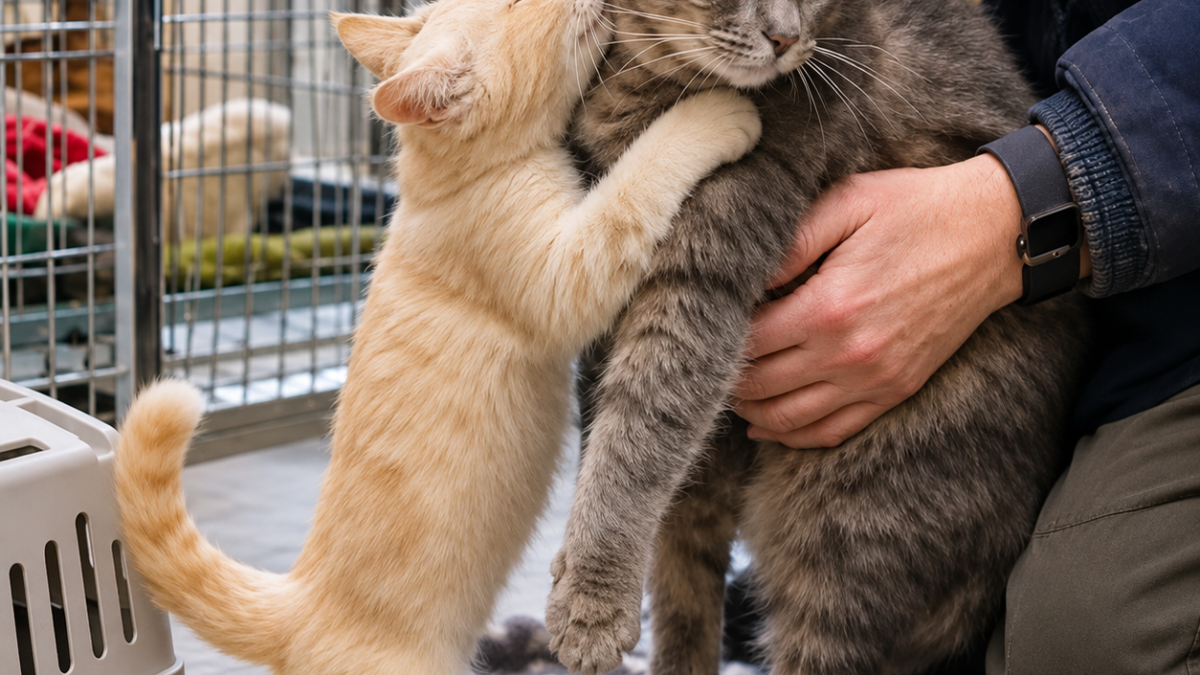
The moment I lifted the big gray cat into my arms, his smaller brother stood on his hind legs and wrapped both paws around him.
He wasn’t scratching me or trying to fight—he was holding on with the desperate strength of someone who believed goodbye meant forever.
I had walked into that shelter thinking loneliness was the worst thing a person could carry home, and I was about to learn how wrong I was.
My name is Laurent, and I was forty-seven years old when I first met Basile and Milo.
Nine months earlier, I had walked out of the house where I’d spent fourteen years with my wife.
There hadn’t been some spectacular betrayal.
No broken plates.
No screaming in the driveway.
No dramatic scene where one of us packed a suitcase while the other begged at the door.
In some ways, I think that would have been easier.
Our marriage simply wore itself down.
Conversation became routine. Routine became distance. Distance eventually became two people sitting across from each other at dinner with nothing left to say.
Then came the paperwork.
The boxes.
The division of furniture.
And finally, the silence.
I rented a small second-floor apartment outside Angers and tried to convince myself it was a fresh start.
The hardwood floors creaked. Paint peeled near the bedroom window. My upstairs neighbor apparently believed midnight was the perfect time to rearrange furniture.
None of that bothered me much.
The silence did.
Every evening, I came home from my job at a home-improvement store, dropped my keys on the dresser, and turned on the television before I even took off my coat.
I rarely watched it.
I just needed another human voice in the room.
Money was tight too.
After rent, utilities, insurance, groceries, and everything the divorce had left behind, I didn’t have much breathing room. I compared prices at the grocery store. I turned down the heat when I left for work. On Sundays, I made one large pot of soup and stretched it across several meals.
Whenever coworkers asked how I was doing, I gave them the same answer.
“I’m getting used to it.”
I wasn’t.
One Thursday during lunch, my coworker Nathalie watched me stir a cup of coffee that had already gone cold.
“Laurent,” she said, “have you ever thought about getting a cat?”
I laughed.
“With my finances?”
“I’m not telling you to adopt a zoo. One cat. Something waiting for you when you get home.”
I shook my head, but she wasn’t joking.
Then she said something I couldn’t stop thinking about.
“Sometimes all a person needs is a good reason to go home.”
A few days later, I started looking at local shelter listings.
I was careful.
Painfully careful.
I calculated food, litter, vaccinations, routine veterinary care, and a small emergency reserve.
One cat was possible.
Two absolutely were not.
The following Saturday, I drove to a small animal rescue about twenty minutes from my apartment.
That’s where I met Basile and Milo.
Basile was a large gray cat with a slightly damaged ear and the permanently annoyed expression of an old judge who had already heard enough excuses.
Milo was smaller, cream-colored, and painfully shy.
He stayed almost completely behind Basile.
Whenever I shifted position, Milo shifted too, using his brother like a living shield.
A volunteer named Jeanne stood beside me.
“They’ve always been together,” she explained. “Basile adjusts fairly quickly. Milo doesn’t.”
I crouched down.
Basile came forward and sniffed my fingers.
Milo remained frozen.
“I think I like the gray one,” I said.
Jeanne gave me a small smile that I didn’t understand yet.
She opened their enclosure.
I slid my hands beneath Basile and lifted him.
That’s when Milo moved.
He rose onto his hind legs, reached up, and wrapped his front paws around his brother.
Tight.
Not aggressively.
Desperately.
Basile didn’t struggle.
Instead, the big gray cat turned his head and gently pressed his nose against Milo’s face.
My hands stopped moving.
Behind me, Jeanne quietly said, “Now you understand why we’ve had trouble placing them separately.”
I looked at the carrier I’d brought.
One carrier.
One food bowl waiting at home.
One cat in my budget.
Then I looked back at Milo.
“What happens if nobody wants both?”
Jeanne hesitated.
“We keep trying.”
“Has anyone wanted Basile?”
“A few people.”
“And Milo?”
Her silence answered me.
I slowly lowered Basile back onto the blanket.
Milo immediately pressed himself against his brother’s side.
For nine months, I had been teaching myself how to live with the absence of someone who wasn’t coming back.
I knew what it felt like to listen for footsteps that never came.
I knew what it was like to wake up expecting another person to be there and find only an empty space.
And now a frightened little cat was staring at me as though I were holding the power to give him that same kind of emptiness.
I sat down.
“I need to redo my budget.”
Jeanne didn’t pressure me.
She simply pulled up another chair.
Twenty minutes later, after we’d discussed food, litter, vaccinations, insurance, emergencies, and every practical reason I had for saying no, I looked through the enclosure.
Basile was lying down.
Milo had one paw resting across his back.
I let out a long breath.
“Do you have another carrier?”
Jeanne smiled.
And for the first time in nine months, I realized I was afraid of going home for an entirely different reason.
I was taking two lives with me.
And I had no idea whether I could afford what I’d just promised them.
PART 2
Jeanne found an old carrier in the storage room.
It was blue, scratched along one side, and missing the little plastic handle cover, but it worked.
Basile entered his without much protest.
Milo did not.
The moment Jeanne separated him from his brother, he twisted around so quickly that she nearly lost her grip.
“It’s okay,” she whispered.
Milo didn’t believe her.
His eyes became huge.
He reached toward Basile’s carrier through the bars, crying in a voice so small that it somehow hurt more than a loud scream would have.
I felt an immediate wave of panic.
“What if we put the carriers together?”
Jeanne nodded.
We placed them side by side.
Basile pushed his nose against the bars nearest Milo.
Almost instantly, Milo stopped struggling.
That was the first lesson those cats taught me.
Comfort didn’t always require fixing anything.
Sometimes it was simply knowing someone hadn’t left.
I signed the adoption papers.
When Jeanne handed me the folder, she kept one hand on it for a moment.
“I know you came for one,” she said.
“I know.”
“And I don’t want you leaving here terrified that you’ve made a mistake.”
“Too late.”
She laughed.
Then her expression softened.
“Call us if you need advice. I’m serious.”
I nodded.
“And Laurent?”
“Yeah?”
“Thank you for seeing Milo too.”
I didn’t know what to say to that.
So I picked up both carriers and carried my two financially irresponsible decisions to the car.
During the drive home, Basile remained silent.
Milo cried every few minutes.
Each time, Basile answered with one low sound from the other carrier.
Then Milo would become quiet again.
I found myself speaking to them at traffic lights.
“We’re almost there.”
Then:
“I hope you boys like cheap furniture.”
And finally:
“If either of you requires gourmet salmon every night, we’re going to have a serious problem.”
I hadn’t talked that much in my car in months.
When I reached my apartment, I put the carriers on the living room floor and opened both doors.
Basile walked out first.
Of course he did.
He moved around the apartment as if conducting a property inspection.
He checked the couch.
The windows.
The kitchen.
The hallway.
My bedroom.
Then he returned to the living room wearing the same serious expression he’d had at the shelter.
“Well?” I asked. “Pass inspection?”
He jumped onto the couch.
Apparently I had.
Milo stayed inside his carrier.
For nearly an hour.
I sat on the floor a few feet away, pretending not to watch.
Eventually, a cream-colored nose appeared.
Then two eyes.
Then one paw.
A truck passed outside.
Milo vanished backward.
Basile lifted his head from the couch, looked toward the carrier, jumped down, and settled beside it.
He didn’t try to coax Milo out.
He simply stayed.
That night, I went to bed wondering whether Milo would ever trust me enough to leave that corner.
At 3:17 in the morning, something crashed in my kitchen.
I jumped out of bed.
Basile was sitting on the counter next to a spoon he’d apparently knocked onto the floor.
Milo was hiding under the table.
I stared at Basile.
He stared back.
“So this is how it’s going to be?”
He blinked.
By morning, I found both cats asleep together on the living room rug.
Basile was on his side.
Milo was curled against his stomach.
I stood in the doorway for a long time.
The apartment felt different.
Nothing had changed physically.
The walls were the same.
The peeling paint was still there.
The upstairs neighbor still seemed determined to move a wardrobe across the floor before sunrise.
But the place no longer felt empty.
For the first time in months, I made breakfast without turning on the television.
I listened to Basile eat.
I listened to Milo walk cautiously across the floor.
I listened to claws click against the hardwood.
Tiny noises.
Ordinary noises.
They filled the room better than any television ever had.
Within a week, Basile had decided that everything I owned belonged to him.
My couch became his couch.
My pillow became his pillow.
My favorite chair was apparently a throne I had been keeping warm on his behalf.
Milo followed him everywhere.
When Basile ate, Milo stayed nearby.
When Basile slept, Milo curled against him.
If a motorcycle passed outside or someone dropped something in the hallway, Milo immediately searched for his brother.
But little by little, he started watching me too.
The first time he crossed the room without Basile beside him, I barely moved.
He came close enough to smell my sock.
Then he ran away.
I considered it progress.
A week after the adoption, Jeanne called.
“So,” she said, “how are my boys?”
“Basile runs the apartment.”
“That sounds right.”
“And Milo runs Basile.”
She laughed.
I told her about the sleeping arrangement and Milo’s slow exploration.
Then I asked something that had been bothering me.
“Have they ever actually been separated?”
The line went quiet.
“Once,” she said.
“What happened?”
“We needed to clean their enclosure and give Basile some treatment. Milo was put in another space for less than an hour.”
“And?”
“He panicked. He threw himself against the gate hard enough to scrape his nose.”
I looked toward the couch.
Milo was sleeping with his face buried against Basile’s shoulder.
“What about Basile?”
“He refused food.”
“Because Milo was gone?”
“We couldn’t prove that’s why. But the moment we put them together again, he ate.”
I rubbed my forehead.
“Then why would anyone even consider adopting them separately?”
“Because people see Basile first.”
There was sadness in her voice now.
“He’s confident. Handsome. Friendly enough. Milo hides. A lot of adopters don’t want to spend weeks or months earning an animal’s trust.”
“So Basile was easy to want.”
“Exactly.”
“And Milo was the extra.”
Jeanne didn’t answer immediately.
“That’s how some people saw him.”
After the call, I sat beside them.
Basile eventually changed positions.
Milo opened his eyes, checked where his brother was, and placed one paw over Basile’s back before falling asleep again.
Something tightened in my throat.
I’d spent months feeling like the leftover piece of my own marriage.
The person who remained after the life I’d known was divided into boxes and bank statements.
I understood, maybe too well, what it meant to wonder whether you were the part someone could leave behind.
“You’re not extra,” I told Milo quietly.
His ear twitched.
“Neither of you.”
Three weeks later, reality came knocking.
At work, our store manager called everyone together before opening.
His name was Benoît Marchand.
He was fifty-two, always perfectly dressed, always smiling when someone above him was visiting, and rarely smiling when they weren’t.
“Corporate is tightening labor costs,” he announced. “Overtime will be reduced until further notice.”
Around me, several people groaned.
I checked the schedule posted afterward.
Five hours were gone.
To some of my coworkers, five overtime hours meant less spending money.
To me, it meant groceries.
It meant the money I had started putting into a small emergency envelope for Basile and Milo.
I stood in front of the schedule longer than necessary.
Nathalie came up beside me.
“How bad?”
“Five.”
She winced.
“I’m sorry.”
“I knew things were tight when I adopted them.”
“Don’t do that.”
“Do what?”
“Start blaming yourself.”
I folded the paper where I’d written my hours.
“I took responsibility for two animals.”
“And you are taking responsibility.”
“I don’t know if responsibility pays veterinary bills.”
That evening, I sat in my car for almost ten minutes before going upstairs.
I kept recalculating everything.
Cancel my phone upgrade.
No coffee from the machine at work.
Cheaper groceries.
Turn the heat down another degree.
Maybe skip replacing my worn work shoes for another month.
I climbed the stairs.
Before I’d even fully opened my door, Milo came trotting toward me.
Not Basile.
Milo.
The cat who had spent his first night hiding behind the couch ran to meet me.
He stopped two feet away, apparently startled by his own courage.
I slowly crouched.
“Hey, little guy.”
He stepped forward.
Then, for the first time, he climbed onto my lap.
I sat down right there on the floor.
Basile watched from the couch.
“I think I may have made a stupid decision,” I told them.
Milo began to purr.
Basile yawned.
I laughed.
Then, without warning, my eyes filled with tears.
I covered my face.
“I’m trying, okay?”
Milo pressed his forehead against my wrist.
That was all.
No miracle.
No money falling from the ceiling.
No solution.
Just one small cat leaning against me.
But somehow I stood up feeling less afraid.
A few days later, I took both cats to the veterinarian for their first full checkup since the adoption.
Basile handled the carrier like an insult.
Milo treated it like a kidnapping.
At the clinic, the veterinarian examined Milo first.
Physically, he was healthy.
Underweight, but improving.
Then she examined Basile.
Everything seemed routine until she opened his mouth.
Her expression changed.
“Hmm.”
I hated that sound immediately.
“What?”
“There’s significant inflammation here.”
She showed me the back of his mouth.
One tooth was badly damaged.
Another looked questionable.
“Does he still eat normally?”
“Like someone is going to steal his food.”
“That’s common. Cats are very good at hiding dental pain.”
“What do we do?”
“He needs dental work under anesthesia. At least one extraction, possibly more depending on what we find.”
I swallowed.
“How much?”
She printed an estimate.
About four hundred fifty euros.
I stared at the number.
She must have seen my face.
“We can schedule it a few weeks out if necessary. But I wouldn’t wait too long.”
Milo suddenly started crying from his carrier.
Basile had been moved behind a partial divider for weighing.
The veterinarian looked toward him.
“Does he always react like that when Basile disappears?”
“Pretty much.”
She lowered her voice.
“We’ll need to be careful on surgery day. Basile will be here for several hours. For Milo, that may be stressful.”
I slipped the estimate into my jacket.
Stressful.
That was one word for it.
That night, I opened my notebook at the kitchen table.
Rent.
Electricity.
Insurance.
Groceries.
Transportation.
Cat food.
Litter.
I crossed out anything that could wait.
New shoes.
Gone.
Replacing my old microwave.
Gone.
A weekend I’d considered spending with my sister.
Gone.
I was doing the numbers for the fourth time when Basile jumped onto the table and sat directly on my notebook.
I stared at him.
“Really?”
He closed his eyes.
“Could you at least pretend to care that you’re expensive?”
Nothing.
“You’re sitting on your own dental budget.”
He began washing his paw.
Despite myself, I smiled.
The next evening, I called my older sister, Isabelle.
She had always been the practical one.
The person who made lists before vacations.
The person who kept receipts.
The person who considered impulse purchases a moral weakness.
I explained the reduced hours.
Then the dental estimate.
She listened without interrupting.
Finally she sighed.
“Laurent, I’m going to say something you won’t like.”
“That usually means you’re about to say it anyway.”
“I’m serious.”
“So am I.”
“You already had trouble making ends meet.”
“I know.”
“Now there’s a four-hundred-fifty-euro surgery.”
“I know.”
“And what happens if the other one gets sick next month?”
I didn’t answer.
“What happens if your car breaks down?”
“Isabelle—”
“You need to think practically.”
“I am thinking practically.”
“No, you’re thinking emotionally.”
Then she said it.
“Maybe you should return one of them.”
The apartment suddenly seemed very quiet.
I turned toward the couch.
Milo was asleep against Basile.
His paws were resting over his brother’s side.
“Which one?” I asked.
“What?”
“Which one should I return?”
“Laurent, that’s not what I—”
“Basile?”
She went quiet.
“He’s the expensive one right now. Maybe I return him.”
“That’s ridiculous.”
“Then Milo?”
“You’re twisting my words.”
“No. I’m asking you to finish the sentence.”
She exhaled sharply.
“I mean whichever one would have a better chance—”
“Basile.”
“What?”
“Basile would have a better chance. That’s what the shelter told me. People wanted him. Milo was the one nobody chose.”
“Then maybe—”
I felt something inside me snap.
Not anger exactly.
Certainty.
“Do you know what Milo did when I picked Basile up?”
She didn’t answer.
“He stood on his back legs and held onto him.”
“Laurent—”
“He wasn’t attacking me. He was begging me not to take his brother away.”
“I understand that it’s sad.”
“No, you don’t.”
“That’s unfair.”
“Maybe it is.”
I looked at them again.
“But I’ve already watched one home fall apart because two people decided being together had become too difficult. I’m not going to make that decision for them just because I’m scared.”
“You can’t compare a marriage to two cats.”
“I’m not.”
My voice softened.
“I’m comparing losing someone to losing someone.”
Silence.
Then Isabelle said quietly, “And if you can’t afford the surgery?”
“I’ll find a way.”
“How?”
“I don’t know yet.”
“That’s exactly what worries me.”
When we hung up, I wasn’t angry at her.
Not really.
Because the worst part was that she wasn’t entirely wrong.
Love didn’t pay invoices.
Promises didn’t buy medicine.
Good intentions didn’t keep the electricity on.
I sat on the floor between Basile and Milo.
“I need one of you to win the lottery.”
Basile looked away.
“Milo?”
Milo licked his paw.
“Fantastic. I’m surrounded by freeloaders.”
The next morning, I asked Benoît if there were any extra shifts available.
He barely looked up from his computer.
“I thought you saw the announcement.”
“I did. I’m just asking whether there are hours somewhere else. Deliveries. Inventory. Weekend coverage.”
“No overtime.”
“What about people who call out?”
“We’ll manage.”
I hesitated.
“I really need the hours.”
That made him look at me.
For half a second, I thought I saw sympathy.
Then it disappeared.
“We all have expenses, Laurent.”
“I know.”
“That’s why adults budget.”
The words irritated me more than they should have.
“I do budget.”
“Then you’ll be fine.”
I left his office without replying.
Nathalie caught up with me near the paint section.
“What did he say?”
“No.”
She rolled her eyes.
“Of course.”
“What does that mean?”
“Nothing.”
“Nathalie.”
She checked the aisle.
Then lowered her voice.
“His nephew worked nine extra hours last week.”
I frowned.
“Julien?”
“Yes.”
“I thought overtime was frozen.”
“So did I.”
I looked toward the office.
“Maybe he was covering something.”
“Maybe.”
Her tone said she didn’t believe it.
Neither did I.
But at the time, I had bigger problems.
I scheduled Basile’s surgery for three weeks later.
Then I started finding money anywhere I could.
I sold an old drill set I no longer used.
I canceled a streaming subscription.
I stopped buying lunch at work altogether.
I put every coin left in my pockets at the end of the day into a glass jar.
Nathalie noticed.
One afternoon she put a sandwich beside me in the break room.
“I didn’t ask for this.”
“I accidentally bought two.”
“You’ve worked here eleven years. You’ve never accidentally bought two sandwiches.”
“Remarkable day.”
“Nathalie.”
“Eat.”
I stared at her.
“Thank you.”
“Don’t make it weird.”
The surgery morning arrived faster than I wanted.
I woke at five.
Basile couldn’t eat because of the anesthesia, which meant Milo couldn’t eat either unless I separated them.
The moment I put Milo in the bedroom with his breakfast, he scratched at the door.
Basile sat on the other side.
I lasted ninety seconds.
“Fine.”
I picked up Milo’s dish.
“You can both be angry at me.”
At the clinic, things got worse.
When the technician took Basile through the treatment-room door, Milo exploded.
He screamed.
Not meowed.
Screamed.
He threw himself against the carrier bars.
“Milo!”
I crouched down.
His pupils were enormous.
He clawed at the door, trying to follow.
The technician came back.
“Maybe you should take him home.”
“I don’t think he’s going to handle that.”
“We can’t keep him in the surgical area.”
I looked toward the door where Basile had disappeared.
“What if he stays here with me for a few minutes?”
They let me use an empty consultation room.
I sat on the floor with Milo.
For nearly twenty minutes, he paced between me and the door.
Then he climbed into my lap.
He was shaking.
I wrapped my jacket around him.
“He’s coming back.”
Milo cried.
“I promise.”
That word scared me.
Promise.
I’d learned promises weren’t always things you could control.
Still, I repeated it.
“He’s coming back.”
Eventually I had to leave.
At home, Milo searched every room.
Under the bed.
Behind the couch.
Inside the bathroom.
He returned to the front door again and again.
By noon, he still hadn’t eaten.
At two, the clinic called.
My heart stopped when I saw the number.
“Laurent?”
“Yes.”
“Basile is awake.”
I sat down.
“He’s okay?”
“He’s doing well. We had to remove three teeth.”
“Three?”
“One was worse than expected. There was infection under the root.”
I closed my eyes.
“What’s the final cost?”
There was a pause.
“Five hundred eighty.”
I stared at the wall.
One hundred thirty euros more than the estimate.
“Okay.”
“We can discuss payment when you arrive.”
“Okay.”
After the call, I sat motionless.
Milo came over and placed one paw on my knee.
“Your brother is expensive.”
He looked at me.
“But he’s coming home.”
For the first time all day, Milo ate.
I don’t know how he understood my voice.
Maybe he didn’t.
Maybe I just wanted to believe he did.
At five, I drove back to the clinic.
Basile looked terrible.
His pupils were huge from medication.
His fur was messy.
His mouth looked slightly swollen.
He appeared personally offended by modern medicine.
I nearly cried from relief.
The clinic allowed me to pay part immediately and the remainder over the next month.
I thanked them more times than necessary.
Then we brought Basile into the waiting room.
The second Milo saw the carrier, he started making a sound I’d never heard from him before.
A soft chirping cry.
Basile answered.
Milo pushed both paws through his carrier bars.
Basile pressed against his own.
The receptionist stopped typing.
One of the technicians smiled.
Even the veterinarian watched.
“Let’s get them home,” I whispered.
That evening, I opened Basile’s carrier.
Milo practically climbed inside before Basile could come out.
He smelled his brother’s face.
His neck.
His back.
Basile, still groggy, gave him one irritated swat.
Milo ignored it and pressed against him.
I sat beside them on the floor.
For several minutes, nobody moved.
The apartment was silent.
But it wasn’t the silence I’d once hated.
This silence was full.
Two days later, Benoît called me into his office.
I assumed it was about scheduling.
I was wrong.
He closed the door.
“We need to talk about your clock-out times.”
“What about them?”
“You’ve been staying late.”
“Only when customers are still in my department.”
“That creates labor issues.”
“I’ve never stayed without working.”
He turned his monitor toward me.
“Last Thursday, your shift ended at seven.”
“Yes.”
“You clocked out at seven twenty-three.”
“Because a customer needed twelve boxes of tile loaded, and Julien disappeared.”
Benoît’s mouth tightened.
“You’re not authorized for overtime.”
“I wasn’t going to leave a seventy-year-old man loading tile alone.”
“Then you should have found someone scheduled.”
“I did. Me.”
He leaned back.
“This can’t continue.”
“Then schedule enough people.”
The words left my mouth before I could stop them.
His expression changed.
“Excuse me?”
I should have apologized.
Instead I thought about Basile’s invoice sitting in my kitchen drawer.
I thought about five missing hours.
I thought about Julien’s extra shifts.
So I said, “We’re short-staffed. Customers still need help. You can’t tell us to finish the work and also pretend the work doesn’t take time.”
His voice became cold.
“Be careful, Laurent.”
“About what?”
“Your attitude.”
I stood up.
“Anything else?”
“Yes.”
He clicked something on his computer.
“Starting next week, you’ll be at thirty-two hours.”
My stomach dropped.
My contract guaranteed more than that.
“Why?”
“Scheduling needs.”
“Last week I had thirty-seven.”
“Business changes.”
“And Julien?”
His eyes narrowed.
“What about him?”
“Nothing.”
I walked out.
Nathalie saw my face.
“What happened?”
“He cut me again.”
“How much?”
“Five more hours.”
She swore under her breath.
That night, for the first time since the adoption, I was genuinely afraid I might lose the apartment.
I sat at my kitchen table until midnight.
Numbers.
Numbers.
Numbers.
There was no room left to cut.
At some point, Milo jumped onto the chair beside me.
He had never done that before.
Basile was asleep on the couch.
Milo looked at him.
Then at me.
Then slowly climbed onto the table.
“Don’t learn from your brother,” I whispered.
He walked across my bills and sat beside my hand.
I scratched under his chin.
He leaned into my fingers.
Something occurred to me then.
During the first weeks, Milo had always needed Basile between us.
Now Basile was across the room.
And Milo had chosen to come to me.
I looked down at him.
“I’m not sending you back.”
He purred.
“Either of you.”
The next day, I checked my employment contract.
Then my pay statements.
Then my schedules from the previous six months.
What started as desperation slowly became suspicion.
There were small differences.
Fifteen minutes here.
Twenty minutes there.
One closing shift where I remembered leaving after nine but the payroll system showed eight forty-five.
I assumed I was remembering wrong.
Then Nathalie checked hers.
Her face changed.
“Laurent.”
“What?”
“Look.”
She showed me two screenshots.
One from the scheduling app she’d taken because she’d been arguing about a Sunday shift.
Another from her final pay record.
The times were different.
“How much?”
“Thirty-six minutes.”
“Could be a correction.”
“I didn’t request one.”
We started asking quietly.
Not everyone.
Only people we trusted.
Three coworkers had similar discrepancies.
Then four.
Then six.
Most were small enough that nobody had noticed individually.
Ten minutes.
Twenty minutes.
Half an hour.
But added together across months?
It wasn’t small.
And every disputed adjustment had been approved under the same manager credentials.
Benoît’s.
Nathalie stared at me.
“You think he’s changing timecards?”
“I think I don’t know enough yet.”
“Why?”
“Because if we accuse him and we’re wrong, we’re finished.”
“And if we’re right?”
I looked through the office window.
Benoît was laughing with Julien.
“If we’re right, he’s been stealing from people who can’t afford to lose anything.”
From that day on, I documented everything.
I photographed the schedule when it was posted.
I recorded my exact clock-in and clock-out times in a notebook.
I kept receipts from late customer transactions showing when I’d still been working.
Nathalie did the same.
Two other employees joined us.
Benoît seemed to notice the change.
A week later, he cornered me near receiving.
“I hear you’re asking questions.”
“About what?”
“Payroll.”
“I’ve been checking my hours.”
“You suddenly don’t trust the company?”
“I trust numbers.”
He smiled.
It wasn’t friendly.
“Be careful you don’t create problems you can’t afford.”
There it was.
Not quite a threat.
Close enough.
I looked him in the eyes.
“My hours are already being cut. What exactly am I supposed to be afraid of?”
His smile disappeared.
“Everyone is replaceable, Laurent.”
I don’t know why, but that sentence hit me harder than he intended.
Replaceable.
I’d felt replaceable in my marriage.
Milo had been treated as the replaceable brother at the shelter.
Now Benoît was standing there telling me the same thing.
Something in me became very calm.
“Maybe,” I said.
Then I walked away.
Two nights later, Isabelle came to my apartment.
She brought groceries.
I almost refused them.
She put the bags on the counter.
“Before you start, I got too much.”
“You live alone.”
“So do you.”
“Exactly.”
She sighed.
“Can we not fight?”
“We’re not fighting.”
“You’ve been avoiding my calls.”
“I’ve been busy.”
She looked toward the couch.
Basile was grooming himself.
Milo was watching her from behind his brother.
“How’s the gray one?”
“Basile.”
“I know his name.”
“Then use it.”
She gave me a look.
“The surgery went well?”
“Three teeth. Infection underneath one.”
“And you paid?”
“Payment plan.”
She nodded slowly.
Then Milo did something unexpected.
He walked out from behind Basile.
Isabelle froze.
Milo crossed the room cautiously and sniffed her shoe.
“That’s the shy one?”
“Very.”
“He’s tiny.”
“He’s gained weight.”
She crouched.
Milo retreated one step.
She stopped moving.
For almost a minute, nothing happened.
Then Basile walked over and sat beside Milo.
Milo immediately relaxed.
Isabelle watched them.
“I didn’t realize.”
“Realize what?”
“How attached they are.”
I didn’t answer.
She sat on my couch.
After a while she said, “I’m sorry.”
“For what?”
“For telling you to return one.”
“You were trying to help.”
“I was trying to solve the problem.”
“That’s what you do.”
“I know.”
She looked down at her hands.
“I forgot not every problem should be solved by removing something.”
That sentence stayed with me.
We talked for nearly two hours.
Not only about the cats.
About the divorce.
About money.
About the fact that I’d been pretending everything was fine for almost a year because admitting otherwise felt like failure.
Before leaving, Isabelle slipped an envelope onto the table.
I immediately pushed it back.
“No.”
“Laurent.”
“No.”
“It’s for the vet.”
“I said no.”
“Why?”
“Because I can handle it.”
She gave me the look older sisters have probably been giving younger brothers since the beginning of human history.
“Taking help doesn’t mean you can’t handle your life.”
“I don’t want your money.”
“Fine.”
She took the envelope.
Then smiled.
“I’ll buy cat food for Christmas.”
“You can buy cat food tomorrow.”
“Interesting how quickly your pride disappeared.”
“Cat food isn’t money.”
“It’s money shaped like chicken.”
“Good night, Isabelle.”
She laughed on her way out.
The next morning, things at work escalated.
Benoît called me into the office with a printed document.
“A customer complained about you.”
I stared at him.
“What customer?”
“That’s confidential.”
“What did I supposedly do?”
“Rude behavior. Failure to assist.”
“When?”
“Last Saturday.”
“I wasn’t here last Saturday.”
He paused.
Only for a second.
Then looked at the paper.
“Friday.”
“I worked receiving Friday. I wasn’t on the sales floor.”
His jaw tightened.
“Are you accusing me of fabricating a complaint?”
“I’m asking to see it.”
“You don’t have the right to interrogate management.”
“Then I’m not signing that.”
He pushed the paper toward me.
“It’s a written warning.”
“I’m not signing something containing facts that aren’t true.”
“You can note your disagreement.”
“I want a copy.”
“You’ll get one after signing.”
“No.”
His face turned red.
“You seem determined to make your employment here difficult.”
“No. I want to come to work, do my job, get paid for the hours I work, and go home.”
“Maybe your personal financial problems are making you overly emotional.”
I stared at him.
He continued.
“I’ve heard about the cats.”
That stopped me.
“What?”
“Nathalie mentioned you had some expensive veterinary issue.”
My hands curled.
“My personal life is none of your business.”
“I’m just saying, perhaps adopting animals you can’t afford wasn’t the wisest decision.”
For a few seconds, I didn’t trust myself to answer.
Then I thought of Milo wrapping himself around Basile.
I thought of the surgery.
The bills.
The nights I’d eaten soup because those cats needed food too.
And I realized Benoît wanted me angry.
He wanted me to shout.
He wanted a real reason to write me up.
So I smiled.
“Thank you.”
He blinked.
“For what?”
“For putting that in perspective.”
I took a photograph of the unsigned warning with my phone.
His expression changed.
“You’re not allowed to photograph internal documents.”
“Then give me a copy.”
“Delete that.”
“No.”
“Laurent.”
“I’ll discuss it with regional HR.”
His face went completely still.
I walked out before he could answer.
That afternoon, my schedule changed again.
Twenty-eight hours.
It was no longer subtle.
Nathalie looked at the screen.
“He’s trying to make you quit.”
“I know.”
“Are you going to?”
I thought about my rent.
My veterinary payment.
The two cats waiting at home.
“No.”
That evening I filed a formal complaint with regional human resources.
Not emotional.
Not dramatic.
Dates.
Times.
Screenshots.
Payroll differences.
The written warning.
Schedule changes after I’d questioned my hours.
Nathalie submitted one too.
So did three other employees.
Then we waited.
Benoît became almost cheerful.
That frightened me more than anger would have.
For several days, nothing happened.
Then one Friday morning, two people from regional management arrived without warning.
Benoît saw them enter.
For the first time since I’d known him, the color drained from his face.
They spent the entire day in the office.
One by one, employees were called in.
When my turn came, a woman named Madame Lefèvre had a folder in front of her.
“We’ve reviewed the documents you submitted.”
I nodded.
“We have several questions.”
For forty minutes, I answered everything.
Did Benoît instruct us to work after scheduled hours?
Yes.
Did he tell us not to record overtime?
Not directly, but he repeatedly said labor costs had to stay under target.
Did I know whether he personally edited time entries?
I didn’t know.
Had I been disciplined before asking about payroll?
No.
Had my hours dropped after I questioned him?
Yes.
She showed me records.
“Is this your signature approving an adjustment?”
I stared at the screen.
“No.”
“You’re certain?”
“Absolutely.”
My name had been entered beside a time correction.
I had never approved it.
My skin went cold.
“How many of these are there?”
She didn’t answer.
But her face told me enough.
The investigation continued for another week.
During that time, Benoît barely spoke to me.
Then, on Tuesday morning, he was gone.
No announcement.
No farewell.
His office door was open.
His framed certificates had disappeared.
Julien arrived late, saw the empty office, and immediately left again.
At noon, regional management called a staff meeting.
Madame Lefèvre stood where Benoît usually stood.
“The company has completed an internal review,” she said. “Mr. Marchand is no longer employed by this location.”
Nobody spoke.
“We identified improper payroll adjustments affecting multiple employees. Those records are being corrected.”
Nathalie looked at me.
I kept my face neutral.
Madame Lefèvre continued.
“Any employee owed wages will receive an adjustment.”
Then she looked directly at me.
“Scheduling changes made during the investigation are also being reviewed.”
For the next several minutes she discussed procedures.
I barely heard her.
Not because I was celebrating.
I wasn’t.
I felt something stranger.
Relief.
For months, I’d been shrinking my life to survive decisions made by someone who believed I wouldn’t fight back because I needed the job too badly.
He had been right about one thing.
I did need the job.
What he didn’t understand was that needing something didn’t make me powerless.
Two weeks later, my corrected paycheck arrived.
Between restored hours, unpaid time adjustments, and compensation for incorrectly altered entries, it was enough to pay the remainder of Basile’s dental bill.
I stared at my banking app.
Then I laughed.
Not a polite laugh.
A ridiculous, loud laugh.
Basile jumped off the windowsill.
Milo ran out of the room.
“Sorry!”
I sat on the couch and covered my face.
The first thing I did was pay the clinic.
The second thing I did was put money into an emergency savings account labeled:
**THE BOYS — DO NOT TOUCH**
Then I bought myself new work shoes.
Nothing expensive.
But when I put them on the next morning, I realized how badly the old ones had hurt.
That mattered to me.
For months, every solution had involved taking something away from myself.
Less heat.
Less food.
Less rest.
Less security.
I was finally learning that surviving wasn’t supposed to mean disappearing.
The store changed after Benoît left.
Not overnight.
But enough.
A temporary manager took over.
Schedules became predictable.
Nobody got punished for clocking the hours they actually worked.
Nathalie received back pay too.
One afternoon she walked into the break room and dropped a pastry in front of me.
“What’s this?”
“I accidentally bought two.”
I smiled.
“Again?”
“I’m incredibly careless.”
We both laughed.
At home, the changes were quieter.
Basile healed.
He ate more comfortably.
He became even more entitled.
Milo continued changing too.
At first, his courage appeared in tiny pieces.
He slept three feet away from Basile instead of touching him.
Then five feet.
Then one afternoon I came home and found Basile in the bedroom while Milo was asleep alone on the couch.
I actually checked both rooms twice because I thought something was wrong.
Nothing was wrong.
Milo had simply learned that separation did not always mean abandonment.
That realization hit me harder than I expected.
Because maybe I was learning the same thing.
My marriage had ended.
Someone had left my daily life.
That didn’t mean every person I loved would disappear.
It didn’t mean every goodbye was a betrayal.
It didn’t mean I had to spend the rest of my life gripping the past with both hands because letting go once had hurt.
Months passed.
My apartment became a place people visited.
Isabelle started coming on Sunday afternoons.
She always claimed she was coming to see me.
She also always arrived carrying cat treats.
Nathalie visited once and laughed so hard when Basile stole her chair that she nearly spilled her coffee.
Even Milo eventually allowed Jeanne to pet him when she came by to see how they were doing.
She sat on my floor and stared at him.
“I can’t believe this is the same cat.”
“He’s still scared of the vacuum.”
“Everyone should be scared of vacuums.”
Milo climbed onto the couch beside Basile.
Jeanne watched them.
“You know, I need to tell you something.”
“What?”
“The day you adopted them, I thought you’d change your mind before you reached the parking lot.”
I laughed.
“So did I.”
“No, really. I thought you’d look at the cost, the carriers, Milo panicking, and decide one cat made more sense.”
“One cat did make more sense.”
“But you took two.”
I looked at them.
“Sometimes the sensible choice and the right choice aren’t the same.”
She nodded.
“Because of those two, we’ve changed something at the rescue.”
“What?”
“Bonded pairs.”
I waited.
“We used to strongly encourage adopters to keep bonded animals together, but in difficult cases we sometimes considered separation.”
My smile disappeared.
“And now?”
“Now if our behavior team identifies a truly bonded pair, they’re adopted together or not at all.”
I looked at Basile and Milo.
“Because of them?”
“Partly.”
She smiled.
“And because people like you proved the right adopter exists.”
I shook my head.
“Don’t make me sound heroic. I spent the first month terrified I’d have to live on potatoes.”
“You did live on potatoes.”
“Soup.”
“Right. Much more sophisticated.”
We laughed.
Then Jeanne grew quiet.
“Do you know how many people asked about Basile before you?”
“You said several.”
“Eleven.”
I looked at her.
“Eleven?”
“Eleven people expressed serious interest.”
“And Milo?”
“None.”
The room seemed to shrink.
I turned toward the couch.
Milo was washing Basile’s damaged ear.
Not one person.
“You never told me that.”
“I didn’t want you adopting him out of guilt.”
“So nobody wanted him.”
“We did.”
“You know what I mean.”
Jeanne nodded.
“People were worried he’d hide forever.”
At that exact moment, Milo jumped down from the couch.
He walked across the room.
Climbed onto my lap.
Curled into a ball.
And closed his eyes.
Jeanne put one hand over her mouth.
I looked down at him.
“Yeah,” I whispered. “Terrible cat.”
She wiped under one eye.
“Absolutely hopeless.”
A year after the adoption, something happened that I hadn’t expected.
My ex-wife called.
We hadn’t spoken in months except for necessary paperwork.
Her name was Claire.
When I saw her name on my phone, the old tightness returned to my chest.
I answered.
“Hello?”
“Laurent?”
“Yeah.”
“I found a box of your things.”
“Oh.”
“Photos. Some books. Your father’s old watch.”
I sat down.
“I thought that was lost.”
“It’s here.”
We agreed to meet for coffee.
I almost canceled.
But I went.
Claire looked almost exactly the same.
That surprised me.
A part of me had imagined divorce would physically alter us both.
Instead she was simply Claire.
We talked politely.
She slid the box toward me.
Then noticed cat hair on my coat.
“You have a cat?”
“Two.”
She smiled.
“You?”
“Two cats.”
“You always said pets were too much responsibility.”
“I was wrong about several things.”
She looked down at her coffee.
“So was I.”
For a moment, I thought we were about to open an old door.
We didn’t.
And I was grateful.
She asked about them.
I showed her a photograph of Basile and Milo sleeping together.
“Brothers?”
“Yeah.”
“They’re adorable.”
“The gray one is a criminal.”
She laughed.
For the first time, the sound didn’t hurt.
When we left the café, Claire hugged me.
Not like a wife.
Not like someone coming back.
Like someone who had once known me very well.
“Take care of yourself, Laurent.”
“You too.”
I walked to my car carrying my father’s watch.
I expected grief.
Instead, I felt peaceful.
At home, Basile was sitting by the door.
Milo came running from the hallway.
I put down the box.
“Well,” I said, “apparently I’m the kind of man who owns two cats now.”
Basile walked away.
Milo rubbed against my leg.
Home.
The word no longer meant the house I’d lost.
That lesson took longer than I care to admit.
Then came the night that nearly took everything from me.
It was late November.
Cold.
Windy.
I’d worked an evening shift and got home around ten-thirty.
Basile met me at the door.
Milo didn’t.
That alone was unusual.
“Milo?”
No answer.
I checked the couch.
Bedroom.
Bathroom.
Under the table.
Nothing.
My heart began pounding.
“Milo?”
Basile walked toward the hallway.
I followed.
The bedroom window was open three inches.
I froze.
I’d left it closed that morning.
Then I remembered.
The landlord had sent someone to inspect the heating system.
They’d been inside while I was at work.
The window screen had pulled loose from one corner.
My stomach dropped.
“No.”
Second floor.
Courtyard below.
Darkness.
I ran downstairs without my coat.
“Milo!”
The wind swallowed my voice.
I searched beneath cars.
Behind garbage bins.
Under the stairs.
Nothing.
Basile stood at the apartment door upstairs crying.
I’d never heard him make that sound before.
I brought him inside because I was terrified he’d escape too.
Then I searched for nearly three hours.
I called Jeanne.
She came despite the time.
Isabelle arrived with a flashlight.
Nathalie drove around the surrounding streets.
We checked bushes.
Garages.
Basements.
Every shadow looked cream-colored.
Every movement made my heart jump.
At one in the morning, I stood in the courtyard shaking from cold.
“This is my fault.”
Jeanne grabbed my arm.
“No.”
“I should have checked the window.”
“You didn’t open it.”
“I should have checked.”
“Laurent.”
“I promised him.”
Her grip tightened.
“Then keep looking.”
So I did.
At three-thirty, we stopped only because Jeanne insisted a terrified indoor cat probably hadn’t gone far.
We left food near the entrance.
I went upstairs.
Basile was pacing.
He searched every room exactly as Milo had searched for him on surgery day.
Then he sat at the front door.
He wouldn’t move.
I lay on the floor beside him.
“I’m sorry.”
Basile stared at the door.
I don’t think I slept.
Just before sunrise, Basile suddenly stood.
His ears turned toward the hallway.
Then he scratched the door.
I opened it.
He ran to the stairwell.
“Basile!”
He stopped at the first landing and cried.
A tiny sound answered.
I stopped breathing.
“Basile?”
Another cry.
Not Basile.
Milo.
I ran downstairs.
The sound came from behind a maintenance panel underneath the lower staircase.
I pulled it open.
Two terrified eyes stared at me from the darkness.
“Milo.”
He had somehow squeezed into the narrow service cavity.
He was covered in dust.
One paw was bleeding slightly.
He refused to come to me.
Then Basile pushed past my leg.
The big gray cat walked straight to the opening.
Milo cried.
Basile answered.
And the frightened little cat crawled out.
Straight into his brother.
I sat on the stairs and sobbed.
Not dignified tears.
Not quiet tears.
I cried so hard I could barely see.
Milo pressed against Basile.
Then something happened I will never forget.
After several seconds, Milo turned.
He walked away from his brother.
Toward me.
And climbed into my arms.
I held him against my chest.
“You scared ten years off my life.”
He pushed his face beneath my chin.
Basile rubbed against my knee.
I stayed there on the cold stairwell floor until my legs went numb.
The veterinarian later confirmed Milo had only a minor cut.
The landlord apologized repeatedly.
The maintenance worker admitted he’d opened the window and failed to secure the screen.
A new screen was installed the same day.
But the experience changed me.
Not because Milo had escaped.
Because of what he did when he came out.
At the shelter, when he was frightened, he’d clung only to Basile.
A year later, after the most terrifying night of his life, he came to me too.
Somewhere along the way, I had become part of his idea of safety.
And he had become part of mine.
That winter, regional management offered me a new position.
Department supervisor.
More responsibility.
A modest raise.
Stable hours.
My first instinct was to say no.
I didn’t want to become Benoît.
The thought actually scared me.
Madame Lefèvre seemed to understand.
“That’s one reason we’re asking you.”
“What do you mean?”
“You know what bad management costs people.”
I looked through the office window at my coworkers.
People I’d worked beside for years.
People who had silently lost fifteen minutes here, thirty minutes there because someone assumed they were too tired or too scared to notice.
“If I take it,” I said, “nobody works off the clock.”
“Agreed.”
“And schedules don’t get changed as punishment.”
“Agreed.”
“And if someone has a family emergency, we treat them like a person before we treat them like a staffing problem.”
She smiled.
“Within reason.”
“Within reason.”
I took the job.
My first week as supervisor, Julien approached me.
His uncle had been fired months earlier.
Julien had remained at the store, quieter than before.
“I assume you’re going to make my life miserable,” he said.
I looked at him.
“Why?”
“Because of Benoît.”
I thought about it.
There had been a time when that idea might have felt satisfying.
Make him miserable.
Cut his hours.
Give him terrible shifts.
Make him understand.
Instead I opened the schedule.
“You work Tuesday through Saturday. Same as requested.”
He looked confused.
“That’s it?”
“That’s it.”
“You don’t hate me?”
“I don’t know you well enough to hate you.”
“But my uncle—”
“Your uncle made his choices.”
I leaned back.
“You get paid for the hours you work. You show up, you do your job, we won’t have a problem.”
He stared at me.
“Why?”
“Because if I become him to punish you, then he still wins.”
That was the end of it.
My revenge wasn’t ruining Benoît’s nephew.
It wasn’t humiliating anyone.
It was sitting in the office Benoît once used to threaten people and running it in exactly the way he’d claimed was impossible.
Every recorded minute paid.
Every schedule documented.
Every correction explained.
Within months, staff turnover dropped.
Customer complaints fell.
Our department numbers improved.
One afternoon, Madame Lefèvre visited and looked over the reports.
“You’re doing well.”
“I have a highly sophisticated management philosophy.”
“Oh?”
“Don’t steal from people.”
She laughed.
“Revolutionary.”
“It has potential.”
The back pay was nice.
Benoît losing his job was satisfying.
But the moment that felt like real revenge came later.
A former coworker named Thierry, who had left the store before the investigation, came in to see me.
He had received a corrected payment after the payroll review expanded.
His wife had been ill, and during the months Benoît had shaved time from his checks, Thierry had been struggling to pay for transportation to her medical appointments.
He stood in my department holding an envelope.
“They found another twelve hours.”
I stared at him.
“Twelve?”
“Across eight months.”
He shook his head.
“I thought I was losing my mind. I kept telling my wife our checks seemed smaller.”
“I’m sorry.”
“No.”
He looked at me.
“Don’t be. Nathalie told me you started asking questions.”
“It wasn’t just me.”
“Maybe not.”
He held out his hand.
“But somebody had to be first.”
I shook it.
That night, when I got home, I sat on the couch between Basile and Milo.
“I think we won.”
Basile was asleep.
Milo was licking his paw.
“No enthusiasm at all.”
I leaned back.
“Fine. I won. You two were emotional support.”
Milo climbed onto my stomach.
Basile placed one paw on my leg.
I smiled.
“Very expensive emotional support.”
A few months later, Isabelle joined me at the shelter for a volunteer day.
That sentence alone would have been impossible to imagine when she first told me to return one cat.
We cleaned enclosures.
Folded blankets.
Carried bags of food.
Near the end of the afternoon, Jeanne called us over.
Inside one enclosure were two older cats.
One black.
One orange.
They were pressed together.
A couple had visited earlier.
They wanted the orange one.
Only the orange one.
The rescue had said no.
Isabelle stood in front of the enclosure.
“They would have separated them before?”
“Possibly,” I said.
“And now they won’t?”
“No.”
She nodded slowly.
“Good.”
Then she looked at me.
“Do you ever think about what would have happened if you’d listened to me?”
I didn’t answer immediately.
Inside the enclosure, the black cat rested his head against the orange one’s shoulder.
“Sometimes.”
“What do you think would have happened?”
“I think Basile probably would’ve been adopted.”
“And Milo?”
I swallowed.
“I don’t know.”
Neither of us said anything for a while.
Then Isabelle slipped her arm through mine.
“I’m glad you didn’t listen.”
“So am I.”
“Don’t get used to hearing that.”
“Too late. I’m writing down the date.”
She elbowed me.
When I returned home that evening, Milo greeted me at the door.
Basile stayed on the windowsill.
Some things never changed.
I put down my keys.
For years, that sound—the keys hitting the dresser—had marked the beginning of the loneliest part of my day.
Now it triggered a routine.
Milo came running.
Basile pretended not to care.
I changed clothes.
They followed me into the kitchen.
I opened their food.
Basile complained that service was too slow.
Milo circled my legs.
Ordinary life.
That’s what I had been missing after my divorce.
Not romance.
Not excitement.
Not some dramatic second chance.
Ordinary life shared with someone else.
A reason to buy groceries.
A reason to get home on time.
A reason to say good morning out loud.
A reason to laugh when a gray cat knocked a spoon onto the floor at three in the morning.
I used to think healing would feel dramatic.
Like waking up one day and realizing the pain was gone.
It wasn’t like that.
Healing was quieter.
It was turning on the television one evening and realizing I’d forgotten to turn it on the night before.
Then forgetting again.
It was buying a second cat bed even though both cats ignored it.
It was putting money into the emergency account each month and watching the number slowly grow.
It was seeing my ex-wife’s name somewhere and not feeling my stomach twist.
It was Milo sleeping in another room from Basile without panicking.
It was Basile going to the veterinarian for a routine checkup while Milo stayed home with me and waited calmly by the window.
It was understanding that love could be secure without being desperate.
Two years after I first walked into the shelter, Jeanne sent me a photograph.
It was the adoption photo she’d taken that first day.
I’d never seen it.
I was standing between the two carriers.
My hair was a mess.
My expression looked terrified.
Basile was visible through one door.
Milo’s face was barely visible through the other.
Underneath, Jeanne had written:
**The man who came for one.**
I laughed when I saw it.
Then I stared at that photograph for a long time.
I remembered exactly who I’d been.
Forty-seven.
Divorced.
Counting every euro.
Coming home to an apartment so quiet that I turned on television shows I didn’t even like just to hear human voices.
I had believed I was going to rescue a cat from loneliness.
That idea seems almost funny now.
Because I wasn’t the only lonely creature in that shelter.
Milo was terrified of losing Basile.
Basile wouldn’t eat without Milo.
And I had spent nine months pretending I didn’t care that nobody was waiting for me.
Three lonely lives.
One stubborn gray cat.
One frightened cream-colored cat.
And one scratched blue carrier we barely managed to fit into my car.
Years have passed since then.
Basile is older now.
There is more silver around his face.
He sleeps longer.
He still believes my pillow belongs to him.
Milo is no longer the tiny shadow who hid behind his brother.
He’s still cautious with strangers.
But not with me.
Every night, he jumps onto the bed first.
Basile comes later.
They usually sleep on opposite sides now.
That detail makes people think they’ve become less bonded.
They haven’t.
If Basile cries from another room, Milo checks on him.
If Milo gets frightened, Basile appears.
They simply no longer have to hold each other every second to know the other one is staying.
Maybe that’s the healthiest kind of love.
The kind that doesn’t need constant proof.
I learned that from two cats.
I also learned something about money.
Isabelle had been right about one thing.
Loving an animal means being responsible for what happens after the emotional moment.
Food matters.
Veterinary care matters.
Emergency savings matters.
I don’t romanticize the months when money was tight.
There were nights I genuinely worried I’d made a promise I couldn’t keep.
But I also learned that struggling doesn’t automatically mean you made the wrong choice.
Sometimes it means you need help.
Sometimes it means something around you is unfair.
Sometimes it means you need to look more carefully at the person telling you that your hardship is your own fault.
Benoît expected me to accept disappearing hours because I was afraid.
He was right that I was afraid.
He was wrong about what fear would make me do.
I didn’t fight because I suddenly became brave.
I fought because two cats were waiting for me every night, and giving up would have affected more than me.
Maybe responsibility works both ways.
You think someone depends on you.
Then one day you realize that dependence gave you the strength to stand up for yourself.
People sometimes ask whether adopting two cats was financially irresponsible.
The truthful answer?
At that exact moment in my life, maybe it was.
One would have been easier.
One food bowl.
One insurance policy.
One set of veterinary bills.
One cat would have fit neatly into my spreadsheet.
But I still think about the moment I lifted Basile.
Milo rising onto his hind legs.
Those small cream-colored paws wrapped around his brother.
Basile pressing his face against Milo’s.
And Jeanne asking:
“Are you sure you only want one?”
I had arrived at the shelter believing I had to choose between what I could afford and what my heart could tolerate.
What I didn’t understand was that life rarely stays inside the boundaries of the budget you make for it.
Unexpected bills come.
Hours disappear.
Marriages end.
Jobs change.
Windows get left open.
Animals get sick.
People disappoint you.
Sometimes people help you.
Sometimes the shyest creature in the room eventually runs to the door because he heard your keys.
There are no guarantees.
Only choices.
That day, I chose not to separate two brothers.
Months later, when my employer tried to squeeze me until I walked away, I chose not to disappear quietly.
When my sister offered help, I eventually learned that accepting love wasn’t the same as failing.
When Claire returned my father’s watch, I chose to let our old life remain in the past without needing to hate her for leaving it.
And every night, when I open my apartment door, I get to see what all those choices built.
Not the life I expected.
Something better suited to who I became.
Last winter, I replaced the old couch.
The original one had reached the point where even I had to admit Basile had destroyed it.
The delivery men carried in the new one.
Basile watched from the kitchen.
Milo hid in the bedroom.
Once everyone left, Basile inspected the couch immediately.
He jumped up.
Walked across every cushion.
Turned around twice.
Then sat in the exact center.
“Of course,” I said.
Milo appeared in the hallway.
He stopped.
Looked at Basile.
Looked at me.
Years ago, he would have run straight to his brother.
Instead he walked to me first.
He rubbed his face against my leg.
Then he jumped onto the couch and settled beside Basile.
Not pressed against him.
Just beside him.
I sat on the other end.
For a few minutes, the three of us stayed there.
Outside, rain tapped against the window.
Someone upstairs dragged something across the floor.
The radiator clicked.
Basile began to purr.
Milo closed his eyes.
I looked around the apartment.
The paint near the window had finally been repaired.
The old television was still there, but it was turned off.
It had been off all evening.
I realized I could hear my own breathing.
Two cats purring.
Rain against glass.
Nothing else.
Years ago, silence had terrified me because it made everything I’d lost impossible to ignore.
Now silence meant something completely different.
It meant everyone who belonged here was already home.
I reached over and scratched Basile under the chin.
Then Milo.
“You know,” I told them, “I only came for one cat.”
Basile opened one eye.
Milo stretched a paw across his brother’s back.
I laughed.
“Yeah. I know.”
I had gone to that shelter because a coworker told me everyone needed a reason to come home.
She was wrong.
I didn’t find one reason.
I found two.
And the little cat nobody had wanted—the frightened brother who once believed every separation meant forever—eventually taught me the thing I had needed to understand most.
Losing one life doesn’t mean you will spend the rest of yours alone.
Sometimes the family waiting for you looks nothing like the one you thought you were building.
Sometimes it has damaged ears, cream-colored fur, veterinary bills, and an unreasonable interest in your pillow.
And sometimes, when you think you’re the one doing the rescuing, two small animals quietly put your life back together while you’re busy trying to save theirs.
Basile is asleep beside me as I write this.
Milo is a few feet away by the window.
They don’t need to cling to each other anymore.
They know.
When morning comes, they’ll still be here.
And so will I.
That is the promise I was really making the day I carried both of them out of the shelter.
Not that nothing bad would ever happen.
Not that we’d never be afraid.
Not that I would always know how to solve every problem.
Only this:
Whatever came next, none of us would have to face it alone.
And after everything we’d survived, that turned out to be more than enough.








