PART 2: I Came to Adopt One Old Hound—But He Refused to Leave the Shelter Without the Terrified Little Dog Waiting Behind Him
PART 2
For several seconds, nobody spoke.
Kennels are rarely quiet places.
There were dogs barking somewhere behind us.
Metal doors opening.
A mop bucket rolling down the hall.
A volunteer calling someone’s name.
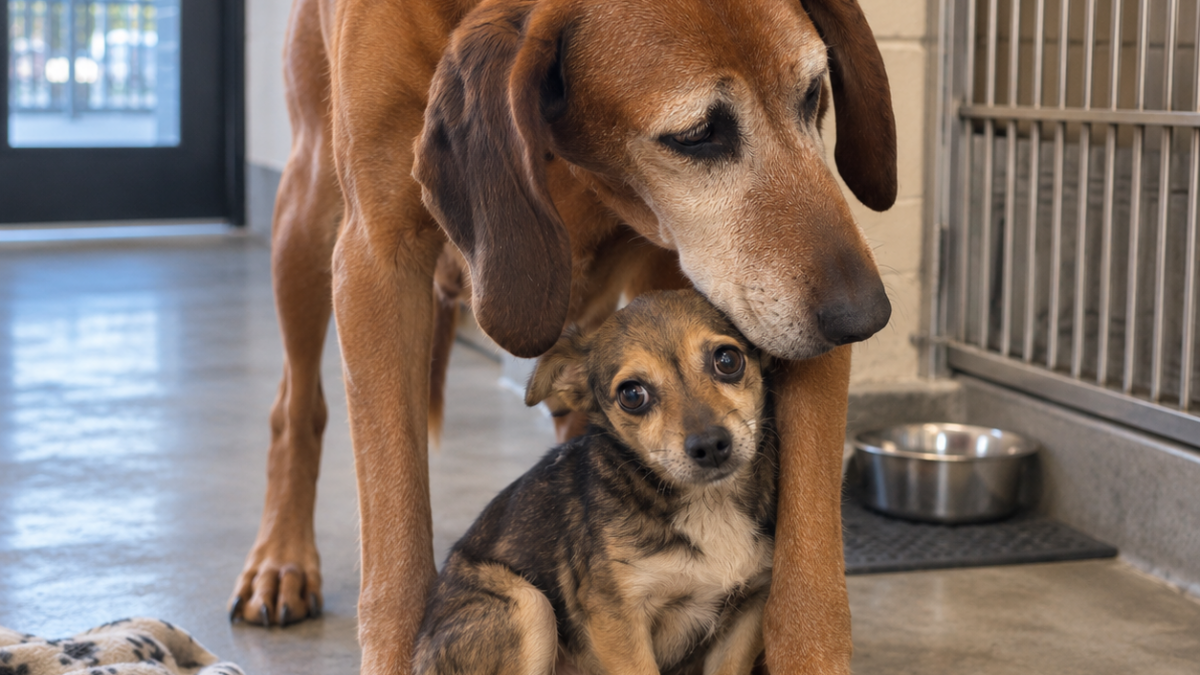
But inside that little pocket of space around Duke and Lulu, everything felt strangely still.
I crouched.
“Duke.”
He looked at me.
Then toward Lulu.
Then back at me.
“You don’t actually know me yet.”
His tail moved once.
“This is emotional blackmail.”
Rachel covered her mouth, trying not to laugh.
I pointed at Duke.
“I see what you’re doing.”
Duke rested his chin on his paws.
Lulu’s nose remained between the bars.
I looked at Rachel.
“How attached?”
She leaned against the wall.
“Very.”
“Explain.”
Rachel glanced at Lulu before answering.
“She arrived ten days ago through animal control. She was terrified of everyone. Wouldn’t eat if anyone was watching. Wouldn’t walk on leash. Wouldn’t come out of the back corner.”
I studied the tiny dog.
“What happened to her?”
“We don’t have the complete history yet.”
“That means you know something.”
Rachel nodded slowly.
“She came from a property outside Mill Creek. Animal control was responding to an unrelated complaint and found several dogs.”
“Several?”
“Eleven.”
My stomach tightened.
“Was it a breeding situation?”
“We think so.”
Lulu lowered her head.
Rachel continued.
“Some of the larger dogs were social enough. Lulu wasn’t. She was hiding behind an outdoor storage shed.”
I looked at the thin gray body beneath the blanket.
“Had she been hurt?”
“No obvious fractures. Some old scars. Nails badly overgrown. Dental issues. Underweight.”
“That isn’t what I meant.”
Rachel understood.
“We don’t know.”
I hated that answer.
“What does Duke have to do with her?”
“That started three days after Lulu arrived.”
Rachel pointed toward a small side yard visible through the window.
“We were walking Duke past the quiet kennel. Lulu panicked when a metal bowl dropped. She started throwing herself against the back of the enclosure.”
I looked at Lulu.
“Duke heard her?”
“He dragged the volunteer over here.”
“That doesn’t sound very independent.”
“No.”
Rachel smiled.
“He sat right where he is now.”
“For how long?”
“Almost two hours.”
I stared at her.
“And she calmed down?”
“Eventually.”
Rachel crouched beside me.
“The next morning, she wouldn’t eat. We tried everything. Chicken. Wet food. Hand feeding.”
“What worked?”
“We put Duke outside her kennel.”
I already knew the answer.
“She ate.”
Rachel nodded.
“Every day since then, he spends part of his morning here.”
I looked at Duke.
“You made a friend.”
His ears lifted at my voice.
Lulu shifted closer to him.
Rachel added quietly, “It’s more than that.”
“How?”
“When he leaves, she waits.”
My chest tightened.
“Waits?”
“She sits by the door looking down the hallway.”
“For him?”
“Yes.”
“And when he comes back?”
“She stops shaking.”
I stood.
This was becoming dangerous.
I had come prepared for one calm, older dog.
One food bowl.
One veterinary budget.
One leash.
One bed.
One set of responsibilities.
I was not the kind of person who made impulsive decisions.
At least not anymore.
My twenties had taught me that impulsive decisions were usually just expensive regrets wearing attractive clothes.
“So what happens to Lulu?” I asked.
Rachel’s expression softened.
“We work with her.”
“Adoption?”
“Eventually.”
“To someone else.”
“That’s generally how shelters work.”
I ignored the sarcasm.
“What about Duke?”
“That depends on you.”
“I’m here to adopt him.”
“I know.”
“So I take him home.”
“Yes.”
I looked down.
Duke remained on the floor.
“Duke.”
Nothing.
Rachel smiled.
“He’ll come eventually.”
“What if he doesn’t?”
“He will.”
But neither of us sounded convinced.
I walked toward the end of the hallway.
“Come on, Duke.”
He watched me.
I held out a treat.
He stood.
For one hopeful second, I thought the problem was solved.
Then he turned toward Lulu.
She stood too.
The moment Duke moved away, Lulu began shaking harder.
Duke stopped.
He looked back.
Then returned to her.
I closed my eyes.
“Oh, come on.”
Rachel laughed.
“This isn’t funny.”
“A little.”
“I specifically picked the low-maintenance dog.”
“Apparently he came with emotional responsibilities.”
I looked at Lulu.
Her eyes met mine for half a second.
Then dropped.
No aggression.
No barking.
Just fear.
I had spent years around scared children in the school library.
Kids who had moved too often.
Kids whose parents were divorcing.
Kids who hid in books because books behaved predictably.
You could not force trust out of a frightened child.
You created enough safe moments that eventually fear stopped expecting the worst.
Maybe animals were not so different.
“What happens if I take Duke today?”
Rachel’s smile faded.
“Lulu will adjust.”
“That isn’t what I asked.”
She took a breath.
“She’ll probably regress for a while.”
“How much?”
“We don’t know.”
“Will she stop eating?”
“Possibly.”
My shoulders dropped.
“This is unfair.”
“To you?”
“Yes.”
Rachel raised an eyebrow.
I looked at Duke.
“Fine. To all of us.”
Duke stood and stretched.
Then pushed his head against the kennel gate.
Lulu moved forward.
Her nose touched his ear.
Something about that gesture destroyed the last piece of resistance I had.
“Can they even be adopted together?”
Rachel blinked.
“You’re asking seriously?”
“I’m asking if it is possible.”
“Yes.”
“How much paperwork?”
“A lot.”
“Of course.”
“And Lulu needs a home assessment because of her behavioral needs.”
“You already did mine.”
“For Duke.”
“My yard hasn’t changed in the last seven minutes.”
“That is encouraging.”
I glared at her.
Rachel smiled.
“We’d also want you to spend time with Lulu first.”
“Obviously.”
“And I am not telling you that you have to take her.”
“I know.”
“This cannot be guilt.”
“I know.”
“Emily.”
“I know.”
I crouched in front of Lulu’s kennel.
She immediately moved backward.
Duke stood.
I stopped.
“Okay.”
I sat on the floor instead.
Not close.
Not reaching.
Just there.
Duke came beside me.
Then lay down halfway between Lulu and me.
I looked at him.
“You have a plan, don’t you?”
He closed his eyes.
Twenty minutes passed.
Then thirty.
Rachel eventually returned to work.
I remained.
Lulu watched me from beneath her blanket.
I stopped looking directly at her.
Instead, I talked to Duke.
I told him about my house.
The yard.
The oak tree.
The ridiculous number of squirrels.
I told him I had already bought a bed.
“One bed,” I emphasized.
His tail thumped.
“I know what you’re doing.”
Eventually, there was movement inside Lulu’s kennel.
I pretended not to notice.
She crawled forward.
One paw.
Then another.
She stopped behind Duke.
He turned his head.
Licked her nose through the gate.
Lulu looked at me.
I placed one treat on the floor near the bars.
Then moved my hand away.
She stared at it.
Five minutes later, she took it.
That was all.
One treat.
One tiny act.
But I felt something shift.
Not trust.
Not yet.
Possibility.
Rachel returned.
“Well?”
I stood.
“My life was simpler when I was single.”
“You’re still single.”
“Apparently I’m about to be outnumbered by dogs.”
Rachel’s face changed.
“Are you sure?”
“No.”
She waited.
I looked at Duke.
Then Lulu.
“I think that’s the point.”
We did not take them home that day.
Rachel insisted on doing things properly.
I appreciated that after I stopped being annoyed.
For the next week, I visited every afternoon after school.
At first, Lulu would only approach if Duke was between us.
So Duke became our bridge.
I sat.
He sat.
Lulu watched.
I read books aloud because reading was the one thing I knew how to do without making anyone nervous.
The first book happened to be *Charlotte’s Web*.
Rachel found me halfway through chapter three.
“You’re reading to her?”
“I work in a library.”
“That does not answer the question.”
“She doesn’t complain about character voices.”
Duke slept beside me.
Lulu listened from behind her blanket.
By day three, she came close enough to take chicken from my fingers.
By day four, I touched her chin.
She jumped backward.
Duke immediately stood between us.
“I didn’t hurt her.”
He stared.
“I know.”
I lowered my voice.
“I’m learning too.”
The next afternoon, Lulu approached again.
This time I did not touch her.
She touched me.
One quick sniff against the back of my hand.
Then retreat.
Duke wagged.
“You’re very proud of yourself.”
He absolutely was.
The shelter behaviorist, Megan, met with me on Friday.
She gave me a list of rules.
No forced affection.
No reaching over Lulu’s head.
No dragging her through doorways.
No strangers crowding her.
No punishment for fear behaviors.
Give her escape routes.
Use predictable routines.
Let Duke model confidence.
“Most importantly,” Megan said, “don’t expect gratitude.”
I looked at her.
“What?”
“People rescue frightened dogs and expect them to understand immediately that they are safe.”
I nodded.
“She won’t.”
“No.”
“She may hide from you.”
“Okay.”
“She may have accidents.”
“Okay.”
“She may panic.”
“Okay.”
“She might not become the dog you imagine.”
That one made me pause.
Megan noticed.
“She doesn’t owe you transformation.”
I thought about that.
“I understand.”
“Do you?”
I looked through the window.
Duke was lying beside Lulu.
“I’m trying to.”
The home visit happened Saturday.
Rachel arrived with a clipboard.
She inspected the fence.
The gates.
The kitchen.
The yard.
I showed her the bedroom.
Then she stared at the living room.
“What?”
“One dog bed.”
I crossed my arms.
“I ordered another.”
“Good.”
“It arrives tomorrow.”
“Excellent.”
“Stop enjoying this.”
She grinned.
On Tuesday morning, exactly one week after I first came to take Duke home, I returned with two leashes.
Duke knew.
I swear he knew.
The moment Rachel clipped on his harness, his entire body changed.
Lulu was more complicated.
She saw the leash and backed into the corner.
Megan sat quietly beside her.
Duke entered the kennel.
Lulu immediately moved toward him.
Megan clipped the leash while Lulu focused on Duke.
Then we reached the hallway.
Duke walked.
Lulu froze.
The front door was thirty feet away.
Too much.
I crouched.
“It’s okay.”
Nothing.
Duke stopped.
He walked back.
Stood beside her.
Lulu took one step.
Then another.
We moved like that.
Duke forward.
Lulu forward.
Pause.
Again.
At the front door, Lulu stopped.
Sunlight spilled through the glass.
Cars moved outside.
A completely ordinary world.
To her, it might as well have been another planet.
Duke stepped through.
Lulu pulled backward.
He turned.
He came back inside.
Pressed his shoulder against her.
I stopped breathing.
Lulu looked at him.
Then the door.
Then him.
She stepped outside.
Rachel made a tiny sound behind me.
I looked back.
She was crying.
“You work here.”
“That doesn’t mean I’m dead.”
Duke walked toward my car.
Lulu followed.
He climbed into the back seat using the ramp I had bought for him.
Lulu refused.
Of course.
So I sat beside the open door for seventeen minutes.
Eventually she placed her front paws on the ramp.
Duke leaned down.
Sniffed her face.
Lulu climbed.
I closed the door.
Then stood there with my hands on the roof of the car.
Two dogs stared at me through the glass.
“What have I done?”
Rachel laughed.
“Adopted a family.”
The drive home took twenty minutes.
Duke slept for eighteen of them.
Lulu did not blink.
She sat pressed against Duke’s side, watching every movement outside.
When we reached my house, Duke stepped out first.
He sniffed the yard.
The mailbox.
The porch.
One bush for so long I began wondering if it contained state secrets.
Lulu stayed in the car.
I did not pull her.
Duke eventually returned.
He stood at the bottom of the ramp.
Lulu stared.
Duke waited.
She came down.
That became the pattern of our first month.
Duke went first.
Lulu followed.
Doorways.
Yard.
Kitchen.
Hallway.
Every new experience passed through him before she trusted it.
The first night, Duke chose the bed I had bought near the fireplace.
Lulu hid beneath the kitchen table.
I put her bed nearby.
She ignored it.
At midnight, I found her sleeping beside Duke instead.
Her body was pressed against his ribs.
Duke’s long ear covered part of her face.
I stood in the dark looking at them.
My house had never felt less empty.
The problem with getting exactly what you think you want is that sometimes it reveals how little you understood what you needed.
I had wanted quiet companionship.
Duke gave me that.
Lulu gave me chaos disguised as silence.
She was afraid of spoons dropping.
Garbage trucks.
Men wearing baseball caps.
The washing machine spin cycle.
Umbrellas.
Plastic bags.
People approaching too quickly.
Brooms.
Raised voices.
And, strangely, red pickup trucks.
The first time one passed our house, Lulu threw herself behind the couch.
I found her shaking.
Duke squeezed beside her.
I sat on the floor several feet away.
“No one is coming in.”
She stared.
“You’re staying here.”
The truck disappeared.
Lulu remained hidden for two hours.
That was when I began wondering exactly what had happened to her.
The shelter had only partial information.
Animal control had removed eleven dogs from a rural property rented by a man named Caleb Voss.
The owner claimed most of the dogs belonged to “friends.”
There were no complete veterinary records.
No breeding permits.
No clear ownership documents.
Lulu had not been microchipped.
No one had claimed her.
The case remained open.
I tried not to obsess.
The past mattered.
But I couldn’t change it.
What I could change was breakfast at seven.
Walk at seven-thirty.
School for me.
Dog walker at noon.
Home by four.
Dinner at six.
Quiet time after.
Predictability became Lulu’s medicine.
Three weeks after adoption, she wagged her tail when I came home.
I stopped inside the door.
“Did you see that?”
Duke looked up from his bed.
“Her tail.”
Lulu immediately stopped.
I laughed.
“Fine. Pretend it didn’t happen.”
The next day she did it again.
A week later, she met me halfway across the living room.
Then came the first time she jumped onto the couch.
She landed beside Duke.
Looked terrified by her own decision.
Then slowly lowered herself.
I sat at the other end.
No touching.
Ten minutes later, I felt something warm against my thigh.
Lulu’s body.
Barely touching me.
I looked away so she wouldn’t notice I was crying.
At school, I became insufferable.
I showed photographs to everyone.
Our principal, Mrs. Adler, eventually said, “Emily, I know what Duke looks like.”
“You haven’t seen this one.”
“He’s sleeping.”
“Different sleeping position.”
She stared at me.
“You need human hobbies.”
“I have books.”
“That somehow proves my point.”
The children loved the stories.
Especially Lulu.
They began leaving drawings on my desk.
Pictures of a tiny gray dog beside a giant red hound.
One first grader drew Duke wearing a superhero cape.
Underneath she wrote:
**DUKE SAVES LULU.**
I brought it home.
I taped it above their beds.
For a while, that felt true.
Then I learned the relationship worked both ways.
One morning, about two months after adoption, Duke collapsed.
Not dramatically.
He stood from his bed.
Took two steps.
Then his hind legs folded.
I dropped my coffee.
“Duke!”
Lulu ran toward him.
He tried to rise.
Couldn’t.
I was on the floor beside him instantly.
His gums looked pale.
His breathing was fast.
“Stay with me.”
I called the emergency veterinarian.
Lulu paced in circles.
I tried leaving her home.
She screamed.
Not barked.
Screamed.
I had never heard that sound from her.
So both dogs went.
At the clinic, they took Duke into the back.
Lulu lost control.
She pulled toward the door until her harness twisted.
I picked her up.
She hated being picked up.
That morning, she allowed it.
Her entire body shook against mine.
“I know.”
I sat with her.
“They’re helping him.”
For two hours, Lulu stared at the treatment-room door.
The diagnosis was less terrifying than my imagination.
Duke had a severe gastrointestinal infection combined with dehydration.
No tumor.
No internal bleeding.
His heart looked good.
He needed fluids and observation.
When Dr. Shah brought him out that evening, Lulu launched herself toward him.
Duke lowered his head.
She licked his entire face.
Duke looked miserable.
I laughed through tears.
“I guess you’re even now.”
That night, Lulu did something new.
Duke was asleep.
She climbed onto my bed.
Alone.
No Duke leading.
No Duke checking first.
She curled against my legs.
The dog who once needed Duke to cross every doorway had crossed one without him because she needed to be near someone.
Me.
I lay awake thinking about that.
Duke had taught Lulu the world could be safe.
Maybe Lulu had started believing I was part of that world.
Spring came.
The backyard transformed.
Duke spent hours beneath the maple tree.
Lulu discovered squirrels.
Fear apparently had limits.
She would hide from a grocery bag but pursue a squirrel with the confidence of a wolf.
The first time she ran full speed across the yard, I shouted.
Not because anything was wrong.
Because I had never seen her run for joy.
Duke lifted his head.
Lulu raced around the tree.
Once.
Twice.
Three times.
Then skidded into the grass beside him.
Duke sighed like an exhausted father.
I laughed until my face hurt.
I sent the video to Rachel.
She replied:
**That is not the same dog.**
I wrote back:
**Yes, she is. She just feels safe now.**
That mattered.
Because rescue stories sometimes make healing sound like transformation.
The frightened dog disappears.
A happy dog replaces her.
That wasn’t true.
Lulu was always Lulu.
Fear had simply covered so much of her that none of us could see the rest.
Then the past knocked on my front door.
Literally.
It happened on a Thursday afternoon.
I had just come home from school.
Duke was outside.
Lulu was lying on the rug.
A red pickup stopped in front of my house.
Lulu saw it through the window.
Her body changed instantly.
Tail down.
Ears flat.
She backed away.
My chest tightened.
A man got out.
Baseball cap.
Work boots.
Heavy jacket.
He walked toward my door.
Lulu disappeared behind Duke.
I stepped onto the porch before he reached it.
“Can I help you?”
He looked past me.
“Those your dogs?”
The question felt wrong.
“Yes.”
“The little gray one.”
My skin went cold.
“What about her?”
He smiled.
“That’s my dog.”
Duke came to the screen door.
Lulu remained invisible behind him.
“What’s her name?”
The man hesitated.
“Lucy.”
Wrong.
Maybe.
Or maybe Lulu had been called something else.
I didn’t open the door.
“Who are you?”
“Caleb Voss.”
There it was.
The name from the animal-control file.
I felt my pulse change.
“You need to leave.”
His smile disappeared.
“I said she’s mine.”
“She was legally transferred through the shelter.”
“They had no right.”
“That sounds like something you should discuss with animal control.”
“I’m discussing it with you.”
Duke growled.
I had never heard Duke growl at a person.
Not once.
Caleb looked at him.
“Control your dog.”
“He’s controlled.”
I looked through the screen.
Lulu’s entire body was shaking.
And suddenly every piece fit.
Red truck.
Baseball cap.
Male voice.
The rural property.
I didn’t know exactly what Caleb had done.
But Lulu knew him.
And she was terrified.
“You need to get off my property.”
His face hardened.
“I paid for that dog.”
Something in the sentence made my stomach turn.
“Paid who?”
“That’s none of your business.”
“Actually, if you’re claiming ownership, it becomes very much my business.”
He stepped closer.
Duke’s growl deepened.
“Give me Lucy and I’ll leave.”
“No.”
“You don’t know what you’re involved in.”
“Then explain it.”
“She’s valuable.”
That word.
Not loved.
Not missed.
Valuable.
“How?”
He realized his mistake.
“I mean she’s mine.”
“You just called her valuable.”
“She’s a purebred mix.”
I nearly laughed.
“That doesn’t mean anything.”
“She had good litters.”
The world became very quiet.
I stared at him.
“How many?”
His eyes shifted.
I understood.
Lulu had been bred.
Repeatedly.
The scars.
The fear.
The property.
Eleven dogs.
I felt sick.
“She’s spayed.”
I said it deliberately.
Caleb’s expression changed.
There.
That was all I needed.
Not grief.
Not heartbreak.
Anger.
“You what?”
“She was spayed before adoption.”
“You had no right.”
I almost smiled.
“I didn’t.”
“The shelter did.”
He stepped toward me.
Duke slammed one paw against the screen door and barked.
Caleb stopped.
I pulled out my phone.
“I’m calling the sheriff.”
He stared at me.
Then pointed toward the house.
“This isn’t over.”
I started dialing.
He walked back to his truck.
Lulu did not come out for three hours.
I sat on the floor near the couch.
Duke lay beside her.
I called Rachel.
Then animal control.
Then the sheriff.
Rachel’s voice changed when I said Caleb’s name.
“He came to your house?”
“Yes.”
“Did he threaten you?”
“Not directly.”
“What did he say?”
I repeated everything.
When I reached the part about litters, Rachel became silent.
“Rachel?”
“I’m here.”
“You knew?”
“No. We suspected.”
“Suspected what?”
“That Lulu was being used for breeding.”
I looked toward the couch.
“How often?”
“We don’t know.”
“She’s tiny.”
“I know.”
“What kind of person—”
I stopped.
Anger wasn’t helping.
“What happens now?”
“File the report. Save any camera footage.”
“I have a doorbell camera.”
“Good.”
“Can he get her back?”
“No.”
The answer came immediately.
“You’re sure?”
“Emily, listen to me. Lulu was transferred after the legal hold period connected to the seizure. No legitimate owner established a claim. You adopted her through the proper process.”
“But he says he bought her.”
“Then he can explain that to investigators.”
I looked at Duke.
He was still guarding the couch.
“Why now?”
Rachel sighed.
“I don’t know.”
We found out two days later.
A local article about Duke and Lulu had appeared online.
Nothing huge.
The shelter had posted an update about bonded dogs and used our adoption as an example.
There was a photograph.
Duke lying in my backyard.
Lulu beside him.
Caleb had seen it.
And apparently Lulu’s previous breeding history had been profitable enough that he believed she still had value.
Except she had been spayed.
He had come for an animal he thought he could use again.
That changed my anger into something colder.
The investigation into Caleb’s property had never fully disappeared.
His visit to my house revived it.
Animal-control officers interviewed me.
They obtained the doorbell video.
Then another former neighbor came forward.
A woman named Mrs. Hanley.
She had lived near Caleb for four years.
According to her, puppies came and went constantly.
Small dogs.
Mixed breeds marketed online as “designer puppies.”
She had heard dogs crying at night.
She had called county services twice.
Each time, Caleb moved animals before inspections.
“Did she know Lulu?” I asked.
Rachel nodded.
“She thinks so.”
Mrs. Hanley later came to my house with an investigator.
The moment she saw Lulu through the glass, she covered her mouth.
“That’s Little Lou.”
I looked at her.
“You know her?”
“She was there for years.”
“How many?”
“At least three.”
Lulu backed away from the stranger.
Mrs. Hanley did not approach.
“She had puppies every time I saw her.”
My stomach turned.
“How many litters?”
“I don’t know.”
Mrs. Hanley’s eyes filled.
“Too many.”
She told us Lulu had lived mostly in a small kennel behind the storage shed.
When pregnant, she disappeared inside the garage.
Weeks later, puppies appeared in advertisements.
Then disappeared.
Again.
Again.
Again.
“Why didn’t anyone stop him?”
I asked the question more harshly than I intended.
Mrs. Hanley looked at the floor.
“We tried.”
Immediately, I regretted it.
“I’m sorry.”
“No.”
She shook her head.
“You have the right to ask.”
She looked toward Lulu.
“I ask myself that every day.”
Duke walked into the room.
Mrs. Hanley smiled sadly.
“So that’s him.”
“Yes.”
“The dog who wouldn’t leave her?”
I nodded.
Duke walked to Lulu.
Immediately, she came forward.
Mrs. Hanley watched.
“That little girl never had anybody.”
Her voice cracked.
“Looks like she does now.”
The case widened.
Records from online advertisements were traced.
Several buyers came forward.
One family still had a dog they believed had been born to Lulu.
DNA testing eventually supported that connection.
Lulu had produced at least four documented litters.
Possibly more.
Four.
She was only estimated to be five years old.
I sat in my kitchen after learning that.
Duke slept under the table.
Lulu rested beside him.
I stared at her.
Four pregnancies.
Four sets of puppies removed.
Four times her body had been used because someone could make money from it.
I hated Caleb.
That was the simplest version.
But hatred made me feel powerless.
So I did what librarians do.
I organized information.
Dates.
Reports.
Messages.
Doorbell footage.
Shelter records.
Mrs. Hanley’s statement.
I saved everything.
Caleb’s attorney eventually sent a letter claiming Lulu had been “wrongfully disposed of.”
My attorney laughed when she read it.
I did not.
“What if he sues?”
“He can sue.”
“That is not comforting.”
“It’s realistic.”
“Could he win?”
“Based on what I’ve seen? Highly unlikely.”
“Highly unlikely is not impossible.”
She looked at me.
“Emily, fear wants certainty.”
I said nothing.
“The law rarely gives certainty. Evidence gives strength.”
So we built evidence.
Meanwhile, Duke became Lulu’s anchor in ways I hadn’t fully appreciated until Caleb’s visit.
Her fear returned.
For weeks, every truck outside sent her into hiding.
She stopped sleeping in the living room.
She began having accidents.
She refused food unless Duke stood beside the bowl.
Part of me felt devastated.
Months of progress.
Gone.
Megan corrected me.
“Not gone.”
“It feels gone.”
“Trauma recovery isn’t a staircase.”
I crossed my arms.
“She was doing so well.”
“She still is.”
“She’s hiding.”
“And then she comes back out.”
“She’s shaking.”
“And then she stops.”
“She won’t eat alone.”
“She eats.”
I looked at her.
Megan leaned forward.
“Do not punish Lulu in your mind for being scared again.”
That hit.
“I’m not.”
“You are mourning the version of her you thought was healed.”
I swallowed.
“She is healed in some ways.”
Megan nodded.
“And injured in others.”
I looked at Lulu.
“So what do I do?”
“The same thing you did before.”
“Wait?”
“Stay.”
So we stayed.
Duke beside Lulu.
Me beside Duke.
No dramatic breakthrough.
Just repetition.
Breakfast.
Walk.
Quiet.
Safety.
Days.
Weeks.
One night, a red pickup drove past.
Lulu froze.
She looked toward the window.
Then at Duke.
Then at me.
She did not run.
I held my breath.
The truck disappeared.
Lulu walked to her bed.
Curled up.
That was victory.
Small.
Invisible to anyone else.
Huge to me.
The criminal hearing against Caleb came almost nine months after he appeared at my house.
By then investigators had found much more.
Veterinary drugs without prescriptions.
Falsified vaccination records used in puppy sales.
Financial records showing hundreds of transactions.
Photographs from buyers.
Statements from neighbors.
Animals removed from another property connected to him.
The charges included animal neglect and illegal commercial breeding violations, along with other offenses associated with the operation.
The exact legal language mattered less to me than one simple fact.
Someone had finally listened.
I attended one hearing.
I almost didn’t.
Rachel came with me.
Duke and Lulu stayed home with Megan.
Caleb entered the courtroom in a clean shirt.
No baseball cap.
He looked smaller than he had on my porch.
That surprised me.
People who dominate frightened animals can look enormous in your imagination.
Courtrooms have a way of returning them to ordinary size.
His attorney argued that conditions at the property had been exaggerated.
Then the prosecutor introduced photographs.
Kennels.
Dirty water.
Improvised enclosures.
Dogs standing on wire.
Lulu’s original intake photograph appeared on a screen.
I stopped breathing.
I had seen parts of it before.
Not that photograph.
She was thinner.
Much thinner.
Her eyes looked enormous.
There was a chain attached to her collar.
Rachel took my hand.
I whispered, “I didn’t know.”
“I know.”
The prosecutor asked an animal-control officer about Lulu.
“She was found hiding behind an outdoor structure.”
“Condition?”
“Underweight, severely fearful, reproductive history consistent with repeated breeding.”
“Did she voluntarily approach staff?”
“No.”
“Did she respond normally to leash handling?”
“No.”
“What happened?”
“She urinated and attempted to hide.”
My eyes burned.
Then Caleb’s attorney said something that made every muscle in my body tense.
“Isn’t it possible this animal simply had an anxious temperament?”
The officer stayed calm.
“Yes.”
The attorney looked satisfied.
Then she continued.
“But temperament does not explain untreated medical needs, poor body condition, reproductive overuse, environmental neglect or lack of records.”
Caleb looked down.
Good.
I wanted him to look.
Another witness described buying a puppy from him.
The puppy became critically ill three days later.
Parvovirus.
The family spent thousands saving him.
Another buyer’s puppy died.
Another had congenital problems.
The advertisements promised “home-raised, healthy family puppies.”
The photographs told another story.
During a recess, Caleb saw me.
Our eyes met.
He walked toward me before his attorney stopped him.
“What?”
I said it first.
He stared.
“You happy?”
The question shocked me.
“Happy?”
“All this.”
He gestured toward the courtroom.
“You got what you wanted.”
I stood.
Rachel moved beside me.
“What do you think I wanted?”
“You wanted revenge.”
For a second, I almost laughed.
Because months earlier, maybe I had.
I had imagined him losing money.
Losing the property.
Losing control.
I had wanted consequences severe enough to somehow balance Lulu’s fear.
But by then, I understood something.
Nothing that happened to Caleb could give Lulu her puppies back.
Nothing could erase years spent trembling.
Nothing could turn her past into something it wasn’t.
“No.”
I looked at him.
“I wanted you to stop.”
His expression changed.
“That’s different.”
“You ruined my business.”
“You did that.”
“You called people.”
“I told the truth.”
“You took my dog.”
I felt Rachel tense.
I stepped closer.
“No.”
My voice stayed quiet.
“You lost Lulu long before I met her.”
He stared at me.
“The day she learned to shake when she heard your truck—that was when you lost her.”
His face went hard.
I continued.
“The day she learned a human hand meant something to fear, you lost her.”
Rachel touched my arm.
I stopped.
Caleb’s attorney called his name.
He turned away.
I thought I would feel powerful.
Instead, I wanted to go home.
So I did.
Duke met me at the door.
Lulu stood behind him.
The moment she saw me, her tail wagged.
Not wildly.
Just enough.
I dropped my purse.
Sat on the floor.
Duke came first.
Lulu followed.
I wrapped my arms around both of them.
“That’s better.”
That was my revenge.
Not the courtroom.
This.
The dog he had frightened choosing to walk toward me.
The case eventually ended with penalties, restrictions on animal ownership and breeding, restitution in several related cases and the loss of the remaining animals connected to the operation.
Some people told me the punishment wasn’t enough.
Maybe it wasn’t.
But the operation was finished.
The dogs were out.
Lulu was safe.
Caleb never came to my house again.
That mattered.
Life became ordinary.
Beautifully ordinary.
Duke turned eight.
His muzzle grew grayer.
He developed mild arthritis.
We started joint supplements.
He complained about rain.
He had opinions about breakfast.
Lulu became brave enough to bark at the mail carrier.
The first time she did it, I ran into the room.
“What happened?”
She stood at the window.
Tail high.
Mail carrier outside.
Duke didn’t even bother lifting his head.
I laughed.
“You’re protecting the house now?”
Lulu barked again.
The poor mail carrier jumped.
“Okay, maybe less protecting.”
At school, my students kept sending drawings.
One second grader wrote a short story titled:
**THE BIG DOG WHO WAITED.**
In it, Duke was a knight.
Lulu was a princess.
I was apparently “the lady with the car.”
Not queen.
Not rescuer.
Car lady.
Humbling.
I framed it anyway.
Then Duke’s original owner’s family contacted me.
That was unexpected.
A woman named Sarah emailed the shelter asking whether Duke had been adopted.
Rachel forwarded the message after getting my permission.
Sarah was the granddaughter of Duke’s former owner, Harold.
Harold had entered assisted living after a stroke.
Duke had been surrendered because no family member could take him.
The shelter records confirmed everything.
Sarah wrote:
**My grandfather still asks about Duke. We told him Duke found a home, but I wondered if there was any possibility of sending a photograph.**
I cried immediately.
Not elegant tears.
Full crying.
I sent twenty photographs.
Possibly excessive.
Duke beneath the tree.
Duke asleep.
Duke with Lulu.
Duke wearing a ridiculous birthday hat.
Duke beside my library tote bag.
A week later, Sarah asked whether I would consider bringing Duke to visit Harold.
I said yes.
Then I worried.
Would it confuse him?
Would Duke think I was giving him back?
Would Harold be devastated?
Rachel reminded me I had a habit of imagining every possible disaster.
“Go.”
So we went.
Lulu came too.
Of course.
The assisted-living facility allowed dogs in a small garden area.
Harold sat in a wheelchair beneath an awning.
He was eighty-six.
Thin.
White hair.
One hand curled against his lap from the stroke.
When Duke saw him, he stopped.
Harold began crying.
“Dukey.”
I had never heard anyone call him that.
Duke moved.
Not slowly.
Not his usual dignified walk.
He pulled me.
I dropped the leash.
He reached Harold.
Placed his front paws gently against the wheelchair.
Harold buried his face in Duke’s neck.
“My boy.”
I turned away.
Couldn’t watch.
Couldn’t not watch.
Lulu stood beside me.
Then something beautiful happened.
Duke turned.
Looked at Lulu.
Then at Harold.
Lulu hesitated.
Walked forward.
Harold lowered one hand.
Lulu stopped just beyond his reach.
Duke touched her shoulder with his nose.
She took another step.
Harold stroked one finger along her cheek.
Lulu did not run.
Sarah started crying.
Everyone was crying.
Apparently that was just our hobby.
Harold looked at me.
“You take good care of him?”
“With my life.”
He smiled.
“He always took care of things smaller than him.”
I looked at Lulu.
“What?”
Harold stroked Duke’s ear.
“When he was younger, I had an old beagle named Rosie.”
I listened.
“She went blind near the end.”
My chest tightened.
“Duke walked beside her everywhere.”
Harold smiled at the memory.
“Rosie couldn’t find the back steps anymore. Duke would stand beside them until she touched him. Then he’d lead her inside.”
I looked down at Duke.
Suddenly the shelter hallway made even more sense.
This wasn’t new.
Duke had always been that dog.
The one who noticed the frightened animal.
The one who waited.
“He did the same thing for Lulu.”
Harold looked at her.
“Then he knew she needed him.”
I knelt beside Duke.
“You’ve been doing this your whole life.”
His tail thumped.
On the drive home, I cried again.
Lulu slept pressed against Duke.
The next month, we visited Harold again.
Then every six weeks.
Sometimes he remembered my name.
Sometimes he didn’t.
He always remembered Duke.
One afternoon, Harold looked at me and said, “He picked you.”
I smiled.
“I thought I picked him.”
“No.”
Harold shook his head.
“Duke’s never been confused about people.”
That sentence stayed with me.
Almost two years after I adopted them, Harold died.
Sarah called me personally.
“He went peacefully.”
I sat on the kitchen floor.
Duke beside me.
“I’m sorry.”
“He had Duke’s picture beside his bed.”
I closed my eyes.
Sarah continued.
“The one with Lulu.”
After the funeral, she brought me an old leather collar.
Duke’s first collar.
Harold had kept it in a drawer.
The tag still had Duke’s name scratched into the metal.
I hung it beside their framed adoption certificate.
Duke sniffed it once.
Then walked away.
Dogs understand something we don’t.
Memory doesn’t require monuments.
We make those for ourselves.
By then, Lulu had become almost unrecognizable from the dog beneath the shelter blanket.
She still had fears.
Storms.
Red trucks.
Men approaching too quickly.
But she had joy too.
She loved sunbathing.
Cheese.
Socks.
Duke’s ears.
For reasons nobody understood, she liked licking the inside of Duke’s ears.
Duke endured this with profound disappointment.
She slept upside down.
She stole my pillow.
She learned three tricks.
Sit.
Spin.
And “go find Duke.”
The last one was unnecessary because she always knew where Duke was.
Then one winter morning, I understood the bond between them had entered a new stage.
Duke was ten by then.
His arthritis had worsened.
He could still walk.
Still enjoy the yard.
But stairs became difficult.
One morning, he stopped at the bottom of the porch steps.
I was carrying groceries.
“Wait.”
Before I could help him, Lulu ran inside.
Then returned.
She stood one step above Duke.
He looked at her.
She went up another.
Stopped.
Looked back.
Duke followed.
One step.
Lulu moved.
Another step.
Duke followed.
I stood frozen.
They reached the porch.
Lulu touched her nose to Duke’s face.
He walked inside.
I put the groceries down and cried beside a bag of potatoes.
Years earlier, Duke had shown Lulu how to cross the shelter door.
Now she was showing him how to climb the steps.
That was the first time I realized Lulu no longer needed saving.
She had become someone who could save him too.
From then on, she adjusted to his pace.
On walks, Lulu used to race ahead.
Now she stopped.
Waited.
Returned to him.
If Duke lay down in the yard, Lulu lay beside him.
If he struggled standing, she hovered.
When he went to the veterinarian, Lulu went too.
Dr. Shah joked that Duke had acquired a tiny nurse.
Then came the diagnosis I had been afraid of.
A mass near Duke’s liver.
We found it during routine blood work.
Ultrasound confirmed it.
Likely cancer.
I sat in the examination room with Lulu pressed against my ankle.
Duke lay on the floor.
“How long?”
I asked.
Dr. Shah hated that question.
Everyone does.
“We don’t know.”
“Months?”
“Possibly.”
“A year?”
“Possibly.”
“Surgery?”
“At his age and with the location, it would be difficult.”
“Could it cure him?”
“No guarantee.”
I looked at Duke.
He was eleven.
Maybe not ancient.
But tired.
“What would you do?”
Dr. Shah leaned back.
“I would decide based on Duke, not the tumor.”
I frowned.
“What does that mean?”
“Is he eating?”
“Yes.”
“Walking?”
“Yes.”
“Interested in you? Lulu? The yard?”
“Yes.”
“Then today he is living.”
I swallowed.
“And when that changes?”
“We talk again.”
I drove home.
Lulu slept against Duke in the back seat.
I parked.
Couldn’t move.
For years, Duke had been the solid thing.
Duke waited.
Duke guided.
Duke protected.
It felt fundamentally wrong that his body could fail him.
At home, I sat on the kitchen floor.
Duke came over.
I held his face.
“I’m not ready.”
His tail moved.
Lulu climbed into my lap.
“I’m really not ready.”
That night, both dogs slept on my bed.
I didn’t complain.
The next four months were surprisingly good.
Medication helped.
Duke ate.
Walked.
Visited Harold’s old garden at the assisted-living facility once with Sarah.
We went to the lake.
Lulu discovered she hated water.
Duke walked knee-deep into it and stood there looking peaceful.
I took photographs.
Too many.
I knew why.
I was already trying to preserve him.
One morning in April, Duke refused breakfast.
Lulu noticed before I did.
She walked to his bowl.
Then to him.
Then back.
Duke stayed on his bed.
My heart dropped.
“Duke?”
He lifted his head.
Didn’t stand.
We went to Dr. Shah.
The tumor had grown.
There was evidence of internal bleeding.
Not catastrophic.
Yet.
But the path had narrowed.
Surgery would be extremely risky.
Comfort care could give days.
Maybe weeks.
I stared at the X-ray.
“What if I make the wrong decision?”
Dr. Shah said something I will never forget.
“You are not choosing whether Duke dies.”
My eyes filled.
“You are choosing whether his last days belong to his illness or to him.”
I looked down.
Lulu was pressed against Duke.
“What would make them belong to him?”
“Home.”
The answer was simple.
So I took him home.
We had twelve more good days.
Not perfect.
Good.
Duke ate chicken.
Lay beneath the maple tree.
Lulu stayed beside him.
I took three days off work.
Mrs. Adler didn’t even let me finish asking.
“Go.”
The children sent cards.
One said:
**TELL DUKE HE IS THE BEST BIG BROTHER.**
I read it aloud.
Lulu licked his face.
Day thirteen was different.
Duke could not stand without help.
His breathing was shallow.
He refused water.
Lulu began pacing.
She knew.
I knew.
Knowing did not make it easier.
Dr. Shah came to the house that afternoon.
We carried Duke into the backyard on his favorite blanket.
Sunlight came through the maple leaves.
Lulu lay beside him.
I sat on the other side.
Dr. Shah gave us time.
I put my hand on Duke’s head.
“Remember the shelter?”
His eyes opened.
“You ruined everything.”
His tail moved weakly.
“I had a plan.”
My voice broke.
“One dog.”
Lulu lifted her head.
“I had bought one bed.”
I laughed through tears.
“You looked at me like I was the stupidest person alive.”
Duke breathed.
“Maybe you were right.”
I pressed my forehead against his.
“You gave me her.”
Lulu moved closer.
“You gave her me.”
I swallowed.
“And somehow, you gave me a home.”
For years, I had told people I adopted Duke and Lulu.
Standing there, I understood how incomplete that sentence was.
Duke had adopted Lulu first.
Then he had trusted me to understand.
Dr. Shah touched my shoulder.
“Emily?”
I closed my eyes.
“Okay.”
The first injection relaxed him.
His breathing softened.
Lulu suddenly stood.
She moved to Duke’s face.
Sniffed.
Then lay across his front paws.
Exactly where she had once pressed herself against his kennel gate.
I started sobbing.
“No.”
Not because I wanted to stop it.
Because the symmetry was too much.
Duke’s eyes opened one final time.
He looked at Lulu.
Then me.
I held him.
“You can go.”
The words barely came out.
“We’ve got her.”
Lulu rested her head against his.
“I promise.”
Dr. Shah gave the final medication.
Duke took one breath.
Then another.
Then none.
Lulu did not move.
I stayed with them for almost an hour.
Eventually, Lulu stood.
She sniffed Duke’s face.
His ears.
His paws.
Then she stepped backward.
She looked at me.
I opened my arms.
For the first time in her life, Lulu crossed the space between us without Duke.
She climbed directly into my lap.
Pressed herself against my chest.
And stayed.
That was how I knew Duke’s work was finished.
The first night without him was unbearable.
Lulu walked from room to room looking.
Bed.
Kitchen.
Back door.
His empty spot near the fireplace.
She whimpered.
I sat on the floor beside her.
“I know.”
She looked at me.
“I’m looking too.”
For three days, she barely ate.
I called Dr. Shah.
I called Megan.
Everyone said the same thing.
Grief.
Give time.
So I did for Lulu what Duke had once done.
I waited.
I sat beside her bowl.
She ate three bites.
The next morning, five.
We walked.
Slowly.
Every few feet she turned around.
Looking for him.
“He’s not coming.”
I hated saying it.
Eventually, she stopped looking every time.
Not because she forgot.
Because she learned the shape of the world without him.
I had to learn too.
Two months after Duke died, I considered moving his bed.
I picked it up.
Lulu panicked.
She ran over.
Climbed onto it.
Curled in the center.
I put it back.
“Fine.”
She slept there that night.
Some things can stay.
Healing does not require clearing every trace.
Caleb’s case was long over by then.
I rarely thought about him.
That surprised me.
At one point, I had wanted to see him ruined.
I imagined satisfaction.
But Duke’s death clarified something.
Time is too expensive to spend making cruel people the main characters of lives they harmed.
Caleb was part of Lulu’s story.
He was not the ending.
Duke was.
Safety was.
Home was.
Years later, Rachel told me Caleb had attempted to start another breeding operation after his restrictions ended.
Neighbors reported him quickly.
The county shut it down before it grew.
“Does that make you happy?”
Rachel asked.
I thought about it.
“No.”
“Really?”
“It makes me relieved.”
There was a difference.
I no longer needed revenge.
I needed the next Lulu not to wait years for someone to notice.
So Rachel and I started something small.
A fund.
We named it Duke’s Door.
The purpose was to support bonded animals and dogs with behavioral trauma who were often difficult to place.
Sometimes shelters separated bonded dogs because finding one home for two was harder.
Sometimes that was unavoidable.
But when possible, Duke’s Door helped pay adoption fees, behavioral support and temporary fostering so animals with important bonds could remain together.
Our first pair was two elderly Chihuahuas named Benny and June.
The second was a shepherd and a blind terrier.
The third made me cry.
A large old hound.
And a tiny frightened dog.
Of course.
They had arrived together after their owner died.
The small dog refused to eat without the hound.
Rachel called me.
“You need to see this.”
“No.”
“Yes.”
“I know what you’re doing.”
“I’m doing nothing.”
I came anyway.
The hound lay beside the smaller dog.
I stood outside their kennel.
Memory hit me so hard I had to grip the railing.
Duke.
Lulu.
First day.
Rachel stood beside me.
“We already have an adopter interested in both.”
I breathed again.
“Good.”
“You thought I was trying to make you adopt them?”
“Yes.”
Rachel laughed.
“I learned after Lulu.”
Lulu was older by then.
Gray around the muzzle.
Still small.
Still suspicious of umbrellas.
But brave in ways I once couldn’t imagine.
She began coming to the shelter with me during Duke’s Door events.
Not to meet frightened dogs directly.
She wasn’t Duke.
That mattered.
She did not have his calm confidence.
But she sat beside me.
People saw her.
They heard where she started.
And they understood that frightened dogs were not hopeless dogs.
One afternoon, a couple came to meet a severely fearful terrier.
The dog hid.
The husband stood.
“This isn’t going to work.”
His wife looked disappointed.
I understood.
Not everyone could take on trauma.
Then Lulu walked past the kennel.
The terrified terrier looked at her.
Lulu stopped.
She looked back.
For several seconds, they watched each other.
Lulu moved closer.
Not too close.
The terrier came forward one inch.
Then another.
The husband sat back down.
“What changed?”
I smiled.
“Nothing.”
He looked confused.
“She just needed more time.”
They stayed another hour.
Two weeks later, they adopted the terrier.
I drove home with Lulu beside me.
“You’re turning into Duke.”
She sneezed.
“No?”
She curled up.
“Fair.”
Lulu lived another six years after Duke died.
Six.
More than I expected.
More than I dared ask for.
She eventually became the dog who greeted me at the door.
The dog who slept on my pillow.
The dog who barked at delivery drivers and then hid if they approached.
Contradictions were part of her charm.
She never became fearless.
I’m glad.
Because that would make the story dishonest.
She became courageous.
There is a difference.
Fearless means there is no fear.
Courage means fear comes with you and does not get to decide everything.
At twelve, Lulu developed kidney disease.
We managed it.
Special food.
Medication.
Fluids eventually.
She tolerated treatment because she trusted me.
That fact never stopped moving me.
The dog who once flinched from hands eventually let me place a needle beneath her skin because she believed my hands would not hurt her unnecessarily.
Trust is not forgetting what humans did.
Trust is giving one of them a different answer.
Her final decline was slower than Duke’s.
Months.
I knew where we were going.
I hated it.
But Duke had taught me something about endings.
So when the bad days became more frequent, I did not pretend.
I called Dr. Shah.
Same veterinarian.
Older now.
So was I.
She sat in my living room.
Lulu was asleep in Duke’s old bed.
Yes.
I still had it.
“What do you think?”
I asked.
Dr. Shah looked at her.
“I think she is tired.”
I knew.
“Is it time?”
“That decision belongs to you.”
“I hate that.”
“I know.”
I sat beside Lulu.
Touched her gray face.
She opened her eyes.
No fear.
Only exhaustion.
I thought of the shelter.
The blanket.
Duke outside the bars.
That tiny nose reaching toward him.
“Okay.”
We chose the next morning.
I made Lulu eggs.
She ate half.
I carried her into the yard.
She hadn’t needed carrying for most of her life with me.
Now she rested against my chest.
Beneath the maple tree, I placed Duke’s old collar beside her.
Not because I thought she understood objects as symbols.
I did.
I needed it.
Dr. Shah arrived.
Lulu lay in my lap.
I told her the entire story.
Again.
“You remember him?”
Her eyes stayed closed.
“The big stubborn idiot who refused to leave you?”
Tail movement.
Tiny.
Maybe coincidence.
I chose to believe otherwise.
“He knew.”
My voice cracked.
“Before I did.”
I stroked her ear.
“He knew you were worth waiting for.”
I looked at Duke’s collar.
“And he was right.”
The medication took effect slowly.
Lulu relaxed.
For the first time since the shelter, there was absolutely no trembling.
None.
I held her.
“You can go find him.”
I had never been particularly religious.
I didn’t know whether dogs went anywhere.
I didn’t know whether Duke existed beyond memory.
But if there was anything after this life, I knew exactly what image I wanted.
A hallway.
A doorway.
Duke waiting.
Lulu crossing toward him.
No fear.
Dr. Shah gave the final injection.
Lulu’s breathing stopped.
I kissed her forehead.
The house became silent.
But it was not the same silence I had lived in before Duke.
That surprised me most.
Before them, silence had felt empty.
After them, silence contained memory.
Duke’s nails on the hallway floor.
Lulu racing after squirrels.
Food bowls sliding across tile.
Snoring.
Barking.
The sound of two animals breathing while I read on the couch.
Nothing living stayed in the house forever.
But what they changed stayed.
I was forty-one by then.
Still a librarian.
Still in the same little house.
The backyard no longer looked like it was waiting for someone.
There were worn paths through the grass.
A faded patch beneath the maple where Duke had slept.
Tiny scratches on the back door from Lulu.
Photographs everywhere.
I had once wanted a dog because I thought a quiet companion might make my empty house feel less lonely.
Instead, I got Duke.
And because Duke refused to walk through one door without Lulu, I got a lesson I had never expected.
Love is not always efficient.
It does not always arrive in the form you prepared for.
Sometimes it doubles the food bill.
Ruins the carpet.
Makes travel complicated.
Breaks your heart twice instead of once.
And still leaves you grateful.
Especially then.
A year after Lulu died, Duke’s Door had helped keep forty-three bonded pairs together.
Forty-three.
Rachel printed the number on a banner for our anniversary event.
I stared at it.
“Forty-three?”
“Forty-three.”
“That seems impossible.”
“You started this.”
“No.”
I shook my head.
“Duke did.”
Rachel smiled.
“He did.”
Near the end of the event, a family arrived.
Mother.
Father.
Two children.
They had come to adopt a dog named Charlie.
Charlie was young.
Friendly.
Easy.
A good family dog.
The papers were almost complete when Charlie stopped at the shelter exit.
I noticed immediately.
He turned around.
Walked back down the hallway.
Rachel looked at me.
“No.”
I started laughing.
Charlie stopped in front of another kennel.
Inside sat an older female dog recovering from surgery.
He pressed his nose to the gate.
Rachel covered her face.
“You have got to be kidding me.”
The family followed.
Their little boy asked, “Is that his friend?”
A volunteer nodded.
“They share the play yard.”
The mother crouched.
“What’s her name?”
“Maggie.”
“How old?”
“Nine.”
The father looked at the adoption papers.
Then at Maggie.
I stayed out of it.
This was not my decision.
The family spoke quietly.
The children begged.
The parents discussed cost.
Medication.
Space.
Responsibility.
Exactly the conversations people should have.
Then the mother laughed.
“Okay.”
Rachel stared.
“Okay what?”
“We’ll meet Maggie.”
I walked outside because I was crying.
Again.
Some habits survive.
I sat on the bench near the front entrance.
For a moment I could almost feel Duke beside me.
Not literally.
Memory does not need to pretend to be a ghost to be powerful.
I remembered his face the morning I came to adopt him.
His calm eyes.
His ridiculous dignity.
The way he walked away from me as if my carefully prepared plan had never mattered.
He knew something I didn’t.
He knew family was not always the individual standing in front of you.
Sometimes family was the one waiting behind.
I had gone to that shelter because I wanted one quiet dog to fill an empty house.
Duke could have walked through the door.
I would have taken him home.
I would have loved him.
He probably would have been happy.
Lulu might eventually have found another family.
Maybe.
Or perhaps she would have stayed frightened too long.
Been passed over.
Regressed.
No one could know.
But Duke did not accept maybe.
He stopped.
Turned around.
And waited.
That single decision shaped everything that came after.
Lulu learned to trust.
I learned patience.
Harold got to hold Duke again before he died.
A breeding operation was exposed.
Other animals were removed.
A support fund was created.
Bonded dogs stayed together.
Families learned that fear was not the same as failure.
All because one old hound refused to leave his friend.
People used to tell me I saved two dogs that day.
They were wrong.
I filled out paperwork.
Opened my car door.
Bought beds.
Paid veterinary bills.
Those things mattered.
But Duke made the first rescue.
He saw Lulu trembling when everyone else saw a difficult adoption case.
He did not know her history.
He did not know why she was afraid.
He did not need an explanation.
He simply understood she should not be alone.
And then he waited until somebody else understood too.
Years later, when I think of Duke, I don’t remember his illness first.
I don’t remember the cancer.
I don’t remember his final breath.
I remember the shelter hallway.
Duke turning away from the exit.
Walking back.
Lying in front of Lulu’s kennel.
That was who he was.
The dog who stayed.
And when I think of Lulu, I do not picture the trembling animal beneath the blanket.
I see her years later, standing one step above Duke on my porch.
Looking back.
Waiting.
Showing him the way up.
Duke taught her how to cross the first door.
She returned the favor when he became old.
Maybe that is what love is when you strip away all the dramatic language.
You go first when the other one is afraid.
You wait when they fall behind.
And someday, when your own legs become weak, you trust that someone you once guided will look back and wait for you.
I came to the shelter for one dog.
I left with two.
For years, I thought that was the surprising part.
It wasn’t.
The surprising part was discovering that Duke had understood family long before I did.
You do not leave the frightened one behind.
You do not measure love by convenience.
And when someone you care about cannot cross the doorway alone—
you turn around.
You go back.
And you wait.








