PART 2: I Came to Adopt One Old Cat—Then a Trembling Paw Reached Through the Bars and He Refused to Leave Without Her
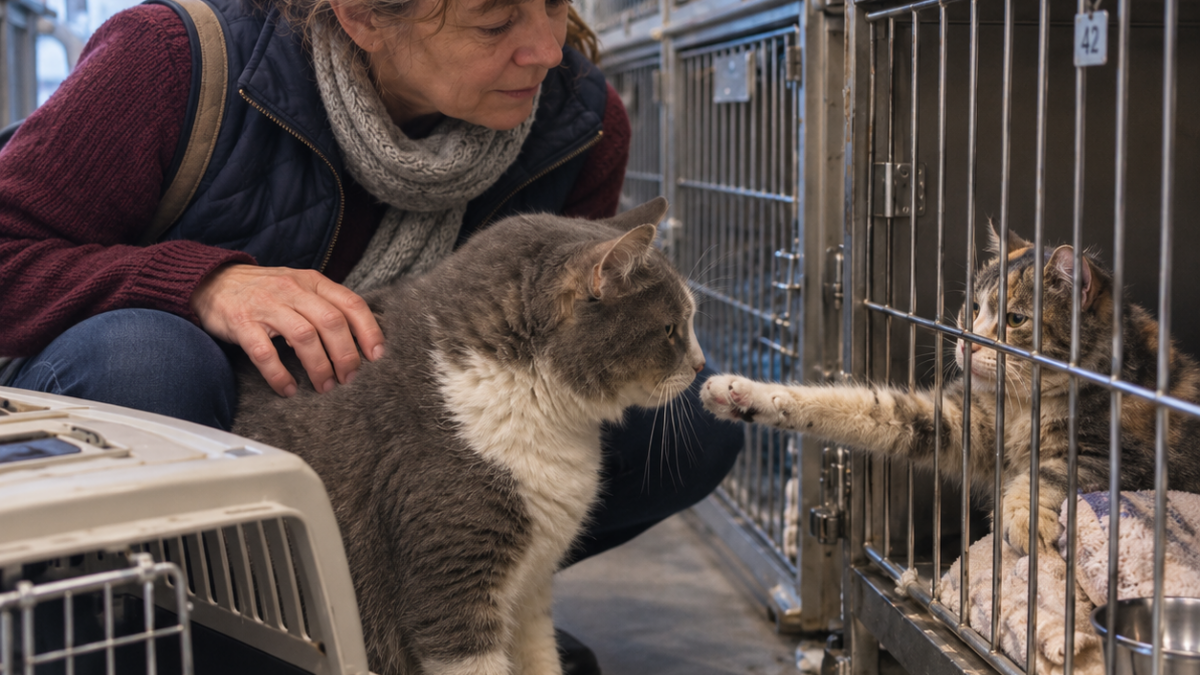
PART 2
I wish I could say I understood immediately.
That I opened my heart, adopted both cats on the spot and drove home feeling like the heroine of some perfect rescue story.
I didn’t.
My first thought was much less noble.
I can’t take two cats.
I had planned for one.
One food bowl.
One litter box.
One annual veterinary bill.
One animal sleeping somewhere in my already small apartment.
My children had spent weeks convincing me that adopting even one cat was a good idea.
“You hate coming home to an empty apartment,” my daughter had said.
“I do not hate it.”
“You turn the television on before you take your coat off.”
“That proves nothing.”
“It proves you want noise.”
“I like the news.”
“You fall asleep during the news.”
She was right.
I didn’t want to admit it.
The silence had become heavier after my mother died.
My divorce had happened years earlier, and I had learned to live around that absence. The children grew up, moved away, called regularly, visited when they could.
Then my mother became ill.
For almost three years, my life had revolved around her needs.
Appointments.
Medication.
Shopping.
Meals.
Phone calls at strange hours.
Driving across town because she couldn’t remember whether she had turned off the stove.
Then eventually sitting beside her bed when there was nothing left to organize.
After she died, people told me I finally had my life back.
I hated that phrase.
My life back to what?
There was no one waiting for me to care for them.
No emergency.
No schedule except work and groceries.
No reason I had to be home at a particular time.
Freedom can feel a lot like emptiness when it arrives after years of being needed.
That was why I had come for Léon.
One old cat.
A quiet presence.
Something manageable.
I looked at Martine.
“I can’t take two.”
She nodded.
“I understand.”
That almost irritated me.
“You don’t sound like you’re trying very hard to convince me.”
“I’m not.”
“Why not?”
“Because two cats are more expensive than one. Ninette may need more veterinary care than Léon. You should not take an animal out of guilt.”
I folded my arms.
“Then why tell me all this now?”
“Because you were about to take Léon.”
I looked back.
His body was still pressed against the bars.
Ninette had finally withdrawn her paw, but she sat as close to him as her own kennel allowed.
Martine continued.
“If you take him, you need to understand what you’re separating.”
“Are they officially a bonded pair?”
The question sounded oddly bureaucratic.
Martine nodded slowly.
“We consider them bonded, yes. But we’ve had trouble finding someone willing to take two older cats. We have discussed separate placement if necessary.”
“What does ‘if necessary’ mean?”
“It means sometimes a shelter has to choose between imperfect outcomes.”
I didn’t like that answer.
Probably because it was true.
“How long have they been here?”
“Almost four months.”
“Four months?”
“Yes.”
“No one wanted either of them?”
“A few people asked about Léon.”
“But?”
“When they learn about Ninette, most decide against it.”
I looked at her.
“So you do this to everyone?”
“Tell them the truth?”
“Yes.”
“Yes.”
I almost laughed.
“You could have warned me before I bought a carrier for one cat.”
Martine smiled faintly.
“You can return carriers.”
I looked down at mine.
“This was on sale.”
“Then perhaps you can buy another one on sale.”
I stared at her.
She raised both hands.
“I am not convincing you.”
“You’re terrible at not convincing people.”
“That’s why they keep me in the cat wing.”
I turned back toward Léon.
He finally looked at me.
His face seemed calm.
There was no accusation in it.
That made the decision harder.
If he had cried, maybe guilt could have made the choice.
Instead, he simply sat beside the bars.
Waiting.
“What happened to their owner?”
I asked.
Martine’s expression softened.
“An elderly man.”
“He surrendered them?”
“Not exactly.”
“What does that mean?”
“He became ill very suddenly. His family moved him into long-term care.”
“And the cats?”
“No one in the family could take them.”
I hated how familiar that story sounded.
My mother had feared the same thing before she died, even though she had no pets.
What happens to the things that belong to us when we can no longer care for them?
Furniture gets divided.
Clothes are donated.
Photographs go into boxes.
Animals cannot go into boxes.
“They lived with him long?”
Martine nodded.
“Léon was there first. Ninette came later.”
“How much later?”
“About five years.”
I looked at the little female.
“So Léon is eleven and she’s…”
“Seven, maybe eight.”
“Not young either.”
“No.”
Martine leaned against the wall.
“The family said Ninette had been found as a stray kitten. Léon apparently accepted her immediately.”
I looked at him.
“Of course he did.”
“They slept together. Ate together. Shared the same windowsill.”
“Then their owner disappears.”
“Yes.”
“They come here.”
“Yes.”
“And we put them in cages.”
Martine winced.
“When you say it that way, we sound terrible.”
“I’m sorry.”
“No, you’re not wrong. But cages also keep them safe until we find somewhere better.”
I nodded.
That distinction mattered.
Still, I looked around the hallway differently.
Kennels are temporary homes built around the hope of leaving.
For some animals, temporary becomes months.
Sometimes years.
I crouched beside Léon again.
“Do you want to go?”
He looked toward Ninette.
Not me.
I laughed without humor.
“Right.”
I turned toward her kennel.
Ninette did not approach me.
She stayed in the far corner.
“Can I meet her?”
Martine hesitated.
“Yes. But slowly.”
She unlocked the door.
Ninette immediately backed farther away.
I stayed outside.
“Hi.”
Her eyes widened.
Martine said, “She’s much more nervous with people than Léon.”
“Was she always?”
“We don’t know.”
I sat on the floor.
For several minutes, nothing happened.
Léon watched from across the aisle.
Ninette watched me.
I started to feel ridiculous.
“I’m sitting on shelter tile talking to a cat who clearly hates me.”
Martine smiled.
“She doesn’t hate you.”
“How can you tell?”
“She hasn’t hissed.”
“Very reassuring.”
Five more minutes passed.
Ninette lowered her head.
Not relaxed.
Just less rigid.
I put my hand flat on the floor outside the kennel.
No reaching.
No coaxing.
Eventually she took one step.
Then stopped.
Léon made a small sound behind me.
Not a full meow.
More like a chirp.
Ninette’s ears moved.
She took another step.
I turned slowly toward him.
“Did you tell her something?”
Léon blinked.
Ninette came closer.
She did not touch me.
But she sat near the door.
I looked at Martine.
“She trusts him.”
“Completely.”
That was the problem.
I had chosen him because I wanted companionship.
She had already chosen him for the same reason.
What right did I have to decide my loneliness mattered more?
That thought was unfair.
I knew it.
Adoption does not work by moral arithmetic.
But once it entered my mind, I could not remove it.
I stood.
“I need to think.”
Martine nodded.
“Of course.”
“I already signed half the paperwork.”
“We can wait.”
“I was supposed to take Léon today.”
“We can wait.”
I looked at the cats.
“If I don’t take him, what happens?”
“He stays.”
“And if someone else wants only him?”
“We have the same conversation.”
I sighed.
“You really are cruel.”
“I’ve been called worse.”
I picked up the carrier.
Léon watched.
Ninette remained at her door.
“I’ll come back tomorrow.”
Martine nodded.
I pointed at her.
“Do not let someone take him tonight.”
She smiled.
“That seems unlikely.”
“That wasn’t comforting.”
“It was honest.”
I drove home alone.
The carrier sat empty on the passenger seat.
I had expected to hear scratching or nervous meowing during that drive.
Instead there was only the hum of the engine and my own thoughts.
At a red light, I called my daughter.
She answered immediately.
“So?”
“I have a problem.”
“You adopted the cat?”
“No.”
“Why?”
“He has a girlfriend.”
Silence.
Then she started laughing.
“This is not funny.”
“I’m sorry. A girlfriend?”
“Another cat.”
“Mom.”
“They are bonded.”
“Oh no.”
“Exactly.”
“You’re getting two cats.”
“No.”
“You are.”
“I live in fifty-two square meters.”
“Cats are small.”
“Léon is not small.”
“How big?”
“Emotionally or physically?”
She laughed again.
“This is serious.”
“I know.”
“Ninette may have medical needs.”
“Can you afford them?”
I hated that children eventually become adults who ask sensible questions.
“Yes.”
“Then what’s the problem?”
“I wanted one.”
There was a pause.
My daughter’s voice softened.
“Do you want Léon?”
“Yes.”
“Would you feel okay taking him without her?”
“No.”
“Then I think you already know.”
“That’s not fair.”
“No.”
“I called for advice.”
“I gave it.”
“You are exactly like your grandmother.”
“That may be the nicest thing you’ve said to me.”
I almost cried.
“Don’t.”
“Okay.”
After we hung up, I sat at my kitchen table.
My apartment was quiet.
I looked around.
One couch.
Two chairs.
One bedroom.
A narrow kitchen.
A small balcony.
There was room for two cats physically.
That was not the real question.
The real question was whether I wanted to become responsible for more than I had planned.
I had spent the years after my divorce trying to reduce obligation.
Then my mother’s illness had pulled me in the opposite direction.
Now I had finally reached a life where I could decide everything for myself.
And somehow two unwanted cats were asking me to choose inconvenience.
I did not like how much that resembled love.
At eight that evening, I called Martine.
“You’re still there?”
“For another hour.”
“Did they eat?”
“Both of them.”
“Are they okay?”
“Yes.”
I hesitated.
“Can two adult cats share one litter box?”
Martine laughed.
“No.”
“Why is that funny?”
“Because you’re already planning.”
“I asked one question.”
“You need at least two, preferably three if space allows.”
“Three?”
“Welcome to cat ownership.”
“I haven’t agreed to anything.”
“Of course not.”
“What else?”
“Separate food bowls. Separate places to retreat. Ninette will probably hide at first.”
“How long?”
“Days. Weeks. Impossible to know.”
“And Léon?”
“He’ll likely adjust faster.”
“Would having him help her?”
“Almost certainly.”
I rubbed my forehead.
“Martine?”
“Yes?”
“Why has no one taken them?”
She was quiet for a second.
“Because people are allowed to want what they want.”
“That sounds sad.”
“It’s realistic.”
“They’re old.”
“They are older.”
“Ninette is scared.”
“Yes.”
“Léon has arthritis?”
“Mild.”
“And dental work?”
“He may need a cleaning.”
I wrote everything down on the back of an electricity bill.
“And Ninette?”
“Her bloodwork is currently good. She came in underweight, but she has gained some. She may have chronic digestive sensitivity.”
“Which means?”
“Special food, possibly.”
“Expensive food.”
“Yes.”
I sighed.
“Anything else terrible?”
“They shed.”
“I noticed.”
“And Ninette snores.”
I stopped writing.
“She snores?”
“Like a tiny tractor.”
For the first time all evening, I laughed.
The next morning, I went shopping.
I told myself I was only pricing things.
That lasted twelve minutes.
Two litter boxes.
Two food bowls.
Two water bowls.
Two soft beds.
A scratching post.
A bag of the food Martine had mentioned.
Then I stood in the pet store looking at carriers.
An employee approached.
“Need help?”
“I need a second carrier.”
“What size?”
“For a small cat.”
“How small?”
“Smaller than the first one.”
She stared at me.
I realized how ridiculous that sounded.
“Never mind. This one.”
I bought it.
At the shelter, Martine saw both carriers and smiled.
“Not one word.”
“I said nothing.”
“You were about to.”
“Never.”
“Where are they?”
“Waiting.”
I walked into the corridor.
Léon was at the front of his kennel.
Ninette sat across from him.
The moment he saw me, Léon stood.
I opened his door.
“Okay, old man.”
He sniffed the carrier.
“Apparently you negotiated very well.”
He stepped inside with almost insulting ease.
I stared.
“Yesterday you acted like this was a death trap.”
Martine said, “Yesterday Ninette wasn’t coming.”
I looked at Léon.
He settled onto the blanket.
“That’s manipulation.”
Martine walked toward Ninette’s kennel.
The small cat retreated immediately.
“Now the difficult one.”
It took almost twenty minutes.
No grabbing.
No forcing.
Martine placed the carrier inside.
Léon made quiet sounds from across the aisle.
Ninette listened.
Eventually she stepped closer.
Then inside.
The door closed.
I looked at both carriers.
My stomach tightened.
“What have I done?”
Martine smiled.
“Adopted two cats.”
“I know.”
“You can still change your mind.”
I looked at Léon.
Then Ninette.
“No.”
It came out more firmly than I expected.
“No. I can’t.”
The paperwork took longer for two cats.
Twice the signatures.
Twice the medical files.
Twice the warnings.
Ninette’s file was thinner because less was known about her earlier life.
Léon’s included notes from his first owner’s veterinarian.
Vaccinations.
Weight.
A tooth extraction years earlier.
A note saying:
Lives with another cat, Ninette. Very attached.
I stopped reading.
“That was in his file?”
Martine looked over.
“Yes.”
“He was attached even then.”
“Yes.”
I looked at the two carriers.
“Why would the family ever imagine separating them?”
“They didn’t. They surrendered them together.”
“Right.”
The shelter had tried.
The world had simply not made it easy.
Before I left, Martine took my hand.
“If it becomes too much, call us.”
“I’m not bringing them back.”
“I didn’t say that.”
“I’m just telling you.”
She smiled.
“Good.”
The drive home was strange.
Léon complained loudly for the first ten minutes.
Ninette was completely silent.
At every red light, I looked back.
“I’m still here.”
Léon meowed.
“I know you hate the car.”
Another meow.
“Ninette?”
Nothing.
My stomach tightened.
At the next stop, I turned farther.
Her eyes were open.
Good.
“Still there?”
She blinked.
“Excellent.”
When we reached my building, the logistics became ridiculous.
Two carriers.
A handbag.
A bag of food.
My keys.
A neighbor holding the door and asking questions.
“You got cats?”
“Apparently.”
“Two?”
“Apparently.”
I carried them upstairs one at a time.
Léon first.
Then I almost panicked leaving Ninette alone in the car for three minutes even though the weather was mild.
When both were inside, I closed the apartment door.
Silence.
“Welcome home.”
Neither cat seemed impressed.
I had prepared the bedroom as a quiet starting space.
Beds.
Water.
Food.
Litter box.
Hiding places.
I opened Léon’s carrier.
He walked out slowly.
Sniffed.
Looked around.
Then walked straight toward Ninette’s carrier.
I opened hers.
Nothing.
Léon sat beside it.
Five minutes.
Ten.
Ninette did not move.
I sat on the floor across from them.
“No rush.”
Léon lay down.
Twenty minutes later, Ninette’s nose appeared.
Then her head.
She sniffed.
Léon remained still.
She stepped out.
Immediately pressed herself against him.
His body curved around hers.
I looked away.
Not because I didn’t want to see.
Because the intimacy of it felt private.
They had been across a shelter aisle from each other for months.
Close enough to touch paws through bars.
Not close enough to sleep together.
Now Ninette buried her face under Léon’s chin.
He began grooming her ear.
The folded one.
I covered my mouth.
“Okay.”
My voice shook.
“I understand.”
That first night, they slept together on the same bed I had bought for Léon.
The second bed remained untouched.
So did half the expensive equipment.
I began learning the first law of cat ownership.
The things you buy are suggestions.
The things cats choose become law.
Ninette hid whenever I moved too quickly.
Léon followed me.
He was surprisingly social for a cat described as independent.
If I went into the kitchen, he appeared.
If I sat on the couch, he sat three feet away.
If I entered the bathroom, he waited outside as though concerned I might escape through some secret exit.
Ninette watched him.
That was how she learned me.
Not by trusting me directly.
By trusting his judgment.
The first time I fed them, she would not approach the bowl while I stood there.
So I walked away.
From the hallway, I watched Léon eat.
Then stop.
Look at Ninette.
Move away from his own bowl.
She approached hers.
Ate.
He resumed.
I leaned against the wall.
“Do you always supervise her?”
Léon ignored me.
The answer was obviously yes.
Over the next week, I discovered their routines.
Léon woke first.
Ninette followed.
Léon investigated new objects.
Ninette waited for his reaction.
If he relaxed, she approached.
If he startled, she disappeared.
At night, they slept pressed together.
Always.
Sometimes Ninette’s paw rested on his chest.
Sometimes his tail curled around her back.
I had wanted one cat to fill the silence.
Instead, I had brought home a relationship.
That was different.
There were nights when I sat on the couch and watched them communicate without understanding any of it.
A glance.
An ear.
A tail movement.
A tiny sound.
The strange thing was that their companionship made me feel less alone even when neither one touched me.
I did not have to be the center of the room.
Life was simply happening around me.
That was enough.
On day eight, Ninette finally came within arm’s reach.
I was sitting on the floor reading.
Léon was asleep beside me.
Ninette approached.
Stopped.
Looked at him.
Then at me.
I did not move.
She sniffed my knee.
“Hello.”
She backed away.
“Too much?”
Léon opened one eye.
“I blame you.”
Ninette returned.
This time she touched her nose to my fingers.
Then fled.
I laughed.
“That counts.”
The next day she did it again.
A week later she allowed one stroke down the side of her neck.
Then vanished under the table as though embarrassed by her own courage.
Trust arrived in increments.
I learned not to demand more.
That was new for me.
With my children, I had fixed things.
With my mother, I had organized things.
With my ex-husband, I had spent years trying to solve a relationship that had already become something neither of us wanted.
Ninette could not be solved.
She could only be given room.
It turned out I needed practice doing that.
Léon became my easier relationship.
He sat beside me.
Accepted petting.
Followed me.
Sometimes placed one enormous paw on my leg when dinner was late.
“You are shameless.”
He blinked.
“Ninette is delicate. You are a criminal.”
He yawned.
Within a month, the apartment no longer felt quiet.
Not noisy.
Alive.
There is a difference.
Claws on the floor at three in the morning.
Litter scattering.
The soft thump of Léon jumping from the couch.
Ninette’s ridiculous snoring.
Martine had not exaggerated.
The first night I heard it, I woke in a panic.
I sat up.
“What is that?”
A strange vibrating noise came from the foot of the bed.
I turned on the lamp.
Ninette was asleep against Léon.
Mouth slightly open.
Snoring.
Léon looked at me as though I were the problem.
“You live with that?”
He closed his eyes.
I laughed so loudly Ninette woke.
She stared at me.
Then ran.
“Sorry.”
The next morning, I called Martine.
“You were right.”
“About?”
“The tractor.”
She laughed.
“Congratulations. She feels safe.”
“How does snoring prove safety?”
“She doesn’t sleep deeply at the shelter.”
I stopped.
“Oh.”
A silly thing suddenly felt important.
Ninette snored because she had relaxed enough to sleep deeply.
That night, when the sound started again, I smiled.
Two months passed.
Their health checkups were mostly reassuring.
Léon had arthritis in his hips.
Nothing severe.
The veterinarian recommended supplements and monitoring.
Ninette’s weight was still low but improving.
Her stomach was sensitive, exactly as Martine warned.
Expensive food.
I complained about it constantly.
Then bought it without hesitation.
My daughter visited one Sunday.
She walked into the apartment, stopped, and stared.
“What?”
“You have cat furniture.”
“I know.”
“You used to make fun of people who had cat furniture.”
“I’ve matured.”
Léon approached her immediately.
Ninette disappeared.
My daughter crouched.
“So this is the boyfriend.”
“Léon.”
“He’s enormous.”
“He’s big-boned.”
“He is fat.”
“He has arthritis. Don’t insult him.”
She laughed.
Eventually Ninette appeared from the bedroom.
“That’s her?”
“Yes.”
“She’s tiny.”
“She’s gaining.”
My daughter held out a finger.
Ninette stopped several feet away.
“Don’t chase.”
“I know.”
“Let Léon decide.”
My daughter looked at me.
“You sound like Martine.”
“Terrifying.”
An hour later, Ninette sniffed her hand.
My daughter’s face changed.
“Oh.”
I smiled.
“Exactly.”
Before leaving, she hugged me in the hallway.
“You seem better.”
I stiffened.
“Better than what?”
“Mom.”
I looked away.
She squeezed my shoulder.
“I’m glad you took both.”
“So am I.”
It was the first time I said it without any trace of fear.
Then something happened that reminded me why the shelter had warned me about adopting older animals.
Léon stopped eating.
Not dramatically.
Breakfast remained half finished.
Dinner barely touched.
The next morning, he smelled the bowl and walked away.
Ninette immediately stopped eating too.
I stared at them.
“No.”
Léon sat near the window.
Ninette beside him.
I called the veterinarian.
By afternoon, we were in the clinic.
Getting two bonded cats into separate carriers was the first battle.
The second was listening to Léon scream in the car while Ninette made tiny frightened sounds.
At the clinic, the vet examined him.
Temperature.
Teeth.
Abdomen.
Bloodwork.
I sat beside both carriers.
“What is it?”
“We need the results.”
“That means you don’t know.”
“Correct.”
Ninette pressed her face against the carrier door toward Léon.
He turned his body toward her.
Even here.
Even frightened.
They were checking for each other.
Bloodwork revealed elevated kidney values.
Not catastrophic.
But enough to require more testing.
I stared at the vet.
“Kidney disease?”
“Possibly early stage. Or dehydration. We need urine testing and imaging.”
My chest tightened.
“How bad?”
“We don’t know yet.”
I hated that sentence.
Older animals come with a particular kind of fear.
You know, rationally, that time is shorter.
Then every medical issue feels like the beginning of the ending.
Léon was eleven.
Maybe twelve.
I had known.
Still, I had only had him two months.
It felt unfair.
I wanted more.
The ultrasound was reassuring.
No mass.
No obvious structural disaster.
The final assessment was early kidney disease that could be managed.
Diet.
Hydration.
Regular monitoring.
I exhaled.
“So he’s not dying?”
The veterinarian smiled gently.
“All living things are technically—”
“Please don’t finish that sentence.”
She laughed.
“No. Not today.”
“Good.”
Léon received fluids.
By evening, he showed interest in food.
The problem was Ninette.
She had stopped eating because he had.
Even after we got home and Léon ate, she hesitated.
I sat near the bowls.
“Come on.”
Léon ate.
Ninette watched him.
He paused.
Looked at her.
Then moved away from his bowl.
Exactly as he had done during the first week.
Ninette approached her food.
Took one bite.
Then another.
I nearly cried.
“You two are impossible.”
Léon returned to his meal.
That night, they slept pressed together.
I watched from the couch.
Martine had said they could not tolerate being separated.
Until then, some part of me had treated that as shelter language.
A label.
Bonded pair.
Now I understood that it was physical.
Their bodies regulated around each other.
Fear.
Food.
Sleep.
They had become part of one another’s sense of safety.
The thought frightened me.
Because one day, one of them would die first.
I hated myself for thinking it.
I pushed it away.
Not today.
That became another lesson.
Do not ruin the time you have by grieving the time you will lose.
Easier said than done.
Still, I tried.
Léon adjusted to his new diet.
Ninette complained because her food smelled more interesting than his.
He occasionally stole hers.
I became a referee.
“You have kidney food.”
Léon stared at Ninette’s bowl.
“No.”
He took one step.
“No.”
Another.
“Léon.”
He looked at me.
Then at the bowl.
“Do not make me separate you.”
He sat down.
I laughed.
“Emotional blackmail. Excellent.”
Months passed.
Winter arrived.
The balcony became too cold, so the cats moved their morning routine to the living-room window.
They sat side by side watching pigeons.
Léon occasionally made clicking noises.
Ninette simply stared.
I began drinking my coffee beside them.
Three old creatures watching the world.
Technically Ninette was not old.
But emotionally she belonged to the club.
One morning, my son called.
“Are you busy?”
“I’m having coffee with the cats.”
“So yes.”
“Correct.”
He laughed.
“You sound happy.”
Again that word.
I used to resist it.
This time, I said, “I am.”
The answer surprised both of us.
I had not become happy because cats cured grief.
That would be too simple.
My mother was still dead.
My marriage had still ended.
My children still lived elsewhere.
I still had evenings when the apartment felt too quiet.
But now quiet had layers.
Léon breathing.
Ninette snoring.
A bowl clinking.
A paw landing on the floor.
Presence.
That mattered.
Then, almost a year after the adoption, Martine called.
“I have a strange question.”
“I’m listening.”
“Would you be willing to bring Léon and Ninette to the shelter anniversary event?”
I laughed.
“Ninette would rather die.”
“That is what I told them.”
“Who is ‘them’?”
“The new coordinator.”
“Absolutely not.”
“Agreed.”
“Then why call?”
“Because we’d like a photograph.”
“Oh.”
“We’re doing a board about bonded pairs.”
I looked toward the window.
Léon and Ninette sat together.
“Why?”
“We’re trying to encourage people to consider adopting them together.”
I smiled.
“Using my poor financial decisions as propaganda?”
“Exactly.”
I sent a photograph.
Two cats.
One large gray body.
One tiny patchy body pressed against it.
The shelter added a caption:
**LÉON & NINETTE — ADOPTED TOGETHER. SOME HOMES NEED MORE THAN ONE HEARTBEAT.**
I cried.
Then complained about the wording.
“Too sentimental.”
Martine replied:
You cried.
I wrote:
Irrelevant.
A month later, she sent me another message.
A photo.
Two senior black cats sitting in the same carrier.
Caption:
Went home together today.
I stared at it for a long time.
Then looked at Léon.
“You started a trend.”
He licked one paw.
“Very modest.”
Ninette slept beside him.
I realized that what had happened in kennel 43—no, different shelter, different number, different story—was not unusual.
Animals build relationships.
Shelters often know this.
Potential adopters sometimes don’t.
People think they are choosing one animal.
Sometimes they discover they are choosing a small family.
That realization changed how I understood adoption.
I had thought rescue meant removing an animal from a bad place.
The shelter was not a bad place.
It had saved them.
Rescue, for Léon and Ninette, meant preserving the one relationship that had already helped them survive losing everything else.
If I had taken Léon alone, I still would have loved him.
I believe that.
But I would have misunderstood what he needed.
Love is not always giving someone more of yourself.
Sometimes it is refusing to take away what they already love.
That became the heart of our life together.
I was not Léon’s whole world.
Neither was I Ninette’s.
They had each other.
At first, that made me feel strangely unnecessary.
Then it made me feel free.
I didn’t have to replace anyone.
Not their old owner.
Not each other.
I could simply join the arrangement.
That was enough.
One summer evening, about eighteen months after they came home, I sat on the balcony with a glass of wine.
Léon lay near the door.
Ninette sat beside him.
The city was warm and noisy below.
I thought about the woman I had been on adoption day.
She wanted one manageable cat.
A project with boundaries.
An answer to loneliness that would not create too much responsibility.
I almost laughed at her.
There were now three litter boxes hidden strategically around my apartment.
Special kidney food.
Digestive food.
Supplements.
Veterinary appointments.
An expensive cat fountain Léon hated.
A cardboard box both cats preferred to the bed my daughter bought them.
Nothing was simple.
And yet my life felt lighter.
Not because responsibility is easy.
Because chosen responsibility feels different from imposed obligation.
I had spent years caring for my mother because I loved her, but illness dictated the terms.
With Léon and Ninette, I had chosen the mess.
That mattered.
Then came the day Ninette disappeared.
Not outside.
She was an indoor cat.
But I woke and couldn’t find her.
I checked under the bed.
Nothing.
Behind the curtains.
Nothing.
Closet.
Bathroom.
Kitchen.
“Ninette?”
Léon followed me.
His behavior changed.
He began vocalizing.
Short, worried sounds.
That frightened me more.
“She’s here.”
I said it for him and myself.
“We’ll find her.”
Finally, I noticed one cabinet door under the sink slightly open.
Ninette was inside.
Curled tightly.
She did not move when I called.
My stomach dropped.
I reached toward her.
She hissed.
Ninette almost never hissed anymore.
I stopped.
“Okay.”
Léon approached.
I tried to block him.
He slipped past.
He lowered himself near the cabinet.
Ninette made a small sound.
Léon answered.
I called the veterinarian.
Within an hour, we were at the clinic.
Again two carriers.
Again Léon furious in the car.
Again Ninette silent.
The veterinarian examined her abdomen.
Ninette cried.
I felt cold.
“What?”
“I want imaging.”
“Why?”
“She’s painful.”
Ultrasound revealed severe inflammation in her intestines.
Likely a flare of chronic gastrointestinal disease.
Treatable.
But she was dehydrated and needed hospitalization.
“How long?”
“Probably overnight. Maybe two.”
I looked at Léon.
“And him?”
“He can go home.”
I knew immediately.
“No.”
The vet looked confused.
“No?”
“You don’t understand.”
I explained.
Bonded pair.
Shelter.
Stopped eating.
The vet listened.
“We can’t hospitalize him medically without reason.”
“I’ll pay.”
“That’s not the issue.”
“Then what do we do?”
The staff eventually allowed Léon to stay in a separate kennel nearby for part of the day while Ninette was stabilized.
That evening, the clinic called.
“Ninette ate.”
I almost shouted.
“Good.”
“And Léon?”
A pause.
“He has not.”
Of course.
I drove back.
The vet met me.
“We think it may be better to send Ninette home if she remains stable for a few more hours and have you monitor closely.”
“Because of him?”
“Partly. And because stress is not helping either one.”
I looked through the treatment room glass.
Their kennels faced one another.
Ninette sat at the front.
Léon sat at his.
Not touching.
Watching.
The shelter all over again.
I felt tears rise.
“Please get them home.”
That night, Ninette slept under medication and blankets.
Léon did not leave her side.
He barely ate until she did.
At three in the morning, I woke to a tiny crunching sound.
Ninette eating from a small plate beside the bed.
Léon watched.
When she finished, he walked to his own bowl and ate.
I sat on the floor in my pajamas and cried.
“You ridiculous animals.”
Léon looked at me.
“You’re going to kill me before kidney disease gets you.”
I regretted the sentence immediately.
“Sorry.”
He blinked.
Ninette returned to bed.
Recovery took a week.
Then two.
Slowly, she became herself again.
The folded ear.
The tiny steps.
The deep snoring.
One evening, she climbed onto the couch beside me.
Not beside Léon.
Beside me.
She had sat near me before.
Touched me.
Allowed petting.
But this was different.
She stepped onto my lap.
Turned once.
Then settled.
I froze.
Léon slept at the other end.
“Ninette.”
She closed her eyes.
“Do you know this took almost two years?”
No response.
I placed one hand gently on her back.
Her body softened.
Then she began to purr.
Quiet.
Almost invisible beneath the sound of the television.
I did not move for an hour.
My legs hurt.
I didn’t care.
Trust does not owe us speed.
Ninette had taken nearly two years to decide my lap was safe.
That made the moment more valuable, not less.
My daughter arrived unexpectedly while she was still there.
She unlocked the door with the spare key.
“Mom?”
“Stop.”
She froze.
“What?”
I pointed.
Her eyes widened.
“Oh.”
“Don’t move.”
She whispered, “Is she on you?”
“Yes.”
“Finally?”
“Yes.”
My daughter slowly took out her phone.
“If you take a picture and scare her, I will disown you.”
She took the picture anyway.
Ninette stayed.
That photograph became my favorite.
Not because I looked good.
I did not.
I was wearing old sweatpants.
My hair looked terrible.
Ninette looked half asleep.
But Léon was visible in the background.
Three lives in one frame.
No drama.
Home.
Years passed.
Léon’s kidney disease progressed slowly.
Ninette’s digestive problems came and went.
We adapted.
Medication hidden in food.
More veterinary checks.
Water bowls everywhere.
Heating pads in winter.
Steps to the couch when Léon’s arthritis worsened.
The apartment changed around their aging bodies.
That seemed natural.
Homes should adapt to the people and animals living in them, not the other way around.
When Léon could no longer jump onto the windowsill easily, my son built a small ramp.
He brought it over on a Saturday.
“This is excessive.”
“You asked me to build it.”
“I asked if you knew how.”
“You sent measurements.”
“Coincidence.”
Léon inspected the ramp.
Ignored it.
Jumped onto the windowsill anyway.
My son stared.
“I hate your cat.”
“He needs time.”
Three days later, Léon used the ramp.
I sent my son a video.
He replied:
VICTORY.
Ninette began using it too despite not needing it.
Typical.
One winter, Léon had a serious kidney flare.
This time the veterinarian’s expression worried me.
“He’s dehydrated.”
“I know.”
“His values are worse.”
“How much worse?”
She showed me.
Numbers.
Charts.
I understood enough to be afraid.
“Can we bring them down?”
“Possibly.”
“Possibly.”
“Yes.”
He stayed overnight.
This time Ninette stayed home.
I had learned more about managing her stress, and the clinic could not accommodate both.
The first night was terrible.
She paced.
Went to the door.
Sniffed his bed.
Refused dinner.
I sat beside her.
“He’s coming back.”
Her eyes stayed on the door.
“I know you don’t believe me.”
She walked away.
At midnight, she still had not eaten.
I called the clinic.
“How is Léon?”
“Stable. He ate a little.”
“He ate?”
“Yes.”
I looked at Ninette.
“You hear that?”
She did not.
The technician asked, “How is Ninette?”
“Not eating.”
A pause.
“Could you bring one of his blankets home from the clinic?”
“I can come now.”
“It’s midnight.”
“I’m fifty-nine. I’m allowed outside after midnight.”
The technician laughed.
I drove there.
They gave me the blanket Léon had been lying on.
At home, I placed it near Ninette.
She sniffed.
Immediately curled onto it.
Ten minutes later, she ate.
I stared.
Even his smell was enough.
The next afternoon, Léon came home.
Ninette met the carrier at the door.
I opened it.
He stepped out.
She pressed her forehead against his.
Then began grooming his face so aggressively that he pulled away.
I laughed and cried at the same time.
“Give him a second.”
She ignored me.
Léon tolerated another thirty seconds.
Then walked toward his water bowl.
Ninette followed.
Of course.
After that hospitalization, I became more afraid of time.
Léon was fourteen now.
Ninette around ten or eleven.
I would catch myself watching them sleep and calculating.
How many years?
Don’t.
I told myself.
Don’t turn love into a countdown.
I had done that with my mother during her final illness.
Every good day became evidence of how few might remain.
I did not want to do that again.
So I practiced being present.
Coffee.
Window.
Cats.
One morning.
That was enough.
Some days I failed.
I would see Léon struggle to stand and feel grief arrive early.
Then Ninette would walk directly over him because apparently dignity meant nothing to her.
He would growl.
She would sit on his tail.
I would laugh.
Life corrected me.
Not yet.
Not today.
When I turned sixty-one, my children organized dinner at my apartment.
I protested.
“There isn’t room.”
“There is.”
“There are two cats.”
“We know.”
“There are three litter boxes.”
“Please stop advertising that.”
Six people squeezed around my little table.
Léon slept through most of it.
Ninette hid for the first hour, then appeared because someone opened cheese.
My son raised his glass.
“To Mom.”
“Why?”
“Because you’re old.”
“Get out.”
Everyone laughed.
My daughter added, “And because you adopted two cats by accident.”
“That was not an accident.”
“You went for one.”
“That was a planning error.”
Martine had become a friend by then.
She joined us for dessert.
At one point, she looked toward the couch.
Léon and Ninette slept together.
Still.
Years later.
Same position.
She smiled.
“They look good.”
“They cost a fortune.”
“I warned you.”
“You did.”
“Any regrets?”
I looked at them.
“No.”
The answer came instantly.
No calculation.
No hesitation.
No.
Later that evening, after everyone left, I found an old folder.
Inside was Léon’s adoption paperwork.
I sat at the table.
There it was.
My original application.
Number of cats desired:
**1**
I laughed out loud.
Ninette appeared in the doorway.
I held up the page.
“This is your fault.”
She blinked.
“Technically Léon’s.”
She walked away.
I turned the page.
There was a note in Martine’s handwriting.
**Adopter informed of bond with Ninette. Considering both.**
Below it, later:
**Approved for pair.**
Pair.
Such a small word.
It had changed everything.
I thought about the moment her paw came through the bars.
If I had not seen it?
Would Martine have told me anyway?
Yes.
Probably.
Would I still have taken both?
I don’t know.
Sometimes our biggest choices depend on tiny visible things.
A paw.
A look.
A cat refusing a carrier.
Léon had made his decision before I made mine.
He was not leaving without her.
Maybe I could have forced the issue.
Humans can force many things.
That does not make them right.
Instead, I listened.
That was perhaps the most important part of the story.
Not that I saved two cats.
That I allowed them to tell me what they needed.
Animals speak constantly.
Not in words.
We often fail because we expect them to communicate in our language.
Léon communicated clearly.
Home without Ninette was not home.
I finally understood.
One spring morning, years after adoption, I woke before sunrise.
The apartment was cold.
I walked into the living room.
Léon was asleep on the rug.
Ninette lay against his stomach.
Her paw rested on his side.
The exact gesture from the shelter.
Small paw.
Gray fur.
Contact.
I sat on the floor.
Neither woke.
I thought about everything they had lost.
Their first home.
Their person.
Their routines.
Then months in a shelter.
Bars between them.
Visitors passing.
People wanting younger cats.
People considering Léon and rejecting the pair.
Then me.
The woman who wanted one animal because one felt manageable.
I reached out and touched Léon’s back.
He opened one eye.
“Hi.”
Ninette continued snoring.
“I almost left her.”
He blinked.
“I know.”
His eye closed.
“Good thing you were stubborn.”
I sat there until sunrise.
The room slowly brightened.
The cats did not move.
It was one of the most peaceful mornings of my life.
Maybe that sounds too small.
After divorce.
Children growing up.
My mother dying.
Years of work.
You imagine peace should be something grand.
A trip.
A revelation.
A dramatic second chance.
Mine looked like two old cats sleeping on a rug.
I had learned something from them that I had failed to learn from people.
Losing a home does not mean you lose your ability to belong.
Losing someone does not mean all future attachment is betrayal.
And accepting a new life does not require abandoning the relationships that helped you survive the old one.
Léon did not have to choose between Ninette and me.
I had almost framed it that way because humans like simple arrangements.
One person.
One pet.
One rescue.
Life had offered something messier.
Take both.
Make room.
Adjust.
It turned out my apartment was large enough.
So was my life.
A few months later, Léon’s health declined again.
I wish I could leave aging animals forever in the happy middle.
But that would not be honest.
He began losing weight.
His kidney disease had progressed.
Medication increased.
Fluids at home became part of our routine.
The first time I had to give them, my hands shook.
Martine came over to help.
“You can do this.”
“I’m going to hurt him.”
“He’ll forgive you.”
“That isn’t reassuring.”
Léon sat on the table looking offended.
Ninette watched from a chair.
We administered the fluids.
Léon protested dramatically.
Then ate a treat.
Martine smiled.
“See?”
“I hated every second.”
“So did he.”
Over the following months, I learned.
Warm the fluid bag slightly.
Hang it from the cabinet.
Sit beside him.
Talk.
Reward.
Routine.
Ninette attended every session like a nervous supervisor.
Sometimes she licked his forehead afterward.
I began calling her Nurse Ninette.
She was terrible at medicine but excellent at attendance.
Léon still had good days.
That mattered.
He ate.
Sat in sunlight.
Used the ramp.
Groomed Ninette.
Demanded food.
Stared at me when I was late.
Those were life.
Then came a week when the good days became fewer.
He stopped using the windowsill.
Then the couch.
He slept more.
His appetite became inconsistent.
I knew.
I did not want to know.
But I did.
The veterinarian reviewed his latest bloodwork.
Her voice was gentle.
“We’re reaching a point where we need to think about quality of life.”
I looked at Léon.
He sat beside me on the exam table.
Ninette was at home.
“What does that mean today?”
“Today? We adjust medication and see if his nausea improves.”
“So not today.”
“Not today.”
I exhaled.
“Thank you.”
She looked at me carefully.
“You know this isn’t something you can avoid forever.”
“I know.”
I hated her for saying it.
Then loved her for saying it.
That night, Léon ate half his dinner.
Ninette ate beside him.
I considered it a victory.
The next day he ate more.
Hope returned.
That is how end-of-life care can be cruel.
A bad day convinces you.
A good day makes you doubt.
I watched.
Tried not to measure only my fear.
Then one evening, Léon walked to the rug.
Ninette followed.
He lay down.
She pressed against him.
I sat nearby.
His breathing was slower than usual.
Not distressed.
Just tired.
I placed my hand beside him.
“Are you tired, old man?”
He opened his eyes.
Ninette’s paw reached across his side.
Exactly like the shelter.
I cried silently.
Léon began purring.
Weakly.
Ninette answered.
Two different rhythms.
I knew then that when the time came, I would not let them be separated.
Not at the end.
Not after all this.
The next morning, Léon would not eat.
Not even his favorite food.
He drank a little.
Then returned to the rug.
I called the vet.
She told me to come.
I asked one question.
“Can Ninette come too?”
There was a pause.
“Yes.”
“Good.”
I put them in the same large carrier I had eventually bought for short trips.
Ninette pressed against him the whole drive.
At the clinic, the veterinarian examined Léon.
The numbers were worse.
Much worse.
She looked at me.
“We can hospitalize and try aggressive treatment.”
“Would it fix this?”
“No.”
“Would it give him good time?”
“Maybe days. Maybe a little longer. I can’t promise.”
I looked at Léon.
He did not look frightened.
Just exhausted.
I knew that look.
I had seen it in my mother.
I had promised myself not to mistake my inability to let go for love.
I swallowed.
“I think we stop.”
The vet nodded.
Ninette remained beside him.
“What about her?”
“She can stay.”
I cried.
“Thank you.”
We placed a blanket on the floor because Léon hated exam tables.
I sat beside him.
Ninette circled.
Then lay against his back.
Her paw crossed his side.
Again.
Always that paw.
I touched his head.
“You really complicated my life.”
His eyes opened.
“You know that?”
Purr.
Faint.
“I came for one easy cat.”
My voice broke.
“You brought me another one.”
Ninette looked at me.
“And she snores.”
I laughed through tears.
The veterinarian gave Léon the first medication.
His body relaxed.
Ninette sniffed his face.
He lifted his head once.
Touched his nose to hers.
Then lowered it.
I will never forget that.
Not because I want to turn it into some human idea of goodbye.
Maybe it was simply contact.
Still.
It was theirs.
I stayed.
Ninette stayed.
Léon died between us.
For a few moments, Ninette did nothing.
Then she stood.
Sniffed him.
Walked around him.
Returned.
Touched his cheek with her nose.
My heart broke in a place I had not prepared.
I whispered, “I’m sorry.”
She looked at me.
As though I had done something.
As though I had failed to protect the one thing I had promised not to take from her.
I cried harder.
The veterinarian sat quietly near us.
Ninette finally moved away.
She walked to me.
Pressed herself against my leg.
I looked down.
That was the moment I understood something that had been forming for years.
At the shelter, I had been afraid that taking Léon would leave Ninette alone.
Now Léon was gone.
And yet Ninette was not alone.
Neither was I.
We had become part of the bond.
Not a replacement.
An extension.
I picked her up.
She allowed it.
For the first time ever, completely.
She rested against my chest.
I held her while the staff carried Léon away.
The drive home was unbearable.
One cat in the carrier.
The exact thing I had originally planned.
I hated the symmetry.
At home, Ninette searched.
Bedroom.
Window.
Rug.
Kitchen.
She called.
A small sound.
Again.
I sat on the floor.
“He’s not coming.”
The words nearly destroyed me.
She searched for days.
Her appetite dropped.
I called the vet.
Called Martine.
Everyone helped.
Routine.
Food.
Pheromone diffuser.
Warmth.
Attention.
But the most important thing was simply presence.
I stayed.
Ninette slept on Léon’s blanket.
Then eventually on my bed.
At first, she slept near my feet.
Then closer.
One night, I woke to find her against my ribs.
Her paw resting on me.
I did not move.
I cried quietly in the dark.
The paw that once reached through bars for Léon had found another body.
Not the same.
Never the same.
But safe.
I whispered, “I’m here.”
Her paw remained.
That became our new life.
Different.
Quieter.
Not empty.
Ninette changed after Léon died.
For several months she seemed older.
Then gradually, strangely, more confident.
She had always let Léon investigate first.
Now there was no Léon.
So she investigated.
Slowly.
She began entering rooms ahead of me.
Approaching visitors.
Demanding breakfast with small, surprisingly sharp meows.
My daughter laughed.
“She has a personality.”
“She always had one.”
“She had Léon.”
“Yes.”
“Now she has you.”
I looked at her.
“I think she has herself now too.”
That felt important.
Léon had protected her.
Guided her.
Given her safety.
But safety had eventually allowed her to grow beyond dependence.
Maybe that is the healthiest form of love.
Not making someone need you forever.
Helping them become brave enough to continue when you are gone.
I thought about that often.
My mother.
My children.
Léon.
Loss repeated in different shapes.
For years, I had treated separation as proof that attachment was dangerous.
The cats taught me something else.
Love does not fail because it ends.
The years still happened.
The safety still mattered.
Léon’s death did not erase the fact that Ninette survived the shelter because he was there.
It did not erase the years on my couch.
The windows.
The food bowls.
The paw through the bars.
Nothing could erase that.
A year after Léon died, the shelter invited me to another bonded-pair adoption event.
This time I went.
Ninette stayed home, obviously.
Martine was still volunteering.
She hugged me.
“How is she?”
“Bossy.”
“Good.”
“Fat.”
“Better.”
“Still snores.”
“Perfect.”
We walked through the cat wing.
Two senior cats sat together in a large enclosure.
One white.
One orange.
A sign read:
**BONDED PAIR — MUST BE ADOPTED TOGETHER.**
I touched Martine’s arm.
“You changed the sign.”
“We changed the policy.”
“What?”
“Whenever medically and behaviorally appropriate, strongly bonded pairs stay together.”
I stared at her.
“Because of Léon and Ninette?”
“Not only them.”
“But partly?”
She smiled.
“Partly.”
I looked at the two cats.
“How long have they been waiting?”
“Six weeks.”
A woman stood several feet away reading their information.
She frowned.
“Two cats?”
Martine glanced at me.
I laughed.
“Don’t.”
“Say nothing.”
“I know.”
The woman crouched.
One cat moved toward her.
The other followed.
She looked at Martine.
“Do they really have to go together?”
Martine answered gently.
“Yes.”
The woman sighed.
I knew that sigh.
Space.
Money.
Responsibility.
Plans changing.
I wanted to tell her everything.
The paw.
The carrier.
The years.
The final day.
Ninette sleeping against my ribs.
I said nothing.
It was her decision.
Later, as I was leaving, Martine ran after me.
“Elise.”
“What?”
“The woman put in an application.”
“For both?”
“For both.”
I smiled.
“That poor woman.”
Martine laughed.
“Exactly.”
At home, Ninette waited by the door.
She had become almost completely deaf by then.
Older.
Rounder.
Her folded ear more pronounced.
I crouched.
“I met someone making a terrible financial decision.”
She rubbed against my hand.
“You started this.”
She walked toward the kitchen.
“Of course. Dinner.”
Life continued.
Ninette reached fifteen.
Then sixteen.
She became an expert at sleeping.
Her snoring worsened.
I recorded it once and sent it to my children.
My son replied:
Are you sure that’s a cat?
My daughter:
She sounds like Dad.
I laughed until I cried.
Ninette’s eyesight dimmed.
She moved slower.
But she still found me.
Still placed a paw on my leg.
Sometimes I looked at that paw and saw the shelter again.
Thin.
Trembling.
Reaching across metal.
It no longer trembled.
That made me happy.
By then, I was sixty-seven.
Nine years had passed since I went looking for one quiet old cat.
Nine years.
I had expected Léon to be a small chapter.
Instead, he had altered the shape of my life.
Ninette even more.
I volunteered at the shelter twice a month.
Nothing dramatic.
Cleaning bowls.
Folding blankets.
Sitting with frightened animals.
Martine joked that I had become her replacement.
“Never.”
“You’re wearing the cardigan.”
I looked down.
It was navy.
Covered in cat hair.
“Oh no.”
She laughed.
There was one particular nervous cat I sat with for weeks.
He never approached.
Visitors ignored him.
I understood.
I did not try to convince him.
I sat.
Eventually, one afternoon, he placed a paw near mine.
Not on.
Near.
I smiled.
“That’s enough.”
I had learned.
Trust does not owe speed.
Ninette died peacefully years later, old enough that the shelter volunteer who first knew her barely recognized the photograph I sent.
She was at home.
On my bed.
No emergency.
No frightening clinic.
Her body simply slowed until there was more sleeping than waking.
The veterinarian came to the apartment when the time arrived.
My daughter was there.
So was Martine.
Ninette lay against me.
Her paw on my wrist.
I whispered, “You know, I was only supposed to adopt Léon.”
Her eyes half opened.
“Everything after that was your fault.”
My daughter laughed through tears.
Ninette purred.
Or maybe breathed.
At that age, the sounds had become similar.
I kissed her folded ear.
“You don’t have to reach through bars anymore.”
My voice broke.
“You found us.”
She died with her paw still touching me.
Afterward, the apartment was silent.
Completely.
For the first time in almost a decade.
No Léon.
No Ninette.
No snoring.
No claws.
No food bowls.
I sat on the couch and listened to it.
Years earlier, that silence had frightened me enough to adopt a cat.
Now it hurt for a different reason.
The silence contained evidence.
They had been here.
You cannot miss what never existed.
Grief is proof of occupation.
They had occupied my rooms.
My schedule.
My money.
My clothes.
My furniture.
My heart, if we want to use the obvious word.
I let the silence hurt.
I did not rush to replace it.
That was another thing they taught me.
Loneliness does not always require immediate repair.
Sometimes it deserves witnessing.
Several months later, I returned to the shelter.
Not to adopt.
I meant that sincerely.
Martine had retired from regular volunteering but came in on Saturdays.
We sat in the hallway with coffee.
“Do you remember what you said the first day?”
She asked.
“No.”
“You said you could not take two cats.”
I laughed.
“I was intelligent then.”
“You also said your apartment was too small.”
“It was.”
“And?”
“It became larger.”
She looked at me.
“Did you move?”
“No.”
She smiled.
“Exactly.”
That was the truth.
The square footage never changed.
My capacity did.
There are things that look impossible when measured only with practical numbers.
Space.
Cost.
Time.
Then love enters and does not erase the numbers.
It changes what you are willing to arrange around them.
I would never tell someone to adopt beyond their means.
That isn’t love.
But I had the means.
What I lacked was imagination.
I could not imagine two cats fitting.
They did.
I could not imagine caring for animals through old age.
I did.
I could not imagine surviving their deaths.
I did.
Not because I was stronger than I thought.
Because grief and gratitude can live in the same body.
That afternoon, I walked past the kennels.
A volunteer stopped me.
“Are you looking to adopt?”
“No.”
She smiled.
“They all say that.”
“I’m serious.”
“Of course.”
I kept walking.
Then I heard a small sound.
Not a meow.
A paw scraping lightly on metal.
I stopped.
“No.”
Martine laughed somewhere behind me.
“Don’t.”
I turned.
Inside a kennel sat an elderly white cat.
Alone.
He stared.
I stared back.
“No.”
He blinked.
“I know this trick.”
Another blink.
“You are not coming home with me.”
I visited him three times before adopting him.
His name was Marcel.
He was twelve.
He hated other cats.
For once, I actually adopted one.
Just one.
Life has a sense of humor.
Marcel never met Léon or Ninette.
But he slept on Léon’s old gray blanket.
He used Ninette’s favorite spot near the radiator.
I did not see that as replacement.
Homes collect histories.
One life leaves warmth behind.
Another finds it.
Sometimes visitors notice the framed photograph on my shelf.
Léon and Ninette at the window.
Gray body.
Small patchy body.
Pressed together.
They ask, “Were they yours?”
I always pause.
Then say, “Yes.”
But that answer is incomplete.
They were each other’s first.
I came later.
That distinction still matters.
I went to the shelter believing adoption meant an animal entering my life.
Léon and Ninette taught me that sometimes you enter theirs.
You do not get to erase what came before.
You do not get to become the center simply because you provide the home.
Sometimes love means preserving an attachment you did not create.
I think back to that carrier.
Open door.
Blanket waiting.
My voice saying:
“Come on, Léon. We’re going home.”
How arrogant that sounds now.
I thought I knew where home was.
Léon knew better.
Home was not the carrier.
Not my apartment.
Not the shelter.
Home, in that moment, was the little trembling paw reaching through the bars.
So he refused to leave it.
And because he refused, I eventually understood.
I did not bring Léon home that day.
I brought home Léon and the piece of home he refused to abandon.
Ninette.
Years later, after both of them were gone, I finally understood why that first moment had affected me so deeply.
I had spent much of my life thinking strength meant being able to leave.
Leave a marriage that no longer worked.
Let children leave home.
Let my mother go.
Learn to live alone.
Independence had become almost sacred to me.
Then I met two animals whose strength came from refusing separation.
They were not weak because they needed each other.
They had survived loss by staying attached.
That changed how I saw dependence.
There is unhealthy dependence.
Of course.
But there is also companionship.
Witness.
Shared history.
A body beside yours saying:
I remember too.
You are not the only one who lost that home.
That is what Léon and Ninette were to each other.
Not simply two cats who liked sleeping together.
They were witnesses to the same vanished life.
The same old owner.
The same rooms.
The same routines.
The same sudden removal.
When everything familiar disappeared, each one remained proof to the other that the old world had been real.
How could I separate that?
I nearly did.
Not from cruelty.
From ignorance.
That is why I stopped judging the people who had passed them by.
Maybe they had small apartments.
Limited money.
Existing animals.
Medical constraints.
Maybe two truly were impossible.
It is easy to turn rescue stories into morality plays.
Good adopter.
Bad adopter.
Hero.
Villain.
Real life is messier.
The victory wasn’t that everyone else was wrong.
The victory was that eventually the right home appeared.
Mine.
And I had almost walked away from it because it did not match the plan in my head.
That lesson followed me beyond cats.
I became more flexible with my children.
Less offended when plans changed.
More willing to accept invitations.
I started volunteering.
I stopped treating solitude as proof of strength.
Sometimes I called a friend simply because I wanted company.
That would have embarrassed the old me.
Not anymore.
Need is not always weakness.
Sometimes reaching through the bars is the bravest thing you can do.
Ninette taught me that.
A tiny paw.
No noise.
No demand.
Just reaching.
Léon answered by pressing closer.
That was love in its simplest form.
Not speeches.
Not promises.
Contact.
I think that is why, even after all the years, the first image remains the clearest.
Not the final day.
Not the illnesses.
Not the windowsill.
The shelter.
The open carrier.
Freedom waiting.
And Léon saying no.
Not until she comes too.
He never said the words.
He didn’t need to.
I understood them eventually.
And every good thing that followed began because, for once, I listened.
So if you ask me what I thought I was doing when I entered that shelter, the answer is simple.
I thought I was adopting one old cat so my apartment would feel less empty.
What actually happened was much larger.
A gray cat refused to leave without the frightened little companion who had already lost one home beside him.
I brought both of them through my front door.
They filled the apartment.
Then my routines.
Then years.
Then memories.
They grew older.
They got sick.
They recovered.
They scared me.
They made me laugh.
They broke my heart exactly as every creature we love eventually does.
And I would choose them again.
Both.
Every bill.
Every litter box.
Every sleepless veterinary night.
Every patch of fur on black clothing.
Every medication.
Every terrible car ride.
Every piece of it.
Because the moment that trembling paw reached through the bars, Ninette was not asking me to rescue her.
She was reaching for Léon.
He was the one who answered.
All I had to do was make sure no one forced him to stop.
That was the promise.
They had already lost everything once.
I would not make them lose each other just because one cat fit my original plan better than two.
So I changed the plan.
And in return, two old animals changed my life.
Not with anything dramatic.
They simply stayed together.
Then they let me stay too.
And for many years, that was enough to turn a quiet little apartment into a home.








