PART 2: I Came to Adopt a Kitten With No Past—Then the Old Cat in Kennel 43 Offered Me the Only Thing He Had Left
PART 2
The moment the door opened, I expected Miel to retreat.
That was what adult shelter cats did in my imagination.
Especially the ones described as difficult.
I expected him to flatten his ears, pull his body backward and disappear into the farthest corner of the kennel.
Instead, he looked at the opening.
Then at me.
Then at the bear.
Nadine stayed still.
“Don’t reach for him yet.”
“I wasn’t going to.”
That was a lie.
My hand had already moved slightly.
I stopped it.
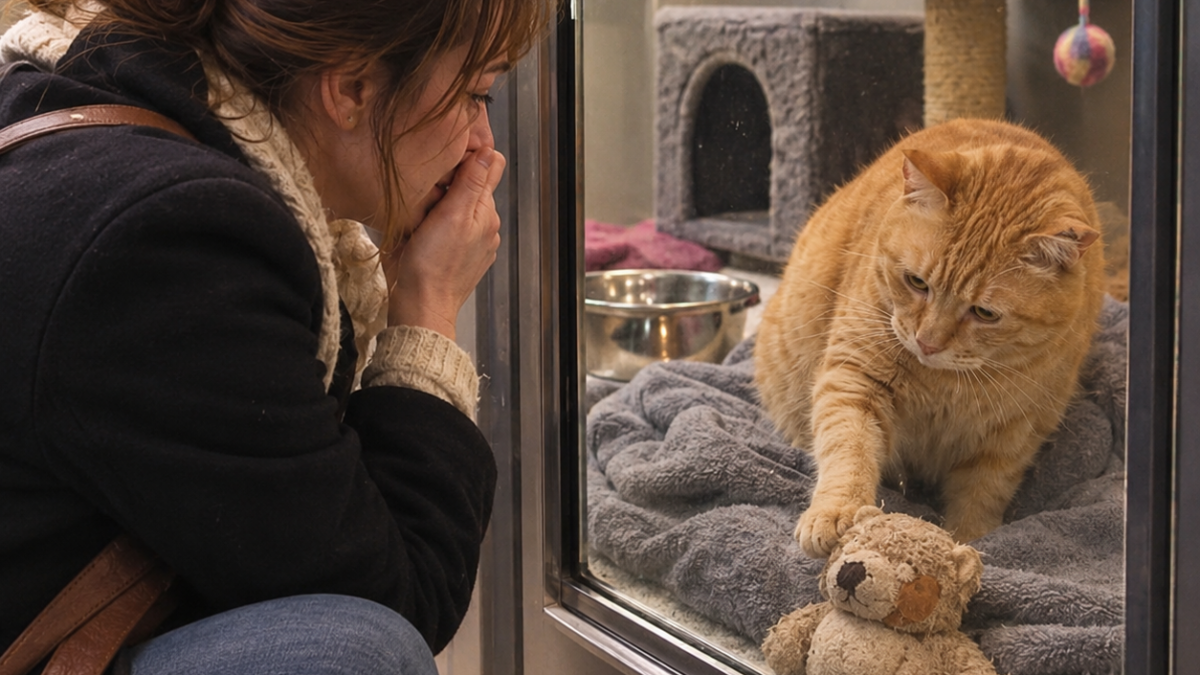
Miel lowered his head and took one of the bear’s worn ears carefully between his teeth.
He lifted the toy.
It looked almost absurd in his mouth.
The bear was so old and flattened that one leg hung lower than the other.
Miel stepped toward the open door.
Once.
Then again.
He stopped at the edge.
I held my breath.
“Come here,” I whispered.
Nadine glanced at me but said nothing.
Miel placed one paw outside the kennel.
Then another.
He was not graceful.
He was a large cat with the slow, deliberate movement of an animal that had learned there was no prize for rushing.
He reached the floor.
Still carrying the bear.
Then he walked directly toward me.
Not Nadine.
Me.
I crouched automatically.
“Hi.”
Miel stopped a foot away.
His eyes were level with mine.
I could see then that they were not sad in the dramatic way people like to describe shelter animals.
They were simply tired.
There is a difference.
Sadness can still expect something.
Tiredness has often stopped asking.
Miel dropped the bear.
It landed between us.
Then he pushed it with one paw.
Toward my knee.
I stared at it.
Nadine spoke quietly behind me.
“He’s never carried it out like that.”
I turned.
“What?”
“He pushes it toward the glass. Sometimes toward the door. But…”
She looked at Miel.
“He doesn’t usually bring it to someone.”
My throat tightened.
“That means nothing.”
I said it too quickly.
Nadine smiled.
“I didn’t say it meant anything.”
Miel sat.
The bear remained between us.
I looked at the toy.
Then at him.
“Is this yours?”
His whiskers twitched.
“Because I don’t want your disgusting bear.”
Nadine laughed softly.
Miel did not.
He placed one paw on it.
I laughed despite myself.
“All right. Fine. I’m sorry.”
Something shifted in my chest.
Just a small crack.
But I felt it.
I reached slowly toward the bear.
Miel watched.
I touched the worn fabric.
He did not pull it away.
I picked it up.
It weighed almost nothing.
The stuffing had compressed into hard little lumps inside.
One eye was a black plastic bead.
The other side was only a circle of thread where another eye had once been.
One leg had been repaired with blue thread.
Not professionally.
Someone had stitched it by hand.
I turned it over.
On the back, near the neck, faint letters had been written in permanent marker.
MIEL.
I looked at Nadine.
“His family wrote his name on it?”
“We think so.”
“You think?”
“They didn’t leave much information.”
“What happened?”
Nadine’s expression changed.
Not dramatically.
Just enough to tell me there was more.
“Elise, you came for a kitten.”
“I know.”
“If I tell you Miel’s story, I don’t want you to feel pressured.”
“I won’t.”
“You might.”
“I’m thirty-nine.”
She raised an eyebrow.
“What does that have to do with anything?”
“I can make my own bad decisions.”
That made her laugh.
“Fair enough.”
She crouched beside us.
Miel remained between us, watching the bear in my hands.
“His family surrendered him after eight years.”
“Why?”
“They said they were moving.”
I looked at Miel.
“Moving where cats aren’t allowed?”
“They didn’t specify.”
“That usually means no.”
Nadine didn’t argue.
“He came in with the bear, an old carrier and a small bag of food.”
“That’s it?”
“That’s it.”
“How did he react?”
“For the first several days, he barely moved.”
I looked at him.
“He ate?”
“Eventually.”
“Was he sick?”
“No. His bloodwork was good. Teeth need a little attention, but nothing severe. He’s healthy for eight.”
“So why has no one taken him?”
Nadine looked down the corridor.
“Because people come in wanting what you wanted.”
I felt heat rise into my face.
“A kitten.”
“A kitten.”
She did not say it accusingly.
That made it worse.
I looked at Miel.
His paw was still touching my shoe.
Barely.
I had not noticed when he moved it.
“I’m not a bad person for wanting a kitten.”
“No one said you were.”
“I know.”
“But you’re defending yourself anyway.”
I frowned at her.
Nadine smiled.
“You don’t know me.”
“I know shelter visitors.”
“That’s annoying.”
“Yes.”
I looked back at Miel.
He blinked slowly.
I held the bear toward him.
“Here.”
He sniffed it.
Then he did something that almost made me drop it.
He pressed his forehead against my hand.
Not the toy.
My hand.
For one second.
Then he sat back down.
That was all.
No dramatic purring.
No climbing into my lap.
No instant movie-scene bond.
One small touch.
I stopped breathing.
Nadine’s voice softened.
“There.”
I swallowed.
“What?”
“That’s what I wanted you to see.”
I stared at Miel.
“He does that with people?”
“No.”
“Then what does he normally do?”
“Wait.”
“For what?”
Nadine shrugged.
“I wish I knew.”
I sat on the floor.
My jeans were going to collect cat hair.
I didn’t care.
Miel looked at me for a long moment.
Then he lay down.
Close enough that his side touched my knee.
The bear was still in my hand.
I lowered it beside him.
He tucked one paw over it.
I sat there for several minutes.
Then ten.
Maybe fifteen.
The kitten room behind me grew noisy.
Someone laughed.
A child squealed.
One of the kittens knocked something over.
It was exactly the sound I had come for.
Bright.
New.
Easy.
But I couldn’t make myself stand.
Eventually, Nadine asked, “Do you still want to meet the tabby?”
I looked over my shoulder.
The kitten with the huge ears was playing with a ball.
He was adorable.
He would be adopted quickly.
I knew that without anyone saying it.
I looked back at Miel.
Eight years old.
Abandoned.
A ridiculous one-eyed bear under his paw.
I hated what came into my head.
You look like me.
Not physically.
Obviously.
But emotionally.
Tired.
Quiet.
Not trying very hard to be chosen.
Holding on to some damaged object from a life that was over.
The thought made me uncomfortable.
I stood.
Miel immediately lifted his head.
“Okay.”
I brushed my hands over my jeans.
“I need to think.”
Nadine nodded.
“Of course.”
I took one step away.
Then another.
Miel stayed where he was.
I walked toward the kitten room.
Behind me:
Toc.
I froze.
I turned.
Miel had pushed the bear against the bottom of the open kennel door.
Not hard.
Just enough to make the sound.
Toc.
He was looking at me.
I closed my eyes.
“Oh, come on.”
Nadine smiled.
“I’m saying nothing.”
“This is emotional manipulation.”
“From me?”
“From the cat.”
“He’s very skilled.”
I went back.
Miel sat quietly.
I pointed at him.
“You are not supposed to make decisions for me.”
He blinked.
“I have a plan.”
Another blink.
“I came here for a kitten.”
Miel looked down at his bear.
“Stop that.”
Nadine covered a laugh.
I looked at her.
“Can I have some time alone with him?”
“Of course.”
She stepped away.
I sat again.
For the next half hour, Miel and I did almost nothing.
That might have been the most honest interaction I’d had with anyone in months.
I didn’t perform happiness.
He didn’t perform affection.
I didn’t explain the breakup.
He didn’t explain being abandoned.
We simply shared space.
At one point, he rested his chin on the bear.
I said quietly, “I don’t want something complicated.”
His ear moved.
“I’ve had enough complicated.”
Nothing.
“I want easy.”
Miel closed his eyes.
“You’re not listening.”
That was probably true.
I looked at the crooked stitching on the bear.
“Do you know why I wanted a kitten?”
No response.
“Because a kitten wouldn’t remind me that things end.”
I surprised myself.
I had not said that out loud before.
Not even to myself.
“A kitten would be beginning.”
My voice dropped.
“You’re eight.”
Miel breathed slowly.
“You already have a whole life behind you.”
I stared at the floor.
“I didn’t want to inherit someone else’s ending.”
Miel’s paw moved.
It landed against my hand.
I laughed once.
Weakly.
“You really are annoying.”
He left the paw there.
The truth was sitting directly in front of me.
I had told myself I wanted a kitten because kittens were cheerful.
The deeper truth was uglier.
I wanted something without history because I was exhausted by history.
My own history.
My ex-partner’s.
The apartment’s.
The little habits that remained after someone left.
The empty half of the closet.
The coffee mug I had not thrown away.
The stupid plant he had bought that I continued watering because letting it die felt petty.
I wanted a living thing with no before.
No reminders.
No grief attached.
Miel was made almost entirely of before.
Eight years with someone.
Then a shelter.
A bear from the old house.
An ear slightly bent from who knew what.
The opposite of what I had planned.
I stood again.
This time Miel didn’t stop me.
I found Nadine near the desk.
“I’m going home.”
She nodded.
“Okay.”
“I need to think.”
“I know.”
“Don’t let anyone adopt him today.”
She looked at me carefully.
“Elise.”
“What?”
“I can’t reserve an animal because someone is emotionally confused.”
“That sounds very specific.”
“It happens more than you’d think.”
I folded my arms.
“Can I put in an application?”
“For Miel?”
I hesitated.
“For…maybe Miel.”
She smiled.
“You can.”
“I’m not promising anything.”
“I know.”
“I may still take the kitten.”
“Okay.”
“I mean it.”
“Elise.”
“Yes?”
“You’re arguing with yourself.”
I hated how right she was.
I filled out the application.
Name.
Address.
Employment.
Landlord information.
Home environment.
Other animals.
Work schedule.
Emergency contact.
Then the question:
Why do you want to adopt this animal?
I stared at it.
I almost wrote:
Because he gave me his bear.
That sounded insane.
Instead I wrote:
Because I think he deserves a quiet home.
Then I crossed out “he” and wrote:
Because I think we both do.
I nearly crossed that out too.
I didn’t.
I drove home without a cat.
That was not the plan.
My apartment was exactly as I had left it.
Too quiet.
I placed my keys in the ceramic dish.
Took off my coat.
Opened the refrigerator.
Closed it.
Turned on the television.
Turned it off.
Then I sat on the couch.
I kept seeing the bear.
That ugly bear.
One eye.
Blue stitches.
Miel written on the back.
Why had his family bothered writing his name on a toy if they were willing to leave him?
I hated that question.
It felt unfair.
I knew nothing about them.
Maybe there had been circumstances.
Money.
Housing.
Illness.
Life can force ugly decisions.
I understood that better than I wanted to.
Still, I kept imagining Miel arriving at the shelter.
Carrier door opening.
Strange smells.
Strange cats.
His family leaving.
The bear remaining.
I wondered if he waited for them to come back.
That thought ruined dinner.
I made pasta and barely ate it.
At eleven, I looked up the shelter website.
Miel’s picture was there.
It was terrible.
He looked enormous.
His eyes were half closed.
The caption said:
MIEL — 8 YEARS — CALM, INDEPENDENT, NEEDS PATIENCE.
Needs patience.
I stared at those words.
I had spent months telling everyone I was tired.
That I needed patience.
That I didn’t have energy.
Maybe I hated Miel because he looked too familiar.
At midnight, I sent Nadine an email.
Subject: Question About Miel.
I wrote:
Does he sleep with the bear?
Then deleted it.
Too stupid.
I wrote:
Has he ever lived in an apartment?
Deleted.
Then finally:
I’m still thinking.
She replied the next morning.
I know.
That irritated me more than it should have.
Two days passed.
I tried to return to normal.
Work.
Emails.
Coffee.
Lunch at my desk.
But I kept thinking about kennel 43.
On Tuesday afternoon, a coworker named Claire leaned over the divider between our desks.
“Didn’t you say you were adopting a cat?”
“I was.”
“What happened?”
“I met one.”
“That sounds like the goal.”
“No, I met the wrong one.”
She stared.
“How can a cat be the wrong one?”
“He’s eight.”
“So?”
“I wanted a kitten.”
“Then get a kitten.”
“I know.”
Claire waited.
I sighed.
“He has a teddy bear.”
Her expression changed.
“Oh no.”
“Do not.”
“You’re adopting him.”
“I am not.”
“He has a teddy bear?”
“A horrible one.”
“You’re finished.”
“I hate you.”
She smiled.
“Show me.”
I pulled up the shelter page.
Claire looked at Miel’s picture.
“That cat looks like he files taxes.”
I laughed so hard that two people turned around.
It was the first real laugh I’d had at work in weeks.
“He does.”
“He looks judgmental.”
“He is.”
“What’s the bear look like?”
I described it.
Claire put a hand over her heart.
“You have no chance.”
“I am a rational adult.”
“Not anymore.”
I shut my computer screen halfway.
“I wanted something easy.”
Claire’s face softened.
“Maybe easy isn’t what you need.”
I looked at her.
“What does that mean?”
She shrugged.
“Maybe you need something real.”
I didn’t answer.
That evening, I drove to the shelter.
I told myself I was only visiting.
Nadine saw me walk in and said nothing.
That was somehow worse than a comment.
“Don’t.”
“I said nothing.”
“You’re thinking something.”
“I’m always thinking something.”
“Where is he?”
“Forty-three.”
Miel was sleeping when I approached.
The bear was tucked beneath his chest.
I stood there.
He did not wake immediately.
For some reason, that made me happy.
The first time, he had been watching everyone.
Waiting.
Now he was sleeping deeply enough not to notice me.
I tapped the glass lightly.
Miel’s head lifted.
His eye—
No.
Both his eyes.
The bear had one eye.
I had already started mixing their images.
Miel blinked.
Then stood.
He picked up the bear.
Toc.
My chest hurt.
“Hi.”
Nadine unlocked the door.
This time, Miel walked out faster.
Not fast.
Just without the long hesitation.
He approached me.
Dropped the bear.
Then rubbed the side of his face once against my shin.
I looked at Nadine.
“That’s new.”
“He remembers you.”
“How?”
“Cats have memories.”
“I know that.”
“You look surprised.”
“I am surprised.”
I sat down.
Miel climbed halfway into my lap.
Not completely.
His front paws rested on one thigh.
The rest of him stayed on the floor.
Like he was keeping an exit available.
I understood that.
I put one hand on his back.
“Okay.”
He purred.
It was quiet.
Almost mechanical.
I froze.
“He didn’t purr last time.”
Nadine sat nearby.
“He doesn’t purr often here.”
“Why?”
“Because this is a shelter.”
I looked at Miel.
Right.
Of course.
Shelters save lives.
They also remain shelters.
Noise.
Smells.
Other animals.
Staff changing shifts.
Doors opening and closing.
No place truly belonging to you.
I stroked him.
His purr deepened.
I knew then.
Not because of fate.
Not because I believed he had chosen me in some mystical way.
I knew because for the first time in months, I did not feel like I was trying to escape my own life.
I was sitting on a shelter floor with an eight-year-old cat half in my lap, holding a ruined stuffed bear.
And I wanted to go home.
Not alone.
“I want him.”
The words came out quietly.
Nadine did not react immediately.
“Are you sure?”
“No.”
She smiled.
“Good answer.”
“I mean it.”
“I know.”
“I’m afraid I’m choosing him because I feel sorry for him.”
“That’s worth thinking about.”
“I don’t want pity to be the reason.”
“Then what is the reason?”
I looked at Miel.
He had closed his eyes.
“I like him.”
“That’s a start.”
“He’s weird.”
“So are you.”
“I’m serious.”
“So am I.”
I laughed.
“He doesn’t demand anything.”
“No.”
“He just…sits there.”
“Yes.”
“And somehow that makes me want to give him everything.”
Nadine nodded.
“That sounds less like pity.”
The shelter required a short waiting period and final approval.
I used those days to prepare my apartment.
I bought bowls.
A litter box.
Scratching posts.
A bed.
Toys.
Too many toys.
I bought a cat tree that required forty-seven pieces of hardware and almost ended my sanity.
Claire came over to help.
At one point we stood in my living room surrounded by cardboard.
“This is the easy pet you wanted?”
“Shut up.”
“Where does the teddy bear go?”
“Wherever he wants.”
Claire smiled.
“Correct.”
The night before pickup, I became afraid.
What if Miel hated the apartment?
What if he hid for weeks?
What if he had medical problems the shelter hadn’t found?
What if I failed him?
What if I wasn’t actually ready to care for anything?
What if I was using him to fill a hole no animal could fill?
I almost emailed Nadine.
Then I thought about Miel waiting.
Not for me specifically.
Just waiting.
I didn’t want fear to become another person leaving him.
So I showed up.
Nadine had his carrier ready.
Miel was inside with the bear.
I crouched.
“Ready?”
He looked deeply unconvinced.
“Same.”
The adoption paperwork felt strangely formal.
Initial here.
Signature there.
Emergency numbers.
Diet.
Vaccinations.
Follow-up.
Then Nadine handed me the carrier.
“He’s yours.”
The sentence hit me harder than expected.
Mine.
I looked through the carrier door.
Miel looked back.
“No pressure.”
Nadine smiled.
“Remember, give him time.”
“I know.”
“He may hide.”
“Okay.”
“He may not eat much the first day.”
“Okay.”
“Keep his routine predictable.”
“Okay.”
“And the bear stays with him.”
I stared at her.
“Obviously.”
She laughed.
“Good.”
I carried him to the car.
Halfway there, I stopped.
“Nadine?”
“Yes?”
“Do you think he knows?”
“Knows what?”
“That he’s not coming back here?”
She looked at Miel.
“No.”
My heart sank.
Then she added, “But he will.”
The first night was terrible.
I need to say that because rescue stories often skip too quickly from adoption to happiness.
Miel hated the carrier.
Then hated the hallway.
Then hated my apartment.
Or at least that was how it felt.
I opened the carrier in my bedroom because it was quieter.
He stayed inside.
For twenty minutes.
Then forty.
I sat on the floor a few feet away.
His bear was beside him.
“You can come out.”
Nothing.
“I bought expensive furniture for you.”
Nothing.
“Not human furniture. Cat furniture.”
Still nothing.
“You are very ungrateful.”
Miel stared.
Eventually, around midnight, I gave up.
I left food, water and the litter box nearby.
Then I went to bed.
At two in the morning, I heard a crash.
I sat upright.
“Miel?”
Silence.
I turned on the lamp.
The carrier was empty.
The bear was gone.
I found Miel under the dining table.
The bear was beside him.
A water glass I had left on the coffee table had been knocked over.
I crouched.
“Okay.”
He stared.
“You’ve been here six hours and already destroyed something.”
His whiskers twitched.
“Promising.”
I cleaned the water.
Then sat on the floor.
Miel stayed under the table.
I did not reach for him.
After ten minutes, I got tired.
I leaned my back against the couch.
“This is ridiculous.”
Miel watched me.
“You know I have work tomorrow?”
Nothing.
“I am going to be exhausted.”
Nothing.
“Fine.”
I closed my eyes.
I woke twenty minutes later because something touched my foot.
Miel.
He stood there.
Bear behind him.
I didn’t move.
He sniffed my ankle.
Then sat down.
I whispered, “Hi.”
Miel walked away.
That was the whole interaction.
It felt like success.
The next morning, he was behind the sofa.
The food bowl was half empty.
The litter box had been used.
I nearly celebrated.
I went to work and spent the entire day worrying.
At lunch, Claire asked, “How’s your son?”
“Don’t call him that.”
“How’s your middle-aged tax accountant?”
“Hiding.”
“Normal.”
“He ate.”
“Good.”
“He knocked over a glass.”
“Excellent.”
“Why excellent?”
“Because you wanted a cat.”
By the fourth day, Miel began spending time outside his hiding spots.
Not near me.
Just visible.
He sat on the windowsill.
Watched the street.
Slept on the gray blanket I had brought from the shelter because Nadine insisted familiar smells might help.
The bear moved everywhere with him.
Bedroom.
Living room.
Window.
One evening I found it in the kitchen beside his food bowl.
“You brought your friend to dinner?”
Miel ate.
I touched the bear.
He stopped.
Looked at me.
I removed my hand.
“Sorry.”
He continued eating.
That was when I realized the bear was not just a toy.
It was a boundary.
An object connected to safety.
Something that had remained constant when everything else disappeared.
I stopped treating it casually.
Then one night, about two weeks after adoption, something changed.
I was on the couch watching television.
Actually watching.
Miel was on the other end.
That alone had become progress.
He slept there sometimes.
Never touching me.
The bear sat beneath one paw.
My phone rang.
My ex-partner’s name appeared.
I stared at the screen.
We had not spoken in almost a month.
I let it ring.
It stopped.
Then a message arrived.
Can we talk?
My stomach tightened.
All the old feelings returned immediately.
Anger.
Guilt.
Loneliness.
The stupid hope that maybe some version of our old life could be repaired.
I put the phone face down.
Miel lifted his head.
“Don’t look at me.”
He did.
“I know.”
I stood.
Walked into the kitchen.
Came back.
Sat.
The phone buzzed again.
I picked it up.
Then put it down.
My hands were shaking.
Miel stood.
He walked toward me.
I assumed he wanted food.
Instead, he stepped onto my lap.
Fully.
For the first time.
I froze.
He turned once.
Then settled.
His weight pressed against my stomach.
His purr started.
Low.
Steady.
I put one hand on his back.
“You have terrible timing.”
Purr.
My eyes filled.
“Or very good timing.”
He stayed.
The phone buzzed one more time.
I didn’t answer.
For nearly an hour, Miel slept on me.
I barely moved.
Eventually my leg went numb.
I didn’t care.
That night, I understood something.
I had thought I was adopting an animal to make my apartment less quiet.
Miel did something different.
He made the quiet feel safe.
That is not the same thing.
Before him, silence meant absence.
After him, silence had breathing in it.
A body shifting on the couch.
Paws crossing the hallway.
A toy being dragged from one room to another.
Presence.
That changed me more slowly than I noticed.
I started coming home earlier.
Not dramatically.
Ten minutes.
Twenty.
I stopped volunteering for unnecessary late work.
One evening, my manager asked if I could stay.
I almost said yes automatically.
Then I pictured Miel sitting near the door.
“I can finish it tomorrow morning.”
The words surprised me.
My manager blinked.
“Okay.”
That was all.
Nothing collapsed.
The office survived.
So did I.
At home, Miel was waiting in the hallway.
The bear beside him.
“Were you waiting?”
He walked toward the kitchen.
“Of course. Food.”
But I smiled.
My apartment changed too.
Not physically at first.
Emotionally.
I stopped seeing it as a place where the old relationship had ended.
It became the place where Miel lived.
There was a scratching post near the window.
A blanket on the chair.
A food mat in the kitchen.
A ridiculous stuffed bear in the middle of the floor.
Gradually, the apartment stopped belonging to the person I had been.
It started belonging to the life I actually had.
Miel became more affectionate.
Not constantly.
He was never that kind of cat.
He did not sit on every visitor.
He did not demand attention.
But he developed routines.
At 6:40 every morning, he walked across my pillow.
At exactly the moment I tried to sleep late on weekends, he knocked something small off the nightstand.
If I worked from home, he sat near the keyboard but never on it.
He was too dignified for that.
Usually.
One Tuesday, he sat directly on a spreadsheet.
“Excuse me.”
Miel stared.
“You are blocking revenue projections.”
He lay down.
“Fine.”
I sent Claire a picture.
She replied:
Accountant reviewing your work.
I laughed.
Those tiny exchanges began returning pieces of me I had forgotten.
Humor.
Interest.
Routine.
I started cooking again because eating frozen meals every night became embarrassing with another living creature watching me.
I invited Claire over.
Then another friend.
Miel vanished under the bed during the first visit.
By the third, he stayed on the chair.
The bear beside him.
Everyone asked about it.
I stopped telling the whole story.
I simply said, “It came with him.”
That phrase meant more to me every time.
He came with history.
The bear came with him.
Fear came with him.
Habits came with him.
Age came with him.
And none of those things made him less worth having.
That lesson started reaching uncomfortable places in my own life.
I had spent months feeling damaged because I was thirty-nine and beginning again.
Too much history.
Too many mistakes.
Too many habits.
Too tired.
Maybe that was why Miel had disturbed me.
He was proof that “used” and “finished” were not the same thing.
One evening, I sat near him on the floor.
“You know what I hate about you?”
Miel licked his paw.
“You’re metaphorical.”
No reaction.
“I wanted a kitten because I thought new meant better.”
He kept cleaning himself.
“That was stupid.”
He stopped.
Looked at me.
“Don’t look pleased.”
He resumed.
A month after the adoption, I noticed something about the bear.
One of the old blue stitches was coming loose.
The damaged leg hung by a few threads.
I picked it up carefully.
Miel immediately approached.
“It’s okay.”
He sniffed.
“The leg is falling off.”
I examined it.
The old thread had frayed.
“I can fix it.”
Miel put one paw on the bear.
“I know.”
I brought out a sewing kit.
Then realized I had almost no idea what I was doing.
I called my mother.
“You sew, right?”
There was a long pause.
“Elise, are you injured?”
“No.”
“Then why are you calling me about sewing?”
“I need to repair a teddy bear.”
Another pause.
“For whom?”
“My cat.”
Silence.
Then she started laughing.
I almost hung up.
“Are you finished?”
“No.”
“Mom.”
“I’m sorry.”
She was still laughing.
“I need help.”
“All right. Send a picture.”
I did.
Her next message came quickly.
That poor thing.
“The bear or the cat?”
The bear.
Fair.
My mother came over that weekend.
It was the first time she had visited since my breakup.
I had avoided her because mothers ask questions no one else dares ask.
She sat at my table with the bear under a lamp.
Miel watched from the doorway.
“He’s suspicious,” she said.
“He should be.”
“Of me?”
“Of anyone touching that bear.”
My mother examined the stitching.
“Who repaired this before?”
“No idea.”
“It’s terrible.”
“I know.”
“But it held.”
She looked at me.
“That matters.”
For some reason, I almost cried.
She noticed.
“Elise?”
“Nothing.”
My mother knew better.
She said nothing.
That kindness made it worse.
We repaired the leg together.
She showed me how to pull the thread through without tearing the old fabric.
How to reinforce the weak seam.
How not to make it perfect.
“Why not perfect?”
“Because the fabric around it is old. If you pull too tight, you’ll damage it.”
I stopped.
My mother looked at me.
Then at the bear.
Then back at me.
Neither of us said anything.
It was too obvious.
When we finished, I placed the bear on the floor.
Miel approached.
Sniffed it.
Then grabbed it by one ear and walked away.
My mother laughed.
“No gratitude.”
“None.”
“He’s beautiful.”
I looked at him.
“Yes.”
My mother stayed for dinner.
That was the first real dinner I had shared with someone in my apartment for months.
Not planned.
Not emotional.
Just soup, bread and too much cheese.
Miel sat under the table.
The bear beside him.
My mother told me about my father’s latest obsession with reorganizing the garage.
I laughed.
She laughed.
And suddenly I realized I had not talked about the breakup once.
There are many ways life returns.
Sometimes it does not arrive with a dramatic revelation.
Sometimes your mother fixes a cat’s teddy bear and stays for soup.
Three months after adoption, I received a call from Nadine.
“Everything okay?”
My stomach tightened immediately.
“Yes. Why?”
“Just checking.”
“You scared me.”
“Sorry.”
“Miel is fine.”
“Good.”
“He’s gained weight.”
“He didn’t need to.”
“I know.”
“He had shelter stress weight loss. A little gain is fine.”
“He screams at me if dinner is four minutes late.”
“Excellent.”
“He does not scream.”
“What does he do?”
“Stares.”
“Worse.”
I smiled.
Then Nadine became quieter.
“I wanted to ask you something.”
“What?”
“Would you send us a picture?”
“Of Miel?”
“Yes.”
“For the shelter page?”
“If you’re comfortable.”
I looked toward the window.
Miel was asleep in sunlight.
His bear under his chin.
“Why?”
“People like updates.”
I almost said no.
Not because I objected.
Because something about turning Miel into a before-and-after story made me uncomfortable.
He had not become valuable because I adopted him.
He had always been valuable.
But then I remembered kennel 43.
Adults sleeping while visitors walked past.
Cats who had learned not to perform.
“Okay.”
I took a picture.
Miel on the windowsill.
Golden fur bright in the sun.
Bear beneath one paw.
I sent it.
The shelter posted it with the caption:
MIEL, FORMERLY KENNEL 43, AT HOME.
That sentence broke me.
At home.
Not rescued.
Not saved.
At home.
A week later, Nadine called again.
“You caused a problem.”
“What?”
“Three people have asked about older cats.”
I laughed.
“Because of Miel?”
“Because of Miel.”
“That’s not a problem.”
“No.”
She sounded pleased.
“One woman came in asking specifically for ‘a cat nobody else wants.’”
I sat down.
“You’re joking.”
“I’m not.”
“What happened?”
“She adopted a ten-year-old black cat.”
I covered my mouth.
Miel walked into the room.
He stopped when he heard my voice.
“You did that.”
He looked uninterested.
Nadine asked, “What?”
“Nothing.”
I looked at Miel.
“You started something.”
Over the next year, life became ordinary.
That is perhaps the happiest sentence I can write.
Ordinary.
Miel had annual bloodwork.
A dental cleaning.
One ear infection.
He hated the carrier.
He hated the veterinarian.
He forgave me within thirty minutes if food was involved.
The bear lost more fur.
My mother repaired it twice.
I eventually learned to do it myself.
Miel became less protective of it.
At first, he carried it everywhere.
Then only into the bedroom.
Later, it sometimes stayed on the couch while he slept in another room.
That change moved me more than I expected.
The bear had been his constant.
The only thing connecting the shelter to whatever came before.
Slowly, he needed it less.
Not because he stopped loving it.
Because his life contained other things now.
A bed.
Windows.
My voice.
The kitchen.
Morning sun.
The sound of my keys.
Home.
One afternoon, I noticed the bear alone in the hallway.
Miel was sleeping on my bed.
I picked it up.
“You forgot something.”
He opened one eye.
I placed it near him.
He stood.
Walked past it.
And curled against my side instead.
I stared at the bear.
Then at Miel.
“Oh.”
He closed his eyes.
I understood.
The bear had once been the thing that remained when people disappeared.
Now people remained.
That changed its job.
I put one hand on Miel’s back.
“I’m still here.”
His purr started.
Maybe he knew.
Maybe not.
It didn’t matter.
I stayed.
Around the same time, my own old objects started losing power.
The mug from the relationship broke accidentally.
I dropped it in the sink.
For ten seconds, I stared at the pieces.
Then I laughed.
I expected grief.
Instead, I got a broom.
The plant finally died despite my efforts.
I threw it away.
The empty side of the closet stopped looking symbolic.
I used it.
My life did not restart.
That was the thing I had misunderstood.
There are no clean restarts.
New chapters are written on pages that already exist.
Miel did not arrive without history.
Neither did I.
We simply made more history.
Together.
One evening, about eighteen months after I adopted him, I came home and noticed Miel was not waiting near the hallway.
That was unusual.
“Miel?”
No answer.
I checked the kitchen.
Nothing.
Bedroom.
Nothing.
My heart began racing.
Then I found him under the dining table.
Curled tightly.
The bear beside him.
My stomach dropped.
“Miel?”
He looked at me but did not rise.
I knelt.
“What’s wrong?”
He made a small sound.
Not a normal meow.
I touched his side.
He tensed.
Within fifteen minutes, we were in the car.
I drove too fast.
The veterinarian examined him.
Bloodwork.
X-rays.
Ultrasound.
The waiting room brought back every fear I had avoided since the shelter.
Eight was already older when I adopted him.
Now he was almost ten.
I had known this.
Of course I had.
But knowing an animal will age is intellectual.
Watching them hurt is not.
The veterinarian eventually came out.
“He has pancreatitis.”
I blinked.
“Is that…bad?”
“It can be serious. But we caught it.”
“Is he going to die?”
The veterinarian looked at me.
“Not if we can help it.”
That was not a guarantee.
But it was enough.
Miel stayed overnight.
I went home alone.
The apartment felt wrong.
The old silence returned instantly.
I hated how quickly fear could resurrect it.
His food bowl was still there.
His blanket.
The bear had gone to the clinic with him.
I had insisted.
The apartment without Miel but with all his things looked exactly like my life before him.
A place full of evidence that someone belonged there.
But no one there.
I sat on the couch.
I cried.
Not delicately.
Not quietly.
I cried because I had finally found something to lose again.
That was the part no one tells you about healing.
When you begin loving life again, you also reopen the possibility of grief.
For months after my breakup, I had thought numbness was safety.
Miel had ruined that.
He had made me care.
Now caring hurt.
I hated him for it.
And loved him for it.
The next morning, the clinic called.
“He ate.”
I closed my eyes.
“Really?”
“A little.”
“Can I see him?”
“Yes.”
When I arrived, Miel was sitting in his kennel.
The bear beneath him.
He looked irritated.
That was beautiful.
“You look terrible.”
His tail flicked.
“And angry.”
Another flick.
“Good.”
I put my fingers through the bars.
He leaned forward.
Pressed his forehead against them.
Same gesture.
The first one.
Years collapsed.
Kennel 43.
The bear.
My hand.
I cried again.
The technician smiled.
“He should go home later today if he keeps improving.”
I laughed through tears.
“Okay.”
Miel came home.
Recovery took time.
Medication.
Diet.
Follow-up.
He became even more demanding about food, which seemed unfair considering the medical issue.
But he recovered.
Not perfectly.
Older animals rarely return to exactly what they were.
He became slower.
Slept more.
Jumped onto lower surfaces.
I bought steps for the bed.
He ignored them for two weeks, then used them as if they had been his idea.
The bear came back into heavier use during recovery.
He slept with it again.
I did not find that sad.
Comfort is not regression.
Sometimes we return to old things when we need them.
I understood that now.
By then, my own life had changed too.
I had left the office job that had exhausted me.
Not dramatically.
No angry resignation.
I simply realized I had spent years confusing endurance with stability.
I found another position with better hours and less money.
Everyone told me to think carefully.
I did.
Then I took it.
The first evening I came home before six, Miel sat by the window in sunlight.
I thought:
This is enough.
That sentence would have terrified the old me.
Enough sounded like settling.
Now it sounded like peace.
I had time.
A home.
Friends I actually saw.
A mother who came over too often and secretly brought Miel treats.
A large honey-colored cat who sometimes slept with a horrible bear.
Enough.
One Sunday, Nadine invited me back to the shelter.
“We’re doing an adoption day for adult cats.”
I almost said no.
Shelters still made me emotional.
Then I went.
Miel did not come.
He had retired from public relations.
I walked down the corridor.
The kennel numbers were the same.
Forty-one.
Forty-two.
Forty-three.
A black-and-white cat lived there now.
She watched me carefully.
No bear.
No dramatic gesture.
Just a cat.
I crouched.
“Hi.”
She blinked.
I stayed.
A young couple walked past toward the kittens.
I smiled.
I understood.
Then, a few minutes later, they came back.
The woman looked at me.
“Do you know anything about this cat?”
I laughed.
“No.”
Nadine appeared.
“But I do.”
I stepped aside.
As she began telling them about the cat, I looked at kennel 43.
For a second, I saw Miel there.
Not literally.
Memory.
Honey-colored.
Bear.
Toc.
That sound had changed my life.
Not because Miel saved me.
I don’t like saying that.
Animals should not be responsible for saving adults.
He did not fix my breakup.
He did not repair my career.
He did not make loneliness disappear permanently.
What he did was smaller and more honest.
He gave me something to respond to.
A gesture.
A routine.
A living presence.
Then I did the rest.
With him beside me.
That distinction matters.
Years passed.
Miel reached eleven.
Then twelve.
His muzzle lightened slightly.
His jumps became calculations.
He still acted offended by medical appointments.
The bear became almost impossible to repair.
Its fabric was so thin that new stitches pulled through old cloth.
One evening, I sat with it under a lamp.
Miel watched.
“I don’t know if I can fix this again.”
His head rested on his paws.
I turned the bear over.
The original word MIEL had faded.
Barely visible.
I traced it with my finger.
Someone had loved him once.
That was another truth I had slowly accepted.
Abandonment did not necessarily mean all eight previous years were false.
People are complicated.
Circumstances change.
Love can exist and still fail.
That truth was more uncomfortable than calling his old family cruel.
But it was probably closer to reality.
I stopped needing a villain.
Miel had stopped needing the past explained.
I carefully placed a patch behind the thinning fabric.
Not perfect.
Reinforced.
Like my mother had taught me.
Miel approached when I finished.
He sniffed.
Then picked the bear up.
Carried it to his bed.
I smiled.
“It’ll hold.”
I hoped so.
There are things we keep repairing not because they can become new again.
Because they are worth keeping.
When Miel turned thirteen, I gave him a ridiculous birthday dinner.
My mother came.
Claire came.
Nadine even stopped by after work.
Miel hated the attention.
He disappeared into the bedroom for twenty minutes.
“This party is going well,” Claire said.
“He has boundaries.”
“He has contempt.”
“Same thing.”
When Miel eventually returned, Nadine sat on the floor.
He approached her slowly.
She held out a hand.
He sniffed.
Then rubbed against her.
Nadine’s eyes filled.
“Oh.”
I saw it.
“You okay?”
“Yes.”
She stroked him.
“He used to sit there with that bear and watch everyone leave.”
I looked at him.
Now he had four adults arguing over which treat he liked most.
I smiled.
“Not everyone.”
Nadine looked at me.
“No.”
Miel walked toward me.
Sat beside my leg.
The bear was on the couch.
Unused.
I thought about the first day.
The way he had pushed it toward me.
For years, I had wondered what that gesture meant.
Nadine had wondered.
Shelter staff had wondered.
Maybe we had all made it more mysterious than it was.
Maybe Miel had not been offering me a gift.
Maybe he was not saying:
Take this.
Maybe he was saying:
This is what I have.
This is what came with me.
Do you still want me?
That interpretation hit me so hard I had to look away.
Because that was the question I had been asking the world too.
This is what I have.
History.
Damage.
Fear.
Habits.
Do you still want me?
Miel and I had answered each other.
Yes.
Not because the baggage disappeared.
With it.
That became the real story.
Not a woman rescues abandoned cat.
Not cat rescues lonely woman.
Two creatures arrived with things already torn and decided they could still make a home.
Nothing cleaner than that.
When Miel was fourteen, his kidneys began failing.
Slowly.
The veterinarian had been watching the numbers for a while.
At first, diet.
Then medication.
Then fluids at home.
I learned how to administer them.
The first time, my hands shook.
“I’m going to hurt him.”
The vet tech said, “You’re helping him.”
“I know, but—”
“Elise.”
She looked at me.
“He trusts you.”
That almost made it worse.
At home, Miel tolerated the fluids with the exhausted dignity of a cat who had accepted humans were strange.
I sat beside him.
“Remember when I said I wanted a cat with no medical problems?”
He glared.
“You really ruined that.”
His tail flicked.
“I know.”
The disease progressed.
Not quickly enough to make decisions easy.
That is one of the cruelest parts of loving an old animal.
There is rarely one dramatic moment.
There are numbers.
Appetite changes.
More sleep.
Weight loss.
Good days.
Bad days.
Then good days again, just enough to make you question everything.
I became obsessed with measuring.
Food eaten.
Water.
Weight.
Medications.
The veterinarian finally said something I needed to hear.
“Stop turning him into a chart.”
I stared.
“What?”
“You know him.”
“I know.”
“Then look at him too.”
So I did.
Miel still wanted breakfast.
Still sat in sunlight.
Still climbed into my lap some evenings.
Still carried the bear occasionally.
Still purred.
Those things mattered.
Later, they changed.
Breakfast became half.
Then a few bites.
The windowsill became too high.
I moved a chair underneath.
Then he stopped using it.
The apartment grew smaller around him.
Bedroom.
Living room.
His bed.
My lap.
The bear.
One night, I woke because Miel was standing beside my pillow.
He rarely did that anymore.
I lifted the blanket.
He stepped underneath.
Curled against my chest.
I could feel how much weight he had lost.
I put my arm around him.
His purr started.
Soft.
Uneven.
I knew.
Not in a medical way.
In the way people who love animals sometimes know.
We were getting close.
I did not sleep.
I stared into the dark.
Miel breathed against me.
The next morning, he did not want breakfast.
He walked toward the bear.
Lay beside it.
I called the veterinarian.
My voice broke before I finished the sentence.
They told me to come in.
I placed Miel in the carrier.
The bear went with him.
Always.
In the examination room, the veterinarian was gentle.
Bloodwork confirmed what his body already told us.
His kidneys were failing badly.
We could hospitalize.
Try aggressive fluids.
Maybe buy days.
Maybe weeks.
No promises.
I looked at Miel.
He looked tired.
Not scared.
Tired.
The same look from kennel 43.
Years earlier.
I hated seeing it again.
“What would you do?”
I asked the vet.
She did not hide behind professional language.
“If he were mine?”
“Yes.”
“I would let him go before the bad days become all he has.”
I cried.
I held Miel.
His bear sat beside us on the table.
“I’m sorry.”
He pressed his forehead against my hand.
The same gesture.
Again.
Beginning.
Ending.
Everything between.
I thought about how desperately I had once wanted something with no painful surprises.
There was no such thing.
Love is the surprise.
So is grief.
You cannot choose one and refuse the other.
I understood that now.
I looked at Miel.
“You gave me your bear.”
My voice shook.
“You idiot.”
He closed his eyes.
“You should have given it to someone stronger.”
The veterinarian placed a hand on my shoulder.
I laughed through tears.
“But I guess I got stronger.”
Miel purred.
Very faintly.
I held him while the first medication relaxed him.
His body softened against me.
I whispered every ordinary thing I could think of.
“You’re home.”
“You’re safe.”
“You’re good.”
“I’m here.”
The last one mattered most.
I’m here.
I had promised presence.
Not forever.
No one can promise forever.
Only through the end.
So I stayed.
Miel died in my arms.
The bear beneath one paw.
For several minutes afterward, I did not move.
I expected some dramatic feeling.
A collapse.
A scream.
Instead, there was silence.
The unbearable kind.
Then the veterinarian asked gently, “Do you want to take the bear?”
I looked at it.
My first reaction was yes.
Of course.
Then I stopped.
The bear belonged to Miel.
But Miel was gone.
What did that mean now?
I picked it up.
The fabric was warm where his paw had rested.
“I don’t know.”
The veterinarian waited.
Eventually, I held it against my chest.
“Yes.”
I brought the bear home.
For weeks, I hated it.
That surprised me.
I thought it would comfort me.
Instead, every time I saw it, the apartment felt empty.
I put it in a drawer.
Then felt guilty.
Took it out.
Put it on the shelf.
Moved it again.
Grief makes objects unbearable.
One afternoon, my mother came over.
She saw the bear on the table.
She touched the patched leg.
“How are you?”
I laughed without humor.
“Everyone keeps asking that.”
“I’m your mother. I’m allowed.”
“I’m terrible.”
She nodded.
“I know.”
That helped.
No false optimism.
No “he had a good life.”
Even though he had.
No “you should be grateful.”
Even though I was.
I just missed him.
My mother picked up the bear.
“You repaired this well.”
“You taught me.”
She turned it over.
The faded letters.
MIEL.
“What are you going to do with it?”
“I don’t know.”
“You don’t have to decide.”
That became my answer for many things.
I don’t know.
And I didn’t have to decide.
Not yet.
Months passed.
Grief became less sharp.
Not smaller.
Different.
I stopped expecting to hear Miel in the hallway.
I stopped stepping around the place where his food bowl had been.
I donated his unused medication.
Kept his gray blanket.
Kept the bear.
One Saturday, almost a year after Miel died, I drove to the shelter.
I had not planned to.
I just found myself on the road.
Nadine was still there.
Older.
Same desk.
Same folders.
She saw me.
Her face softened.
“Elise.”
“Hi.”
We hugged.
I had never hugged her before.
“How are you?”
“Better.”
She nodded.
“Miel?”
I smiled sadly.
“Gone.”
She closed her eyes.
“Oh.”
“Last year.”
“I’m sorry.”
“He made it to fourteen.”
Nadine smiled.
“Six years with you.”
“Almost.”
“That’s a good run.”
“It was.”
We stood in silence.
Then I held up the bag I had brought.
Inside was the bear.
Nadine stared.
“You kept it.”
“Yes.”
“Why did you bring it?”
“I don’t know.”
That was still my favorite honest answer.
We walked toward the adult-cat corridor.
Different cats.
Same doors.
I stopped at kennel 43.
Empty.
Cleaning day.
I laughed.
“Of course.”
Nadine stood beside me.
“What are you thinking?”
“I used to think Miel gave me this because he wanted me to take him.”
“Maybe.”
“I don’t think so anymore.”
“What do you think?”
I looked at the bear.
“I think he was showing people what came with him.”
Nadine was quiet.
“Like a warning?”
“No.”
I smiled.
“Like a question.”
“What question?”
I touched the old stitching.
“If this is part of me, do you still want me?”
Nadine’s eyes filled.
“That sounds like Miel.”
I sat on the bench.
For a while, neither of us spoke.
Then a sound came from three kennels down.
A small meow.
I looked.
An elderly gray cat sat near the door.
One eye cloudy.
Thin.
Not dramatic.
Not pleading.
Just watching.
Nadine followed my gaze.
“No.”
I laughed.
“What?”
“I know that look.”
“What look?”
“The one where you’re about to make your life complicated.”
“I am not adopting a cat.”
“Of course.”
“I mean it.”
“Certainly.”
I stood.
The gray cat blinked.
I walked closer.
“What’s her name?”
Nadine smiled.
“Colette.”
“How old?”
“Eleven.”
“Any problems?”
Nadine looked delighted.
“Oh, several.”
I laughed.
Actually laughed.
The sound filled the corridor.
“Of course.”
Colette stood.
Approached the door.
I crouched.
“Hi.”
She sniffed my fingers through the bars.
Then sat.
No bear.
No trick.
No emotional manipulation.
Just an old cat.
I did not adopt her that day.
That part matters.
I went home.
Thought.
Visited again.
Asked medical questions.
Calculated costs.
Talked to my mother.
Talked to Claire.
Then, two weeks later, I returned with a carrier.
Colette came home.
Not because she replaced Miel.
She couldn’t.
That is not how love works.
Miel had taught me something more useful than replacement.
A life can end without making the next life less worth beginning.
I kept the bear.
It stayed on a shelf at first.
Colette ignored it.
Then one afternoon, I found her sleeping beside it.
I stood in the doorway.
My chest tightened.
Not pain exactly.
Something warmer.
I did not move the bear.
Colette opened one eye.
“That’s not yours.”
She closed it again.
I smiled.
“Fine.”
Years earlier, I had walked into a shelter wanting a kitten with no past, no problems and no unpleasant surprises.
I wanted something light because I thought light meant safe.
I wanted something new because I thought history was the source of pain.
I was wrong.
History is also where tenderness lives.
It lives in repaired seams.
Faded names.
Animals who remember enough to be afraid and still choose to move closer.
People who have already lost something and still open a door again.
Miel was not easy.
Neither was I.
That turned out not to matter.
He came with an old bear.
I came with a broken version of my life.
Neither of us arrived empty-handed.
And maybe that was why we recognized each other.
I sometimes still think about the first sound.
Toc.
A small stuffed bear touching glass.
At the time, I thought it was strange.
Then manipulative.
Then meaningful.
Now I think it was simply Miel being Miel.
He had one thing left from home.
So he put it where I could see it.
That was enough.
I stopped.
He looked.
I stayed.
Everything else came after.
The apartment.
The windowsill.
The late dinners.
The spreadsheet.
My mother repairing the bear.
The pancreatitis.
The years.
The kidney disease.
The last night beneath the blanket.
The goodbye.
The grief.
Colette.
None of it was in that first moment.
That is what beginnings are.
Tiny.
Ordinary.
Easy to miss.
A sound in a hallway.
Toc.
I had gone to the shelter searching for a life with no history.
Miel gave me the opposite.
He gave me his.
And somehow, by carrying his history home, I finally stopped running from my own.
That ugly one-eyed bear still sits on my shelf.
Its fur is nearly gone.
The stitches no longer match.
One leg has more patches than original fabric.
The word MIEL on its back is almost impossible to read.
Most visitors think it’s trash.
I understand why.
But every time I see it, I remember the question I think Miel was asking from behind the glass.
This is what I have left.
This is where I’ve been.
This is part of me.
Do you still want me?
And I remember the answer I was finally able to give him.
Yes.
All of it.
Come home.








