PART 2: I Came Home After Ten Years and Found the HOA President Living in My Family Cabin—Then I Saw the Deed She Used to Take It
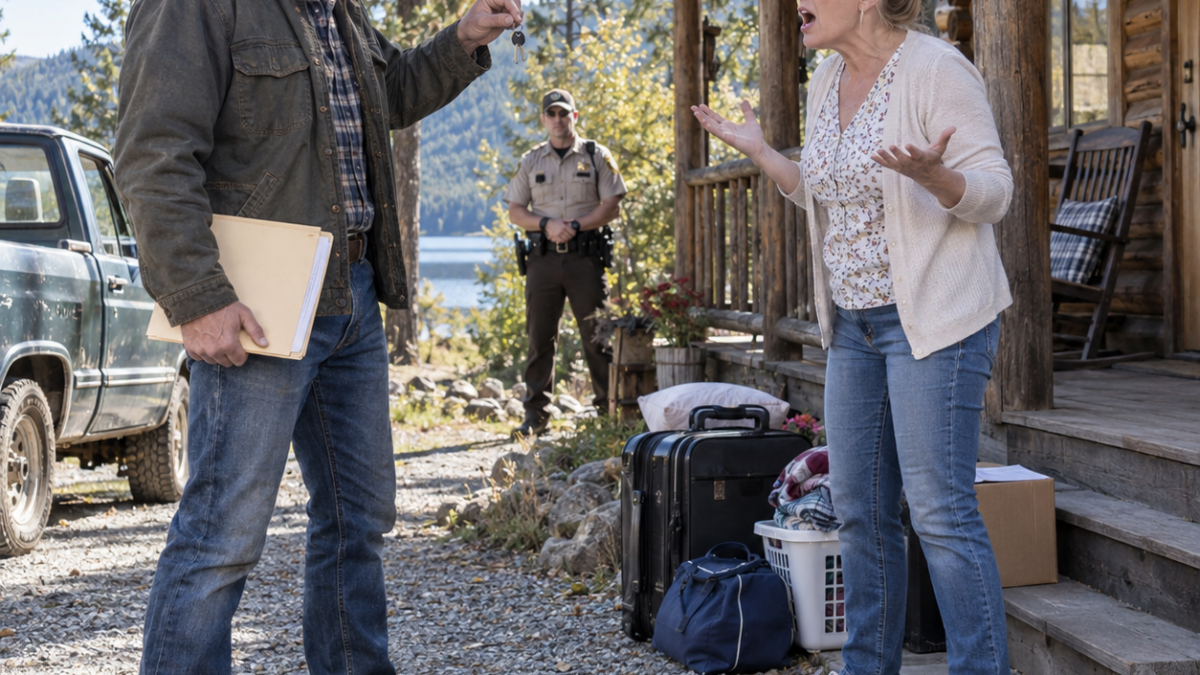
After ten years away, I drove twenty-two hours straight to the lake expecting to unlock my grandfather’s cabin, sleep beneath the same cedar rafters I remembered from childhood, and finally feel like I had come home—only to find a strange woman standing on my porch telling me I had ten seconds to leave before she had my truck towed. She called herself Karen Miller, president of an HOA that had not even existed when my family bought the land, and she calmly informed me that my cabin had been foreclosed for unpaid association dues and sold to her “fair and square.” The moment she produced a deed carrying her name, I knew this was no longer a trespassing argument, because somebody had built an entire legal paper trail designed to prove that my own family history had never belonged to me.
“You have exactly ten seconds.”
Karen stood at the top of the porch steps with a cordless phone in one hand and a coffee mug in the other.
Behind her was the front door my grandfather had hung in 1964.
Except it was painted pale blue now.
My mother had hated blue doors.
For some reason, that tiny detail bothered me almost as much as the woman standing in front of it.
“My name is Jack Riley,” I said. “This is the Riley cabin.”
Karen laughed.
Not nervously.
Confidently.
“Oh, that story.”
“What story?”
“The long-lost heir coming back after abandoning the property.”
I stared at her.
“I never abandoned anything.”
“You stopped paying HOA assessments.”
“I’ve never belonged to an HOA.”
Her expression changed from amused to condescending.
“Lakeside Serenity Estates annexed this parcel years ago. The dues accumulated. We filed a lien. Eventually the property went through foreclosure.”
She took a satisfied sip of coffee.
“I purchased it at auction.”
I looked past her.
There was a satellite dish attached to the roof.
Solar lights lined the porch.
Two ceramic cats sat where my grandmother used to keep pots of red geraniums.
Someone had removed the wooden swing my father built.
Ten years.
I had been away ten years.
Army assignments first.
Then overseas security work.
Training contracts.
Long stretches where coming home for more than a week simply wasn’t practical.
But every county tax bill had followed me.
Germany.
Virginia.
Kuwait.
Texas.
I had paid every one.
The cabin wasn’t forgotten property.
It was the one permanent thing in my life.
Karen pointed toward my truck.
“Time’s up.”
Then she pressed a button on her phone.
“I’m calling the sheriff.”
“Good.”
She blinked.
“Excuse me?”
“Call him.”
Her mouth tightened.
Twenty minutes later, Deputy Mark Evans pulled into the gravel drive.
He looked young enough that I wondered whether he had been in middle school the last time I spent a full summer at the lake.
Karen met him before he reached the porch.
“Officer, thank God.”
“Deputy.”
“What?”
“Deputy Evans.”
She waved away the correction.
“This man showed up claiming my home belongs to him. He refuses to leave.”
Evans looked at me.
“Sir?”
I handed him my driver’s license.
Then the folder I kept behind my truck seat.
Original deed copy.
Recent county tax receipt.
Insurance records.
A decades-old survey.
“My family has owned this property since 1922.”
Karen shoved her papers toward him.
“Foreclosure deed.”
Evans read both sets.
His forehead tightened.
Then he looked at me with the expression of someone about to deliver an answer he already hated.
“Mr. Riley, your paperwork looks legitimate.”
Karen started objecting.
He held up a hand.
“But she also has a recorded deed.”
“That deed is wrong.”
“Maybe.”
“It’s my cabin.”
“I understand.”
“No. You understand paper.”
My voice sharpened before I caught it.
I took a breath.
“Sorry.”
Evans nodded.
“I know your family name. My dad remembers your grandfather.”
That hurt more.
“Then you know.”
“I know history. I don’t adjudicate title.”
Karen folded her arms.
“Exactly.”
Evans ignored her.
“If there are competing recorded deeds, I can’t make a title decision standing in a driveway. You need civil court.”
“So she stays?”
“For tonight, yes.”
I looked at my cabin.
Then at the woods beyond Karen’s newly planted hedge.
“How much property does her deed claim?”
Evans unfolded the HOA plat.
“This lot.”
He pointed.
“Approximately half an acre.”
“And beyond that hedge?”
“HOA common ground, according to this.”
I almost smiled.
Because I knew something Karen didn’t.
That oak tree beyond the hedge had been inside my family’s original hundred-acre tract since before anyone named this development.
I opened my truck.
Pulled out my rucksack.
Then my tent.
Karen stared.
“What are you doing?”
I walked fifty feet past her hedge and dropped my gear beneath the old oak.
“If the system needs time to figure out who owns my cabin,” I said, driving the first tent stake into the ground, “I guess I’ll stay close enough to watch it happen.”
And when Karen screamed that I was now trespassing on HOA land too, I looked at the woods I had known since I was seven years old and realized there was only one question that mattered.
Who had taught the county to believe any of this belonged to her?
PART 2
That first night beneath the oak, I barely slept.
Not because camping bothered me.
I had spent enough nights sleeping on dirt, concrete, plywood, armored vehicles, and the floors of airports to consider a proper tent almost luxurious.
What kept me awake was the cabin.
I could see one upstairs window through the trees.
The curtains were new.
Karen paced behind them several times, phone pressed to her ear.
Every few minutes, the porch light snapped on.
Then off.
Once, she stepped outside and stared toward my tent.
I waved.
She went back inside.
Petty?
Probably.
Satisfying?
Absolutely.
But beneath that satisfaction was something uglier.
I felt violated.
The cabin wasn’t impressive.
Two bedrooms.
One bathroom.
Stone fireplace.
A porch facing Lake Mercer.
The original structure was built by my great-grandfather in 1922, expanded by my grandfather after he came home from Korea, and updated by my father in the eighties.
Every room held something.
Not valuable things.
Meaningful things.
My grandmother had marked our heights in pencil inside the pantry door.
Dad had carved his initials into one porch beam when he was twelve and got whipped for it.
My mother kept an old yellow mixing bowl in the kitchen cabinet because she claimed cornbread tasted wrong in anything else.
After my parents died, I left the furniture mostly untouched.
Not like a museum.
Like a promise.
Someday I would come home.
Now a stranger was sleeping in my grandfather’s bedroom because some document said she owned the place.
At 5:12 in the morning, I stopped trying to sleep.
I boiled coffee on a small camp stove.
Opened my notebook.
And wrote:
**OBJECTIVE ONE: Establish actual chain of title.**
Below it:
**OBJECTIVE TWO: Determine how HOA claimed jurisdiction.**
Then:
**OBJECTIVE THREE: Get inside legally.**
That last word mattered.
Legally.
I had enough anger to kick my own door in.
Enough training to do worse.
Neither would get me my home back.
Paper had taken it.
Paper was going to return it.
The county courthouse opened at eight.
I was waiting at the records counter at 8:01.
The clerk looked up.
She was probably seventy.
Silver hair.
Reading glasses hanging from a chain.
“Can I help you?”
“I need everything connected to parcel 4815-B.”
She stopped.
Then looked at my face.
“Riley?”
“Yes, ma’am.”
“Jack Riley?”
I stared.
“Martha Ellis?”
She smiled.
“You used to steal peppermints from my desk when your mother brought you in here.”
“I was eight.”
“You were a criminal.”
For the first time since arriving, I felt something soften.
“You remember Dad?”
“Everybody remembers Tom Riley.”
She reached across the counter.
“Good to see you home, son.”
Home.
That word nearly broke me.
Instead I said, “Somebody stole the cabin.”
Martha’s smile disappeared.
“Who?”
“Karen Miller.”
Her expression told me that name carried history.
“Oh.”
“That bad?”
She removed her glasses.
“Tell me.”
I did.
She listened.
No interruption.
When I finished, she looked toward the back records room.
“Give me a few minutes.”
The next six hours changed everything.
First came my deed.
No surprise.
My great-grandfather purchased the original hundred-acre tract in 1922.
My grandfather inherited.
My father inherited.
Then me.
Clean chain.
No sale.
No gift.
No transfer.
No mortgage foreclosure.
No tax sale.
My property taxes were current.
Every year.
Some payments had come from overseas.
Others through escrow accounts.
But every year was there.
Then Martha pulled the subdivision records.
Lakeside Serenity Estates had been created eight years earlier after a developer purchased land north and west of the remaining Riley tract.
The subdivision surrounded part of my property but did not include it.
At least originally.
Then we found a document dated six years earlier.
**VOLUNTARY ANNEXATION AGREEMENT.**
Owner:
Jack Riley.
Parcel:
4815-B.
I stared at the signature.
“That isn’t mine.”
Martha leaned closer.
“Not even close.”
My signature is ugly.
Always has been.
Sharp J.
Long tail on the y.
The signature on that document looked like someone trying to imitate cursive from memory.
Worse, the owner address listed beneath it was a post office box in Millhaven.
I had never lived in Millhaven.
Never had a PO box there.
Never received mail there.
Martha checked the accompanying paperwork.
There was no valid notarial acknowledgment from me.
Instead, a board certification referenced County Ordinance 7.4-C.
“What is that?”
Martha pulled the ordinance.
It was old.
Originally written to help planned communities deal with genuinely abandoned parcels that became health or safety problems during rapid development.
Under narrow circumstances, adjacent property could be subjected to certain maintenance agreements after notice, findings of blight, hearings, and court review.
It did not simply allow an HOA to take title.
Somebody had treated it as though it did.
I read the board certification.
**Property abandoned.**
**Owner unreachable.**
**Severe blight.**
**Public safety concern.**
I almost laughed.
The cabin had been locked.
Roof intact.
Grass cut twice a year by a local caretaker I paid.
Taxes current.
Insurance current.
Utilities winterized.
They had manufactured abandonment.
Then used the fake annexation to create HOA dues.
Notices went to the Millhaven PO box.
Unpaid dues became fines.
Fines became attorney charges.
Then a lien.
Then foreclosure.
The foreclosure purchaser:
Lakeside Property Holdings LLC.
I asked Martha, “Who owns that?”
She typed.
Then stopped.
Registered agent:
Karen Miller.
My hands went cold.
“How much did they pay?”
Martha found the recorded sale.
$18,700.
For a cabin and surrounding acreage worth several hundred thousand dollars.
The alleged HOA debt was just under $14,000.
I stared at the screen.
Martha whispered, “Oh, Jack.”
I didn’t answer.
Because something inside me had become very still.
It was one thing to imagine Karen bought at an auction in good faith.
That could have been a mess.
But explainable.
This wasn’t.
The HOA created the debt.
The HOA initiated foreclosure.
A company connected to its president bought the property.
Then Karen transferred the deed from that company to herself.
Months later.
My cabin had traveled through paper from me to her without me signing a single legitimate document.
I ordered certified copies of everything.
Martha stamped each one.
“Where are you going?”
“Lawyer.”
“Who?”
“Don’t know yet.”
“I do.”
She wrote a name.
**SARAH JENKINS, ATTORNEY AT LAW.**
“She used to be Army JAG.”
I looked at Martha.
“You planned that.”
“I’m seventy-two. Planning is all I have left.”
Sarah Jenkins’s office occupied the second floor above an insurance agency on Main Street.
She was younger than I expected.
Late thirties.
Dark hair.
Gray suit.
No nonsense.
She looked through my documents in silence.
Then returned to the annexation agreement.
“This signature isn’t yours?”
“No.”
“Can you prove where you were when it was supposedly executed?”
I checked the date.
“Afghanistan.”
Her eyes lifted.
“Military orders?”
“Contract after active service by then. But yes, travel records. Employment records. Passport.”
She kept reading.
“Did you ever receive HOA notices?”
“No.”
“Never?”
“Not one.”
“Did you authorize anybody to accept them?”
“No.”
“Did you ever consent to annexation?”
“No.”
“Did you know the HOA existed?”
“I knew houses were being built near the lake. That’s it.”
She sat back.
“Okay.”
“How bad?”
“For Karen?”
“Yes.”
Sarah smiled.
“Potentially catastrophic.”
Good.
I wanted catastrophic.
She saw it.
“Don’t enjoy that yet.”
I said nothing.
“We have two separate issues,” she continued. “Title and conduct.”
“Explain.”
“First, we get your property back. That is the urgent part.”
“Yes.”
“Second, we determine whether these documents resulted from fraud, forgery, misrepresentation, improper foreclosure procedure, conflicts of interest, or some combination.”
“All of the above?”
“Maybe.”
I hated maybe.
Lawyers love it.
“What happens today?”
“We file.”
“Today?”
“Yes.”
Emergency request to prevent sale, transfer, damage, leasing, or further encumbrance.
Lis pendens against title.
Complaint seeking declaratory judgment and quiet title.
Fraud-related claims where supportable.
Then discovery.
“Can I evict Karen?”
“Not today.”
My jaw tightened.
“She’s in my house.”
“The recorded deed currently says otherwise.”
“It’s fraudulent.”
“We intend to prove that.”
“You’ve seen the documents.”
“A judge needs to see them.”
I leaned back.
This was the part military people often hate about civilian law.
You can know something and still be required to wait while procedure catches up.
Sarah folded her hands.
“Jack.”
“What?”
“You are going to win this by being boring.”
I stared.
“Boring?”
“Painfully boring.”
“That sounds awful.”
“No threats. No angry confrontations. No cutting utilities. No changing locks. No standing at her driveway making comments.”
“I’m living in a tent.”
“Yes.”
“That’s not boring.”
“It will be if you sit quietly.”
I gave her a look.
She smiled.
“Can you do that?”
“I spent six hours in a courthouse records room.”
“Excellent. Weaponize patience.”
By four that afternoon, we had filed.
The judge reviewed the emergency request the next morning.
He didn’t give me possession yet.
But he issued an interim order prohibiting Karen from selling, refinancing, leasing, transferring, destroying, or materially altering the disputed property pending hearing.
Sarah called at 10:17.
“Got it.”
“Everything?”
“Enough.”
“What does that mean?”
“She can keep occupying for now, but she cannot move the property anywhere legally or alter it.”
“When is she served?”
“Soon.”
I made coffee.
Sat in my camp chair.
Waited.
At 11:04, a black SUV pulled into the driveway.
A process server got out.
Large man.
Bald.
Gray beard.
He knocked.
Karen opened the door.
Even from fifty yards away, I could see her smile disappear when he handed over the documents.
She read the first page.
Then the second.
Then looked directly at me.
I raised my coffee mug.
I probably shouldn’t have.
But I did.
She came across the yard like a storm.
Stopped at the hedge.
“You.”
“Morning.”
“You filed a lawsuit.”
“Yes.”
“This is harassment.”
“No.”
“You have no claim.”
“I have one hundred four years of deeds.”
“I bought this property legally.”
“That’s what court is for.”
Her face turned red.
“You think sleeping in the woods makes you intimidating?”
“I’m sleeping under my grandfather’s oak.”
“This is HOA land.”
“We’ll be discussing that too.”
“What is that supposed to mean?”
I smiled.
“Read the complaint.”
She stood there.
For once, no answer.
Then she turned and marched back.
That afternoon, two women arrived at the cabin.
Karen’s board allies.
Cynthia Bell and Denise Parker.
I recognized them from a photo on the HOA website.
They stood on the porch pointing toward my tent.
I waved again.
Cynthia gave me a gesture that would not have passed architectural review.
The countersuit arrived the next morning.
Harassment.
Stalking.
Emotional distress.
Interference with peaceful enjoyment.
They asked the court to order me five hundred yards away.
Sarah called me laughing.
“This is my favorite paragraph.”
“What?”
“She alleges your silent sitting creates ‘a militaristic atmosphere of implied intimidation.’”
“That sounds impressive.”
“You own one folding chair.”
“It’s tactical.”
“Stop.”
The judge refused emergency relief against me.
I was camping in an area whose ownership was itself disputed.
I had made no threats.
Approached no one.
Blocked nothing.
But Sarah still warned me.
“Keep cameras running.”
“I have two.”
“Good.”
“If she approaches me?”
“Record.”
“If she threatens me?”
“Record.”
“If she apologizes?”
“Call me because hell has frozen.”
The HOA emergency meeting occurred three nights later.
A notice appeared on the subdivision bulletin board.
Karen planned to discuss the “Riley property litigation.”
I attended.
Sarah told me I could observe quietly if the meeting rules permitted homeowner attendance.
Technically, Karen argued I wasn’t a homeowner.
I sat anyway until asked to leave.
The clubhouse was small.
About thirty residents.
Karen stood behind a podium.
Cynthia and Denise beside her.
She started with victimhood.
“A dangerous individual has appeared in our community claiming rights to lawfully acquired property.”
Dangerous.
Interesting.
She never once mentioned my name.
She called me “the trespasser.”
Then:
“The association is under legal attack.”
That got attention.
A man in the front raised his hand.
Bald.
Blue polo.
“Karen, if he’s suing over your house, why is the association paying?”
Karen’s expression tightened.
“Because he is attacking the annexation procedure.”
“So?”
“The HOA conducted that procedure.”
“Did homeowners vote?”
“The board had authority.”
“Did we buy your house?”
Murmurs.
Karen looked toward the back.
Saw me.
Everything stopped.
Her face went white.
“You are not permitted here.”
I stood.
“My name is Jack Riley.”
Karen slammed the gavel.
“You are not recognized.”
I continued calmly.
“My family has owned 142 Lakeview Lane since 1922.”
People turned.
“I have never joined this HOA.”
“Security.”
“The annexation agreement used to claim my property contains a signature that is not mine.”
Whispers.
Karen shouted, “Remove him.”
I raised one hand.
“I’m leaving.”
Then I looked around.
“One question before I go.”
A teenage security guard had reached me.
He looked embarrassed.
I asked the room:
“Has anyone here reviewed an independent audit of your HOA finances?”
Silence.
“Jack.”
Karen’s voice cracked.
I walked out.
The question stayed behind.
That was the point.
The first person to visit my camp was Bill Henderson.
The man in the blue polo.
He came with his wife, Mary.
“Mind if we sit?”
I had one extra chair.
Mary sat.
Bill used a cooler.
They told me about the birdbath.
Gift from their daughter.
Ceramic.
Three feet high.
Karen cited it as unauthorized ornamentation.
Fine after fine.
Then attorney fees.
They paid nearly twenty-two hundred dollars to make the problem stop.
“She wears you down,” Mary said.
Bill looked toward my cabin.
“I thought maybe you were some crank.”
“Reasonable.”
“Then you asked about the audit.”
I nodded.
“We haven’t had one.”
“How long?”
“Not that I know.”
“Who’s treasurer?”
“Denise.”
“Karen’s friend?”
“Best friend.”
That night, another couple came.
Luke and Ashley Young.
They had repainted their house three times.
Not because it violated a specific color list.
Because Karen rejected shades after application.
“First was too warm.”
“Second too gray.”
“The third?”
Ashley laughed bitterly.
“Karen said it looked dirty in afternoon light.”
“How much?”
“Twelve thousand total.”
My camp became a confession booth.
Not because I asked people to complain.
They wanted to.
For years, everyone believed their Karen problem was personal.
Then they saw mine.
And each other’s.
Fear works best privately.
Sarah saw opportunity.
“Discovery.”
She issued requests.
HOA financials.
Minutes.
Bank statements.
Vendor contracts.
Lien records.
All foreclosures.
All annexations.
Correspondence regarding my parcel.
Karen’s lawyer objected.
Too broad.
Burdensome.
Harassing.
The judge narrowed some requests.
Enforced others.
Thirty days.
Boxes arrived.
A mess.
No indexing.
Duplicates.
Random receipts.
Unsorted bank statements.
Document dump.
Sarah looked exhausted.
I looked delighted.
“What is wrong with you?”
“This is easy.”
“Nothing about this is easy.”
“You’ve never reviewed Afghan contractor logistics.”
For seven days, I built spreadsheets.
Vendor.
Date.
Amount.
Authorization.
Invoice number.
Account.
Board reference.
Then patterns appeared.
**Serenity Landscaping LLC.**
Payments totaling more than fifty thousand dollars.
Owner:
Karen Miller.
No clear conflict disclosures.
No competitive bids in many cases.
Possible legitimate work.
Possible self-dealing.
We didn’t label it before proving it.
Then **Miller Construction.**
Fifteen thousand dollars.
**Emergency deck repair and improvement — 142 Lakeview Lane.**
My cabin.
I stared at the invoice.
Sarah came behind me.
“Problem?”
I pointed.
“That deck didn’t exist when I left.”
She read.
“Paid by HOA?”
“Yes.”
“Vendor ownership?”
We searched.
Registered to Ronald Miller.
Karen’s brother-in-law.
Sarah sat down.
“Interesting.”
“Criminal?”
“Don’t say that yet.”
“She used dues to improve the cabin she took.”
“It appears the HOA paid.”
“Sarah.”
“We verify.”
Always verify.
We obtained copies of canceled checks.
Karen’s signature on approval.
Denise’s secondary signature.
Then I installed a trail camera across the cove on land I had confirmed I could lawfully access.
Not aimed into private windows.
Only the exterior work area.
A construction crew began modifying the deck.
Despite the court order prohibiting material alterations.
That was beautiful.
Not because I wanted her to violate it.
Because Sarah had something clean to take to the judge.
Timestamped photographs.
Crew.
Demolition.
Materials.
Karen outside.
Court issued an order directing work to stop.
Karen blamed the contractor.
The contractor produced emails from Karen.
Another thread.
Another pull.
Then a handwriting examiner reviewed the annexation signature.
Opinion:
It was not mine.
My overseas employment records placed me on another continent near the execution date.
The supposed mailed notices went to an address never associated with me.
The appraisal supporting “blight” consisted largely of exterior photos from a road showing leaves, weathered siding, and an uncut section of grass.
No structural inspection.
No hearing notice received by me.
No personal service.
Then we discovered the foreclosure notice newspaper publication had misspelled my surname.
**Riely.**
Small detail.
Big consequence when combined with everything else.
Sarah assembled a referral package for prosecutors.
She was careful.
“We’re reporting facts.”
“I understand.”
“We are not demanding an arrest.”
“Understood.”
“We do not tell media she committed felonies before charges exist.”
“I know.”
“Good.”
She paused.
“Because you look like you want to buy a billboard.”
“I was thinking small billboard.”
“No.”
The District Attorney’s office accepted the referral.
That alone did not mean charges.
Investigators began reviewing financial records.
Separately, our civil case moved.
Then the news found us.
David Chen from Channel 8 arrived with a camera crew.
Sarah knew him professionally.
He sat across from me under the oak.
My tent behind me.
Cabin beyond.
Perfect optics.
Almost too perfect.
I worried it would look staged.
David said, “The truth already looks absurd. Don’t decorate it.”
I told him what I could.
Family ownership.
Tax payments.
Forged signature allegation.
Court orders.
No dramatic accusations.
Then he knocked on Karen’s door.
She should have said:
My attorney has advised me not to comment.
Instead, she opened the door and argued.
David asked about the fifteen-thousand-dollar deck payment.
Karen’s face changed.
“No comment.”
“Serenity Landscaping?”
“Legitimate vendor.”
“Owned by you?”
“That’s irrelevant.”
“Were homeowners informed?”
“Get off my property.”
That phrase became unfortunate.
Because the segment cut immediately from Karen saying **my property** to a close-up of my 1922 deed.
The story aired at six.
By sunrise, fourteen residents stood near my campsite.
Bill brought coffee.
Ashley brought breakfast sandwiches.
One man brought a folding table.
“What’s that for?”
“Petition.”
“For what?”
“Special HOA meeting.”
The rebellion had stopped whispering.
The board’s other members panicked.
Denise resigned first.
Cynthia two days later.
Karen called them cowards.
That email leaked instantly.
Sarah read it.
“She is spectacularly bad at retaining allies.”
The DA investigation deepened.
Karen’s attorney withdrew from aspects of the HOA representation due conflicts.
Our judge scheduled summary judgment on the title issue.
That became my entire world.
Because I did not care how much public humiliation Karen endured if I still slept under canvas.
I wanted the cabin.
The hearing came six weeks after I first arrived.
Gray morning.
Cold rain.
Karen sat with new counsel.
No floral dress.
Dark jacket.
Hair less controlled.
Sarah placed the chain of title before the judge.
Then the purported annexation.
Expert handwriting analysis.
Employment and travel records.
Notice defects.
Misapplied ordinance.
Conflict surrounding foreclosure purchase.
Sarah’s closing on the motion was simple.
“Your Honor, Mr. Riley did not sell this property.”
She held up the annexation.
“He did not sign this.”
Then the tax history.
“He did not abandon it.”
Then the foreclosure.
“And an organization in which the defendant held substantial decision-making authority created the alleged debt that ultimately placed the property into an entity connected to her.”
Karen’s attorney argued.
Procedural reliance.
Good-faith purchase.
Apparent authority.
Presumption of recorded documents.
Need for trial.
The judge asked questions.
Hard ones.
Especially about notice.
Especially about the forged signature.
Then he recessed.
Forty-three minutes.
I counted every one.
When we returned, I stood.
The judge looked down at his order.
“The court finds no genuine dispute as to several material elements of title.”
My pulse hammered.
He described the chain.
The invalid annexation.
Defective process.
Then:
“The subsequent lien and foreclosure cannot convey title the association did not lawfully obtain authority to burden in the manner asserted here.”
Sarah touched my sleeve.
“Accordingly, plaintiff’s motion for partial summary judgment as to title is granted.”
I stopped breathing.
“Title to parcel 4815-B shall be restored to Jack Riley subject to entry of final corrective instruments.”
My knees weakened.
Not dramatically.
Just enough that I gripped the table.
The cabin.
Mine.
Again.
Karen stood.
“This is insane.”
Her lawyer grabbed her arm.
She kept going.
“I paid for improvements.”
The judge stared at her.
“Sit down.”
“I bought that property.”
“Ms. Miller.”
“This is theft!”
The irony almost physically hurt.
The judge’s voice dropped.
“One more interruption and we will discuss contempt.”
Karen sat.
The court then addressed possession.
Her attorney requested time to arrange removal of personal property.
Sarah did not object to a short, orderly period.
I looked at her.
She whispered, “Do you want chaos or your house?”
I hated wisdom.
The judge issued an expedited writ of possession effective after a short compliance period.
Not weeks.
Not months.
But not a theatrical immediate street eviction either.
Karen had until noon the following day to vacate voluntarily before sheriff enforcement.
Twenty-four hours.
That was enough.
I did not sleep in the tent that night.
Not really.
I lay awake listening to movement inside the cabin.
Boxes.
Doors.
Something heavy dragging.
Once Karen screamed at someone over the phone.
At dawn, I packed the tent.
Slowly.
Folded it.
Rolled the sleeping bag.
Put away the stove.
Fifty-three nights beneath that oak.
I touched the trunk.
“Thanks.”
Then loaded everything into my truck.
At 11:43, I drove down the gravel drive.
Not to the edge.
All the way.
Deputy Evans waited beside his cruiser.
Same young deputy.
Different day.
He smiled.
“Mr. Riley.”
“Deputy.”
“Looks like court figured it out.”
“Eventually.”
He looked embarrassed.
“About that first day…”
“You followed the record you had.”
“I still felt like hell sending you away.”
“You didn’t create the bad deed.”
“No.”
He nodded.
“Still.”
Neighbors had gathered.
Not on my property.
Along the road.
Hendersons.
Youngs.
Others.
No cheering.
No signs.
Just witnesses.
At noon, Evans knocked.
“Karen Miller. Sheriff’s Office.”
Noise inside.
“Court deadline has expired. Please open the door.”
A minute later, it opened.
Karen stood there holding a box of ceramic cats.
I remembered those cats from my first day.
They looked even worse up close.
“You can’t do this.”
Evans held the order.
“Ma’am, the court has restored possession to Mr. Riley.”
“My appeal—”
“Your attorney can pursue whatever appellate rights exist. This order is enforceable now unless stayed.”
“It’s my home.”
I felt something twist inside me.
Because despite everything, she believed that.
Maybe not legally.
Emotionally.
For years she had slept there.
Changed walls.
Built decks.
Arranged furniture.
Told herself a story often enough that the stolen thing became home.
Evans continued.
“You need to leave voluntarily. If necessary, we’ll enforce the writ.”
Karen looked past him.
At me.
“You.”
I said nothing.
“You think you won?”
Still nothing.
“I improved this dump.”
My jaw tightened.
“This dump belonged to my family.”
“Your family abandoned it.”
“No.”
“You disappeared.”
“I served.”
“You left it empty.”
“I paid someone to maintain it.”
“No one lived here!”
“That didn’t make it yours.”
She stared at me.
Something finally gave way in her face.
Not remorse.
Understanding.
The system she had manipulated was no longer protecting her.
Her clipboard kingdom had ended at a real court order.
She stepped onto the porch.
Then did something unnecessary.
She dropped the box.
Ceramic shattered across the boards.
Evans sighed.
“Ma’am.”
Karen grabbed her suitcase.
Walked toward her sedan.
Neighbors watched.
She looked at none of them.
At her car, she turned.
“This isn’t over.”
I answered for the first time.
“You’re right.”
She froze.
“The title case is over.”
I looked directly at her.
“The financial investigation isn’t.”
Her face drained.
Then she got in the car.
Drove away.
Dust followed her to the road.
Nobody applauded.
Bill Henderson simply said, “Welcome home, Jack.”
That nearly broke me.
I walked up the steps.
Evans handed me the possession paperwork.
Then the key Karen surrendered.
I didn’t need it.
She had changed the locks.
But it felt symbolic anyway.
I opened the door.
Potpourri.
That was the first thing.
Aggressive cinnamon and fake pine.
Not cedar.
Not woodsmoke.
Not the cabin.
The living room looked wrong.
White carpet.
Gold-framed prints.
Glass tables.
A massive television above my grandfather’s stone fireplace.
I walked slowly.
Touched the stones.
Same stones.
Same mortar lines.
One chipped corner where I crashed a toy truck at six years old.
Still there.
Kitchen.
Cabinets painted cream.
My mother’s yellow bowl gone.
Pantry door replaced.
I opened it.
No height marks.
My stomach dropped.
That hurt worse than the deed.
Those pencil lines were gone.
Jack — 8.
Danny — 6.
Jack — 11.
Dad had written dates.
Mom added notes.
All removed with one door.
I stood there.
Sarah Jenkins had come in behind me.
She remained quiet.
“I should be happy.”
“You are.”
“It doesn’t feel like it.”
“You got the structure back.”
She looked around.
“Home takes longer.”
That sentence became my next mission.
But a different kind.
Not war.
Restoration.
The community helped.
The first Saturday, twelve people arrived.
Bill brought a dumpster.
Mary brought cleaning supplies.
Ashley brought food.
Luke brought tools.
Deputy Evans came off-duty with work gloves.
Even Martha from the courthouse arrived carrying a pie.
“What are you doing here?”
“Supervising.”
“You’re seventy-two.”
“Exactly.”
We removed carpet.
Underneath:
Original hardwood.
Scratched.
But beautiful.
My grandfather’s floor.
We pulled artificial wall panels.
Found cedar.
Karen’s new deck?
That required more care.
The court had already ordered no destruction pending financial investigation because HOA funds might have paid for it.
Once investigators documented everything, a contractor assessed it.
Parts were poorly attached.
Some railings violated code.
Bill stood beside me.
“Sledgehammer?”
“Not yet.”
“You’re no fun.”
Eventually we dismantled much of it legally and reused salvageable material.
I rebuilt a simpler redwood deck based on photographs of my grandfather’s.
No revenge swing.
No dramatic demolition party.
Just work.
Board by board.
The criminal investigation took months.
That mattered.
Real cases do.
The District Attorney did not immediately declare Karen guilty because Channel 8 aired a bad interview.
Investigators subpoenaed bank records.
Reviewed invoices.
Interviewed board members.
Examined annexation filings.
Traced foreclosure transactions.
Compared vendor work with payments.
Some things that looked suspicious turned out to have explanations.
Others did not.
Serenity Landscaping had performed actual landscaping.
But Karen’s ownership had not been properly disclosed, and pricing appeared inflated.
Miller Construction had done real work too.
But HOA funds paying for improvements to Karen’s claimed private residence created a serious problem.
The forgery question was worse.
Investigators eventually identified who had prepared several filing documents.
A former management employee admitted Karen had provided owner information and instructed staff to process the annexation despite incomplete consent documentation.
Whether Karen physically forged my signature could not be conclusively established.
That changed the eventual charges.
I was disappointed at first.
Sarah corrected me.
“You want accurate charges.”
“I want accountability.”
“Then want accurate charges.”
She was right.
Prosecutors eventually filed charges related to fraudulent filings, misuse of association funds, and theft-related conduct supported by the records.
Not every allegation stuck.
Not every count survived.
Karen fought for months.
Then negotiated a plea.
She pleaded guilty to reduced felony and misdemeanor counts involving misuse of funds and fraudulent property records.
Sentence:
A period of incarceration shorter than the television commentators wanted.
Several years of supervised probation.
Restitution.
Restrictions involving fiduciary roles.
Civil judgments remained separate.
No twenty-year prison fantasy.
No dramatic seizure of every possession she owned.
Real punishment.
Enough.
The HOA pursued recovery of improperly spent funds.
Insurance covered some losses.
Not intentional conduct.
Karen sold the house she actually owned elsewhere in the subdivision to meet obligations and legal costs.
I never learned whether she was financially ruined.
I stopped caring.
That surprised me.
At the beginning, I wanted her destroyed.
Sitting beneath that oak, watching her drink coffee inside my cabin, I had imagined every possible humiliation.
By the time sentencing happened, I mostly wanted to finish my pantry door.
I found the original door in the crawlspace.
Karen had not thrown it away.
Why?
No idea.
Maybe it was too solid.
Maybe she planned to reuse it.
Maybe someone moved it there before her.
I dragged it into daylight.
Dusty.
Warped slightly.
But there they were.
Pencil lines.
My height.
Danny’s.
Dad’s handwriting.
Mom’s note:
**Jack finally passed me — June 12.**
I sat on the floor.
Held the door against my knees.
And cried.
Not heroic tears.
Not cinematic.
Ugly.
Shoulders shaking.
Because suddenly ten years disappeared.
Mom in the kitchen.
Dad laughing.
Danny stealing cookies.
Grandpa outside splitting wood.
Everything Karen could never steal because she didn’t know it existed.
I rehung the pantry door.
Crooked at first.
Fixed it.
Then sat at the kitchen table and looked at it for an hour.
That was the day the cabin became home again.
The HOA changed too.
Karen’s board was replaced.
Bill Henderson became interim president only after several people pushed him.
He hated it.
That made him perfect.
Mary became treasurer.
An actual accountant named Rebecca Shaw joined the board.
Their first six months were boring.
Audits.
Records policies.
Conflict-of-interest forms.
Fine procedures.
Appeal rights.
Vendor bidding.
Transparent budgets.
They did not “shred every rule.”
That would have been stupid.
Shared communities need rules.
Road maintenance.
Drainage.
Common areas.
Lake access.
Noise.
The difference was specificity and restraint.
The birdbath came back.
Bill installed it exactly where the original had stood.
Bigger.
Blue ceramic.
Mary hated it.
“It’s ugly.”
“It’s freedom.”
“It’s ugly freedom.”
The Young family repainted their house one final time.
They chose soft green.
Approved on the first application because the new architectural committee had an actual color list.
Their daughter’s playset remained yellow.
No one died.
People stopped calling me “the guy in the tent.”
Mostly.
At the first community barbecue after everything settled, a teenager asked:
“Mr. Riley, is it true you camped in Karen’s yard for two months?”
“Not her yard.”
Bill laughed from across the table.
“There he goes.”
I pointed.
“Property boundaries matter.”
The teenager said, “My dad says you stared at her house every morning.”
“I drank coffee.”
“Facing her house.”
“The lake was behind it.”
He looked unconvinced.
Legends are inaccurate.
Martha retired the following year.
I built her a small bookshelf from reclaimed redwood removed from Karen’s deck.
When I delivered it, she ran her hand along the wood.
“Poetic.”
“Don’t start.”
“She paid HOA money for this.”
“Allegedly part of the disputed expenditure.”
Martha smiled.
“You’ve been around lawyers too long.”
I placed the shelf in her living room.
She put family photographs on it.
That felt better than smashing the material into a dumpster.
Sarah Jenkins became a friend.
Not the romantic kind.
People kept making that joke because apparently a male veteran and female attorney cannot exchange documents without a Hallmark subplot.
Sarah was married to a pediatrician named Angela.
When I finally met Angela, she shook my hand and said:
“So you’re the cabin.”
“I’m Jack.”
“In our house, you’re the cabin.”
Fair.
They visited often.
Sarah brought legal updates for months.
Eventually she stopped bringing folders.
That was another sign life was returning.
One autumn evening, the three of us sat on the new deck.
Lake orange under sunset.
Angela asked, “What are you going to do with a hundred acres?”
“Most of it stays woods.”
“Development offers?”
“Three.”
Sarah looked at me.
“You didn’t tell me.”
“You’re my lawyer, not my mother.”
“I’m neither anymore.”
“Still terrifying.”
The largest offer came from another developer.
More money than I expected.
Enough that I could have lived comfortably forever.
But the plan showed thirty-four lake houses across the Riley tract.
Roads where I used to hike.
Docks along coves where Dad taught me to fish.
I said no.
Not because development is evil.
It isn’t.
Lakeside Serenity housed families.
Good families.
Karen had not made them bad.
But some land only gets sold once.
Money can be earned other ways.
Grandfather’s oak could not be regrown in my lifetime.
I placed much of the forest into a conservation easement while retaining family use and limited management rights.
The decision shocked Bill.
“You spend your entire fight proving you own land, then restrict what you can do with it?”
“Yes.”
“Why?”
“Because ownership isn’t only permission.”
He frowned.
“What is it?”
“Responsibility.”
He stared.
“You’ve become unbearable.”
“Years of legal education.”
The conservation agreement also ensured the HOA could never accidentally “annex” the woods again through creative paperwork.
That part made me smile.
Years passed.
The cabin aged.
So did I.
My Ranger knees began complaining about stairs that hadn’t bothered me before.
I repaired the dock.
Replaced the roof.
Restored the old stone chimney.
Found Mom’s yellow bowl in a box from my storage unit.
I placed it back in the same cabinet.
First cornbread I made was terrible.
Turns out the bowl was not the secret.
Mom had been.
Still ate it.
Every October, former members of my unit came to the cabin.
At first three.
Then five.
Then spouses.
Children.
One year twenty-two people filled the property.
Tents beneath the trees.
Food on the deck.
Stories around the fire.
Nobody asked permission from an HOA president.
They asked me.
I always said yes.
The funniest part?
The new HOA eventually requested permission to hold a small lakeside cleanup event along part of my shoreline.
Bill came personally.
Folder in hand.
“Jack.”
“What?”
“I have a proposal.”
“No.”
“I haven’t said it.”
“Practice.”
He showed me plans.
Volunteers.
Insurance.
Hours.
Access route.
Trash removal.
Written acknowledgement of private property.
I read it.
“Approved.”
Bill looked stunned.
“That easy?”
“You asked.”
He stared at me.
“That’s the secret?”
“Yes.”
“All Karen had to do was ask?”
“She could’ve saved herself a lot of trouble.”
The cleanup happened.
Forty residents.
Children collecting plastic.
Adults pulling old fishing line.
I grilled burgers.
For one afternoon, the boundary between Riley land and Lakeside Serenity mattered legally but not socially.
That was healthy.
Boundaries are not supposed to prevent relationships.
They make respectful relationships possible.
Deputy Evans became Sheriff Evans eventually.
At his campaign barbecue, he told the cabin story from his perspective.
“I arrive and find Jack holding an eighty-year-old deed and Karen holding a newer deed.”
He looked at me.
“And both of them expect a twenty-six-year-old deputy to solve property law before dinner.”
Everyone laughed.
“I thought he hated me.”
“I did.”
More laughter.
“For twelve hours.”
Evans pointed.
“He camped fifty feet from the cabin out of pure spite.”
“Fifty-one.”
“See?”
He later became one of my closest friends.
The first night had not been his failure.
It was a lesson about records.
Law enforcement often acts on what systems show.
If the system has been poisoned with bad paperwork, even good people can enforce the wrong reality temporarily.
That realization changed how Evans handled property disputes as sheriff.
“Verify,” he liked to say.
“Then verify what you verified.”
Martha would have approved.
Karen eventually completed her sentence and probation.
I heard about it through Sarah.
Not because I asked.
One afternoon she called.
“Karen wrote me.”
“What does she want?”
“To know whether you would accept a letter.”
I went quiet.
“Why?”
“She didn’t say.”
“Do I have to?”
“No.”
I almost declined.
Then remembered the panic I felt when my life was being decided through documents I never received.
“Send it.”
The letter arrived three days later.
No return address.
Handwritten.
Jack,
I have started this letter more times than I care to admit.
There are things I still disagree with about what happened, and there are things I told myself for years because admitting the truth was harder.
I convinced myself the cabin was abandoned because I wanted the property.
I convinced myself you had forfeited it because that made taking it feel less like taking.
I treated technical procedures as if they could turn something wrong into something right.
They did not.
I am sorry for what happened to your family home.
I am especially sorry that I used the association to make my decisions look like community decisions.
I do not expect forgiveness.
Karen.
I sat at the kitchen table.
Read it twice.
Then looked at the pantry door.
The pencil marks.
The fireplace.
The lake beyond the window.
I did not suddenly forgive everything.
There were too many people hurt.
Too much money.
Too much fear.
But the letter mattered.
Accountability without recognition can feel incomplete.
Recognition had finally arrived.
I wrote one sentence back.
**I received your letter, and I appreciate that you wrote it.**
Nothing else.
No lecture.
No absolution.
No cruelty.
That was enough.
By then, Karen no longer occupied much space inside my head.
That was perhaps the most satisfying defeat of all.
There was a time when I woke thinking about her.
Ate breakfast thinking about her.
Reviewed documents thinking about her.
Fell asleep staring toward her silhouette in my stolen cabin.
Years later, entire months passed without remembering her name.
The cabin stopped being **the house Karen stole.**
It became the Riley cabin again.
Simple.
Exactly as it should have been.
Bill died fourteen years after the fight.
Heart attack.
Quick.
Mary held his memorial beside the community lake pavilion.
The blue birdbath sat near the entrance with flowers inside it.
His daughter had placed a small sign beside it.
**DAD’S FAVORITE VIOLATION.**
I laughed and cried.
Afterward, Mary asked if I would take the birdbath when she eventually moved.
“No.”
“Why?”
“It belongs there.”
“That’s what I told her.”
It remains there today.
At least as I write this.
The HOA bylaws now specifically permit reasonable birdbaths.
Bill would have considered that legislative immortality.
As I got older, I thought more about what would happen to the cabin after me.
My brother Danny had died years earlier.
No children.
I had no children.
The Riley line, at least through us, was thinning.
For a while, that bothered me.
I had fought so hard to reclaim the property.
What happens if there is no Riley to inherit it?
Then one summer, the answer walked up my driveway carrying a toolbox.
Her name was Emma Hayes.
Twenty-six.
Martha Ellis’s granddaughter.
Architectural preservation graduate student.
She was researching historic lake cabins.
“My grandma says yours matters.”
“Your grandma exaggerates.”
“She also says you’re difficult.”
“Accurate.”
Emma studied the cabin.
Its 1922 core.
1950s expansion.
Stonework.
Local timber.
Hand-built details.
She treated every scar like evidence.
When she saw the pantry door, she stopped.
“You kept that?”
“Of course.”
“You understand most people replace things like this.”
“Most people are wrong.”
She smiled.
Over the next two years, Emma helped me document the cabin’s history.
Photographs.
Oral histories.
Old plans.
Family records.
I showed her grandfather’s oak.
The original well.
Stone foundation.
She eventually proposed something I had not considered.
A preservation trust.
The cabin could remain private during my lifetime, then become part of a small nonprofit retreat and local-history center tied to the conserved woodland.
Not a museum full of velvet ropes.
A living place.
Veterans could stay there during short retreats.
Local students could learn restoration skills.
Families could access trails under controlled conditions.
The Riley cabin could keep being used rather than frozen.
“What would my grandfather think?”
Emma smiled.
“Did he like strangers?”
“No.”
“That complicates things.”
I laughed.
Then considered it.
For months.
Eventually, I created the trust.
I named it for my grandparents.
**Thomas and Eleanor Riley Lake Trust.**
The documents included one sentence I insisted upon:
**No homeowners association shall possess governing authority over trust property.**
Sarah laughed so hard when she read it that Angela came downstairs to check on her.
“You are petty beyond death,” Sarah said.
“Estate planning.”
“Petty estate planning.”
“Legally valid?”
She sighed.
“Yes.”
“Then leave it.”
The trust stayed.
On the twentieth anniversary of my return, Sheriff Evans came for coffee.
We sat on the deck.
He was gray now.
So was I.
The original tent was stored in the shed.
He asked:
“You ever think about that first night?”
“Sometimes.”
“If I’d thrown Karen out then, none of this happens.”
I shook my head.
“You couldn’t.”
“I know.”
“More importantly, maybe everything else never comes out.”
“The money.”
“The other families.”
“Board abuses.”
“Fraud.”
“Exactly.”
He stared across the lake.
“Strange.”
“What?”
“How the worst night of your life can open a door.”
“Don’t get inspirational.”
“I’m sheriff.”
“That does not qualify you.”
He laughed.
Then pointed toward the cabin.
“You were right, by the way.”
“About?”
“That land across Karen’s hedge.”
I smiled.
“Eventually the corrected plat restored all of it.”
“You knew.”
“I remembered where Grandpa’s fence used to be.”
Evans shook his head.
“Fifty-one feet.”
“Important foot.”
That extra foot had put my tent outside the parcel Karen’s fraudulent deed claimed.
It hadn’t actually made ownership simple.
But symbolically, it mattered.
One step beyond what she thought she controlled.
That became the story residents remembered.
Not the lawsuits.
Not the charges.
Jack Riley moved fifty-one feet and camped on his own land until the truth caught up.
I wish I could say I planned it with profound strategic genius.
Mostly I was angry and needed somewhere to sleep.
Life makes legends from practical decisions.
One evening, near the end of summer, I sat on the deck alone.
The same lake.
The same pine smell.
A loon called from somewhere across the water.
Inside, the stone fireplace held a low fire.
Mom’s bowl sat in the cabinet.
Dad’s chair by the hearth.
Grandpa’s oak spread enormous branches above the old campsite.
The cabin had survived a century.
Weather.
War.
Deaths.
Neglect.
Development.
Karen.
Me.
Someday it would have to survive without me.
For the first time, that thought felt peaceful.
I walked inside.
Stopped beside the pantry door.
My childhood marks ended at sixteen.
I had never added another.
So I took a pencil.
Stood against the wood.
Made a small line at my current height.
A little shorter than I used to be.
Age has a sense of humor.
Beside it I wrote:
**Jack — Home again.**
No date.
It didn’t need one.
Because that was the real ending.
Not Karen leaving in a cloud of driveway dust.
Not the judge returning the title.
Not the criminal case.
Not the money.
Not the news coverage.
Those things were consequences.
Necessary ones.
Satisfying ones.
But home was something quieter.
Home was opening a cabinet and finding the right bowl.
Hearing rain on the roof your grandfather built.
Knowing the tree outside your window had watched you grow.
Sitting on a deck built by people who once believed a property line was worth defending because the person on the other side was worth respecting.
Karen’s greatest mistake had been thinking my cabin was merely an asset.
A parcel number.
A structure.
Something abandoned because nobody was currently sleeping there.
She never understood that absence and abandonment are not the same thing.
I had been away.
The cabin had waited.
And after ten years, one forged signature, fifty-three nights beneath an oak tree, thousands of pages of records, a courtroom, an eviction order, and more anger than I ever wanted to carry, I finally returned to what had been mine all along.
Not because I was stronger than Karen.
Not because I had better threats.
Because eventually the truth outlasted the paperwork built to hide it.
I turned off the kitchen light.
Outside, moonlight spread across the lake.
The Riley cabin settled around me with familiar old creaks.
No potpourri.
No angry phone calls.
No HOA notices.
Just cedar.
Firewood.
Water.
Memory.
And the quiet, almost sacred certainty that when I woke the next morning, I would still be exactly where I belonged.
The next morning, I woke before sunrise.
For several seconds I didn’t know where I was.
That happens after you spend too many years sleeping in unfamiliar places.
Barracks.
Hotels.
Airports.
Contract housing.
Tents.
Your body wakes before your memory catches up.
Then I smelled cedar.
Heard the old refrigerator hum in the kitchen.
Felt the uneven floorboard beneath my left foot when I got out of bed.
Home.
I smiled.
Outside, mist covered the lake.
I made coffee and carried it onto the deck.
Grandfather’s oak stood beyond the lawn, the same oak that had sheltered my tent when Karen was sleeping inside my cabin.
I could still see the faint rectangle where the grass had grown differently beneath the tent.
For fifty-three nights, that little patch of ground had been my bedroom.
My office.
My observation post.
My reminder that proximity to something does not mean possession of it.
I thought about covering the spot with seed.
Instead, I left it alone.
Not as a monument to Karen.
As a reminder of patience.
At seven-thirty, a truck pulled into the driveway.
Emma Hayes stepped out carrying a cardboard tube and three coffees.
She had been helping me organize the cabin preservation trust.
“You’re early.”
“You’re old.”
“That is not how appointments work.”
She handed me coffee.
“I brought plans.”
We spread them across the kitchen table.
The trust would preserve most of the woodland permanently.
The cabin would remain mine for life.
Afterward, it would become a retreat primarily for veterans, first responders, and local families participating in preservation programs.
Nothing fancy.
No conference center.
No sprawling parking lot.
No banquet hall.
I had rejected all of that.
The cabin survived a hundred years because nobody tried turning it into something bigger than itself.
Emma understood.
“We’ll keep occupancy small,” she said.
“How small?”
“Eight overnight.”
“Six.”
“Jack.”
“Six.”
“The cabin sleeps eight.”
“It sleeps six comfortably.”
“You once fit twenty-two Rangers out here.”
“Half were in tents.”
She looked toward the old campsite.
“Fine. Six indoors.”
“Good.”
“You negotiate like somebody defending a hostage.”
“I learned from an HOA.”
She gave me a look.
Then pointed to the access plan.
“The existing driveway stays. No widening unless safety requires it.”
“Good.”
“Parking remains near the barn.”
“Good.”
“Lake access controlled.”
“Good.”
“And no homeowners association.”
I looked at her.
“Say it again.”
Emma sighed.
“The trust documents expressly prohibit annexation into any private homeowners association.”
“Beautiful.”
“You’re enjoying this too much.”
“Yes.”
The preservation work gave the cabin a future.
That changed the way I saw everything.
For years, I had thought my duty was protecting what had been handed to me.
Eventually I understood protection also means deciding what happens after you are no longer the person holding the keys.
My great-grandfather had built the original cabin.
My grandfather expanded it.
My father maintained it.
I fought to recover it.
None of us owned it forever.
We were temporary custodians of something that outlived us.
That idea might have terrified me when I was younger.
Now it felt peaceful.
The first veterans’ weekend happened the following October.
Six men and women came.
Different wars.
Different branches.
Different ages.
One Marine named Carlos had lost his left leg below the knee.
A Navy corpsman named Rebecca had not slept more than four hours at a time in years.
A young Army mechanic named Tyler barely spoke the first day.
Nobody was required to talk about service.
That was the rule.
We fished.
Cooked outside.
Split firewood.
Walked trails.
Sat near the lake.
At night, we built a fire beside the old oak.
Carlos stared at the cabin.
“You really came back and some HOA lady was living in there?”
“Yes.”
“And you camped right here?”
“Approximately.”
“For almost two months?”
“Fifty-three nights.”
He laughed.
“Man, I would’ve kicked the door in.”
“I considered it.”
“What stopped you?”
“Prison.”
Everyone laughed.
Then Rebecca asked, “Seriously.”
I looked toward the cabin.
“Because being right doesn’t give you permission to become stupid.”
The fire cracked.
“You can lose a good case with one bad decision.”
Tyler, who had barely spoken all weekend, nodded.
“That’s hard.”
“What?”
“Not doing anything.”
I understood him immediately.
People trained to act often struggle most with waiting.
Waiting for doctors.
Waiting for paperwork.
Waiting for investigations.
Waiting for appeals.
Waiting for the rest of the world to recognize something you already know.
“It was harder than fighting,” I admitted.
Tyler stared into the fire.
“My brother keeps telling me I need patience.”
“What are you waiting for?”
“VA claim.”
There it was.
Another paper war.
Different battlefield.
“Keep copies of everything,” I said.
Carlos groaned.
“Here comes Ranger Grandpa.”
“Dates. Names. Reference numbers.”
Rebecca laughed.
“He can’t help himself.”
“No.”
I pointed toward the cabin.
“Paper almost cost me that house.”
Then toward Tyler.
“Good paper helped me get it back.”
That weekend became the first of many.
The cabin changed again.
Not physically.
Meaning.
For most of my life, it had been where my family remembered itself.
Now strangers came carrying their own memories.
Some heavy.
Some painful.
Some funny.
People sat in Dad’s chair.
Used Mom’s yellow bowl.
Slept beneath Grandfather’s rafters.
They added nothing permanent to the walls.
That was another rule.
But they left pieces of themselves in the stories told around the fire.
Years later, I could still remember dozens.
The helicopter mechanic who had never told his wife about the crash he survived.
The combat medic who finally slept six uninterrupted hours beside the lake.
The sheriff’s deputy who arrived insisting he was “fine” and spent two days fishing without saying more than fifty words.
Sometimes healing looked disappointingly ordinary.
Coffee.
Woodsmoke.
Silence.
A place where nobody expected anything.
Karen had once called the cabin abandoned.
There was irony in watching it become one of the most quietly useful places I knew.
Lakeside Serenity changed too.
Not perfectly.
Never perfectly.
HOA meetings still became ridiculous sometimes.
One resident demanded a rule against wind chimes.
Another wanted to prohibit political signs entirely.
Someone complained that children riding bicycles lowered the neighborhood’s “luxury character.”
Bill Henderson’s successor, Rebecca Shaw, handled it all with a patience I admired.
Whenever debates became absurd, somebody eventually said:
“Do we really want another Karen situation?”
That ended many arguments.
I disliked the phrase at first.
It kept Karen alive inside the neighborhood.
Eventually it stopped meaning Karen Miller personally.
It became shorthand for unchecked authority.
No surprise rules.
No secret liens.
No undisclosed vendor relationships.
No enforcement designed to punish disagreement.
One afternoon, Rebecca called.
“We found something.”
Those words still had power over me.
“What?”
“Old storage box in the clubhouse.”
“What kind of box?”
“Karen’s files.”
I felt my stomach tighten.
“What’s in them?”
“Mostly garbage. Old notices. Printouts. Personal notes.”
“Destroy them if records policy allows.”
“There’s one folder marked Riley.”
I went quiet.
“Do you want it?”
Part of me didn’t.
That chapter was finished.
Then curiosity won.
“Bring it.”
Rebecca arrived that evening.
The folder was thick.
Karen’s handwriting covered sticky notes.
Property photographs.
Old tax-map copies.
My original barn caretaker’s invoices.
Printed satellite images.
HOA meeting notes.
Then I found something I had never seen.
An email from seven years before my return.
Karen to Denise Parker:
Riley parcel would complete the shoreline continuity. If we can bring it under association authority, it eventually becomes the most valuable lake asset we control.
Denise replied:
Can’t annex without owner consent.
Karen:
There are abandonment provisions. He hasn’t been here in years.
Denise:
Taxes are being paid.
Karen:
That does not mean maintained. We need to think strategically.
I stopped.
Rebecca watched me.
“You okay?”
“Yes.”
I kept reading.
Another email.
Karen discussing possible future HOA uses for my acreage.
Walking trail.
Kayak launch.
Premium event space.
Possible clubhouse expansion.
She had imagined my property absorbed into the neighborhood long before the foreclosure.
Not merely my cabin.
The land.
For years I had wondered whether Karen stumbled into opportunity once dues accumulated.
Now I knew.
She had wanted the land first.
Then found a mechanism she believed could deliver it.
That should have made me furious.
Instead it made everything smaller.
Karen’s great conspiracy had once governed my entire emotional world.
Now it was a folder on my kitchen table.
“She really planned it,” Rebecca said.
“Looks that way.”
“Want to give this to Sarah?”
I considered it.
The criminal and civil cases were long finished.
Statutes of limitation might make some things irrelevant.
No need to reopen wounds simply because new proof made old wrongdoing look uglier.
“I’ll let her review it.”
“Going after Karen again?”
“No.”
Rebecca looked surprised.
“Why not?”
“Because I already have the cabin.”
That answer felt good.
Sarah reviewed the files.
She confirmed some might have been useful years earlier.
Now?
Mostly historical.
We gave copies to the trust archive because they documented the property dispute.
The originals went back to the HOA under their records policy.
I kept one page.
Not the incriminating email.
A handwritten note Karen had apparently written to herself after my first court filing.
Why won’t he just leave?
Three words.
That question explained more about her than any prosecution memo.
Why won’t he just leave?
Because she had built her life around people leaving.
Leaving meetings.
Dropping appeals.
Paying fines.
Removing birdbaths.
Repainting houses.
Backing down.
Her authority worked because resistance became exhausting.
When I didn’t leave, the mechanism failed.
Years later, I showed that note to Tyler, the young veteran from our first retreat weekend.
He had eventually won his VA appeal.
He was married now.
Two children.
He volunteered at the cabin every autumn.
“You kept this?”
“Yes.”
“Why?”
“Reminder.”
“Of Karen?”
“No.”
“Then what?”
I handed him the note.
He read it.
Then smiled.
“Persistence.”
“Exactly.”
People often romanticize persistence.
They imagine fists clenched.
Heroic speeches.
Refusing to surrender under dramatic pressure.
Most persistence is uglier.
It is opening another envelope.
Making another call.
Showing up to another appointment.
Waiting another month.
Reading another page.
Going to sleep frustrated and waking up willing to continue.
That was how I got the cabin back.
Not by overpowering Karen.
By outlasting the version of reality she had manufactured.
At eighty, I finally stopped leading veterans’ weekends myself.
Emma took over program management.
Tyler coordinated volunteers.
Sheriff Evans handled safety planning.
I remained what Emma called “resident curmudgeon.”
My duties included drinking coffee, criticizing modern tools, and refusing to replace furniture younger people found uncomfortable.
Dad’s chair became a major point of conflict.
Emma said it should be professionally restored.
“No.”
“The springs are failing.”
“Adds character.”
“It injures people.”
“Builds character.”
Eventually she had the springs repaired without telling me.
I sat down.
Immediately knew.
“You touched my chair.”
She looked innocent.
“What?”
“It’s comfortable.”
“You’re welcome.”
“Treason.”
Age does something strange to property.
When you’re young, objects can feel permanent.
When you’re old, everything begins looking like something you’re borrowing.
I started labeling photographs.
Writing names on the back.
Recording stories.
Not because I expected people to care about every detail.
Because memory becomes fragile when only one person carries it.
The pantry door received special documentation.
Emma photographed each pencil mark.
Grandfather’s notes.
Dad’s.
Mine.
Then she asked:
“Can veterans who stay here add their names?”
“No.”
She looked disappointed.
“That door belongs to the family.”
Then I thought.
“Build another.”
“A second height door?”
“Not height.”
“What?”
“Just names.”
We mounted a plain pine board beside the mudroom.
Small plaque:
IF THIS PLACE GAVE YOU A GOOD DAY, LEAVE YOUR NAME.
No ranks.
No units.
No diagnoses.
No stories required.
Just names.
Within five years, the board was full.
Carlos.
Rebecca.
Tyler.
Marcus.
Helen.
Drew.
Kenny.
Lisa.
Hundreds eventually.
We added another board.
I sometimes stood reading them.
People I barely remembered.
Others I would never forget.
Every name represented somebody who had arrived carrying something and left, I hoped, slightly lighter.
That became the final answer to Karen’s old accusation.
Abandoned.
The cabin had never been abandoned.
It had simply been waiting for its next use.
My eighty-fifth birthday was held on the lawn.
I objected.
Nobody cared.
Nearly sixty people came.
Neighbors.
Veterans.
Former deputies.
Martha’s family.
Sarah and Angela.
Emma.
Tyler.
Children.
Grandchildren of people I once knew.
Someone brought a cake shaped like a deed.
Terrible taste.
Excellent frosting.
Sheriff Evans, retired by then, raised a glass.
“To Jack Riley.”
I groaned.
“No speeches.”
He ignored me.
“Who once moved exactly fifty-one feet to avoid being evicted from land he owned.”
Laughter.
“Who taught half this county to read deeds.”
More laughter.
“And who has spent twenty years pretending he hates people while creating a property trust specifically designed to invite them over.”
I pointed.
“This is why you’re no longer sheriff.”
Evans smiled.
Then became serious.
“Welcome home, Jack.”
Two words.
Same words Bill Henderson had said the day Karen left.
They still got me.
That night, after everyone was gone, I sat on the deck.
Eighty-five years old.
Blanket over my knees.
Lake black beneath a full moon.
I knew I was near the end of my time there.
Not necessarily dying tomorrow.
But age stops pretending infinity exists.
Emma sat beside me.
“You okay?”
“Yes.”
“Tired?”
“Always.”
She looked toward the cabin.
“Do you regret creating the trust?”
“No.”
“Really?”
“Ask me when I’m dead.”
“That seems inconvenient.”
We sat quietly.
Then she asked:
“What do you think your grandfather would say?”
“About strangers sleeping in his cabin?”
“Yes.”
“He’d complain.”
“Then?”
“Make coffee.”
She smiled.
“That sounds right.”
I looked at the windows.
Warm light.
Stone chimney.
Cedar siding.
The cabin Karen once occupied as proof of her victory.
The cabin I once sat fifty-one feet away from, wondering whether the law would ever catch up with the truth.
The cabin that now belonged to something larger than either of us.
“I spent years thinking I fought Karen because she stole my house,” I said.
Emma listened.
“But really?”
“She tried to decide the meaning of my absence.”
“What does that mean?”
“She saw nobody here and called it abandonment.”
I looked at the lake.
“But sometimes leaving is how you preserve something.”
Military service.
Work.
Distance.
Life.
I had left the cabin because life required it.
I paid taxes.
Maintained what I could.
Carried it in my mind.
Home doesn’t disappear because you aren’t physically standing inside it.
Emma said softly, “She didn’t understand that.”
“No.”
“Do you think she did eventually?”
I remembered Karen’s apology.
I convinced myself the cabin was abandoned because I wanted the property.
“Yes.”
“I think she did.”
That mattered.
Not enough to erase consequences.
Enough to make the story human.
The last time I visited Grandfather’s oak alone, autumn leaves covered the ground.
I walked slowly.
Cane.
Bad knee.
Stubborn pride.
The old campsite was impossible to identify now.
Grass had long since evened out.
I stood approximately where the tent had been.
Looked toward the cabin.
The view was the same.
Different deck.
Older trees.
More memories.
I imagined myself all those years earlier.
Rucksack beside me.
Coffee in hand.
Angry.
Certain.
Waiting.
If I could speak to that younger version of myself, I knew exactly what I would say.
Stay.
Not forever.
Just long enough.
Stay when you’re tired.
Stay when paperwork seems impossible.
Stay when people tell you the system has already decided.
Stay calm enough that anger doesn’t become your enemy.
Stay honest enough that winning doesn’t become your identity.
And when the door finally opens, walk home without carrying the person who locked you out inside your head.
I placed my hand against the oak.
Rough bark.
Solid.
“Good post.”
Wind moved through the branches.
That evening, I returned to the cabin.
Stopped beside the pantry door.
My final pencil mark still read:
Jack — Home again.
Below it, years earlier, Emma had added a tiny note in pencil without permission:
And stayed.
I had pretended to be furious.
Never erased it.
I ran my thumb over the words.
Then shut off the kitchen light.
Outside, the lake reflected the moon.
The cabin settled around me.
Old wood contracting in the cold.
A familiar creak in the hallway.
Wind against the chimney.
Sounds I had crossed oceans to hear again.
Karen had once believed possession was established by paperwork.
For a while, fraudulent paperwork even convinced the world she was right.
But documents can lie.
Titles can be corrupted.
Institutions can fail.
People can abuse systems.
What held in the end was something stronger.
Evidence.
Memory.
Neighbors willing to speak.
Officials willing to correct mistakes.
A community willing to admit what had been done in its name.
And one stubborn man willing to sleep under an oak until the truth had enough time to catch up.
The cabin was never my greatest victory.
Keeping it would have meant very little if I had spent the rest of my life guarding it from everyone.
The victory was opening it again.
Letting people in by choice.
Preserving the woods instead of developing them.
Putting names on a board.
Giving veterans a quiet place to breathe.
Leaving something useful behind.
That was what Karen never understood about ownership.
Real ownership is not the power to keep everyone out.
It is the responsibility to decide carefully when the door should open.
I walked into the bedroom.
Left the window cracked so I could hear the lake.
The same way Grandfather used to.
Before getting into bed, I looked once toward the old oak.
Its branches were black against the stars.
Somewhere beyond it stood the development Karen had once ruled.
Different board.
Different families.
Blue birdbath still there.
Kids riding bicycles.
Ordinary life.
Exactly what communities should become when nobody is trying to control every inch of them.
I lay down.
For once, no documents waited beside the bed.
No court date.
No certified letters.
No strategy.
Only quiet.
The kind I had wanted when I drove twenty-two hours home all those years earlier.
It had taken longer than expected.
Cost more than it should have.
Changed more people than I could have imagined.
But eventually, the fight became history.
The history became a lesson.
And the lesson became something peaceful enough that I no longer needed to tell myself I had won.
I was simply home.
And that was better.
[END OF STORY]








