PART 2: I Came Home After Ten Years and Found the HOA President Living in My Family Cabin—By Noon the Next Day, the Sheriff Was Evicting Her
PART 2
I slept fifty-one feet from my own front door that night.
I’ve slept in worse places.
Mountain ridgelines.
Temporary outposts.
Cold mud.
Buildings with half the roof missing.
Compared with those, a tent beneath an oak tree beside a lake should have felt comfortable.
It didn’t.
Because every time I opened my eyes, I could see the cabin.
My cabin.
Lit from inside by lamps I hadn’t chosen.
Curtains I didn’t recognize.
A silhouette moving behind the windows.
Karen.
The anger wasn’t explosive anymore.
It had become worse.
Cold.
Precise.
I lay there remembering summers with my grandfather.
He had called the cabin a cabin even though it was larger than most year-round houses.
Stone foundation.
Cedar exterior.
Wide porch.
Deep fireplace.
Built slowly over years.
My great-grandfather had acquired the land in the early 1920s.
My grandfather expanded the cabin after returning from Korea.
My father repaired the dock twice.
The Riley family wasn’t wealthy.
The cabin was the one thing that survived every generation.
It wasn’t an investment property.
It wasn’t an asset we flipped.
It was where our family gathered.
Christmas sometimes.
Summers always.
Funerals.
Engagements.
Birthdays.
Silence when somebody needed it.
When my father died, the deed passed to me.
I was overseas when the estate finished probate.
I paid property taxes automatically.
Insurance automatically.
A local caretaker checked the place occasionally for the first few years.
Then he died.
I had intended to come back sooner.
But one contract became another.
Afghanistan.
Eastern Europe.
Africa.
Then security consulting in Virginia.
Ten years vanished.
I told myself the cabin would wait.
It had waited almost a century.
I never imagined someone would manufacture enough paperwork to steal it.
At three in the morning, a porch light clicked on.
Karen stepped outside.
She could see my tent through the trees.
For almost a minute, neither of us moved.
Then she shouted:
“You can’t stay there forever!”
I stayed inside the tent.
“Go to sleep, Karen.”
“This is harassment!”
“I’m camping.”
“On HOA land!”
I unzipped the tent enough to look at her.
“You sure?”
She went silent.
“Because you’ve been wrong once today already.”
She slammed the door.
That was the first time I felt something important.
Not victory.
Doubt.
Hers.
At sunrise, I made coffee on a small stove.
The smell of pine mixed with burnt coffee and lake mist.
I sat in the camp chair and built a plan.
First objective:
Title.
Not Karen.
Not revenge.
Not HOA.
Title.
If she held a deed, I needed to understand exactly how it entered the county record.
I drove into town shortly after eight.
The county courthouse hadn’t changed much since I was young.
Old brick.
Wide steps.
Flags outside.
Records office in the basement.
A woman behind the desk looked up when I gave my name.
“Riley?”
“Yes, ma’am.”
She stared at me for another second.
“Jack Riley?”
I nodded.
She removed her glasses.
“Lord.”
I waited.
“You’re Frank Riley’s boy.”
“My father, yes.”
“Martha Bennett.”
Then I remembered.
She’d worked in the tax office when I was a teenager.
My father used to complain that Martha knew everyone’s business before they did.
“You look like him,” she said.
“I’ve been told.”
“Thought you were still overseas.”
“Came home yesterday.”
Her smile faded.
“Cabin?”
That was fast.
“You heard?”
“Small town.”
I leaned on the counter.
“I need everything.”
She looked over her glasses.
“How bad?”
“Somebody has a deed to my house.”
Martha’s face changed completely.
“Sit down.”
For the next six hours, she helped me reconstruct nearly a century.
Original deed.
1922.
Transfer to my grandfather.
Then my father.
Then me.
Probate.
Tax ID:
4815-B.
Every county tax payment.
Current.
No tax foreclosure.
No sale by the family.
No mortgage foreclosure.
Then we reached six years earlier.
A document appeared.
**VOLUNTARY ANNEXATION AGREEMENT**
I read it once.
Then again.
The document stated that I, Jack Riley, voluntarily agreed to annex Parcel 4815-B into Lakeside Serenity Estates HOA.
I stared at the signature.
It wasn’t mine.
Not close.
My real signature was angular.
Fast.
Decades of signing field reports and military forms had made it almost mechanical.
The signature on the annexation was rounded.
Slow.
The J in Jack looked like something from a greeting card.
“This is forged.”
Martha leaned closer.
“You’re sure?”
“Absolutely.”
Then I saw the address.
A post office box in a town almost two hours away.
Never mine.
Never rented by me.
“Where did all notices go?”
Martha understood immediately.
“That PO box.”
Which meant HOA dues.
Violation notices.
Lien warnings.
Foreclosure notices.
Everything went somewhere I would never see.
I felt my jaw lock.
“Who filed this?”
Martha flipped pages.
The submission cover sheet listed:
**Lakeside Serenity Estates HOA**
Authorized representative:
**Karen Miller, President**
There she was.
Not buried.
Not hidden.
Right at the beginning.
But there was another complication.
The annexation referred to county ordinance 7.4-C.
Martha pulled the old ordinance.
It allowed certain properties contiguous to developments to be annexed under narrow circumstances if they were legally classified as abandoned or blighted and if procedural requirements were met.
My cabin wasn’t abandoned.
Taxes paid.
Insurance active.
Family ownership intact.
No blight inspection.
No county condemnation.
No legitimate basis.
Yet a board resolution had been attached.
Three votes.
Property labeled:
**Abandoned nuisance parcel creating adverse visual conditions.**
I laughed.
Martha looked at me.
“What?”
“A visual nuisance.”
“Doesn’t sound funny.”
“Karen likes aesthetics.”
Then I found the next piece.
HOA assessments started immediately after annexation.
Notices sent to false PO box.
Unpaid.
Late fees.
Legal fees.
Lien.
More fees.
Then foreclosure.
The amount was surprisingly small compared with the cabin’s value.
Karen had manufactured debt against property I never agreed to place in the HOA.
Then foreclosed on that debt.
Auction records showed one bidder.
Karen Miller.
Purchase price:
Barely more than the alleged lien.
I sat very still.
Martha said quietly:
“Jack.”
I didn’t answer.
“This isn’t some mix-up.”
“No.”
“She took it.”
“Yes.”
There are moments when anger becomes so complete that it almost disappears.
I wasn’t shaking.
I wasn’t yelling.
I wasn’t imagining smashing anything.
I simply saw the structure of what had happened.
False annexation.
False address.
Manufactured dues.
Lien.
Foreclosure.
Controlled auction.
Acquisition.
A system.
A process.
A theft performed through filing cabinets.
Martha touched my arm.
“Be careful.”
I looked at her.
“You know Karen?”
“Everybody knows Karen.”
“Has she done this before?”
Martha hesitated.
“Not exactly this.”
That wasn’t comforting.
“What has she done?”
“People lose fights with that HOA.”
“Why?”
“Because fighting costs money.”
I nodded.
“They count on surrender.”
“Yes.”
I gathered certified copies.
Everything.
Martha charged me almost nothing.
I tried to argue.
She gave me the look only women who knew your parents when you were a child can give.
“Go get your house back.”
My next stop was a law office on Main Street.
**SARAH JENKINS — ATTORNEY AT LAW**
A former teammate had recommended her.
“She was JAG,” he said. “She’ll terrify you a little. That’s a good sign.”
He was right.
Sarah Jenkins was late thirties.
Dark suit.
Hair pulled back.
No wasted words.
She listened while I placed the documents in chronological order.
Old deed.
Probate.
Taxes.
Forged annexation.
False address.
HOA lien.
Foreclosure.
Auction.
Karen deed.
Sarah compared the signatures.
Then leaned back.
“This is terrible.”
“I was hoping you’d say that.”
She smiled slightly.
“For Karen.”
“Can we get her out?”
Sarah laughed.
That was my first indication I’d hired the right lawyer.
“Jack, getting her out is the easy part.”
“Really?”
“Assuming these records authenticate, she acquired title through fraudulent conveyance.”
She tapped the annexation.
“This signature is the heart of it.”
“I didn’t sign it.”
“Good.”
She looked at the false PO box.
“This is even better.”
“Better?”
“From an evidentiary standpoint.”
She explained.
If someone had merely made a clerical mistake about my mailing address, that’s one problem.
But a false address combined with a forged signature and notices designed never to reach me suggested intent.
Then there was the foreclosure.
“And Karen bought it herself,” Sarah said.
“Yes.”
She sat back.
“That’s almost offensively stupid.”
“What happens now?”
“Emergency injunction.”
“To remove her?”
“First, to freeze everything.”
Sarah stood and walked to a board.
“We stop sale.”
She wrote:
**NO SALE**
“Stop refinancing.”
**NO LOAN**
“Stop alteration.”
**NO ALTERATION**
“Record litigation notice.”
**LIS PENDENS**
“Then we move to void the deed.”
I nodded.
“And criminal referral?”
She looked at me.
“You’ve been reading ahead.”
“Habit.”
“Yes. Once we authenticate the forgery, we package it for the DA.”
I thought about Karen sitting in my cabin.
“What about tonight?”
Sarah saw the frustration.
“Tonight you camp.”
I laughed without humor.
“You’re serious.”
“Absolutely.”
“She sleeps in my bed.”
“Probably.”
“Uses my kitchen.”
“Yes.”
“Walks my dock.”
“Yes.”
“And I camp.”
“For a little while.”
I leaned back.
“That’s hard to accept.”
Sarah’s expression softened slightly.
“Jack, you can have satisfaction now or ownership permanently.”
That landed.
“Permanently.”
“Good.”
We filed the next morning.
The judge reviewed the chain of title, the forged annexation, my tax records, and Karen’s foreclosure deed.
Emergency order granted.
She could not sell.
Mortgage.
Lease.
Alter.
Damage.
Transfer.
Or materially change the property.
A process server delivered it.
I watched from my camp chair.
Karen opened the door.
Read.
Then looked directly toward me.
Her face went red.
She shouted something I couldn’t hear.
I raised my coffee mug.
She slammed the door.
That afternoon, three black SUVs arrived.
HOA board members.
Karen’s friends.
They stood on the porch talking.
Every few minutes, one glanced toward my tent.
I read legal documents.
Let them stare.
The next morning, I was served.
Karen sued me.
Harassment.
Stalking.
Intentional emotional distress.
She wanted a court order forcing me five hundred yards away from the cabin.
Sarah called me laughing.
“You’ve officially frightened her.”
“By sitting under a tree.”
“Terrifying behavior.”
“She stole my house.”
“Yes.”
“And I’m harassing her.”
“Yes.”
“Law is fascinating.”
“It is.”
She moved to dismiss Karen’s case.
Meanwhile, the HOA called an emergency meeting.
I wasn’t invited.
I attended anyway.
The clubhouse was thirty years newer than the cabin and had somehow aged worse.
Beige walls.
Industrial carpet.
Artificial flowers.
Karen stood at a podium.
Two women beside her.
About thirty residents in folding chairs.
I sat in the back.
She didn’t notice me initially.
“Our community is under attack,” she began.
Predictable.
She described me as an aggressive transient.
An opportunist.
A man attempting to steal her legally purchased home.
She told residents my lawsuit threatened HOA finances.
That their dues would pay lawyers instead of improving common areas.
A man near the front raised his hand.
“Karen?”
She stopped.
“Bill.”
“If this is about your house, why are HOA funds paying your lawyer?”
Good question.
Karen’s smile tightened.
“Because he’s also attacking the association’s authority.”
“But the title is in your name.”
“He’s challenging the foreclosure process.”
“So are we defending the HOA or you?”
Murmurs.
Karen’s tone sharpened.
“They are inseparable.”
No.
They weren’t.
That was the first crack.
Then she saw me.
Her mouth stopped mid-word.
The room followed her gaze.
Thirty heads turned.
I remained seated.
Not threatening.
Not angry.
Just there.
Karen pointed.
“He has no right to attend.”
I stood.
“My name is Jack Riley.”
Someone whispered.
I continued.
“My family has owned the cabin at the end of Lakeview Lane for more than a hundred years.”
Karen struck the gavel.
“You are not recognized.”
“I’ll be brief.”
“You are trespassing.”
“No.”
I held up the county plat.
“The land beneath that cabin was never voluntarily surrendered to this HOA. The document used to annex it carries a forged version of my signature.”
The room shifted.
Karen shouted:
“That’s a lie.”
I looked toward the residents.
“I have fifteen years of county tax records. Original deeds. Probate records. And the annexation document filed while I was overseas.”
A woman asked:
“You were overseas when you supposedly signed?”
“Yes.”
Karen struck the gavel again.
“This is harassment!”
I ignored her.
Then I asked one question.
“When was the last time any of you saw a complete audit of HOA finances?”
Silence.
Karen went pale.
Interesting.
I hadn’t expected that reaction.
I filed it away mentally.
A teenage security guard approached.
“Sir, I need to ask you to leave.”
“Of course.”
I looked at Karen.
“Good night.”
Then walked out.
I hadn’t convinced the room.
I didn’t need to.
I had made them curious.
Curiosity is dangerous to people who depend on secrecy.
The first visitor to my campsite came the following evening.
Bill Henderson.
His wife Mary.
They approached slowly.
“Mr. Riley?”
“Jack.”
Mary held a thermos.
“We brought coffee.”
“Then you’re welcome.”
They sat.
Bill told me about a bird bath.
Ceramic.
Gift from their daughter.
Karen claimed it violated yard ornament restrictions.
Two hundred dollars per month.
Six months.
Then lien threats.
They paid.
Removed the bird bath.
Mary’s voice cracked when she said:
“Our daughter thought we hated her gift.”
I understood then.
Karen didn’t merely enforce rules.
She made people feel powerless in their own homes.
Bill looked toward the cabin.
“Is your signature really forged?”
“Yes.”
I showed them.
Real signature.
Fake signature.
They stared.
“Jesus,” Bill whispered.
“What else do you know about the HOA?” I asked.
They exchanged a look.
“Not much.”
“Budgets?”
“No.”
“Vendor contracts?”
“No.”
“Annual audit?”
Mary shook her head.
“Karen handles everything.”
That phrase again.
Karen handles everything.
Control thrives where oversight gets delegated to one personality.
The next day, another family visited.
Young couple.
Toddler.
They had repainted their house three times.
Karen approved a sample, then later claimed the full paint looked different.
Thousands of dollars wasted.
Another neighbor described landscaping fines.
Another told me about driveway restrictions.
My campsite became a confessional.
I told Sarah Jenkins.
“We have a pattern.”
“We have anecdotes.”
“Difference?”
“Affidavits.”
So we got affidavits.
Then discovery began.
Sarah demanded records.
Everything related to my property.
Meeting minutes.
Board votes.
Bank statements.
Vendor invoices.
Contracts.
Emails.
Past liens.
Foreclosures.
Fine collections.
Karen’s lawyer fought.
Too broad.
Too burdensome.
Harassing.
The judge ordered production.
The HOA responded with boxes.
Disorganized paper.
No index.
Random years mixed.
Duplicate invoices.
Missing tabs.
A deliberate document dump.
Sarah looked at the first stack.
“This is designed to waste time.”
I smiled.
“What?”
“They don’t know what I do for fun.”
I spent a week building order from chaos.
Date.
Vendor.
Amount.
Check number.
Authorization.
Meeting minutes.
Related homeowner.
I created a spreadsheet.
Timeline.
Cross-references.
Then I found the handwritten notes.
Official board minutes were vague.
But the secretary’s handwritten notebook told a different story.
Meeting six years earlier:
**K. Miller states Riley property abandoned and blighted.**
Motion.
Second.
Three-to-zero vote.
**K. Miller will handle paperwork.**
No inspection.
No verification.
No attempt to contact me at my real tax address.
Karen simply declared my family home abandoned.
Then handled everything herself.
That was bad.
The money was worse.
Serenity Landscaping LLC received tens of thousands from the HOA.
I searched state corporate records.
Owner:
Karen Miller.
I stared at the screen.
Then checked again.
Same.
She was paying her own company with HOA money.
Invoices described vague work.
“Landscape enhancement.”
“Seasonal beautification.”
“Emergency common-area maintenance.”
Several amounts seemed absurd.
I called Bill.
“Does Karen’s landscaping company work here?”
“Karen owns a landscaping company?”
Exactly.
Then another invoice.
Miller Construction.
Fifteen thousand dollars.
**Emergency deck repair and improvement — 142 Lakeview Lane**
My cabin.
My deck.
Paid with HOA money.
I almost knocked over my coffee.
Sarah read the invoice twice.
“She used association money to renovate the house?”
“Looks like it.”
“We need proof work occurred.”
“I can get that.”
“Legally.”
“Obviously.”
Across a narrow cove from the cabin was public land.
I mounted a cellular trail camera with a wide view of the back.
No intrusion.
No hidden interior.
Just exterior construction visible from public land.
Within days:
Crew.
Materials.
Demolition.
My grandfather’s redwood deck being torn apart.
Composite boards installed.
Built-in benches.
Solar lights.
Then Karen.
Clear photograph.
Standing beside the foreman.
Handing him a check.
I sent it to Sarah.
She called almost immediately.
“I assume you’re sitting down.”
“I am.”
“Oh, Karen.”
“What?”
“You spectacular idiot.”
“Useful?”
“Extremely.”
We researched Miller Construction.
Registered to Karen’s brother-in-law.
Revoked contractor license.
Prior bankruptcy.
Then Serenity Landscaping.
Karen’s company.
More payments.
Possible self-dealing.
Possible embezzlement.
Possible fraud.
We stopped speculating and built evidence.
Section A:
Fraudulent annexation.
Section B:
Foreclosure.
Section C:
Financial records.
Section D:
Deck.
Section E:
Witness affidavits.
Four-inch binder.
Color tabs.
Two copies.
One went to the district attorney.
The other went to investigative reporter David Chen.
That decision took longer.
I wasn’t sure I wanted media.
Sarah argued:
“Karen built her power publicly.”
“I don’t want trial by television.”
“Neither do I.”
“Then why?”
“Because homeowners deserve to know where their dues are going.”
Fair.
David Chen arrived with a cameraman.
We filmed at the campsite.
My tent in foreground.
Cabin behind.
I hated the image.
Which meant it was effective.
He asked:
“How does it feel to sleep in a tent fifty feet from a home your family has owned for generations?”
“Wrong.”
“Are you angry?”
“Yes.”
“You don’t seem angry.”
“I don’t need to perform anger for it to be real.”
He liked that answer.
I didn’t.
It sounded too polished.
Then I walked him through documents.
Old deed.
Tax records.
Forged annexation.
False PO box.
Lien.
Foreclosure.
Auction.
HOA records.
Vendor payments.
Deck invoice.
David stopped.
“The HOA paid fifteen thousand dollars to improve this house after Karen bought it?”
“That’s what the records indicate.”
“And Miller Construction?”
“Registered to a relative.”
He looked toward the cabin.
“Can we ask her?”
“You can.”
He walked to my front door.
That sentence still felt wrong.
My front door.
Karen opened it.
Saw the camera.
Tried to close it.
David asked about the deck payment.
She shouted:
“No comment!”
Then Serenity Landscaping.
She shouted:
“Get off my property!”
He said:
“We have records indicating—”
Door slammed.
The story aired that night.
I watched from Bill’s house.
I couldn’t watch from the tent.
Too strange.
The segment began with an old Army photograph of me.
Then campsite.
Then documents.
Then Hendersons talking about the bird bath.
Then Karen slamming my door.
When it ended, Bill muted the television.
Nobody spoke.
Finally Mary said:
“She looks guilty.”
I answered:
“Television doesn’t decide guilt.”
Bill looked at me.
“You’re still defending the process.”
“Process is why I’m getting my house back.”
The following morning, twenty people were near my campsite.
Not reporters.
Homeowners.
Coffee.
Food.
Questions.
Bill stood in front.
“We’re calling a special meeting.”
“Why?”
“No-confidence vote.”
“That should be your decision.”
“It is.”
“I don’t want anyone doing it because of me.”
Bill looked irritated.
“Jack, respectfully, stop acting like you’re the only person she hurt.”
That shut me up.
He was right.
The HOA wasn’t mine to fix.
It was theirs.
My fight merely broke the silence.
Sarah and I went to the district attorney that afternoon.
DA Ramirez listened.
Her expression changed at the forged signature.
Changed again at the financial records.
Then the deck invoice.
She stopped Sarah.
“Who owns Miller Construction?”
“Brother-in-law.”
“And Serenity Landscaping?”
“Karen Miller.”
Ramirez picked up the phone.
“Get White Collar in here.”
That was the moment the fight changed again.
Until then:
Civil.
Title.
Money.
Now:
State investigation.
Karen’s lawyer withdrew soon afterward.
Irreconcilable differences.
Sarah called him a rat leaving a ship.
I thought that unfair to rats.
Karen stopped sitting on the porch.
Curtains closed.
Deck lights stayed off.
My camp remained.
One evening, rain came hard.
Bill offered me a room.
I refused.
“Why?”
“Because I started here.”
“That’s stupid.”
“Probably.”
Mary overruled both of us.
She brought me a hot meal.
The camp had become symbolic.
Not because I wanted martyrdom.
Because Karen could see it.
Every morning she looked out and saw the owner she had failed to erase.
I wasn’t shouting.
I wasn’t threatening.
I was simply still there.
Then came the summary judgment motion.
Sarah believed the title evidence was overwhelming enough that no full trial was necessary.
Chain of title.
Forgery evidence.
Procedural failures.
False mailing address.
Tax history.
Foreclosure based on invalid annexation.
Karen hired another attorney.
He filed objections.
Disputed intent.
Claimed Karen relied on board authority.
Claimed procedural irregularities shouldn’t void later title.
Sarah responded line by line.
Hearing set.
Two weeks.
The night before court, I couldn’t sleep.
Not because I doubted the evidence.
Because court introduces uncertainty.
Anyone who says they know exactly what a judge will do is either inexperienced or selling something.
I sat beneath the oak.
Cabin dark.
I remembered climbing that tree when I was nine.
My father yelling:
“Don’t go higher!”
I went higher.
Grandfather laughed.
My mother nearly killed both of us.
I wondered what they would think of me camping beneath it because someone forged my name.
At some point, Karen came outside.
She stood on the porch.
No shouting.
No phone.
Just looked at me.
I stood.
For several seconds, we stared across fifty feet of grass.
Then she called:
“You should’ve stayed gone.”
My body went still.
“What?”
“This place was empty.”
“No.”
“Nobody lived here.”
“My family owned it.”
“You were gone ten years.”
“I paid taxes.”
“That doesn’t make a home.”
I walked closer to the hedge.
“Neither does stealing one.”
She laughed bitterly.
“I improved it.”
“With HOA money?”
Silence.
There it was.
She knew.
I continued.
“You tore down my grandfather’s deck.”
“It was rotting.”
“It wasn’t yours.”
“You abandoned this place.”
“You keep using that word.”
“Because it’s true.”
“No, Karen. I left. I didn’t abandon anything.”
Her voice rose.
“Ten years!”
“I served.”
“Then worked overseas.”
“Yes.”
“You can’t disappear and expect the world to freeze.”
“I didn’t.”
I pointed toward the cabin.
“I expected ownership records not to be forged.”
She turned away.
Before going inside, she said:
“You have no idea what I’ve done for this community.”
Maybe that was true.
People are rarely villains in their own minds.
Karen likely believed the neighborhood needed her.
That empty or rustic property threatened standards.
That fines created discipline.
That she deserved compensation.
That taking the cabin was justified because she’d “saved” it.
The most dangerous abuse often comes wrapped in self-justification.
I went back to the tent.
Court the next morning.
Gray sky.
Low clouds.
Sarah met me outside.
“You look terrible.”
“Thanks.”
“Sleep?”
“No.”
“Good.”
I stared.
“Why is that good?”
“You’ll look sympathetic.”
“Excellent legal strategy.”
Inside, Karen sat alone except for her attorney.
No HOA board.
No supporters.
The community had abandoned her.
Sarah presented first.
Chain of title.
Original family deed.
Tax history.
Forged annexation.
Handwriting comparison.
False PO box.
Board notes.
Foreclosure sequence.
Karen’s purchase.
She kept it simple.
“Your Honor, there is no genuine dispute regarding the foundational facts. Mr. Riley did not execute the voluntary annexation. The signature is not his. The mailing address was not his. The alleged debt existed only because the property was improperly brought under HOA authority.”
Karen’s attorney stood.
He argued mistake.
Good faith.
Reliance.
Procedural confusion.
The judge asked:
“Where is Mr. Riley’s notarized consent?”
The attorney shuffled papers.
“We contend annexation could occur under ordinance—”
“Where is the blight finding?”
Another shuffle.
“The board determined—”
“County finding?”
None.
“Inspection?”
None.
“Notice at his registered tax address?”
None.
The judge looked toward Karen.
Then back to the documents.
Silence.
Finally:
“The court finds the evidence of fraudulent conveyance clear and convincing.”
I stopped breathing.
“The purported annexation was predicated upon a document not executed by the owner and was further advanced through a process that failed to satisfy the requirements cited by the association.”
Sarah’s hand touched my arm.
“The lien and subsequent foreclosure are void.”
My eyes closed.
“The deed issued through that process is void.”
Karen made a sound.
Half gasp.
Half protest.
“Title to Parcel 4815-B is restored to Jack Riley.”
I looked down.
Couldn’t speak.
Then:
“The court further orders ejectment of Ms. Karen Miller. She shall vacate the premises within twenty-four hours.”
Karen stood.
“This is outrageous!”
Her attorney grabbed her arm.
She shook him off.
“I paid for that house!”
The judge looked over his glasses.
“You paid at a sale arising from a void foreclosure.”
“I improved it!”
“You are advised to sit down.”
“This is theft!”
The judge’s expression hardened.
“Ms. Miller.”
She stopped.
“You are already the subject of separate investigations beyond the scope of this proceeding. I strongly recommend you consult counsel before making additional statements.”
She sat.
I felt one tear run down my face.
Embarrassing.
Didn’t care.
Outside, Sarah handed me the order.
“What now?”
I stared at it.
“Home.”
“The sheriff serves ejectment.”
“When?”
“Immediately.”
“When does she have to leave?”
“Noon tomorrow.”
For weeks, I’d imagined that moment.
Karen gone.
Keys returned.
I expected excitement.
Instead, I felt exhausted.
That afternoon, I broke down the tent.
Not fully.
I left it standing until the final minute.
Symbolism.
Maybe stubbornness.
At 11:45 the next morning, I drove my truck up the Riley driveway.
For the first time since I returned.
A sheriff’s cruiser was already there.
Deputy Evans stood beside it.
Same young deputy who had told me to leave.
He smiled.
“Morning.”
“Morning.”
“Feels different.”
“Very.”
He held up the order.
“Judge makes life easier.”
“He does.”
Neighbors were watching.
Not cheering.
Just present.
Hendersons.
Young couple.
Others.
Bill gave me a nod.
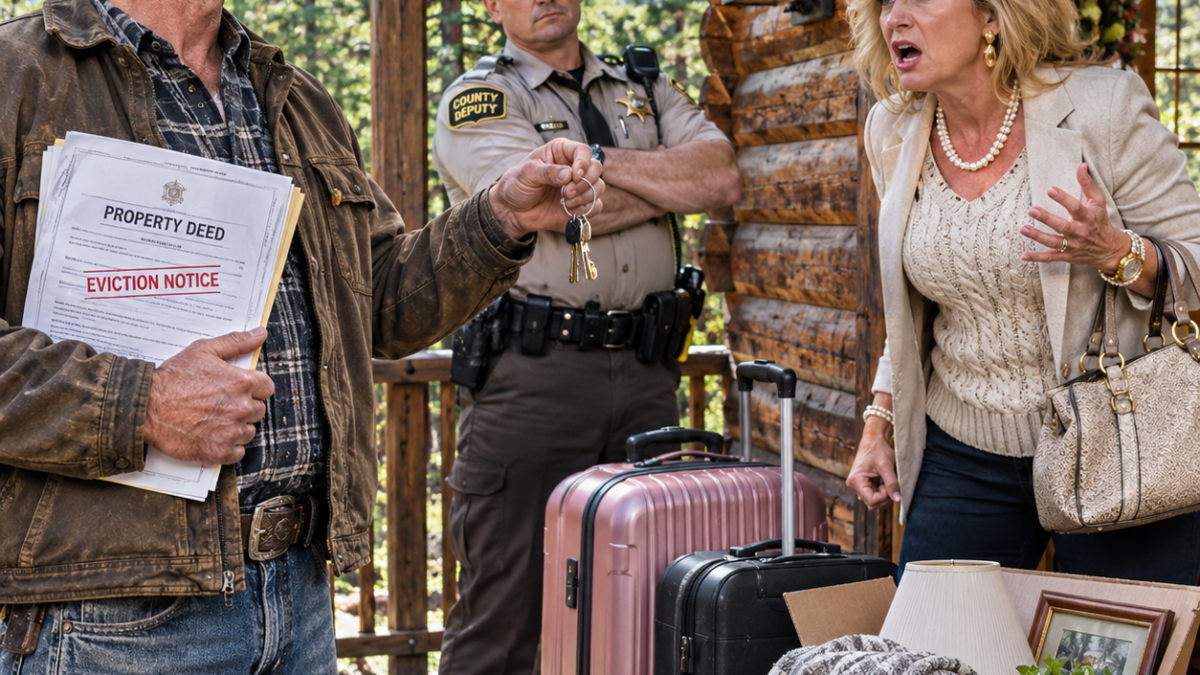
At noon, Evans and I walked to the door.
He knocked.
“Sheriff’s Department.”
No answer.
Again.
“Karen Miller, your court-ordered occupancy period has expired. You need to vacate.”
Crash inside.
Something dropped.
Then the door flew open.
Karen looked nothing like the woman who threatened me weeks earlier.
Hair loose.
No makeup.
Wrinkled clothes.
A box of ceramic cat figurines in her arms.
“You can’t do this.”
Evans remained calm.
“Ma’am, I have a court order.”
“This is my home.”
“No, ma’am.”
“I paid for it.”
“You’ve had twenty-four hours to arrange removal of your property.”
She looked past him.
At me.
Hatred flashed across her face.
“You.”
I said nothing.
“This is what you wanted.”
“I wanted my house.”
“You destroyed everything.”
“I found paperwork.”
Her face twisted.
“You think you’re some hero because you wore a uniform?”
“No.”
“You think everyone here loves you now?”
“No.”
“You think they’re different?”
I glanced at the neighbors.
“That’s up to them.”
She stepped toward me.
Evans moved slightly between us.
Karen spat near my boots.
“This isn’t over.”
I finally spoke.
Quietly.
“It is for the cabin.”
Something broke in her face.
Not sadness.
Recognition.
She had no leverage left.
She threw the box.
Ceramic cats shattered across the lawn.
Mary Henderson gasped.
Karen grabbed a suitcase.
Walked past us.
Down the steps.
She didn’t look at neighbors.
Didn’t look at the cabin.
Got into an old sedan.
Door slammed.
Engine started.
She drove away in a cloud of dust.
No dramatic music.
No applause.
Just gravel under tires.
Then silence.
Deputy Evans looked at me.
“Want to go inside?”
I nodded.
The front door felt strange under my hand.
New handle.
Same wood.
I stepped inside.
The smell hit first.
Potpourri.
Artificial vanilla.
Carpet cleaner.
Not cedar.
Not smoke from the fireplace.
Not lake air.
Karen had replaced furniture.
Hung generic art.
Covered my grandfather’s hardwood with thick beige carpet.
She had removed family photographs.
Changed light fixtures.
Painted over a pencil mark in the kitchen where my mother measured children.
That almost got me.
I walked to the stone fireplace.
My grandfather had laid every stone.
I placed my hand against it.
Cold.
Solid.
Still there.
Sarah Jenkins waited outside.
She knew this wasn’t her moment.
I walked through every room.
Bedroom.
Kitchen.
Porch.
Then back door.
The deck.
Composite gray.
Built-in benches.
Solar lights.
My grandfather’s redwood gone.
I stood there.
Bill came around the side.
“Jack?”
I looked at him.
“We’re taking this thing down.”
He smiled.
“When?”
“Tomorrow.”
The next morning, eight neighbors arrived.
Then twelve.
Cleaning supplies.
Gloves.
Boxes.
Tools.
Dumpster.
Mary brought food.
The young couple brought a pressure washer.
Someone brought a pry bar.
Bill brought two sledgehammers.
“What are those for?”
He looked toward the deck.
“Therapy.”
We started inside.
Karen’s belongings were boxed carefully.
Not destroyed.
That mattered.
Whatever she’d done, I wasn’t stealing from her.
The sheriff had given instructions regarding property collection.
We followed them.
Furniture removed.
Decorations removed.
Paperwork preserved when potentially relevant.
Carpets pulled.
Underneath:
My grandfather’s hardwood.
Beautiful.
Dusty.
Scratched in a few places.
But intact.
Mary knelt.
“Oh, Jack.”
I ran my hand over the boards.
“I thought she destroyed them.”
“Nope.”
We spent hours cleaning.
Windows open.
Air moving.
Artificial scent slowly disappearing.
Then came the deck.
Bill handed me a sledgehammer.
“First swing is yours.”
I hesitated.
The deck itself was evidence of Karen’s wrongdoing.
Photographed.
Documented.
Released after legal review.
It could go.
I raised the hammer.
Hit one composite board.
Crack.
Bill hit another.
Soon everyone joined.
Not violently.
Methodically.
Screws.
Fasteners.
Joists.
Sections dismantled.
Every piece into dumpster.
Underneath were remnants of the old redwood supports.
Some could be reused.
I kept them.
By sunset, the ugly deck was gone.
We sat on overturned buckets drinking beer.
The cabin looked wounded.
But honest.
Mary said:
“What are you building back?”
“Redwood.”
Bill groaned.
“Expensive.”
“Worth it.”
The HOA no-confidence meeting happened that weekend.
Outdoors.
Lake lawn.
No podium.
No Karen.
No little gavel.
Bill spoke first.
“This association forgot its purpose.”
People listened.
“We let enforcement become punishment.”
Nods.
“We let one person control finances, vendors, records, and violations.”
More nods.
“We don’t fix that by replacing Karen with another Karen.”
That line mattered.
Vote:
Old board removed.
Unanimous.
New board elected.
Bill president.
Mary treasurer.
Young father named David vice president.
First priority:
Independent audit.
Second:
Bylaw review.
Third:
Reimbursement and relief for improperly targeted homeowners where evidence supported it.
Fourth:
Full cooperation with criminal investigation.
Then Bill proposed something I didn’t expect.
“The HOA should pay Jack Riley’s legal fees.”
I stood.
“No.”
People turned.
Bill frowned.
“Why?”
“The people here didn’t forge my signature.”
“The association did it in our name.”
“Karen did.”
“The board allowed it.”
I looked around.
“Your reserve funds belong to families who weren’t involved.”
Mary raised her hand.
“Jack.”
“Yes?”
“What happens if an HOA harms someone?”
I hesitated.
She continued.
“The association has responsibility.”
Bill nodded.
“We’ll work with insurance and counsel. We’re not draining reserves blindly.”
Fair.
The motion passed.
I let it.
Learning to accept help was harder than fighting.
The audit findings were devastating.
Serenity Landscaping.
Karen’s company.
Overpriced contracts.
Invoices lacking documentation.
Miller Construction.
Brother-in-law.
Deck.
Other questionable payments.
Legal consulting.
Catering expenses for events nobody remembered.
The DA’s office moved.
Karen was eventually charged.
Forgery tied to annexation documents.
Fraud.
Theft-related financial counts associated with HOA funds.
I followed from a distance.
I didn’t attend every hearing.
Didn’t need to.
By then, my cabin mattered more.
I rebuilt.
Redwood deck.
Same general design my grandfather had used.
Wide boards.
Simple railing.
Nothing flashy.
Bill helped.
David helped.
Even Deputy Evans came one Saturday on his day off.
“You know you’re not required to work here.”
“I know.”
“You feel guilty?”
“A little.”
“You followed the record.”
“I still made you leave.”
“You would’ve violated procedure if you didn’t.”
He nodded.
“Doesn’t feel good.”
“Good law enforcement isn’t about always feeling good.”
He smiled.
“Ranger?”
“Grandfather.”
We worked until dark.
Inside, floors were refinished.
Walls repainted.
Old family furniture returned from storage.
My father’s worn leather chair went beside the fireplace.
Grandmother’s kitchen table went back under the window.
Black-and-white photographs returned to the wall.
The cabin slowly stopped looking like Karen’s house and started feeling like home.
The strangest moment came when I found a box in storage marked:
**LAKE HOUSE — PHOTOS**
Inside was a photograph of my father standing on the porch with me when I was maybe seven.
My grandfather behind us.
Three generations.
The same oak tree visible in the background.
I sat on the floor for a long time holding that picture.
Ten years away had made me think of the cabin as something permanent.
Something waiting.
But buildings aren’t permanent.
Neither are families.
Home survives because somebody chooses to maintain it.
I had almost waited too long.
That realization hurt more than Karen.
She exploited my absence.
But my absence was real.
I had paid taxes.
Maintained legal ownership.
Done everything necessary on paper.
Yet I hadn’t been here.
I promised myself that would change.
I wasn’t spending another decade away.
Karen eventually accepted a plea agreement.
The exact legal consequences mattered less to me than restitution.
HOA money returned.
Financial records corrected.
Her separate property sold as part of resolving obligations.
Probation and custody consequences followed according to the case.
People expected me to celebrate.
I didn’t.
Bill asked:
“You don’t feel anything?”
“Relief.”
“Not satisfaction?”
“Some.”
“Come on.”
I looked toward the cabin.
“I wanted her out of my house.”
“She is.”
“I wanted title restored.”
“It is.”
“I wanted neighbors’ money returned.”
“Working on it.”
“Then what else do I need?”
Bill considered that.
“Nothing.”
Exactly.
Revenge gets boring once peace becomes available.
The new HOA abolished many of Karen’s favorite rules.
Bird baths became legal.
Paint approvals simplified.
Reasonable safety and maintenance requirements remained.
The association focused on common roads.
Lake access.
Shared landscaping.
Budget.
Insurance.
No one measured ornamental grasses.
Mary put the Henderson bird bath back.
Not the old one.
Their daughter bought them a larger one.
Ridiculously ornate.
Three tiers.
Little ceramic frogs.
I visited the day they installed it.
Bill stepped back.
“What do you think?”
“Hideous.”
Mary laughed.
“Karen would’ve had a heart attack.”
“Don’t design your life around irritating Karen.”
“Too late.”
Children played more freely.
Families held barbecues.
Residents who had spent years avoiding HOA meetings started attending.
Transparency changed behavior.
Bank statements published.
Vendor ownership disclosed.
Competitive bids.
Minutes detailed.
No president handling everything.
The most important reform was simple:
No action affecting title could occur without independent counsel and verified notice to the legal owner at county tax records.
That rule had my fingerprints on it.
I didn’t join the board.
They asked.
I refused.
“Why?” Bill said.
“I just got home.”
That was true.
For the first time in ten years, I wanted a quiet life.
I fished.
Repaired the dock.
Rebuilt an old canoe.
Cut firewood.
Sat on the deck.
At night, the lake sounded exactly as I remembered.
Small waves.
Frogs.
Loons farther out.
Wind through pine needles.
Peace.
But sometimes I woke before dawn.
For a split second, I thought I was back in the tent.
Then I smelled cedar.
Home.
One evening, Mary brought an envelope.
“What’s this?”
“Found in the old HOA office.”
Inside were copies of original letters regarding my property.
One from a board member named Thomas Green.
Six years earlier.
He had written:
**I am uncomfortable classifying the Riley parcel as abandoned when taxes appear current. Recommend contacting county owner address before annexation.**
Karen’s handwritten note at bottom:
**No response expected. Proceed.**
I read it twice.
Mary watched.
“You okay?”
“Yeah.”
“You didn’t know?”
“No.”
This mattered.
It showed Karen had been warned.
Not confused.
Warned.
She chose speed.
Control.
Outcome.
Over verification.
I gave the document to Sarah Jenkins.
She forwarded it appropriately.
Then I sat on the deck.
Angry again.
For months, I’d told myself perhaps Karen believed her own story.
Maybe she convinced herself the cabin was abandoned.
That note complicated mercy.
She knew there was a problem.
She proceeded.
Then I remembered something my father once told me:
Understanding why someone did wrong does not require pretending they didn’t know better.
You can understand and still hold accountable.
I kept moving forward.
The civil settlement eventually resolved.
Insurance.
Former board liability.
Karen’s personal obligations.
Legal fees.
Property damage.
Emotional harm.
The amount was substantial.
Enough to restore the cabin properly.
Enough to secure my retirement.
Enough that I could have bought another lake house.
I didn’t want another lake house.
I wanted this one.
We used part of the money for something better.
A fund at the county historical society to preserve local land and deed records digitally.
That was Sarah Jenkins’s idea.
“Your whole case depended on a century of documents surviving in filing cabinets.”
She was right.
Martha cried when I told her.
“These old records matter,” she said.
“Apparently.”
“People think everything is online.”
“Not the good stuff.”
She laughed.
The Riley Land Records Preservation Fund wasn’t huge.
But it paid for scanning old plats.
Deeds.
Survey notes.
Historical property files.
Years later, someone else might find their truth faster because of it.
That felt better than buying a new truck.
Though I bought one eventually too.
My old F-150 deserved retirement after the twenty-two-hour drive and weeks of campground duty.
I kept it.
Couldn’t bring myself to sell.
It became the cabin truck.
One afternoon, Deputy Evans stopped by.
“Got news.”
“What?”
“New owners moved into Karen’s old house.”
“The one she actually owned?”
“Yes.”
“Nice people?”
“Teacher and firefighter.”
“Good.”
“They heard the story.”
“Bad.”
Evans smiled.
“They want to meet you.”
“Why?”
“They’re afraid you’ll hate them because they bought her place.”
I shook my head.
“That’s ridiculous.”
“You should tell them.”
So I did.
They came by.
Evan and Laura.
Two kids.
Nervous.
Laura said:
“We just want you to know we had nothing to do with—”
I interrupted.
“Stop.”
She stopped.
“You bought a house.”
“Yes.”
“You didn’t forge my signature.”
“No.”
“You didn’t steal HOA funds.”
“No.”
“Then welcome to the lake.”
Her shoulders dropped.
The children loved the dock.
A month later, their son caught his first fish from it.
I helped him remove the hook.
That’s how communities heal.
Not by preserving enemies.
By refusing to create new ones.
The cabin became gathering place again.
Summer barbecues.
Thanksgiving.
Neighbors.
Veterans from my old unit.
Martha once came for dinner.
She stood in the doorway and looked around.
“Looks like Frank’s place again.”
That was the highest compliment possible.
I rebuilt the pencil height marks in the kitchen too.
Not the originals.
Karen’s paint had covered them.
But I had photographs.
I recreated each.
My name.
My sister’s.
Cousins.
Years.
Approximate heights.
Then left room below for new generations.
My nephew brought his daughter.
We marked her height.
She asked:
“Why are all these names on the wall?”
“Family history.”
“Did somebody erase them?”
I paused.
“Yes.”
“Why?”
“Didn’t know what they meant.”
She thought.
“That’s sad.”
“Yes.”
“Why did you put them back?”
“Because I knew.”
Simple.
That became a theme.
Karen saw land.
Value.
Leverage.
Property.
I saw memory.
That’s not a legal argument.
Courts restore title because documents prove ownership.
Not because a fireplace feels like your grandfather.
But once the court work ends, that’s what remains.
Memory.
Years passed.
The campsite location under the oak stayed clear.
I considered planting something there.
Never did.
Eventually Bill installed a small bench.
Without asking.
I complained.
“Technically this isn’t HOA property.”
He smiled.
“Technically it’s a gift.”
I sat.
A brass plate read:
**WELCOME HOME, JACK**
I hated it.
Kept it.
Sometimes I sit there instead of on the deck.
Same place where I watched Karen through my windows.
Now I look at the cabin without anger.
That took time.
One autumn evening, Bill joined me.
“Remember the tent?”
“Unfortunately.”
“You looked insane.”
“Thanks.”
“You know what changed everything?”
“The forged document?”
“No.”
“What?”
“You stayed.”
I looked at him.
“I didn’t have anywhere else to go.”
“You could’ve gone to a hotel.”
“True.”
“You stayed fifty feet from the house.”
“Stubbornness.”
“Maybe.”
He looked toward the lake.
“But everyone saw you.”
I understood.
The campsite made the fraud visible.
Before that, Karen’s story existed on paper.
Foreclosure.
Auction.
Deed.
Official words.
Then residents saw the man those papers erased sleeping under a tree beside his own home.
Reality contradicted paperwork.
That made people curious.
Curiosity led to questions.
Questions led to records.
Records led to truth.
Sometimes systems fail because nobody asks who benefits from the paperwork.
Karen benefited.
That should’ve been enough for somebody to look sooner.
The old HOA board apologized eventually.
Not as a group.
Individually.
One woman wrote me a letter.
She had voted for annexation.
She claimed Karen told them county officials had already declared the cabin abandoned.
She never verified.
Her letter said:
**I trusted the president because she seemed to know the procedure. I now understand that my responsibility was to know before I voted.**
That sentence mattered.
People love saying:
“I was told.”
Leadership doesn’t excuse that.
If your vote harms someone, you owe them more than passive trust.
I replied.
Short.
**Thank you for acknowledging it. Please carry that lesson forward.**
No friendship.
No cruelty.
Enough.
The community changed leadership rules.
Term limits.
Dual signatures on large payments.
Independent annual audit.
Conflict disclosures.
No board member-owned vendors without full bidding and member approval.
Verified owner notice.
Clear appeal process.
All things that should’ve existed before.
People sometimes ask whether Karen created those reforms.
Indirectly.
But I don’t give her credit.
A fire doesn’t deserve credit for the sprinkler system installed afterward.
The people who rebuilt deserve credit.
Mary became an excellent treasurer.
Almost annoyingly excellent.
She posted quarterly statements.
Explained every unusual expense.
Held budget sessions.
Bill joked that she could account for every paper clip.
She replied:
“That’s because you people can’t be trusted.”
Healthy marriage.
Eventually Bill stepped down.
David became president.
The association survived.
No dictatorship.
No collapse in property values.
No lawns turned into junkyards.
No apocalypse because somebody owned a bird bath.
Turns out communities can maintain standards without terrorizing residents.
Who knew.
One summer, a local reporter returned for a follow-up.
Not David Chen.
A younger woman.
She asked:
“Do you consider yourself the man who brought down the HOA?”
“No.”
She looked disappointed.
“But your lawsuit exposed—”
“I brought down a fraudulent title.”
“Karen lost control because of your case.”
“She lost control because residents stopped giving it to her.”
“Would you say the HOA was corrupt?”
“The former leadership had serious corruption.”
“Same thing.”
“No.”
She frowned.
I continued.
“An HOA is a structure. People use it well or badly.”
“Do you support HOAs now?”
“Depends.”
“That isn’t a good television answer.”
“Then don’t use it.”
She laughed.
The interview aired anyway.
They used the line:
**People use power well or badly.**
Not terrible.
The cabin became more important as I aged.
Not because of the fight.
Because time narrowed the circle.
Old teammates passed away.
Martha retired.
Sarah Jenkins became a judge.
Bill’s hair disappeared entirely.
Children grew.
Parents aged.
The cabin remained.
One winter evening, I sat by the fireplace during a snowstorm.
Rare heavy snow.
Electricity went out.
Generator started.
For an hour, the house looked like my childhood.
Firelight.
No television.
No phones ringing.
I remembered Karen telling me:
“You should’ve stayed gone.”
For years, that sentence bothered me.
Because part of me agreed.
If I’d returned sooner, maybe none of it would’ve happened.
But regret is dangerous when it pretends the victim could’ve prevented another person’s wrongdoing by living differently.
I should’ve visited more.
Yes.
I should’ve checked the property more often.
Yes.
But Karen still chose forgery.
She still chose false notices.
She still chose foreclosure.
She still chose to buy the property through the system she controlled.
Those choices were hers.
I could learn from my absence without accepting responsibility for her fraud.
That distinction brought peace.
One day I received a letter.
No return address I recognized.
Inside:
Karen.
Years after her release from custody and supervision.
Short.
She didn’t ask forgiveness directly.
She wrote:
**I told myself the cabin was abandoned because I wanted it to be true. I thought improving the property justified how I acquired it. I was wrong. I know that isn’t enough.**
I read it several times.
Then put it away.
Bill asked whether I’d respond.
“No.”
“Why?”
“Nothing useful to say.”
“Could forgive her.”
“I don’t know her.”
He waited.
“I don’t hate her.”
“That’s something.”
“Yes.”
Forgiveness doesn’t always need a conversation.
Sometimes it means the person no longer occupies your emotional space.
I didn’t need Karen to understand me.
I needed her to stop controlling any part of my life.
She had.
That was enough.
The new deck aged beautifully.
Redwood silvered over time.
I could’ve stained it.
Didn’t.
Grandfather had let the original weather naturally.
So did I.
One board loosened slightly every few years.
I fixed it.
Simple maintenance.
No permits.
No HOA approval.
Parcel 4815-B remained outside the association.
Funny part?
I voluntarily contributed to certain shared projects.
Road repairs.
Lake cleanup.
Fire prevention.
Not dues.
Contributions.
Choice.
Bill once said:
“You realize you pay almost as much voluntarily as HOA dues would’ve been.”
“I know.”
“Then why fight so hard?”
“Because choosing is different from being extorted.”
He nodded.
“Fair.”
Community works best when generosity isn’t confused with surrender.
The oak beside the old campsite grew larger.
Storm split one limb.
I hired an arborist.
He said the tree could survive another century.
I liked that.
That oak had seen my grandfather.
My father.
Me as a boy.
Karen’s occupation.
My tent.
The eviction.
The rebuilding.
Maybe someday it would watch another Riley return after being away too long.
Hopefully to less drama.
I created a trust eventually.
Not because I expected another Karen.
Because documents matter.
Clear succession.
Current mailing address.
Property manager when absent.
Annual title check.
Taxes monitored.
No ambiguity.
My niece teased me.
“This file is enormous.”
“Good.”
“You have three backup copies.”
“Good.”
“One in a safe deposit box.”
“Good.”
“You’re paranoid.”
“Experienced.”
The lesson wasn’t to fear paperwork.
It was to respect it.
Paper stole the cabin temporarily.
Paper returned it.
The difference was truth.
A forged signature is paper.
A court order is paper.
Both can change lives.
Only one deserves authority.
On the tenth anniversary of my return, neighbors organized a dinner.
I tried to cancel.
Failed.
Tables on the lawn.
Lights in trees.
Children running.
Mary’s absurd bird bath displayed proudly.
David gave a speech.
Too long.
Bill heckled him.
Then someone brought out a framed photograph.
My tent beneath the oak.
Cabin behind it.
I stared.
“Who took this?”
Mary raised her hand.
“First week.”
“You photographed me?”
“You looked dramatic.”
“I looked homeless.”
“Exactly.”
Everyone laughed.
Under the photograph:
**THE NIGHT THE NEIGHBORHOOD STARTED ASKING QUESTIONS**
That line stopped me.
Not:
The night Jack fought back.
Not:
The night Karen lost.
The night the neighborhood asked questions.
Better.
I hung it inside the cabin.
Near the hallway.
Not because I wanted guests to admire my fight.
Because institutions fail when people stop asking questions.
Where did the money go?
Who signed this?
Who verified ownership?
Where was notice sent?
Who benefits?
Why is one person controlling the process?
Those questions would’ve stopped Karen years earlier.
Silence allowed her to grow.
Questions dismantled her.
The final legal matter closed long before that anniversary.
Restitution complete as far as the courts could manage.
Civil settlement paid.
HOA finances repaired over time.
Some families received refunds or settlements for improper fines.
Not everyone.
Evidence varied.
Some grievances were legitimate enforcement.
That mattered too.
Once Karen fell, there was a temptation to assume every decision she’d ever made was wrong.
It wasn’t.
Some residents really had violated reasonable rules.
One man wanted to keep four broken cars on his front lawn.
Another repeatedly blocked a fire lane.
The new board enforced those rules.
Fairly.
Due process.
Clear notice.
Real authority.
The goal wasn’t absence of governance.
The goal was governance without abuse.
That’s harder.
And better.
I spent my later years teaching that distinction whenever anyone wanted a simple villain story.
Karen was a villain in mine.
But systems that rely on everyone being heroic are bad systems.
Good systems assume somebody eventually won’t be.
So they require records.
Multiple signatures.
Audits.
Appeals.
Conflicts disclosed.
Term limits.
Verification.
Checks.
Boring things.
Boring things protect homes.
Sometimes I think about Deputy Evans.
The first night, he made me leave.
Some people hearing the story say:
“He should’ve arrested Karen immediately.”
No.
He had conflicting deeds.
A recent county record showing her ownership.
He didn’t have authority to decide forgery roadside.
He followed the record.
It hurt.
But later, when the court corrected the record, he enforced that too.
That’s the system working slowly, painfully, imperfectly—but correctly once evidence reaches the right place.
The villain wasn’t the deputy.
The villain was corrupted documentation.
Evans eventually became sheriff.
Good one.
At his campaign barbecue, he joked:
“My first lesson in property law was telling Jack Riley to leave his own house.”
People laughed.
I raised my drink.
“You’ve improved.”
He shouted:
“I still have the bodycam!”
That became another local legend.
The cabin never became famous outside the region.
I’m glad.
Stories online have a way of turning people into characters.
Karen becomes “HOA Karen.”
I become “Ranger Grandpa.”
Reality is messier.
But the core remains.
I returned after nearly a decade.
Someone else was living in my family cabin.
She held a deed created through a process built on forged consent.
I slept outside.
Found records.
Hired a lawyer.
Followed the money.
Helped expose wrongdoing.
Went to court.
Got title restored.
Watched the sheriff remove her.
Then rebuilt.
That last part matters most.
Rebuilt.
Because getting something back isn’t the same as restoring it.
The court gave me title.
Neighbors helped give me home.
The first night after Karen left, I didn’t sleep in the bedroom.
Too much her smell.
Too many unfamiliar things.
I slept on the floor near the fireplace.
Sleeping bag.
Same one from the tent.
Window open.
Lake outside.
At two in the morning, I woke to the sound of wind moving through pine branches.
For one confused second, I thought I was still under the oak.
Then I saw the stone fireplace.
My grandfather’s work.
I reached out and touched the floor.
My floor.
Not because I felt entitled.
Because I had proof.
History.
Law.
Memory.
And finally, possession again.
I fell asleep smiling.
Years later, that remains the moment I think of when people ask whether revenge was satisfying.
Not Karen carrying boxes.
Not the ceramic cats breaking.
Not the judge ruling.
Not the indictment.
Not prison.
Not repayment.
That night.
Sleeping on the floor.
Nobody telling me to leave.
That’s what justice felt like.
Quiet.
At home.
The Riley cabin still stands.
Redwood deck.
Old fireplace.
Family photographs.
Height marks in the kitchen.
Oak tree by the drive.
Parcel 4815-B.
Taxes paid.
Title clean.
Every document updated.
And whenever I leave for more than a few weeks, I have someone check the place.
Lesson learned.
But I always come back.
Because a home isn’t just something you own.
It’s something you return to.
Karen understood acquisition.
She never understood belonging.
That’s why she thought she could manufacture a deed and become part of the story.
She couldn’t.
Paper can transfer property when it’s lawful.
It can’t manufacture memory.
It can’t create a grandfather’s hands in stonework.
It can’t recreate a father’s chair by the fireplace.
It can’t replace summers on a dock.
And it can’t turn theft into home simply because enough official stamps appear on the page.
She lived there for years.
I came back after ten.
Yet the moment I stepped through that door after the sheriff removed her, the cabin knew exactly who had returned.
Or maybe I did.
Either way, I was finally home.








