PART 2: I Came Home After Four Years and Found the HOA President’s Luxury Pool on My Forest—So I Took My Land Back
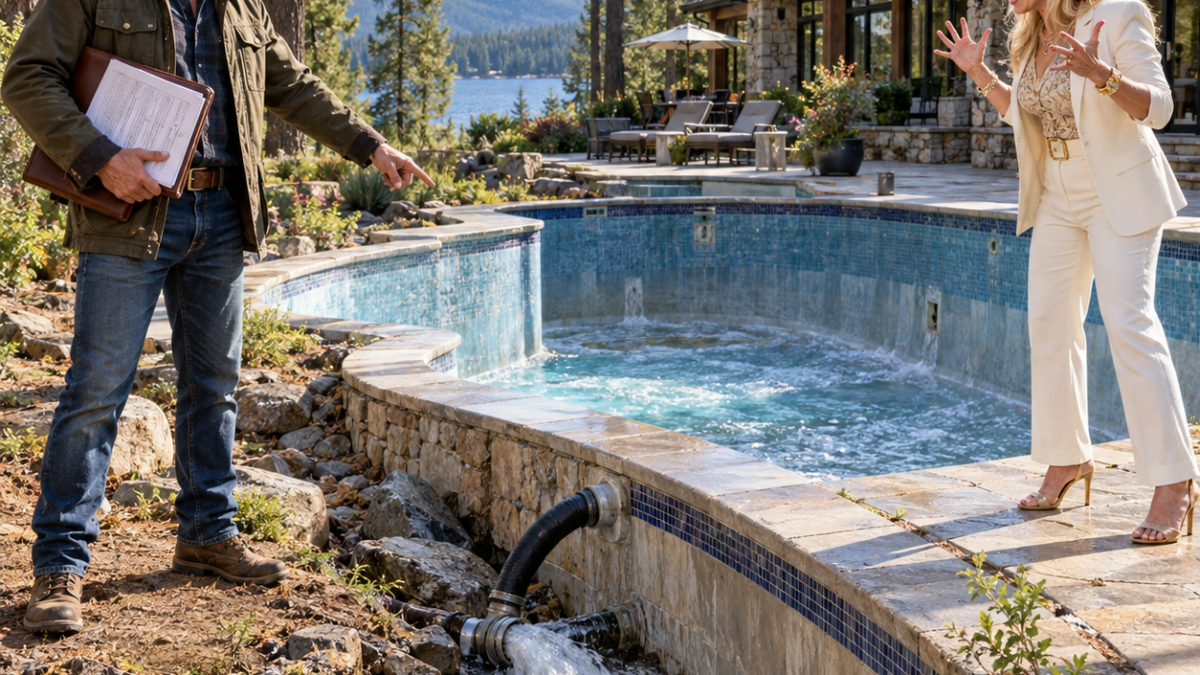
I came home after four years away expecting fifty quiet acres of pine, creek water, and the land my family had protected for generations—then I heard children screaming from a swimming pool that had never existed when I left.
The HOA president was drinking rosé beside it when she informed me that my woods had been declared an “aesthetic improvement zone” and that the turquoise pool, stone patio, and outdoor kitchen sitting nearly eighty feet inside my boundary were now part of her community.
What she didn’t know was that my grandfather had taught me to trust iron survey pins more than people, and one of those missing pins was about to cost her far more than the pool ever had.
“This is my land now, soldier boy.”
Karen Blevins raised her wineglass toward the pool like she was making a toast.
Behind her, children splashed in bright blue water while half a dozen adults sat beneath expensive umbrellas.
A stainless-steel grill hissed beside an outdoor bar.
Flagstone stretched across ground where my grandfather’s hunting blind used to stand.
I stared at it.
Not because I didn’t understand what I was seeing.
Because I understood perfectly.
“You built this in my woods.”
Karen laughed.
“I improved an abandoned area.”
“It wasn’t abandoned.”
“You disappeared for four years.”
“I was working.”
“Well, the world didn’t stop while you were gone.”
My name is Jack Miller.
My family had owned those fifty acres since my great-grandfather bought the land after World War II.
My grandfather was a surveyor.
He taught me that boundaries weren’t suggestions.
When I was ten, he walked me through those woods carrying a canvas survey bag and showed me the iron monuments marking each corner.
“People forget promises,” he told me. “Steel remembers.”
Before leaving for a long engineering contract overseas, I walked that boundary myself.
The woods were untouched.
The creek still ran cold.
My taxes were current.
The deed was clean.
There was no HOA.
No easement granting anyone use of my land.
No agreement allowing anyone to cut trees, pour concrete, or move a single shovelful of soil.
While I was away, however, the neighboring farm had become a development called Whispering Pines.
And Karen had become its president.
Apparently that title convinced her she could redraw reality.
The next morning I brought her my deed.
My grandfather’s recorded plat.
And a professional survey I had commissioned before leaving.
She opened her front door wearing a silk robe and holding a tiny barking dog.
“Again?” she said.
“Your pool is on my property.”
She rolled her eyes.
Then she disappeared inside and returned carrying an HOA binder.
“Our board had its own survey performed.”
She showed me a glossy map.
I looked at it once.
Then again.
The property line curved unnaturally around her backyard, conveniently enclosing the exact footprint of the pool.
“That isn’t my boundary.”
“It’s the current boundary.”
“Where are the original iron monuments?”
She hesitated.
“Construction probably removed them.”
My stomach tightened.
“You removed survey markers?”
“They were obsolete.”
“No, Karen.”
I closed her binder.
“They were evidence.”
Her expression changed.
Only for a second.
Then the arrogance returned.
“Your forest was an eyesore and fire hazard. The HOA voted to improve it.”
“My land isn’t part of your HOA.”
She flipped to a rule labeled Aesthetic Blight Abatement.
“Anything negatively affecting community appearance can be addressed by the board.”
“You can’t vote yourself somebody else’s property.”
Her face reddened.
“We’ll also be issuing violations against you.”
I almost laughed.
“For what?”
“Overgrown trees. Brush. Lack of approved landscaping.”
“You stole part of my forest and now you’re fining me because the rest still looks like a forest?”
“Five hundred dollars per day if you fail to comply.”
That was when I stopped believing this might be a misunderstanding.
I stepped closer.
Not threateningly.
Just enough that she finally looked directly at me.
“You built a permanent structure on land you don’t own, using a survey I believe is fraudulent, after removing official boundary markers.”
Her little dog stopped barking.
“You need a real attorney.”
Karen pointed toward the road.
“Get off my property.”
I placed my documents back into the leather portfolio.
“Gladly.”
Then I looked past her toward the turquoise water sparkling between the trees.
“But understand something.”
She folded her arms.
“That pool is leaving.”
She laughed.
“You can’t touch my pool.”
I turned toward the forest.
“We’ll see.”
The first call I made wasn’t to a demolition contractor.
It was to an old surveyor named Gus Monroe.
And when I told him someone had removed the iron pins my grandfather set decades earlier, the seventy-year-old man went completely silent.
Then he said five words.
“Don’t touch anything until tomorrow.”
PART 2
Gus Monroe arrived at 6:47 the next morning in a dusty white pickup that looked nearly as old as he did.
He stepped out wearing faded work pants, suspenders, a broad-brimmed hat, and an expression that told me retirement had never managed to soften him.
Two younger surveyors climbed out behind him and began unloading tripods, range poles, electronic equipment, flagging tape, and cases that probably cost more than Karen’s outdoor kitchen.
Gus ignored all of that at first.
He walked straight toward the woods.
“Show me where the southeast monument was.”
I led him to the spot.
Or what used to be the spot.
My grandfather’s iron pin had once sat beside a granite rock shaped vaguely like a broken tooth.
The rock remained.
The pin did not.
Gus knelt.
He brushed aside mulch and decorative stone that had spilled from Karen’s landscaping.
Then he dug carefully with a small hand tool.
Nothing.
He looked toward the pool.
“How far did they excavate?”
“About eighty feet at the deepest point, according to my estimate.”
He grunted.
“Who surveyed for her?”
“She says the HOA hired someone.”
“Name?”
“Not yet.”
“You got her map?”
I handed him a photograph I had taken of Karen’s glossy survey.
Gus put on reading glasses.
He studied it.
Then made a sound I had heard my grandfather make whenever someone handed him poor work.
Not quite a laugh.
Not quite a curse.
“Look at this.”
He pointed to the southwest bearing.
“Curve makes no sense.”
“I saw that.”
“There’s no natural monument. No deed call. No recorded boundary adjustment. No adjoining conveyance.”
He looked at me.
“You don’t just bend a property line because somebody wants a pool.”
“Apparently Karen does.”
Gus removed his glasses.
“She remove more than one monument?”
“At least two.”
He stood slowly.
“Then we do this correctly.”
That was why I called him.
Not because I needed someone to agree with me.
Because I needed someone who would tell me if I was wrong.
For the next eight hours, Gus and his crew rebuilt the property line from recorded evidence.
They did not start from where I believed the line should be.
They started from a county benchmark several thousand feet away.
They established control.
Cross-checked bearings.
Measured recorded distances.
Compared my deed with adjoining parcels.
Checked historic plats.
Referenced subdivision filings.
Karen appeared around nine.
She walked across her lawn wearing white pants and a wide straw hat.
Behind her came two women I recognized from the previous day’s pool party.
“What are they doing?”
I stayed on my side of the line.
“My land is being surveyed.”
“You don’t have permission to perform work affecting Whispering Pines.”
Gus looked through the instrument.
“Ma’am, unless Whispering Pines acquired a surveying board while I wasn’t looking, we don’t require HOA permission.”
One of the younger crewmen bit his lip.
Karen glared.
“We already had a survey.”
“Who performed it?”
“That’s confidential.”
Gus finally looked away from the instrument.
“A licensed survey isn’t a state secret.”
“It was approved by our attorney.”
“Name of the surveyor?”
“I said it’s confidential.”
Gus nodded.
“Then stay out of the crew’s way.”
Karen’s face darkened.
“Excuse me?”
“You heard me.”
She looked at me.
“Control your employee.”
“He isn’t my employee.”
Gus smiled slightly.
“I’m worse. I’m independent.”
Karen retreated.
Not gracefully.
By late afternoon, fluorescent pink tape ran through what Karen considered her backyard.
Across the edge of her rose garden.
Through the flagstone patio.
Across the deep end of the pool.
One new iron monument stood so close to a tile corner that the pool contractor had probably excavated directly over the original.
Gus handed me preliminary field notes.
“Jack.”
I looked at the drawing.
The encroachment was worse than I thought.
At its maximum, Karen’s construction extended almost eighty feet beyond her deeded boundary.
The swimming pool straddled the line.
Most of the deep end was mine.
Approximately half the outdoor kitchen sat on my parcel.
So did patio.
Landscaping.
Irrigation.
Lighting.
A retaining wall.
And a portion of an underground drainage system.
Gus pointed toward the tree line.
“They took down mature timber here.”
“How much?”
“Hard to tell without old aerials.”
“I have photographs from before I left.”
“Good.”
His expression tightened.
“I also found cut steel.”
“What?”
He led me to the northern corner.
Near the new marker, buried below mulch, was a section of oxidized iron.
Flat on one side.
Bright on the other where machinery had severed it.
Gus lifted it.
“Part of your old monument.”
I stared.
My grandfather had driven that pin.
I remembered him wrapping my ten-year-old fingers around it.
Steel remembers.
Someone had cut it.
Gus noticed my expression.
“Don’t get emotional yet.”
“Working on it.”
“Get emotional after we document it.”
That sounded exactly like something my grandfather would have said.
Gus photographed the piece in place before moving it.
Measurements.
Coordinates.
Orientation.
Then he bagged it.
“I’m putting this in my affidavit.”
“You think removal was deliberate?”
“I think an iron rod doesn’t cut itself.”
The final certified survey arrived three days later.
Signed.
Sealed.
Recorded description.
Encroachment exhibit.
Affidavit regarding disturbed monuments.
I spent ten minutes just looking at it.
Then I made my second phone call.
David Chen answered with:
“If this is another veterans-network fundraiser, I already donated.”
“It isn’t.”
“Then you need a lawyer.”
“I do.”
“What happened?”
“My neighbor built a swimming pool on my land.”
Silence.
“How much of the pool?”
“Enough.”
“Define enough.”
“The boundary runs through the deep end.”
Another silence.
“Come tomorrow.”
David had served in the Marines before law school.
Unlike me, he enjoyed conflict professionally.
His office sat on the sixth floor of a brick building downtown.
I arrived carrying a leather portfolio, survey tube, folder of photographs, copies of the deed, historical plat, Karen’s fake map, and the cut survey-pin fragment Gus had placed in an evidence bag.
David spread everything across his conference table.
He began with my deed.
Then adjoining deeds.
Then Gus’s survey.
Then Karen’s map.
He studied the signature block.
“Martin Phipps.”
“You know him?”
“I know the name.”
“Good?”
“No.”
He turned to his computer.
After several minutes he leaned back.
“Licensed surveyor. Disciplinary history.”
“How bad?”
“Suspension for gross negligence three years ago. Reinstated with conditions.”
I sat forward.
“Karen said the HOA hired him.”
“You know their relationship?”
“No.”
“Find out.”
Gus already had.
His call came that afternoon.
“Brother-in-law.”
“You’re sure?”
“Property records and marriage announcement. His wife is Karen’s sister.”
That shifted the case.
An inaccurate survey is one thing.
A survey prepared by the HOA president’s relative that conveniently redraws a line to accommodate the president’s own pool is something else entirely.
David’s reaction was restrained.
Which meant he was excited.
“Do not call this fraud publicly yet.”
“Why?”
“Because we prove intent first.”
“She knew.”
“Probably.”
“She removed the markers.”
“Probably.”
“She built anyway.”
“Probably.”
“You’re enjoying saying probably.”
“I’m enjoying preventing my client from making statements I’ll later have to defend.”
Fair.
Then he asked me something important.
“Why did she think she could do this?”
“That’s what I want to know.”
We dug into Whispering Pines.
County records.
Subdivision plat.
HOA declarations.
Amendments.
Board minutes.
Architectural committee decisions.
The subdivision had been built while I was overseas.
My property was explicitly excluded from its platted boundary.
There was no annexation document.
No easement.
No landscaping agreement.
Nothing allowing Whispering Pines to occupy my land.
Then we found the “Aesthetic Blight Abatement” amendment.
Passed eleven months earlier.
Emergency meeting.
Twenty-four hours’ notice.
Attendance: eleven homeowners out of more than one hundred households.
The amendment gave the HOA authority to remediate “conditions adversely affecting aesthetics, safety, or property values” within common areas and member lots.
It said nothing about outside land.
Karen had simply decided it did.
We found another item buried in meeting minutes from three months later.
“Community edge improvement initiative.”
Budget approved.
No parcel number.
No map.
No disclosure that the “improvement” directly benefited Karen’s backyard.
David circled the language.
“This matters.”
“How?”
“If HOA funds were used.”
I hadn’t considered that.
We requested public permits.
The pool permit was issued to Karen personally.
The patio permit was tied to her parcel.
But contractor invoices later obtained through preliminary correspondence referenced a “Whispering Pines community edge beautification reimbursement.”
How much?
We didn’t know yet.
But the smell had changed.
This was not just a neighbor trespassing.
Karen may have used association money to help pay for her project.
David drafted a demand.
Fourteen days.
Remove encroaching structures.
Restore my land.
Cease trespass.
Preserve all records.
Identify the surveyor and contractor.
Provide copies of HOA approvals and expenditures.
Notify insurer.
Do not alter evidence.
The letter went to Karen.
Every board member.
HOA counsel.
Management company.
Martin Phipps.
The pool contractor.
Karen signed for hers on a Tuesday.
At 4:16 that afternoon, she called me.
I let voicemail record.
“Jack, this is Karen Blevins. Your ridiculous letter was received. You have no legal authority to threaten this community. Our attorneys have reviewed everything and your claims are completely baseless. If you continue harassing me, I will pursue every remedy available, including action against your unmanaged woodland, which remains a serious safety issue.”
Click.
I forwarded it to David.
His reply contained one word.
Excellent.
The HOA lawyer responded on day twelve.
Three pages.
Polished.
Aggressive.
Wrong.
They relied on the Phipps survey.
Claimed adverse community impact.
Claimed Karen had acted under color of HOA approval.
Then they made an extraordinary demand.
I was to pay accumulated HOA “abatement fines.”
Fence my land.
Clear two acres.
And stop “harassing association representatives.”
David read the letter.
Then laughed.
Actually laughed.
“They countersued us?”
“Not yet.”
“They threatened.”
“They’ll file.”
“They’re insane.”
“They’re confident.”
“Difference?”
“Evidence.”
He was right.
Karen and the board believed their paperwork created reality.
Then they filed.
The HOA sought injunctive relief against me for alleged nuisance conditions.
That was the moment their arrogance became useful.
Discovery opened.
Emails.
Texts.
Invoices.
Board records.
Survey drafts.
Communications with Phipps.
Internal HOA messages.
Contractor correspondence.
Financial records relating to the “community edge” project.
But lawsuits take time.
I still had an illegal pool occupying my land.
And every weekend people kept using it.
Children.
Guests.
Parties.
Noise.
Chlorine.
Lawn furniture.
Trespass.
Trail cameras captured dozens of people walking across my parcel every day because Karen’s pool deck itself sat there.
I wanted them gone.
David prepared a formal notice demanding vacation of the encroached area.
Then came the issue that nearly ended our attorney-client relationship.
“I want to drain it.”
David stared at me.
“No.”
“It’s my land.”
“The water is hers.”
“The pool is on my property.”
“Partially.”
“Mostly enough.”
“That is not a legal category.”
“She’s using it every weekend.”
“I know.”
“I gave notice.”
“I know.”
“I want it empty.”
David leaned back.
“Jack, you are an engineer. Act like one.”
“That means what?”
“It means consequences exist even when geometry favors you.”
I disliked him intensely in that moment.
He continued.
“You drain a pool improperly, you could damage soil, downstream property, septic systems, landscaping, or the pool structure.”
“I can engineer discharge.”
“That is the most dangerous sentence you could say to your lawyer.”
I folded my arms.
“Can it be done lawfully?”
He stared.
“Possibly.”
That was all I needed.
“Then determine how.”
David called environmental counsel.
We reviewed county discharge rules.
Chlorinated water could not simply be dumped untreated into a natural creek.
The original story Karen later told everyone—that I pumped chlorinated water directly into the stream—would have made me an idiot.
I wasn’t.
We hired a licensed pool service.
They tested chlorine.
Shut down chemical feed.
Allowed levels to drop.
Prepared dechlorination.
The engineer in me refused shortcuts.
We also obtained written advice concerning temporary removal of water from the portion of the encroaching structure on my parcel.
David still hated it.
But after additional notice and safety controls, we planned the operation.
Karen received seventy-two hours to cease using the encroaching structure and propose a court-approved solution.
She tore the notice from her door.
One of my trail cameras captured her doing it.
She looked directly toward the trees and laughed.
“Come drain it, soldier boy.”
Bad thing to say to an engineer with legal counsel.
The deadline expired Friday at noon.
We did not move at midnight like thieves.
We moved Saturday morning in daylight.
That mattered to me.
Licensed pool technician.
Environmental consultant.
Videographer.
Surveyor.
David’s junior attorney.
Commercial pump.
Containment.
Dechlorination.
Safe discharge to a temporary tank and approved drainage location away from the creek.
No vandalism.
No breaking concrete.
No entering Karen’s house.
No touching her furniture.
We simply lowered the water in the portion of the pool that could not continue operating while the encroachment dispute was active.
Karen discovered us at 8:31.
Her scream reached the forest before she did.
“What the hell are you doing?”
She ran across the patio.
Bathrobe.
Bare feet.
Phone in hand.
“Stop that!”
David’s associate, Mia Torres, stepped forward.
“Ms. Blevins, please remain on your side of the marked boundary.”
“This is my pool!”
“It’s an encroaching structure subject to notice.”
Karen pointed at me.
“I’m calling the police.”
I kept watching the pump.
“Okay.”
She called.
Two sheriff’s deputies arrived thirty minutes later.
Karen met them in the driveway.
“He’s destroying my property!”
The senior deputy approached me.
“Sir?”
I handed him a packet.
Survey.
Court filings.
Notice.
Proof of service.
Environmental plan.
Contractor licenses.
Photographs.
He looked through them slowly.
Then walked to the pink flagged boundary.
He looked at the pool.
Back at the survey.
Then at Karen.
“Ma’am, this is a civil property dispute.”
“He drained my pool!”
The technician corrected gently.
“We are removing water under counsel supervision.”
Karen rounded on him.
“Nobody asked you!”
The deputy held up one hand.
“Ma’am.”
She stopped.
“Do you have a court order stating he cannot access this portion of his property?”
“No, because it isn’t his property!”
The deputy lifted Gus’s survey.
“This says otherwise.”
“That survey is fraudulent.”
“Then your attorney needs to raise that in court.”
“Arrest him.”
“No.”
Her face changed.
“You’re refusing?”
“I’m saying I don’t see probable cause for a criminal arrest based on what you’ve shown me.”
“This is destruction!”
“No structure has been damaged.”
The second deputy looked into the slowly lowering water.
“Actually looks professionally handled.”
Karen nearly combusted.
The deputies left.
The pool kept dropping.
By afternoon, the turquoise surface had become shallow.
Tile appeared.
Then steps.
Then the slope toward the deep end.
We stopped at the engineer’s planned level rather than recklessly emptying it completely, because an empty in-ground pool can experience structural problems depending on groundwater.
Again, I wanted my land back.
I didn’t want to create new damage that would weaken my case.
Karen stood behind the line the entire time.
Silent by the end.
The pool looked wounded.
Not destroyed.
Just unusable.
That image spread through Whispering Pines faster than any legal letter could.
Mr. Henderson called me that evening.
I had met him only briefly during my document research.
Seventy-nine.
Widower.
Thirty-year resident of the area.
“Jack.”
“Yes, sir.”
“You drained her pool.”
“Part of it.”
He laughed so hard he coughed.
“People are finally asking questions.”
“What kind?”
“Why their dues paid for her survey.”
I sat upright.
“Who told you that?”
“Former secretary.”
“Name?”
“Not over the phone.”
He came to my house the next morning.
Walked with a cane.
Carried a manila envelope.
Inside were printed HOA emails.
One was from Karen to the treasurer.
Authorize Phipps Surveying invoice under community boundary maintenance.
Another:
Pool project is integral to edge beautification initiative. Association should cover survey and landscaping portions.
Another:
Do not circulate detailed map until construction is complete. Too many residents will ask irrelevant questions.
David nearly shouted when I sent scans.
“Where did Henderson get these?”
“Former secretary.”
“Can she authenticate?”
“Yes.”
“Then now we have something.”
“What?”
“Intent.”
Discovery later confirmed it.
But before that, residents revolted.
Under Whispering Pines bylaws, twenty percent of members could call a special meeting.
Henderson collected signatures in forty-eight hours.
The Miller family helped.
That’s how I learned their story.
Tom and Rachel Miller had an eight-year-old daughter named Lily.
Lily had cerebral palsy.
Tom had built a custom swing and supportive play structure in their backyard.
Not huge.
Not ugly.
Designed specifically so Lily could transfer safely from her walker.
Karen’s architectural committee had denied it because it wasn’t from an approved vendor.
Then fined them.
Daily.
Rachel showed me the letters with shaking hands.
“She uses that swing when physical therapy hurts.”
I looked through the kitchen window.
Lily was outside.
Her father pushed her gently.
She laughed every time the swing moved forward.
“What happens if you don’t remove it?”
Rachel swallowed.
“Fines increase.”
Tom looked ashamed.
“We were going to take it down.”
“No.”
He looked at me.
I repeated it.
“No.”
“This isn’t your fight.”
“It is now.”
He shook his head.
“I don’t want you spending money—”
“I’m not offering money.”
“What are you offering?”
“A lawyer’s phone number.”
David reviewed their case without charge.
The HOA’s own rules included a reasonable-accommodation clause required in certain circumstances.
Karen had ignored it.
That became another crack.
Henderson had his own story.
His roses.
His wife planted them before she died.
Red.
Deep red.
Karen’s landscape committee later revised an approved color palette.
The exact shade was removed.
He received an order to dig up twenty-three mature bushes or pay daily fines.
“Carol picked those,” he told me.
His voice changed when he said his wife’s name.
“I’ve had them twenty-six years.”
He looked toward the neighborhood.
“I was going to pull them.”
“Don’t.”
He smiled.
“You say that a lot.”
“I’m learning.”
The special meeting happened on a Thursday evening.
The clubhouse overflowed.
Karen sat at the front with four board members.
Martin Phipps wasn’t there.
David was.
So was Gus.
Tom.
Rachel.
Henderson.
Dozens of homeowners.
Karen opened with procedural objections.
“This meeting is invalid.”
David raised the bylaws.
“It is not.”
“The petition signatures are defective.”
“They have been independently verified.”
“This man isn’t even a member.”
She pointed at me.
David nodded.
“Correct. Mr. Miller is here because your association is using member funds to litigate against him.”
Murmurs spread.
Karen banged the gavel.
“Order.”
Henderson stood.
“Let him speak.”
Karen’s eyes hardened.
“You sit down.”
Henderson didn’t.
“I’ve been sitting down for five years.”
The room became silent.
He raised his cane slightly.
“Tonight I’m standing.”
People began clapping.
Karen shouted.
“No applause.”
That only made it louder.
When the room settled, I walked to the projector.
Two maps appeared.
Left:
My family plat.
Recorded deed.
Gus’s survey.
Straight boundary.
Right:
Phipps’s map.
The unnatural curve.
I pointed.
“This is the recorded line.”
Then the other.
“This is the line Karen used.”
A woman near the front whispered, “Oh my God.”
The difference was obvious even to someone who knew nothing about surveying.
Gus spoke next.
He explained methods.
Benchmarks.
Monuments.
Deed calls.
Adjoining parcels.
Then he held up the bag containing the cut iron section.
“This appears to be part of an original boundary monument.”
Karen interrupted.
“Appears?”
“Yes.”
“So you don’t know.”
Gus looked at her.
“I know enough that I reported it.”
Her face changed.
“To whom?”
“County surveyor.”
“And?”
“State board.”
Martin Phipps’s name suddenly mattered.
Gus continued.
“The survey relied upon by Ms. Blevins is not supported by recorded title evidence.”
Karen banged the gavel.
“You are attacking a licensed professional who is not here to defend himself.”
David stood.
“He’ll have that opportunity.”
Then Henderson walked to the microphone.
He held one of Karen’s emails.
“Why did HOA money pay her brother-in-law?”
Chaos.
Karen shouted.
“It did not!”
Henderson held the page higher.
“Then what is this?”
The former secretary stood in the back.
“I printed it.”
Every head turned.
Her name was Susan Hale.
She had resigned eight months earlier.
“I was secretary when the payment was approved.”
Karen stared.
“Susan.”
“I kept copies.”
“You stole confidential records.”
“No.”
Susan stepped into the aisle.
“They were association records.”
Karen’s composure cracked.
Susan continued.
“You told us the boundary survey was for a common-area project.”
“It was.”
“The common area was your backyard.”
“No.”
“You told us nobody would object.”
Karen stood.
“You’re lying.”
Susan’s voice shook.
But she didn’t back down.
“You told me Jack would probably never come back.”
That sentence hit harder than anything else.
I stared at Karen.
The room disappeared for a moment.
Four years.
She thought absence was abandonment.
She believed my family’s history became available because nobody was watching.
Karen looked toward me.
For the first time since I returned, I saw fear.
Not anger.
Fear.
Then Rachel Miller took the microphone.
She told the room about Lily.
About physical therapy.
The custom swing.
The fines.
Halfway through, she began crying.
“I’m tired of explaining to my daughter why adults think her swing is a problem.”
Tom put an arm around her.
Lily wasn’t there.
They had made sure of that.
Rachel wiped her face.
“We almost took it down because we were afraid of you.”
She looked directly at Karen.
“That’s not community.”
Henderson spoke after her.
He told them about Carol’s roses.
Then Janet Coleman described fines for wind chimes.
Another resident spoke about Christmas decorations.
Another about contractor parking.
Another about mailbox paint.
Another about a wheelchair ramp Karen tried to delay because the railing style wasn’t approved.
The stories kept coming.
The special meeting stopped being about my pool.
It became a public inventory of fear.
Karen’s authority had always depended on every resident believing their humiliation was private.
That night, privacy ended.
A recall petition began before the meeting finished.
Three board members resigned within seventy-two hours.
Karen refused.
“I was elected.”
So the members removed her.
The vote wasn’t close.
When Mark Henderson—Mr. Henderson’s son, who had agreed to oversee ballots—announced the result, Karen stood in the back of the clubhouse.
No gavel.
No front table.
No special chair.
Just a homeowner.
“You’ll regret this.”
Nobody answered.
The litigation continued.
Now, without Karen controlling the HOA, everything came faster.
Discovery produced email after email.
One from Karen to Phipps:
Need line adjusted enough to keep pool inside project area. Jack is overseas indefinitely.
Phipps replied:
Recorded calls don’t support that much movement.
Karen:
Then use updated field conditions. The old pins are gone anyway.
Another:
Do not put family relationship in HOA packet. People make everything political.
Another from Karen to the contractor:
Proceed. Boundary issue has been handled.
The contractor replied:
Survey stakes differ from prior markers.
Karen:
Martin says old ones were incorrect.
Then the financials.
HOA paid Phipps’s survey invoice.
HOA paid part of landscaping.
HOA paid a contractor to clear “hazardous vegetation” on what turned out to be my acreage.
Homeowners had funded part of the destruction of my property without knowing it.
That enraged them more than the pool itself.
Phipps cracked first.
The state licensing board opened an investigation.
His attorney contacted David.
He wanted settlement.
Cooperation.
Reduced civil exposure.
In exchange, he would testify about Karen’s instructions.
David asked me what I wanted.
“The truth.”
“You’re becoming annoyingly noble.”
“I’m serious.”
“So am I.”
Phipps sat for deposition.
He looked twenty years older than his professional photo.
Under oath, he admitted Karen had pressured him to “harmonize” the field survey with the planned improvement.
He claimed he warned her.
Then admitted he still signed the map.
He said he believed the historic monument evidence was “unreliable.”
Gus nearly exploded when he read that.
Phipps also admitted seeing excavated iron near the pool site.
He did not report it.
“Why?”
David asked.
Phipps stared at the table.
“Karen said it was construction debris.”
“Did you believe her?”
Long pause.
“No.”
That was it.
Intent.
Knowledge.
Participation.
Phipps’s license was eventually revoked.
The civil case against Karen and the HOA became nearly impossible to defend.
Then came Karen’s deposition.
Six hours.
David questioned her calmly.
That was worse for her than aggression.
“Did you know Mr. Miller owned the adjoining parcel?”
“Yes.”
“Did you know it was excluded from Whispering Pines?”
“I was told different things.”
“Who told you?”
“I don’t remember.”
“Did you have his deed?”
“I may have seen it.”
“Did you know he was overseas?”
“Yes.”
“How?”
“People knew.”
“Did you believe he was returning?”
“I didn’t know.”
David displayed her email.
Jack is overseas indefinitely.
“Those are your words?”
“Yes.”
“Why did his absence matter?”
“It didn’t.”
“Then why mention it?”
Karen’s attorney objected.
David waited.
Then:
“Did you instruct Mr. Phipps to adjust the line?”
“No.”
Email.
Need line adjusted enough to keep pool inside project area.
Karen stared at it.
“I was speaking colloquially.”
“What does ‘adjusted enough to keep pool inside project area’ mean colloquially?”
Objection.
David continued.
“Did you tell the contractor the boundary issue had been handled?”
“Yes.”
“Had it?”
“I believed it had.”
“Based on what?”
“Martin’s survey.”
“Which you requested be adjusted.”
“I did not.”
Email again.
By hour four, Karen was angry.
By hour five, she was exhausted.
By hour six, she was making mistakes faster than David could mark exhibits.
At one point she said:
“That forest was doing nothing for anyone.”
David stopped.
“Excuse me?”
Karen realized.
Too late.
“It was overgrown.”
“Was it yours?”
“No.”
“Was it owned by the HOA?”
“No.”
“Did Mr. Miller authorize you to clear it?”
“No.”
“Did you build your pool on it?”
“My pool was built according to the survey.”
“Did you ask Mr. Miller?”
“He wasn’t there.”
David leaned forward.
“Is absence consent?”
Her attorney objected.
David asked again.
“Did Mr. Miller’s absence transfer ownership of his land to you?”
“No.”
That line ended up in every settlement memo afterward.
The insurer issued a reservation of rights.
Parts of Karen’s conduct might not be covered.
That meant personal exposure.
Substantial.
The HOA’s new interim board wanted out.
Not because they suddenly loved me.
Because continuing would drain member money to defend conduct they now understood.
Settlement mediation began.
I did not ask to keep Karen’s pool.
I didn’t want it.
I didn’t want the patio.
Outdoor kitchen.
Rose garden.
Tile.
Lights.
I wanted trees.
So that was the first major term.
Remove every structure crossing my boundary.
At Karen’s expense.
Pool.
Deck.
Kitchen.
Retaining features.
Irrigation.
Electrical.
Drainage.
Then ecological restoration.
David thought “ecological restoration” might sound punitive.
I brought a forest ecologist.
Dr. Emily Foster.
She inspected the site.
Documented removed soil horizons.
Compaction.
Lost canopy.
Altered drainage.
Tree removal.
She prepared a restoration plan.
Native oak.
Hickory.
Pine.
Understory species.
Erosion control.
Soil reconstruction.
Invasive-species monitoring.
Five-year survival requirements for replacement trees.
Karen’s lawyer nearly choked at the estimate.
“That’s absurd.”
Dr. Foster answered calmly.
“No. That is what restoration costs after excavation.”
Karen looked at me.
“You don’t need all that.”
“I need my land back.”
“Plant grass.”
“It wasn’t grass.”
“Trees grow naturally.”
“Then you should’ve left them alone.”
She looked down.
Other terms followed.
HOA apology.
Refunds to residents whose fines had been issued under improper procedures.
Independent rewrite of bylaws.
Reasonable accommodation review for the Millers.
Removal of penalties against Henderson.
Financial controls.
Conflict disclosure.
No related-party contracts without member transparency.
Compensation for my loss of use.
Legal fees.
Survey costs.
Environmental consulting.
Punitive component paid largely by Karen personally.
She fought the number.
Of course she did.
At mediation hour nine, David whispered:
“We can go to trial.”
I looked through the glass wall.
Karen sat with her lawyer.
Head down.
No jewelry.
No HOA binder.
No audience.
“Will trial help the community?”
“Financially? Maybe not.”
“Will it get my land restored faster?”
“No.”
“Will she be held accountable?”
“Yes either way.”
I nodded.
“Settle.”
David studied me.
“You sure?”
“Yes.”
Karen signed after midnight.
The pool was coming out.
The day demolition began, I woke before sunrise.
I made coffee.
Walked to the line.
The pool was still there.
Mostly empty.
Leaves collected at the bottom.
No parties.
No laughter.
No umbrellas.
Just a shell.
At seven, excavators arrived.
Legally permitted.
Insured.
Contracted under the settlement.
Karen stayed inside.
The first machine lifted the outdoor kitchen.
Steel frame.
Countertop.
Appliances.
Removed carefully because salvage value offset part of the cost.
Then patio stones.
Each palletized.
Then coping.
Tile.
Concrete.
Rebar.
The pool shell took days.
Hydraulic hammer.
Excavator bucket.
Dump trucks.
My grandfather once told me construction is optimistic.
Demolition is honest.
You learn what was really underneath.
Under Karen’s pool was compacted fill.
Broken root systems.
Cut drainage paths.
And one more piece of iron from the old boundary monument.
Gus was there when they uncovered it.
He picked it up.
Looked at me.
“Your granddaddy would be mad.”
“He was usually mad.”
Gus laughed.
“He’d also be proud.”
That hit harder.
I turned away so nobody would notice my eyes.
The demolition took two weeks.
Restoration took months.
Dr. Foster insisted we rebuild the land properly.
Not dump soil in a hole and throw seed over it.
Subsoil.
Topsoil.
Grading.
Drainage.
Organic material.
Native planting.
Fencing around young trees.
Watering plan.
Monitoring.
The first rain after grading frightened me.
I stood at the edge of the creek in a rain jacket watching runoff.
Dr. Foster walked beside me.
“Relax.”
“I’m an engineer.”
“That’s why I said relax.”
Water followed the restored contour.
No erosion.
No chemical plume.
No patio runoff.
Just rain.
By spring, wildflowers appeared.
Saplings budded.
The scar remained visible.
Nature does not erase excavation overnight.
But it was healing.
So was Whispering Pines.
The Millers’ swing stayed.
More than stayed.
The new board approved construction of a small accessible play area near the clubhouse.
Not because Lily needed charity.
Because families realized accessibility benefited everyone.
The first afternoon it opened, Lily sat on a specially designed swing beside two other children.
Her mother stood behind her crying.
I kept my distance.
Rachel saw me.
She walked over.
“You helped make this happen.”
“No.”
“Yes.”
“The community did.”
“You started the fight.”
I shook my head.
“Karen started it.”
That made her laugh.
Mr. Henderson’s roses became neighborhood legend.
He replanted two new bushes in colors specifically not listed on Karen’s old palette.
Purple.
Orange.
Wildly impractical.
He called them his rebellion roses.
One afternoon I found him kneeling beside the bed.
“You’re too old to kneel like that.”
He looked up.
“You’re too young to talk like my doctor.”
I helped him stand.
He touched one of Carol’s original red blooms.
“She would’ve liked this.”
“The new board?”
“No.”
He looked around.
“People talking to each other again.”
That mattered.
Karen lost the presidency.
Lost the pool.
Lost substantial money.
Her brother-in-law lost his license.
She became socially isolated.
But I never wanted Whispering Pines to become a community that celebrated someone’s collapse every day.
At some point accountability has to end.
Otherwise revenge becomes governance.
Karen put her house on the market.
The for-sale sign appeared in early summer.
I noticed because it was visible through the new saplings.
She left two months later.
I was checking protective tubes around young trees when her car stopped on the road.
Not the Escalade.
A smaller sedan.
She rolled down the window.
For a moment, neither of us spoke.
The injunction terms allowed communication through counsel, but direct interaction was discouraged.
I didn’t approach.
She didn’t get out.
Her face looked thinner.
Tired.
“I’m leaving.”
I nodded.
“I saw the sign.”
She looked across the restored ground.
“You really put the forest back.”
“That was the agreement.”
“I thought you’d build something.”
“Why?”
“To prove it was yours.”
I considered that.
“The trees prove it.”
She smiled faintly.
Not happily.
“You know what’s strange?”
“What?”
“I hated those woods.”
I said nothing.
“They made my yard look unfinished.”
She looked toward the houses.
“Everything here was supposed to look complete.”
“And the forest didn’t?”
“It looked uncontrolled.”
There it was.
The whole story in one word.
Uncontrolled.
I rested one hand on a young oak’s protective stake.
“Not everything needs controlling.”
She looked at me.
“I know that now.”
I wasn’t sure whether I believed her.
Maybe it didn’t matter.
“I thought nobody cared about that land,” she said.
“My family cared.”
“You weren’t here.”
“It was still mine.”
“I know.”
She swallowed.
“I should have asked.”
“Yes.”
Another silence.
“I’m sorry about your grandfather’s markers.”
That one surprised me.
I nodded once.
“Thank you.”
She rolled up the window.
Then lowered it again.
“Jack?”
“Yes?”
“Was draining the pool really necessary?”
I almost smiled.
“Absolutely.”
For the first time, Karen laughed.
Quietly.
Briefly.
Then she drove away.
I watched the sedan disappear past the Whispering Pines entrance.
No triumph.
No cheering neighbors.
No cinematic music.
Just quiet.
That felt right.
Years later, the forest no longer looks restored.
It simply looks like forest.
Some replacement trees are taller than me.
The wildflower mix has given way to natural understory.
Deer returned.
Wild turkey cross the site.
The creek runs clear.
If you didn’t know where Karen’s pool once sat, you might walk past without noticing.
Except for one thing.
The iron boundary pin.
Gus’s replacement.
I keep the vegetation cleared around it.
Every year.
Just like my grandfather did.
The small cabin I dreamed about during those four years away finally exists deeper in the property.
Nothing fancy.
Timber frame.
Metal roof.
Porch facing the creek.
Solar panels.
Wood stove.
Enough glass to watch weather move through the trees.
Sarah loves it.
Our grandchildren love it even more.
Yes.
Grandchildren.
Time moved faster than the lawsuit ever did.
My oldest grandson was eight when I first walked him along the property line.
He carried a small compass.
Asked questions every thirty seconds.
At the southeast corner, we stopped.
He saw the iron marker.
“What’s that?”
“Property monument.”
“What does it do?”
“Shows where our land ends.”
“And the other land starts?”
“Exactly.”
He crouched.
“Did Grandpa put it there?”
“My grandfather put the original one there.”
“Where is it?”
I paused.
Then told him the story.
Not the dramatic version.
No “Karen.”
No villain speech.
Just facts.
Somebody built over the line.
The marker was removed.
We had the land surveyed.
Went to court.
Restored it.
He listened seriously.
Children always know which detail matters most.
“Why would somebody build on land that isn’t theirs?”
I smiled.
“That’s a very good question.”
“What happened to them?”
“They had to take it down.”
He thought about that.
Then touched the orange cap.
“So this stopped a swimming pool?”
“No.”
I looked through the trees.
“People stopped the swimming pool.”
He frowned.
“I don’t understand.”
So I told him what my grandfather told me.
“Steel remembers.”
He looked at the marker.
Then at me.
“That doesn’t explain it.”
Smart kid.
I laughed.
“It means evidence matters. But evidence only helps when someone is willing to use it.”
We kept walking.
Later that evening, sitting on the cabin porch, I thought about everything Karen had taken.
Trees.
Soil.
Time.
Peace.
Trust.
Then everything the fight unexpectedly created.
Henderson found his voice.
The Millers kept Lily’s swing.
Whispering Pines rewrote its rules.
Phipps lost the license he abused.
The HOA learned transparency.
The forest was restored.
I learned something too.
When I first returned, I wanted revenge.
I wanted Karen to feel what I felt standing beside that pool.
The violation.
The disbelief.
The insult of being told that something belonging to my family now belonged to someone else because they had voted on it.
I imagined demolishing the pool myself.
I imagined watching her face when the water disappeared.
I imagined court.
Damages.
Public humiliation.
Some of those things happened.
But none gave me the satisfaction I expected.
The most satisfying moment came much later.
A doe stepped into the restored clearing with two fawns.
No one else was there.
No cameras.
No lawyers.
No HOA.
No Karen.
The animals crossed the exact place where lounge chairs once sat.
One fawn stopped beside a young hickory and chewed a leaf.
Then they vanished into the woods.
That was when I knew I had my land back.
Not when Karen signed.
Not when the excavator broke concrete.
Not when the survey board punished Martin Phipps.
When the land stopped looking like a battlefield.
Whispering Pines changed too.
I stayed mostly out of its affairs.
I wasn’t a member.
Never wanted to be.
But Henderson occasionally invited me to neighborhood events.
Their new covenants fit in a booklet less than half the size of Karen’s.
Fines required notice and hearing.
Accommodation requests received independent review.
Board members had to disclose family and business relationships.
Major expenditures required competitive bids.
Emergency meetings required legitimate emergencies.
And, my favorite provision, added almost certainly because of me:
The Association shall exercise no enforcement power beyond property subject to this Declaration.
Henderson mailed me a framed copy.
I hung it in the cabin bathroom.
David called that disrespectful.
I called it interior design.
Lily grew older.
The little girl whose adaptive swing Karen wanted removed became a teenager who could operate her wheelchair faster than most adults could walk.
One summer she worked with Dr. Foster on a school ecology project.
They came to my property to measure tree growth in the restored area.
Lily looked at the oaks.
“So there was really a pool here?”
“Right where you’re sitting.”
She looked around.
“No way.”
“Way.”
“How big?”
“Too big.”
“Did you actually drain it?”
“Part of it.”
“My dad says you drained the whole thing in the middle of the night like some commando.”
“Your father exaggerates.”
“Dad says you were an Army engineer.”
“Corps of Engineers.”
“So basically commando with spreadsheets?”
I laughed.
“That’s offensive on multiple professional levels.”
She grinned.
Her mother had told her some of the story.
Not everything.
Good.
Children shouldn’t inherit every grievance their parents fought.
Lily leaned toward a sapling tag.
“This tree survived four years.”
“Yes.”
“So it’ll probably make it.”
“Probably.”
She nodded.
“Good.”
That single word mattered more than she knew.
Henderson lived long enough to see Carol’s roses officially protected under the new landscaping standards.
He thought that was hysterical.
“They made my flowers legal.”
“They were always legal.”
“Don’t ruin my victory.”
When he died at eighty-four, his daughter asked the HOA if one of his rose bushes could be transplanted near the clubhouse.
The board approved it unanimously.
They placed a small plaque beneath it.
FOR GEORGE HENDERSON
WHO REMINDED US THAT A COMMUNITY IS PEOPLE, NOT RULES.
I stood there after the dedication.
Rachel Miller joined me.
“He would have complained about the plaque.”
“Too sentimental.”
“Exactly.”
We smiled.
I sometimes wonder what happened to Karen after she left.
I heard rumors.
Smaller house.
Another town.
Maybe divorced.
Maybe not.
I never checked.
That surprises people when they hear the story.
They expect the revenge to continue.
They want updates.
Did she suffer?
Did she lose everything?
Did she apologize?
Did karma keep punishing her?
I don’t know.
And eventually, not knowing became part of winning.
Because as long as I needed to monitor Karen’s life to measure my satisfaction, she still owned space in mine.
The real ending came when I stopped caring where she lived.
I cared about the forest.
My family.
The creek.
Survey pins.
The cabin.
The people Karen hurt.
The systems her behavior exposed.
But not Karen herself.
One autumn afternoon, Gus Monroe drove out to visit.
He was in his eighties by then.
His knees were worse.
His eyesight still sharp.
We walked slowly to the corner monument.
He tapped it with his boot.
“Still there.”
“Check every year.”
“Good.”
He looked through the restored trees.
“Can’t tell there was a pool.”
“That was the goal.”
“You ever miss it?”
I stared at him.
“What?”
“Free swimming pool.”
I laughed.
“Get off my property, Gus.”
He laughed harder.
Then became serious.
“Your granddaddy would’ve liked this.”
“The restoration?”
“All of it.”
“I’m not sure he would’ve liked the lawsuit.”
“He sued the county once.”
“What?”
Gus grinned.
“He never told you?”
“No.”
“Road crew moved a corner fence twelve feet.”
“What happened?”
“He made them move it back.”
I stared at him.
“So this is genetic.”
“Probably.”
“Wonderful.”
Gus sat on a fallen log.
“He used to say people think surveyors measure dirt.”
“What do surveyors measure?”
“Agreements.”
I knew immediately what he meant.
A line on a map is an agreement.
This belongs here.
That belongs there.
Your rights reach this far.
Mine begin here.
Civil society is mostly boundaries people agree not to cross.
Property lines.
Contracts.
Authority.
Personal dignity.
Karen’s mistake was thinking a boundary existed only when somebody powerful enforced it.
My grandfather understood something simpler.
The line exists before the argument.
The argument only reveals who respects it.
The sun began dropping through the trees.
Gus looked tired.
I helped him stand.
“Come to the cabin. Coffee.”
“Whiskey?”
“Coffee.”
“Your grandfather kept whiskey.”
“My grandfather wasn’t driving home.”
“Good point.”
We walked slowly.
Past young pines.
Past hickories.
Across soil that once supported concrete.
Near the place where Karen’s outdoor kitchen stood, Gus stopped.
“You know what I’d do?”
“What?”
“Put a pool here.”
I stared at him.
He smiled.
“Small one.”
“You’re banned.”
Years later, after Gus was gone, I placed a small granite stone near the restored boundary.
Nothing dramatic.
No revenge slogan.
No mention of Karen.
It simply reads:
A LINE HONORED IS PEACE PRESERVED.
My grandson thinks it sounds old-fashioned.
He’s probably right.
I’m old-fashioned about some things.
Deeds.
Promises.
Evidence.
Neighbors asking before they use your land.
I’m comfortable with that.
Every spring, I walk the property.
Check drainage.
Inspect trees.
Clear invasive vines.
Photograph monuments.
Not because I expect another Karen.
Because stewardship means attention.
That was the part Karen never understood.
She thought ownership meant control.
My grandfather taught me ownership meant responsibility.
Those fifty acres are not valuable because I can exclude people.
They are valuable because four generations protected them long enough for the next generation to know what an unbroken creek sounds like.
I nearly lost part of that because I trusted permanence.
I was gone.
Paid taxes.
Held a deed.
Assumed that was enough.
Karen taught me that rights left unattended can become opportunities for people who convince themselves they deserve what they want.
But she taught Whispering Pines something too.
HOAs are not kingdoms.
Presidents are not monarchs.
Bylaws cannot transfer someone else’s land.
A board vote cannot transform theft into improvement.
Community aesthetics do not outrank deeds.
And silence is not consent.
The final time I thought seriously about the pool was during a heavy summer storm.
Rain hammered the cabin roof.
The creek rose.
Water moved through the restored drainage swale exactly as Dr. Foster designed it.
I put on boots and walked out with a flashlight.
Old engineering habit.
Everything held.
The young trees bent but didn’t break.
Water stayed within the natural channel.
No washout.
No erosion.
No artificial patio sending runoff where it didn’t belong.
I stood in rain near the boundary monument.
Lightning flashed.
For a second I could see the entire restored area.
Wild.
Dark.
Alive.
Then I remembered the first afternoon back.
Chlorine.
Stone.
Music.
Karen raising her glass.
“This is my land now, soldier boy.”
I almost laughed.
Rain ran off my cap.
“No,” I said to nobody.
It never was.
The next morning the storm passed.
Sun came through dripping branches.
Birds started before breakfast.
I made coffee and sat on the cabin porch.
My grandson came outside wrapped in a blanket.
“You check the line?”
“Yes.”
“Still there?”
“Still there.”
He sat beside me.
“Do you really have to check every time it rains?”
“No.”
“Then why?”
I handed him the binoculars.
“Because some things matter enough to pay attention to.”
He looked through them toward the creek.
A deer stepped between trees.
He whispered, “Cool.”
I drank my coffee.
No pumps.
No attorneys.
No excavators.
No gavel.
No fake survey.
No shouting HOA president.
Just forest.
Exactly what I spent four years dreaming about.
Karen had believed the great victory was turning woods into something expensive.
Tile.
Water.
Stone.
Appliances.
Landscaping.
She thought improvement meant making nature look controlled.
She was wrong.
The most expensive thing she ever paid for was undoing her improvement.
And the most valuable thing I got from the lawsuit wasn’t the damages.
It wasn’t seeing her removed.
It wasn’t watching the pool disappear.
It was standing years later where the deep end had been and realizing I could no longer tell where construction stopped and forest began.
That was restoration.
That was justice.
And that was enough.
One evening, my family gathered at the cabin for my seventieth birthday.
Children.
Grandchildren.
Sarah.
Friends.
Rachel and Tom Miller came from Whispering Pines.
Lily arrived driving herself.
She worked in accessibility design by then.
Not surprising.
She had grown up learning how bad rules could exclude people.
Mr. Henderson was gone.
Gus was gone.
David still complained about my legal opinions.
We ate outside.
As darkness settled, Lily asked the younger kids whether they knew what used to be near the trees.
They shook their heads.
“A swimming pool.”
My grandson groaned.
“Not the pool story again.”
Everybody laughed.
Sarah looked at me.
“You did tell it a lot.”
“I told it accurately.”
“Repeatedly.”
David raised his glass.
“To boundaries.”
Tom added, “To accessible swing sets.”
Rachel said, “To roses.”
Lily lifted hers.
“To fewer HOA committees.”
That received the loudest cheer.
I looked beyond them.
The restored forest disappeared into darkness.
Somewhere near the line stood the iron pin.
Small.
Ordinary.
Almost invisible.
The entire fight had once seemed enormous.
Lawsuit.
Fraud.
Demolition.
Money.
Power.
But in the end, it came down to something as small as that piece of steel.
A clear point in the ground saying:
This far.
No farther.
Every good relationship has one.
Every fair government has one.
Every community needs one.
Every person deserves one.
Karen crossed mine because she believed wanting something badly enough made the boundary negotiable.
She learned otherwise.
So did I.
I learned that defending a boundary does not require becoming cruel.
I could demand restoration without wanting her destroyed.
I could hold her accountable without spending the rest of my life hating her.
I could drain the pool and still protect the creek.
I could sue the HOA and still help its residents rebuild.
I could win and eventually stop needing an enemy.
That was the part of the story nobody expected.
Maybe not even me.
Late that night, after everyone went inside, Sarah and I remained on the porch.
She took my hand.
“Worth it?”
“What?”
“All of it.”
I looked toward the dark trees.
The lawsuit had consumed months.
Cost sleep.
Changed relationships.
Forced me to revisit family history I had assumed was safe.
“Ask me something easier.”
She smiled.
“Okay. Do you miss the pool?”
I laughed.
“No.”
“Not even a little?”
“No.”
“It had a nice grill.”
“Go inside.”
She rested her head on my shoulder.
“You know what I like best?”
“What?”
“You came home wanting to build a cabin.”
I looked around.
“And?”
“You finally did.”
That was true.
For a long time, Karen delayed the life I had imagined.
Then I realized delay is not defeat.
The cabin came later.
The peace came later.
The forest healed later.
Some victories arrive slowly.
Tree by tree.
Season by season.
A legal judgment can say a wrong has been corrected.
Nature takes longer.
People do too.
But both can recover when given the chance.
The next morning I walked the line again.
Not because I was worried.
Because it had become ritual.
At the southeast corner, I brushed leaves from the iron pin.
Morning light fell across the orange cap.
Beyond it stood Whispering Pines.
Neat roofs.
Lawns.
Children riding bikes.
Henderson’s roses near the clubhouse.
The accessible playground.
A community that had survived a bad president and learned not to surrender its judgment to the next one.
On my side stood forest.
Not manicured.
Not uniform.
Not approved by committee.
Beautiful precisely because it had never asked permission.
I rested my hand against the granite marker nearby.
A LINE HONORED IS PEACE PRESERVED.
Then I continued walking.
The creek waited ahead.
And for the first time in a long time, there was nothing on my land that did not belong there.








