PART 2: I Came Home After 6 Months to Find an HOA Road Through My Vineyard—So I Bulldozed Their “Community Property” Back Into Dirt
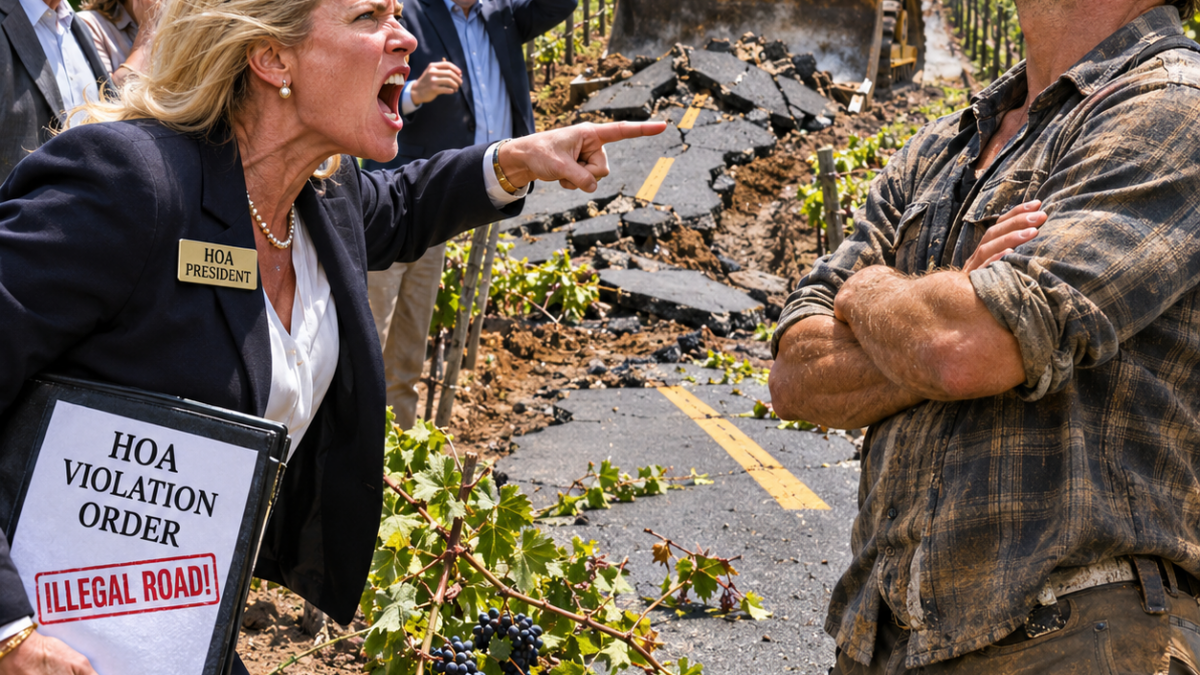
PART 2
I did not bulldoze the road that night.
That would have been emotionally satisfying and strategically stupid.
The Army had taught me that the easiest way to lose a position you are legally entitled to hold is to respond to provocation before you understand the battlefield, and as badly as I wanted to put a steel blade under that asphalt and peel it off my vineyard before sunrise, I knew Karen was waiting for exactly that kind of reaction.
She had already threatened me with arrest.
If I touched the road before establishing ownership, documenting damages, and putting the board on formal notice, she would spend the next HOA meeting describing me as an unstable veteran who had destroyed “community infrastructure.”
So I walked.
I measured.
I photographed.
My father’s old Nikon sat in the farmhouse closet, but I used my phone because the timestamps mattered.
Beginning of road.
Property line.
Destroyed rows.
Cut irrigation.
Grading damage.
Asphalt depth at shoulder.
Compaction.
Drainage change.
Oak tree.
Memorial location.
I took more than three hundred photographs.
Then video.
Slow.
Narrated.
“Row Five. Approximately twenty-seven mature vines removed.”
“Row Six. Main irrigation lateral severed.”
“Row Seven. Complete destruction.”
“Memorial marker location. Paved over.”
The more methodical I became, the angrier I felt.
But anger becomes useful when it has columns.
At 10:40 that night, I sat at my father’s oak desk.
His pipe tobacco smell was still in the wood.
I had spent six months in his house three states away watching his body become smaller while his voice remained stubbornly normal.
Pancreatic cancer took almost everything quickly.
Weight.
Energy.
Appetite.
Eventually mobility.
But not memory.
During his last lucid week, he asked:
“How do the south rows look?”
“Good.”
“Powdery mildew?”
“Under control.”
“Row Seven still weak?”
“Better.”
He nodded.
“Your grandfather always overcropped that section.”
I smiled.
“You’ve told me that forty times.”
“Then maybe you’ll remember.”
Those were the things dying people sometimes talk about.
Not grand speeches.
Not philosophy.
Irrigation.
Harvest.
A tractor belt.
A grape row.
Normal things because normal things are where life actually lived.
Now Row Seven was asphalt.
I opened my property file.
Deed.
Original 1954 survey.
Updated survey from when I retired.
County agricultural classification.
Tax map.
Every recorded easement.
There was no HOA easement.
No public right-of-way.
No fire-access grant.
Nothing.
My ten acres belonged to me.
Oak Haven Estates had been built fifty years later.
From the beginning, Karen had disliked that fact.
The development wrapped around two sides of my land like a horseshoe.
To her, my vineyard interrupted symmetry.
Their houses were beige.
My barn was weathered red.
Their grass was clipped.
My perimeter supported wildflowers.
Their landscaping came from approved plant lists.
Mine produced grapes.
When Oak Haven first broke ground, Karen started mailing me letters.
Unsightly compost.
Improper tractor noise.
Unapproved agricultural fencing.
Weeds.
She once called grape trellises “industrial visual clutter.”
Every time I answered with the same polite packet.
My deed.
County map.
No HOA membership.
No covenants.
No jurisdiction.
Certified mail.
Return receipt.
For five years we had maintained a cold war.
Then Dad got sick.
I stopped caring about Karen.
I hired Leo Ramirez, a local twenty-three-year-old who had helped me during harvest, to mow, check irrigation, keep vandals out, and call me if anything serious happened.
He had done that.
Mostly.
I called him the next morning.
He answered immediately.
“Mr. Thorne.”
“Leo.”
Pause.
“You saw it.”
“Yes.”
“I’m sorry.”
“What happened?”
He sounded sick.
“About two months ago they started marking.”
“Who?”
“Some contractor.”
“Did you talk to them?”
“Yes.”
“They said HOA had approval.”
“Did you call me?”
“I tried.”
I remembered.
Several missed calls during one week Dad had been hospitalized.
My phone stayed on silent except hospice and family.
“I should’ve kept calling.”
“No.”
I rubbed my forehead.
“Tell me everything.”
Leo had confronted the paving crew.
Karen appeared.
Showed him a board resolution and a preliminary map.
Told him the HOA had established an emergency access right.
Leo argued.
She threatened to have him removed for trespassing because he was “not the owner.”
He took photographs.
I straightened.
“You still have them?”
“Yeah.”
“Send everything.”
Twenty minutes later, my phone filled with images.
Survey paint.
Flags.
Grading equipment.
Vines piled beside the road.
A backhoe ripping out posts.
Karen talking with the contractor.
One photo froze me.
My grandfather’s granite marker sitting beside a machine before paving.
So it had not been accidentally buried.
They had seen it.
Removed it.
Then apparently put it back into the graded corridor and paved over it.
That detail changed the emotional temperature of the entire case.
I called the county recorder.
Then county planning.
Then Marcus Cole.
Marcus had served with me for ten years.
Army engineer officer.
Brilliant.
Annoyingly optimistic in dangerous situations.
After retirement, GI Bill.
Law school.
Property litigation.
Municipal fights.
Land-use cases.
When he answered:
“Jack Thorne.”
“Mark.”
“You sound terrible.”
“Dad died.”
His voice changed immediately.
“Jack.”
“Last week.”
“I’m sorry.”
“Thank you.”
“You okay?”
“No.”
“Fair.”
I looked through the window toward the black road.
“I also have an HOA that paved through my vineyard.”
Silence.
“Say that again.”
“They built a road.”
“On your parcel?”
“Yes.”
“With an easement?”
“No.”
“Recorded right-of-way?”
“No.”
“Condemnation?”
“No.”
“Acquisition?”
“No.”
“Your permission?”
“No.”
Another pause.
Then:
“I’m suddenly furious on your behalf.”
“They destroyed close to two hundred vines.”
“Photos?”
“Hundreds.”
“Survey?”
“Old one and retirement update.”
“Get a current certified one.”
“Already planning.”
“Contractor?”
“Likely related to Karen.”
“You know that?”
“Not confirmed.”
“Good.”
“Keep saying ‘not confirmed.’”
I smiled despite everything.
“Same Marcus.”
“Same Jack.”
Then:
“Send me deed, surveys, every HOA letter, photos, board resolution if you have it.”
“I don’t.”
“Request it.”
“What do I do about the road?”
“Nothing.”
“I hate that answer.”
“I know.”
“Do not remove it yet.”
“Yet?”
“Yet.”
That word helped.
My first formal demand went out that afternoon.
Ten pages.
Measured.
Professional.
Parcel identification.
Ownership history.
No easement.
No HOA membership.
Photographs.
Preliminary damages.
Destroyed mature vines.
Agricultural losses.
Irrigation damage.
Soil compaction.
Memorial damage.
Restoration.
I gave them ten business days to submit a removal plan and compensation proposal.
Every board member received a copy.
Karen.
Gerald, treasurer.
Brenda, secretary.
Two at-large directors.
Certified.
Signed receipts.
Ten days.
Nothing.
Day eleven:
A violation notice appeared on my farmhouse door.
**$250 — FAILURE TO MAINTAIN LANDSCAPE CONSISTENT WITH OAK HAVEN COMMUNITY AESTHETIC STANDARDS.**
Reason:
**DAMAGED / DISTURBED VEGETATION ADJACENT TO COMMUNITY PATH.**
I read it three times.
They destroyed my vineyard.
Then fined me for the destroyed vineyard.
I called Marcus.
He listened.
Then said:
“Jack?”
“Yes?”
“Please scan that before you do anything creative with it.”
“I was considering framing it.”
“Excellent.”
“That was sarcasm.”
“I know.”
The next board meeting was nine days away.
I attended.
Fifteen residents.
Folding chairs.
Coffee.
Air freshener.
Karen at the front.
Gerald beside her.
He had the posture of a man trying to become invisible.
Brenda looked irritated before I even spoke.
The agenda included:
Holiday decoration timing.
Sprinkler schedules.
Mailbox refinishing.
Then homeowner comments.
I stood.
“Jack Thorne.”
Karen’s jaw hardened.
“I own the ten-acre agricultural parcel adjacent to Chestnut Lane.”
Murmurs.
“I am not an HOA member.”
More murmurs.
“I’m here because this board authorized construction of a ten-foot paved road approximately two hundred yards into my private vineyard.”
Karen leaned toward microphone.
“Your correspondence has been sent to counsel.”
“I’m asking the board.”
“This is not a litigation forum.”
“Fine.”
I held up the violation.
“Then explain why your board fined me for vineyard damage caused by your contractor.”
People started whispering.
Gerald stared down.
Karen said:
“You failed to maintain the area.”
“You paved it.”
“That area is now maintained as part of the community improvement corridor.”
“It is my property.”
“We disagree.”
“No.”
I kept my voice level.
“You disagree with the deed.”
Karen’s eyes flashed.
“The board relied on developer documents demonstrating a future access route.”
“A dotted line on a preliminary sketch?”
Her expression changed.
Barely.
That was useful.
I continued.
“Where is the recorded easement?”
Silence.
“County book and page?”
Nothing.
“Instrument number?”
Nothing.
“Grantor?”
Nothing.
Karen said:
“Our counsel has advised—”
“Then show me.”
“That material is privileged.”
A woman in the back raised her hand.
Linda Morales.
I would learn her name later.
“Karen?”
Karen looked irritated.
“What?”
“You said this road connected us to the park.”
“Yes.”
Linda looked toward me.
“But it stops at Mr. Thorne’s oak tree.”
“It is Phase One.”
“Where does Phase Two go?”
Karen stiffened.
“The project is ongoing.”
“Across whose land?”
No answer.
Linda shrank slightly under Karen’s stare.
I saw the entire strategy.
Different stories.
To one homeowner:
Fire lane.
Another:
Walking trail.
Another:
Park connection.
Everyone voted for an idea.
Nobody knew what the idea really was.
I faced the room.
“Every member of this association should understand something.”
Karen grabbed gavel.
“Mr. Thorne—”
I continued.
“If I file suit, I will not only name Karen Prescott.”
People went silent.
“The association itself authorized spending.”
“Association insurance may be involved.”
“Association legal fees will be involved.”
“And if intentional misconduct is established, board members may face personal exposure.”
Gerald looked up sharply.
I saw sweat near his collar.
“I estimate restoration and damages already exceed six figures.”
Someone whispered:
“Jesus.”
Karen hammered the gavel.
“That is enough.”
I looked at the homeowners.
“You paid for a road built across someone else’s property.”
That landed.
Karen stood.
“You are removed from this meeting.”
I nodded.
“I’ll go.”
At the door, I turned.
“Now that every board member here has been told directly that the road is disputed private property, any continued occupation becomes harder to call an innocent mistake.”
Gerald closed his eyes.
Karen’s face went red.
I left.
Marcus called the next morning.
“Good meeting?”
“How’d you know?”
“Three homeowners emailed my office.”
I stopped.
“What?”
“One asked if association members could be personally assessed for a judgment.”
“Another asked whether board members had D&O coverage.”
“Third asked if they should hire their own lawyer.”
I smiled.
“First charge.”
“What?”
“Nothing.”
“Combat engineer nonsense.”
“Possibly.”
“Survey?”
“Today.”
Henderson Surveying arrived at nine.
The owner, Cal Henderson, was sixty-three, sunburned, thin, and spoke as though unnecessary words cost money.
He had known Dad.
“Sorry about your father.”
“Thank you.”
“He was stubborn.”
“Yes.”
“You’re worse.”
“I’ve heard.”
Cal studied my deed.
1954 survey.
Updated survey.
Developer plat.
Then went to work.
GPS equipment.
Total station.
County monuments.
Old pins.
By early afternoon, he called me to Chestnut Lane.
A pink stake stood in the asphalt five feet beyond the cul-de-sac curb.
Cal tapped it.
“Property line.”
I looked down the road.
“So everything beyond?”
“Yours.”
“All of it?”
“All of it.”
“No disputed strip?”
“No.”
“No easement line?”
“No.”
“You sure?”
Cal stared at me.
“Jack.”
“Right.”
He drove another stake twenty feet down.
Then another.
By evening, pink flags ran down the entire road like a row of indictments.
Every foot of asphalt sat inside my parcel.
Karen arrived forty-eight minutes later.
Her SUV stopped so hard the suspension rocked.
She marched toward the first stake.
“What are these?”
“Survey markers.”
“You are defacing HOA property.”
I was on the porch.
Coffee.
Deliberate.
“Certified survey.”
“These are false.”
Cal turned from his instrument.
“You calling my survey false?”
Karen looked at him.
“Who are you?”
“Cal Henderson.”
“Licensed surveyor.”
“This land is subject to HOA access.”
Cal pointed.
“Show me recorded easement.”
Karen opened her mouth.
Closed it.
“The developer map—”
“Not title.”
“The board—”
“Not title.”
“We were advised—”
“Not title.”
I almost felt sorry for her.
Almost.
She pointed toward asphalt.
“This road was legally authorized.”
Cal shrugged.
“Not by any instrument I can find.”
I raised my phone.
“Marcus is listening.”
Karen looked at me.
“You’re recording me?”
“No.”
“He’s on speaker.”
Marcus’s voice:
“Ms. Prescott, Marcus Cole.”
“You have been formally notified that your association is maintaining an unauthorized improvement on Mr. Thorne’s property.”
“Our counsel—”
“Should call me.”
“I strongly recommend that no additional construction occur.”
“We will be filing for injunctive relief, ejectment, property damages, and quiet title.”
Karen’s face finally showed fear.
Small.
But unmistakable.
She turned and left.
The lawsuit followed.
Seventy pages.
Oak Haven Estates HOA.
Karen individually.
Gerald.
Brenda.
Other directors.
Trespass.
Property destruction.
Slander-of-title-related claims where applicable.
Private nuisance.
Civil conspiracy allegations tied to knowingly proceeding without ownership.
Punitive damages request.
Restoration.
Vine loss.
Future production loss.
Soil rehabilitation.
Irrigation.
Memorial.
Attorney fees.
The number at the bottom was large enough that Oak Haven started paying attention immediately.
Marcus explained:
“This isn’t a demand that every homeowner personally write you a check.”
“I know.”
“But politically, they’re going to see the maximum exposure.”
“That is part of the point.”
“Good.”
We also demanded documents.
Everything related to the road.
Minutes.
Draft minutes.
Emails.
Texts preserved as corporate communications where available.
Plat maps.
Planning communications.
Bid packages.
Invoices.
Checks.
Contractor ownership.
Consultants.
Special assessment material.
Karen’s lawyer sent almost nothing.
Thin folder.
Heavily redacted minutes.
One contractor bid.
Karen’s brother-in-law’s company.
No competing bids.
Letter saying remaining records were privileged or unavailable.
Marcus called.
“They’re hiding.”
“Or incompetent.”
“Could be both.”
He filed motion to compel.
Before hearing, we examined Karen’s sworn affidavit.
That was when I saw the map.
Grainy photocopy.
Dotted line across my vineyard.
**POTENTIAL FUTURE ACCESS**
I remembered it.
Dad and I had attended the county zoning meetings when Oak Haven was proposed.
Developer wanted future connection through our property.
Dad stood at the microphone and said:
“No.”
Not angrily.
Just no.
County planning ultimately approved the subdivision with a specific condition:
No access through Thorne agricultural parcel without separately acquired lawful easement.
I still had the planning resolution.
So did the county.
Karen had attached the preliminary sketch.
Not the final resolution.
Marcus stared at both.
Then laughed.
“What?”
“She submitted this under oath?”
“Yes.”
“And this final county document expressly rejects that access?”
“Yes.”
“Jack.”
“Yes?”
“She may have just turned a property case into a credibility disaster.”
At motion hearing, Karen’s lawyer argued discovery was excessive.
Marcus stood.
Calm.
“Your Honor, the plaintiff board claims good-faith reliance upon a supposed access plan.”
He gave the judge Karen’s affidavit.
Preliminary sketch.
Then certified final county resolution.
The judge read.
Her expression changed.
She looked at HOA counsel.
“Why is the preliminary sketch attached while the final approval condition is not?”
Counsel shifted.
“We believe there may have been misunderstanding—”
“Did your client review the final resolution before filing this affidavit?”
“I cannot answer that today.”
“You might want to find out.”
Then:
“Motion to compel granted.”
Every requested category relevant to the claims.
Forty-eight hours for initial production.
Additional schedule thereafter.
The boxes arrived.
Actual boxes.
Messy.
Unsorted.
Marcus’s conference room became a battlefield I understood.
Arthur Chen—not my lawyer Marcus, but an Oak Haven homeowner who had spent thirty years in corporate accounting—joined us after Marcus cleared conflict issues.
Arthur adjusted his glasses.
“I’ve wanted to see these books for years.”
“Enjoy.”
“I doubt I will.”
He was right.
Emails first.
Gerald:
**Karen, I don’t think we have a recorded easement. We need a survey and legal review before spending association money.**
Karen:
**Gerald, stop being such a worrywart. The developer map is enough. Thorne isn’t even here. Better to ask forgiveness than permission. Get it done before he gets back.**
I read that line three times.
Dad was dying.
She knew I was gone.
That mattered.
Another email:
Brenda:
**The vineyard side looks terrible anyway. The path will improve the whole view.**
Karen:
**Exactly. Once the corridor is established, future expansion becomes easier.**
Future expansion.
There it was.
Not just emergency access.
A foothold.
We found communications pitching the project differently to different residents.
Fire safety.
Jogging.
Park access.
Property value enhancement.
No consistent purpose.
Then contractor records.
Prescott Paving Solutions was not named Prescott.
It had a generic name.
But ownership traced to Karen’s brother-in-law.
One bid.
No competitive process.
Almost twice regional market range according to the independent estimates Marcus obtained.
Then:
Twenty-thousand-dollar “project coordination and consulting fee.”
Recipient:
A small LLC.
Registered address connected to Karen.
Maiden name in the filing history.
Arthur removed his glasses.
“Jack.”
“What?”
“This isn’t just sloppy governance.”
Marcus raised a hand.
“Careful.”
Arthur nodded.
“Potential self-dealing.”
“Better.”
“Potential misuse of funds.”
“Yes.”
Arthur looked furious.
“These people paid a special assessment for this.”
“Correct.”
“And she may have paid herself a consulting fee on a project she knew lacked easement authority.”
“That is what documents appear to suggest.”
Marcus smiled slightly.
“Now you sound like a lawyer.”
“I hate that.”
The next email was worse.
Gerald:
**I’m serious. If Thorne comes back and challenges this, we could be personally exposed.**
Karen:
**He’ll complain and then calm down. He’s grieving and he’s never involved in the community anyway. Once asphalt is down, he won’t spend money removing it.**
I stopped reading.
Sarah was visiting that weekend.
She sat beside me.
“What?”
I handed her the email.
Her eyes filled.
“She knew about Dad?”
“Apparently.”
“She knew you were gone because he was dying?”
“Yes.”
Sarah whispered:
“She used it.”
I could not answer.
That was the moment the case stopped being satisfying.
I had expected arrogance.
I had not expected timing.
Maybe Karen did not understand what caregiving looked like.
Maybe she did.
But she knew enough to write:
**He’s grieving.**
And still decided that made the project safer to force through.
I walked outside Marcus’s office.
Couldn’t breathe properly for a few minutes.
Dad’s final hospital room came back.
The plastic cup of ice chips.
The machines.
His hand.
The last time he opened his eyes fully and said:
“Go home when this is over.”
I had.
And found asphalt.
Marcus came outside.
“You okay?”
“No.”
“Want to stop?”
“No.”
“I mean today.”
I looked at him.
“No.”
He nodded.
“Then we finish today.”
By evening, evidence structure was complete.
Road knowingly built without established easement.
Internal warnings ignored.
Timing accelerated while I was absent.
Noncompetitive related-party contractor.
Potentially inflated pricing.
Consulting payment linked to Karen.
Misleading communications to homeowners.
Questionable affidavit.
The legal landscape had changed.
Marcus drafted settlement demand.
Road removal.
At HOA expense.
Contractor chosen by me.
Full vineyard restoration.
Soil decompaction and remediation.
Irrigation replacement.
Mature vine replacement where feasible.
Professional viticulture consulting.
Memorial restoration.
Legal fees.
Survey fees.
Damages.
Two hundred thousand dollars punitive component.
Karen’s resignation.
Gerald’s resignation.
Brenda’s resignation.
Governance reforms.
I read the figure.
“Two hundred?”
“You asked for punitive damages.”
“I know.”
“What if they accept?”
I thought.
Then:
“I don’t want it.”
Marcus stared.
“Then why sue for it?”
“I want them to feel it.”
“That’s not an answer.”
I looked at him.
“Veterans fund.”
He waited.
“If money comes from this, after restoration and legal costs, I want a substantial portion going to local veterans who need housing and employment help.”
Marcus smiled.
“Your father would approve?”
“He’d say I was being dramatic.”
“Probably.”
Settlement packet went out.
Alongside separate notice preserving evidence for potential referral to appropriate authorities.
I did not threaten federal prosecution personally.
Marcus was careful.
Evidence would go where it needed to go if settlement did not resolve the civil case.
HOA counsel called within hours.
Meeting requested.
Neutral conference room.
Karen.
Gerald.
Brenda.
Their attorney.
Marcus.
Me.
Karen looked smaller than usual.
No muumuu.
Navy suit.
Hands tight together.
Her attorney began:
“My clients are prepared to resolve the matter.”
Marcus said:
“Good.”
“Most terms are acceptable.”
“Most is not enough.”
“The resignations—”
“No.”
Karen finally spoke.
“You have made this personal.”
I looked at her.
“You paved over my grandfather’s memorial.”
“That was not intentional.”
“Your crew photographed it before paving.”
Her mouth closed.
“You knew I was caring for my dying father.”
Her eyes moved away.
“You wrote about it.”
Gerald looked at her.
That was interesting.
Maybe he had not seen that email.
Karen said:
“I was told the project had to proceed.”
“By whom?”
Silence.
I continued.
“You told Gerald to do it before I came home.”
Her attorney touched her arm.
“Karen.”
Marcus slid evidence summary forward.
“Every term.”
“Road.”
“Restoration.”
“Damages.”
“Fees.”
“Resignations.”
“Or we proceed.”
Karen stared at the agreement.
Then:
“If I resign, this community falls apart.”
Gerald let out the smallest sound.
Almost a laugh.
Karen turned.
“What?”
Gerald finally looked at her.
“I warned you.”
She froze.
“You what?”
“I warned you not to build.”
“You signed the checks.”
“Because you told us counsel approved it.”
“I said the board approved it.”
“You told me the easement existed.”
“It was on the map.”
“The preliminary map.”
Their attorney closed his eyes.
Brenda whispered:
“Stop.”
Karen’s authority was collapsing in real time.
She looked around.
No allies left.
Then signed.
Gerald signed.
Brenda signed.
Road legally became what it had always physically been:
An unauthorized structure on my property.
And I received authority under settlement to remove it.
The special HOA meeting happened four days later.
Karen did not attend.
Gerald and Brenda submitted resignations.
Residents looked stunned.
Arthur became interim treasurer.
Linda joined governance committee.
Another homeowner served as temporary president.
Marcus attended only long enough to explain settlement obligations.
One man raised his hand.
“Are dues going up because of this?”
The interim president answered:
“Insurance will cover some portions, reserve funds some, and recovery actions may apply.”
Another:
“Why did we build the road?”
Silence.
Linda spoke.
“Because we were told it was a fire lane.”
A woman across room:
“We were told park access.”
Another:
“I was told jogging path.”
People started looking at one another.
That was when they understood.
Karen had not led consensus.
She had assembled separate assumptions.
After meeting, Linda found me outside.
“I’m sorry.”
“You didn’t pave it.”
“I voted for assessment.”
“You were lied to.”
“I should’ve asked more.”
“Next time ask.”
She nodded.
“I will.”
The bulldozer arrived Thursday morning.
Caterpillar D6.
Lowboy trailer.
Yellow steel.
Heavy enough that the sound alone brought people to windows.
I had arranged dump trucks through an old Army buddy named Ray Foster.
Front-end loader.
Crew for traffic safety.
County agricultural restoration permit.
Utility locates.
Everything documented.
No cowboy demolition.
No uncontrolled ripping.
If I was going to remove Karen’s illegal road, I was going to do it more lawfully than she built it.
Sarah showed up before sunrise.
“You’re really doing this yourself?”
“I know the machine.”
“You’re sixty-one.”
“So?”
“Nothing.”
“That sounded like something.”
“Try not to become a YouTube accident.”
“Encouraging.”
Marcus arrived.
He stared at D6.
“You know, when I said ‘remove road,’ I imagined contractor.”
“I am the contractor.”
“You own a contracting company?”
“Settlement says contractor of my choosing.”
“You chose yourself.”
“Correct.”
“You’re impossible.”
“Legally?”
“Unfortunately.”
At 7:30, I climbed into cab.
The controls felt familiar.
Not identical to machines from Army years.
Close enough.
Engine started.
Deep diesel vibration through seat.
I positioned blade at first pink survey flag.
That line mattered.
HOA cul-de-sac ended there.
My land began there.
The road began there.
I lowered blade.
Steel touched asphalt.
For one second, I stopped.
Thought about Dad.
Grandfather.
Rows.
Hospital.
Karen’s laugh.
Then moved forward.
The asphalt cracked.
Not dramatically at first.
A line.
Then another.
Blade bit deeper.
Entire slab lifted.
Black surface folded upward.
Broke.
Rolled.
Beneath it appeared pale compacted base aggregate.
Then, deeper:
Soil.
My soil.
The smell reached cab.
Damp earth and diesel.
I kept moving.
Ten feet at a time.
Asphalt buckled.
Loader gathered debris.
Dump trucks carried it away.
Residents gathered at cul-de-sac.
Phones out.
Kids watched.
Someone applauded.
I ignored them.
This was not performance.
Every pass was restoration.
Hour in, half road gone.
Then Karen arrived.
Of course.
Her SUV stopped.
She got out.
Hair disheveled.
No authority left.
No title.
Still Karen.
She shouted.
I could not hear over engine.
I idled down.
“What?”
“What are you doing?”
“Removing road.”
“You can’t.”
I looked at her.
“The settlement you signed says otherwise.”
“This is community property!”
“No.”
“It was built with community funds.”
“Still no.”
“You are destroying hundreds of thousands of dollars of infrastructure.”
“It was built on my land.”
“You’re doing this to humiliate me.”
That stopped me.
I switched engine to low idle.
“No.”
“You want everyone watching.”
“I didn’t invite them.”
She pointed toward phones.
“You love this.”
I looked at road.
Then at her.
“My father died.”
She froze slightly.
“I came home from his funeral and found asphalt through the last thing we were supposed to preserve together.”
Her face changed.
“I asked you to remove it.”
“You laughed.”
“I told you you had no easement.”
“You threatened arrest.”
“I sent formal demand.”
“You fined me for damage you caused.”
“You knew why I was gone.”
Karen’s eyes lowered.
“That email was taken out of context.”
“What context makes ‘get it done before he gets back’ acceptable?”
No answer.
I continued.
“I’m not doing this to humiliate you.”
“I’m doing it because the road has to leave.”
“You signed that.”
“The judge recognizes my title.”
“The survey recognizes my title.”
“The county recognizes my title.”
“Your own board now recognizes my title.”
I pointed toward asphalt.
“The only person still pretending this belongs to you is you.”
Her face crumpled with rage.
“I’ll call police.”
“Call them.”
“You’re vandalizing association property.”
“Call Marcus too.”
“He’ll explain your settlement.”
She looked toward crowd.
No one supported her.
Not even Gerald.
Not Brenda.
Just residents who had spent money on a project they now understood had been sold under false pretenses.
Karen turned.
Went back to car.
Then stopped.
“You ruined my life.”
I stared at her.
“No.”
“You made decisions.”
“They arrived.”
She flinched.
Then left.
I restarted D6.
By sunset, road was gone.
Not hidden.
Gone.
Asphalt removed.
Base material excavated.
Compacted layer ripped and scarified.
I stopped before going too deep.
Soil specialist would handle rehabilitation.
At memorial location, we worked carefully by hand.
Under broken asphalt and crushed base, granite appeared.
Corner first.
Then name.
**THOMAS THORNE
1924–1998
HE GREW WHAT HE LOVED**
My grandfather.
The stone had a chip.
Otherwise intact.
I knelt beside it.
Sarah stood behind me.
Neither of us spoke.
I brushed dirt away.
For months I had imagined the most satisfying part would be seeing Karen lose control.
It wasn’t.
It was seeing that name again.
Ray, my trucking friend, removed his cap.
Nobody filmed.
I appreciated that.
We lifted the marker.
Set it safely aside for restoration.
Then finished road removal.
When I climbed down, my arms were tired.
Back hurt.
Dust covered everything.
Linda approached with casserole.
Arthur carried bourbon.
“Thought you might be hungry.”
“I am.”
Arthur handed bottle.
“Thought you might be thirsty.”
“Not while operating heavy equipment.”
“Later.”
“Good.”
Linda looked over rough earth.
“It’s strange.”
“What?”
“I got used to road.”
“It was there only months.”
“I know.”
“That’s what scares me.”
I understood.
Illegal things can become normal surprisingly quickly if they look permanent.
Asphalt looks permanent.
Authority looks permanent.
Neither always is.
The next morning, soil specialist arrived.
We excavated contaminated aggregate.
Tested compaction.
pH.
Organic matter.
Drainage.
Vineyard soil is not just dirt.
Years of root systems.
Microbiology.
Structure.
One road had compressed all of it.
Restoration would take time.
I contacted viticulturist recommended by regional growers.
Dr. Elena Navarro.
She walked the corridor.
Kneeling.
Breaking clods.
Looking at surviving roots.
“You won’t get original production back quickly.”
“I know.”
“Mature vines cannot simply be replaced like shrubs.”
“I know.”
“Some heritage line can be propagated?”
“Yes.”
“You have cuttings elsewhere?”
I almost laughed.
Dad had insisted.
Years earlier, we had supplied propagation material to another vineyard forty miles north.
Elena smiled.
“So genetic line survives.”
“Yes.”
“Then we rebuild.”
Those words hit harder than expected.
We rebuild.
The neighborhood showed up Saturday.
Unplanned.
Linda.
Arthur.
Eight others.
Shovels.
Rakes.
Wheelbarrows.
Children.
Someone brought sandwiches.
Someone brought coffee.
I stood at property line confused.
Arthur said:
“Don’t make it weird.”
“What?”
“We came to help.”
“You don’t owe me labor.”
“No.”
“We owe ourselves better than what happened.”
That was different.
I let them in.
We spread compost.
Worked amendment into topsoil.
Removed stones.
Rebuilt irrigation trenches.
Straightened surviving trellis.
Kids collected pieces of asphalt we missed.
One boy held up chunk.
“Can I keep it?”
His mother said:
“Why would you want that?”
“Souvenir.”
I said:
“Take two.”
By afternoon, people who had once looked at my vineyard as an unsightly old farm were standing ankle-deep in its soil.
Linda asked about vines.
“How long until grapes?”
“Replacement vines?”
“A few years.”
“Why so long?”
“Wine grapes are patient.”
Arthur said:
“Sounds terrible.”
“It is.”
People laughed.
We reset Grandpa’s marker.
New stone base.
Not directly where road had crossed.
Near oak.
More visible.
Sarah placed small bunch of wildflowers.
“He’d hate this fuss.”
“Yes.”
“He’d say marker doesn’t grow grapes.”
“Yes.”
She smiled through tears.
We stood together.
I realized that in defending inheritance, I had gained something Dad never expected.
Neighbors.
He had always considered the subdivision an invasion.
Honestly, so had I.
After Karen, I stopped seeing houses.
I saw Linda.
Arthur.
The kids.
People.
That did not erase the trespass.
It changed what came afterward.
Settlement money arrived.
Restoration costs.
Fees.
Damages.
Two hundred thousand punitive component.
I did what I had told Marcus.
Thorne Family Veterans Fund.
Local VFW administered.
Housing assistance.
Emergency rent.
Work boots.
Certification fees.
Transportation for veterans starting jobs.
Some people called that generous.
It wasn’t entirely.
I did not want Karen’s money becoming part of my vineyard.
I wanted vines restored with restoration funds.
I wanted punitive money to become something useful somewhere else.
My father would have approved.
Probably after asking how much tax paperwork it created.
The investigation continued without me driving it.
Evidence from discovery had been referred.
Consulting fee.
Related-party paving contract.
Electronic communications.
Financial records.
Months passed.
Then letter.
U.S. Attorney’s Office.
I opened it at kitchen table.
Karen had pleaded guilty to one count related to wire fraud after cooperation and restitution.
Probation.
Fine.
Community service.
Restitution.
Barred from serving on boards.
No prison under agreement.
I read it once.
Then twice.
Sarah was visiting.
“Well?”
I handed it to her.
She read.
“Does this feel good?”
I thought.
“No.”
“Bad?”
“No.”
“Then?”
“Finished.”
That was it.
Finished.
Karen and her husband sold their home.
Moved.
I never saw her again.
Oak Haven elected new board.
Arthur agreed to serve as treasurer.
Only after residents promised term limits.
“Why me?”
“Because you read numbers.”
“I hate people.”
“Perfect.”
He published detailed budgets.
Contracts required competitive bids.
Related-party transactions disclosed.
Meeting minutes actually described votes.
Emergency projects required documented authority.
Property projects required title review.
Someone proposed naming that policy after me.
I said absolutely not.
They called it:
**Private Property Verification Standard.**
Boring.
Excellent.
The new board also killed the road idea permanently.
No Phase Two.
No park connection.
No fire-lane fiction.
Cul-de-sac remained cul-de-sac.
County fire access continued through proper public routes.
Nobody died.
Property values did not collapse.
Joggers found other roads.
Civilization survived.
The first replacement vines arrived in spring.
Heritage Zinfandel clones.
Elena supervised.
Small.
Green.
Almost insultingly unimpressive compared with mature trunks Karen had destroyed.
I held one plant.
Roots wrapped.
Sarah said:
“That’s it?”
“That’s it.”
“Dad’s vines were huge.”
“Twenty-year vines are.”
“How long before these look right?”
“Years.”
She sighed.
“I hate patience.”
“So did Dad.”
We planted.
Row by row.
Exactly through former road corridor.
Not decorative.
Agricultural.
A deliberate reversal.
Where asphalt had dictated movement, vines now returned.
The first year, survival mattered more than fruit.
We removed clusters to push root growth.
Linda was horrified.
“You’re cutting grapes off?”
“Yes.”
“Why?”
“Plant needs strength.”
“But those are grapes.”
“Tiny bad grapes.”
“They’re still grapes.”
Arthur said:
“Don’t argue with vineyard people.”
Second year:
Stronger trunks.
Trellis training.
Third:
Small crop.
Fourth:
Real promise.
Every season reduced road’s memory.
Grass grew between rows.
Soil softened.
Earthworms returned.
I knew because Elena got unusually excited about them.
“Biological recovery.”
Arthur stared at worm.
“Remarkable.”
“You accountants lack wonder.”
“I have spreadsheets.”
One year after road removal, vines produced first small clusters.
Not enough for commercial wine.
Enough to taste.
I picked one grape.
Sweet.
Acid.
Young-vine simplicity.
Still:
Zinfandel.
I carried small cluster to grandfather’s marker.
Felt stupid.
Did it anyway.
“Back.”
That was all I said.
The vineyard expanded modestly.
Not because I wanted bigger business.
Because I wanted resiliency.
I propagated replacement stock.
Maintained backup blocks elsewhere.
Documented.
Everything Karen did reinforced my belief that legacy without records is vulnerable.
Deeds.
Surveys.
Plant genetics.
Contracts.
History.
Memory.
All need redundancy.
My father had preserved cuttings without calling it strategy.
He just believed you never keep your best genetics in one place.
Same reason soldiers do not put all supplies in one truck.
Same reason good communities do not put all authority in one Karen.
Redundancy.
Accountability.
Backup.
The veterans fund grew.
The local paper wrote a story.
They wanted headline about bulldozer.
I asked them not to.
Reporter looked disappointed.
“That’s the best part.”
“No.”
“What’s better?”
“People helped replant.”
He stared.
“Less clickable.”
“Probably.”
Final article:
**VINEYARD DISPUTE ENDS WITH COMMUNITY RESTORATION AND VETERANS FUND**
Dad would have mocked it.
I liked it.
The bulldozer story spread anyway.
Stories simplify.
According to one version, I came home at midnight, saw road, started bulldozer immediately, and Karen chased me in a golf cart screaming.
False.
Another claimed I crushed HOA sign.
False.
Another said police arrested Karen on site.
False.
Truth was slower.
Letters.
Survey.
Meetings.
Court.
Discovery.
Settlement.
Then bulldozer.
I corrected people when I could.
“Why ruin a good story?”
Arthur once asked.
“Because truth already won.”
He nodded.
“Annoyingly principled.”
Years passed.
Dad’s desk stayed in office.
I kept one photograph from road days.
Not Karen.
Not bulldozer.
The photograph Leo took before paving.
Grandfather’s marker beside removed vines.
I kept it because it reminded me what was damaged before anyone understood legal significance.
I also kept one piece of asphalt.
The boy returned his souvenir eventually.
His mother made him.
I put it on shelf.
Sarah said:
“You said you didn’t want monuments.”
“It’s evidence.”
“The case is closed.”
“It’s paperweight.”
“Ugly paperweight.”
She was right.
Eventually I threw it away.
That felt good.
Oak Haven became ordinary.
Best outcome.
New board made mistakes.
Residents complained.
Budgets debated.
People argued over pool hours.
Normal democracy is irritating.
Still better than dictatorship.
Linda served one term.
Arthur two.
Then both left board voluntarily.
I attended one HOA meeting years later.
Invited.
The president started:
“Before we begin, Mr. Thorne, thank you for—”
I raised hand.
“No speech.”
Laughter.
They discussed drainage.
Real drainage.
Shared retention pond.
Engineer presented.
Property boundaries verified.
I almost applauded.
After meeting, young resident approached.
“You’re the vineyard guy.”
“Apparently.”
“My parents told me about road.”
“Hope they told it accurately.”
“They said Karen literally stole your land.”
“Temporarily occupied.”
“That sounds less exciting.”
“It’s more accurate.”
He looked toward vineyard.
“Can I buy wine?”
“Not licensed for random driveway retail.”
He laughed.
“Rules.”
“Good rules.”
That distinction became recurring joke.
I never became anti-rule.
Combat engineers love rules when rules correspond to reality.
Load limits.
Slope.
Drainage.
Clearances.
Explosive safety distances.
Useful standards.
What Karen practiced was not standards.
It was preference disguised as authority.
That difference matters.
The vineyard improved.
I began producing small batches again.
First bottle from restored rows came seven years after road.
I labeled it:
**ROW SEVEN — 1954**
Not:
Victory.
Not:
Karen.
Not:
Bulldozer.
1954.
Year family formally surveyed vineyard layout.
I poured first glass at kitchen table.
Sarah.
Marcus.
Linda.
Arthur.
Leo.
Elena.
Ray.
People who helped.
I raised glass.
No speech prepared.
Arthur said:
“Oh God, he’s going to get emotional.”
“Quiet.”
Laughter.
I looked around.
“To Dad.”
Sarah’s eyes filled.
Everyone raised glasses.
“To Dad.”
Wine was good.
Not perfect.
A little tight.
Needed time.
Fitting.
We drank.
After dinner, Marcus walked rows with me.
“You know what I remember?”
“What?”
“First phone call.”
“What about it?”
“You said ‘I’ve got an HOA that built a road through my vineyard.’”
“Yes.”
“I thought you were exaggerating.”
“I don’t exaggerate.”
“You absolutely do.”
“Rarely.”
He stopped near memorial stone.
“You did good.”
“Legally?”
“As person.”
I looked at him.
“That sounds expensive.”
“Consultation free.”
We stood there.
He said:
“You ever wish you had bulldozed it first night?”
I thought.
“Every day for first month.”
“And now?”
“No.”
“Why?”
“Would have made case about my reaction.”
“Instead of their action.”
“Exactly.”
Marcus smiled.
“Maybe you learned something in Army.”
“Possibly.”
That became advice I gave others.
When someone crosses your line, first instinct is often to cross theirs harder.
Sometimes necessary.
Often costly.
Document first.
Understand.
Then act from strongest position.
Force applied at correct time achieves more with less damage.
Engineering principle.
Legal principle.
Life principle.
The emotional part took longer to heal.
For years, returning from trips gave me strange anxiety.
I would turn onto Chestnut Lane and look for something changed.
Fence.
Road.
Equipment.
I hated that.
Karen had made home feel vulnerable.
Eventually that faded.
One autumn I traveled two weeks.
Returned.
Nothing happened.
Just leaves.
I laughed alone in truck.
Normalcy is underrated.
My relationship with Dad’s memory changed too.
For months after his death, vineyard was grief.
Every row was him.
Every tool.
Every mistake reminded me he would have noticed.
Road compounded it.
Made me feel I had failed while away.
Intellectually I knew better.
Emotionally, less so.
One evening Sarah found me staring at restored Row Seven.
“You know Dad would be mad at you.”
“For?”
“Thinking this was your fault.”
“I don’t.”
“You do.”
I looked at her.
She continued.
“You were with him.”
“You were supposed to be with him.”
“Farm survived.”
“Vines came back.”
“You did not abandon anything.”
That sentence broke something loose.
Karen called property neglected because I was caring for father.
I had internalized tiny piece of that accusation.
Not rationally.
But grief is not rational.
Sarah hugged me.
I let her.
After that, vineyard felt less like proof and more like home again.
The memorial stone became gathering spot.
Not shrine.
We restored chip.
Added no new inscription.
Dad did not have marker there.
His ashes were scattered partly along oak line per wishes.
One windy morning, I carried small urn with Sarah.
No ceremony.
Just us.
She said:
“He’d complain we chose wrong wind.”
“He complained about everything.”
“True.”
We scattered.
Some came back at us.
We laughed until we cried.
That memory finally overtook asphalt.
Good.
The veterans fund helped first recipient that winter.
Former Marine.
Eviction notice.
New job starting in three weeks.
Fund covered rent gap.
Later he came to vineyard.
“Wanted to thank you.”
“You don’t owe me.”
“I know.”
“Then?”
“Still wanted to.”
He looked at rows.
“This is where money came from?”
“In a weird sense.”
“What happened?”
“HOA built road.”
He stared.
“Through grapes?”
“Yes.”
“Then paid damages?”
“Yes.”
“And you donated some?”
“Yes.”
He shook head.
“That is weird.”
“Correct.”
He volunteered at harvest.
Then returned next year.
Community grows strangely.
Karen intended road to connect subdivision physically.
Instead, illegal road connected people after removal.
I appreciated irony.
The HOA hired ethics consultant.
Arthur hated phrase.
“Do we need a consultant to tell us not to steal land?”
“Apparently.”
Policies improved.
Board members received training.
Conflict-of-interest declarations.
Counsel review for property acquisition.
Competitive procurement.
No major construction without recorded rights.
Again:
Boring.
Excellent.
The old road proposal survived in archived minutes.
Future boards could see.
One president asked whether to remove Karen’s name.
“No.”
“Why?”
“History should be accurate.”
“Even bad?”
“Especially.”
Not revenge.
Memory.
Institutions that erase failures repeat them beautifully.
So minutes stayed.
Email preservation stayed.
Audit records stayed.
Not public spectacle.
Governance record.
One spring, Oak Haven kids held bike parade.
Route ended at cul-de-sac where road once began.
They decorated bikes.
One child asked:
“Why doesn’t street continue?”
I said:
“Because that’s private farm.”
“That’s it?”
“That’s enough.”
He nodded.
No resentment.
Boundary understood.
Sometimes simplest sentence solves what adults complicate:
Because that is someone else’s land.
The vineyard began attracting birds.
Pollinators.
Wildflowers returned margins.
Elena persuaded me to reduce mowing.
Karen would have had stroke.
I enjoyed that privately.
We installed native cover between some rows.
Soil health improved.
Water retention improved.
Grapes benefited.
The “eyesore” became more ecological than manicured subdivision.
Oak Haven adopted native planting later.
Linda joked:
“Karen would call it weeds.”
“Probably.”
“But it saves water.”
“Function over appearance.”
She smiled.
“Look at you influencing HOA.”
“Don’t say that.”
At sixty-eight, I stopped operating heavy equipment alone.
Ray insisted.
“You almost tipped skid steer.”
“I did not.”
“You came close.”
“Terrain.”
“Age.”
“Terrain.”
We agreed to disagree.
The D6 road removal remained last big machine operation I did for myself.
Maybe good.
It became symbolic in stories.
To me, physical memory was vibration through seat.
Blade biting asphalt.
Earth smell.
Not revenge.
Relief.
Every pass said:
This line matters.
One night, years later, storm washed gravel from Oak Haven drainage onto my boundary.
New board president called before touching anything.
“Jack, runoff crossed into your field.”
“I see.”
“We’d like permission to send crew tomorrow.”
“Granted.”
“We’ll email temporary access agreement.”
I smiled.
“What?”
“Nothing.”
“You’re laughing.”
“A little.”
They sent written permission form.
Crew entered.
Fixed.
No war.
That was progress measured in paperwork.
The house Karen once owned sold twice.
Eventually couple with teenagers.
I met them at community barbecue.
They had no idea.
“Previous owner?”
“Some HOA lady?”
“Something like that.”
Good.
People should not inherit ghosts with real estate.
They planted vegetable garden.
HOA approved.
World continued.
Arthur retired from board and became vineyard pest.
He arrived without calling.
Criticized pruning.
Knew nothing.
“Too short.”
“You’re accountant.”
“Plants also have assets.”
“Leave.”
Linda brought grandchildren during harvest.
Leo started his own landscaping company.
I hired him sometimes.
He still felt guilty for not stopping road.
I finally confronted.
“Leo.”
“What?”
“You were twenty-three.”
“I should have called sheriff.”
“For paving contractor with paperwork claiming authorization?”
“Maybe.”
“You did exactly what I asked when I left.”
“Watch property.”
“You documented.”
“You challenged.”
“You called.”
“Stop carrying it.”
He looked relieved.
Sometimes people need permission to stop punishing themselves.
I knew that from Dad.
The restored heritage Zinfandel developed distinct character.
Elena claimed compacted section recovery changed root behavior and created slight variation.
We joked that road vintage tasted litigious.
One winery owner asked to buy grapes from Row Seven specifically because of story.
I declined first year.
Then agreed later.
Not because publicity.
Because grapes were good.
That mattered.
I refused to let Karen define their value.
One article headline:
**THE VINES THAT OUTLIVED AN HOA ROAD**
Accurate enough.
Dad would like.
Sarah framed it.
I pretended not to.
At seventy, I wrote succession plan.
No surprise.
Vineyard trust.
Sarah’s children.
Agricultural conservation easement considered.
Irony of easements not lost on me.
This time:
Voluntary.
Recorded.
Reviewed.
Signed.
I joked to Marcus:
“Look.”
“Real easement.”
He laughed.
“Beautiful.”
“What does it protect?”
“Agricultural use against future development pressure.”
“Including HOA?”
“Especially hypothetical future HOA.”
“Good.”
We recorded.
County clerk stamped.
I felt calmer.
The best answer to Karen was not lifetime vigilance.
It was making title more secure for people after me.
That was stewardship.
One afternoon I found copy of Board Resolution 2023-17B.
The document Karen waved.
I read.
It said:
Board “designates proposed corridor as Oak Haven community emergency and recreational access.”
It never claimed deed transfer clearly.
Never identified recorded easement.
Just designation.
A declaration pretending nouns create rights.
I wrote note:
**A board can name a road. It cannot name itself the owner.**
Placed in archive.
Maybe future family will understand.
The settlement also required HOA public apology.
I had forgotten.
They mailed printed copy.
New board drafted:
**Oak Haven Estates acknowledges that construction of the former access road across the Thorne property occurred without lawful easement or owner authorization. The Association apologizes for the damage caused to the vineyard and for subsequent improper enforcement notices.**
Simple.
I liked it.
No groveling.
Accuracy.
I framed that?
No.
Filed.
Sarah asked:
“Why not hang it?”
“House isn’t courtroom.”
“Good answer.”
Karen’s guilty plea news circulated.
People expected celebration.
I stayed home.
Pruned vines.
Arthur stopped by.
“No party?”
“No.”
“She got probation.”
“I heard.”
“You satisfied?”
“Yes.”
“Thought you’d want prison.”
“Why?”
“She nearly destroyed vineyard.”
“She’s paying restitution.”
“Lost house.”
“Lost board role.”
“Barred from boards.”
“Community fixed.”
“What would prison add for me?”
Arthur shrugged.
“Revenge.”
“I already removed road.”
He smiled.
“Fair.”
Accountability should match law.
Not my anger.
That became easier with distance.
I did not forgive everything quickly.
But I stopped needing new punishment.
The first major harvest from replacement vines came several years later.
Rows full.
Grapes heavy.
Crew arrived before dawn.
Headlamps.
Bins.
Clippers.
Cool morning.
Sarah joined despite bad knees.
“Dad would be happy.”
“He’d complain sugar is two Brix low.”
“Yes.”
We laughed.
At sunrise, I stood where yellow road stripe once ran.
Now vine rows crossed it.
No visible trace.
If you did not know, you could not tell.
That was satisfying.
Restoration does not always need memorial scar.
Sometimes healing looks like evidence disappearing because life grew back.
We kept photographs.
That was enough.
Harvest yielded small batch.
We named wine:
**HOME ROW**
Better than road reference.
At release dinner, I gave one bottle to every neighbor who helped restoration.
Linda cried.
Arthur said:
“This will appreciate.”
“Drink it.”
“I understand assets.”
“Drink it.”
He did.
Oak Haven annual meeting became almost boring enough to skip.
Budgets.
Pool.
Landscaping.
Reserve study.
Sometimes contentious.
No dictatorship.
I attended rarely.
Preferred farm.
One year, young board president came to ask:
“We’re considering walking path along common perimeter.”
I stared.
He immediately said:
“Entirely within HOA parcel.”
I smiled.
“Good start.”
“We had survey.”
“Even better.”
“No connection through yours.”
“Excellent.”
“Would you object?”
“If it stays on yours, none of my business.”
That was it.
They built path.
People walked.
No lawsuit.
Property lines permit coexistence.
That was lesson in miniature.
One section overlooked vineyard.
Walkers waved.
I waved.
Sometimes sold them grapes at licensed events.
No wall needed.
Respect did job.
My father’s death anniversary became less painful.
I started remembering funny parts.
He hated smartphones.
Called voicemail “answering machine in sky.”
He believed irrigation timers were conspiracy.
He taught me grafting badly.
Once flooded Row Three overnight.
He would have loved legal battle while pretending not.
I could hear:
“Should’ve put chain across road.”
Simpler solution.
Wrong but emotionally appealing.
One Veterans Day, fund announced it had helped fifty families cumulatively.
They asked me speak.
I declined twice.
Then went.
A young Army veteran with two kids said assistance helped secure apartment after discharge.
I thought about punitive settlement.
Karen’s actions generated something she never intended.
Again, not justification.
Transformation.
Bad acts do not become good because good can grow afterward.
But people can choose what to build from damage.
We built vines.
Friendships.
Fund.
Governance.
That was enough.
At seventy-five, I handed day-to-day vineyard operations to niece Emily—Jessica’s younger sister, who unexpectedly became viticulturist.
Family is confusing.
I remained annoying advisor.
“Prune that spur.”
“I know.”
“Water pressure?”
“I checked.”
“Soil moisture?”
“Jack.”
“Uncle Jack.”
“Right.”
She smiled.
“You’re worse than Grandpa.”
“Impossible.”
She updated irrigation.
Installed sensors.
Modernized without erasing.
Good.
She asked whether to move grandfather marker.
“No.”
“Roots are getting close.”
“Then move slightly if necessary.”
She looked surprised.
“You said no first.”
“I changed mind based on evidence.”
“Growth.”
“Don’t get used to it.”
The marker moved three feet.
Properly.
Respectfully.
Recorded.
No asphalt.
Progress can happen without erasure.
Karen’s line from first day returned occasionally:
“Progress doesn’t wait for sentiment.”
She was partly right.
Progress cannot freeze for sentiment.
But that doesn’t mean progress gets to ignore consent.
Real progress makes room for history.
Oak Haven eventually widened cul-de-sac sidewalk.
They asked temporary access to six inches of my soil during construction.
Written agreement.
Restored after.
Worked fine.
I laughed when engineer handed form.
“What?”
“Long story.”
He knew story.
Everyone eventually did.
The bulldozer became local legend.
A hardware store clerk once recognized me.
“You’re vineyard bulldozer guy!”
“I have name.”
“My dad showed me video.”
“Great.”
“You really tore whole HOA road out?”
“With legal permission.”
“That part wasn’t in video.”
“It should be.”
Important.
Without settlement, road removal could have complicated case.
Viral version:
Man comes home, bulldozes HOA road overnight.
Actual version:
Man comes home, documents damage, surveys land, sends demand, attends meeting, hires lawyer, files suit, obtains discovery, proves misconduct, negotiates signed settlement, gets restoration authority, secures permits, then bulldozes road.
Less exciting.
Much more useful.
When people asked advice, I emphasized sequence.
Do not copy climax without foundation.
Force is last.
Documentation first.
One local farmer nearly made that mistake.
Neighbor built fence over boundary.
He called me furious.
“I’m ripping it out.”
“Survey?”
“Old.”
“Get current.”
“I know line.”
“Get survey.”
“Why?”
“Because if you’re wrong by six inches, you become problem.”
He got survey.
Fence was actually three feet inside his own neighbor’s land—not farmer’s.
He called:
“You saved me lawsuit.”
“No.”
“Survey did.”
That is why boring steps matter.
Oak Haven invited county property lawyer for workshop.
Standing room only.
People had learned.
The lawyer said:
“A plat note is not necessarily an easement.”
Half room looked at me.
I sank in chair.
Arthur whispered:
“Celebrity.”
“Quiet.”
The land healed beyond vineyard.
Road grading had altered drainage slightly.
We restored contour.
Native grass.
Pollinator strip.
Oak’s roots survived.
Grandfather marker stayed.
By year ten, aerial imagery showed no road.
I compared old satellite view.
Black scar.
Then green.
I printed both.
Not to relive.
To show restoration.
One image of damage.
One image healed.
Hung in winery office.
Under them:
**WHAT WE BUILD MATTERS. WHAT WE RESTORE MATTERS TOO.**
Maybe sentimental.
Dad would mock.
Fine.
Sarah’s health declined before mine.
Cancer again.
Different.
Slower.
I spent time with her.
History repeating enough to hurt.
This time vineyard stayed safe.
Emily handled.
Oak Haven neighbors brought food.
Linda’s daughter.
Arthur’s son.
People Dad never knew.
Sarah noticed.
“You see?”
“What?”
“The subdivision.”
“What about it?”
“Not invasion anymore.”
“No.”
“Karen accidentally fixed you.”
I glared.
She smiled weakly.
“Had to say it.”
“You’re terrible.”
“You love me.”
“Yes.”
She died peacefully.
Neighbors lined driveway with small lanterns after funeral.
No HOA approval needed.
I stood on porch.
Vineyard beyond.
The community I once wanted distant now held me up.
That was perhaps greatest change.
Boundary remained.
Relationship crossed it voluntarily.
Consent again.
After Sarah, I slowed.
Emily took over more.
Marcus retired.
Arthur died.
Linda moved.
Generations.
The vineyard remained.
One afternoon young couple from Oak Haven knocked.
They wanted wedding photos among vines.
“Why here?”
“It’s beautiful.”
I almost laughed.
Karen called it eyesore.
“Fine.”
“Stay between marked rows.”
“Thank you.”
Photos at sunset.
Bride’s dress.
Old vines.
Oak.
No asphalt.
Beauty is strange.
The thing one person wants erased becomes another person’s backdrop.
I did not tell them story.
Let beauty stand.
On twentieth anniversary of road removal, Emily organized harvest dinner.
I objected to anniversary.
“We celebrate vineyard, not road.”
“Exactly.”
Long table between rows.
Neighbors.
Veterans fund recipients.
Family.
Wine.
At dusk, Emily gave short speech.
“Twenty years ago this part of vineyard was asphalt.”
People quieted.
“Most of us know story.”
She looked at me.
“Uncle Jack says story is not about winning.”
I had never said exactly that.
Close enough.
“It’s about restoration.”
She raised glass.
“To people who put things back.”
That got me.
Because combat engineers often build.
Sometimes unbuild.
But restoration is different.
It requires patience.
You cannot bulldoze vineyard into maturity.
You can only remove obstacle, repair soil, replant, wait.
Justice was fast compared with grapes.
The road came out in one day.
The vineyard took years.
That was deeper lesson.
Removing wrong is not same as rebuilding right.
Communities too.
Karen resigned quickly.
Trust returned slowly.
Policies took months.
Friendships years.
Healing cannot be bulldozed.
I raised glass.
“To waiting.”
Arthur would have hated.
Everyone drank.
Later, I walked Row Seven alone.
Moonlight.
Leaves.
Memorial stone.
I touched granite.
Thought of grandfather.
Dad.
Sarah.
Karen barely entered mind.
Good.
Conflict should shrink in final story.
Legacy should grow.
The title people gave episode often:
**Man Bulldozes HOA Road Overnight.**
But if I had to title my own memory:
**I Came Home to Damage and Found Community While Repairing It.**
Not viral.
True.
Still, the bulldozer was fun.
I admit that.
At eighty, I stopped drinking more than one glass.
Still walked rows.
Slow.
Oak Haven cul-de-sac children became parents.
Some remembered watching road removal.
One man brought son.
“I was nine when you bulldozed road.”
“You shouldn’t have been that close.”
“My mom kept us behind cones.”
“Good.”
“Best day of my childhood.”
“That is concerning.”
His son asked:
“Can we see bulldozer?”
“Long gone.”
Disappointment.
“But grapes?”
He tried one.
“Sweet.”
“Not ripe enough.”
“It’s good.”
Children ignore standards.
Maybe healthy.
The Veterans Fund crossed million dollars in assistance over decades through donations beyond settlement seed.
That surprised me.
One bad consulting fee eventually became something much larger in opposite direction.
Again:
Transformation.
I wrote Karen once.
Not soon.
Years later.
I heard she completed probation and community service.
No contact for decades.
I sent no accusation.
Just:
**The vineyard has recovered. I hope you have found some peace.**
No response expected.
One came.
Short.
**I am sorry. I was wrong. I have thought about your father often. I hope the vines thrive.**
I read.
Filed.
Did not show everyone.
Some apologies are not public assets.
I accepted privately.
Not because harm vanished.
Because carrying rage had stopped serving land.
Forgiveness is not transfer of title.
You can release anger without giving back authority.
I wished I had understood earlier.
On final years, I spent mornings on porch.
Same view.
Rows.
Oak Haven houses beyond.
The original black road existed only in photos.
If someone arrived without story, nothing suggested it.
That was perfect.
One morning, Emily’s daughter asked:
“Why does Row Seven curve slightly?”
Restoration had followed corrected contour, not original perfectly straight alignment.
I said:
“Because there used to be a road.”
She stared.
“Through grapes?”
“Yes.”
“Why?”
“Adults make mistakes.”
“Big mistake.”
“Yes.”
“What happened?”
“We fixed it.”
That was enough for child.
Maybe enough for me.
We fixed it.
Not me.
We.
Lawyer.
Surveyor.
Neighbors.
Soil specialist.
Family.
New board.
Time.
Roots.
No single hero.
Even bulldozer needed dump trucks.
Stories simplify.
Life collaborates.
When I finally signed full management over to Emily, we sat at Dad’s desk.
I handed her keys.
Records.
Trust documents.
Survey.
Settlement.
She smiled.
“Anything else?”
“Never trust preliminary developer sketch.”
She laughed.
“Noted.”
“And keep backup cuttings.”
“Already.”
“Check irrigation pressure—”
“Uncle Jack.”
“Right.”
She reached across.
“Thank you.”
“For?”
“Not selling.”
“Never considered.”
“For fighting.”
I looked out window.
“I fought because I was angry.”
“You stayed because you loved it.”
Better.
She was right.
Anger starts things.
Love sustains them.
That is why revenge stories ending at opponent’s humiliation always felt incomplete.
Karen lost.
Fine.
What then?
Rows.
Years.
Maintenance.
Community.
If story ends at bulldozer, you miss vineyard.
The satisfying ending is not destruction.
It is growth.
The last bottle I personally labeled came from Row Seven.
Simple cream label.
**THORNE VINEYARD
ROW SEVEN
HERITAGE ZINFANDEL**
No slogan.
Back label:
**From vines replanted after a difficult season.**
That was enough.
Marcus received bottle.
Sent photo.
Text:
**Still better than trebuchet.**
I laughed.
He never forgot first joke.
I replied:
**Debatable.**
Sunset that night was deep orange.
I walked to oak.
Memorial marker.
Sat.
Could hear children on cul-de-sac.
Dog.
Mower.
Distant laughter.
A tractor farther down valley.
No asphalt traffic.
No joggers on illegal road.
Just life.
I remembered Karen saying:
“Progress doesn’t wait for sentiment.”
Maybe I would answer differently now.
Progress can wait long enough to check the deed.
Progress can ask permission.
Progress can design around what already matters.
Progress can be good neighbor.
And sentiment?
Sentiment is not law.
But neither is convenience.
The law protected boundary.
Love gave boundary meaning.
Those are different.
Both mattered.
When Dad died, I thought vineyard was last permanent thing.
Then road showed even soil can be altered overnight.
Nothing physical is completely safe.
Not land.
Not vines.
Not houses.
Not people.
What persists is care.
People choosing to defend.
Repair.
Replant.
Pass forward.
That became inheritance.
Not acreage alone.
Responsibility.
Karen tried to turn inheritance into corridor.
Failed.
But fight taught me land cannot survive merely because history feels important.
It survives because someone does work.
Documents.
Maintenance.
Community.
Succession.
That is what I passed to Emily.
I did not pass anger.
At least I tried not to.
One final Oak Haven meeting invited me when board adopted permanent boundary-respect policy after updated survey.
I went.
President read:
“No community improvement shall be designed, constructed, or represented as authorized across property not owned by association or subject to properly recorded right.”
Someone laughed.
“Seems obvious.”
President said:
“History suggests otherwise.”
Everyone looked at me.
I raised both hands.
“Not my rule.”
Meeting ended.
No drama.
I walked out.
Cul-de-sac stopped exactly where it should.
Vineyard began.
No fence.
Just change in pavement to soil.
Visible enough.
That was better than wall.
Boundaries do not always need hostility.
They just need respect.
On way home, one rooster from neighbor’s backyard crowed.
I laughed.
Wrong story.
Still appropriate.
I reached farmhouse.
Put boots beside door.
Dad’s photograph on wall.
Young.
Vineyard behind him.
No subdivision.
No Karen.
No road.
I said:
“Kept it going.”
Of course photo did not answer.
But I heard him anyway.
**Row Seven still weak?**
I smiled.
“Better.”
Much better.
Outside, the vines moved in evening wind.
Rows crossed exactly where asphalt once had been.
The road Karen called permanent was gone.
The vineyard she called a hobby was alive.
The HOA she controlled belonged to people again.
The money she misused helped veterans.
The neighbors she manipulated became friends.
And my grandfather’s stone stood under the oak, clean and visible, exactly where anyone could read it.
**HE GREW WHAT HE LOVED.**
In the end, that was the only monument I needed.
Karen built her monument out of asphalt.
I removed it in a day.
My family built ours out of roots.
And roots, if you protect them long enough, know how to come back.








