PART 2: I Came Back to My 240-Acre Ranch and Found 27 HOA Homes on It—Then I Checked Who Owned Their Only Road
PART 2
For several seconds, I simply stared at the signature.
My father had a distinctive way of writing his name.
**Thomas Edwin Sanders.**
His capital T leaned slightly forward. The S in Sanders was large and open. The final s curled back under the word.
The signature on the deed looked close.
Close enough that somebody who had never watched him sign checks at the kitchen table might believe it.
I did not.
“There’s a problem,” I said.
Marilyn nodded.
“I know.”
“My father died in 2016.”
“I know.”
“That document says he signed it in October 2018.”
“Yes.”
I pushed the page back toward her.
“Then it’s fake.”
Her expression did not change.
“Keep reading.”
Below my father’s signature was a notary certification.
**Paul Whitfield.**
I did not recognize the name.
Marilyn opened another file.
“Mr. Whitfield died in April of 2018.”
I looked up.
“Six months before this deed.”
“Yes.”
A dead landowner had supposedly transferred eighty acres.
A dead notary had supposedly watched him do it.
And somehow nobody had stopped the transaction before twenty-seven houses went up.
I sat back.
“How did this get recorded?”
“That is one of the questions troubling me.”
“One of them?”
She turned the page.
Attached was a survey.
The Sanders Ranch boundary had been redrawn.
My original survey ran beyond Miller Creek to the lake.
This one stopped at the creek.
The missing eighty acres sat neatly outside the new line.
I took my father’s survey from my folder and laid it beside the county copy.
Even without equipment, I could see the difference.
I had spent my career working as an engineer.
Property surveys were not foreign to me.
Lines moved for reasons.
They did not move eighty acres because someone changed ink.
“Who signed this survey?”
“Raymond Keeler.”
“Still licensed?”
Marilyn looked uncomfortable.
“Not anymore.”
“Why?”
“I’d rather you verify through the licensing board.”
That answer told me enough to start worrying.
I photographed everything I was allowed to photograph and ordered certified copies.
Before I left, Marilyn stopped me at the door.
“Mr. Sanders.”
I turned.
“I’ve seen other filings connected to Sullivan Development that made me uncomfortable.”
“How many?”
“I can’t speculate without reviewing them.”
“Why didn’t anyone investigate?”
Her expression hardened slightly.
“People rarely walk into a county office asking whether a house built six years ago is sitting on stolen land.”
Fair.
I thanked her.
Then I drove straight back to Lakewood Estates.
This time I did not stop at the gate.
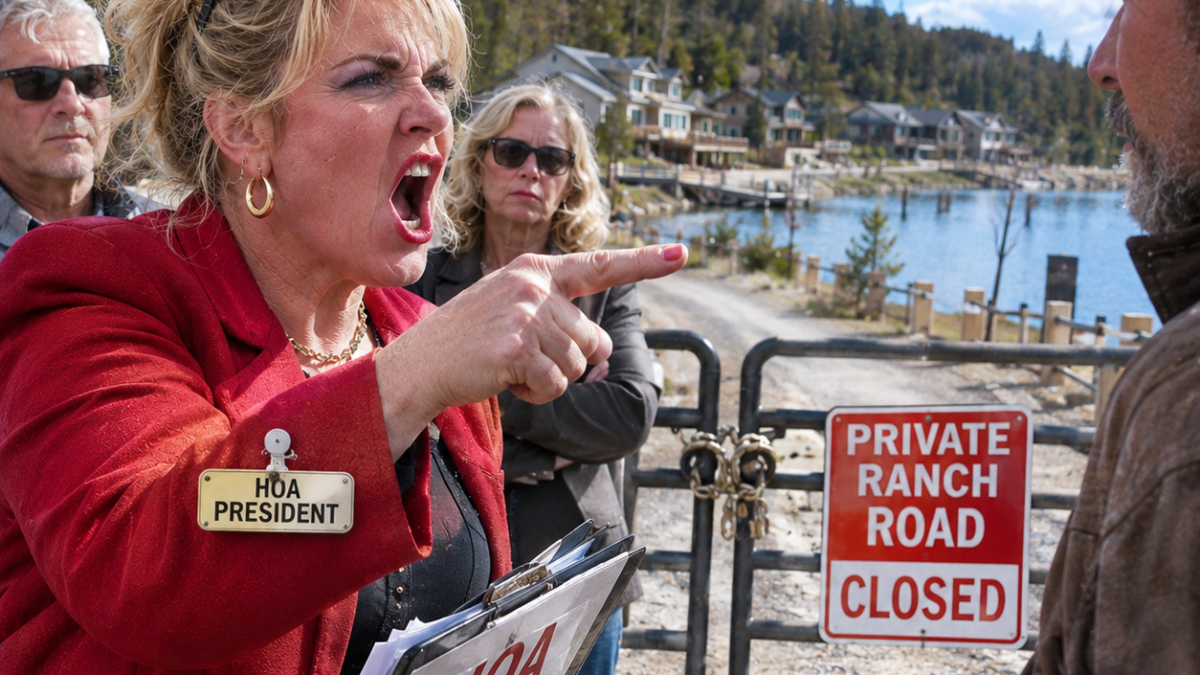
I parked outside the entrance and walked into the HOA office housed in one of the model homes.
A woman behind a glass desk stood when I entered.
Mid-fifties.
Perfect hair.
Expensive blazer.
Expression already irritated before I spoke.
“Can I help you?”
“Are you Denise Barker?”
Her eyes narrowed.
“Yes.”
“HOA president?”
“Yes.”
I placed the certified copy of the quitclaim deed on her desk.
“My father supposedly signed that two years after he died.”
She looked down.
Then back at me.
“I’m not qualified to evaluate legal documents.”
“The notary died six months before the signature date.”
“I said I’m not qualified.”
“Twenty-seven houses were built on the land this document transferred.”
“You need to contact the developer.”
“Garrett Sullivan?”
“Yes.”
“Did the HOA ever review the chain of title?”
“That would have been handled during development approval.”
“By who?”
“Attorneys.”
“Names?”
She stood straighter.
“Mr. Sanders, if you have a claim, bring it through counsel.”
Her tone had changed.
Not confused.
Prepared.
That bothered me.
“You knew I was coming.”
She said nothing.
“You knew my name before I walked in.”
“Your situation has already been brought to our attention.”
“By Sullivan?”
“I’m not discussing privileged matters.”
“You’re an HOA president, not his lawyer.”
Her smile disappeared.
“You need to leave.”
I picked up the deed.
“Tell Garrett Sullivan I’m not dead.”
Something flickered in her face.
Tiny.
Gone immediately.
I noticed anyway.
I walked outside and called Sullivan Development.
The receptionist transferred me.
Then another transfer.
Then voicemail.
I called back.
“I want somebody with authority.”
Eventually a man answered.
“This is legal counsel for Sullivan Development.”
“My name is Randy Sanders.”
“We’re aware.”
“Good. Then you know I’m calling about eighty acres stolen from my ranch.”
“We reject that characterization.”
“My father signed your deed two years after his funeral.”
“Any concerns should be directed to litigation counsel.”
“Who authorized construction?”
“Our permits were properly issued.”
“Based on a forged survey?”
“I’m ending this call.”
“Tell Mr. Sullivan I’m coming after the land.”
The line went dead.
I stood in the parking lot holding my phone.
The worst thing I could have done then was act angry.
The second worst would have been doing something theatrical.
So I went back to the ranch boundary and studied the map.
Two hundred forty acres originally.
Eighty claimed by Sullivan.
One hundred sixty still recorded cleanly in my family’s name.
That remaining acreage wrapped around the development’s southern approach.
And through it ran one road.
Lakewood Drive.
I followed it from the subdivision gate toward the county highway.
Every foot between Lakewood Estates and the public road crossed my remaining land.
I pulled county easement records on my laptop.
Nothing.
Searched again under older parcel numbers.
Nothing.
Utility easements existed.
Pipeline access.
Electrical service.
But no roadway easement.
No right-of-way.
No deed granting Lakewood residents permanent vehicle access across those one hundred sixty acres.
I sat on the hood of my truck staring at the screen.
That was Sullivan’s mistake.
He had obtained paperwork—fraudulent or otherwise—for the eighty acres he wanted to develop.
But the road connecting those houses to the world still crossed land he had never managed to claim.
I did not smile.
Not yet.
Because the road did not carry Sullivan.
It carried families.
Children.
Nurses.
Teachers.
Retired couples.
People who had probably spent their life savings buying those homes.
If I shut the road, they would suffer first.
That evening I watched cars pass.
One after another.
Every one technically crossing private land without a recorded easement.
I photographed the road.
The entrance.
Boundary markers.
Vehicle flow.
Not faces.
I did not want to turn residents into evidence against themselves.
I needed to document use.
Then I called a lawyer.
Teresa Price came recommended by a colleague who had fought a boundary dispute three years earlier.
His description was simple.
“She reads everything.”
That was enough for me.
Her office occupied a converted Victorian house in Austin.
Files everywhere.
Books stacked on the floor.
Coffee strong enough to remove paint.
I put the deed, surveys, photographs, death records, and county filings across her conference table.
She did not say anything for nearly forty minutes.
Finally she tapped the quitclaim deed.
“Fraudulent quitclaim deeds are an old problem.”
“So you think it’s fake.”
“I think your father being dead makes the signature difficult to explain.”
“That’s lawyer language.”
“It keeps me employed.”
She looked at the notary block.
“Dead notary helps.”
“Also lawyer language?”
“No. That’s just bizarre.”
I pointed to the survey.
“Eighty acres.”
“And twenty-seven houses.”
“Yes.”
“Value?”
“Millions.”
“Developer?”
“Garrett Sullivan.”
She leaned back.
“Deep pockets.”
“So?”
“So if you expect this to end because we send an angry letter, it won’t.”
“What do we need?”
“Forensic authentication. Full title history. Survey comparison. County audit logs if records were digitized. Developer communications if we can obtain them legally. Permit history.”
“And the road?”
Her eyes shifted toward me.
“You noticed that.”
“No easement.”
“I saw.”
“Can I close it?”
She did not answer immediately.
“Property rights are one thing. Courts also consider emergency access, reliance, necessity, possible implied rights, and harm to innocent residents.”
“So that’s a no.”
“That’s a ‘do not put up a gate tonight because you’re angry.’”
“I wasn’t planning to.”
“You were thinking about it.”
“Yes.”
“Good. Think first.”
We started with the signature.
Teresa hired Dr. Rebecca Hollis, a forensic document examiner who had testified in state and federal courts.
I provided genuine samples of my father’s handwriting.
Bank records.
Tax returns.
Old checks.
The original 1987 deed.
Even a birthday card he had written me when I turned thirty.
Three days later, Rebecca met us.
She placed enlarged signature comparisons across the table.
“The questioned signature is not consistent with Thomas Sanders’s natural writing.”
“What gives it away?”
“Several things.”
She pointed.
“Pen pressure. Stroke hesitation. Letter formations. Someone appears to have copied a model rather than produced spontaneous handwriting.”
Then she slid another report toward us.
“And there’s this.”
“What?”
“The ink chemistry.”
I leaned closer.
“The ink formulation used on the questioned signature did not enter commercial production until after the date shown on the deed.”
“How long after?”
“Approximately a year.”
Teresa looked at me.
“So somebody created a document dated 2018 using ink that wasn’t available then.”
Rebecca nodded.
“That is my conclusion regarding the ink dating.”
The forgery was no longer just obvious because my father was dead.
It was technically demonstrable.
Now we needed the connection to Sullivan.
That came from Joseph.
Or more accurately, from the things Joseph left behind.
His daughter had boxed his personal belongings and stored them in the old foreman’s barn.
I called her first.
“Maria, I need to look through your father’s ranch files.”
“Why?”
I told her.
Silence.
Then she said:
“I knew he was fighting somebody.”
My stomach tightened.
“What did he tell you?”
“Almost nothing.”
“When can I look?”
“They’re yours if they concern the ranch.”
I spent that Saturday in the barn.
Joseph had kept everything.
Feed receipts from fifteen years earlier.
Tractor repairs.
Veterinary bills.
Tax records.
Fence maps.
At the bottom of a wooden crate beneath old farming almanacs was a folder.
One word written across the front.
**SULLIVAN.**
I sat on the dusty floor.
The first letter was polite.
Garrett Sullivan wanted to purchase part of Sanders Ranch.
Fair-market offer.
Development opportunity.
Mutually beneficial.
Joseph had written **NO** in the corner.
Second letter.
Firmer.
The owner was deceased.
The heir was absent.
Maintaining unused acreage was financially inefficient.
Sullivan suggested a sale before “complications” arose.
Third letter.
No courtesy.
**Mr. Martinez, your employer is deceased and his heir has effectively abandoned this property. Continued resistance will only create legal expenses neither you nor Mr. Sanders can reasonably sustain. I strongly advise reconsideration.**
My hands went cold.
Joseph had received that while I was in San Antonio telling myself the ranch was safe because he was watching it.
He had never called me.
Part of me became angry at him.
Then immediately ashamed.
He was seventy.
Managing somebody else’s land.
Facing a wealthy developer.
And I had made myself almost impossible to reach emotionally.
I kept reading.
Joseph had written notes.
**Never signed.**
**Told him Randy owns it.**
**Sullivan came again.**
**Do not allow survey crew past creek.**
Then I found two surveys.
Original 1987.
Sullivan’s 2019 filing.
I spread them across the workbench.
The manipulation became obvious.
The old boundary extended approximately 2,300 feet beyond Miller Creek to the natural shoreline.
The new one stopped at the creek.
Eighty acres simply disappeared from the Sanders parcel.
The surveyor was Raymond Keeler.
Teresa checked his record.
License revoked in 2021.
Reasons included fraudulent survey practices and professional misconduct.
That was another thread.
Still not the center.
The bigger question remained.
How had a forged signature page entered county records?
Marilyn had told me something strange the first day.
The physical file was incomplete.
The digital version looked complete.
Teresa started digging into county contracts.
Three days later, she called me.
“Come to Austin.”
“What did you find?”
“Something you need to see.”
On her table was a county invoice.
**Lonear Data Solutions.**
Contract amount: roughly $200,000.
Purpose: digitization and database integration of historical property records.
Date: 2019.
I read the authorized representative.
Garrett Sullivan.
My throat tightened.
“His company digitized county property files?”
“Indirectly.”
She handed me corporate records.
“Lonear was created about six months before the county contract.”
“Owner?”
“Subsidiary relationship to Sullivan Development.”
“How long did it operate?”
“Dissolved eight months after the project.”
I sat down.
Teresa’s expression was grim.
“If somebody from that company used access to alter county records, this stops being only a title dispute.”
“Computer fraud.”
“Potentially.”
“Wire fraud.”
“Potentially.”
“Conspiracy.”
“If we prove who did what.”
There was that lawyer word again.
**If.**
We had enough to file suit.
But Teresa warned me.
“Sullivan can drag civil litigation out.”
“How long?”
“Years if he’s motivated and well funded.”
“He is both.”
“Yes.”
“Meanwhile twenty-seven families live on the land.”
“Yes.”
“And limitation issues keep developing.”
“Yes.”
I looked at the road map.
“What about Lakewood Drive?”
Teresa followed my eyes.
“No recorded easement.”
“Can we use it?”
“As leverage?”
“Yes.”
She was quiet.
Then:
“Legally, you have a strong argument that continued unrestricted use requires your permission.”
“Strong argument?”
“I don’t promise judges.”
“Would you put up a gate?”
She stared at me.
“If you do it, do it transparently, at the exact surveyed boundary, with emergency contingencies, advance documentation, and readiness to defend it in court within hours.”
“So yes.”
“I said considerably more than yes.”
I thought about the residents.
“All twenty-seven families would be stuck.”
“Yes.”
“They didn’t steal anything.”
“Probably not.”
“Then this feels wrong.”
Teresa folded her hands.
“What feels worse?”
I looked at her.
“Closing the road or letting Sullivan continue profiting while he tries to turn occupation into a stronger legal position?”
“That’s not fair.”
“Neither is the problem.”
I spent three days deciding.
I drove out to Lakewood.
Watched children get off the school bus.
Saw an elderly man collecting mail.
A woman in hospital scrubs left every morning before sunrise.
I knew what closing that road would do.
Then I went to the family cemetery.
My father was buried there.
So was my grandfather.
Three generations of Sanders markers beneath live oaks.
I stood in front of my father’s grave.
“I left.”
Saying it aloud hurt.
“I told myself Joseph had it.”
Wind moved through the grass.
“I left you both to deal with this.”
Nothing answered.
Of course not.
But sometimes silence forces honesty.
Sullivan had done the stealing.
Still, my absence had made it easier.
I could not undo eight years.
I could decide what I did next.
Monday morning I called Teresa.
“I’m closing it.”
“Then we do it correctly.”
The contractor came from San Antonio.
I chose people with no local ties because I did not want pressure on them.
At 4:30 Tuesday morning, they started.
Survey stakes already verified.
No digging outside my parcel.
Steel posts.
Industrial gate.
Heavy lock.
Reflective warning signs.
Teresa insisted on a second sign.
**EMERGENCY SERVICES: CALL NUMBER BELOW FOR IMMEDIATE ACCESS.**
I gave the sheriff and fire district temporary access instructions before the gate was completed.
If somebody had a heart attack, I was not turning a property dispute into a funeral.
At 5:15, the gate closed.
I stood beside my truck watching dawn spread over the Texas sky.
For the first time since I returned, my hands were steady.
That lasted an hour.
At 6:22, a silver sedan stopped.
The woman driving wore blue scrubs.
Exactly the nurse I had noticed days earlier.
She honked.
Got out.
Read the sign.
Then saw me.
“What is this?”
“My property boundary.”
“I have to work.”
“I understand.”
“Open the gate.”
“I can’t allow unrestricted access right now.”
Her face changed.
“What do you mean you can’t?”
“This road has no recorded easement.”
“I bought a house here.”
“I know.”
“I have a mortgage.”
“I know.”
“Then open the gate.”
“I’m sorry.”
“You’re sorry?”
Another car stopped behind her.
Then another.
By 6:45, eight vehicles waited.
By seven, the line disappeared toward the subdivision.
Horns.
Shouting.
Phones held up.
One man tried driving around the gate.
His SUV dropped into the drainage ditch.
I had warned the contractor to place barriers.
Apparently he found the one gap.
He climbed out furious.
“You’re paying for this!”
“No.”
“You blocked the road!”
“You left the road.”
“Because you blocked it!”
Fair point emotionally.
Not legally.
Children sat in back seats watching adults lose patience.
That was the part I hated.
At 7:18, a sheriff’s cruiser arrived.
Deputy looked maybe twenty-eight.
He approached carefully.
“Randy Sanders?”
“Yes.”
“We have multiple complaints.”
“I expected that.”
I handed him a folder.
Deed.
Survey.
Teresa’s legal memorandum.
No easement search certification.
Emergency contact procedure.
He read.
Called his sergeant.
The sergeant arrived ten minutes later.
They spoke beside the cruisers.
Residents gathered around them.
Finally the sergeant raised his voice.
“This appears to be a civil property dispute. We are not ordering the landowner to remove the gate without a court order.”
People erupted.
“What about our homes?”
“You can’t trap us!”
“I have medication!”
The sergeant continued.
“Emergency services have access procedures. Contact your HOA and legal counsel regarding ordinary access.”
A woman shouted toward me:
“You’re a monster!”
I did not answer.
Then a black Mercedes arrived.
Garrett Sullivan got out.
I recognized him from development websites.
Tall.
Silver hair.
Dark suit.
Even at seven-thirty in the morning he looked ready for a boardroom photograph.
Residents parted for him.
He walked directly toward me.
“Randy Sanders.”
“Garrett Sullivan.”
“You are making a tremendous mistake.”
“Maybe.”
“You’re illegally imprisoning twenty-seven families.”
“No.”
“I’ll bury you in litigation.”
“I assumed.”
“You think owning a strip of useless pasture gives you the power to shut down a residential community?”
“It’s not useless if your road crosses it.”
His face tightened.
“You’re going to lose everything your father left you paying legal bills.”
That landed exactly where he intended.
I stepped closer.
“Bring your lawyers.”
He smiled.
“I will.”
“Bring Raymond Keeler too.”
His smile disappeared.
I lowered my voice.
“And bring the quitclaim deed your dead notary supposedly witnessed.”
His jaw moved.
“I don’t know what you’re talking about.”
“Then maybe Lonear Data Solutions can explain it.”
That did it.
The change was small.
A tightening around his eyes.
But I saw it.
He turned away.
Phone already out.
That was the first time I knew he was afraid of something more than a civil lawsuit.
Residents slowly dispersed.
Some returned home.
Others kept calling attorneys.
One man approached after the crowd thinned.
Mid-fifties.
Polo shirt.
Khakis.
Tired face.
“Mr. Sanders?”
“Yes.”
“I’m Eugene Bennett.”
He held out his hand.
“Pastor at the community church.”
I shook it.
“I bought here five years ago.”
I waited.
“My wife and I raised our kids here.”
“I understand.”
“No, I don’t think you do.”
His voice stayed calm.
“There are people in there who had nothing to do with Sullivan.”
“I know.”
“Mrs. Delgado was the woman in scrubs.”
I glanced toward the line.
“She works at the county hospital.”
“I figured.”
“Mr. Hanley has dialysis three days a week.”
“Emergency and medical transport can pass.”
“People need more than ambulances.”
“I know.”
He studied me.
“You’ve been wronged.”
“Yes.”
“I can see that.”
He looked back toward Lakewood.
“But those families were sold homes by somebody they trusted.”
“I know.”
“So what do you want from us?”
That question hit differently than Sullivan’s threats.
“Nothing.”
“Then why punish us?”
I looked at the gate.
“I’m trying to stop the person who stole eighty acres from turning time into another weapon.”
Pastor Bennett said nothing.
“If I open this without resolving access, Sullivan gets exactly what he needs. Continued use. Continued appearance of legitimacy. More time.”
“And if you keep it closed?”
“He has to come to the table.”
“So we’re leverage.”
I hated the word.
But I would not lie.
“Yes.”
He absorbed that.
I continued.
“When Sullivan is held accountable, I will work with the residents on permanent access.”
“Promise?”
“Yes.”
“Cheap?”
“I’m not interested in making money from your families.”
He looked at me for a long time.
“I hope you mean that.”
“So do I.”
He nodded.
“I’ll pray for a just resolution.”
“Pray quickly.”
That almost made him smile.
Sullivan moved faster than prayer.
Two days later, Teresa called at seven in the morning.
“Emergency hearing.”
“When?”
“Ten.”
“On what?”
“Temporary restraining order to force the road open.”
I drove to Bernett County Courthouse.
Sullivan sat with three attorneys.
Judge Helen Cartwright presided.
Late fifties.
Silver-streaked hair.
Expression suggesting she had little patience for theatrics.
Sullivan’s lawyer went first.
He described a humanitarian crisis.
Twenty-seven families.
Children unable to reach school.
Workers unable to leave.
Elderly residents.
Medical needs.
He called my gate “self-help extortion.”
Some of it hurt because some of it was true.
Not extortion.
But harm.
People were suffering.
Judge Cartwright looked at me.
“Mr. Sanders, I understand you assert ownership rights. I also have twenty-seven households who cannot freely reach a public road.”
Teresa rose.
“Your Honor, the residents are victims. But they are victims of Mr. Sullivan’s conduct, not of my client’s decision to assert documented property rights.”
She presented the deed.
My father’s death certificate.
The dead notary record.
Forensic signature analysis.
Ink dating.
Raymond Keeler’s licensing history.
Lonear Data Solutions contract.
Judge Cartwright began reading.
Sullivan’s attorney objected.
“These are unproven allegations.”
The judge looked over her glasses.
“I have a forensic report stating the signature purporting to transfer eighty acres was executed with an ink formulation unavailable on the stated date.”
Silence.
She held up the notary record.
“I also have a certification attributed to a deceased notary.”
Sullivan shifted in his chair.
Teresa continued.
“My client has implemented emergency access. He is willing to allow school buses, emergency responders, scheduled medical transport, and other court-approved necessity access while title is litigated.”
Judge Cartwright looked at me.
“You agree?”
“Yes, Your Honor.”
“All emergencies?”
“Yes.”
“School transportation?”
“Yes.”
“Medical appointments?”
“Yes.”
“Essential deliveries if coordinated?”
I looked at Teresa.
She nodded.
“Yes.”
The judge turned toward Sullivan.
“Your motion for unrestricted access is denied at this stage.”
Sullivan shot upright.
“This is extortion.”
Judge Cartwright’s voice became cold.
“Sit down.”
He did.
She continued.
“If even half of the evidence before me is accurate, roadway access may become the least significant legal problem facing your company.”
Then she issued temporary conditions.
Emergency vehicles.
School buses.
Verified medical transport.
Reasonable humanitarian access.
No general resident traffic unless I permitted it or further court order modified the arrangement.
It was not total victory.
It was better.
Outside, Teresa exhaled.
“That went well.”
“I still have twenty-seven families angry at me.”
“Yes.”
“I hate this.”
“Good.”
“Good?”
“If you enjoyed it, I’d worry.”
Her phone rang.
Mine did too.
Marilyn Odum.
“Mr. Sanders, I found something.”
Her voice was tight.
“What?”
“You need to come here.”
I drove straight to the clerk’s office.
Same back room.
Different file.
Yellowed folder labeled:
**SANDERS RANCH TRUST TRANSFER DOCUMENTS — 2018**
Marilyn opened it.
“Your digital quitclaim deed has six pages.”
“Yes.”
“This original has four.”
She laid them out.
Cover.
Legal description.
Transfer language.
Recording material.
Missing:
Signature page.
Notary page.
I stared.
“But the digital copy has both.”
“Exactly.”
She handed me an audit report.
“In 2019, during the digitization project, forty-seven property files were manually corrected.”
“Corrected by who?”
“Temporary contractor accounts.”
She pointed to one entry.
Sanders Ranch.
Timestamp:
**2:14 a.m., March 15, 2019.**
“Two in the morning?”
“Yes.”
“User?”
She gave me the account number.
“It belonged to the Lonear Data Solutions project.”
I sat down.
Marilyn lowered her voice.
“The physical file never contained the two pages that supposedly transferred your father’s property.”
“So someone inserted them digitally.”
“That is what the records suggest.”
“Can you preserve these logs?”
“I already requested a legal hold.”
I looked at her.
“Why?”
“Because I don’t want anyone saying later that they disappeared.”
For the first time since I returned, I felt something stronger than anger.
Fear.
If Sullivan’s people had altered official county records during a government digitization contract, we were no longer talking about a developer exploiting sloppy paperwork.
This looked planned.
I called Teresa from the parking lot.
She listened.
Then said:
“Don’t email those logs.”
“Why?”
“Preserve originals. Certified copies. Chain of custody.”
“You think federal?”
“I think computer access, interstate financial transactions, shell companies, possible wire fraud.”
“Federal.”
“Yes.”
She paused.
“Randy, stop investigating on your own.”
“I’m an engineer, not Batman.”
“Good. Stay that way.”
Within forty-eight hours, Special Agent Diana Reeves and Agent Marcus Webb sat in Teresa’s conference room.
They did not promise arrests.
They did not call Sullivan guilty.
They asked questions.
A lot of them.
Who had access?
When?
Who controlled Lonear?
Who approved the county contract?
What financial benefit followed?
What evidence tied the altered file to construction?
Diana Reeves looked at me.
“Mr. Sanders, do you understand that civil ownership and criminal culpability are separate issues?”
“Yes.”
“Good.”
“Why?”
“Because people in your position sometimes become so focused on getting land back that they start treating suspicion as proof.”
“I don’t want suspicion.”
“What do you want?”
“Something that holds up after Sullivan hires the best lawyers money can buy.”
That earned the first hint of a smile.
“Then we agree.”
Sullivan’s counterattack intensified.
Appeals.
Counterclaims.
Allegations of interference with business expectancy.
Demand letters.
A claim that Joseph Martinez had informally authorized road use years earlier.
Teresa asked for the document.
None appeared.
Then came the purchase offer.
A courier delivered it to my hotel in Austin.
I was staying there because hearings and meetings had become too frequent to keep driving back to San Antonio.
The number was printed at the bottom.
**$4.8 million.**
Cash.
Immediate closing.
My remaining 160 acres.
Release all claims.
Road access included.
I sat on the hotel bed staring at it.
Four-point-eight million dollars.
Enough to walk away.
Pay every legal bill.
Buy land somewhere else.
Invest.
Retire early if I wanted.
I called Teresa.
“He offered triple market.”
“He’s worried.”
“Or he thinks the land is worth more.”
“Both can be true.”
“What would you do?”
“I’m your attorney. I tell you legal consequences, not what your father’s ranch is worth to you.”
“If I sell, what happens to the stolen eighty?”
“Your lawsuit could be settled as part of the deal if you agree.”
“And the investigation?”
“You cannot privately make a federal investigation disappear.”
“But he keeps the development.”
“Likely, depending on settlement.”
I looked at the offer.
Joseph’s letters were on the table beside me.
My father’s deed.
Marilyn’s audit logs.
“If I take it, he gets what he wanted.”
“Yes.”
“Draft one sentence.”
“What sentence?”
“Not for sale.”
Teresa laughed softly.
“I can make that more legal.”
“Don’t.”
The rejection went out.
Three words.
**NOT FOR SALE.**
Lakewood Estates had started fracturing.
Some residents blamed me.
Signs appeared.
**OPEN OUR ROAD.**
**FAMILIES ARE NOT LEVERAGE.**
One man shouted at me every time he walked past the gate.
I let him.
He had a right to be angry.
Others started looking at Sullivan.
Pastor Bennett called on Saturday.
“Can you come to the community center?”
“Why?”
“Residents found something.”
Under the court’s temporary order, I could enter on foot.
I walked through the gate.
For the first time, I saw the development from inside.
Nice homes.
Clean streets.
Families.
Nothing about them looked fraudulent.
That was the cruelty of what Sullivan had done.
He had turned ordinary people’s legitimate lives into the final layer covering his theft.
At the community center, twelve residents sat around folding tables.
Bank statements everywhere.
Pastor Bennett pointed to a monthly line item.
“Every homeowner pays four hundred fifty dollars in HOA dues.”
“That’s over a hundred forty thousand a year.”
“More than that with fees.”
“What’s wrong?”
He showed me the account balance.
Rarely above $12,000.
“Where does it go?”
They traced transfers.
**LWE MANAGEMENT SERVICES LLC.**
State business records showed Garrett Sullivan controlled it.
Month after month, dues moved out.
Residents believed the money paid road maintenance, landscaping, community operations.
Some did.
Large portions disappeared into management fees controlled by Sullivan’s company.
A woman named Carla Mendoza said:
“We thought Denise managed the HOA.”
Pastor Bennett shook his head.
“Apparently Sullivan managed Denise.”
I looked at the records.
“Get an independent accountant.”
“We are.”
“Do not give me originals.”
“Why?”
“You may need them.”
One man stared at me.
“You really don’t hate us?”
“No.”
“You locked us in.”
“I closed unauthorized access.”
“That felt exactly like being locked in.”
He was right.
I did not try to win the wording.
“I’m sorry for what it did to you.”
“Then open it.”
“I can’t yet.”
He shook his head.
“You can. You won’t.”
That sentence followed me for days.
He was right too.
I **could** physically open it.
I was choosing not to.
The question was whether the reason justified the harm.
That afternoon, I returned to Joseph’s storage barn.
I needed distance from the residents.
Needed to remember why I had started.
At the bottom of a crate sat an envelope.
My name in Joseph’s handwriting.
**RANDY.**
I opened it standing in the doorway.
One sheet.
His handwriting shaky near the end.
**Randy,**
**If you’re reading this, I’m gone and you finally came home. I’m sorry I couldn’t protect the ranch better. Sullivan tried everything to make me sign papers, sell pieces, give him access. I never did. I never signed anything. Whatever they have with my name or your father’s name, it isn’t from us. I kept copies of everything I could. Check the Sullivan folder.**
**Don’t give up. Your father built this place with his hands. Don’t let anybody take it with a pen.**
**Joseph**
I sat on an overturned bucket.
For eight years, Joseph had stayed.
I had run.
He had faced Sullivan.
Kept records.
Protected boundaries.
Probably worried about bothering me because I made grief look like a locked door.
I read the letter again.
Then cried.
Quietly.
No dramatic collapse.
Just tears I had owed two dead men for a long time.
When I finally stood, I folded the letter carefully and put it inside my shirt pocket.
I called Teresa.
“I’m staying.”
“I assumed.”
“No. I mean after this.”
“On the ranch?”
“Yes.”
She was quiet.
“That sounds bigger than the lawsuit.”
“It is.”
Federal agents interviewed Denise Barker the following Monday.
I was not there.
What I know came later through evidence, testimony, and public proceedings.
Denise initially maintained she had trusted Sullivan.
Then investigators showed her financial transfers and email chains.
By the end of that process, she began cooperating through counsel.
Her emails became important.
Sullivan had instructed her repeatedly to discourage residents from checking county property records directly.
To route questions through development counsel.
To characterize title concerns as “settled.”
One message stood out.
Sent months before I returned:
**Don’t worry about the Sanders property. By the time anyone figures out what happened, we’ll have enough time behind us to make the claim stick. We just need to run out the clock.**
Teresa read it aloud.
I felt no satisfaction.
Only exhaustion.
“He knew.”
“Looks that way.”
“He knew the title was vulnerable.”
“Yes.”
“And Denise?”
“She received the message.”
“Did she understand the fraud?”
“That will be part of what investigators evaluate.”
Again, no exaggeration.
No need.
The words already existed.
A grand jury eventually heard the evidence.
Then Teresa called me one evening.
I was standing on the dock at Miller Lake.
Sunset.
Gold on the water.
“Randy.”
“What?”
“Federal warrant was signed.”
I gripped the phone.
“For Sullivan?”
“Yes.”
“Charges?”
She listed them.
Wire fraud.
Computer-related fraud.
Conspiracy connected to property fraud.
Money laundering allegations tied to the financial structure.
The exact counts would be litigated.
But the warrant was real.
“When?”
“Agents will handle that.”
I looked across the lake.
I had spent weeks imagining what I would feel.
Triumph.
Relief.
Vindication.
What I felt was tired.
“Randy?”
“I’m here.”
“You okay?”
“Yes.”
“No celebration?”
“Joseph should have seen this.”
Teresa’s voice softened.
“I know.”
The arrest happened the next morning.
I did not go.
Local news showed footage later.
Federal agents entered Sullivan Development’s Austin office.
Twelve minutes afterward, Garrett Sullivan came out in handcuffs.
Same silver hair.
Same tailored suit.
But none of the arrogance he had worn at my gate.
Reporters shouted questions.
He answered nothing.
I watched once.
Then turned the television off.
Pastor Bennett called.
“Did you see?”
“Yes.”
“How do you feel?”
“I don’t know.”
“That’s probably healthier than what I expected you to say.”
The gate remained.
Court-ordered access continued.
School buses crossed at scheduled times.
Medical transport.
Emergency vehicles.
Residents began using car pools from the gate.
It was inconvenient.
Awful at times.
But no one was abandoned.
As Sullivan’s control disappeared, the residents organized better.
They created an access committee.
Pastor Bennett coordinated essential transportation.
One morning Mrs. Delgado—the nurse who had been first at the gate—approached me.
“You cost me two hours that first day.”
“I know.”
“My supervisor wrote me up.”
“I’m sorry.”
She studied me.
“I still think what you did was cruel.”
“I understand.”
“But I read the deed.”
I waited.
“And the forensic report.”
I nodded.
“And Denise’s emails.”
“Yes.”
She looked toward Lakewood.
“He did this to us.”
“Yes.”
She shook her head.
“I hate that both things can be true.”
“What things?”
“That closing your road hurt us.”
“And?”
“That leaving it open might have helped him.”
I looked at the gate.
“I hate it too.”
She held out her hand.
I shook it.
That small moment stayed with me.
The federal trial did not happen immediately.
Months passed.
Discovery.
Motions.
Negotiations.
Sullivan’s attorneys explored plea options.
Prosecutors did not accept the early proposal on the terms offered.
Eventually the case went to trial.
Eleven days.
I attended every day I could.
The prosecution built the case in pieces.
Dr. Rebecca Hollis explained the forged signature.
Marilyn Odum explained the missing physical pages and extra digital pages.
County IT staff authenticated the access logs.
The former surveyor, Raymond Keeler, testified after reaching his own agreement with prosecutors.
According to his testimony, Sullivan paid him to produce boundary work that favored the development.
Denise testified about instructions and communications.
Financial experts traced money through Sullivan-controlled entities.
Federal agents explained how the temporary contractor account had been used.
Each piece alone could be attacked.
Together, they formed something difficult to escape.
Sullivan’s defense fought hard.
They challenged attribution.
They argued employees had acted without his knowledge.
They questioned whether altered data conclusively proved his direct involvement.
They attacked cooperating witnesses as people trying to save themselves.
Some of those arguments were legitimate.
Raymond Keeler **was** trying to help himself.
Denise **did** have reasons to cooperate.
That was why independent evidence mattered.
Emails.
Company records.
Payments.
Contracts.
Access logs.
Dates.
The facts that did not depend on anyone becoming honest at the last minute.
Day eight hurt the most.
Joseph’s letter was introduced as part of the timeline and supporting evidence surrounding the attempted acquisition pressure.
I did not know whether prosecutors would use it.
When they read his words, the courtroom became still.
**Sullivan tried everything to make me sign papers, sell pieces, give him access. I never did. I never signed anything.**
I stared at the table.
Could not look at the jury.
Joseph had died thinking maybe nobody would ever open that envelope.
Now twelve strangers deciding Sullivan’s fate were listening to his words.
The prosecutor continued.
**Your father built this place with his hands. Don’t let anybody take it with a pen.**
My eyes burned.
I looked toward Sullivan.
For once, I did not see a powerful developer.
Just a man sitting beside lawyers while the voice of an old ranch foreman he had tried to pressure filled the courtroom after death.
The jury deliberated six hours.
We were called back.
I sat behind Teresa.
Pastor Bennett sat two rows away.
Marilyn was there.
Maria Martinez, Joseph’s daughter, sat beside me.
The foreman stood.
Guilty.
Then another count.
Guilty.
Again.
Again.
By the end, Sullivan had been convicted on the counts submitted and proven in the case.
Maria squeezed my hand.
I thought I would feel something explosive.
Instead, I whispered:
“Your dad did it.”
She shook her head.
“No.”
Her eyes were wet.
“You both did.”
Sentencing came later.
The judge imposed a substantial federal prison sentence—twelve years under the judgment then in effect—and restitution totaling millions of dollars, including amounts directed toward victims harmed by the property and financial fraud.
Sullivan’s lawyers announced appeals.
That was their right.
I did not treat the first sentence as the universe closing a book forever.
Legal cases continue.
Appeals happen.
Orders change.
But accountability had finally become real.
The civil property case also moved toward resolution.
The fraudulent eighty-acre transfer was invalidated.
Title was restored to the Sanders estate and then to me under the proper chain.
That created another problem.
Twenty-seven houses.
Twenty-seven families.
Some structures sat entirely or partly on land legally returned to me.
I could have taken the hardest possible position.
Remove everything.
Restore all eighty acres.
Teresa told me:
“You have leverage.”
I hated that word by then.
“What happens to the families?”
“Depends on lot configuration, title insurance, restitution, negotiations, court orders.”
“Can we protect them?”
“We can try.”
That became my priority.
Sullivan had used innocent buyers as a shield.
I refused to use them as revenge.
Some homeowners wanted to leave.
They took settlements, insurance proceeds, restitution claims, or negotiated exits as available.
A few homes were eventually removed where restoring the land made the most legal and practical sense.
Other families wanted to stay.
For those, we negotiated legitimate purchases or long-term arrangements at fair values rather than pretending their fraudulent titles had never caused a problem.
It was complicated.
No single solution fit every lot.
Pastor Bennett became the bridge between us.
Literally and figuratively.
One night we sat at Teresa’s conference table with maps covering every surface.
Pastor Bennett pointed to a blue-marked parcel.
“Mrs. Hanley wants to stay.”
“She can.”
“This family wants out.”
“We’ll work with their counsel.”
“This lot overlaps the restoration zone.”
“That one may have to be removed.”
He rubbed his forehead.
“I thought ministry was complicated.”
Teresa looked at him.
“Property law is just theology with more exhibits.”
I laughed for the first time all day.
Eventually the landscape stabilized.
Some houses remained.
Some did not.
Pasture returned in sections.
Fence lines were restored.
The lakefront opened again where Sullivan had tried to privatize it.
And then there was the road.
Lakewood Drive.
The weapon I had used because Sullivan left it sitting on my land.
The gate was still there when the verdict became final enough for us to resolve permanent access.
Teresa asked:
“What do you want?”
I knew immediately.
“One dollar.”
She stared.
“For what?”
“Annual easement.”
“You’re serious?”
“Yes.”
“For the residents?”
“Yes.”
“Why one dollar?”
“So nobody can ever say it was free or informal.”
She smiled.
“That is painfully you.”
I added conditions.
No commercial expansion through the easement.
No new development using the road without separate consent.
Ordinary residential traffic permitted.
Emergency access permanent.
Maintenance responsibilities clearly allocated.
And a modest annual contribution by the neighborhood to a Miller Lake water-quality fund.
Pastor Bennett reviewed it.
“You could charge a fortune.”
“I don’t want a fortune from them.”
“The road has value.”
“I already got what I wanted.”
“What?”
“My land back.”
The agreement was recorded.
Every remaining household signed the necessary acknowledgments through proper counsel.
On a Sunday morning, I unlocked the gate.
Pastor Bennett stood beside me.
Mrs. Delgado was there.
So were several families.
Nobody cheered.
That would have felt strange.
I removed the chain.
The metal dropped against the post.
Then I swung the gate open.
Mrs. Delgado’s silver sedan was first.
She stopped beside me.
Window down.
“Try not to do this again.”
I smiled.
“Try not to buy any more stolen houses.”
She laughed.
Then drove through.
One car.
Then another.
Then another.
This time, they crossed with permission.
Not because Sullivan forged a document.
Not because an HOA president claimed authority.
Because a real easement existed.
Signed.
Recorded.
Understood.
The old Lakewood Estates HOA did not survive in its original form.
Residents voted to dissolve it and replace it with a simpler neighborhood association.
Transparent books.
Elected leadership.
No developer-controlled management company.
Pastor Bennett became president reluctantly.
I told him:
“You finally got your punishment.”
He sighed.
“I prayed for justice. I should have been more specific.”
The association recovered what it could from improper management transfers and related proceedings.
Residents learned exactly how much of their monthly dues had been flowing toward Sullivan-controlled entities.
Some were furious.
Others embarrassed.
Most were simply tired.
I never blamed them.
They had been sold more than houses.
They had been sold trust.
Clean titles.
Safe investments.
A functioning community.
The assumption that every professional before them had checked the paperwork.
Sullivan had exploited that.
One year after sentencing, I moved home.
Not visited.
Moved.
I sold my place in San Antonio.
Reduced my work schedule.
Brought my drafting desk back to the ranch house.
The first night, I slept badly.
Too quiet.
Then at five in the morning I woke and smelled something I had not smelled in years.
Rain on dry Texas soil.
I walked onto the porch.
My father’s chair was gone, but the spot where he used to sit remained.
I put my coffee there.
Watched dawn reach Miller Lake.
For eight years, I had believed staying away protected me from grief.
It had not.
It simply turned grief into distance.
And distance had allowed other people to treat the ranch as abandoned.
That part was mine to carry.
Not the forgery.
Not the theft.
But the absence.
I stopped pretending otherwise.
The court restored the stolen acreage to my ownership.
In places where houses remained under negotiated purchases, new property lines were surveyed correctly.
Where houses were removed, we restored pasture.
The first time I saw cattle grazing on a section that had been marked for Sullivan’s expansion, I stood beside the fence longer than necessary.
Joseph would have approved.
I visited his grave on the anniversary of his death.
Small cemetery outside town.
He was buried beside his wife.
I brought flowers.
Felt ridiculous carrying them.
Joseph had never been a flower man.
I set them down anyway.
For a while, I said nothing.
Then:
“You held the line.”
Wind moved through the grass.
“You did it alone.”
My throat tightened.
“I’m sorry.”
That was the hardest word.
“I should’ve been here.”
A bird called somewhere beyond the cemetery fence.
“I’m here now.”
I stood with my hands in my pockets.
“I’ll take care of it.”
The silence did not forgive me.
It did something better.
It let me say what I needed without arguing back.
At the ranch entrance, I replaced Sullivan’s iron **LAKEWOOD ESTATES** arch.
The original wooden Sanders gate was gone.
I could not bring it back.
So I built a new one.
Heavy cedar.
Simple.
No ornamental stone.
No security booth.
Beside it I installed a small bronze plaque.
**JOSEPH MARTINEZ
1952–2023
THE MAN WHO NEVER SIGNED**
Pastor Bennett suggested the last line.
I could not improve it.
Maria Martinez came for the installation.
She touched the plaque.
“My dad would hate this.”
“Why?”
“He hated attention.”
“Good.”
She laughed through tears.
“He’d ask what it cost.”
“And then?”
“Tell you he could’ve made it cheaper.”
“That sounds right.”
We stood beside the gate.
Cars from Lakewood passed on the recorded easement.
Several drivers slowed.
One man lowered his window.
“Morning, Randy.”
“Morning.”
That was normal now.
The road was no longer leverage.
It was a road.
That felt important.
Garrett Sullivan had believed controlling documents meant controlling reality.
For years, he was almost right.
A forged deed entered the system.
A false survey changed a map.
A corrupt contractor account inserted pages.
Permits followed.
Construction followed.
Mortgages followed.
Families moved in.
An HOA formed.
Fees were collected.
And every new layer made the original lie look more legitimate.
By the time I came home, the neighborhood looked more real than my father’s deed.
That was what made the fraud so effective.
Reality had been built on top of paperwork.
Twenty-seven roofs.
Twenty-seven driveways.
Twenty-seven families saying:
“But we bought this.”
And they had.
In good faith.
That did not make the original theft true.
It made fixing it harder.
One evening Pastor Bennett came down to the dock.
I was fishing.
He sat beside me without asking.
He had earned that.
For a while we watched the lake.
Then he said:
“I’ve been thinking about the gate.”
“Which one?”
“The one you closed.”
“Oh.”
“A lot of people hated you.”
“I noticed.”
“I might have, if I’d met you that first morning.”
“You were pretty polite.”
“I’m a pastor. It’s camouflage.”
I smiled.
He looked toward Lakewood.
“Do you regret it?”
I did not answer immediately.
The easy answer was no.
I had won.
Sullivan went to prison.
Land came back.
Residents received access.
But that was too simple.
“I regret what it did to innocent people.”
“That isn’t what I asked.”
“I know.”
“Would you close it again?”
I watched my fishing line.
“Yes.”
He nodded slowly.
“Even knowing Mrs. Delgado would miss work?”
“Yes.”
“Knowing people would call you cruel?”
“Yes.”
He was quiet.
“Why?”
“Because Sullivan was counting on everyone being too afraid of inconvenience to challenge the lie.”
Pastor Bennett looked at me.
“I think you did what you had to do.”
I waited.
“And I think you managed not to become the thing you were fighting.”
That landed harder than praise should have.
“I don’t know about that.”
“I do.”
“I used your families as leverage.”
“Yes.”
He did not soften it.
“That was ugly.”
“Yes.”
“But when you finally had the power to punish us, you gave us the road for a dollar.”
“Per year.”
“Greedy.”
I laughed.
He smiled.
“The difference matters.”
“What difference?”
“Sullivan used power to take what wasn’t his.”
He looked toward the gate.
“You used yours to force the truth into the open, then gave up the advantage when you didn’t need it anymore.”
I stared at the water.
That was the part I had struggled to explain to myself.
Power is easiest to justify while you are fighting.
The real test comes after you win.
Do you keep squeezing because now you can?
Or do you stop when the original wrong is repaired?
I hoped I had stopped.
Pastor Bennett leaned back.
“Any fish?”
“No.”
“So justice works better than fishing.”
“Apparently.”
We sat until sunset.
Children laughed somewhere across the water.
Lakewood children.
Some living in houses that remained.
Some from families who had gone through months of fear wondering whether they would lose everything.
The sound carried across Miller Lake.
Life continuing.
The next spring, I rebuilt the dock.
Joseph had patched it for years.
My father originally put it in.
I replaced rotten boards but kept the old posts where I could.
Maria brought Joseph’s old toolbox.
Inside was a hammer worn smooth at the handle.
I used it for half the job even though I had better tools.
Teresa came out one Saturday.
She stood on the dock looking suspiciously uncomfortable without legal files.
“You fish?”
“No.”
“Then why are you here?”
“You owe me barbecue.”
“For?”
“Saving your ranch.”
“I thought that was my forensic evidence.”
“That evidence did not draft itself.”
Fair.
At lunch she looked around.
“You really moved back.”
“Yes.”
“San Antonio?”
“Sold.”
“Work?”
“Consulting remotely. Fewer projects.”
“Regret?”
“No.”
She nodded toward Lakewood.
“What about them?”
“No.”
She smiled.
“You’re less angry.”
“I’m more tired.”
“That’s middle age.”
“Get off my land.”
“Which eighty acres specifically?”
I threw a napkin at her.
Marilyn Odum retired the following year.
I attended her retirement reception.
She looked embarrassed when I thanked her publicly.
“I only showed you the file.”
“You showed me the physical file.”
“That was my job.”
“Exactly.”
That phrase came up repeatedly.
Joseph kept records because it was his job.
Marilyn preserved files because it was hers.
Rebecca examined ink because it was hers.
Teresa built the case.
Agents investigated.
Pastor Bennett organized residents.
No one person solved everything.
That was another lesson Sullivan misunderstood.
He built his scheme around isolated people.
A grieving heir in San Antonio.
An elderly foreman.
Busy homeowners.
County clerks buried in records.
A developer with money beats each one separately.
What he did not expect was for those people to start comparing notes.
Once we did, his advantage disappeared.
Years passed.
The Sanders Ranch never returned exactly to what it had been before.
It could not.
Some roads remained.
Some houses remained under new legitimate ownership.
The landscape carried scars of what Sullivan built.
At first I hated them.
I wanted every trace gone.
Then one morning I realized that would mean tearing homes away from families who had fought beside me in the end.
I stopped thinking of restoration as making the past perfect.
Restoration meant making the present honest.
Correct boundaries.
Clean titles.
Voluntary agreements.
Open records.
No stolen ground pretending to be something else.
That was enough.
I planted new oaks near the family cemetery.
One for my father.
One for Joseph.
Pastor Bennett helped.
He was terrible with a shovel.
“You’re supposed to dig wider.”
“I deal in souls, not root balls.”
“Trees are less argumentative.”
“Depends on the tree.”
We planted them anyway.
A few years later they were tall enough to cast narrow shadows over the grass.
Every time I drove past, I thought about the eight years I lost.
There was no way to recover them.
That was the one thing no court could restore.
I could recover acreage.
Correct records.
Collect damages.
Open roads.
But I could not get another morning with my father.
Could not call Joseph and say:
“Thank you for staying when I didn’t.”
That regret remained.
It became less sharp.
Never disappeared.
Maybe it should not.
One Saturday, Mrs. Delgado came by the ranch.
She carried a pie.
“I don’t know why.”
“What?”
“Why I brought this.”
“Because you feel guilty about yelling at me?”
“No.”
“Because you damaged my ditch?”
“That wasn’t me.”
“Right.”
She handed me the pie.
“My daughter graduated nursing school.”
“Congratulations.”
“She remembers the gate.”
“I’m sure she does.”
“She was in the back seat that morning.”
I remembered a little girl staring through a car window.
“That was her?”
“Yes.”
Mrs. Delgado smiled.
“She wrote about the whole thing in a college essay.”
“Oh no.”
“She said she learned that adults can both be right and wrong at the same time.”
“That sounds smarter than most lawyers.”
“She said you were wrong to hurt families.”
“Also smart.”
“And right to stop Sullivan.”
I looked at her.
“What did admissions think?”
“She got in.”
“Then I accept the insult.”
She laughed.
Before leaving, she stopped near Joseph’s plaque.
“Did he know?”
“About the houses?”
“He knew Sullivan was trying.”
“He fought him.”
“Alone?”
“For too long.”
She touched the edge of the plaque.
“I’m glad you came back.”
So was I.
On the tenth anniversary of my father’s death, I woke before dawn.
Made coffee.
Walked to the dock.
Miller Lake was perfectly still.
No wind.
No boats.
I carried Joseph’s letter in my jacket pocket.
Not because I needed to read it.
I knew every line.
I sat where my father used to sit.
For years, I had told myself the ranch represented grief.
Then theft.
Then battle.
Eventually it became home again.
That took longer than winning any case.
A truck crossed Lakewood Drive in the distance.
Legally.
Quietly.
No gate stopping it.
No Sullivan company collecting money.
Just a resident leaving for work.
I smiled.
The road had once been my strongest weapon.
Now the fact that I no longer needed it as a weapon felt like the real victory.
I took out Joseph’s letter.
The paper had begun wearing along the folds.
**Don’t let anybody take it with a pen.**
I looked across the water.
They had tried.
A forged signature.
A false survey.
A dead notary.
A manipulated database.
Shell companies.
Threats.
Money.
Time.
Twenty-seven houses built over the lie.
For six years, the lie had stood in sunlight and looked permanent.
Then I came home.
Not because I was brave.
Because Joseph died.
That part still hurt.
If he had lived longer, maybe I would have stayed away another year.
Maybe five.
That thought humbled me.
People like to imagine that when something precious is threatened, they will immediately rise.
I did not.
I ran for eight years.
Joseph held the ranch while I hid.
My father had given me land.
Joseph gave me time.
What I finally did was use it before there was none left.
The sun reached over the ridge.
Light moved across the lake.
Behind me, somewhere near the gate, I heard a vehicle slow.
Probably someone reading Joseph’s plaque.
Then it continued.
I put the letter away.
Cast my line.
Waited.
No fish.
Some traditions remain disappointing.
An hour later, Pastor Bennett walked down carrying two coffees.
“You know you have a road.”
“So?”
“You could drive here.”
“I walked.”
“Why?”
“Exercise.”
“You’re getting old.”
“So are you.”
He sat.
We drank.
Across the lake, children were shouting near one of the remaining Lakewood homes.
I could see the roof through trees.
That house stood on land that had once been part of the stolen eighty.
Now the family owned its lot legitimately.
Surveyed.
Purchased.
Recorded.
No forgery.
I liked seeing it.
Not because development had won.
Because consent had replaced theft.
Pastor Bennett followed my gaze.
“Still strange?”
“Yes.”
“Wish they were all gone?”
I thought about it.
“No.”
He nodded.
“That’s progress.”
“Or age.”
“Same thing if you’re lucky.”
We sat quietly.
The ranch was not exactly my father’s anymore.
It was mine.
That difference had taken me years to accept.
Protecting his legacy did not mean freezing every acre in 2016.
It meant making sure whatever changed happened honestly.
By choice.
Not by a developer rewriting a dead man’s signature.
I looked toward the new cedar entrance.
Joseph’s plaque caught the morning light.
Then toward the lake.
Three generations of Sanders land.
Part restored pasture.
Part homes with clean titles.
A road crossing it under a one-dollar easement.
Messy.
Imperfect.
Real.
I had spent eight years afraid to come home because I thought grief lived here.
When I finally returned, I found twenty-seven houses and a sign telling me the ranch no longer existed.
That sign was gone now.
The ranch had survived.
The lake had survived.
And after years of believing distance was the only way I could live with what I lost, I had survived too.
Pastor Bennett nudged me.
“You’ve got something.”
My fishing line moved.
I grabbed the rod.
“Finally.”
I reeled.
Nothing.
Hook empty.
Bennett laughed.
I stared at him.
“Get off my property.”
He laughed harder.
The sound carried across Miller Lake.
I started laughing too.
And for the first time since my father’s funeral, the place did not feel like something I was responsible for defending.
It simply felt like home.
[END OF STORY]








