PART 2: I Brought Two Old Dogs to My Grieving Mother’s Door—What Happened When She Opened It Broke Me
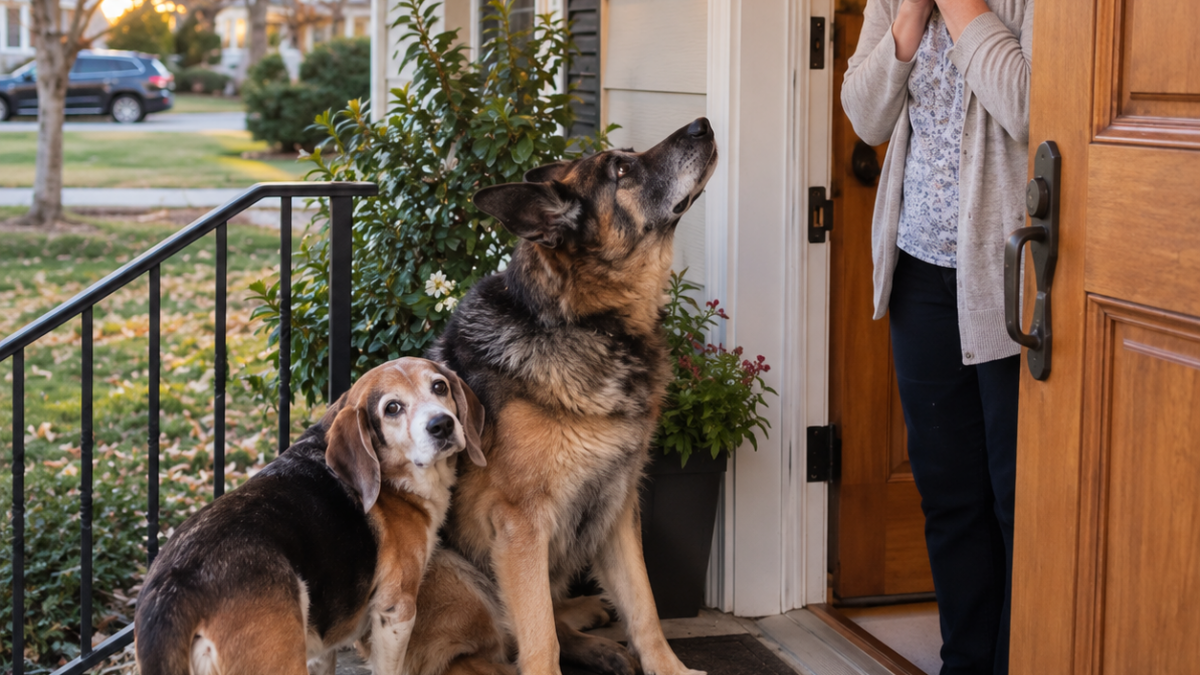
My mother had been hiding her grief from us for months, smiling through phone calls while slowly disappearing inside the house she had shared with my father for forty-three years.
Then one Saturday afternoon, I pulled into her driveway with two old rescue dogs in the back seat and absolutely no idea whether she would hug me, yell at me, or tell me to take them back.
But when I saw what those two dogs did before my mother even opened the door, I realized I had misunderstood what that day was really about.
My father died the previous fall.
After that, my childhood home seemed to lose its voice.
Mom still made tea every morning. She watered the hydrangeas along the porch. She folded laundry, paid bills, answered my calls, and always told me the same thing.
“I’m doing fine, sweetheart.”
But she wasn’t.
I lived about forty minutes away, and I called her every night after work. Sometimes we talked for twenty minutes. Sometimes she insisted she was tired after five.
What bothered me most were the pauses.
Before Dad died, there had always been noise behind her voice—the television, Dad complaining about baseball, cabinet doors closing, music from the kitchen.
Now there was nothing.
Just silence.
One evening I asked, “Mom, are you lonely?”
She laughed softly.
“I’m seventy-two. I’m allowed to enjoy some peace.”
But her voice cracked on the last word.
That was when I started thinking about a dog.
Not a puppy.
The last thing Mom needed was something chewing furniture, waking her at five in the morning, and demanding three-mile walks.
I pictured an older dog.
Quiet.
Gentle.
The kind that would sleep near her chair while she read and follow her into the kitchen because being close was enough.
So the following Saturday, without telling her, I drove to a rescue center outside town.
A woman named Catherine met me near the front desk.
When I explained what I was looking for, she studied me for a moment.
“You’re not looking for a dog for yourself.”
“No.”
“For your mother?”
I nodded.
“She lost my dad.”
Catherine’s expression softened.
“Come with me.”
She led me down a long kennel aisle.
Young dogs jumped against gates. A terrier spun in circles. A Labrador pressed his nose through the bars.
Then I reached the last enclosure.
And stopped.
Two dogs sat together in the corner.
One was a small elderly beagle with a gray muzzle and tired brown eyes.
The other was a large German shepherd whose face had gone silver with age.
The beagle was pressed against him.
Her head rested on his front paw.
“What are their names?” I asked.
“Luna and Bruno.”
Catherine became quiet.
“They came in together after their owner died.”
I looked at her.
“She was an older woman. They were her family.”
Something tightened in my chest.
Catherine opened the gate.
Luna didn’t run toward me.
She looked at Bruno first.
Only after Bruno lifted his head did she take several cautious steps forward.
I crouched.
Luna sniffed my hand, then immediately returned to Bruno.
“He has arthritis,” Catherine explained. “His back legs are weak. Luna rarely goes anywhere without checking where he is.”
“Have people tried adopting them?”
“A few.”
“What happened?”
“They wanted one.”
I looked back at them.
Catherine shook her head.
“We won’t separate them unless there’s absolutely no alternative. Luna panics when Bruno disappears. Bruno doesn’t show it the same way, but he stops eating.”
I sat on the floor.
For several minutes, neither dog did anything remarkable.
That was exactly what got me.
Luna leaned against Bruno.
Bruno rested his chin over her shoulder.
Two old animals who had lost the person they trusted most had somehow decided that whatever happened next, they would face it together.
And suddenly I wasn’t thinking about adopting a companion for Mom.
I was thinking about my mother sitting alone at the kitchen table where Dad’s chair was still pushed beneath the table exactly the way he had left it.
“I’ll take them,” I said.
Catherine blinked.
“Both?”
“Both.”
Two hours later, Luna and Bruno were in my back seat.
As I turned onto Mom’s street, panic finally caught up with me.
What if this was too much?
What if I had mistaken grief for loneliness?
What if Mom looked at these dogs and saw two more living things she might someday lose?
I parked in her driveway.
Luna stood carefully.
Bruno lifted his head.
Then both dogs looked toward the house.
The porch light came on.
Mom’s silhouette appeared behind the curtain.
The front doorknob slowly turned.
And suddenly I wasn’t sure whether I had brought her exactly what she needed—or made the biggest mistake of my life.
PART 2
The door opened.
Mom stood there wearing the blue cardigan Dad had given her the Christmas before he died.
For a second, she looked at me.
Then she looked past me.
Luna was standing beside my leg.
Bruno was still near the car because the three porch steps looked like a mountain to his tired hips.
Mom didn’t say anything.
Her hand stayed wrapped around the doorknob.
“Before you get mad,” I began, “I can explain.”
She raised one finger.
That was a gesture I remembered from childhood.
It meant stop talking.
So I stopped.
Luna looked up at her.
Then something happened that I still think about whenever anyone tells me animals don’t understand grief.
Luna walked toward my mother.
Not quickly.
Not excitedly.
She simply crossed the porch, sat directly in front of her, and rested her gray muzzle against Mom’s shin.
Mom’s face changed.
Her mouth trembled.
“Oh,” she whispered.
That single word nearly broke me.
She crouched slowly and placed one hand on Luna’s head.
Luna closed her eyes.
Then Mom noticed Bruno.
“Who’s that?”
“That’s Bruno.”
“Why isn’t he coming?”
“His hips are bad.”
Mom immediately stood.
She walked past me without another question and went down the steps.
Bruno watched her approach.
He was a big dog, even old and thin, but there was something dignified about him. He didn’t jump or bark.
Mom stopped two feet away.
“Hello, handsome.”
Bruno’s tail moved once.
Just once.
Mom knelt beside him.
And then she started crying.
Not the controlled tears I had seen at Dad’s funeral.
Not the quiet wiping of her eyes whenever somebody mentioned his name.
This was different.
She buried her face against Bruno’s neck and sobbed.
I stood beside the car feeling helpless.
Luna came down the steps and pressed herself against Mom’s side.
For almost a minute, the three of them remained like that.
Then Mom looked up at me.
“You brought me two dogs?”
“They’re a package deal.”
Through her tears, she almost laughed.
“I noticed.”
“I can take them back if this is too much.”
Her expression changed immediately.
“No.”
“Mom—”
“No.”
She held Luna closer.
“You are not taking them anywhere.”
That was the first decisive thing I had heard her say in months.
I smiled.
“I thought you might say that.”
“No, you didn’t.”
“No. I really didn’t.”
She looked at Bruno again.
“What happened to them?”
“Their owner died.”
Mom froze.
I instantly regretted saying it so bluntly.
But then she touched Bruno’s face.
“So you lost someone too.”
Bruno leaned into her hand.
Mom nodded as though he had answered.
“Well,” she whispered, “then I suppose we understand each other.”
Getting Bruno inside took nearly ten minutes.
Dad had built those porch steps twenty years earlier, back when neither of them had ever considered arthritis.
Mom refused to let me carry Bruno.
“He’ll be embarrassed.”
“Mom, he’s a dog.”
“He has dignity.”
Apparently, after seventy-two years on earth, my mother had become an expert on the emotional boundaries of German shepherds.
We found an old plywood board in Dad’s garage and made a temporary ramp.
Bruno tested it carefully.
Luna climbed halfway, turned around, and waited.
Only when Bruno started moving again did she continue.
Mom watched them.
“She waits for him.”
“Always.”
Her eyes followed Luna.
“That’s love.”
That evening changed the rhythm of the house.
Mom found an old quilt and folded it beside the fireplace.
Luna immediately curled up on one end.
Bruno lowered himself beside her with a tired groan.
Luna moved closer until her back touched his chest.
Mom sat in Dad’s recliner.
For nearly an hour, none of us spoke.
The silence was still there.
But it felt different.
Before, the silence had seemed empty.
Now it felt occupied.
Alive.
At almost nine, Mom finally said, “Your father wanted another dog.”
I turned toward her.
“What?”
“Last spring.”
“You never told me.”
“We talked about it.”
She kept watching Luna and Bruno.
“He said the house was too quiet after Maggie died.”
Maggie had been the black Lab my parents owned for fourteen years.
She died two years before Dad.
Mom rubbed her thumb against the edge of her blanket.
“I told him we were getting too old.”
“You weren’t.”
“I know that now.”
She smiled sadly.
“He said we should adopt an old dog. He said young dogs always find homes, but old ones need someone who understands slowing down.”
I stared at her.
“You’re kidding.”
“No.”
“Dad actually said that?”
“He kept showing me shelter pictures on his phone.”
Mom laughed quietly.
“He had terrible taste. Every dog he chose weighed more than I did.”
I looked at Bruno.
“That sounds about right.”
For the first time since the funeral, Mom laughed hard enough that she had to wipe her eyes.
It lasted maybe five seconds.
But it filled the whole room.
Before I left that night, I asked again if she was sure.
Mom looked offended.
“Where exactly do you think they’re going?”
“I’m just checking.”
“You can check from your own house.”
“Okay.”
“And bring me one of those orthopedic beds tomorrow.”
“For Bruno?”
“For both.”
“Mom, Luna weighs twenty pounds.”
“She deserves orthopedic support too.”
I walked to my car smiling.
Halfway home, I had to pull into a gas station because suddenly I couldn’t see the road clearly.
I sat behind the steering wheel and cried.
I had spent months trying to fix my mother with phone calls, groceries, invitations to dinner, and reminders that she wasn’t alone.
Two old dogs had walked into her house and done more in twenty minutes than I had managed in six months.
But the truth was, none of us understood yet how deeply Luna and Bruno were about to change her.
Or how close someone would come to taking one of them away.
The first week went better than I expected.
Mom developed a routine immediately.
At 6:30 every morning, Luna woke her by tapping one paw against the side of the bed.
Mom swore it was exactly 6:30.
I accused her of exaggerating.
She sent me a photograph of her alarm clock beside Luna’s face.
6:31.
“Your new supervisor is strict,” I texted.
Mom replied, “Unlike my son, she is punctual.”
Bruno moved more slowly.
Mom put non-slip runners across the hardwood floor.
She ordered raised food bowls after reading that bending could be uncomfortable for older shepherds.
She bought a ramp for the porch.
Then another ramp for the two steps leading into the backyard.
Then, for reasons nobody could explain, she bought Bruno a red raincoat.
When I saw it, I stared at her.
“Dad would have mocked you relentlessly.”
“I know.”
“He’d call him Captain Raincoat.”
“I know.”
“And then he’d secretly take twenty pictures.”
Mom smiled.
“I know.”
That became our way of talking about Dad.
Not through tragedy.
Through ordinary memories.
Dad hated raisins.
Dad always lost the television remote.
Dad believed every household repair required at least three trips to the hardware store.
Dad snored during movies and denied it.
The dogs gave us permission to remember him without making every memory hurt.
Luna claimed Mom’s side of the couch.
Bruno chose the patch of afternoon sunlight near the sliding doors.
Whenever Mom went into the garden, they followed.
Bruno would stop at the edge of the grass and watch while Luna wandered between the flowers.
Mom talked to them constantly.
I once arrived without knocking and heard her in the kitchen.
“No, Bruno, your father would have absolutely given you bacon. That man believed bacon was a food group.”
I stood in the hallway.
Mom looked up.
For a second, she seemed embarrassed.
Then she pointed at Bruno.
“He asked.”
“Of course he did.”
About ten days after the adoption, I took both dogs to the veterinarian.
Mom insisted on coming.
Dr. Elena Morales examined Luna first.
“For her age, she’s doing pretty well.”
“How old?” Mom asked.
“Probably eleven or twelve.”
Mom nodded.
“And Bruno?”
Dr. Morales spent longer with him.
She checked his hips, knees, spine, heart, and teeth.
Finally she pulled her stool closer.
“He has significant arthritis in both hips. There’s also some muscle wasting in the back legs.”
Mom’s hand immediately settled on Bruno’s shoulder.
“Is he hurting?”
“Some days, probably.”
“What do we do?”
The veterinarian explained medication, weight management, short walks, supplements, physical therapy, and the possibility of injections.
Mom listened as though she were being given instructions for a military operation.
“What about swimming?” she asked.
“That can be excellent if he tolerates it.”
“We have a small lake ten minutes away.”
“Start slowly.”
Mom nodded.
Then she asked the question I knew was coming.
“How long?”
Dr. Morales paused.
“That’s difficult to answer.”
“I’d rather know.”
“He’s an older shepherd. Maybe twelve. Maybe older.”
Mom looked down.
“Months?”
“Could be. Could be years. His heart sounds good. His bloodwork will tell us more.”
Mom swallowed.
“I just lost my husband.”
Dr. Morales’s expression softened.
“I’m sorry.”
“I don’t know if I can…”
She stopped.
Bruno turned his head and placed his muzzle in her lap.
Mom closed her eyes.
Dr. Morales gave her a moment.
Finally Mom said, “No. That’s selfish.”
“What is?”
“Being afraid to love him because I might lose him.”
She stroked Bruno’s ears.
“I already know what losing love feels like. That doesn’t mean I wish I’d never had it.”
I looked away because my eyes had filled.
The bloodwork came back better than expected.
Bruno had arthritis, but his organs were functioning well.
Mom celebrated by buying him a hamburger.
“No bun,” she informed me.
“Because that makes it healthy?”
“Exactly.”
Three weeks passed.
Then Catherine called.
I was at work.
I almost ignored the number because I didn’t recognize it.
“Hello?”
“Is this Daniel?”
“Yes.”
“This is Catherine from Pine Ridge Rescue.”
My stomach tightened.
“Are Luna and Bruno okay?”
“As far as I know. I’m calling because we may have a situation.”
“What kind of situation?”
There was a pause.
“Do you remember me telling you their owner had died?”
“Yes.”
“She was named Margaret Bell.”
“Okay.”
“Margaret had a grandson. His name is Ryan Bell.”
I waited.
“He came to the shelter this morning asking for Bruno.”
I sat straighter.
“What?”
“He says Bruno belonged to his grandmother and should have gone to him.”
“But you adopted Bruno to us.”
“I know.”
“Then how is this even a conversation?”
“It may not be. Legally, I think you’re fine. But I wanted you to hear it from me before someone contacts you directly.”
I stood and walked into an empty conference room.
“Why didn’t he take Bruno when his grandmother died?”
“That’s part of the problem.”
“What do you mean?”
“When Margaret died, Ryan was the family member who signed the surrender paperwork.”
I stared through the glass wall of the office.
“He gave them up?”
“Yes.”
“Both?”
“Yes.”
“And now he wants Bruno?”
“Yes.”
“What about Luna?”
Another pause.
“He didn’t ask for Luna.”
Something hot moved through my chest.
“Of course he didn’t.”
“Daniel—”
“No. Tell me exactly what he said.”
Catherine lowered her voice.
“He said Bruno was his grandmother’s ‘real dog’ and that Luna had only been adopted later.”
“That matters how?”
“It doesn’t.”
“Did he say why he changed his mind?”
“He said the family had reconsidered.”
“That’s not an answer.”
“I know.”
“Does my mother know?”
“No.”
“Good. Don’t call her.”
“I wasn’t planning to.”
I rubbed my forehead.
“Can he legally take Bruno?”
“Our adoption contract transferred ownership to you. The surrender was signed voluntarily. I’m going to speak with our attorney.”
“Please do.”
“I’m sorry.”
“It’s not your fault.”
After we hung up, I spent ten minutes convincing myself not to call Mom.
Then I called anyway.
She answered on the second ring.
“You’re calling early.”
“Everything okay?”
“Yes. Luna stole half my toast.”
“Mom…”
“What?”
I hesitated.
I had never been good at hiding things from her.
Neither had Dad.
There was an old family saying that Mom could detect dishonesty from three rooms away.
“What happened?” she asked.
“Nothing happened.”
“Daniel.”
I sighed.
“The rescue called.”
Silence.
“Is one of them sick?”
“No.”
“What then?”
I told her.
Every word.
When I finished, Mom didn’t respond.
“Mom?”
“I’m here.”
“Catherine thinks the paperwork is solid.”
“Why does he want Bruno?”
“I don’t know.”
“And he doesn’t want Luna?”
“No.”
Her voice hardened.
“Well, then he doesn’t know Bruno.”
“What do you mean?”
“You can’t want Bruno and not want Luna.”
I smiled despite myself.
“Exactly.”
“What happens next?”
“Nothing right now.”
“Daniel.”
“Catherine is checking with their attorney.”
Mom was quiet.
Then she asked, “Did he abandon them?”
“I wouldn’t use that word until we know what happened.”
“I would.”
“Mom.”
“Someone signs two grieving animals into a shelter after the woman they loved dies, then comes back weeks later asking for the big impressive one and leaves the little old beagle behind?”
She inhaled sharply.
“I know exactly what word I’d use.”
There was more fire in her voice than I had heard in months.
Part of me was worried.
Another part was proud.
“Don’t do anything,” I said.
“I’m seventy-two, not twelve.”
“That sentence does not reassure me.”
She hung up.
At six that evening, I arrived at her house.
She was sitting at the kitchen table with a yellow legal pad.
“What’s that?”
“Questions.”
“For whom?”
“Catherine.”
“Mom.”
“And Mr. Bell.”
“You are not interrogating anybody.”
She looked over her glasses.
“My husband used to say that too.”
“Dad was right.”
“Your father was often wrong.”
“You two were married forty-three years.”
“Exactly. I have extensive evidence.”
Luna was asleep under the table.
Bruno lay beside Mom’s chair.
She reached down and touched him.
“I’m not letting someone separate them.”
“He probably can’t.”
“That isn’t the point.”
“What is the point?”
Her face changed.
“The point is that they already lost one home.”
She looked at me.
“They’re not losing another.”
The next morning, Catherine called again.
The rescue’s attorney believed our adoption was legally binding.
Ryan had signed an unconditional surrender after Margaret’s death.
The shelter had veterinary invoices, intake records, and the adoption transfer.
He had no automatic right to reclaim either dog.
I exhaled.
“So that’s it.”
“Probably.”
“Probably?”
“He says he’s going to challenge the surrender.”
“On what grounds?”
“He claims he was grieving and didn’t understand it was permanent.”
I laughed once.
“He signed a document that says permanent surrender?”
“Three times.”
“That seems pretty understandable.”
“I agree.”
Then Catherine said something that made me stop smiling.
“He also asked for your address.”
“What?”
“We did not give it to him.”
“Why would he ask?”
“He said he wanted to talk to you directly.”
“No.”
“That’s what I told him.”
“Does he know my name?”
“Yes. Your first name is on the adoption record, but your contact information is private.”
I called Mom immediately.
This time I didn’t soften anything.
“Keep the doors locked.”
She laughed.
“I always do.”
“If a stranger comes to the house, don’t open the door.”
“Daniel, I survived raising you.”
“I’m serious.”
“So am I.”
“Mom.”
“All right.”
“Promise me.”
“I promise.”
For two days, nothing happened.
Then on Thursday afternoon, my phone rang.
Mom.
I answered immediately.
“What’s wrong?”
“There’s a man here.”
My entire body went cold.
“Inside?”
“No.”
“Where?”
“Driveway.”
“Did you open the door?”
“No.”
“Good. Call the police.”
“He hasn’t done anything.”
“Call them anyway.”
“He says he’s Ryan Bell.”
I was already grabbing my keys.
“Do not go outside.”
“He wants to talk.”
“I don’t care.”
“Daniel.”
“I’m twenty-five minutes away.”
“Drive carefully.”
“Mom.”
“I said drive carefully.”
The line disconnected.
I made the trip in seventeen minutes.
A dark SUV was parked near the mailbox.
A man stood beside it.
He looked around forty.
Clean jeans. Gray jacket. Nervous posture.
Not the monster I had built in my head.
Mom was on the porch.
Luna sat beside her.
Bruno was lying behind them.
I slammed my car door.
“Are you Ryan?”
He turned.
“Yes.”
“You were told not to contact us.”
“I just want to talk.”
“You asked a rescue for our address.”
“They wouldn’t give it to me.”
“So how did you find this house?”
His hesitation told me enough.
“My grandmother’s vet mentioned where Bruno had been adopted.”
That made no sense.
No veterinarian should have given him our address.
Later, we learned the truth was simpler: he had recognized the neighborhood from a photograph the rescue posted before removing identifying details.
He had driven around until he saw Mom walking Bruno.
That didn’t make me feel better.
“You need to leave.”
Mom spoke behind me.
“Daniel.”
I turned.
She was standing now.
“I want to hear him.”
“I don’t.”
“This is my house.”
That ended the argument.
Ryan looked at Bruno.
His face changed.
“Hey, buddy.”
Bruno lifted his head.
Nothing else.
No tail wag.
No attempt to approach.
Ryan swallowed.
“He used to sleep beside my grandmother’s bed.”
Mom folded her arms.
“So why didn’t you take him?”
Ryan flinched.
“I couldn’t.”
“You mean you wouldn’t.”
“You don’t know what was happening.”
“No. I don’t. So explain it.”
Ryan looked at me.
I said nothing.
He turned back to Mom.
“My grandmother died suddenly.”
“So did my husband.”
The words landed hard.
Ryan glanced at Bruno.
“I had two kids. A small apartment. My landlord didn’t allow large dogs.”
“And Luna?”
“My wife didn’t want another dog.”
Mom nodded slowly.
“So you surrendered them.”
“Yes.”
“Together?”
“Yes.”
“Did you tell the shelter they had to stay together?”
Ryan looked away.
Mom’s expression sharpened.
“Did you?”
“No.”
Luna moved closer to Bruno.
Mom saw it.
“So Catherine did that.”
“Yes.”
“Not you.”
Ryan’s jaw tightened.
“I was dealing with a funeral, an estate, medical bills—”
“And they were dealing with losing the only person they knew.”
“I know that now.”
Mom took one step forward.
“Why are you here?”
Ryan’s eyes returned to Bruno.
“My daughter misses him.”
“What about Luna?”
“She barely knew Luna.”
“Bruno knows Luna.”
“That doesn’t mean—”
“Yes, it does.”
Mom’s voice rose for the first time.
Bruno stood shakily.
Luna immediately pressed against him.
Mom pointed.
“Look at them.”
Ryan fell silent.
“Look.”
He did.
“When Bruno gets up, she gets up. When Luna goes outside, he watches the door until she comes back. She sleeps touching him. He won’t eat until she starts eating.”
Ryan swallowed.
“You want Bruno?”
Mom continued.
“Then you want that too. Because that little beagle is part of him now.”
“I’m not asking you to give him back today.”
“You came to my house.”
“I wanted you to understand.”
“No. You wanted to see whether I was weak enough to convince.”
“Mom,” I said quietly.
She lifted a hand.
“No.”
Then she looked directly at Ryan.
“I spent months after my husband died pretending I was fine so my children wouldn’t worry.”
My throat tightened.
“I woke up every morning in a house that felt too large. I made two cups of coffee three times because forty-three years of habit doesn’t disappear because somebody dies.”
Ryan’s face softened.
Mom continued.
“I would reach for the phone to tell him something, and then remember there was nobody to call.”
She rested one hand on Bruno’s back.
“These two understand that.”
Ryan looked down.
“They don’t need another person deciding which piece of their family is convenient.”
For several seconds, the driveway was silent.
Then Ryan said, “My grandmother loved Bruno.”
“I believe you.”
“She raised him from a puppy.”
“I believe that too.”
“I made a mistake.”
Mom’s expression softened slightly.
“Yes.”
“I panicked.”
“Yes.”
“I didn’t know what to do.”
“That happens.”
He looked up, surprised by her gentler tone.
Then Mom added, “But making a mistake doesn’t give you permission to make another one.”
Ryan stared at her.
Mom pointed toward Luna.
“The second mistake would be separating them because you want to undo your guilt.”
That sentence hit him.
I saw it.
His shoulders dropped.
He looked at Bruno again.
“You really think he’s happy here?”
Mom almost smiled.
“No.”
Ryan frowned.
“I know he is.”
As if on cue, Bruno turned around and slowly walked back toward the front door.
Luna followed.
Mom opened it.
Both dogs went inside.
Ryan watched them disappear.
Then Mom said, “If you loved your grandmother, let the last thing she loved stay safe.”
He stood there for a long time.
Finally he nodded.
“I’m sorry.”
Mom didn’t answer.
Ryan walked to his SUV.
Before getting inside, he turned.
“Can I ask one thing?”
I tensed.
Mom said, “What?”
“Could I send you some pictures of them with my grandmother?”
Mom’s face changed instantly.
“Yes.”
He nodded.
“Thank you.”
Then he left.
I waited until his SUV disappeared before turning to Mom.
“You promised me you wouldn’t open the door.”
“I didn’t.”
“You were on the porch.”
“I used the back door.”
I stared at her.
“That is not how promises work.”
She shrugged.
“You should be more specific.”
I laughed.
I couldn’t help it.
Then she started laughing too.
For a moment we stood there in the driveway laughing like idiots.
And suddenly I realized something.
My mother had not spoken that forcefully to anyone since Dad died.
Grief had made her cautious.
Small.
Apologetic for existing.
But when someone threatened two old dogs who depended on her, she found her voice.
Maybe they were saving her in ways I hadn’t even understood.
Ryan did not challenge the adoption.
Three days later, Catherine called to say he had signed an additional statement confirming he would not dispute the surrender.
Then Mom received an envelope.
Inside were thirty-seven photographs.
Margaret Bell with Bruno as a puppy.
Margaret sitting in a lawn chair with Bruno’s head on her knee.
Margaret holding Luna several years later.
Luna and Bruno asleep beneath a Christmas tree.
Margaret on a hospital bed at home, one hand resting on each dog.
Mom went through them slowly.
On the back of the final photograph, Ryan had written:
She called them her shadows. Thank you for keeping them together.
Mom read it twice.
Then she cried.
Not because she was afraid of losing them.
Because she finally understood exactly what she had been trusted with.
That evening, she framed one photograph.
It showed Margaret sitting between Luna and Bruno.
She placed it on the shelf beside Dad’s picture.
I noticed when I visited the next morning.
“You put her next to Dad.”
Mom nodded.
“They all belong to the story.”
Summer arrived.
Bruno’s medication started helping.
He would never move like a young dog again, but he became stronger.
Twice a week, Mom took him to canine physical therapy.
The first time I went along, I watched a seventy-two-year-old widow stand knee-deep beside an elderly German shepherd in a rehabilitation pool while encouraging him as if he were preparing for the Olympics.
“Come on, Bruno. One more.”
The therapist smiled.
“He’s doing well.”
“He can do better.”
“Mom, let him rest.”
She glared at me.
“Whose side are you on?”
Bruno looked at me.
I swear he was asking the same question.
Luna hated water.
She stood at the edge of the pool, barking whenever Bruno moved too far away.
Eventually the therapist gave her a tiny life vest and let her stand on the ramp.
Mom laughed so hard she nearly fell into the pool.
I took a picture.
That photograph became my favorite.
Mom soaked from the knees down.
Bruno looking deeply offended.
Luna in a ridiculous yellow life jacket.
All three alive.
All three needed.
By July, neighbors had started noticing Mom’s change.
Mrs. Parker from across the street stopped me one afternoon.
“I haven’t seen your mother this happy in a long time.”
I looked toward the garden.
Mom was throwing small pieces of carrot for Luna.
Bruno was asleep beneath the maple tree.
“She’s doing better.”
Mrs. Parker smiled.
“Those dogs gave her somewhere to put her love.”
That sentence stayed with me.
Grief is love with nowhere to go.
I had heard versions of that idea before.
But watching Mom, I understood it differently.
She had spent months carrying all the habits of loving someone who was no longer there.
Cooking too much food.
Turning to share a joke.
Listening for footsteps.
Reaching across the bed.
Love had kept moving inside her even after Dad stopped being there to receive it.
Luna and Bruno did not replace him.
Nothing could.
They simply gave some of that love somewhere warm to land.
In August, Mom surprised me.
“I want to volunteer at Pine Ridge.”
I nearly dropped my coffee.
“You?”
“What is that supposed to mean?”
“Nothing.”
“It sounded like something.”
“You hate driving at night.”
“I won’t volunteer at night.”
“You complain about your knees.”
“I’ll complain at the shelter.”
I laughed.
“What do you want to do?”
“Senior dogs.”
Of course.
Catherine welcomed her immediately.
Every Tuesday and Thursday, Mom spent three hours at the rescue.
She sat with old dogs.
Brushed them.
Read to frightened ones.
Helped write little biographies for the adoption page.
She became especially angry whenever she saw the phrase senior dog used as if it were an apology.
One afternoon she called me.
“Who writes these descriptions?”
“Why?”
“This one says, ‘Despite being eleven, Charlie still enjoys affection.’”
“Okay.”
“Despite?”
I knew that tone.
“Mom—”
“He enjoys affection because he is eleven. That dog has eleven years of experience loving people.”
“I don’t work there.”
“Well, somebody needs to fix it.”
She rewrote Charlie’s profile.
He was adopted four days later.
After that, Catherine gave Mom permanent editing privileges.
This may have been a mistake.
Mom became a one-woman public relations department for elderly dogs.
She wrote about Gus, a thirteen-year-old spaniel who snored “like a tiny chainsaw.”
She wrote about Betty, an old hound who had “retired from the exhausting profession of chasing squirrels.”
She wrote about Max, a shepherd mix with one eye who “has seen enough nonsense and would now prefer a sofa.”
People started sharing the posts.
Adoptions increased.
Then, in September, something happened that brought everything full circle.
Catherine called Mom about a bonded pair.
Two dogs.
Both old.
Their owner had entered hospice.
The family could not keep them.
One was a fourteen-year-old terrier.
The other was a ten-year-old mixed breed.
“They’re terrified,” Catherine said.
Mom drove to the shelter.
When she arrived, she found them pressed together in the back of a kennel.
She sat on the floor.
She didn’t reach for them.
She didn’t coax them.
She simply sat.
After twenty minutes, the terrier crawled into her lap.
The other dog moved beside him.
Catherine watched from the doorway.
“They remind me of Luna and Bruno.”
Mom nodded.
“What happens if nobody takes both?”
Catherine hesitated.
“That’s always the problem.”
Mom looked down at the dogs.
“How often does this happen?”
“More than you’d think.”
That evening, Mom called me.
“I have an idea.”
Those words from my mother had become dangerous.
“What kind of idea?”
“I want to start a fund.”
“For what?”
“Bonded senior dogs.”
I was quiet.
She continued.
“Sometimes people want them but can’t afford two adoption fees, two veterinary exams, two medications.”
“So you want to pay part of it?”
“I want to help.”
“With what money?”
“Your father’s boat.”
I sat up.
“Dad’s boat?”
“It has been sitting in storage for almost a year.”
“He loved that boat.”
“He loved complaining about that boat.”
“That’s also true.”
“He once said it was a hole in the water where money went to die.”
“Also true.”
Mom laughed.
“I’m selling it.”
“Are you sure?”
“Yes.”
I could hear the certainty in her voice.
“I kept it because getting rid of it felt like getting rid of him.”
She paused.
“But objects aren’t people.”
“No.”
“And if selling something he no longer needs keeps two old dogs from being separated, your father would approve.”
I smiled.
“He’d negotiate aggressively.”
“He would absolutely negotiate aggressively.”
The boat sold for more than expected.
Mom donated enough to establish a small program at Pine Ridge Rescue.
They called it the Together Home Fund.
Mom refused to put her own name on it.
Catherine suggested naming it after Luna and Bruno.
Mom refused that too.
“They’re still here,” she said. “Don’t turn them into a memorial before they’re dead.”
Finally, Mom chose Dad’s name.
The Harold Bennett Together Home Fund.
When Catherine showed her the plaque, Mom stared at it for a long time.
Then she said, “He would complain the lettering was crooked.”
It wasn’t.
But she cried anyway.
The fund helped adopt the terrier and mixed-breed pair together.
Then two elderly dachshunds.
Then a pair of twelve-year-old Labs whose owner had moved into memory care.
Every time another bonded pair left the shelter together, Catherine sent Mom a picture.
Mom printed every one.
By Christmas, the refrigerator was covered.
That Christmas was our first without Dad.
I dreaded it.
Mom did too.
We both pretended otherwise.
On Christmas Eve, I came over early.
Dad’s old ornaments were on the tree.
His stocking was not.
Mom had struggled with that decision.
Finally she placed his stocking folded beneath the tree beside a framed photograph.
Luna wore a green bandana.
Bruno wore absolutely nothing festive because he had developed a deep distrust of clothing after the raincoat incident.
We cooked Dad’s favorite dinner.
Roast beef.
Mashed potatoes.
Green beans.
Mom burned the rolls.
Dad had always burned the rolls.
We stood in the kitchen staring at them.
Then Mom started laughing.
“He did this on purpose.”
“From beyond the grave?”
“He never liked competition.”
We laughed until we cried.
Then we cried until we didn’t need to anymore.
After dinner, Mom gave me a small box.
Inside was Dad’s watch.
I looked up.
“Mom.”
“He wanted you to have it.”
“You sure?”
“Yes.”
I put it on.
It was slightly too loose.
Dad had thicker wrists.
Mom touched the watch face.
“Time keeps going,” she said.
I looked at her.
She looked toward Bruno and Luna.
“That used to make me angry.”
“What changed?”
“I realized going forward isn’t the same as leaving someone behind.”
I swallowed.
She smiled.
“You can carry people with you.”
That was probably the most important thing my mother ever taught me.
January was cold.
Bruno began having harder mornings.
His back legs trembled more.
Sometimes he needed help standing.
Mom bought a support harness.
She learned how to use it without making him feel helpless.
Luna became even more attentive.
If Bruno struggled, she stood beside him.
If he slept too deeply, she nudged him.
If he went outside, she waited by the door.
One morning, Mom called me at 5:12.
My heart stopped before I answered.
“What happened?”
“Bruno can’t stand.”
I was dressed in two minutes.
When I arrived, Mom was sitting on the kitchen floor.
Bruno lay on his side.
Luna paced around him.
Mom’s face was pale.
“He tried three times.”
I knelt beside him.
“Hey, big guy.”
His eyes followed me.
We drove him to the emergency clinic.
Luna came too.
There was no question.
At the clinic, they ran tests.
Mom sat between the dogs on the floor of the exam room.
Finally Dr. Morales came in.
“It doesn’t look like a catastrophic neurological event.”
Mom exhaled.
“What is it?”
“Severe inflammation around his hips and lower spine. We can adjust his medication.”
“Will he walk?”
“I think so.”
“You think?”
“I can’t promise.”
Mom’s eyes filled.
Dr. Morales knelt beside her.
“Bruno is old.”
“I know.”
“He has had more time than many shepherds get.”
“I know.”
“We need to start talking about quality of life.”
Mom nodded.
“I know.”
But her voice broke.
That night, Bruno came home.
He needed support to walk.
For the next four days, Mom slept downstairs beside him.
I offered to stay.
She refused.
“He stayed beside someone once,” she said. “Now I’ll stay beside him.”
On the fifth morning, Bruno stood on his own.
Only for three seconds.
But he stood.
Mom called me crying.
“He did it.”
The following week, he walked to the mailbox.
Luna beside him.
Mom behind them.
It took fifteen minutes.
That walk became a neighborhood event.
Mrs. Parker cheered from her porch.
A delivery driver slowed his truck and gave Bruno a thumbs-up.
Mom pretended she wasn’t crying.
Bruno reached the mailbox, sniffed the post, and urinated on it.
Mom laughed.
“Well, apparently that was his goal.”
Spring came.
Bruno made it.
Then summer.
His pace slowed, but his spirit remained.
He still loved sitting beside Mom while she gardened.
He still waited for Luna before eating.
He still raised his head whenever Mom said Dad’s name.
One evening in August, Ryan Bell called.
Mom had given him her number months earlier after he sent the photographs.
They had spoken occasionally.
He asked how Bruno was doing.
Mom told him.
Then Ryan became quiet.
“My daughter wants to see him.”
Mom hesitated.
“Does she understand he’s old?”
“Yes.”
“How old is she?”
“Fourteen.”
Mom agreed.
The following Saturday, Ryan arrived with his daughter, Emily.
This time, he parked at the curb.
This time, he waited to be invited onto the porch.
Emily stepped out holding something against her chest.
A faded blue blanket.
The moment Bruno saw her, his ears lifted.
Emily covered her mouth.
“Bruno.”
His tail began moving.
Slowly.
But unmistakably.
The girl dropped to her knees.
Bruno walked toward her.
It was one of the longest walks I ever saw him take without help.
Emily wrapped her arms around him.
He leaned into her.
She sobbed.
Luna stood nearby watching.
After a minute, Emily looked at her.
“Hi, Luna.”
She opened one arm.
Luna hesitated.
Then joined them.
Mom stood in the doorway.
Ryan beside her.
“I should have brought them home,” he whispered.
Mom looked at him.
“Maybe.”
“I failed them.”
“For a while.”
He glanced at her.
“That’s generous.”
“No. It’s accurate.”
She looked toward Emily.
“You came back.”
“Too late.”
“Not for this.”
Ryan’s eyes filled.
Mom continued.
“Guilt is only useful if it teaches you something.”
He nodded.
“I’m trying.”
“I know.”
There was no revenge in that moment.
No victory.
Only something better.
Grace with boundaries.
Mom never pretended Ryan’s decision had been acceptable.
But she also refused to reduce a frightened human being to his worst day.
Emily visited several more times that summer.
She brought photographs.
Stories.
She told Mom that Margaret used to make scrambled eggs for Bruno every Sunday.
Mom stared at Ryan.
“You didn’t tell me this.”
He smiled.
“I thought you were worried about his cholesterol.”
“He’s ninety in dog years. Give him the eggs.”
From that Sunday forward, Bruno got scrambled eggs.
Luna did too.
Fairness mattered.
In October, one year after Dad died, Mom organized a small gathering at Pine Ridge Rescue.
Not a memorial.
She refused that word.
“A thank-you,” she called it.
Families who had adopted bonded senior pairs through Dad’s fund came.
There were folding chairs.
Coffee.
Cookies.
Dogs everywhere.
Old dogs.
Gray faces.
Cloudy eyes.
Stiff legs.
Dogs whose years had frightened away most adopters.
Mom stood in front of everyone.
Public speaking had always terrified her.
I expected her to read from notes.
She didn’t.
“My husband believed old things were usually better made,” she began.
People laughed.
“He said that about furniture, tools, cars, and himself.”
More laughter.
Mom smiled.
“Before he died, he wanted us to adopt an older dog.”
She looked toward Bruno and Luna.
“I told him we were too old.”
Her voice softened.
“I was wrong.”
The room became quiet.
“After Harold died, I thought the hardest part of grief was missing him.”
She shook her head.
“It wasn’t.”
She looked at me.
“The hardest part was believing I no longer had a future worth planning.”
My eyes filled immediately.
Mom continued.
“I stopped buying food for more than two days. I stopped planting anything that wouldn’t bloom quickly. I stopped making appointments months ahead.”
She took a breath.
“I was still alive. But I had quietly stopped expecting life.”
Nobody moved.
“Then my son showed up with two dogs I had never asked for.”
People laughed softly.
Mom looked at me.
“He has always had poor boundaries.”
“True,” I said.
That got a bigger laugh.
Mom looked at Bruno.
“Those dogs had lost someone too.”
Her voice trembled.
“They did not ask me to stop grieving. They did not tell me it was time to move on. They simply needed breakfast the next morning.”
I lowered my head.
“And then they needed breakfast the morning after that.”
She smiled.
“Bruno needed medicine. Luna needed reassurance. They needed walks. Veterinary appointments. Clean blankets. Someone to sit with them when thunder frightened Luna.”
She touched her chest.
“Without realizing it, I started planning tomorrow again.”
Catherine was crying openly.
Mom continued.
“So if you ask whether I rescued these dogs, the answer is no.”
She shook her head.
“We found each other.”
She looked around the room at the elderly dogs lying beside their new families.
“That is what this fund is for.”
Her voice strengthened.
“Not charity.”
“Not pity.”
“A second beginning.”
The applause began quietly.
Then everyone stood.
Mom looked horrified.
She hated attention.
Bruno barked once.
Everyone laughed.
Afterward, while families talked and exchanged stories, Catherine pulled me aside.
“Your mother has changed this place.”
“She thinks you changed her.”
“Maybe both can be true.”
I looked toward Mom.
She was sitting in a folding chair.
Luna under one hand.
Bruno beneath the other.
For the first time, I understood that healing does not always look dramatic.
Sometimes it looks like medication at 7:00 a.m.
A slow walk to the mailbox.
A burnt dinner roll.
A dog sleeping by your chair.
Sometimes the person you think you are saving becomes the reason you start living more fully too.
Winter returned.
Bruno slowed again.
This time, he did not recover as quickly.
By February, he needed help almost every morning.
Dr. Morales adjusted his medication.
Mom watched him constantly.
One evening, she called me.
Her voice was calm.
Too calm.
“I think it’s almost time.”
I closed my eyes.
“I’ll come over.”
When I arrived, Bruno was lying beside the fireplace.
Luna was curled against him.
Mom sat on the floor.
“He didn’t eat dinner.”
“That’s one meal.”
“He refused eggs this morning.”
That frightened me.
Bruno loved eggs.
Mom touched his paw.
“He looked at me today.”
“How?”
“Like your father did near the end.”
I knew what she meant.
Dad’s last weeks had been difficult.
There had come a point when his eyes changed.
Not surrender.
Exhaustion.
Mom had recognized it before any of us.
She recognized it now.
The next morning, we went to Dr. Morales.
She examined Bruno gently.
Then she sat with us.
“His pain is getting harder to control.”
Mom nodded.
“I know.”
“We can increase medication again.”
“Will it give him good days?”
“Maybe.”
“How many?”
“I can’t know.”
Mom’s lips trembled.
“What would you do if he were yours?”
Veterinarians probably hate that question.
Dr. Morales took a long breath.
“I would give him the best day I could.”
Mom closed her eyes.
Luna sat beneath Bruno’s chin.
I knelt beside Mom.
“You don’t have to decide this second.”
“Yes, I do.”
She opened her eyes.
“I promised him I wouldn’t keep him here for me.”
We took Bruno home.
Mom cooked scrambled eggs.
He ate half.
We drove to the lake.
I spread a blanket near the water.
Bruno lay in the sun.
Luna beside him.
Emily came with Ryan.
Catherine came too.
Mrs. Parker walked over.
Nobody called it goodbye.
But everyone knew.
Mom sat beside Bruno all afternoon.
She told stories about Dad.
About their first apartment.
About the time Dad tried repairing a dishwasher and flooded the kitchen.
About the vacation where he got lost for three hours and insisted the map was wrong.
Bruno listened.
Or maybe he slept.
It didn’t matter.
As sunset approached, Mom pressed her forehead against his.
“Tell Harold I finally took his advice.”
My chest collapsed.
Mom whispered, “Tell him the old dog was worth it.”
Luna licked Bruno’s ear.
That evening, Dr. Morales came to the house.
Bruno died on his bed beside the fireplace.
Mom’s hand rested on his chest.
Luna was against his side.
I sat beside Mom.
Bruno’s breathing became slower.
Then stopped.
Luna did not move.
Mom didn’t either.
For several minutes, nobody spoke.
Finally Mom whispered, “Thank you.”
I didn’t know whether she meant Bruno, Dr. Morales, God, or all of them.
Maybe it didn’t matter.
After Dr. Morales left, Luna remained beside Bruno’s empty bed.
She searched the house that night.
Bedroom.
Kitchen.
Porch.
Garden door.
Mom followed her.
Around midnight, I found them in the living room.
Mom was lying on the rug.
Luna pressed against her chest.
“I’m staying,” I said.
Mom nodded.
None of us slept much.
For the next several days, Luna barely ate.
Mom knew that grief.
She didn’t force her.
She sat beside her.
Talked to her.
Took her outside.
Kept Bruno’s blanket nearby.
Ryan brought Emily.
Emily sat with Luna for two hours.
No one tried to cheer her up.
We simply refused to let her be alone.
A week later, Luna ate an entire breakfast.
Mom called me.
“She ate.”
I understood the significance immediately.
“Good.”
“Then she stole my toast.”
I smiled.
“So she’s recovering.”
“Apparently.”
Bruno’s ashes came home in a simple wooden box.
Mom placed it beside Margaret’s photograph.
Not beside Dad.
I asked why.
She answered, “Because she had him first.”
That was my mother.
Grief had not made her possessive.
Love had made her generous.
Spring arrived again.
Mom planted tomatoes.
Then roses.
Then a young maple tree.
I noticed while helping her carry soil.
“You bought a tree.”
“Yes.”
“That’ll take years to get big.”
“I know.”
I looked at her.
She understood what I meant.
A year earlier, she had admitted she stopped planting anything that required a future.
Now she was putting a tree into the ground that might not reach maturity for twenty years.
Mom pressed soil around the roots.
“I may not see it full-grown.”
“Probably not.”
She smiled.
“Someone will.”
That was enough.
Luna lived two more years.
She became Mom’s shadow.
She followed her from room to room.
She slept beside Mom’s bed.
She attended every senior-dog event at Pine Ridge.
Her muzzle became almost completely white.
Her hearing faded.
Eventually her eyesight did too.
But she always knew where Mom was.
One summer afternoon, I found them beneath the maple tree Mom had planted after Bruno died.
Luna was asleep with her head on Mom’s shoe.
Mom was reading.
I sat beside her.
Neither of us spoke for a while.
Then Mom said, “You know what I feared when you first brought them here?”
“What?”
“That I would love them.”
I laughed softly.
“That was the problem?”
“Yes.”
“Why?”
“Because loving them meant losing them eventually.”
She closed her book.
“After your father died, I thought I had learned something.”
“What?”
“Don’t love anything you can lose.”
I looked at Luna.
“And?”
“I was wrong.”
She touched Luna’s gray head.
“The lesson was the opposite.”
She looked at me.
“Love it while it’s here.”
Luna died peacefully the following winter.
She was lying in Mom’s lap.
There was no emergency.
No dramatic final moment.
She simply became tired.
Mom knew.
This time, although she cried, she was not afraid.
She thanked Luna.
She told her Bruno was waiting.
Then she let her go.
Afterward, I worried Mom would fall back into the emptiness I had seen after Dad died.
She didn’t.
She grieved.
Deeply.
But grief no longer frightened her.
She knew what it was.
Proof that something mattered.
Within three weeks, she was back at Pine Ridge.
Catherine saw her walking down the kennel aisle and smiled.
“I wondered when you’d come back.”
Mom stopped beside a kennel containing a thirteen-year-old mutt named Walter.
Walter had one floppy ear, terrible teeth, and the expression of a man who had just discovered his retirement account had disappeared.
Mom crouched.
“How long has he been here?”
“Six weeks.”
“Why?”
“Age.”
Mom frowned.
“That’s not a reason.”
Walter came to the gate.
Mom held out her hand.
He sniffed it.
Then sneezed directly into her face.
Catherine burst out laughing.
Mom wiped her cheek.
“That’s disgusting.”
Walter wagged his tail.
Mom looked at him.
“Oh, fine.”
Catherine raised an eyebrow.
“What?”
“You know exactly what.”
Mom sighed.
“I’m not adopting him.”
Walter sneezed again.
Mom brought him home that afternoon.
When I arrived, Walter was lying on Dad’s old rug.
I stared at her.
“You have terrible self-control.”
She pointed at me.
“You started this.”
“That was three years ago.”
“And I have witnesses.”
Walter lived another eighteen months.
After him came Daisy.
Then Cooper.
Mom never filled the house with dogs.
One at a time.
Usually the oldest one nobody else chose.
Sometimes she had them for two years.
Sometimes six months.
Once, only nineteen days.
That one hurt.
But Mom never regretted it.
“Dogs don’t measure love in years,” she told me.
“They measure whether you were there.”
The Harold Bennett Together Home Fund grew.
A local veterinarian began donating reduced-cost senior exams.
A pet supply store contributed orthopedic beds.
A retired teacher organized transportation for elderly adopters.
Ryan Bell eventually became one of the fund’s regular donors.
Every year on Margaret’s birthday, he sent money.
He never asked for recognition.
Emily grew up and went to college.
Her senior-year application essay was about Bruno.
She sent Mom a copy.
The final sentence read:
Sometimes making amends does not mean getting back what you lost; it means becoming someone who would not abandon it again.
Mom cried for twenty minutes.
Then she called Ryan and told him he had raised a good daughter.
Ryan cried too.
Years passed.
The maple tree grew.
Dad’s photograph remained on the shelf.
Margaret’s did too.
So did Luna and Bruno’s collars.
My mother never stopped missing my father.
That matters.
I don’t want to tell this story as if two dogs erased forty-three years of marriage or repaired grief like medicine repairs an infection.
They didn’t.
Some mornings Mom still woke expecting Dad beside her.
Certain songs still made her leave grocery stores.
Every anniversary still hurt.
When his favorite baseball team reached the playoffs, she still looked toward his empty chair.
Healing was not forgetting.
Healing was learning that sorrow and joy could occupy the same house.
Years after the day I first brought Luna and Bruno home, Mom and I sat on the porch during a rescue fundraiser.
Several families were walking old dogs across the lawn.
A bonded pair of elderly spaniels slept beneath a picnic table.
A little girl carefully pushed a wagon carrying a fifteen-year-old Chihuahua who could no longer walk far.
Mom watched them.
“Do you remember what you said when you brought Luna and Bruno?”
“No.”
“You said, ‘Before you get mad, I can explain.’”
I laughed.
“That sounds like me.”
“I almost did get mad.”
“What stopped you?”
She thought about it.
“Luna.”
“What did she do?”
“Nothing.”
Mom smiled.
“She looked at me.”
“That’s it?”
“That was enough.”
She looked toward the maple tree.
“I recognized her.”
“From where?”
“Not her face.”
Mom touched her chest.
“Her loneliness.”
I didn’t answer.
She continued.
“She had lost her person. I had lost mine.”
“And Bruno?”
“Bruno had already learned something Luna and I hadn’t.”
“What?”
“That surviving doesn’t have to mean surviving alone.”
I swallowed.
Mom reached across the porch and squeezed my hand.
“You thought you brought me two dogs.”
“I did.”
“No.”
She smiled.
“You brought me tomorrow.”
I looked away because even after all those years, my mother could still destroy me with one sentence.
The sun was setting behind the maple tree.
Its branches stretched over the yard now.
Not huge.
Not yet.
But growing.
That was the thing about the future.
You didn’t have to know exactly how much of it you would see to plant something anyway.
When my father died, my mother believed her story had ended.
Then two old dogs arrived carrying grief of their own.
She gave them a home.
They gave her a reason to wake up expecting something.
Breakfast.
A walk.
Medicine.
A warm body beside her chair.
Another day.
Then another.
Then another.
I once believed rescue meant one person reaching down and saving an animal.
I don’t believe that anymore.
Sometimes rescue moves in both directions.
Sometimes the hand reaching down is trembling just as badly as the creature reaching up.
Sometimes two broken hearts do not repair each other.
They simply sit together long enough to remember how to beat.
And sometimes, if you are very lucky, you pull into your grieving mother’s driveway with two old dogs you never planned to adopt, terrified you have made a terrible mistake.
Then the door opens.
A gray-faced beagle walks forward.
An aging German shepherd waits behind her.
Your mother kneels.
And without anyone realizing it yet, three lonely hearts choose each other.
That afternoon, I thought I was bringing Luna and Bruno home.
Years later, I finally understood.
They were bringing my mother back to hers.








