PART 2: I Bought the “Haunted” House Next Door for $100 — The HOA President Called 911 Before I Even Unlocked the Door
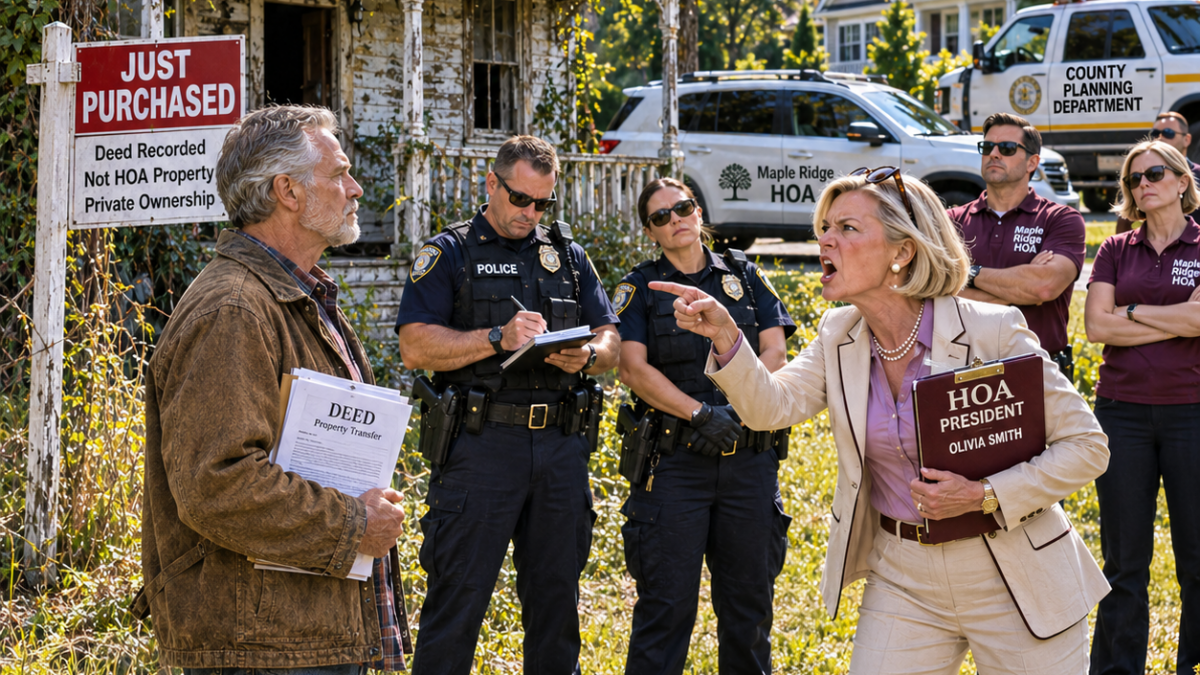
I had owned the abandoned house on Maple Ridge Lane for less than three hours when HOA president Olivia Smith called 911 and told police a dangerous stranger was breaking into it, even though my name was already recorded on the deed and the property had never belonged to her association. When I handed the responding officers my closing papers, Olivia didn’t look embarrassed—she looked terrified, and ten minutes later she quietly offered me fifty times what I had paid if I would give her the keys and walk away. What bothered me most wasn’t the false police call or the money; it was the planning-department vehicle I had seen beside her the night before and the question I couldn’t stop asking: why was the woman who had spent years convincing everyone this house was worthless suddenly desperate to own it?
My name is James Anderson. I’m a retired civil engineer, which means I spent most of my adult life looking at things people called hopeless and asking whether the numbers agreed.
The house at 19 Maple Ridge looked hopeless.
The porch sagged. Paint peeled in long strips. Three windows were broken, weeds had swallowed half the driveway, and a sun-bleached piece of police tape still clung to one porch column.
Pinewood Estates called it the haunted house.
According to neighborhood folklore, its last owner, Professor Henry Morrison, had died there eight years earlier. People claimed lights flickered at midnight, footsteps crossed the upstairs hallway, and an old music box played by itself.
The stories worked.
The asking price fell from twenty-five thousand dollars to twelve thousand.
Then two thousand.
Finally, one hundred dollars through a distressed-property disposal.
Nobody wanted it.
I did.
Not because I believed in ghosts.
Because before making an offer, I checked the plat.
The foundation looked repairable.
The lot was large.
And most important, the house had been built in 1976—five years before Pinewood’s HOA was formed.
It had never joined.
That should have made Olivia Smith irrelevant.
Instead, the first time she saw me inspecting the place, she marched across the sidewalk in a pastel blazer and said, “You really shouldn’t be here.”
“The property is listed.”
“For a reason.”
“Bad roof?”
“Worse.”
She lowered her voice.
“People have had experiences.”
I almost smiled.
“I’m an engineer, Ms. Smith.”
“So?”
“Ghosts rarely survive due diligence.”
Her expression tightened.
Then I mentioned that the house wasn’t subject to Pinewood’s HOA covenants.
That wiped the smile completely away.
“We have ways of protecting community standards.”
“Against ghosts?”
“Against problems.”
That sentence stayed with me.
So did something else.
That evening, when I returned for another inspection, Olivia appeared again.
This time she wasn’t alone.
A city vehicle sat beside her Lexus.
DEPARTMENT OF PLANNING.
The man with her introduced himself reluctantly as Brian Smith.
Same last name.
Her brother.
He called their presence a “routine safety check.”
I called it interesting.
When they left, I went home and searched planning records.
Buried in preliminary transportation studies was a proposed Highway 47 connector.
Nothing approved yet.
Nothing guaranteed.
But one possible corridor ran near Pinewood’s eastern edge.
Near 19 Maple Ridge.
If that route was ever built, neglected property on that side of the neighborhood could become extremely valuable.
The next morning, I bought the house.
One hundred dollars plus closing costs, back taxes, and enough repair estimates to make any sensible person reconsider.
At 1:12 p.m., I pulled into my new driveway with a toolbox and the deed folder beside me.
Olivia was already outside.
“You actually did it.”
“I did.”
She glanced toward the house.
“James, let’s be adults. I’ll give you five thousand dollars today.”
“For a haunted ruin?”
Her jaw flexed.
“Ten thousand.”
I stared at her.
“You’re increasing awfully fast.”
“I’m trying to save you trouble.”
“Whose trouble?”
Her eyes flicked toward the upstairs window.
Then back to me.
“You don’t understand what you bought.”
Before I could answer, sirens rose behind us.
A police SUV turned onto Maple Ridge.
Then another.
Olivia stepped away from my driveway and lifted one trembling hand toward the officers.
“That’s him,” she called. “He broke into the abandoned house.”
I slowly reached for the folder containing my deed.
And when Olivia saw exactly which document I was holding, every trace of color left her face.
PART 2
The older officer approached first.
“Sir, keep your hands where I can see them.”
“Absolutely.”
I held the folder by one corner.
“My name is James Anderson. I own this property.”
Olivia gave a sharp laugh from the sidewalk.
“He does not.”
The officer looked at me.
“Identification?”
I handed over my driver’s license.
Then the closing statement.
Then the recorded deed receipt from the county.
The younger officer studied them while the older one looked toward the house.
“How long have you owned it?”
“Closed this morning.”
Olivia stepped forward.
“That sale is disputed.”
I turned.
“By who?”
“The community.”
“The community didn’t own it.”
“Pinewood has an interest in all property affecting neighborhood safety.”
The older officer raised a hand.
“Ma’am, let us sort this out.”
She pursed her lips.
I pointed to the parcel number on the paperwork.
“You can verify it through the county.”
The younger officer returned to the SUV.
Two minutes later he came back.
“It matches.”
Olivia stared at him.
“What matches?”
“Ownership.”
“That can’t be right.”
He looked again.
“County shows Mr. Anderson as the current recorded purchaser.”
She stepped closer.
“There are title complications.”
“Do you have documentation?”
“I don’t carry HOA legal files on the sidewalk.”
I almost laughed.
The older officer looked at me.
“Did you break anything to get inside?”
“No. I have the key.”
I held it up.
“Listing agent gave it to me at closing.”
He nodded.
Then turned to Olivia.
“Ma’am, what made you believe a burglary was occurring?”
“I saw an unknown man entering an abandoned structure.”
“You knew who I was.”
She looked at me.
“You told me your name once.”
“And yesterday you offered advice about whether I should buy the place.”
The younger officer’s eyebrows rose.
Olivia’s face tightened.
“I was concerned.”
The older officer sighed.
“Concern is fine. But before calling 911 for an active break-in, it helps to verify whether the person belongs there.”
“I acted in good faith.”
“Then next time call non-emergency unless there’s an actual emergency.”
She folded her arms.
“I hope you officers understand that if something happens because you allowed him inside—”
The older officer cut her off.
“We aren’t allowing him inside. He owns the property.”
That sentence landed hard.
For years, Olivia had apparently been the person who decided what happened on Maple Ridge.
Now two uniformed officers had told her, in front of half the street, that this one house did not belong to her.
They left after taking a short report.
I expected Olivia to follow.
She didn’t.
She stood across from me, staring.
Finally I said, “Ten thousand?”
Her eyes narrowed.
“What?”
“Your last offer.”
“That was before you embarrassed me.”
“You called police.”
“You made the situation confusing.”
I actually laughed.
“You reported a burglary at a house you knew I was buying.”
“I didn’t know the closing had gone through.”
“Then why were you waiting here?”
She didn’t answer.
I stepped toward the porch.
“Have a good afternoon, Olivia.”
“Twenty-five.”
I stopped.
She was serious.
“Twenty-five thousand dollars?”
“Cash purchase. I can have an agreement prepared tonight.”
The house had sold for one hundred dollars because nobody would touch it.
Now she was offering two hundred fifty times that amount.
“What do you want with it?”
“Remove an eyesore.”
“For twenty-five grand?”
“Pinewood values appearances.”
“Then why didn’t the HOA buy it for a hundred?”
Her mouth opened.
Closed.
I smiled.
“That’s what I thought.”
She walked away.
I stood there watching her heels strike the pavement.
Then I looked at the house.
For the first time, it didn’t feel lonely.
It felt like evidence.
That evening I walked every room again.
Not looking for ghosts.
Looking for information.
Henry Morrison’s engineering diploma was still in the upstairs study.
So were several old technical books.
Transportation Planning.
Hydrology.
Municipal Infrastructure Finance.
That surprised me.
According to the neighborhood stories, Henry had been some eccentric professor who died isolated and angry.
The books suggested something more ordinary.
A civil engineer.
My field.
I opened one.
His name was handwritten inside.
H. MORRISON.
Underneath:
Ethics is what remains after the concrete cures.
I smiled.
That sounded exactly like a professor.
The study desk drawers were mostly empty.
One contained pencils.
Another contained old utility bills.
The lowest drawer stuck.
I pulled harder.
It opened.
Inside was a folder.
Nothing dramatic.
Property tax records.
Original house plans.
A copy of the 1981 Pinewood HOA declaration.
And a letter.
Mr. Morrison,
As previously discussed, your property remains excluded from the Pinewood Estates declaration because your lot predates the association and you have declined voluntary annexation.
Future owners cannot be compelled to join absent lawful consent.
County Counsel’s Office.
Dated 1982.
I sat down.
Henry had known.
He had protected the parcel intentionally.
Then I found another paper.
A hand-drawn map.
Not of ghosts.
Of roads.
A dotted line ran along Pinewood’s eastern boundary.
At the bottom:
Possible future connector corridor—monitor.
Date: 1998.
I stared at it.
Henry had seen the possibility decades before Olivia.
Maybe that was why the house mattered.
Not because it was haunted.
Because it was strategically placed.
I scanned everything.
Cloud backup.
External drive.
Printed copies.
Habit.
Fifteen years of engineering work had taught me that documents disappear most often right after someone says they aren’t important.
The first threat arrived at 11:43 that night.
Unknown number.
You don’t understand what you bought.
Return the keys.
No signature.
No punctuation.
I took a screenshot.
Didn’t answer.
Then I changed my mind.
I typed:
I understand I bought 19 Maple Ridge Lane.
Nothing else.
The reply arrived instantly.
You were warned.
I saved that too.
The next morning, red spray paint covered part of my fence.
FREAK.
Subtle.
I photographed it before touching anything.
Then I checked my temporary camera.
Nothing.
I hadn’t installed proper security yet.
That changed before lunch.
Eight motion cameras.
Cloud backup.
Driveway coverage.
Porch.
Back gate.
Interior entry points.
I wasn’t paranoid.
I had already had police called on me for entering my own home.
The neighborhood gossip started almost immediately.
I learned later that someone had posted anonymously:
New owner of haunted property has criminal history.
Another:
Parents should keep children away.
Then:
He changed his name after legal trouble.
I found all three posts.
No evidence.
No source.
No details.
Just enough poison to make people hesitate.
The first time a mother pulled her son away from my sidewalk, I felt something I hadn’t expected.
Shame.
Not because I’d done anything.
Because public suspicion does that.
It makes you feel dirty even when you know the dirt was thrown by someone else.
I spent that night at my folding kitchen table staring at half-stripped wallpaper.
For the first time, I wondered whether I’d made a mistake.
I could sell.
Olivia would probably still pay twenty-five thousand.
Walk away with a ridiculous profit.
Let Pinewood keep its ghosts.
I thought about it seriously.
Then someone knocked.
Three slow taps.
I checked the camera.
An old man with a cane.
I opened the door.
“James Anderson?”
“Yes.”
“Dave Miller.”
He offered his hand.
“Retired postal worker. Lived here since ’86.”
“Come in.”
He looked around.
“Smells better.”
“Than what?”
“Last time I was inside.”
“You knew Henry?”
“Everybody who mattered did.”
That got my attention.
We sat.
Dave looked toward the study stairs.
“You hearing ghosts yet?”
“Only plumbing.”
“That’s Henry.”
I laughed.
“What’s the real story?”
Dave became serious.
“Olivia started most of it.”
“The haunting?”
“Not all at once.”
He leaned his cane against the table.
“Henry refused to join the HOA. She hated that.”
“Why?”
“Control. And eventually land.”
“Highway?”
His eyebrows rose.
“You found that?”
“I found preliminary maps.”
He nodded slowly.
“Henry knew too.”
“What happened to him?”
“Cancer.”
I stared.
“So he didn’t die mysteriously inside?”
“No.”
“Funeral?”
“Private. Sister in Oregon handled it.”
“Why does everyone say no family existed?”
“Because rumors are more interesting.”
“Lights?”
“Old electrical timer.”
“Music box?”
Dave laughed.
“Henry liked classical music. Had a timer on a radio upstairs.”
“Footsteps?”
“Raccoons.”
I leaned back.
“So the haunted story was garbage.”
“Mostly.”
“Mostly?”
Dave smiled.
“Old houses make noises.”
Fair.
“What did Olivia do?”
“She encouraged everything.”
“How do you know?”
“I heard her.”
He told me the story.
After Henry died, Pinewood wanted the lot annexed into the HOA.
The estate refused.
A buyer came.
Olivia told the buyer about mold, electrical danger, crime history, and paranormal incidents.
They walked.
Another buyer came.
Same thing.
Then another.
“Five families over the years,” Dave said.
“Five?”
“Not all this house. She did similar things elsewhere.”
“What things?”
“Rumors. Code complaints. HOA fines when she had authority. Police calls when she didn’t.”
“Why?”
“Properties.”
I sat forward.
“What properties?”
“People she wanted gone.”
He gave me names.
Two homes sold to an LLC.
One to a friend of hers.
One to her brother’s business partner.
“Can you prove that?”
“No.”
“Then it’s a theory.”
“Smart.”
“I spent my career being sued by contractors who hated facts.”
Dave smiled.
“You really do remind me of Henry.”
That night, I searched public property records.
Dave was partly right.
Five homes connected to people who had publicly fought with Olivia had changed hands over eight years.
Three buyers were LLCs.
Two LLCs shared the same registered mailing suite.
A commercial mail center downtown.
Not proof of ownership.
But enough to keep looking.
The highway corridor made the pattern more interesting.
All five properties sat near Pinewood’s eastern boundary.
So did mine.
I created a spreadsheet.
Address.
Former owner.
Sale date.
Buyer.
LLC registration.
Distance from proposed corridor.
I mapped them.
The cluster was obvious.
That didn’t prove Olivia owned them.
It proved somebody had been collecting land near the possible route.
I needed help.
I called Ethan Clark.
Ethan had worked fraud investigations for several contractors and insurers before becoming a licensed private investigator.
I’d used him once when a subcontractor on a bridge rehabilitation project billed for materials that never arrived.
He answered:
“Please tell me you’re retired.”
“I am.”
“Then why are you calling?”
“Because retirement is disappointing.”
I explained.
He whistled.
“HOA president, haunted house, highway corridor.”
“Yes.”
“Sounds like internet nonsense.”
“I have deeds.”
“That helps.”
“Public records only.”
“Even better.”
“I want to know who owns the LLCs.”
“That could take time.”
“I have time.”
“And money?”
“Less enthusiasm there.”
He laughed.
“Send me what you have.”
While Ethan worked, I renovated.
That part mattered.
I didn’t want my life to become only Olivia.
I repaired the porch.
Replaced broken windows.
Opened walls.
Removed old wiring.
Had professionals inspect asbestos and mold.
There was mold.
Not supernatural.
Just water.
The structure was better than expected.
One afternoon, I found a message scratched beneath old wallpaper in the study.
H.M. 1997.
Nothing else.
I ran my fingers over it.
Henry had probably marked the wall during renovation.
Yet standing there with dust floating in the afternoon light, I felt strangely connected to a man I’d never met.
Or thought I’d never met.
At that point I didn’t know.
Olivia shifted from rumors to paperwork.
HOA NOTICE.
UNAPPROVED EXTERIOR REPAIR.
I mailed it back.
Property is not subject to Pinewood HOA declaration. Please cease sending enforcement notices.
Second notice:
LANDSCAPING NONCOMPLIANCE.
Third:
DISTURBANCE OF COMMUNITY HARMONY.
That one was almost impressive.
I wrote:
Please provide the recorded covenant granting Pinewood Estates HOA authority over Parcel 19-MR.
No response.
Then a camera caught Olivia at 2:47 a.m.
Pink blazer.
Flashlight.
She walked to my mailbox.
Photographed my driveway.
Peered through the side gate.
I printed one still frame.
Mailed it to the HOA office.
No accusation.
No note.
Just the photograph.
An hour after delivery, Olivia emailed:
Mr. Anderson,
Your ongoing campaign of intimidation, photography, and harassment is inappropriate. You are advised to stop escalating conflict with neighborhood leadership.
Olivia Smith
President
I smiled.
She had just acknowledged receiving a photograph of herself on my property in the middle of the night without denying it.
Saved.
Backed up.
Folder.
Then came the trash.
Motion alert at 3:23 a.m.
I opened the footage.
Olivia’s Lexus stopped near my fence.
A second person got out.
Hooded.
They unloaded black bags.
Some went over my fence.
Others were dumped near the curb.
The second person wasn’t identifiable.
Olivia was.
Clear face.
Clear vehicle.
Clear plate.
I waited until daylight.
Inside one bag:
Rotten food.
Broken garden pots.
Shredded paper.
Half-burned documents.
That last part mattered.
I wore gloves.
Photographed everything.
Called the sheriff.
Deputy Collins arrived.
He watched the footage twice.
“That’s your HOA president?”
“Yes.”
“Why’s she dumping garbage in your yard?”
“If I knew, my retirement would be simpler.”
He photographed the bags.
Then looked at the paper scraps.
“You recognize these?”
“HOA forms.”
Some pieces contained invoice numbers.
Vendor names.
Signatures.
One readable fragment:
WHITMORE MAINTENANCE LLC.
Another:
COMMUNITY LANDSCAPING — $22,800.
“Don’t handle those any more than you have to,” Collins said.
“I already used gloves.”
“Good.”
“Can you collect them?”
“We can document and take what appears relevant.”
“Is dumping shredded HOA paperwork in my yard relevant?”
He smiled.
“Probably.”
Before leaving, he added:
“Mr. Anderson, whatever this is, don’t play investigator yourself.”
“I’m an engineer.”
“That wasn’t reassuring.”
Ethan called the same afternoon.
“I found the LLCs.”
I sat down.
“And?”
“Three trace through registered agents, but beneficial ownership becomes clearer through property tax mailing addresses and public business records.”
“Olivia?”
“Two connect to her household.”
My pulse jumped.
“Two?”
“Another connects to Brian Smith.”
“Her brother.”
“Yes.”
“The planning department deputy director?”
“Correct.”
I stood.
“Conflict of interest.”
“Potentially.”
“Highway?”
“Brian has worked on transportation-planning reviews.”
“That’s worse.”
“Careful.”
Ethan’s tone hardened.
“Working in planning isn’t proof he manipulated a corridor.”
“I know.”
“Say it.”
“It isn’t proof.”
“Good.”
“What is proof?”
“That Olivia-controlled entities have acquired multiple distressed properties near a proposed transportation corridor.”
I breathed out.
“That’s enough for motive.”
“Potential motive.”
“You enjoy this.”
“It’s my job.”
“Anything else?”
“Yes.”
“Bad?”
“Interesting.”
He sent the files.
The HOA’s public budget reports showed recurring maintenance payments to Whitmore Maintenance LLC.
Olivia’s husband was Richard Smith.
Not Whitmore.
But Ethan found that Richard had used the trade name Whitmore Automotive for a garage he once operated with his mother’s family.
Whitmore Maintenance LLC listed an address associated with the same property.
“How much?”
“Public HOA reports show well over one hundred thousand dollars paid across several years.”
“For what?”
“Maintenance.”
“Did they do it?”
“That requires records.”
“Dave says projects never happened.”
“Then get a lawyer.”
So I did.
Sarah Chen.
Municipal and association litigation.
Calm voice.
Sharp eyes.
She listened for forty minutes without interrupting.
Then she said:
“You have several separate issues.”
“That’s disappointing. I was hoping for one giant lawsuit.”
She ignored me.
“First, harassment and possibly defamation.”
“Okay.”
“Second, unauthorized HOA enforcement against a non-member parcel.”
“Easy.”
“Third, possible financial self-dealing.”
“Harder.”
“Much.”
“Fourth, possible conflicts relating to property acquisitions and your highway theory.”
“Possible.”
She nodded.
“Good. You understand the word.”
“Ethan trained me.”
“Keep him.”
She reviewed the old HOA declaration.
Then Henry’s letter.
“You’re right. Your parcel isn’t in the HOA.”
“I know.”
“That doesn’t mean you can demand HOA financial records as a member.”
I paused.
The source version of my revenge plan had just suffered a technical problem.
“Because I’m not a member.”
“Exactly.”
“How do we get records?”
“From actual members.”
Dave.
Carol.
Others.
“Or through litigation if we establish a proper basis.”
“So I can’t storm into a meeting demanding the books.”
“You can storm anywhere you want. I won’t represent you while you do it.”
I smiled.
“Noted.”
Dave was a member.
So was Carol Whitaker from Lot 17.
Carol had volunteered on a landscaping committee.
When Dave explained what we found, she went pale.
“Twenty-two thousand eight hundred?”
“That’s one invoice,” I said.
“We never got new irrigation.”
“You’re sure?”
“I chaired the committee.”
That changed everything.
Sarah helped Dave and Carol make formal member requests for financial records under applicable state law and the association bylaws.
The HOA had ten business days.
Olivia refused.
Her email said:
Records containing vendor and financial information are confidential and exempt from resident inspection.
Sarah read it.
“That’s not how this works.”
“What now?”
“Demand letter.”
Olivia ignored that too.
Then Sarah filed.
A judge ordered production of the non-privileged association records required by law.
Olivia delayed.
“Technical problems.”
“Accounting transition.”
“Unavailable archives.”
The court didn’t like that.
Neither did the other board members.
Eventually, five years of records arrived.
Not in one magical box containing every crime.
In batches.
Bank statements.
Vendor invoices.
Board minutes.
Canceled checks.
Credit-card records.
Enough.
Sarah hired a forensic accountant.
That was the right move.
Not Dave with a magnifying glass.
Not me with a spreadsheet.
Professionals.
While they worked, Olivia became more aggressive.
The anonymous rumors returned.
This time with my photograph.
COMMUNITY SAFETY WARNING.
The page claimed I had a criminal record and posed a risk to children.
I had no criminal record.
I ordered a certified background report.
Posted a simple statement on a website:
My name is James Anderson. False statements are circulating regarding my criminal history. Attached is a current certified background report. I will not speculate about who created the rumors. I will address provable misconduct through appropriate legal channels.
Nothing else.
No insult.
No “Karen.”
No threats.
Within two days, neighbors started asking different questions.
“Who posted this?”
“Why?”
“Why did the HOA call police on him?”
The narrative moved.
Not because I shouted louder.
Because facts are harder to sustain a war against.
Then Carol called.
“We found something.”
“What?”
“Late fees.”
“What about them?”
“My daughter and her husband were charged twelve hundred dollars last year.”
“I remember.”
“They paid on time.”
“Proof?”
“Bank statements.”
“What did Olivia say?”
“That payment was misapplied.”
Sarah reviewed it.
Then another resident came forward.
Then another.
Overcharges.
Duplicated late fees.
Vendor payments.
The pattern widened.
The forensic accountant’s preliminary report arrived six weeks later.
Sarah called me to her office.
Dave and Carol were there.
She put the document on the conference table.
“Before anybody celebrates, this is preliminary.”
Dave whispered:
“She knows us.”
Sarah pointed to the summary.
Approximately $127,000 in transactions required further explanation or lacked adequate supporting documentation.
Not all theft.
That distinction mattered.
Some were sloppy bookkeeping.
Some legitimate expenses with missing records.
But several payments to Whitmore Maintenance had no matching work orders, contracts, or proof of completion.
A $9,800 pool-equipment invoice had been paid during a year the pool was closed and had no equipment matching the description.
An $8,700 electrical-upgrade payment had no permit, inspection, or physical project.
A $3,500 “community leadership conference” reimbursement matched travel expenses in Rome.
Dave stared.
“Rome?”
Sarah nodded.
Carol’s mouth fell open.
“We couldn’t afford playground repairs that year.”
Nobody laughed.
Then Sarah showed us bank tracing obtained through lawful discovery in the civil action.
Some Whitmore payments moved into accounts associated with Richard’s business.
Several later transfers went toward household expenses.
Not enough yet to prove every dollar was stolen.
Enough to escalate.
Sarah referred the records to the county prosecutor.
I sat in my kitchen that evening.
No celebration.
The house creaked around me.
Rain tapped the rebuilt windows.
I looked at Henry’s diploma.
“What did you know?” I asked.
The house, professionally, did not answer.
The next HOA meeting drew more people than the clubhouse could hold.
I wasn’t an HOA member.
But the board allowed affected neighboring property owners during public comment.
Olivia hated that.
She sat at the front.
No pink blazer.
Navy.
Serious.
Dave spoke first.
“We asked for records because association money belongs to the association.”
Olivia said:
“You received records.”
“After a court ordered you.”
Murmurs.
Carol stood.
“Why did you tell us there was no money for playground repairs when twenty-two thousand dollars went to landscaping that never happened?”
Olivia’s voice sharpened.
“You are not an accountant.”
“No.”
Carol looked toward the forensic accountant seated beside Sarah.
“She is.”
That got attention.
The accountant summarized.
Not accusations.
Findings.
Unsupported payments.
Related-party vendor concerns.
Missing approvals.
Unexplained reimbursements.
Olivia interrupted repeatedly.
“Mischaracterized.”
“Out of context.”
“Accounting error.”
Then somebody asked about the Italy conference.
Silence.
Olivia looked toward her attorney.
He whispered something.
She said:
“It was professional development.”
Dave called from the back:
“Did the Coliseum teach lawn enforcement?”
The room broke into laughter.
Even I smiled.
Olivia slammed the gavel.
“This meeting is adjourned.”
A board member named Karen Walters raised her hand.
“No.”
Olivia stared.
“No?”
“Our bylaws require a majority.”
Karen looked around.
“I move that we continue.”
Another member seconded.
Vote.
Every board member except Olivia voted to continue.
I watched the realization cross her face.
This was the first time her own rules had turned against her.
She had spent years teaching Pinewood that procedure was power.
Now procedure had left her standing alone.
A homeowner asked:
“Are you personally connected to Whitmore Maintenance?”
Olivia said:
“My husband has business interests.”
“Did you disclose that?”
“It was known.”
“Where in the minutes?”
Silence.
Another:
“Why did companies connected to you buy distressed properties near the highway corridor?”
Her head snapped toward me.
There.
She knew exactly where that question came from.
“This meeting has nothing to do with private investments.”
I stood.
“You told people this house was worthless.”
“Mr. Anderson is not recognized.”
Karen Walters said:
“I recognize him.”
Olivia glared at her.
I continued.
“You offered me five thousand dollars the morning I bought it.”
Whispers.
“Then ten.”
More.
“Then twenty-five.”
Olivia stood.
“That was an attempt to remove a dangerous structure.”
“For twenty-five thousand?”
“You are twisting—”
“Did you offer it?”
She stopped.
Everyone watched.
“Yes.”
“Why?”
“To protect property values.”
“By spending twenty-five thousand on a house you said was worth one hundred?”
Her face tightened.
I reached into my folder.
Not secret bank records.
Public documents.
“These LLCs purchased five properties near the proposed Highway 47 corridor.”
I placed copies on the table.
“Two trace through public records to your household. One to your brother.”
Brian’s name produced another wave of murmurs.
Olivia’s face changed.
“You had no right investigating my family.”
“All public filings.”
“This is harassment.”
“No.”
I looked around the room.
“This is why she wanted the haunted house.”
Olivia slammed both palms on the table.
“You don’t know anything!”
The room went quiet.
I said:
“Then explain it.”
She stared at me.
Her chest rose and fell.
Finally:
“The connector will increase property values.”
There it was.
Not a confession to corruption.
Not proof Brian manipulated anything.
But motive.
She realized too late that she had said it out loud.
Someone near the front asked:
“How long have you known?”
Olivia looked toward the door.
Another homeowner:
“Did Brian tell you?”
Her attorney stood.
“My client will not answer questions regarding an unrelated city project.”
That was probably smart.
It also sounded terrible.
The meeting ended in chaos.
By the next day, Pinewood’s board suspended Olivia’s financial authority pending the audit and investigation.
She remained technically president until a removal vote.
But her kingdom had cracked.
Then someone threw a rock through my kitchen window.
2:14 a.m.
Glass everywhere.
A note tied around it:
LEAVE OR WE’LL MAKE YOU.
That scared me.
Not philosophically.
Physically.
I sat in the dark with a flashlight and a broom until deputies arrived.
My cameras caught a hooded figure.
Not enough face for identification.
But the vehicle that stopped nearby resembled Richard’s pickup.
Resembled.
Not proved.
Deputy Collins asked:
“You want a patrol check for a few nights?”
“Yes.”
That was the first time I admitted it.
I was afraid.
Not of Olivia.
Of escalation.
People become unpredictable when they think their identity depends on winning.
Sarah called in the morning.
“Don’t respond.”
“I wasn’t planning to.”
“Don’t post the video.”
“Okay.”
“Don’t accuse Richard.”
“I won’t.”
“Good.”
Then:
“James, this stops being entertaining here.”
“It stopped being entertaining a while ago.”
She arranged for a protective-order petition based on documented harassment.
The court issued temporary restrictions while the matter was heard.
Olivia responded with a countersuit.
Defamation.
Harassment.
Intentional interference with HOA operations.
Fabrication of evidence.
Sarah read it and said:
“Some allegations are serious.”
“You sound worried.”
“Good lawyers always sound worried.”
“Can she win?”
“Anybody can win something. Our job is evidence.”
Discovery helped.
So did Olivia’s own emails.
One message to a board member after my purchase:
We need pressure on Anderson immediately. If he normalizes that property, the entire eastern acquisition strategy becomes harder.
Eastern acquisition strategy.
Sarah stared at that phrase.
“So she had one.”
“Apparently.”
Another email:
Keep the Morrison property stigmatized until we can resolve ownership.
Stigmatized.
The haunted story wasn’t just gossip.
It was strategy.
Dave provided old newsletters.
Over the years Olivia had repeatedly described 19 Maple Ridge as:
unsafe.
blighted.
structurally questionable.
a community hazard.
None of those descriptions came with engineering reports.
The county building department had no condemnation order.
One old inspector’s report had called the house neglected but structurally repairable.
That one made me angry.
She had known—or could have known—that the house wasn’t hopeless.
Fear had depressed interest.
Depressed interest lowered the price.
Low price made acquisition easier.
Ethan found another piece.
Brian Smith had attended public internal planning meetings regarding the connector project.
That wasn’t illegal.
It was his job.
But public ethics records showed he had not disclosed his sister’s nearby property interests until after questions were raised.
The city opened an internal conflict-of-interest review.
Important:
No evidence proved Brian had personally moved the highway route.
The feasibility corridor predated some of the acquisitions.
I insisted on that distinction every time someone tried to make the story bigger.
We had enough wrongdoing.
We didn’t need imaginary wrongdoing.
Then Richard came onto my property at 3:06 a.m.
My camera caught him clearly.
Crowbar.
Gloves.
Baseball cap.
He walked toward the backyard shed where I stored renovation documents and backup drives.
Motion lighting came on.
He froze.
I was awake.
I didn’t go outside.
I called 911.
That decision probably prevented the story from becoming much worse.
Deputies arrived before Richard left.
They detained him near the side gate.
I watched through the window.
No confrontation.
No shotgun.
No heroic takedown.
Just police lights.
Later, according to the incident report and statements disclosed to Sarah, Richard claimed Olivia believed I had documents stolen from the HOA office.
He said she wanted them recovered.
His lawyer later disputed parts of that statement.
The security footage did not.
He was on my property at three in the morning with a crowbar.
That was enough for me.
The prosecutor’s investigation accelerated.
Search warrants were executed for specified HOA and financial records.
Olivia’s home and office were searched under judicial authority.
The board removed her as president before criminal charges were formally filed.
Vote:
Eight to zero.
I wasn’t there.
Dave called afterward.
“It’s done.”
“No.”
“What?”
“She isn’t president.”
“That’s what I said.”
“The rest isn’t done.”
He sighed.
“Engineers.”
“Postal workers.”
“Fair.”
The local news eventually picked up the story.
PINEWOOD HOA PRESIDENT UNDER INVESTIGATION.
The headline annoyed me.
Not because it was false.
Because people suddenly acted as if everything had begun the moment television arrived.
Neighbors who hadn’t spoken to me for months appeared at my porch.
One woman brought pie.
“I’m sorry.”
“For what?”
“I believed the rumor.”
“Which one?”
She looked embarrassed.
“The registry.”
I nodded.
“I should’ve checked.”
“Yes.”
That answer surprised her.
I didn’t soften it.
“You should have.”
Her eyes filled.
Then she nodded.
“I know.”
I took the pie.
“Thank you for saying it.”
That was enough.
Other apologies came.
Some I accepted easily.
Others took time.
Children started riding bicycles past my house again.
The first time a little boy stopped and asked:
“Is your house really haunted?”
I looked toward his mother.
She looked horrified.
I crouched.
“Only by bad plumbing.”
He laughed.
“What about the music box?”
“Want to see it?”
His mother said:
“James.”
I smiled.
“From the porch.”
I brought the old music box outside.
It worked after cleaning.
One small cylinder.
A simple tune.
The boy listened.
“That’s not scary.”
“Nope.”
“Why did everybody say it was?”
I looked down the street.
“Sometimes people repeat stories because repeating is easier than checking.”
He nodded as if that made perfect sense.
Adults could learn from that.
The audit became final.
Approximately $127,000 in association funds had been misappropriated or improperly diverted over several years, according to the forensic findings later introduced in court proceedings.
Not every questionable transaction was criminal.
Prosecutors focused on the clearest ones.
Payments routed through Whitmore Maintenance.
False invoices.
Personal expenses.
Travel.
Vehicle-related payments.
Home improvements.
Records showed Olivia’s involvement.
Richard’s company benefited.
The prosecutor filed charges including theft/embezzlement-related offenses, falsification of records, and obstruction arising from efforts to conceal documents and interfere with the investigation.
The false rumors and harassment supported my civil case rather than becoming some invented “criminal defamation” charge.
Reality was enough.
Olivia’s criminal attorney proposed a plea.
Her civil attorney proposed settlement.
My lawyer called.
“They’re offering you twenty thousand to resolve your personal claims.”
I laughed.
“That’s almost the house times two hundred thousand percent.”
“That’s not how percentages work.”
“It is emotionally.”
“Do you want it?”
“What terms?”
“Confidentiality. Non-disparagement. Release.”
“No.”
“Think before answering.”
“I am.”
“James.”
“I want correction of the false statements.”
“That can be negotiated.”
“I want documented damages.”
“Obviously.”
“I will not sign something that prevents me from truthfully discussing public court records.”
Sarah nodded.
“Reasonable.”
“And I won’t drop cooperation with prosecutors.”
“They can’t buy that anyway.”
“Good.”
The settlement eventually resolved portions of my civil claims.
Not revenge money.
Compensation.
Window damage.
Security costs.
Legal expenses where recoverable.
Documented defamation harm.
Harassment.
The larger community restitution issue remained separate.
The criminal case moved forward.
The courthouse smelled like old paper and coffee.
Olivia looked different.
No pink blazer.
Beige suit.
Hair pulled back.
Richard sat at a different table with separate counsel because their legal interests had diverged.
Sarah wasn’t the prosecutor.
She sat beside me as my civil attorney and victim advocate.
The state presented financial records.
Witnesses.
Board testimony.
Forensic accounting.
Richard’s conduct.
Olivia’s emails.
Then the acquisitions.
The prosecutor was careful.
Buying property near a future highway wasn’t itself illegal.
Knowing planning information wasn’t automatically criminal.
The problem was what Olivia had done to drive people out, conceal self-dealing, misuse HOA money, and obstruct scrutiny.
That distinction made the case stronger.
Carol testified.
Her hands trembled.
“You told residents the playground couldn’t be repaired.”
“Yes,” the prosecutor said.
“What did you later learn?”
“That money had been going to companies connected to Olivia’s family.”
“Did you trust her?”
Carol looked toward Olivia.
“Yes.”
The word broke slightly.
That was harder to hear than anger.
Dave testified next.
Thirty-seven years in Pinewood.
He described Henry.
The pressure to annex.
The rumor campaign.
Other residents driven out after disputes.
Defense counsel asked:
“Mr. Miller, isn’t it true that you dislike Mrs. Smith?”
Dave shrugged.
“Now?”
A few people smiled.
The lawyer didn’t.
“Did you dislike her before?”
“I disliked what she did.”
“That’s not my question.”
“Yes.”
“So you may be biased.”
“Everybody who lived there has an opinion.”
“Mr. Miller—”
“But documents don’t.”
The judge told him to answer only the questions.
Dave apologized.
Not sincerely.
When I testified, I told the truth in order.
The house.
The plat.
Olivia’s warnings.
Brian’s appearance.
The 911 call.
Offers.
Vandalism.
Rumors.
Cameras.
Dumped records.
The public property acquisitions.
The financial investigation.
Richard’s trespass.
The prosecutor asked:
“Mr. Anderson, why did you continue?”
I thought about giving some sharp answer.
Bullies.
Justice.
Truth.
Instead I said:
“At first, pride.”
Sarah looked at me.
The prosecutor paused.
“Pride?”
“Yes.”
“I didn’t like being pushed.”
“And later?”
“People were losing money.”
I looked toward Carol.
“People had been isolated into thinking they were alone.”
Then toward Dave.
“And I realized the house wasn’t the only thing Olivia had tried to make everyone afraid of.”
“What else?”
“Each other.”
That was the emotional center, although I didn’t know it then.
Olivia’s attorney cross-examined.
“You paid only one hundred dollars for this house.”
“Yes.”
“Yet today it’s worth substantially more.”
“Yes.”
“So you profited from this controversy.”
“No.”
“You’re saying the publicity didn’t increase the value?”
“I don’t know.”
“You stand to gain hundreds of thousands of dollars.”
“If the highway is approved.”
“So you had a financial motive.”
“For what?”
“To discredit my client.”
I stared at him.
“I bought the house before I knew what she’d done with HOA money.”
“You knew about the corridor.”
“Yes.”
“You expected appreciation.”
“I thought it was possible.”
“So you’re an investor.”
“I’ve never denied that.”
The attorney smiled slightly.
“Then this isn’t a story about a victim protecting a haunted house. It’s a story about two people fighting over a valuable piece of real estate.”
That was a good line.
Dangerously good.
I took a breath.
“Partly.”
The smile faded.
“Excuse me?”
“I wanted the house because I thought it was undervalued.”
He waited.
“So did Olivia.”
“Apparently.”
“So you admit—”
“But I bought it from the legal seller.”
Silence.
“I didn’t tell other buyers it was haunted.”
He stopped.
“I didn’t call 911 on them.”
He looked at the judge.
“I didn’t vandalize their fences.”
“Mr. Anderson—”
“I didn’t use HOA funds to buy myself a vacation.”
Sarah touched my sleeve.
Stop.
I stopped.
The judge said:
“Answer only the question asked.”
“Yes, Your Honor.”
The attorney returned to his table.
The prosecution’s most damaging witness wasn’t me.
It was Richard.
He had entered a cooperation agreement on the obstruction portion.
He looked exhausted.
Older.
When asked about Whitmore Maintenance, he admitted the company had billed Pinewood for work it did not fully perform.
“How did that happen?”
“Olivia handled most of the invoices.”
“Did you receive money?”
“Yes.”
“Did you know some invoices were false?”
He hesitated.
“Yes.”
Olivia shut her eyes.
Then came the break-in.
“Did you enter Mr. Anderson’s property on the night of May 14?”
“Yes.”
“Why?”
“Olivia said he had documents that belonged to the HOA.”
“Did you believe that?”
“I wanted to.”
That sentence hung in the room.
“Did she ask you to retrieve them?”
“Yes.”
Olivia whispered something to her attorney.
“Did you bring a crowbar?”
“Yes.”
“Why?”
Richard stared at his hands.
“I didn’t know what I’d need.”
“Were you authorized to enter the property?”
“No.”
The defense tried to undermine him.
Divorce tension.
Potential sentencing benefit.
Blame shifting.
All valid concerns.
But his testimony matched camera footage, texts, and other records.
The case did not depend on one bitter husband.
It depended on corroboration.
The judge ultimately accepted a negotiated resolution rather than a dramatic all-or-nothing verdict.
Olivia pleaded guilty to felony theft-related charges involving association funds and to obstruction-related conduct.
She was ordered to pay substantial restitution to Pinewood.
She received a custodial sentence largely suspended under strict conditions, supervised probation, community service, and a ten-year prohibition on holding fiduciary leadership in an HOA or similar association.
My separate civil judgment and settlement compensated documented personal damages.
Richard received his own consequences.
The city ethics review found Brian had failed to adequately disclose family property interests while working on matters touching the corridor.
No evidence established that he had secretly moved the highway route.
He was disciplined, removed from direct involvement in the project, and later resigned from the department.
Again:
Enough truth.
No need for invented conspiracy.
When the judge asked Olivia whether she wanted to speak before sentencing, she stood.
For the first time since I met her, her voice had no performance in it.
“I thought Pinewood needed me.”
Nobody moved.
“I told myself rules were what kept property valuable.”
She looked toward the residents.
“Then property value became the reason for everything.”
Her eyes found mine.
“I believed if I controlled what people saw, what they said, who moved in, and who moved out, I could control what happened.”
She looked down.
“I couldn’t.”
The judge said:
“You weren’t convicted because you cared about property values. You were convicted because you treated other people’s money and rights as tools for your own benefit.”
Olivia nodded.
That was it.
No screaming.
No collapse.
No gavel followed by applause.
Real consequences are quieter than that.
Outside, reporters crowded the courthouse.
One shouted:
“Mr. Anderson, what happens now?”
Sarah began steering me away.
I stopped.
“I’m going home.”
The reporter tried again.
“What about the house?”
“I still own it.”
“Will you sell?”
“No.”
“Even if values rise?”
I smiled.
“Ask me after I finish the kitchen.”
That clip made the local evening news.
Dave found it hilarious.
One week later, Pinewood held elections.
Dave Miller was nominated.
He refused.
Then accepted.
Then claimed he had been manipulated.
He won by a landslide.
His first action as HOA president was to pass financial-transparency reforms.
Monthly reports online.
Independent annual audits.
Competitive bidding above a set threshold.
Conflict disclosures.
Resident inspection rights.
No unilateral fines by the president.
Clear appeal procedures.
He called me afterward.
“You joining now?”
“The HOA?”
“Yes.”
“No.”
“You could voluntarily annex.”
“Absolutely not.”
“Coward.”
“My house has survived forty-five years outside your authority.”
“Henry would approve.”
That made me pause.
“Yeah.”
The renovations took another six months.
The house transformed slowly.
Not television makeover slowly.
Actual slowly.
Permit delays.
Rotten joists.
Wrong cabinet shipment.
A plumber who vanished for two weeks.
I kept Henry’s study nearly intact.
Desk restored.
Diploma rehung.
Books cleaned.
The music box stayed downstairs.
One rainy afternoon I opened one of Henry’s old engineering texts.
A photograph fell out.
College classroom.
Late 1980s.
Professor at the front.
Students behind him.
I stared.
Then leaned closer.
That couldn’t be.
I took the photograph upstairs into better light.
Professor Henry Morrison.
Younger.
Dark hair.
Glasses.
I knew that face.
Not from Pinewood.
From college.
I opened my laptop.
Searched old university archives.
There he was.
Professor Henry Morrison.
Visiting lecturer in civil engineering.
1989 to 1994.
I had taken his transportation ethics seminar.
One semester.
I barely remembered.
Then memory came back.
Room 214.
Tuesday evenings.
A professor who made us argue about whether an engineer’s responsibility ended when the client signed the plans.
I called the listing attorney who had handled the distressed transfer.
“Does Henry Morrison’s estate still have representation?”
“Yes.”
“Can you give them my contact?”
“Why?”
“I think he was my professor.”
There was a long pause.
“Mr. Anderson.”
“Yes?”
“You should probably speak with the estate trustee.”
That was strange.
“What aren’t you telling me?”
“I can’t discuss estate matters.”
“Of course.”
Two weeks later, a certified envelope arrived.
MORRISON FAMILY TRUST.
Inside:
A letter.
And an invitation to meet the trustee.
Not a two-hundred-thousand-dollar check appearing magically in my mailbox.
That would’ve been absurd.
I met attorney Rebecca Hale downtown.
She was in her seventies.
Sharp as Sarah.
She placed a file on the table.
“Henry knew who you were.”
My throat tightened.
“How?”
“When you made the purchase offer, the title agent forwarded purchaser information to the trust.”
“Why?”
“The trust controlled the disposal conditions.”
“I thought the county distressed process—”
“It was a hybrid estate disposal after years of unpaid maintenance assessments and tax issues. The one-hundred-dollar price was nominal. You assumed significant repair obligations and liens were cleared through the estate.”
That made much more sense than a perfectly good house literally being sold for the price of dinner.
“Henry recognized my name?”
“He had instructions in the trust.”
“Before he died?”
“Yes.”
She slid a letter toward me.
Dated eleven years earlier.
To whoever eventually takes responsibility for 19 Maple Ridge:
This house was never intended to make anyone wealthy.
It was intended to remain free.
I taught civil engineering for thirty-two years. Engineers like to believe structures fail because of material limits, but most catastrophic failures begin earlier—with somebody deciding an inconvenient rule no longer applies to them.
Pinewood wanted this parcel for decades. I refused because voluntary associations cease to be voluntary the moment dissent becomes punishable.
If the eventual owner chooses to join, that is their right.
If they choose not to, protect that right just as fiercely.
Rebecca paused.
“There’s another page.”
I turned it.
The handwriting changed slightly.
If the purchaser is James Anderson, formerly of my transportation ethics seminar, tell him I remember him.
My eyes blurred.
I sat back.
Rebecca waited.
I read.
He once stayed after class for twenty minutes arguing that an engineer should refuse a legal project if the foreseeable public harm was too great.
I told him he was young.
He told me ethics didn’t improve with age unless practiced.
Annoying student.
Good engineer.
If he is still that stubborn, the house will be fine.
I laughed.
Then covered my face.
A memory returned so vividly it hurt.
Henry at the classroom door.
Me, twenty-two, arguing.
He had laughed then too.
I lowered the letter.
“Why one hundred dollars?”
Rebecca smiled.
“Henry had a sense of humor.”
“Clearly.”
“He also wanted the next owner selected primarily by willingness to assume the property, not by a bidding war.”
“Did he expect Olivia?”
“Not specifically.”
“But the HOA?”
“Yes.”
“What happens now?”
Rebecca folded her hands.
“Henry established a restoration trust.”
I stared.
“How much?”
“The trust can reimburse qualified restoration costs up to two hundred thousand dollars, provided the property remains outside forced association control and specified historic features are preserved.”
Not a personal windfall.
Better.
“He set aside money for the house.”
“Yes.”
“Why wasn’t I told before?”
“Because the trust activates after the purchaser maintains ownership and begins bona fide restoration.”
“How long?”
“Six months.”
I laughed.
“So he wanted to see if I ran.”
“In legal terms, yes.”
“What happens if I sell?”
“Depends on timing and terms. The restoration grant does not become unrestricted cash.”
That was exactly the kind of arrangement an engineer would create.
Purpose-driven.
Conditions.
No lottery ending.
I took the letter home.
Sat in Henry’s study.
Read it five times.
Annoying student.
Good engineer.
I hadn’t cried through the trial.
Not when neighbors apologized.
Not when Olivia was sentenced.
I cried then.
Quietly.
Because suddenly the house wasn’t a random bargain.
It was a line between who I’d been at twenty-two and who I was now.
The highway connector was approved the following year.
Not exactly beside my fence.
Roughly two miles east.
Property values across Pinewood rose substantially.
Mine did too.
A new appraisal came in just under nine hundred thousand dollars after restoration, acreage, location, and market changes.
People loved that part of the story.
“One hundred dollars to nine hundred grand.”
It sounded like magic.
It wasn’t.
I had paid taxes.
Liens.
Permits.
Repairs.
Months of labor.
Professional contractors.
Legal costs.
And the original nominal price reflected an asset nearly everyone considered toxic.
But yes.
I had been fortunate.
Offers came.
Investors.
Developers.
One close to a million dollars.
I declined.
Not because selling would betray Henry.
The property was mine.
He had said choice mattered.
I declined because I finally liked living there.
That was enough.
The Morrison restoration trust helped finish the study, restore original exterior details, and repair the old front porch.
I used part of my own settlement proceeds to create something separate.
The Morrison-Anderson Engineering Scholarship.
Smaller than the source story’s fantasy version.
Realistic.
Sustainable.
One student each year.
Preference for first-generation engineering students interested in public infrastructure.
The first recipient was Maya Hernandez.
Nineteen.
Community college transfer.
Wanted to design bridges.
At the award dinner, she shook my hand.
“Why bridges?”
I asked.
“My dad drives trucks.”
“That’s why?”
“He complains about bad ones constantly.”
I laughed.
“Excellent technical motivation.”
She smiled.
Then:
“I read Professor Morrison’s letter.”
“Which part?”
“About rules.”
I nodded.
“My professor says engineering is just math.”
“Your professor is wrong.”
She looked shocked.
I leaned closer.
“Don’t tell them I said that.”
“Too late.”
That year Pinewood held its first neighborhood barbecue on the lawn outside the clubhouse.
No matching chair requirement.
No approved tablecloth colors.
A child brought a pet chicken.
Dave stared at it.
“What is that?”
“Freedom,” I said.
“That is poultry.”
“Same thing.”
Sarah laughed.
Carol brought food.
Deputy Collins stopped by off duty.
Even Brian Smith came briefly.
That surprised me.
He looked uncomfortable.
“James.”
“Brian.”
“I wanted to say something.”
I waited.
“My ethics review was deserved.”
That wasn’t what I expected.
He continued.
“I should have disclosed Olivia’s holdings earlier.”
“Yes.”
“I told myself the corridor was preliminary, so it didn’t matter.”
“Did you give her confidential information?”
“No.”
The official investigation had found no proof he did.
I believed evidence.
“Then I won’t say you did.”
He looked relieved.
“But you knew she was buying.”
“Yes.”
“And you knew the corridor.”
“Yes.”
“You understand why that looks terrible.”
“Yes.”
He nodded.
“I resigned because I couldn’t keep doing that work with people wondering what I was hiding.”
“What are you doing now?”
“Transportation consulting.”
I laughed once.
“What?”
“Nothing.”
“Fair.”
He held out his hand.
I shook it.
Not forgiveness exactly.
Recognition.
People can fail without being monsters.
Olivia had crossed much farther lines.
Brian hadn’t stopped her soon enough.
That had consequences too.
At sunset, Dave stood with a plastic cup and tapped a spoon against it.
“Speech!”
Everyone groaned.
“I am president. You must suffer.”
“That’s not in the bylaws,” I called.
“It will be.”
He looked toward me.
“A year ago, most of us treated that house over there like a problem.”
People turned.
My house glowed warm through the trees.
New windows.
Restored porch.
Henry’s old sycamore still standing near the road.
“Then James bought it.”
Dave grinned.
“And immediately became a bigger problem.”
Laughter.
“Good.”
He raised his cup.
“Turns out Pinewood needed one.”
I hated public attention.
But I raised mine.
“To fewer meetings.”
“Denied,” Dave said.
More laughter.
Later, when everybody left, I walked home alone.
The old streetlights threw soft circles across Maple Ridge.
No one crossed the street to avoid me.
No anonymous flyers.
No police waiting in my driveway.
I climbed the porch steps.
The house creaked.
One board somewhere contracting in the cool night.
I stopped.
“Henry?”
Another creak.
I laughed.
“Very funny.”
Inside the study, his letter sat framed beside the old diploma.
Not the check.
Not the appraisal.
The letter.
Annoying student.
Good engineer.
I switched off the light.
Before bed, I went outside one last time.
The sycamore moved in the wind.
Across the neighborhood, somebody’s backyard chicken made a sound it absolutely should not have been making at eleven at night.
Dave would regret his reforms.
I sat in the porch chair.
For years Pinewood’s story about 19 Maple Ridge had been that the house was cursed.
Lights.
Whispers.
Footsteps.
Death.
Danger.
They had needed that story because fear was useful.
Fear kept buyers away.
Fear kept questions away.
Fear made Olivia’s control easier.
Now children rode past without speeding up.
Neighbors stopped for coffee.
Students occasionally visited Henry’s restored study through scheduled scholarship events.
The house had become ordinary.
That was the best ending I could imagine.
I thought about Olivia.
I didn’t know every detail of her life after sentencing.
I knew she sold her Pinewood house as part of her financial recovery and restitution obligations.
She moved out of state near relatives.
Her probation prohibited HOA fiduciary leadership.
I hoped she followed it.
I didn’t need her miserable forever.
Consequences had done their work.
The rest belonged to her.
Somewhere around midnight, rain began.
Soft.
Steady.
The roof I’d repaired held perfectly.
No leaks.
No flickering lights.
No mysterious footsteps.
I went upstairs anyway.
Henry’s study window was open half an inch.
Curtain moving.
On the old desk sat the music box.
I had forgotten it there after showing it to scholarship students.
I wound it once.
The little melody filled the room.
For a moment, I understood exactly how the ghost story had survived.
Old house.
Dark night.
Music upstairs.
Wind in the sycamore.
People will build whatever explanation they need.
I let the tune finish.
Then closed the lid.
On my way downstairs, I touched the framed letter.
“Good night, Professor.”
The floorboard behind me creaked once.
I smiled.
Not because I believed Henry was haunting the house.
Because I no longer cared whether anyone else did.
I had bought the place for one hundred dollars because I trusted deeds, structures, and numbers more than rumors.
In the end, the most valuable thing I found wasn’t the highway corridor, the appraisal, the lawsuit, or even Henry’s trust.
It was the thing Olivia had spent years trying to convince Pinewood it didn’t have.
A choice.
I could sell.
I could stay.
I could join the HOA.
I could remain outside it.
I could restore Henry’s house exactly as he wanted.
Or someday change it.
The property was mine.
The decision was mine.
That was all Henry had ever protected.
And all Olivia had ever tried to take.
The next morning, I carried coffee onto the porch.
Dave was walking past.
He stopped at the gate.
“Any ghosts?”
“One.”
He raised an eyebrow.
“Dangerous?”
“Retired engineering professor.”
“Those are the worst kind.”
I laughed.
He pointed toward my porch railing.
“By the way, that color isn’t approved.”
I looked at him.
“My house isn’t in your HOA.”
“I know.”
“Then why are you telling me?”
“Because Olivia would’ve hated it.”
I studied the railing.
Storm gray.
The exact shade she’d once criticized on someone else’s house.
I lifted my coffee.
“Then I’m keeping it.”
Dave raised his mug.
“Good.”
He continued down the sidewalk.
The sun climbed over Pinewood.
Somewhere nearby, sprinklers started.
A delivery truck rolled past.
Kids shouted from bicycles.
The sycamore leaves moved overhead.
And the house everyone once feared stood quietly in the morning light, no longer haunted, no longer abandoned, and no longer waiting for someone else to decide what it was worth.
[END OF STORY]








