PART 2: I Bought a $47,000 Ghost Town — Then an HOA President Showed Up With $8,500 in Fines and Claimed She Controlled It
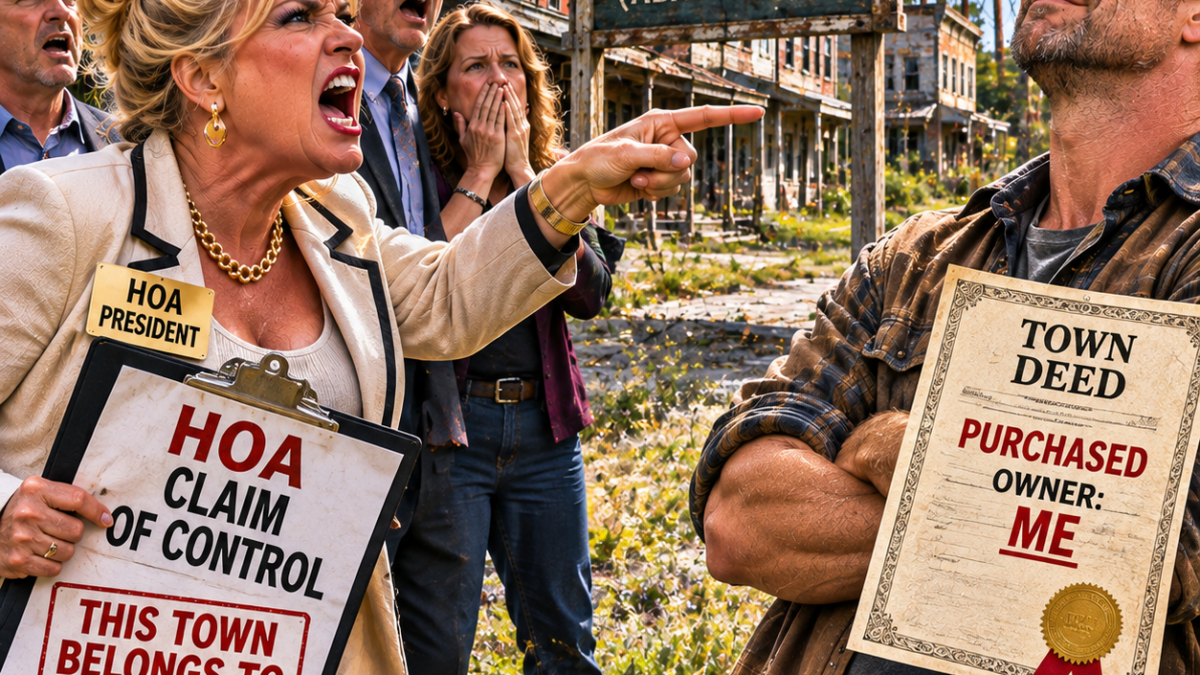
PART 2
I read the paragraph again.
Then a third time.
Janet watched me from the other side of the counter.
“You find something?”
“I think so.”
The original filing was legitimate.
That was the first surprise.
Some developer really had created something called Willowbrook Estates in 1987. The plan had been straightforward: convert the old town site and surrounding acreage into a residential project, preserve several historic-looking structures as amenities, build houses around them, and govern the whole thing through an association.
Except the houses were never built.
Financing collapsed.
The developer disappeared.
The railroad eventually reclaimed portions of surrounding land, and Willowbrook slowly returned to dust.
More important was the clause I had just found.
The association structure was tied to commencement of residential development within five years. Actual homeowners were then supposed to elect the governing board.
No residential construction began.
No homeowners existed.
No election could have happened.
The development failed long before 1992.
I pointed at the paragraph.
“Do you have anything after this showing the association was extended?”
Janet frowned.
“I can search.”
She did.
Nothing.
No amendment preserving Willowbrook Estates indefinitely.
No annexation.
No later declaration.
No residential plat completion.
No homeowner election.
I sat there with the file open, feeling the anger inside me sharpen into something cleaner.
Delilah’s binder was not authority.
It was theater.
I paid for certified copies.
Janet stamped them.
Before I left, she tapped Delilah’s demand letter.
“You going to need an attorney?”
“Probably.”
“That woman actually trying to foreclose on a ghost town?”
“Apparently.”
Janet looked toward the records room.
“I’ve worked here twenty-one years.”
“And?”
“That is new.”
—
The sun was dropping when I returned to Willowbrook.
I could see the general store from half a mile away.
Something looked wrong.
Then I got closer.
Bright orange spray paint stretched across the weathered facade.
**HOA VIOLATION NOTICE**
The words were nearly six feet tall.
I stopped the truck.
For a few seconds I just sat there gripping the steering wheel.
Then I saw the broken glass.
It covered part of the street.
Two doors had glue packed into their locks.
One window I had repaired the previous week had been cracked.
The smell of fresh spray paint still hung in the warm air.
That was the moment the fight changed for me.
Until then, Delilah had been paperwork.
Threats.
Bluster.
A woman pretending an expired filing gave her authority.
Now somebody had touched the buildings.
My buildings.
I had bought Willowbrook because almost nobody wanted it.
That did not make it worthless.
The old general store still had hand-painted shelf labels behind the counter. The town hall still carried faded election notices from decades earlier. Initials were carved into the boarding-house porch railings by people who were probably grandparents now.
I hadn’t bought ruins.
I had bought history nobody else had bothered to protect.
And somebody had just spray-painted over it because I refused to pay a fake fine.
I pulled out my phone.
Photographs first.
Every lock.
Every broken pane.
Every painted wall.
Then I called the sheriff’s office.
—
The responding deputy was one of the two who had come out before.
He stepped from his cruiser and stared at the general store.
“Well.”
“That’s about what I said.”
“Any cameras?”
“Not yet.”
He wrote that down.
“Anyone threaten vandalism?”
“Not directly.”
“Your HOA woman?”
“She isn’t my HOA woman.”
He looked at the orange paint.
“Fair.”
I gave him copies of the county documents.
He read the relevant section.
“You’ve got counsel?”
“Not yet.”
“Get some.”
Everybody loved saying that.
Before the deputy left, he told me something useful.
“Civil dispute is one thing. Property damage is another. Install cameras.”
I did.
Battery-operated units.
Motion activated.
Several visible.
Several less obvious.
Then I hired a locksmith, replaced the damaged hardware, bought paint remover, and spent the rest of the evening cleaning orange letters from a building that had survived forty years of abandonment only to get vandalized after I showed up trying to save it.
At midnight, my hands smelled like solvent.
I was exhausted.
But I wasn’t quitting.
—
The following morning I filed complaints with state agencies overseeing real-estate activity and consumer practices.
I didn’t write that Delilah was a criminal.
I wrote exactly what I could prove.
She represented herself as president of Willowbrook Estates HOA.
She demanded money.
She threatened a lien.
She threatened foreclosure.
County records appeared to show the development condition tied to the association had never occurred.
Then I attached everything.
Deed.
1987 filing.
Demand letter.
Photographs.
Dates.
I had learned early in construction management that adjectives make people argue.
Documents make them work.
Then I did something pettier.
Not illegal.
Not even particularly noble.
But satisfying.
I learned where Delilah lived.
Desert Palms.
Real subdivision.
Real homes.
Real HOA.
Very real board.
Her black Mercedes was registered there.
I attended the next open meeting.
—
Desert Palms looked like everything Willowbrook wasn’t.
Landscaped entrance.
Stucco homes.
Uniform walls.
Decorative palms.
A clubhouse that smelled faintly of coffee and carpet cleaner.
The board president was Harold Grayson, a retired CPA with silver hair and the posture of a man who had spent forty years asking why numbers didn’t match.
During public comment, I introduced myself.
“My name is Xavier Reeves. I own property west of here.”
Harold nodded.
“I’m looking into a person who has been using HOA credentials to demand money from property owners.”
The room changed.
Not dramatically.
But Harold’s pen stopped moving.
“Whose credentials?” he asked.
“Willowbrook Estates.”
A woman in the second row frowned.
“Where is that?”
“Ghost town.”
Someone laughed.
I didn’t.
“I’m serious.”
I handed Harold copies.
He read the letterhead.
Then the signature.
His expression changed.
“Delilah Pemberton?”
“Yes.”
Several people looked toward one another.
Harold removed his glasses.
“Ms. Pemberton is a resident here.”
“I know.”
“What exactly are you asking this board to do?”
“Nothing outside your authority.”
I pointed to the address on one of Delilah’s documents.
“But if she’s operating a business from her residence, using false association credentials, and her activities affect your own rules, you may want to understand what she’s doing.”
Harold studied me.
“You have evidence?”
I placed the county filing beside the fine notice.
“Start there.”
He did.
—
Delilah called me the next morning.
First direct call since our original confrontation.
“You went to my HOA.”
“I attended a public meeting.”
“You had no right.”
I nearly laughed.
“You drove forty miles into the desert and told me you controlled my town.”
“That is different.”
“How?”
“You are interfering with my private residence.”
“You were using that address on business documents.”
Her voice went quiet.
Dangerously quiet.
“You have no idea what you’re involving yourself in.”
“Then stop involving yourself in Willowbrook.”
She hung up.
Three days later, my water line was damaged.
—
It wasn’t a utility shutoff.
The utility confirmed my account was current.
Someone had physically damaged the line near where it entered the property.
I found water spreading through desert sand at sunrise.
I stood over the broken fitting watching a resource Nevada treats like money disappear into the ground.
That one hurt differently.
Willowbrook’s water rights were part of the reason I had bought the place.
Without reliable water, restoration became nearly impossible.
I photographed it.
Called the sheriff again.
Called a repair crew.
Then drove to a gas station for bottled water while the line was being fixed.
My phone rang.
“Mr. Reeves?”
“Yes.”
“Detective Santos, county sheriff’s office. I need to speak with you about a complaint.”
I closed my eyes.
“What complaint?”
“Ms. Pemberton says you threatened her.”
—
Detective Santos’s interview room had a metal table, three chairs, and coffee that smelled old enough to qualify for historic preservation.
He slid a statement toward me.
Delilah claimed I had followed her after the Desert Palms meeting.
Approached her near her Mercedes.
Used threatening language.
Made references to property disputes being “settled another way.”
Two people supposedly witnessed it.
I read every line.
“None of this happened.”
Santos leaned back.
“I’m listening.”
“I spoke during public comment.”
“You approach her afterward?”
“No.”
“Parking lot?”
“No.”
“Call?”
“She called me the next morning.”
“Record?”
“Phone log, yes.”
I pulled it up.
He wrote something.
“Witnesses say differently.”
“Who?”
“I can’t give you that yet.”
I pushed the statement back.
“Check the clubhouse cameras.”
Santos looked up.
“What?”
“Desert Palms is the kind of HOA that probably records its parking lot.”
He stared at me for a second.
Then almost smiled.
“That’s useful.”
“I’m in construction. We document everything.”
“So I’m learning.”
The video later showed me leaving through a different side of the property than Delilah.
Her allegation went nowhere.
But at that point I understood she wasn’t improvising.
She had witnesses willing to lie.
She had forms.
She understood systems.
And she was desperate enough to keep escalating.
The question was why.
A fake HOA was absurd.
An $8,500 demand was aggressive.
Vandalism was criminal.
False accusations were reckless.
What was in Willowbrook that made any of that worth the risk?
I still didn’t know.
—
Harold called that night.
His voice had lost the pleasant retirement-meeting tone.
“Xavier.”
“Yeah?”
“Your Delilah problem just got stranger.”
“What happened?”
“She attempted to open a financial account connected to Willowbrook Estates.”
I sat up.
“With what authority?”
“That is precisely what created the problem.”
According to Harold, word had reached Desert Palms through a local banking contact that Delilah had attempted to establish a business account using documents claiming Willowbrook Estates represented an active residential association.
The bank had asked ordinary verification questions.
Where were the houses?
Who were the homeowners?
Where was the current election record?
What was the tax identification structure?
The application did not survive those questions.
Later, through investigators, I learned the attempt triggered fraud concerns and outside reporting.
At the time, Harold only knew enough to say:
“She’s trying to turn the fake organization into something that looks financially real.”
“Why now?”
“Because you challenged it.”
That bothered me.
If this had only been about collecting a few thousand dollars from me, opening a bank account made no sense.
She was building infrastructure for something larger.
—
The next morning, my mailbox was gone.
Not knocked over.
Gone.
The metal post had been cut cleanly.
The box had been removed.
In its place was a hand-painted sign.
**MAIL DELIVERY SUSPENDED — HOA VIOLATION**
I stood there reading it.
Then laughed.
Not because it was funny.
Because whoever did it had finally picked the wrong federal agency to irritate.
I called the postal inspectors.
They were not amused.
Neither was my mail carrier.
By the end of the afternoon, the destruction had its own case number.
That was the week I hired Rita Moreno.
Private investigator.
Former insurance-fraud investigator.
Late forties.
Direct.
No patience for dramatic theories.
I showed her everything.
She finished reading and said:
“You think she wants your town.”
“She says she already controls it.”
“That isn’t what I asked.”
I looked at her.
“Yes.”
“Why?”
“I don’t know.”
“That’s what I’ll work on.”
—
Rita started with Delilah’s business history.
Real-estate transactions.
LLCs.
Civil filings.
Property complaints.
Association names.
Two weeks later, she met me at the general store.
She placed a folder on the counter.
“She’s done versions of this before.”
“How many?”
“At least three situations I can document enough to care about.”
Vacant properties.
Abandoned parcels.
Stalled developments.
Letters using association language.
Owners who paid fees rather than hire lawyers.
Some records were messy.
Some claims had never become lawsuits.
But the pattern was there.
“You’re not her first,” Rita said.
“Why didn’t anybody stop her?”
“Because she chooses properties nobody is paying attention to.”
That sentence stayed with me.
Willowbrook had been ignored for decades.
That might have been exactly why she wanted it.
But I still didn’t know what she wanted from it.
Then Delilah produced something that nearly stopped me cold.
A real court order.
—
She arrived with a deputy.
Not the local patrol deputy who knew the history.
Different officer.
He stepped out carrying papers.
Delilah stayed beside her car.
No smile.
No binder.
That scared me more.
“Mr. Reeves?”
“Yes.”
“I have an order requiring suspension of construction activity pending review of alleged safety violations.”
I took the document.
Judge Patricia Hawthorne.
Signed.
Court seal.
Actual case number.
I read it.
Then read it again.
“This is real?”
The deputy nodded.
“I’m not here to interpret it. I’m here to serve it.”
Delilah finally smiled.
Small.
Controlled.
“I told you approval mattered.”
I ignored her.
The order referenced building-code violations.
Specific numbers.
I had spent twenty-five years around building departments.
Something felt wrong.
Not the order itself.
The citations.
One supposedly governed historical timber modifications.
Another referenced a structural safety requirement I had never seen.
After the deputy left, I called Rita.
“I need you to check a judge.”
Silence.
“Careful.”
“She signed an order.”
“Name?”
“Patricia Hawthorne.”
Rita was quiet.
Then:
“Give me a day.”
It took less.
She called back that evening.
“Sit down.”
“I’m sitting.”
“Patricia Hawthorne is Delilah Pemberton’s sister.”
I stared through the general-store window at the empty street.
“That can’t be enough by itself.”
“It isn’t.”
“What else?”
“I’m checking prior cases.”
The next day she returned with copies showing the judge had signed orders in other property matters touching entities associated with Delilah.
Not proof of criminal conspiracy by itself.
But enough that my lawyer—by then I had hired one—immediately sought review.
Then we checked the statutes and code sections cited in my injunction.
Several did not say what the application claimed.
At least one citation did not correspond to the described violation at all.
The order had been obtained on representations that could not survive scrutiny.
For the first time, Delilah’s pressure campaign had moved beyond fake HOA letterhead into actual court process.
And that attracted attention she could not control.
—
The order was challenged.
The construction pause hurt.
Every week mattered.
I had crews scheduled.
Materials stored.
Insurance running.
But the bigger damage was psychological.
A fake fine could be laughed at.
A real court seal was different.
For two nights, I slept badly.
The town felt enormous in the dark.
Broken windows.
Empty rooms.
Wind through rafters.
I had come here because I wanted nobody around me.
Now that isolation felt less romantic.
It felt vulnerable.
I considered selling.
I really did.
I sat inside my trailer with the county deed on the table.
Forty-seven thousand dollars.
I could probably unload the land.
Take a loss.
Go somewhere else.
Buy a regular house.
Mow a regular lawn.
Argue with nobody.
Then I looked out at the general store.
I remembered scrubbing orange spray paint from its siding.
And something in me refused.
Not because Willowbrook was valuable.
At least I didn’t know it was yet.
Because it was mine.
I had bought it honestly.
Delilah wanted me to believe ownership only mattered until someone wealthier, more connected, or more shameless decided otherwise.
I couldn’t accept that.
So I stayed.
—
Delilah’s next accusation involved drugs.
According to reports later disclosed through the investigation, she told federal authorities suspicious chemical odors and late-night activity at Willowbrook might indicate illegal narcotics manufacturing.
The “chemical odors” were solvents, wood finishes, rust treatment, and restoration compounds.
The “late-night activity” was me working.
Agents came.
They searched.
I cooperated.
No meth lab.
No drugs.
No criminal operation.
What they did find was a mountain of paperwork involving questionable HOA claims, a contested judicial order, and a property dispute already drawing fraud investigators.
That referral widened the investigation.
Not because federal agents instantly adopted my side.
They didn’t.
Because Delilah had now placed her allegations into multiple official systems, and contradictions were accumulating.
Once agencies started comparing records, her versions stopped matching.
Rita called me after meeting with investigators.
“She’s created too many paper trails.”
“I thought paper trails were her strength.”
“They are when nobody compares them.”
That was the beginning of the end for the fake HOA network.
But it still wasn’t the biggest thing hiding in Willowbrook.
—
With the immediate injunction challenged and investigators focused on Delilah, I finally returned to restoration.
The town hall was last.
I had avoided it because the west wall leaned enough to make me uncomfortable.
Inside smelled like dust, mouse nests, old paper, and desert heat trapped in plaster.
I was removing water-damaged material when my pry bar hit metal behind a wall panel.
Not pipe.
Too wide.
I pulled more material away.
Green steel.
A filing cabinet.
Old government style.
Heavy enough that I wondered how anyone had gotten it there.
Locked.
The key was long gone.
It took me half an hour to open it.
When the final mechanism gave way, the door released with a deep metallic groan.
Folders slid forward.
Dust lifted into the flashlight beam.
The top documents were old.
1978.
Railroad letterhead.
Geological surveys.
Aggregate studies.
I sat on the floor.
Started reading.
Sand.
Gravel.
Construction aggregate.
High-grade material.
Large estimated recoverable volume.
Then a market-value assessment.
Millions.
I stopped breathing for a second.
Not gold.
Not silver.
Something more boring.
And in construction, boring can be worth a fortune.
Sand and gravel.
Concrete.
Road base.
Infrastructure.
Materials contractors need constantly.
I knew that business.
I had bought those materials for twenty-five years.
According to the old surveys, Willowbrook sat over a commercially significant deposit.
I kept reading.
Then reached documents that weren’t old.
Paper too white.
Printing too modern.
Dates from the previous three years.
My stomach tightened.
One name appeared again and again.
**Delilah Pemberton.**
—
I spread the papers across the floor.
Letters.
Property monitoring notes.
Corporate correspondence.
Acquisition plans.
One document described watching county-auction activity involving Willowbrook.
Another discussed using association-related title concerns to discourage buyers.
Then I found a proposed contract.
Sunset Construction.
Aggregate supplier.
Exclusive access arrangement.
Seven figures.
Contingent on Delilah acquiring legal control of Willowbrook’s mineral interests.
I read the amount twice.
$2.1 million over five years.
Suddenly every stupid HOA fine made sense.
She had never cared about landscaping.
There was no landscaping.
She had never cared about community standards.
There was no community.
She wanted the land.
More specifically, she wanted what was under it.
And she knew before I bought it.
I sat inside that decaying town hall with dust on my hands and felt something colder than anger.
She had monitored the auction.
She had expected to control the property eventually.
Then I showed up.
A divorced construction manager with forty-seven thousand dollars and a deed.
I wasn’t the target because I broke HOA rules.
I was the obstacle between Delilah and millions of dollars in aggregate rights.
That was why she had escalated.
Why fines became vandalism.
Why vandalism became false reports.
Why she needed court orders.
She wasn’t trying to discipline me.
She was trying to make ownership so miserable that I would sell.
I called Rita.
“Come to Willowbrook.”
“What happened?”
“I found why.”
“Why what?”
“Everything.”
—
Rita arrived ninety minutes later.
She read silently.
Then photographed every page before touching anything else.
“Do not move these off-site yet.”
“Why?”
“Chain of custody.”
“They’re mine.”
“The cabinet is on your property. The documents may become evidence. We document where they were found.”
She called my attorney.
My attorney called investigators.
By that evening, the old town hall had become something I never expected.
Evidence location.
The correspondence filled gaps investigators had been struggling to explain.
Motive.
Premeditation.
Financial benefit.
The fake HOA wasn’t random fraud.
It was a tool.
Later filings alleged similar tactics had been used elsewhere.
Not always for mineral rights.
Sometimes distressed acquisitions.
Sometimes liens.
Sometimes cheap property transfers.
But Willowbrook was the biggest prize.
And Delilah’s own files explained the plan.
She had documented herself.
That was arrogance in its purest form.
People who believe they will never be challenged keep records because they think records prove how smart they are.
Sometimes records prove something else.
—
The investigation widened quickly after that.
Delilah’s professional license was suspended while the allegations were examined.
The judicial relationship involving her sister came under formal scrutiny.
Judge Hawthorne was removed from active duties pending investigation.
Other people connected to Delilah’s operation were interviewed.
I was told not to discuss certain details publicly.
So I didn’t.
That was difficult.
I had spent months being called irresponsible, threatening, unstable, unlicensed, dangerous, even suspicious enough to justify a drug allegation.
Now I had documents explaining exactly why.
And I couldn’t wave them around.
Rita understood my frustration.
“Let investigators do their job.”
“I’ve been doing that.”
“You’ve also been attending HOA meetings out of spite.”
“One.”
“One extremely effective one.”
“Still.”
I smiled.
Then looked across the town.
“What happens to Willowbrook now?”
“That part is yours.”
That question turned out to be harder than fighting Delilah.
—
The mineral rights appeared to be attached to my purchase.
That sounded simple.
It wasn’t.
Nothing involving mining is simple.
I called Harold.
He became so excited I had to move the phone away from my ear.
“You own the aggregate?”
“That’s what counsel is confirming.”
“How much?”
“Old survey says potentially millions.”
“Old survey?”
“1978.”
“Then you need modern verification.”
“I know.”
“You need environmental review.”
“I know.”
“Permits.”
“I know.”
“Mining counsel.”
“Harold.”
“What?”
“Breathe.”
He paused.
“Sorry.”
Then immediately continued.
“You need a mining lawyer.”
He was right.
—
Rebecca Martinez had spent fifteen years handling mineral and land-use matters.
She read the old Union Pacific documents without smiling.
Then read the current title work.
Then looked at me.
“You understand that owning mineral rights does not mean you start digging tomorrow.”
“I was hoping next Tuesday.”
She didn’t laugh.
I liked her immediately.
“You will need current geological verification, environmental baseline work, county approvals, state permits, operating plans, reclamation bonding, water analysis, dust-control plans, traffic plans—”
“I get it.”
“No, you don’t.”
She leaned forward.
“You have spent months fighting a woman who abused fake authority. Do not respond by abusing real rights.”
That shut me up.
She continued.
“If you do this, you do it correctly.”
“Yes, ma’am.”
“Don’t call me ma’am.”
“Yes—”
I stopped.
Rebecca almost smiled.
—
Dr. Sarah Zane led the geological and environmental work.
She spent days mapping Willowbrook.
Core sampling.
Soil characterization.
Hydrology.
Habitat assessment.
The new work confirmed the old survey had not been fantasy.
The deposit was commercially valuable.
Large.
Accessible.
Useful for construction aggregate.
Not every yard was worth what the 1978 estimates suggested.
Markets change.
Extraction costs change.
Permitting costs change.
But it was valuable enough to transform my forty-seven-thousand-dollar purchase.
That should have made me euphoric.
Instead, it scared me.
I had wanted an escape.
Now I had a business opportunity larger than anything I had ever personally owned.
Rebecca noticed.
“You look miserable.”
“I’m sitting on millions in rock.”
“Potential value.”
“Thank you for making it less exciting.”
“You’re welcome.”
“I bought this place because I wanted fewer people.”
She looked around the site.
“If this works, you’re about to have employees.”
“I know.”
“Contractors.”
“I know.”
“Regulators.”
“I know.”
“Customers.”
“Stop.”
She finally laughed.
—
The environmental plan changed how I thought about the project.
No reckless strip mining.
No dig-and-leave destruction.
Phased extraction.
Dust suppression.
Water management.
Reclamation.
Retention areas.
Habitat considerations.
Restoration planning from day one.
I had spent my career buying aggregate from operations.
I knew what bad sites looked like.
Noise.
Dust.
Broken roads.
Neighbors who hated every truck.
If Willowbrook became that, Delilah would have destroyed something even after losing.
I didn’t want that.
So we built slowly.
Public meetings.
County review.
Contractor input.
Environmental consultants.
Local hiring discussions.
At first I expected people in nearby towns to oppose everything.
Some did.
Most asked practical questions.
“How many trucks?”
“What hours?”
“What happens to groundwater?”
“Where does dust go?”
“Will the road be improved?”
Good questions.
Questions Delilah would have hated.
I answered them.
When I didn’t know, Sarah answered.
When neither of us knew, we said so.
That transparency became one of our strongest assets.
—
The business plan eventually became simple enough to explain.
Extract responsibly.
Supply regional construction projects.
Hire locally.
Restore land in phases.
Use a percentage of profits for community projects.
Harold helped with numbers.
Rebecca handled legal structure.
Sarah handled environmental compliance.
I handled operations.
For the first time since my divorce, I felt like I was building something instead of escaping something.
That frightened me too.
Escape is easy.
You only need to leave.
Building means you can lose something again.
—
Delilah’s network had not disappeared.
That became clear when environmental protesters showed up.
Signs.
Camp chairs.
A few tents.
Claims that Willowbrook would destroy critical habitat.
Some people were sincere.
That was important.
Not everybody opposing me was a Delilah puppet.
Many genuinely believed the material they had been shown.
A respected scientist named Dr. Patricia Wells arrived among them.
She confronted me near the entrance.
“Mr. Reeves, this project threatens sensitive desert ecology.”
“Have you read our environmental assessment?”
“I’ve reviewed materials.”
“Mine?”
She hesitated.
That told me everything.
“Come inside.”
“I’m not participating in a publicity stunt.”
“Then don’t.”
I pointed toward Sarah’s field office.
“Sit with our geologist. Bring your own questions. Bring your own people. Photograph everything.”
She studied me.
“Why?”
“Because somebody wants you angry before you see the site.”
That irritated her.
Good.
Scientists don’t like being told they’ve been manipulated.
She came.
—
Sarah spent four hours with Dr. Wells.
Maps.
Samples.
Habitat data.
Reclamation plan.
The alleged endangered-tortoise breeding area shown in opposition material did not match the surveyed conditions on my property.
Dr. Wells asked harder questions than regulators had.
Sarah answered them.
At sunset, Wells found me.
“I owe you a correction.”
“Not an apology?”
“I said correction.”
I smiled.
“Fair.”
“The materials we received were misleading.”
“Can you say that publicly?”
She looked at me.
“If I conclude that after reviewing everything, yes.”
She did.
Within a week, organized opposition weakened considerably.
Not because everybody suddenly loved mining.
Because the argument moved from fabricated information to actual plans.
That was all I wanted.
Debate reality.
Not propaganda.
Rita eventually traced the misinformation campaign back through consultants hired by people connected to Delilah’s real-estate network.
Rebecca responded legally.
Cease-and-desist letters.
Defamation claims where appropriate.
Correction demands.
No shouting.
Documents again.
Always documents.
—
Then came the financial attack.
Equipment vendors heard rumors that my permits were fraudulent.
Potential customers were told federal investigators were questioning my title.
Two contractors backed away from preliminary agreements.
One equipment lessor wanted additional security.
That one scared me.
A mine without equipment is geology.
Nothing more.
Rebecca called a meeting.
Harold attended.
Sarah.
Me.
She placed three folders on the table.
“We stop chasing rumors individually.”
“What do we do?” I asked.
“Create one due-diligence package.”
Permits.
Title opinion.
Environmental approvals.
Letters confirming I was cooperating with investigators, not under criminal investigation.
Ownership chain.
Insurance.
Corporate structure.
Everything legitimate buyers and lenders needed.
Then we invited vendors to verify it directly.
That worked.
Slowly.
Business relationships returned.
Not every one.
Trust lost is slower to restore than trust never damaged.
But enough.
—
The worst attack came at three in the morning.
I was living in a trailer on-site.
Insomnia had become normal.
The sound woke me.
Diesel.
Heavy diesel.
Not highway traffic.
Closer.
I looked outside.
Work lights moved across the desert.
Two bulldozers.
An excavator.
On my property.
At first I thought I was dreaming.
Then one blade hit the ground.
I called 911.
I did not approach the equipment.
I stayed where I could observe safely and recorded what I could from a distance.
The operators apparently realized someone was awake.
Machines stopped.
People fled in vehicles.
They left the heavy equipment.
By sunrise, sheriff’s deputies had taped off sections of Willowbrook.
Rita arrived before breakfast.
She stared at the abandoned bulldozers.
“Subtle.”
“They damaged the deposit.”
Sarah walked the disturbed area.
“Some.”
“How bad?”
“Not fatal.”
That was the first useful sentence I heard all morning.
The shallow material in one accessible section had been contaminated with fill and debris.
Expensive damage.
But the major deposit remained.
Then Rita traced the equipment rentals.
The paperwork led back through companies and payment methods tied to Delilah’s associates.
Investigators later alleged forged authorizations and fraudulent payment information had been used.
The sabotage was no longer rumor.
It was machinery sitting on my land.
Physical evidence.
—
The timing made federal investigators interested in communications from people already under scrutiny.
Later, prosecutors disclosed recordings and communications showing coordination between Delilah and associates while she was detained.
That was the moment her defense became much harder.
She had not stopped.
Even with investigators watching.
Even after the fake HOA was exposed.
Even after the mineral motive was known.
She kept trying to control the ending.
That obsession destroyed her.
—
Judge Hawthorne’s situation worsened too.
While suspended, materials associated with another purported order surfaced, attempting to halt activity again.
Rebecca’s reaction was almost frightening.
She read it.
Set it down.
Then said:
“No.”
One word.
That was all.
The document had no legitimate effect under the circumstances, but its existence added to the public-corruption investigation.
Federal authorities now had overlapping allegations:
Property fraud.
Fraudulent association activity.
Financial misconduct.
Judicial abuse.
False reporting.
Sabotage.
Interference with business relationships.
Coordinated communications.
I stopped trying to understand every charge.
Rebecca told me:
“Your job is Willowbrook.”
“Seems like their job is also Willowbrook.”
“No.”
She pointed toward the town.
“Your Willowbrook.”
Then toward the case files.
“Their Delilah.”
That distinction saved my sanity.
—
The trial came much later.
Long enough that the initial anger had cooled.
By then, Willowbrook had equipment.
Employees.
Permits.
A functioning operation.
The general store had been stabilized.
The town hall had been restored enough to serve as offices.
I almost didn’t attend every day.
Then Rita told me I should.
“You need to see the end of this.”
So I did.
Federal court in Las Vegas.
Media outside.
Reporters inside.
Delilah at the defense table.
She looked smaller.
Not physically.
Institutionally.
No Mercedes.
No binder.
No HOA title.
Just a defendant beside counsel.
The prosecution’s case was built the way good construction is built.
Foundation first.
Records.
Financial transactions.
Fake association activity.
Witnesses from earlier property disputes.
Bank records.
Judicial connections.
My case.
The Willowbrook documents.
Then the sabotage communications.
Rita testified.
So did investigators.
Sarah testified about the property and the environmental damage.
Others testified about court orders and business records.
The strongest evidence was not dramatic testimony.
It was Delilah’s own documentation.
Her plans.
Her contracts.
Her communications.
Her voice on recorded calls.
All the things she created because she believed control required paperwork.
In the end, the paperwork controlled her.
—
The jury deliberated for hours, not days.
When they returned, I watched Delilah’s hands.
She kept them folded.
Very still.
The foreperson stood.
Guilty findings followed on the major counts presented against her.
I did not cheer.
Some people in the gallery reacted.
I couldn’t.
I remembered the first day.
Black Mercedes.
Pearls.
Binder on my workbench.
**Your deed doesn’t mean anything without our approval.**
Now federal marshals stood behind her.
It should have felt triumphant.
Instead, it felt heavy.
Fifteen years was the sentence imposed on Delilah in the source proceedings that followed, along with substantial restitution obligations.
Judge Hawthorne received a lengthy federal sentence connected to the judicial-corruption case.
Other participants received their own consequences.
People lost licenses.
Jobs.
Careers.
Money.
Freedom.
A network built around the belief that nobody would challenge official-looking documents had finally collided with people who read them.
—
I spoke during the victim-impact portion.
I had written three pages.
Used maybe half.
I looked at the judge.
Then at Delilah.
“I bought Willowbrook because I wanted to be left alone.”
A few people smiled.
“I thought an abandoned town was the one place nobody would tell me what I could build, where I could park, or what color something had to be.”
Delilah looked down.
“I was wrong.”
The room stayed quiet.
“What was done to me cost money. It cost time. It destroyed pieces of property I can’t replace. It made me question whether owning something legally mattered when somebody else had more connections.”
I paused.
“But the strangest part is that the place she tried to take from me gave me a reason to stop running from my life.”
That sentence surprised even me.
I hadn’t written it.
I continued.
“Willowbrook is not abandoned anymore.”
Then I told the court about the community development fund.
Scholarships.
Environmental projects.
Local training.
The first awards were already being planned.
I didn’t deliver a clever insult.
Didn’t tell Delilah crime didn’t pay.
She already knew.
I just told the truth.
She tried to empty my town.
Instead, people were coming back.
—
Two years later, Willowbrook barely resembles the place I bought.
The main street still looks old.
I wanted that.
We preserved the weathered facades where we could.
The general store became a visitor and training center.
Town hall became office space.
The old workshop was rebuilt for maintenance crews.
Several unsafe structures were stabilized rather than demolished.
Behind the historic district, the aggregate operation runs in controlled phases.
Thirty-seven people work there directly.
More jobs exist through trucking, maintenance, surveying, environmental work, and contractors.
I know every full-time employee by name.
That matters to me.
When you spend years managing construction, it is easy to think labor is a line on a spreadsheet.
Willowbrook cured me of that.
—
Sarah’s reclamation plan became one of the things I’m proudest of.
Areas extracted first were shaped into retention and habitat features.
Not every acre became beautiful overnight.
That would be dishonest.
Mining changes land.
The question is whether you plan for that change responsibly.
We did.
Monitoring continued.
Water testing.
Dust measurements.
Habitat surveys.
The site eventually began attracting university groups interested in responsible aggregate extraction and reclamation.
Every time Sarah leads a group through the property, she reminds them:
“This site exists because the owner accidentally bought valuable rocks while trying to avoid people.”
I hate that introduction.
Students love it.
—
Rebecca moved more of her practice toward Willowbrook.
At first, she came because permits never end.
Then because the operation grew.
Then because somewhere between lawsuits, environmental hearings, equipment financing, and six a.m. coffee, we became important to each other in a way I had not expected.
I had spent the first year after my divorce telling everyone I was finished building a personal life.
Rebecca never argued with me.
She simply kept showing up.
One morning we sat on the general-store porch watching sunrise turn the mountains pink.
I handed her coffee.
She took a sip.
“Too much sugar.”
“You always say that.”
“Because you always put too much sugar in it.”
“Make your own.”
“I’m your lawyer.”
“That doesn’t make me your barista.”
She smiled.
I realized I had not thought about my divorce in days.
Then weeks.
That was how healing happened for me.
Not dramatic.
No moment where I became a new man.
Just fewer mornings looking backward.
—
Rita moved her investigative business into part of the restored town hall.
That felt appropriate.
The same building where Delilah had hidden documents became the place Rita helped other property owners uncover fraud.
Her caseload expanded beyond Nevada.
Fake liens.
Property scams.
Association abuse.
Fraudulent management companies.
She hated when people called her a hero.
“Heroes work for free,” she said.
“I send invoices.”
Fair.
Harold became our unofficial financial conscience.
He refused a formal salary.
Accepted lunch.
Then complained about the lunch receipts.
Retired accountants are not normal people.
I once approved a landscaping invoice without asking for three quotes.
Harold found out.
He called me.
“Xavier.”
“What?”
“Have we learned nothing?”
“It was eight hundred dollars.”
“That is how civilizations collapse.”
He made me get another quote.
—
The Willowbrook Community Development Fund grew faster than I expected.
We tied contributions to operating profits.
That meant the fund rose and fell with business performance.
No fake promises.
No vanity projects.
Scholarships focused on environmental science, construction trades, engineering, geology, and rural economic development.
The first recipient was a young woman from a town forty miles away who wanted to study environmental engineering.
At the ceremony, she stood inside the old general store beneath a framed copy of Willowbrook’s original railroad map.
Her mother cried.
I almost did.
Afterward, she asked:
“Why environmental engineering?”
“I should ask you.”
“No. Why fund it?”
I looked through the window toward the operation.
“Because the easiest way to make money from land is to think only about what you can take out.”
She waited.
“The harder question is what you leave when you’re done.”
She nodded.
I didn’t need to say more.
—
The federal investigation uncovered other victims.
More than I had known.
People who had paid fines because hiring counsel cost more than surrendering.
Owners of vacant land.
Small investors.
Families.
Some received restitution.
Some got property issues corrected.
Not every loss could be reversed.
That bothered me.
Justice after damage is still after damage.
One older couple visited Willowbrook.
They had lost money in one of the earlier schemes.
The husband stood in the town square staring at the restored buildings.
“Wish I’d fought.”
I didn’t know what to say.
His wife answered for me.
“You didn’t know what you were fighting.”
That was true.
Delilah’s advantage had always been confusion.
Authority that looked real.
Letterhead.
Titles.
Legal language.
People surrender faster when they think everyone else understands something they don’t.
I had been lucky.
Construction taught me not to accept a drawing that didn’t match the site.
That instinct saved me.
—
Delilah remains in federal custody.
I rarely think about her now.
That took longer than I expected.
For months, every good thing in Willowbrook still felt like revenge.
New permit?
Delilah lost.
First equipment delivery?
Delilah lost.
First scholarship?
Delilah lost.
First profitable quarter?
Delilah lost.
Eventually Rebecca noticed.
“You’re still building this around her.”
“No, I’m not.”
“You just said she’d hate the new visitor center.”
I had.
That irritated me.
“So?”
“So why does she get a vote in your head?”
I didn’t answer.
That evening I walked the empty end of Main Street.
The western buildings still waited for restoration.
Wind moved through sage.
For the first time, I understood what Rebecca meant.
If every success remained a response to Delilah, she still occupied Willowbrook.
Just differently.
I stopped doing that.
Slowly.
—
The original black Mercedes never returned.
The fake HOA binder disappeared into evidence.
I kept one thing.
A photocopy of the first demand letter.
$8,500.
Plus $1,200 inspection fee.
I framed it.
Not in my office.
In the visitor center.
Beside it is a certified copy of my deed.
Underneath both is a simple brass plaque.
**DOCUMENTS SHOULD AGREE WITH REALITY.**
Harold wrote that.
Naturally.
Visitors sometimes laugh.
Some think the whole story sounds impossible.
Maybe it does.
A fifty-two-year-old divorced construction manager buys a ghost town.
An HOA appears.
The HOA isn’t real.
The president wants mineral rights.
A judge gets involved.
Federal investigators.
Sabotage.
Mining.
Scholarships.
If someone pitched it to me before I lived it, I’d tell them to cut half the plot.
Life didn’t.
—
One October afternoon, a school bus arrived.
Twenty-seven fourth graders.
I was walking past the general store when the doors opened and children poured onto the street.
The noise startled me.
Willowbrook had been silent when I bought it.
Wind.
Metal signs.
Loose shutters.
My boots.
That was it.
Now kids ran toward the visitor center while a teacher tried to stop them from touching everything simultaneously.
One boy looked up at the old hotel facade.
“Did cowboys live here?”
“I doubt it.”
“Outlaws?”
“Probably somebody owed money.”
He considered that.
“Cool.”
Inside, Sarah was preparing a geology demonstration.
Rebecca stood near the front desk answering an email.
Rita walked across town hall carrying a file.
An equipment truck rumbled in the distance.
People were everywhere.
I stepped outside again.
For years I thought freedom meant nobody could tell me what to do.
That was why an abandoned town appealed to me.
No neighbors.
No committee.
No expectations.
Then Delilah arrived and tried to take ownership by force of personality.
I fought her because I thought freedom meant defending a boundary.
Partly, it does.
But Willowbrook taught me something else.
Freedom is also choosing what happens after you win.
I could have sold the mineral rights.
Taken the money.
Left.
I could have turned the entire site into an industrial operation with fences and warning signs.
Instead, I stayed.
Not because I had nowhere else.
Because for the first time in years, I had somewhere I wanted to be.
—
Near sunset, the school bus left.
The town quieted.
Not ghost-town quiet.
Working-day quiet.
Different.
Doors closing.
A forklift backing up.
Someone laughing near the maintenance shop.
Rebecca came outside carrying two coffees.
She handed me one.
I took a sip.
“Too little sugar.”
She rolled her eyes.
We walked toward the restored town square.
The old Willowbrook sign stood at the far end of the street.
We had repaired it but kept the faded lettering.
I could still remember the first day I stood beneath it holding the deed.
Forty-seven thousand dollars.
Fresh divorce.
Dust in my boots.
No idea what I had bought.
Then the Mercedes.
Delilah.
Her binder.
**Your deed doesn’t mean anything without our approval.**
I looked around now.
Restored buildings.
Employees’ trucks.
Environmental-monitoring equipment.
Visitor-center lights.
Children’s drawings taped inside the general-store window from that afternoon’s field trip.
Rebecca touched my arm.
“What?”
I hadn’t realized I had stopped walking.
“Nothing.”
“You’re doing that thing.”
“What thing?”
“Looking like you’re arguing with someone who isn’t here.”
I smiled.
“Old habit.”
She nodded toward the square.
“You win?”
I thought about the question.
Then shook my head.
“No.”
She raised an eyebrow.
I looked down Willowbrook’s main street.
At the place Delilah had tried to steal.
At the town I had bought because I wanted to disappear.
At the people who now depended on it.
At the buildings that had voices inside them again.
“Better than that.”
Rebecca waited.
I took another sip of coffee.
“I stayed.”
The desert wind moved through the restored storefronts.
Somewhere behind town hall, machinery shut down for the evening.
The old street lights came on one by one.
And for the first time since I had purchased Willowbrook, not a single window on Main Street was dark.
The next morning, I woke before sunrise.
That still happened more often than I liked.
For years, construction had trained my body to believe five in the morning was a reasonable time to begin thinking about concrete pours, crane schedules, labor shortages, inspection windows, and whatever emergency had appeared overnight. Retirement had never managed to erase the habit, and Willowbrook certainly hadn’t helped.
I stepped outside with coffee and walked Main Street alone.
The desert was blue-gray before sunrise. The mountains looked flat against the horizon, and the restored storefront windows reflected the first thin streaks of orange light. A maintenance truck sat outside the old machine shop. Someone had left a pallet of replacement filters beside the environmental-monitoring building. Everything looked strangely ordinary.
That was what struck me.
Ordinary.
For decades, Willowbrook had been abandoned.
Then for months it had been evidence.
Crime scene.
Legal battlefield.
Investment opportunity.
Construction site.
Mining operation.
Somewhere along the way, it had quietly become a place where people came to work on Monday morning.
I stopped in front of the general store.
The original wooden doors had been restored instead of replaced. They still carried scars from weather and age, including one shallow groove where someone had apparently dragged something metal across the wood fifty years earlier.
I had insisted we leave it.
Rebecca once asked why.
“Because new wood would lie.”
She looked at me.
“About what?”
“About what this place survived.”
That morning, standing there alone, I realized the same could probably be said about people.
I had spent the first year after my divorce trying to erase evidence.
New address.
New state.
New routines.
No photographs in the trailer.
No familiar furniture.
I wanted a clean surface.
Willowbrook had taught me something different.
Restoration wasn’t pretending damage never happened.
It was making damage part of something that could still stand.
I was thinking about that when headlights appeared at the far end of the road.
A pickup approached slowly.
Not one of ours.
It stopped outside the visitor center.
An older man stepped out.
Late sixties, maybe.
Gray hair.
Western shirt.
He stood there staring at the buildings.
I walked over.
“Can I help you?”
He looked at me.
“You Reeves?”
“Depends who’s asking.”
He smiled.
“Fair enough.”
He reached into his truck and pulled out a battered folder.
“My name’s Calvin Mercer.”
The name meant nothing to me.
Then he added:
“Delilah Pemberton took twelve thousand dollars from my wife and me six years ago.”
That got my attention.
I set down my coffee.
“What happened?”
Calvin looked toward the general store.
“She said our property was subject to an association we’d never heard of.”
Same opening.
Different property.
“Vacant land?”
“Twenty acres outside Tonopah.”
He opened the folder.
Notices.
Fines.
Threats.
A supposed lien.
His wife had been undergoing cancer treatment at the time.
They didn’t have money for a prolonged legal fight.
“We paid,” he said.
“How much?”
“Started at thirty-eight hundred. Ended at twelve.”
His jaw tightened.
“Then we sold.”
I had read summaries of other victims through the federal case, but summaries are clean.
Human beings aren’t.
“How’s your wife?”
He looked down.
“She died three years ago.”
I didn’t know what to say.
“I’m sorry.”
He nodded.
“Federal restitution got some money back.”
“Good.”
“But that isn’t why I came.”
He handed me one photograph.
It showed a woman standing beside a dusty pickup on open Nevada land.
“She wanted that place.”
“Your wife?”
“Linda.”
He smiled slightly.
“She wanted to build a little horse property out there.”
I looked at the photograph.
“What happened to the land?”
“Developer bought it after we sold.”
“Houses?”
“Storage facility.”
He laughed without humor.
“Linda hated storage units.”
I handed the photograph back.
“So why Willowbrook?”
Calvin looked around.
“Because she didn’t get to see this part.”
“What part?”
“The part where somebody didn’t fold.”
That sentence stayed between us.
I almost rejected it.
Because I had folded plenty of times in my life.
Marriage.
Career decisions.
Compromises.
Fear.
But I understood what he meant.
Calvin walked Main Street with me for almost an hour.
He didn’t care about the mine.
He cared about the restored buildings.
At the town hall, he stopped beside Rita’s office.
“You help other people now?”
“She does.”
“Good.”
At the visitor center, he read the display about fraudulent property organizations and title verification.
He stood there a long time.
Then asked:
“Could I leave something?”
“What?”
“Linda’s picture.”
I looked at him.
“For the exhibit?”
“If you think it belongs.”
I took the photograph.
“It belongs.”
That became the beginning of something I hadn’t planned.
Other victims came.
Not all at once.
One every few months.
A woman from Arizona who had paid fraudulent assessment fees on land she inherited from her father.
A retired teacher from northern Nevada whose vacant parcel had been threatened with foreclosure over an association that barely existed on paper.
A young couple who had nearly abandoned a small commercial property after receiving letters that looked official enough to scare their lender.
Rita started collecting their stories.
With permission.
Copies of notices.
Photographs.
Court records.
Bank statements.
Eventually one wall inside the visitor center became less about Delilah and more about the people she had targeted.
Rebecca hated the first layout.
“It makes her too central.”
“She was central.”
“To the crime.”
Rebecca pointed at the wall.
“But not to their lives.”
She was right.
So we redesigned it.
Victims first.
Their properties.
Their families.
What happened afterward.
Delilah became part of the explanation, not the centerpiece.
That distinction mattered.
One afternoon, Calvin returned and saw Linda’s photograph in the new exhibit.
Below it was a short card.
LINDA MERCER WANTED A PLACE FOR HORSES.
Nothing about cancer.
Nothing about Delilah.
Nothing about being a victim.
Just what she wanted.
Calvin read it.
Then covered his mouth with one hand.
I turned away and pretended to inspect a display case until he was ready.
When he finally spoke, his voice was rough.
“You got it right.”
That was one of the best compliments Willowbrook ever received.
Our second scholarship year brought more applications than we expected.
Harold complained immediately.
“This is becoming administratively irresponsible.”
“We received sixty-two applications.”
“Exactly.”
“That’s good.”
“It’s expensive.”
“The fund can afford it.”
“That sentence is how people go broke.”
Rebecca looked at him.
“The fund has an audited balance.”
Harold frowned.
“Don’t team up against me.”
Nobody was teaming up.
We were enjoying ourselves.
We increased the program from two awards to four.
One construction trades.
One geology or engineering.
One environmental science.
One rural entrepreneurship.
The entrepreneurship award came from Rita.
“Not every smart kid needs a university.”
Harold nodded.
“Finally, somebody speaks sense.”
Rebecca stared at him.
“You have an accounting degree.”
“That was different.”
“Why?”
“My parents paid.”
Nobody could argue with that logic because there wasn’t any.
The recipient of the first rural-business award was a twenty-year-old named Elena Torres.
She wanted to open a mobile welding service.
Her father welded.
Her grandfather welded.
But Elena wanted to focus on ranches, rural infrastructure, and small construction crews that couldn’t afford downtime waiting for repair companies to travel from larger towns.
She showed up at Willowbrook wearing work boots and carrying a business plan more detailed than some I had seen from contractors asking banks for six figures.
I read it twice.
“You wrote this?”
“Yes.”
“Yourself?”
She looked offended.
“Yes.”
“Good.”
She pointed at the page.
“The cash-flow assumptions are conservative.”
Harold appeared from nowhere.
“How conservative?”
Elena turned.
“Who are you?”
“My worst nightmare,” I said.
Harold ignored me.
Twenty minutes later, they were sitting together going through equipment depreciation.
I looked at Rebecca.
“That kid is never getting away.”
“She’ll be fine.”
“What if Harold adopts her?”
“Financially?”
“Yes.”
“Too late.”
Elena won.
A year later, her welding truck had our Willowbrook Community Development Fund logo in one corner.
Small.
Tasteful.
Harold still complained that it should be three percent smaller.
The mining side continued growing, but not without problems.
Success attracts assumptions.
People heard “millions in aggregate” and imagined money coming out of the ground like water from a faucet.
It doesn’t work that way.
Equipment breaks.
Fuel prices move.
Permits get amended.
Customers delay projects.
One year, unusually heavy storms damaged a haul road and shut down part of our operation for nine days.
Another year, a major highway contract we had expected to supply was delayed by state budgeting issues.
We had to cut overtime.
That was one of the hardest decisions I made.
Thirty-seven employees had become thirty-seven families in my head.
I knew whose daughter was starting college.
Whose mother needed surgery.
Who had just bought a house.
Who was expecting a baby.
Construction management had taught me to look at labor as cost.
Willowbrook taught me to look at cost as people.
Harold came into my office one evening.
“You cannot operate emotionally.”
“I know.”
“You’re trying to preserve overtime we cannot justify.”
“I know.”
“You keep saying that.”
“Because I know.”
“Then why haven’t you done it?”
I stared at the staffing sheet.
“Because Carlos just had twins.”
Harold’s voice softened.
“And if the company runs badly, Carlos eventually has no job.”
I hated him when he was right.
We reduced overtime.
Explained why.
Showed employees the numbers.
No hidden surprises.
No fake optimism.
I expected anger.
We got disappointment.
Those are different things.
One operator named Mike stayed after the meeting.
“You didn’t have to show us all that.”
“Yes, I did.”
“No company I worked for ever did.”
I thought about Delilah.
About fake authority.
About information being used as leverage.
“I’ve had enough people tell me to trust them without showing me why.”
Mike nodded.
“Fair.”
The highway project resumed three months later.
Overtime returned.
Transparency hadn’t eliminated the pain.
It had kept the pain from becoming suspicion.
That was worth something.
Rebecca and I eventually stopped pretending our morning coffee was about legal work.
Rita noticed before either of us admitted it.
One morning, she walked into the general store, saw Rebecca sitting across from me, and stopped.
“Oh, good.”
Rebecca looked up.
“What?”
“You finally figured it out.”
“Figured what out?”
Rita pointed between us.
“That.”
I said, “There is no that.”
Rebecca said at the exact same time:
“There is definitely a that.”
I stared at her.
Rita laughed so hard she had to sit down.
That was how my second serious relationship began.
Not with fireworks.
Not with some dramatic desert kiss.
With my lawyer humiliating me in front of a private investigator.
Appropriate.
We moved slowly.
I had learned that loneliness can make speed feel like certainty.
Rebecca had her own history.
A marriage that ended years earlier.
A daughter in college.
A career she had built carefully.
Neither of us wanted to disappear inside someone else’s life.
That helped.
Eventually she kept clothes at Willowbrook.
Then books.
Then an espresso machine I considered unnecessary until I used it.
The old town gained another kind of permanence.
Not legal.
Personal.
My ex-wife contacted me once.
That deserves less drama than it sounds.
She emailed.
We hadn’t spoken in nearly two years.
The subject line was:
Saw the article.
A national magazine had published a piece about Willowbrook’s restoration and sustainable aggregate operation.
I almost deleted her message.
Then opened it.
She wrote that she was glad I had found something meaningful.
She apologized for a few things.
Not everything.
Neither did I.
At the end she wrote:
You always needed a project bigger than yourself. I just wish we had figured that out before we became each other’s project.
I read that sentence several times.
It hurt.
Because it was true enough to be useful.
Rebecca found me sitting outside the town hall later.
“You okay?”
I handed her the phone.
She read the email.
Then returned it.
“What are you going to say?”
“I don’t know.”
“You don’t have to say anything.”
“I know.”
I eventually replied with three sentences.
Thanked her.
Apologized for my part.
Wished her well.
No reopening the past.
No accusation.
No reunion fantasy.
Just closure.
For years I thought the end of a marriage required someone to be wrong enough to justify leaving.
Willowbrook had made me less interested in simple villains.
Some relationships fail because both people keep trying to win arguments nobody should have been having.
Delilah was a criminal.
My ex-wife wasn’t.
Those categories mattered.
On Willowbrook’s fifth anniversary under my ownership, the county asked if we wanted to hold a public event.
I almost said no.
Then Rebecca reminded me that I had purchased a town and therefore had forfeited my right to complain about public events forever.
We organized something simple.
Food trucks.
Equipment demonstrations.
Guided restoration tours.
Geology exhibits.
Scholarship presentations.
Rita hosted a property-fraud workshop.
Harold hosted what he called a “basic financial literacy session,” which somehow attracted forty people because apparently there is a market for being scolded by retired accountants.
Calvin Mercer came.
So did Elena with her welding truck.
Dr. Wells, once the face of the protest against us, gave a talk alongside Sarah about how to evaluate environmental claims before reacting to them.
That session drew the largest crowd.
I stood in the back listening.
Dr. Wells said:
“Good environmental advocacy requires skepticism even toward information that confirms what we already believe.”
Sarah looked at me from the stage.
I knew exactly what she was thinking.
Delilah’s people had weaponized certainty.
Transparency had beaten it.
After the talk, Wells found me.
“Still mining?”
“Apparently.”
“Still annoying environmental scientists?”
“Only the interesting ones.”
She shook my hand.
It felt good.
Not because I had converted an opponent.
Because she had never really been the enemy.
She had been given bad information.
Once she saw better information, she changed her mind publicly.
That takes more courage than people realize.
The anniversary event lasted until sunset.
I climbed the small platform in the town square to thank everyone.
Public speaking still wasn’t my favorite activity.
I looked out.
Employees.
Families.
Former victims.
County people.
Contractors.
Students.
Rebecca.
Rita.
Harold.
Sarah.
Calvin.
Elena.
The entire street was full.
Five years earlier, I could have fired a nail gun down Main Street and hit nothing but dust.
I had prepared remarks.
Then ignored them.
“I bought Willowbrook because I wanted to get away from people.”
Laughter.
“Clearly, that part failed.”
More laughter.
I looked toward the general store.
“When I first got here, I thought the best thing about this place was that nobody wanted it.”
The crowd grew quieter.
“I was wrong.”
I paused.
“The best thing about Willowbrook turned out to be how many people could build something here once somebody stopped trying to control it through fear.”
That was all I wanted to say.
No Delilah.
No prison sentence.
No revenge.
We handed out scholarships.
Music started.
People ate.
Kids climbed on an old restored rail cart we had permanently locked in place because I had learned that children will attempt to operate anything with wheels.
Night came slowly.
Lights turned on.
Exactly like the evening Rebecca and I had walked Main Street years earlier.
But now every window wasn’t just lit.
Every building had a purpose.
Town hall:
Investigation offices and meeting rooms.
General store:
Visitor center.
Machine shop:
Training space.
Old boarding house:
Offices and temporary lodging for researchers.
Workshop:
Maintenance.
Even one of the old residences had become a small archive room for Willowbrook history.
Nothing was empty anymore.
Late that night, after everyone left, I walked toward the edge of town.
Rebecca followed.
“You disappeared.”
“Needed quiet.”
“You bought the wrong town.”
I smiled.
We reached the old sign.
The letters had faded a little more.
WILLOWBROOK
Rebecca looked at me.
“You ever regret buying it?”
“Yes.”
She laughed.
“I expected something sentimental.”
“You asked.”
“When?”
“The night of the DEA search.”
“Fair.”
“During the injunction.”
“Also fair.”
“After the bulldozers.”
“Very fair.”
I put my hands in my pockets.
“But not anymore.”
The wind moved across the desert.
In the distance, I could see the low lights from the processing operation.
Quiet for the night.
Rebecca leaned against me.
“Forty-seven thousand dollars.”
“Worst bargain of my life.”
“Your town is worth millions.”
“Still.”
“You met me.”
“Adding to the cost.”
She elbowed me.
I laughed.
Then we stood there quietly.
That was the strange thing about Willowbrook.
The silence had changed.
When I first arrived, silence felt empty.
Like absence.
Like something had ended and nobody came back.
Now silence came after activity.
Workers had gone home.
Visitors had left.
Doors were locked.
Machines were off.
People would return tomorrow.
That made it peaceful instead of lonely.
The following spring, Calvin called.
His voice sounded weak.
He had been sick.
He asked me for one favor.
“Take Linda’s picture outside.”
“Outside?”
“Just once.”
“Why?”
“She always wanted to see the desert at sunset.”
I understood.
That evening I removed the photograph carefully from the exhibit.
Rebecca came with me.
We carried it to the edge of town.
The sun was dropping behind the mountains.
Orange light crossed the desert.
I held the photograph facing west.
It felt ridiculous.
Beautifully ridiculous.
Rebecca stood beside me.
Neither of us spoke.
I took a picture with my phone.
Linda’s old photograph against the Nevada sunset.
Sent it to Calvin.
He replied fifteen minutes later.
Thank you.
He died two months afterward.
His daughter later gave us permission to keep Linda’s photograph permanently.
Now it hangs near the entrance.
Not as evidence.
Not as tragedy.
As a reminder that property disputes are never only about parcels.
They are about plans.
A horse property.
A workshop.
A family home.
A retirement.
A business.
A ridiculous ghost town someone bought after a divorce because he thought hiding in the desert counted as healing.
The legal documents describe acres.
People describe futures.
That difference is why fraud hurts.
Years after Delilah first stepped out of that Mercedes, I walked into the general store one morning and found a group of middle-school students gathered around the framed $8,500 fine notice.
One kid raised his hand.
“Mr. Reeves?”
“Yeah?”
“Did you really think she could take the town?”
I thought about lying.
Giving him the heroic answer.
Never.
I knew my rights.
I wasn’t afraid.
Instead I said:
“For a while, yes.”
The students looked surprised.
“Why?”
“Because scary paperwork works.”
A few laughed.
“I’m serious.”
I pointed at the document.
“It looks official. It uses confident language. It tells you there’s a deadline. It tells you terrible things happen if you don’t obey.”
The teacher nodded.
“So how did you know it was fake?”
“I checked.”
“That’s it?”
“That’s a lot.”
I pointed toward the framed deed.
“Never confuse confidence with authority.”
One boy frowned.
“What if you don’t understand the documents?”
“Find somebody who does.”
“Like a lawyer?”
“Sometimes.”
“Accountant?”
I looked toward Harold’s office.
“Unfortunately.”
The teacher laughed.
“Engineer?”
“Yes.”
“Private investigator?”
“Sometimes.”
“What if you can’t afford all that?”
That was the hardest question.
I crouched slightly so I wasn’t talking down to him.
“Then start with records. Ask questions. Find other people affected. Most people who abuse systems depend on everyone feeling alone.”
The boy considered that.
Then looked at Delilah’s letter again.
“She was dumb.”
“No.”
That answer surprised him.
“She was smart.”
“Then why’d she lose?”
I looked around the restored store.
“Because she started believing being smart meant nobody else could be.”
The teacher stared at me for a second.
Then wrote something down.
I hoped it wasn’t for a test.
That afternoon, I walked back outside.
A truck rolled through town carrying aggregate toward a county road project.
Elena’s welding rig was parked near the maintenance shop.
Rita stood on the town-hall steps talking to a client.
Harold was probably criticizing an expense report somewhere.
Rebecca was on a call beneath the general-store awning.
Sarah’s environmental team had markers set along a reclaimed area where desert plants were beginning to return.
The wind carried dust.
Diesel.
Sage.
Coffee.
Work.
Life.
I stood in the middle of Main Street and remembered the first day Delilah told me:
“Your deed doesn’t mean anything without our approval.”
For a long time, I thought the perfect answer would have been something clever.
Some devastating sentence.
Some line that would make her realize she had picked the wrong man.
But I know the answer now.
The deed mattered.
The records mattered.
The truth mattered.
But none of those things saved Willowbrook by themselves.
People did.
Janet finding the old filing.
Harold asking questions.
Rita tracing patterns.
Rebecca forcing me to respect the law even when anger made shortcuts tempting.
Sarah insisting environmental responsibility was not optional.
Dr. Wells changing her position when evidence changed.
Employees showing up.
Students applying.
Victims telling their stories.
Calvin bringing Linda’s photograph.
Every person added something Delilah’s system could never understand.
Trust that wasn’t based on fear.
I bought an abandoned town because I wanted nobody around.
Then I spent years filling it with people I trusted.
Life has a strange sense of humor.
I walked toward the general store.
Rebecca ended her call.
“Dinner?”
“Where?”
“Your place.”
“My place is technically forty-seven acres.”
“Then pick a building.”
I pointed toward the restored residence near town hall.
She shook her head.
“You are still terrible at being normal.”
“I’m improving.”
“Slowly.”
We crossed Main Street together.
Behind us, the old Willowbrook sign creaked once in the evening wind.
Ahead, lights came on inside the buildings.
Not all at once.
One window.
Then another.
Then another.
Years ago, darkness had been Willowbrook’s defining feature.
Now darkness simply meant someone hadn’t flipped the switch yet.
And every night, sooner or later, somebody did.
[END OF STORY]








