PART 2: I Bought 8,000 Acres Outside the HOA at Christmas—Then They Claimed My Road as Their Property
PART 2
I pulled out the chair across from him.
“What?”
Marlo didn’t answer immediately.
He flattened the old engineering map with both hands.
The paper smelled like dust and basement storage. Blue lines marked the Silverpine River where it cut through the canyon, and a narrow black line stretched from one rim to the other.
The bridge.
I had driven across it twice since arriving without giving it much thought.
It was long—more than four hundred feet of steel truss suspended over a gorge deep enough that the river looked like a dark ribbon from the deck.
Every vehicle entering or leaving Silverpine Ridge crossed it.
I pointed to the map.
“What am I supposed to be looking at?”
Marlo sat down.
“The subdivision doesn’t own this bridge.”
“I assumed the county did.”
“No.”
“The state?”
“No.”
I stared at him.
“Then who does?”
He turned my purchase schedule around.
Page forty-three.
One line had been highlighted.
**Silverpine Bridge, together with all appurtenant structures, maintenance corridors, access roads, and associated rights.**
I read it once.
Then again.
Then I looked at Marlo.
“That’s included in my purchase?”
“Yes.”
“The bridge?”
“Yes.”
“The bridge everybody in Silverpine uses?”
“Yes.”
I leaned back slowly.
“That can’t be right.”
“That was my first reaction.”
He pulled another document from his stack.
“The Hensley Land Company built it in 1968. Walter Hensley needed a route for logging trucks coming out of the high country. He paid for the bridge. His company maintained it. When the mill shut down, the bridge remained part of the Hensley holdings.”
“And when Silverpine Ridge was developed?”
“They got permission to use it.”
“Permission.”
“Not ownership.”
Marlo slid an old agreement across the table.
The copy was incomplete, but enough survived to show that when Silverpine Ridge Estates was developed in the 1990s, the Hensleys had granted the HOA conditional use of the corridor road and bridge.
“What conditions?”
“That’s what I’m trying to confirm.”
He tapped a paragraph.
“This refers to annual maintenance contributions, inspections, operating restrictions. But the complete agreement isn’t in the subdivision packet.”
“Where is it?”
“Could be in the recorder’s archives. Could be in the old Hensley corporate files. Could be nowhere.”
I looked at the map again.
Silverpine Ridge sat on a plateau west of the canyon.
The bridge connected it to the state highway and town.
“What happens without this bridge?”
“In summer?”
“Yeah.”
“There’s an old Forest Service road over Kestrel Pass.”
“I saw it.”
“It adds at least ninety minutes.”
“And winter?”
“Closed.”
I looked up.
“So this is their only road.”
“The only practical winter route.”
“Ambulances?”
“The bridge.”
“Fuel?”
“The bridge.”
“School buses?”
“The bridge.”
“Everything?”
Marlo nodded.
“Everything.”
I stood and walked to the window.
Snow had covered the porch railing.
My Christmas lights glowed against the glass.
Three days earlier, I had thought I had purchased privacy.
Now I discovered that buried inside my purchase was the one structure hundreds of people depended on every day.
I didn’t feel powerful.
I felt sick.
Marlo seemed to understand.
“You don’t have to do anything tonight.”
“I’m not closing it.”
“I didn’t say you were.”
“I want that clear.”
“It is.”
I turned.
“I don’t want some kid missing an ambulance because Vivienne Cross irritated me.”
Marlo nodded once.
“Good.”
“But I also don’t want an HOA deciding that because they’ve used something long enough, they can pretend it belongs to them.”
“That,” he said, “is the actual problem.”
My phone buzzed.
Certified delivery notice.
I opened the email version.
Silverpine Ridge was demanding that I sign a perpetual access agreement granting the association unrestricted rights to my road corridor and bridge.
No cost.
No maintenance requirement.
No limits.
No expiration.
I handed the phone to Marlo.
He read it.
Then looked at me.
“She knows.”
“You’re sure?”
“I’m sure she knows enough.”
“Why?”
“Because people don’t demand perpetual rights to property they believe they already own.”
That sentence stayed with me.
We drafted my response that night.
One paragraph.
I would review any legitimate legal claim the association could document.
Until then, I would sign nothing.
I said nothing about discovering ownership of the bridge.
Marlo agreed.
“Let her keep talking.”
“Why?”
“People tell you useful things when they think you know less than they do.”
Late that afternoon, a young man wearing a Silverpine maintenance jacket drove up.
He wouldn’t look me in the eye.
He handed me another letter.
One sentence.
**The Silverpine Ridge Estates HOA will continue to use the bridge as it always has.**
I read it twice.
Then watched the young man leave.
I called Marlo.
“Tomorrow morning.”
“What about it?”
“We find everything.”
“Everything what?”
“Every document that bridge has ever touched.”
Christmas morning came clear and bitter.
The storm had passed overnight, leaving a hard blue sky over the mountains.
I drove down the corridor road toward the canyon.
The bridge appeared between the trees, steel trusses white with frost.
Vehicles were already crossing toward town.
SUVs packed with presents.
A minivan with a Christmas wreath tied to its grille.
A pickup carrying skis.
Then I saw something beside the eastern abutment.
A new sign.
Green background.
Gold letters.
Silverpine crest.
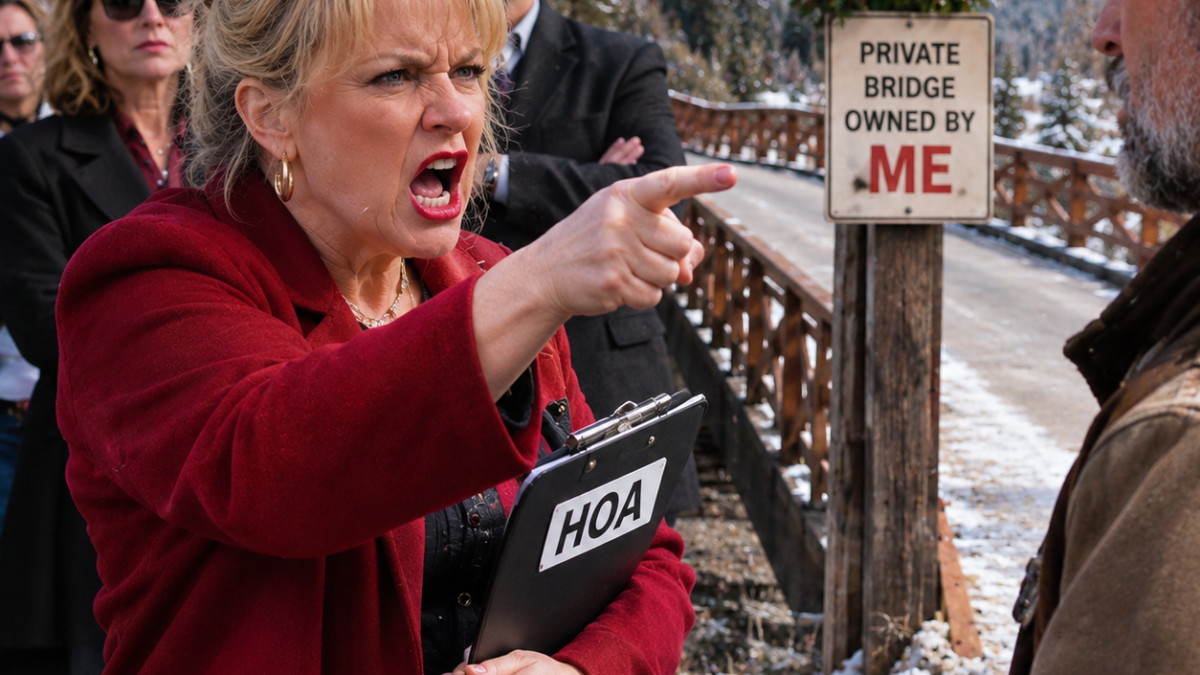
**SILVERPINE RIDGE HOA — PRIVATE COMMUNITY ACCESS**
I stopped my truck.
The steel post had been installed recently.
Fresh disturbed gravel surrounded the base.
I stepped out.
Took photographs.
Called Marlo.
“I think they just helped us.”
“How?”
“They installed a sign.”
“What does it say?”
I read it.
Silence.
Then Marlo said, “Don’t touch it.”
“I wasn’t planning to.”
“Photograph everything.”
“I am.”
“Wide shots too. Show location.”
“Done.”
“And Elias?”
“Yeah?”
“That sign may matter more than they realize.”
At nine, Vivienne arrived.
Her black SUV came first.
Two vehicles followed.
She stepped into the snow wearing a dark green coat.
Behind her were Gordon Price, the HOA treasurer, Linda Hale from the landscaping committee, and three board members I hadn’t met.
Vivienne looked at the sign.
Then at me.
“You’re making this harder than it needs to be.”
“I didn’t install that.”
“You know what I mean.”
“No. I don’t.”
She gestured toward the mountain road.
“Take down your gate. Stop interfering with access. Let people enjoy Christmas.”
“I haven’t closed this bridge.”
“You’ve threatened the security of the community.”
“When?”
“You’re questioning rights that have existed for decades.”
“I’m asking you to show me those rights.”
Gordon stepped forward.
“Everybody knows this bridge belongs to Silverpine.”
“Then the deed should be easy to produce.”
He opened his mouth.
Nothing came out.
Vivienne spoke instead.
“Usage matters.”
“So does title.”
“Our residents have relied on this bridge for more than twenty years.”
“I understand.”
“You cannot appear out of nowhere and erase that.”
“I haven’t erased anything.”
“Then stop acting like you own the place.”
I looked at her.
Behind us, another family crossed the bridge.
Then another.
“You told me something at my gate two nights ago.”
Her eyes narrowed.
“You said I didn’t understand who owned this community.”
“That isn’t what I—”
“Actually, Vivienne, I know exactly who owns it.”
She stared at me.
I pointed at the HOA sign.
“You don’t own this bridge.”
Linda shifted uncomfortably.
Gordon’s brow furrowed.
Vivienne remained still.
“You have no idea what you’re talking about.”
“Maybe.”
I looked toward the road behind her.
“Then your documents should clear it up.”
Before she could answer, shouting came from uphill.
Two younger men were walking toward my gate.
I recognized one from a pickup that had driven slowly past my house earlier that week.
The other carried bolt cutters.
I moved immediately.
“Hey.”
They ignored me.
One crouched beside the lock.
“Don’t touch that.”
The bolt cutters closed.
Metal snapped.
The padlock fell into the snow.
One man yanked my gate open.
The other wired it against the cedar post.
“Public right-of-way,” he announced loudly.
Nobody spoke.
My first instinct was anger.
The kind that arrives before thought.
I took two steps toward them.
Then a voice behind me said, “Elias.”
Marlo.
His mud-covered Jeep had stopped behind my truck.
He stood beside it holding his phone.
Recording.
I stopped.
The two men walked back toward their pickup as though they had accomplished something heroic.
I looked at Vivienne.
Her face had gone pale.
“You tell them to do that?”
“No.”
I believed her.
But that didn’t make her innocent.
She had spent days telling residents I was stealing their road.
Eventually somebody decided to become the hero of the story she created.
I picked up the broken lock.
“I’m not going to stop anyone from crossing.”
Relief flickered across Vivienne’s face.
“Good.”
“Until I know exactly what rights they have.”
The relief vanished.
Marlo approached carrying a gray archival box.
Snow covered his shoulders.
He looked exhausted.
“I found it.”
“What?”
“The original agreement.”
Every board member turned toward him.
Marlo placed the box on my truck hood.
Inside was a certified copy dated June 14, 1994.
At the bottom were two signatures.
Walter Hensley.
Raymond Ashford, founder and first president of Silverpine Ridge Estates Homeowners Association.
Marlo looked at Vivienne.
“You may want to hear this.”
She folded her arms.
He read.
The Hensley Land Company granted Silverpine Ridge a revocable residential-use license over the bridge and corridor.
Not ownership.
Not a permanent public easement.
A conditional license.
In return, the HOA had agreed to three obligations.
Annual maintenance contributions.
Independent engineering inspections every five years.
Compliance with reasonable operating rules established by the bridge owner, including weight restrictions and temporary repair closures.
Marlo pulled out county financial records.
“Silverpine paid consistently for nine years.”
Gordon stepped closer.
“Then what?”
“Payments became irregular after 2003.”
He turned another page.
“They stopped entirely after 2011.”
Gordon looked at Vivienne.
She looked at the bridge.
Marlo continued.
“The last documented engineering inspection paid for under the agreement was in 2009.”
“That doesn’t terminate anything automatically,” Vivienne said.
“Maybe not.”
Marlo turned to the final page.
“But this does make your new sign interesting.”
He read the clause aloud.
The association received no ownership interest in the bridge, corridor, or surrounding land and was specifically prohibited from representing through signage, publication, or other means that it possessed ownership.
Everyone slowly looked at the green-and-gold sign.
**PRIVATE COMMUNITY ACCESS.**
Marlo lowered the document.
Linda whispered, “Oh my God.”
Vivienne said nothing.
He handed her a copy.
She read the last page.
Then read it again.
Wind moved through the steel trusses.
Cars continued crossing behind us.
For nearly a minute, nobody said anything.
I could have enjoyed that moment.
Part of me wanted to.
Vivienne had come to my gate expecting obedience.
Now she stood beside a sign her board had installed in direct contradiction of an agreement signed by the HOA’s own founder.
But when I looked toward the vehicles crossing the bridge, I remembered something more important.
Families depended on it.
This wasn’t a game.
“I’m not closing the bridge,” I said.
Vivienne looked up.
“I’m not charging residents tolls. I’m not trying to embarrass anyone on Christmas.”
Gordon visibly relaxed.
I continued.
“But we’re fixing this.”
“How?” Vivienne asked.
“New legal agreement. Fair maintenance contribution. Inspection schedule. Your sign comes down.”
I pointed toward the mountains.
“You stay off my eight thousand acres unless you have permission.”
Vivienne folded the document carefully.
“And if we refuse?”
“Then we find out what the existing agreement actually gives you.”
She looked at Marlo.
He said nothing.
“I won’t sign something that humiliates this association.”
“This isn’t about humiliation.”
“It will look like surrender.”
“To who?”
“Our residents.”
“No.”
I shook my head.
“It’ll look like paperwork.”
Her eyes hardened again.
“You don’t understand leadership.”
“Maybe not.”
I looked at the broken lock in my hand.
“But I understand ownership.”
She turned and walked back to her SUV.
The board followed.
Gordon lingered.
He looked at the bridge.
Then at me.
“If what he said about inspections is true…”
“It is.”
“You’re going to inspect it?”
“Yes.”
“When?”
“As soon as we can get an engineer.”
Gordon nodded and left.
Marlo watched them drive away.
“She’ll get another lawyer.”
“Probably.”
“She’ll fight.”
“Probably.”
I looked west.
Gray clouds were building over the peaks.
The temperature had fallen noticeably in less than an hour.
Marlo followed my gaze.
“Storm coming.”
“That’s what the forecast says.”
Neither of us understood yet how quickly the legal argument was about to become something much more dangerous.
By ten that night, the wind was shaking the old log house.
Snow hit the windows almost horizontally.
The temperature dropped twenty degrees in two hours.
I went to bed after midnight.
At 6:15 the next morning, my phone rang.
I answered half asleep.
“Mercer.”
“This Elias?”
“Yeah.”
“My name’s Russ Delaney. I plow the Silverpine road.”
Something in his voice pulled me upright.
“What happened?”
“I think your bridge is cracking.”
I was dressed in less than three minutes.
Russ met me at the eastern abutment.
The storm was still hammering the canyon.
Wind gusted over fifty miles an hour.
Snow piled against the approach.
Russ led me toward the third truss.
“I heard it when I was plowing.”
“Heard what?”
“A groan.”
He shined his flashlight through the railing.
“Then I saw this.”
I crouched.
Below the deck, one of the long lower steel members had split along an old weld.
The crack was wider than my hand.
Ice glittered inside it.
Even without engineering experience, I knew it was bad.
Then the bridge made another sound.
Low.
Metallic.
Almost like something alive complaining under pressure.
I stood immediately.
“Nobody else crosses until we know what that is.”
Russ nodded.
I called the sheriff.
Then a heavy construction company in Billings run by Dale Whitaker, a man I knew from business years earlier.
He answered on the fourth ring.
“Elias?”
“I need a bridge engineer.”
“You bought a bridge?”
“Apparently.”
“That sentence needs more explanation.”
“It’s cracked.”
His tone changed instantly.
“Send pictures.”
I sent them.
Thirty seconds later, he called back.
“Close heavy traffic now.”
“Can passenger vehicles cross?”
“I can’t tell you from photographs.”
“I’ve got three hundred people above this canyon.”
“Then control traffic. One vehicle at a time if absolutely necessary. No heavy trucks. Get law enforcement at both ends.”
“I need you here.”
“I’m five hours away in this weather.”
“I know.”
Silence.
Then Dale said, “We’re coming.”
My third call was to Marlo.
“Document everything.”
“That was going to be my advice to you.”
“Times. Decisions. Photographs. Every crossing.”
“I’ll meet you there.”
By eight, deputies controlled both approaches.
We established temporary rules.
Emergency vehicles first.
Passenger cars one at a time.
Walking speed.
No stopping.
No trucks over five tons.
Russ volunteered to direct traffic.
I stood beside him as frightened residents came through.
Most didn’t know who I was.
Some did.
Nobody argued.
At nine, Vivienne arrived.
She marched straight toward me.
“You can’t ration our road.”
I stared at her.
“What?”
“You have families waiting uphill.”
“I have a cracked structural member beneath this bridge.”
“You’re using an emergency to establish authority.”
I grabbed my flashlight.
“Come here.”
She hesitated.
“Come here, Vivienne.”
I led her to the railing.
Shined the beam down.
The crack had grown.
It was now nearly the length of my forearm.
Blue-white ice coated the edges.
The wind screamed through the trusses.
“If that fails,” I said, “I don’t care whose name is on the deed.”
She stared downward.
“The people who die won’t be paperwork.”
Her face changed.
Not completely.
But enough.
“What do you need?”
That was the first useful question she had asked me.
“Keep residents from coming down unless they need to leave.”
“I can do that.”
“No delivery trucks.”
She nodded.
“If there’s a medical emergency, call the sheriff before they move.”
“Okay.”
“Can Silverpine open the clubhouse?”
“For what?”
“Anybody stranded on the town side may need somewhere warm when they return.”
“Yes.”
She looked down at the crack again.
“What if it fails?”
I didn’t answer.
Because there was no answer I could give her that would help.
Dale’s crew arrived shortly before noon.
Three trucks came through the storm wearing chains.
They brought hydraulic jacks, steel plate, welding equipment, floodlights, generators, cables, and enough cold-weather gear for a small army.
Dale climbed out.
His beard was already white with frost.
“You really know how to spend Christmas.”
“Day after.”
“Feels like Christmas.”
He walked the bridge with his engineer.
Twenty minutes later, they returned.
“Well?”
Dale rubbed both hands together.
“It’s ugly.”
“How ugly?”
“Not dead.”
I waited.
“We can stabilize it.”
“How long?”
“Twelve hours if the weather doesn’t get worse.”
“It’s getting worse.”
“Then fourteen.”
“What do you need from me?”
“Keep traffic off while we jack it.”
I looked toward the line of vehicles.
“How long?”
“Two-hour blocks. Maybe three.”
I told the deputies.
Vivienne helped notify residents.
Nobody complained.
That surprised me.
Maybe fear clarifies priorities.
Dale’s crew worked through the afternoon.
Men rappelled beneath the deck into the canyon wind.
They clamped both sides of the fractured lower chord.
Hydraulic jacks brought the member back into alignment.
Steel splice plates went over the crack.
Bolts thicker than my thumb were driven through both plates.
When darkness came, floodlights turned the falling snow gold.
I stood near the abutment with coffee I couldn’t taste.
Around midnight, Vivienne appeared beside me.
She held out another cup.
“Clubhouse coffee.”
“Is that a warning?”
“It’s bad.”
I accepted it.
For a while, we watched the crew.
“You could have closed it,” she said.
“Yes.”
“You probably had the legal right.”
“Probably.”
“Why didn’t you?”
I looked toward the bridge.
“Because people live up there.”
“That simple?”
“It should be.”
She was quiet.
“I thought you were going to use the bridge against us.”
“I know.”
“I would have.”
The admission surprised me.
She looked embarrassed after saying it.
“That’s probably why you assumed I would.”
She stared into her coffee.
“I suppose.”
At four in the morning, Dale called for the first load test.
Pickup truck.
Then plow.
The repaired section held.
His engineer checked movement.
Measured deflection.
Inspected the plates again.
Finally Dale walked toward me, removed his welding hood, and grinned.
“She’ll carry traffic until spring.”
My legs nearly gave out with relief.
“And spring?”
“Real repair.”
“How real?”
“Expensive.”
“How expensive?”
“I’ll let you enjoy breakfast first.”
By sunrise, the bridge reopened.
Residents crossed quietly.
A pharmacy delivery van came through just before noon.
Later I learned it carried insulin for Harold Fitch, an elderly Silverpine resident.
An ambulance crossed that afternoon to take a young girl with a high fever into town.
The deputies cleared every other vehicle first.
I watched the ambulance disappear across the canyon.
That alone justified every dollar I had spent.
But while Dale’s crew packed equipment, Marlo sat inside his Jeep going through records requested from the Hensley estate’s attorney in Arizona.
At seven-thirty, he came toward me carrying two pages.
The look on his face was different from Christmas morning.
Not excited.
Angry.
“You need to read this.”
“What is it?”
“Certified letter.”
“From who?”
“Hensley family’s lawyer.”
“When?”
“March 9, 2022.”
“About what?”
“The bridge.”
I took the pages.
The letter had been addressed directly to the president of Silverpine Ridge Estates.
It explained that the HOA’s license had lapsed because maintenance contributions had gone unpaid for years.
It stated the bridge had not received the required independent inspection since 2009.
It warned that significant structural work might be necessary.
Then it offered Silverpine two choices.
Buy the bridge and corridor.
Or negotiate a new use agreement with full cost sharing.
If they refused both, the estate intended eventually to sell the bridge with the surrounding property, and future access would depend on whoever purchased it.
I looked at Marlo.
“Did they respond?”
“No.”
“How do we know they received it?”
He handed me the second page.
Certified-mail return receipt.
One signature.
**Vivienne Cross.**
I stopped breathing for a second.
“She knew.”
“Yes.”
“For almost three years.”
“Yes.”
“She knew the HOA didn’t own the bridge.”
“Yes.”
“She knew they hadn’t paid.”
“Yes.”
“She knew it hadn’t been inspected.”
“Yes.”
I looked toward Silverpine Ridge.
“She knew there could be structural problems.”
Marlo nodded.
“And she said nothing.”
“Apparently.”
That angered me more than the gate.
More than the sign.
More than the threats.
People had crossed that bridge every day.
School buses.
Ambulances.
Families.
She hadn’t merely concealed a property dispute.
She had concealed a safety issue because admitting it might cost money and damage her reputation.
I called her.
She answered on the first ring.
“Elias.”
“We need to talk.”
A pause.
“When?”
“Today.”
Another pause.
“I know what you found.”
That told me everything.
We met that afternoon in the Silverpine clubhouse.
Small conference room.
Long walnut table.
Window facing the canyon.
Vivienne sat at the far end wearing the same coat she had worn at the bridge.
I placed the certified letter on the table.
She didn’t touch it.
“You knew.”
“Yes.”
No denial.
No speech.
Just yes.
“When?”
“When it arrived.”
“March 2022.”
“Yes.”
“You signed for it.”
“Yes.”
“And you never told your board?”
“No.”
“The residents?”
“No.”
“Why?”
She stared toward the window.
“At first, money.”
I sat across from her.
“What money?”
“The estate included rough engineering estimates.”
She rubbed her thumb against one knuckle.
“If we purchased the bridge and repaired everything they thought might be wrong, the special assessment could have approached forty thousand dollars per household.”
I understood why that number frightened her.
Silverpine looked wealthy from outside, but not every resident was rich.
Some were retired.
Some had bought years before prices exploded.
Some lived on fixed incomes.
Vivienne continued.
“I had been president less than a year.”
“So you buried it.”
“I delayed.”
“For three years.”
“I thought the estate would keep doing what it had always done.”
“Which was what?”
“Nothing.”
I stared at her.
“The heir lived in Arizona. He didn’t care about the bridge. Residents kept crossing. Nothing happened.”
“Until somebody bought it.”
“You.”
“And you panicked.”
Her eyes met mine.
“Yes.”
It was the first completely honest conversation we had ever had.
“If you started asking questions,” she said, “the board would discover I had known. Property values might fall. People would ask why I hadn’t acted.”
“So you decided I needed to look unreasonable first.”
“Yes.”
“The gate.”
“Yes.”
“The county complaint.”
“Yes.”
“The bridge sign?”
“My decision.”
“The demands?”
“Yes.”
“You thought if you claimed ownership loudly enough, everybody would believe you.”
She gave a tired laugh without humor.
“I think I believed it myself by the end.”
I leaned back.
For several seconds, neither of us spoke.
“The biggest mistake wasn’t that you didn’t know,” I said.
She looked at me.
“You knew.”
Her face tightened.
Then she nodded.
“I knew.”
“What happens now?” she asked.
“You tell them.”
Her eyes narrowed.
“Who?”
“Everybody.”
The old defensiveness returned.
“You want to humiliate me.”
“No.”
“You have the deed. The agreement. The letter. You could sue us. You could force me out. You could shut the bridge down tomorrow.”
“I don’t want any of that.”
She looked genuinely confused.
“What do you want?”
I pulled a folded document from my coat.
Marlo and I had drafted it that morning.
I pushed it across the table.
“An agreement.”
She opened it.
Four pages.
Silverpine would receive a recorded residential access right to the bridge and corridor.
Not something dependent on my mood.
A real legal right that would survive even if I sold the property.
In exchange, the HOA would contribute a fair annual share toward maintenance based on independent engineering calculations.
My side would remain responsible for coordinating structural inspections and major repairs.
No HOA jurisdiction over my eight thousand acres.
No unauthorized signs.
No representation of ownership.
Disputes handled through legal channels.
Not intimidation.
Not clubhouse politics.
Vivienne read slowly.
“This is better than the old agreement.”
“Yes.”
“Why?”
“Because residents shouldn’t lose access because of a dispute they didn’t create.”
She turned the page.
Then she reached the final section.
Her expression changed.
“No.”
“That section stays.”
“You cannot expect me to agree to this.”
“I can.”
The section required Silverpine to disclose the complete legal history of the bridge.
The 1994 agreement.
The missed maintenance payments.
The failed inspections.
The 2022 warning letter.
Vivienne’s receipt.
Everything.
In writing.
And at a public meeting.
“You said you weren’t trying to humiliate me.”
“I’m not.”
“This does exactly that.”
“No. The truth might embarrass you. That isn’t the same thing.”
She pushed the agreement away.
“I can’t.”
“You can.”
“I’ll lose the presidency.”
“Maybe.”
“People will hate me.”
“Some probably will.”
She stood.
“You don’t understand.”
“I understand perfectly.”
“No, you don’t.”
She pressed both hands against the table.
“I’ve spent years keeping that community stable.”
“And the bridge almost failed yesterday.”
Her face went still.
“That’s why this part isn’t negotiable.”
She sat back down.
I lowered my voice.
“You don’t rebuild trust by hiding the thing that broke it.”
She stared at the agreement.
“What if I refuse?”
“Then Marlo and I handle it legally.”
“You’d sue?”
“If necessary.”
“And the bridge?”
“I’ll keep it safe.”
That answer bothered her more than a threat would have.
Because I wasn’t holding the community hostage.
I was giving her nowhere to hide.
She took the agreement home.
At ten the next morning, my phone rang.
Vivienne.
“Call the meeting.”
I said nothing.
“I’ll tell them.”
The clubhouse was packed on December 28.
More than a hundred residents came.
Marlo arranged copies of every document on a table at the front.
Deed.
1994 agreement.
Payment records.
Inspection history.
2022 letter.
Certified-mail receipt.
I sat against the side wall.
I didn’t want the meeting to become a trial with me as prosecutor.
Marlo presented facts.
Nothing else.
When he explained that Silverpine had never owned the bridge, people murmured.
When he showed that maintenance payments had stopped years earlier, people became angry.
When he explained the missing inspections, voices rose.
Then he lifted the return receipt.
“Signed March 14, 2022.”
He read the name.
“Vivienne Cross.”
Silence.
Every person in the room looked toward her.
Gordon stood.
“I’ve been treasurer four years.”
Vivienne nodded.
“You never showed me this.”
“No.”
“Why?”
She didn’t answer yet.
A man near the back shouted.
“My kids ride a bus over that bridge every day!”
Another voice.
“You knew it wasn’t inspected?”
“Let her speak,” someone else said.
Then Russ Delaney stood.
The snowplow driver.
He removed his hat.
“I want to say something.”
The room settled.
“I found that crack.”
He pointed toward me.
“And I called him.”
People looked my way.
Russ continued.
“He could’ve shut the bridge. Nobody could’ve blamed him after what happened Christmas morning.”
He looked around the room.
“He didn’t.”
Harold Fitch stood next.
He was thin, probably seventy-five.
“My insulin got across yesterday because Mr. Mercer kept the bridge open.”
A young woman rose near the center aisle.
“My daughter went to the hospital in that ambulance.”
Her voice broke.
“Deputies stopped everybody so she could cross first.”
I looked down.
I hadn’t expected gratitude.
It made me uncomfortable.
Marlo finished presenting the documents.
Then nodded toward me.
I stood.
“I know what some of you thought when I arrived.”
Nobody spoke.
“Stranger buys eight thousand acres. Puts up a gate. Doesn’t introduce himself. Starts asking questions about roads people have used for decades.”
I looked around.
“I would’ve wondered too.”
A few people shifted.
“But I didn’t come here to take something from you.”
I paused.
“I own the bridge.”
The words still felt strange.
“That’s true.”
I looked toward the windows.
“But I don’t want to own your fear.”
The room went quiet again.
“I want a legal agreement so nobody in this room has to wonder whether their family can get to town next winter.”
Then I sat.
Vivienne stood.
For several seconds, she couldn’t begin.
Nobody rescued her.
Finally she faced her neighbors.
“The Silverpine Ridge Estates Homeowners Association does not own the Silverpine Bridge.”
Her voice shook slightly.
“Elias Mercer does.”
She told them everything.
She admitted receiving the 2022 letter.
She admitted keeping it from the board.
She explained the financial fears.
The property-value fears.
Her belief that ignoring the problem would preserve stability.
Then she admitted what she had done after I bought the land.
The demands.
The sign.
The attempts to establish control.
“The sign at the eastern abutment was installed on my instruction,” she said.
Linda Hale looked down.
Vivienne continued.
“There was no legal basis for representing that the bridge belonged to the association.”
A man shouted, “Why should you stay president?”
Vivienne looked toward him.
“I don’t know that I should.”
No defense.
No counterattack.
That changed the room.
She finished.
“I thought I was protecting Silverpine.”
She swallowed.
“But I protected my decision instead.”
Then she sat.
Nobody applauded.
Nobody needed to.
The vote on the new agreement was ninety-one to eleven.
Afterward, residents approached me slowly.
Some shook my hand.
Some apologized.
Some just nodded.
That was enough.
Outside, snow was falling.
Far below, Dale’s temporary work lights still illuminated the bridge.
Vivienne came through the clubhouse door.
She stopped beside me.
“Can I ask you something?”
“Sure.”
“If you don’t need that bridge, why keep it?”
I looked toward the canyon.
“I do need it.”
“For your land?”
“Not much.”
“Then what?”
I thought about the ambulance.
The insulin delivery.
The school buses.
“Somebody has to own it.”
She waited.
“And owning something doesn’t mean you have to use it to control people.”
Vivienne stared toward the lights.
After a moment, she nodded.
The final agreement was signed January 2.
I signed first.
Vivienne signed for Silverpine.
Marlo recorded it that afternoon.
The board debated whether Vivienne should resign.
Some demanded it.
She offered.
In the end, the residents voted to let her finish her term under close oversight.
Frankly, I thought that was harder punishment than resignation.
Leaving would have allowed her to escape the consequences.
Staying meant repairing what she had damaged.
She did.
The HOA commissioned the first proper bridge inspection in years.
Vivienne personally removed the green-and-gold ownership sign.
One afternoon, she drove to my house and leaned it against my porch.
Beside it, I placed the laminated COMMUNITY ACCESS ROAD sign I had removed from my gate.
We looked at both.
“Kind of embarrassing,” she said.
“Very.”
She laughed.
That was the first time I heard her laugh without calculation.
In April, Dale returned with a full engineering crew.
The temporary splice came off.
The damaged lower chord was rebuilt.
Several bearings were replaced.
The deck came up.
Corroded connections were repaired.
By June, the bridge had new steel, a new deck surface, improved drainage, reinforced bearings, and a five-year inspection certificate.
The final bill was painful.
Silverpine paid its agreed share.
I covered the major structural work.
No one complained.
That summer, I finally began living the life I had intended to live when I bought the Hensley property.
I walked miles without seeing another person.
I restored trails.
Repaired the old cabin.
Fished the lake.
And made one major decision.
Nearly six thousand acres went into permanent conservation protection.
No subdivision.
No condominium project.
No clear-cutting.
The rumor Linda Hale had heard about me developing the forest turned out to be almost exactly opposite of what I wanted.
I built one new house above the lake.
Stone.
Timber.
Wide windows toward the valley.
Solar panels on the roof.
A small hydroelectric system using water from the creek.
Nothing extravagant by the standards of what I could afford.
Just permanent.
I also built a private northern road through the trees.
Not because I wanted to avoid Silverpine.
Because I never again wanted someone else’s access problem to become my only access problem.
By autumn, something unexpected happened.
People started visiting.
Russ came first.
He brought venison.
Then Gordon stopped by with bridge expense reports because he wanted to make sure the new payment schedule was transparent.
Harold Fitch showed up with his grandson and a bottle of bourbon.
The young mother whose daughter had taken the ambulance brought apple pie.
Even Linda came once.
“I owe you an apology,” she said.
“For what?”
“I told people you were building condominiums.”
I looked at the untouched mountains.
“Terrible location.”
She laughed.
Slowly, eight thousand acres stopped feeling like a fortress.
That surprised me.
I had purchased it because I believed solitude was the opposite of obligation.
But those mountains taught me there was another kind of quiet.
The quiet that comes when boundaries are clear enough that nobody needs to defend them every day.
The following Christmas Eve, snow drifted gently over the ridge.
I put white lights along the porch of the new house.
Then I walked to the old Hensley cabin and decorated that porch too.
I had kept it standing.
Crooked chimney.
Silver logs.
All of it.
From the bench above the lake, I could see Silverpine Ridge glowing below.
Farther down, the bridge stretched across the canyon.
The HOA had voted that autumn to decorate it.
Not with a sign.
Lights.
Warm gold bulbs traced the trusses from one rim to the other.
The bridge looked almost weightless in the darkness.
I heard tires on snow.
A small gray sedan stopped near my gate.
The gate stood open.
It had been open most of the year.
Vivienne stepped out carrying a cookie tin.
“No black SUV?”
“I sold it.”
“Why?”
“Bad memories.”
I smiled.
She walked toward the overlook.
Her hair was loose.
I had never seen it that way before.
She handed me the tin.
“I made these.”
“You?”
“Don’t sound so worried.”
“I watched you nearly start a land war over a bridge.”
“Cookies are less complicated.”
We stood together looking down at the valley.
After a while she said, “Do you still plan to live up here alone?”
“I bought eight thousand acres because I wanted quiet.”
“I remember.”
“You were very determined to interrupt it.”
“I was.”
She glanced at me.
“And now?”
I watched headlights move slowly across the bridge.
They disappeared into Silverpine.
Another vehicle came the opposite direction.
Nobody stopped at a gate.
Nobody needed permission from an HOA president.
Nobody needed permission from me either.
They had rights now.
Written rights.
Clear obligations.
Clear boundaries.
“I think I finally found a place worth staying.”
Vivienne looked toward the bridge.
“So the land worked.”
“Not the way I expected.”
Below us, the Christmas lights shone against the steel.
One year earlier, she had stood outside my gate telling me that I couldn’t control everything around my property.
She had been right about that.
I had been right too.
Ownership mattered.
But the year had taught me something neither of us understood that first night.
Ownership and control were not the same thing.
I could have used the bridge to punish Silverpine.
I could have demanded tolls.
Threatened closure.
Dragged the HOA through court.
Made every family pay for Vivienne’s mistake.
I had enough money.
Enough lawyers.
Enough leverage.
But then I would have become another person using someone else’s fear to feel powerful.
That wasn’t why I had come to Montana.
The bridge remained mine.
The land remained mine.
Silverpine had legal access because we had chosen to write down exactly what belonged to whom and exactly what each side owed.
No assumptions.
No manufactured authority.
No threats disguised as community rules.
Vivienne opened the cookie tin.
“You’re supposed to wait until Christmas.”
“It’s Christmas Eve.”
“That isn’t Christmas.”
“You drove onto eight thousand acres to police my cookie schedule?”
She laughed.
I took one.
It was actually good.
We stood there until snow began collecting on our shoulders.
From high above, the whole valley looked smaller than any of our arguments had made it feel.
A house beside a frozen lake.
A cluster of homes on a distant plateau.
Eight thousand acres of dark forest.
And between them, one bridge glowing gold over the canyon.
There was no Silverpine ownership sign anymore.
No warning.
No claim.
Just lights.
Cars.
Snow.
And steel carrying people safely from one side to the other.
I had bought the property because I wanted to get away from everyone.
Instead, the one thing buried deepest in my deed—the thing I hadn’t even known I owned—had tied my life to theirs.
And strangely, I no longer minded.
[END OF STORY]








