PART 2: I Bought 42 Acres Outside McCall—Then an HOA Sent Cops to My Gate and Told Me I Had 30 Days to Leave
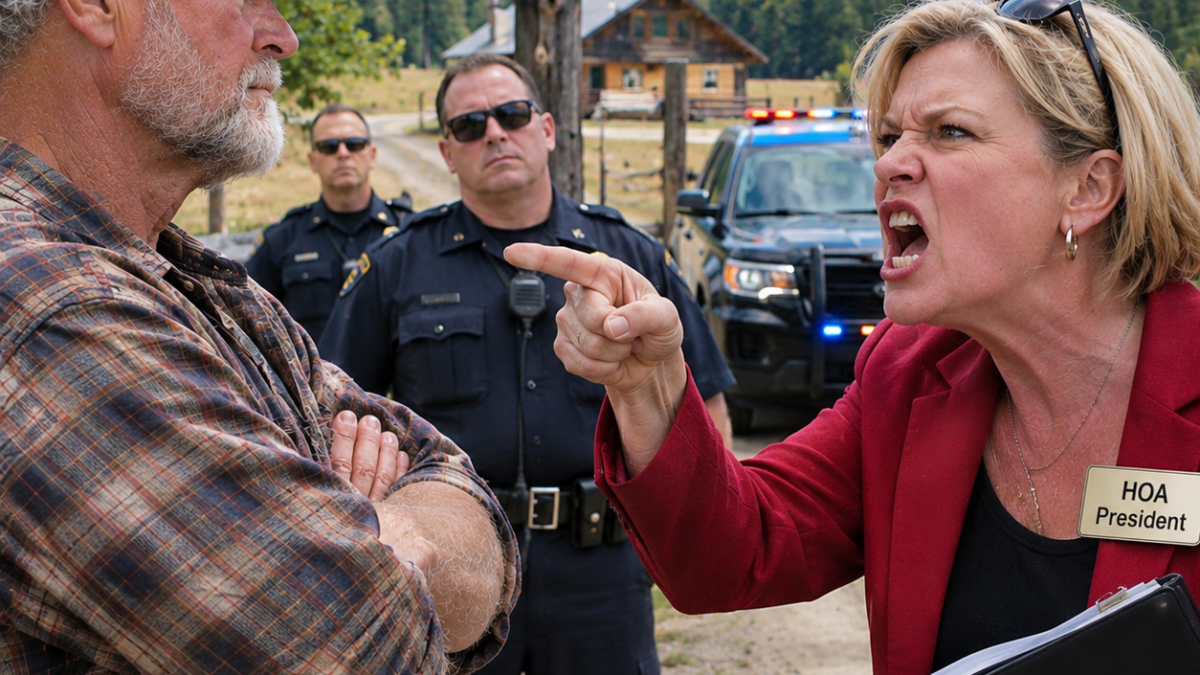
PART 2
Sloan’s office sat above a fly-fishing outfitter in downtown McCall, squeezed between a tax preparer and a dentist whose waiting room music came faintly through the wall.
When I walked in, she already had three oversized maps spread across her conference table.
Sloan was thirty-nine, sharp-eyed, dark-haired, and had the habit of pushing her glasses up with one finger whenever she was about to tell somebody something they would rather not hear.
She pointed at a faded red line.
“This is Pine Ridge Estates.”
I leaned over the map.
The subdivision occupied a broad wedge east of my land.
My forty-two acres sat clearly beyond the boundary.
Not close enough to argue.
Not ambiguous.
Outside.
“Then we’re done,” I said.
“No.”
I straightened.
“You just told me I’m not in the HOA.”
“You’re not.”
“So what exactly are we doing?”
She tapped a dotted line running diagonally across my meadow.
“This.”
I looked closer.
“What is it?”
“An easement.”
“What kind?”
“Old access easement. Recorded decades before Pine Ridge existed.”
I followed the dotted line with my finger.
It entered my land near the county road, crossed the lower meadow, then continued toward property now occupied by the subdivision.
“I’ve never used that road.”
“Because most of it isn’t a road anymore.”
“So why does it matter?”
Sloan sat back.
“Because it’s still legally active.”
I didn’t like the way she said it.
“Active for what?”
“Historically, agricultural and access purposes. It served the larger farm that used to include your parcel and the land that eventually became Pine Ridge.”
I looked at the map again.
“So the HOA has an easement across my property?”
“Possibly some rights connected to the original beneficiary parcels. We need to trace exactly what survived subdivision and transfer.”
“That sounds bad.”
“It sounds complicated.”
“Lawyers say complicated when they mean expensive.”
She smiled.
“Usually.”
I pulled out a chair.
“Can they use it to tell me what color to paint my shed?”
“No.”
“Can they tell me to remove my fence?”
“Not based on anything I’ve found.”
“Can Mara tell me to leave?”
“Absolutely not.”
“Then what is the problem?”
Sloan slid a second map over the first.
This one was newer.
County planning.
Future development corridors.
Traffic studies.
Proposed utility extensions.
The dotted easement cut through the same stretch of land.
“What am I looking at?”
“I’m not sure yet.”
“That’s comforting.”
“I said don’t celebrate because I don’t think Mara is confused about your property line.”
I thought about her words at my gate.
It doesn’t matter whether your parcel sits technically inside the original subdivision.
“You think she knows.”
“I think we need to assume she might.”
“Then why pretend I’m under HOA rules?”
Sloan folded her arms.
“That’s the question.”
I drove home with copies of the maps rolled up on the passenger seat.
All the way back, I kept glancing at them as if they might move when I wasn’t looking.
The strange part was how normal my place looked when I arrived.
Forty-two acres.
Pines.
Open meadow.
The old cabin I had spent two summers repairing.
The tool shed I had rebuilt almost completely.
The gravel lane I had graded myself.
Nothing about it looked valuable enough to inspire a campaign.
That was my first mistake.
I was measuring value by what existed.
Someone else was measuring it by what might exist later.
Four days after my meeting with Sloan, a thick envelope appeared in my mailbox.
PINE RIDGE ESTATES HOMEOWNERS ASSOCIATION.
FORMAL NOTICE OF VIOLATION.
Three pages.
Mara’s signature at the bottom.
According to the notice, I had thirty days to repaint my cabin in an approved earth-tone palette, replace portions of my roof with association-compliant materials, remove my private-property sign, relocate sections of fence, stop mechanical work inside my shed, and submit all future improvements to the Pine Ridge Architectural Review Committee.
I read the letter twice.
Then I called Sloan.
“You sitting down?” I asked.
“I’m a lawyer. I’m always sitting down.”
“They sent me a violation notice.”
“Send it.”
“They’re telling me to repaint the cabin.”
“Send it.”
“They’re telling me I can’t repair engines in my own shed.”
“Calder.”
“What?”
“Send it.”
I scanned the pages.
Ten minutes later, she called.
“This is useful.”
“I’m glad somebody’s enjoying it.”
“They cite Pine Ridge design guideline 7.3.”
“I saw that.”
“You never agreed to those guidelines.”
“I know.”
“They also cite a viewshed provision.”
“What does that mean?”
“It means apparently anything visible from their community is now emotionally their business.”
I laughed.
“That can’t be real.”
“It’s real language inside their rules. It just doesn’t bind you.”
“So what do we do?”
“Reply once. Calmly. Ask them to identify the recorded instrument that subjects your parcel to their jurisdiction.”
“That’s it?”
“That’s it.”
I wrote six sentences.
No insults.
No threats.
No speculation.
Provide the deed, covenant, annexation document, or recorded agreement giving Pine Ridge Estates authority over parcel number…
I sent it certified.
They never answered.
A week later, they billed me instead.
$1,250.
ADMINISTRATIVE ENFORCEMENT FEE.
I stood in my kitchen holding the invoice and started laughing.
Not because it was funny.
Because something about being invoiced for violating rules of an association I had never joined pushed the situation past ordinary stupidity.
People make mistakes.
Organizations send letters to the wrong address.
Boards misunderstand boundaries.
But once you ask for proof and they refuse to give it, then send you a bill anyway, the mistake starts looking like a strategy.
I called Sloan.
“Another present.”
“What now?”
“They billed me.”
Silence.
“For what?”
“Enforcing rules against me.”
“How much?”
“Twelve-fifty.”
She laughed too.
“Don’t pay it.”
“I wasn’t planning to.”
“Keep the envelope.”
“Why?”
“Postmark.”
I looked at it.
“Does everything become evidence when you’re a lawyer?”
“Only the things people wish they hadn’t mailed.”
That weekend, I drove out to see Walt Dobri.
Walt was sixty-eight, built like an old fence post, and had been one of my first restoration clients after I left engineering work.
His ranch bordered the far side of Pine Ridge.
He knew the land better than most maps did.
I showed him the notice.
He read half the first page.
Then he snorted.
“They got you too.”
I looked at him.
“What?”
“Pine Ridge.”
“They did this to you?”
“Not exactly this.”
He handed the papers back.
“Five, six years ago, they decided my hay barn hurt their mountain views.”
“Your barn?”
“Been standing there since 1989.”
“What did they do?”
“Letters. Calls. One county complaint. Said the roof runoff was affecting a drainage channel.”
“Was it?”
“No.”
“Did you fight?”
Walt looked toward the cattle.
“For a while.”
“What happened?”
“I got tired.”
That answer bothered me.
“They made you move it?”
“No. I painted the roof and planted some trees so they’d shut up.”
“You shouldn’t have had to.”
“I had cows to feed and a wife going through chemo. Sometimes being right is more expensive than being tired.”
We stood quietly.
Then he looked at me.
“You planning to fight them?”
“Yes.”
He gave a humorless smile.
“Then keep receipts.”
“What does that mean?”
“It means people like Mara don’t count on being right.”
He picked up a feed bucket.
“They count on you having something better to do.”
I thought about that sentence all the way home.
A few days later, Sloan called.
“I traced the history.”
“Good history?”
“For you, yes.”
I drove into town.
She had more documents waiting.
My forty-two acres had once been part of a much larger working farm.
Decades ago, the owner sold off a portion.
That portion eventually became Pine Ridge Estates.
My parcel remained outside.
Every recorded plat said the same thing.
Every deed.
Every transfer.
No annexation.
No declaration joining it to the HOA.
No covenant.
Nothing.
I felt my shoulders loosen.
“So Mara has nothing.”
“On HOA jurisdiction? Correct.”
“Then why does she keep doing this?”
Sloan moved back to the old easement.
“Because of this.”
“I still don’t understand.”
“Neither did I until I pulled county planning records.”
She opened a folder.
Inside were traffic projections for Pine Ridge.
Their main entrance connected to the county road through a narrow route that had become congested as the subdivision expanded.
“Residents have complained about the entrance for years,” Sloan said.
“Okay.”
“The county has also pushed them to develop a secondary access if they add more homes.”
“Add more homes where?”
She slid another document toward me.
PINE RIDGE EXPANSION CONCEPT.
I studied the dates.
Five years old.
“Why have I never seen this?”
“Because it never moved beyond preliminary planning.”
I turned pages.
Additional residential lots.
Utility extension.
Secondary road.
Then I saw it.
A black line crossed what looked like my meadow.
I leaned closer.
“That’s my property.”
“Yes.”
“That road is on my land.”
“Yes.”
“They drew a road through my land before I even bought it.”
“Before you bought it, after the previous owner refused to sell.”
I looked up.
“What?”
Sloan had found correspondence from the old owner.
Two offers.
Both rejected.
My pulse changed.
“What happened after I bought?”
“Nothing officially.”
“Until now.”
“Until now.”
I sat back.
“So they want the easement.”
“They want something broader than the easement.”
“What?”
“Control.”
I stared at her.
“That sounds dramatic.”
“So does sending police to a man’s house over imaginary livestock.”
Fair point.
Sloan pointed at the proposed secondary road.
“The old easement is narrow and legally limited. It doesn’t automatically let them build a modern subdivision road, run expanded utilities, or support commercial resort traffic.”
“Resort?”
Her eyes met mine.
“I’m still working on that part.”
That was the first time I heard the word.
Resort.
It sounded absurd.
My land sat outside McCall, sure, but not beside some polished development.
I had pines.
Mud.
Deer.
Snowdrifts big enough to bury a pickup.
A resort belonged on glossy brochures.
Not behind my tool shed.
Then the pressure changed.
Before, the visits had been annoying.
After Sloan started digging, they became regular.
A county inspector showed up Tuesday afternoon.
“Complaint about an unpermitted structure.”
“What structure?”
He checked his tablet.
“Accessory workshop.”
I pointed toward the shed.
“That?”
“Yes.”
“Previous owner permitted it.”
He frowned.
“You have paperwork?”
I did.
I kept everything.
We stood in the driveway while he compared the permit number to his system.
Finally he shook his head.
“This is valid.”
“Who complained?”
“Anonymous.”
“Of course.”
He left looking embarrassed.
Thursday, a man in a polo shirt with the Pine Ridge crest parked on the public shoulder and began photographing my cabin with a telephoto lens.
I walked toward him.
“Can I help you?”
He lowered the camera.
“Routine documentation.”
“For what?”
“Community planning.”
“This isn’t your community.”
He got into his truck and left.
Saturday morning, tire tracks appeared near my shed.
Not mine.
A vehicle had entered sometime during the night, looped through the gravel turnaround, then left.
Nothing stolen.
Nothing damaged.
The next week it happened again.
That was when I installed two more cameras.
I had spent most of my working life around construction projects and machinery.
You learn something when expensive equipment and insurance are involved:
Memory is weak.
Logs are strong.
So I created a folder on my computer.
PROPERTY INTERFERENCE LOG.
Every incident went in.
Date.
Time.
Weather.
Vehicle.
Name.
Statement.
Photograph.
Video.
Document.
I wrote everything in flat engineering language.
No words like harassment.
No words like intimidation.
No guesses.
Just what happened.
March 14, 3:17 p.m. — county inspector arrived regarding anonymous report of unpermitted accessory structure. Permit confirmed valid. Inspector departed 3:42 p.m.
March 17, 11:06 a.m. — unidentified male photographed residence from public right-of-way. Shirt displayed Pine Ridge Estates emblem. Departed when questioned.
March 22, approximately 2:00 a.m. — unknown vehicle entered private turnaround. Tire tracks photographed.
I started sleeping lighter.
That was the part I hated most.
Not the letters.
Not Mara.
Not even the police.
The feeling that my land no longer gave me rest.
I had bought forty-two acres because quiet mattered to me.
I didn’t have a wife or children waiting in the cabin.
I wasn’t hiding from anyone.
I simply liked coming home to a place where the loudest decision belonged to weather.
Now every engine on the gravel road made me look out the window.
Every set of headlights after dark tightened my jaw.
I caught myself checking the gate before bed twice instead of once.
Then one morning, I found the chain on the ground.
The padlock had been cut clean through.
I stood there staring at it.
No confusion.
No accident.
Someone had taken bolt cutters to my gate.
I walked back to the cabin, pulled up the camera footage, and found the time stamp.
2:17 a.m.
A dark utility vehicle stopped outside.
Two people got out.
One stood watch.
The other cut the chain.
The image wasn’t perfect, but the vehicle was clear enough.
PINE RIDGE ESTATES.
I called Sloan.
“I have them.”
“Doing what?”
“Cutting my gate.”
Silence.
“Video?”
“Yes.”
“Back it up in three places.”
“Already doing it.”
“Do not post it.”
I frowned.
“Why?”
“Because I want to know what they think they can get away with next.”
“They cut my lock.”
“I know.”
“I could call the sheriff.”
“You can, and we may. But first send me the footage.”
“Sloan.”
“Calder, listen to me. Right now Mara still thinks you are reacting incident by incident. Complaint, response. Letter, response. Visit, response.”
“So?”
“So let her keep thinking that.”
I looked at the broken chain.
“You want me to wait.”
“I want you to stop showing her what you know.”
I hated that advice.
Which, by then, I had learned usually meant it was good.
I replaced the lock.
Installed another camera where it couldn’t be seen from the road.
Then I waited.
Mara came four days later.
Alone.
No police.
No clipboard.
No HOA polo shirts.
She parked her white SUV outside the gate and called my phone.
I walked down.
She smiled.
“I thought perhaps we could speak like adults.”
“That would be new.”
Her smile faded slightly.
“I’m here with an offer.”
“For what?”
“Your property.”
There it was.
Finally.
“How much?”
“One hundred eighty thousand dollars.”
I almost looked behind me to see if she meant some other forty-two acres.
“Seriously?”
“It’s fair.”
“No.”
“You haven’t considered it.”
“I did.”
“That quickly?”
“Yes.”
She opened a leather folder.
“We can close within thirty days. Cash. You wouldn’t have to make further repairs to the cabin.”
I laughed.
“You think I’m worried about repairs?”
“I think you have been experiencing considerable stress.”
Something in the way she said it made my hands curl.
“Stress from who?”
She ignored the question.
“One hundred eighty thousand is a clean exit.”
“I don’t want an exit.”
“Everyone has a number.”
“Not that number.”
“Two hundred twenty.”
I stared at her.
“You just raised the offer forty thousand dollars in ten seconds.”
“I have some discretion.”
“No.”
Her jaw tightened.
“You are overvaluing this land.”
“No. I just don’t undervalue it.”
For the first time, the polished expression cracked.
“You don’t understand who you’re up against.”
The words came out faster than she meant them to.
We both heard it.
I let the silence sit there.
“Who am I up against, Mara?”
She recovered.
“I mean the association has resources.”
“That’s not what you said.”
“You’re interpreting—”
“Who am I up against?”
She closed the folder.
“Think about the offer.”
“I have.”
“This could get much harder.”
“For who?”
She looked at me for a long moment.
Then returned to her SUV.
I stood by the gate until she disappeared down the road.
My phone rang before I reached the cabin.
Sloan.
“You busy?”
“Mara just offered me two hundred twenty thousand.”
There was silence.
Then:
“Do not sign anything.”
“I wasn’t planning to.”
“Good, because I just finished the appraisal work.”
“How bad?”
“For Mara?”
“Yes.”
“Very.”
I drove to Sloan’s office that afternoon.
She had county planning files open across the conference table.
The first rendering looked like something from a real-estate magazine.
Timber lodge.
Stone chimney.
Luxury cabins.
Walking paths.
Outdoor fire pits.
Mountain-view lots.
A curved road.
I recognized the ridgeline immediately.
“That’s behind my property.”
“Yes.”
“What is this?”
“Northstar Ridge Resort.”
I flipped the page.
Pine Ridge Estates Expansion and Resort Partnership.
I looked at her.
“Partnership?”
“Keep reading.”
New premium residential lots.
Extended water and sewer.
New access corridor.
Service road.
Emergency egress.
Every major route converged across my forty-two acres.
I stared.
“That black line is my meadow.”
“Yes.”
“That little cluster there is where my cabin is.”
“Yes.”
“They’ve drawn over my house.”
“Conceptually.”
“That doesn’t make it better.”
Sloan pulled out appraisal data.
“Your property is worth more than Mara offered even as ordinary rural acreage. But as a strategic access corridor?”
“How much?”
“Several times her offer.”
“Define several.”
“If the resort proceeds, the access value could easily justify high six figures or more.”
My stomach tightened.
“She offered one-eighty.”
“Then two-twenty.”
“She’s not trying to buy land.”
“No.”
“She’s trying to steal the difference.”
Sloan’s expression stayed careful.
“We still need evidence tying the harassment to acquisition.”
“Police complaints. Letters. Cut lock.”
“That proves pressure. We need motive.”
She slid another corporate filing toward me.
Northstar Ridge Development.
Consultant list.
One name had been highlighted.
Mara Voss.
I read it twice.
“She worked for them?”
“Three years as a paid land-use consultant.”
“When?”
“Before becoming HOA president.”
“Did the board know?”
“I don’t know.”
Another filing.
Shareholders from an older entity connected to Northstar.
A surname I recognized from Mara’s HOA biography.
Voss wasn’t there.
Another name was.
Her former husband.
I looked up.
“You’re kidding.”
“No.”
“How much did he own?”
“Enough to be relevant historically. I don’t know what interest remains.”
“Does Mara?”
“Good question.”
I walked to the window.
The whole thing suddenly felt smaller and bigger at the same time.
Smaller because Mara’s behavior finally had a shape.
Bigger because she might not be acting alone.
“So they use the HOA to make me miserable.”
“That’s our theory.”
“I get tired.”
“Yes.”
“I sell cheap.”
“Yes.”
“They get the road.”
“Yes.”
“Resort moves forward.”
“Yes.”
I turned around.
“Find proof.”
Sloan studied me.
“That may take time.”
“Then take it.”
“This could get expensive.”
“I know.”
“You could still negotiate.”
“With Northstar?”
“With whoever actually wants the land.”
I thought about Mara at my gate.
Thirty days.
Leave.
Then the police.
The anonymous complaints.
The cut chain.
“No.”
“No negotiation?”
“Not while they think fear is part of the purchase price.”
Sloan nodded slowly.
“Then we build the file.”
The proof arrived sooner than either of us expected.
Sloan called me after nine one evening.
“I found an email.”
“From who?”
“Board records.”
“How’d you get them?”
“Public-facing nonprofit filings led to a disclosure packet attached to an older dispute. Long story.”
“What does it say?”
“I want you to hear the wording exactly.”
Paper moved.
Then she read:
“‘Increase enforcement frequency until the owner becomes financially exhausted enough to reconsider disposition.’”
I stopped breathing for a moment.
“Owner.”
“Yes.”
“Which owner?”
“Doesn’t say.”
“When was it sent?”
“Four days before your first police visit.”
“Sender?”
Pause.
“Mara.”
I sat down at the kitchen table.
For weeks I had been trying not to use the word harassment because Sloan kept telling me that facts mattered more than labels.
Now Mara’s own sentence sat there like a label she had written herself.
Financially exhausted.
That had been the point.
Not compliance.
Not community appearance.
Not emergency access.
Exhaustion.
“How sure are you?”
“Header information, account records, context. Very.”
“What do we do?”
“We do not send it to Mara.”
“I know.”
“Good.”
“Where do we send it?”
“Several places.”
We assembled a dossier.
My deed.
County plat.
Historical subdivision documents.
The easement.
Every violation notice.
The fee invoice.
My incident log.
Sheriff visit dates.
Inspector reports.
Security footage of the cut chain.
Mara’s purchase offers.
Northstar corporate connections.
The resort concept.
The email.
Copies went to Sloan’s permanent file, my insurer, the county recorder’s office, and a state consumer-protection contact Sloan believed should be aware of an HOA asserting authority over nonmember property.
I expected Mara to go quiet.
She did the opposite.
Pine Ridge scheduled an emergency membership meeting.
The notice described me as a “hostile adjacent landowner whose activities threaten community safety, property values, and future access.”
I read that phrase three times.
Hostile adjacent landowner.
Sloan called.
“Don’t go.”
“I’m going.”
“Calder.”
“They’re talking about me to a room full of people who have never met me.”
“That’s why you have counsel.”
“I’m not making a speech.”
“That sentence worries me more than if you said you were.”
I went anyway.
The Pine Ridge clubhouse had stone fireplaces, leather furniture, and a view of the mountains that probably added fifty thousand dollars to every house.
I arrived fifteen minutes after the meeting started.
Mara stood at the front.
“…refusal to cooperate has forced the board to consider additional enforcement options.”
I opened the door.
The room went quiet.
Mara stopped.
“What are you doing here?”
“I heard I’m hostile.”
“This is a private association meeting.”
“You’re discussing my property.”
“You are not a member.”
“Exactly.”
That got a few looks.
I carried the dossier to the front and set it on the table.
Mara’s face tightened.
“What is that?”
“Things you should’ve read before sending police to my gate.”
I opened to the plat map.
A board member leaned closer.
He was maybe fifty, silver hair, reading glasses hanging from a cord.
“What’s the red line?”
“Official Pine Ridge boundary.”
He looked at Mara.
“His property is outside it?”
Mara answered too quickly.
“The association’s influence extends beyond the original plat under planning provisions.”
The man frowned.
“Influence?”
Another board member stood.
“Are the forty-two acres part of the HOA or not?”
Mara’s mouth tightened.
I said nothing.
I wanted her to answer.
She finally said, “Not formally.”
The room changed.
Not loudly.
Just enough.
People shifted.
Someone whispered.
A woman near the window said, “Then why are we fining him?”
Mara raised her hand.
“The access easement creates overlapping interests.”
I turned a page.
“The easement doesn’t make me a member.”
She looked at me.
“This is not the place—”
“It became the place when you called me hostile.”
A younger board member picked up a copy of the enforcement invoice.
“Did we vote on this fee?”
Mara looked at him.
“Operational enforcement falls under presidential discretion.”
He frowned.
“Since when?”
“It is established practice.”
“I’ve been on this board two years.”
Another member spoke.
“So have I.”
The room was beginning to fracture.
I closed the folder.
“I didn’t come here to destroy your association.”
Mara laughed sharply.
“That is precisely what you’re attempting.”
“No.”
I looked around the room.
“I came here because your association has spent weeks trying to make me feel like I don’t belong on land I own.”
Nobody spoke.
“I want to know why.”
Mara’s face went pale, then red.
“You know exactly why. Your property obstructs reasonable community development.”
There.
I heard it.
So did everyone else.
A man in the second row asked:
“What development?”
Mara froze.
Sloan would later tell me that was the moment Mara realized she had said too much.
At the time, I only knew her eyes changed.
She gathered papers.
“This meeting is adjourned.”
People protested.
She repeated it.
I left.
I had made it halfway home when Sloan called.
“What did you do?”
“How’d you hear?”
“A board member just called my office.”
“That was fast.”
“He wants independent legal review.”
“Good.”
“Calder.”
“What?”
“Did Mara mention development?”
“Yes.”
Long pause.
“That helps.”
“I thought you’d yell.”
“I can multitask.”
The retaliation came the next evening.
I was repairing an old oak chair on my porch when light flashed through the trees.
Blue.
Red.
Then more blue.
Three sheriff’s cruisers came up my gravel road.
Three.
I set the chair down.
Officers stepped out.
Their posture was different this time.
More guarded.
One called my name.
I walked to the porch rail.
“What’s going on?”
“We received a complaint of illegal commercial operations and possible hazardous storage.”
“Do you have a warrant?”
The senior officer looked at me.
“We’d like to inspect the property.”
“That wasn’t my question.”
Another officer said, “Sir, cooperation would make this easier.”
I almost laughed.
Same phrase.
Different uniform.
“Do you have a warrant?”
“No.”
“Then you’re not searching my buildings.”
“We have probable cause based on a complaint.”
“What complaint?”
“We can discuss—”
“Show me.”
The officer looked toward the others.
I took out my phone and called Sloan.
She answered on the second ring.
“Calder?”
“Three cruisers are at my house.”
Her voice changed instantly.
“Put me on speaker.”
I did.
“This is attorney Sloan Merritt. Who is the supervising officer?”
The senior deputy identified himself.
Sloan said, “Does your department possess a warrant authorizing entry into Mr. Calder’s residence, workshop, or enclosed property?”
“No, ma’am.”
“Is there an emergency?”
“We received a complaint regarding hazardous commercial activity.”
“What specific facts have you personally observed?”
Silence.
“Officer?”
“None at this time.”
“Then my client does not consent to a search.”
The younger deputy shifted uncomfortably.
I asked again:
“Who filed the complaint?”
“We don’t have that information available.”
“Is it anonymous?”
No one answered.
Sloan did.
“Calder, do not obstruct them physically. Do not consent to entry. Keep recording.”
We stood there for nearly twenty minutes.
The cruisers painted my cabin blue and red.
The night smelled like pine and cold dirt.
One deputy kept glancing toward the tree line.
I noticed it.
“Waiting for somebody?”
He looked at me.
“No.”
“You keep looking down the road.”
The senior officer said, “Sir, let’s keep this calm.”
“I am calm.”
And I was.
That surprised me.
Months earlier, Mara showing up with one deputy had made my hands shake.
Now three cruisers stood in my yard and all I could think about was documentation.
The officers gathered near the first cruiser.
Talked quietly.
Then the supervisor returned.
“We’ll follow up through proper channels.”
“Good.”
They left.
One at a time.
Tail lights disappeared down the gravel road.
Silence returned.
I stood on the porch listening until I couldn’t hear engines anymore.
Then I noticed something near the gate.
One camera was hanging sideways.
I walked down with a flashlight.
The housing had been smashed.
Lens broken.
Mount bent.
Someone had destroyed it while the police were on the property.
My first thought was that an officer had done it.
That thought lasted about thirty seconds.
Because I had another camera.
Hidden higher in the trees.
I pulled the footage.
At 8:41 p.m., while I stood on the porch speaking with deputies, a man moved along the fence line.
Dark jacket.
No uniform.
He looked toward the house.
Then struck the camera housing twice with something in his hand.
When he turned, the second camera caught a patch on his sleeve.
PINE RIDGE SECURITY.
I called Sloan.
She watched the video remotely.
“Do you recognize him?” I asked.
“No.”
“Can we call the sheriff now?”
“Yes.”
“Finally.”
“But send me the original file first.”
“Of course.”
The next morning, the sheriff’s office took the report.
The deputy who had supervised the previous night looked genuinely angry when I showed him the footage.
“That man wasn’t with us.”
“I know.”
“Was he here when we arrived?”
“I don’t know.”
He watched again.
“Do you know his name?”
“No.”
Sloan found out.
Pine Ridge’s security contractor supplied the guard.
But payroll records showed something strange.
The company wasn’t being paid directly by the HOA for the hours connected to my property.
Invoices ran through a small consulting company.
That company’s only substantial client?
Northstar Ridge Development.
I sat across from Sloan.
“So the resort developer pays security to trespass on my land while police are distracting me.”
“That is one interpretation.”
“Sloan.”
“I know.”
“You can say it.”
“I can say the records show Northstar-funded security personnel on your property without permission during a police response generated by another questionable complaint.”
“That’s a very lawyer sentence.”
“It’s a sentence I can defend.”
A week later, she called me from her office.
Her voice was low.
“Someone contacted me.”
“Who?”
“Says he used to work for Northstar.”
“What does he want?”
“To talk.”
“About?”
“He said, ‘I know why they need the land.’ Then the call dropped.”
“Name?”
“Wouldn’t give one.”
“Sounds trustworthy.”
“He called from a number that traces to a prepaid phone.”
“Even better.”
“You don’t have to meet him.”
“Yes, I do.”
Two days later, we drove to a coffee shop outside town.
The man arrived first.
Mid-forties.
Thin.
Tired eyes.
He kept checking the parking lot.
“My name is Brennan Pike.”
Sloan sat across from him.
“You worked for Northstar Ridge Development?”
“Planning consultant.”
“When?”
“Until last year.”
“Why did you leave?”
He wrapped both hands around a coffee cup.
“Ethics.”
I almost smiled.
“That’s a broad category.”
He looked at me.
“They call your property the access problem.”
The smile disappeared.
“What?”
“Internally. Not by your name most of the time. Just ‘the access problem.’”
Sloan opened her notebook.
“Start at the beginning.”
Brennan exhaled.
“Northstar has been trying to build the resort for years.”
“I know.”
“No, you know the public plan.”
He leaned closer.
“The real numbers depend on combining the resort with Pine Ridge expansion. Premium lots, lodge, utility extension, recreation access. The whole project only makes sense at full scale.”
“And my land?”
“The cheapest practical connection to the county road.”
“Cheapest?”
“Also the cleanest. Terrain, grading, utilities.”
“Why not use Pine Ridge’s existing entrance?”
“Capacity. Emergency access. County conditions. It becomes a problem once the resort and new lots are added.”
“So buy my land.”
“They tried with the previous owner.”
“I know.”
Brennan nodded.
“Then you bought it.”
“And they could have asked me.”
“They believed you would demand too much.”
“Did they know me?”
“Enough.”
That irritated me.
“What does that mean?”
“Your work history. Cash purchase. No mortgage leverage. No family dependence. No obvious financial pressure.”
I stared at him.
“They investigated me.”
“Due diligence.”
“Don’t call it that.”
He lowered his eyes.
“Fine.”
Sloan asked, “How did the HOA become involved?”
Brennan looked uncomfortable.
“That was Gideon.”
“Gideon who?”
“Vale. Director of Northstar.”
I had never heard the name.
Brennan continued.
“He didn’t want the company directly pressuring a private owner. Too visible. Too much litigation risk.”
“But an HOA?”
“An HOA creates friction without looking like acquisition pressure.”
I felt my jaw tighten.
“Friction.”
“That was the word.”
“Police at my house are friction?”
“I’m telling you how they talked.”
“Go on.”
Brennan looked at Sloan.
“Pine Ridge could issue notices. Create complaints. Question land use. Challenge structures. Make his property expensive to defend.”
“Until?”
He looked at me.
“Until you sold.”
“How cheap?”
“Cheap enough that the project still penciled out.”
I sat back.
Every letter suddenly felt different.
Not random.
Not personal.
A process.
Sloan asked, “What was Mara’s role?”
Brennan hesitated.
“She wasn’t the architect.”
“Was she aware?”
“She knew Northstar wanted the land.”
“Did she know the complaints were fabricated?”
“I can’t prove what she knew about each one.”
“But?”
“She attended strategy calls.”
“With Gideon?”
“Yes.”
“Did she have financial incentive?”
“Not directly that I saw.”
I thought about her old consulting work.
Her ex-husband.
Brennan nodded when Sloan mentioned it.
“Northstar liked people with relationships.”
“Did they pay her?”
“I don’t know.”
“Why are you telling us?”
His eyes moved toward the window.
“I objected.”
“To what?”
“The pressure campaign.”
“What happened?”
“They called me disloyal.”
“That all?”
“I got a severance agreement and an NDA.”
Sloan’s expression sharpened.
“You understand there may be legal consequences to disclosing protected material.”
Brennan gave a tired laugh.
“You know what I’ve learned about NDAs?”
“What?”
“They don’t make you sleep better.”
He reached into his jacket.
Pulled out a flash drive.
Sloan didn’t touch it immediately.
“What’s on that?”
“Documents I kept.”
“Why?”
“Because I knew someday somebody would deny all of it.”
He looked at me.
“I’m sorry.”
I didn’t know what to do with that.
He hadn’t sent the police.
Hadn’t cut my chain.
Hadn’t threatened me.
But he had sat in rooms where people discussed doing it.
“How long did you know?”
“Too long.”
“That’s not an answer.”
“About eight months.”
I looked away.
Sloan said quietly, “Calder.”
I stood.
Walked to the window.
Outside, a pickup pulled into the lot.
I watched until I saw an elderly couple get out.
Not Northstar.
Not Pine Ridge.
I sat back down.
“Give Sloan the drive.”
Brennan did.
The files changed the case.
Not because there was one dramatic confession.
There wasn’t.
There were fragments.
Meeting summaries.
Access studies.
Cost projections.
Notes.
Phrases.
“Owner resistance.”
“Enforcement leverage.”
“HOA interface.”
“Acquisition fatigue.”
That one nearly made me throw the paper.
Acquisition fatigue.
My sleepless nights had a project-management term.
Brennan had also preserved a memo identifying Gideon Vale as the executive overseeing the access strategy.
Two days later, Gideon called me.
Not my lawyer.
Me.
“Calder?”
“Who is this?”
“Gideon Vale.”
I looked at Sloan across her office.
We had been expecting the call.
She nodded.
I put him on speaker.
“I believe we should meet.”
“Why?”
“Because this situation has become unnecessarily adversarial.”
“That’s an interesting word.”
“I’d rather discuss solutions than accusations.”
“Through my attorney.”
“I’m happy to include counsel. But I think you and I should speak directly.”
Sloan wrote on a legal pad.
MEET. PUBLIC. I ATTEND.
I said, “Fine.”
We met at a hotel restaurant in McCall.
Neutral ground.
Sloan sat two tables away at my request.
Not hiding.
Just letting Gideon decide how much he wanted to say.
He was in his fifties, silver at the temples, understated suit, polished shoes, the kind of man who made money look like good posture.
He shook my hand.
“Beautiful property you have.”
“You’ve been there?”
“Only through surveys and photographs.”
“That’s a strange way to compliment somebody’s home.”
He smiled.
“I understand this has felt intrusive.”
“Felt?”
“Poor choice of words.”
“I’ve had police at my gate repeatedly.”
“I don’t control law enforcement.”
“No. You outsource.”
The smile disappeared for half a second.
“Calder, I came here to find a reasonable ending.”
“Then stop.”
“Stop what?”
“Everything.”
“Northstar hasn’t taken any action against you.”
I almost admired that sentence.
Technically arranged to sound innocent.
“Why do you need my land?”
He folded his hands.
“The resort project would bring significant economic benefit to the area.”
“Jobs.”
“Yes.”
“Tax revenue.”
“Yes.”
“Property values.”
“Certainly.”
“I’ve heard the brochure.”
“You should consider the broader picture.”
“I do. It has forty-two acres in the middle.”
He smiled.
“Then let’s discuss value.”
“Okay.”
“Five hundred thousand.”
I didn’t respond.
“Cash acquisition,” he continued. “Reasonable closing period. You retain personal property. We absorb transaction costs.”
“No.”
He blinked.
“You haven’t considered—”
“I considered it.”
“Seven hundred fifty thousand.”
I laughed softly.
His eyes narrowed.
“What’s funny?”
“Mara started at one-eighty.”
“That offer did not come from Northstar.”
“Of course not.”
He leaned back.
“Seven-fifty is exceptionally strong.”
“No.”
“Then give me a number.”
“I don’t have one.”
“Everyone has one.”
“Mara said that too.”
His expression cooled.
“One million.”
The restaurant noise seemed to fade.
One million dollars.
I had spent years accumulating what it took to buy my place.
A million dollars was more money than I had ever seen attached to my name.
Gideon pulled out a folded document.
“Letter of intent.”
He slid it across the table.
I didn’t touch it.
For the first time since this started, temptation arrived honestly.
Not because I wanted to sell.
Because I was tired.
I was tired of cameras.
Tired of logs.
Tired of checking the road.
Tired of lawyers.
Tired of police lights against my cabin.
A million dollars could buy another piece of land.
Farther away.
No HOA.
No Mara.
No Gideon.
I looked at the paper.
Then at him.
And something clicked.
Every time I had refused, their number went up.
Every time their pressure failed, my land became more valuable.
I pushed the document back.
“Now I understand exactly how much these forty-two acres are worth.”
Gideon didn’t touch the paper.
“You’re making an emotional decision.”
“No.”
“You are.”
“I’m making a pricing observation.”
“You’re refusing a million dollars for rural acreage.”
“I’m refusing a million dollars from the man who apparently thinks police complaints are a negotiation tool.”
His face hardened.
“I have never instructed anyone to file a false police complaint.”
“Good. Then the evidence will be very comforting for you.”
He leaned forward.
“You should be careful with accusations.”
“And you should be careful with land that isn’t yours.”
For several seconds, neither of us spoke.
Then Gideon stood.
Buttoned his jacket.
The charm was gone.
“Then we’ll make you regret owning it.”
There it was.
Plain.
No brochure.
No jobs.
No community benefit.
Just the threat underneath all of it.
I looked toward Sloan.
She was holding her phone on the table.
Gideon noticed.
His eyes moved from her to me.
I smiled.
“You have a good evening.”
He left.
Sloan came over.
“Tell me you got that.”
“I did.”
“Audio?”
“Yes.”
“Clear?”
“Very.”
I exhaled.
“That was stupid of him.”
“Angry people often become generous.”
“With evidence?”
“Exactly.”
We didn’t release the recording.
Not yet.
Sloan wanted one room.
One meeting.
One moment where nobody could claim they had only heard pieces.
She spent weeks arranging it.
Pine Ridge board.
Independent counsel for the HOA.
County representative.
Northstar representative.
Mara.
Gideon.
Brennan available to confirm records.
Me.
Sloan.
The night before the meeting, she drove to my cabin with two boxes of files.
We spread them across my kitchen table.
Deed.
Plat.
Easement.
Notices.
Invoices.
Security footage.
Police logs.
Northstar documents.
Mara email.
Brennan files.
Corporate relationships.
Gideon recording.
It looked less like a property dispute than an archaeological dig through bad decisions.
Around midnight, Sloan leaned back.
“Can I ask you something?”
“You usually do.”
“Why didn’t you take the million?”
I looked at the papers.
“You think I should’ve?”
“I think most people would have considered it longer.”
“I did consider it.”
“For twelve seconds.”
“Long twelve seconds.”
She smiled.
Then waited.
I looked toward the dark window.
“If I sell because I want to sell, that’s one thing.”
She nodded.
“If I sell because they made living here unbearable, all they learn is that it works.”
Sloan stopped smiling.
I continued.
“They do it to me. Then Walt. Then somebody else. Push hard enough, invent enough problems, make a person tired enough, and eventually the deed doesn’t matter because you can pressure the owner into handing it over.”
She looked down at the plat.
“That’s why?”
“Yeah.”
“What if you lose?”
I was quiet.
That question had lived in me for months.
Not losing the legal argument.
Losing money.
Losing peace.
Losing years.
“What if I win and hate this place afterward?” I said.
Sloan looked up.
“That’s what scares me.”
Not Mara.
Not Gideon.
That.
I had bought the land because it felt quiet.
What if they poisoned that forever?
Sloan closed one file.
“Then tomorrow we make sure the fight ends cleanly.”
The formal meeting took place in a county conference room.
No chandeliers.
No clubhouse fireplace.
Just fluorescent lights, beige walls, a long table, and a clock loud enough to hear when nobody spoke.
Mara arrived first.
She looked at me but didn’t say anything.
Gideon arrived with Northstar counsel.
He didn’t look at me at all.
Pine Ridge board members filed in.
Several had never seen the documents.
That mattered.
Sloan began with the simplest question.
“Is Calder’s forty-two-acre parcel part of Pine Ridge Estates?”
The county representative answered.
“No.”
Mara shifted.
Sloan displayed the official plat.
“Has it ever been annexed?”
“No.”
“Is there a recorded declaration subjecting the parcel to HOA covenants?”
“No.”
“Did Calder sign Pine Ridge governing documents?”
“No record of that.”
Sloan placed the violation notices on the table.
“Then on what legal basis were these sent?”
Pine Ridge’s outside counsel turned toward Mara.
She said, “The board understood that the easement created a community interest.”
Sloan nodded.
“A community interest in what?”
“Access and planning.”
“Does the easement grant authority over paint colors?”
Silence.
“Fence design?”
Nothing.
“Mechanical work inside a private shed?”
Mara’s face tightened.
“No.”
“Does it authorize membership fees?”
“No.”
“Enforcement assessments?”
“No.”
One board member stared at the table.
Another shook his head.
Sloan continued.
She displayed my incident log.
Police calls.
Inspectors.
Anonymous complaints.
Dates.
Then the email.
Increase enforcement frequency until the owner becomes financially exhausted enough to reconsider disposition.
The room became still.
The older board member with silver hair read the sentence twice.
“Mara.”
She didn’t look at him.
“Did you write this?”
“It has been taken out of context.”
“Did you write it?”
She folded her hands.
“Yes.”
A woman on the board spoke.
“What context makes that acceptable?”
Mara looked toward Gideon.
That was the first time.
Just a glance.
Sloan saw it.
So did I.
She moved to the security footage.
Pine Ridge vehicle cutting my gate.
Then the second video.
Private security guard destroying my camera during the police visit.
She showed payroll connections.
Northstar-funded intermediary.
Gideon’s attorney finally spoke.
“Northstar contracts with numerous security and consulting vendors. That does not establish direction of individual conduct.”
Sloan nodded.
“Agreed.”
He looked almost surprised.
Then she opened Brennan’s documents.
“Which is why we also have internal planning records.”
Gideon’s face changed.
Only slightly.
But I saw it.
Sloan read the phrases.
Access problem.
HOA interface.
Enforcement leverage.
Acquisition fatigue.
The board members stared at Gideon now.
He leaned toward his attorney.
Whispered something.
The county representative opened his copy of the resort plan.
Sloan displayed the access corridor.
My land.
My meadow.
My cabin.
The road Northstar needed.
Then she showed Mara’s old consulting relationship.
The historical investment link through her former husband.
Mara shook her head.
“My ex-husband’s financial affairs have nothing to do with me.”
Sloan said, “That may be true. The point is not that his former shares prove misconduct.”
Mara looked relieved for half a second.
“The point,” Sloan continued, “is that these relationships were not disclosed while you used HOA authority against the owner of land necessary to a development project involving your former employer.”
The relief vanished.
The retired schoolteacher on the board, a quiet woman named Eleanor Price, finally spoke.
“Mara, did our attorney review these violation notices before they were sent?”
Mara looked at her.
“Not every operational notice requires—”
“That isn’t what I asked.”
The room went silent.
Eleanor leaned forward.
“Did counsel review the notices against Mr. Calder before you sent them?”
Mara’s fingers tightened.
“No.”
“Did the board vote to assess him fees?”
“No.”
“Did the board authorize repeated complaints to county agencies?”
Mara said nothing.
Eleanor sat back.
That silence did more damage than any accusation.
But Sloan wasn’t finished.
She produced an email dated years earlier.
Before I bought the property.
Mara to a Northstar planning consultant.
The message discussed “the privately held forty-two-acre tract outside Pine Ridge jurisdiction.”
I looked at her.
Mara had known.
Not suspected.
Known.
Before I owned the land.
Before she stood at my gate pretending boundaries were debatable.
The younger board member whispered:
“You knew it wasn’t ours.”
Mara tried to recover.
“I knew it wasn’t formally part of the association, but the access relationship—”
“You told police he was violating HOA rules.”
“I never told police—”
Sloan held up a complaint summary.
Mara stopped.
Gideon shifted in his chair.
His attorney murmured something.
This was the moment he still believed Northstar could distance itself.
I could see it.
Mara had written the email.
Mara had signed the notices.
Mara had made the offers.
Northstar could call her overzealous.
An HOA president gone too far.
A separate problem.
Sloan looked at me.
I reached into my bag.
Set a small recorder on the table.
Gideon’s eyes locked on it.
His attorney said, “What is that?”
Sloan answered.
“A lawfully preserved recording relevant to motive and pressure.”
Gideon leaned back.
I pressed play.
His voice filled the room.
Five hundred thousand.
Seven hundred fifty.
One million.
My refusals.
Then:
“You’re refusing a million dollars for rural acreage.”
My voice:
“I’m refusing a million dollars from the man who apparently thinks police complaints are a negotiation tool.”
His warning about accusations.
My response.
Then the final line.
Clear.
Undeniable.
“Then we’ll make you regret owning it.”
The recording ended.
Nobody spoke.
Gideon’s attorney closed his eyes briefly.
Mara stared at Gideon.
Not me.
Him.
Something inside her expression changed.
Maybe that was when she finally understood she could be blamed for everything.
Or maybe she had understood for weeks.
Gideon recovered first.
“A frustrated remark made during a failed negotiation does not establish illegal conduct.”
Sloan nodded.
“No. By itself, it doesn’t.”
She gestured to the table.
“That’s why it isn’t by itself.”
Brennan joined by video conference.
He confirmed the access strategy.
The resort dependency.
The term acquisition fatigue.
The use of HOA pressure as a buffer between Northstar and targeted landowners.
Gideon’s attorney challenged his credibility.
“You signed a nondisclosure agreement.”
“Yes.”
“You left the company after a dispute.”
“Yes.”
“You hold resentment against Mr. Vale.”
Brennan thought.
“I resent what we did.”
“That wasn’t my question.”
“No.”
“What wasn’t?”
“I don’t resent Gideon enough to invent documents with his name on them.”
Sloan displayed metadata and file histories supporting the records.
The county representative asked for copies.
Pine Ridge counsel asked for copies.
The board asked for copies.
The room had turned.
Gideon no longer looked at me.
Mara did.
Her eyes were wet, but she wasn’t crying.
I didn’t feel triumphant.
That surprised me.
For months I had imagined this moment.
Mara exposed.
Gideon cornered.
The board realizing what happened.
I thought victory would feel hot.
Instead it felt quiet.
I looked at Mara.
“I’m not doing this because you hate me.”
She swallowed.
“I don’t hate you.”
“I know.”
That seemed to hurt more.
“I’m doing it because you thought you could make somebody afraid enough to give up land you had no right to take.”
She looked down.
I continued.
“If you had come to my gate with an offer on day one, I might have said no.”
Gideon looked up.
“I probably would’ve said no.”
A few people almost smiled.
“But that would’ve been a negotiation.”
I tapped the file.
“This was something else.”
No one argued.
The consequences did not arrive with sirens.
They came in letters.
Votes.
Withdrawals.
Meetings.
Formal notices.
Pine Ridge immediately suspended all enforcement activity involving my land.
Every violation notice was rescinded.
The $1,250 fee was voided in writing.
The association sent a formal acknowledgment that my forty-two acres lay outside its jurisdiction.
The sheriff’s office revised its handling notes so future anonymous complaints connected to the dispute would receive greater verification before deputies were sent to my property.
The county confirmed the legal boundaries and the limited nature of the old easement.
No HOA control.
No right to expand it into whatever road Northstar wanted without proper agreement and legal process.
Mara resigned three days later.
Not because I demanded it.
Her board did.
Trust had collapsed.
Eleanor Price became interim president.
One of her first actions was to hire independent counsel to review every enforcement decision from Mara’s tenure.
That created another problem.
Mine wasn’t the only strange story.
Walt called me.
“People are talking.”
“About what?”
“Old notices.”
His hay barn.
A mechanic two miles south who had been pressured over outdoor storage.
A woman whose access road had suddenly become a “community visual concern.”
A retired couple who received drainage complaints after refusing to sell a strip of property near a utility corridor.
Sloan’s phone started ringing.
Incidents that had looked unrelated began to form a pattern.
Northstar issued a statement.
It blamed “individual actions inconsistent with company policy.”
Gideon Vale’s name was nowhere in the statement.
A month later, he stepped down.
Northstar withdrew the resort application not long after.
Without my access corridor—and with every county official now examining the history of the project—the economics no longer worked.
The glossy lodge disappeared from the planning website.
The luxury cabins vanished.
The black road through my meadow vanished with them.
Just like that, someone else’s future stopped being drawn over my home.
Sloan asked whether I wanted to sue.
We had options.
Interference.
Trespass.
Damage.
Potential claims arising from false reports and costs I had incurred.
I thought about it for days.
Part of me wanted everything.
Money.
Public admission.
Depositions.
Gideon sitting under oath.
Mara answering every question.
I wanted them to experience inconvenience the way I had.
Then I looked at my desk.
Boxes.
Logs.
Letters.
Months of my life.
I realized revenge could become another way they kept owning my time.
So I made a different choice.
We pursued reimbursement and remedies where they were clean, documented, and useful.
Damage to the gate.
Camera.
Certain legal costs.
Formal retractions.
Written boundary acknowledgment.
No endless war.
Sloan didn’t push me.
“You’re sure?”
“Yes.”
“You could go farther.”
“I know.”
“Why not?”
“I want my land back.”
“It never left.”
I looked around the cabin.
“You know what I mean.”
She did.
The first morning after the final Pine Ridge letter arrived, I woke at five-thirty.
No engine.
No siren.
No knock.
Just habit.
For months, my body had learned to wake before trouble could.
I lay there staring at the ceiling.
Then I got up.
Made coffee.
Walked outside.
Snow had fallen lightly overnight.
The road was untouched.
No tire tracks.
I stood at the gate longer than necessary.
I had forgotten how good an empty road looked.
A week later, I heard a vehicle approaching.
My shoulders tightened automatically.
Then I saw it.
Gray sedan.
No markings.
Mara.
She stopped outside the gate.
For a moment, I considered staying inside.
Then I walked down.
She looked different.
Not physically, exactly.
She still dressed neatly.
Still stood straight.
But the performance was gone.
No clipboard.
No HOA folder.
No deputy.
“Can we talk?”
“You’re here.”
She looked at the gate.
New chain.
New lock.
“I heard you’re not suing me personally.”
“I haven’t decided every legal detail.”
“But Sloan said—”
“Sloan doesn’t discuss my case with you.”
Mara nodded.
“Right.”
We stood there.
She finally asked:
“Are you really not going to sell?”
I almost laughed.
“After all this, that’s still the question?”
“I’m asking for myself.”
“Why?”
“Because I don’t understand.”
“That’s been clear.”
She accepted that.
“I mean it. Northstar offered you a million dollars.”
“How do you know?”
She looked away.
Of course she knew.
“I would have taken it.”
“I know.”
“You could buy something larger.”
“I don’t want larger.”
“Something farther from Pine Ridge.”
“I’m already outside Pine Ridge.”
She flinched.
I hadn’t meant it as a jab.
Maybe I had.
She looked toward my meadow.
“What are you going to do with forty-two acres?”
“Keep them.”
“That’s all?”
“That’s enough.”
Wind moved through the pines.
She stared at the cabin.
“I really did believe the development would be good.”
“I believe you.”
She looked surprised.
“That doesn’t make what you did okay.”
“I know.”
“Did Gideon tell you to send the police?”
“Not directly.”
“Then why?”
She took a long breath.
“Because every time something failed, he asked what enforcement options the association had. He never said, ‘File a false complaint.’ He didn’t have to.”
That sounded believable.
More believable than a conspiracy where everybody gave explicit orders.
“He made it feel like the project’s success was my responsibility,” she continued. “Like if I could solve the access problem, I was proving I deserved the position.”
“So you solved me.”
Her eyes closed.
“Yes.”
That was the closest thing to an apology I expected.
She opened them.
“I’m sorry.”
I nodded once.
Not forgiveness.
Acknowledgment.
She turned to leave.
Then looked back.
“Were you ever going to sell?”
“Before all this?”
“Yes.”
I thought about it.
“Maybe someday.”
Her face tightened with regret.
“That’s the part that hurts, isn’t it?” I said.
“What?”
“You could’ve asked.”
She had no answer.
She drove away.
That was the last real conversation we ever had.
I repaired the gate myself.
I could have hired somebody.
Didn’t want to.
I replaced the cut chain with a heavier one.
Reset the hinge.
Mounted a new camera.
Then I made a sign.
Plain white board.
Black letters.
PRIVATE PROPERTY
42 ACRES
NO HOA JURISDICTION
Sloan arrived while I was leveling it.
She got out of her car and stared.
“You’re serious.”
“What?”
“The last line.”
“You don’t like it?”
“I love it.”
“Too much?”
She laughed.
“After what they billed you? Absolutely not.”
I tightened the last bolt.
She stepped back.
“Little crooked.”
“It is not.”
“Left side is low.”
I checked the level.
Perfect.
“You’re lying.”
“Lawyer.”
“Same thing.”
“Careful.”
That friendship surprised me.
Sloan had started as a voice on the phone telling me not to say stupid things.
By summer, she stopped by sometimes without files.
Coffee.
Beer.
Once a fishing rod she claimed she didn’t know how to use.
We never made a ceremony out of becoming friends.
Some relationships arrive through easy circumstances.
Others get built at midnight over survey maps.
Brennan moved out of the region.
He sent one email months later.
No dramatic confession.
Just a sentence.
I’m glad the road never got built.
I replied.
Me too.
Walt repainted his hay barn.
Red.
Bright red.
I drove over and stared at it.
“You did that on purpose.”
“Couldn’t find the approved Pine Ridge color chart.”
“That is the ugliest red I’ve ever seen.”
“Thank you.”
We stood there laughing.
By July, I started doing things I had postponed during the fight.
Replaced porch boards.
Rebuilt the stone path from the cabin to the tree line.
Repaired an old retaining wall.
Painted the shed.
I spent twenty minutes choosing the color.
Not because the color mattered.
Because nobody else got a vote.
Dark green.
I liked it.
That was enough.
The county’s final confirmation arrived months after the confrontation.
Sloan texted me.
**Official boundary confirmation filed. All 42 acres remain yours. No Pine Ridge jurisdiction.**
I was sitting on the porch.
I read the message twice.
Then set my phone face down.
No cheering.
No phone calls.
No victory speech.
The sun was dropping behind the ridge.
Orange fading into purple.
Wind moving through the pines.
My fence stretched across the meadow.
My cabin sat where it had always sat.
The tool shed caught the last light.
Everything looked ordinary.
That was exactly what I had fought for.
I thought about the first morning.
Mara in expensive boots.
The cruiser.
The clipboard.
The way she pointed at my cabin as though authority could be created by gesture.
I thought about the second visit.
The anonymous complaints.
The cold fire pit.
The empty pasture.
I thought about the cut chain lying in gravel.
The broken camera.
Three cruisers washing my porch in red and blue.
Gideon sliding a million-dollar offer across a restaurant table.
Northstar’s glossy rendering with a road drawn straight through my meadow.
For months, I had felt as though my property were shrinking around me.
Forty-two acres on paper.
Less every day in my head.
I stopped walking certain sections at night.
Stopped leaving tools outside.
Stopped sitting on the porch without checking the road.
That was what they had really taken.
Not land.
Space inside my own mind.
Now I was getting it back.
Slowly.
I walked down to the gate.
The new sign stood straight.
Private Property.
42 Acres.
No HOA Jurisdiction.
A truck passed on the county road.
The driver lifted two fingers from the steering wheel.
I waved back.
Then the road emptied again.
I rested one hand on the fence post I had been holding the morning this started.
Same post.
I had never finished setting it properly that day.
Too distracted by Mara.
Too angry afterward.
For months it remained slightly loose.
I had noticed every time I walked past.
That evening, I went to the shed.
Grabbed a shovel.
Concrete mix.
Level.
I dug around the base.
Reset the post.
Packed it.
Checked the line.
Adjusted it once.
Then again.
When I finished, the post stood straight.
Nothing dramatic.
Just a fence post finally where it belonged.
I sat on the ground beside it until the light disappeared.
I had spent most of my adult life fixing things other people had given up on.
Machines.
Old buildings.
Fences.
An abandoned cabin.
I used to think repair meant returning something to the condition it was in before it broke.
I don’t believe that anymore.
Some things never go back.
I would never again hear a vehicle on my gravel road without looking up.
I would never assume a letter with an official-looking logo had authority just because someone printed it confidently.
I would never look at a property line as nothing more than ink on a survey.
But the land did not need to become what it had been before Mara arrived.
It just needed to feel like mine again.
Weeks passed.
Then months.
The next winter came hard.
Snow buried the lower fence.
Pines bent under the weight.
One morning I had to shovel three feet off the porch before I could reach the truck.
It took hours.
My back hurt.
My gloves soaked through.
At one point I stopped, leaned on the shovel, and started laughing.
Nobody was telling me how high the snow could be.
Nobody was citing a viewshed provision.
Nobody was mailing me a fee.
It was just winter.
Beautiful, inconvenient, honest winter.
I finished clearing the path.
Went inside.
Made coffee.
From the kitchen window, I could see the meadow under snow.
No resort road.
No luxury lodge.
No line of new houses.
Just white ground disappearing toward the trees.
My phone buzzed.
A message from Sloan.
**Pine Ridge adopted new policy. No enforcement outside recorded HOA boundaries without independent legal review.**
I smiled.
**Seems obvious.**
She replied:
**Apparently they needed 42 acres of education.**
I laughed.
Then I put the phone away.
For a long time, I stood at the window.
I had bought that place believing ownership meant a deed.
A legal description.
A signature.
Taxes paid.
A key in your hand.
Those things matter.
More than people realize.
But ownership also means something less visible.
It means the right to wake up in the morning without someone inventing a reason you should leave.
The right to repair your own shed.
The right to keep an ugly fence.
The right to refuse a million dollars.
The right to sit on your porch and let your land be ordinary.
That evening, I walked to the gate.
Snow had collected along the top of the sign.
I brushed it away with my glove.
PRIVATE PROPERTY.
42 ACRES.
NO HOA JURISDICTION.
Behind me, the cabin windows glowed warm against the dark.
Ahead of me, the county road was empty.
I closed the gate.
Locked it.
Then I walked home across forty-two acres that nobody was ever going to explain to me again.
[END OF STORY]








