PART 2: I ADOPTED AN 11-YEAR-OLD SEARCH DOG SO HE COULD FINALLY REST—THEN A LITTLE BOY VANISHED INTO THE FOREST
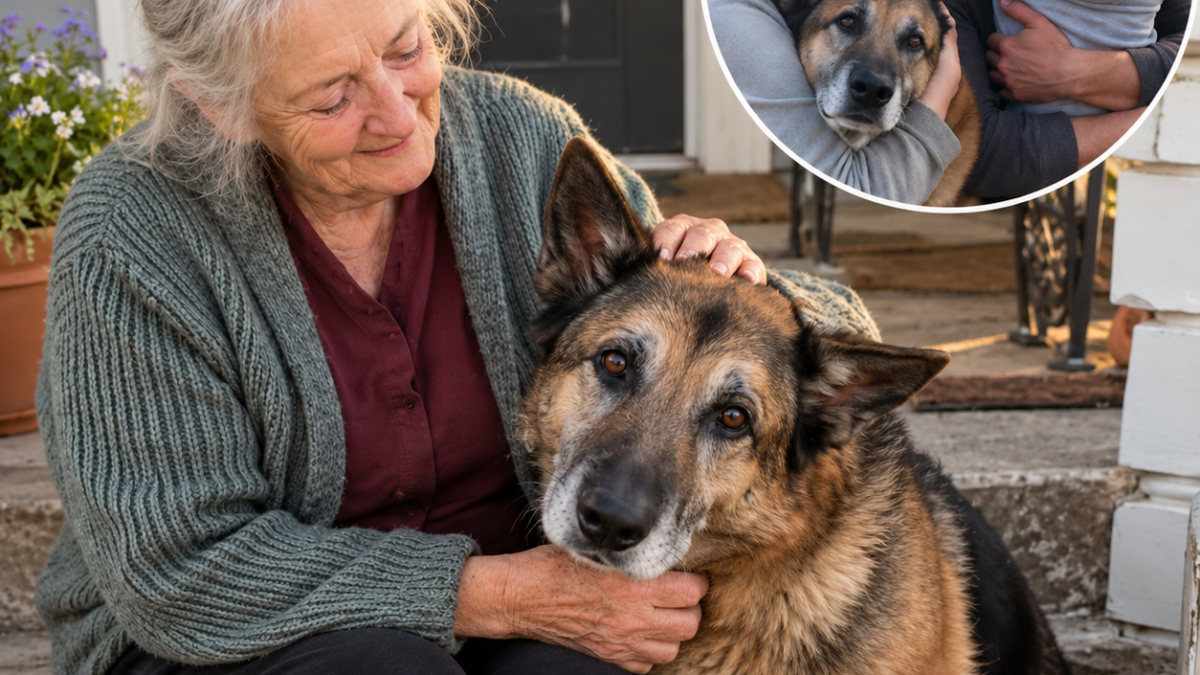
PART 2
“Bruno!”
My voice disappeared between the trees, but he did not turn back.
For the first time since I had brought him home, I saw what years of retirement had hidden beneath his slow morning walks and long naps beside my chair. His body might have been eleven years old, his joints might have stiffened after too many cold nights and too many miles beside rescue teams, but something inside him had awakened with absolute certainty.
He knew what he was doing.
The younger men moved ahead of me because the ground had become rough and I could no longer match their pace, but I kept going anyway, grabbing tree trunks when the slope became steep and stepping carefully across loose stones.
One of the men turned.
“Ma’am, you should slow down.”
“I am slowing down.”
“You could fall.”
“So could that boy.”
He didn’t argue again.
Ahead of us, Bruno stopped.
He lowered his nose close to the ground.
Moved several feet to the left.
Stopped again.
Then returned to the exact spot where he had been.
I watched him make a slow half-circle.
The behavior looked deliberate.
Not confusion.
Analysis.
“He lost the scent?” someone asked.
“I don’t think so.”
Bruno suddenly lifted his head and stared toward higher ground.
Then he moved.
Not straight uphill, but diagonally through a narrow break between trees.
The men followed.
I followed them.
My lungs burned.
My knees complained with every step.
At seventy-one, I was not designed for chasing a retired working dog through uneven forest.
But every time I considered stopping, I looked at Bruno.
He never hesitated for long.
When the scent weakened, he searched.
When he found it again, his body changed immediately.
He seemed to become younger whenever he knew the direction.
I thought about the shelter worker saying, “Mostly, he waits.”
Had Bruno spent months sitting behind that gate remembering this?
Had he watched visitors walk past him while some part of him still listened for the sounds that once meant a search was beginning?
I had adopted him because I thought he was finished with work.
Perhaps Bruno had never thought of himself that way.
Maybe he had simply understood that nobody was asking anymore.
We had gone nearly another fifteen minutes when Bruno stopped so suddenly that one of the men nearly ran into him.
His head rose.
His ears came forward.
He stared through the trees.
“What is it?” I whispered.
He moved again.
Faster now.
We pushed through a dense stretch of brush and emerged onto rocky ground where the forest opened enough for late-afternoon light to reach us.
Then I saw what lay ahead.
A ravine.
Not enormous, but steep enough that one bad step could become dangerous.
Bruno walked to the edge.
He stopped.
His body went perfectly still.
I approached more slowly.
“Bruno?”
He stared downward.
One of the younger men reached my side.
“Careful.”
I nodded.
We moved close enough to look.
At first I saw only rock and weeds.
Then Bruno barked.
Three times.
Short.
Controlled.
Nothing like the barking I had heard from neighborhood dogs chasing delivery trucks.
Three clear signals.
The young man beside me froze.
“There’s something down there.”
I followed his gaze.
Then I saw metal.
A bicycle.
It lay awkwardly between stones and tall grass, one wheel twisted toward us.
My heart stopped.
“Oh God.”
Another man shouted for the others.
Bruno barked again.
Then I saw the boy.
He was farther down the ravine, partially hidden by brush, his body unnaturally still.
For several seconds, nobody moved.
The entire search—the shouting, the forest, the exhaustion—collapsed into that one sight.
Then training seemed to return not only to Bruno but to everyone around him.
“Call emergency services.”
“I’ve got a signal.”
“Give them our location.”
“Don’t all go down at once.”
Bruno started toward the slope.
I caught his collar.
“No.”
He pulled once.
“Bruno, wait.”
His eyes stayed fixed on the child.
One of the men carefully began descending.
Another followed.
I moved down only far enough that I could maintain balance.
Bruno came with me.
His age showed now.
His hind legs were not as steady as they had looked while tracking.
I put one hand against his side.
“Easy.”
He ignored me.
Every part of his attention belonged to the boy.
When we reached a safer ledge, I crouched.
“Can you hear me?” one of the men called.
Nothing.
The boy remained still.
My stomach tightened.
Please.
Please don’t let us have come this far too late.
Then Bruno whined.
It was the first uncertain sound he had made all afternoon.
I touched his back.
“We found him.”
But Bruno did not relax.
Finding was only part of what he had once been trained to do.
A rescue was not complete until the person came home.
One young man reached the boy and knelt beside him.
“He’s breathing!”
The words moved through the ravine like electricity.
I closed my eyes.
Behind me, someone exhaled loudly.
The man below called again.
“He’s breathing! He’s unconscious, but he’s alive.”
I crouched beside Bruno.
“He’s alive.”
Bruno looked at me.
I don’t know how much he understood.
Dogs do not need human vocabulary to recognize changes in a group.
Our tension shifted.
Our voices changed.
People began moving with purpose instead of dread.
Bruno looked back toward the child.
He did not wag his tail.
Not yet.
Emergency responders were already on their way.
Our location was difficult to reach, and waiting seemed endless even though it probably was not.
One of the men stayed with the boy.
Another moved upward to guide rescuers toward us.
I remained beside Bruno.
Every few minutes, he tried moving closer.
“Stay.”
He looked at me.
“Yes, I know. You found him.”
That word felt inadequate.
Found.
As though Bruno had located a misplaced set of keys.
A child was alive at the bottom of a ravine because an eleven-year-old dog had smelled one small shoe and remembered a skill nobody had asked him to use in years.
When the rescue team finally arrived, everything became faster.
Ropes.
Medical bags.
Instructions.
People positioning themselves carefully along the slope.
A paramedic reached the boy and began examining him.
I couldn’t hear every word.
I heard enough.
Pulse.
Breathing.
Possible head injury.
Need to stabilize him.
I looked at Bruno.
He sat beside me.
His breathing was heavy.
Too heavy.
Suddenly I became aware that he had been working for more than an hour through forest terrain that had exhausted men half my age.
“Hey.”
He looked at me.
I touched his chest.
“You’re done.”
His gaze immediately returned to the child.
“Bruno.”
Nothing.
“Your part is done.”
The old dog refused to believe me.
So we waited.
When the rescue team finally lifted the boy from the ravine, Bruno stood.
The stretcher moved slowly upward.
He followed with his eyes.
When they passed near us, Bruno took two steps forward.
A paramedic glanced down.
“This the dog?”
One of the young men answered before I could.
“He found him.”
The paramedic looked at Bruno differently.
“Good boy.”
Bruno watched the stretcher.
I rested my hand on his back.
“It’s okay.”
He looked toward me.
“You did what you were supposed to do.”
His tail moved once.
Slowly.
Only once.
I saw it.
And I started crying.
Not loudly.
I simply stood there with one hand on his back while tears ran down my face.
One of the young men smiled.
“He knows.”
“Maybe.”
Bruno sat down.
His body suddenly looked old again.
The focus had vanished.
His shoulders lowered.
His breathing remained heavy.
In minutes, the working dog disappeared and my Bruno returned.
I knelt despite the pain in my knees.
“You’re exhausted.”
He leaned slightly against me.
“I told you retirement.”
His tail moved again.
“Apparently you don’t listen.”
The hike back felt twice as long.
The adrenaline was gone.
My legs hurt.
Bruno walked slowly.
The younger men offered to help me several times.
I accepted a hand over the steepest parts.
Eventually one of them offered to carry Bruno if needed.
I almost laughed.
“I’d like to watch you try.”
Bruno was still a large German Shepherd.
Old did not mean small.
But after another fifteen minutes, he began slowing more.
I stopped.
“Water.”
Someone handed me a bottle and a collapsible cup.
Bruno drank.
Then sat.
I knelt beside him.
“You scared me today.”
One of the men smiled.
“He probably saved that kid.”
I looked at Bruno.
“He did.”
There was no reason to pretend modesty.
We could have spent hours searching the wrong part of the forest.
Darkness was approaching.
Temperatures would fall.
The boy had been unconscious.
Time mattered.
Bruno had shortened the search.
Possibly by hours.
Maybe more.
When we finally emerged from the forest, the village looked completely different from the way we had left it.
People were waiting.
Word had already traveled faster than we had.
The ambulance was preparing to leave.
The boy’s mother stood beside it.
Her face was wet with tears.
The moment she saw us, she moved toward Bruno.
Not toward me.
Toward him.
She dropped to her knees.
Bruno stopped.
She put both hands gently against his face.
“Thank you.”
Her voice broke.
“Thank you.”
Bruno stared at her.
He had never met her properly.
To him, she was simply another human carrying the scent of the child he had just found.
She pressed her forehead against his head.
I had to look away.
A man standing nearby asked, “Is he trained?”
“He was.”
“What do you mean?”
“He’s retired.”
Someone else laughed softly.
“Apparently not.”
People gathered.
Everyone wanted the story.
Who thought of using the shoe?
How did Bruno know?
How far did he lead us?
Did he bark when he found the boy?
Had he ever done this before?
I answered what I could.
“He spent years in search and rescue.”
“How many people did he save?”
“I don’t know.”
“You don’t know?”
“No.”
That surprised them.
But when I adopted Bruno, I had not requested his résumé.
The shelter had told me enough.
Working dog.
Search and rescue.
Eleven years old.
Retired.
Waiting.
That had been sufficient.
Now suddenly everyone wanted to know the details of the life Bruno had lived before becoming mine.
I looked down at him.
He sat against my leg.
Exhausted.
No interest whatsoever in being celebrated.
One teenager crouched and tried petting him.
Bruno accepted it.
Another person called him a hero.
Someone else repeated the word.
Hero.
Hero.
Hero.
I did not object.
But it felt incomplete.
Bruno had not become a hero that afternoon.
The forest had not transformed him into something new.
That dog had existed all along.
The village simply had not known him.
Neither had I.
Not fully.
I had known the dog who slept near my chair.
The dog who waited while I watered flowers.
The dog who followed me into the kitchen even though he had just eaten.
The dog whose nails clicked against the hallway floor at night.
The dog who lifted his head when I laughed.
But another Bruno had been resting inside the same body.
A dog who understood scent as information.
A dog who could move through forest with purpose.
A dog who knew how to lead humans.
A dog who did not stop simply because nobody had formally put a working vest on him.
That evening, after the ambulance left and the crowd finally thinned, I walked home with Bruno.
Nobody let us go quietly.
People kept stopping us.
“Good boy.”
“You did amazing.”
“That dog deserves steak.”
I laughed at that.
“He definitely agrees.”
At our gate, Bruno paused.
He looked toward the road.
Then toward the forest in the distance.
For one second, I wondered whether he wanted to go back.
Instead he turned and walked through the gate.
Home.
I unlocked the door.
Bruno entered.
He did exactly what he did every evening.
He walked to his favorite corner.
Turned once.
Lowered himself onto his blanket.
That was it.
No heroic pose.
No waiting for applause.
I stood there staring.
“You just saved a child.”
His eyes opened.
“And now you’re going to sleep?”
He closed them.
I laughed.
“Fine.”
I brought him water.
He drank without standing.
Then I sat on the floor beside him.
My body hurt in places I had forgotten could hurt.
“I adopted you so you could rest.”
Bruno breathed deeply.
“That was the arrangement.”
His eyes remained closed.
“You were supposed to spend retirement stealing my rug and judging my cooking.”
One ear moved.
“Not running into ravines.”
His tail gave the smallest movement.
I smiled.
“You’re impossible.”
The house grew quiet.
But something about the silence had changed.
Before Bruno, silence had felt like absence.
After Bruno came home, it had become shared silence.
There is a difference.
The click of his nails in the hallway.
His breathing while he slept.
The shake of his collar when he stood.
The heavy sigh he made whenever I moved him from the exact spot where I needed to walk.
Small sounds.
They had filled spaces I had stopped noticing were empty.
That evening, while Bruno slept beside me, I thought about the shelter.
“Mostly, he waits.”
Those words had made me adopt him.
At the time, I had imagined Bruno waiting for someone to rescue him from loneliness.
Now I wondered whether I had misunderstood.
Perhaps he had simply been waiting for home.
Not another mission.
Not another handler.
Not another vest.
Home.
The fact that he had performed one more rescue did not mean he had been incomplete without work.
That mattered to me.
Working dogs are often praised for what they can do.
Their value becomes tied to performance.
Find.
Track.
Protect.
Detect.
Serve.
But Bruno’s life should not have needed one more rescue to justify giving him a couch.
He deserved home even if he never found another person.
He deserved warmth even if his nose never followed another scent.
He deserved love simply because he existed.
That evening, after the most extraordinary day of our life together, I wanted him to understand exactly one thing.
He was not valuable because he had saved the boy.
He was valuable because he was Bruno.
I put my hand against his side.
“You don’t have to do anything else.”
He slept.
“I mean it.”
His breathing remained steady.
“Nothing.”
I sat there until my back complained enough to force me into my chair.
The next morning, I woke earlier than usual.
For several seconds, I forgot what had happened.
Then I heard Bruno moving in the hallway.
The entire day returned.
Forest.
Ravine.
Bicycle.
Boy.
Ambulance.
Bruno appeared in the doorway.
He looked stiff.
I immediately stood.
“Are you hurting?”
He walked slowly toward me.
“Of course you are.”
I called the veterinarian.
By late morning, we were there.
I explained what Bruno had done.
The veterinarian stared at me.
“He did what?”
“Tracked a missing child through the forest.”
“At eleven?”
“Yes.”
“For how long?”
“More than an hour.”
The veterinarian looked at Bruno.
Bruno looked back.
“You realize you’re retired, right?”
I laughed.
“I’ve tried explaining.”
The examination showed no major injury.
Fatigue.
Some soreness.
Exactly what you would expect after an elderly dog suddenly decided retirement was optional.
“Rest,” the veterinarian said.
I pointed at Bruno.
“You hear that?”
Bruno looked toward the treat jar.
The veterinarian laughed.
“He heard the opening of that cabinet.”
Bruno received a treat.
Then another because apparently heroism had benefits.
When we returned home, I put his water bowl on the terrace.
“Today, we do nothing.”
He settled in the sun.
“No missing children.”
His eyes closed.
“No mountains.”
One ear moved.
“No forests.”
He sighed.
“Good.”
I sat beside him.
That afternoon, someone knocked.
I expected another neighbor.
Instead, the boy’s family stood outside.
The child was with them.
He had been treated and was recovering.
Seeing him upright made my knees feel weak all over again.
His mother hugged me.
Then she immediately looked for Bruno.
“He’s outside.”
The boy held something against his chest.
We walked to the terrace.
Bruno lifted his head.
The child stopped.
For a moment, neither moved.
Then Bruno stood.
Slowly.
He walked toward the boy.
The child knelt.
His mother looked nervous.
“Is it okay?”
“Yes.”
Bruno sniffed him.
Shoes.
Pants.
Hands.
Then he looked up.
The boy touched his head.
“Hi, Bruno.”
I watched my old dog accept the touch as though finding unconscious children in ravines was simply another way of meeting people.
The boy held out a sheet of paper.
“This is for him.”
I took it.
A drawing.
Bruno appeared enormous on the page.
Two tall ears.
Long body.
Huge tail.
Beside him stood a much smaller person.
I smiled.
“Is that you?”
The boy nodded.
“And what’s Bruno doing?”
He looked at the picture.
“He’s coming to get me.”
Nobody said anything for a moment.
His mother started crying.
The boy seemed confused by this reaction.
Children sometimes understand gratitude more simply than adults.
He did not need a speech.
Bruno had come to get him.
That was enough.
I framed the drawing.
It stayed in my bedroom where I could see it each morning.
For weeks afterward, Bruno became the most famous resident in the village.
People who had passed my gate for years without more than a wave suddenly stopped.
“Is Bruno outside?”
Sometimes I wanted to answer, “No, he has appointments with the mayor.”
Instead, I smiled and let them see him.
Children were especially fascinated.
“Did he really find him?”
“Yes.”
“How?”
“With his nose.”
“Can he find anything?”
“No.”
“Can he find my ball?”
“Probably, but he is retired.”
The children rarely accepted that answer.
Neither, apparently, had Bruno.
But I became protective of him.
People wanted demonstrations.
Could he follow a hidden person?
Could we show them how search dogs worked?
Would he track someone through the woods again?
My answer was always the same.
“No.”
Some were disappointed.
“But he still can.”
“I know.”
“Then why not?”
“Because he doesn’t have to.”
That was important.
Bruno had already given years of his life to work.
One spontaneous mission did not cancel retirement.
I was not going to turn him into village entertainment because people had discovered he possessed an extraordinary skill.
He deserved to be old.
He deserved sore mornings.
He deserved naps.
He deserved to sniff one bush for ten minutes without somebody timing him.
He deserved days when the only thing expected of him was waking up.
So our routine returned.
Breakfast.
Garden.
Walk.
Books.
Terrace.
Dinner.
Silence.
Beautiful silence.
But the village had changed toward Bruno.
People knew him now.
A woman from two streets over brought homemade dog biscuits.
A man repaired a loose section of my gate without accepting payment.
The local shopkeeper kept a bowl of water outside and called it “Bruno’s station.”
I rolled my eyes at that.
Bruno loved it.
Every walk became longer because somebody stopped us.
“There’s the hero.”
Bruno accepted affection with professional dignity.
Then looked at me as though asking whether any of these people had food.
“You’re becoming arrogant,” I told him.
His tail moved.
One afternoon, we passed the boy and his mother.
The boy saw Bruno and ran toward us.
Bruno recognized him immediately.
His tail wagged harder than usual.
That surprised me.
Maybe scent memory.
Maybe association.
Maybe simple affection.
The boy wrapped his arms around Bruno’s neck.
I watched carefully.
Bruno stood still.
Then leaned gently against him.
His mother smiled.
“He asks about Bruno constantly.”
“I’m afraid Bruno has developed the same problem.”
The boy looked up.
“Can he come to my house?”
“Maybe someday.”
“Can he sleep over?”
I laughed.
“No.”
“Why?”
“Because he snores.”
Bruno looked offended.
The boy laughed.
That became their friendship.
Nothing dramatic.
Sometimes the boy walked with us.
Sometimes he brought Bruno a biscuit.
Sometimes he sat on my terrace and told stories while Bruno slept nearby.
The rescued child and the retired rescue dog.
I tried not to turn it into symbolism.
Life does enough of that without help.
Months passed.
Bruno slowed further.
At first the changes were tiny.
He took longer standing after naps.
He stopped jumping into the car without assistance.
Our walks became shorter.
The hill near my house became optional.
I adjusted.
That is what love does with aging.
You stop asking the body to be what it was.
I bought a ramp for the car.
Placed another rug on the slippery hallway floor.
Moved his water closer to his favorite sleeping place.
Our world became smaller again.
But unlike the silence before Bruno, smaller did not mean empty.
He occupied everything.
If he slept in one room, I knew exactly where.
If I cooked, I stepped around him.
If I read, I rested one foot against his side.
We had developed the kind of companionship in which very little needed saying.
One cold morning, I found him standing near the front door.
“Walk?”
His tail moved.
I put on my coat.
We went slowly.
At the edge of the village, Bruno stopped.
He looked toward the forest.
I stopped beside him.
For a long time, he simply stared.
I wondered what he remembered.
Searches before me.
Mountains.
Missing hikers.
Handlers whose names I did not know.
Rain.
Snow.
Commands.
Praise.
Long drives home after successful missions.
Perhaps failed searches too.
Working dogs carry histories humans can only guess at.
Then Bruno looked toward me.
“Don’t even think about it.”
His tail moved.
“We’re walking around the block.”
He turned away from the forest.
I smiled.
“Good decision.”
We went home.
The anniversary of the boy’s rescue arrived without anyone officially planning it.
His family remembered.
So did half the village.
That afternoon, the boy came carrying another drawing.
This one showed Bruno sleeping beside a house.
I laughed.
“What happened to the rescuer?”
The boy shrugged.
“He’s tired.”
“Finally someone understands.”
He handed me the picture.
Bruno lay nearby.
The boy sat beside him.
“Does he miss working?”
I looked at Bruno.
“I don’t know.”
“Why not?”
“Because he can’t tell me.”
The boy thought about that.
“Maybe he likes this better.”
“This?”
“Being home.”
I smiled.
“Maybe.”
The boy scratched Bruno behind one ear.
“I would.”
Children occasionally say the thing adults spend years trying to understand.
Being useful is not the same as belonging.
Bruno had spent most of his life being useful.
With me, he belonged.
That became more important as he aged.
There were no performance standards in my house.
No mission he could fail.
No scent he had to follow.
If he could walk, we walked.
If he was tired, we stayed.
If he slept until late morning, I drank coffee quietly.
One evening I sat beside him while rain hit the windows.
The house was warm.
Bruno slept deeply.
I remembered my life before him.
The chair opposite mine had always been empty.
I used to leave the radio playing because silence made the rooms feel larger.
Now I rarely needed it.
Bruno breathed.
Sometimes snored.
Sometimes kicked one paw while dreaming.
Those sounds were enough.
I realized that when I entered the shelter, I had believed I was adopting a dog to solve loneliness.
That was selfish in the harmless way many human decisions begin.
I wanted company.
A warm body in the house.
Someone waiting when I returned from the market.
What I had not expected was responsibility.
Not burden.
Responsibility.
Bruno’s life became tied to mine.
His medication.
His food.
His appointments.
His comfort.
His aging.
Loneliness had made me focus on what I lacked.
Bruno made me focus on what another living being needed.
That difference gave my days shape again.
Morning mattered because Bruno needed breakfast.
Walks happened because Bruno waited beside the door.
Appointments existed.
Routines mattered.
Someone depended on me.
Maybe that was what I had lost without realizing it.
Purpose can disappear quietly.
Not because life becomes meaningless, but because nobody needs you at a specific time.
Bruno needed me.
Then, on that day in the forest, he reminded me that being needed goes both directions.
I had believed I was protecting him from the emptiness of a shelter.
He had protected my neighbor’s child.
And, in another way, he had protected me too.
Not from a ravine.
From shrinking too far inside my own quiet life.
After Bruno arrived, I knew more neighbors.
The boy’s family visited.
Children waved during walks.
People stopped at my gate.
I went outside more.
I laughed more.
My house still contained silence.
But it no longer contained isolation.
Bruno had opened the world again simply by walking beside me.
The boy grew.
He returned to the forest eventually, but always with adults at first.
His mother struggled with that.
Understandably.
Fear after a child disappears does not vanish when he comes home.
One afternoon she sat with me while the boy played in the yard.
“I still wake up thinking he’s missing.”
I nodded.
“I imagine that takes time.”
“I check his room sometimes.”
“That sounds like being a mother.”
She smiled weakly.
Then looked at Bruno.
“He really saved him.”
“Yes.”
“I don’t know how to repay that.”
“You don’t.”
She looked at me.
“What?”
“Bruno doesn’t keep accounts.”
She laughed.
“He definitely keeps accounts of treats.”
“That’s different.”
We watched him.
He was asleep.
She became serious.
“I mean it. If you ever need anything for him…”
“I know.”
“Vet bills. Medication. Anything.”
I hesitated.
Pride has always been a complicated thing for me.
At seventy-one, accepting help can feel too close to admitting decline.
But the offer was not about me.
It was about Bruno.
“Thank you.”
She reached over and squeezed my hand.
That conversation changed something.
When Bruno later needed more medication for arthritis, the family quietly helped.
I protested.
They ignored me.
The boy brought a bag with the prescription and a handwritten note.
“FOR BRUNO.”
I laughed.
No argument possible.
Bruno’s final years became communal in a way neither of us expected.
He belonged to me.
But the village loved him.
People checked if they had not seen us walking.
The shopkeeper asked about his joints.
The boy visited after school.
Nobody demanded another rescue.
They had finally learned my rule.
Heroism did not create an obligation to keep performing.
Bruno had earned rest.
Then came the winter that frightened me.
He developed a respiratory infection.
At first it seemed mild.
Then one evening his breathing sounded different.
I called the veterinarian.
“Bring him in.”
The old fear returned immediately.
Not the forest.
Not the child.
A different fear.
The fear of loving an old dog.
Every good day carries an awareness that there may not be infinitely many more.
At the clinic, Bruno lay against my legs while the veterinarian examined him.
The boy’s mother drove us because I did not trust myself behind the wheel.
The vet ordered tests.
We waited.
I kept one hand on Bruno.
“Not another mission,” I whispered.
His eyes lifted.
“This one is just you staying.”
Treatment worked.
Slowly.
For several nights, I slept on the couch because Bruno could no longer climb the stairs comfortably.
He slept beside me.
At three in the morning, I woke and listened to his breathing.
I thought about the boy in the ravine.
How everyone had watched for one small movement.
Now I was doing the same.
Bruno opened one eye.
“Sorry.”
He closed it.
“You can sleep.”
I rested my hand near him.
“Both of us.”
He recovered.
Not completely to the strength he had before.
Old bodies often charge a price for illness.
But enough.
Spring returned.
Bruno returned to the terrace.
The boy, older now, came over one afternoon.
He sat beside him.
“Remember me?”
I laughed.
“Of course he remembers you.”
“How do you know?”
“Because his tail is moving.”
The boy looked down.
It was.
Slowly.
“He’s getting really old.”
“Yes.”
The boy became quiet.
“Is he going to die?”
Children ask questions adults spend entire lives avoiding.
“Yes,” I said.
“When?”
“I don’t know.”
“Soon?”
“Maybe not. Maybe. Nobody knows exactly.”
He looked upset.
I put my hand on his shoulder.
“That’s why we love him today.”
The boy nodded.
Then lay beside Bruno in the grass.
Bruno’s paw rested against his arm.
I went inside before either saw me cry.
That evening, I looked at the first drawing again.
Bruno coming to get him.
Then the second.
Bruno asleep beside the house.
Two pictures.
They contained his entire life with us.
Work.
Home.
Rescue.
Rest.
I framed them together.
Bruno slept beneath them without knowing he had become a piece of another family’s history.
Time continued.
It always does.
His walks shortened to the end of the street.
Then sometimes only the garden.
He slept more.
His hearing diminished.
I learned to touch him gently before approaching from behind so he would not startle.
His eyes clouded slightly.
But his nose remained extraordinary.
I tested it accidentally one afternoon when I dropped a piece of chicken under the table.
Bruno was asleep in another room.
Thirty seconds later, he appeared.
I laughed.
“Still got it.”
His tail moved.
“Selective retirement.”
Food searches remained authorized.
One autumn evening, he stood in the doorway and stared outside.
Leaves moved across the yard.
I opened the door.
He walked slowly to the gate.
I followed.
Then he turned toward the forest road.
My heart tightened.
We had not gone that direction in months.
“Bruno?”
He continued.
Slowly.
I let him.
We walked farther than usual.
Not to the forest itself.
Only to the place where the road curved and the tree line became visible.
Bruno stopped.
His nose lifted.
Wind moved toward us from the woods.
He breathed deeply.
I stood beside him.
“No work.”
He looked at me.
“Just remembering.”
We stayed there.
Perhaps five minutes.
Then Bruno turned toward home.
I followed.
That walk felt like a goodbye to something.
Not to life.
To work.
To the identity he had carried before me.
He did not look back again.
Months later, Bruno stopped eating breakfast.
That was unusual enough for immediate attention.
The veterinarian examined him.
Bloodwork.
Imaging.
Quiet conversations.
Age had finally started gathering debts medicine could not fully repay.
There were treatment options.
There were also questions about comfort.
I listened.
Asked everything.
Went home.
Bruno lay on his blanket.
The decision every old-dog owner dreads began taking shape around us.
Not that day.
But someday close enough that I could finally see it.
I hated the universe for making love temporary.
Then I hated myself for being angry.
Bruno had been eleven when I adopted him.
I knew.
Of course I knew.
I had entered this relationship already standing near the final chapters.
That did not make them easier.
The boy—no longer quite so little—visited.
He sat beside Bruno.
“Is he sick?”
“Yes.”
“Can they fix it?”
“Some things. Not everything.”
He looked at Bruno.
Then at me.
“Does he hurt?”
“We’re making sure he doesn’t.”
That answer mattered most.
Bruno had spent his working life finding people in danger.
I would not let his final days become an endurance test simply because I could not bear losing him.
So we watched.
Comfort.
Appetite.
Movement.
Interest.
Sleep.
Good days.
Bad days.
The veterinarian helped me understand what to look for.
For a while, Bruno stabilized.
Those weeks became precious.
We did nothing extraordinary.
That was the point.
Sun on the terrace.
Chicken mixed into dinner.
Short walks.
The boy sitting nearby.
My hand resting on Bruno while I read.
Every ordinary moment became sacred because I knew it was finite.
One afternoon, the boy’s mother brought the entire family.
They sat outside with us.
Nobody said why.
Bruno knew them all.
He accepted attention.
The boy lay his head near Bruno’s shoulder.
His mother looked at me.
Tears stood in her eyes.
“I wish dogs lived longer.”
“So do I.”
The boy said, “Bruno already did more than most dogs.”
I smiled.
“He did more than most people.”
Everyone laughed.
Bruno opened one eye.
The sound probably annoyed him.
That evening, after they left, I sat beside him.
“Apparently you’re legendary.”
No response.
“I think it’s gone to your head.”
His tail moved once.
“There he is.”
The final decline came gently, which was the only kindness I could ask from it.
Bruno became weaker over several days.
He still drank.
Still responded to my touch.
But standing became difficult.
The veterinarian came to the house.
I had asked for that.
Bruno had spent enough time in institutions during his life.
If the final decision had to be made, I wanted him where he knew every smell.
His blanket.
His water bowl.
My chair.
The terrace beyond the door.
Home.
The veterinarian examined him.
Then sat beside me.
“We can continue supportive care a little longer.”
I looked at Bruno.
“And?”
“He’s tired.”
I already knew.
My throat closed.
“How do I know when?”
The veterinarian answered gently.
“You know him.”
I did.
That was the worst part.
I knew him well enough to recognize the difference between an old dog resting and an old dog asking his body for something it could no longer give.
That night, I lay on the floor beside Bruno.
The same house that had once been too silent now felt impossibly full of memories.
I touched his head.
“I’m not ready.”
Bruno breathed.
“I know that’s not your problem.”
His eyes opened.
He looked at me.
“You found everybody else.”
My voice broke.
“Then you found me.”
I cried quietly.
“I don’t know how to do the house without you.”
Bruno moved his head closer to my hand.
That was all.
No miracle.
No sign.
Just an old dog choosing contact.
It was enough.
The next morning, sunlight entered through the window.
Bruno did not want breakfast.
He did not stand when I opened the door.
I knew.
I called the veterinarian.
Then I called the boy’s family.
They came quickly.
The boy sat on the floor.
He was older now, but in that moment I saw the child from the drawing.
He pressed his face against Bruno’s neck.
“Thank you.”
Those same words his mother had spoken years earlier.
Bruno’s tail moved.
Barely.
But it moved.
The boy cried.
“I think he knows.”
I sat on the other side.
“He knows you’re here.”
The veterinarian arrived later.
We gave Bruno time.
No rushing.
No clinical room.
The boy’s family eventually stepped outside so Bruno and I could have quiet.
I held his head on my lap.
Exactly where it belonged.
The veterinarian explained everything.
I nodded.
My hand remained on Bruno.
“You can stop working now,” I whispered.
His breathing was calm.
“You hear me?”
I bent closer.
“You don’t have to find anyone.”
Tears fell onto his fur.
“You don’t have to watch the door.”
I kissed his head.
“You don’t have to take care of me.”
My voice broke completely.
“Rest, Bruno.”
He did.
Peacefully.
At home.
With my hand on him.
For a long time afterward, I remained on the floor.
The veterinarian gave me space.
The house was completely silent.
The kind of silence I had once known before Bruno.
But it was not the same.
This silence contained him.
His water bowl.
The blanket.
A few hairs near the baseboard.
The worn place where he had slept.
The leash hanging beside the door.
Absence can be louder than noise.
I learned that that day.
The boy’s family returned after the veterinarian left.
His mother held me.
I did not pretend to be strong.
The boy went straight to Bruno’s blanket.
He sat beside it.
Then he reached into his backpack.
“I made something.”
Another drawing.
Bruno stood beneath a large tree.
No leash.
No rescue vest.
No people waiting to be found.
Just Bruno.
The boy had drawn sunlight above him.
I swallowed.
“What’s he doing?”
The boy answered, “Resting.”
I could not speak.
I placed the picture beside the other two.
Coming to get me.
Sleeping at home.
Resting.
Three chapters.
That night, the house felt unbearable.
I turned on the radio.
Turned it off.
Walked into the kitchen expecting Bruno to appear.
Nothing.
I opened the back door.
No nails across the floor.
No old dog standing behind me.
For years before Bruno, I had believed I understood loneliness.
I had been wrong.
Loneliness after love is different.
Before, there had simply been empty space.
Now the space had a shape.
Bruno’s shape.
For weeks, I avoided the forest road.
Then one morning, I took his leash from the hook.
I don’t know why.
I put it in my coat pocket and walked.
Alone.
Past the village.
Toward the tree line.
The boy joined me partway.
He didn’t ask permission.
He simply walked beside me.
We reached the road curve where Bruno had once stopped to smell air from the forest.
I stood there.
The boy said, “This is where he went?”
“Farther.”
We continued.
Not to the ravine.
I did not need to see it.
Instead we stopped at a small clearing.
Sun came through the trees.
The boy looked at me.
“I still remember his barking.”
“So do I.”
“I was asleep.”
“You were unconscious.”
“I remember hearing something.”
I looked at him.
“What?”
“I don’t know if it was really Bruno.”
He shrugged.
“Maybe I dreamed it.”
“Maybe.”
He looked toward the trees.
“I’m glad he found me.”
“So am I.”
Then he said something I have never forgotten.
“I’m glad you found him first.”
I stopped.
The shelter.
Bruno behind the gate.
“Mostly, he waits.”
My hand on his head.
His body leaning toward me.
I had spent years telling the story as though Bruno found the boy.
But before that, I had found Bruno.
Or maybe Bruno had found me.
The sequence mattered less than I once thought.
Lives cross.
Doors open.
Someone says yes.
Everything changes.
We walked home.
The boy carried Bruno’s leash for part of the way.
At my gate, he handed it back.
“You should keep it.”
“I will.”
And I did.
It stayed beside the door for years.
Not because I expected Bruno to return.
Because grief sometimes needs physical objects.
A leash.
A drawing.
A water bowl.
Evidence that love existed in a form you could once touch.
The village remembered Bruno.
Someone wanted to put up a plaque.
At first I refused.
Bruno would have hated the fuss.
Then the boy suggested something simpler.
A bench near the beginning of the forest trail.
No grand monument.
Just a place for people to sit.
The village agreed.
A small plaque was attached.
It said:
**BRUNO — SEARCH AND RESCUE DOG. GOOD BOY. HOME AT LAST.**
I cried the first time I saw it.
The wording had been the boy’s idea.
Home at last.
That was what mattered.
People sometimes assumed the bench honored the day Bruno found the missing child.
It did.
But for me, the final line honored something else.
Bruno had spent years searching for people.
Then retirement placed him in a shelter.
He waited.
And eventually, an old woman who did not know what she was looking for walked through the door.
I thought I gave him a home.
But home became mutual.
My life after Bruno remained quieter.
I was still seventy-something.
Still loved books.
Still cared for plants.
Still sat near the window.
But I never became quite as isolated as I had been before him.
The boy’s family remained close.
Neighbors visited.
People knew my name because they had once known my dog’s.
Bruno’s final mission had connected more than one missing child with home.
It had connected me with the people around me.
That was the part nobody saw when they called him a hero.
A hero story usually ends at the rescue.
Mine continued afterward.
With casseroles brought to my door.
With the boy visiting after school.
With someone checking my gate after a storm.
With neighbors inviting me to holidays.
Bruno’s search had drawn a path through the forest.
Then somehow that path continued through the village and into my life.
Years later, the boy became a teenager.
One afternoon he visited the bench with me.
He was taller than I was now.
I teased him about it.
He sat.
“You know what I want to do?”
“What?”
“Volunteer with search and rescue.”
I looked at him.
“Because of Bruno?”
He nodded.
“Partly.”
I smiled.
“He’d expect treats as payment.”
The boy laughed.
Then became serious.
“I want to help find people.”
I looked toward the forest.
Some legacies are not monuments.
They are directions.
Bruno had followed one scent through those trees.
Years later, a child he saved was choosing a path because of him.
That felt almost too perfect to be real.
But life occasionally gives you symmetry.
Not often.
Enough.
When people ask me why I adopted an eleven-year-old dog, I tell them the truth.
I was lonely.
I wanted another living creature in the house.
I did not adopt Bruno because I was noble.
I did not know he would save anyone.
I did not know his history would matter to the village.
I simply saw an old dog waiting while younger dogs demanded attention.
Something in me recognized something in him.
Two lives that had grown quiet.
That was all.
The extraordinary part came later.
And even now, I don’t think Bruno’s greatest achievement was finding the child.
It was extraordinary.
It may have saved a life.
But Bruno had already spent years doing extraordinary things.
His greatest final achievement may have been learning not to work.
Learning that he could sleep through the afternoon.
Learning that a woman touching his head did not need anything from him.
Learning that he could simply exist beside me.
There is dignity in usefulness.
There is also dignity in rest.
Working animals deserve both.
That is why the ending I carry is not Bruno standing at the ravine.
It is Bruno on the terrace the next morning.
Sun warming his old back.
Water beside him.
Head against my feet.
Asleep.
No mission.
No missing person.
No command.
No responsibility.
Just home.
The child lived.
Bruno returned.
And life became quiet again.
But never empty.
Sometimes I still look at the first drawing.
The boy beside the giant German Shepherd.
“He’s coming to get me.”
Then I look at the second.
Bruno sleeping beside the house.
Then the last.
Bruno beneath the tree.
Resting.
I have thought many times about what title I would give those three pictures together.
For years, Bruno searched for missing people.
Then an old woman found him waiting in a shelter.
Then he found one final child.
And finally, after a lifetime of helping everyone else get home, Bruno got to stay home himself.
That is the story.
Not of an old dog who came out of retirement for glory.
Not of a miracle animal who never aged.
Not of heroism defeating death.
Bruno aged.
Bruno became tired.
Bruno died.
But before that, he lived somewhere he was loved for reasons completely unrelated to what his nose could do.
That matters more to me than anything.
On the last evening before his leash was finally placed in a box with the drawings, I sat beside the window where I used to spend those long silent nights.
The chair beside me was empty.
Outside, the village lights came on one by one.
Somewhere a child laughed.
A car door closed.
Someone called a dog inside.
The world continued.
I put my hand on the empty space beside the chair.
“Thank you, Bruno.”
The words sounded strange in the room.
Then I smiled.
Because I realized they were the same words everyone had said to him after the rescue.
The boy’s mother.
The neighbors.
The searchers.
The child.
Thank you.
But mine meant something different.
Thank you for finding him.
Yes.
But also:
Thank you for following me from room to room.
Thank you for making me walk when I would have stayed inside.
Thank you for filling this house with the sound of paws.
Thank you for making neighbors knock.
Thank you for giving a lonely woman somebody to come home to.
Thank you for letting yourself become old beside me.
Thank you for trusting that you were allowed to stop.
People still tell the story of Bruno’s last mission.
They talk about the shoe.
The scent.
The forest.
The ravine.
The three barks.
The bicycle between the rocks.
The unconscious child.
The ambulance.
All true.
I tell those parts too.
But when they finish and say, “What an incredible rescue dog,” I always add the sentence that matters most.
“Yes.”
Then I say:
“But after that, he came home.”
Because that was the reward.
Not applause.
Home.
The boy came home to his mother.
Bruno came home to me.
For one extraordinary afternoon, an old search dog did what he had been trained to do his entire life.
Then he returned through my door, walked to his blanket and lay down.
And finally, for the remaining years he had, nobody asked him to prove anything again.
I had entered the shelter because my house was too silent.
I thought I was choosing a dog who needed somewhere peaceful to spend his retirement.
I know better now.
Bruno was not waiting for another mission.
He was waiting for somebody who would still want him after the missions ended.
And perhaps I had been waiting too.
Not for a hero.
Not for a rescue.
Just for another heartbeat in the room.
Somehow, we found each other.
Then, when a child needed him one final time, Bruno followed the scent into the forest, found the boy everyone was searching for, and came back to the only place he had ever chosen for himself.
Home.
That was where his last mission truly ended.
For a long time after that day, people in the village kept calling what happened in the forest Bruno’s final mission, but I slowly came to understand that they were only partly right, because finding that little boy was the last time Bruno ever worked as a search-and-rescue dog, yet it was not the final thing he came into my life to do.
His real last mission was quieter.
It happened one ordinary day at a time.
He taught an old woman how to stop measuring her life by everything that had already ended.
Before Bruno came home with me, I had become very good at living without expecting much from tomorrow. I was seventy-one, my working years were behind me, old friendships had scattered, some people I loved were gone, and my days had slowly narrowed into routines that felt safe because they never surprised me.
Then Bruno arrived.
Suddenly I had to wake because someone wanted breakfast.
I had to walk even when the morning was cold because somebody was standing beside the door waiting.
I had to come home on time because somebody knew the sound of my footsteps.
I had to laugh when he stole my spot beside the window, complain when his hair appeared on every piece of clothing I owned, and move his enormous body when he decided the center of the hallway was the perfect place to sleep.
The house was still quiet.
But silence and loneliness were no longer the same thing.
For several years after the rescue in the forest, Bruno lived exactly the life I had promised him at the shelter.
He rested.
He slept in patches of sunlight.
He learned which neighbors carried treats.
He took slow walks through the village.
He spent summer evenings on the porch while I read beside him.
And sometimes the boy he had rescued came to visit.
At first, the child always came with his mother.
Then he became old enough to walk over by himself.
He would sit on the porch steps and talk to Bruno about school, friends, bicycles, things that had happened during the week, and Bruno would lie beside him with his eyes half closed as though every word were important.
One afternoon, the boy asked me something I had never considered.
“Do you think Bruno remembers finding me?”
I looked down at the old shepherd.
Bruno was sleeping with his nose between his paws.
“I don’t know,” I answered.
The boy thought for a moment.
“I remember him.”
That was enough.
He reached down and scratched Bruno behind the ears.
Bruno’s tail tapped once against the porch.
The boy smiled.
“He remembers.”
Maybe he did.
Maybe dogs remember differently.
Perhaps Bruno did not remember the bicycle between the rocks or the ravine or the people calling through the trees.
Perhaps he remembered only a scent.
Or the feeling of having a purpose.
Or the relief in the humans around him when the child was finally lifted to safety.
I never needed to know.
The boy was alive.
Bruno was home.
That was enough.
Time, however, is patient.
It takes what it takes slowly enough that sometimes you do not notice until something ordinary becomes difficult.
Bruno’s walks became shorter.
The steps near the back door became harder.
I bought rugs for the hallway because his paws sometimes slipped on the floor.
I started helping him into the car.
Some mornings he stood beside his bed for several seconds before his legs seemed to remember what they were supposed to do.
But his eyes remained the same.
Whenever I spoke his name, he looked at me.
Whenever the boy visited, his tail moved.
Whenever food appeared, retirement seemed temporarily suspended.
“You’re getting old,” I told him one morning.
Bruno looked toward the piece of chicken in my hand.
“I’m serious.”
He continued staring at the chicken.
“You have no respect for emotional conversations.”
I gave him the chicken.
His tail moved.
“That’s bribery.”
He swallowed and waited for more.
I laughed.
I wanted those mornings to last forever.
Of course they couldn’t.
Nobody gets that promise.
One winter, Bruno became sick.
At first it was only tiredness.
Then he stopped finishing meals.
The veterinarian ran tests, adjusted medication, explained what age was beginning to do to a body that had already worked harder than most dogs ever would.
There were better days afterward.
Enough that I convinced myself we might have another year.
Maybe two.
Humans become excellent negotiators when we are afraid to lose someone.
Just one more spring.
One more summer.
One more Christmas.
One more morning with those paws crossing the kitchen floor.
But eventually Bruno stopped negotiating.
His body simply became tired.
The boy was older by then.
Almost a teenager.
When he heard Bruno was declining, he came immediately.
He entered my house more quietly than usual.
Bruno was lying on his blanket beside my chair.
The boy knelt.
“Hey, Bruno.”
One eye opened.
Then the other.
The tail moved.
Barely.
But it moved.
The boy pressed his face into Bruno’s neck.
For several minutes, nobody spoke.
Then he whispered the same words his mother had said years earlier beside the ambulance.
“Thank you.”
I turned toward the window because I could no longer see clearly.
That evening the veterinarian came to my house.
I had decided Bruno would not spend his final moments beneath bright clinic lights if I could prevent it.
He had slept in tents, rescue vehicles, kennels, forests, mountains and eventually a shelter.
He deserved to leave this world in the one place that had asked nothing from him.
Home.
The veterinarian examined him gently and then looked at me.
I already knew.
Still, I needed someone else to say it.
“He’s tired.”
I nodded.
Bruno’s head rested across my lap.
For a moment, I was suddenly back at the shelter.
Eleven years old.
Sitting quietly while younger dogs barked for attention.
“Mostly, he waits.”
That was what the shelter worker had told me.
I ran my hand slowly over his head.
“You waited long enough, didn’t you?”
His eyes opened.
I bent close.
“You found hikers.”
My voice shook.
“You found people lost in mountains and forests.”
I swallowed.
“You found that little boy.”
Tears dropped onto his fur.
“And somehow you found me too.”
Bruno breathed slowly.
I rested my forehead against his.
“You don’t have to search anymore.”
His body relaxed beneath my hands.
“No more missions.”
I kissed him between the ears.
“No more work.”
My voice broke.
“You’re home, Bruno.”
Those were the last words I wanted him to hear.
He died peacefully with his head in my lap.
For a long time afterward, I did not move.
The veterinarian quietly stepped away.
The room became completely silent.
I had once believed silence was simply the absence of sound.
That night I learned that silence could contain an entire life.
Bruno’s bowl remained beside the kitchen.
His leash hung near the door.
There was hair on the rug.
A dent remained in the blanket where his body had rested.
Everything was still there except the one thing that had made those objects matter.
I cried harder than I expected.
Perhaps harder than I had cried for people.
Grief does not care whether the person you loved had two legs or four.
It only recognizes absence.
The next morning, I woke automatically at the time I used to feed him.
For several seconds I forgot.
I put my feet on the floor.
Looked toward the doorway.
Waited for the familiar sound of nails against wood.
Nothing came.
That was when I understood the true price of allowing another living being to fill an empty house.
One day the house becomes empty again.
But I would still choose Bruno.
Every time.
Because an empty house after love is painful.
An empty house that never knew love is worse.
A few days later, the boy came carrying another drawing.
He had drawn Bruno beneath a large tree.
No search vest.
No leash.
No forest trail.
No missing child.
Bruno was simply lying in the shade.
I touched the page.
“What’s he doing?”
The boy answered quietly.
“Resting.”
That drawing joined the others.
The first showed Bruno coming to find him.
The second showed Bruno sleeping beside my house.
The third showed him resting beneath the tree.
Years of his life contained on three pieces of paper.
Search.
Home.
Rest.
The village wanted to remember Bruno.
Someone suggested a large memorial.
I said no.
Bruno had never cared about attention.
Eventually, we agreed on something simpler.
A wooden bench was placed near the trail leading toward the forest.
A small plaque was attached.
It read:
BRUNO — SEARCH AND RESCUE DOG.
GOOD BOY.
HOME AT LAST.
The first time I saw those words, I had to sit down.
The boy sat beside me.
For a long time we listened to wind moving through the trees.
Then he said, “I want to do what Bruno did.”
I turned.
“What do you mean?”
“When I’m old enough, I want to help search for people.”
My chest tightened.
“Because of him?”
He nodded.
“He found me. Maybe someday I can help find somebody else.”
I looked toward the forest.
That was the moment I realized Bruno’s final mission had never really ended at the ravine.
Something had continued.
A dog followed a scent.
A child survived.
That child grew up remembering who came through the forest for him.
And somewhere inside that memory, a direction had been planted.
Years later, the boy kept his promise.
He began volunteering with a local search organization when he was old enough.
The first time he came to show me his training equipment, he stood in my doorway looking taller than I could believe.
“You’re serious about this.”
He smiled.
“I told you.”
Then he reached into his bag.
He pulled out an old photograph.
Bruno.
The boy carried it with him during training.
I could not speak for several seconds.
“He goes with you?”
“Every time.”
I laughed through tears.
“Then you’d better bring enough treats.”
The boy smiled.
“Always.”
After he left, I sat beside the window.
The same window where I had once spent evenings watching other people return to houses filled with life.
My house was quiet again.
But I was no longer the woman who had walked into that shelter.
Bruno had changed too much.
The boy’s family still visited.
Neighbors still checked on me.
People stopped at the gate.
Somebody always remembered Bruno.
Through one old dog, my small life had somehow stretched outward.
That was his greatest rescue.
People think Bruno’s story is about the afternoon he found a missing child.
It is.
But it is also about an eleven-year-old dog sitting quietly in a shelter while people walked past.
It is about an old woman who thought she was choosing an animal because she could no longer tolerate the silence.
It is about two creatures whose useful years, according to the world, might have seemed largely behind them.
And then they found each other.
Bruno proved that an old dog could still save a life.
But he also taught me something more important.
A life does not need one final heroic act to remain valuable.
Bruno deserved my home even if he had never followed another scent.
He deserved the porch.
The blanket.
The chicken from my dinner plate.
The slow walks.
The afternoon naps.
The simple privilege of growing old without being expected to earn his place.
Finding the child was extraordinary.
Coming home afterward was the real reward.
Sometimes I still walk to Bruno’s bench.
I sit there and listen.
Occasionally search teams train farther along the trail.
Young dogs bark.
People call instructions.
Boots move through the forest.
And sometimes I imagine an old German Shepherd somewhere beyond the trees, ears raised, ready to work.
Then I smile and correct myself.
No.
Not working.
Bruno finished that.
In my mind, he is lying beneath the tree from the boy’s drawing.
No one missing.
No one calling.
Nothing left to find.
And if someone asks me now why I chose an eleven-year-old dog that day at the shelter, I tell them I didn’t understand what I was choosing.
I thought I was giving an old rescue dog a peaceful place to spend his final years.
I thought I was saving him from waiting.
But Bruno had spent his entire life finding people who needed to be brought home.
In the end, he found a little boy in a ravine.
He found a lonely woman behind a quiet front door.
And after a lifetime of leading everyone else back to safety, he finally found the one thing he had been searching for without even knowing it.
A place where nobody needed him to be a hero.
A place where he could grow old.
A place where he could close his eyes without listening for the next call.
A place where he was loved simply because he was there.
Home.
That was Bruno’s final mission.
And this time, he found it for himself.








