PART 2: I ABANDONED MY 12-YEAR-OLD GOLDEN RETRIEVER FOR A PUPPY—TEN DAYS LATER, I RACED BACK BEFORE IT WAS TOO LATE
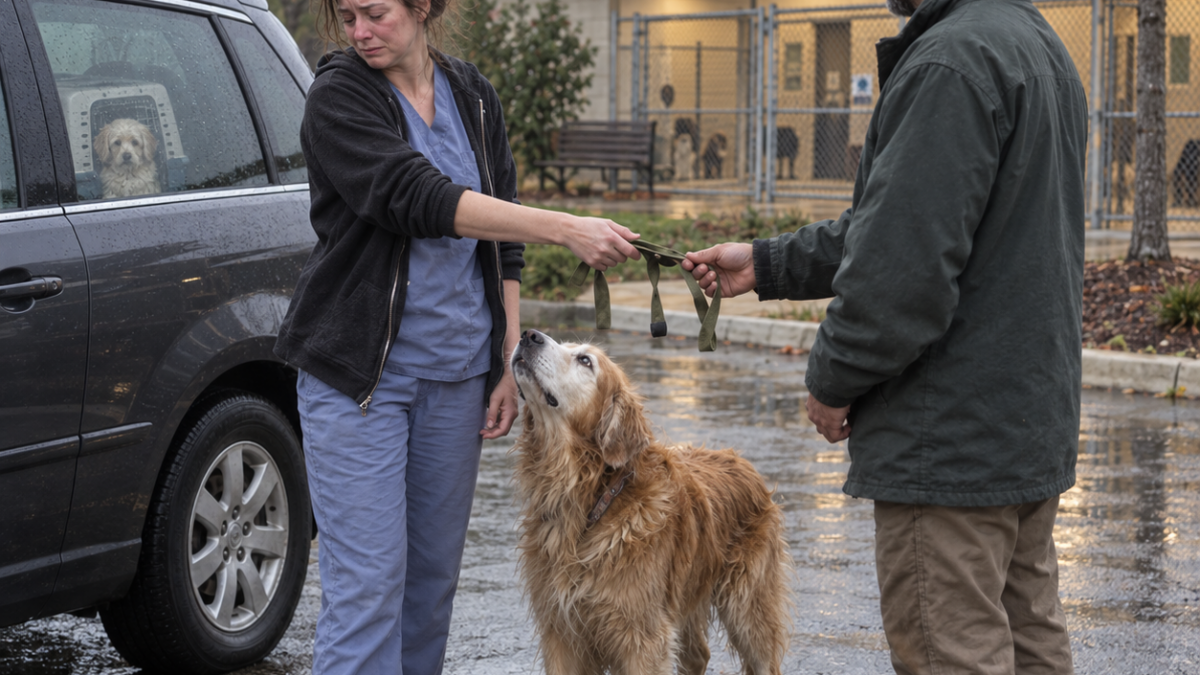
The worst thing I ever did began with a lie I told a shelter worker while my twelve-year-old Golden Retriever stood beside me, still trusting every word that came out of my mouth.
I convinced myself I was exhausted, overwhelmed, and entitled to choose an easier life, even if that easier life meant walking away from the dog who had never once walked away from me.
Ten days later, one exhausted old man in an emergency room forced me to see exactly what I had become—and before that night was over, I was driving through a storm toward a place I had prayed I would never have to enter again.
“Why are you surrendering a senior dog?”
The woman behind the shelter counter held Barley’s leash but kept looking at me.
Not at the paperwork.
At me.
I forced myself to shrug.
“I’m moving. The apartment doesn’t allow large dogs.”
The lie came out frighteningly easily.
Barley stood between us with his white muzzle lifted, tail moving slowly.
He had been mine for twelve years.
He had slept beside the couch when I had the flu.
He had waited by the front door through hundreds of twelve-hour hospital shifts.
When my mother died, Barley had rested his head across my feet for three straight nights while I sat awake because sleep felt impossible.
But lately his hips had gotten worse.
He slipped on the kitchen floor.
He had accidents.
Some mornings I had to support most of his seventy pounds just to get him down the porch steps.
And I was tired.
That was the excuse I kept using.
I was an emergency room nurse working nights, and after years of blood, screaming relatives, overdose patients, wreck victims, staffing shortages, and alarms that never stopped, something inside me had gone numb.
Barley needed patience.
I had none left.
So I had decided I deserved something easy.
Something new.
Something fun.
Waiting in my car outside the shelter was an eight-week-old designer puppy I had paid an embarrassing amount of money for.
The shelter worker glanced down at Barley.
“He’s been with you his whole life?”
“Yes.”
“Twelve years?”
“Yes.”
Her mouth tightened.
“Does he know anyone else?”
I hated the question.
“My schedule is crazy. He’ll adjust.”
She looked at me for a long moment.
Then she crouched beside Barley.
His tail immediately swept the floor.
“Oh, sweetheart,” she whispered.
I looked away.
That was when Barley leaned against my leg.
Just once.
The way he always did when he thought I was stressed.
Even there, while I was abandoning him, he was trying to comfort me.
I stepped away.
His head lifted.
For the first time, his tail stopped.
I signed the form.
The worker unclipped my leash and attached a shelter lead.
Barley watched my hands.
I could almost see him trying to understand the new game.
When I walked toward the glass doors, his nails clicked behind me.
He followed.
The worker stopped him.
“Come on, buddy.”
Barley resisted then.
Not violently.
He simply planted his weak back legs and looked at me.
I heard one soft whine.
I kept walking.
If I turned around, I knew I might lose my nerve.
Outside, rain dotted the windshield.
The puppy bounced excitedly in his carrier.
I sat behind the steering wheel and stared straight ahead.
“Fresh start,” I whispered.
I almost believed it.
For about six hours.
That night the puppy screamed until two in the morning.
The next day he chewed through the heel of my nursing shoe.
He peed on my comforter, bit my ankles, shredded a charger, and woke me every ninety minutes.
Yet none of that was what broke me.
The silence did.
When the puppy finally slept, there was no slow breathing beside my couch.
No gray muzzle on my knee.
No tired eyes following me from room to room.
I would turn automatically, expecting Barley to be there.
Every time, the rug was empty.
Ten days after I surrendered him, paramedics rolled an eighty-one-year-old man into my ER.
He had severe memory loss.
They had found him outside a shopping mall.
Pinned to his jacket was a note.
His family said they could no longer care for him.
The old man kept watching the doors.
Waiting.
Trusting.
Certain someone he loved would come back.
I stopped breathing.
Because suddenly I wasn’t looking at a patient.
I was looking at Barley.
And then my phone began to vibrate in my pocket.
PART 2
I almost ignored the call.
We were short-staffed that night, two ambulances were waiting to unload, and a trauma alert had just sounded from the other side of the department.
But something made me reach into my pocket.
The screen showed a number I recognized only after staring at it for several seconds.
County Animal Services.
My stomach dropped.
I stepped into the medication room and listened to the voicemail.
The recording was automated.
Flat.
Efficient.
Almost polite.
It informed me that the senior Golden Retriever I had surrendered had completed the required holding and assessment period.
Because of Barley’s age, severe mobility problems, chronic pain, and poor adjustment to shelter confinement, he had been classified as an extremely low-probability adoption candidate.
His euthanasia was scheduled for the following morning.
For several seconds, I heard nothing.
Not the alarms.
Not the intercom.
Not the crash cart wheels rattling outside.
Nothing.
I replayed the message.
Then again.
My hand started shaking.
Tomorrow morning.
Barley had less than twelve hours because I had decided cleaning my carpet was inconvenient.
I looked through the narrow glass window in the medication-room door.
The elderly patient was still sitting upright on his stretcher.
He was watching the entrance.
Waiting for somebody who had left him.
And something inside me finally cracked.
I yanked my stethoscope from around my neck.
Marla, my charge nurse, saw me heading toward the lockers.
“Where are you going?”
“I have to leave.”
“What?”
“I have to go.”
She stepped into my path.
Marla had been an emergency nurse longer than I had been an adult, and she had the terrifying ability to become completely calm when everyone else was losing their minds.
“You have patients.”
“I know.”
“Then tell me what’s happening.”
I opened my mouth.
Nothing came out.
She studied my face.
“Family?”
“My dog.”
Her eyebrows drew together.
I heard how ridiculous it sounded.
“My dog is going to die because of something I did.”
Marla’s expression changed.
Not sympathy.
Concern.
But I was already moving.
“I’m sorry.”
“You can’t just leave.”
“I know.”
“Then stop.”
“I can’t.”
I pushed through the staff doors.
Marla shouted my name once.
I kept going.
That decision would cost me later.
It should have.
But at that moment there was only Barley.
Rain hammered the parking garage as I ran to my car.
By the time I pulled onto the street, the storm had swallowed the city.
Windshield wipers slapped back and forth at full speed.
Headlights blurred across wet pavement.
Every red light felt personal.
Every slow driver felt like an enemy.
I kept seeing Barley on the day I adopted him.
He had been ten weeks old, all paws and ears.
The rescue volunteer had placed him in my arms, and Barley had immediately licked my chin.
Twelve years.
Thousands of mornings.
Thousands of nights.
And I had reduced them to one surrender form.
“Please be alive,” I whispered.
The shelter was technically closed when I arrived.
The front lobby lights were still on.
I parked badly, left the car running, and ran through the rain.
A woman unlocking the side entrance shouted that public hours were over.
“I’m reclaiming a dog!”
“You’ll have to come back tomorrow.”
“He won’t have tomorrow!”
I shoved through the lobby doors the moment they opened.
Three people were waiting near the counter.
I did not care.
“Barley!”
The worker behind the desk looked up.
It was her.
The same woman.
The same sharp eyes.
Morgan.
She recognized me immediately.
Her face went cold.
“The senior Golden,” I gasped. “Kennel forty-two. I need him.”
Her jaw tightened.
“You surrendered him.”
“I know.”
“You signed ownership over.”
“I know.”
“He has been here ten days.”
“I know.”
She looked at my soaked scrubs.
Then directly into my eyes.
“Do you?”
That stopped me.
I deserved everything in her expression.
“I made a terrible mistake.”
Morgan stared at me.
“Dogs aren’t furniture.”
“I know.”
“You don’t trade them in when they get old.”
“I know.”
“Do you?”
My throat closed.
“No,” I whispered. “I didn’t. But I do now.”
She looked unconvinced.
“Why should I believe you?”
“You shouldn’t.”
That surprised her.
I wiped rain from my face.
“You shouldn’t believe anything I say. Just let me take him home and prove it.”
Morgan said nothing.
Then she pulled a form from beneath the counter.
“There’s a reclaim fee, medical assessment fee, and administrative charge.”
“Fine.”
“You’ll need identification.”
I slammed my wallet down.
My hands shook so badly that I dropped two cards before finding my license.
Morgan processed everything without rushing.
I wanted to scream at her.
Instead I stood there understanding that ten days earlier, Barley had stood somewhere nearby while I had rushed through exactly the opposite transaction.
Finally, she handed my card back.
“Medical isolation.”
“Where?”
“I’m taking you.”
We went through a locked door.
The sound hit first.
Barking.
Howling.
Metal doors.
Dogs throwing their bodies against kennel gates.
Others remaining completely silent.
The floor smelled like disinfectant, wet fur, urine, and something harder to name.
Fear, maybe.
Morgan walked quickly.
I followed.
Kennel forty-two was empty.
I stopped.
“Where is he?”
“Medical block is farther back.”
I almost fell with relief.
Almost.
The medical wing was quieter.
That frightened me more.
Old dogs looked through cage doors without barking.
A terrier wearing a recovery collar slept under a blanket.
A pit bull with bandaged paws watched us pass.
Then Morgan stopped.
At the very end.
I saw the white muzzle first.
Barley lay flat on the concrete.
His coat, normally soft and golden, looked dull and tangled.
His water bowl was untouched.
He was thinner than I remembered.
But the worst part was his position.
He wasn’t watching the hallway.
Barley had always watched doors.
Home.
The veterinary clinic.
My mother’s house.
Anywhere we went, he watched for me.
Now his face rested between his front paws.
His eyes were open.
But he had stopped waiting.
I dropped to my knees.
“Barley.”
Nothing.
I grabbed the chain-link gate.
“Buddy.”
One ear twitched.
Morgan stood behind me.
I couldn’t breathe.
“Barley, it’s me.”
Slowly, his head lifted.
His eyes were cloudy.
For one terrible second, he simply stared.
I thought he didn’t recognize me.
Then his tail moved.
Once.
A weak tap against concrete.
I put both hands over my mouth.
“No.”
His tail moved again.
“Barley.”
He tried to stand.
His back legs collapsed.
He tried again.
“Don’t,” I cried. “Stay there. I’m coming to you.”
Morgan unlocked the gate.
I crawled inside before she had fully opened it.
Barley dragged himself forward.
Then somehow he got his front half upright.
His nose pressed into my chest.
I wrapped both arms around him.
“I’m sorry.”
His whole body smelled like kennel disinfectant and damp fur.
“I’m so sorry.”
His tail tapped the floor.
“I’m sorry.”
I said it until the words no longer sounded real.
Barley pushed his head harder against me.
No anger.
No hesitation.
No punishment.
He was simply happy I had returned.
That forgiveness hurt worse than hatred would have.
Morgan crouched outside the kennel.
“He stopped eating yesterday.”
I closed my eyes.
“Was he scared?”
“Yes.”
The answer came immediately.
No mercy.
Good.
I needed truth.
“He paced the first two days,” Morgan said. “Then he started waiting near the gate whenever footsteps came down the hall.”
I buried my face in Barley’s neck.
“After a while, he stopped doing that.”
Every sentence felt like something I deserved to carry forever.
“I did this.”
“Yes,” Morgan said.
I looked at her.
She didn’t soften the word.
Then she added, “What happens next is also going to be because of you.”
That sentence stayed with me.
Morgan helped me get Barley into my car.
He couldn’t jump anymore.
I slid one arm under his chest and another beneath his hips.
He gave a small grunt when I lifted him.
“I’ve got you.”
Those words should have sounded comforting.
Instead they tasted like shame.
Because there had been a time when Barley could have said the same thing to me.
Every bad day.
Every lonely night.
Every loss.
He had stayed.
Now I was finally carrying him.
At home, the puppy rushed toward us.
Barley barely reacted.
I created a bed on the living-room floor with blankets and towels.
He drank half a bowl of water.
Then he slept.
I sat beside him until sunrise.
Every few minutes I touched his side just to make sure he was breathing.
The puppy whined from the kitchen.
For the first time, the sound did not irritate me.
It simply reminded me that I had made two selfish decisions instead of one.
I had bought a puppy because I wanted a replacement for something that had never needed replacing.
And now that puppy deserved better too.
The next morning, I called the breeder.
She refused to take him back.
“He’s your responsibility now.”
The irony nearly made me laugh.
Instead I contacted a coworker whose sister had recently lost a young dog to cancer.
They had two teenagers, a fenced yard, experience with puppies, and someone home most of the day.
I told them everything.
Not a cleaned-up version.
Everything.
They came that afternoon.
The puppy ran straight to the older boy.
Within minutes, the two were rolling on the floor together.
I watched from the doorway.
The puppy deserved a home that wanted who he actually was.
Not a fantasy.
When they left, I cried.
Not because I regretted rehoming him.
Because I understood how easily animals become victims of human impulses.
Barley slept through most of it.
The following morning, he tried to stand.
His back paws slid sideways.
He yelped.
It was a tiny sound.
Almost apologetic.
That sound terrified me.
I wrapped a towel underneath his abdomen and helped him up.
“I’ve got you.”
He looked over his shoulder.
Those eyes.
Still trusting.
Still soft.
Still mine.
At nine o’clock I called a veterinary clinic across town.
Not Barley’s old clinic.
I was ashamed to face them.
The new veterinarian was Dr. Lenora Voss.
She was in her sixties, silver-haired, direct, and gentle only where gentleness belonged.
Barley lay on a padded mat while she examined him.
She checked his hips.
Spine.
Heart.
Teeth.
Reflexes.
Eyes.
Then she read the shelter report.
“Severe degenerative joint disease,” she said.
I nodded.
“Muscle wasting.”
I nodded again.
“Possible canine cognitive dysfunction.”
My mouth went dry.
She looked at me.
“Tell me how he ended up at the shelter.”
I could have lied again.
Maybe an older version of me would have.
“I surrendered him.”
Dr. Voss remained still.
“I saw that.”
“I lied on the form.”
No reaction.
“I said I was moving.”
Barley’s tail tapped when the veterinary technician scratched behind his ear.
“I wasn’t moving.”
“Why did you surrender him?”
I stared at the floor.
“Because I was tired.”
Silence.
“I work nights in an ER. He had accidents. I had to carry him. I stopped sleeping. And I…”
I could barely say it.
“I bought a puppy.”
The technician stopped writing for half a second.
I noticed.
Dr. Voss did too.
She looked at Barley.
“He has significant pain.”
“I know.”
“No. You know now.”
I swallowed.
“Yes.”
She picked up a printed quality-of-life chart.
“Pain. Hydration. Appetite. Hygiene. Happiness. Mobility. More good days than bad.”
I stared at it.
“I just got him back.”
“I understand.”
“I’m not putting him down.”
“I didn’t tell you to.”
“I almost lost him yesterday.”
“I know.”
“I need to make it up to him.”
That was when Dr. Voss set the paper down.
“Be careful.”
“With what?”
“Making his final months about your guilt.”
The words hit hard.
“I love him.”
“I believe you.”
“Then why would you say that?”
“Because guilt and love can look similar from the outside.”
I said nothing.
Dr. Voss leaned forward.
“If Barley is still enjoying food, affection, familiar people, sunlight, smells, and ordinary parts of his life, then we manage his pain and support him.”
“And if he stops?”
“Then you love him enough not to make him stay just so you can keep apologizing.”
I hated her for several seconds.
Then I realized I hated her because she was right.
We made a care plan.
Pain medication.
Joint support.
Non-slip runners throughout the house.
A lifting harness.
Raised food and water bowls.
A low ramp.
No stairs.
Short walks.
Frequent bathroom trips.
Washable bedding.
A medication schedule.
And a promise.
“When the bad days become the majority,” Dr. Voss said, “you call me.”
I looked at Barley.
The technician offered him peanut butter.
His tail thumped three times.
“Not today,” I whispered.
Dr. Voss nodded.
“Not today.”
Those two words became my prayer.
The first weeks were not beautiful.
They were exhausting.
At 3:14 one morning, I cleaned urine from the rug.
At 4:02, Barley woke confused and tried to walk behind the couch.
At 5:20, I washed dried stool from his tail while he stood trembling against my leg.
Twice I cried in the laundry room.
Once I sat on the bathroom floor after stepping in another accident and whispered, “I can’t do this.”
Barley lifted his head.
I froze.
The sentence sounded familiar.
I can’t do this.
Those words had taken him to a shelter.
I crawled across the floor and pressed my forehead to his.
“I can.”
He blinked.
“I can do this.”
His tail moved.
“I can.”
The next morning I did something the old version of me would not have done.
I asked for help.
Dr. Voss adjusted Barley’s medication and gave me the number of a retired veterinary technician named Cal who made home visits.
Cal arrived wearing faded jeans and carrying a canvas bag.
He was sixty-something, white-bearded, and apparently made of whatever magic causes nervous animals to trust a stranger immediately.
Barley loved him.
“Traitor,” I muttered.
Cal laughed.
“That tail still works.”
“Only for everybody except me, apparently.”
Barley’s tail hit the floor.
Cal raised an eyebrow.
“Seems functional.”
For the first time in weeks, I laughed.
Cal watched me help Barley stand.
Then he stopped me.
“You’re lifting wrong.”
“I’m a nurse.”
“That explains it.”
“What does that mean?”
“Nurses are fantastic at keeping everybody alive except themselves.”
He showed me how to use my legs instead of my back.
How to support Barley’s chest.
How to massage the wasted muscles around his hips without causing pain.
How to trim the fur between his paw pads so he had better traction.
Then he watched Barley settle onto his bed.
“Let me give you one piece of advice.”
“I’m collecting those lately.”
“Good.”
He pointed toward Barley.
“Don’t make him live longer because you’re sorry.”
I looked away.
Cal continued.
“Make every day he has left easier because you love him.”
I heard Dr. Voss’s voice inside those words.
Different sentence.
Same warning.
Guilt was demanding.
Love was practical.
Guilt wanted punishment.
Love washed blankets.
Guilt wanted me awake all night proving something.
Love knew when to call for help.
Ten days after bringing Barley home, I returned to the hospital.
Marla was waiting near the lockers.
My stethoscope was in her hand.
She held it out.
“You left this.”
I took it.
“Thanks.”
“You also left three patients.”
My shame returned immediately.
“I know.”
“You put us in a terrible position.”
“I know.”
“The manager wanted to terminate you.”
I stared at her.
“What happened?”
“I argued that exhaustion, emotional crisis, and previously spotless performance justified a formal review instead.”
I exhaled.
“Thank you.”
“Don’t.”
Her eyes hardened.
“What you did was still patient abandonment.”
“Yes.”
“And whatever happened with your dog doesn’t erase that.”
“I know.”
That became the sentence everyone kept giving me.
Nothing erased anything.
Not reclaiming Barley.
Not volunteering.
Not crying.
Not becoming better afterward.
Actions did not disappear because regret arrived late.
Marla opened my locker.
“You’re restricted pending review. No trauma lead. No charge duty. Documentation support and lower-acuity assignments.”
“I understand.”
She studied me.
“Did you get him?”
My throat tightened.
“Yes.”
“Alive?”
“Yes.”
Marla nodded.
“Good.”
Then she added, “Burnout can make decent people do cruel things.”
I looked at her.
“But burnout doesn’t make cruelty okay.”
“No.”
“If you’re at the point where you’re walking out of shifts and abandoning animals you’ve loved for twelve years, you need to stop pretending you’re functioning.”
That hurt.
Again, because it was true.
“I’ve started talking to employee counseling.”
“Good.”
“And I asked for fewer consecutive nights.”
“Better.”
Marla nodded toward the hallway.
“Room six.”
I paused.
“What about it?”
“Remember the elderly man who came in from the mall?”
My stomach tightened.
“Yes.”
“His daughter is here.”
Anger rose before I could stop it.
Marla saw it.
“Don’t.”
“Don’t what?”
“Turn your guilt into moral superiority.”
I looked away.
“She left an eighty-one-year-old man outside a shopping mall.”
“Yes.”
“With a note pinned to him.”
“Yes.”
“That could have killed him.”
“Yes.”
Marla’s voice stayed level.
“You still don’t know the whole story.”
I walked toward room six anyway.
The man’s name was Arthur Bell.
He had advanced Alzheimer’s disease.
According to his chart, he had worked thirty years repairing school buses.
He loved oatmeal cookies.
He became frightened by sudden movement.
And he repeatedly asked for his daughter.
She was standing beside him.
June Bell looked nothing like the monster I had imagined.
She looked exhausted.
Forty-five, maybe.
Hair tied badly.
Sweater wrinkled.
Eyes swollen.
One thumb bandaged.
Skin on both hands raw from constant washing.
A teenage boy stood near the wall.
Arthur looked at June.
“My little girl.”
June’s face collapsed.
“I’m here, Dad.”
Arthur smiled.
“There you are.”
I had prepared anger.
I had prepared judgment.
Then I saw June’s hands.
The cracked knuckles.
The bandage.
The tired shoulders.
I knew those hands.
Mine had started looking similar.
Our social worker, Patrice, called me into the hall.
“She left him,” I whispered.
“Yes.”
“She abandoned him.”
“Yes.”
“How can everybody be this calm?”
Patrice folded her arms.
“You want the full story?”
I did.
And I didn’t.
She told me anyway.
Arthur had wandered away from June’s home three times in two weeks.
She had been sleeping on the floor in front of the front door.
Her husband had left the previous year.
Her teenage son, Eli, had started missing school to help watch his grandfather.
June worked remotely whenever she could.
She had applied for government-supported respite care.
Waiting list.
She called private facilities.
Too expensive.
She asked relatives for help.
Excuses.
One brother lived four states away and promised to “look into options.”
He never did.
Neighbors said, “Call if you need anything.”
They stopped answering after the third emergency.
June had gone more than a year without one full night’s sleep.
“That doesn’t make leaving him outside a mall okay,” I said.
“No,” Patrice replied.
I waited.
“That’s it?”
“What do you want me to say?”
“That it excuses her.”
“It doesn’t.”
“Then what?”
Patrice looked through the glass into Arthur’s room.
“It makes the wrong choice understandable without making it right.”
I hated that.
Because monsters were easier.
Monsters allowed distance.
A monster abandoned an old dog.
A monster abandoned an elderly father.
A monster did things I would never do.
Except I had.
Inside the room, Eli suddenly spoke.
“You left Grandpa like trash.”
June closed her eyes.
“I know.”
“You drove away.”
“I know.”
“You said we were getting help.”
“I thought somebody would have to help if I left him somewhere public.”
“That’s insane.”
“I know.”
Arthur looked between them.
Then smiled.
“My June is a good girl.”
June bent forward and covered her face.
Eli turned away.
Arthur reached for his daughter’s hand.
He had no idea why everyone was crying.
Or maybe some part of him did.
I left that room quieter than I entered.
That night, I found Barley stuck between the couch and wall.
He had tried to turn around.
His hips gave out.
He had simply stayed there.
Waiting.
That was what Barley did.
Waited at doors.
Waited at windows.
Waited at the shelter.
Waited for me to become somebody worthy of his faith.
I lifted him with the harness.
“Sorry, buddy.”
His tail tapped the baseboard.
I sat beside him.
“I met somebody today.”
Barley sighed.
“His daughter did something terrible.”
He rested his head on my leg.
“I wanted to hate her.”
Barley closed his eyes.
“But maybe sometimes we hate people because it keeps us from recognizing ourselves.”
He was asleep before I finished.
Two weeks later, my phone rang.
Morgan.
The shelter worker.
I considered letting it go to voicemail.
I answered.
“Hello?”
“Is Barley alive?”
No greeting.
Classic Morgan.
“Yes.”
“Safe?”
“Yes.”
“Eating?”
“Most days.”
“Pain controlled?”
“We’re working with a veterinarian.”
A pause.
“Good.”
I waited.
“You checked the volunteer box on your reclaim paperwork.”
“I did.”
“You serious?”
“Yes.”
“You’re not walking puppies.”
“Fine.”
“You’re not taking adoption pictures.”
“Fine.”
“You’re doing laundry, senior kennels, medical cleanup, dishes, whatever nobody else wants.”
“Good.”
Another pause.
“Saturday. Six.”
“I’ll be there.”
“And wear shoes you’re willing to destroy.”
She hung up.
Saturday morning, I walked through the same glass doors I had used to abandon Barley.
I stopped inside.
Morgan appeared carrying towels.
“You planning to stand there all day?”
“No.”
“Laundry’s back here.”
Four hours.
Blankets.
Towels.
Food bowls.
Mop water.
Urine.
Feces.
Disinfectant.
Nobody congratulated me.
That mattered.
I had begun to understand something.
Redemption wasn’t an emotion.
It wasn’t posting an apology.
It wasn’t crying dramatically while everybody reassured you that you were still a good person.
Redemption was labor nobody applauded.
On my third Saturday, Morgan took me into the senior wing.
“This is where the hard placements stay.”
Gray muzzles turned toward us.
Cloudy eyes.
Stiff legs.
Lumps.
Old dogs whose bodies had stopped being convenient.
One beagle named Captain screamed like a smoke alarm whenever anyone stopped petting him.
A yellow Lab mix named Daisy had recently had a tumor removed.
At the last kennel lay a black shepherd.
He did not look up.
His paperwork listed no name.
Owner deceased.
Family unable to take animal.
Morgan pointed.
“We call him Sunday.”
“Why?”
“He came in Sunday.”
I crouched.
“Hey, Sunday.”
Nothing.
I sat down.
Morgan continued working.
Twenty minutes passed.
Then thirty.
My knees hurt.
Sunday’s eyes finally shifted toward me.
Barely.
But it was something.
I knew that look.
The look of an animal who had stopped expecting footsteps to mean anything good.
I stayed.
When I returned home, Barley sniffed my clothes for several minutes.
“Daisy, Captain, and Sunday.”
His ears moved.
“Don’t get jealous.”
He sneezed directly onto my scrub pants.
“Excellent.”
A month passed.
Barley had good days.
On those mornings, we shuffled to the mailbox.
Harness around his middle.
My hand on the handle.
He moved slowly but proudly.
Neighbors began recognizing him.
A little girl two houses down drew a picture of Barley.
Yellow dog.
Huge wings.
She taped it to my front door.
I sat on the porch and cried.
On bad days, Barley stood facing walls.
Sometimes he forgot where the back door was.
Sometimes he woke at two in the morning panting.
Sometimes he looked directly at me and, for one terrifying second, seemed uncertain who I was.
Then I said his name.
“Barley.”
The tail always moved.
That tail became my measure of the universe.
At the hospital, my disciplinary review ended.
I kept my job.
Barely.
I accepted the written warning without argument.
I reduced overtime.
I attended counseling.
I stopped calling burnout a personality trait.
I learned to say, “I need help,” before my exhaustion became dangerous.
One Thursday afternoon Patrice called.
“I have an unusual request.”
“What?”
“Arthur keeps asking about a Golden Retriever.”
I looked at Barley.
He was asleep beside my chair.
“What Golden Retriever?”
“Apparently he had one years ago. His daughter says the dog died when she was a teenager.”
“And?”
“Arthur is moving into memory care tomorrow. He’s agitated. June and Eli will be there for a family meeting.”
I knew where this was heading.
“No.”
“I understand.”
“Barley isn’t a therapy dog.”
“I know.”
“He’s fragile.”
“I know.”
“I’m not using him to make somebody feel better about abandoning her father.”
Patrice was silent.
Then she said, “That’s fair.”
After we hung up, I looked down.
Barley had opened his eyes.
“What?”
Tail wag.
“No.”
Another wag.
“You didn’t hear the conversation.”
His tail continued.
I called Dr. Voss.
She approved a short visit.
No slick floors.
No crowd.
No more than twenty minutes.
Leave immediately if Barley appeared tired.
The next afternoon, I carried enough supplies to support a small expedition.
Blankets.
Water.
Medication.
Harness.
Towels.
Treats.
The memory-care facility was simple.
Brick exterior.
Rocking chairs.
Flower beds.
Inside, the common room was filled with people whose lives had become fragments.
Arthur sat near a window twisting a napkin.
June stood behind him.
Eli leaned against the wall.
Hard-faced.
Angry.
Barley entered slowly.
The room changed.
A woman in pink whispered, “Dog.”
An old man near a piano started crying before Barley got within ten feet.
Arthur stopped moving.
His eyes widened.
“Well,” he whispered.
Barley looked at him.
Then something happened I still cannot explain.
He walked straight past me.
Past Patrice.
Past June.
Past the treats in my pocket.
Straight to Arthur.
Barley lowered his head onto the old man’s knee.
Arthur placed both hands around Barley’s face.
His shaking stopped.
“My good boy.”
June covered her mouth.
Eli looked away.
Arthur stroked Barley’s ears.
For several minutes, nobody discussed placement.
Nobody argued.
Nobody blamed anybody.
Arthur talked about fishing.
A pond.
A yellow dog.
A truck he may or may not have owned.
Barley listened.
Then Arthur looked at June.
“You came back.”
June froze.
Arthur patted Barley.
“Good girl.”
Maybe he was confused.
Maybe memory had folded his daughter and an old dog into the same place.
June dropped to her knees.
“I’m sorry, Dad.”
Arthur touched her hair.
“Don’t cry.”
Eli’s face twisted.
He looked at his mother.
Then at his grandfather.
Then at Barley.
An old dog.
Abandoned.
Still giving comfort.
Eli slid down the wall and covered his face.
He cried.
The visit lasted seventeen minutes.
Someone took a photograph.
The next morning that picture appeared on a local community page.
Arthur sitting with Barley’s head on his lap.
June kneeling beside him.
Eli wiping his eyes.
The caption read:
Sometimes the ones we fail are still the first to forgive us.
For several hours the comments were kind.
Then somebody recognized Barley.
I never learned who.
A comment appeared.
Wait—isn’t that the senior dog his owner dumped at the county shelter and reclaimed right before euthanasia?
Everything changed.
People found my name.
They found my workplace.
They found an old photograph of Barley on my public profile.
Then came judgment.
Some deserved.
Some vicious.
Anyone who abandons a senior dog is garbage.
She only took him back because she got scared of looking bad.
That dog should have been given to someone better.
She works in healthcare? Terrifying.
People like her should never own animals.
Then others defended me.
She made a horrible mistake and corrected it.
Caregiver burnout is real.
The dog obviously loves her.
People can change.
That created another fight.
Burnout is not an excuse for cruelty.
Nobody said it was.
Stop defending abandonment.
Stop pretending mistakes make people permanently evil.
I read everything.
That was a mistake.
At midnight, I sat on the kitchen floor beside Barley.
One comment had lodged itself inside me.
That poor dog deserves better than being used in her redemption story.
I read it again.
And again.
Because it was partly true.
Barley did deserve better.
He deserved the version of me who never left him.
That person did not exist.
No amount of rehabilitation could create a past where I had done the right thing.
I could only decide what happened next.
The following morning, I called Morgan.
“I’m not volunteering Saturday.”
Silence.
“Why?”
“The shelter is getting mentioned online because of me.”
“So?”
“I don’t want controversy hurting adoptions.”
“That’s not why you’re quitting.”
I closed my eyes.
“No.”
“You’re ashamed.”
“Yes.”
“Good.”
I blinked.
“What?”
“Shame means you still understand right from wrong.”
“That’s not exactly comforting.”
“I’m not here to comfort you.”
Of course she wasn’t.
Morgan continued.
“You coming Saturday?”
“I just said—”
“Dogs don’t read comment sections.”
I said nothing.
“Sunday doesn’t care what somebody on Facebook called you. Daisy doesn’t care. Captain definitely doesn’t care.”
Despite myself, I smiled.
Morgan’s voice sharpened.
“If you stop doing useful work every time somebody reminds you what you did, then all you ever cared about was feeling forgiven.”
That landed harder than anything online.
“What time?”
“Six.”
“I’ll be there.”
“Good.”
Saturday morning, a young woman entered the shelter carrying a tiny gray-faced beagle mix wrapped in a blanket.
A toddler balanced on her hip.
She looked close to panic.
“I need to surrender him.”
Morgan approached.
“What’s his name?”
“Walter.”
“Age?”
“Fourteen.”
The woman swallowed.
“He snapped at my son.”
My first reaction came hot.
Instant.
Judgment.
Of course.
Old dog gets difficult.
Dump him.
I hated the woman before she finished speaking.
Then I looked at her.
Really looked.
Tired eyes.
Messy hair.
Toddler crying.
Walter trembling.
Morgan glanced at me.
Not asking me to speak.
Maybe warning me not to.
I walked closer anyway.
“I’m not going to judge you.”
The woman laughed bitterly.
“Everybody judges.”
“Yes.”
That surprised her.
“They do.”
Walter looked toward her voice.
His tail gave a weak movement.
“Did he bite?”
“No. My son pulled his tail. Walter snapped at the air.”
“Has Walter ever bitten anybody?”
“No.”
“Any pain problems?”
“I don’t know.”
“Veterinarian recently?”
Tears filled her eyes.
“I can’t afford it right now.”
There it was.
The edge.
The place between love and exhaustion where terrible decisions become possible.
I crouched.
“My dog is twelve.”
She looked at me.
“I surrendered him.”
Morgan went very still.
“I left him here because he got old and difficult.”
The woman stared.
“I bought a puppy instead.”
“Why are you telling me this?”
“Because if somebody had stopped me that day and forced me to slow down, maybe I wouldn’t have done the worst thing I’ve ever done.”
Walter sniffed my hand.
“I came back for him.”
The woman began crying.
“My husband says Walter has to go.”
“Your child has to be safe.”
She nodded.
“So does Walter.”
“I don’t know how to do both.”
“That’s different from not loving him.”
Morgan opened a drawer.
She removed a flyer.
A small local senior-pet assistance program.
Low-cost veterinary vouchers.
Behavior consultations.
Baby gates.
Temporary respite fostering.
Medication assistance.
Not miracles.
Help.
The woman stared at the paper.
“I don’t have to leave him?”
Morgan replied, “Not today, if there’s a safe plan you can commit to.”
The woman hugged Walter.
“I can try.”
When she left, Morgan looked at me.
“Don’t get proud.”
“I’m not.”
“Good.”
She began stacking forms.
“Pride helped get you here.”
A week later, Walter’s owner called.
His snapping had been pain.
Arthritis.
The child was learning “gentle hands.”
Walter had his own quiet room when he needed space.
Nobody had been bitten.
He stayed home.
That felt better than any stranger online telling me I was forgiven.
Maybe that was the closest thing to revenge life offered.
Not revenge against the people who condemned me.
Revenge against the person I had been.
Every difficult thing I did afterward became an answer to her.
The woman who walked through those shelter doors.
The woman who chose easy.
The woman who believed love only counted while it remained convenient.
She had abandoned Barley.
I could not erase her.
But I could refuse to let her make another decision.
Spring came.
Arthur Bell died peacefully in his sleep.
June and Eli were both beside him.
No final speech.
No miraculous reconciliation.
Just hands held in a quiet room.
A framed photograph stood on Arthur’s bedside table.
Barley’s head resting on his knee.
June mailed me a letter.
I still hate what I did.
Eli may hate me for a long time.
But after Barley visited, Dad stopped asking why we left him at the mall.
He started asking when the good dog was coming back.
Maybe that was his way of forgiving me.
I don’t know if I deserve it.
I’m trying to live like the forgiveness meant something.
I put the letter beside Barley’s medicine.
Her words could have been mine.
Around the same time, Sunday finally got adopted.
A retired mail carrier named Mr. Alvarez came into the shelter.
He had lost his wife the year before.
Morgan asked what kind of dog he wanted.
“Old.”
She blinked.
“Old?”
“I’m seventy-two. I don’t need something that thinks five in the morning is playtime.”
“What size?”
“Whatever fits on a couch.”
“Activity level?”
Mr. Alvarez considered.
“Do you have one who understands naps?”
Morgan brought him to Sunday.
The black shepherd still spent most days lying quietly.
Mr. Alvarez sat outside the kennel.
Sunday did not move.
Five minutes.
Ten.
Twenty.
Morgan started to explain that Sunday was emotionally withdrawn.
Mr. Alvarez lifted one hand.
“He doesn’t owe me enthusiasm.”
That sentence almost undid me.
He remained on the concrete.
After forty minutes, Sunday finally lifted his head.
He shuffled to the gate.
Then rested his chin against it.
Mr. Alvarez began crying.
“I’ll take him.”
Morgan frowned.
“You haven’t walked him.”
“Neither of us looks like much of a walker.”
Sunday went home wearing a red donated collar.
I sat in my car afterward and cried so hard I had to wait fifteen minutes before driving.
That evening, I told Barley.
“Sunday got a home.”
Tail thump.
“With a retired mailman.”
Another.
“They’re both lazy.”
Barley looked offended.
“I meant Sunday.”
His tail stopped.
“Fine. You’re all extremely athletic.”
Tail thump.
Summer approached.
Barley began declining.
Not all at once.
That would almost have been easier.
Instead life stole him by inches.
First the mailbox walk became too far.
Then the driveway.
Then the porch.
He stopped meeting me at the door.
Stopped waking when I opened the treat jar.
Stopped recognizing the sound of his leash.
But my voice still worked.
“Barley.”
Tail.
Every time.
One afternoon I came home and found him lying in the hallway.
He had tried to reach the door.
His back legs had collapsed.
He had soiled himself.
His front legs were wet where he had dragged himself through it.
He looked exhausted.
Then he saw me.
His tail moved.
Once.
And Barley looked away.
I knew that expression.
Embarrassment.
My dog was ashamed of something his broken body had done.
I dropped beside him.
“No.”
His ears moved.
“You never apologize to me.”
I slid my hands beneath him.
“Never.”
I cleaned him slowly.
Warm water.
Towels.
Fresh bedding.
He didn’t resist.
He also didn’t lean against me.
That frightened me more.
He simply allowed the care.
That night, I opened the notebook Dr. Voss had told me to keep.
Good days.
Bad days.
For months, I had recorded everything.
Ate breakfast.
Enjoyed sunshine.
Wagged for Cal.
Recognized me.
Mailbox.
Peanut butter.
Slept peacefully.
Then the bad list.
Couldn’t stand.
Wouldn’t drink.
Panted.
Confused.
Cried when moved.
Refused food.
Lost in familiar rooms.
The pattern was undeniable.
Bad days had taken over.
I argued with the notebook.
I added tiny things.
He blinked when I sang.
He smelled chicken.
He slept touching my shoe.
But I knew what I was doing.
I was negotiating with reality.
The next morning, I called Dr. Voss.
“I think it’s time.”
There was a pause.
Not long.
Long enough.
“I’m sorry.”
I closed my eyes.
I wanted her to disagree.
“Are you sure?”
“Yes.”
The word destroyed me.
I had wanted someone to stop me when I abandoned Barley.
Now I wanted someone to stop me again.
But for the opposite reason.
Back then, love meant keeping him.
Now love meant releasing him.
We scheduled an at-home euthanasia for the following evening.
I spent Barley’s final full day doing almost nothing.
No bucket list.
No forced beach trip.
No exhausting car ride so I could manufacture photographs.
Barley had given me twelve years of ordinary love.
I gave him an ordinary day.
Eggs for breakfast.
He ate two bites.
I brushed him.
Opened the window.
Sat beside him.
A dog barked outside.
One ear lifted.
I told him stories.
The sandwich he stole from my hand when he was three.
The skunk incident.
The Christmas turkey disaster.
The time he refused to leave the bathroom while I had the flu.
The night after my first patient died.
I had been twenty-six.
I came home at four in the morning and collapsed onto the kitchen floor.
Barley was a young dog then.
Strong.
Beautiful.
He walked over and pressed his entire body against mine.
He stayed until I stopped shaking.
“You carried me first,” I whispered.
Barley breathed slowly.
“So many times.”
I stroked his ears.
“And when carrying you got difficult, I forgot.”
His eyes remained closed.
“I left you.”
My voice broke.
“You waited anyway.”
I kissed his head.
“I can’t forgive myself for that.”
His ear twitched.
“But I’m going to spend the rest of my life treating your forgiveness like it mattered.”
Near sunset, someone knocked.
Morgan.
She stood on my porch holding a paper bag.
“What are you doing here?”
“Cal told me.”
She lifted the bag.
“Cheeseburgers.”
I almost laughed.
“Dr. Voss said bland food.”
“Barley is dying tomorrow.”
Fair argument.
Morgan knelt beside his bed.
We removed plain pieces of hamburger.
Barley ate three.
Morgan wiped her face quickly.
“You tell anybody I cried, I’ll deny it.”
“I’m an unreliable witness.”
“Clearly.”
I laughed.
Then cried.
Morgan scratched Barley’s head.
“You caused a lot of trouble, old man.”
Tail thump.
She looked at me.
I could see her choosing words.
“You did right by him at the end.”
I shook my head.
“I should’ve done right by him from the beginning.”
“Yes.”
No comforting lie.
“You should have.”
I nodded.
Morgan’s eyes filled.
“But you came back.”
“Barely.”
“You came back.”
“I don’t know if that’s enough.”
“It isn’t.”
I looked at her.
She continued.
“Nothing you do afterward makes abandoning him okay.”
I swallowed.
“But?”
“But life isn’t a courtroom where every sentence has to end with guilty or innocent.”
She looked down at Barley.
“You did something awful.”
“Yes.”
“Then you spent every day afterward doing the work.”
I said nothing.
“Maybe that’s all people can do after they become the villain in their own story.”
At seven the next evening, Dr. Voss arrived.
Cal came too.
I hadn’t asked him.
I was grateful anyway.
Barley lay on his bed near the window.
The same window where he had watched for me after thousands of shifts.
Dr. Voss explained the process.
Sedation first.
Then, when he was completely relaxed, the final injection.
“You can stop me at any point before the second medication.”
I nodded.
My brain kept screaming stop.
My heart knew why we couldn’t.
I lay on the floor.
Barley’s head rested in my lap.
Dr. Voss gave the sedative.
Within minutes, Barley’s breathing changed.
The tension around his eyes disappeared.
The trembling in his legs stopped.
For the first time in months, his face looked young.
Not his body.
His face.
I ran my fingers through the fur behind his ears.
“You’re the best thing that ever happened to me.”
His ear moved.
“I’m sorry I forgot that.”
My vision blurred.
“I’m sorry I made you think I wasn’t coming back.”
I pressed my forehead against his.
“But I’m here now.”
His breathing slowed.
“I’m staying.”
Morgan turned away.
Cal stared through the window.
Dr. Voss waited.
I kissed Barley’s muzzle.
“You don’t have to wait anymore, buddy.”
His tail moved.
One small thump.
I laughed through tears.
“That thing never quits.”
Another thump.
Then I nodded to Dr. Voss.
She administered the second medication.
I kept one hand over Barley’s heart.
For several seconds, I felt it.
Slow.
Strong enough to remind me of thousands of days.
Then slower.
Then—
nothing.
There are silences that are simply the absence of sound.
And there are silences that divide your life into before and after.
The silence after Barley’s last breath was the second kind.
I remained on the floor.
Nobody rushed me.
Finally, Dr. Voss placed her stethoscope against his chest.
She listened.
Then she touched my shoulder.
“He’s gone.”
I nodded.
“He was peaceful.”
“He deserved peaceful.”
“Yes.”
“He deserved better than me.”
Dr. Voss sat beside me.
“Careful.”
I looked at her.
“Don’t turn grief into another form of self-punishment.”
“How am I supposed to live with what I did?”
“By remembering it.”
“That sounds like punishment.”
“No.”
She looked toward Barley.
“Punishment is staying exactly the person who hurt him.”
I stared at her.
“Remembering is how you avoid becoming that person again.”
For three days, the house was unbearable.
No medicine alarm.
No nails against laminate.
No water bowl.
No old-dog sigh.
No heavy head dropping onto my knee.
I woke at three in the morning and reached for the lifting harness.
Then remembered.
On the fourth morning, I drove to the shelter.
Morgan was folding laundry.
She looked surprised.
“You shouldn’t be here.”
“Yes, I should.”
“You’re allowed to grieve.”
“I know.”
“You don’t owe anybody a shift.”
“I know.”
“Then why are you here?”
I looked around.
Because Barley was gone.
Because I had once entered this building to discard loyalty.
Because afterward I had returned to reclaim it.
Because now there were dozens of animals who had no idea what I had learned.
“Because the dryers are empty.”
Morgan stared.
Then tossed me wet towels.
“Second load needs detergent.”
That was all.
It was enough.
Months passed.
I kept working at the ER.
I didn’t become some magically serene nurse.
People still yelled at me.
Patients still vomited on my shoes.
Doctors still ordered impossible things five minutes before shift change.
Administration still believed staffing shortages could be solved with inspirational emails.
I still became exhausted.
The difference was that I stopped worshiping endurance.
When the thought came—
I can’t do this—
I treated it as a warning.
Not a command.
I asked for help.
I slept.
I declined overtime.
I admitted when I was angry.
I stopped allowing resentment to quietly make decisions for me.
June and Eli began visiting Arthur’s former memory-care facility once a month.
They brought cookies.
Sometimes Eli played cards with residents.
June sat with people who had no visitors.
Their visits didn’t erase what happened to Arthur.
Nothing erased it.
But like me, June learned something uncomfortable.
You can’t change the worst thing you did.
You can only stop asking the past for permission to do better today.
Walter stayed with his family.
The toddler learned gentle hands.
Walter got arthritis medication.
He still peed on things.
His family bought washable pads.
Sunday became the undisputed owner of Mr. Alvarez’s recliner.
Morgan showed me photographs.
In every one, Mr. Alvarez was squeezed into a corner while Sunday occupied approximately ninety percent of the chair.
Daisy found a foster home.
Captain continued screaming like a fire alarm.
And one Saturday morning, Morgan handed me a key.
“What’s this?”
“Senior wing.”
I stared.
“You trust me with a key?”
“Don’t make it weird.”
“You didn’t trust me to carry towels six months ago.”
“I still don’t trust you with towels.”
I laughed.
Morgan’s face softened.
“We’re starting a volunteer program.”
“What kind?”
“Senior dogs. Owners in crisis. Temporary help before surrender.”
I went still.
“Respite?”
“Transportation. Laundry. Dog sitting. Vet appointments. Small ramps. Food deliveries. Whatever keeps an overwhelmed owner from reaching the point where they think abandonment is the only answer.”
I looked toward the senior wing.
“Why are you telling me?”
“Because you understand that point better than anybody here.”
The shame came automatically.
Morgan saw it.
“I didn’t say that as an insult.”
“That may be a first.”
“Don’t get used to it.”
She handed me a folder.
The program needed a name.
Someone suggested Golden Years.
Too cute.
Someone suggested Senior Safety Net.
Accurate, boring.
Then Morgan wrote two words on the board.
STAY HOME.
I stared at them.
“That one.”
“You sure?”
“Yes.”
The program started small.
Five volunteers.
A veterinarian willing to discount appointments.
Cal.
Two rescue groups.
One hardware store that donated ramps and baby gates.
A groomer willing to do sanitary trims for homebound senior dogs.
And me.
The first month, we helped four families.
Then nine.
Then fourteen.
One evening, a man called.
His eleven-year-old mastiff could no longer climb stairs.
The man’s wife had cancer.
He sounded ashamed.
“I think I have to surrender Duke.”
I closed my eyes.
I knew that sentence.
“Tell me everything.”
For twenty minutes he talked.
Not just about Duke.
About his wife.
Bills.
Lack of sleep.
His own bad back.
The smell.
The accidents.
The guilt.
When he finished, I asked, “If the stairs disappeared as a problem, would you still want Duke?”
A long silence.
“Of course.”
We installed a temporary ramp two days later.
Duke stayed home.
Another woman called because her old spaniel barked all night.
She hadn’t slept properly in six months.
Veterinary exam.
Cognitive decline.
Medication.
Nightlight.
Routine.
Dog stayed home.
Not every story ended that way.
Sometimes surrender was genuinely necessary.
Owner died.
Domestic violence.
Eviction.
Severe behavioral risk.
Medical catastrophe.
We learned quickly that “never surrender” was as simplistic as “just surrender.”
The goal was not judgment.
The goal was to make sure desperation was not mistaken for the absence of options.
One afternoon, nearly a year after Barley died, Morgan asked me to come to the front desk.
A woman stood there with a senior Golden Retriever.
White muzzle.
Cloudy eyes.
Weak hips.
For one second, the room disappeared.
I saw Barley.
The woman gripped the leash.
“I have to surrender him.”
His name was Cooper.
Thirteen.
Her husband had died.
She was losing her house.
The apartment she found had a sixty-pound weight restriction.
Cooper weighed seventy-four.
She was crying so hard she could barely speak.
“I’ve had him since he was nine weeks old.”
I did not judge her.
That mattered.
The old version of me might have judged her because I hated seeing my own sins.
The newer version listened.
“Would you keep him if we could find temporary foster care while you appeal the apartment restriction?”
Her head snapped up.
“What?”
Morgan looked at me.
I continued.
“We can try. No promises.”
The housing manager eventually approved Cooper as an accommodation after letters from his veterinarian and social worker.
Three weeks later, I watched the woman kneel in the shelter lobby as Cooper shuffled toward her from temporary foster.
His tail moved so hard his whole body swayed.
She sobbed into his fur.
I had to walk outside.
In the parking lot, I stood in the exact place where my car had been the day I abandoned Barley.
For years, I thought justice meant punishment.
Somebody hurts you.
They suffer.
Somebody betrays you.
They lose.
Somebody acts selfishly.
Life destroys them.
But standing there, I understood another kind of justice.
The thing that nearly destroyed Barley had been turned into something that kept Cooper home.
My worst decision had become knowledge.
Knowledge had become action.
Action had saved an old dog from sleeping in a kennel wondering why his person disappeared.
It did not redeem the past.
It changed the future.
That was enough.
On the first anniversary of Barley’s death, I took his collar from the hook near my door.
I had never moved it.
The leather had softened with age.
His tags clicked against one another.
BARLEY.
My phone number.
An address we no longer used.
I drove to the shelter before opening.
Morgan was already there.
Of course.
“You’re early.”
“So are you.”
“I work here.”
“Excuses.”
She rolled her eyes.
I walked to the senior wing.
Captain had finally been adopted.
Daisy was gone too.
Different dogs filled those kennels now.
Same gray faces.
Same uncertain eyes.
At the end was an old Golden mix.
Maybe eleven.
Maybe older.
He lifted his head when I approached.
I sat down.
No plans.
No heroic intentions.
Just sat.
After several minutes, he shuffled toward the gate.
I slid my fingers through the bars.
He sniffed them.
Then rested his forehead against my hand.
I closed my eyes.
For one second, I felt Barley’s weight again.
Not literally.
I knew better than to turn coincidence into magic.
But memory has its own kind of weight.
Morgan appeared behind me.
“His name is Milo.”
“What happened?”
“Owner went into hospice. Family couldn’t take him.”
“How long has he been here?”
“Four days.”
“Eating?”
“Some.”
“Medical?”
“Arthritis. Mild kidney disease. Still enjoys people.”
I nodded.
Morgan studied me.
“No.”
“I didn’t say anything.”
“I know your face.”
“I’m not adopting him.”
“Good.”
“I work nights.”
“Yes.”
“I volunteer too much.”
“Yes.”
“And Barley has been gone a year.”
Morgan’s eyes narrowed.
“Still no.”
I laughed.
“I’m not adopting him.”
Milo pressed harder against my hand.
Two weeks later, Mr. Alvarez adopted him.
Sunday had died peacefully that winter.
Mr. Alvarez told Morgan his house had become too quiet.
“I can’t replace Sunday,” he said.
Morgan replied, “Good, because Milo isn’t Sunday.”
Mr. Alvarez smiled.
“That’s why I’m here.”
That sentence mattered too.
Love doesn’t replace.
It expands.
Barley had never been replaceable.
The puppy hadn’t failed at replacing him.
I had failed by asking.
My mother wasn’t replaceable.
Arthur wasn’t replaceable.
Sunday wasn’t.
Every relationship is its own country.
When it ends, you do not move another soul into the empty house and pretend nothing changed.
You learn to carry the absence.
Two years after the night I raced back to the shelter, the Stay Home program helped its hundredth senior dog.
The shelter held a tiny celebration.
Morgan hated celebrations.
So naturally we made it as embarrassing as possible.
Someone bought a cake decorated with gray dog faces.
Cal gave a speech despite being told not to.
Patrice came.
Marla came straight from work.
June and Eli came.
Walter’s family came with photographs.
Mr. Alvarez came.
Even Dr. Voss attended.
Morgan stood near the wall pretending she wished she were anywhere else.
A reporter from the local paper asked how the program started.
Everyone looked at me.
I hated that.
The reporter raised her recorder.
“Was there one particular moment that inspired this?”
“Yes.”
“What happened?”
I could have told the polished version.
Burned-out nurse sees challenges facing senior-pet owners and decides to help.
Technically true.
Cowardly.
Instead I said, “I abandoned my dog.”
The room went silent.
The reporter lowered the recorder slightly.
I continued.
“He was twelve. His hips were failing. I was exhausted. I bought a puppy because I wanted something easier.”
Nobody moved.
“I lied to the shelter when I surrendered him.”
The reporter glanced at Morgan.
Morgan crossed her arms.
“He was nearly euthanized.”
My throat tightened even after two years.
“I got him back the night before.”
The reporter asked softly, “And that changed you?”
“No.”
She looked surprised.
“Getting him back didn’t change me.”
I thought of those months.
Accidents.
Medication.
Fear.
Lifting.
Laundry.
The notebook.
The final evening.
“Taking care of him afterward changed me.”
The reporter waited.
“I used to think regret proved you were sorry. It doesn’t.”
I looked around the room.
“Regret is a feeling. Repair is behavior.”
Morgan looked down.
Cal smiled faintly.
June wiped her eyes.
The reporter asked, “Do you forgive yourself?”
I had been asked that before.
Online.
At counseling.
By friends.
I finally knew the answer.
“No.”
The room shifted.
“But I also don’t hate myself anymore.”
I touched Barley’s collar, which I had started carrying in my pocket on difficult days.
“Forgiveness isn’t really the question.”
“What is?”
“Whether I’m living differently.”
The reporter nodded.
“What would you say to somebody overwhelmed by caring for an aging pet?”
I thought about Arthur.
June.
Walter.
Barley.
“Ask for help before resentment starts making decisions.”
The article ran the following Sunday.
The headline embarrassed me.
THE OLD DOG WHO INSPIRED A SECOND CHANCE FOR HUNDREDS.
Morgan taped it inside the laundry-room cabinet where nobody could see it.
“Why there?”
“So you don’t get an ego.”
“Thoughtful.”
“I’m nurturing.”
“You terrify volunteers.”
“Leadership style.”
That afternoon, a new volunteer asked me which dog in the photographs was Barley.
I showed her.
Golden coat.
White muzzle.
Brown eyes.
Lying beside my couch.
She smiled.
“He looks happy.”
“He was.”
“Even after what happened?”
I looked at the picture.
That question had haunted me for years.
I thought about the shelter cage.
The last months.
His final tail thumps.
“Yes.”
I swallowed.
“I think he was.”
That night, I went home after an ER shift.
Hard night.
Two traumas.
One death.
A mother screaming in a hallway.
The kind of night that once made me come home angry at anything that needed me.
I unlocked the door.
The house was quiet.
Barley’s collar hung beside the frame.
I sat in his old spot on the rug.
For years, I had pictured the worst moment.
Barley watching me walk away.
Now another memory came first.
Barley in my lap on his final night.
My hand on his heart.
My voice telling him I was staying.
That did not erase the first memory.
They existed together.
Maybe that was the real ending.
Not innocence restored.
Not some fantasy where one good act cancelled one terrible act.
Just both truths.
I left him.
I came back.
I failed him.
I cared for him.
I caused fear.
I later gave comfort.
I made a selfish choice.
Then I spent the remaining time choosing differently.
And Barley?
He never demanded an explanation.
He never asked why I traded twelve years for an eight-week-old puppy.
He never made me earn one tail wag before offering another.
He simply gave me what dogs give us far too freely.
Trust.
That is why abandoning him was so terrible.
And why being trusted again became such a responsibility.
People sometimes ask whether I think Barley forgave me.
I know he did.
He forgave me inside a shelter kennel the moment his tail touched concrete.
But Barley’s forgiveness was never permission to forget.
It was a debt.
Not the kind you repay once.
The kind you honor.
Every old dog we helped stay home.
Every exhausted caregiver who heard, “Tell me what you need,” instead of, “How could you?”
Every Saturday spent cleaning kennels.
Every night I asked for help instead of choosing anger.
Every patient I treated with more patience because I remembered what exhaustion had done to me.
All of it belonged, in some small way, to Barley.
A year later, our program expanded to two neighboring counties.
Cal trained volunteers.
Dr. Voss developed a quality-of-life workshop for senior-pet owners.
Patrice connected us with caregiver groups.
June began speaking quietly at support meetings about what had happened with Arthur.
She never softened her story.
Neither did I.
That was important.
When people tell stories about redemption, they often polish the original sin until it stops looking ugly.
We didn’t.
June said, “I left my father outside a mall.”
I said, “I abandoned my dog.”
Then we talked about what came before.
And what had to come afterward.
One night after a meeting, June and I sat outside the memory-care facility.
Eli was inside helping an elderly resident assemble a puzzle.
June stared toward the windows.
“Do you ever wish nobody knew?”
“About Barley?”
“Yes.”
“Every day.”
She laughed softly.
“Me too.”
We sat quietly.
Then she asked, “Would you erase it if you could?”
I answered immediately.
“Yes.”
She looked surprised.
I continued.
“I would erase Barley being scared in that shelter. Absolutely.”
June nodded.
“I’d erase Dad sitting alone outside the mall.”
“Yes.”
She rubbed her hands together.
“But then maybe none of this happens.”
“I know.”
“Does that ever make you feel grateful for the mistake?”
“No.”
She looked at me.
“Never.”
I shook my head.
“I’m grateful we survived the consequences long enough to do something useful afterward.”
June smiled sadly.
“That sounds more honest.”
“It’s less inspirational.”
“Good.”
We both laughed.
Inside, Eli waved through the window.
June waved back.
My phone buzzed.
A message from Morgan.
EMERGENCY FOSTER NEEDED. 13-YEAR-OLD GOLDEN. OWNER HOSPITALIZED.
I showed June.
She smiled.
“Go.”
The dog’s name was Henry.
I fostered him for nine days.
The first night, he stood at my front door and whined.
Waiting for his owner.
I sat beside him.
“I know.”
Henry looked at me.
“I know what waiting feels like from the wrong side now.”
He rested beside the door.
His owner recovered.
When she came to pick him up, Henry transformed.
His old body seemed young for thirty seconds.
Tail flying.
Feet slipping.
Whining.
The woman sank to her knees.
“I thought I’d lost him.”
Henry buried his face against her chest.
I stood behind them.
For a second, the shelter hallway returned.
Barley stumbling toward me.
Tail thumping.
Forgiving.
I finally understood why that memory had hurt so much.
Barley’s joy when I returned had not proven my abandonment didn’t matter.
It proved how much my presence had mattered all along.
That was the lesson I had missed.
Dependence is not inconvenience.
Trust is not something we deserve automatically.
And loyalty is never measured during the easy years.
It is measured after the body weakens.
After the bills rise.
After the sleep disappears.
After love becomes work.
Years have passed now.
Barley’s collar is still beside my door.
The tag has worn smooth.
Sometimes, before a difficult shift, I touch it.
Not for luck.
For perspective.
I still see old patients whose families are overwhelmed.
I no longer immediately divide the world into loyal people and monsters.
I ask questions.
Who is helping you?
When did you last sleep?
Can somebody take one night?
Have you spoken with social work?
Do you understand the options?
Are you safe?
Is your loved one safe?
Sometimes the answer is ugly.
Sometimes someone truly doesn’t care.
Sometimes abandonment is exactly what it looks like.
But sometimes behind a terrible decision is a person standing at the edge of collapse.
That does not excuse harm.
It tells us where prevention has to begin.
One winter evening, I finished my shift and walked into the hospital lobby.
A therapy dog organization had set up near the entrance.
Among the dogs was an elderly Golden Retriever.
White muzzle.
Soft eyes.
His handler noticed me staring.
“Want to say hello?”
I almost said no.
Instead I knelt.
The dog walked over and lowered his head onto my knee.
Exactly like Barley.
I stopped breathing.
The handler smiled.
“He does that when somebody needs him.”
I laughed, then cried.
Of course.
I stroked the dog’s ears.
“What’s his name?”
“Benny.”
“Hey, Benny.”
Tail thump.
I stayed there for five minutes.
When I stood, my scrubs had Golden Retriever hair all over them.
For once, I didn’t brush it off.
I drove home through light snow.
At a red light, I thought about the woman I had been the day I left Barley.
I spent years imagining I needed to defeat her.
Punish her.
Hate her.
That was my idea of revenge.
But hatred kept me tied to her.
The real revenge was becoming someone she would no longer recognize.
Someone who stayed.
Someone who asked for help.
Someone who carried.
Someone who cleaned the mess instead of resenting the one who made it.
Someone who understood that sometimes the greatest expression of love was not another exciting beginning.
Sometimes it was sitting beside an old soul at the end.
I pulled into my driveway.
The porch light came on automatically.
For a split second, I imagined Barley behind the window.
Waiting.
Twelve years of waiting.
Then I remembered something important.
He wasn’t waiting anymore.
He had left knowing I was there.
That was the mercy I had almost denied both of us.
I walked inside.
Touched his collar.
And whispered the same words I told him on his last night.
“I came back, buddy.”
The house remained silent.
I smiled through tears.
“I stayed.”
Barley taught me that loyalty is not proven when love is young, healthy, beautiful, and easy.
Anybody can love a puppy bouncing across the floor.
Anybody can enjoy a dog who runs beside them, catches tennis balls, and sleeps quietly through the night.
The real test comes years later.
When the golden fur turns white.
When strong legs tremble.
When accidents stain the carpet.
When medicine bottles cover the counter.
When sleep disappears.
When the animal who once carried your heart begins needing you to carry his body.
That is when love stops being something you feel and becomes something you do.
I failed that test once.
Barley gave me another chance.
Not because I deserved one.
Because that was who he was.
He forgave me before I had done anything to earn forgiveness.
Then, day after day, his failing body gave me opportunities to understand what his forgiveness required.
Stay.
Clean.
Lift.
Ask for help.
Tell the truth.
Do not choose easy simply because love has become difficult.
And when the final day arrives, do not make them keep suffering because you cannot bear to say goodbye.
Barley died with his head in my lap.
He heard my voice.
He felt my hands.
He knew I had come back.
That fact will never make the shelter disappear.
It should not.
I need that memory.
I need the shame of those glass doors.
I need to remember the weak tail hitting concrete when he recognized me.
Because people sometimes believe the opposite of love is hate.
I don’t anymore.
I think the opposite of love is treating another life as disposable when it becomes inconvenient.
Barley was never disposable.
Arthur wasn’t.
Walter wasn’t.
Sunday wasn’t.
Neither are the people and animals who become slower, weaker, confused, expensive, repetitive, dependent, or difficult.
We may not always be able to care for them alone.
Sometimes we genuinely cannot keep them in our homes.
Sometimes safety demands another arrangement.
Sometimes professional care is the loving decision.
But there is a difference between seeking help and throwing someone away.
I learned that difference too late to remain innocent.
But not too late to become useful.
Today, whenever somebody brings an old dog into the shelter and says, “I can’t do this anymore,” Morgan doesn’t shame them first.
Neither do I.
We say:
“Tell us what’s making this impossible.”
Sometimes nothing can be fixed.
Often something can.
A ramp.
Three nights of respite.
Pain medication.
Food assistance.
A foster placement.
A baby gate.
A ride to the vet.
Someone willing to sit down and listen before desperation makes the decision.
Every time an old dog walks back out those doors beside the person who loves him, I think of Barley.
Every single time.
Not as a hero.
I will never make myself the hero of his story.
Barley was.
He was loyal when I didn’t deserve loyalty.
Patient when I had no patience.
Forgiving when I had done something I still struggle to forgive in myself.
And when his body could no longer carry him, he trusted me enough to let me carry him.
That was his final gift.
Years ago, I walked out of a shelter telling myself I was buying a fresh start.
I was wrong.
Fresh starts are cheap.
You can buy a puppy.
Move houses.
Change jobs.
Throw away anything that reminds you of the hard years.
But real change?
Real change begins when you return to the place where you failed.
When you look directly at the damage.
When you stop explaining.
When you stop demanding forgiveness.
When you kneel in the mess.
When you pick up what you abandoned.
And when you stay.
Barley forgave me in kennel forty-two.
But he changed me in every ordinary day afterward.
The medication alarms.
The wet towels.
The slow walks.
The sleepless nights.
The good days.
The terrible days.
The final cheeseburger.
The last tail thump.
All of it.
I used to think love meant wanting someone.
Barley taught me something harder.
Love means taking responsibility for what your presence promises.
Especially when leaving would be easier.
Especially then.
And for the rest of my life, whenever I become tired enough to hear that old voice whisper—
I can’t do this—
I remember a white muzzle behind a chain-link gate.
I remember a weak tail striking concrete.
I remember an old dog who had every reason in the world to stop trusting me.
And I remember that he didn’t.
So I ask for help.
I slow down.
I stay.
Because Barley spent twelve years believing I was the kind of person who would never abandon him.
For ten terrible days, I proved him wrong.
For every day since, I have tried to prove that his faith in me was not completely misplaced.
I will never be able to change the moment I walked through those shelter doors.
But I can decide what his forgiveness creates in the world.
And as long as one more old dog gets to fall asleep at home instead of waiting in a kennel for footsteps that never come, a piece of Barley’s loyalty is still doing what it always did.
Saving me.
And this time, I’m not walking away.








