PART 2: HOA’s Fake “Cops” Kept Cutting Through My Ranch After I Refused $4.5 Million—So I Installed Six Steel Bollards
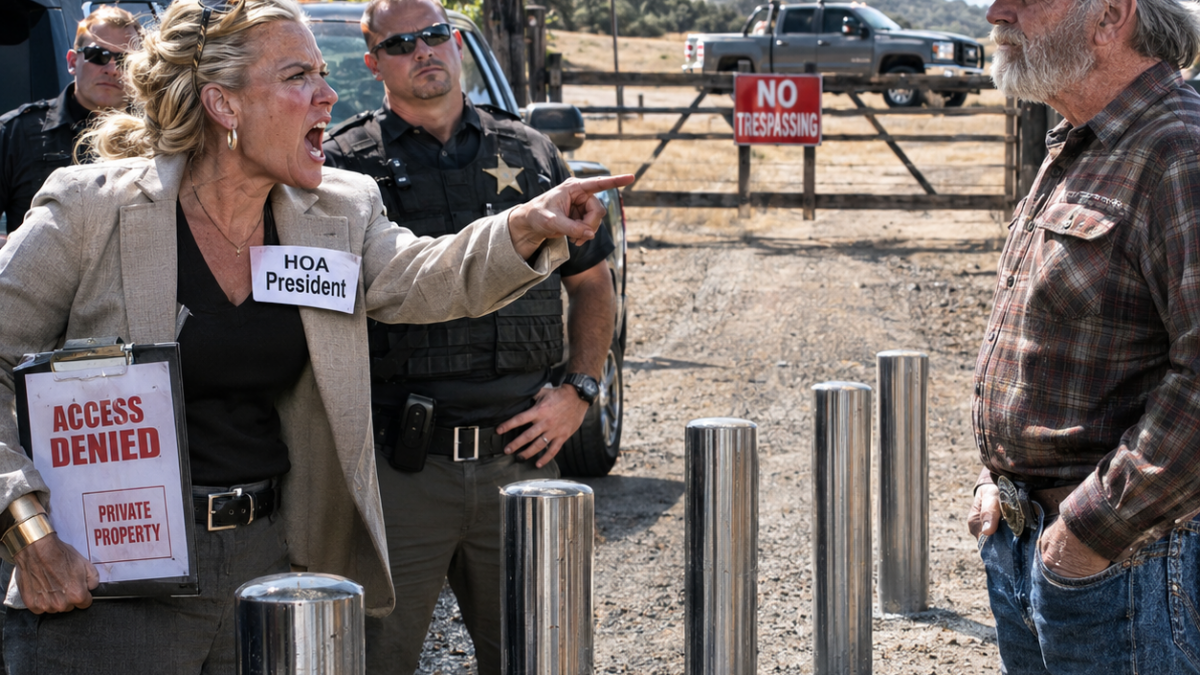
PART 2
There was no badge number.
No department seal.
No county name.
Just a generic shield, an eagle stamped across the center, and two words in tiny letters beneath it.
**SECURITY ENFORCEMENT.**
I stared at the screen for a long time.
Then I opened another clip.
The passenger-side door.
There it was again.
A black shoulder patch stitched with gold thread.
**RIDGEWOOD SECURITY.**
Not sheriff.
Not police.
Not state troopers.
Private security.
The realization made me angry, but what bothered me more was how easily it had worked.
I had stepped aside.
Not because either man had actually said, “We are police.”
They had never needed to.
They wore the costume.
They flashed the lights.
They used words like *official business* and *authority.*
My brain filled in the rest.
That was the point.
I replayed the moment when the bigger man used my name.
“Mr. Dawson.”
He had known exactly whose property he was crossing.
This was not confusion.
It was theater.
And I was the audience they expected to intimidate.
I shut the laptop.
It was nearly midnight, but I knew I wouldn’t sleep.
Instead, I walked outside.
The ruts from their tires cut diagonally through the pasture, from my front entrance toward a gap along the eastern fence.
They had driven the same path often enough that the grass had begun dying beneath it.
A private road created without permission.
I followed it for nearly half a mile.
Moonlight made the flattened grass look silver.
When I reached the hill, I turned toward Helen’s grave.
Even at night I could find it without a flashlight.
I had walked there almost every morning for four years.
Her headstone was simple.
**HELEN DAWSON**
Dates.
**BELOVED WIFE**
Nothing else.
She would have hated anything fancier.
I sat on the bench beside her.
“I may have a problem.”
The wind moved through the grass.
I looked toward Ridgewood Estates.
From the hill, I could see the glow of porch lights beyond my south fence.
Two hundred forty homes.
Streetlights.
A clubhouse.
Victor Harmon’s enormous house up on the ridge.
All of it built because he had convinced people he could turn open land into money.
Now he wanted mine.
I remembered the first offer.
Three-point-two million dollars.
I had laughed because I thought he expected me to negotiate.
Six months later he came back at three-point-eight.
Then four-point-five.
Each time he seemed less interested in buying and more offended that I still had the right to refuse.
The last time, he stood in my kitchen doorway and said:
“You’re sixty-two, Earl. What exactly are you holding onto?”
I looked at him.
“My ranch.”
He smiled.
“You could live anywhere.”
“No.”
“You could retire.”
“I’m already where I want to be.”
“You could buy twice this acreage farther west.”
“Helen isn’t buried farther west.”
That finally silenced him.
Only for a second.
Then he said:
“Cemeteries handle relocations all the time.”
I remember putting my coffee down.
Carefully.
Because I was afraid if I kept holding the mug, I might throw it.
“Get out.”
“I’m just explaining your options.”
“You have one option.”
His smile disappeared.
“Leave.”
He left.
The security cars started less than a month later.
Sitting beside Helen’s grave that night, I finally accepted what I had been avoiding.
Victor Harmon had stopped negotiating.
Now he was applying pressure.
I went home after midnight.
The next morning, I drove into Cedar Mill and spent two hours at the county clerk’s office searching business registrations.
The woman behind the desk showed me how to use the database.
“Business name?”
“Ridgewood Security Services.”
She typed it.
A record came up.
Registered eighteen months earlier.
Principal owner:
**Victor Harmon.**
Business address:
**Ridgewood Estates Clubhouse, Suite 211.**
Registered agent:
**Victor Harmon.**
I printed the page.
Then another.
And another.
I sat in my truck afterward staring at them.
He had not simply hired a security company whose employees happened to become aggressive.
He owned it.
Created it.
Controlled it.
That changed things.
Before driving home, I made one mistake.
At least I thought it was a mistake afterward.
I decided to give Victor one last chance to behave like an adult.
I went to the Ridgewood clubhouse.
The receptionist looked at my boots, then at the polished tile floor.
“Can I help you?”
“I need Victor.”
“Do you have an appointment?”
“No.”
“Mr. Harmon is very busy.”
“He’ll make time.”
Something in my face must have convinced her.
She disappeared down the hall.
Victor came out thirty seconds later wearing a pale blue golf shirt and pressed khakis.
Same easy smile.
“Earl.”
“Mr. Dawson.”
He chuckled.
“Still formal.”
“Your security company has been entering my ranch.”
His smile barely moved.
“I’m sure there’s a misunderstanding.”
“Six times that I documented.”
“Security patrols the perimeter.”
“My pasture isn’t your perimeter.”
“They may have taken the wrong access.”
“Six times?”
He shrugged.
“I’ll speak with them.”
I studied him.
“You own Ridgewood Security.”
“Of course.”
“You didn’t mention that.”
“You didn’t ask.”
“Your men wear badges.”
“They’re security officers.”
“They use emergency-style lights.”
“They have high-visibility equipment.”
“They told me they had authority to cross my land.”
Victor leaned back against the receptionist’s counter.
“Earl, uniforms project authority. That’s partly the point.”
I stared at him.
He smiled.
“People see professional security and behave responsibly.”
“They’re pretending to be police.”
“I didn’t say that.”
“No. You’re careful enough not to.”
The smile became smaller.
He stepped closer.
“Your ranch sits directly between our eastern expansion zone and County Road Twelve. It creates an inefficient access problem.”
“My ranch is not an access problem.”
“It is from a planning perspective.”
“That sounds like your problem.”
“It could become ours.”
He said it gently.
That was what made it a threat.
I asked:
“Are you sending those men through my property because I won’t sell?”
Victor laughed.
“Don’t be dramatic.”
“Answer.”
“You could end every inconvenience tomorrow.”
“How?”
“You know how.”
“Sell.”
“Take four and a half million dollars. More money than that ranch has ever produced. Keep a generous closing window. We’ll handle everything else.”
“And Helen?”
His face became neutral.
“I’ve explained that there are procedures.”
“No.”
“Earl—”
“No.”
He sighed.
“I hate seeing you waste your golden years fighting progress.”
I looked around the clubhouse.
Polished tile.
Leather chairs.
Framed photographs of ribbon cuttings.
Victor smiling in every third one.
“Keep your men off my land.”
He held out both hands.
“Of course.”
I left.
That night at 11:43, flashing blue and red light moved across my bedroom ceiling.
I sat upright.
Engine noise.
Fast.
The sedan tore past my house.
Across the pasture.
Out the east side.
Thirty seconds.
Then silence.
Victor had not misunderstood me.
He had answered.
The next week was worse.
Not because of the cars.
Because of people.
At the feed store, Larry barely looked at me.
I had known him twenty years.
Usually he would talk until I invented an excuse to leave.
That morning he rang up cattle mineral, handed me change, and turned to stock shelves.
At the diner, conversations quieted when I entered.
At the gas station, a man I knew from high school looked away.
I didn’t understand why until Linda Morales stopped at my gate.
She lived in Ridgewood.
Mid-fifties.
Gray streak in her hair.
Always waved when she drove past.
That afternoon, she rolled down her window.
“Mr. Dawson?”
“Earl is fine.”
She looked back toward Ridgewood.
“I thought you should know something.”
“What?”
“Victor’s talking about you.”
“What’s he saying?”
“That you’re unstable.”
I laughed once.
She did not.
“Hostile. Anti-development. Dangerous.”
“Dangerous?”
“He says you’ve made threats.”
“I haven’t.”
“I know.”
“What else?”
“People are talking about complaints.”
“What kind?”
“Livestock odors. Noise. Dust. Property maintenance. Anything they can send to the county.”
I leaned on the gate.
“Do you believe any of it?”
She shook her head.
“No.”
“Why tell me?”
“Because what he’s doing doesn’t feel right.”
She looked embarrassed.
“I used to think this was just a stubborn landowner refusing a good offer.”
“It’s my land.”
“I know that now.”
She drove away.
I stood there for several minutes.
The plan became clearer.
Victor did not need to force me out physically.
He could isolate me.
Make the town tired of me.
Make Ridgewood residents resent me.
Send complaints.
Run fake patrols.
Keep me awake.
Make every ordinary day harder until four and a half million dollars stopped looking like an offer and started looking like an escape.
That was when I stopped treating the vehicles like isolated trespassing.
I began documenting everything.
The cameras caught four more entries over the next two weeks.
One at sunrise.
One at dusk.
One after two in the morning.
Then one afternoon the sedan stopped in the pasture.
The passenger got out.
Walked to a fence post.
Looked directly toward one of my trail cameras.
Then deliberately urinated against the post.
He smiled at the lens.
Got back into the sedan.
Drove away.
I watched the video twice.
The second time, I paused on his face.
That smile was the moment I quit feeling embarrassed about how angry I was.
They were not just crossing my land.
They wanted me to know they could.
I called Sheriff Ray Caldwell that night.
Ray and I had known each other since high school.
We played football together until he wrecked his knee junior year.
I stayed around ranches.
He went into law enforcement.
Forty years later, we were still the kind of friends who could go six months without talking and pick up the same conversation.
He came after his shift.
Still in uniform.
Sat at my kitchen table.
I showed him the footage.
First clip.
Second.
Third.
He said nothing.
Then the one at the fence post.
His jaw tightened.
When it ended, he leaned back.
“Those are not my deputies.”
“I know.”
“That badge looks like it came from a costume store.”
“They say security enforcement.”
“Vehicle?”
“Registered to Ridgewood Security.”
“Victor?”
I slid the business registration toward him.
Ray read it.
“Damn.”
“Can you arrest them?”
“Not from my kitchen.”
“You’re the sheriff.”
“And I still need evidence tied to an offense in my jurisdiction that I can establish properly.”
“I have video.”
“Yes. Which is useful.”
He pointed to the screen.
“But Earl, they’ve been careful. They imply authority. They don’t clearly identify themselves as deputies on these clips.”
“They know what they’re doing.”
“I agree.”
“Then stop them.”
He rubbed his face.
“I will do what I legally can.”
That answer irritated me.
He saw it.
“Don’t look at me like that.”
“Like what?”
“Like I’m Victor’s lawyer.”
“I didn’t say anything.”
“You didn’t have to.”
He leaned forward.
“Listen to me. Document every entry. Dates. Times. Witnesses. Keep original footage. Make backups.”
“I already am.”
“Good.”
“Anything else?”
“Secure your property.”
“How?”
“Legally.”
“That’s vague.”
“It’s intentionally vague because I’m not going to tell you how to build something on your ranch.”
I looked at him.
“But?”
“But you have every right to control access to private property.”
He stood.
“At the same time, do not create a hidden hazard. Do not confront them physically. Do not give Victor the fight he wants.”
I walked him outside.
At his cruiser, Ray turned.
“Victor has money.”
“I know.”
“Lawyers.”
“I know.”
“Connections.”
“I know.”
“He’s counting on you getting angry before he does.”
I folded my arms.
“What do I have?”
Ray almost smiled.
“Patience.”
“That’s it?”
“And eighty acres he hasn’t managed to buy.”
He left.
The next morning I called Marcus Morgan.
Marcus had handled my father’s estate and a boundary dispute years earlier.
I brought him everything.
Footage.
Business registration.
Letters.
Photographs.
My deed.
He listened.
Then said:
“You have multiple legal paths.”
“Fast ones?”
“No.”
“Of course.”
“We could sue. Seek an injunction. Damages for trespass. Pursue claims against Ridgewood Security and potentially Harmon.”
“How long?”
“Could be years.”
“How expensive?”
“Enough that you’ll start hating my face.”
“I already dislike it.”
“Good. Saves time.”
He flipped through photographs.
“Or you physically secure the entrances.”
“Fence?”
“They might cut a fence.”
“Gate?”
“Better.”
“They can ram it.”
Marcus leaned back.
“What do you want?”
“I want them unable to drive through.”
He studied me.
Then opened a drawer and removed a photograph from another case.
Steel bollards.
Bright yellow.
Obvious.
Permanent.
“You install something like this professionally.”
I looked at the picture.
“Legal?”
“Properly placed on your property with adequate notice and visibility, physical access control is ordinary.”
“I don’t want a trap.”
“Then don’t build one.”
He tapped the photograph.
“A hidden cable across a road is a trap. Bright yellow posts with reflective markings and warning signs are barriers.”
I understood the distinction.
“Send notice?”
“Yes.”
“To Harmon?”
“Certified.”
“What should it say?”
“Plain language. Your land is closed to unauthorized vehicles. Barriers are installed. Do not enter.”
That afternoon I ordered six steel bollards.
The crew could install Tuesday.
Before they arrived, I sent Victor a certified letter.
No threats.
No insults.
Just notice.
Unauthorized vehicle access prohibited.
Physical barriers being installed.
Private property.
Written permission required.
I kept a copy.
Return receipt requested.
Monday night I barely slept.
Not because I doubted the property line.
Because I doubted myself.
For sixty-two years, I had built my life around avoiding unnecessary fights.
Fix your fences.
Pay your bills.
Help neighbors.
Don’t create trouble.
Now I was putting steel in concrete because men in fake badges would not stop driving through my pasture.
Around three in the morning, I got out of bed and made coffee.
Then I drove up to Helen’s hill.
I sat beside her in the dark.
“I don’t know if you’d like this.”
The ranch lay quiet below me.
“She would probably say I’m being stubborn.”
A coyote called somewhere far off.
Then I remembered one of the last conversations we had in the hospital.
Helen was exhausted.
Her voice had become thin.
We were talking about paperwork.
The house.
Cattle.
The cemetery plot.
I told her I would keep everything together.
She squeezed my hand.
“Don’t let anybody take what’s ours just because you’re tired.”
At the time, I thought she meant grief.
Maybe she did.
But sitting on that hill, I heard it differently.
By sunrise, I was ready.
The installation truck arrived at seven.
Three workers.
Auger.
Concrete.
Six bright yellow bollards.
I showed them where vehicles had been entering.
The foreman studied the tire ruts.
“You having problems?”
“Yes.”
He looked at my NO TRESPASSING signs.
“Somebody not reading?”
“They read fine.”
Installation took most of the morning.
When they finished, six posts stood across the unauthorized vehicle path.
Bright.
Reflective.
Impossible to miss.
I added warning signs on both sides.
Then photographed everything.
Wide shots.
Close shots.
Property line.
Road approach.
Signs.
Bollards.
I uploaded copies.
Printed copies.
Put them in a folder.
Three days later, the certified-mail receipt came back.
Delivered.
Someone at Ridgewood signed for it.
Marcus reviewed the file.
“Good.”
“Now what?”
“Wait.”
“I hate that answer.”
“Most legal strategy is waiting after you’ve done the important work.”
I sat on the porch that evening and looked toward the yellow posts.
For the first time in months, I felt like the ranch had a front door again.
Then I upgraded the cameras.
Three proper weatherproof units.
Night vision.
Motion alerts.
Cloud backup.
One covered the entrance.
One covered the pasture route.
The third went near the eastern ridge.
Near Helen.
I told myself that location gave the best angle.
That was partly true.
I liked knowing one camera looked out from near her hill.
Marcus helped organize everything.
Deed.
Survey.
Tax records.
Video index.
Screenshots.
Business registration.
Certified notice.
Signed receipt.
Installation invoice.
Photographs.
Warning signs.
By the end, the binder was thick enough that Marcus slapped it once and said:
“If this ends up in court, nobody gets to claim they were confused.”
I also filed a formal complaint with the sheriff’s office.
Suspected law-enforcement impersonation.
Repeated trespass.
Vehicle information.
Business ownership.
The deputy at the desk looked skeptical until he watched the footage.
Then he leaned closer to the monitor.
“They’re using light bars?”
“Yes.”
“And these badges?”
“Security enforcement.”
He watched another clip.
Then another.
“Mr. Dawson, I’m forwarding this.”
“To Ray?”
“To detectives. We may also share material with other appropriate agencies.”
“How long?”
He shook his head.
“Could take time.”
Of course.
Everything legitimate took time.
Victor counted on that.
Men like him understood the difference between speed and authority.
If he could act in hours while law moved in weeks, he could make law feel irrelevant.
For seven days after the bollards went in, nothing happened.
Not one security car.
No late-night lights.
No trespassing.
At first, I thought Victor had finally listened.
By day five, I doubted it.
The silence felt wrong.
On the eighth night, I sat at my kitchen table reviewing older footage.
I found a clip I had watched at least ten times.
The sedan moving slowly through my pasture.
Driver and passenger talking.
I had always studied the image.
That night I put on headphones.
Turned up the audio.
Static.
Engine noise.
Wind.
Then one voice.
“Old man’s got cameras now.”
The other laughed.
“Who cares? What’s he going to do?”
I replayed it.
Again.
Again.
*Who cares? What’s he going to do?*
That was their entire understanding of me.
Not that I lacked rights.
That I lacked power.
The next afternoon Linda Morales knocked on my door.
She looked nervous.
“Victor had a board meeting.”
“What did he say?”
“That you’ve installed illegal booby traps.”
I pointed toward the entrance.
“Those are bright yellow steel posts.”
“I know.”
“He can see them from space.”
“I know.”
“What else?”
She lowered her voice.
“He said you’re unstable. That the board may need to take stronger action.”
“What does that mean?”
“I don’t know.”
She looked back toward the road.
“He said he was going to escalate this weekend.”
“Will you write that down?”
She hesitated.
Fear crossed her face.
I regretted asking immediately.
“You don’t have to.”
“I’m sorry.”
“Don’t be.”
“I have to live there.”
“I know.”
Before she left, she said:
“Be careful.”
I called Ray.
Then Marcus.
Ray told me he could not station deputies based only on secondhand information.
Marcus told me not to confront anyone.
“Stay back.”
“I know.”
“Do not stand in front of a vehicle.”
“I know.”
“Do not touch them.”
“I know.”
“Call law enforcement.”
“I know.”
“Earl?”
“What?”
“Knowing something and doing it while angry are different.”
That night I sat on the porch until midnight.
The bollards reflected moonlight.
I thought about the first time those men told me they had authority.
I stepped aside because I believed them.
That was not cowardice.
It was what civilized people do when they believe lawful authority is speaking.
Victor had weaponized that instinct.
Saturday morning came gray and cool.
I woke before dawn.
Checked cameras.
Made coffee.
Waited.
At 2:17 that afternoon, my phone chimed.
Motion alert.
I opened the camera app.
White sedan.
County Road Twelve.
Coming toward my entrance.
Behind it:
Black SUV.
My heartbeat climbed.
I stood.
The sedan turned.
Red-and-blue lights began flashing.
Same car.
Same theater.
I called 911 before stepping outside.
Then I walked toward the entrance and stopped well back from the barrier.
The cameras had everything.
The signs.
The approach.
The bollards.
The vehicles.
Derek Sloan was driving.
I knew his face by then.
Tommy Vance rode passenger.
The black SUV followed.
Derek did not stop.
That confused me.
The signs were visible.
The posts were obvious.
He kept coming.
Thirty miles an hour, maybe more.
For one second I wondered whether he planned to stop at the last moment.
He didn’t.
The sedan struck the first bollard.
The sound was violent.
Metal folding.
Glass breaking.
Airbags exploding inside the cabin.
The car stopped abruptly, its front end crushed around the barrier.
The SUV behind it braked too late and struck the sedan from behind.
Then everything went still.
The light bar kept flashing.
Blue.
Red.
Blue.
Red.
Steam rose from the damaged hood.
My legs wanted to move toward them.
I made myself stay where I was.
Derek forced open his door.
Blood ran from small cuts across his face.
Tommy came out the passenger side holding his forehead.
Neither appeared unconscious.
Neither collapsed.
Then Derek saw me.
His confusion turned to rage.
“You!”
He staggered toward me.
“You set a trap!”
I kept my phone raised.
“Stay where you are.”
“You tried to kill us!”
“Stay back.”
Behind the sedan, the SUV door opened.
Victor Harmon stepped out.
Golf shirt.
Khaki pants.
He looked at the wrecked sedan.
Then at the bollards.
Then at me.
For once, Victor had no smile.
People were already stopping along County Road Twelve.
Ridgewood residents came toward the entrance.
Phones appeared.
Linda stood near the shoulder with one hand covering her mouth.
Derek kept shouting.
“You’re going to prison!”
I said:
“You entered private property.”
“You deliberately put those there.”
“They’re marked.”
“You knew we’d hit them.”
“You received written notice.”
Victor finally spoke.
“Do not say anything else.”
He was talking to Derek.
Derek spun toward him.
“What?”
“Stop talking.”
That told me Victor understood the situation before Derek did.
Sirens approached.
Real ones.
Ray’s cruiser arrived first.
Two deputies behind him.
Ray stepped out.
He looked at the wreck.
The signs.
The bollards.
Me.
Derek.
Tommy.
Victor.
Then he walked to the sedan.
“Anybody seriously hurt?”
Derek pointed at me.
“He tried to kill us.”
Ray ignored the accusation for the moment.
“Do you need an ambulance?”
“No.”
Tommy said:
“I think I’m okay.”
Ray called for medical evaluation anyway.
Then he turned.
“Identification.”
Derek pulled out his wallet.
Ray checked it.
“Badge.”
Derek hesitated.
“Excuse me?”
“The badge you’re wearing.”
Derek unclipped it.
Ray held it.
Turned it over.
No serial number.
No department marking.
“This isn’t a law-enforcement badge.”
“We’re security.”
“You told Mr. Dawson you had official authority.”
“We do.”
“What agency?”
Derek stopped.
Ray looked at Tommy.
“Your identification and badge.”
Tommy handed them over without arguing.
Ray then turned to Victor.
“Mr. Harmon.”
Victor straightened.
“Sheriff.”
“These men work for Ridgewood Security?”
“They’re contracted personnel.”
“Who owns Ridgewood Security?”
Victor looked toward the crowd.
“I do.”
Ray nodded.
“Your office received written notice not to enter this property.”
“I receive hundreds of letters.”
“It was certified.”
“My staff handles mail.”
Victor was already building distance between himself and his own company.
Ray noticed.
“So you didn’t know about the bollards?”
“I knew Earl had installed some kind of obstruction.”
“Obstruction?”
“This route has been used repeatedly for community security.”
“On his property?”
Victor looked at me.
“It’s been an ongoing dispute.”
Ray’s face changed.
“No.”
He pointed toward my ranch.
“A dispute implies competing rights. Show me yours.”
Victor did not answer.
Ray turned to one deputy.
“Separate everybody.”
The next hour felt strangely quiet despite all the people.
Photographs.
Measurements.
Statements.
Medical checks.
Videos copied.
Warning signs documented.
Certified-mail receipt photographed.
The damaged sedan sat folded around the yellow post while its fake emergency lights continued flashing until a deputy finally shut them off.
I remember that moment.
The lights went dark.
Something in me relaxed.
Not because the problem was over.
Because the costume had stopped working.
Derek and Tommy were taken into custody as investigators sorted through the existing complaint and what had happened that afternoon.
Victor tried to leave.
Ray raised one hand.
“Not yet.”
Victor stopped.
“Am I under arrest?”
“Not at this time.”
“Then I’m free to go.”
“You are connected to an active investigation involving your company, your employees, repeated trespass complaints, and representations of law-enforcement authority.”
“My attorney will contact you.”
“I expect he will.”
Victor looked at me.
Not angry.
Not exactly.
He looked betrayed.
As if I had violated an agreement I never made.
“You did this on purpose.”
I shook my head.
“No.”
“You knew they’d come back.”
“I hoped they wouldn’t.”
“That’s a lie.”
Ray stepped between us.
“Victor, leave.”
Victor got into the black SUV once deputies finished with him.
He drove away slowly.
No lights.
No shortcuts.
Public road.
Just like everyone else.
The tow truck removed the sedan before sunset.
The bollard had a scrape of white paint.
That was about it.
I stood there after everyone left and ran my hand across it.
For months, letters had failed.
Conversations failed.
Warnings failed.
Complaints moved slowly.
Then six visible pieces of steel made the boundary undeniable.
I looked toward Helen’s hill.
“It might be over.”
I did not say *we won* yet.
I had learned not to declare endings too early.
The investigation moved faster after that day.
Footage that had been scattered across months became one timeline.
Every entry.
Every flash of the light bar.
Every fake badge.
Every warning.
Every certified document.
Derek and Tommy claimed they were only doing their jobs.
That argument did not help Victor.
Because then investigators asked the obvious question.
Who gave the orders?
Ridgewood Security’s records became important.
Victor’s ownership became important.
Scheduling records.
Patrol instructions.
Invoices.
Communications.
The company had not been some independent contractor he barely knew.
It was his.
The more investigators looked, the harder it became for Victor to separate himself from what his employees had done.
Ridgewood held an emergency HOA meeting.
Linda called me beforehand.
“You should come.”
“I’m not in your HOA.”
“That’s why you should come.”
“I don’t want to.”
“People need to see you.”
“They’ve seen enough of me.”
“Earl.”
I sighed.
“Fine.”
The clubhouse parking lot was full.
Victor was not there.
His attorney had apparently advised him to stay away.
That changed the room immediately.
Without Victor standing at the front telling everyone what the facts meant, residents had to read them themselves.
The temporary board chair opened the meeting.
People shouted questions.
“Who approved Ridgewood Security?”
“Why did they have emergency lights?”
“Were dues paying for this?”
“Why were they on Dawson’s ranch?”
“Did the board know?”
Some answers were ugly.
The company had been paid through association-related contracts.
Victor had pushed the arrangement.
Oversight had been minimal.
Board members assumed the patrol function was legitimate.
No one had bothered asking why an HOA security company needed to cross private ranch land that did not belong to the community.
Linda stood.
“Because Victor wanted the ranch.”
Silence.
She looked toward me.
Then back to the board.
“He talked about Phase Two constantly.”
A man across the aisle said:
“That doesn’t prove he ordered harassment.”
“No,” Linda answered. “But maybe somebody should ask why the harassment began after Earl refused to sell.”
For months she had been afraid to speak openly.
That night she did.
I respected her for it.
One resident turned toward me.
“Why didn’t you sell?”
I looked at him.
“Because I didn’t want to.”
He waited.
Maybe he expected a better reason.
I gave him one.
“My wife is buried there.”
The room changed.
Some residents knew.
Most didn’t.
I continued.
“She chose the eastern hill.”
Nobody spoke.
“Victor knew.”
A woman whispered:
“He still kept offering?”
“Yes.”
Another resident asked:
“Couldn’t the grave stay?”
“Maybe.”
I looked at him.
“But I made her a promise.”
That was all.
I did not need everyone to understand.
The board voted to suspend all contracts with Ridgewood Security pending investigation.
A month later, the company’s license was under state scrutiny.
Soon after, it was effectively finished.
Derek and Tommy’s cases moved through the courts.
Their lawyers tried several explanations.
They were private guards.
They never explicitly claimed to be sheriff’s deputies.
The light bar was for visibility.
The badges were company insignia.
Crossing my ranch was a route misunderstanding.
Each explanation might have sounded plausible alone.
The problem was the pattern.
Months of footage.
My warnings.
The deliberate entries.
Their statements about authority.
The humiliation at the fence post.
The final drive through clearly posted barriers.
The documentation made it difficult to pretend any one event was accidental.
Eventually both men faced serious criminal consequences tied to the impersonation scheme, trespass, and related conduct.
Derek received the heavier sentence.
Tommy received less.
Both lost the ability to continue in the security work they had treated like a private police force.
I did not attend every court date.
I went to enough.
At one hearing, Derek looked at me across the courtroom.
He seemed smaller without the uniform.
No badge.
No sunglasses.
No light bar behind him.
Just a man in ordinary clothes sitting beside a lawyer.
He looked away first.
That gave me no pleasure.
I expected it might.
It didn’t.
The uniform had been the point.
Authority was the point.
Without the costume, there was nothing impressive about him.
Victor’s legal position took longer.
He had good attorneys.
Very good attorneys.
They argued he had not personally worn a fake badge.
He had not driven the sedan into my ranch that final afternoon.
He had not personally threatened me with arrest.
He was simply a businessman whose employees exceeded their responsibilities.
Then investigators produced the company filings.
His ownership.
His control.
My certified letter.
Internal records.
The history of Phase Two.
He had known there was an ongoing trespass dispute.
He had known I was refusing to sell.
He had known barriers were installed.
And he had done nothing meaningful to stop the conduct.
His lawyers could argue details.
They could not erase chronology.
Ultimately, Victor accepted a resolution rather than drag everything through a public trial.
Financial penalties.
Probation.
Restrictions that removed him from the kind of HOA authority he had been using.
No dramatic prison sentence.
That annoyed some people.
One man from Ridgewood told me:
“He should be locked up.”
“Maybe.”
“You don’t think so?”
“I think punishment is somebody else’s job.”
He looked disappointed.
People wanted me to hate Victor forever.
For a while, I did.
Then I learned hatred was just another way of letting the man occupy land he did not own.
Inside your head.
I had already refused to give him the ranch.
I wasn’t giving him that either.
The punishment that hurt him most came from Ridgewood itself.
The HOA board removed him.
Unanimously.
A community he had built around his own influence decided it no longer wanted him controlling it.
Phase Two died immediately.
Without my eighty acres, the expansion plan did not work the way Victor designed it.
No shortcut.
No convenient connection to County Road Twelve.
No clean block of development land.
Investors backed away.
Victor’s projections collapsed.
The thing he had been trying to force me into selling became the thing he could not build without.
That felt closer to justice than prison would have.
Ridgewood Security disappeared.
Its vehicles were sold.
The black SUV Victor drove that afternoon went at auction.
Months later somebody told me a rancher two counties over bought it for his teenage son.
I liked that.
A vehicle once used to intimidate a rancher hauling feed and fence posts instead.
The white sedan was finished.
No surprise there.
The front half looked like crushed foil after hitting the bollard.
It was scrapped.
For weeks after the crash, people slowed down when passing my gate.
Some took photographs.
That irritated me.
I was not running a roadside attraction.
One afternoon, a man from Ridgewood pulled over.
“I’ve got to ask.”
“No.”
He laughed.
“You don’t even know the question.”
“Yes, I do.”
“Did you know they were going to hit those?”
“I knew they had been told not to enter.”
“But did you know?”
“No.”
I looked at the posts.
“I thought rational people would stop.”
He considered that.
“Fair.”
Then drove away.
Linda became a friend.
Not close in the way Ray and I were.
But close enough that she occasionally brought food when she thought I had forgotten groceries.
A week after the arrests, she showed up with a casserole.
“I don’t need this.”
“You live alone.”
“I can cook.”
“You eat canned chili.”
“That is cooking.”
She handed me the dish anyway.
Then looked toward the hill.
“You really take coffee up there every morning?”
“Yes.”
“That sounds lonely.”
“It isn’t.”
She nodded.
She understood not to ask more.
The new Ridgewood board was different.
Younger.
Less interested in expansion.
More interested in figuring out where several years of dues had actually gone.
Meetings opened.
Contracts reviewed.
Security spending examined.
People asked questions that Victor had trained them not to ask.
Linda told me one meeting lasted four hours.
“Sounds miserable.”
“It was.”
“Good.”
She laughed.
“Why good?”
“Maybe you’ll read documents next time.”
“We read all of them now.”
“Better.”
They discovered that no single board vote had explicitly authorized a campaign to harass me.
Victor had operated through overlapping decisions.
Security budget here.
Route instruction there.
Development planning somewhere else.
No one document said:
**Intimidate Earl Dawson until he sells.**
Real abuses rarely come labeled that cleanly.
They form through people not asking questions.
Someone assuming somebody else checked.
Someone signing because Victor always handled it.
Someone staying silent because raising objections made meetings uncomfortable.
That disturbed Ridgewood residents more than if Victor had simply been a lone villain.
It meant the system had helped him.
Not because everyone was corrupt.
Because too many people were passive.
The new board changed that.
No security company controlled by a board member.
Vendor disclosures.
Competitive bids.
Written limits on patrol authority.
No entering adjacent private property without permission.
That final rule made me laugh when Linda told me.
“You needed a rule for that?”
“Apparently.”
“Civilization is doomed.”
“Probably.”
The social hostility faded slowly.
Larry at the feed store started talking to me again.
The first time, he acted like nothing had happened.
“How many mineral blocks?”
“Six.”
“Same brand?”
“Yes.”
He started ringing them up.
Then stopped.
“Earl.”
I waited.
“I believed Victor.”
“I know.”
“He said you threatened people.”
“I know.”
“I should’ve asked.”
“Yes.”
He looked at me.
I could have made him suffer.
Could have listed every time he avoided my eyes.
Instead I said:
“Your daughter’s wedding go okay?”
Larry smiled weakly.
“Yeah.”
“Good.”
That was enough.
At the diner, conversations stopped going quiet when I entered.
A few people apologized.
Some never did.
That was fine too.
I had learned that requiring apologies from everyone was another exhausting form of dependence.
I knew what happened.
The people who mattered knew.
The record knew.
That was enough.
Ray came by one evening after the worst legal part was over.
We sat on my porch.
He brought two beers.
I gave him coffee instead.
“You’re becoming boring.”
“I’m sixty-two.”
“That never stopped you before.”
We watched the eastern sky darken.
He pointed toward the bollards.
“You keeping those?”
“Yes.”
“Even now?”
“Yes.”
“You know nobody’s coming through.”
“That’s the idea.”
He smiled.
“You scared me that day.”
“The crash?”
“The whole situation.”
“Why?”
“Because I knew how angry you were.”
“I stayed back.”
“You did.”
“I called first.”
“You did.”
“I listened.”
“You did.”
I looked at him.
“So what’s the problem?”
He took a drink.
“Most people think self-control means you’re not angry.”
I waited.
“You were furious.”
“Yes.”
“And you still followed every instruction Marcus and I gave you.”
“Almost every.”
He laughed.
“What did you ignore?”
“You told me to relax.”
“That was unrealistic.”
I looked toward Helen’s hill.
“Victor wanted me to lose my temper.”
“I know.”
“If I’d hit one of those men?”
“He would have used it.”
“Threatened them?”
“Used it.”
“Fired a gun?”
Ray looked at me.
“You’d have handed him the story he wanted.”
I nodded.
That had become clear afterward.
The fake uniforms were not only intimidation.
They were bait.
Push the old rancher.
Humiliate him.
Make him explode.
Then Victor could point at me and say:
See?
Unstable.
Dangerous.
Unreasonable.
Instead, the cameras showed something else.
Them entering.
Me warning.
Them laughing.
Them escalating.
That difference mattered more than any speech.
Spring came.
The ruts through the pasture disappeared beneath new grass.
I repaired the east fence.
Repainted the warning signs.
Then one Saturday morning, I brought out a can of dark blue paint.
Six yellow bollards stood at the entrance.
I painted one letter on each.
H.
About three inches tall.
Not large enough for anybody driving by to understand.
Linda noticed.
“What does H mean?”
“Helen.”
Her face softened.
“Oh.”
I stepped back.
“They look ridiculous.”
“No.”
“Yes.”
“They look like highway equipment with initials.”
“That’s what they are.”
She smiled.
“Then why do it?”
I looked toward the hill.
“Because she’s why they’re here.”
Not literally.
Victor was why the steel was there.
But Helen was why I stayed.
Why the four and a half million dollars never became tempting enough.
Why every offer was different from an ordinary land sale.
When Helen was dying, I promised two things.
She would stay on the hill.
I would eventually be beside her.
Victor thought those promises were logistical issues that money could solve.
That was why he never understood me.
He believed everybody had a price because everything in his world had a price.
Land.
Votes.
Access.
Silence.
Security.
Influence.
I had something he could not negotiate because I had decided long before meeting him that it was not negotiable.
The ranch stayed.
So did Helen.
Every morning, I still carried coffee up the hill.
Some days I talked.
Some days I didn’t.
After the case settled, I told her:
“Victor’s gone.”
The headstone did not answer.
“Ridgewood’s staying where it is.”
Wind moved through cedar and live oak.
“The cows are still stupid.”
That made me smile.
I sat there until the coffee cooled.
The ranch looked almost exactly as it had before everything started.
Same hills.
Same creek.
Same barn.
Same eastern pasture.
Ridgewood houses still visible beyond the fence.
But the land felt different.
Not because a court had given it to me.
It had always been mine.
Not because the deed changed.
It didn’t.
Because for the first time, I understood that ownership on paper and ownership in practice are not quite the same feeling.
A deed tells the world where the line is.
Sometimes you still have to insist that the line matters.
Months later, a pickup with out-of-state plates turned onto my entrance.
The driver slowed.
Saw the warning signs.
Saw the yellow posts.
Stopped.
He rolled down his window.
“Sir?”
I walked toward him.
“Can I help you?”
“I think my GPS sent me wrong.”
“Where are you headed?”
“State Highway Twenty-Seven.”
“You’re six miles off.”
He laughed.
“Figures.”
He looked at the bollards.
“Those serious?”
“Yes.”
“Nice fence.”
“It works.”
I gave him directions.
He backed out carefully.
Turned around.
Left.
No confrontation.
No authority.
No flashing lights.
Just a man who saw a boundary and respected it.
That was when I knew the whole thing was finally over.
Not when Derek and Tommy were handcuffed.
Not when Victor lost Ridgewood.
Not when the company disappeared.
When a stranger saw the signs, stopped, asked permission, and turned around.
I finished my coffee.
Looked once toward Helen’s hill.
Then walked back inside.
The six yellow bollards stayed at the entrance.
Each one carried the same small dark-blue H.
To everybody else, they were steel posts.
To me, they marked something far older than the fight with Victor Harmon.
A promise.
A boundary.
And the place where, after sixty-two years, I finally learned I did not have to step aside simply because somebody wore a badge and told me they had authority.
[END OF STORY]








