PART 2: HOA Voted to Run a Trail Through My Orchard—Then a $410,000 Loss Estimate Stopped Them Cold
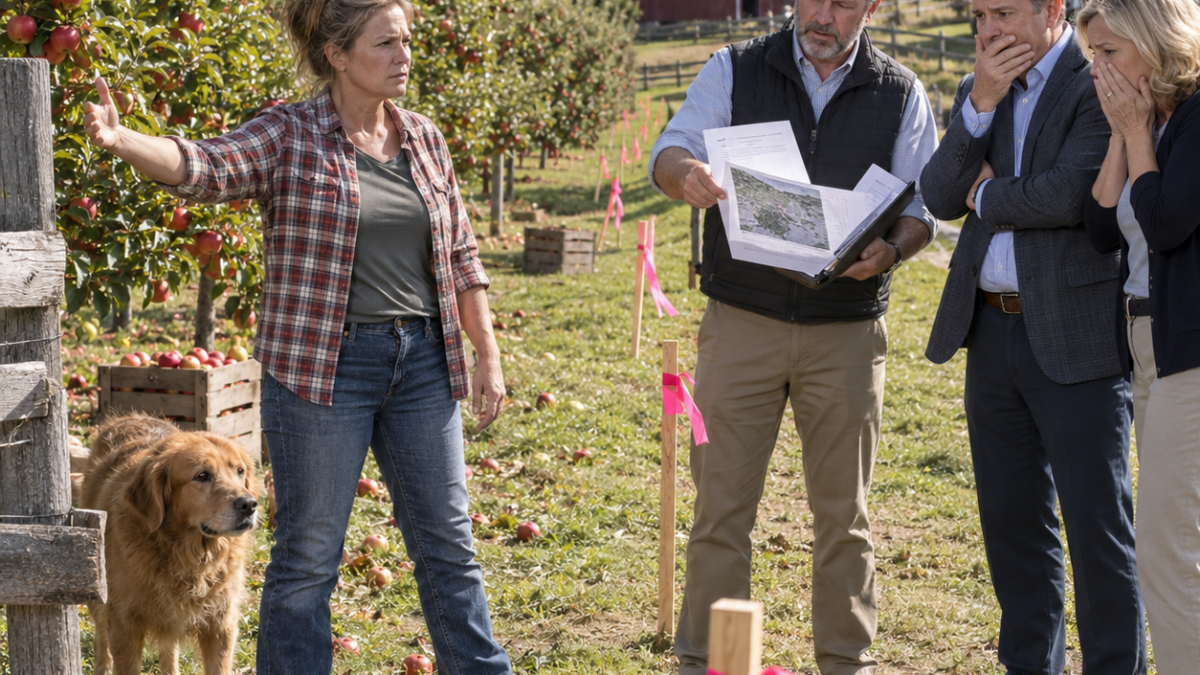
The HOA president looked me straight in the eye and said their vote gave them the right to cut a ten-foot-wide walking trail through the most valuable two acres of my apple orchard.
When I told her my farm wasn’t part of their association and there wasn’t a single public easement across my land, she smiled and said, “You’re one man, Mr. Caldwell. The community has spoken.”
What she didn’t know was that within forty-eight hours, one insurance specialist would put a dollar figure on the damage—and that number would make every person who voted with her start wondering what her “wellness trail” was really going to cost them.
My name is John Caldwell.
I’m forty-five, a retired Army Corps of Engineers major, and for the last decade I’ve operated fifteen acres of commercial apple orchard beside a subdivision called Whispering Pines.
The orchard wasn’t a hobby.
It paid our mortgage.
It helped put our daughter through school.
We supplied three farmers markets, a local cider company, and two boutique grocery stores with Honeycrisp, McIntosh, Cortland, and several heirloom varieties my wife Sarah’s family had been growing for generations.
Some of our oldest trees had been planted by Sarah’s grandfather.
The subdivision came later.
Five years after we bought the property, developers built rows of nearly identical houses along our eastern boundary.
I never joined their HOA.
My deed wasn’t subject to their covenants.
My survey showed exactly where Whispering Pines ended and Caldwell Orchard began.
For years, that was enough.
Then I received the letter.
COMMUNITY ENHANCEMENT INITIATIVE.
That was the phrase printed across the top.
The HOA had voted unanimously to build a “wellness trail” connecting two sections of the subdivision.
Attached was a map.
A thick red line ran straight across my orchard.
Not along the edge.
Not beside the fence.
Through it.
Ten feet wide.
It crossed irrigation lines and cut directly through Block C, where fifty-two mature Honeycrisp trees stood in their prime producing years.
At first I thought it was a mistake.
So I attended their next meeting carrying my deed and survey.
Karen Peterson, the HOA president, sat at the front beneath a banner reading WHISPERING PINES — COMMUNITY FIRST.
I waited through discussions about trash cans and mailbox paint.
Then I stood.
“My name is John Caldwell. I own the orchard west of your subdivision.”
Karen folded her hands.
“I know who you are.”
“I received your trail letter.”
“Yes.”
“There’s a problem.”
She smiled.
“The board has already approved the project.”
“That is the problem.”
I placed my survey on the table.
“The proposed route is entirely on private property. My property.”
A board member glanced at the map.
Karen didn’t.
“Our bylaws encourage cooperation with adjoining landowners for community improvement.”
“Encourage?”
“Yes.”
“That isn’t an easement.”
Her smile disappeared slightly.
“Our residents deserve a safe route for walking and exercise.”
“I’m sure they do.”
“Then I’m glad we agree.”
“We don’t.”
The room became quiet.
I pointed at the red line.
“That trail would remove productive trees, damage root systems, interfere with irrigation, introduce unrestricted foot traffic into an active commercial operation, and divide the orchard.”
Karen leaned back.
“Mr. Caldwell, with all due respect, your little hobby farm does not supersede the community’s right to wellness.”
I stared at her.
“Hobby farm?”
Sarah’s grandfather had planted trees on that ground after coming home from war.
Her father had taught us grafting techniques beneath those branches.
Our children had spent autumn weekends sorting fruit there.
Karen saw scenery.
I saw thirty years of work.
“The orchard is a commercial business,” I said.
“The community voted.”
“I don’t care.”
A murmur ran through the room.
Karen’s eyes narrowed.
“We begin clearing Monday.”
“No, you don’t.”
“The decision is final.”
I picked up my survey.
“If a contractor crosses my property line without permission, he will be trespassing.”
“You can threaten all you want.”
“I’m not threatening you.”
I slid my deed back into the folder.
“I’m telling you where my property starts.”
Karen laughed.
“You’re one person against an entire community.”
That sentence stayed with me all the way home.
Sarah was waiting in our kitchen.
I spread the HOA map across the table and showed her where the trail would go.
She stared at the red line.
“That’s Grandpa’s block.”
“I know.”
“They can’t do this.”
“No.”
She looked at me.
“So what happens now?”
I turned toward the orchard outside the window.
“We stop arguing about whether they’re allowed to do it.”
Sarah frowned.
“What does that mean?”
“It means tomorrow I find out exactly what happens financially if they try.”
The following afternoon, a crop-loss adjuster walked the proposed route with me.
He measured trees.
Studied roots.
Reviewed five years of production.
Calculated lost yield.
Future production.
Soil compaction.
Pest pressure.
Irrigation disruption.
Two hours later, he handed me his preliminary report.
At the bottom was one number.
$410,000.
And suddenly Karen’s little walking trail wasn’t a neighborhood improvement anymore.
It was a potential financial disaster.
PART 2
I read the number three times.
Four hundred ten thousand dollars.
Dave Mercer, the senior agricultural adjuster, stood beside his pickup while the October sun slid behind Block C.
He had spent most of his career evaluating losses from hail, frost, wind, drought, disease, and equipment accidents.
He had never evaluated damage caused by a homeowners association that believed a community vote somehow created rights over somebody else’s farm.
“Is that worst case?” I asked.
“No.”
That surprised me.
“What is it?”
“Conservative projected loss.”
He opened the binder again.
“Fifty-two trees would likely be removed entirely if they actually follow the line on this map.”
He pointed toward the orchard.
“These aren’t nursery saplings. Most of them are mature production trees.”
“I know.”
“I’m saying that because a non-farmer thinks tree equals tree.”
He tapped one of the Honeycrisps beside us.
“You cut this down and plant another tomorrow, you don’t replace it tomorrow.”
He looked at me.
“You replace the physical object.”
“Not the production.”
“Exactly.”
He showed me the calculations.
Average yield.
Market value.
Tree lifespan.
Transition period.
Additional losses caused by the path itself.
A ten-foot gravel trail would not affect only ten feet.
Construction equipment compacting soil could damage roots beyond the visible trail.
Uncontrolled public access increased risk from pests, contamination, broken branches, theft, litter, unleashed dogs and accidental damage.
My irrigation lines crossed the proposed route twice.
The orchard’s spray schedule could become complicated if members of the public wandered through whenever they wanted.
Then came liability.
Dave had written three words I hadn’t considered seriously enough.
ACTIVE AGRICULTURAL OPERATION.
This was not a public park.
We used tractors.
Sprayers.
Pruning equipment.
Harvest vehicles.
Ladders.
During parts of the year, farm machinery moved through rows before sunrise.
A recreational path through the middle of it would create a safety problem for everyone.
“You should send this to your attorney,” Dave said.
“I don’t have one yet.”
“Get one.”
He closed the binder.
“John, I’m not trying to scare you.”
“You already succeeded.”
“That isn’t my point.”
He rested both hands on the open truck door.
“The minute someone formally announces an intention to destroy commercial agricultural assets after being told they have no right to do it, you stop treating it like a neighborhood disagreement.”
I looked back toward Whispering Pines.
From where we stood, I could see roofs beyond the eastern fence.
“That’s exactly what they think it is.”
“Then educate them.”
He handed me the binder.
“Preferably before anyone starts a machine.”
Sarah was waiting at the kitchen table when I went inside.
She saw my face.
“How bad?”
I placed the report in front of her.
She read the first page.
Then the last.
Her hand went over her mouth.
“Four hundred ten thousand?”
“That’s his preliminary figure.”
“For a trail?”
“For everything the trail damages over time.”
She stood and walked toward the window.
Her grandfather’s block stretched into darkness.
“He planted those trees.”
“Some of them.”
“He used to bring me out there with pruning shears when I was nine.”
“I know.”
“I hated it.”
That made me smile slightly.
“You told me.”
“I wanted to play.”
She laughed once, but there was no humor in it.
“Now I’d give anything for one more morning of him telling me I was cutting at the wrong angle.”
I walked over and put my hands around her waist.
“We’re not losing the trees.”
“How do you know?”
“Because they don’t have a legal right to them.”
“But Karen thinks she does.”
“That’s why I need someone who can explain it in a language she respects.”
“Lawyer?”
“Lawyer.”
The next morning I called three people I had served with.
The third gave me a name.
Marcus Thorne.
Former Army JAG.
Property attorney.
His office was in an older brick building downtown between an insurance brokerage and a dentist.
No marble lobby.
No polished receptionist behind a glass wall.
Just framed military photographs, two shelves of legal books, and a coffee maker that looked older than I was.
Marcus was fifty-eight.
Lean.
Gray at the temples.
His handshake was firm without being theatrical.
“Major Caldwell?”
“Retired.”
“So am I.”
He pointed toward a chair.
“What did you bring?”
I placed the documents on his desk.
HOA letter.
Trail map.
County survey.
Deed.
Insurance assessment.
“That all?”
“For now.”
“Good.”
He started with the deed.
Read slowly.
Then the survey.
Then the HOA letter.
He paused at the line referencing Article Nine, Section Four.
“What does this say?”
“Cooperation with adjacent properties for community betterment.”
Marcus looked at me.
“You belong to the HOA?”
“No.”
“Any easement?”
“No.”
“Recorded access agreement?”
“No.”
“Prior license?”
“No.”
“Did a previous owner grant anything?”
“Not according to the title report.”
He leaned back.
“Then this is nonsense.”
“That was my assessment.”
“Your assessment is correct.”
He picked up the HOA letter again.
“They voted?”
“Unanimously.”
Marcus smiled.
“Wonderful.”
“Why wonderful?”
“Because most people are smart enough to make bad decisions verbally.”
He held up the letter.
“These people printed theirs.”
He reached for the insurance report.
That changed his expression.
He studied the numbers carefully.
“Who prepared this?”
“Senior agricultural adjuster.”
“Licensed?”
“Yes.”
“Supporting production records?”
“Five years.”
“Market sales?”
“Yes.”
“Tree ages?”
“Yes.”
“Projected losses?”
“Yes.”
Marcus looked at me.
“This is important.”
“I assumed so.”
“No.”
He tapped the $410,000 figure.
“This is extremely important.”
He explained why.
Until that report existed, Karen could dismiss the trail as a disagreement about a few trees.
Now there was a documented estimate showing substantial potential commercial harm.
If they proceeded after receiving it, they could no longer credibly claim they had no idea what the consequences might be.
“What do we do?”
“First, no theatrics.”
“Fine.”
“No threats.”
“Fine.”
“No arguing with Karen.”
“I can manage that.”
“Everything in writing.”
“Already doing it.”
He smiled.
“Army.”
“Army.”
Then his tone changed.
“I’m sending a cease-and-desist letter.”
“To the HOA?”
“To the HOA, the president, and each board member.”
“Individually?”
“Yes.”
He leaned forward.
“Karen’s strength is that she can tell everyone this is abstract HOA business.”
“A board decision.”
“Exactly.”
“I want the four other people who voted for this sitting at their kitchen tables reading a letter addressed to them by name.”
Marcus began making notes.
“They need to understand that they were formally warned this land is not theirs.”
He pointed at the insurance report.
“They need the $410,000 estimate attached.”
“And then?”
“We demand written abandonment of the project.”
“How long?”
“Five business days.”
“And if they don’t?”
“We prepare for an injunction and damages if they attempt entry.”
I nodded.
Marcus studied me.
“You look disappointed.”
“No.”
“Yes, you do.”
“I expected something more aggressive.”
He almost laughed.
“John, there is nothing more aggressive than giving an unreasonable person one final opportunity to become reasonable while building evidence that they refused.”
That sentence sounded like something my commanding officer might have said.
Marcus continued.
“Also, install cameras.”
“I already have security cameras around the house.”
“I want the orchard boundary covered.”
“That’s a lot of ground.”
“Then cover the section where their trail starts.”
“Why?”
“Because if someone steps across that line after receiving written notice, I want proof.”
The following afternoon I installed four high-definition cameras.
One faced the old stone boundary markers.
Another covered the service gate.
A third pointed toward Block C.
The fourth covered the north fence where the HOA map showed their proposed entrance plaza.
Sarah watched me from the porch.
“This is getting ridiculous.”
“I know.”
“I used to think cameras were for raccoons.”
“Now they’re for homeowners associations.”
She smiled despite herself.
“I liked the raccoons better.”
“So do I.”
The cease-and-desist letters went out by certified mail.
Delivery confirmation arrived for the HOA office first.
Then Karen.
Then each board member.
Marcus emailed me the timestamps.
Five days.
That was all they had to send one sentence:
The project is canceled.
Nothing came.
No attorney.
No acknowledgement.
No apology.
No revision.
Nothing.
The silence bothered me more than an angry response would have.
On Friday afternoon, I called Marcus.
“Deadline expired.”
“I know.”
“What now?”
“Has anyone entered?”
“No.”
“Then we continue documenting.”
“They said Monday.”
“Correct.”
“You think they’ll actually come?”
Marcus paused.
“I think rational people won’t.”
“And Karen?”
“I’ve never met Karen.”
“I have.”
“That answers your question.”
Monday morning I woke at 5:10.
Harvest season normally made early mornings peaceful.
That one felt different.
I poured coffee and opened the camera feeds on the monitor in my office.
Black screen.
Boundary fence.
Rows of trees.
Dawn slowly gathering between branches.
Sarah appeared behind me wearing a robe.
“You slept?”
“Some.”
“No, you didn’t.”
“I rested horizontally.”
She put a hand on my shoulder.
“Don’t go looking for a fight.”
“I won’t.”
“Promise.”
“I promise.”
At 7:53, Camera Two detected motion.
A white utility truck stopped beside the subdivision road.
A trailer followed.
On the trailer sat a compact brush-clearing machine.
My heartbeat changed instantly.
Then a black SUV pulled up.
Karen stepped out.
Khaki pants.
Hiking boots.
An embroidered HOA vest.
Of course she had an embroidered vest.
Sarah whispered:
“She actually came.”
“I know.”
“Call Marcus.”
I already was.
He answered.
“They’re here.”
“Have they crossed?”
“No.”
“Keep recording.”
“Do I call the sheriff?”
“If they cross or begin damaging property, yes. Otherwise give the contractor notice first.”
I grabbed my phone.
Sarah caught my arm.
“John.”
“I’m okay.”
“I know.”
She looked toward Block C.
“Just come back okay too.”
I kissed her forehead.
Then I walked.
Not fast.
Running communicates panic.
I was not panicked.
I was furious.
But anger and panic are different things.
Karen was standing beside the contractor when I approached.
The contractor held orange spray paint.
Karen was pointing toward my orchard.
“Straight through there,” she said.
“Ten feet wide.”
She pointed toward one of my oldest trees.
“Line it up with that oak on the far side.”
Then she said the sentence that made my stomach tighten.
“Don’t worry about the smaller apple trees. Just clear them.”
“Morning,” I said.
Both turned.
Karen’s expression hardened.
“Mr. Caldwell.”
The contractor looked uncertain.
“I need to speak with you,” I told him.
Karen stepped between us.
“No. You don’t.”
I ignored her.
“Sir, what’s your name?”
“Rick.”
“Rick, you’re standing at the boundary of private agricultural property.”
He looked down at the marker.
“Ma’am said there’s a community right-of-way.”
“There isn’t.”
Karen snapped:
“Yes, there is.”
I held up my phone.
“This conversation is being recorded.”
Rick looked at the camera post behind me.
Then at the other one.
I continued.
“The HOA received formal written notice that there is no easement across this land.”
Karen folded her arms.
“Our attorneys disagree.”
That was interesting.
“Name?”
“What?”
“Your attorney.”
“That is confidential.”
I nearly smiled.
It wasn’t.
I turned back to Rick.
“You and your company are now personally on notice that I do not authorize entry.”
He lowered the spray can.
Karen said:
“Rick, ignore him.”
I continued.
“The HOA has also received a certified agricultural loss estimate calculating potential damages at four hundred ten thousand dollars.”
Rick looked at Karen.
She said:
“That number is fabricated.”
“It was prepared by a licensed agricultural adjuster.”
Rick frowned.
“What exactly are we clearing?”
Karen answered quickly.
“A trail corridor.”
“Across his farm?”
“It’s an easement.”
“No,” I said.
Karen shouted:
“Yes!”
I pointed toward the survey marker.
“Rick, that stone is the property line.”
Then toward Block C.
“Everything beyond it is mine.”
He looked at Karen.
“You got easement paperwork?”
Karen’s face changed.
“The HOA board approved it.”
Rick blinked.
“That’s not what I asked.”
For the first time, I felt a tiny shift.
Not victory.
Reality entering the conversation.
Karen stepped closer to him.
“Your contract says begin Monday.”
“My contract says clear the trail corridor you provided.”
“Correct.”
“You told me permissions were handled.”
“They are.”
“Then show me.”
Karen’s mouth tightened.
Rick looked at me.
“You gonna call the cops if we cross?”
“Yes.”
No hesitation.
“Absolutely.”
“And sue us?”
“If property is damaged, yes.”
Rick slowly capped the spray paint.
Karen stared.
“What are you doing?”
“I’m calling my boss.”
“I am your client.”
“You’re one client.”
He walked toward his truck.
Karen followed.
“You will start this work!”
Rick turned.
“Not until I see legal access.”
“You have my authorization.”
“Lady, you keep saying that like you own his farm.”
Karen went completely red.
“Do you know who I am?”
“Yes.”
Rick glanced at her embroidered vest.
“You’ve made it extremely clear.”
I almost laughed.
Karen pointed at me.
“He’s intimidating you.”
“No.”
Rick shook his head.
“He’s telling me I might get arrested.”
“You won’t.”
“You paying my legal bills?”
Silence.
“That’s what I thought.”
He climbed into the utility truck.
Karen slapped her palm against the passenger door.
“You can’t leave.”
“Watch me.”
He called something to the second worker.
They loaded the small clearing machine.
Within five minutes, the utility truck was gone.
Karen stood at the boundary alone.
I kept recording.
She looked at me with hatred so intense that for a moment I felt almost sorry for her.
Almost.
“You think you won?”
“No.”
“This community will get that trail.”
“No.”
“I will bury you in legal fees.”
“Karen.”
“What?”
“You had five days to respond to my attorney.”
She froze.
I continued.
“You chose this instead.”
Her eyes moved toward the camera.
“You staged this.”
“I was asleep when you hired the contractor.”
“This isn’t over.”
“That’s probably the first thing you’ve said today that I believe.”
She stormed toward her SUV.
Before getting inside she shouted:
“You’re selfish!”
I didn’t answer.
She slammed the door.
The SUV disappeared.
For another minute I remained beside the boundary.
Wind moved through the leaves.
A Honeycrisp dropped into the grass behind me.
I stopped recording.
Then my hands began shaking.
Adrenaline.
Nothing heroic.
Nothing dramatic.
Just biology catching up after the danger passed.
Sarah walked toward me.
I hadn’t noticed her coming.
She wrapped both arms around me.
“They didn’t touch anything.”
“No.”
“You did it.”
“We did one part.”
She looked up.
“What happens now?”
I looked at the cameras.
“Now Marcus gets the video.”
Marcus watched it twice.
Then a third time.
When he called, his voice was calm.
“Excellent.”
“That feels like a strange word.”
“It’s excellent evidence.”
“They never crossed.”
“Even better.”
“Why?”
“Because we have her clearly attempting to initiate the work after notice without needing actual trees to be destroyed.”
“So we sue?”
“I file for declaratory and injunctive relief if needed, and we notify their counsel—if they have one—that any future attempt triggers immediate emergency action.”
“Karen claimed their attorneys disagree.”
Marcus laughed.
“Interesting, because nobody from a law firm has contacted me.”
That afternoon, word spread through Whispering Pines.
I didn’t spread it.
Rick did.
Apparently contractors also have neighborhood networks.
By evening, people began contacting me.
The first was Bill Dawson.
His property bordered mine on the subdivision side.
Bill was an accountant.
Quiet.
Early fifties.
Two children.
He arrived holding a folder.
“Can we talk?”
“Sure.”
We sat at the kitchen table.
Sarah brought coffee.
Bill placed the folder between us.
“They’re taking part of my yard too.”
“What?”
He showed me another HOA notice.
The trail entrance plaza included a six-by-ten-foot corner of Bill’s property.
Unlike mine, his lot was inside the HOA.
But even there, the documents he showed me raised questions.
The board had simply announced that a decorative gravel area and memorial bench would occupy the space.
“They said it’s common-use enhancement.”
“Do your covenants allow them to take exclusive-use yard area?”
“I don’t know.”
“Did you sign an easement?”
“No.”
“Did they offer compensation?”
“No.”
“Did you agree?”
Bill laughed bitterly.
“I asked Karen what happened if I said no.”
“What did she say?”
“That the project had already been approved.”
That sounded familiar.
He stared into his coffee.
“My kids play there.”
“How long have you lived here?”
“Four years.”
“You afraid of her?”
Bill didn’t answer immediately.
“Yes.”
There was no shame in his voice.
Only exhaustion.
“They’ve threatened liens over fines.”
“What fines?”
“Landscaping.”
Sarah sat beside me.
“Bill, have you spoken to an attorney?”
“No.”
“Would you be willing to let Marcus look at this notice?”
He hesitated.
Then pushed the folder toward me.
“Yes.”
The next day, Maria Alvarez stopped me near the mailbox.
Single mother.
Two jobs.
A twelve-year-old son.
She looked around before speaking.
“Mr. Caldwell?”
“John.”
She held out a folded paper.
“I heard you stopped the trail crew.”
“They stopped themselves.”
“Karen sent me this last month.”
Fine: $500.
Violation:
VISIBLE RECREATIONAL STRUCTURE IN PROPOSED WELLNESS CORRIDOR VIEWSHED.
I read it again.
“What recreational structure?”
“My son’s swing set.”
I looked at her house.
The swing set was inside her fenced backyard.
“You paid this?”
Her eyes filled.
“I tried to appeal.”
“What happened?”
“Karen said the board decision was final.”
“Maria, the trail doesn’t exist.”
“I know.”
“She fined you because your swing set could be seen from a trail she planned to build across land she doesn’t own?”
“Yes.”
Sarah muttered something in Spanish under her breath.
I didn’t know exactly what it meant.
Tone made translation unnecessary.
Maria continued.
“I couldn’t risk a lien.”
“How long did it take you to save five hundred dollars?”
She looked away.
“That was groceries and the electric bill.”
That changed something for me.
Up until then, my conflict with Karen felt huge because the number attached to my loss was huge.
Four hundred ten thousand dollars.
But Maria’s five hundred might have hurt her more than my hypothetical four hundred ten thousand had hurt me.
I had resources.
A farm.
Insurance.
Veteran connections.
A lawyer I could afford.
Maria had fear.
That was what Karen counted on.
Sarah saw the realization on my face.
“Now you understand.”
“What?”
“Why nobody stopped her.”
More homeowners came.
A retired couple fined for a flower-bed border.
A family threatened over basketball equipment.
A widow charged for replacing exterior lights with a similar but not “approved” model.
Not every complaint was legally significant.
Some might have been valid.
We were careful.
I refused to turn this into a rumor campaign.
“Documents only,” I told everyone.
“If Karen said something but nobody can prove it, write it down as your recollection. Don’t exaggerate.”
Bill helped organize records.
Maria contacted other residents.
Marcus reviewed claims separately.
Within days, the shape of the problem became visible.
Whispering Pines had not been governed.
It had been conditioned.
People learned that resistance brought more letters.
More fines.
More meetings.
More costs.
So they complied.
Then Frank Donnelly called me.
Frank had served with me overseas and now worked as a licensed investigator.
He opened with:
“Heard you’re fighting Napoleon.”
“Who told you?”
“Marcus.”
“Of course.”
“You want some help?”
“What kind?”
“Public-record kind.”
I hesitated.
“I don’t want anything illegal.”
“John.”
“I’m serious.”
“So am I.”
His voice sharpened.
“I said public records.”
“Fine.”
“I want HOA budgets, vendor relationships, liens, lawsuits.”
“Why?”
“Because people who abuse power badly in one category often get lazy in others.”
“That sounds like profiling.”
“It’s accounting.”
I laughed.
“Go ahead.”
Three days later he called back.
“You sitting down?”
“No.”
“Sit.”
I did.
“The HOA reserves are terrible.”
“How terrible?”
“Too low for a development this size and age.”
“Mismanagement?”
“Could be.”
“Could be doesn’t help.”
“I know.”
He continued.
“There have also been prior homeowner disputes.”
“How many?”
“Four civil cases in five years.”
“Results?”
“Settled.”
“For what?”
“Selective enforcement. Lien challenges. One architectural-control dispute.”
“Costs?”
“Enough to matter.”
I felt the familiar anger rising.
“Anything on the trail?”
“That’s why I called.”
Frank paused.
“Contract awarded to Prestige Landscaping and Hardscaping.”
“So?”
“Seventy-five thousand dollars.”
“For half a mile of gravel trail?”
“That caught my attention too.”
“Owner?”
“Gary Miller.”
I waited.
“Karen’s husband?”
“No.”
“Brother?”
“No.”
Another pause.
“Brother-in-law.”
I closed my eyes.
“You’re sure?”
“Corporate registration and marriage records.”
“Anything illegal about hiring family?”
“Not automatically.”
That mattered.
Frank continued.
“But I couldn’t find evidence of competitive bidding in the board materials available to me.”
“Conflict disclosed?”
“Not in the minutes I found.”
“How inflated is the price?”
“I talked to two contractors. Both said substantially high, though actual site conditions matter.”
“Can we prove corruption?”
“No.”
“Then we don’t say corruption.”
“Exactly.”
That restraint became important later.
The facts were damaging enough.
We didn’t need adjectives.
Marcus reviewed Frank’s findings.
“Conflict of interest.”
“Potentially.”
“Self-dealing?”
“Potentially.”
“Fraud?”
“Not without more.”
“Understood.”
He looked pleased.
“You’re learning.”
“I had good teachers.”
“What’s our next move?”
“File.”
The lawsuit named the HOA and sought a declaration that it possessed no right to enter my property or construct the trail.
It sought injunctive protection.
It documented the threatened commercial losses.
Marcus also included the video from Monday.
Karen’s explicit instruction.
The contractor’s refusal.
The notice.
The survey.
The $410,000 report.
We did not claim actual $410,000 damage had occurred.
It hadn’t.
The trees were still standing.
That mattered.
Our point was that the board had been warned about the magnitude of harm it intended to create.
Then the board members were served.
That changed Whispering Pines overnight.
Karen had managed to convince them that my attorney’s letter was theater.
A lawsuit was harder to pretend away.
The four board members retained independent advice.
One resigned immediately.
Another emailed the association demanding that no further action be taken on the trail.
Karen responded with an emergency meeting announcement.
The subject:
DEFENSE OF WHISPERING PINES AGAINST HOSTILE OUTSIDE LITIGATION.
The proposed solution:
A one-time special legal assessment of $1,000 per household.
Sarah read the email and stared at me.
“She’s making them pay.”
“Apparently.”
“How many houses?”
“More than two hundred.”
“She wants two hundred thousand dollars?”
“For legal defense.”
Sarah shook her head.
“After trying to spend seventy-five thousand on her brother-in-law’s trail?”
“That fact hasn’t been explained to residents yet.”
She looked at me.
“You’re going.”
“To the meeting?”
“Yes.”
“I’m not an HOA member.”
“Marcus?”
“He can attend if invited or permitted.”
“Then get Bill to invite him.”
Bill didn’t hesitate.
Neither did Maria.
The emergency meeting was scheduled for Wednesday at seven.
By 6:30, the clubhouse parking lot was full.
People parked along both curbs.
I walked in with Sarah.
Bill and Maria were already there.
Marcus stood near the wall wearing a dark suit.
He looked less like a lawyer than a man waiting for an inspection to begin.
Karen stood behind the podium.
She had transformed herself into a victim.
That became clear within the first thirty seconds.
“My friends,” she began.
I almost looked around to see who she meant.
“Whispering Pines is under attack.”
The room was quiet.
She continued.
“An outside landowner has chosen litigation over cooperation.”
Outside landowner.
Not John.
Not orchard owner.
Not neighbor.
Outside landowner.
“He is demanding hundreds of thousands of dollars from this community because we attempted to provide residents with safe recreational access.”
I felt Sarah shift beside me.
“Don’t.”
“I didn’t move.”
“You thought loudly.”
Karen continued.
“This is not merely a dispute over a path.”
For once, we agreed.
“This is about whether an individual can hold an entire community hostage.”
A few loyalists applauded.
Most people didn’t.
Karen placed her hand over her chest.
“I have spent six years serving this neighborhood.”
Bill whispered:
“Here it comes.”
“I have been attacked personally.”
Correct.
“My family has been attacked.”
That caught my attention.
Sarah looked at me.
“Contract.”
I nodded.
Karen continued.
“Now we must defend ourselves.”
She explained the $1,000 assessment.
Groans spread immediately.
A man in the second row raised his hand.
Karen ignored him.
A woman called:
“Why a thousand?”
“Legal defense is expensive.”
“What did we do wrong?”
“We did nothing wrong.”
Another voice:
“Then why did the contractor refuse to work?”
Karen’s eyes flickered toward the crowd.
“Because Mr. Caldwell threatened him.”
I stood.
Marcus touched my arm.
“No.”
He stepped into the aisle instead.
“Madam President.”
Karen’s face tightened.
“You are not a homeowner.”
“My name is Marcus Thorne. I represent John Caldwell.”
More murmurs.
“We know who you are,” Karen said.
“Good.”
He looked at Bill.
Bill stood.
“As a homeowner, I have invited Mr. Thorne to address the proposed assessment before we vote.”
Karen slammed her palm on the podium.
“This meeting is not a legal hearing.”
Marcus smiled politely.
“Excellent. Then this will be brief.”
Nothing about Marcus was ever brief when he said that.
He turned toward the residents.
“I’m not here to tell you how to run your association.”
Karen muttered:
“Then leave.”
He ignored her.
“I am here because you are being asked to spend your own money defending conduct directed at my client.”
He held up the survey.
“Before you vote, you deserve accurate information.”
Karen said:
“We’ve already provided it.”
Marcus unrolled a larger copy of the county survey.
He taped it to the wall.
The orchard parcel was obvious.
Separate.
Outside Whispering Pines.
The red proposed trail route cut straight through it.
“Fact one.”
He pointed.
“John Caldwell’s property is not part of this homeowners association.”
Silence.
“It has no recorded HOA easement across it.”
He looked around.
“Your board can vote on matters within its lawful authority.”
“Your board cannot create ownership of somebody else’s land by voting.”
That line hit.
A homeowner asked:
“So the trail vote means nothing?”
Marcus answered carefully.
“As to creating a property right over Mr. Caldwell’s land, correct.”
Karen interrupted.
“That is his attorney’s opinion.”
Marcus nodded.
“Yes.”
Then he looked at her.
“If you have counsel with a different written title opinion, I encourage you to provide it.”
Karen didn’t.
Marcus continued.
“Fact two.”
He displayed the insurance report.
Not just the last page.
The supporting breakdown.
Trees.
Yield.
Projected operational effects.
Then the final estimate.
$410,000.
People reacted instantly.
“What?”
“Four hundred thousand?”
“For trees?”
Marcus raised a hand.
“This is not a bill sent to your HOA.”
Important clarification.
“It is a certified agricultural estimate of potential long-term loss if the proposed project proceeds as mapped.”
He pointed toward me.
“My client is not claiming those damages have already occurred.”
“Why not?”
A woman asked.
“Because the trees are still standing.”
That mattered even more.
“But your board received this assessment before sending a contractor to begin clearing.”
Now the room changed.
People looked toward Karen.
Marcus continued.
“The contractor refused after learning there was no documented right of entry.”
Karen snapped:
“Because he was threatened.”
Marcus looked toward me.
“John?”
I stood.
He played the video.
Not the whole thing.
Enough.
My warning.
Karen insisting her authorization was sufficient.
Rick asking for easement paperwork.
Karen failing to provide it.
Rick leaving.
No screaming.
No violence.
No threats beyond calling law enforcement if they trespassed.
When the video ended, one man in the front row turned slowly toward Karen.
“You told us they ran because he threatened them.”
Karen’s voice sharpened.
“He did!”
“He told them he’d call the sheriff.”
“That is a threat.”
Someone laughed.
Not kindly.
Marcus raised his hand.
“One more fact.”
Karen shouted:
“No.”
The room went silent.
Her composure broke.
“This man is not entitled to hijack our meeting!”
Maria stood.
“I’m paying a thousand dollars if this passes.”
Her voice shook.
“So I want to hear the fact.”
Others agreed.
“Let him speak.”
“Finish.”
“Go on.”
Karen looked around.
For the first time, she was no longer controlling the room.
Marcus removed three documents.
“This is the trail contract.”
More murmurs.
“Prestige Landscaping and Hardscaping.”
He displayed the corporate registration.
“Principal: Gary Miller.”
Karen closed her eyes briefly.
Marcus continued.
“Public records indicate Mr. Miller is related by marriage to your HOA president.”
A resident yelled:
“How?”
Bill answered from his seat.
“Brother-in-law.”
The clubhouse went silent.
Marcus did not say corruption.
He did not say theft.
He did not say fraud.
He didn’t need to.
“The available board materials we reviewed did not reflect a competitive bidding process or a conflict-of-interest disclosure.”
Karen finally found her voice.
“That contract was legitimate.”
Marcus nodded.
“Then an independent review should resolve that.”
“You are insinuating criminal conduct.”
“No.”
His answer was immediate.
“I’m saying homeowners asked to fund litigation are entitled to understand potential governance conflicts connected to the underlying project.”
Sarah whispered:
“That’s why he gets paid.”
Karen pointed at Marcus.
“You are slandering me.”
“No, ma’am.”
He held up the documents.
“I’m reading records.”
Then Maria stood.
She held her $500 fine notice.
“Can I read something too?”
Karen shook her head.
“This is not on the agenda.”
Maria walked forward anyway.
“I paid five hundred dollars because my son’s swing set could supposedly be seen from the trail.”
People turned toward her.
She held up the letter.
“The trail that doesn’t exist.”
Karen looked furious.
“The violation concerned aesthetics.”
“No.”
Maria unfolded the page.
“I can read.”
She read the exact line.
VISIBLE RECREATIONAL STRUCTURE IN PROPOSED WELLNESS CORRIDOR VIEWSHED.
Someone in the back cursed.
Maria’s voice cracked.
“I work two jobs.”
She looked at Karen.
“That five hundred dollars was my electric bill.”
The room became still.
“I paid you because you told me you could put a lien on my house.”
Karen said:
“The board approved the fine.”
Maria looked toward the board.
One member lowered his head.
Another said quietly:
“I never saw that letter.”
That was the crack.
Bill stood next.
He showed his notice about the trail entrance plaza taking part of his yard.
Then George Whitman, an older resident I had never met, stood and described a garden-border dispute.
Another woman pulled a violation letter from her purse.
Then another.
People had brought their paperwork because they thought the meeting was about money.
Now those papers became evidence of something much larger.
Karen kept trying to regain control.
She struck the gavel.
Called people out of order.
Reminded everyone she was president.
But each time she said the word president, it seemed to matter less.
Finally Bill stepped onto a folding chair.
He was not dramatic by nature.
That made the moment stronger.
“I move that we suspend Karen Peterson’s authority as president pending an independent review of this trail contract and the association’s finances.”
The room erupted.
Karen shouted:
“You cannot!”
A board member named Cynthia Wallace stood slowly.
“I second.”
Karen turned.
“Cynthia?”
Cynthia’s face was pale.
“You told us legal had reviewed the orchard access.”
“They did!”
“Then where is the opinion?”
Karen said nothing.
Cynthia continued.
“You told us the contract had been vetted.”
“It was.”
“By whom?”
Silence.
Cynthia sat down.
“I second the motion.”
The vote was overwhelming.
Karen and a handful of supporters voted no.
Everyone else raised their hands.
The gavel remained in front of Karen.
But authority had left the room.
Bill approached the podium.
“Karen.”
She gripped the wood.
“You have no right.”
“The membership just voted.”
“This is my board.”
“No.”
His voice surprised me.
“It’s their association.”
He gestured toward the homeowners.
“Step away from the podium.”
For a moment, I thought she would refuse.
Then she saw the faces.
Not enemies.
Neighbors.
People she had spent years assuming would remain quiet.
Karen backed away.
As she passed me, she stopped.
“This is what you wanted.”
I looked at her.
“No.”
“Liar.”
“I wanted you to stay off my orchard.”
Her mouth twisted.
“Your precious apples.”
“Yes.”
I didn’t apologize.
“My precious apples.”
She laughed bitterly.
“You ruined my life over trees.”
I held her gaze.
“No, Karen.”
“You were told where my property line was.”
“You were shown the survey.”
“You were given the loss estimate.”
“You received a lawyer’s notice.”
“You still brought a contractor.”
“That part belongs to you.”
She looked like she wanted to answer.
Instead she pushed past me.
The clubhouse door slammed.
Nobody applauded.
That mattered.
The room was too stunned.
The next morning, an interim committee froze the trail project.
Two days later, Prestige Landscaping received written termination notice.
A week later, the HOA retained an independent accountant.
That was when the story became messier.
And more serious.
I need to be careful about how I describe what followed because rumors moved faster than facts.
The audit did not begin with a conclusion.
It began with records.
Invoices.
Contracts.
Bank statements.
Reserve accounts.
Vendor relationships.
Settlement payments.
The first confirmed issue was simple.
The reserve fund was dangerously low.
The second was worse.
Multiple contracts during Karen’s presidency had been awarded to people with personal or family connections without clear disclosures in the minutes.
Some prices appeared significantly above comparison estimates.
Not everything was improper.
Some vendors had done real work at fair rates.
Others raised serious questions.
The trail contract became the center of the review because it involved Karen’s brother-in-law and because residents could find no record showing competitive bids.
Then auditors found inconsistencies in landscaping invoices.
Pool maintenance.
Holiday decorations.
Consulting fees.
The new board turned everything over to counsel.
Counsel contacted authorities regarding items they believed required investigation.
That process took months.
I was not involved.
And I was glad.
At first I wanted to know everything.
Every invoice.
Every accusation.
Every consequence.
Then Sarah stopped me one night.
We were sitting on the porch.
Harvest lights glowed in the barn.
“You’re checking the neighborhood forum again.”
“No.”
She held out her hand.
“Phone.”
“I’m forty-five.”
“Phone.”
I handed it over.
She looked at the screen.
Neighborhood forum.
Karen discussion.
She raised one eyebrow.
“I hate that you’re always right.”
“No, you don’t.”
“No.”
I sighed.
She put the phone beside her.
“Why do you care whether someone found another invoice?”
“Because she tried to take our land.”
“And she failed.”
“She could have destroyed—”
“But she didn’t.”
“Because we stopped her.”
“Yes.”
Sarah pointed toward Block C.
The trees stood dark against the twilight.
“So go look at what you saved.”
That shut me up.
We walked into the orchard.
It was almost harvest time.
Honeycrisp apples hung heavy.
Red over yellow.
Cool from the evening air.
Sarah stopped beneath one old tree.
“My grandfather grafted this one.”
“You sure?”
She touched a scar low on the trunk.
“I remember the shape.”
“How old were you?”
“Maybe six.”
“You remember a graft scar from when you were six?”
“No.”
She smiled.
“I remember him showing me.”
She leaned against the trunk.
“He said if you choose the right rootstock, the tree can survive things the fruiting part couldn’t survive alone.”
I looked at her.
“That sounds suspiciously metaphorical.”
“He was a farmer. Everything was metaphorical.”
She picked an apple.
“You spent weeks fighting because you thought saving this orchard meant defeating Karen.”
“Didn’t it?”
“No.”
She handed me the apple.
“Saving it means harvest.”
That sentence changed the rest of the year.
I stopped following every rumor.
Marcus handled legal communication.
Bill handled the HOA.
Auditors handled the books.
Authorities handled whatever needed investigation.
I handled apples.
The new interim board asked to meet with me.
Same clubhouse.
Different atmosphere.
Bill sat at the head table now.
He looked uncomfortable there.
That reassured me.
“John,” he said when I entered.
“Bill.”
“Marcus.”
They shook hands.
Sarah came too.
Cynthia sat beside Bill.
So did three residents elected to fill temporary board seats.
Bill began without speeches.
“First, we owe you an apology.”
I looked around.
“You personally don’t.”
“The association does.”
“That I agree with.”
He nodded.
“The proposed trail through your land is canceled.”
“Permanently?”
“Permanently.”
Marcus slid a document across the table.
The board had passed a formal resolution acknowledging that Whispering Pines claimed no easement or property interest in Caldwell Orchard.
The recorded survey was incorporated by reference.
The trail map was withdrawn.
No future association project could use my property without a separately negotiated written agreement.
I read it.
Then again.
“Good.”
Bill continued.
“We’re also reimbursing your reasonable legal costs related to stopping the project.”
“That isn’t necessary.”
Marcus looked at me.
“Yes, it is.”
I glanced at him.
He didn’t blink.
Sarah whispered:
“Take the reimbursement.”
I did.
Not as punishment.
Because homeowners needed to see that reckless board actions cost money.
Responsibility mattered.
Bill cleared his throat.
“There’s one more thing.”
“What?”
“Maria’s fine.”
My expression changed.
“We reviewed it.”
“And?”
“Canceled.”
“She paid it.”
“Refunded.”
“Good.”
“Bill’s yard?”
“No plaza.”
“Other fines?”
“Case-by-case review.”
Marcus nodded.
“That’s appropriate.”
Bill looked tired.
“We’ve already found dozens that need reconsideration.”
I felt no satisfaction.
Only anger at the years wasted.
“What happens to Karen?”
Bill looked toward Marcus.
Marcus shook his head.
“Not our issue.”
Bill understood.
“The independent process will determine that.”
That was the right answer.
The lawsuit ended through settlement.
The HOA paid my documented legal expenses.
It formally abandoned the trail.
I withdrew the remaining claims because the threatened damage had never occurred.
No trees lost.
No irrigation cut.
No soil compacted.
No $410,000 actual loss.
Some people told me I should have demanded more.
Punitive money.
Personal damages.
Public apology from Karen.
I didn’t.
Marcus asked why.
“I got the land protected.”
“Yes.”
“The trees are standing.”
“Yes.”
“The board is changed.”
“Yes.”
“The residents are fixing the rest.”
“Yes.”
“Then I’m done.”
Marcus leaned back.
“You know how rare that sentence is in litigation?”
“Probably why you drive an old truck instead of a yacht.”
He laughed.
“Fair.”
By late October, the orchard was ready.
The Honeycrisps looked almost defiant.
That was irrational.
Trees do not understand lawsuits.
They do not understand HOAs.
They do not care about property rights.
They respond to soil, water, pruning, sun and weather.
Maybe that’s why walking among them felt so good.
They had kept doing what they were built to do while humans fought around them.
Produce fruit.
Sarah found me one morning beneath the same tree the trail map would have destroyed.
“You’re brooding.”
“I’m inspecting.”
“You’ve been staring at one apple for five minutes.”
“It’s complicated.”
“It’s an apple.”
She picked it.
“Problem solved.”
She took a bite.
Juice ran over her thumb.
“Perfect.”
I smiled.
Then she said:
“We should invite them.”
“Who?”
“Whispering Pines.”
I stared.
“To what?”
“Harvest day.”
“No.”
“John.”
“Absolutely not.”
She laughed.
“Why?”
“Because two months ago they voted to bulldoze my trees.”
“Karen and the old board did.”
“The vote was unanimous.”
“Based on what they were told.”
“They still voted.”
“Some of them regretted it.”
“After the lawsuit.”
“Exactly.”
I shook my head.
“This orchard is our business.”
“It still will be.”
“I don’t want people wandering through Block C.”
“Then don’t let them wander.”
She looked around.
“Make a designated area.”
“For what purpose?”
“So they understand what they almost destroyed.”
That sentence landed.
Sarah continued.
“Karen called this a hobby farm because people didn’t know any better.”
“They could have asked.”
“Yes.”
“They didn’t.”
“I know.”
“So why reward them?”
Sarah’s expression softened.
“Because if all they remember is the lawsuit, they’ll remember you as the angry farmer who stopped their trail.”
“I can live with that.”
“I can’t.”
“Why?”
“Because this is my family’s land.”
She touched the tree beside her.
“I want them to understand why.”
That was different.
Not forgiveness.
Education.
Connection.
I agreed.
One condition.
“No trail.”
She laughed so hard she dropped an apple.
We mailed invitations.
CALDWELL ORCHARD COMMUNITY HARVEST DAY.
SATURDAY, OCTOBER 24.
Families welcome.
No admission.
One basket per household.
Cider and apple pie.
Please remain in marked visitor areas for farm safety.
I expected twenty people.
Maybe thirty.
By ten in the morning, seventy had arrived.
Then more.
Sarah’s cousins helped with parking.
We used the south meadow, not the orchard rows.
Visitors checked in near the barn.
We gave every family a small basket.
I explained safety rules.
“Do not climb trees.”
Children groaned.
“Do not cross red flag lines.”
Adults nodded.
“Do not touch farm equipment.”
More nodding.
“And please do not hold any votes regarding land use.”
The crowd laughed.
That broke the tension.
Bill arrived with his daughter Emma on his shoulders.
Maria brought her son.
Cynthia came with her husband.
Even several people who had supported Karen appeared awkwardly near the entrance.
I welcomed them too.
Not because I had forgotten.
Because the land didn’t need my grudge.
Sarah led small groups through the safe section of the orchard.
She showed children how to twist apples upward rather than yank them down.
I demonstrated grafting.
We explained why commercial trees were not interchangeable.
Rootstock.
Cultivar.
Pollination.
Age.
Soil health.
Years to full production.
One man approached me after the demonstration.
He looked embarrassed.
“I voted for the trail.”
“I know.”
“You know?”
“You spoke at the meeting.”
His face reddened.
“Right.”
He stared at the trees.
“I thought Karen was exaggerating when she called this a hobby farm, but I didn’t know it was this…”
“Big?”
“Serious.”
I nodded.
“That was part of the problem.”
“I’m sorry.”
I believed him.
Not because he looked ashamed.
Because he didn’t ask me to make him feel better.
“Thank you.”
He pointed toward his children.
“They’ve never picked apples before.”
“Then take them to Sarah. She’ll show them.”
That was enough.
Near noon, Maria found me beside the cider press.
Her son carried a basket overflowing with fruit.
“You refunded?”
She smiled.
“Yesterday.”
“All five hundred?”
“All of it.”
“Good.”
“I paid the electric company.”
That made me happier than the lawsuit settlement.
She looked toward her son.
“He thinks you’re rich because you own all these apples.”
“I wish apples worked that way.”
“He asked if we can plant one.”
“You can.”
“In our yard?”
“If the HOA approves.”
Maria stared at me.
I held the expression for two seconds.
Then smiled.
She punched my arm.
“Not funny.”
“Little funny.”
Bill joined us.
Emma had sugar on her face from a cider donut.
He looked around.
“You know what’s strange?”
“What?”
“This is what Karen claimed she wanted.”
I frowned.
“Meaning?”
“Community wellness.”
He gestured toward the families.
“People outside.”
“Walking.”
“Talking.”
“Kids learning something.”
He shook his head.
“She tried to force it with gravel and bylaws.”
I looked around.
People laughed near the barn.
Children carried apples.
Neighbors who had sat on opposite sides of the clubhouse now shared cider.
Bill continued.
“You did it without taking anybody’s land.”
I smiled.
“That helped.”
He laughed.
Then became serious.
“Thank you.”
“For what?”
“For stopping us.”
“You stopped yourselves.”
“No.”
He shook his head.
“Most of us were scared.”
“Of Karen?”
“Of conflict.”
That distinction mattered.
“It was easier to let the board decide.”
He looked ashamed.
“That’s how it happened.”
I thought about all the military briefings I had attended where nobody wanted to challenge the most senior voice.
Rank can become silence.
Silence can become consent.
HOAs were smaller.
The psychology wasn’t.
Bill looked toward Block C.
“If you hadn’t fought…”
“Trees would be gone.”
“Yes.”
I picked one apple from a crate.
“Then remember that next time someone says a vote makes something right.”
He nodded.
“I will.”
Late afternoon turned the orchard gold.
Families began leaving.
Children waved from car windows.
People carried baskets.
Sarah stood beside the barn looking exhausted and happy.
When the final car disappeared, I brought her two cups of cider.
“That was your idea.”
“I know.”
“I admit nothing.”
“You had fun.”
“No.”
“You spent twenty minutes teaching kids how grafting works.”
“Educational obligation.”
“You gave Bill’s daughter three donuts.”
“Supply-chain error.”
Sarah laughed.
We walked toward Block C.
Most leaves had begun turning.
The Honeycrisp crop was nearly finished.
She stopped at her grandfather’s tree.
“You know something?”
“What?”
“I was angrier than you were.”
“I doubt that.”
“I hid it better.”
“That I believe.”
She leaned against me.
“When Karen called this a hobby farm…”
“I know.”
“I wanted to scream.”
“I know.”
“But today people saw it.”
“Yes.”
“That matters.”
I looked down the row that had appeared on Karen’s map as nothing more than space between two neighborhoods.
That was the problem with maps.
They simplify.
A red line does not show roots.
Labor.
Memory.
Mortgage payments.
College tuition.
A grandfather’s hands.
A daughter’s childhood.
Years of pruning.
Years of frost warnings.
Years of harvest.
Karen had drawn one line and believed that because it looked simple on paper, the reality underneath it must also be simple.
It wasn’t.
The next spring, Whispering Pines elected a permanent board.
Bill resisted becoming president.
Maria nominated him anyway.
He won.
His first meeting drew ninety people.
His sixth drew thirty.
A year later, nineteen showed up.
He called that progress.
The new board rewrote its procurement rules.
Family or personal relationships with vendors had to be disclosed.
Large contracts required multiple bids where practical.
Major expenditures required clearer homeowner notice.
Fine appeals went before people other than the officer who issued the citation.
Liens required legal review.
Nothing revolutionary.
Just boring safeguards.
The best safeguards usually are.
Their reserve fund recovered gradually.
Some homeowners received refunds.
Some old fines remained valid.
That mattered too.
Reform does not mean pretending every rule was wrong.
It means applying rules fairly.
Karen sold her house eventually.
I heard about it from Bill.
I didn’t ask why.
I did not stand at the road watching the moving truck.
I did not need that scene.
For months I had imagined satisfaction coming from watching her leave.
When the moment arrived, I was pruning trees.
That felt better.
Sarah found me in Block A.
“She’s gone.”
“Okay.”
“That’s all?”
“What do you want me to do?”
“Nothing.”
She handed me pruning shears.
“I’m proud of you.”
“For pruning?”
“For not making this about her anymore.”
I looked at the trees.
“It was always about this.”
“Eventually.”
Fair.
The legal and financial investigations continued independently after Karen left.
Some findings became public.
Others remained part of private disputes or official reviews.
There were consequences.
Contracts were examined.
Certain payments were challenged.
People responsible for confirmed misconduct faced the processes available to the association and authorities.
I stopped following every detail.
That surprised me more than anyone.
One night Marcus called.
“You really don’t want updates?”
“Do they affect my land?”
“No.”
“My settlement?”
“No.”
“The orchard?”
“No.”
“Then I’m good.”
He was quiet.
“You’ve changed.”
“No.”
“You have.”
“Maybe harvest season beats litigation.”
“Most things do.”
The $410,000 report remained in my office.
Not because I expected to use it.
Because it reminded me of the day the argument changed.
Before that number existed, Karen saw fifty-two apple trees.
Dave saw productive assets.
Marcus saw quantifiable damages.
I saw my family’s future.
The report translated one reality into another.
That was its power.
Not the size of the number.
The specificity.
Fifty-two mature trees.
One hundred twenty adjacent trees at increased risk.
Lost future yield.
Irrigation disruption.
Soil compaction.
Pest exposure.
Business interruption.
Liability.
Suddenly “community wellness” had a price tag.
Karen expected everyone to treat my land as free because she never bothered to calculate what taking it would destroy.
That mistake appears everywhere.
People think what they don’t own has no cost.
A tree.
A field.
A driveway.
Someone else’s time.
Someone else’s peace.
The number forced her board to see cost.
The orchard forced the neighborhood to see value.
Those were different lessons.
Both mattered.
Two years after the fight, Emma Dawson came to the orchard on a school field trip.
Bill’s daughter.
She recognized me immediately.
“Mr. Apple Man!”
Twenty children turned toward me.
Her teacher looked mortified.
“That’s apparently me.”
Emma pointed toward Block C.
“My dad says a bad lady tried to build a road there.”
Bill had some explaining to do.
I crouched.
“Not exactly.”
“She did.”
“She wanted a trail.”
“Without asking.”
“That part is true.”
“Dad says you beat her.”
I looked at twenty curious faces.
“No.”
Emma frowned.
“He said you did.”
“I stopped the trail.”
“That’s beating.”
“Maybe.”
The teacher smiled.
I stood.
“But the important part is why the trees matter.”
That became the day’s lesson.
We talked about how long an apple tree takes to become productive.
Why pollinators matter.
Why orchards need controlled access.
How farmers manage soil.
Why agricultural land is both property and business.
One child asked:
“How much is one tree worth?”
That was a complicated question.
I answered the only way I could.
“Depends on what you mean by worth.”
Money?
Fruit?
Years?
Memory?
Replacement?
Those are not always the same number.
After the class left, I thought about Sarah’s grandfather again.
He would have hated Karen.
Probably.
But he also would have thought my obsession with the lawsuit was ridiculous.
He distrusted people who spent too much time indoors.
His solution to most problems involved coffee and work.
I imagined telling him about the $410,000 estimate.
He would have stared at me.
Then asked:
“Did the trees get cut?”
“No.”
“Then quit whining.”
That thought made me laugh alone in the orchard.
Years kept moving.
Markets changed.
One grocery buyer dropped us.
Another added a contract.
We replaced aging trees gradually.
A storm took three one winter.
Ironically, losing those trees naturally hurt more than I expected.
Not because of money.
Because every old tree eventually becomes part of the landscape of your life.
The first tree we replaced in Block C was not one Karen had threatened directly.
It simply reached the end of its productive life.
Sarah stood beside me as we cut it.
“You okay?”
“It’s a tree.”
“That isn’t an answer.”
I touched the trunk.
“Your grandfather planted it.”
“Yes.”
We cut it down carefully.
Then planted a young tree nearby.
Sarah’s grandson—our first grandchild—was two.
We put his name on the nursery tag.
Not because the tree belonged to him.
Because someday we wanted to tell him when it was planted.
That was the point.
Land is not frozen history.
It changes.
Trees die.
New ones grow.
Businesses adapt.
Communities change leaders.
Preserving a legacy does not mean refusing change.
Karen never understood that either.
I wasn’t against trails.
Whispering Pines eventually built one.
Entirely on its own land.
Bill called me before they approved it.
“You’re going to laugh.”
“What?”
“We found a route.”
“Congratulations.”
“No private property.”
“Excellent innovation.”
“Environmental review done.”
“Impressive.”
“Three contractor bids.”
“Now you’re showing off.”
He laughed.
“Want to see the map?”
“Does it cross my orchard?”
“No.”
“Then surprise me at the ribbon cutting.”
They did.
The trail wound around their stormwater pond.
Through a strip of association-owned woods.
Past the playground.
It was longer than Karen’s proposed shortcut.
About eight hundred yards longer.
Nobody died from the additional steps.
In fact, residents joked that the longer route better supported “community wellness.”
At the opening, Bill handed me ceremonial scissors.
I refused.
“Your project.”
“You caused it.”
“That is historically inaccurate.”
Maria grabbed the scissors.
“I’ll do it.”
She cut the ribbon.
Everyone applauded.
Her son—older now—rode his bike down the trail.
His old swing set was still visible from one section.
Nobody fined him.
Standing there, I realized something strange.
If Karen had simply asked me whether I would consider allowing some kind of pedestrian arrangement along the extreme edge of the property, I might have discussed it.
Not through Block C.
Never through active orchard rows.
But perhaps a seasonal agreement elsewhere.
Maybe.
She never asked.
That was the heart of the entire conflict.
She confused voting with consent.
Authority with ownership.
Community desire with entitlement.
Had she approached me as a neighbor, the story might have been different.
Instead she approached me as a ruler.
That made cooperation impossible.
The new board understood.
Before doing anything affecting another owner, they asked.
Sometimes the answer was yes.
Sometimes no.
Nobody died from hearing no.
On the fifth anniversary of the confrontation, Dave Mercer stopped by.
The insurance adjuster.
He was semi-retired.
“I was nearby.”
“Want cider?”
“Always.”
We sat beside the barn.
I retrieved his old report from the office.
“You still have that?”
“Of course.”
He flipped through it.
“Four hundred ten thousand.”
“Famous number.”
“I was conservative.”
“You told me.”
He looked toward Block C.
“Trees look good.”
“They had a strong year.”
He nodded.
“You know what’s funny?”
“What?”
“If they’d cut those fifty-two trees, the final damage could have been higher than this.”
“I know.”
“But because they didn’t, some people probably think the estimate was exaggerated.”
“Probably.”
Dave handed the binder back.
“That’s the problem with prevention.”
“What?”
“When it works, people forget what you prevented.”
I thought about that for a long time.
He was right.
No ruined orchard photographs existed.
No stumps.
No destroyed irrigation.
No lawsuit for actual crop loss.
No family bankruptcy.
Just trees still standing.
Sometimes the absence of disaster makes the original danger seem less real.
But I remembered Monday morning.
Orange spray paint.
Brush machine.
Karen pointing.
“Don’t worry about the little apple trees.”
That sentence never left me.
The trees she called little were twenty years old.
Productive.
Healthy.
Irreplaceable in any immediate sense.
The contractor had been minutes from crossing the line.
Prevention had worked because paperwork, cameras, legal notice, and one cautious worker combined at the right moment.
It looked easy afterward.
It had not felt easy.
That evening Sarah and I walked through Block C.
The trees had changed over five years.
So had we.
“You know what anniversary this is?”
She sighed.
“You remembered.”
“The Great Trail War.”
“Do not call it that.”
“The Battle of Honeycrisp.”
“Worse.”
“The $410,000 Stand.”
She stopped walking.
“If you turn our lives into one of your military documentaries, I’m leaving you here.”
I laughed.
She picked an apple.
“Here.”
I bit into it.
Crisp.
Sweet.
Slight acidity.
Perfect.
Sarah smiled.
“You made that face the night of harvest day.”
“What face?”
“The justice face.”
“I do not have a justice face.”
“You absolutely do.”
We kept walking.
At the end of the row stood the old boundary stone where Karen and Rick had stopped.
Moss covered most of it now.
I knelt and brushed leaves away.
The marker had been there long before Whispering Pines.
Long before Karen.
Possibly before Sarah was born.
A simple stone.
No gavel.
No vote.
No letterhead.
Yet that small marker represented something Karen’s entire board could not override.
A boundary.
That lesson seemed almost embarrassingly obvious.
But boundaries are easy to respect when nobody wants something on the other side.
Their meaning appears when somebody does.
My boundary protected trees.
Bill’s should have protected his yard.
Maria’s should have protected her home from invented fines.
The community’s governing documents should have protected residents from undisclosed deals.
Boundaries are not selfish.
They are what make consent possible.
Without them, cooperation is just coercion with nicer language.
That became the lesson I carried forward.
Not “fight every HOA.”
That would be stupid.
Most people serving on boards are ordinary volunteers handling thankless work.
Not “never cooperate.”
Also stupid.
Communities require cooperation.
The lesson was simpler.
Know where authority ends.
Know where your rights begin.
And when somebody insists those lines don’t matter because they have enough votes, ask them to show the document that says so.
If they cannot, do not let confidence substitute for authority.
Years after Karen left, nobody in Whispering Pines talked about her much.
Children who moved in later didn’t know her name.
New homeowners used the longer trail.
The HOA meetings became boring.
Bill eventually stepped down.
Maria served one term on the board and hated every minute.
She was good at it.
Cynthia apologized to residents for rubber-stamping too many decisions.
Some forgave her quickly.
Others didn’t.
That was their choice.
George finally built his ridiculous garden border.
Perfectly legal.
Sarah and I continued harvest day every October.
Not as an HOA event.
Our event.
Our invitation.
Whispering Pines residents came.
So did customers.
Veterans.
School families.
Farmers-market regulars.
What began as closure became tradition.
One year nearly three hundred people attended.
I looked around and told Sarah:
“This is getting out of control.”
She smiled.
“Community wellness.”
“Don’t.”
She laughed.
Our grandson ran between tables carrying a Honeycrisp almost as big as his hand.
He stopped beside me.
“Grandpa?”
“Yeah?”
“Dad says somebody tried to cut these trees.”
“A long time ago.”
“Why?”
“They wanted a shorter path.”
He looked toward the rows.
“Through here?”
“Yes.”
“That’s dumb.”
Children have a gift for compressing complicated disputes.
“Yes.”
He took another bite.
“Did you stop them?”
“With a lot of help.”
“Grandma says the apples stopped them.”
I looked toward Sarah.
She was pretending not to listen.
“In a way.”
“How?”
“That’s another long story.”
He shrugged.
“I’m eating.”
Fair.
I knelt beside him.
“Somebody calculated how much damage cutting the trees could cause.”
“How much?”
“Four hundred ten thousand dollars.”
His eyes widened.
“For apples?”
“For a business.”
He looked around.
Then at his apple.
“Is this one expensive?”
“Not that expensive.”
“Good.”
He ran away.
Sarah walked over.
“You left out Karen.”
“Didn’t seem necessary.”
She smiled.
Exactly.
That became the most satisfying ending I could have imagined.
Not Karen punished forever.
Karen forgotten.
The orchard remembered.
The harvest remembered.
The community repaired.
The trees survived.
Every autumn Block C still turns red and gold.
The same rows Karen once dismissed as disposable obstacles remain some of our strongest producers.
The $410,000 report sits in a cabinet now.
I almost never open it.
I don’t need to.
The evidence that mattered is outside.
Fifty-two trees still standing.
Hundreds more still healthy.
Irrigation lines intact.
Soil uncompacted.
Children learning how apples grow.
Farm workers earning wages.
Customers buying fruit.
Sarah walking beneath branches her grandfather once pruned.
That is what the number represented.
Not money alone.
Continuity.
Karen looked at our orchard and saw empty space between two points on a map.
That was her first mistake.
She looked at an HOA vote and saw ownership.
That was her second.
She looked at my refusal and saw weakness from one man standing against hundreds.
That was her third.
Then she looked at a contractor and assumed payment would matter more than legality.
Wrong again.
But her biggest mistake was believing people would never compare what she said with what the documents showed.
The moment they did, everything changed.
My deed.
The county survey.
The loss estimate.
The contractor video.
Maria’s fine.
Bill’s property notice.
The trail contract.
The financial records.
One document alone didn’t bring Karen down.
Truth accumulated.
Page by page.
Person by person.
That is how her power disappeared.
Not in one explosion.
In a series of people saying:
“Show me.”
Show me the easement.
Show me the rule.
Show me the bid.
Show me the authority.
Show me where I agreed.
Show me why I owe this money.
Show me why your vote gives you rights over my land.
She could never answer those questions clearly.
Eventually no amount of confidence could hide that.
People sometimes ask me whether I feel like I got revenge.
For a while, yes.
When the contractor drove away, I felt it.
When the $1,000 legal assessment collapsed, I felt it.
When the room voted to suspend Karen, I felt it.
I would be lying if I claimed otherwise.
But revenge ages poorly.
After enough years, those moments became less satisfying than smaller ones.
Maria getting her $500 back.
Bill’s daughter eating a cider donut on his shoulders.
Sarah teaching neighborhood children how to pick fruit without damaging the spur.
The safe trail opening entirely on HOA land.
George complaining about meeting minutes.
The reserve fund recovering.
Our grandson biting into an apple from a tree that was once marked for destruction.
Those things lasted.
Karen’s humiliation didn’t.
That is why, when I tell the story now, I don’t end with the clubhouse door slamming behind her.
That wasn’t the ending.
The ending came years later on an October evening.
Harvest day was over.
Cars had left.
Folding tables were stacked.
The barn lights were off.
Sarah and I walked alone through Block C.
Leaves crackled under our boots.
She stopped beneath one tree and reached upward.
There was a final Honeycrisp hidden behind a cluster of leaves.
She twisted gently.
The stem released.
She handed it to me.
“Last one.”
I looked at it.
Perfect skin.
Deep red.
A little gold around the stem.
“This tree would have been gone.”
“I know.”
“So would the one behind it.”
“I know.”
I looked down the entire row.
Fifty-two mature trees.
The center of the proposed trail.
Still there.
Sarah leaned against me.
“What are you thinking?”
“Four hundred ten thousand dollars.”
She groaned.
“Still?”
“No.”
I smiled.
“I’m thinking the number was never really the point.”
“What was?”
I bit into the apple.
The flesh snapped cleanly.
Sweet.
Cold.
Alive.
“This.”
Sarah looked down the row.
Then she smiled.
The orchard had survived not because it was worth $410,000.
It had survived because it was ours.
The estimate simply forced people who refused to understand that first truth to recognize a second one they could not ignore.
Destroying somebody else’s livelihood has a cost.
Ignoring somebody else’s boundaries has a cost.
Letting one person turn authority into entitlement has a cost.
But standing up early has value too.
So does documentation.
So does patience.
So does one contractor with enough common sense to ask for proof before starting his machine.
Karen wanted a ten-foot walking trail.
What she created instead was a line the entire neighborhood finally learned not to cross.
And every autumn, when those trees bend beneath the weight of another harvest, I’m reminded that sometimes the best revenge is not watching the person who tried to destroy something fall.
Sometimes it is standing years later inside the thing they failed to destroy.
Still working.
Still growing.
Still producing.
Still yours.








