PART 2: HOA Voted to Pave My 200-Year-Old Wagon Trail—They Never Knew I Helped Write the Three State Laws Protecting It
PART 2
I closed the farmhouse door behind me and stood in the foyer for several seconds without moving.
Outside, voices carried across the field.
Karen was arguing with the bulldozer operator.
The engine remained silent.
That mattered.
The first rule in any crisis is to stop irreversible damage.
Everything else can be sorted out afterward.
I walked into my study.
The room had once belonged to the farmer who owned the property before me. He had used it as an office for seed invoices and livestock records. I had kept the old built-in shelves, repaired the warped pine floor, and placed the oak desk my grandfather built in the center of the room.
That desk had followed me through four states and three houses.
Now it became a command post.
I removed Karen’s violation notice from my pocket and set it flat beneath a desk lamp.
ONE HUNDRED DOLLARS PER DAY.
OBSTRUCTION OF APPROVED COMMUNITY IMPROVEMENT PROJECT.
Underneath, in Brenda’s handwriting, were three words:
Effective immediately.
I almost laughed.
Instead, I took out my phone and photographed both sides.
Then I placed the original in a clear document sleeve.
Thirty years in logistics had taught me that memories become arguments.
Documents become evidence.
I opened the tall cabinet beside the window.
The Barlow Trace file occupied almost an entire shelf.
When I bought the property, I had researched the trail more carefully than I researched the farmhouse.
The house could be repaired.
History could not.
The Barlow Trace had begun as a rough wagon route through the valley during the early nineteenth century. Over time, newer roads redirected traffic. The old trace gradually disappeared beneath fields, subdivisions, parking lots, and development.
My section survived because generations of farmers had simply worked around it.
Some portions were barely visible.
Others remained remarkably clear.
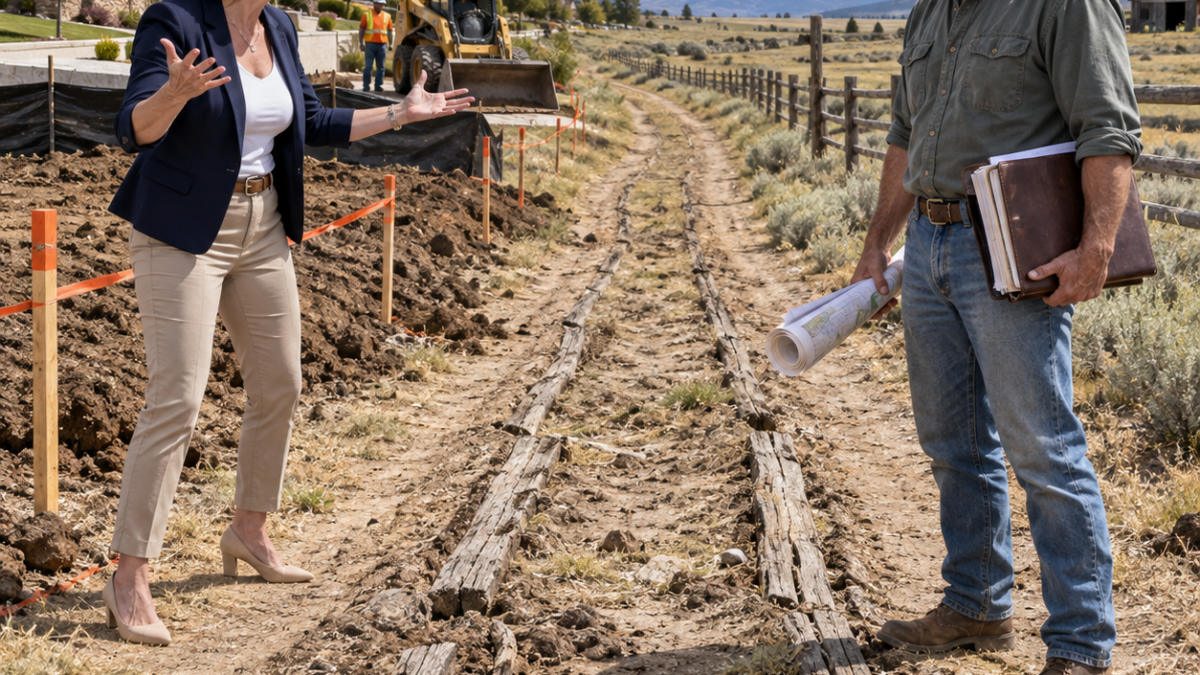
Two parallel depressions ran beneath the grass where iron-rimmed wagon wheels had pressed repeatedly into the soil.
I had photographs from every season.
Winter frost made the ruts look like pale scars.
Spring rain filled them with dark water.
During late summer, sunlight struck the depressions at an angle and revealed their shape more clearly than any survey line.
I had always considered them quiet things.
Karen had turned them into a battlefield.
I opened the first binder.
Historical Preservation Act.
The second.
Agricultural Land Easement Act.
The third.
Veteran Homestead Protection Act.
I sat down.
The irony was almost unbelievable.
After retiring from the Army, I had spent five years volunteering as an unpaid technical consultant to a bipartisan legislative working group dealing with land access, preservation, and veteran property disputes.
I had never been an elected official.
I had never wanted to be one.
I was the person legislators called when they needed somebody who understood how a beautifully written policy could become a disaster once it touched an actual road, farm, easement, or property line.
My fingerprints were on all three laws.
Not literally.
Legislation has dozens of authors, lawyers, committees, amendments, hearings, and compromises.
But I had sat in rooms helping draft provisions.
I had suggested language.
I had testified about enforcement problems.
I had helped lawmakers understand why a historic designation meant nothing if a developer could destroy the protected feature before an injunction arrived.
That morning Karen had stood fifty yards from my farmhouse waving an HOA handbook at me while preparing to violate statutes I had spent years helping strengthen.
I opened a blank document on my computer.
Then I began typing.
The letter was four pages.
It identified the Barlow Trace by registry number.
It cited the preservation protections.
It explained the agricultural zoning.
It disputed the association’s claim that the trail constituted common HOA property.
It warned that contractors entering my parcel without authorization would be considered trespassers.
It demanded immediate suspension of the paving contract.
And at the end I included a sentence I knew Karen would hate more than anything else:
This letter should not be interpreted as a negotiation.
I printed copies for every board member.
Then I drove into town and mailed each one certified.
By the time I returned, the bulldozer was gone.
Karen was gone too.
For forty-eight hours, I heard nothing.
That should have worried me.
Karen Smith did not retreat.
She regrouped.
The notice appeared Tuesday afternoon.
SPECIAL EMERGENCY MEETING.
COMMUNITY SAFETY AND ACCESS ROAD RESOLUTION.
Thursday.
Seven p.m.
Oakridge clubhouse.
I stood beside the community bulletin board reading it twice.
Someone behind me said, “She really doesn’t know when to stop, does she?”
I turned.
The speaker was a woman in her late thirties carrying a canvas grocery bag.
I recognized her from walks through the neighborhood.
Sarah Bennett.
She taught American history at the middle school.
We had spoken a few times about the Barlow Trace because she had once asked permission to bring twelve students out to see it.
“No,” I said. “Apparently she doesn’t.”
Sarah looked at the notice.
“She’s telling people the trail is blocking emergency access.”
“I have a paved county road.”
“I know.”
“She knows too.”
Sarah lowered her voice.
“A lot of people don’t.”
That sentence stayed with me.
Karen didn’t need to be legally right if she could make twenty-nine homeowners emotionally afraid.
Fear moves faster than documentation.
I thanked Sarah and went home.
Thursday evening, I arrived early.
The clubhouse smelled like burnt coffee and carpet cleaner.
Rows of folding chairs faced a portable lectern.
Karen had installed a projector.
That alone told me what kind of evening we were going to have.
At exactly seven, she struck the gavel.
“Good evening, neighbors.”
Not members.
Not homeowners.
Neighbors.
Karen understood theater.
“For those who may not know me, I’m Karen Smith, your HOA president.”
Everyone knew her.
She continued anyway.
“We have called this emergency session because a serious safety matter has arisen concerning access to the rear portion of our community.”
First slide.
SAFETY FIRST.
Behind the words was a stock photograph of flames racing through pine trees.
I leaned back.
Karen pointed at the screen.
“Imagine a wildfire.”
She let silence work for her.
“Imagine your children asleep upstairs while flames approach from the valley.”
A woman near the front shifted in her chair.
Karen clicked again.
Now an ambulance filled the screen.
“Or imagine a medical emergency. A child stops breathing. A father has a heart attack. An elderly resident falls.”
She lowered her voice.
“Seconds matter.”
Another click.
A photograph of a muddy road.
“Our current rear access route is unreliable.”
That was a lie.
Not technically.
Something worse.
A carefully arranged omission.
The image on the screen was not even my trail.
It was some generic muddy road pulled from the internet.
Karen never mentioned that a full-width paved county road already reached my farmhouse from the opposite direction.
She never mentioned that firefighters had used it during a brush fire two years before.
She never mentioned that the Barlow Trace was not designated for emergency vehicles by the county.
Then my photograph appeared.
Karen had taken it from a distance.
I was standing beside the trail with Gus, my golden retriever.
“Unfortunately,” she said, “one property owner has chosen personal sentiment over community safety.”
There it was.
Not law.
Not ownership.
Not history.
Sentiment.
Karen looked directly at me.
“Mr. Miller believes his private appreciation for some old wagon marks is more important than ensuring first responders can protect our families.”
A few heads turned.
I stayed seated.
Arguing too early would make me part of her show.
Karen continued.
She described me as “uncooperative.”
Then “elitist.”
Then, somehow, “anti-community.”
I almost admired the escalation.
The man sitting beside me whispered, “She’s laying it on thick.”
I looked over.
Gray mustache.
Wire-frame glasses.
I had seen him walking his terrier.
He extended his hand quietly.
“David Ramsey.”
“John Miller.”
“I know.”
Before I could ask more, Sarah raised her hand three rows ahead of us.
Karen’s expression tightened.
“Yes, Sarah?”
“I’ve brought students to the Barlow Trace. Isn’t it registered with the state?”
“It has some historical notation.”
“Registration.”
Karen sighed.
“Yes.”
“Then did the board contact the preservation office before approving construction?”
Several people looked toward Karen.
That was the first crack.
Small.
But audible.
Karen smiled as though Sarah had asked about napkin colors.
“This is an internal association matter.”
Sarah persisted.
“But state designation—”
“Thank you, Sarah.”
“I’m asking whether—”
“I said thank you.”
Sarah slowly lowered her hand.
Her face flushed.
Karen clicked to the final slide.
PROPOSED SOLUTION:
PAVE REAR ACCESS ROUTE
IMPROVE SAFETY
PROTECT OUR COMMUNITY
Then came the money.
“To proceed promptly, the board recommends a one-time emergency assessment of five hundred dollars per household.”
The room erupted in murmurs.
A man near the aisle raised his hand.
“Five hundred dollars? How much is this project?”
Karen answered too quickly.
“Costs include engineering, preparation, drainage, material, equipment, and contractor mobilization.”
“That wasn’t what I asked.”
Karen’s smile tightened.
“All documentation will be available through normal association procedures.”
David shifted beside me.
“Interesting,” he murmured.
I looked at him.
“What?”
“Nothing yet.”
Karen called for the vote.
Fifteen in favor.
Twelve against.
Three absent.
Motion carried.
The people who supported it weren’t cheering.
Most looked uneasy.
Karen struck the gavel.
“The paving project is approved.”
Then she looked directly at me.
“The community has spoken.”
I stood.
Every face turned toward me.
I could have given them a speech.
I could have explained that constitutional government had survived more serious challenges than an HOA board with a projector.
Instead I said, “Thank you. Please record my objection in the minutes.”
Karen frowned.
That wasn’t the reaction she wanted.
As people began stacking chairs and gathering coats, I walked toward the door.
“Mr. Miller.”
Sarah caught up with me in the parking lot.
“I’m sorry.”
“For what?”
“For not pushing harder.”
“You asked the right question.”
“They didn’t listen.”
“Some did.”
David joined us.
Up close, he looked to be in his late sixties.
He tucked his hands into the pockets of a brown jacket.
“I was HOA treasurer before Karen became president,” he said.
That got my attention.
“For how long?”
“Four years.”
“And?”
“And five hundred dollars times thirty houses is fifteen thousand.”
I nodded.
“Correct.”
David looked back toward the clubhouse.
“That paving job is going to cost a lot more than fifteen thousand.”
“Probably.”
“So where is the rest coming from?”
Sarah glanced between us.
“Reserve funds?”
“Maybe,” David said. “But if so, there should have been a disclosure before the vote.”
He rubbed his mustache.
“Karen has never liked showing detailed financials.”
“What does she show?”
“One-page summaries.”
“Bank statements?”
“No.”
“Invoices?”
“Only if someone insists.”
“Contracts?”
He gave me a humorless smile.
“Good luck.”
I looked through the clubhouse windows.
Karen stood inside talking with Gerald and Brenda.
The three of them were laughing.
Maybe about me.
Maybe about the meeting.
It didn’t matter.
I looked at David.
“You know the state records-access requirements?”
“I used to.”
“I do.”
His eyes sharpened.
“What are you thinking?”
“I’m thinking Karen just created a financial transaction tied directly to an attempt to alter protected property.”
Sarah stared at me.
“And?”
“And financial transactions leave trails.”
For the first time that night, David smiled.
“Now you’re speaking my language.”
We met at my farmhouse Saturday morning.
Sarah brought coffee.
David brought a laptop, calculator, and the suspicious enthusiasm of a retired accountant who had just been given permission to inspect books he had disliked for years.
Gus positioned himself beneath the table in case evidence became edible.
I unfolded a large map of Oakridge Estates.
Thirty homes.
The clubhouse.
My twenty-acre parcel behind them.
I marked each household according to the vote.
Sarah raised an eyebrow.
“Are we invading Poland?”
“Information helps.”
“You actually color-coded the neighborhood.”
“Occupational habit.”
David pointed at the reds.
“Fifteen voted yes.”
“Not all fifteen support Karen,” Sarah said. “Some really believed the emergency argument.”
“That matters,” I said.
Sarah leaned forward.
“Why?”
“Because we’re not fighting fifteen neighbors.”
I circled Karen’s house.
“We’re fighting bad information.”
That distinction became our strategy.
Sarah would talk to residents.
Not pressure them.
Not accuse Karen.
Just give them verifiable facts.
She showed people historical photographs.
She explained the state registry.
She reminded them that the county access road already existed.
Most importantly, she asked a simple question:
Have you seen the paving contract?
Meanwhile, David and I drafted a formal demand for five years of financial records.
Bank statements.
Invoices.
Vendor contracts.
Bids.
Meeting minutes.
Reserve fund activity.
Insurance documentation.
We sent it certified to Brenda in her official capacity as secretary.
Ten business days.
The law required a response.
On day eleven, I found a manila envelope in my mailbox.
David and Sarah came over that evening.
I emptied the contents onto the dining table.
Twenty-three pages.
David picked up the first bank statement.
Most significant entries were blacked out.
“Seriously?”
Sarah held another page toward the light.
“They redacted the payees.”
“And the descriptions,” I said.
David began sorting.
No contracts.
No competitive bids.
No invoices.
No full meeting minutes.
Just sanitized summaries and partially redacted statements.
Sarah looked disappointed.
“They gave us nothing.”
David looked delighted.
“Oh, no.”
He spread three statements beside each other.
“They gave us exactly what we needed.”
I leaned over.
“How?”
“They blacked out names.”
He tapped the first statement.
“But not dates.”
Second.
“Not amounts.”
Third.
“And not transaction classifications.”
His finger stopped on one entry.
$7,500.
Electronic payment.
Six days after the emergency meeting notice had been drafted.
“What do you think?” I asked.
“Deposit.”
“For the paving contract?”
“That would be my first guess.”
Sarah frowned.
“But if the name is blacked out, how do we know who received it?”
David opened his laptop.
“We don’t.”
He smiled.
“Yet.”
What followed was less exciting than Hollywood makes investigations look.
There were no dramatic midnight break-ins.
No secret microphones.
No anonymous envelopes slid beneath doors.
There were public databases, registration records, contractor listings, insurance filings, property searches, incorporation dates, and many cups of coffee.
David loved every minute of it.
Two evenings later, he called me.
“John.”
His voice sounded different.
“What did you find?”
“Come over.”
“Tell me.”
“Come over.”
Twenty minutes later, Sarah and I were sitting at David’s kitchen table.
His laptop displayed a corporate registration page.
PRESTIGE PAVING LLC.
Organized six months earlier.
Registered agent:
Frank Gable.
“Mean anything?” David asked.
“No.”
Sarah leaned toward the screen.
“Wait.”
She pulled out her phone.
“I know that name.”
“How?”
“Facebook.”
David stared at her.
She shrugged.
“You investigate your way. I investigate mine.”
Thirty seconds later she turned the phone around.
A family photograph showed Karen standing beside a heavyset man at a Christmas dinner.
Caption:
Great Christmas with my brother Frank and the whole family!
Sarah swiped.
Another photo.
Frank beside a dump truck.
Then a company page.
Prestige Paving.
Owner: Frank Gable.
Karen’s brother.
In the source records we later confirmed the family relationship through filings and local records, but that first social-media photograph told us where to look.
David sat back.
“Well.”
I felt something inside me go cold.
The trail had been bad enough.
This was different.
This meant Karen might not merely have been arrogant.
She might have had a financial motive.
“Do we have the contract amount?” I asked.
“Not yet.”
David tapped the redacted statement.
“But we have the deposit.”
He looked at me.
“If that seven-five payment went to Prestige, we’re not dealing with a preservation dispute anymore.”
Sarah finished his thought.
“We’re dealing with self-dealing.”
The next morning I called someone I hadn’t spoken to in almost a year.
Mark Ellison.
He worked in enforcement at the State Historical Preservation Office.
“John Miller,” he said when he answered. “Either you’ve finally decided to join civilized society or someone is trying to destroy something old.”
“The second one.”
I explained the Barlow Trace.
The bulldozer.
Karen.
The vote.
The proposed paving.
Then I mentioned Prestige Paving.
Mark became quiet.
“Send me everything.”
“I will.”
“Has construction begun?”
“No.”
“Keep it that way.”
“I intend to.”
“No, John. I mean legally. Don’t create a confrontation on the property. We’ll issue formal notice.”
“How quickly?”
“Today.”
That afternoon, the state sent a cease-and-desist notice to the association.
The wording was careful and severe.
No alteration.
No excavation.
No grading.
No paving.
No obstruction.
No action affecting the registered feature without required approval.
Penalties could follow for willful violations.
I received a copy.
Karen received hers.
And then something fascinating happened.
She told nobody.
Three days passed.
Not one community email.
Not one bulletin.
Not one emergency notice.
Nothing.
Sarah discovered that Karen had even removed a resident’s post from the HOA message board asking whether the state had contacted them.
That was when several homeowners began calling me.
The first was Mark Delaney, who had voted yes.
“John, can I ask you something?”
“Sure.”
“Did the state really order the HOA to stop the project?”
“Yes.”
“Karen told us your lawyer sent a threatening letter.”
“My lawyer hasn’t sent anything yet.”
Silence.
“So this actually came from the state?”
“Yes.”
Another pause.
“I didn’t vote to break the law.”
“I know.”
“You’re not angry?”
“At you?”
“Yeah.”
“No.”
“Why not?”
“Because you were told it was an emergency safety project.”
“That’s what I thought.”
“That’s why facts matter.”
He exhaled.
“Karen said you were trying to hold the neighborhood hostage.”
“I’m trying to stop a bulldozer.”
He laughed once.
Not because it was funny.
Because sometimes embarrassment needs somewhere to go.
“I think I owe you an apology.”
“You don’t owe me anything yet. Ask the board to show you the contract.”
That became our refrain.
Show us the contract.
Sarah said it at the grocery store.
David said it while walking his terrier.
I said it whenever anyone called.
Not:
Karen is corrupt.
Not:
Karen is stealing.
Just:
Show us the contract.
Karen started feeling the pressure.
She sent a neighborhood email accusing “certain individuals” of spreading misinformation designed to undermine board authority.
That email changed more minds than anything Sarah and I could have written.
Because frightened people ask fewer questions.
Angry people ask more.
David finally located a copy of the Prestige bid through documentation tied to the association’s insurance process.
He called another meeting at my house.
He placed the amount on the table.
$65,000.
Sarah stared at it.
“For half a mile?”
“Approximately.”
“Is that normal?”
David removed his glasses.
“No.”
“How abnormal?”
He opened a spreadsheet.
“I priced comparable work based on area rates, mobilization, material, grading, drainage, and reasonable contingency.”
He turned the screen.
“Forty thousand.”
“Maybe forty-five,” he said. “If you’re generous.”
I looked at the contract again.
Sixty-five thousand dollars.
The HOA had approved a fifteen-thousand-dollar special assessment.
Meaning roughly fifty thousand would need to come from existing reserves.
Money residents had contributed for roofs, drainage, clubhouse repairs, storms, and other long-term needs.
Sarah whispered, “Twenty thousand dollars.”
“At least,” David said.
“What?”
“Potential overpricing.”
Her expression changed.
“That’s why she needed the trail paved.”
“Maybe,” I said.
David looked at me.
“You still don’t want to accuse her.”
“Not without evidence.”
“We have the brother.”
“We have the inflated bid.”
“We have concealment.”
“We have strong indicators.”
David leaned back.
“You really were an officer.”
“For thirty years.”
“You people can turn plain English into a marching formation.”
Sarah laughed.
The tension broke for a moment.
Then I looked at the contract again.
“If we make the accusation too early and we’re wrong about one detail, Karen will make the entire dispute about that detail.”
David nodded slowly.
“So?”
“So we build the whole case first.”
That was when I called Jessica Thorne.
Jessica and I had met through an old Army friend.
Former JAG.
Now a property and civil-litigation attorney.
She had a direct way of speaking that I appreciated.
Her downtown office contained very little decoration beyond framed military photographs and shelves full of legal books.
I laid our documents across her conference table.
She read silently for almost twenty minutes.
Karen’s violation notice.
The county survey.
The HOA declaration.
The state registration.
My certified letters.
The state cease-and-desist notice.
The redacted records.
Prestige Paving’s corporate filing.
Frank’s relationship to Karen.
The contract amount.
David’s market comparison.
Jessica eventually looked up.
“Do you know what your biggest advantage is?”
“The state law?”
“No.”
“The records violation?”
“No.”
“The related-party contract?”
“That’s strong.”
She tapped Karen’s violation notice.
“This.”
I frowned.
“A hundred-dollar fine?”
“No. Intent.”
She slid it toward me.
“She was told the property was yours. She was told the trail was protected. She was told construction could be unlawful. Instead of investigating, she fined you for preventing the work.”
Jessica folded her hands.
“That makes it harder for her to portray everything afterward as an innocent mistake.”
She moved to the Prestige documents.
“Now add potential self-dealing.”
David asked, “Can board members be personally liable?”
“In some circumstances.”
Karen had apparently assumed that the HOA corporation was a fortress.
Jessica explained that it was more like an umbrella.
Useful in ordinary rain.
Less useful when somebody deliberately walked into a hurricane.
“If there is fraud or knowing misconduct,” she said, “insurance may not save them.”
Sarah looked at me.
“So what do we do?”
Jessica smiled.
“Nothing dramatic.”
I almost laughed.
“What counts as dramatic to you?”
“Filing tomorrow.”
She pointed to the HOA clubhouse through the window, though it was several miles away.
“Right now Karen still controls the board. She controls information. She’s probably counting on homeowners being more afraid of legal expenses than angry about her conduct.”
“Correct.”
“So don’t make this John versus Karen.”
“What do we make it?”
“The homeowners versus the evidence.”
Jessica advised us to request another special meeting.
The formal topic would be:
Financial and legal implications of the proposed paving project.
I submitted the request.
Karen approved it within hours.
That told me she still believed she had won.
Thursday came.
This time the clubhouse was packed.
Not twenty-seven people.
Nearly everyone.
Some couples stood along the walls.
A few residents who had never attended a board meeting in their lives had come because rumors about money spread faster than rumors about history.
Karen sat behind the folding table with Gerald and Brenda.
She wore a navy blazer.
Pearl earrings.
A calm smile.
When she struck the gavel, conversations stopped.
“As everyone knows, Mr. Miller has requested yet another opportunity to express his opposition to a necessary safety project.”
I sat in the front row beside Sarah and David.
Jessica had advised me not to bring her.
“This is a community meeting,” she said. “Not a courtroom. Yet.”
Karen continued.
“We will allow Mr. Miller ten minutes.”
I stood.
“I’ll need twenty.”
Her smile tightened.
“The agenda allows ten.”
“Then I’ll submit the remaining information in writing to every homeowner.”
A man in the back called out.
“Give him twenty.”
Someone else said, “Yeah.”
Another voice:
“We came to hear it.”
Karen looked around.
Control is an interesting thing.
It rarely disappears all at once.
It leaks.
A little at a time.
“Fine,” she said. “Twenty.”
I connected my laptop.
The first image appeared.
Not Karen.
Not the contract.
The Barlow Trace.
An old black-and-white photograph from the county historical archive.
A wagon standing beside the same cottonwoods that still grew near my field.
I let people look.
“This photograph was taken more than a century ago.”
Next image.
A modern photograph.
Same curve.
Same distant ridge.
Same trail.
“I want to begin with what we’re actually discussing.”
No legal terms.
No accusations.
Just the land.
“The Barlow Trace predates every home in this community. It predates the subdivision, the county road, the clubhouse, and probably the grandparents of everyone sitting in this room.”
Sarah watched the screen with a small smile.
“This is not my history alone.”
Next slide.
State registry.
“This belongs to the larger history of our valley.”
Then I shifted.
“Now let’s discuss the law.”
I showed the state designation.
I explained the preservation requirement in plain language.
Then I put the cease-and-desist letter on the screen.
A murmur moved through the room.
I waited.
“Every board member received this.”
Heads turned toward Karen.
“The letter directs that no alteration proceed without state approval.”
A woman near the wall raised her hand.
“Karen, when were we told about this?”
Karen interrupted.
“This is Mr. Miller’s presentation.”
The woman said, “I’m asking you.”
Karen ignored her.
I continued.
“The important point is that the state has formally intervened. Whatever anyone thought during the first vote, the legal situation is now clear.”
Then I changed slides.
Three words.
FOLLOW THE MONEY.
David smiled.
I said, “The paving project is priced at sixty-five thousand dollars.”
The room became absolutely quiet.
Someone whispered, “What?”
I repeated it.
“Sixty-five thousand.”
Karen shifted in her chair.
“The emergency assessment raises fifteen thousand.”
Next slide.
$15,000 ASSESSMENT.
$65,000 CONTRACT.
$50,000 DIFFERENCE.
“That remaining money must come from somewhere.”
A man named Paul stood halfway.
“Are you saying they’re taking fifty grand from reserves?”
“I’m saying the records indicate reserve funds were expected to cover the difference.”
Paul looked at Karen.
“Our reserves?”
She grabbed the microphone.
“These figures are being presented without proper context.”
I turned toward her.
“Then provide the context.”
Her mouth tightened.
“This is your presentation.”
“Correct.”
I clicked again.
PRESTIGE PAVING LLC.
Owner:
FRANK GABLE.
Now I looked directly at Karen.
“Karen, would you tell the homeowners what relationship you have to Mr. Gable?”
Her face lost color.
Gerald suddenly became fascinated by a paper in front of him.
Brenda folded her arms.
“I don’t see how my personal family life is relevant.”
Nobody moved.
I said, “Frank Gable is your brother.”
For one heartbeat, silence.
Then the room exploded.
“What?”
“Her brother?”
“Are you kidding?”
“You gave the contract to your brother?”
Karen stood.
“No one gave anyone anything!”
I raised my hand.
The crowd gradually quieted.
“This is exactly why I have been careful not to accuse anyone of a crime.”
Karen seized on that.
“Because there was no crime!”
“I said I haven’t accused you.”
I turned back to the audience.
“What I can show you are facts.”
Next slide.
Prestige incorporated six months earlier.
Next.
Contract value.
Next.
Comparable market estimate.
David stood.
“My name is David Ramsey. Most of you know me. I served as association treasurer for four years.”
A few people nodded.
“I reviewed the available numbers independently.”
He explained the cost.
Not dramatically.
That made it worse.
Paving.
Grading.
Equipment.
Drainage.
Labor.
Contingency.
He showed a realistic range.
Forty to forty-five thousand.
“Sixty-five thousand is extraordinarily high,” he concluded.
Karen slammed her palm onto the table.
“He is not a licensed paving estimator!”
David adjusted his glasses.
“No.”
He looked at her calmly.
“I’m an accountant.”
A few people laughed.
Karen reddened.
David continued.
“And accountants become curious when organizations refuse to produce contracts.”
He held up the redacted statements.
“These are what the board provided after a lawful records request.”
He turned one toward the room.
Nearly half the page was black.
Someone said, “Jesus.”
David pointed out the deposit.
The missing vendor names.
The absent invoices.
The lack of documented competing bids.
Brenda finally spoke.
“We were advised to protect confidential vendor information.”
“By whom?” David asked.
Brenda hesitated.
Karen snapped, “This is turning into an interrogation.”
A voice from behind me said, “Good.”
Karen banged the gavel.
“Order.”
Nobody stopped talking.
She banged it again.
“ORDER.”
I watched Gerald.
Sweat had appeared along his hairline.
He leaned toward Karen and whispered something.
She shook her head sharply.
That was another crack.
Then Sarah stood.
She didn’t use the microphone.
She didn’t need it.
“I voted against the project because I care about the history.”
People quieted.
“But I don’t think the people who voted for it did anything wrong.”
Several of those homeowners looked at her.
“You were told this was necessary to protect families.”
Sarah glanced at Karen.
“You were not shown the state letter.”
A woman nodded slowly.
“You were not shown the full contract.”
Another homeowner crossed his arms.
“You were not told the contractor was related to the board president.”
Now the anger in the room changed.
Before, it had been loud.
Now it became personal.
Betrayal is quieter than outrage at first.
A mother named Jennifer stood.
She had voted for Karen.
“I voted yes because you showed us a picture of a wildfire.”
Her voice trembled.
She looked directly at Karen.
“You said our houses could burn because John refused emergency access.”
Karen said, “That remains a legitimate concern.”
Jennifer shook her head.
“There’s already a paved road.”
“It’s not adequate for every—”
“Did the fire department ask you to pave the trail?”
Karen stopped.
Nobody had asked that question before.
Jennifer repeated it.
“Did they?”
Karen looked toward Gerald.
He looked away.
“No formal request was necessary.”
Jennifer’s face changed.
“You made it sound like firefighters asked for this.”
“I explained the risk.”
“You made me afraid for my kids.”
Karen’s composure began slipping.
“You are twisting my words.”
“No,” Jennifer said. “You used my kids to get five hundred dollars from me.”
The room erupted again.
Karen grabbed the gavel.
“THIS MEETING WILL COME TO ORDER!”
No one cared.
Gerald stood suddenly.
“I need to clarify something.”
Karen whirled.
“Sit down.”
He didn’t.
“I was not involved in selecting Prestige.”
Karen stared at him.
“What are you doing?”
Gerald swallowed.
“I reviewed the payment authorization after the contract was selected.”
Brenda’s head snapped toward him.
“So did I.”
Karen looked from one to the other.
“You both approved it.”
Gerald’s voice cracked.
“Because you told us it was the lowest qualified bid.”
The room went silent again.
Karen whispered, “Gerald.”
He stepped away from the table.
“I never saw competing bids.”
Brenda joined him.
“Neither did I.”
Karen looked as though both of them had physically struck her.
That was the moment her board ceased to exist.
Not when we found the contract.
Not when the state intervened.
When Gerald and Brenda realized Karen could drag them down with her.
I walked to the laptop.
“There is one final thing everyone should know.”
Jessica had reviewed this slide personally.
I displayed three lines.
FORMAL PRESERVATION COMPLAINT.
FINANCIAL MISCONDUCT REFERRAL.
CIVIL ACTION PREPARED.
I spoke slowly.
“The preservation issue has been referred to the appropriate state office.”
Karen opened her mouth.
I continued.
“The financial records and related-party contract have been referred for review.”
Her face became pale.
“And my attorney has prepared civil claims concerning the attempt to enter and alter my property after notice.”
Gerald gripped the back of his chair.
I looked at the three board members.
“If misconduct is established, there are circumstances in which individual board members can face personal exposure.”
Gerald sat down.
Brenda whispered, “Oh my God.”
Karen exploded.
“This is blackmail!”
“No.”
I closed the laptop.
“This is disclosure.”
“You are threatening us!”
“I warned you before the bulldozer arrived.”
“You think because you were some Army colonel you can march in here and order everyone around!”
I felt every eye in the room move toward me.
There are insults worth answering.
That wasn’t one.
Karen pointed at me.
“You bought twenty acres and decided you were better than everybody else! You hide up there in that farmhouse judging this community while I have worked for years to keep this place running!”
Her voice broke.
“I painted the entrance sign!”
Nobody spoke.
“I organized the Christmas potluck!”
Still nothing.
“I fought the county over trash pickup! I fixed the pool contract! I spent hundreds of hours—hundreds—while people like you sat at home and complained!”
The anger was no longer strategic.
It was wounded.
Raw.
She looked around the room for gratitude.
She found none.
Jennifer spoke first.
“You did some good things.”
Karen stared at her.
“But that doesn’t make our money yours.”
That sentence ended something.
A woman in the back stood.
“I move for a vote of no confidence in the president.”
Someone immediately called, “Second.”
Then another.
“Second.”
“Second.”
Karen slammed the gavel.
“You cannot do that.”
Sarah opened the bylaws.
“Yes, we can.”
Karen stared at her.
Sarah read the relevant section aloud.
Members representing the required threshold could bring an emergency motion from the floor.
Hands went up.
The motion was formally stated.
Removal of Karen Smith as president pending investigation.
The vote wasn’t close.
Twenty-four in favor.
Two against.
Karen and one loyal neighbor.
Gerald abstained.
Brenda abstained.
Karen stood behind the lectern with both hands flat against it.
For the first time since I met her, she had nothing to say.
Then someone moved to remove Gerald.
He closed his eyes.
“I understand.”
The motion passed.
Brenda was next.
She didn’t fight.
Within twenty minutes, Oakridge Estates had an interim board.
Maria Alvarez became president.
David became treasurer.
Sarah became secretary.
Maria was a nurse administrator who had lived in the neighborhood for eleven years and had the useful habit of asking one question before every decision:
What exactly are we authorizing?
Her first motion was to terminate the Prestige Paving contract subject to legal review.
Unanimous.
Second motion:
Cancel the special assessment.
Unanimous.
Third:
Preserve all association financial records and authorize independent forensic review.
Unanimous.
For the first time that evening, people applauded.
Karen picked up her purse.
She walked toward the door.
As she passed me, she stopped.
“This is what you wanted.”
“No.”
She looked at me.
“You wanted me humiliated.”
“I wanted the bulldozer stopped.”
“You destroyed everything I built.”
I lowered my voice.
“You had several chances to stop.”
Her eyes filled with something I hadn’t expected.
Not tears exactly.
Something close.
For a moment, I saw the woman behind the president.
A woman who had confused control with respect until she could no longer tell the difference.
Then the anger returned.
“I hope that stupid trail was worth it.”
She walked out.
The door closed behind her.
I stood there watching it for several seconds.
Sarah came beside me.
“You okay?”
“Yes.”
“You don’t look happy.”
“I’m not.”
“Why?”
“Because this part is easy.”
She frowned.
“Removing her?”
“Compared with rebuilding trust.”
That turned out to be true.
The next month was uglier than the meeting.
Investigators requested records.
The HOA’s bank received subpoenas.
Prestige Paving’s financial relationship with the association was examined.
The new board found additional transactions that required explanation.
Not all were criminal.
Some were merely careless.
Others reflected a culture in which Karen had made decisions first and demanded approval later.
Gerald and Brenda hired lawyers.
Then they began cooperating.
When faced with the possibility that they could share responsibility for decisions they barely understood, loyalty disappeared.
Gerald admitted he had stopped questioning Karen years earlier because every disagreement became exhausting.
“She’d call me five times a day,” he told investigators.
“She’d send twenty emails.”
He rubbed his face.
“Eventually you just say yes because you want your life back.”
Brenda’s explanation was worse in a different way.
“She knew the bylaws better than anybody.”
That sentence haunted me.
Not because Karen truly understood law.
She understood procedures.
There is a difference.
A person can memorize every rule in a handbook and still know nothing about justice.
Maria ordered a professional audit.
The findings made uncomfortable reading.
Prestige Paving was the clearest conflict.
But there were smaller issues.
Questionable landscaping charges.
Reimbursements with poor documentation.
Vendor selection without meaningful comparison.
A pattern of Karen treating board approval as ceremony rather than oversight.
The total picture was not a sophisticated criminal empire.
It was something more ordinary.
And in some ways more dangerous.
A small institution had gradually stopped asking questions.
Karen had filled the vacuum.
At first, perhaps, because she was willing to do the work.
Then because she enjoyed being necessary.
Then because being necessary became being unquestioned.
And finally because being unquestioned felt like ownership.
That transformation did not happen in one afternoon.
It happened through years of people saying:
Whatever Karen thinks.
Ask Karen.
Karen handles that.
Karen knows the rules.
By the time a bulldozer reached my land, the habit had become a system.
The state preservation office met with Maria and me.
They could have imposed severe financial penalties on the association.
Technically, the HOA had authorized concrete steps toward altering the protected trail.
Money had been committed.
A contractor had been dispatched.
Equipment had reached the site.
Only my physical intervention and the operator’s caution had prevented damage.
But punishing the entire neighborhood would also punish the same homeowners who had just removed the board and cooperated.
Mark proposed something better.
Restoration.
Education.
Oversight.
Instead of directing every possible dollar into fines, the association could fund a preservation project approved by the state.
The Barlow Trace would become safer for pedestrians.
Erosion would be addressed.
Historic wagon ruts would remain untouched.
Interpretive markers would tell the route’s story.
Maria asked me to serve as volunteer project consultant.
I agreed on one condition.
“No payment.”
She smiled.
“I expected that.”
“And no HOA money for fancy monuments.”
“What do you want?”
“Simple markers. Accurate history. Durable materials.”
Sarah leaned across the table.
“And school access.”
I looked at her.
She grinned.
“If you’re making rules, so am I.”
We shook hands.
By then summer had begun turning toward fall.
The story might have ended there.
Karen removed.
Contract canceled.
Trail saved.
But consequences rarely arrive in clean little packages.
One Tuesday morning, a local television van parked outside the clubhouse.
A reporter called my house.
“Colonel Miller, we’re working on a story about an HOA contract investigation.”
“I’m retired.”
“Mr. Miller, then.”
“I’m not the association president.”
“We understand you uncovered—”
“Maria Alvarez is president.”
“You were the homeowner involved in the trail dispute.”
“Yes.”
“Would you comment?”
I looked through my kitchen window toward the ridge.
“No.”
“Nothing?”
“One thing.”
I paused.
“The neighborhood corrected the problem itself. You should talk to the people doing the rebuilding.”
The headline ran that evening anyway.
LOCAL HOA CONTRACT UNDER INVESTIGATION AFTER HISTORIC TRAIL DISPUTE.
Karen’s photograph appeared.
It had been taken at a previous community event.
She was smiling.
I was glad they hadn’t used a photograph from her breakdown.
By then I no longer wanted humiliation.
I wanted accountability.
There is a difference.
Humiliation satisfies anger for a moment.
Accountability changes what happens next.
Two weeks later, a FOR SALE sign appeared in Karen’s yard.
Gus and I passed the house during our morning walk.
No curtains in the front windows.
No decorative wreath.
No HOA PRESIDENT placard in the flower bed.
Just the sign.
Sarah called that evening.
“Did you see?”
“Yes.”
“Do you feel bad?”
I thought about it.
“A little.”
She was silent.
“That surprises me,” she said.
“Why?”
“She tried to destroy the trail.”
“Yes.”
“She lied about you.”
“Yes.”
“She used emergency fears to get money.”
“Yes.”
“And you feel bad?”
“For the human consequences.”
I looked toward my study.
“Not for the accountability.”
There are people who believe justice requires hatred.
I don’t.
Sometimes hatred gets in the way.
You can want someone stopped without wanting them destroyed.
You can believe a person should face consequences and still recognize that watching a life collapse is not entertainment.
Karen sold the house.
Before she left, something happened I will remember longer than the legal proceedings.
It was Community Trail Day.
Sarah invented the name.
I objected.
She ignored me.
The restoration plan had been approved.
A narrow stabilized walking surface would run beside the original wagon depressions where appropriate, using local aggregate and preservation methods designed not to erase the historic fabric.
Markers would identify important points.
A small protective barrier would keep vehicles from entering the most vulnerable area.
I expected maybe fifteen volunteers.
At seven-thirty Saturday morning, I heard engines outside.
I walked onto the porch.
Pickup trucks lined the county road.
Cars filled my grass overflow area.
People were unloading shovels.
Rakes.
Wheelbarrows.
Coolers.
Someone brought donuts.
Someone else brought a portable speaker.
Maria walked up carrying work gloves.
“How many?”
“Forty-seven signed in.”
“You’re kidding.”
“No.”
More arrived.
Among them was Jennifer, the woman Karen had frightened with the wildfire presentation.
She brought both of her teenage sons.
Mark Delaney came.
Paul came.
People who had voted for paving worked beside people who had voted against it.
Nobody mentioned the vote.
They didn’t need to.
Work has a way of simplifying things.
A heavy marker post doesn’t care how you voted.
It requires two people to lift it.
By noon, David was sweating through his shirt while trying to keep a post level.
“You’re off by half an inch,” I told him.
He glared.
“I’m an accountant.”
“Apparently not a carpenter.”
“Apparently retired colonels are unbearable.”
Sarah walked past us carrying a shovel.
“Apparently both statements can be true.”
For the first time in months, I laughed until my stomach hurt.
We worked into the afternoon.
Near four o’clock, I saw the moving truck.
It stopped in front of Karen’s house down the hill.
The laughter around me continued.
A drill whined.
Kids carried small buckets of gravel.
Maria was arguing good-naturedly with David over whether a marker leaned two degrees.
Then Karen appeared.
She carried a cardboard box from her front door toward a sedan.
She looked up.
Even from that distance, I knew she saw us.
Almost fifty neighbors on my property.
Restoring the trail.
The trail she had called irrelevant dirt.
Nobody jeered.
Nobody waved sarcastically.
Nobody celebrated her departure.
That mattered to me.
Karen placed the box in her car.
Then she looked directly at me.
I stood beside the first completed marker.
BARLOW TRACE
ESTABLISHED 1819
I could have smiled.
I didn’t.
I could have waved.
I didn’t.
For several seconds we simply looked at each other across the distance.
Then she got into her car.
The sedan backed out.
The moving truck followed.
She turned onto the county road and disappeared behind the trees.
Sarah came to stand beside me.
“Was that her?”
“Yes.”
“She looked over here.”
“Yes.”
“What were you thinking?”
I watched the empty road.
“That none of this needed to happen.”
Sarah nodded.
“No.”
“It started with a bulldozer.”
She shook her head.
“No, John.”
I looked at her.
“It started long before that.”
She was right.
The legal case continued for months.
Investigators reconstructed the Prestige transaction.
Frank Gable claimed the bid was legitimate.
He argued that mobilization and site complications justified the price.
But the related-party relationship had not been properly disclosed, competitive procedures were deficient, and testimony from former board members damaged the defense.
Karen eventually accepted a plea agreement resolving the most serious allegations without a trial.
She pleaded guilty to a reduced fraud-related conspiracy charge.
The court considered her lack of prior criminal history.
She avoided prison.
She received probation.
She was ordered to pay substantial restitution connected to the improper transaction and associated losses.
Frank’s company was dissolved.
Contracting restrictions followed.
Gerald and Brenda received lesser consequences after cooperating and acknowledging their roles.
My civil lawsuit never reached trial.
Jessica kept it prepared for months.
It gave us leverage when cooperation stalled.
Eventually, after restitution terms, preservation commitments, and written acknowledgment of my property’s exclusion issue were resolved, I agreed to dismiss the remaining claims.
Jessica called me afterward.
“You realize most clients don’t walk away when they could keep squeezing.”
“I got what I wanted.”
“You could have gotten money.”
“I didn’t start this for money.”
“What did you start it for?”
I looked through the study window at the Barlow Trace.
“So nobody paved that.”
Jessica laughed softly.
“You may be the least profitable client I’ve ever had.”
“I’ll put that on my résumé.”
The title problem with my property was finally corrected as well.
The clerical error that had mistakenly placed my twenty acres beneath the HOA umbrella was removed through recorded legal documentation.
The distinction was now unmistakable.
The farmhouse and heritage parcel stood outside normal HOA jurisdiction.
Access rights were clearly defined.
Historic protections were explicitly referenced.
Maria asked whether I still wanted to attend meetings.
“Why?”
“You complain effectively.”
“That is not a qualification.”
“For an HOA board, it might be.”
“No.”
“Advisory committee?”
“No.”
“Historical committee?”
I hesitated.
She smiled.
“Got you.”
I joined that one.
The restoration project became more than I expected.
Sarah researched families associated with the route.
We found diary excerpts in county archives.
Freight records.
Land grants.
Photographs.
A handwritten letter from 1851 describing a broken wagon axle near the ridge behind my field.
That detail affected me more than the grand historical summaries.
An axle.
One exhausted family.
One terrible afternoon.
History is usually taught through wars, presidents, and dates.
But most lives are remembered in smaller moments.
A broken wheel.
A child with a fever.
A night beside a fire.
A father wondering whether the family had made a terrible mistake by coming west.
Sarah built her school lessons around those details.
The first group of students arrived on a cold October morning.
Twenty-three eighth-graders came walking up the county road carrying notebooks.
Gus believed the visit had been arranged entirely for him.
Within thirty seconds, he had collected enough attention to become unbearable.
Sarah gathered the students beside the first marker.
“What do you see?” she asked.
A boy raised his hand.
“A path.”
“What else?”
“Grass.”
“Trees.”
“Mr. Miller’s dog.”
Everyone laughed.
Sarah pointed toward the parallel depressions.
“What are those?”
A girl stared.
“Wagon tracks?”
“Ruts.”
Sarah nodded.
“More than two hundred years ago, people traveled through this valley using wagons whose wheels passed over the same ground again and again.”
The students became quiet.
Sarah told them to stand still.
“Imagine you have no road map on your phone.”
A few smiled.
“No convenience store.”
More smiles.
“No hospital ten minutes away.”
She pointed toward the ridge.
“You have everything your family owns in a wagon.”
Now no one laughed.
“You don’t know what is on the other side.”
I watched their faces.
That was why preservation mattered.
Not because old dirt is sacred.
Because physical places make abstract history real.
One student remained behind when the others moved toward the next marker.
He looked down at the ruts.
“Mr. Miller?”
“Yes?”
“Is it true somebody wanted to pave this?”
Children have a talent for asking questions more directly than adults.
“Yes.”
“Why?”
I could have told him about Karen.
The contract.
The fraud case.
The HOA fight.
Instead I said, “Because sometimes people see old things and only notice what they can turn them into.”
He considered that.
Then looked down again.
“I like it better like this.”
“So do I.”
He ran to catch his class.
That afternoon, I sat on my porch longer than usual.
Gus slept near my boots.
The sun moved behind the trees.
For months, the trail had represented conflict.
Now children had walked it and talked about people who lived two centuries before them.
That felt like victory.
Not Karen’s conviction.
Not the canceled contract.
Not my framed five-hundred-dollar refund check.
The children.
That was the part I hadn’t anticipated.
Maria returned every dollar collected through the special assessment.
My refund arrived in a plain envelope.
Five hundred dollars.
I looked at the check.
Then I took it into my study.
On the wall above my desk hung my retirement photograph.
Thirty years in uniform.
Awards.
Flags.
Ceremonial things.
I placed the check in a frame beneath them.
David saw it the next time he visited.
“You know checks expire.”
“I’m not cashing it.”
“That violates every financial instinct I possess.”
“It’s a souvenir.”
“It’s five hundred dollars.”
“I have a pension.”
“Colonel, this is why accountants exist. To prevent people like you from framing negotiable instruments.”
Sarah walked in behind him.
“He framed it?”
David pointed accusingly.
“He framed money.”
She looked at the wall.
“I like it.”
“Of course you do.”
I poured coffee.
“What would you have me do with it?”
“Deposit it.”
“Boring.”
David looked personally wounded.
“Responsible.”
The check stayed on the wall.
The HOA changed too.
Maria introduced rules that should have existed all along.
Contracts above certain thresholds required multiple competitive bids.
Related-party transactions had mandatory disclosure.
Financial statements were distributed regularly.
Meeting minutes became detailed.
Homeowners could access records through a secure website Sarah maintained.
Board members rotated responsibilities.
No single person controlled vendor selection.
At the first annual meeting under the new system, Maria projected the financial report.
Twenty minutes later, a homeowner raised his hand.
“I have a complaint.”
Everyone turned.
Maria braced herself.
“What?”
“This is boring.”
The room laughed.
David shouted from the back, “That means we’re doing it right.”
He was.
Healthy governance is usually boring.
No screaming.
No surprise bulldozers.
No secret contracts.
No heroic rescues.
Just procedures working before anyone needs a hero.
A year after the confrontation, we held an anniversary walk.
Sarah hated calling it an anniversary.
“It sounds like we’re celebrating Karen.”
“We’re celebrating the trail.”
“Then call it Heritage Day.”
Maria approved.
Heritage Day it became.
More than a hundred people attended.
Families from outside Oakridge came.
The historical society set up a small table.
Students displayed projects.
One girl recreated a pioneer supply list.
A boy built a miniature wagon.
Someone produced apple cider.
David complained it was overpriced.
He had purchased three cups.
Near sunset, after most people left, I found Sarah sitting on a bench beside the trail.
“You tired?” I asked.
“Exhausted.”
“Successful day.”
She looked down the path.
“Do you ever think about what would have happened if you hadn’t been home that morning?”
I did.
More often than I admitted.
The bulldozer blade had been inches away.
If Mike had believed Karen.
If he had pushed forward.
If the first cut had been made.
If gravel had been dumped.
If asphalt had covered the ruts.
The state could have fined them afterward.
A court could have awarded damages.
Karen could have lost ten houses.
None of it would have recreated two hundred years of untouched ground.
“Sometimes,” I said.
Sarah pulled her jacket tighter.
“Does it make you angry?”
“It used to.”
“And now?”
I thought about the question.
“Now it makes me grateful Mike stopped the machine.”
She nodded.
“One decent decision.”
“That’s often all it takes.”
One decent decision.
One contractor refusing to move.
One teacher asking whether the trail was protected.
One retired accountant noticing that fifteen thousand dollars did not equal sixty-five thousand.
One homeowner asking whether the fire department had actually requested the project.
One community deciding that being misled once did not obligate them to remain misled forever.
People tell stories about justice as though one person defeats one villain.
That was never really what happened.
I knew the laws.
Yes.
I had evidence.
Yes.
I refused to move.
But I did not save the Barlow Trace alone.
Mike saved it when he shut off the bulldozer.
Sarah saved it when she asked questions.
David saved it when he followed the money.
Jessica saved it when she converted anger into legal strategy.
Maria saved it when she rebuilt the board instead of merely inheriting Karen’s chair.
Even the neighbors who originally voted to pave it helped save it when they allowed new facts to change their minds.
Changing your mind is underrated.
People call it weakness.
Often it requires more courage than stubbornness.
Karen could never do it.
That was ultimately her tragedy.
At every stage, she had an exit.
When I showed her the registry, she could have stopped.
When I cited the law, she could have checked.
When the contractor refused, she could have postponed.
When my certified letter arrived, she could have consulted counsel.
When Sarah questioned her at the meeting, she could have disclosed the issue.
When the state notice arrived, she could have canceled the contract.
When the related-party relationship became public, she could have apologized.
Instead, every challenge to her authority became proof that she needed to assert more authority.
She mistook backing down for losing.
So she kept escalating until there was nowhere left to go.
Years ago, during my Army career, a young captain once asked me what separates confidence from arrogance.
At the time, I gave him some forgettable answer about preparation.
I know the better answer now.
Confidence can absorb new information.
Arrogance cannot.
The trail taught me that.
Or maybe Karen did.
The following spring, I received an envelope from an address two counties away.
No return name.
Inside was a single sheet of stationery.
The handwriting was Karen’s.
John,
I have started and thrown away this letter six times.
I am not writing to ask you to forgive me.
I do not expect that.
I am writing because during the investigation I spent months telling myself that everyone betrayed me.
Gerald.
Brenda.
The neighborhood.
My brother.
You.
I told myself I was punished for trying to improve the community.
That version was easier.
My attorney made me read the meeting records and emails.
All of them.
Including the ones where people warned me.
I hated him for that.
I can see now that I made the project about winning.
I still believe I did good things for Oakridge.
Maybe that made it harder for me to admit when I was doing something wrong.
I do not know.
I lost my house.
I lost friends.
Frank barely speaks to me.
I am still paying restitution.
Those are consequences I brought on myself.
I saw a photograph online of the trail markers.
They look good.
I never understood why that place mattered to you.
I think I understand a little better now.
Karen
I read the letter twice.
Then a third time.
It would be satisfying to say I felt triumphant.
I didn’t.
I felt tired.
And strangely sad.
Not because her consequences were unfair.
They weren’t.
But because so much damage had grown from something that could have ended with four simple words:
I might be wrong.
I folded the letter.
For several minutes I considered throwing it away.
Instead, I placed it in the Barlow Trace file.
Not with the legal documents.
At the back.
A historical record of another kind.
I never wrote back.
Not because I wanted to punish her.
Because I couldn’t think of anything honest that needed saying.
A few days later, Sarah came by.
I showed her the letter.
She read it silently.
“Wow.”
“Yeah.”
“You going to respond?”
“No.”
“Why?”
“What would I say?”
She considered that.
“Maybe nothing.”
“That’s where I landed.”
She returned the letter.
“At least she finally looked at herself.”
“Eventually.”
“Some people never do.”
That was true.
I placed the letter back in the file.
Outside, children rode bicycles along the newer walking surface beside the preserved ruts.
Their tires made a soft crunch over the crushed stone.
The old trail remained untouched.
That summer, the county historical society nominated our restoration project for a preservation award.
I almost refused to attend the ceremony.
Sarah threatened me.
“You are going.”
“I hate ceremonies.”
“You spent thirty years in the Army.”
“That is why I hate ceremonies.”
“You own a suit.”
“I own several.”
“Wear one.”
Maria joined the conspiracy.
So did David.
I went.
The ceremony was held at the county courthouse.
The same building where some of the original Barlow land records had been filed more than a century earlier.
When our project was announced, Sarah walked to the podium.
I expected her to talk about preservation techniques.
Instead, she talked about conflict.
“A historic place survives,” she said, “only when people decide the past still has something to teach the present.”
Then she looked at our group.
“This trail was nearly destroyed because people stopped listening to one another.”
She paused.
“It survived because they started again.”
I liked that better than any speech about victory.
Afterward, a reporter asked for a photograph.
Maria stood beside Sarah.
David beside Maria.
I tried to move to the back.
Sarah grabbed my sleeve.
“No chance.”
The photograph ran in the Sunday newspaper.
Four people holding a plaque.
Behind us, an enlarged photograph of the Barlow Trace.
The caption called me “a preservation advocate.”
David clipped the article and mailed me a copy even though I already had one.
At the bottom he wrote:
NOTICE THEY DID NOT CALL YOU AN ACCOUNTANT.
I wrote beneath it:
BECAUSE I HAVE DIGNITY.
He framed that too.
Years passed.
The wagon ruts stayed.
Grass grew.
Leaves fell.
Snow filled the depressions each winter and melted each spring.
The neighborhood changed.
Families moved.
New families arrived.
Most of them knew nothing about Karen until someone told the story.
To them, the Barlow Trace had always been protected.
The markers had always been there.
The HOA had always posted financials.
Contracts had always been transparent.
That may have been the most satisfying outcome of all.
Good systems eventually make old battles look unnecessary.
People forget how close something came to breaking.
One autumn evening, long after Gus’s muzzle had begun turning white, I took him for our usual walk.
He moved slower.
So did I.
We stopped at the first marker.
The sun was low, throwing long golden shadows across the field.
I rested one hand on the wooden post.
My fingers traced the carved letters.
BARLOW TRACE.
EST. 1819.
Beyond it ran the preserved wagon depressions.
No asphalt.
No curbs.
No painted emergency lane.
Just earth.
History doesn’t shout.
That may be why it is so easy to destroy.
A bulldozer is loud.
A board meeting is loud.
Anger is loud.
Power is loud.
Old ground is silent.
It relies on somebody noticing before it disappears.
Gus leaned against my leg.
“All right,” I told him. “We’re going.”
He looked up at me as though he had been waiting several hours.
We continued down the trail.
At the second marker, I heard voices behind us.
Sarah was leading another group of students.
I stepped aside.
A boy near the front pointed toward me.
“Are you the guy who stopped the bulldozer?”
Sarah groaned.
“Ethan.”
“What? My brother told me.”
I smiled.
“Something like that.”
“Did you really stand in front of it?”
“Yes.”
His eyes widened.
“Weren’t you scared?”
I thought about Mike in the cab.
Karen shouting.
The steel blade.
“No.”
That wasn’t completely true.
So I corrected myself.
“I was more scared of what would happen if I moved.”
The boy nodded as though that made perfect sense.
Maybe it did.
Sarah gathered the students around the marker.
I started walking again.
One girl called after me.
“Mr. Miller?”
I turned.
“Thank you for saving it.”
For a moment, I couldn’t answer.
All the hearings.
The investigation.
The angry meetings.
The lawyers.
The money.
The insults.
Karen’s letter.
The volunteer day.
It collapsed into that one sentence from a thirteen-year-old girl standing where pioneer families once traveled.
“Take care of it,” I said.
She smiled.
“We will.”
Gus and I continued toward the farmhouse.
That evening I sat on the porch until the last sunlight disappeared behind the ridge.
The neighborhood lights came on below me.
One at a time.
Thirty homes.
Thirty families.
People who had once been divided into red, green, and yellow marks on my tactical map.
I had thrown that map away years earlier.
I no longer needed it.
There were no enemy houses.
That had been another lesson.
Karen had spent years turning disagreement into loyalty tests.
If you questioned her, you were against her.
If you challenged a decision, you were against the community.
That thinking poisoned everything.
A neighborhood cannot survive if every disagreement becomes a war.
Neither can a country.
Neither can a family.
Some fights are necessary.
But the purpose of fighting should be to protect something worth returning to afterward.
Not to make fighting permanent.
The Barlow Trace was what we returned to.
Maria later had a small plaque installed near the trailhead listing the volunteers and organizations involved in the restoration.
She wanted my name first.
I refused.
Alphabetical order.
She argued.
I won.
Technically.
Sarah found another way around me.
At the bottom of the plaque she added a sentence:
PRESERVED BY THE PEOPLE OF OAKRIDGE ESTATES FOR THOSE WHO CAME BEFORE AND THOSE WHO WILL COME AFTER.
No individual names mattered much after that.
That sentence did.
I sometimes think about the first morning.
Karen holding her binder.
The bulldozer idling.
Black exhaust drifting through clean autumn air.
Her telling me my attachment to old wagon ruts was irrelevant.
In one sense, she had been right.
My attachment was irrelevant.
The trail did not deserve protection because I loved it.
It deserved protection because no temporary board president, homeowner, developer, contractor, or retired colonel owns history alone.
We borrow places.
We inherit them for a little while.
Then we decide what condition they will be in when the next person arrives.
Karen wanted to make the trail convenient for the present.
We chose to make it available to the future.
That difference cost her far more than she ever imagined.
But it gave Oakridge something none of us expected.
An identity.
People began referring to our subdivision differently.
Not the development near Route 17.
Not the place with the brick entrance.
Oakridge became:
The neighborhood with the old wagon trail.
House listings mentioned it.
Teachers visited it.
Veterans groups held memorial walks there.
Neighbors proposed an annual cleanup every spring.
David created a budget line called HISTORIC TRAIL MAINTENANCE.
I teased him about it.
“You gave dirt its own account.”
“It has receipts.”
“Of course it does.”
“And three authorized signatories.”
“You’re enjoying this too much.”
“I’ve waited my entire life for transparent trail accounting.”
Even Maria laughed.
Those ordinary moments meant more than revenge.
Karen had wanted authority.
What survived her was community.
There is a justice in that no court can order.
One winter, several years after everything ended, a heavy snowstorm covered the valley.
The modern roads disappeared beneath white.
I stood at my study window watching flakes settle over the Barlow Trace.
For a few hours, the wagon ruts vanished too.
Then wind moved across the field.
Slowly, the depressions reappeared.
Two faint parallel lines.
Still there.
That image stayed with me.
Systems can cover truth for a while.
Fear can cover it.
Noise can cover it.
Money can cover it.
A person with enough confidence and a loud enough voice can convince a room full of reasonable people that black is white and private property is common property and a protected historical trail is merely inconvenient dirt.
But covering something is not the same as erasing it.
The truth remains underneath.
Sometimes all it needs is somebody willing to brush the snow aside.
I had helped draft three state laws years before Karen ever arrived at my gate.
At the time, they had been abstractions.
Language.
Sections.
Definitions.
Enforcement provisions.
Penalties.
We debated commas.
We argued over phrases like “material alteration” and “irreparable historical impact.”
I remember sitting through one six-hour session wondering whether any ordinary person would ever notice the work.
Then, years later, I stood in front of a bulldozer.
Suddenly every boring word mattered.
That is something people misunderstand about law.
The dramatic part is rarely the courtroom.
The dramatic part happens years earlier when somebody quietly writes a sentence strong enough to protect a place they may never see.
The lawmakers who passed those statutes did not know Karen.
They did not know me.
They did not know the Barlow Trace would one morning be inches from a bulldozer blade.
They simply tried to build a guardrail.
When I needed it, the guardrail was there.
The same was true of the HOA bylaws Sarah used to force the confidence vote.
Karen had treated those bylaws as her personal weapon.
In the end, the same document gave homeowners the mechanism to remove her.
Rules are tools.
Their moral value depends on how people use them.
Karen used procedure to silence.
Sarah used it to restore a voice.
Karen used community funds to consolidate influence.
David used financial rules to restore trust.
Karen used fear to manufacture consent.
Maria used transparency to make fear unnecessary.
I had entered the fight believing I was defending a trail.
I came out understanding I had been defending something broader.
The right of ordinary people to know what is being done in their name.
The right to ask questions without becoming enemies.
The right to say no when authority exceeds its boundaries.
And the obligation to preserve things that cannot be replaced once destroyed.
I am older now.
The trail is older too, obviously.
But unlike me, it looks almost exactly the same.
That comforts me.
Someday someone else will own this farmhouse.
Maybe they will remove my shelves.
Replace the oak desk.
Paint the kitchen a color I would hate.
That will be their right.
But when they walk outside, the Barlow Trace will still cross the field.
Children not yet born will step over those wagon ruts.
Some teacher will tell them families passed this way when the valley had no subdivision, no power lines, no HOA, and no paved county road.
Maybe one child will ask why the ruts were never covered.
And maybe someone will tell them there was once a ridiculous argument involving a bulldozer, a board president, a retired colonel, an accountant, a history teacher, a lawyer, and three state laws.
They will probably laugh.
I hope they do.
Because if the story seems ridiculous to them, it will mean the danger has become distant.
It will mean the trail survived long enough for the fight over it to sound unbelievable.
That is the kind of victory I wanted.
Not my name on a plaque.
Not Karen’s name in a court file.
Not money.
Not revenge.
Continuity.
One evening near the end of fall, I walked to the highest point of the property alone.
Gus had died the previous spring.
Fourteen years old.
A good life.
Still, the trail felt wrong without the soft sound of his paws behind me.
I stopped near the first marker.
Someone had left a small stick beside it.
Probably a child.
Gus used to carry sticks from one end of the property to the other for reasons known only to golden retrievers.
I picked it up.
For a second, grief caught me by surprise.
That is another kind of history.
Personal history.
The things nobody registers with the state.
Nobody passes statutes protecting them.
A dog walking beside you.
A grandfather’s desk.
A neighbor bringing coffee.
A teacher standing up at the wrong moment for the right reason.
An accountant complaining about an uncashed check.
A community learning each other’s names because somebody tried to pave over a trail.
Those memories disappear eventually.
All human memories do.
That does not make them meaningless.
It makes preserving what we can even more important.
I set the stick beside the marker.
Then I walked home.
Behind me, the wagon ruts darkened as evening settled over the valley.
They had endured rain.
Snow.
Horses.
Wagons.
Farm machinery.
Developers.
Time.
And one HOA president who thought a majority vote gave her permission to erase whatever stood in her way.
She had been wrong.
Not because I was stronger.
Not because I shouted louder.
I never did.
She was wrong because authority has boundaries.
Because history has defenders.
Because money leaves records.
Because frightened communities can recover.
Because people who were misled can change their minds.
And because sometimes the quietest thing in the entire fight—the faded tracks of wagon wheels pressed into old earth—is the thing that survives everyone.
The night Karen brought that bulldozer onto my property, she believed she had already won.
She had the board.
She had the vote.
She had the contractor.
She had the money.
She had the paperwork.
I had dirt.
At least that was what she thought.
What I actually had was two centuries of history, three layers of state protection, a growing group of neighbors willing to ask questions, and one principle I had learned long before retirement:
Never confuse temporary authority with permanent ownership.
Karen lost her presidency.
She lost her scheme.
She lost the house from which she had ruled Oakridge like a private kingdom.
She spent years paying restitution for decisions she could have stopped at almost any point.
But the ending that matters most is not what she lost.
It is what remained.
The children.
The neighbors.
The restored trust.
The old farmhouse.
The markers.
The history walks.
And beneath the grass, exactly where they had been for generations, two quiet wagon ruts running toward the ridge.
Still visible.
Still protected.
Still unpaved.
And still leading forward.








