PART 2: HOA Voted to Bulldoze the Only Road to My Home—Then Their Entire Neighborhood Learned What Else Used It
PART 2
The operator leaned forward.
His name was Henderson.
It was stitched above the breast pocket of his faded work shirt.
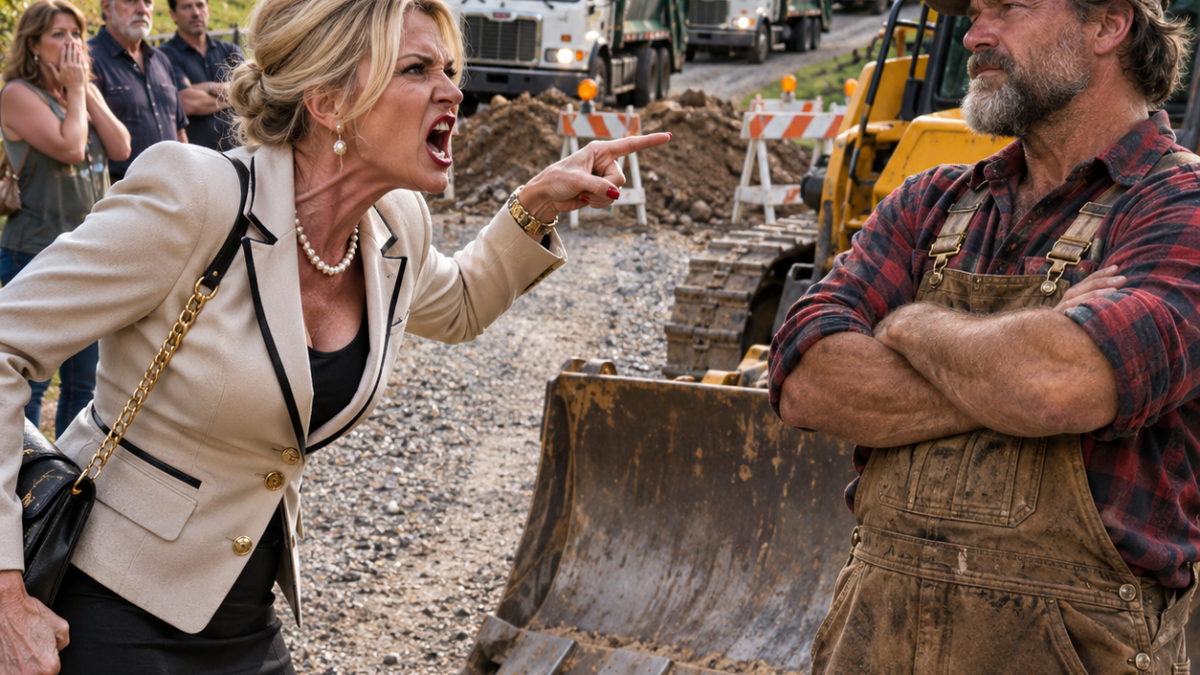
Karen immediately stepped between us.
“You don’t need to listen to this.”
Henderson looked at her.
Then at me.
“I’d rather hear him.”
Karen’s mouth tightened.
I opened the folder.
“The first thing you need to know is that this is a legally recorded private right-of-way.”
Karen waved her papers.
“He has already made that claim.”
“It isn’t a claim.”
I pulled out the survey.
“County recording number is here.”
I pointed.
“Fifty-foot access and utility easement.”
Henderson took the page.
Karen did not.
“Mr. Hemlock granted it when I bought the property.”
Henderson studied the document.
“This runs through where they want me to cut?”
“Yes.”
“All of it?”
“Yes.”
Karen scoffed.
“Our attorney reviewed the issue.”
“Did your attorney give the demolition contractor a title opinion?”
She stared at me.
Henderson looked toward her.
“Did they?”
“That isn’t necessary.”
His face changed slightly.
Contractors have a particular relationship with the phrase **not necessary** when someone else is asking them to accept liability.
He handed the survey back.
“What’s the second thing?”
I removed a letter printed on Allied Waste Services letterhead.
Karen’s eyes followed it.
“This road is also the only practical route used by the main garbage truck serving the rear section of Oakwood Estates.”
She laughed.
“That is ridiculous.”
I handed Henderson the letter.
He read.
His eyebrows rose.
Karen stepped toward him.
“This has nothing to do with your work.”
Henderson continued reading.
I said, “The automated front-loader cannot safely make the turns inside the development because of the narrow intersections and decorative curbs.”
Henderson looked up.
“They use this road every week?”
“For years.”
Karen folded her arms.
“They can use the main entrance.”
“No.”
She snapped her head toward me.
“No?”
“The route supervisor already evaluated it.”
I nodded toward the letter.
“That’s why he put it in writing.”
Henderson read the final paragraph.
Then whistled softly.
“What?”
Karen demanded.
He looked at her.
“It says if this road is removed, the company can’t guarantee service to the back section with their primary truck.”
Karen stared.
“That is not my problem.”
“It becomes your problem if you hired me to destroy their access.”
Henderson started handing the letter back.
“Hold on.”
I pulled out the second document.
“This one matters more.”
Karen’s voice rose.
“I am done with this performance.”
I ignored her.
“This is from the county fire marshal’s office.”
Henderson stopped moving.
Karen did too.
I handed him the letter.
“The main roads inside Oakwood technically meet minimum residential standards.”
I pointed toward Oakwood Estates.
“But the intersection geometry and decorative curbing make access difficult for the county’s largest ladder apparatus.”
Henderson read.
I continued.
“My easement is wider.”
“No curbs.”
“Gentler entrance.”
“More maneuvering space.”
I nodded toward the page.
“The county considers this road a substantially better emergency-access route for heavy apparatus serving the rear homes.”
Henderson’s expression changed completely.
Five minutes earlier, he had been a contractor caught between an angry property owner and an HOA president.
Now he was a man holding a letter containing the words **fire apparatus** and **emergency access**.
Those words have a miraculous ability to focus the mind.
Karen pointed toward the bulldozer.
“You have a signed contract.”
Henderson turned toward the machine.
He reached up.
Killed the engine.
The sudden silence was astonishing.
Even the birds seemed louder.
Karen stared at him.
“What are you doing?”
“I’m calling my boss.”
“I am your client.”
“The HOA is my client.”
“Then proceed.”
“No.”
Her face flushed.
“You can’t just refuse.”
Henderson folded the county letter carefully.
“Ma’am, you hired my company to remove gravel.”
“Yes.”
“You did not hire us to destroy a recorded easement while potentially blocking garbage service and emergency-vehicle access.”
“I told you we have authority.”
“And he has county documents.”
“That’s his interpretation.”
Henderson looked at me.
Then at her.
“I’m not choosing between your interpretations.”
He pulled out his phone.
“I’m choosing not to lose my insurance.”
Karen looked as if she had been slapped.
“This is pathetic.”
Henderson walked away while dialing.
She turned toward me.
“You planned this.”
“Yes.”
That answer surprised her.
“You admit it?”
“I made phone calls.”
“You interfered with an HOA contractor.”
“No.”
I pointed toward Henderson.
“I informed him what he was actually being asked to destroy.”
“You are sabotaging a lawful board decision.”
“Karen.”
I lowered my voice.
“You held a meeting about my property and refused to let me speak.”
“You weren’t a member.”
“You voted to demolish my road after refusing to read the deed.”
“We read it.”
“Then you knew.”
“It is still an encroachment.”
“On what?”
She hesitated.
“Community land.”
“The easement existed before your community.”
“That doesn’t—”
“It existed before the developer bought the land.”
She said nothing.
“It is recorded.”
Nothing.
“It is permanent.”
Her jaw tightened.
“You think paperwork protects you from everything.”
“No.”
I looked toward the bulldozer.
“But today it’s doing a respectable job.”
Henderson spent almost forty-five minutes on the phone.
First his supervisor.
Then, judging by the way his posture changed, someone higher.
Possibly an attorney.
Possibly insurance.
Karen paced.
I waited.
A couple of neighbors appeared at the edge of Oakwood Lane.
Then more.
News travels quickly when a bulldozer appears beside someone’s home.
Bob arrived.
Of course Bob arrived.
Bob was Karen’s most enthusiastic supporter.
He lived on the rear cul-de-sac and treated his Bermuda grass like a dependent child.
He walked up to Karen.
“What’s happening?”
“This contractor is refusing to fulfill his agreement.”
Bob looked at the bulldozer.
“Why?”
I answered.
“Liability.”
Karen glared.
Bob ignored me.
“What liability?”
Henderson ended his call and returned.
“All right.”
Karen straightened.
“Finally.”
He looked at her.
“We’re leaving.”
Her face emptied.
“What?”
“My boss says nobody touches this road without a court order.”
“That’s outrageous.”
“And written clearance from the county regarding emergency access.”
“You already signed a contract.”
“A contract doesn’t override our insurer.”
“Your company will hear from our attorney.”
Henderson shrugged.
“They can talk to ours.”
He climbed onto the bulldozer.
Karen stepped toward the track.
“You cannot leave.”
He looked down.
“Ma’am.”
The engine started.
“You’re going to want to move.”
She moved.
Slowly.
The bulldozer backed away.
The same machine Karen had brought as the physical symbol of her authority crawled backward down the road while half a dozen neighbors watched.
Nobody spoke.
I almost felt sorry for her.
Almost.
Then a familiar mechanical groan came from the county road.
Everyone turned.
Green and white.
Large.
Loud.
The Allied Waste Services front-loader.
Tuesday.
Trash day.
The truck turned toward my road.
Exactly as it had for years.
Only now Karen was standing almost directly in its path.
The driver slowed.
His window came down.
“Morning!”
He had a beard that could have survived winter.
I knew him as Gus.
“Morning, Gus.”
He looked at the bulldozer backing away.
“Road work?”
“Something like that.”
Karen walked toward him.
“You are not authorized to use this road.”
Gus looked at her.
“What?”
“This is private HOA property.”
I raised my eyebrows.
Gus looked toward me.
I said, “Apparently I’ve been demoted.”
Karen snapped.
“Do not encourage him.”
Gus rested one forearm on the window.
“Ma’am, I’ve been driving this route for five years.”
“You will use the main subdivision entrance from now on.”
He blinked.
“I can’t.”
“Yes, you can.”
“No, ma’am.”
“I am the HOA president.”
“That’s nice.”
Bob coughed to hide a laugh.
Karen turned toward him.
He immediately became serious.
Gus continued.
“My truck doesn’t make the back intersections safely.”
“Other trucks do.”
“My truck weighs a little more than your recycling pickup.”
“You can maneuver.”
“I can drive over your curbs.”
Karen stared.
“Excuse me?”
“And probably your landscaping.”
His voice remained patient.
“If that’s what you want.”
“You will not damage HOA landscaping.”
“Then I need this road.”
“You can’t use it.”
Gus sighed.
Then picked up his radio.
“Dispatch, Gus. Oakwood.”
Static.
“Yeah, access issue.”
More static.
“HOA president says gravel route is closed.”
Karen folded her arms triumphantly.
Then Gus listened.
“All right.”
He hung the microphone back up.
“What?”
Karen asked.
“My supervisor says if legal access is disputed, we don’t proceed.”
“Good.”
“We skip collection.”
Her face changed.
“What?”
“Back section won’t get pickup today.”
Bob stepped forward.
“What do you mean?”
Gus nodded toward him.
“Your street’s in the back section, right?”
“Yes.”
“Then I’ll see you next week.”
“You can’t leave our garbage.”
Gus shrugged.
“Can’t service without safe access.”
He restarted the truck.
Karen moved toward the window.
“You need to contact your company.”
“My supervisor just told me to leave.”
“I will call them.”
“Please do.”
The truck backed out.
Turned.
Drove away.
Bob looked at Karen.
“Wait.”
She ignored him.
“What does that mean for Tuesday pickup?”
She stared at me.
I smiled politely.
“You should probably call Allied Waste.”
Bob looked from me to Karen.
Then toward his full garbage cans.
The first consequences had arrived.
They smelled much worse by Friday.
July heat is merciless.
Garbage that might survive another day in October becomes biological warfare in summer.
Six homes on the rear section had missed collection.
Some families had two cans.
Bob had three.
By Thursday afternoon, the lids would no longer close.
By Friday, flies hovered around them in black clouds.
The carefully manicured cul-de-sac smelled like a landfill wearing expensive landscaping.
Sarah and I smelled almost nothing.
Our trash pickup used a separate private service.
I did not arrange that to punish them.
We had used the same company since before the subdivision existed.
But the irony was difficult to miss.
Sarah walked in Friday morning.
“You’re not smiling.”
“I’m not.”
“You are.”
“I am concerned for public sanitation.”
“You are enjoying this far too much.”
“I don’t enjoy garbage.”
“You enjoy consequences.”
“That may be accurate.”
She poured coffee.
“Are they really not picking it up?”
“Not until access is resolved.”
“What about the main entrance?”
“Truck can’t make the turns without risking property damage.”
She looked through the window toward Oakwood.
“Karen didn’t know that?”
“No.”
“How?”
“She doesn’t ask questions that might produce answers she dislikes.”
The management company received dozens of calls.
So did the waste company.
Karen reportedly told residents the disruption was my fault.
That lasted until people began calling Allied Waste directly.
The company’s explanation was straightforward.
They had not changed the route.
The HOA had disputed access to the route they used.
That distinction mattered.
Bob came to my house late Friday.
I found him standing awkwardly near the mailbox.
“Jack.”
“Bob.”
He removed his hat.
His hair was flattened beneath it.
“We need to talk.”
“About?”
He looked back toward Oakwood.
“The garbage.”
“I’m not in charge of your garbage.”
“You know what I mean.”
“Yes.”
“Can’t you just let the truck through?”
I stared at him.
“Bob.”
“What?”
“I have never stopped the truck.”
He blinked.
“Karen told them they couldn’t use the road.”
“I know.”
“She told you the road should be destroyed.”
He shifted.
“That was different.”
“How?”
He didn’t answer.
“You supported the vote.”
“That road looks terrible.”
I almost laughed.
“So your garbage is currently rotting in ninety-degree heat because you voted to remove a road you thought looked terrible.”
Bob rubbed the back of his neck.
“When you say it like that…”
“How else should I say it?”
He sighed.
“I guess nobody explained the truck situation.”
“I tried to explain the road situation.”
He looked at the gravel.
“We didn’t let you speak.”
“No.”
“That was wrong.”
I waited.
Bob stared at the road for a while.
“Can the truck come Tuesday?”
“If the company believes access is legally clear.”
“Can you tell them it is?”
“I already told them they had permission from me.”
His eyes widened.
“You did?”
“Yes.”
“Then what’s the problem?”
“The HOA.”
He closed his eyes.
“Karen.”
“Yes.”
He put his hat back on.
“She has to fix this.”
“That would be sensible.”
Bob looked at me again.
“For what it’s worth, I’m sorry about the meeting.”
It was not a full apology.
Not yet.
But it was the first crack.
“Goodnight, Bob.”
“Night.”
The garbage gave me leverage.
But leverage alone does not create accountability.
Karen had spent two years shaping the story.
To many residents, I was still the stubborn outsider.
So I decided the facts needed a larger audience.
Maria Sanchez was an investigative reporter with a local television station.
I had watched several of her stories.
Contractor fraud.
County spending.
Consumer issues.
She liked paperwork.
That made her useful.
I sent an email.
Short.
**HOA voted to bulldoze private deeded access road. Road is sole practical route for community garbage collection and superior access for county heavy fire apparatus. Bulldozer stopped after contractor learned facts. Residents now missing trash service. Full documentation available.**
Maria called twenty minutes later.
“Is this real?”
“Yes.”
“Do you have documents?”
“Yes.”
“How many?”
I looked at my binder.
“A lot.”
She laughed.
“I like you already.”
We met at a coffee shop.
I brought everything.
Deed.
Easement.
County plat.
Certified letters.
HOA violations.
Demolition notice.
Board resolution.
Waste-company letter.
Fire marshal assessment.
And the recording from the HOA meeting where Karen refused to let me speak.
Maria listened twice.
“You’re not an HOA member?”
“No.”
“And she said you couldn’t speak because you weren’t a member?”
“Yes.”
“During a meeting about destroying your road?”
“Yes.”
She stared at me.
“That’s incredible.”
“Not in a good way.”
“No.”
She looked through the Allied Waste letter.
“This garbage truck detail is gold.”
“For television?”
“For explaining the stupidity.”
She interviewed Frank from Allied Waste.
The fire marshal’s office.
Residents.
Bob initially refused.
The Millers agreed anonymously.
Mrs. Gable agreed publicly.
That surprised me.
Maria sat with her on the porch.
“How long has that road existed?”
Mrs. Gable smiled.
“Longer than most of the people complaining about it.”
“Do you remember the original easement?”
“I remember Hemlock using that path before Jack bought his land.”
“Is it part of the HOA?”
“No.”
“How sure are you?”
“My house isn’t either.”
She looked directly into Maria’s camera.
“Some of us were here before all those rules.”
The story aired Monday.
The headline was merciless.
**HOA POWER PLAY LEAVES NEIGHBORHOOD IN A STINK**
They showed my road.
The bulldozer.
Oakwood Lane.
The tight corners.
Then Bob’s overflowing garbage cans.
I did feel a little sorry for Bob.
Not much.
Maria explained the easement.
Then the truck issue.
Then the fire-access concern.
Then played Karen’s voice from the meeting:
**“You are not a member. Therefore, you have no standing to speak.”**
The segment ended with Maria standing beside the road.
“The HOA declined an on-camera interview but stated that the board believed it acted within its authority.”
Sarah muted the television.
“That was brutal.”
“Yes.”
“Do you feel bad?”
“No.”
“Good.”
The community Facebook page exploded.
People who had spent months avoiding the dispute suddenly discovered strong opinions.
**Why were we never told the road was deeded?**
**Why did the board approve demolition without consulting the garbage company?**
**What happens if there is a fire?**
**Why wasn’t Reynolds allowed to speak?**
Then the harder questions.
**How much did we pay for the bulldozer?**
**Did HOA funds cover Karen’s attorney?**
**Who approved this?**
The Millers stopped whispering.
They printed a petition.
Special meeting.
Vote of no confidence.
They needed a certain number of homeowner signatures.
Within twenty-four hours, they had more than seventy percent.
Karen tried to fight back.
Another email went out.
She called the news report misleading.
She accused me of manipulating public opinion.
She claimed garbage service had been “temporarily disrupted due to a hostile adjacent property owner.”
That sentence was a mistake.
Frank at Allied Waste forwarded the company’s written statement to several homeowners.
It made clear that I had never revoked access.
The HOA had disputed it.
Now people were not merely angry.
They felt lied to.
The management company scheduled an emergency meeting.
Sarah and I arrived early.
The room was already almost full.
Mrs. Gable sat in front.
The Millers stood near the back holding the petition.
Bob sat three rows from Karen.
Not beside her.
That was new.
When I entered, people looked up.
A man I barely knew stood.
“Jack.”
I stopped.
“I owe you an apology.”
“For?”
“I believed the newsletters.”
He looked embarrassed.
“I should have asked you.”
Another neighbor came over.
Then another.
Not everyone.
But enough.
Karen sat at the front table.
She looked smaller.
Not physically.
Authority can change the size of a person.
When people believe your title means something, you occupy more space.
When that belief cracks, the illusion goes with it.
A representative from the management company called the meeting to order.
He looked nervous.
“We are here to address service interruptions and concerns arising from recent media coverage.”
A voice shouted:
“We’re here to talk about Karen.”
Applause.
Karen grabbed her microphone.
“This meeting will follow proper procedure.”
Someone laughed.
The manager raised his hands.
“Please.”
Mr. Miller stood.
“I move for a vote of no confidence in the HOA president and immediate removal from the presidency.”
“Second!”
The word came from at least three directions.
The manager looked toward legal counsel seated beside the board.
The attorney whispered.
Then the manager nodded.
“The motion is recognized.”
Karen shot to her feet.
“This is completely inappropriate.”
A homeowner responded.
“So was trying to bulldoze somebody’s road.”
Applause again.
Karen pointed toward me.
“This entire thing has been orchestrated by him!”
I remained seated.
The manager looked at me.
“Mr. Reynolds, counsel has advised that given the circumstances, you should be permitted to address the membership before the vote.”
I stood.
Karen laughed bitterly.
“Of course.”
I carried my binder forward.
Same documents.
No dramatics.
I began with the oldest fact.
The easement.
I projected the original survey onto the screen.
“This is the fifty-foot access and utility easement granted by the Hemlock family when I purchased my ten acres.”
I pointed.
“Recorded with the county.”
Next.
“My property was never part of Oakwood Estates.”
Next.
“I sent this documentation to the HOA after the first road violation.”
Certified receipt.
Then the second notice.
Then my statutory response.
Then the board resolution authorizing demolition.
I looked around the room.
“I requested five minutes to explain this before the vote.”
Then I played the recording.
Karen’s voice filled the clubhouse.
**“As you so frequently remind us, you are not a member. Therefore, you have no standing to speak here.”**
Nobody looked at her.
I continued.
“The board then approved spending your money to destroy the road.”
Next slide.
Allied Waste Services.
I read the relevant sentence.
**Sole viable route for primary automated collection vehicle servicing rear properties.**
People murmured.
Next.
County fire marshal.
**Superior heavy-apparatus access.**
I stopped.
“I did not create these dependencies.”
I looked toward Karen.
“I discovered them after the HOA voted to destroy the road.”
A woman raised her hand.
“How much did the bulldozer cost?”
The manager looked through papers.
“Mobilization fee was approximately twenty-eight hundred dollars.”
The room erupted.
Someone shouted:
“For nothing?”
Another:
“Who approved that?”
The manager answered.
“The board.”
Bob slowly stood.
Karen looked at him.
“What are you doing?”
He looked uncomfortable.
Then he turned toward the room.
“I voted for it.”
A few people murmured.
He raised one hand.
“I did.”
Then he looked at me.
“And I was wrong.”
The room went quiet.
Karen stared at him.
“Bob.”
He ignored her.
“I believed the road was unauthorized because that’s what we were told.”
He looked at Karen.
“We weren’t shown the deed.”
“We discussed it.”
“No.”
Bob shook his head.
“You said his claim was invalid.”
“It was!”
“The county says it isn’t.”
“Bob, sit down.”
He turned toward her.
“No.”
That one word probably hurt Karen more than anything I had said all evening.
Bob continued.
“My garbage sat outside for a week because we tried to remove the road the garbage truck uses.”
A few people laughed.
He smiled awkwardly.
“I realize how stupid that sounds now.”
Even I smiled.
Then Mrs. Gable stood.
She didn’t need a microphone.
“I remember that road before Oakwood existed.”
Karen rolled her eyes.
Mrs. Gable caught it.
“I saw that.”
The room chuckled.
“You can roll your eyes at me if you like.”
She pointed toward Karen.
“But you do not get to rewrite history because it ruins your landscaping plan.”
Applause.
The manager tried to restore order.
The vote happened fifteen minutes later.
Nearly every hand went up.
No confidence.
Removal.
Karen stared across the room.
Her lips pressed into a thin line.
“How many?”
The manager counted again.
It did not improve.
She was out.
No dramatic speech.
No final gavel strike.
No dignified exit.
She simply gathered her folder.
Some papers slipped onto the floor.
Nobody helped her.
Then she walked out.
The door closed.
For several seconds, the room stayed silent.
The strange thing about watching someone lose power is how ordinary it looks.
No thunder.
No music.
A woman walks through a door.
A title disappears.
The world keeps turning.
Mr. Miller became interim president until an election could be held.
One of the first things he did was call Allied Waste.
The legal dispute was considered resolved.
The company received written confirmation that I, as easement holder, continued allowing service access consistent with its historic use.
The following Tuesday, Gus returned.
He slowed beside the house.
Air horn.
One short blast.
Sarah nearly dropped her coffee.
I raised my mug.
Gus gave me a thumbs-up.
Then continued toward the rear cul-de-sac.
The garbage mountains disappeared.
The smell did too.
Oakwood started becoming normal again.
The new board hired a lawyer to review the old files.
They issued a resolution acknowledging the easement.
Not grudgingly.
Clearly.
My access road was not HOA property.
It predated the subdivision.
It was legally recorded.
The association would not challenge it.
The letter arrived by certified mail.
I laughed when I saw the envelope.
Sarah asked why.
“Symmetry.”
She read the resolution.
“Frame it?”
“No.”
“Burn it?”
“No.”
“Use it to line the chicken coop we don’t have?”
“File it.”
She sighed.
“You’re very boring.”
“I have survived because of that.”
Then came the apology.
Formal.
Signed by the new board.
**On behalf of the Oakwood Estates Homeowners Association, we apologize for the improper actions taken against your property and for refusing you an opportunity to present evidence before the prior demolition vote.**
I read that sentence twice.
Not because I needed validation.
Because apologies are rare when institutions are involved.
Organizations prefer phrases like:
**communication failure**
or
**procedural misunderstanding**
This one used the word improper.
That mattered.
Bob came by a week later.
Hat in hand again.
This time, the apology was complete.
“Jack.”
“Bob.”
“I was an ass.”
I considered it.
“That’s fairly accurate.”
He laughed nervously.
“I deserved that.”
“Yes.”
He looked toward the road.
“I complained about the gravel.”
“I remember.”
“I said you should pave it.”
“You did.”
“My wife reminds me of that every Tuesday when the garbage truck drives over it.”
That made me laugh.
“Good woman.”
“She also made me bring this.”
He held out a pie.
“What kind?”
“Apple.”
“Homemade?”
He hesitated.
“Store-bought.”
“I appreciate the honesty.”
Bob looked serious again.
“I’m sorry I treated you like you didn’t belong.”
That one mattered.
“You weren’t the only one.”
“No.”
He looked toward Oakwood.
“But I was loud about it.”
“Yes.”
He smiled.
“Friends?”
“That may be ambitious.”
“Neighbors?”
“That’ll do.”
He left the pie.
Sarah found it later.
“Poisoned?”
“Probably not.”
“You sound disappointed.”
“I like contingencies.”
The social climate changed slowly.
People waved again.
Then stopped to talk.
Someone asked about Sarah’s tomatoes.
Someone else wanted advice about drainage.
The road that had made us seem separate began doing the opposite.
Kids rode bicycles past the entrance.
Garbage trucks used it.
Occasionally emergency services practiced access through the area after the fire marshal raised the issue.
The county suggested Oakwood formalize emergency-use coordination.
The new board agreed immediately.
No fight.
No ego.
Just problem-solving.
That was perhaps the greatest contrast.
Karen had viewed every question as a contest over authority.
The new board treated problems as things to solve.
Sarah noticed first.
“You seem different.”
“How?”
“You don’t watch every car coming down the road.”
I thought about it.
She was right.
For two years, every unfamiliar vehicle had created tension.
Another notice?
Inspector?
Lawyer?
Contractor?
Karen had turned my own driveway into a warning system.
Now it was a road again.
Just gravel.
Dust in summer.
Mud at the edges when it rained.
Exactly what it had been before her.
And yet the story did not end immediately.
Karen’s house went on the market less than a month after the recall.
For Sale sign.
Perfectly centered.
Perfect landscaping.
Of course.
I saw her once while retrieving the mail.
She was standing beside the sign talking to a realtor.
She noticed me.
For a second, we simply looked at each other.
Then she crossed the road.
Sarah later told me she would have paid money to see the conversation.
Karen stopped several feet away.
“You happy?”
“No.”
She seemed surprised.
“You got what you wanted.”
“What did I want?”
“To humiliate me.”
I shook my head.
“I wanted you to leave my road alone.”
“You ruined my reputation.”
“I handed people documents.”
“You went to the media.”
“After you brought a bulldozer.”
Her mouth tightened.
“You could have handled it privately.”
“I tried.”
“No, you wanted attention.”
“I sent you certified letters.”
“You threatened legal action.”
“After you threatened a fraudulent lien.”
She looked away.
Then said:
“This neighborhood was beautiful before you turned everyone against each other.”
I almost answered angrily.
Instead I thought of Mrs. Gable.
The Millers.
Bob.
The silent families who had been afraid to speak.
“No.”
Karen looked back.
“You turned people against each other.”
“That’s ridiculous.”
“You taught them that disagreement meant punishment.”
“I enforced standards.”
“You taught them to watch their neighbors.”
“I protected property values.”
“You made them afraid.”
Her face hardened.
“You think they’ll thank you in five years when this place looks like chaos?”
I looked toward Oakwood.
Green lawns.
Children riding bicycles.
A basketball hoop at the end of one driveway.
Someone had left a trash can visible beside a garage.
Civilization had somehow survived.
“I think they’ll be fine.”
Karen laughed bitterly.
“You always thought you were better than us.”
“No.”
“You refused to join the community.”
“I wasn’t part of the HOA.”
“Same thing.”
“That sentence is the whole problem.”
She stared at me.
“A community is not paperwork, Karen.”
“What would you know about community?”
I thought about twenty-five years of service.
Units held together by trust.
Engineers building bridges for people they would never meet.
Crews working at night because somebody else needed the route by morning.
I thought about Sarah.
Mrs. Gable.
Neighbors who eventually spoke up.
“A little.”
Karen’s expression faltered.
Then she turned away.
Before she left, I said:
“For what it’s worth, I hope the next place makes you happy.”
She stopped.
Looked over her shoulder.
There was no reply.
Maybe she thought I was mocking her.
I wasn’t.
I had no interest in carrying Karen around in my head after she was gone.
Victory that requires you to keep hating someone is just another kind of occupation.
Two weeks later, the moving truck came.
Her Lexus followed.
Then Oakwood entered its post-Karen era.
It was less exciting.
Thank God.
The board meetings became boring.
Budgets.
Pool maintenance.
Snow contracts.
Landscaping bids.
The kinds of things an HOA should discuss.
Nobody announced wars against gravel.
The Millers eventually won election to the board.
Mr. Miller became president.
He called me after his first month.
“I understand why presidents become dictators.”
“That was fast.”
“You know how many emails I got about mailbox paint?”
“How many?”
“Twenty-three.”
“I’m sorry.”
“Someone wants us to create a rule about inflatable holiday decorations.”
“Don’t.”
“I’m tempted.”
“Resist.”
“How did Karen survive this?”
“She enjoyed it.”
He went quiet.
“That explains everything.”
Sarah and I hosted a small barbecue the following spring.
Not an HOA event.
Just neighbors.
Bob came.
Mrs. Gable.
The Millers.
Several families.
Gus even stopped by because Bob somehow knew his route schedule and invited him.
He parked the garbage truck at the road and walked up carrying a bag of chips.
I looked at him.
“You drove a garbage truck to my barbecue.”
“I’m working.”
“Convenient.”
“Also dramatic.”
Bob pointed toward him.
“That man traumatized me.”
Gus laughed.
“Your garbage traumatized me.”
Everyone laughed.
That sound meant more than Karen’s recall.
For two years, the road had become a boundary.
My side.
Their side.
The stubborn outsider.
The subdivision.
Now folding tables sat beside it.
Kids ran across the gravel.
Nobody cared about dust.
Mrs. Gable sat beneath an oak tree drinking lemonade.
She caught me watching.
“What?”
“Nothing.”
“Liar.”
I walked over.
“You were right.”
“About?”
“The road.”
She smiled.
“I’m old. That happens.”
“You said it had been here since before Oakwood.”
“It has.”
“You said Karen had no more right to destroy it than repaint your house beige.”
Mrs. Gable frowned.
“If somebody paints my house beige, I’m burning the subdivision down.”
I laughed.
“You’re more dangerous than Karen.”
“Don’t forget it.”
Then she became serious.
“I’m glad you fought.”
“So am I.”
“No.”
She looked toward Oakwood.
“I mean for them.”
I followed her eyes.
Neighbors.
Families.
Bob arguing with Gus over whether the garbage truck could theoretically fit through the main entrance.
“You gave them permission to stop being scared.”
“I didn’t.”
“Yes, you did.”
“They signed the petition.”
“After you stood there first.”
I thought about that.
In the Army, courage is often misunderstood.
People imagine courage as one person charging forward alone.
Real courage spreads.
One person moves.
Then someone beside them moves.
Then another.
Soon the thing that looked impossible becomes ordinary.
Maybe Mrs. Gable was right.
The road had never only been mine.
Legally, yes.
But symbolically, it had become something else.
A reminder that access matters.
Not just physical access.
Access to facts.
Access to meetings.
Access to the right to speak when decisions affect you.
Karen had tried to shut all three.
The road survived.
So did the others.
Later that summer, the county fire department asked permission to conduct a route familiarization exercise.
I agreed.
A ladder truck came through.
Huge machine.
Long chassis.
The crew tested turning and staging near the rear homes.
The fire captain spoke with the HOA board.
“This road gives us options.”
That was his phrase.
**Options.**
In an emergency, options are worth more than appearances.
The board adopted a formal emergency-access memorandum.
My easement remained private.
But fire and contracted service vehicles had documented permission consistent with existing use.
The arrangement cost almost nothing.
Karen could have achieved the same result with one conversation.
Instead, she nearly destroyed it.
That fact became a running joke.
Mr. Miller called me after signing the memorandum.
“You realize we officially protected the road Karen tried to remove.”
“I noticed.”
“Should we name it after her?”
“No.”
“Karen Memorial Parkway?”
“Absolutely not.”
“Peters Boulevard?”
“Stop.”
He laughed.
A year after the whole fight ended, Sarah and I were sitting on the porch on a Tuesday morning.
I had coffee.
She had tea.
We heard the truck before we saw it.
Hydraulics.
Diesel.
Then Gus rounded the bend.
He slowed.
Looked toward the porch.
Raised one hand.
I raised my coffee.
Then he blasted the air horn.
Sarah jumped.
Coffee almost went everywhere.
“GUS!”
He laughed out the window and kept driving.
I was laughing too hard to help.
Sarah glared.
“You encouraged that.”
“I absolutely did not.”
“You looked delighted.”
“That is not evidence.”
“You and your evidence.”
The horn faded into the distance.
The garbage truck reached the rear cul-de-sac.
Cans emptied.
Normal life.
I looked down the road.
Ten years earlier, I had built it because Sarah and I needed a way home.
Nothing more complicated.
A strip of gravel.
A practical solution.
Then people built around it.
Systems began depending on it.
Waste collection.
Emergency access.
Deliveries.
Our lives.
Karen saw gravel.
She did not see function.
That was her first mistake.
Her second was assuming that because something was outside her control, it needed to be removed.
That mistake cost her everything she actually cared about.
Title.
Influence.
Reputation.
Control.
I sometimes wondered if she ever understood.
Probably not.
People rarely experience themselves as the villain.
Karen likely still believed she had tried to protect Oakwood.
Maybe that was true in her mind.
But good intentions are not enough when combined with unchecked authority.
You still have to ask:
**Do I have the right?**
**Do I have the facts?**
**Who gets hurt if I’m wrong?**
She never asked those questions.
I did.
So did Henderson.
Frank.
The fire marshal.
Maria.
The homeowners eventually did too.
That was why the bulldozer stopped.
Not because I was stronger than Karen.
Because once everyone looked at the same facts, her story stopped working.
Years passed.
Oakwood matured.
Trees grew.
Children who had been toddlers when the fight began became teenagers.
Bob eventually stopped maintaining his lawn with military precision.
He claimed age.
His wife claimed enlightenment.
The first dandelion I ever saw in his yard nearly made me pull over.
He caught me looking.
“Don’t.”
I pointed.
“There are weeds.”
“They’re flowers.”
“Who are you?”
“Shut up, Jack.”
I laughed for half the drive home.
Mrs. Gable remained in her cottage.
Her roses flourished.
Sarah often helped her.
When she turned eighty-five, half of Oakwood attended the party.
She stood beside the cake and announced:
“I was here before all of you, and I intend to outlive the HOA.”
Mr. Miller shouted:
“Please don’t dissolve us in your will.”
She gave him a look that made everyone laugh.
That was community.
Not identical roofs.
Not decorative curbs.
Not covenant enforcement.
Knowing whose birthday it was.
Checking on a widow after a storm.
Borrowing tools.
Arguing.
Apologizing.
Letting the garbage truck use the road because that’s what makes sense.
The easement paperwork stayed in my filing cabinet.
Original survey.
Hemlock deed.
County recording.
All of it.
Sarah once asked why I still kept duplicates in three places.
“Trauma.”
“No.”
“Preparedness.”
“You have one in the fireproof safe.”
“Yes.”
“One at the attorney’s office.”
“Yes.”
“And one scanned to cloud storage.”
“Yes.”
“And the original.”
“Yes.”
“Karen broke you.”
“Karen educated me.”
She shook her head.
“Same difference.”
Old Man Hemlock’s children visited once.
They had heard the story.
One of his sons walked the road with me.
“Dad would have enjoyed this.”
“Being sued by an HOA?”
“No.”
He smiled.
“Watching somebody try to argue that his easement wasn’t real.”
We stopped near the property line.
“He was stubborn.”
“I gathered.”
“He made me drive him to the courthouse twice when your sale was closing.”
“Why?”
“To verify the easement recording.”
I looked at him.
“Twice?”
“He didn’t trust developers.”
That made me laugh.
“Smart man.”
His son nodded toward Oakwood.
“He knew they’d build someday.”
“He expected this?”
“Not exactly.”
He looked at the gravel.
“But he said landlocked property is only worth what its access is worth.”
I thought about that sentence long after he left.
Hemlock had protected a road on paper before any of us understood how important it would become.
That is the strange thing about infrastructure.
When it works, nobody notices.
Roads.
Pipes.
Drainage.
Access.
Waste removal.
Fire routes.
People notice only when someone breaks them.
Karen noticed my road because she thought it looked ugly.
Frank noticed it because his truck needed it.
The fire department noticed because seconds matter.
I noticed it because it led home.
Different perspectives.
Same gravel.
The county eventually repaved a section of the public road near the entrance.
A contractor asked whether I wanted my gravel access paved while equipment was nearby.
I considered it.
Then declined.
Sarah looked surprised.
“You could have finally made Bob happy.”
“He likes the gravel now.”
“He likes not smelling garbage.”
“That too.”
Truth was, I had grown attached to it.
Not because of the fight.
Because gravel fit the land.
Rain sounded good on it.
Tires announced visitors.
Dust settled after summer traffic.
It felt like the place we had chosen before the subdivision arrived.
I did improve drainage.
Added stone.
Regraded sections.
But it remained gravel.
That mattered somehow.
Not as defiance.
As continuity.
The story became local folklore.
New residents would hear some version.
HOA president tried to bulldoze road.
Garbage truck couldn’t get in.
Neighborhood filled with trash.
News station came.
President recalled.
The details grew exaggerated over time.
One teenager told me Karen had personally driven the bulldozer.
“No.”
Another claimed the garbage piled ten feet high.
“No.”
Someone said the fire department arrested her.
“Definitely no.”
Eventually I stopped correcting everyone unless the story became ridiculous.
The truth was dramatic enough.
Maria Sanchez won a regional journalism award that year for a package of consumer stories.
She emailed me.
“You made the highlight reel.”
“Wonderful.”
“You sound thrilled.”
“I’m famous because of garbage.”
“There are worse reasons.”
“I’m sure.”
She later interviewed me for a follow-up about HOA accountability.
At the end, she asked:
“What would you tell someone facing something similar?”
I thought for a moment.
“Don’t assume official-looking paper means the person sending it has authority.”
She nodded.
“What else?”
“Read your deed.”
“Good.”
“Read the rules.”
“Good.”
“Document everything.”
“Anything emotional?”
“No.”
She laughed.
“Jack.”
I considered again.
“Don’t fight alone if you don’t have to.”
That was the real answer.
Karen had initially made the conflict feel like me against Oakwood.
That was how she wanted it.
One outsider.
One difficult man.
One ugly road.
But the moment the problem touched garbage, safety, money, and fairness, people started looking closer.
Then the story changed.
Not me versus them.
Us versus a bad decision.
And finally:
Us fixing it.
That progression mattered.
Because revenge alone would have produced a satisfying ending for me.
Community produced a better ending for everyone.
The new board was not perfect.
No board is.
They made mistakes.
Residents complained.
Someone proposed a ridiculous rule limiting basketball play after eight.
It failed.
Someone else wanted matching porch lights.
That failed too.
But the process remained open.
People spoke.
Minutes were recorded.
Decisions were explained.
If someone disagreed, they could show up without being threatened with trespass.
A low bar.
But an important one.
Karen’s greatest failure had not been that she made bad decisions.
Everyone does.
It was that she created a system where disagreeing with her became evidence that you were the problem.
That is how petty power becomes dangerous.
Years later, Sarah and I were on the porch at sunset.
The road glowed pale beneath the trees.
Oakwood lights flickered on beyond it.
A garbage truck had passed that morning.
A delivery van in the afternoon.
Mrs. Gable’s nephew had driven through to help with her roses.
Normal traffic.
Sarah handed me a drink.
“You know what I remember most?”
“What?”
“The bulldozer.”
“I figured.”
“No.”
She sat beside me.
“I remember your face.”
“What about it?”
“You were furious.”
“I was calm.”
“You were pretending to be calm.”
“I was calm.”
“Jack.”
I conceded.
“Fine.”
She smiled.
“I thought you were going to do something stupid.”
“That hurts.”
“You were staring at that bulldozer like you wanted to dismantle it with a wrench.”
“I considered options.”
“And then you opened the folder.”
“Yes.”
“That was when I knew Karen was in trouble.”
I laughed.
“Why?”
“Because every time you bring a folder to an argument, somebody else is about to have a terrible afternoon.”
That may have been the most accurate description of my retirement.
We sat quietly.
Then a car approached from Oakwood.
Slowed near the property line.
A young family.
New residents.
The father lowered the window.
“Mr. Reynolds?”
“Yes?”
“Is this the famous garbage road?”
Sarah started laughing before I could answer.
I sighed.
“It’s an access easement.”
The man grinned.
“That’s not what my neighbor called it.”
“What did he call it?”
“The road that beat Karen.”
I shook my head.
“Roads don’t beat people.”
His wife smiled from the passenger seat.
“Apparently this one did.”
They drove on.
Sarah was still laughing.
“You’re never escaping this.”
“Apparently not.”
I looked down at the gravel.
The road that beat Karen.
Ridiculous.
But maybe there was something fitting about it.
Karen had built her authority through complicated language.
Covenants.
Violations.
Assessments.
Jurisdiction.
Enforcement.
My road was simple.
It existed.
It was recorded.
People needed it.
That simplicity defeated her.
Not personality.
Not revenge.
Function.
Truth is often like that.
Less impressive than a speech.
Harder to move.
The final irony came years later when Oakwood conducted a professional emergency-access review.
Growth in the surrounding area had changed response planning.
The county recommended formal secondary access for the subdivision.
Guess what route became part of the plan.
Mine.
Not transferred.
Not surrendered.
Still my easement.
But through a carefully drafted agreement, emergency services received explicit secondary-access rights.
The HOA contributed money toward maintaining a portion of the gravel used by contracted service vehicles.
I nearly laughed when Mr. Miller brought the proposal.
“So now you’re paying to maintain the road Karen tried to bulldoze?”
He looked offended.
“We prefer the term infrastructure partnership.”
“Of course you do.”
“It sounds better in the minutes.”
“Government language.”
“You taught me.”
I signed.
The first maintenance reimbursement was modest.
Enough for fresh gravel.
I used it to improve the entrance.
Bob came over.
“This looks good.”
I stared at him.
“Careful.”
“What?”
“You’re complimenting the road.”
He laughed.
“I’ve evolved.”
“Slowly.”
“But I got there.”
That might have been Oakwood’s story too.
Slowly.
But it got there.
Mrs. Gable passed away at ninety-one.
Peacefully.
Her niece invited Sarah and me to the memorial.
The clubhouse was full.
The same room where Karen had once refused to let me speak.
Now photographs of Mrs. Gable covered the tables.
Roses.
Her cottage.
Old pictures of farmland before Oakwood.
One photograph showed the dirt track that eventually became my gravel road.
I stood looking at it for a long time.
Her niece came over.
“She labeled that one.”
She handed me the photograph.
On the back, in Mrs. Gable’s shaky handwriting:
**Hemlock north access, 1978. Told you so, Jack.**
I laughed.
Then cried.
Not much.
Enough.
Sarah held my arm.
“She got the last word.”
“She usually did.”
Her niece told me to keep the photograph.
I framed it.
It still hangs in my office.
Beside the easement map.
Not because I need more proof.
Because some documents prove legal rights.
Others prove memory.
Mrs. Gable had been there before all of us.
Before Karen.
Before Oakwood.
Before the garbage trucks.
Before my gravel.
She knew that a community’s history doesn’t begin when a developer files covenants.
Land remembers previous lives.
Farm roads become access roads.
Fields become neighborhoods.
Old boundaries remain under new maps.
The mistake is assuming new rules erase old reality.
Karen made that mistake.
And almost everyone paid for it.
By then, the anger was gone.
Completely.
If somebody asked whether I hated Karen, I honestly could say no.
I disliked what she did.
I resented the stress she caused Sarah.
I despised the way she tried to weaponize fear.
But hate requires maintenance.
Like a road.
You have to keep feeding it.
I had better things to maintain.
Our home.
Our land.
The easement.
Friendships.
Sarah’s tomatoes.
My increasingly unreliable knees.
Peace.
One final Tuesday morning, years after the conflict, I sat on the porch.
Older.
Slower.
Coffee in hand.
The garbage truck came down the road.
Not Gus.
He had retired.
A younger driver.
Same company.
Newer truck.
He slowed near the porch.
Then, apparently following a tradition somebody had passed down, gave one short blast on the air horn.
I laughed.
Raised the cup.
Sarah opened the front door.
“They’re still doing that?”
“Tradition.”
“Idiocy.”
“Both can coexist.”
The truck continued toward Oakwood.
I watched it disappear between the trees.
The road remained.
Fresh gravel in places.
Older stone beneath.
Drainage ditch along one side.
Oaks arching overhead.
Nothing grand.
No monument.
No plaque.
Just access.
That was enough.
I thought about the morning Karen stood at the entrance with the bulldozer.
She believed power meant having enough votes to order something removed.
I learned the opposite.
Power can also mean knowing when something needs to remain.
Knowing its purpose.
Knowing who depends on it.
Knowing the difference between ownership and authority.
And being willing to stand still while somebody louder insists otherwise.
Karen wanted revenge against a road because it represented something she could not control.
What she got instead was the consequence of learning too late that systems are connected.
Destroy one thing, and another stops working.
Block one route, and garbage piles up.
Ignore one easement, and contractors walk away.
Silence one homeowner, and eventually an entire neighborhood starts asking why.
That was the chain reaction she never saw.
And maybe that is why the ending still satisfies me.
Not because Karen lost her title.
Not because the news embarrassed her.
Not because a bulldozer backed away.
Those things felt good for a while.
The real victory came later.
When Bob apologized.
When neighbors waved again.
When the board recorded the easement.
When fire officials gained a better emergency route.
When Mrs. Gable’s history was respected.
When the Millers stopped whispering.
When the road stopped being a battlefield and became what it had always been meant to be.
A way home.
That was all I had wanted at the beginning.
A home.
A little land.
Sarah’s garden.
A quiet retirement.
And one gravel road connecting us to the rest of the world.
Karen nearly turned that road into the thing that divided us from our neighbors.
Instead, by trying to destroy it, she accidentally made everyone understand why it mattered.
Sometimes justice arrives through a judge.
Sometimes through a vote.
Sometimes through journalism.
And sometimes it arrives every Tuesday morning in a green-and-white garbage truck.
The driver turns onto the road.
The tires crunch over gravel.
The truck disappears toward the houses.
The cans get emptied.
Life goes on.
I finish my coffee.
Sarah tends the tomatoes.
Oakwood wakes up.
And the road remains exactly where it belongs.








