PART 2: HOA Voted to Bulldoze a Trail Through My Apple Orchard—Then a $410,000 Damage Report Stopped Them Cold
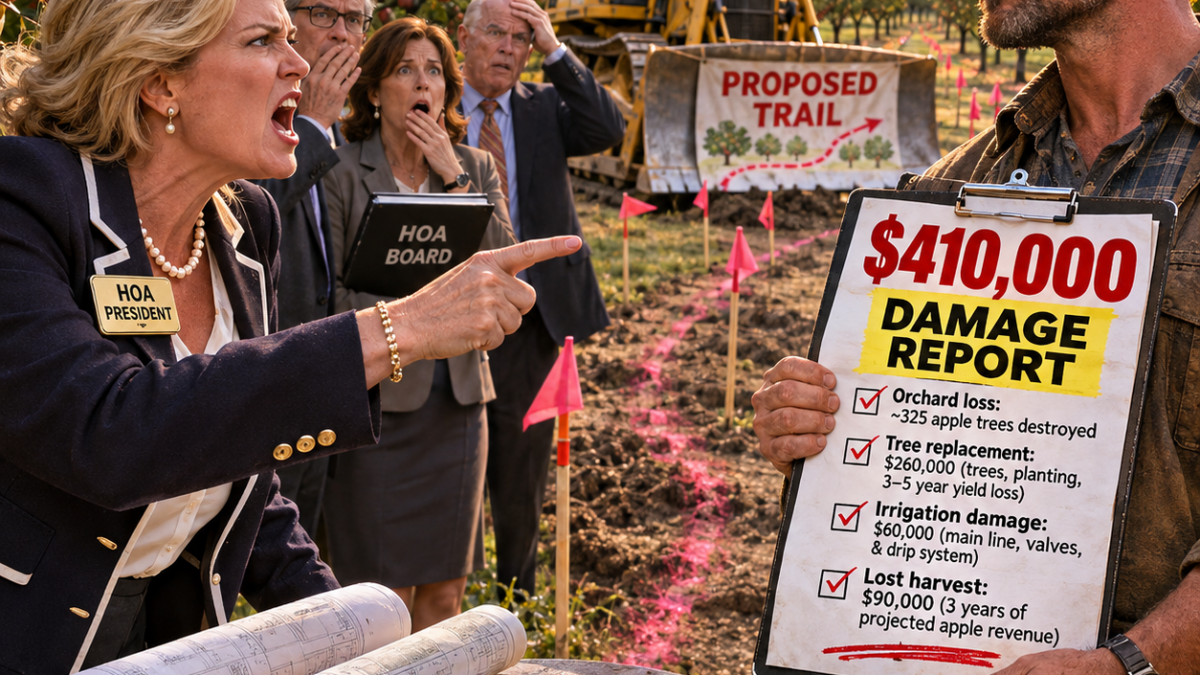
Karen sat at the head of the HOA table, looked me straight in the eye, and calmly announced that a vote by people who did not own a single inch of my farm had somehow given them the right to carve a ten-foot-wide walking trail through the middle of the apple orchard my wife’s family had spent three generations building.
I had walked into that clubhouse carrying my deed and county survey because I honestly believed one rational conversation would end the misunderstanding, but when Karen called my livelihood a “little hobby farm” and told me their bulldozers would start clearing Monday whether I agreed or not, I realized this was no longer a disagreement about property lines.
What none of them understood that night was that those rows of old apple trees were not simply scenery on somebody’s wellness map, and before the first machine ever touched my soil, I was going to translate their arrogant little red line into a language every homeowner, lawyer, contractor, and board member in Whispering Pines would understand.
My name is John Caldwell.
I was forty-five when this happened, retired from the Army Corps of Engineers and finally living the kind of life I had spent years dreaming about.
Quiet mornings.
Hard work.
My wife Sarah beside me.
Fifteen acres of rolling North Carolina land covered in apple trees.
The orchard had belonged to Sarah’s family long before it belonged to us.
Her grandfather planted some of the oldest trees after returning from war.
Her father expanded the operation, learned grafting, introduced heirloom varieties, and built relationships with local markets.
By the time Sarah and I took over, the orchard supplied three farmers markets, a cider press, and a boutique grocery chain.
It wasn’t enormous.
But it was profitable.
More importantly, it was ours.
When I bought the parcel a decade earlier, there was nothing beside us except an open field.
Then developers arrived.
Within a few years, Whispering Pines Estates rose on the other side of my property line—rows of nearly identical houses with neat lawns, decorative streetlights, shared amenities, and a homeowners association that slowly developed an opinion about almost everything.
I never joined.
My land was never annexed.
No HOA covenant appeared on my deed.
There was no public easement through the orchard.
Our boundary had been surveyed and recorded years before the first Whispering Pines foundation was poured.
That should have settled everything.
Then the letter arrived.
**COMMUNITY ENHANCEMENT INITIATIVE.**
I remember standing at the kitchen counter reading those words while Sarah watched my expression change.
“What?”
I handed her the letter.
Attached was a map.
A thick red line began inside Whispering Pines, crossed the property boundary, continued straight through the center of our orchard, and reentered the subdivision on the other side.
Ten feet wide.
Gravel surface.
Walking and recreational trail.
It cut directly through Block C.
Our Honeycrisp trees.
The most profitable part of the farm.
At first, I laughed.
Not because it was funny.
Because the alternative was believing a group of strangers had genuinely voted to take part of our land.
The letter cited an HOA bylaw requiring “cooperation with adjacent properties for community betterment.”
I read that sentence three times.
Then I pulled my deed.
Survey.
County plat.
Nothing had changed.
So I went to the next HOA meeting.
I waited through discussions about trash cans, lawn heights, and exterior paint.
Finally, they called new business.
I stood.
“My name is John Caldwell. I own the orchard beside Whispering Pines. I believe there’s been a serious misunderstanding.”
I spread the county survey on the table.
Karen barely looked at it.
“The proposed trail is entirely on private agricultural property,” I said. “There is no easement.”
Karen smiled.
“We understand where the boundary is.”
That answer stopped me.
“Then why is your trail on my side of it?”
“Because the community needs a safe recreational connection.”
“You don’t own the land.”
“The board voted unanimously.”
“That doesn’t matter.”
Her smile vanished.
“Your little hobby farm does not supersede the community’s right to wellness, Mr. Caldwell.”
The room went quiet.
I felt my anger sharpen.
“That ‘hobby farm’ supports my family.”
Karen leaned back.
“The vote is final.”
“No.”
“We begin clearing Monday.”
I looked around at the board members nodding beside her.
Then at the red line running across trees planted before their subdivision existed.
I folded my survey.
Slowly.
“Then before Monday,” I said, “I suggest every person at this table find out exactly what those trees are worth.”
Karen laughed.
I didn’t.
Because I already knew something she didn’t.
Destroying an orchard is very different from cutting down a few trees.
And I had four days to prove it.
PART 2
I drove home angry enough that I barely remembered the first half of the trip.
The tires of my truck crunched over our gravel drive.
That sound steadied me.
My gravel.
My driveway.
My land.
Sarah was waiting by the kitchen door.
She knew immediately.
“How bad?”
“Worse than stupid.”
“That sounds serious.”
“They know.”
“Know what?”
“That it’s ours.”
She stared at me.
“And?”
“They don’t care.”
I put the HOA map on the kitchen table.
The red trail line looked even uglier under the warm light.
Sarah followed it with her finger.
Right through Block C.
Her expression changed.
“No.”
“I know.”
“These trees…”
“I know.”
“My grandfather planted the first row over there.”
“I know.”
She looked up.
“They said Monday?”
“Yes.”
“With what?”
“Karen said clearing begins.”
“They can’t just bring equipment onto our property.”
“No.”
“Can they?”
I looked at her.
“No.”
That answer was legally simple.
Practically, it was more complicated.
People can do illegal things.
The law often becomes useful after damage occurs.
My job was to make sure Karen understood the price before she created damage we could never fully undo.
I unrolled my county survey.
Then her map.
Then a production chart.
Sarah watched me.
“That look.”
“What look?”
“The Army look.”
“I’m retired.”
“You’re making columns.”
“That proves nothing.”
“You haven’t even eaten.”
I opened my laptop.
“Coffee?”
She sighed.
“I’ll make it.”
—
The first call I made the next morning was not to a lawyer.
It was to Carol, our crop-insurance agent.
I explained the proposal.
There was a long pause.
Then:
“John, they can’t do that.”
“Apparently they held a vote.”
“That doesn’t make it legal.”
“I know.”
“What exactly are you asking from me?”
“I need an official loss assessment.”
“For damage that hasn’t happened yet?”
“For the damage their written plan would cause if implemented.”
Another pause.
Then her tone changed.
Professional.
Focused.
“What width?”
“Ten feet.”
“Surface?”
“Gravel.”
“Foot traffic?”
“Residents. Walking, possibly bikes, strollers, dogs.”
“Route through production acreage?”
“Yes.”
“Send me everything.”
“I already did.”
She laughed.
“Of course you did.”
“I need something certified.”
“I’ll send Dave.”
“Today?”
“Today.”
—
Dave arrived after lunch.
Sixties.
Weathered face.
Work boots that had actually seen mud.
He had evaluated hail losses, freeze damage, disease outbreaks, windstorms, and equipment accidents.
Apparently, he had never evaluated an orchard threatened by an HOA walking trail.
“So let me understand.”
He pointed toward Whispering Pines.
“They voted to take your land?”
“Yes.”
“Without buying it?”
“Yes.”
“No easement?”
“No.”
“And they put it in writing?”
I handed him the letter.
Dave read it.
His eyebrows rose.
“Community enhancement initiative.”
“That’s what they call it.”
“I’ve heard theft described in a lot of ways.”
He handed it back.
“That’s new.”
We walked the proposed path.
The red line crossed healthy grass first.
Then entered Block C.
Honeycrisp.
Mature.
Productive.
Beautiful.
Dave stopped beside one of the trees.
“How old?”
“About twenty.”
“Yield?”
I told him.
He asked market price.
Wholesale contracts.
Harvest history.
Projected productive lifespan.
Then he knelt and pressed his fingers into the soil.
“People think the loss is whatever trees the gravel touches.”
“That’s what Karen thinks.”
“No.”
He stood.
“A ten-foot trail affects more than ten feet.”
He pointed around us.
“Soil compaction.”
“Root zones?”
“Exactly. Add foot traffic. Bikes. Dogs. Equipment during construction. You’ll get pressure outside the actual trail.”
He walked several yards.
“These trees don’t care where the legal width ends.”
We continued.
He identified irrigation impacts.
Pest-control issues.
Disease vectors.
Access complications.
Liability.
Security.
Loss of contiguous production.
Potential disruption to spraying schedules.
Contamination concerns near harvested fruit.
Then came the trees themselves.
Dave put a hand on one trunk.
“This is what nonfarmers never understand.”
“What?”
“You can replace a tree.”
He looked at me.
“You can’t replace time.”
I nodded.
“A sapling doesn’t produce like this next year.”
“No.”
“Or five years from now.”
“No.”
“These are productive assets.”
“Yes.”
“And your most profitable block?”
“Yes.”
He took measurements.
Tree count.
Spacing.
Trunk circumference.
Soil samples.
I brought him five years of production records.
Sales.
Contracts.
Crop yields.
He sat in his truck for almost an hour running calculations.
Sarah came outside.
“What’s he doing?”
“Putting a price on stupidity.”
“That could take all night.”
Despite everything, I laughed.
—
The sun was dropping when Dave returned.
He carried a preliminary report.
His expression was serious.
“John.”
“What?”
“Direct removal: fifty-two mature prime-production trees.”
I felt my stomach tighten even though I knew the route.
“Adjacent impact?”
“Potential yield reduction across approximately one hundred twenty more, depending on construction and use.”
He turned pages.
“Soil mitigation.”
Another.
“Increased pest-management cost.”
Another.
“Operational disruption.”
Then:
“Future productive loss.”
He stopped at the final page.
“Based on your current production, market history, replacement timelines, expected remaining productive life, and reasonable mitigation assumptions…”
He tapped the number.
**$410,000.**
I stared.
Four hundred ten thousand dollars.
Not the cost of fifty-two saplings.
The economic damage from destroying mature production and compromising the block around it.
Sarah came beside me.
She read the number.
Her hand found mine.
Dave said:
“This is preliminary, but I’m comfortable certifying it.”
Karen saw a walking path.
Dave saw a twenty-year agricultural loss.
Sarah whispered:
“She was going to do this for a trail.”
I squeezed her hand.
Dave closed the report.
“Now you call a lawyer.”
—
I called Marcus Thorne.
Retired JAG.
Property law.
Recommended by a former master sergeant I had served with.
His office was not impressive.
That impressed me.
Old brick building.
No marble lobby.
No giant abstract sculpture.
Just books, files, and a man who looked as if wasted words physically offended him.
“Mr. Caldwell.”
“John.”
“Fine. John. Start.”
So I did.
Fifteen acres.
Family history.
Subdivision.
No HOA membership.
No easement.
Letter.
Map.
Meeting.
Karen’s “hobby farm” comment.
Monday threat.
Then I put Dave’s report on his desk.
Marcus read.
Quickly at first.
Then slowly.
He flipped back.
Read again.
Finally:
“Four hundred ten thousand.”
“Yes.”
A smile appeared.
Not a pleasant smile.
“John.”
“What?”
“They are in spectacular trouble.”
He pulled out my deed.
“Jurisdiction first.”
He tapped it.
“They have none.”
“I know.”
“No, I mean absolutely none based on what you’ve shown me. Their bylaws bind their members and property subject to their declaration. You are neither.”
He picked up the HOA letter.
“This ‘cooperation with adjacent properties’ clause?”
“Yes.”
“Means they can ask.”
“Karen thinks it means they can vote.”
“My book club can vote to install a swimming pool in your kitchen.”
“Same authority?”
“Approximately.”
Then he lifted the insurance report.
“This is where it becomes expensive.”
“Explain.”
“If they knowingly trespass after warning and damage a commercial orchard, we aren’t discussing the replacement cost of a few trees.”
He tapped $410,000.
“We are discussing foreseeable business losses.”
I leaned forward.
“What do we do?”
“Two fronts.”
Of course.
A military lawyer.
“First, cease and desist.”
“To Karen?”
“Karen, HOA, every board member individually.”
“Why individually?”
“Because I want them reading the number at their own kitchen tables.”
Marcus continued.
“Deed. Survey. No easement. Relevant trespass law. Commercial interference. Certified loss estimate.”
“Deadline?”
“Five business days.”
“And if they ignore it?”
“We file.”
He looked at me.
“And from now until this ends, you document everything.”
“I already do.”
“No.”
He pointed.
“You’re about to discover a new definition of everything.”
—
That afternoon I bought cameras.
High definition.
Date-stamped.
Overlapping coverage.
Every section of orchard adjoining Whispering Pines.
One camera focused directly on the proposed entry point.
Sarah watched me mount the last unit.
“Fortress Caldwell?”
“Evidence.”
“Same thing with you.”
—
Marcus sent the letters.
Certified.
Karen.
Each board member.
HOA corporate address.
The $410,000 report was attached in full.
The letter demanded written abandonment of the trail within five business days.
No ambiguity.
No compromise.
No trail.
For four days:
Nothing.
Friday came.
Five o’clock.
Nothing.
I called Marcus.
“Deadline passed.”
“Any response?”
“No.”
“Board lawyer?”
“No.”
“Contractor?”
“No.”
Marcus exhaled.
“Stay alert Monday.”
“Why?”
“Because Monday is the day she promised to start.”
“You think she’ll still do it?”
“I’ve met people like her.”
“So have I.”
“Then you know.”
—
Monday morning was cold and clear.
Harvest weather.
I was awake before sunrise.
Coffee.
Camera monitor.
Sarah came down in a robe.
“You sleep?”
“Enough.”
“No.”
“No.”
At 7:53, a white utility truck stopped near the property line.
Then a trailer.
Small ride-on brush-clearing machine.
A man got out.
Work vest.
Spray paint.
Then a black SUV pulled in.
Karen.
Of course.
She wore khaki pants, hiking boots, and a vest embroidered with:
**HOA PRESIDENT**
Sarah looked at the screen.
“She actually came.”
“Yes.”
“She received the letter.”
“Yes.”
“All of them did.”
“Yes.”
“John.”
“I know.”
I took my phone.
“Stay here.”
“Absolutely not.”
“Sarah.”
“I’m staying behind the fence.”
“That sentence made no sense.”
“You know what I mean.”
I did.
We walked outside.
—
Karen was explaining the route.
“Straight through there.”
She pointed.
“Ten feet wide.”
The contractor held orange paint.
“What about those trees?”
“Just clear what’s in the way.”
My jaw tightened.
I walked closer.
“Good morning.”
The contractor turned.
Karen sighed dramatically.
“Mr. Caldwell.”
I ignored her.
I addressed the worker.
“Sir, my name is John Caldwell. You’re standing at the boundary of private property.”
He looked at Karen.
Then me.
“I’ve been hired to mark a trail.”
“I understand.”
I pointed toward the security camera.
“You are being recorded.”
His face changed.
Karen stepped between us.
“Do not listen to him.”
I held up my phone.
“This conversation is also being documented.”
“Stop threatening my contractor.”
“I haven’t threatened anyone.”
I looked at the man.
“The property beyond these boundary stones belongs to me. There is no easement. The HOA received a formal cease-and-desist order.”
Karen snapped:
“It was a letter from his lawyer. Not an order.”
“Correct.”
I nodded.
“A legal demand notifying you that entry would be trespass.”
I looked back at the contractor.
“If you cross this line after notice and damage commercial trees, you and your company may face civil liability.”
The spray can lowered.
Karen said:
“I am authorizing the work.”
“Your authorization means nothing on my land.”
She laughed bitterly.
“The community voted.”
The contractor looked confused.
“You own this?”
I answered:
“No.”
Karen said:
“The HOA has right-of-way authority.”
“No.”
She turned on me.
“You do not get to decide.”
“I own the land.”
“Yes. I do.”
The contractor looked at the orchard.
Then the camera.
Then Karen.
I continued:
“The projected commercial damage from this trail has been independently assessed at four hundred ten thousand dollars.”
His head snapped toward me.
“What?”
Karen’s face changed.
Only slightly.
He caught it.
“You didn’t tell us that.”
“It’s nonsense,” she said.
“Do you have an easement?”
He asked Karen now.
She stiffened.
“The board has authority.”
“That’s not what I asked.”
Silence.
He capped the orange paint.
“I’m not doing this.”
Karen exploded.
“What?”
“I’m not getting sued over a walking trail.”
“You signed a contract!”
“Contract says you have authority.”
“We do.”
The worker pointed toward me.
“He says you don’t.”
Karen shouted:
“He is lying!”
The contractor looked toward the camera.
“Then get a court order.”
I almost smiled.
Karen looked at him as if betrayed.
“I hired you.”
“Not to trespass.”
“Start the machine.”
“No.”
“I’ll sue.”
“Okay.”
“You’ll never work in Whispering Pines again.”
He shrugged.
“I can live with that.”
He loaded the equipment.
Karen stood there shaking.
I said:
“Please call the sheriff if you think I’m wrong.”
She spun toward me.
“You would love that.”
“Yes.”
That caught her.
“I have my deed, survey, the HOA map, your certified receipt, the $410,000 assessment, and video of you instructing this contractor to proceed after notice.”
The contractor looked at her.
Again.
Then drove away.
Karen remained.
Her fists clenched.
“This isn’t over.”
“It should be.”
“You think you can bully an entire community because you have money.”
I looked at my work clothes.
Orchard boots.
Twenty-year-old truck behind me.
“I’m a farmer.”
“You’re selfish.”
“Get off my property line.”
“I’m not on your property.”
“For once, you’re right.”
She stormed back to the SUV.
Tires squealed.
Sarah emerged from farther up the row.
“I heard everything.”
“I know.”
“She really told him to destroy the trees.”
“Yes.”
“What now?”
I stopped the recording.
“Now Marcus files.”
—
But something else happened first.
The contractor talked.
People inside Whispering Pines heard his version.
Not Karen’s email claiming I had “threatened an innocent worker.”
His.
No easement.
Cameras.
Lawyer notice.
$410,000 potential damage.
Karen ordering him to proceed anyway.
That changed the atmosphere.
That evening, my neighbor Bill came over.
He technically lived inside Whispering Pines.
Accountant.
Quiet.
The kind of man who apologized when asking someone to pass salt.
He carried documents.
“I heard what happened.”
“News travels.”
“Karen sent this to me last month.”
He handed me a notice.
The HOA planned to appropriate a six-by-ten-foot corner of his backyard.
Memorial bench.
Decorative gravel.
Trail entrance plaza.
“Your yard?”
“Yes.”
“HOA common property?”
“No.”
“Easement?”
“No.”
“What did you do?”
Bill looked embarrassed.
“Nothing.”
“Why?”
“She said the aesthetics committee approved it.”
I stared at him.
“She threatened fines if I interfered.”
“Bill.”
“I know.”
His voice dropped.
“My kids play there.”
He looked toward the ground.
“I was afraid of getting a lien.”
That word again.
Fear dressed as paperwork.
“Leave me a copy.”
He nodded.
“What are you doing?”
“Documenting.”
“Can I help?”
“Yes.”
For the first time, Bill smiled.
—
Maria came the next day.
Single mother.
Two jobs.
Her son’s swing set had been fined.
Five hundred dollars.
Why?
Visible from the planned trail.
The trail that did not exist.
On land the HOA did not own.
She appealed.
Karen denied it.
Maria paid.
“I couldn’t risk a lien.”
“How much did that hurt?”
She laughed without humor.
“That was grocery money.”
My anger returned.
Not the hot kind.
The useful kind.
I created a file.
Bill.
Maria.
Then others.
Threat letters.
Fine notices.
Appeal denials.
Karen’s signature appeared again and again.
The orchard had been the wrong target.
Because by attacking me, she had given people a reason to compare notes.
—
Frank called.
Old Army friend.
Private investigator now.
“Johnny.”
“Frank.”
“I hear you’re fighting suburban Napoleon.”
“Apparently.”
“Want me to look?”
“At what?”
“Money.”
I hesitated.
“How much?”
“Free.”
“Why?”
“I hate bullies.”
“That’s not a business model.”
“For you, it is.”
“Fine.”
“What do you have?”
“HOA contracts. Trail project. Reserve funds. Anything public.”
“Send it.”
“Already did.”
Frank laughed.
“You really haven’t changed.”
—
Marcus filed the lawsuit.
HOA.
Karen.
Board members individually where legally appropriate.
Trespass-related injunctive relief.
Tortious interference.
Commercial damages if construction proceeded.
Abuse claims arising from documented conduct.
Request for financial review tied to evidence that was emerging.
Process servers went to their homes.
That mattered more than I expected.
There is a psychological difference between an HOA letter arriving at an office and a court summons arriving while your spouse watches from the doorway.
Suddenly board membership wasn’t ceremonial.
Liability had an address.
—
Then Frank called.
“You sitting?”
“Why does everyone ask that?”
“Because you’re going to like this.”
“I’m standing.”
“Prestige Landscaping and Hardscaping.”
“The trail contractor?”
“Company awarded seventy-five grand.”
“Public bid?”
“No.”
“Interesting.”
“Owner is Gary Miller.”
I waited.
“Karen’s relative?”
“Brother-in-law.”
There it was.
“Confirmed?”
“Corporate filings. Marriage records.”
“Price?”
“My industry contact says at least thirty thousand above reasonable market for the scope.”
I sat down.
“Anything else?”
“Reserve fund is a disaster.”
“How bad?”
“Too low for a development this young.”
“Why?”
“Legal settlements, strange expenses, aggressive spending.”
He continued.
“Four prior homeowner lawsuits in five years.”
“Against Karen’s board?”
“Yes.”
“Outcome?”
“Settled.”
“Amounts?”
“Enough.”
I rubbed my forehead.
“So fines increase because reserves are low.”
“That’s my working theory.”
“And the trail contract sends money to family.”
“Looks that way.”
I thought about Maria’s five hundred dollars.
Bill’s threatened yard.
Karen talking about wellness.
“Send everything to Marcus.”
“Already did.”
Of course.
—
Karen responded by calling an emergency HOA meeting.
Not to discuss the conflict.
Not to disclose Prestige.
Not to reconsider the trail.
She wanted a special assessment.
**$1,000 PER HOUSEHOLD**
For legal defense.
To fight me.
Marcus almost sounded happy.
“She is asking her victims to finance the defense of the conduct they’re complaining about.”
“Yes.”
“Go.”
“To the meeting?”
“Yes.”
“I’m not a member.”
“Bill and Maria are.”
“And you?”
“I’ll attend as counsel regarding the litigation.”
“Karen will throw you out.”
“She can try.”
—
The clubhouse was packed.
Families held the assessment notice.
One thousand dollars.
Some angry.
Some frightened.
Some confused.
Karen stood at the podium.
Hand over her heart.
“My dear neighbors…”
I almost groaned.
She called the lawsuit hostile.
Frivolous.
Extortion.
She called me a wealthy farmer.
Sarah squeezed my hand.
“Millionaire?”
“Apparently.”
“You still owe me for the tractor repair.”
“Shh.”
Karen said I cared more about “a few apple trees” than seniors and children.
Then:
“We will not be bullied.”
Her loyalists applauded.
“I ask you tonight to approve a one-time assessment of one thousand dollars per household to defend our community.”
Groans.
Karen pushed.
“All in favor—”
“Point of order.”
Marcus stood.
Everything stopped.
Karen glared.
“Who are you?”
“Marcus Thorne. Counsel for John Caldwell.”
“This meeting is for homeowners.”
“Then your homeowners should receive accurate information before voting to fund litigation involving my client.”
“You have no right—”
Marcus walked toward the front.
“Fact one.”
He unrolled a large county survey.
“John Caldwell’s orchard is not part of Whispering Pines.”
He pointed.
“Your HOA has no easement across it.”
A resident called:
“Is that true?”
Karen said:
“It’s more complicated.”
Marcus answered:
“No.”
Laughter.
Nervous.
Then stronger.
“Fact two.”
He lifted Dave’s certified report.
Then a poster-sized copy of the final page.
**$410,000**
The room went silent.
“This is the independent projected commercial-loss estimate associated with the trail plan your board adopted.”
People leaned forward.
Four hundred ten thousand dollars.
Large enough to change the emotional temperature of a room.
Marcus continued:
“If the board proceeds with knowingly unauthorized construction and causes the assessed damage, the resulting exposure could be substantial.”
Someone shouted:
“We would have to pay that?”
Marcus answered carefully.
“Potential liability is why competent legal advice matters.”
All eyes turned to Karen.
She had stopped smiling.
Then Marcus said:
“Fact three.”
Prestige Landscaping.
Seventy-five thousand dollars.
No meaningful competitive bidding.
Contractor:
Gary Miller.
Karen’s brother-in-law.
The room exploded.
“WHAT?”
“Is that true?”
“My dues?”
“Show us!”
Karen shouted:
“That is private family information!”
Marcus looked at her.
“The corporate registration is public.”
Then prior settlements.
Reserve shortfalls.
Maria’s swing-set fine.
Bill’s yard appropriation.
The whispers became anger.
Karen tried to regain control.
“This meeting is about protecting our community from Mr. Caldwell!”
Bill stood.
His hands were trembling.
But he stood.
“No.”
Karen stared.
Bill climbed onto a chair.
“This meeting is about you asking us for another thousand dollars after threatening to take my yard.”
The room quieted.
“I move that Karen Miller be suspended as president pending an independent forensic audit.”
Applause erupted.
A board member stood.
“I second.”
Karen’s head snapped toward him.
“What?”
He wouldn’t look at her.
“Second.”
Karen screamed:
“You can’t do this!”
Bill shouted over her:
“All in favor?”
Hands.
Everywhere.
Almost the whole room.
Karen and two loyalists opposed.
That was it.
No gavel.
No graceful resignation.
A vote.
Her title disappeared.
Someone took the microphone.
Bill looked at Karen.
“You’re no longer in charge.”
For the first time since I had met her, Karen had no answer.
She left.
The door slammed.
—
The audit was worse than Frank predicted.
Trail contract.
Landscaping.
Pool maintenance.
Decorations.
Shell companies.
Friends.
Family.
Inflated prices.
Poor reserves.
Questionable reimbursements.
Selective fines used to generate cash.
Not every expense was criminal.
Important distinction.
But enough demanded referral.
The interim board turned records over to the district attorney.
Karen and Gary became targets of a fraud and embezzlement investigation.
The trail was formally canceled.
Unanimously.
Bill invited me to the clubhouse.
Same room.
Different atmosphere.
He stood when I entered.
“John.”
“Bill.”
He shook my hand.
“I’m sorry.”
“You personally didn’t vote for this.”
“I stayed quiet.”
There it was.
I respected him for saying it.
“We’re formally abandoning every trail plan involving your property.”
“Good.”
“We’ll reimburse your legal costs incurred to date as part of settlement.”
Marcus looked at me.
I nodded.
“And?”
Bill glanced around.
“We’re reviewing every fine and lien issued under Karen.”
Maria sat nearby.
She looked emotional.
“Good.”
Bill continued:
“We want the lawsuit resolved.”
I looked at Marcus.
He said:
“If the trail is permanently abandoned, costs addressed, improper enforcement corrected, and financial oversight established, my client is prepared to settle.”
Karen would have called that weakness.
It wasn’t.
The orchard was safe.
That was the mission.
—
The agreement was signed.
No trail.
No easement claim.
Legal fees covered.
Improper resident fines reviewed.
Third-party financial controls.
Independent management support.
Competitive bidding.
Conflict disclosures.
Karen gone.
My lawsuit withdrawn once obligations were satisfied.
The $410,000 never became an actual loss.
That was the best possible outcome.
The number had done its job.
It translated trees into language arrogance could not ignore.
—
Karen’s criminal case continued.
Fraud allegations.
Self-dealing.
Payments involving family-linked companies.
Eventually plea negotiations.
Restitution.
Probation.
Community service.
Financial consequences.
Her home went up for sale.
I saw the sign when driving past Whispering Pines.
Sarah noticed me looking.
“Feel good?”
I thought.
“A little.”
“Honest.”
“Mostly tired.”
“She almost destroyed your orchard.”
“Yes.”
“You’re allowed a little satisfaction.”
I smiled.
“Permission appreciated.”
—
Whispering Pines changed under Bill.
He did not want to be president.
That made me trust him.
He hired independent accountants.
Published monthly financials.
Required competitive bids.
Created conflict-of-interest rules.
Reviewed liens.
Refunded unfair fines where appropriate.
Maria got her five hundred dollars back.
She cried when the check arrived.
Not because of the amount.
Because someone finally acknowledged she had been bullied into paying it.
Bill’s yard stayed Bill’s yard.
His kids kept playing there.
The memorial bench went somewhere on actual HOA property.
Turns out that was possible.
—
Then harvest came.
Honeycrisp season.
The block Karen wanted to bulldoze was heavy with fruit.
Red.
Gold.
Branches bending.
I walked those rows every morning.
Touched trunks.
Checked apples.
Listened to leaves.
The war was over.
But peace felt strangely incomplete.
Sarah noticed.
“You’re still fighting.”
“No.”
“In your head.”
I looked toward Whispering Pines.
“Maybe.”
“You got what you wanted.”
“The orchard’s safe.”
“So why are you walking around like you’re waiting for artillery?”
Army wives know too much.
“I don’t know.”
She did.
“We spent months talking about community.”
“Karen did.”
“No. Everyone did.”
She picked an apple.
“Let’s show them.”
“Show them what?”
“What this place actually is.”
—
Sarah proposed a harvest day.
Invite Whispering Pines.
Everyone.
No charge.
No speeches.
No legal presentation.
No cameras.
Just apples.
At first, I hated the idea.
“These people voted for a trail.”
“Some did.”
“They let her.”
“Some were afraid.”
“They called it a hobby farm.”
“Karen called it that.”
I sighed.
Sarah waited.
She knew she had me.
“What exactly are you suggesting?”
“Apple picking.”
“For the HOA.”
“For neighbors.”
“They’re not my neighbors.”
She looked at me.
“John.”
“They tried to steal my land.”
“Karen tried.”
“The board voted.”
“And the board changed.”
I hated when she was right.
“Fine.”
She smiled.
“Great.”
“That was too easy.”
“Twenty-three years of marriage.”
“Twenty-two.”
“Feels longer.”
—
We sent invitations.
**CALDWELL ORCHARD COMMUNITY HARVEST DAY**
Saturday.
Cider.
Apple picking.
Families welcome.
No cost.
No agenda.
I expected twenty people.
More than a hundred came.
At first, awkwardly.
Families stayed near the barn.
Children stared at trees.
Parents looked uncertain.
Then Sarah started handing out baskets.
“Pick a peck.”
A little girl asked:
“What’s a peck?”
I laughed.
“Good question.”
Soon kids ran between designated rows.
Not through production zones we needed protected.
Because unlike Karen, we understood planning.
I showed families how to twist an apple instead of yanking it.
Explained grafting.
Rootstock.
Pollination.
Why mature trees matter.
Why you don’t replace twenty years of growth with a sapling and expect the same harvest.
People listened.
Really listened.
A man approached one of the old heirloom rows.
“How old?”
“Some date to Sarah’s grandfather.”
He touched the bark.
Carefully.
“I had no idea.”
That sentence repeated all day.
I had no idea.
Neither had Karen.
The difference was these people were willing to learn.
—
Bill found me beside the cider press.
His daughter sat on his shoulders.
Her face was sticky.
Apple in one hand.
Donut in the other.
Dangerous combination.
Bill looked around.
“This is what she kept talking about.”
“What?”
“Community wellness.”
I laughed.
He shook his head.
“No, really.”
“People outside?”
“Families together. Walking. Kids playing. Shared space.”
“Except this is private.”
“Exactly.”
He smiled sadly.
“You invited us.”
I understood.
“She wanted to force it.”
“Yes.”
“And that ruined the whole point.”
He nodded.
“She thought community was something the board could vote into existence.”
We watched two children comparing apples.
“What is it?” Bill asked.
“Community?”
“Yes.”
“Permission.”
He looked confused.
“Explain.”
“People choosing to be here.”
I pointed toward the orchard.
“Me choosing to invite you.”
Then toward Whispering Pines.
“You choosing to come.”
“No one taking.”
“No one forcing.”
Bill smiled.
“Respect.”
“Pretty much.”
He looked toward Block C.
“The four-hundred-ten-thousand-dollar trees.”
“Please don’t call them that.”
“Neighborhood nickname.”
“No.”
“Too late.”
—
Eleanor—an older Whispering Pines resident I had met during the reform process—brought apple pie.
Maria brought her son.
Bill’s kids ran with them.
Contract disputes became jokes.
The trail became something people shook their heads about.
That mattered.
Not forgetting.
Transforming.
—
As evening came, families left carrying bags of fruit.
One by one, cars disappeared.
Quiet returned.
Sarah and I stood on the porch.
The orchard smelled like apples.
Grass.
Wood smoke from somewhere down the valley.
I bit into a Honeycrisp.
Loud crack.
Sarah smiled.
“What?”
“You look ridiculous.”
“I’m eating.”
“You look triumphant.”
“I saved this tree.”
“We saved the orchard.”
“Technical distinction.”
She leaned against me.
“Was the $410,000 worth it?”
“What?”
“The report.”
“It cost a few hundred dollars.”
“You know what I mean.”
I looked toward the rows.
“The number scared them.”
“Yes.”
“But the number wasn’t the orchard.”
“No.”
“Dave understood that.”
“What?”
“Time.”
A mature tree is time made visible.
Years of pruning.
Weather.
Disease management.
Harvest.
Labor.
Family history.
You can calculate revenue.
You can estimate future loss.
But the spreadsheet never captures everything.
Karen saw trees as obstacles between two pieces of a subdivision.
She didn’t see Sarah’s grandfather.
Her father.
Our kids.
Harvest mornings.
Years.
The $410,000 estimate forced her world to recognize a fraction of what she had dismissed.
That was why it mattered.
—
The DA investigation eventually resulted in Karen and her brother-in-law facing fraud-related charges.
The details became less important to me as months passed.
There were agreements.
Restitution.
Probation.
Community service.
Financial penalties.
People in Whispering Pines followed every development.
I stopped.
Sarah asked why.
“Nothing Karen does now changes the orchard.”
That was true.
Revenge has a strange appetite.
Feed it one consequence and it wants another.
Then another.
I had seen enough.
Accountability had happened.
I wanted apples.
—
The new HOA adopted a rule that any project involving adjacent property required written consent from the actual owner before even being budgeted.
Bill called it “The Caldwell Rule.”
I hated that.
“It’s basic property law.”
“Yes.”
“So why name it after me?”
“Because ‘Don’t Steal John’s Orchard Rule’ was too long.”
“Very funny.”
He also banned closed-bid contracts involving relatives unless disclosed and independently reviewed.
That one mattered.
The trail scandal became a governance lesson.
Something good extracted from stupidity.
—
One day, the original contractor came by.
The man with the orange spray paint.
I recognized the truck.
He stopped at the roadside.
“Mr. Caldwell?”
“Yes.”
He held up both hands.
“I’m not here to build anything.”
I laughed.
“What can I do for you?”
“I wanted to say thanks.”
“For threatening to have you arrested?”
“For warning me.”
He looked toward the orchard.
“I found out later who owned Prestige.”
“You weren’t with them?”
“Subcontract.”
“Ah.”
“Karen told us rights were already secured.”
“They weren’t.”
“I know.”
He hesitated.
“If I’d crossed that line…”
“You didn’t.”
“I almost did.”
“But you didn’t.”
He nodded.
“My wife said that decision probably saved our business.”
“Your decision saved your business.”
He looked relieved.
Then:
“Can I buy apples?”
I sold him two boxes.
Full price.
I’m generous, not insane.
—
The $410,000 report stayed in my office.
Eventually Sarah wanted to throw out old legal files.
“No.”
She held up the binder.
“This?”
“Keep.”
“Why?”
“Record.”
“The trail is gone.”
“Record.”
“The case is settled.”
“Record.”
She rolled her eyes.
“Army.”
“Correct.”
She kept it.
—
Years later, our daughter found the report.
She had come home with her husband and their little boy.
“What is this?”
“The famous number.”
She flipped to the last page.
“Four hundred ten thousand.”
“Yes.”
“For a walking trail?”
“For projected commercial damage.”
She looked out the window.
“That block?”
“Yes.”
Her son was eating an apple from one of the trees Karen wanted removed.
My daughter stared at him.
Then at me.
“That’s weird.”
“What?”
“If she’d won, he’d be standing on gravel.”
That sentence hit harder than the number ever had.
Maybe that was legacy.
Not preserving land because nothing can change.
Preserving the right to decide what changes.
—
Some of the original trees eventually died.
Natural causes.
Disease.
Storm damage.
Age.
The first time we removed one from Block C, I felt strangely sad.
Sarah caught me watching the stump grinder.
“You okay?”
“Yeah.”
“You fought a war to save these.”
“Not forever.”
She nodded.
“That matters.”
The point was never that every tree must live forever.
The point was that Karen didn’t get to decide when they died.
Nature could.
Time could.
We could.
Ownership is not immortality.
It is stewardship.
—
Bill served one term as president.
Refused another.
“Why?”
“I want to enjoy my yard.”
“Fair.”
Maria joined the board.
That surprised me.
“I thought you hated the HOA.”
“I hated Karen’s HOA.”
“Difference?”
“Apparently.”
She became the loudest defender of transparent appeals.
Whenever someone mentioned a lien, she demanded documentation.
Good.
Fear had turned into competence.
—
The orchard’s business grew.
The grocery chain added another location.
Cider sales increased.
We started a small fall festival.
Nothing huge.
Hayrides.
Apple tasting.
Educational tours.
Whispering Pines residents became regular customers.
The irony was obvious.
The HOA once tried to steal a trail so residents could walk through my orchard.
Years later, many of those same residents paid for cider and waited politely at the farm gate because we invited them in.
Consent works surprisingly well.
—
One autumn afternoon, a little boy asked why there wasn’t a trail connecting the neighborhood through the orchard.
His mother looked horrified.
“Ethan!”
“What?”
I laughed.
“There almost was.”
“Why isn’t there?”
“Because this is a working farm.”
“Couldn’t you make one?”
“We could.”
“Will you?”
“Maybe someday.”
His mother stared at me.
“Seriously?”
“On our terms.”
That was the entire story in three words.
On our terms.
—
Sarah and I eventually created a short seasonal educational path along the outer edge of the orchard.
Not through Block C.
No mature tree removal.
No production disruption.
Visitors could use it during harvest events.
Signs explained pollination.
Grafting.
Soil.
Tree age.
Pest control.
At the entrance, Sarah wanted a sign:
**COMMUNITY WELLNESS TRAIL**
I stared at her.
“Absolutely not.”
She laughed.
“Come on.”
“No.”
“Too soon?”
“Forever too soon.”
We called it the Orchard Learning Walk.
Bill still called it the Karen Memorial Trail.
He was banned from naming things.
—
The old red-line map remained in my files.
Sometimes I compared it to the actual educational walk.
Karen’s route was ruler-straight.
No understanding of terrain.
Roots.
Irrigation.
Production.
History.
Our route curved.
Avoided sensitive soil.
Stayed away from equipment.
Protected trees.
Allowed families to see the orchard without hurting it.
That contrast taught me something.
Good planning begins by understanding what already exists.
Bad power starts with drawing a line and assuming reality will move.
—
I never spoke to Karen again.
I saw her once after she moved.
Gas station.
She recognized me.
I recognized her.
Neither approached.
I thought I would feel satisfaction.
I didn’t.
Mostly distance.
She had once occupied huge space in my mind.
Now she was a stranger standing beside a gas pump.
That was freedom.
—
People still tell the story wrong.
“HOA tried to steal farmer’s land and farmer hit them with $410,000 bill.”
Not exactly.
I never collected $410,000.
The trees were not destroyed.
That was the victory.
The report estimated what their plan could cost if they proceeded.
It turned an abstract threat into a quantifiable risk.
It stopped people from pretending the trail was harmless.
The best damage award is sometimes the one you never need because the damage never happens.
I would choose standing trees over a settlement check every time.
—
The report also stopped Karen’s allies from hiding behind ignorance.
Before:
“It’s just a trail.”
After:
“Four hundred ten thousand dollars?”
Numbers strip away comfortable vagueness.
Ten feet wide sounds small.
Fifty-two mature trees sounds less small.
One hundred twenty additional trees at risk sounds serious.
Twenty years of production sounds expensive.
Four hundred ten thousand dollars sounds like something a board member should have investigated before voting.
They didn’t.
That failure became their problem.
—
The orchard taught Whispering Pines another lesson.
Property rights are not anti-community.
Boundaries can create better relationships.
Because once people know what is mine and what is yours, generosity can become real.
A gift only exists if the giver could have said no.
Karen wanted residents to experience my orchard.
She tried to seize access.
Sarah invited them instead.
Same land.
Same people.
Completely different result.
One created war.
The other created harvest day.
—
Our annual harvest gathering continued.
Not HOA-sponsored.
Not mandatory.
No wellness initiative.
Just invitation.
Every year, Bill arrived too early.
Maria brought too much food.
Children ran around.
People picked apples.
Sometimes newcomers asked about Karen.
Older residents groaned.
“No politics on harvest day,” Sarah declared.
Good rule.
Better than most HOA bylaws.
—
One year, Dave the insurance adjuster came.
I hadn’t seen him since the case.
He stood beneath one of the Honeycrisp trees.
“Still producing?”
“Better than ever.”
He smiled.
“Four-hundred-ten-thousand-dollar celebrity.”
“Please stop.”
“Everyone calls them that?”
“Unfortunately.”
He examined the tree.
“You know, my report was conservative.”
“I’m glad nobody tested it.”
“Me too.”
Sarah handed him cider.
“Thank you.”
“For what?”
“For putting a number on something they refused to value.”
Dave looked at the rows.
“That’s the job.”
Then:
“Still can’t put a number on all of it.”
Exactly.
—
Our grandson eventually learned to pick apples.
Twist.
Lift.
Don’t pull.
He was standing in Block C when I told him the shortened story.
“Bad lady wanted to cut these down?”
“That is an extremely simplified version.”
“Mom said yes.”
“Then yes.”
“Why?”
“For a path.”
He looked between the trees.
“There’s already grass.”
I laughed.
“Excellent observation.”
“Why didn’t they walk there?”
“Because they didn’t own it.”
He thought.
“So they had to ask?”
“Yes.”
“Did they?”
“No.”
“Then they couldn’t.”
Children understand property law remarkably well before adults teach them complicated excuses.
—
As I got older, I stopped describing Karen as a tyrant.
Not because she hadn’t abused authority.
Because the word made her sound more powerful than she was.
Her power depended on cooperation.
Board members nodded.
Residents paid.
Contractors assumed.
People stayed quiet.
Once enough people asked for proof, the system collapsed.
That is important.
Karen wasn’t a dictator.
She was an HOA president surrounded by people who had forgotten they could question her.
That can happen anywhere.
—
My military career taught me to respect chain of command.
It also taught me that lawful authority has limits.
Good leaders know them.
Bad leaders treat boundaries as personal insults.
Karen heard:
“You do not own this land.”
And interpreted it as:
“You are challenging me.”
That emotional mistake cost her everything.
If she had simply said:
“Understood. Can we discuss alternatives?”
We might have found one.
Maybe a route entirely inside Whispering Pines.
Maybe sidewalk improvements.
Maybe a voluntary seasonal partnership.
Maybe even the educational walk we eventually created.
Instead, she chose entitlement.
The expensive option.
—
I sometimes wonder what would have happened without the $410,000 report.
Maybe the cease-and-desist alone would have stopped them.
Maybe the contractor still would have refused.
Maybe not.
The number mattered because it turned consequences into something board members could imagine losing.
People who dismiss heritage often understand liability.
I don’t love that truth.
But I learned to use it.
—
The old clubhouse still stands.
Different board.
Different atmosphere.
I attended one meeting years later because they were discussing drainage near the shared boundary.
Bill joked:
“Everybody hide the red markers.”
Maria said:
“John has PTSD from trail maps.”
I replied:
“I have lawyers.”
Meeting stayed short.
Drainage problem solved cooperatively.
That is how adults are supposed to work.
Survey.
Facts.
Consent.
Cost sharing.
No threats.
No thousand-dollar war chest.
No family contractor.
Remarkably efficient.
—
When Sarah’s father died, we scattered some of his ashes near the oldest heirloom row.
He had been proud we kept the orchard.
Not because he believed land should never change.
Because he believed the next generation should have a choice.
That idea became more important as I aged.
Legacy is not freezing the past.
It is passing forward enough value that the future can decide responsibly.
Karen’s trail would have taken that choice from us.
That was why I fought.
—
Years after the conflict, one of Karen’s former board members visited.
He had been among those who nodded during the original vote.
His name was Peter.
He stood awkwardly near the barn.
“I owe you an apology.”
I waited.
“I voted yes.”
“I remember.”
“I didn’t understand the orchard.”
“You understood it was private.”
He winced.
“Yes.”
That mattered.
“I told myself Karen knew something legally that I didn’t.”
“Did you ask?”
“No.”
“Why?”
He looked ashamed.
“Because asking questions made meetings difficult.”
That may have been the most honest answer anyone gave me.
“And you thought I’d back down.”
“Yes.”
“Because I was one person.”
“Yes.”
I nodded.
“Thank you for saying it.”
He looked surprised.
“That’s all?”
“What do you want?”
“I don’t know.”
“Then have cider.”
We sat.
That apology meant more than Karen’s punishment.
Peter understood his own part.
Systems improve when ordinary participants understand how they helped bad decisions survive.
—
The original $1,000 special-assessment notice also survived in my files.
Sarah wanted to frame it next to the $410,000 report.
“No.”
“Why?”
“Too much Karen memorabilia.”
“She’d hate being memorabilia.”
“Exactly why we’re not doing it.”
We laughed.
—
When our daughter eventually took more responsibility for the orchard business, I handed her the property records.
Deed.
Survey.
Water information.
Agricultural contracts.
Insurance.
Then the old HOA folder.
She groaned.
“Do I need this?”
“Probably not.”
“Then why?”
“History.”
“Dad.”
“Read the first letter.”
She did.
Then Karen’s trail map.
Then Dave’s report.
Then Marcus’s cease-and-desist.
She shook her head.
“Four hundred ten thousand.”
“Yes.”
“They were insane.”
“Careless.”
“Same thing.”
“No.”
I looked at her.
“Careless people can become dangerous without realizing it.”
She considered that.
“Good point.”
“Keep the survey.”
“That’s your lesson?”
“Always keep the survey.”
She laughed.
—
The orchard’s Honeycrisp block eventually became associated with the whole fight.
We never marketed it that way.
Dave suggested a cider called **$410K Honeycrisp**.
I threatened to remove him from the property.
Sarah thought it was brilliant.
I married badly.
—
One season, we raised money for a local food pantry by donating part of the harvest.
Whispering Pines residents volunteered.
Boxes.
Sorting.
Loading.
I watched Maria work beside Peter.
Bill directing kids.
Our daughter handling inventory.
That was the community Karen claimed she wanted.
No fines.
No compulsory participation.
No commandeered land.
Just people choosing to help.
Her mistake was believing good outcomes justified coercive methods.
They don’t.
A healthy community cannot be stolen into existence.
—
The most satisfying apple I ever ate came at the end of the first harvest after the fight.
Honeycrisp.
From a tree directly in the proposed trail route.
I picked it at sunset.
Sarah stood beside me.
I bit.
Sharp crack.
Sweet.
Tart.
Cold from the evening air.
She asked:
“Justice?”
I smiled.
“Pretty good apple.”
She laughed.
But yes.
It tasted like justice.
Not because Karen lost.
Because the tree was still there.
—
That distinction became everything.
People like dramatic endings.
Karen exposed.
Karen suspended.
Audit.
Criminal investigation.
House sold.
Those are satisfying.
But the real ending was quieter.
No bulldozer ever entered Block C.
No fifty-two trees were cut down.
No soil was compacted.
No productive acreage was severed.
No $410,000 loss occurred.
Sometimes the best victory leaves almost nothing visible.
A disaster that didn’t happen.
A row of trees still standing.
A family still farming.
—
Karen looked at our orchard and saw unused space between two neighborhoods.
That was her first mistake.
She saw value only through the lens of what she wanted.
The trees were not empty space.
The soil was not empty space.
The history was not empty space.
My refusal was not selfishness.
It was stewardship.
Once you understand that, the entire fight becomes obvious.
—
I still walk Block C at sunrise.
Slower now.
The oldest trees show their age.
Some branches need support.
Newer trees fill gaps where storms have taken old ones.
Life changes.
The subdivision is still visible beyond the boundary.
But it no longer feels like an invasion waiting to happen.
Sometimes residents wave.
I wave back.
That is enough.
—
One morning, my grandson walked with me.
He pointed toward Whispering Pines.
“Grandpa, is that where the bad HOA lived?”
I laughed.
“HOAs don’t live anywhere.”
“You know what I mean.”
“Yes.”
He picked an apple.
“Can they ever build the trail?”
“Not unless whoever owns this land agrees.”
“Who owns it?”
“For now, us.”
“For now?”
I looked at him.
“Nothing is forever.”
He frowned.
“Then why fight so hard?”
That was a better question than he knew.
I looked down the row.
At trees planted before him.
Some before me.
“You fight so the choice belongs to the right people.”
“Us?”
“Whoever is responsible for the land when the time comes.”
He thought.
Then bit the apple.
“Okay.”
Children accept philosophy faster when snacks are involved.
—
Karen thought the HOA vote was final.
That sentence still amuses me.
Votes are powerful inside legitimate jurisdiction.
Outside it, they are opinions with paperwork.
Whispering Pines could vote unanimously that my orchard should become a park.
They could vote that my barn should become a gym.
They could vote that my house should be painted purple.
Without legal authority or my consent, none of it would matter.
Authority begins with knowing what is yours to decide.
Karen never learned that until the cost of not learning became enormous.
—
The $410,000 estimate did not create my rights.
My deed did.
The survey did.
Property law did.
The estimate simply made the consequences impossible to dismiss.
That is why the title of this story often gets the order wrong.
People say:
“$410,000 stopped the HOA.”
Not exactly.
The law stopped them.
The contractor’s common sense stopped them.
Residents finding courage stopped them.
The audit stopped Karen.
The number just made everyone finally pay attention.
—
And maybe that is the final lesson.
Truth is not always enough when people refuse to look at it.
Sometimes truth needs a map.
Sometimes photographs.
Sometimes receipts.
Sometimes a lawyer.
Sometimes a financial estimate printed in enormous numbers and held up in front of a room full of people about to vote away another thousand dollars.
Whatever form it takes, documentation gives truth weight.
That was something the Army taught me.
The orchard confirmed it.
—
The red-line trail map eventually faded.
The ink is still visible.
Straight through Honeycrisp Block C.
I keep it beside a recent photograph.
Same view.
Trees heavy with apples.
My grandson standing beneath one.
Sarah beside him.
Whispering Pines houses in the distance.
No gravel.
No path.
No bulldozer.
I prefer that photograph.
—
Karen wanted to build a shortcut.
Instead, her project took the longest possible route to nowhere.
It cost her authority.
Exposed her financial dealings.
Forced an audit.
Triggered litigation.
United the homeowners she had kept divided.
And ultimately ended the very control she had been trying to expand.
Her trail never existed.
But the consequences of trying to force it did.
—
The orchard survived.
Whispering Pines survived.
In fact, both were healthier afterward.
Their HOA became transparent.
Our relationship with residents improved.
The farm grew.
Families visited during harvest by invitation.
People learned what mature trees were worth.
Not just financially.
Historically.
Emotionally.
Humanly.
That is the ending I wanted.
Not neighbors staring across a boundary with hatred.
Neighbors understanding why the boundary exists.
—
If Karen had come to my porch in the beginning and said:
“John, residents would love a walking connection. Is there any arrangement you’d consider?”
I would have listened.
Maybe the answer would still have been no.
Probably.
Block C was too valuable.
But conversation might have produced something else.
Seasonal access.
An edge route.
A partnership.
The later educational walk.
Who knows?
She never asked.
She voted.
Then demanded.
Then threatened.
That difference destroyed her.
—
Real community requires the possibility of hearing no.
Without that, cooperation is just obedience wearing a friendly name.
Karen called her trail “community wellness.”
Bill later said she wanted the right thing in the wrong way.
I disagreed slightly.
A goal that requires stealing someone else’s land is already corrupted by the method.
You cannot build wellness through violation.
You cannot build community by erasing ownership.
You cannot create shared space by pretending private space does not exist.
Sarah’s harvest day proved the opposite.
Respect first.
Connection afterward.
—
The last family left our first harvest day just before sunset.
Their children waved from the back seat.
Bill loaded apples into his truck.
Maria hugged Sarah.
The orchard became still again.
I stood beneath one of the Honeycrisp trees directly in Karen’s planned route.
Twenty-year-old trunk.
Healthy canopy.
Fruit still hanging high where we hadn’t picked.
I placed a hand against the bark.
Not because I’m sentimental.
Sarah says I am.
I deny it.
But I thought about the number.
$410,000.
It had sounded enormous in the insurance report.
Yet standing there, it suddenly felt inadequate.
How much is twenty years worth?
How much is a grandfather planting trees after war?
A daughter growing up under them?
A family business?
A future harvest?
You can calculate lost income.
You cannot calculate every meaning.
That was what Karen never understood.
—
She saw a shortcut.
I saw inheritance.
She saw a hobby.
I saw work.
She saw a ten-foot path.
I saw fifty-two mature trees, one hundred twenty more at risk, twenty years of production, and three generations of memory.
She saw one stubborn farmer standing against an entire HOA.
What she eventually discovered was that I wasn’t standing alone.
The law stood with me.
The documents stood with me.
Her own residents eventually stood with me.
And, in the end, reality stood with me.
—
Today, there is still no HOA trail through Block C.
There never will be unless the person responsible for the orchard someday chooses otherwise.
The trees continue producing.
The cider press still buys from us.
Families still arrive every fall.
Whispering Pines residents are among our best customers.
Bill still jokes about the four-hundred-ten-thousand-dollar apples.
I still tell him to stop.
He never does.
—
Sometimes, on cool autumn evenings, Sarah and I sit on the porch with cider while the sunset burns gold behind the orchard.
No lawyers.
No cameras.
No emergency meetings.
No red lines on maps.
Just trees.
Wind.
Occasional laughter from somewhere beyond the property line.
That quiet was what I wanted from the beginning.
It just took a war over a walking trail to teach all of us what peace actually required.
Not silence.
Not obedience.
Respect.
Respect for land.
Respect for history.
Respect for neighbors.
Respect for the word no.
—
Karen once told me the community had spoken.
She believed that settled the matter.
She was wrong.
A community cannot vote away rights it never possessed.
And a president cannot manufacture authority simply by holding a gavel.
The HOA’s vote did not own my orchard.
Their map did not create an easement.
Their contractor did not create permission.
Their desire did not create entitlement.
That is why their ten-foot trail remained a red line on a sheet of paper.
And why my Honeycrisp trees remained exactly where Sarah’s family intended them to be.
Standing.
Growing.
Producing.
—
In the end, I never received $410,000.
I’m glad.
Because receiving that money would have meant something irreplaceable had already been destroyed.
Instead, I got something worth more.
I got to walk through Block C during another harvest.
I got to watch my grandson bite an apple from a tree Karen had marked for removal.
I got to see Whispering Pines families enjoying the orchard because they had been invited, not because someone had seized it.
I got to watch an abusive HOA board collapse and a healthier community replace it.
And I got to keep the one thing Karen treated as disposable.
The choice.
My land.
My family’s legacy.
My decision.
That was the real victory.
The $410,000 estimate only made them stop long enough to understand it.








