PART 2: HOA Vice President Kept Stealing Power From My EV Charger—Then She Tried to Fine Me for Owning It
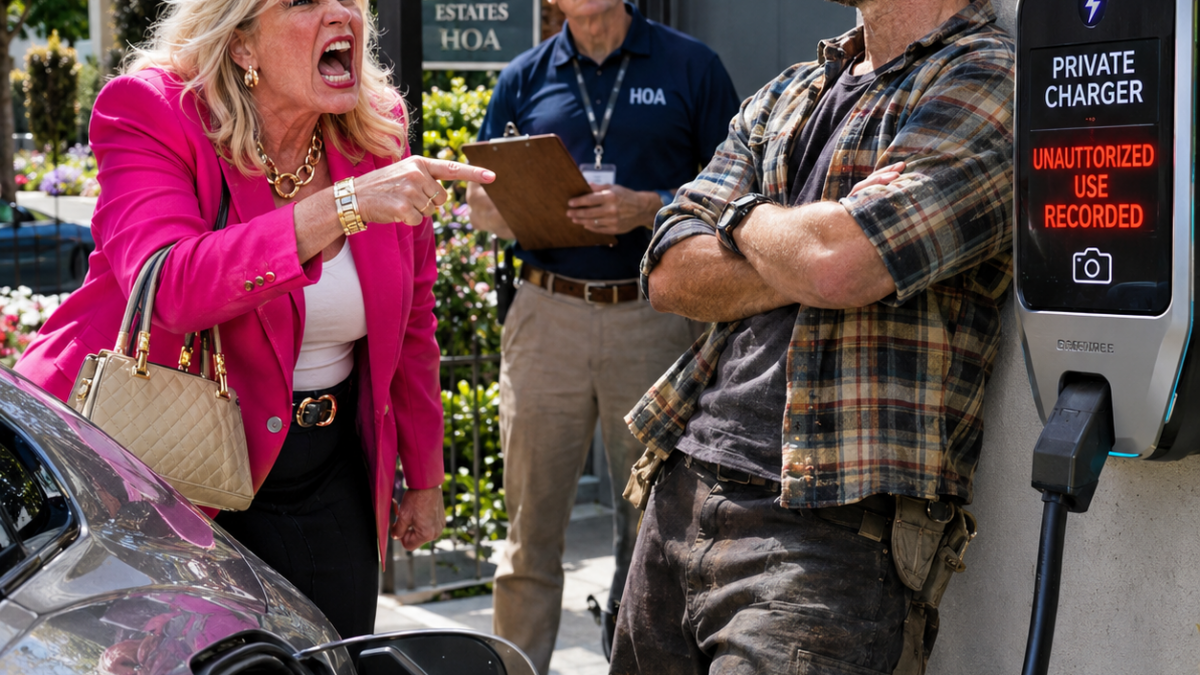
PART 2
For several seconds, I just sat there on the edge of my bed with the phone glowing in my hand.
The number on the screen kept climbing.
Energy delivered.
Session active.
My electricity.
Her car.
Again.
I considered walking outside.
I imagined crossing those three houses in sweatpants, knocking on her door, and holding up the app while asking what part of *stop using my charger* had confused her.
The thought was satisfying.
That was exactly why I did not do it.
I had been in Ridgewood Heights for two months.
Evelyn had been there eight years.
She had spent six of those years as HOA vice president.
She knew the board members.
She knew the management company.
She knew which neighbors went to meetings and which ones never did.
And judging by the community-app post, she knew how to make a private dispute look like a moral failure on somebody else’s part.
I had data.
She had influence.
Those were not the same kind of power.
Not yet.
So I let the charging session continue.
The next morning, I opened the app again.
Forty-seven kilowatt-hours.
Another entry.
Another timestamp.
I took a screenshot and dropped it into the folder.
Then I wrote a second email.
This time, I copied the entire HOA board.
I kept it painfully polite.
I explained that I had privately purchased and installed the charger.
I attached a summary of the unauthorized sessions.
I asked the board to confirm, in writing, whether privately owned EV chargers connected to individual homeowners’ electrical meters were considered community amenities.
I did not accuse Evelyn of theft.
I did not mention her post.
I did not call anyone corrupt.
I asked one simple question that should have taken thirty seconds to answer.
The board never answered.
Monday passed.
Tuesday.
Wednesday.
Thursday.
Nothing.
By Friday evening, the silence itself felt like an answer.
Mark came over while I was taking my trash cans in.
He nodded toward my phone.
“Still happening?”
“She used it again.”
He grimaced.
“After you emailed her?”
“After I emailed the whole board.”
Mark rubbed the back of his neck.
“That’s bad.”
“Why?”
“Because if nobody answered, she probably got to them first.”
I looked at him.
“You think the board knows?”
“I think Evelyn has been here long enough that most people let her handle enforcement however she wants.”
“That’s not the same thing.”
“I know.”
He glanced toward the street before lowering his voice.
“But around here, it becomes the same thing.”
We walked inside.
I offered him a beer.
He accepted.
At my kitchen counter, he told me about the Henderson family.
They had lived in Ridgewood Heights for almost nine years.
Two kids.
Quiet.
A fence dispute began because Evelyn claimed their side fence violated architectural standards.
“They had approval,” Mark said.
“Written?”
“Yep.”
“What happened?”
“She said the approval applied to the old design, not the replacement.”
“That makes no sense.”
“Welcome to Ridgewood Heights.”
They appealed.
Then came a notice about landscaping.
Then trash cans.
Then holiday lights.
Then a mailbox.
“Eventually they sold,” Mark said.
“Because of her?”
“They never said that publicly.”
“But?”
He took a drink.
“Everybody knew.”
I leaned against the counter.
“Why hasn’t anyone challenged her?”
“People have.”
“What happened?”
“They got tired.”
That answer stayed with me because it was not dramatic.
People imagine bullies winning through strength.
Often they win through exhaustion.
One letter.
One appeal.
One meeting.
One hundred dollars.
Then two hundred.
Then another afternoon off work to argue over something that should never have happened.
Eventually peace becomes more valuable than being right.
Evelyn seemed to understand that.
Maybe better than anyone.
A few days later, the envelope arrived.
White.
Official-looking.
Red stamp across the front.
**ACTION REQUIRED.**
I opened it at the kitchen table.
The heading read:
**NOTICE OF VIOLATION — CASE 2024-0147**
Property: my address.
Violation:
**Unauthorized Exterior Equipment Installation.**
I read the next paragraph twice.
According to the HOA, my EV charger violated Article 7, Section 4 of the Ridgewood Heights covenants because it was exterior equipment visible from the street and had been installed without architectural approval.
I had thirty days to remove it.
After that:
One hundred dollars per day.
Administrative fees.
Potential remediation performed at my expense.
At the bottom was Evelyn Rogers’s signature.
I set the paper down.
Then I walked into my garage.
The charger was mounted to the interior wall.
Inside.
Behind the garage door.
From the street, you could not see it.
From the sidewalk, you could not see it.
From my driveway with the garage closed, you could not see it.
The only reason Evelyn knew exactly where it was was because she had been coming onto my property at night to use it.
That was the first moment when the entire thing stopped feeling petty.
She was not merely taking my electricity.
She was using the HOA process against me because I had told her no.
I went back inside.
Opened the covenants.
Article 7.4 was exactly where she said it was.
But the language mattered.
Exterior equipment.
Visible from the street.
Satellite dishes.
Solar equipment.
HVAC equipment.
My charger satisfied neither part of the rule she had cited.
Then I kept researching.
Arizona had enacted protections limiting how HOAs could restrict residential EV charging equipment.
An association could regulate certain reasonable installation details.
It could not simply prohibit a homeowner from having charging equipment on private property.
My charger was not only inside my garage.
It was the kind of equipment state law specifically protected.
I called Desert Community Services, the management company that handled Ridgewood Heights administration.
Ten minutes of menus later, I reached Jennifer.
I explained the citation.
She pulled up my file.
“Give me a moment, Mr. Reyes.”
I waited.
Keyboard sounds.
Then:
“You said the charger is inside the garage?”
“Yes.”
“Mounted to an interior wall?”
“Yes.”
“Visible when the garage door is closed?”
“No.”
Another pause.
“Article 7.4 concerns equipment visible from the street.”
“That’s what I read.”
“Yes.”
“So the notice is invalid?”
Jennifer became careful immediately.
“I can’t make that determination officially.”
“Can you tell me whether the article appears to apply?”
“It appears inconsistent with what you’re describing.”
“And state law?”
“There are protections involving EV charging equipment.”
“Can the board order me to remove mine?”
“I would recommend filing an appeal.”
I smiled despite myself.
Corporate language is its own dialect.
Jennifer knew exactly what the problem was.
She simply did not have authority to say it plainly.
“When is the next meeting?”
“Two weeks from Thursday.”
“I’ll be there.”
After the call, I took a screenshot of the call log.
Added the date and time to my notes.
Then I photographed the charger from every reasonable angle.
Garage closed.
Driveway.
Sidewalk.
Across the street.
Nothing.
You could not see it.
Mark stopped by that evening.
I showed him the notice.
He barely reached the bottom before shaking his head.
“Article 7.4.”
“You recognize it?”
“She used it on the Hendersons.”
“For what?”
“Their fence.”
“A fence is exterior.”
“Sure. But she claimed it was visible from the common area.”
“Was it?”
“You needed a ladder.”
I laughed once.
Mark did not.
“This is what I mean, Alan.”
He handed me the notice.
“She finds a rule first.”
“And the violation second.”
“Exactly.”
I looked again at Evelyn’s signature.
“Does she know she’s wrong?”
Mark thought about it.
“I don’t know.”
“That bothers me more.”
“Why?”
“Because if she knows, she’s retaliating.”
“And if she doesn’t?”
“She thinks her interpretation becomes law because she made it.”
Mark nodded slowly.
“That’s Evelyn.”
After he left, I created three new folders on my computer.
**CHARGING LOGS.**
**HOA COMMUNICATIONS.**
**VIOLATION 2024-0147.**
Then I ordered a security camera.
Weatherproof.
Night vision.
Cloud backup.
Motion alerts.
Wide enough to capture the driveway, garage entrance, charger cable, and sidewalk.
I installed it Saturday morning beneath the garage eave.
Tested it repeatedly.
Walked up the driveway.
Walked down.
Checked the night mode.
Adjusted the angle.
The final image was almost annoyingly clear.
If Evelyn came back, I would see her face.
I did not need to provoke anything.
I did not need to leave bait.
I did not need to create a situation.
All I had to do was document what she was already choosing to do.
Then I added a smart cable lock to the setup.
I could control access from my phone.
The feature let me secure the connector remotely.
I tested it once.
Locked.
Unlocked.
Worked perfectly.
For a moment, I considered using it the next time Evelyn connected.
I imagined freezing the cable while her Tesla sat plugged in.
Making her come to my door.
Making her explain herself.
Then I decided against it.
Too theatrical.
Too easy for her to describe as harassment.
The real advantage was not trapping her physically.
It was knowing the system gave me control.
If I needed it.
For the next four nights, nothing happened.
I checked the footage each morning.
Empty driveway.
No session.
No Evelyn.
By the third day, I started wondering whether she had stopped.
Maybe the board email had finally worried her.
Maybe somebody had spoken to her.
Maybe the violation notice had been the last attempt to intimidate me before she moved on.
Then I opened the community app.
Evelyn had posted again.
**A QUICK NOTE ABOUT NEIGHBORHOOD VALUES**
She wrote about sharing.
Helping.
Not “hoarding resources while neighbors go without.”
The wording was so absurd that I read it twice.
Eighteen likes.
Comments agreeing.
One resident wrote:
**Some people just don’t belong in communities like this.**
I stared at that sentence longer than I should have.
I had moved here because I wanted to belong somewhere.
That was the embarrassing truth.
I was thirty-eight.
Single.
Most of my college friends had married, moved outward, and built lives that looked established from the outside.
I had spent years renting apartments near work.
Then remote work made location less important.
I finally had enough saved for a down payment.
Ridgewood Heights had seemed like the kind of place where I could stay.
A garage.
A patio.
A neighborhood where people waved.
Two months later, a woman I barely knew had turned me into “the selfish new guy” because I would not fund her Tesla.
I closed the app.
For the first time, moving crossed my mind.
Not seriously.
Just enough to scare me.
Would it be easier?
Absolutely.
Sell.
Take the loss.
Find a house somewhere without an HOA.
Never see Evelyn again.
Then I pictured the Hendersons.
I did not even know them.
But I understood the pattern now.
Somebody gets tired.
Somebody leaves.
Evelyn stays.
I decided I would not make a housing decision while angry.
That was the most responsible way I could phrase what I really meant.
I was not going anywhere.
Two weeks remained before the board meeting.
During those two weeks, Evelyn used my charger three more times.
I knew because the app told me.
I knew because the camera showed me.
The first video arrived at 12:18 a.m.
There she was.
Pajama pants.
Light jacket.
Hair pulled back.
She checked the street.
Walked up my driveway.
Disconnected my car.
Attached the cable to an extension arrangement running toward her house.
Then walked away.
No hesitation.
No confusion.
No moment of surprise.
She knew exactly what she was doing.
I saved the footage.
Second session:
1:06 a.m.
Same procedure.
Third:
11:53 p.m.
Same.
By then, the total value of electricity taken was not enormous.
That almost made her behavior stranger.
She could afford a Tesla.
She lived in a house that probably cost more than mine.
She could afford her own charger.
This was not desperation.
It was entitlement.
The amount did not matter because, in her mind, the boundary did not matter.
She had decided I should share.
Therefore refusing was selfish.
Once she reached that conclusion, taking what she wanted probably did not feel like theft to her.
It felt like correcting me.
That was the psychology that made everything click.
Mark had been right.
Evelyn probably did not see herself as the villain.
She saw herself as the person teaching me how Ridgewood Heights worked.
The violation notice was part of the lesson.
The community posts were part of the lesson.
The neighbors avoiding me were part of the lesson.
Eventually I was supposed to understand.
Give in.
Stop resisting.
Be easier.
I decided the board needed to understand that too.
The camera went quiet for four days.
Then, on the fifth night, my phone buzzed at 11:47.
I was already in bed.
**CHARGING SESSION STARTED.**
I opened the security-camera feed.
Evelyn came into frame.
Clear as daylight under night vision.
She glanced left.
Right.
Then walked straight up my driveway.
That glance mattered.
Someone who believes an item is public property does not usually check whether anyone is watching before using it.
She unplugged my car.
Connected the charger to the extension setup already waiting.
Then walked away.
Thirty seconds.
Practiced.
Routine.
I watched the video three times.
Not because I needed to.
Because it was the first footage that captured everything in one uninterrupted sequence.
Approach.
Look around.
Enter property.
Disconnect my car.
Take charger.
Route electricity toward her property.
Leave.
I saved it locally.
Then to cloud storage.
Then to an external drive.
At six the next morning, I checked the session.
Fifty-two kilowatt-hours.
I opened my spreadsheet.
Seven unauthorized sessions.
Three hundred twelve kilowatt-hours.
Around forty-five dollars at my rate.
Again, not life-changing money.
But there is a strange thing that happens when somebody repeatedly takes a small amount from you.
The smallness starts to feel insulting.
As though the amount itself is supposed to make you too embarrassed to object.
*It’s only forty-five dollars.*
Exactly.
Then why not pay for your own?
That afternoon, I booked a consultation with Olivia Murphy, an attorney whose name kept appearing in discussions about HOA disputes.
She reviewed everything over video.
The violation notice.
My photographs.
The covenants.
The charging logs.
The emails.
The community posts.
Then I played the video.
Olivia watched without interrupting.
When it ended, she leaned back.
“You’ve been very patient.”
“That’s one word.”
“Were you planning to call police?”
“I considered it.”
“Why didn’t you?”
“I want the HOA issue resolved first.”
She nodded.
“You have two different problems.”
“Exactly.”
“One is the violation notice.”
“Yes.”
“The other is Evelyn.”
“Yes.”
Olivia tapped something on her desk.
“The violation notice is weak.”
“Because the equipment is inside?”
“That, and the state-law issue.”
“So appeal should be easy.”
“Should.”
I caught the word.
“You don’t sound convinced.”
“I’ve practiced long enough to know that boards sometimes protect board members.”
“Even with video?”
“People protect relationships.”
“What would you do?”
“What do you want?”
That question stopped me.
I had spent weeks thinking about evidence.
Not outcome.
“I want the notice withdrawn.”
“Reasonable.”
“I want the board to acknowledge my charger is private.”
“Also reasonable.”
“And…”
Olivia waited.
“I want Evelyn to stop using her position to make me look like the problem.”
“That one is harder.”
“I know.”
“What does success look like?”
I looked at the frozen video thumbnail.
Evelyn’s hand on my cable.
“The room sees it.”
Olivia raised an eyebrow.
“The board meeting.”
“Yes.”
“You want to present everything publicly.”
“Yes.”
“High risk.”
“Because?”
“If the board closes ranks, Evelyn gets to claim you ambushed her.”
“She’ll claim that anyway.”
“True.”
“She’s already posting about me.”
Olivia nodded.
“And if it works?”
“Then nobody can say they didn’t know.”
She smiled slightly.
“That’s also true.”
We spent the rest of the consultation structuring the presentation.
Not dramatic.
Chronological.
Start with the violation.
Show why it does not apply.
Then explain the charging issue.
Logs before video.
Emails showing notice.
Then the footage.
“Do not insult her,” Olivia said.
“I won’t.”
“Do not speculate about motive.”
“I won’t.”
“Do not call it a crime in the presentation.”
“I thought it was theft of services.”
“It may be. Let authorities use criminal labels if you go that route.”
“Facts only.”
“Exactly.”
That was language I understood.
Facts were safer anyway.
The night before the meeting, Evelyn posted:
**Looking forward to seeing everyone Thursday. Important community business ahead.**
I almost admired the confidence.
She knew my appeal was on the agenda.
She had signed the violation.
She knew I had complained about her charger use.
And she was still acting as though the meeting belonged to her.
I slept better that night than I had in weeks.
The uncertainty was gone.
I had the law.
The documents.
The logs.
The emails.
The video.
At that point, Evelyn could disagree.
She could get angry.
She could call me selfish.
But she could not make 11:47 p.m. disappear.
The Ridgewood Heights Community Center looked exactly like the kind of building designed for arguments about landscaping.
Beige stucco.
Low roof.
Fluorescent lighting.
Rows of folding chairs.
A long board table at the front.
The parking lot was already half full when I arrived at 6:45.
I carried my laptop bag inside.
About forty homeowners were there.
More than I expected.
Mark sat near the back.
He gave me a small nod.
I took a seat near the center.
At 6:55, the board entered.
Robert Hendricks, the president, sat in the middle.
Gray hair.
Early sixties.
The exhausted face of a man who had probably mediated one thousand arguments about garbage cans.
Linda took the seat beside him.
Then Evelyn.
Cream blouse.
Hair styled.
Perfect posture.
She saw me.
Her smile tightened.
That was all.
The meeting began.
Budget.
Pool resurfacing.
Garage-sale weekend.
Landscaping contract.
I barely heard any of it.
My case was Item Seven.
Violations and Appeals.
Forty-five minutes later, Robert reached it.
He adjusted his glasses.
“Mr. Alan Reyes.”
I stood.
“Violation 2024-0147.”
“Yes.”
“You may present.”
I carried my laptop to the front.
Connected it to the projector.
The first slide appeared.
The violation notice.
I faced the room.
“Thank you. I’ll keep this straightforward.”
Evelyn leaned back in her chair.
I continued.
“I received this notice claiming my EV charger violates Article 7.4 because it is exterior equipment visible from the street.”
Next slide.
Photographs.
Garage wall.
Charger.
Closed garage.
Street view.
“Here is the charger.”
Click.
“Here is the garage from my driveway.”
Click.
“Here is the property from the sidewalk.”
Click.
“Here is the view from across the street.”
I looked toward Robert.
“The charger is mounted inside my garage. It is not exterior equipment, and it is not visible from the street.”
Linda leaned forward.
Robert looked at the citation.
Evelyn remained still.
I continued.
“Additionally, Arizona law limits an HOA’s ability to prohibit or unreasonably restrict residential EV charging equipment.”
I displayed the relevant material Olivia had helped me summarize.
“For those reasons, I am requesting that Notice 2024-0147 be rescinded.”
Robert nodded.
“That seems—”
Evelyn interrupted.
“If I may.”
Robert looked at her.
She turned toward the room.
“This is exactly the kind of technical rules-lawyering that creates problems in communities.”
There it was.
She looked at me.
“Mr. Reyes has lived here two months.”
I said nothing.
“He has repeatedly rejected the cooperative culture that residents have built over years.”
Robert raised a hand.
“Evelyn—”
“The spirit of Article 7.4 is to prevent unapproved equipment from affecting neighborhood appearance and use.”
I spoke.
“Before we discuss the spirit of the rule, I’d like to address the second issue.”
She stopped.
I clicked.
The spreadsheet filled the screen.
Dates.
Times.
Kilowatt-hours.
Seven rows.
I heard a chair move somewhere behind me.
“This is data exported from my ChargePoint system.”
I pointed.
“These are charging sessions I did not initiate.”
No one spoke.
“All occurred overnight.”
I clicked again.
“Total unauthorized consumption: three hundred twelve kilowatt-hours.”
Evelyn’s face changed slightly.
Not much.
Enough.
I continued.
“On May 15, I emailed Mrs. Rogers directly and explained that the charger was privately owned, privately installed, and connected to my personal electrical meter.”
I displayed the email.
Sent.
Timestamp.
No response.
“On May 22, I copied the board and requested written clarification.”
Next slide.
“No response.”
Robert’s eyes moved toward Evelyn.
I clicked again.
A video player appeared.
Evelyn sat forward.
I pressed play.
11:47 p.m.
My driveway.
Night vision.
A figure entered the frame.
There was an immediate change in the room.
People recognized her before I said anything.
Evelyn walked up my driveway.
Looked both directions.
Unplugged my car.
Connected my charging cable to the extension running toward her house.
Then walked away.
Thirty seconds.
I let the footage finish.
No commentary.
No accusation.
Just video.
Evelyn shot to her feet.
Her chair scraped backward so hard that several people jumped.
“You cannot show that.”
Her voice cracked.
Robert stared at the screen.
Linda covered her mouth.
I paused the video on a clear frame.
Evelyn’s face.
Her hand on my charging connector.
She pointed at me.
“You recorded me without permission.”
“The camera records my driveway.”
“That is an invasion of privacy.”
“You were on my property.”
“You set this up.”
“I installed a security camera after repeated unauthorized use of equipment at my house.”
She looked around the room.
“This is insane.”
I kept my voice level.
“I did not ask you to come onto my property.”
“You knew I would.”
“I asked you in writing not to.”
Silence.
That line landed.
Robert picked up the printed email.
“You received this?”
Evelyn stared at him.
“I receive hundreds of emails.”
“It’s addressed directly to you.”
“She was being dramatic.”
I blinked.
Robert did too.
“She?”
Evelyn corrected herself quickly.
“He.”
Nobody laughed.
It somehow made the moment worse.
I spoke again.
“There were three additional unauthorized charging sessions after that email.”
I clicked.
More timestamps.
Then:
“This video is from the seventh session.”
Evelyn’s hands tightened around the edge of the table.
“You could have shared.”
There it was.
Not denial.
Justification.
A murmur moved through the room.
I looked at her.
“That was your choice to make?”
“It’s electricity.”
“That I pay for.”
“Forty-five dollars.”
“You knew I said no.”
She opened her mouth.
Closed it.
Robert cleared his throat.
“I think we need a recess.”
Evelyn turned toward him.
“Robert—”
“Fifteen minutes.”
“Robert, this is completely inappropriate.”
“So is what I just watched.”
The room went still again.
That was the first time anyone on the board had publicly contradicted her.
Evelyn stared at him.
He did not look away.
“Board members,” he said, “back room.”
Linda stood.
Robert gathered the documents.
Evelyn remained seated.
For a few seconds, I thought she might refuse.
Then she snatched her purse off the floor and followed them.
The door closed.
The room erupted.
Not loudly at first.
Whispers.
Then questions.
“Was that really her?”
“She’s been charging at his house?”
“Seven times?”
“After he told her to stop?”
I disconnected my laptop.
Mark came over.
He looked at me.
“You okay?”
“I think so.”
“You look pale.”
“I hate public speaking.”
He laughed.
“That’s what you’re worried about?”
“I’m a software engineer. We prefer angry computers.”
An older man approached.
Late sixties, maybe seventy.
“You’re Alan?”
“Yes.”
“Peterson.”
He shook my hand.
Then lowered his voice.
“She used my garden hose for a summer.”
I thought I had misheard him.
“What?”
“Filled her pool.”
“Without asking?”
“I confronted her.”
“What happened?”
“She said I was overreacting.”
The resemblance was almost absurd.
“Did you prove it?”
“No camera.”
He looked toward the closed board-room door.
“But I knew.”
A woman behind him spoke.
“She reported my Christmas lights three years in a row.”
Another resident added:
“She cited my mailbox.”
Someone else:
“She made me move a basketball hoop that had been there since before she joined the board.”
The recess became a confession circle.
Six years of small grievances.
Things people had swallowed because each one seemed too minor to become a war.
That was the real architecture of Evelyn’s power.
Nobody had enough reason alone.
Together, they had a pattern.
Fifteen minutes became twenty-three.
Then the side door opened.
Robert returned first.
Linda behind him.
Evelyn last.
Her face was pale.
She took her seat without looking at anyone.
Robert adjusted the microphone.
“The board has reviewed the appeal and the additional information provided.”
He looked down at his notes.
“Violation Notice 2024-0147 is rescinded effective immediately.”
A few people clapped.
Robert raised a hand.
“Please.”
He continued.
“The notice was improperly issued under Article 7.4.”
Evelyn stared straight ahead.
“The board will send a written clarification to residents regarding privately owned EV charging equipment and applicable state requirements.”
He paused.
Then:
“The board also finds that the conduct shown in the video is inconsistent with the standards expected of HOA leadership.”
Evelyn’s jaw tightened.
“Mrs. Rogers has agreed to resign as vice president, effective immediately.”
The room exploded.
Not cheers.
Noise.
Questions.
A whistle from somewhere in back.
Evelyn turned sharply toward Robert.
“You said—”
He leaned toward her.
“Evelyn.”
She stopped.
His voice was quiet.
That was enough.
Robert looked at me.
“Mr. Reyes, the board owes you a formal apology.”
I nodded once.
“Thank you.”
“Is there anything else?”
I stood.
“Yes.”
Evelyn looked at me.
“I’m not asking the HOA to pursue anything further on the electricity issue.”
Her shoulders loosened slightly.
Then I continued.
“I will file a small-claims action to recover the electricity cost and filing fees directly from Mrs. Rogers.”
Her head snapped toward me.
“You’re suing me over forty-five dollars?”
“No.”
“What do you call small claims?”
“I’m asking the court to establish that taking something after being told not to take it has a consequence.”
She laughed.
Sharp.
Disbelieving.
“You are unbelievable.”
Mr. Peterson stood from the front row.
“Six years ago, she used my water.”
Evelyn turned.
“What?”
“You remember.”
“I have no idea what you’re talking about.”
“My hose.”
People shifted.
Peterson continued.
“You filled your pool.”
“That is ridiculous.”
“I confronted you.”
“You’re confused.”
He shook his head.
“No.”
A woman stood.
“Then maybe I’m confused too.”
Evelyn looked toward her.
“My Christmas lights.”
Another voice.
“My mailbox.”
Another.
“You fined me because my garbage can was visible for forty minutes after pickup.”
“I was enforcing standards!”
Evelyn stood.
The room quieted.
Her face had turned blotchy red.
Her hands shook.
“For six years, I have given my time to this neighborhood.”
No one answered.
“Six years.”
She looked around.
“Do you think any of you wanted to do the work?”
Robert said quietly:
“Evelyn.”
“No.”
She pointed toward me.
“He has been here two months.”
Her voice rose.
“Two months.”
Nobody moved.
“He doesn’t know this community.”
I kept my hands at my sides.
“He refuses to participate.”
“I pay my dues,” I said.
“That’s not community.”
“What is?”
“Sharing.”
The word hung there.
I looked at her.
“Sharing requires permission.”
Her expression changed.
For the first time all night, she had nothing ready.
I continued.
“You weren’t asking.”
She grabbed her purse.
“This is a witch hunt.”
Nobody followed when she walked out.
The door shut quietly behind her.
That was somehow more final than a slam.
Robert sat back down.
He looked exhausted.
“I think that concludes tonight’s business.”
People laughed nervously.
The meeting ended.
Outside, the Arizona night was warm.
Mark caught up with me in the parking lot.
“I told you she played the long game.”
“You did.”
He clapped my shoulder.
“You played it better.”
I shook my head.
“I didn’t trap her.”
Mark looked at me.
“You absolutely did.”
“No.”
I thought about the camera.
The app.
The spreadsheet.
The emails.
“She kept doing the same thing after being told to stop.”
“Because she thought nobody could touch her.”
“That’s my point.”
I looked back at the community center.
“The trap was just letting the truth stay recorded long enough for people to see it.”
Mark smiled.
“That sounds like something a software engineer would say.”
“It probably is.”
The next morning, the community app was nearly unusable.
Someone had posted a summary of the meeting.
Then another person posted that privately owned chargers were not community amenities.
Comments multiplied.
Some supported me.
Some criticized the board for letting Evelyn operate unchecked.
Several residents began sharing their own stories.
I read for about ten minutes.
Then stopped.
I had spent weeks caring too much about what those people thought of me.
Now that most of them were suddenly on my side, I realized that approval could be just as distracting as rejection.
I closed the app.
Made coffee.
Checked my charger.
My car was at one hundred percent.
That felt absurdly good.
Later that week, I filed the small-claims paperwork.
The amount was simple.
Electricity.
Documented usage.
Court costs.
I did not ask for emotional damages.
Did not turn it into a crusade.
The case resolved quickly.
Evelyn did not contest it.
Three weeks after the board meeting, judgment was entered for three hundred eighty-seven dollars including the documented amount and costs recognized in the case.
The check arrived later.
No note.
No apology.
Just her name.
I deposited it.
Then deleted the reminder from my calendar.
That should have ended the story.
Instead, Ridgewood Heights started changing.
Not dramatically.
No revolution.
No parade.
Just small things.
Robert sent a formal neighborhood communication.
Private residential EV chargers were not shared HOA amenities.
The prior notice issued to me had been withdrawn.
Future enforcement involving charging equipment would be reviewed against state requirements and the governing documents.
The board retained legal counsel to review the relevant language.
At the next meeting, Linda—now vice president—approached me afterward.
“Alan.”
I turned.
“I owe you an apology.”
“You didn’t issue the notice.”
“I was on the board.”
“That’s not the same thing.”
“It’s close enough.”
I appreciated that.
Most people prefer distributing blame until nobody has to own any.
Linda did the opposite.
“We should have answered your email.”
“Yes.”
“We should have checked the rule.”
“Yes.”
She gave me a tired smile.
“You’re not making this easy.”
“I thought honesty was the goal.”
“It is.”
I held out my hand.
“We’re fine.”
She shook it.
Over the next few months, three more homeowners installed EV chargers.
Nobody was cited.
Nobody was told to share.
Nobody received a post about hoarding resources.
That was probably the most satisfying part.
Not Evelyn’s resignation.
Not the video.
Not the small-claims judgment.
The fact that the next person did not have to fight the same battle.
Evelyn disappeared from neighborhood life almost immediately.
At first, I still saw her Tesla.
Then less often.
Six weeks after the meeting, Mark knocked on my door.
“They listed the house.”
“Who?”
He gave me a look.
“Evelyn.”
I felt nothing for a second.
Then a strange mix of relief and discomfort.
“Because of the meeting?”
“Who knows.”
“You sound like you know.”
“I know people.”
“Of course you do.”
“They priced below market.”
“How far?”
“Enough for a quick sale.”
I looked toward her house.
Blinds closed.
No Tesla.
I had imagined consequences while this was happening.
But the reality felt quieter.
She had spent years building social authority in Ridgewood Heights.
Then one thirty-second video changed how people interpreted everything that came before it.
That had to hurt.
I did not enjoy that part.
I also did not feel responsible for it.
If Evelyn had stopped after the first email, there would have been no video.
If she had admitted the charger was mine, there would have been no appeal.
If she had not signed the retaliatory notice, there would have been no board presentation.
Every off-ramp had existed.
She drove past all of them.
The house sold in ten days.
A moving truck arrived.
I watched from my kitchen window for less than a minute.
Evelyn came outside once.
She looked toward my house.
I could not tell whether she saw me.
I stepped away from the window.
That was the last time I saw her.
The new owners arrived a few weeks later.
Jason and Maria.
Early thirties.
A toddler named Sophia.
Golden retriever with absolutely no respect for property boundaries.
I brought them a bottle of wine.
Jason laughed when he saw my EV.
“We’re thinking of going electric next year.”
“Do it.”
“Easy to install a charger?”
“Very.”
“HOA okay with it?”
I looked at him.
Then started laughing.
He looked confused.
“Sorry.”
I shook my head.
“Yes.”
“Definitely?”
“Definitely.”
Maria smiled.
“Sounds like there’s a story.”
“There is.”
“Bad?”
“Not anymore.”
I left it there.
They did not need to inherit the neighborhood’s old drama.
A week later, someone posted a welcome message in the community app.
Jason.
Maria.
Sophia.
Golden retriever.
Then the last sentence:
**Please make them feel welcome—and remember, don’t borrow their garden hose without asking.**
Twelve laughing reactions appeared almost immediately.
Peterson commented:
**Too soon.**
Then added a laughing emoji.
Three people tagged me.
I stared at the screen.
Then laughed.
That was the first time the story felt like it belonged to the neighborhood instead of just to me.
Months earlier, I had avoided the community mailbox because conversations stopped when I approached.
Now people said hello.
Some overcorrected.
One woman spent five full minutes apologizing for liking Evelyn’s original “culture of generosity” post.
“I didn’t know it was about you.”
“You did.”
She looked embarrassed.
“Okay. I suspected.”
“It’s fine.”
“I feel terrible.”
“Don’t.”
“But—”
“You liked a Facebook-style neighborhood post. You didn’t unplug my car.”
She laughed.
“Fair.”
That mattered too.
I could have stayed angry at everyone.
It would have been easy.
But fear spreads socially, and so does conformity.
Most of my neighbors were not cruel.
They had simply learned that being on Evelyn’s bad side was uncomfortable.
Some had seen what happened to the Hendersons.
Others had experienced her selective enforcement directly.
Silence had become a survival strategy.
Once Evelyn lost the power to punish disagreement, people remembered they had opinions.
Mark and I became actual friends.
Not dramatic friendship.
The useful kind.
Borrowed tools.
Beer on patios.
Texts asking if either of us needed anything from the hardware store.
One Saturday, he came over carrying a six-pack.
We sat outside while the desert sky turned orange.
He looked toward my garage.
“You still have the camera?”
“Yes.”
“Smart lock?”
“Yes.”
“Are you ever going to stop checking the charger logs?”
I looked at him.
“I don’t check every day.”
“You checked today.”
“That’s not every day.”
He laughed.
Then became quieter.
“You know what’s weird?”
“What?”
“I’ve lived here seven years.”
“Okay.”
“This is the first time the HOA feels boring.”
“That’s good.”
“I know.”
He took a drink.
“Maybe boring is what competent government looks like.”
“Don’t call an HOA government around me.”
He laughed again.
“Fine.”
Then he looked toward the houses.
“I used to think nothing would change.”
“Because of Evelyn?”
“Because everybody was afraid of being next.”
I nodded.
“Sometimes one person saying no reminds everybody else they can too.”
I looked at him.
“That sounds suspiciously inspirational.”
“Beer does that.”
We sat quietly after that.
A few days later, I came home to find a package on my porch.
No shipping label.
Just my name.
Inside was a bottle of wine.
Under the ribbon was a handwritten note.
**Thank you for doing what the rest of us were too tired or too afraid to do.**
No names.
At the bottom:
**Your neighbors.**
I recognized Peterson’s handwriting from a community volunteer sheet.
I carried the bottle inside.
Set it on the counter.
Then sat down.
That note affected me more than I expected.
Because I knew what it cost people to admit fear.
Mark had warned me.
Peterson had stayed quiet about the water.
The Hendersons had moved.
I had almost considered leaving too.
Fear did not always look like panic.
Sometimes it looked like paying the fine.
Sometimes it looked like deleting the draft email.
Sometimes it looked like changing your walking route so you did not have to see the person who had turned your neighbors against you.
I opened the wine that evening.
Sat on the patio.
The Arizona sky was clear.
My phone buzzed.
ChargePoint.
For half a second, my stomach tightened automatically.
Then I looked.
**CHARGING COMPLETE — 100%.**
I laughed.
The first morning in this whole story, I had stood in a silent garage with fifteen percent battery and no idea where my cable had gone.
Now the same notification felt almost ceremonial.
My charger.
My electricity.
My car.
Nothing extraordinary.
Exactly the point.
A month later, Robert asked if I would join the architectural committee.
I declined so quickly that he laughed.
“You don’t even want to think about it?”
“No.”
“Why?”
“I just survived one HOA dispute.”
“That means you’re qualified.”
“It means I’ve learned to stay away from HOA committees.”
“Fair.”
I did agree to review the draft language on EV charging.
Not as a board member.
Just as the homeowner who had lived through the problem.
The new language was simple.
Privately owned EV charging equipment installed on an owner’s property remained private.
Reasonable standards could apply where legally permitted.
Nothing in the rules created shared-use rights.
That last sentence was probably unnecessary.
Everyone insisted we keep it anyway.
Peterson called it “the Evelyn clause.”
We did not officially call it that.
Unofficially, everyone did.
The management company also changed its internal procedure.
Violation notices involving state-regulated equipment would receive legal review before being issued.
Jennifer called me after the change.
“I thought you’d appreciate knowing.”
“I do.”
“And for what it’s worth…”
She hesitated.
“Yes?”
“I’m sorry.”
“You didn’t sign the notice.”
“No.”
“But I saw enough to know something was wrong, and all I did was tell you to appeal.”
“That was your job.”
“Sometimes job descriptions are convenient places to hide.”
I respected her for saying that.
“Thank you.”
After we hung up, I thought about how many people had known pieces of the truth.
Mark knew Evelyn retaliated.
Jennifer knew the citation was shaky.
Peterson knew about the pool.
Other residents knew about selective fines.
The board probably knew she could be aggressive.
But nobody had the whole picture.
That was why documentation mattered.
Not because data is magical.
Because it turns scattered experience into a pattern.
Seven charging sessions looked different together than any one of them did alone.
An email looked different beside a later violation.
A community post looked different beside footage of the person preaching generosity taking electricity at midnight.
Context changed everything.
That was also why I never regretted staying quiet at the beginning.
People later asked why I had not posted the ChargePoint logs immediately.
Why not expose Evelyn the first week?
Why let her continue?
The answer was simple.
At first, I did not know enough.
If I had posted after the first discovery, Evelyn could have said it was an accident.
If I posted after four sessions, she could say the charger had been presented to her as shared.
After my email, that defense disappeared.
After the board email, the board could not say it had no notice.
After the violation, retaliation became visible.
After the camera footage, intention became harder to deny.
I did not manufacture any of those steps.
I only preserved them.
There is a difference.
That distinction mattered to me.
I never wanted the story to become:
*Alan tricked a woman into stealing electricity.*
I wanted the truth.
She had been doing it before I knew.
She continued after I asked her to stop.
She used her HOA position against me when I resisted.
Then she continued again.
The camera did not create the behavior.
It removed the ambiguity.
Two months after Evelyn moved away, I was working late when the doorbell rang.
It was Peterson.
He held a coiled garden hose.
I stared at it.
He grinned.
“Community amenity.”
I laughed so hard I had to hold the doorframe.
“I hate you.”
“No, you don’t.”
“What are you doing?”
“My hose split.”
“And?”
“Mark said you had a spare.”
“I do.”
Peterson held up both hands.
“I am formally requesting permission.”
“You may borrow the hose.”
“Can I get that in writing?”
“Get off my porch.”
He left laughing.
That was how Ridgewood Heights healed.
Not through some dramatic reconciliation.
Through jokes that were finally safe to make.
Through boring meetings.
Through people asking instead of assuming.
Through homeowners realizing a board member was not a monarch.
Through a new family moving into Evelyn’s old house without being told they had inherited a social battlefield.
The Hendersons never came back.
I asked Mark once if anyone had contacted them.
“I tried.”
“What did they say?”
“They’re happy where they are.”
“Did you tell them Evelyn was gone?”
“Yes.”
“And?”
Mark shrugged.
“Some places stop feeling like home after you’ve been pushed out of them.”
That stayed with me.
Not every consequence could be repaired.
Evelyn’s resignation did not return the Hendersons’ time.
It did not undo the months Peterson spent doubting himself.
It did not erase every selective fine.
It certainly did not give me back the first few months in a house I had worked years to buy.
But the neighborhood could at least stop repeating the damage.
That had to count for something.
Autumn softened the Arizona heat.
I started taking evening walks again.
The first time I passed the house that had belonged to Evelyn, Jason was outside washing the Toyota.
Sophia sat on the driveway drawing with sidewalk chalk.
Maria waved from the porch.
Jason held up the hose.
“I asked permission.”
“Smart man.”
He laughed.
“Maria wants an EV.”
“I heard.”
“I’m doomed.”
“Install the charger before the car.”
“Really?”
“Trust me.”
A few weeks later, I helped him compare electricians.
When the charger went in, it was mounted inside his garage.
Almost exactly like mine.
No violation notice appeared.
No passive-aggressive post.
No one suggested I had to share mine with him.
That should not have felt like a victory.
It did.
At the next HOA meeting, Linda gave a financial update.
Robert discussed pool maintenance.
Someone complained about weeds near the community entrance.
Peterson argued that the new trash-bin reminder email sounded “too authoritarian.”
The entire meeting lasted fifty-two minutes.
Nobody resigned.
Nobody presented night-vision footage.
Nobody accused anyone of theft.
As we walked out, Mark said:
“Worst meeting ever.”
I smiled.
“Perfect.”
Life became ordinary.
My client deadlines returned to being the most annoying thing in my week.
The charger faded into the background.
Some nights I did not even open the app after plugging in.
That took time.
For months, any ChargePoint notification made me tense.
Not fear exactly.
Expectation.
A learned response.
I would glance toward the garage.
Check the camera.
Check the session.
Then eventually I stopped.
That was one of the quieter things Evelyn had taken from me.
The assumption that my property would still be the way I left it when I woke up.
People think boundary violations only matter when the stolen object is expensive.
Sometimes the damage is simply that you start checking.
Locks twice.
Camera three times.
App at midnight.
The first week I went without checking the camera felt strange.
The second felt better.
By winter, I could plug in the car, close the garage, and forget about it.
One Friday evening, Mark and I sat on my patio with the bottle opener between us.
He asked:
“Do you ever wonder what Evelyn tells people wherever she moved?”
I laughed.
“About me?”
“Yeah.”
“Probably that I’m a psycho with cameras.”
“Probably.”
“Maybe I ruined her life over forty-five dollars.”
“That sounds right.”
I took a drink.
“You know what?”
“What?”
“I hope she tells it.”
Mark looked surprised.
“Why?”
“Because every version still has to explain why she was using my charger at midnight.”
He laughed.
“That is a difficult detail.”
“Very.”
We sat in silence.
Then he said:
“You never used the smart lock, did you?”
“No.”
“Not once?”
“No.”
“You bought the perfect petty-revenge device and didn’t use it.”
“I considered it.”
“What stopped you?”
“It would have made the story about the lock.”
“And instead?”
“It became about her choices.”
Mark shook his head.
“You are annoyingly reasonable.”
“I work in software.”
“That explains nothing.”
But the question stayed with me.
The source of satisfaction had never really been humiliating Evelyn.
Not by the end.
At the beginning, sure.
When I first installed the camera, there was a part of me that wanted the moment.
I wanted her face when the footage appeared.
I wanted the room to know she was a hypocrite.
I wanted people who had avoided me to feel embarrassed.
I am not proud of that.
I am also not going to pretend I was above it.
Being publicly misrepresented makes public vindication appealing.
But the board meeting taught me something.
The most powerful moment was not Evelyn turning red.
It was Robert saying the violation was rescinded.
It was Peterson standing up.
It was other residents realizing they were not isolated.
It was the board changing the rule.
Humiliation fades.
Structure lasts longer.
The new procedure mattered more than the old vice president’s embarrassment.
About six months after everything ended, I received an email from a homeowner I did not know.
Different neighborhood.
Same city.
He had heard about our EV-charger dispute through a friend.
His HOA was trying to stop him from installing charging equipment.
He asked what I had done.
I stared at the message.
Then wrote back:
Read your documents.
Save every notice.
Keep communication in writing.
Document your installation.
Check applicable state law.
Do not insult anyone in email.
If necessary, talk to an attorney.
I almost added:
And install a camera.
Then deleted it.
His problem was not necessarily mine.
That mattered too.
Not every HOA dispute is corruption.
Not every board member is Evelyn.
Not every misunderstanding needs a war.
Evidence works both ways.
Sometimes it proves you are right.
Sometimes it tells you the other side has a legitimate point.
The goal is not to win every fight.
It is to know what fight you are actually in.
A year after I moved into Ridgewood Heights, I sat on the patio with the anonymous bottle of wine my neighbors had given me.
I had saved the last glass for no particular reason.
The evening was cool.
Sophia’s laughter carried from three houses down.
A dog barked.
Someone was grilling.
My phone buzzed on the table.
ChargePoint.
I looked at it.
**Charging complete — 100%.**
For a moment, I saw that first morning again.
Fifteen percent.
Cold coffee.
Cable disappearing across the lawn.
Evelyn on my porch saying:
“Give me a heads-up next time.”
I almost laughed.
If she had apologized that day, the story would have ended there.
If she had said:
“I’m sorry. I misunderstood.”
I probably would have believed her.
If she had offered twenty dollars for the electricity, I probably would have refused it.
If she had stopped after my email, there would have been no camera footage.
No public meeting.
No resignation.
No small-claims case.
No house sale.
That was the part people missed when they called what I did a trap.
I did not build the road she walked down.
I kept turning on the lights.
She kept walking.
The ChargePoint notification disappeared from the screen.
I put the phone face down.
Inside the garage, the charger hung on the wall exactly where it had always been.
Private property.
Ordinary equipment.
Nothing worth a neighborhood war.
Which was why the whole thing mattered.
Evelyn had never really been fighting over electricity.
She was fighting over whether my “no” counted.
By the end, it did.
Not because I shouted louder.
Not because I embarrassed her more effectively than she embarrassed me.
Because I had dates.
Emails.
Logs.
Video.
And enough patience to let the facts arrive in the right order.
I poured the last of the wine.
Across the street, Peterson walked past with his dog.
He noticed the bottle and raised one hand.
“Still hoarding resources?”
“Absolutely.”
“Terrible neighbor.”
“The worst.”
He kept walking.
I smiled.
Then my garage light clicked off automatically.
The charger had finished its job.
The car was full.
The house was quiet.
And for the first time since I had moved to Ridgewood Heights, none of that quiet felt like I was waiting for something to happen.
It was simply home.
[END OF STORY]








