PART 2: HOA Turned My Private Creek Into a Community Fishing Spot—So I Had Every Board Member Cited for Trespassing
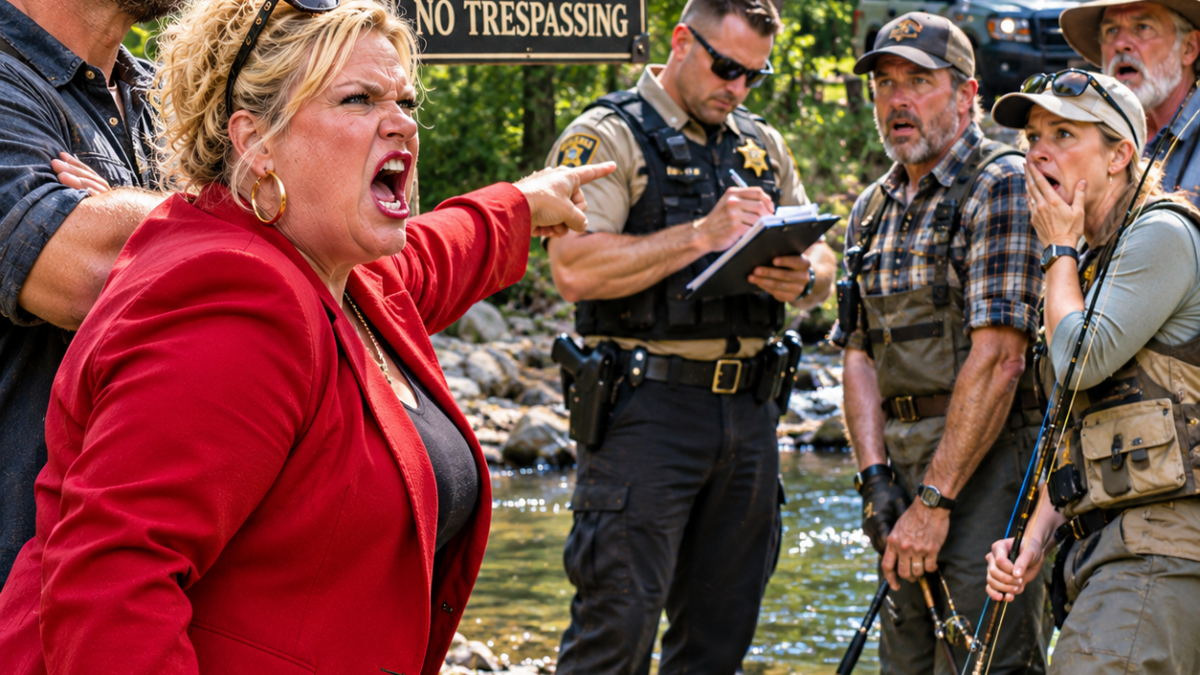
PART 2
I had installed four of them when I first bought the property.
Not because I expected HOA board members to start using my creek as a private fishing club.
I simply liked privacy.
Two cameras covered the house.
One watched the detached garage.
The other four sat farther down toward the creek, hidden along the tree line.
Small.
Battery-backed.
Motion activated.
All connected to a private server in my basement.
I had installed them after catching strangers once cutting through the property to reach a public trail.
Nothing serious.
Just enough to teach me that “private” only works when people know somebody is paying attention.
I sat at my desk.
Opened the archive.
Selected the creek camera.
Three weeks earlier.
Motion.
Video loaded.
Marla walked into frame.
Not alone.
Two men followed carrying tools.
One of them had a chainsaw.
I leaned closer.
The tree I had noticed upstream was still standing.
A full-grown dogwood.
Beautiful tree.
Pink blossoms every spring.
Probably older than half the houses in Willow Creek.
One man pointed.
Marla gestured toward the water.
The chainsaw started.
I felt something cold move through me.
They cut it down.
Not because it was dead.
Not because it was dangerous.
They cut it because it sat where they wanted people to sit.
The camera recorded them trimming the trunk.
Dragging part of it closer to the creek.
Rolling it into position.
Turning a living dogwood into a bench.
I watched the entire thing.
Then another clip.
Three days later.
Marla.
Linda.
Carol.
Two maintenance workers carrying bags of gravel.
They spread it along the muddy creek path.
Another clip.
Someone tied a rope swing to one of my sycamores.
Then came residents.
Families.
Kids.
Fishing poles.
Coolers.
Beer.
Dogs off leash.
One little boy jumped into the creek from the rope swing.
An older man slipped on the bank and nearly fell.
A woman moved one of my trail markers.
Another man drove two stakes into the soil to hold a folding canopy.
It wasn’t just trespassing.
They had modified my land.
And every single person involved appeared to believe the HOA had authorized them.
That was the part that scared me.
If one of those children got injured?
If somebody drowned?
If someone broke a leg?
Whose land would the lawsuit identify?
Mine.
I backed up every recording.
Twice.
Saved them to an external drive.
Uploaded encrypted copies.
Printed screenshots.
Then made two calls.
The first was to Rachel Moore.
Rachel had been a friend since college.
Property attorney.
Sharp enough to make judges double-check their own questions.
She didn’t answer.
So I left a message.
“Call me. HOA problem. Bigger than mailbox nonsense.”
The second call was to the county sheriff.
A deputy arrived that afternoon.
Deputy Carter.
Early forties.
Calm.
No drama.
I showed him the deed first.
Then the recordings.
He watched Marla’s crew cut the dogwood.
His eyebrows rose.
Then the gravel.
Then the families.
Then Marla sitting with Linda and Carol.
When the last clip ended, he leaned back.
“Yeah.”
“That bad?”
“Worse than a normal trespass complaint.”
“How?”
“Unauthorized land alteration. Property damage. Repeat trespass. Potential liability issues. Possibly environmental concerns depending on the creek classification.”
I pointed toward the screen.
“They’ve been doing this for weeks.”
“I can see that.”
“Can I press charges?”
He looked at me.
“Yes.”
I didn’t hesitate.
“Then I want to.”
He nodded.
“I’ll need copies.”
“You’ll have them.”
Before leaving, he walked down to the creek with me.
He photographed the stump.
Gravel.
Rope swing.
Folding chairs.
Beer cans.
Then he looked at the floating sign caught in reeds farther downstream.
“That yours?”
“Was.”
He sighed.
“Somebody wanted you to get the message.”
“They did.”
“What message?”
“That they think my deed is optional.”
His expression tightened.
“They’re about to find out it isn’t.”
Rachel called that evening.
I started explaining.
She interrupted after maybe four minutes.
“Wait.”
“What?”
“You said your parcel sits outside Willow Creek’s declaration.”
“Yes.”
“You sure?”
“Yes.”
“Send me the deed.”
I did.
Then the title report.
Then the HOA declaration Marla had once emailed me.
Rachel disappeared for two hours.
When she called back, her voice was different.
No joking.
No irritation.
Focused.
“Ethan.”
“Yeah?”
“You’re not in Willow Creek.”
“I know.”
“No.”
She emphasized it.
“You are completely outside their jurisdiction.”
“That’s what I’ve been telling them.”
“I mean they have zero recorded authority over your parcel.”
Silence.
“They’ve fined me.”
“I know.”
“For almost two years.”
“I know.”
“Can they do that?”
“No.”
I sat down.
“Rachel.”
“Yeah?”
“That sounds like fraud.”
“That is exactly the word I was about to use.”
For several seconds, all I could hear was my refrigerator humming.
The mailbox fines.
Shed-window notices.
Trash-can warnings.
Every threatening letter.
Every demand.
I had treated them as annoying.
Some I ignored.
Two early fines I actually paid because the amounts were small and I didn’t want to waste time fighting.
Now I understood something worse.
They had taken money from me under authority they did not possess.
Rachel said:
“I’m filing for an injunction Monday.”
“What does that do?”
“Stops them from entering or using the land while this gets sorted out.”
“They’re already trespassing.”
“Which is why we want a court order saying what your deed already says in language even Marla can’t pretend not to understand.”
I laughed once.
Rachel continued.
“And Ethan?”
“Yeah?”
“Don’t contact them.”
“Why?”
“Because I want to see what they do when the first real legal notice arrives.”
She knew Marla well already.
Two days later, Rachel sent the formal notice.
Cease trespass.
Cease unauthorized use.
Cease fines.
Preserve records.
No further claims of authority over my parcel.
The response arrived in person.
Of course it did.
Marla appeared at my door Tuesday morning.
Linda and Carol behind her.
All three dressed like they were attending a very tense brunch.
Pressed jeans.
Pastel shirts.
Marla had the clipboard.
Always the clipboard.
I opened the door but stayed inside.
“Ethan.”
“Marla.”
“We need to talk.”
“My lawyer says we don’t.”
Her face tightened.
“This escalation is unnecessary.”
“You cut down a tree.”
“For community improvement.”
“On my property.”
“The creek was underused.”
I stared at her.
“You don’t get to decide whether my land is being used enough.”
Linda crossed her arms.
“People loved it.”
“I don’t care.”
Carol scoffed.
“That’s selfish.”
That made me laugh.
“Selfish?”
“Yes.”
“You trespassed onto land you don’t own, cut down a mature tree, built a path, installed a rope swing, and invited families to use it without my permission.”
I looked at Carol.
“And I’m selfish because I want you to stop?”
Marla stepped forward.
“We were creating something positive.”
“You were creating liability.”
Her expression shifted.
“Don’t threaten us.”
“That wasn’t a threat.”
I pointed toward the creek.
“If a child gets hurt on a rope swing you installed on my property, guess whose name appears on the parcel record.”
Nobody answered.
“You didn’t even ask.”
Marla waved one hand.
“We believed we had authority.”
“No.”
I shook my head.
“You believed nobody would challenge you.”
Her eyes sharpened.
“That is insulting.”
“It’s accurate.”
She held up a folder.
“The board has longstanding jurisdiction over neighborhood-adjacent amenities.”
“Show me.”
“We already have.”
“No.”
I stepped onto the porch.
“You’ve shown me newsletters.”
Nothing.
“Notices.”
Nothing.
“Fake violation forms.”
Her eyes flashed.
“But never a deed.”
Silence.
“Never an easement.”
Silence.
“Never an annexation agreement.”
Linda looked toward Marla.
“Never a recorded covenant.”
I paused.
“Because none exists.”
Marla’s jaw tightened.
“The fines were for the good of the neighborhood.”
“No.”
I pointed at her clipboard.
“They were for your ego.”
That landed.
She stepped back.
“This conversation is over.”
“You came to my house.”
She spun around.
Linda and Carol followed.
Halfway down the walkway, Marla turned.
“You’re going to regret turning the whole neighborhood against you.”
I almost answered.
Then I remembered Rachel.
So I smiled.
“Have a good morning.”
The neighbors started coming to me before the week ended.
First Tom and Elise.
Young couple.
Three houses inside Willow Creek.
Tom drove a utility-company truck for work.
Elise taught second grade.
They arrived carrying a pie.
That was suspicious enough.
“We thought this might help.”
I looked at the pie.
“With what?”
“The HOA apocalypse.”
I laughed.
Invited them in.
Tom had received daily fines because his work truck was supposedly parked too close to the curb.
Elise showed me photographs.
It wasn’t.
They had paid more than eight hundred dollars because they didn’t know how to fight.
Then Mrs. Holloway came.
Seventy-three.
Tiny woman.
Louder voice than expected.
She had been fined because her roses weren’t on the approved landscaping list.
“They said they were the wrong red.”
I stared.
“There’s a wrong red?”
“Apparently.”
Then Derek.
Violation because of a toddler swing set in his backyard.
Then another resident.
Then another.
Story after story.
Rules nobody remembered approving.
Fines with no clear authority.
Notices referencing sections that didn’t exist.
Rachel listened.
Then said:
“We organize.”
So we created a shared folder.
Residents uploaded everything.
Not opinions.
Evidence.
Emails.
Letters.
Photographs.
Meeting minutes.
Bank statements.
Fine schedules.
Screenshots.
Within one week, the folder became enormous.
And a pattern emerged.
Marla’s board had gradually expanded its own power without properly changing the underlying documents.
They issued “community standards” as though newsletters could create new covenants.
They treated informal votes like legal amendments.
They sent fines first and answered questions later.
Most homeowners paid.
Not because the board was right.
Because one hundred dollars was cheaper than hiring a lawyer.
That business model depended on exhaustion.
Then my creek footage landed in the middle of all of it.
A board physically entering property outside its jurisdiction.
Cutting a tree.
Building improvements.
Advertising the area verbally as a community amenity.
That was harder to explain away.
The board called an emergency meeting.
I didn’t go.
Rachel did.
I wanted to.
She refused.
“You’re emotional.”
“I’m angry.”
“That’s what emotional means.”
“I can handle myself.”
“I know.”
“Then why can’t I go?”
“Because Marla wants you to stand up and yell so she can tell everyone this is a personality conflict.”
I hated how right that was.
“What are you doing?”
“Dropping paper.”
Apparently she meant that literally.
The next morning, Rachel told me she had walked into the community center carrying a thick stack.
Sheriff report.
Injunction filing.
Deed.
Footage screenshots.
Cease-and-desist notice.
Demand for accounting of every fine ever collected from my parcel.
She dropped it on the table in front of Marla.
Then said:
“My client’s land is not your land.”
One board member resigned forty-eight hours later.
Another stopped answering messages.
The rope swing disappeared overnight.
Too late.
The county sheriff issued formal trespass and property-damage citations based on what investigators could document.
Marla.
Linda.
Carol.
The men involved in the tree cutting faced their own consequences.
And because those actions had been outside valid HOA authority, association counsel warned the board that using community funds to cover personal citations could create even more problems.
For the first time, Marla had to pay for her own behavior.
She hated that.
I knew because she sent me an email.
Rachel forwarded it with only one sentence:
**Do not respond. Enjoy.**
Marla wrote:
**Your vindictive conduct is financially harming volunteers who were acting solely for community benefit.**
Volunteers.
That was convenient.
When they were giving orders, they were officials.
When consequences arrived, they were volunteers.
I didn’t respond.
Then the planning department called.
That surprised me.
An inspector named Wesley asked to visit the creek.
“Why?”
“Gravel.”
“Gravel?”
“The sheriff’s report mentions imported fill near a waterway.”
I met him the next morning.
He walked the path.
Kneeled.
Picked up a handful.
Then looked toward the drainage area.
“Who placed this?”
“HOA.”
“Permit?”
“Not that I know.”
He sighed.
“This drainage feeds a protected runoff channel.”
“Is that bad?”
“Potentially.”
He photographed everything.
The gravel had altered how water moved during storms.
Small issue initially.
Then county inspectors started checking other Willow Creek projects.
That was when Marla’s problems multiplied.
A community garden encroached onto land the HOA didn’t own.
A drainage ditch had been redirected without proper permits.
Retaining work had been completed without approvals.
A decorative structure near the entrance exceeded an easement boundary.
Little things.
Individually manageable.
Together they revealed a culture.
Nobody checked.
Because Marla said it was okay.
Then Rachel found the money.
She called me late Thursday afternoon.
“Sit down.”
“I’m sitting.”
“Good.”
“What?”
“We got access to part of the financial records through discovery.”
“And?”
“Reimbursements.”
“To who?”
“Marla.”
My stomach tightened.
“And?”
“Linda.”
“How much?”
“Thousands.”
“For what?”
“Equipment.”
“What equipment?”
“That is the interesting question.”
Invoices referenced landscape maintenance.
Security.
Beautification.
Creek improvements.
Storage.
Several expenses had no corresponding asset.
One landscaping company receiving regular work was owned by Marla’s brother-in-law.
Another vendor shared a mailing address with a board member’s relative.
None of that automatically proved theft.
But it smelled bad enough that Rachel sent the documents to appropriate state authorities.
Within two weeks, investigators were requesting bank records and emails.
The first subpoena changed everything.
Marla stopped sending me notices.
Not because she had accepted defeat.
Because she suddenly had bigger problems.
The morning she was arrested, I was sitting at my kitchen table drinking coffee.
Tom called.
“You seeing this?”
“Seeing what?”
“Look outside.”
I walked to the front window.
A sheriff’s vehicle sat near Marla’s house.
Another behind it.
Neighbors stood in driveways.
Marla walked out.
No clipboard.
Hands behind her.
For years she had walked around Willow Creek like rules were physical objects she personally carried.
Now a deputy helped her into a cruiser.
I expected satisfaction.
It came.
For maybe five seconds.
Then it felt strange.
Heavy.
I didn’t cheer.
I didn’t film.
I closed the curtain.
Tom called again.
“You there?”
“Yeah.”
“You okay?”
“I don’t know.”
“She got what she deserved.”
“Maybe.”
“You don’t sound happy.”
“I wanted her off my creek.”
Silence.
“I didn’t wake up wanting her in handcuffs.”
Tom understood.
The operating account was frozen during the investigation.
The board effectively collapsed.
A temporary board stepped in.
Residents finally began breathing again.
I thought we were nearing the end.
Then I received a certified letter from the county tax assessor.
That letter reopened everything.
My property had been flagged for:
**UNREPORTED STRUCTURAL IMPROVEMENTS ASSOCIATED WITH RECREATIONAL USE.**
Attached was a blurry aerial photograph.
Wooden platform near the creek.
I didn’t recognize it.
I drove to the planning office that afternoon.
Pulled permits.
There it was.
Application for:
**CREEKSIDE COMMUNITY OBSERVATION DECK**
Permit reference used my parcel number.
Applicant:
Carol Denton.
I read it twice.
Then a third time.
“They used my property ID.”
The clerk looked uncomfortable.
“That’s what the record shows.”
“Did I sign this?”
“No.”
“Who approved it?”
She pointed.
A county employee.
“Where is this deck?”
She showed me the map.
It wasn’t even on my property.
It sat just beyond my boundary on public land.
They had used my parcel identity to secure permission for a structure on property neither I nor the HOA owned.
I called Rachel.
She sighed before I finished.
“That’s identity fraud.”
“Using a parcel number can be fraud?”
“Combined with false representations and government filings?”
“Yes.”
“How bad?”
“Potential felony bad.”
I drove home.
Pulled my drone.
Flew it toward the site.
There it was.
Workers in unmarked vests.
Timber.
Concrete footings.
Half-built platform beside the creek.
Moving fast.
I drove down.
From my side of the boundary, I could see a sign nailed to a tree:
**COMMUNITY OBSERVATION POINT**
**PROPERTY OF WILLOW CREEK HOA**
Except it wasn’t.
None of it was.
The sheriff returned.
This time with someone from the Department of Public Lands.
They confirmed the boundary.
Public parcel.
Misfiled permit.
False property identity.
The worker crew left before sunset.
Carol was arrested the next morning.
Linda followed two days later after financial records connected her to payments for deck materials.
Suddenly, a floating private-property sign had turned into a full investigation of years of bureaucratic corruption.
That sounds dramatic.
Living through it felt mostly exhausting.
Reporters showed up.
Local news vans parked outside the community center.
People who had never cared about HOA meetings suddenly wanted interviews.
I declined almost all of them.
Rachel handled the civil case.
Not just the dogwood.
Not just trespass.
Unauthorized land alteration.
Improper fines.
Legal fees.
Restoration.
Harassment.
Financial damages.
The judge expedited parts because governing bodies acting outside their recorded authority tend to make courts nervous.
Marla’s attorneys argued good faith.
That phrase followed us everywhere.
Good faith.
They believed the creek was community-adjacent.
Good faith.
They believed the HOA had implied authority.
Good faith.
They believed recreation benefited everyone.
Rachel stood in court holding my deed.
“Your Honor, good faith does not create an easement.”
Simple.
That sentence ended a lot of nonsense.
We won.
Full compensation for the destroyed dogwood based on professional valuation.
Restoration costs.
Legal fees where allowed.
Repayment of fines improperly collected from my parcel.
Injunction.
And one remedy that mattered more than the money.
The HOA was ordered to clearly mark the limit of its authority.
Not with vague neighborhood maps.
Recorded boundaries.
The joke around Willow Creek became:
**Apparently the HOA ends where the HOA actually ends.**
I approved.
But the legal victory didn’t feel complete.
Not yet.
The residents had seen too much.
More than forty homeowners signed a motion under Willow Creek’s own governing documents to remove the remaining board.
With Marla, Linda, and Carol facing serious charges and other members resigning, the vote was almost anticlimactic.
The old board disappeared.
Residents debated whether to abolish everything.
Some wanted no organization at all.
Others pointed out they still needed to coordinate shared road landscaping, common areas, and neighborhood events.
Eventually they created something different.
A small nonprofit stewardship group.
No fines.
No architectural police.
No pretend law-enforcement authority.
Volunteer projects.
A retired firefighter.
A nurse.
A biology teacher.
Tom volunteered.
Elise did too.
I refused.
“You started all this,” Tom complained.
“No.”
“You absolutely did.”
“I found three women fishing.”
“And now I attend monthly nonprofit meetings.”
“Sounds like your problem.”
He threatened to leave zucchini on my porch.
He eventually did.
The county dismantled the illegal observation deck.
Posts pulled.
Railings removed.
Concrete broken out.
Then came restoration.
That mattered to me.
I could have hired contractors.
Instead, residents volunteered.
Not everyone.
Enough.
We removed excess gravel near the creek.
Replanted native grasses.
Stabilized the disturbed runoff area.
Then came the dogwood.
The old one was gone.
Nothing could undo that.
Rachel had obtained compensation.
Marla had paid consequences.
Still gone.
The new stewardship group bought a young dogwood.
Tom brought it down.
“Thought you might want help.”
I looked at the small tree.
Maybe eight feet.
Thin trunk.
Nothing like the old one.
“It’ll take years.”
“That’s how trees work.”
“I know.”
We planted it near the old stump.
Mrs. Holloway showed up carrying lemonade.
Derek brought his toddler.
Elise brought gloves.
Even residents I didn’t know came.
I looked around.
“This isn’t community property.”
Tom smiled.
“We know.”
“You asked permission.”
“Repeatedly.”
“Good.”
We planted it anyway.
That was the moment the creek started feeling like mine again.
Not because everyone left.
Because the people who came understood the difference between invitation and entitlement.
A few weeks later, the neighborhood held a potluck at the park pavilion.
No speeches planned.
That was the promise.
Then somebody handed me a microphone.
Traitors.
I stood there looking at maybe eighty people.
Some I knew.
Many I didn’t.
Two years living near them and we had barely spoken before Marla accidentally gave us a shared enemy.
I didn’t want a heroic speech.
So I told the truth.
“I didn’t want to be the guy who sued the neighborhood.”
A few people laughed.
“But I also didn’t want to become the guy who stayed quiet while people used power as a weapon.”
The room went still.
“What happened at my creek was ridiculous.”
I looked toward Tom.
“Three board members fishing where they didn’t belong.”
Laughter.
“But ridiculous things become serious when nobody questions them.”
I paused.
“A fine.”
“A letter.”
“A fake map.”
“A tree cut because someone thinks they’re allowed.”
“Eventually, people stop asking whether the authority is real.”
I looked around.
“And silence becomes permission.”
Nobody applauded immediately.
That made me nervous.
Then Mrs. Holloway started.
Small clap.
Then others.
Not loud.
But real.
That mattered more.
The criminal cases continued.
I did not follow every hearing.
Marla faced charges tied to financial records and conspiracy allegations.
Carol and Linda faced their own charges related to fraudulent filings and government documents.
There were plea negotiations.
Court dates.
Lawyers.
I kept living.
For a while, that was harder than expected.
People assume winning gives you peace immediately.
It doesn’t.
For months, every time I walked toward the creek, I looked for chairs.
I checked the trees.
Checked the rope-swing branch even though the rope was gone.
Checked the gravel.
It had become a habit.
The land had been private before.
Then strangers had turned it into a public space.
My body didn’t immediately believe the public space was gone.
One evening, I found a fisherman near the old bridge.
My heart jumped.
He saw me.
“Sorry!”
He raised both hands.
“I thought this was public.”
I took a breath.
“Where’d you hear that?”
“Some old neighborhood map online.”
Of course.
I could have lost my temper.
Instead I walked down.
Showed him the boundary.
He apologized.
Packed his gear.
Before leaving:
“You might want a better sign.”
I stared at him.
“Long story.”
The next week, I installed a new one.
Not because I should have needed it.
Because clarity is cheaper than conflict.
**PRIVATE CREEK ACCESS**
**NO PUBLIC OR HOA RECREATIONAL RIGHTS**
**PERMISSION REQUIRED**
Big.
Simple.
Impossible to misunderstand.
Tom saw it.
“You forgot ‘Marla specifically banned.’”
“Go home.”
The new dogwood survived its first winter.
I checked it more than I should have.
New growth appeared in spring.
Tiny green buds.
Then flowers.
Not many.
Enough.
That affected me more than the court ruling.
You can replace money.
Legal victories become paper.
A tree growing back is different.
Not the same tree.
That was the point.
Restoration does not mean pretending damage never happened.
It means deciding what grows after.
The creek became a place I spent more time at.
Before the whole mess, I went down there maybe once a week.
Afterward, almost every evening.
Sometimes with a beer.
Sometimes no drink.
Just sitting.
Water moved.
Birds.
Frogs.
One evening, Tom walked down but stopped ten yards away.
“Permission to enter sovereign territory?”
I laughed.
“Granted.”
He sat beside me.
“You know what Elise says?”
“That marrying you was a mistake?”
“Frequently.”
“What else?”
“She says the neighborhood is better now.”
I looked toward the water.
“Because Marla’s gone?”
“Partly.”
“Mostly because people know each other.”
That was true.
Before, Willow Creek looked connected.
Shared landscaping.
Newsletter.
Holiday decorations.
But most people didn’t actually talk.
Marla’s system substituted compliance for community.
After it collapsed, people had to communicate.
Shared folder.
Meetings.
Restoration.
Potluck.
Disagreement.
Actual relationships.
Funny how that works.
“What happened with your truck fines?” I asked.
“Refunded.”
“Good.”
“Elise bought a grill.”
“With HOA money?”
“With my money.”
“Tragic.”
He threw a pinecone at me.
For months, residents received refunds on improper fines where records supported them.
Not everything was recoverable.
Some notices were valid.
That became important.
The new group reviewed complaints carefully.
Derek’s swing set?
Never prohibited under recorded rules.
Refund.
Mrs. Holloway’s roses?
No enforceable restriction on species.
Refund.
A homeowner fined for painting his house fluorescent purple?
That one was actually covered.
He remained angry.
Fairness isn’t always satisfying.
I respected the new board for saying so.
Rachel did too.
One afternoon she came to my house carrying a folder.
“We’re done.”
“What does done mean?”
“Civil judgment satisfied.”
I stared.
“Everything?”
“Restoration payment, damages, legal-fee portion, improper fines.”
She handed me the final paperwork.
I looked at the total.
It was significant.
Not life-changing.
Enough.
“What should I do with it?”
Rachel laughed.
“I am your attorney, not your financial planner.”
“I’m serious.”
“Fix the creek.”
“Already doing that.”
“Then buy something irresponsible.”
“I don’t need anything.”
“Everyone needs something.”
I looked outside.
The old dogwood stump remained near the water.
An idea formed.
I used part of the settlement to place a conservation restriction on the creek bank.
Nothing dramatic.
A legal instrument limiting future development along that stretch.
The irony pleased Rachel.
“So Marla tried to make it a community amenity.”
“Yes.”
“And you responded by legally making sure nobody builds anything there.”
“Yes.”
“Petty.”
“Conservation.”
“Petty conservation.”
“Still legal.”
She smiled.
“Very.”
We restored native vegetation.
Removed unnecessary fill.
Had an arborist assess the sycamores.
Repaired erosion.
The county helped because of the runoff issue.
Within two seasons, the bank looked less disturbed.
The remaining stump softened.
Moss spread over it.
The new dogwood grew.
I left the stump.
At first I thought about removing it.
Then decided against it.
It became a reminder.
Not of Marla.
Of consequences.
One day, Derek’s little daughter asked:
“Why’s that tree cut?”
I looked at the stump.
“Somebody cut it who shouldn’t have.”
“Why?”
“They thought they could.”
She considered that.
“Were they bad?”
Children ask impossible questions casually.
“No.”
I thought.
“They made bad choices.”
“Did they say sorry?”
I almost laughed.
“Not really.”
She nodded like that made perfect sense.
Then ran back toward her father.
Maybe that was healthier than the adult version.
No endless debate over whether Marla was evil.
She had done wrong.
Consequences followed.
Life continued.
Marla eventually disappeared from Willow Creek.
Her house went up for sale.
The day the sign appeared, people noticed.
Nobody threw a party.
At least not publicly.
I saw her once before she moved.
Grocery store.
Produce aisle.
She saw me.
I saw her.
For a second, both of us considered walking away.
Then she said:
“Ethan.”
“Marla.”
She looked older.
Tired.
No clipboard.
No sunglasses.
Just a woman buying tomatoes.
“I heard the creek looks good.”
“It does.”
“The dogwood?”
“Growing.”
She nodded.
“I didn’t think cutting it would matter that much.”
I stared at her.
“It wasn’t your decision to make.”
“I know.”
That surprised me.
She looked down.
“I know that now.”
There were a hundred things I could have said.
You committed fraud.
You took money.
You harassed neighbors.
You turned your title into a weapon.
Instead:
“Why did you care so much about my creek?”
She sighed.
“The development brochure promised natural amenities.”
I almost laughed.
“They sold houses using my creek?”
“Not directly.”
“Marla.”
Her eyes lifted.
“Yes.”
There it was.
The HOA had pressure from residents.
They wanted trails.
Water access.
Nature.
The developer had oversold proximity to the creek without securing rights.
Marla apparently decided she could solve that problem through sheer confidence.
“If I could make it accessible,” she said, “people stopped complaining.”
“So you took it.”
“I convinced myself it didn’t hurt you.”
“You cut a tree.”
“I know.”
“You fined me while having no authority over me.”
“I know.”
“You used residents’ money to support this.”
She closed her eyes.
“I know.”
The conversation wasn’t satisfying.
No dramatic apology.
No collapse.
Just two people standing beside grocery-store tomatoes admitting reality.
Then she said:
“Do you hate me?”
I thought.
“No.”
She looked surprised.
“I was furious.”
“Still?”
“Sometimes.”
“What changed?”
I picked up a tomato.
“The creek still flows.”
She stared.
I put the tomato back.
“Your part of my life got smaller.”
That was true.
For a while, Marla had occupied everything.
Emails.
Cameras.
Court.
Conversations.
Then eventually she became one bad chapter.
The creek remained.
I left without saying more.
That was the last time I saw her.
Carol and Linda eventually faced their own outcomes.
Carol’s permit fraud became especially ugly because of falsified government records.
Linda had approved payments tied to the deck project.
Neither remained in the neighborhood.
The old HOA technically continued on paper for a while before being wound down and replaced with the stewardship nonprofit.
That organization did not have enforcement power over private parcels.
That was deliberate.
It coordinated voluntary projects.
Shared common-property maintenance.
Events.
Native planting.
Emergency information.
No fines.
No pretend government.
No “community officers.”
The difference was obvious.
At the first annual meeting, the retired firefighter running it opened with:
“I’d like to remind everyone I cannot fine you for anything.”
People applauded.
He looked horrified.
“This is going to be a long year.”
It wasn’t.
Turns out most neighborhood disagreements don’t require a quasi-government.
They require people talking.
One family complained about a neighbor’s dog.
They talked.
Problem solved.
Someone wanted a block party.
They asked.
People agreed.
The community garden needed repair.
Volunteers showed up.
The world did not collapse without Marla’s clipboard.
That was probably the greatest insult to her entire philosophy.
The thing she believed required constant control worked better without it.
The creek remained private.
But I changed how I used it.
Not because the HOA won.
Because I wanted to.
Once a month in summer, I invited neighborhood families for a supervised creek afternoon.
Invitation only.
Clear rules.
Kids could swim in the shallow section.
Adults could fish.
No alcohol near the water.
No rope swings.
No cutting trees.
Tom joked:
“So it became a community amenity.”
“No.”
“What’s the difference?”
“I can cancel it.”
“Dictator.”
“Landowner.”
The difference mattered.
Choice.
Consent.
Responsibility.
When people came because I invited them, I enjoyed it.
That surprised me.
I had thought the trespassing would make me permanently territorial.
Instead, once control returned to me, generosity felt safe again.
That was another thing Marla’s behavior had almost stolen.
The ability to share without feeling exploited.
Mrs. Holloway became obsessed with fishing.
Seventy-five years old.
Tiny spinning rod.
Terrible technique.
Caught more fish than everyone.
She never let Tom forget.
Derek’s daughter learned to skip stones.
Elise brought lemonade.
Kids chased frogs.
Sometimes I sat on the bank and watched.
The scene looked almost exactly like the unauthorized HOA gatherings.
Same water.
Same lawn chairs.
Same laughter.
Completely different feeling.
Because one word changed everything.
Permission.
That became the story’s real center for me.
Not property law.
Not fines.
Not Marla.
Permission.
People love talking about community as though community ownership exists wherever enough people want something.
It doesn’t.
Community is not the right to take.
Community is the ability to ask without assuming the answer.
When residents asked, I often said yes.
When Marla demanded, I said no.
She interpreted that as selfishness.
In reality, she had confused generosity with entitlement.
Those are opposites.
Years later, Rachel asked me to speak at a property-rights seminar.
I refused.
She signed me up anyway.
I told the room about the creek.
Not all the drama.
Just the beginning.
“My private-property sign was floating downstream.”
People laughed.
“Then I found three HOA board members fishing.”
More laughter.
I held up a copy of the deed.
“The important document wasn’t the trespass citation.”
I tapped it.
“It was this.”
A deed.
Boring.
Black ink.
County stamp.
I told them:
“The first question in almost any property dispute is not who is angriest.”
“Not who has the nicest letterhead.”
“Not who has the bigger board.”
“It is: what does the recorded document actually say?”
That was what saved me.
The HOA had confidence.
I had title.
Confidence wins until somebody checks.
Then people asked about the financial investigation.
I told them something else.
“If someone is willing to invent authority over one parcel, don’t assume it’s the only place they invented authority.”
That was exactly what happened.
The creek exposed a habit.
The habit exposed the finances.
The finances exposed permit fraud.
Not because I was some genius investigator.
Because systems built on shortcuts leave footprints.
Invoices.
Emails.
Signatures.
Reimbursements.
Permits.
The more people act, the more records they create.
Marla’s board had relied on one thing:
Nobody looking at all of it together.
Once residents pooled records, the pattern appeared.
That inspired the stewardship group to create a permanent transparent archive.
Meeting notes.
Expenses.
Vendor relationships.
Voluntary contributions.
Anyone could see them.
No hidden reimbursement categories.
No vague beautification expenses.
Tom hated how much bookkeeping it required.
I loved that.
“Transparency is annoying,” I told him.
“You sound happy.”
“I am.”
“Psychopath.”
Possibly.
The new dogwood eventually grew taller than me.
Then taller than Tom.
The first spring it flowered heavily, Mrs. Holloway took a photograph.
She framed it.
Gave it to me.
Underneath she wrote:
**Some things grow back better when people stop standing on them.**
I kept that one.
Years passed.
The creek changed naturally.
Floods moved stones.
Branches fell.
The gravel Marla’s crew spread slowly disappeared under soil and grass.
The rope-swing limb broke during a storm.
The old stump softened.
Nature has a way of reducing human drama to compost.
I liked that.
One rainy afternoon, I found the original **PRIVATE PROPERTY** sign in my garage.
The one that had floated downstream.
I had recovered it from the reeds months after the incident.
Bent corner.
Water stained.
One mounting hole torn.
For years, I kept it as evidence.
Then as a memory.
I picked it up.
Considered throwing it away.
Instead, I walked down to the creek.
Tom was there fixing a volunteer erosion barrier.
He looked at the sign.
“Oh, relic.”
“Thinking of getting rid of it.”
He shook his head.
“Keep it.”
“Why?”
“So when you’re ninety you can complain about Marla to children who don’t care.”
“Fair.”
I hung it inside the garage.
Not outside.
The new boundary sign was enough.
No need to make the creek look hostile.
That mattered to me.
A property can be protected without feeling like a fortress.
The longer I lived there, the more I understood that.
Security is not the same thing as suspicion.
Boundaries aren’t aggression.
The best boundary is one everyone understands well enough that nobody needs to fight over it.
Marla had turned every boundary into a personal insult.
No wonder she lived in constant conflict.
One summer evening, a teenage boy from Willow Creek stopped me near the old stone bridge.
“Mr. Calder?”
“Yeah?”
“Can I fish?”
Simple.
I looked at him.
“By yourself?”
“My dad’s coming.”
“Catch and release?”
“Yes.”
“Stay upstream of the sycamore bend.”
“Thanks.”
He walked away.
That interaction lasted maybe fifteen seconds.
I thought about Marla.
She could have done that.
Day one.
Knock.
Ask.
“Would you consider letting residents fish occasionally?”
Maybe I would’ve agreed.
Maybe not.
But there would have been no lawsuit.
No criminal investigation.
No destroyed dogwood.
No arrests.
No board collapse.
Entitlement is expensive.
It turns requests into wars.
And sometimes the answer was never going to be no until somebody demanded yes.
The financial cases ended long before people stopped talking about them.
Marla’s reputation became neighborhood legend.
New families heard exaggerated versions.
According to one, she had built an entire marina on my creek.
False.
According to another, I had every HOA member arrested while they were fishing.
Also false.
Three board members were cited for documented conduct.
Other residents who had been told access was legitimate were mostly treated differently.
That distinction mattered to me.
They had been misled.
Marla knew better.
Punishment should follow knowledge and conduct, not embarrassment.
That principle became important as the neighborhood healed.
I didn’t want every resident who had taken a child swimming on my land to feel like a criminal forever.
Some apologized.
Some didn’t.
Most simply stopped coming without permission.
Enough.
I once met one father who had used the rope swing with his kids.
He approached me at a hardware store.
“I owe you an apology.”
“For?”
“We used your creek.”
“I figured.”
“Marla told us the HOA opened it.”
“I know.”
“I should’ve checked.”
“Probably.”
He looked guilty.
“My daughter loved that swing.”
“I’m glad she didn’t get hurt.”
That shut him up.
Then he nodded.
“Me too.”
No drama.
No lawsuit.
People make mistakes.
The legal system doesn’t need to become a machine for maximum punishment.
That was the thing Marla never understood when she ran Willow Creek.
Every violation became leverage.
Every mistake became revenue.
Every disagreement became a chance to prove authority.
The new group did the opposite.
Fix first.
Punish rarely.
The neighborhood became calmer.
Funny.
One afternoon, Deputy Carter stopped by.
Same deputy who had watched the first footage.
He was off duty.
Fishing rod in his truck.
He smiled.
“Thought I’d try something revolutionary.”
“What?”
“Ask.”
I laughed.
“Permission granted.”
He spent two hours at the creek.
Caught nothing.
Mrs. Holloway arrived later and caught two small bass in twenty minutes.
Carter stared.
“She’s cheating.”
“She says that’s what losers say.”
He shook his head.
Before leaving, he looked at the dogwood.
“Came back nice.”
“New tree.”
“I know.”
He looked toward the water.
“Hard to believe all that started here.”
“Floating sign.”
He nodded.
“People never know which small thing is going to expose the big thing.”
That was exactly right.
A missing sign.
Three chairs.
Fishing lines.
Ordinary trespass.
Behind it:
Fake jurisdiction.
Improper fines.
Property damage.
Environmental violations.
Suspicious reimbursements.
Permit fraud.
Government filings using my parcel number.
Years of unchecked board power.
If I had shrugged and said:
“They’re only fishing.”
Maybe none of the rest comes out.
That thought bothered me.
How many systems survive because every individual incident looks too small to fight?
Ten-dollar fee.
Fifty-dollar fine.
One strange inspection.
One unauthorized photograph.
One tree.
One creek.
People tell themselves:
Not worth it.
Often they’re right.
Life is short.
Lawyers cost money.
Conflict drains you.
Not every stupid thing deserves war.
But there is a difference between letting go of a small mistake and teaching someone there is no boundary.
That is the judgment call.
I almost made the wrong one.
If Marla had simply sat by the water once, maybe I would have complained and moved on.
But she said:
**The board voted.**
That changed it.
She wasn’t asking forgiveness for a mistake.
She was claiming the right to take.
That is where I drew the line.
Literally.
Years after the case, Willow Creek’s new stewardship group asked me to help update a neighborhood map.
Tom handed me a draft.
I stared at it.
“What?”
He smiled.
“Look at the creek.”
My parcel was shaded differently.
Along the boundary:
**PRIVATE PROPERTY — NO ASSOCIATION ACCESS**
I laughed.
“Subtle.”
“After everything, we thought subtlety was overrated.”
The map was distributed to every new homeowner.
Buyers signed acknowledgment.
No confusion.
Real-estate agents received copies.
The county mapping system was cross-referenced.
The neighborhood learned what recorded boundaries were.
Apparently that required a small legal apocalypse.
Still worth it.
The observation deck incident also changed county procedures.
Parcel identity verification tightened for recreational structure permits near public land.
That might have been the most satisfying bureaucratic consequence.
Not dramatic.
A new checkbox.
Additional title confirmation.
People laugh at paperwork.
Until paperwork prevents someone from using your parcel number to build on government land.
Good bureaucracy is invisible because nothing happens.
Bad bureaucracy becomes my story.
Rachel eventually retired.
Sort of.
Lawyers never fully retire.
At her retirement dinner, she introduced me to another attorney.
“This is Ethan.”
The attorney’s eyes widened.
“Creek guy?”
I closed mine.
“Apparently that’s my permanent identity.”
Rachel laughed.
“Could be worse.”
“How?”
“Mailbox guy.”
Fair.
She gave me a framed copy of the injunction.
I stared at it.
“You think I want legal paperwork on my wall?”
“You framed a dogwood picture.”
“That’s a tree.”
“This saved the tree that came after.”
I took it.
Never hung it.
It sits in a drawer.
The dogwood picture stayed on the wall.
That tells you what mattered in the end.
The creek.
Not the case.
The tree.
Not Marla.
The neighbors.
Not the board.
That is the difference between winning a conflict and surviving it well.
You decide what deserves permanent space in your life afterward.
For a while, I gave Marla too much.
Every conversation was about her.
Every neighbor story.
Every document.
Every evening checking cameras.
Then, slowly, she became less important.
The new dogwood became more important.
The summer creek days.
Tom’s terrible jokes.
Mrs. Holloway humiliating every fisherman.
Derek’s daughter learning to swim.
Those replaced the anger.
Not erased it.
Replaced its position.
That is healing, I think.
Not forgetting.
Reordering.
One year, a storm flooded the creek.
Water rose almost three feet.
The old gravel path disappeared completely.
The creek carried branches downstream.
For several hours I worried the new dogwood would wash out.
It survived.
The next morning, I walked the bank.
Mud everywhere.
The sign tilted.
Debris wrapped around roots.
Tom arrived.
Then Elise.
Then half a dozen neighbors.
I hadn’t called them.
“What are you doing?”
“Helping.”
“This is private property.”
Tom grinned.
“We’re standing outside the boundary.”
He pointed to the path.
“Permission?”
I laughed.
“Granted.”
We cleaned for hours.
That moment told me the neighborhood had truly changed.
Years earlier, people came because Marla said they were entitled.
Now they waited because they weren’t.
Then helped because I said yes.
Same people.
Different culture.
Permission creates respect.
Respect creates trust.
Trust creates community.
Marla tried to skip directly from community to entitlement.
Everything broke.
The new group rebuilt from the other direction.
It worked.
I’m older now.
The creek seems smaller than when I bought the place.
Maybe because I know every bend.
Maybe because age changes scale.
Sometimes I sit on the same bank where Marla’s chair had been.
The dogwood casts real shade now.
One evening, I found myself laughing at the memory of Linda saying:
“It’s just water.”
At the time, that made me furious.
Now it seems almost philosophical.
It was never just water.
It was access.
Ownership.
Consent.
Liability.
Power.
Trust.
Everything people hide inside simple words.
My deed didn’t mean I owned every molecule passing downstream.
It meant I held legal rights and responsibilities tied to that land and water.
Rights Marla treated like an inconvenience.
The most important part wasn’t possession.
It was responsibility.
If someone got hurt, I had responsibility.
If the bank eroded, I had responsibility.
If a tree fell, mine.
If the property needed restoration, mine.
Ownership means you carry the burden.
That’s why outsiders don’t get to claim only the enjoyable part.
Fish here.
Swim here.
Drink here.
Install swing.
Then disappear when somebody breaks an ankle.
That isn’t community.
That is consumption.
I think Marla genuinely believed she was sharing a resource.
But she wanted to share my benefits without sharing my responsibility.
That was the flaw.
Years later, a local environmental group approached me.
They wanted to study the creek habitat.
Old me might have said no immediately.
Instead, I asked questions.
What access?
How many people?
Insurance?
Duration?
Restoration?
They answered everything.
In writing.
I said yes.
Students came.
Collected water samples.
Mapped vegetation.
Identified native species.
One professor pointed at the young dogwood.
“Nice tree.”
I smiled.
“Long story.”
The study helped identify erosion-control improvements.
I implemented several.
The creek became healthier.
That experience proved something else.
Boundaries don’t prevent cooperation.
They make healthy cooperation possible.
Because when everyone knows where permission begins, trust has somewhere to stand.
That lesson spread beyond the creek.
The stewardship group adopted written permission forms for volunteer projects crossing private parcels.
Not because everyone suddenly loved paperwork.
Because ambiguity had already cost us enough.
Tom called me the neighborhood’s “consent bureaucrat.”
I accepted the title.
Better than HOA president.
I was never joining another board.
Ever.
Emily—my niece, not to be confused with anyone from previous stories—once asked why I didn’t move after all the trouble.
I had considered it.
During the worst month.
Marla arrested.
News vans.
Court dates.
People staring.
I looked at listings.
Found a house farther out.
No HOA for miles.
More acreage.
Another creek.
For two days, leaving sounded wonderful.
Then I walked to the dogwood stump.
The old one.
The tree Marla’s crew destroyed.
I realized moving because I wanted more land would be one thing.
Moving because they made my own land feel contaminated would be different.
So I stayed.
That decision mattered more than I understood.
If I had left, every memory of the creek might have ended with trespass.
Instead, I stayed long enough to create newer memories.
Kids invited properly.
Dogwood growing.
Neighbors helping after floods.
Fishing with Deputy Carter.
Mrs. Holloway’s ridiculous success.
The land reclaimed its own story.
So did I.
The criminal cases eventually became old news.
Marla’s name disappeared from local articles.
The stewardship nonprofit changed leadership twice.
Tom finally escaped the board.
He celebrated with beer.
I reminded him it wasn’t a board.
He said:
“Whatever. I’m free.”
New families arrived who knew almost nothing about what happened.
That was good.
One new homeowner introduced herself at the mailbox.
“I heard there used to be a really intense HOA here.”
“Depends who you ask.”
“The realtor said it was dissolved.”
“Basically.”
“Why?”
I looked toward the creek.
“Fishing.”
She laughed.
Then realized I wasn’t completely joking.
“What?”
“Long story.”
I left it there.
Not everyone needs the history.
Some victories are successful when new people no longer have to understand the war that created the peace.
The important part was they received the correct map.
They knew the creek was private.
They knew the stewardship group couldn’t fine them.
They knew county law still applied.
They knew neighborliness required asking.
Enough.
One autumn afternoon, the new dogwood dropped leaves across the bank.
I sat beneath it.
Tom walked down with two beers.
He stopped at the sign.
“Permission?”
“You’ve asked that joke for ten years.”
“And I’ll ask for ten more.”
“Come in.”
He sat.
We watched the water.
Then he said:
“Do you ever miss the excitement?”
I stared at him.
“No.”
“Not even a little?”
“No.”
“You had news vans.”
“I hated news vans.”
“Court victory.”
“I prefer fishing.”
“Arrests.”
“Tom.”
“Fine.”
We sat quietly.
He eventually said:
“You know, when this started, I thought you were kind of an asshole.”
I laughed.
“Why?”
“You wouldn’t let people use the creek.”
“They didn’t ask.”
“I know that now.”
“What changed?”
“You.”
“Me?”
“You kept inviting people after everything.”
I thought.
That was true.
“I figured you’d put up fences and cameras everywhere.”
“I already had cameras.”
“You know what I mean.”
Yes.
I did.
I could have become hard.
Suspicious.
Possessive.
Marla’s worst legacy would have been turning me into someone who saw every neighbor as a potential trespasser.
I nearly let that happen.
Instead, I learned the difference between openness and surrender.
That may be the most valuable thing the whole mess taught me.
You can be generous and still have boundaries.
Friendly and still say no.
Community-minded and still own something privately.
The people who tell you boundaries are selfish are often the ones benefiting from you not having any.
Marla taught me that.
Unintentionally.
The sun dropped behind the trees.
Tom opened his beer.
“So who owns the fish?”
“Leave.”
He laughed so hard he nearly spilled it.
Some jokes never improve.
The dogwood is mature now.
Not ancient.
But strong.
Every spring, pink blossoms.
The old stump is almost gone beneath moss.
The original trespass sign remains in my garage.
The new sign by the creek has been replaced twice because weather does what weather does.
The cameras are still there.
Fewer.
More obvious now.
I don’t like hidden surveillance unless necessary.
One points at the access path.
Not because I’m waiting for Marla.
Because trespass still happens sometimes.
People get lost.
Teenagers explore.
A fisherman misreads a map.
Most encounters are simple.
“Private property.”
“Oh, sorry.”
“Bridge is public. Creek access from there isn’t.”
“Got it.”
Done.
No lawyers.
No arrests.
No war.
That is what a functioning boundary looks like.
It needs force only when someone insists force shouldn’t exist.
Marla insisted.
That was her mistake.
People sometimes ask if I regret pressing charges.
No.
Not because I enjoyed the outcome.
Because without consequences, the board would have treated the incident as a disagreement.
It wasn’t.
There is value in naming conduct correctly.
Trespassing is trespassing even when the trespasser wears a pastel blouse and carries HOA paperwork.
Property damage is property damage even if somebody calls it beautification.
Fraud doesn’t become governance because it appears on letterhead.
Misrepresentation doesn’t become community service because volunteers do it.
Names matter.
They stop abusive systems from hiding behind softer vocabulary.
That became another principle the new stewardship group adopted.
Don’t call fines “donations.”
Don’t call restrictions “suggestions.”
Don’t call public land private.
Don’t call private land public.
Say what things are.
Simple language protects people.
Marla loved vague language.
Community wellness.
Shared amenities.
Resident expectations.
Neighborhood standards.
Half of those phrases had no legal content.
They sounded powerful because nobody asked:
Under what authority?
I ask that question a lot now.
Not only with HOAs.
Companies.
Contractors.
Government.
Anyone.
What authority?
Show me.
Good authority survives the question.
Bad authority resents it.
That difference is worth remembering.
On the tenth anniversary of the creek incident, Tom tried to organize a party.
I refused.
He organized one anyway.
Not at my creek.
At the park pavilion.
Good choice.
He made a banner:
**TEN YEARS WITHOUT A COMMUNITY FISHING CRISIS**
Elise made him take it down.
I took a picture first.
Mrs. Holloway was still alive.
Eighty-plus.
Still better at fishing than everyone.
She raised a plastic cup.
“To Ethan.”
I groaned.
She continued.
“For being stubborn enough to save us all from approved roses.”
Everyone laughed.
She pointed at me.
“And for letting me fish.”
I smiled.
“With permission.”
“Yes, yes.”
That word again.
Permission.
Maybe I overuse it.
Probably.
Some lessons deserve repetition.
After the party, I walked home alone.
Stopped at the creek.
The water reflected moonlight.
The new dogwood moved slightly in the wind.
I thought about the day I saw my sign floating away.
How tired I felt.
How easy it would have been to shrug.
Three women fishing.
A tree.
Some gravel.
Not worth the hassle.
Except it was.
Not because fishing mattered.
Because they believed they could vote away ownership.
That belief had infected everything else they did.
Once challenged, the system cracked.
The financial fraud came later.
The permit fraud later.
The board collapse later.
But the first truth was simple.
They did not own the creek.
They never had.
And in the end, that was enough.
I still walk down there most evenings.
Sometimes alone.
Sometimes with neighbors.
Sometimes with invited kids carrying fishing rods too big for them.
The dogwood throws shade now.
The creek sounds exactly the way it did before Marla ever decided to improve it.
Water over stone.
Wind through sycamores.
Frogs near the reeds.
No chairs unless I put them there.
No rope swing.
No HOA sign.
No one claiming “community access.”
Just a small stretch of land doing what land does when people finally stop trying to turn every beautiful thing into something they control.
And every once in a while, I remember that floating sign.
I used to think it was an insult.
Now it feels like a warning the creek sent me.
Pay attention.
Someone is testing the line.
I did.
And once I started looking, the line led straight through years of bad decisions nobody else had connected.
That is why I don’t tell this story as revenge.
Yes, Marla was cited.
Yes, Linda and Carol faced consequences.
Yes, the old board collapsed.
Yes, the financial investigation became much bigger than any of us expected.
All of that happened.
But the satisfying part came later.
The tree.
The restored bank.
The neighbors asking.
The stewardship group learning transparency.
The quiet.
The fact that I can now sit beside the water without feeling like I’m guarding it.
That is what winning looked like.
Not keeping everyone away.
Knowing I could choose who came close.
The creek never needed an HOA.
It needed a boundary people respected.
So did I.
And once that boundary was finally clear, the community became something better than Marla ever managed to build with fines, clipboards, and threats.
It became voluntary.
Human.
And honest.
That was worth fighting for.








