PART 2: HOA Turned My Late Wife’s Garage Into Public Parking—So I Locked 32 Cars Inside and Went Fishing
PART 2
Donna Kessler had been HOA president for nine years.
Nine years is a long time for anyone to hold authority in a neighborhood where most residents are too busy living their lives to argue about landscaping rules.
The neighbors called her **the Warden**.
Never to her face.
Donna was heavyset, blonde-highlighted, always dressed like she was halfway between brunch and a board meeting.
Linen blazer.
Yoga pants.
Large sunglasses.
White Cadillac Escalade.
She even had a bumper sticker:
**RIDGELINE ESTATES — BOARD PRESIDENT**
As if the Escalade itself held office.
Her reputation preceded her.
One homeowner received a fine because the doormat outside his house was “too whimsical.”
Another family repainted their shutters three times because Donna kept deciding the gray was wrong.
An eighty-year-old widow received a violation for leaving her recycling bin visible from the street one day too long.
Nobody liked Donna.
Everybody obeyed her.
That combination creates dangerous people.
The first letter I received looked harmless.
**COURTESY NOTICE**
The HOA was requesting that I make my detached garage available for community overflow parking during sanctioned events.
Board meetings.
Block parties.
Holiday bazaar.
“Occasional use for the good of the neighborhood.”
I read the notice twice.
Then laughed.
I wrote a polite response.
Attached my deed.
Attached the property plat.
Explained that the garage sat entirely within my privately owned lot and was not an HOA common element.
Then I wrote:
**Thank you for the suggestion, but I respectfully decline.**
I thought that would end it.
That was my first mistake.
At the next board meeting, Donna stood behind the podium with my letter in her hand.
I sat in the back row.
She lifted it.
“Mr. Shelton seems to misunderstand the meaning of community.”
A few people looked toward me.
Donna smiled.
“Sweetheart, when you live in a community, sometimes your things become everyone’s things.”
Then she dropped my letter into the trash can beside her chair.
The room went silent.
I stared at her.
Not because I was angry yet.
Because I was fascinated.
In engineering, if you find a crack somewhere it shouldn’t exist, you study it.
Not the crack itself.
The forces behind it.
After the meeting, my neighbor Wade Tillman came to my house.
Wade was sixty-four.
Retired plumber.
Gray mustache.
Hands permanently scarred from forty years of work.
He stood on the porch.
“Garrett.”
“Yeah?”
“You should be careful.”
“Of Donna?”
He nodded.
“Three families tried saying no before you.”
“What happened?”
“They moved.”
I laughed once.
Wade didn’t.
“She buried them.”
“In what?”
“Violations. Fines. Lawyers. Complaints.”
“You’re telling me she drove people out because they argued with her?”
“I’m telling you Donna doesn’t hear no very often.”
The next week, four board members parked in my driveway.
No permission.
No call.
No knock.
I stood inside the kitchen watching a Lexus drip oil onto concrete I had poured myself.
I walked outside.
Donna was across the street.
“Whose cars?”
“Board members.”
“Why are they on my driveway?”
“We had overflow.”
“Move them.”
She sighed.
“Garrett.”
“That’s my driveway.”
“We discussed this.”
“No. You talked. I declined.”
She pushed her sunglasses higher.
“You need to become more cooperative.”
I pointed at the Lexus.
“Move it.”
She did.
Eventually.
But Monday morning, the first violation arrived.
My Mustang was supposedly an abandoned vehicle creating a visual nuisance.
Two hundred dollars per day until removed.
The Mustang was sitting inside my garage.
On jack stands.
Registered.
Insured.
Actively being restored.
I sent a certified response.
Registration.
Insurance.
Photos.
Restoration documentation.
At the next board meeting, Donna held up the envelope.
She glanced at the first page.
Then dropped the whole thing into the trash.
“The board does not read fiction, Mr. Shelton.”
I heard somebody inhale sharply.
I wanted to stand up.
Instead, I opened my notebook.
Date.
Time.
Statement.
Engineers document.
The second violation arrived the following Monday.
**Oil stains on community-adjacent surfaces.**
The oil stain was on my driveway.
And it came from Phil Kessler’s truck.
Donna’s husband.
Phil owned a commercial real-estate company.
He parked on my driveway every Thursday.
I photographed his truck.
Photographed the oil beneath it.
Photographed the violation letter.
Saved everything into a digital folder.
I named it:
**INSURANCE**
Not because I planned to file a claim.
Because evidence is insurance.
The third violation called my garage an unauthorized commercial structure.
That one almost impressed me.
The garage appeared on the original county plat.
Certificate of occupancy.
Permits.
Inspection records.
Everything dated before Donna’s presidency.
I drove to the Douglas County records office.
Barb, the clerk, pulled the file.
She smelled like lavender hand lotion and spoke so softly I kept leaning closer.
After reviewing the documents, she smiled.
“Honey, this garage was approved before the HOA even had mature bylaws.”
“I thought so.”
She copied everything.
Permits.
Inspection certificates.
Site plan.
Occupancy approval.
Then I started reading Colorado HOA procedure more closely.
I had spent my career buried in codes.
Building code.
Bridge design manuals.
Transportation regulations.
HOA statutes weren’t much different.
Dense.
Boring.
Useful.
I discovered Donna had skipped basic due-process steps on nearly every fine.
Written notice was one thing.
A real opportunity for a hearing was another.
Donna treated board meetings like courtrooms where she was judge, jury, and bailiff.
That wasn’t how the process was supposed to work.
I didn’t tell her.
Not yet.
Instead, I added statutory notes to the folder.
The folder got thicker.
Phil started coming around more often.
Every Thursday.
Same truck.
Same driveway.
Donna would join him inside her Escalade.
They’d sit together looking at documents and a tablet.
Then Phil would leave.
Donna would walk through my garage.
Without knocking.
Without permission.
The first time I caught her, I said:
“Donna.”
She looked up.
“You can’t walk in here.”
“I’m inspecting.”
“You have no authority to inspect my garage.”
“It’s adjacent to community space.”
“That sentence doesn’t mean anything.”
“It will.”
Then she walked out.
Another Thursday, I was working on the Mustang wiring harness when Phil entered.
No knock.
He looked around.
“You know, if you cleaned all this out, you could probably fit eight or ten cars.”
I kept working.
“It’s not a parking structure.”
“Wasted space.”
“My space.”
He laughed.
“For now.”
That phrase stayed with me.
**For now.**
Three weeks later, Donna held an emergency board meeting.
Notice went out eleven days ahead.
Their bylaws required fourteen.
I wrote it down.
The meeting introduced something Donna called the **Shared Access Resolution**.
The wording was almost clever.
Any detached structure located within fifteen feet of a community road could be designated temporary overflow parking during HOA-sanctioned events.
My garage sat twelve feet from the road.
What a miracle.
Donna stood at the podium.
“We need to maximize existing resources.”
Resources.
My garage.
Laura’s garage.
She held up a stack of proxy votes.
“Eighty-nine votes in favor.”
Applause.
Four opposed.
Donna banged a small wooden gavel.
“Motion passes.”
I did the math.
Ridgeline had one hundred forty homes.
Under the governing documents, changing individual property rights required a supermajority.
Ninety-four votes minimum.
Donna had eighty-nine.
Even if every proxy was legitimate.
She hadn’t won.
I didn’t raise my hand.
Didn’t argue.
I simply wrote:
**89 < 94**
Then circled it.
Two days later, I woke at seven to pounding outside.
A contractor was installing a sign beside my garage.
White plastic.
Blue lettering.
HOA logo.
**COMMUNITY PARKING — RIDGELINE ESTATES**
On my grass.
I walked outside.
“Who authorized that?”
“HOA.”
“This is private property.”
He shrugged.
“I just install signs.”
I pulled it out after he left.
Leaned it against the garage.
The next morning:
Five-hundred-dollar fine.
**Destruction of community property.**
I laughed for the first time in weeks.
The sign was community property.
The soil it had been hammered into, apparently, was negotiable.
That was when I started knocking on doors.
Not to campaign.
Not to rant.
One question.
“Did you sign a proxy supporting the Shared Access Resolution?”
First house:
“No.”
Second:
“No.”
Third:
“Phil came by, but I didn’t sign.”
Fourth:
“What resolution?”
By house forty, thirty-four homeowners told me they had never signed the proxy attributed to them.
Some said Phil showed up with vague paperwork.
Others said they refused.
Helen Pierce, a retired teacher, told me:
“He said it was neighborhood beautification.”
“You signed?”
“No. I spent thirty-five years teaching teenagers not to sign documents they don’t understand.”
I smiled.
“I like you.”
She smiled back.
Thirty-four questionable signatures.
Possibly fake.
Now Donna had moved beyond bullying.
She had created evidence.
I was sitting in my truck outside Helen’s house when my phone buzzed.
Unknown number.
**Can we meet? Not at the community center.**
Cindy Novak.
HOA secretary.
We met at a diner off Highway 85.
Cindy arrived ten minutes early.
Thin.
Nervous.
Mid-forties.
She ordered coffee.
Never drank it.
“I’ve wanted to say something for two years.”
I waited.
“The minutes are fake.”
“What?”
“The board minutes.”
She looked around.
“When somebody objects, Donna tells me to write unanimous.”
My stomach tightened.
“When people raise concerns?”
“Sometimes removed.”
“When votes fail?”
“She changes wording.”
Cindy reached into her purse.
A small blue USB drive.
“I kept my original notes.”
I stared at it.
“Why?”
“Because I knew someday somebody would ask.”
I picked it up.
Two years of real meeting minutes.
Cindy’s original notes.
Vote counts.
Objections.
Questions.
Everything Donna had ordered removed from the official record.
“I’m scared,” Cindy said.
“I understand.”
“No. You don’t.”
Her hands shook.
“She ruined the McAllisters.”
“Who?”
“One of the families Wade told you about.”
“What happened?”
“Fines. Lien threats. Complaints. Their business got reported.”
“By Donna?”
Cindy looked at me.
“They moved to Arizona.”
I put the USB in my pocket.
“I won’t use your name without permission.”
“You can.”
“You’re sure?”
“No.”
She almost laughed.
“But yes.”
That night I opened Laura’s old laptop because mine was updating.
The screensaver was still a photograph of her sitting on the hood of the Camaro.
Wrench in one hand.
Grease across her forehead.
Laughing at whoever took the picture.
Me.
I inserted Cindy’s USB.
Started reading.
Two hours.
Three.
Donna’s official minutes and Cindy’s originals barely resembled each other.
Questions erased.
Votes inflated.
Objections removed.
Then the proxies.
Some had identical handwriting.
Some signatures didn’t match homeowner records.
No proper verification.
I sat back.
The Mustang was visible through the kitchen window.
Moonlight across the roof.
“We’re getting somewhere, Laura.”
Talking to dead people becomes less strange after you lose someone you spoke to every day.
Then came the morning they towed her Mustang.
That was the day everything changed.
I had driven to a salvage warehouse in Castle Rock.
Three hours searching bins for original tail-light housings.
Laura hated reproduction parts when original ones could be saved.
I found a set.
Paid too much.
Drove home feeling strangely happy.
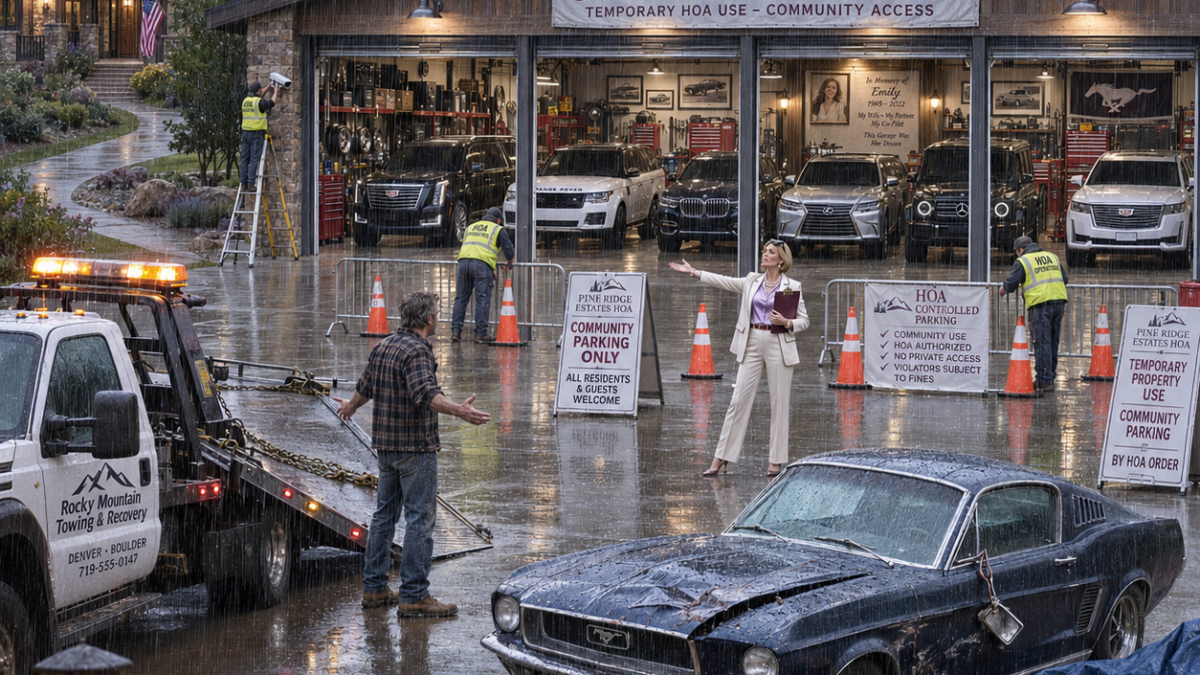
Then I saw the tow truck.
Yellow flatbed.
Diesel idling.
Chains swinging.
My Mustang sat outside.
In the rain.
For several seconds, I couldn’t process it.
Then I saw the passenger mirror.
Broken.
Hanging by wiring.
Dent in the hood.
Scratch across the quarter panel.
Rain running across primer.
Inside the garage:
Vehicles.
Donna’s Escalade.
Phil’s truck.
Four other board members’ SUVs.
Six cars filling the place where Laura and I had worked together.
Donna stood near the entrance holding Starbucks.
She looked at me.
Then smiled.
“See?”
I said nothing.
“Plenty of room when you cooperate.”
I walked past her.
Put my hand on the Mustang hood.
Cold.
Rainwater moved around my fingers.
I remembered Laura sanding that quarter panel.
Fleetwood Mac blasting from a radio on the bench.
Four hours.
She refused help.
“It’s my side.”
The scratch cut across it now.
The tow driver approached.
Young guy.
Maybe twenty-two.
“I’m sorry, sir. I was told it was abandoned.”
“By who?”
“Property manager.”
I turned toward Donna.
The kid continued.
“She showed me HOA documentation.”
I looked back.
“That car is registered.”
“I know now.”
“Insured.”
“Yes.”
“Active restoration.”
He nodded.
“I’m sorry.”
I wasn’t angry at him.
He had been lied to.
“Keep your work order.”
“What?”
“Don’t throw it away.”
He looked confused.
“You may need it.”
He left.
Donna didn’t.
She stepped further into the garage.
“Garrett, if you would just cooperate, none of this would happen.”
I looked at her.
“The car was my wife’s.”
She sighed.
“Here we go.”
My jaw tightened.
“She died before we finished it.”
Donna rolled her eyes.
“Spare me.”
That was the moment.
“You think I care about some dead woman’s rusty junk?”
Everything went quiet.
Rain.
Traffic somewhere.
My heartbeat.
Donna continued.
“The community needs parking.”
I looked at Laura’s Mustang.
Then at Donna.
“Get off my property.”
She tilted her head.
“It’s community space now, sweetheart.”
“No.”
“The board voted.”
“No.”
She shrugged.
Then climbed into her Escalade.
The other board members followed.
Engines started.
Wet tires squeaked across my concrete.
Exhaust filled the garage.
When they were gone, I stood beside the Mustang.
Rain kept falling.
I didn’t move the car inside immediately.
I photographed everything.
Mirror.
Hood.
Quarter panel.
Tow receipt.
Tire marks.
Cardboard the board members had laid on my floor.
Oil stains.
Every angle.
Then I sat on a five-gallon bucket inside the garage.
One hour.
Maybe two.
Laura’s empty work gloves hung from the wall.
I took out my phone.
Called Tom Overstreet.
“I need a lawyer.”
Tom was a property attorney in Littleton.
Quiet.
Precise.
Brown jacket every meeting.
The kind of man who could make silence feel argumentative.
I laid the file on his table.
Violations.
Fake resolution.
Proxies.
County records.
Tow paperwork.
Cindy’s USB.
He read.
Fifteen minutes.
Then removed his glasses.
“This is not an HOA disagreement.”
“What is it?”
“Potential fraud.”
He pointed to Cindy’s files.
“Potential falsification.”
Another page.
“Trespass.”
Another.
“Property damage.”
“What do you need?”
Tom looked at me.
“Money.”
“What?”
“Follow the money.”
That was good advice.
I requested HOA financial records.
Five years.
Eventually, I received hundreds of pages.
Bank statements.
Invoices.
Vendor payments.
Landscaping.
Snow removal.
Maintenance.
Most normal.
Then three wire transfers.
Same recipient.
Total:
$47,000.
Description:
**Parking Infrastructure Consulting**
Recipient:
**Kessler Ridge Development LLC**
I stared at the name.
Kessler.
Phil.
State corporate registry confirmed it.
Phil Kessler, registered agent.
Company formed eighteen months earlier.
Right around the time Donna began pushing shared parking.
I searched county zoning applications.
That was where everything finally clicked.
Phil was trying to build twenty-four townhomes on three vacant parcels south of Ridgeline.
High density.
Tight lots.
Problem:
Parking.
The project needed significant overflow capacity.
The parcels couldn’t provide enough.
Nearby streets were too narrow.
Then there was my garage.
Four bays.
Large floor area.
Twelve feet from a community road.
Exactly inside Donna’s magically invented fifteen-foot rule.
I stared at the development plan.
Then at the HOA resolution.
Then at the $47,000 in payments from homeowners to Phil’s company.
It had never been about block parties.
Never been about community spirit.
Never been about efficient space.
Donna was attempting to convert my private garage into parking capacity that made her husband’s development project more viable.
And homeowners had been paying him to plan it.
I called Tom the next morning.
“I found it.”
“What?”
“The reason.”
I explained.
He became very quiet.
When I finished, I said:
“I don’t want to fight the HOA anymore.”
Tom waited.
“I want Donna gone.”
“Garrett.”
“You know what I mean.”
“I do.”
“What do we have?”
“Enough for a criminal referral.”
That sentence felt heavy.
“Do it.”
Tom began working.
So did I.
My garage doors were old wooden overhead doors.
Easy to open.
Easy to block.
Too easy for Donna to treat like public access.
I replaced them.
Not with booby traps.
Not with anything designed to hurt people.
Commercial steel rolling doors.
Electronic controls.
Proper permits.
Professional installation.
Four bays.
Four secure doors.
The installation crew arrived Monday.
Donna drove past slowly.
Window down.
“What are you building?”
“Upgrading my private garage.”
“A prison?”
“Garage.”
She stared at the steel.
Then drove away.
I added cameras.
Inside.
Outside.
Clear coverage.
Cloud backup.
Then hired a licensed surveyor.
Dale Merrick spent most of a day on the property.
GPS unit.
Transit.
Recorded pins.
Orange caps.
When he finished, there was no ambiguity.
My lot.
My driveway.
My garage.
My property line.
Donna saw the survey markers the next morning.
She marched across the lawn.
“What are those?”
“Survey pins.”
“Remove them.”
“No.”
“They look hostile.”
“They look orange.”
“You’re intimidating residents.”
“They mark a boundary.”
“You cannot just put metal stakes into community land.”
I smiled.
“Exactly.”
She stared.
Then left.
Tom filed complaints and notices.
Attorney General.
District Attorney.
Board-member liability letters.
Proxy affidavits.
Financial irregularities.
Then I called an investigative reporter.
Ellen Bryce.
She covered HOA governance and suburban development.
I told her the story.
She asked one question.
“Documents?”
“Yes.”
“How many?”
“Too many.”
“Send them.”
She agreed to wait before publishing.
Then Wade Tillman offered his living room.
Over two evenings, forty-five homeowners came.
No speeches.
No screaming.
Binders.
Wire transfers.
Proxy forms.
Phil’s development plans.
County records.
Survey.
Cindy’s real minutes.
One by one, homeowners realized they had been financing the attempt to take control of my garage.
Helen Pierce sat in the front.
After Cindy read several altered board minutes aloud, Helen said:
“I spent thirty-five years grading dishonest work.”
She looked toward the documents.
“This gets an F.”
People laughed.
Then the room became quiet again.
Thirty-eight residents signed affidavits.
Seven offered to testify.
The system Donna had controlled through silence was beginning to fail.
I booked a cabin.
Eleven Mile Canyon.
Three nights.
Friday through Sunday.
Laura loved that area.
Clear water.
Pines.
Trout.
She had tied a box of Elk Hair Caddis flies before she got sick.
I had never used them.
It felt like time.
Donna noticed the garage security.
She hated it.
Then someone spray-painted one of the new doors.
**MOVE OR ELSE**
Camera timestamp:
2:14 a.m.
Dark clothes.
Black baseball cap.
Spray can.
The figure finished.
Turned.
Tripped over a survey marker.
Fell face-first into wet grass.
Hat flew off.
Face turned toward the infrared camera.
Phil Kessler.
I watched the footage in the morning.
Once.
Then again.
Sent it to Tom.
Sent it to three storage locations.
Photographed the damage.
Painted over it.
Evidence first.
Always.
Donna held what she called a **Neighborhood Watch Meeting**.
Twelve people attended.
Eight already knew what she was doing.
She stood at the front and described me as unstable.
Reclusive.
Aggressive.
“Fortifying his property against the community.”
Helen raised her hand.
“What exactly are you proposing?”
Donna smiled patiently.
“All options must remain available.”
“Does that include entering Mr. Shelton’s property without permission?”
“If necessary for community safety.”
Helen nodded.
Sat down.
Her phone was recording.
Donna kept giving me evidence.
Every time she felt power slipping, she reached further.
That is what overloaded systems do.
They deform.
Crack.
Fail.
The next board meeting agenda contained one item:
**Emergency authorization for protective action concerning fortified residential structures.**
My garage.
Donna wanted authority to remove or override the steel doors.
The vote passed with twelve in favor.
Eight against.
Eight abstaining.
Nowhere near the threshold for changing private property rights.
Donna called it overwhelming support.
Tom called it:
“More paper for the file.”
Then attorney Brent Shafer sent a threat to place a lien on my house unless I removed the doors.
The statutes he cited barely applied.
Tom responded.
Real law.
Real deed.
Real survey.
Certificate of occupancy.
Property rights.
Abuse-of-process warning.
Brent never responded.
Friday approached.
Ridgeline Summer Block Party.
The HOA always struggled with parking.
Donna had already started telling residents my garage would be available.
I sent one final email.
Donna.
Board members.
Tom.
Ellen Bryce.
I wrote:
**My property remains private property.**
**I do not authorize HOA parking, access, entry, storage, or use of my garage.**
**Any person entering or using the premises without my express permission does so without consent.**
I attached the survey.
Then:
**I will not respond to further notices unsupported by the governing documents or Colorado law.**
Donna read the email at a board gathering.
Cindy recorded it.
Afterward Donna looked around the room and said:
“Well, it appears Mr. Shelton has finally given up.”
People clapped.
Phil whistled.
That part still amazes me.
Silence looks like surrender to people who only understand noise.
Thursday night, I stood in the garage.
Mustang inside.
Mirror replaced.
Hood repaired.
Scratch still visible.
I had deliberately left a few inches of it untouched.
Not forever.
Just then.
Laura’s radio sat on the bench.
Fleetwood Mac.
I pressed the garage controls.
Doors down.
Steel.
Locks.
Then back up.
Everything worked.
I packed my truck.
Cooler.
Waders.
Two rods.
Laura’s flies.
Friday arrived with one of those Colorado skies so blue it almost looks fake.
The block party started around four.
Bounce house.
Barbecue.
DJ.
Children.
Neighbors.
And parking.
I watched from inside the house.
First car entered my driveway.
Then another.
Donna stood beside the garage in a red sundress.
Clipboard.
Waving drivers forward.
“Straight back.”
“Two rows.”
“Tight together.”
I had left the garage open.
Not because I authorized parking.
My written notice said the opposite.
I wanted to see whether Donna would stop.
She didn’t.
By 5:15, thirty-two vehicles filled the garage.
SUVs.
Sedans.
Minivans.
Pickup trucks.
Donna even placed orange traffic cones in my driveway.
She had transformed my property into exactly what I had refused to give her.
Then she walked to the party microphone.
Started her annual speech.
Thanked the board.
Thanked volunteers.
Thanked herself.
I carried my tackle box outside.
Cooler in the other hand.
Two fly rods over my shoulder.
Donna saw me.
Stopped mid-sentence.
She lowered the microphone.
“Finally learned to share, Shelton?”
I walked past.
Put the cooler in the truck.
Tackle box in the passenger side.
Secured the rods.
Then I took out my phone.
Donna watched.
I pressed the garage controls.
The four steel doors began descending.
Mechanical hum.
One.
Two.
Three.
Four.
The party noise faded.
The first door reached the floor.
Then the second.
Third.
Fourth.
Locks engaged.
Silence.
Thirty-two unauthorized vehicles were inside my private garage.
Donna stared.
Someone near the grill said:
“What the hell?”
A child dropped a hot dog.
Donna ran toward me.
“What are you doing?”
I rolled down my window.
“Locking my garage.”
“There are cars inside!”
“I noticed.”
“You can’t!”
“My property.”
“Open those doors right now!”
“No.”
Her face changed.
I looked toward her.
“Always has been, Donna.”
Then I drove away.
Not fast.
Not dramatic.
Just left.
I turned onto Ridgeline Drive.
Then toward the highway.
Behind me, I could see Donna standing in the street.
Clipboard hanging from one hand.
I didn’t look back again.
What happened next came from reports.
Cindy.
Wade.
Deputy Harmon.
Donna grabbed the steel door and pulled.
Nothing.
She kicked it.
Nothing.
Phil called a locksmith.
The locksmith arrived.
Looked at the door.
Looked at the survey marker.
Asked:
“Who owns the garage?”
Donna said:
“The community.”
He asked:
“Who is on the deed?”
No answer.
He refused to open it without my authorization.
Donna called police.
Deputy Craig Harmon arrived.
Walked the property.
Reviewed the survey.
Reviewed the deed copy Cindy had.
Asked whether residents had permission.
Donna claimed the board authorized parking.
Harmon asked:
“Does the board own the structure?”
“No, but—”
“Then that’s not permission from the owner.”
“There are thirty-two cars trapped.”
Harmon reportedly said:
“Then thirty-two people parked on private property without the owner’s consent.”
The block party collapsed.
People called rides.
Spouses.
Friends.
Some walked home.
Donna sat on the curb.
Her own Escalade was inside.
That part felt almost too perfect.
Meanwhile, I was seventy miles away.
Eleven Mile Canyon.
Phone off.
Cold water around my legs.
Laura’s fly tied to the line.
I cast.
Badly at first.
She had always been better.
“Don’t muscle it,” she used to say.
“Let the line do the work.”
I smiled when I remembered.
Second cast.
Better.
Third.
A rainbow trout rose.
Hit.
The rod bent.
For the first time in months, my brain contained no Donna.
No HOA.
No lawyers.
No garage.
Just water.
Line.
Fish.
Pine wind.
I landed the trout.
Held it briefly.
Released it.
Then stood there watching it disappear.
I cried.
Not because of the fish.
Because Laura should have been there.
Grief is like that.
It waits until the world gets quiet.
Saturday morning, while I fished, Tom delivered evidence packages.
Douglas County District Attorney.
Colorado Attorney General.
Reporter Ellen Bryce.
Phil’s financial records.
Fake proxies.
Real minutes.
Spray-paint footage.
Tow records.
Survey.
Donna’s parking directives.
Everything.
Ellen published Saturday afternoon.
The headline spread faster than I expected.
**HOA PRESIDENT USED WIDOWER’S PRIVATE GARAGE AS COMMUNITY PARKING—OWNER LOCKED IT AND WENT FISHING**
By Sunday morning, the story had gone viral.
I didn’t know.
Phone still off.
I fished again.
Sat beside the creek.
Used another one of Laura’s flies.
Then drove home Sunday afternoon.
Ridgeline looked different.
Quiet.
No party decorations.
No music.
No Donna directing traffic.
A line of residents stood from the garage toward the sidewalk.
Thirty-two owners.
Waiting.
I parked.
Got out.
Nobody spoke at first.
Then a woman approached.
“I’m sorry.”
I recognized her Lexus.
Bay three.
“I didn’t know.”
I nodded.
Another man said:
“Donna told us you agreed.”
“She lied.”
“I know now.”
I held up a clipboard.
Not Donna’s.
Tom’s.
Statement:
**I acknowledge that I parked or allowed my vehicle to be parked at 1847 Ridgeline Drive without express consent from Garrett Shelton, the property owner.**
Nothing dramatic.
No humiliation.
No fee.
No ransom.
Just acknowledgment.
I said:
“One at a time. Sign. Then I open the doors.”
Nobody argued.
They signed.
Thirty-one people.
Then Donna.
She reached the front.
Phil behind her.
Sunglasses on despite the cloudy sky.
Her blazer wrinkled.
She looked smaller.
“Sign.”
She stared at the paper.
“I was acting under board authority.”
“Then write that below your signature.”
She looked at me.
Then signed.
Donna Kessler.
Phil signed next.
I opened the app.
Doors rose.
Slowly.
Sunlight filled the garage.
Thirty-two vehicles sat exactly where they had been.
No damage.
No scratches.
No mysterious vandalism.
I had not touched them.
People drove away one by one.
Some waved.
Most looked embarrassed.
Donna was last.
She climbed into the Escalade.
Closed the door.
Then sat there.
For maybe thirty seconds.
I wondered whether she would say something.
She didn’t.
She backed out.
Drove away.
Through the actual street.
Monday morning changed Ridgeline.
Phil was arrested later in connection with the financial investigation and the documented vandalism allegation.
The district attorney opened a wider inquiry.
The Attorney General’s office began reviewing proxy and governance issues.
A professional complaint was filed against Brent over the baseless lien threat.
Then came the emergency HOA meeting.
A real meeting.
Proper notice.
Packed room.
Donna arrived.
No gavel.
No speech prepared.
At least none she got to finish.
Helen moved to remove her as president.
One hundred nineteen votes in favor.
Four against.
The four were members of Donna’s inner circle.
Nine years.
Gone.
Wade stood beside me in the back.
Donna looked around the room after the vote.
I thought she might explode.
Instead, she sat down.
For the first time since I met her, she didn’t know what to say.
Cindy read the motion.
Officially.
Accurately.
Then Donna walked out.
No applause.
That surprised me.
Maybe the neighborhood had finally understood something.
Accountability didn’t need cheering.
It just needed to happen.
The financial investigation grew.
Forty-seven thousand dollars had flowed to Phil’s company.
Investigators examined contracts.
Invoices.
Board approvals.
Conflict disclosures.
Phil’s planned townhouse development stalled.
Without my garage as a pretend source of overflow parking, the economics changed too.
His project had been built around taking something that was not his.
That happens more often than people think.
Not always a garage.
Sometimes labor.
Sometimes time.
Sometimes access.
Sometimes silence.
Donna had mistaken my grief for weakness.
My privacy for surrender.
Laura’s empty workspace for unused capacity.
Those were not the same things.
Tom filed the civil suit.
Trespass.
Property damage.
Improper towing.
Interference with property rights.
Legal expenses.
Additional claims tied to the HOA’s conduct.
It took four months.
Eventually, settlement.
$178,000.
Enough to repair everything.
Pay legal bills.
Restore the Mustang.
And do something I had been thinking about since that first weekend in the canyon.
I didn’t need revenge money.
I needed the garage to mean something again.
So I created the **Laura Shelton Community Workshop**.
Wade thought I had lost my mind.
“You’re opening the garage to the neighborhood?”
“Some of it.”
He stared at me.
“The same garage Donna tried to steal?”
“Yes.”
“That is either incredibly mature or deeply sarcastic.”
“Both.”
Saturday mornings.
Nine o’clock.
Doors open.
Kids from Ridgeline.
Teenagers.
Parents.
Anybody willing to learn and follow the rules.
Oil changes.
Basic wiring.
Brake systems.
Tool safety.
How to read a torque specification.
How to understand why things fail.
No politics.
No HOA.
No Donna.
Just people making things.
The first Saturday, six kids came.
The second, eleven.
By the third month, I needed a sign-up sheet.
One boy named Marcus had never held a wrench.
He stared at a socket set like it was surgical equipment.
“Which one?”
“Measure.”
He guessed.
“Don’t guess.”
He tried again.
I watched him.
Laura would have liked Marcus.
Laura hated guessing too.
One Saturday, Helen brought cookies.
Cindy brought coffee.
Wade sat in the corner telling teenagers plumbing stories nobody asked for.
For the first time since Laura died, the garage felt alive.
Not because I had replaced her.
Nothing does.
But grief had stopped owning every square foot.
Then came the Mustang.
I had postponed finishing it for years.
Because finishing meant Laura would never get the first ride.
As long as the car stayed incomplete, some impossible future remained alive.
One night I finally understood that.
I sat behind the wheel.
No windshield yet.
No interior.
Just the shell.
“Okay,” I whispered.
“We’re finishing it.”
The workshop kids helped.
Not with anything too delicate.
Cleaning.
Organizing parts.
Holding lights.
Learning.
I rebuilt the suspension.
Finished wiring.
Installed interior.
Bodywork.
Paint.
Wimbledon Blue.
Exactly the color Laura chose.
I still had the paint chip.
She had taped it to the sun visor of her daily driver.
I kept it in an envelope after she died.
September morning.
The Mustang was finished.
Wade came.
Cindy.
Helen.
Several workshop kids.
I sat behind the wheel.
Turned the key.
Engine cranked.
Once.
Twice.
Then the V8 caught.
Deep rumble.
Garage walls vibrated.
Somebody cheered.
Wade clapped.
Cindy cried.
I didn’t move.
Hands on the steering wheel.
Laura should have been beside me.
That ache returned.
Then Marcus shouted from outside:
“Mr. Shelton, drive it!”
I laughed through tears.
“Give me a minute.”
I looked at the empty passenger seat.
“You still get the first ride.”
Maybe that sounds stupid.
I don’t care.
I reached across.
Placed one of Laura’s old work gloves on the passenger seat.
Then I backed out.
The neighborhood lined the street.
Not planned.
Word had spread.
People watched.
Some recorded.
I drove slowly.
Past the community center.
Past Donna’s old house.
Around Ridgeline.
Then out toward the foothills.
No destination.
Just road.
The engine sounded beautiful.
When I returned, the workshop kids were waiting.
Marcus ran over.
“How fast?”
“Legal speed.”
“That’s boring.”
“I’m an engineer.”
“Exactly.”
I laughed.
The Mustang became part of the workshop.
Not a museum piece.
A teaching car.
Electrical systems.
Ignition.
Brakes.
Suspension geometry.
Old machines make good teachers because you can see what everything does.
Laura used to say that.
“If you can see the part move, you can understand why it matters.”
The community changed too.
Not magically.
Ridgeline still had complaints.
People still argued about landscaping.
Snow removal.
Dogs.
Parking.
Humans remain humans.
But leadership changed.
Term limits.
Transparent votes.
Recorded meetings.
Conflict disclosures.
Financial oversight.
No more altered minutes.
Cindy became board secretary officially.
This time without Donna dictating what she wrote.
Helen joined the compliance committee under one condition:
“If I see one fine for a whimsical doormat, I resign.”
They promised.
Wade refused any position.
“Retirement means retirement.”
He attended every meeting anyway.
Donna stayed in the neighborhood.
That shocked everyone.
Her house didn’t sell.
Maybe she refused to run.
Maybe nowhere else wanted her.
I saw her occasionally.
Grocery store.
Gas station.
Never spoke.
Phil’s legal situation continued longer.
Some charges changed.
Some allegations were resolved.
Some money was recovered.
I didn’t follow every detail.
Tom did.
At some point, I realized I didn’t care enough anymore.
That was progress.
The garage became the center of my life again.
But differently.
Laura and I had built things there together.
Now I taught other people how.
One Saturday, a girl named Sophie arrived.
Fourteen.
Quiet.
Her father said:
“She likes cars, but nobody in our family knows anything.”
I handed Sophie a multimeter.
She frowned.
“What’s this?”
“Start of your trouble.”
She smiled.
Three hours later, she diagnosed a bad ground on a training board faster than Marcus.
Marcus accused her of cheating.
She replied:
“You’re just slow.”
Laura would have loved her.
A year later, Sophie entered a high-school automotive technology program.
Another student went into mechanical engineering.
One chose welding.
One simply learned to change his mother’s oil without stripping the drain plug.
Not every outcome needs to be dramatic.
The workshop held an annual car show.
Ridgeline Car Day.
No reserved parking in my garage.
That detail was very important.
Cars lined the street legally.
Vintage Chevys.
Muscle cars.
Imports.
Old pickups.
Electric vehicles.
Kids argued about which was better.
Adults argued louder.
The Mustang sat near the entrance.
Beside it, on the wall, hung one object from the old fight.
The plastic sign Donna installed:
**COMMUNITY PARKING — RIDGELINE ESTATES**
Underneath, I added a small plaque:
**PRIVATE PROPERTY. ALWAYS HAS BEEN.**
Wade thought it was hilarious.
Tom called it evidence abuse.
I called it interior decorating.
Five years after Donna’s removal, she walked into the workshop.
Saturday morning.
I was helping Sophie—now nineteen and studying engineering—replace a brake line on her own project car.
The garage doors were open.
Donna stood at the threshold.
Nobody noticed her immediately.
Then Marcus did.
He had grown six inches.
Still came around.
He whispered:
“Uh-oh.”
I looked up.
Donna had changed.
Less polished.
Hair shorter.
Plain jeans.
Jacket.
No clipboard.
That was the first thing I noticed.
“Garrett.”
I wiped my hands.
“Donna.”
The room became too quiet.
Teenagers are terrible at pretending not to listen.
“What do you need?”
She looked around.
At the benches.
Cars.
Kids.
Laura’s photograph.
Then the parking sign.
She almost smiled.
“I deserved that.”
“Yes.”
Direct.
No point pretending.
She nodded.
“My grandson wants to come.”
That surprised me.
“Workshop?”
“Yes.”
“How old?”
“Thirteen.”
“Does he like cars?”
“Apparently more than school.”
“Common condition.”
Donna looked relieved I had made a joke.
“He heard about the Mustang.”
“Most people have.”
“He wants to learn.”
I thought about saying no.
For half a second.
Not to hurt the boy.
To hurt Donna.
That scared me.
Because revenge can linger in small places after the big battle is over.
I looked at Laura’s photograph.
She would have hated that.
Not Donna.
The boy.
Punishing somebody for the family they were born into.
“Have him fill out the safety form.”
Donna blinked.
“That’s it?”
“That’s it.”
“No problem?”
“Not unless he creates one.”
Her face changed.
“Thank you.”
She turned.
Then stopped.
“Garrett?”
“Yeah?”
“I’m sorry.”
Nobody moved.
I waited.
She looked toward the Mustang.
“I shouldn’t have had it moved.”
My jaw tightened.
“No.”
“I knew about Laura.”
That made me angry all over again.
“You knew?”
“Wade told me.”
“Then why did you say what you said?”
Donna stared at the floor.
“Because I wanted to hurt you.”
There it was.
Not misunderstanding.
Not board procedure.
Not community interest.
Cruelty.
I respected the honesty more than I wanted to.
“Why?”
“Because you wouldn’t give me what I wanted.”
She swallowed.
“And I had gotten used to getting what I wanted.”
The workshop remained silent.
I could feel Sophie pretending to inspect the same bolt for thirty seconds.
Donna continued.
“I told myself it was for the neighborhood.”
“It wasn’t.”
“I know.”
“For Phil.”
“Yes.”
“For the townhomes.”
“Yes.”
“And the money.”
She nodded.
“I knew some of it.”
“Some?”
“I didn’t know everything he was doing.”
I didn’t argue.
Five years earlier, I would have.
I had learned not every confession needs cross-examination.
Donna looked at Laura’s photo.
“She looks happy.”
“She was.”
“I’m sorry.”
This time she meant more than the Mustang.
“Thank you.”
She left.
The workshop remained silent another second.
Then Marcus said:
“Wow.”
Everybody laughed.
Tension broke.
Sophie looked at me.
“You okay?”
“Yeah.”
“You sure?”
“No.”
She nodded.
“Fair.”
Donna’s grandson came the following Saturday.
Caleb.
Thirteen.
Skinny.
Nervous.
He had no idea how much history walked in with him.
I gave him safety glasses.
Showed him tools.
His first task:
Remove a wheel.
He struggled with the lug nuts.
I told him:
“Use leverage.”
He pushed harder.
“It’s not moving.”
“Longer handle.”
He tried.
The nut loosened.
His face lit up.
“Physics.”
“Mostly.”
Donna picked him up three hours later.
She waited outside.
Did not enter the garage.
Interesting.
Caleb ran to her.
“Grandma, I used a torque wrench.”
Donna looked at me.
I nodded.
She smiled.
That became normal.
Caleb came most Saturdays.
He was good.
Patient.
Eventually he learned welding.
Not on structural work.
Practice plates.
He burned holes through the first three.
Then improved.
One afternoon he asked:
“My grandma really used to park cars in here?”
Marcus nearly fell off a stool laughing.
I said:
“Yes.”
“Why?”
“Long story.”
“She says she was stupid.”
I paused.
“That’s shorter.”
Caleb laughed.
Maybe that was enough.
The garage became something Donna originally claimed she wanted.
Community space.
But there was one critical difference.
I chose it.
Permission changed everything.
Ownership didn’t prevent generosity.
It made real generosity possible.
That became the lesson I told students.
“If somebody takes your tools without asking, that’s theft.”
“If you lend them, that’s generosity.”
“Same tool.”
“Same person.”
“Different consent.”
That applies to garages too.
Years later, the workshop became a nonprofit.
Laura Shelton Community Workshop Foundation.
Local businesses donated tools.
A community college partnered with us.
We created scholarships for technical education.
The Mustang appeared in fundraising photos.
I hated that.
Wade loved it.
“You’re becoming respectable.”
“Disgusting.”
Cindy became foundation treasurer.
Nobody trusted anybody else with minutes after Donna.
Every meeting was recorded.
Every vote published.
Every dollar posted.
Sometimes bad governance teaches good governance better than any seminar.
I kept one rule:
The garage remained mine.
The nonprofit used it by written agreement.
Tom insisted.
“You’ve learned nothing if you make the same mistake in reverse.”
He was right.
Document generosity too.
Laura would have laughed.
“Only you would need a contract to be kind.”
Maybe.
But contracts prevent kindness from becoming entitlement.
The Mustang finally took its first long trip ten years after Laura’s death.
I drove from Ridgeline to Pueblo.
Same town where we found it.
Same barn auction property had changed owners.
The barn was gone.
Housing development in its place.
Of course.
I parked nearby.
Sat with the engine off.
Laura’s glove still traveled in the passenger-side storage pocket.
Not visible.
Just there.
I thought about her sitting in the rusted shell.
**When it’s done, I want the first ride.**
I had spent years believing finishing the car meant betraying that promise.
Now I understood something different.
The promise was never really about her being physically in the seat.
It was about us finishing something beautiful.
We did.
It just took longer than either of us planned.
On the drive back, I stopped at a turnout.
Mountains in the distance.
I talked to her.
Out loud.
“Garage is full again.”
Wind.
“Kids.”
Nothing.
“Donna’s grandson too.”
I laughed.
“You’d like that.”
Then I cried for a while.
Grief doesn’t disappear.
It changes shape.
At first, it is a locked room.
Later, maybe, a door you can open without being destroyed by what’s inside.
The garage had become that for me.
Once a shrine.
Then battlefield.
Then classroom.
Then community.
But mine.
Always mine.
Donna eventually moved out of Ridgeline.
Not dramatically.
No foreclosure.
No police escort.
She downsized after Phil’s business collapsed.
The new house was somewhere near Parker.
Before she moved, she left an envelope on my porch.
No HOA logo.
No gold lettering.
Inside:
A handwritten note.
**Garrett,**
**I spent years believing authority meant I was entitled to whatever I could get people to approve. I understand now that a vote cannot give away something the voters never owned.**
**I am sorry about Laura’s car. More than anything else, I am sorry for what I said about her.**
**Caleb talks about the workshop constantly. Thank you for giving him something better to learn from than I did.**
**Donna**
I sat on the porch.
Read it twice.
Then went into the garage.
Pinned it inside a cabinet.
Not on the wall.
Some things belong in private.
Caleb kept coming even after Donna moved.
His mother drove him.
At sixteen, he rebuilt his first engine.
At eighteen, he received one of our technical scholarships.
Automotive engineering.
The irony became less funny with time.
It became meaningful.
A boy connected to the woman who tried to take my garage used that garage to build his future.
That was better than punishment.
When Caleb graduated, Donna attended.
She stood in the back.
I went to her.
“You came.”
“Of course.”
“He’s good.”
“I know.”
She looked toward him.
“Better than us.”
“Most kids are.”
She smiled.
Then:
“You know, I used to hate those doors.”
“The steel ones?”
“Yes.”
“I remember.”
“I thought they represented you shutting the neighborhood out.”
I looked at the workshop.
Kids.
Families.
Cars.
Open bays.
“And now?”
“They represented you deciding who gets in.”
I nodded.
Finally.
“That’s the difference.”
Years after the original dispute, one of the industrial doors needed replacement.
Wear.
Thousands of cycles.
The installer asked:
“You want the same style?”
I looked at the old steel.
Scratches.
Dents.
Years.
The faint outline of Phil’s old spray paint remained underneath newer coatings.
“Yes.”
“Same electronic system?”
“Updated.”
“Why keep industrial doors on a community workshop?”
I smiled.
“History.”
He didn’t ask.
The old door panel was cut into sections.
One section now hangs inside the workshop.
You can still see a faint red line where **MOVE OR ELSE** had once been painted.
Below it:
**STRENGTH ISN’T KEEPING EVERYONE OUT.
IT’S KNOWING WHO HAS THE RIGHT TO OPEN THE DOOR.**
Sophie wrote that.
She became a structural engineer.
I pretended not to be proud.
She once asked why I stayed in Ridgeline after everything.
I thought about it.
“Laura chose this house.”
“That’s the only reason?”
“No.”
“What else?”
“Leaving would’ve made Donna part of the decision.”
Sophie nodded.
“That’s stubborn.”
“Engineering.”
“Same thing.”
Probably.
Wade died at seventy-four.
Heart attack.
I was with his family at the service.
He had been the first neighbor to warn me.
The first person who believed Donna could be challenged.
His daughter gave me his old pipe wrench.
“He wanted you to have it.”
“Why?”
“She said you were the only engineer he trusted.”
That was probably an insult.
I hung it near Laura’s tools.
The workshop carries people now.
Laura.
Wade.
Cindy.
Kids.
Even Donna, in a strange way.
Not because she deserves credit.
Because conflict leaves marks.
What matters is what you build after.
Cindy once asked me:
“Do you regret locking the cars in?”
I thought.
“No.”
“Would you do it again?”
Longer pause.
“Probably not exactly that way.”
She laughed.
“Age?”
“Lawyers.”
“Tom got to you.”
“Eventually.”
Then I said:
“But I don’t regret drawing the line.”
That is the part that matters.
People focus on thirty-two cars locked in a garage.
Funny story.
Good headline.
But the real moment happened months earlier.
Donna said:
“When you live in a community, your things become everyone’s things.”
That sentence was the foundation of everything wrong.
Community is not shared ownership of whatever one powerful person wants.
Community is voluntary responsibility.
Respect.
Permission.
Reciprocity.
You don’t become generous by letting someone steal from you.
You become generous by having something that is truly yours and choosing to share it.
Donna never understood that until she lost authority.
I didn’t fully understand it until I regained mine.
On the twentieth anniversary of Laura’s death, the workshop held a small gathering.
Not memorial.
I hate memorial events.
Too formal.
We called it **Laura Day**.
Cars.
Music.
Food.
No speeches planned.
Of course people made me speak.
The Mustang sat behind me.
Wimbledon Blue shining.
Caleb was there.
Sophie.
Marcus.
Cindy.
Tom.
Helen.
Dozens of former students.
Some arrived with their own children.
I stood near the workbench Laura first touched when we bought the house.
I said:
“Laura once stood right here and told me this was where we were going to build something beautiful.”
I stopped.
The room was quiet.
“For years, I thought she meant cars.”
A few people smiled.
“She did.”
Laughter.
“But not only cars.”
I looked around.
“She believed broken things weren’t worthless.”
My voice tightened.
“She believed if you understood how something was built, you could usually figure out how to repair it.”
I looked at the Mustang.
“The car was one broken thing.”
Then the room.
“So was I.”
Silence.
“And for a while, this neighborhood was too.”
Cindy wiped her face.
I continued.
“People think the workshop exists because I won a fight.”
“No.”
“It exists because after the fight, I had to decide what I wanted to protect.”
I touched the bench.
“I realized I didn’t want to protect an empty garage.”
“I wanted to protect what happened inside it.”
Learning.
Patience.
Work.
Music.
Arguments.
Grease.
Laughter.
Laura.
I finished:
“Doors are useful because they can close.”
Pause.
“But they matter because they can open.”
Nobody laughed.
Good.
I was afraid it sounded cheesy.
Then Caleb started clapping.
Everybody followed.
Later that night, after everyone left, I sat in the Mustang.
Garage quiet.
The community parking sign still hung on the wall.
Laura’s photograph beneath it.
I looked at her face.
“You were right.”
Of course she didn’t answer.
“You said we’d build something beautiful.”
I looked around.
Tools.
Benches.
Training boards.
Student projects.
Old door section.
Wade’s pipe wrench.
Scholarship certificates.
Then the Mustang.
“I just didn’t know what.”
I started the engine.
The V8 filled the garage.
Then I shut it off.
Silence returned.
Peaceful.
Not empty.
That distinction took me years to understand.
The next morning was Saturday.
Nine o’clock.
I opened all four steel doors.
One after another.
Sunlight poured across the concrete.
Kids arrived.
Parents.
Cars.
Caleb came with his daughter.
She was nine.
“Mr. Shelton?”
“Garrett.”
“My dad says you know everything about cars.”
“Your dad lies.”
Caleb laughed.
She pointed toward the Mustang.
“Can I sit in it?”
I looked at Caleb.
He smiled.
“Up to you.”
I looked at the girl.
“Clean hands?”
She held them up.
“Mostly.”
“Good enough.”
She climbed into the driver’s seat.
Grabbed the steering wheel.
Her eyes widened.
“What year?”
“1967.”
“Is it fast?”
“Depends who’s asking.”
She grinned.
Then:
“Who picked the color?”
I looked at Laura’s photograph.
“My wife.”
“Where is she?”
Children ask direct questions adults avoid.
“She died a long time ago.”
The girl looked back at the car.
“Oh.”
Then quietly:
“She picked a good color.”
I smiled.
“Yeah.”
“She did.”
That afternoon, when the workshop closed, I stood outside.
Garage doors open.
No traffic cones.
No unauthorized SUVs.
No clipboard.
No Donna.
Just my property.
Shared because I chose to share it.
That was the part the headlines never understood.
I didn’t win when the steel doors closed.
I won when I could open them again without feeling like something was being taken from me.
Donna thought locking the garage made me selfish.
Later, people online said locking the cars was revenge.
Maybe it was partly.
I was angry.
I wanted Donna to feel what it meant to lose control.
I’m not going to pretend otherwise.
But revenge wasn’t the ending.
The ending was permission.
The ending was the Mustang finished.
The ending was Caleb learning to weld.
Sophie becoming an engineer.
Thirty-two embarrassed neighbors becoming people who finally understood the difference between an HOA vote and ownership.
The ending was a garage full of kids instead of a garage full of strangers’ cars.
Laura once told me structures reveal what they’re carrying.
Too much load.
Wrong load.
Unbalanced load.
Eventually something gives.
Donna’s system carried too much ego.
Too many lies.
Too many fake votes.
Too much money flowing where it shouldn’t.
Too many people afraid to say no.
By the time she reached my garage, the system was already cracking.
I didn’t destroy it.
I stopped holding it up.
That was enough.
These days, the garage doors still close every night.
Four steel doors.
Red indicators.
Locks.
The same deep mechanical sound.
But every Saturday morning, they rise.
Green lights.
Sunlight.
Students.
Noise.
And whenever the first door opens, I still think about the evening Laura stood in that empty garage before we owned a single restoration project.
She touched the workbench.
Smiled at me.
And said:
“This is where we’re going to build something beautiful.”
It took me more than twenty years to understand what she meant.
The beautiful thing was never only the Mustang.
It was having a place that belonged to us.
A place where broken things could be repaired.
A place that eventually taught me that grief could be repaired too.
Not erased.
Repaired.
Scarred.
Still functional.
Still worth something.
Donna tried to turn that place into forty parking spaces for her husband’s profit.
She failed.
The garage remained mine.
Then, when I was finally ready, I gave part of it back to the neighborhood on my own terms.
That is the difference between being robbed and being generous.
One begins with entitlement.
The other begins with consent.
The Mustang sits in bay one now.
Wimbledon Blue.
Laura’s glove inside.
Community parking sign above the bench.
And beneath that sign, the sentence I wrote years ago is still there:
**PRIVATE PROPERTY. ALWAYS HAS BEEN.**
I’ve thought about adding another line.
Maybe someday I will.
Something Laura might have liked.
Maybe:
**PRIVATE DOESN’T MEAN CLOSED.
IT MEANS THE OWNER GETS TO OPEN THE DOOR.**
Until then, the original line is enough.
Because Donna spent nine years believing power meant she could decide what belonged to whom.
It took one garage, thirty-two cars, a stack of real documents, and a neighborhood finally willing to speak up to prove her wrong.
The steel doors only locked her out for a weekend.
The truth locked her out for good.