PART 2: HOA Turned My Family Quarry Into Their Toxic Landfill — I Took Nearly $7 Million and Forced Their Board Out
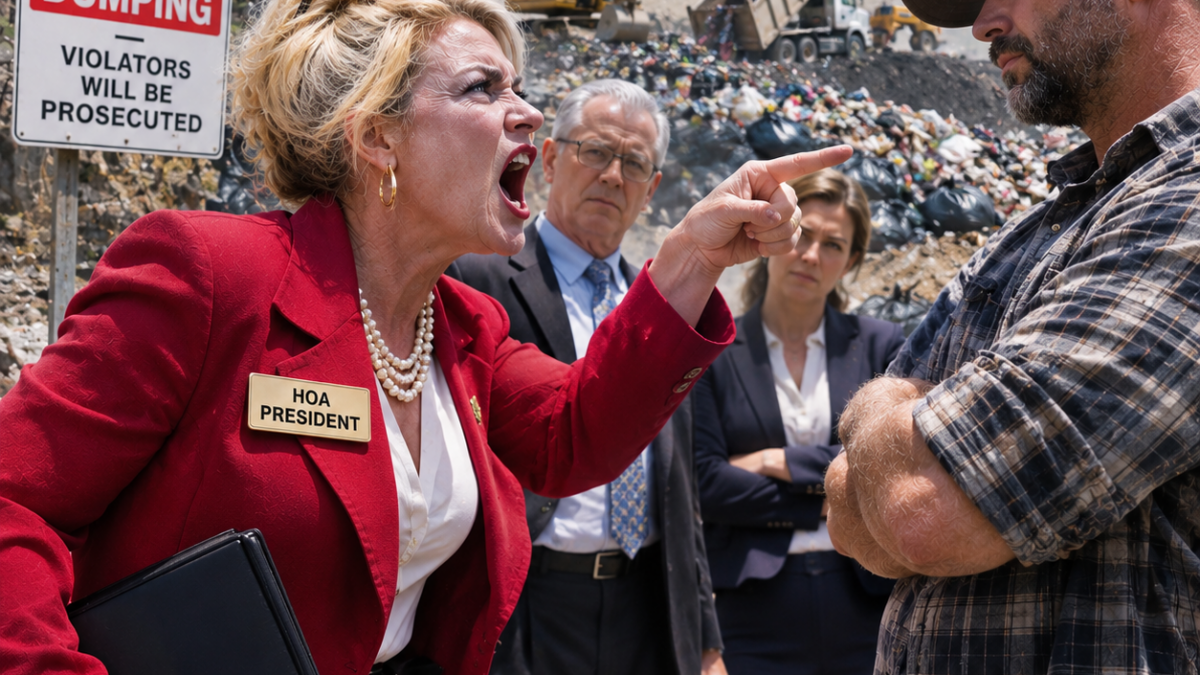
PART 2
## THE FIRST REPORT
The county environmental officer’s name was Gerald.
He arrived three days after I called.
Tired eyes.
Mud-covered boots.
Clipboard.
He walked the lower terrace, photographed everything, took samples, and made notes.
“Any idea who did it?”
“Not yet.”
“Access from the highway?”
“Possible.”
“But?”
I pointed toward the service road behind Ridgecrest Estates.
“Easier from there.”
Gerald looked.
“Could be.”
He collected pieces of pipe insulation and old flooring.
“Some of this may need lab testing.”
“For what?”
“Asbestos. Lead. Depends on age.”
I looked at the pile again.
That changed the situation.
Garbage was one thing.
Hazardous waste was another.
Gerald promised an investigation.
He sounded like a man who had promised investigations many times.
I wasn’t going to rely on promises.
So I drove directly to Ridgecrest.
Constance sat inside the HOA office.
Her desk looked like a surgical theater.
Folders aligned.
Pens aligned.
Calendar color-coded.
I showed her photographs.
She studied them.
Then looked at me.
“That’s terrible.”
“Some of the tire tracks lead toward your service corridor.”
She gave me a sympathetic smile.
“Daryl, lots of contractors use those roads.”
“Your clubhouse is being renovated.”
“Yes.”
“Lots of demolition waste?”
“Some.”
“Interesting.”
Her expression changed by half a degree.
Then she leaned back.
“You know, if the quarry were maintained more responsibly, it might not attract illegal dumping.”
I stared at her.
“Someone cuts my fence and dumps construction waste on my land, and your suggestion is that my land invited it?”
“I’m suggesting appearances matter.”
“Whose contractor is doing the clubhouse?”
She smiled again.
“Licensed professionals.”
I left.
In my truck, I opened my phone.
Typed:
**DOCUMENT EVERYTHING.**
That sentence became the foundation of the next year of my life.
## SIX CAMERAS
I bought six trail cameras.
Not because I wanted to play detective.
Because I wanted license plates.
Faces.
Times.
Dates.
I mounted them high enough to avoid easy discovery.
One covered the eastern road.
One the lower terrace.
One the gate.
Three covered alternate approaches.
Cloud backup.
Second backup.
Then I called my cousin Bev.
Bev worked as a paralegal in Springfield.
“Need a favor.”
“That sentence always costs me time.”
“Pull Ridgecrest Estates.”
“What exactly?”
“Everything public.”
Articles of incorporation.
CC&Rs.
Minutes.
Secretary of State filings.
Vendor disclosures.
Board rosters.
She whistled.
“What are you looking for?”
“I’ll know when I see it.”
Two weeks later, the camera found it first.
11:47 p.m.
White pickup.
Dump trailer.
Missouri plates.
The driver backed through the cut fence.
Raised the trailer.
Construction debris slid out.
Drywall.
Tile.
Metal.
The truck belonged to Ridgecrest Property Services LLC.
I knew the name.
It was in the HOA vendor directory.
I watched the footage twice.
Then a third time.
The strange thing was, I wasn’t furious.
I felt calm.
When something moves from suspicion to proof, anger becomes less useful.
I saved the video.
Backed it up.
Printed still frames.
And waited.
## THE LETTER THAT MADE ME LAUGH
About a month later, a certified letter arrived.
Ridgecrest Estates HOA.
Signed by Constance.
Co-signed by Todd Bleeker and Shirley Dunmore.
The board had voted to support a petition asking Carthage County to reclassify my quarry as an inert construction-waste disposal site.
I read it twice.
Then laughed.
They had been dumping illegally.
Now they wanted the county to legalize the dump after the fact.
At no cost to them.
On my property.
I called Bev.
She sent me to Augusta Crane.
Property-rights attorney.
Mid-fifties.
Short gray hair.
Voice so calm it made everyone else sound emotional.
She read the letter.
Then the camera stills.
Then the HOA minutes.
“They dumped on your property?”
“Yes.”
“Using their contractor?”
“Yes.”
“And now they want the county to classify your property as their disposal facility?”
“Yes.”
She took off her glasses.
“That is genuinely impressive.”
“You admire her?”
“No.”
She tapped the letter.
“I admire nerve the way I admire a tornado.”
Fair.
## THE $14,000 LINE ITEM
Augusta asked me to read three years of HOA minutes.
Not skim.
Read.
At eleven that night, I found it.
Budget amendment.
**Ridgecrest Property Services LLC — Debris Removal / Site Clearing — $14,000.**
I compared dates.
Same period as the clubhouse renovation.
Same contractor whose truck my camera captured.
Homeowner dues had paid a contractor.
That contractor had dumped the waste on my land.
I called Augusta the next morning.
“Found something.”
She listened.
Then said:
“Now we need the invoice.”
“What happens if the invoice names my property?”
“Then your case gets much uglier for them.”
It eventually did.
## CONSTANCE GETS THERE FIRST
My formal objection to the county reclassification was scheduled for a Tuesday.
I arrived five minutes early.
Constance’s Lexus was already outside.
Inside, the receptionist told me the preliminary discussion had been moved forward two days.
The change had been posted online at six that morning.
Constance and Todd were already meeting with commissioners.
I stood at the counter holding forty pages of documentation.
“You changed the meeting?”
“Preliminary discussion only.”
“Was the landowner notified?”
She looked uncomfortable.
“I don’t handle notices.”
I filed my objection anyway.
Walking out, I saw Constance through the conference-room glass.
She looked at me.
No smile.
That was the first time I realized she might actually be worried.
## THE FACEBOOK STORY
That evening, screenshots arrived from someone inside Ridgecrest’s private Facebook group.
A page calling itself Carthage County Concerned Citizens claimed:
I operated an illegal quarry.
I owed back taxes.
I threatened neighbors.
None of it was true.
I wanted to reply.
I wrote three paragraphs.
Deleted them.
Sent screenshots to Augusta.
Subject line:
**Defamation file.**
She responded:
**Good. Don’t engage.**
I hated how often lawyers were right about silence.
## THE LAB RESULTS
Gerald called Thursday.
“Daryl, we got the samples.”
His voice had changed.
“What’s in it?”
“Chrysotile asbestos in some material.”
My stomach dropped.
“And lead-paint compounds.”
I looked toward the quarry.
Rain had fallen twice since the dumping.
“Runoff?”
“Possible.”
I closed my eyes.
That was the point when the whole thing stopped being about property disrespect.
It became contamination.
Augusta moved quickly.
Environmental complaint.
Civil complaint.
Trespass.
Property damage.
Improper disposal.
Nuisance.
Loss of use.
Loss of value.
And claims against the parties we believed responsible.
The HOA’s lawyer countered that my quarry was a dangerous, blighted attractive nuisance.
Augusta read their filing.
Then smiled.
“You know what they just did?”
“What?”
“They basically admitted the dumping occurred while arguing your property somehow encouraged it.”
“Does that help us?”
“A lot.”
## THE FINANCIAL RECORDS
We subpoenaed Ridgecrest Property Services.
And the HOA.
Their lawyer asked for more time.
Then more.
That told Augusta something.
“They don’t want us looking at the accounting.”
Eleven days late, the records arrived.
We found the $14,000 invoice.
Service description:
**Debris removal / disposal.**
Address:
**Voss Road adjacent parcel.**
My property.
I remember staring at those words.
No ambiguity.
No mysterious fly dumper.
No misunderstanding.
Their contractor billed the HOA for dumping debris on land the HOA did not own.
The invoice had been approved by board vote.
Constance.
Todd.
Shirley.
Augusta leaned back.
“They documented their own misconduct.”
“I’m noticing that’s a theme.”
## THE PROPERTY VALUE
I hired a certified appraiser named Marcus Webb.
Not to value the quarry as contaminated land.
To value the highest-and-best-use opportunity I had lost.
The public recreation project Constance had helped block years earlier.
Dock.
Swimming area.
Event space.
Natural preserve.
His preliminary valuation put recreational development rights at around $4.2 million.
Then add remediation.
Loss of use.
Diminished value.
Legal fees.
Harassment.
Business interference.
Augusta looked at the numbers.
“We could be approaching seven million.”
I stared at her.
“Seven?”
“Potentially.”
Money had never been the reason I started.
But I would be lying if I said that number did not get my attention.
Then Bev found the clause.
## ARTICLE 7, SECTION 4
HOA Articles of Incorporation are terrible reading.
That’s why people miss important things inside them.
Bev did not miss things.
She called Saturday morning.
“I found something weird.”
“Good weird?”
“For you.”
Article 7.
Section 4.
In plain English:
If the association or its agents damaged or encroached on adjacent private property, indemnification obligations could extend to remediation, consequential damages, and attorney fees.
And if board members engaged in willful misconduct?
Potential personal exposure.
I read it to Augusta.
She went quiet.
“How old is this?”
“Original incorporation.”
“Who drafted it?”
“No idea.”
“Constance ever read it?”
“I’m guessing not.”
Suddenly Constance, Todd, and Shirley were no longer people hiding comfortably behind an association.
If the evidence supported willful misconduct, their personal positions could become very uncomfortable.
The camera footage mattered.
The invoice mattered.
The reclassification campaign mattered.
Together?
They told a story.
## THE HOMEOWNERS WERE VICTIMS TOO
This part mattered.
There were 240 families in Ridgecrest Estates.
Most knew nothing.
They paid dues.
Used the pool.
Complained about landscaping.
Went to cookouts.
Their money funded the contractor.
That did not make them responsible.
It made them victims too.
The first homeowner who contacted me was Phyllis Monroe.
Retired school principal.
Moved from Kansas City to be near her grandchildren.
She sat at my kitchen table and looked at the invoice.
“We paid for this?”
“Looks that way.”
She looked sick.
“I voted for Constance.”
“That doesn’t make this your fault.”
“I defended her.”
“Still doesn’t make it your fault.”
“What can homeowners do?”
That question changed everything.
## SIXTY-ONE SIGNATURES
Phyllis started quietly.
No Facebook drama.
No shouting.
She spoke to neighbors.
Showed records.
Asked questions.
Within six weeks, sixty-one households signed a petition demanding a special meeting to review board conduct and consider recall.
More than enough under Ridgecrest’s governing structure.
Constance found out.
Then she did what people like her always do when transparency becomes dangerous.
She punished the people asking for it.
## RETALIATION
Violation notices began.
Driveways.
Mailbox colors.
Vegetation.
Basketball hoops.
Work vans.
One family received a notice over a basketball goal that had stood untouched for six years.
Another over a contractor van parked in their own driveway.
Every household on the recall petition suddenly seemed to have developed a “community standards” problem.
Two withdrew signatures.
Fifty-nine stayed.
Phyllis called me.
“She’s trying to scare them.”
“I know.”
“What do we do?”
“Save every letter.”
Augusta collected them.
One by one.
Constance was helping again.
## THE LIS PENDENS
As part of the litigation strategy, Augusta recorded notices related to the pending property claims where legally appropriate.
Constance had listed her home for sale.
$485,000.
The litigation cloud killed the transaction.
The buyer walked.
Constance called it harassment.
Augusta called it notice.
I called it the first time Constance personally felt what uncertainty could do to a property owner.
I did not celebrate.
But I noticed.
## ATTEMPTED INFLUENCE
County Commissioner Walt called.
He had known my father.
“Daryl, you need to know something.”
“What?”
“Constance came to see me.”
He said she had proposed that the HOA fund a new picnic pavilion for the county fairgrounds if commissioners would table environmental action.
Approximate value:
$35,000.
Walt refused.
Documented the conversation.
I told Augusta.
She took notes.
“How many times is she going to make the case better?”
“I’m afraid to answer.”
## MY BUSINESS
Then someone called one of my remaining aggregate customers.
Anonymous.
Claimed I was the target of a federal environmental investigation.
Suggested continued business with me could create reputational risk.
Dennis, the paving-company project manager, called.
“Daryl, I don’t believe it, but I have to ask.”
“You should.”
I sent him documentation showing I was the complainant and affected property owner.
Contract remained.
But I understood the message.
Constance wasn’t just protecting herself anymore.
She wanted to damage anything around me.
That made the conflict personal again.
I thought about Dad.
Grandpa.
The old quarry.
Then I called Augusta.
“Add it.”
She did.
## DR. SOLANO
Dr. Patricia Solano was an environmental engineer from Springfield.
She spent four days at the quarry.
Sampling grids.
Groundwater.
Air.
Soil.
Photography.
Terrain mapping.
Her final report was sixty-eight pages.
The photographs were devastating.
Asbestos-containing debris.
Lead residues.
Runoff paths.
Contaminated lower terrace.
Potential migration toward the quarry pond.
Approximately fourteen thousand square feet affected.
Cleanup estimate:
Between $280,000 and $420,000 depending on method.
Then came the worst finding.
Some runoff had reached the groundwater connection serving the quarry basin.
Potentially connected to nearby groundwater.
Including water beneath Ridgecrest.
I sat with that for a while.
Constance had spent years talking about protecting property values.
Her own dumping operation may have threatened the resource beneath the very neighborhood she claimed to protect.
## THE VIEWING PLATFORM
My friend Garrett built a viewing platform at the upper rim.
Safe railing.
Wide deck.
Clear view.
From there, you could see everything.
Turquoise pond above.
Contaminated lower terrace below.
Gray debris.
Brown runoff channels.
Trash piles against limestone.
You didn’t need a lawyer to understand.
That mattered.
Evidence should not only persuade judges.
Sometimes it should let ordinary people see what happened with their own eyes.
## MIDNIGHT
February.
12:23 a.m.
My phone buzzed.
Camera four.
Headlights.
No high beams.
White pickup.
Same contractor.
Trailer.
My pulse jumped.
I called Hank Dressel.
Retired deputy.
Neighbor.
He answered instantly.
“On my way.”
I did not confront the driver.
Augusta had drilled that into me.
Observe.
Record.
Call authorities.
Do not become part of the incident.
I watched from my porch.
The pickup moved down the access road.
Backed toward the contaminated area.
Trailer positioned.
The driver started unloading.
Then Hank arrived with active sheriff’s units.
Floodlights triggered.
The driver froze.
Shovel in hand.
Deputies moved in.
He was arrested.
Inside the truck:
A printed work order.
Authorization digitally linked to Todd Bleeker.
The timing was eleven days before a major hearing.
The location was an active evidence site.
Augusta called me at 1:30 in the morning.
“This is bad.”
“For us?”
“For them.”
## TODD’S MISTAKE
Attempting to alter or contaminate evidence during active litigation is not something lawyers enjoy explaining.
Todd retained criminal counsel by noon.
Shirley resigned the following day.
Her letter cited health concerns.
Through her attorney, she signaled willingness to cooperate.
Constance said nothing.
For the first time since I met her, silence seemed to have found her.
## THE COUNTY BACKS OFF
Commissioners withdrew the quarry-reclassification proposal.
Unanimously.
Nobody wanted to explain why private contaminated land should become an HOA landfill anymore.
Phyllis’s recall petition grew.
Seventy-eight households.
Then more.
The special meeting was set for Saturday in March.
Location:
The Ridgecrest community center.
The same renovation project that had generated the waste.
You could not invent better irony.
## THE NIGHT BEFORE
I barely slept.
Not from fear.
From memory.
I walked to the quarry at midnight.
Cold air.
Stars.
No trucks.
No engines.
No dumping.
The pond reflected moonlight.
I remembered Grandpa teaching me how limestone sounded different depending on fractures.
Dad explaining machinery.
Me as a kid throwing rocks into the water.
Then I looked at the contaminated terrace.
For months, I had thought about seven million dollars.
Court.
Constance.
Winning.
That night, all I wanted was the land clean.
Money is abstract until something you love smells like asbestos dust and wet drywall.
I promised Grandpa silently:
“We’re fixing it.”
## THE SPECIAL MEETING
194 households present or represented by proxy.
Standing room only.
Coffee.
Travel mugs.
Angry faces.
Reporters.
Dr. Solano.
Augusta.
An EPA representative observing.
Constance sat alone at the board table.
Todd absent.
Shirley gone.
Her blazer looked perfect.
Her posture too.
But she looked like someone sitting inside a building she no longer owned emotionally.
The property manager opened the meeting.
Two agenda items.
Board conduct.
Recall.
I asked to speak.
Seven minutes.
No shouting.
No dramatic accusations.
I explained:
My property.
The dumping.
The contractor.
The invoice.
The contamination.
The litigation.
Then I said:
“If anyone wants to see what was done with your HOA dues, come to my property this afternoon.”
I sat.
## PHYLLIS
Homeowners spoke.
One after another.
The man with the basketball hoop.
A woman cited over mailbox paint.
A family whose driveway had suddenly become unacceptable after signing the petition.
Then Phyllis.
She walked to the microphone.
No notes.
“As a principal,” she said, “I learned that rules mean nothing when the person enforcing them exempts herself.”
Silence.
“We were told this board protected property values.”
She looked at Constance.
“Instead, our money was used to damage someone else’s property.”
Constance stared straight ahead.
Phyllis continued.
“We were told questions created division.”
Her voice stayed calm.
“No. Secrecy created division.”
I watched reporters writing.
Then she said the line everyone remembered.
“You cannot call yourself a good neighbor while paying someone to dump your trash over the fence.”
She sat.
The room erupted.
## CONSTANCE SPEAKS
She spoke once.
“The board acted in good faith.”
Murmurs.
“Litigation remains unresolved.”
More murmurs.
“I cannot discuss pending matters.”
A homeowner shouted:
“Can you discuss the invoice?”
The property manager called for order.
Constance’s face hardened.
That was the last time I saw the old version of her.
The woman who believed the room belonged to her.
## THE RECALL
Paper vote.
Counted publicly.
161 for removal.
22 against.
11 abstentions.
The numbers were read.
Constance remained still.
Then she closed her notepad.
Stood.
Walked out.
No screaming.
No meltdown.
No threat.
No Hollywood ending.
Just a woman passing through neighbors who finally knew too much to be intimidated.
The door closed.
That was enough.
## THE QUARRY TOUR
Sixty residents came that afternoon.
Cars lined the road.
Families walked to the viewing platform.
Then they looked down.
Nobody talked for the first minute.
The debris field was worse in person.
One older man stood at the railing.
Gray beard.
Work jacket.
Hands like my father’s.
He eventually turned.
“I’m sorry.”
“You didn’t dump it.”
“We paid for it.”
“You didn’t know.”
He looked down.
“We should have.”
That answer mattered.
Not because homeowners were guilty.
Because accountability begins when people stop saying:
I didn’t know.
And start asking:
Why didn’t I know?
## THE SETTLEMENT CALL
Three weeks later, Augusta called.
“You sitting?”
“No.”
“Sit.”
I did.
Negotiated settlement.
HOA insurer.
Responsible parties.
Constance’s side.
Todd’s side.
Full remediation.
Loss of use.
Diminished value.
Legal fees.
Business-interference damages.
Other claims.
Total:
$6.87 million.
I did not speak.
Augusta said:
“Daryl?”
“I’m here.”
“Say something.”
“That’s a lot of gravel.”
She laughed.
I didn’t.
Not yet.
When the wire confirmation hit my account on a Thursday afternoon, I was eating lunch at my kitchen table.
I looked at the number.
Then out the window.
The quarry still looked poisoned.
Seven million dollars does not instantly heal land.
That was when I understood the money was not the ending.
Cleanup was.
## SEVEN MONTHS
Remediation took seven months.
Protective suits.
Licensed crews.
Containment.
Removal.
Soil treatment.
Groundwater testing.
Repeat testing.
More removal.
More testing.
Dr. Solano oversaw everything.
The first clean groundwater result made me happier than the settlement wire.
The second confirmed it.
The third made me trust it.
When the final contaminated material left, I stood beside the access road watching the truck drive away.
This time, garbage was leaving my property.
That felt right.
## WHAT WAS UNDERNEATH
Once the terrace was cleaned and stabilized, something appeared.
Natural limestone shelf.
Wide.
Layered.
Beautiful.
For years, quarry operations had obscured it.
Then garbage had buried it.
Now exposed, it looked almost designed.
Marcus Webb—the appraiser, not the contractor—stood beside me.
“You know what this would make?”
“Don’t say luxury condos.”
He laughed.
“A recreation terrace.”
I looked toward the turquoise water.
The idea I had proposed years earlier returned.
Swimming.
Walking trails.
Picnic shelter.
Public weekends.
Not commercial exploitation.
A place.
## I APPLIED AGAIN
Same county.
Same zoning system.
Different circumstances.
Conditional-use application.
Voss Quarry Preserve.
Limited weekend access.
Memorial Day through Labor Day.
Safety fencing.
Supervised swimming area.
Parking.
Native landscaping.
No overnight use.
No alcohol sales.
No commercial dumping, obviously.
The county voted unanimously.
I almost laughed when I saw the commissioners raise their hands.
The same system Constance had tried to manipulate now approved the project she had helped stop.
I walked outside.
No victory speech.
Just relief.
## THE FIRST SUMMER
Forty people came opening Saturday.
Families.
Retirees.
Teenagers.
Kids who had heard stories about Voss Pond.
The water still looked impossible.
Turquoise against white limestone.
A teenager jumped from the low dock.
Splash.
Came up yelling because the water was colder than expected.
Everyone laughed.
That sound hit me harder than I expected.
I remembered standing on the porch with coffee burning my hand.
Garbage piled into Grandpa’s quarry.
Now children were laughing there.
That was worth more than the settlement.
## ERNEST VOSS LAND STEWARDSHIP SCHOLARSHIP
I used another part of the money to create a scholarship.
Two students each year.
Environmental science.
Natural-resource management.
Agricultural sustainability.
Named for Grandpa.
At the first ceremony, I brought an old black-and-white photograph.
Ernest standing beside a drill rig.
Work shirt.
Dust on his face.
No smile.
He hated cameras.
I told the students:
“My grandfather didn’t think of himself as an environmentalist.”
A few smiled.
“He was a quarryman.”
I looked at the photograph.
“But he believed land was something you handed forward in better shape whenever possible.”
That was true.
Even when mining it.
He understood stewardship before we used the word.
## THE NEW RIDGECREST
Phyllis won election to the new board.
Landslide.
She invited me to their first meeting.
I almost declined.
Then went.
I kept my remarks short.
“Best HOA?”
People waited.
“One that remembers the H stands for homeowners and the N in neighbor isn’t silent.”
Someone laughed.
Then I said:
“Treat people across the fence like neighbors too.”
That was all.
The new board opened vendor records.
Published contracts.
Required conflict disclosures.
Limited enforcement discretion.
Created appeals.
Nothing revolutionary.
Just boring transparency.
Exactly what Constance had hated.
## TODD
Todd’s legal problems continued.
His resolution included restitution and community service.
Four hundred hours.
At a county landfill.
The legitimate kind.
When Augusta told me, I thought she was joking.
“No.”
“You’re serious?”
“Yes.”
I sat down.
There are rare moments when reality writes better endings than fiction.
That was one.
## SHIRLEY
Shirley cooperated.
People expected me to hate her.
I didn’t.
She had voted with Constance.
Signed letters.
Approved things she should have questioned.
That mattered.
But once she understood the seriousness, she stopped protecting the board.
Cooperation does not erase responsibility.
It does tell you something about a person’s remaining character.
I was able to live with that.
## CONSTANCE
The litigation notices were eventually released after settlement.
She sold her house.
Moved to Branson.
I heard she bought a condo.
Someone asked:
“Does it have an HOA?”
I laughed.
“I hope not.”
That was the last joke I needed.
I stopped following her life.
At first I wanted updates.
Every consequence.
Every humiliation.
Then cleanup began.
The more time I spent rebuilding the land, the less interesting Constance became.
Healing consumes attention too.
Better use of it.
## THE QUARRY AT SUNRISE
My favorite time is early.
Before visitors.
Coffee.
Back porch.
Mist sometimes hangs above the turquoise water.
Prairie grass moves along the rim.
Wild bergamot.
Milkweed.
The lower terrace is clean.
If you did not know where the dumping happened, you might miss it.
I never do.
Scars remain even when outsiders cannot see them.
That is okay.
Land does not need to pretend nothing happened.
Neither do people.
## THE MAN FROM RIDGECREST
One morning, someone knocked.
The gray-bearded man from the viewing platform.
His name was Harold.
He brought a cardboard box.
Inside:
Native wildflower seed.
“My wife ordered too much.”
“That happens?”
“She says yes.”
He looked toward the quarry.
“I wanted to help.”
I accepted.
We planted some along the upper path.
Months later, flowers appeared.
That is how communities repair things.
Usually not through speeches.
Through small contributions after the big damage is over.
## BEV
I took Bev to dinner after settlement.
“You know Article 7 made you several million dollars.”
She shook her head.
“The cameras did.”
“Article 7.”
“Environmental report.”
“Article 7.”
“Augusta.”
“Article 7.”
She laughed.
“You’re impossible.”
I paid her bonus anyway.
People talk about brilliant legal strategies.
Sometimes winning is having one stubborn cousin willing to read boring documents nobody else reads.
## AUGUSTA
Augusta refused to act impressed by the final settlement.
“Cases are facts.”
“Seven million dollars is a pretty good fact.”
“Six point eight seven.”
“Now you’re just showing off.”
She sipped coffee.
“You know what made the case?”
“What?”
“They kept making new mistakes after you already had enough.”
That was true.
Dumping.
Reclassification.
Financial trail.
Retaliation.
Business interference.
Midnight evidence tampering.
Constance thought escalation showed strength.
Actually, it multiplied liability.
## THE BIGGEST LESSON
Powerful people are not always the most dangerous.
Sometimes it is someone with small authority and no meaningful resistance.
A board title.
A committee chair.
A budget line.
A vote.
A letterhead.
Constance did not control the county.
She did not control the EPA.
She did not control my land.
But for years, she controlled a room.
That was enough for her to begin believing she controlled reality.
Nobody corrected that belief early.
Then one day reality arrived with lab results.
## THE MONEY
People always ask:
“What did you do with seven million?”
First:
Taxes and fees exist.
Lawyers exist.
Remediation exists.
Settlement headlines always sound cleaner than bank accounts.
But yes, the outcome changed my life.
I invested conservatively.
Funded the preserve.
Scholarship.
Land restoration.
Upgraded safety systems.
Set aside long-term maintenance funds.
I did not buy a sports car.
Grandpa would have risen from the grave just to slap me.
## MY FATHER
Dad died before this happened.
I often wondered what he would have done.
He had less patience than Grandpa.
More temper than me.
He would have wanted to drive straight to Constance’s house the first day.
Mom would have stopped him.
Eventually, he would have respected the paper trail.
He loved records.
Every quarry invoice.
Every maintenance log.
Every employee hour.
I think he would have loved the camera footage most.
“Got them,” he would have said.
Probably three times.
## ANOTHER FAMILY
One afternoon, a young couple visited the preserve.
Their son swam.
They sat under the pavilion.
The husband eventually recognized me.
“You’re Daryl?”
“Depends who’s asking.”
He laughed.
“My parents live in Ridgecrest.”
“Okay.”
“They signed the recall.”
“Good.”
“My mom was scared.”
“I know.”
“She says the board used to make everyone feel like one complaint could ruin their home.”
I thought about that.
“Does she still feel that way?”
“No.”
That mattered.
The preserve was one victory.
People no longer fearing their own board was another.
## THE VIEWING PLATFORM STAYS
I considered removing it.
The contamination was gone.
No need to display damage anymore.
Then Dr. Solano suggested keeping it.
Not as an evidence platform.
An education deck.
We added signs.
Limestone geology.
Groundwater.
Illegal dumping impacts.
Asbestos safety.
Watershed protection.
School groups use it now.
A place built to show people a crime became a place to teach prevention.
I liked that.
## THE TOILET
Someone saved the toilet.
I wish I were joking.
During cleanup, one contractor asked:
“You want to keep anything as evidence?”
I said no.
He pointed.
“Not even the toilet?”
“Why would I want the toilet?”
“It’s kind of iconic.”
“No.”
Phyllis later told people I should put it in the HOA clubhouse as a monument to bad decisions.
I almost agreed.
Almost.
## THE SECOND SUMMER
Attendance doubled.
Families brought lunches.
Teenagers swam.
Retirees walked the trails.
One boy asked:
“Was this really a dump?”
“For a while.”
“Why?”
“Bad decisions.”
“Why would someone dump here? It’s pretty.”
Exactly.
Beauty does not protect land automatically.
People do.
Laws help.
Documents help.
Cameras help.
But somebody has to care enough to use them.
## ONE RAINSTORM
Heavy rain came late summer.
I walked the runoff channels.
Years earlier, contaminated water had followed those same lines.
Now native grasses slowed erosion.
Clean water flowed toward the basin.
I stood there in rain.
Soaked.
Smiling.
That was one of the best days of the whole story.
No reporters.
No checks.
No lawyers.
Just clean water moving where poisoned runoff once moved.
## RIDGECREST PROPERTY VALUES
They recovered.
That was another irony.
Constance had justified everything with property values.
Yet secrecy, litigation, and contamination had threatened them more than my recreation plan ever could.
After cleanup, board reform, and the preserve opening, the area became more desirable.
People liked living beside protected open space.
Who could have predicted?
Almost everyone.
## THE COUNTY FAIR PAVILION
The county eventually built a picnic structure at the fairgrounds.
Legitimately funded.
Publicly approved.
No backroom deal.
Walt invited me to the opening.
I went.
He pointed toward it.
“Better this way.”
“Cheaper too.”
He laughed.
Maybe.
The important thing was process.
The pavilion itself was innocent.
How someone tried to use it was the problem.
## PHYLLIS’S FIRST YEAR
Phyllis called after twelve months as president.
“I owe Constance an apology.”
I nearly dropped the phone.
“What?”
“This job is miserable.”
I laughed.
“Why?”
“Everybody complains.”
“Community leadership.”
“One woman wrote three emails about mulch.”
“Dangerous stuff.”
“She measured it.”
I laughed harder.
Then Phyllis said:
“But the records are clean.”
That was everything.
Complain all you want.
Measure mulch.
Argue over mailbox colors.
Just keep the money clean.
Keep the process fair.
Keep everyone’s property on the correct side of the fence.
## THE LAST COURT DOCUMENT
When everything finally closed, Augusta mailed me a copy of the dismissal and settlement completion records.
I put them in a box.
Not the kitchen table.
Not a display.
A box.
For nearly two years, paperwork had occupied my house.
Court filings.
Invoices.
Environmental results.
Camera stills.
Petitions.
Now I wanted my table back.
That night, I ate dinner without a legal binder beside me.
Small thing.
Wonderful thing.
## WHY I DIDN’T SELL
After settlement, developers called.
Of course.
“You have a valuable recreational asset.”
“Potential resort.”
“Private club.”
“Luxury homes overlooking turquoise water.”
I declined.
Not because development is evil.
Because I knew what I wanted now.
Public weekends.
Conservation.
Education.
Quiet weekdays.
Enough.
Grandpa bought the land because nobody else wanted it.
I didn’t need to prove its value by selling it to people who suddenly did.
## THE ERNEST VOSS SCHOLARS
The second scholarship class included a young woman named Mia who wanted to study hydrology.
At the ceremony she said:
“My family lives in Ridgecrest.”
That surprised me.
“My parents signed the recall.”
She smiled.
“I grew up thinking the quarry was ugly.”
“Thanks.”
She laughed.
“Then I saw what happened.”
She pointed toward the water.
“Now I want to study groundwater contamination.”
Sometimes consequences become careers.
That felt like justice too.
## THE ANNIVERSARY
Three years after the settlement, I stood where the first dumping pile had been.
Native plants.
Clean soil.
No debris.
I tried to picture the toilet.
Couldn’t.
Good.
Some memories deserve to fade.
Others stay.
Constance’s smile that first morning.
The cut fence.
The truck footage.
Phyllis at the microphone.
161 votes.
Settlement figure.
First clean groundwater test.
A kid laughing after jumping into cold quarry water.
That last one wins.
## WHAT REVENGE FELT LIKE
At first?
I wanted Constance hurt.
Financially.
Publicly.
I wanted her to know exactly what she had done to my family’s land.
Then the lawsuit grew.
Numbers grew.
People joined.
The case became larger than anger.
By the time the settlement arrived, revenge felt strangely small.
Seven million sounds enormous.
But you know what felt bigger?
Watching a parent sit under the pavilion while her children swam in water that had nearly been contaminated.
Watching homeowners elect a board without fear.
Watching wildflowers grow over cleaned soil.
That is why I stopped checking what Constance was doing.
Her life was no longer the measure of mine.
## THE REAL PUNISHMENT
Constance lost the presidency.
Lost credibility.
Faced litigation.
Had to move after the case.
Todd dealt with consequences.
Shirley resigned.
But the real punishment for that board was simpler.
Everybody started reading.
Budgets.
Invoices.
Meeting minutes.
Contracts.
No future board could hide behind boredom so easily.
Once people learn where to look, secrecy becomes expensive.
## THE QUARRY AT NIGHT
Weekdays, after visitors leave, the quarry gets quiet.
Frogs.
Wind.
Water moving somewhere beneath limestone.
Sometimes I sit on the rim.
Grandpa probably sat there too.
Different view.
Same stone.
I think about the phrase “highest and best use.”
Appraisers use it financially.
But land has other measures.
Grandpa’s highest and best use was stone.
Dad’s was a business.
Mine became recreation and conservation.
All valid.
The worst use?
Someone else’s secret dump.
## THE BOARD PHOTO
Phyllis once gave me a photograph of the new board.
“Why would I want this?”
“History.”
“I’m not framing your HOA board.”
“You framed quarry maps.”
“Different.”
She wrote on the back:
**The year we finally started reading the invoices.**
I kept it.
## A PHONE CALL FROM ANOTHER LANDOWNER
Eventually people heard the story.
A farmer two counties away called.
Neighboring development was using part of his drainage easement without permission.
“What do I do?”
“I’m not your lawyer.”
“I know.”
“Get one.”
“What else?”
“Cameras.”
He laughed.
“Seriously?”
“Very.”
“Anything else?”
I looked toward my old box of records.
“Keep everything.”
That was the part worth passing on.
Not revenge.
Method.
## SEVEN MILLION DOLLARS
People like the number.
I understand.
Seven million grabs attention.
But the number exists because the damage was serious.
Contamination.
Lost value.
Legal costs.
Interference.
Cleanup.
It was not a lottery prize.
It was a measurement, however imperfect, of harm.
If someone offered me the choice beforehand—
Seven million and poisoned land?
Or no seven million and no dumping?
I would choose the clean quarry every time.
That is something people forget when they hear settlement numbers.
Compensation follows loss.
It does not erase it.
## THE FINAL PIECE OF TRASH
During remediation, crews found one last piece of construction debris buried near the lower edge.
A broken ceramic tile.
Small.
Nothing dangerous.
The worker handed it to me.
“Last one.”
I held it.
White tile.
Blue pattern.
Probably from the clubhouse renovation.
I almost threw it in the dumpster.
Then stopped.
I kept it.
It sits in a drawer now.
Not a trophy.
A reminder.
A community of 240 homes nearly lost millions because three board members believed nobody would care where one contractor dumped their debris.
Huge failures often begin with small assumptions.
## GRANDPA’S HAMMER
At the preserve entrance, I mounted one of Grandpa’s old quarry hammers inside a glass case.
Below it:
**ERNEST VOSS, 1918–1997
LAND IS SOMETHING YOU BORROW FROM THE NEXT GENERATION.**
He never said those exact words.
But he lived them.
That felt honest enough.
## THE SATURDAY SOUND
On summer weekends, I sit on my porch.
I hear people from the preserve.
Splashing.
Laughing.
Someone calling for sunscreen.
Coolers opening.
Kids complaining about cold water.
That sound travels across the hill.
It reaches the same porch where I stood holding hot coffee and looking at mountains of garbage.
Sometimes the contrast makes me stop whatever I’m doing.
Three generations of work did not disappear.
Constance tried to bury it.
Instead, the whole community finally saw what had been there.
## ONE FINAL RIDGECREST MEETING
Years later, Phyllis asked me back.
Annual meeting.
I sat near the rear.
Financial report.
Insurance.
Landscaping.
Pool repairs.
Boring.
A homeowner asked:
“Why is the vendor comparison packet twenty-seven pages?”
Phyllis answered:
“Because we like knowing where the money goes.”
Nobody argued.
I smiled.
That was enough.
## WHAT I LEARNED ABOUT POWER
Constance’s biggest mistake was not dumping trash.
That was the worst act.
Not the biggest mistake.
The biggest mistake was believing everyone else was passive.
She believed:
The sheriff wouldn’t care.
The county would move slowly.
Homeowners wouldn’t read budgets.
I wouldn’t install cameras.
The contractor would stay quiet.
The commissioners could be influenced.
The board’s incorporation documents were irrelevant.
Environmental testing would take too long.
I would get tired.
Every assumption was built on the same idea:
Nobody will push this far.
Then everyone did.
## THE LAST TIME I SAW HER
Gas station outside Springfield.
Years later.
I recognized her first.
Older.
Shorter haircut.
No binder.
She saw me.
We stood maybe twenty feet apart.
For a second, I imagined every speech I once wanted to give.
Then she looked away.
I bought my coffee.
Left.
That was all.
No satisfaction.
No anger.
Just distance.
That is what healing eventually looks like.
## THE PEOPLE WHO STAYED
Harold still visits.
Phyllis definitely visits.
Mia comes back from college during summers.
Dr. Solano brings graduate students occasionally.
Bev brings her kids.
Augusta refuses to swim because she says quarry water is “unnaturally cold.”
She is correct.
Todd obviously does not visit.
Constance does not.
That’s fine.
Places do not need everyone.
They need the right people.
## DAD’S OLD OFFICE
I converted Dad’s old quarry office into a small visitor room.
Photos.
Maps.
Old blasting permits.
Employee records.
History of limestone work.
Then the dumping case.
Not sensational.
Just a timeline.
Cut fence.
Camera photograph.
Invoice.
Environmental sampling.
Cleanup.
Restoration.
At the bottom:
**DOCUMENT EVERYTHING.**
Bev suggested it.
I couldn’t argue.
## THE SCHOOL GROUP
A boy stood in front of the illegal-dumping display.
“Why would grown-ups do this?”
His teacher looked at me.
I said:
“Because adults can make stupid decisions too.”
The boy nodded.
“Did they get in trouble?”
“Yes.”
“Good.”
Then he ran toward the water exhibit.
Simple justice.
Maybe kids have it right.
## MY FAVORITE PART
Not the settlement.
Not the vote.
Not the court filings.
My favorite part is Monday.
The preserve closed.
No visitors.
I walk the lower terrace.
Wildflowers.
Limestone.
Clean soil.
The land doesn’t perform for anyone.
It just exists.
After so long fighting to prove what happened there, I love that the quarry no longer needs to prove anything.
## IF I COULD SPEAK TO GRANDPA
I would tell him:
“They tried to turn it into a dump.”
He would swear.
Then:
“We cleaned it.”
He would nod.
“Kids swim there now.”
Another nod.
“I named a scholarship after you.”
He would hate that.
“Too late.”
He would probably ask:
“How much did they pay?”
I would tell him.
He would finally smile.
Not because of the money.
Because Grandpa understood that people respect consequences.
## THE REAL ENDING
Constance once believed the quarry was useless.
Old hole.
Abandoned industrial land.
Easy place to hide contractor debris.
She was wrong.
The quarry held water.
History.
Value.
Memories.
Potential.
She looked down into that pit and saw somewhere nobody would notice.
I saw my grandfather.
My father.
My childhood.
That difference is why we fought.
## WHY I OPENED IT FOR FREE
People asked why I did not charge admission.
I could have.
Insurance costs money.
Maintenance costs money.
But Grandpa’s quarry had always belonged partly to local memory.
Kids sneaked in for decades.
Families knew it.
I wanted safe access.
Not another exclusive place where people with money got better views.
Weekend entry stayed free.
Donations accepted.
No pressure.
The settlement gave me the privilege of making that choice.
I used it.
## THE STORY PEOPLE TELL
Around Carthage County, the story became:
“HOA dumped trash in guy’s quarry and he got seven million.”
Close.
But incomplete.
The actual story is:
They dumped.
I documented.
They escalated.
Homeowners discovered their money was being used.
Environmental testing exposed contamination.
The board retaliated.
A contractor came back during litigation.
Police caught him.
The community recalled the board.
The responsible parties settled.
The land was restored.
That is less punchy.
More useful.
## THE QUIET GUY
People later told me Constance had called me “passive.”
I liked that.
Quiet people are often mistaken for passive.
Sometimes quiet means collecting documents.
Sometimes it means waiting for lab results.
Sometimes it means putting cameras where nobody notices.
Sometimes it means letting someone continue making mistakes because interrupting them would only improve their strategy.
Constance mistook silence for surrender.
That was expensive.
## THE FINAL MORNING
This morning looked almost exactly like that first Tuesday.
Coffee.
Back porch.
Missouri air.
Wet limestone smell after overnight rain.
I walked outside.
Stopped.
Same view.
Different world.
No drywall.
No refrigerator.
No shingles.
No toilet.
Turquoise water.
Prairie grass.
Clean limestone.
A hawk circling above the rim.
I took a sip.
No coffee spilled this time.
Down near the preserve entrance, a sign caught the morning light.
**VOSS QUARRY PRESERVE
PUBLIC ACCESS — WEEKENDS
PLEASE RESPECT THE LAND**
Grandpa would have liked the last line.
I stood there for a while.
The settlement money was invested.
The lawsuit over.
Constance gone.
Todd’s community service completed.
The HOA reformed.
The scholarship funded.
The quarry clean.
For years, I thought revenge would feel like watching the people who hurt me lose.
It didn’t.
That feeling passed quickly.
What lasted was watching the thing they tried to destroy become more useful, more beautiful, and more protected than it had been before.
Constance wanted my quarry to disappear beneath her garbage.
Instead, her garbage exposed her board.
She wanted county officials to declare my land a dump.
Instead, the county approved it as a public recreation preserve.
She wanted Ridgecrest residents to believe I was the problem.
Instead, those same homeowners removed her by a vote of 161 to 22.
She wanted to use my silence against me.
Instead, that silence gave me time to build a case.
She wanted me buried under process.
Instead, process buried her scheme.
And yes—
the settlement came to almost seven million dollars.
But that check was never the best part.
The best part came on the first Saturday after the preserve opened.
A boy stood at the edge of the dock.
Maybe twelve.
Nervous.
His friends were already in the water.
He looked down at that impossible turquoise.
Then back at me.
“Is it deep?”
“Very.”
“Cold?”
“Very.”
He hesitated.
Then jumped.
He hit the water.
Came up yelling and laughing.
His friends laughed with him.
That sound bounced off the same limestone walls my grandfather blasted open more than sixty years earlier.
I stood there listening.
And I realized Constance had failed in the one way that mattered most.
She had not changed what this land meant.
She had only changed how many people understood its value.
My grandfather carved the quarry out of stubborn Missouri rock.
My father kept it alive as a business.
I nearly watched it disappear beneath somebody else’s trash.
But it survived.
Not untouched.
Nothing survives completely untouched.
It survived documented.
Cleaned.
Restored.
Shared.
And protected.
That was enough.
More than enough.
So when people ask me what I did after an HOA turned my family’s quarry into its private landfill, I tell them the truth.
I didn’t storm the clubhouse.
I didn’t threaten anyone.
I didn’t dump the garbage back on their lawns.
I didn’t cut their gates.
I didn’t destroy their property.
I installed cameras.
I pulled records.
I hired experts.
I listened to my lawyer.
I kept every document.
I let Constance keep making choices.
And every time she believed she was burying me a little deeper, she added another layer to the case beneath her own feet.
By the time she finally understood that, sixty-one homeowners had become seventy-eight.
The EPA was involved.
The county had backed away from her plan.
Her own contractor had been caught on my land.
One board member had resigned.
Another needed a criminal defense lawyer.
And the community she had controlled for nine years was waiting with paper ballots.
That is the thing about small power.
It feels enormous when nobody challenges it.
Until someone does.
Then all that authority suddenly becomes exactly what it always was:
A title.
A chair.
A signature.
A few votes.
Nothing more.
The quarry is still here.
So am I.
And every summer, children jump into water Constance once tried to bury beneath construction waste.
That sound is the only victory speech I ever needed.








