PART 2: HOA Tried to Take My Property With a Fake Verbal Deal—Then My Doorbell Camera Exposed Everything
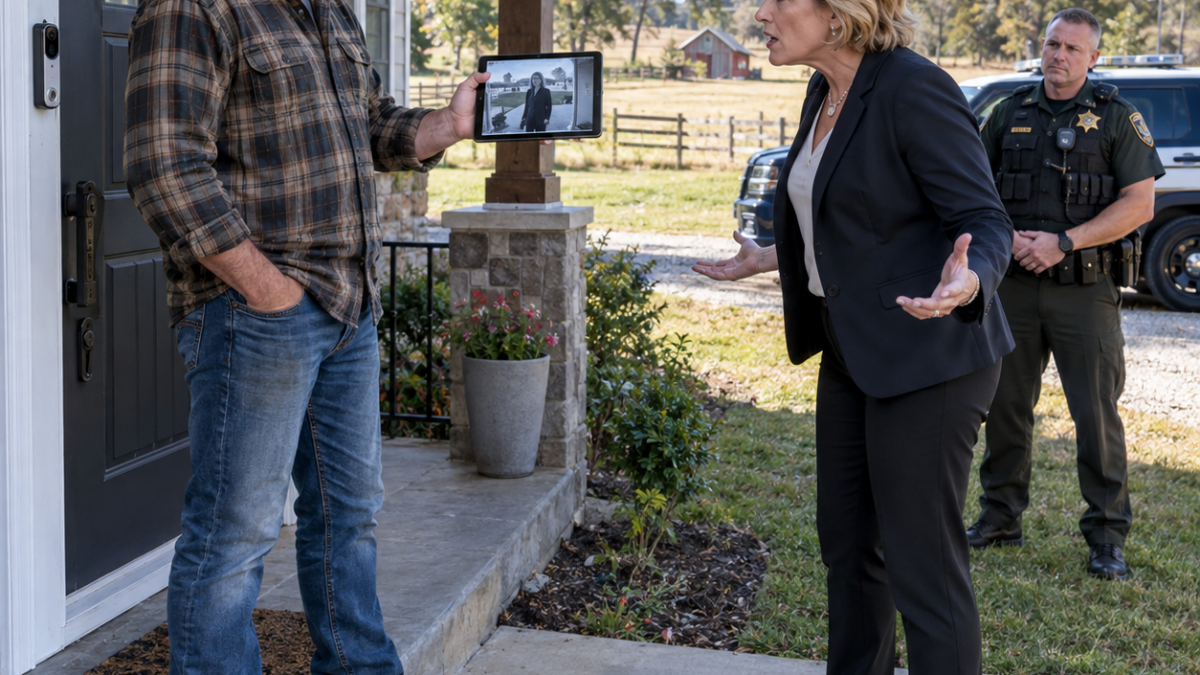
The HOA president told me I had voluntarily given her a twenty-foot strip of my family’s property—and that I now owed her $14,750 for landscaping I had never authorized.
She had a recorded easement, a notarized signature that looked like mine, and meeting minutes claiming I had agreed to everything in person.
There was only one problem with her story, and the tiny camera beside my front door had been quietly saving the truth for months.
“The document you signed is already on file with the county, Mr. Davies.”
Karen Miller’s voice came through my phone with the calm confidence of someone who believed official-looking paperwork could turn a lie into reality.
I stood in my kitchen staring at the certified letter she had sent.
Twenty-foot beautification and access easement.
Oakwood Preserve Homeowners Association.
Amount due: $14,750.
Thirty days past due.
Additional penalties pending.
I read the number again.
Then I looked through the back window.
Where my family’s property line had been for three generations, fresh sod now stretched across a strip of land roughly twenty feet wide.
Imported gray river rock curved around new landscaping.
Mulch.
Shrubs.
Edging.
It was professionally done.
It was also on my property.
“Karen,” I said carefully, “I never gave the HOA an easement.”
A little laugh came through the phone.
“We had a very clear conversation on May fourteenth.”
“No, we didn’t.”
“You verbally agreed to the beautification project, and your signature finalized the transfer.”
My grip tightened around the phone.
Oakwood Preserve had grown around my family’s old brick ranch after my father sold most of the surrounding acreage years earlier.
He kept the house and two acres.
Those two acres never joined the HOA.
We paid no dues.
We were bound by no Oakwood covenants.
Karen hated that.
For years she had left notes about my grass.
My old 1972 Ford pickup.
The appearance of my fence.
Every time, I gave her the same answer.
“Thank you for your concern, Karen. My property is not part of Oakwood Preserve.”
She always smiled tightly.
“We’ll see.”
Apparently, she had finally decided to manufacture the answer she wanted.
“You’re saying I signed away twenty feet of my property?”
“I’m saying you already did.”
“And now you’re billing me for landscaping you installed on that land?”
“The HOA improved the area based on your consent.”
“I didn’t consent.”
“The county record says otherwise.”
Then her voice sharpened.
“And if you continue refusing payment, the board is prepared to place a lien against your property.”
That stopped me.
A fake agreement was one thing.
Threatening my home with it was another.
I had spent twenty years in the Army Corps of Engineers.
Complex problems had taught me something useful: anger feels productive right before it makes you careless.
So instead of shouting, I became very calm.
“Send me everything.”
There was a pause.
“Excuse me?”
“The easement. The invoice. The board minutes approving the project. Every document you claim gives you authority.”
“It’s all perfectly standard.”
“Then producing it shouldn’t be difficult.”
Another pause.
“The late fees will continue.”
“Send it certified.”
She hung up.
My wife, Sarah, entered the kitchen a moment later.
“What happened?”
I handed her the letter.
She read it.
Then read it again.
“She’s claiming you gave them part of the yard?”
“Yes.”
“Did she actually file something with the county?”
“That’s what I’m going to find out.”
Sarah looked outside at the new landscaping.
“They came onto our property.”
“I know.”
“And then charged us for it.”
“I know.”
Her face tightened.
“What are you going to do?”
I looked toward my office.
“Build the record.”
I spent the next morning at the county recorder’s office.
When the clerk pulled up my parcel, my stomach dropped.
Karen had not been bluffing.
A document had been recorded.
Twenty-foot easement.
My name.
My address.
And at the bottom—
my signature.
Except it wasn’t mine.
It was close.
Close enough to fool someone who had never watched me sign my name.
But I knew every line.
The fake J curled too far.
The D was wrong.
Someone had practiced.
Then I saw the date supporting Karen’s story.
May 14.
And suddenly I stopped being angry.
Because on May 14, Sarah and I hadn’t been anywhere near our front porch.
We had been four hundred miles away in Missouri.
I drove home with a certified copy of the easement beside me.
Walked into my office.
Turned on my computer.
And opened the archive from my doorbell camera.
May 14.
Midnight to midnight.
I pressed play.
The porch appeared.
Empty.
And I began to smile.
PART 2
I didn’t fast-forward at first.
I wanted to watch the day exactly as it had happened.
The timestamp in the corner read 12:00:01 a.m.
My front porch sat under the yellow glow of the exterior light.
Nothing moved.
No Karen.
No HOA paperwork.
No mysterious agreement.
Just my empty house while Sarah and I were hundreds of miles away.
At 5:42 in the morning, the porch light clicked off automatically.
At 7:16, a squirrel jumped onto the railing and disappeared.
At 8:03, the newspaper delivery car passed without stopping.
At 11:42, our mail carrier walked onto the porch, tucked a small package beside the door, and left.
At 1:17 in the afternoon, a stray orange cat stretched across the warm concrete like it owned the place.
At 3:03, a UPS driver dropped off a package.
Five minutes later, he came back looking embarrassed, picked it up, and carried it to the correct house.
I almost laughed.
That man spent more time on my porch on May 14 than Karen did.
The sun moved.
Shadows lengthened.
The flag beside my door hung almost perfectly still in the humid air.
The porch light came on again.
Moths began circling it.
Midnight arrived.
Twenty-four hours.
No Karen.
No knock.
No conversation.
No signature.
No agreement.
Nothing.
Sarah stood behind my chair.
“She never came.”
“No.”
“Not even once.”
“No.”
I moved the video back to noon.
Then forward again.
Empty porch.
Sarah folded her arms.
“She knew we were gone.”
“Maybe.”
“You think this was planned while we were out of town?”
“I think we’re going to stop guessing.”
I downloaded the entire twenty-four-hour file.
Then May 13.
Then May 15.
Then every motion-triggered clip for the week.
I copied everything to an external drive and a cloud folder.
After twenty years around engineering investigations, I had developed an almost unhealthy respect for redundant copies.
Sarah watched me create folders.
“Are you naming this one too?”
I looked at her.
She smiled.
I typed:
EVIDENCE.
“Disappointingly normal,” she said.
“I’m maturing.”
“That would be new.”
Then I pulled my travel records.
Flight confirmation.
Hotel receipt.
Credit-card charges.
Guest lecture schedule from Fort Leonard Wood.
Meal receipts in St. Robert, Missouri.
Parking records.
Sarah’s travel itinerary.
Everything placed us four hundred miles from home.
Karen had not chosen an ambiguous date.
She had chosen one of the easiest days of my life to prove.
That interested me.
A careful fraudster would have selected a day I might plausibly have forgotten.
Karen had done the opposite.
Why?
Arrogance.
She didn’t expect me to challenge the record.
She believed once something had been filed with the county, the average homeowner would see an official stamp and surrender.
That assumption was beginning to look expensive.
The paperwork Karen promised arrived four days later.
Certified mail.
Thick envelope.
I signed for it at the door, which felt appropriately ironic.
Inside were three things.
First, a copy of the easement I had already obtained from the county.
Second, a detailed invoice for $14,750.
Third, HOA board minutes supposedly authorizing the entire arrangement.
I spread them across my father’s old oak desk.
Sarah brought coffee.
“Anything good?”
“Depends on your definition.”
I started with the invoice.
Premium fescue sod.
Imported Appalachian gray river stone.
Soil grading.
Bed preparation.
Shrubs.
Mulch.
Labor.
And a line item that immediately caught my attention:
PROJECT MANAGEMENT FEE — $2,500.
Payable to Oakwood Preserve HOA.
I tapped it.
“What does that mean?” Sarah asked.
“It means the association charged us twenty-five hundred dollars for managing an unauthorized project on land they don’t own.”
“That sounds reasonable.”
“Very community-minded.”
The landscaping vendor was called Lawn and Order.
I stared at the name for several seconds.
Sarah leaned over my shoulder.
“No.”
“Yes.”
“That’s actually the name?”
“Yes.”
“Maybe Karen should be arrested just for that.”
“Let’s focus.”
The company itself appeared legitimate.
Good reviews.
Licensed.
Established.
Probably contractors who had been told the HOA controlled the strip.
I didn’t blame them.
Yet.
Then I opened the board minutes.
April 28.
According to the document, five HOA board members had unanimously authorized negotiations with me to acquire a twenty-foot easement along the western community boundary.
The motion authorized up to $15,000 in landscaping expenses once a signed agreement was secured.
I read it again.
“That was before the date she claims we talked,” Sarah said.
“Exactly.”
“So she got approval to spend money before you supposedly agreed?”
“Yes.”
“Could be normal.”
“It could.”
“But?”
“But look at the language.”
The minutes described the arrangement as if it were essentially complete.
Not proposed.
Not tentative.
The board expected to receive my consent.
Almost as though someone had already told them the outcome.
Then I examined the notarization block on the easement.
Patricia L. Higgins.
Local notary.
Commission current.
Store address.
I searched the address.
Pack-and-ship shop about fifteen minutes away.
The next morning, I drove there.
It sat between a mattress store and a vape shop in a tired little strip mall.
Inside, a teenager was wrapping a cardboard box.
An older woman sat behind a counter with a name tag.
PAT.
“Patricia Higgins?”
She looked up.
“Yes?”
“My name is John Davies.”
Nothing at first.
Then I placed the easement on the counter.
Recognition appeared.
“Oh. The land thing.”
My pulse kicked once.
“The Oakwood Preserve document?”
“Right.”
“Do you remember notarizing this?”
“Sure. Karen brought it.”
Four words.
Karen brought it.
I kept my voice casual.
“I’m trying to clear up a paperwork issue. Do you remember what ID I gave you?”
Pat frowned.
“You weren’t here.”
The teenager at the other end of the counter stopped taping for half a second.
I leaned slightly closer.
“I wasn’t?”
“No. Karen brought the paper.”
Pat was beginning to look uncertain.
“She said you had signed it before leaving unexpectedly.”
“What did she say happened?”
“Family emergency, I think.”
“Did you personally see me sign it?”
“No.”
“Did you verify my identification?”
“No, but Karen said she witnessed it.”
Pat’s tone shifted toward defensiveness.
“She’s HOA president. She brings documents in here all the time.”
“Did she sign as a subscribing witness?”
Pat looked down.
The line was blank.
The color changed in her face.
“No.”
“Did she provide a written sworn statement that she witnessed my signature?”
“No.”
I uncovered the signature.
“That isn’t mine.”
Pat stared at it.
Then at me.
“I don’t understand.”
“On the date this document says I agreed to the easement, my wife and I were in Missouri.”
Her mouth opened.
Nothing came out.
“I have travel records.”
She looked at the notary stamp.
Then at the signature.
Then back at me.
“Oh my God.”
“I’m not here to threaten you.”
“I trusted her.”
“I understand.”
“She said you signed it.”
“I understand.”
Pat lowered her voice.
“Am I in trouble?”
“I don’t know. That depends on people above my pay grade.”
Her eyes filled with panic.
“I’ve notarized things for Karen for years.”
That sentence changed the direction of the entire case.
“For years?”
“HOA paperwork. Affidavits. Vendor things.”
“Did she often bring documents already signed?”
Pat realized what she had said and stopped.
“I think I need to call somebody.”
“That would be smart.”
I pulled out a business card.
“All I need from you right now is the truth. If my attorney contacts you, tell him exactly what you told me.”
She took the card.
I started toward the door.
“Mr. Davies?”
I turned.
“I’m sorry.”
I believed her.
That didn’t excuse the notarization.
But I believed she had been careless rather than malicious.
There is a difference between being part of someone’s scheme and being used by it.
Karen had a talent for turning other people’s weaknesses into tools.
Pat’s weakness had been trust.
The board’s weakness, I was beginning to suspect, was passivity.
Mine had been assuming Karen was merely annoying.
By lunchtime, I had decided the case was bigger than I could safely handle myself.
I needed a lawyer.
Not someone who enjoyed sending threatening letters.
I already had Karen for that.
I wanted someone who understood real-estate title disputes, fraudulent instruments, easements, and HOA governance.
That search led me to David Chen.
His downtown office was twenty floors above street level.
Modern glass.
Clean lines.
No fake leather law books.
David was younger than I expected.
Late thirties.
Dark suit.
Restless energy.
He shook my hand.
“Mr. Davies?”
“John.”
“David.”
We sat at a conference table.
He opened a legal pad.
“Tell me what happened.”
I told him.
I kept emotion out of it.
Not because I wasn’t angry.
Because anger wastes a lawyer’s time.
I gave him the chronology.
Independent property.
Years of minor HOA harassment.
Certified letter.
Claimed verbal agreement.
Recorded easement.
Forged signature.
$14,750 invoice.
Threatened lien.
May 14 alibi.
False notarization.
David barely interrupted.
Then I placed the certified easement in front of him.
He read it.
“Your real signature?”
I handed him a canceled check.
Then my driver’s license copy.
He compared them.
His eyebrows rose.
“That’s not subtle.”
“No.”
“Anyone who knows your signature would catch this.”
“Yes.”
“Who filed it?”
“HOA.”
“Who prepared it?”
“Still determining that.”
“Who notarized?”
I explained Pat.
He wrote faster.
Then I placed the travel documents down.
He looked at the date.
Looked again.
“You were in Missouri.”
“With my wife.”
“Documented?”
“Excessively.”
“Good.”
Then I opened the laptop.
“There’s more.”
I played the doorbell footage.
Not the entire twenty-four hours in real time.
I had prepared a fast-motion review with the original file preserved separately.
Morning.
Mail carrier.
Cat.
UPS mistake.
Empty porch.
Evening.
Night.
No Karen.
David leaned forward.
At the end, he sat back.
For a few seconds he said nothing.
Then:
“This may be the cleanest title-fraud fact pattern I’ve ever seen.”
“That good?”
“For you.”
He picked up the easement.
“For them? Catastrophic.”
He explained the broad shape of the case.
The false document had clouded my title.
The landscaping constituted an unauthorized entry onto my land.
The bill appeared tied to a project I had never requested.
The notarization raised separate issues.
The county filing made everything more serious.
And if Karen had knowingly caused a forged instrument to be recorded, the problem extended well beyond an HOA disagreement.
“What do you recommend?”
David tapped his pen.
“We can send them a letter.”
“That sounds anticlimactic.”
“It would probably work.”
“Probably?”
“Your evidence is overwhelming.”
He leaned back.
“A competent attorney sees this and tells the HOA to unwind everything immediately.”
“What happens to Karen?”
“That depends.”
“On?”
“How badly she wants to keep fighting.”
I already knew the answer.
David must have seen it in my face.
“You think she’ll escalate.”
“I know she will.”
“How?”
“No idea.”
“Excellent.”
I stared at him.
“You lawyers have unusual emotional responses.”
He smiled.
“If someone is going to behave recklessly, it is often useful to allow them to do so after they have been given clear notice.”
“So you want me to warn her.”
“Formally.”
“And then wait.”
“Precisely.”
He helped me draft a demand letter.
It came from me, not his firm.
Short.
Professional.
No threats beyond stating my rights.
I told the HOA the easement was fraudulent.
My signature was forged.
The claimed May 14 agreement had never occurred.
I possessed documentary evidence establishing that Sarah and I were out of state.
I demanded that the HOA immediately extinguish the recorded easement, remove the false debt, restore my property, and issue written confirmation that no lien or collection activity would occur.
Deadline:
Ten business days.
I sent it certified.
Karen signed for it.
Then we waited.
Sarah hated that part.
“You’re expecting her to do something stupid?”
“Yes.”
“And that’s the plan?”
“I wouldn’t call it the plan.”
“What would David call it?”
“Preserving evidence of state of mind.”
She stared at me.
“Lawyers found a complicated phrase for letting someone make things worse.”
“Essentially.”
“What if she surprises you?”
“She might.”
“What if she apologizes?”
“I’d accept it.”
Sarah narrowed her eyes.
“You sound disappointed.”
“I would be delighted.”
“You would hate it.”
“I would adapt.”
The first seven days passed quietly.
No letter.
No call.
Nothing.
Day eight.
FedEx envelope.
Downtown law firm.
I carried it into my office before opening it.
Sarah followed.
“This is it?”
“Maybe.”
Inside was a letter from Barry Gable.
Counsel for Oakwood Preserve.
The tone made Karen sound reasonable and me unstable.
It accused me of making defamatory allegations.
It called my forgery claim “belated and self-serving.”
It insisted the easement was duly executed.
It demanded retraction.
Then came the revised balance.
Original invoice.
Late fees.
Collection charges.
Attorney fees.
Total:
Just over $18,000.
Sarah whispered, “They’re increasing it?”
“Yes.”
Then another page slipped from the envelope.
I picked it up.
NOTICE OF LIEN.
Filed that morning.
For several seconds, I didn’t move.
This was my grandfather’s property.
The house my father had maintained.
The land Sarah and I intended to keep until one of us could no longer walk it.
Karen had taken a forged document, created an unauthorized debt, been formally warned that the signature was fraudulent—
and then placed a lien against my home anyway.
Sarah sat down.
“They actually did it.”
I felt anger then.
Real anger.
The kind that makes your hands cold.
“They did.”
“Call David.”
I scanned everything.
Sent it.
His response arrived four minutes later.
One sentence:
She took the bait.
When we spoke, he sounded almost cheerful.
“This is worse for them than I expected.”
“Glad one of us is happy.”
“John, listen carefully. Before your letter, they might have tried to characterize this as misunderstanding or negligent process.”
“And now?”
“You put them on explicit notice.”
“Then they filed the lien anyway.”
“Correct.”
“What does that prove?”
“It gives us powerful evidence regarding willfulness.”
David’s voice hardened.
“Now we file.”
The lawsuit named Oakwood Preserve Homeowners Association.
Karen Miller.
And the four board members listed on the April 28 minutes.
The claims were broad.
Fraud-related claims.
Slander of title.
Trespass.
Improper encumbrance.
Damages for restoring my property.
Legal fees.
And claims concerning board conduct.
David also wanted the fraudulent easement declared void.
The lien removed.
And records preserved.
Before filing, however, he asked me one question.
“How much do you know about Karen’s history?”
“Not enough.”
“Find out.”
That afternoon, I visited Richard Henderson.
Everyone called him Mr. Henderson even though he had spent forty years asking former students to call him Richard.
He was seventy-eight.
Retired history teacher.
Rose gardener.
Owner of one of the first homes built in Oakwood Preserve.
He was trimming bushes when I walked up.
“John.”
“Mr. Henderson.”
“You look serious.”
“I need to ask about Karen.”
He stopped clipping.
“That is generally a serious subject.”
I told him everything.
Not every legal detail.
Enough.
By the time I finished, his pleasant expression had disappeared.
“She forged your signature?”
“That’s what the evidence indicates.”
“And took your land?”
“Tried.”
He looked toward Karen’s side of the neighborhood as if she might hear us from three streets away.
“I’m not surprised.”
“You should be.”
“I wish I were.”
Then he told me about the mailboxes.
Five years earlier, shortly after Karen became HOA president, the association announced a neighborhood beautification initiative.
Every mailbox would be replaced with a specific premium model.
Cost:
Three hundred dollars per house.
Mr. Henderson refused.
His existing mailbox complied with the written covenants.
It was clean.
Functional.
Proper height.
Correct location.
Karen fined him anyway.
One hundred dollars a week.
He appealed.
Denied.
He requested a hearing.
Delayed.
He wrote the board.
Ignored.
Then came the threat of a lien.
“So I paid.”
The shame in his voice sounded exactly like Frank Abernathy’s shame would have sounded in another life, another story.
I hated hearing it.
“You didn’t have a choice you could afford.”
“That is how she wins.”
Mr. Henderson clipped a dead rose.
“Two weeks later, I learned the mailbox supplier was owned by her brother-in-law.”
I stared at him.
“You’re sure?”
“Public business records.”
“How many homes?”
“More than two hundred.”
I did the math.
“So she forced the entire community to buy products from a relative.”
“Yes.”
“Did the board disclose it?”
“Not that I ever saw.”
Mr. Henderson lowered his clippers.
“And that wasn’t the only project.”
“What else?”
“Entrance landscaping.”
“Roofing vendor recommendations.”
“Management consulting.”
“Holiday lighting.”
“Anything Karen could package as protecting property values.”
A pattern.
Always property values.
Always beautification.
Always urgency.
Always money.
The $2,500 management fee on my fake invoice suddenly looked different.
Not random.
Familiar.
I told Sarah everything that night.
She listened quietly.
Then said:
“People need to talk to each other.”
“They’re afraid.”
“Because they think everyone else is okay with it.”
“Probably.”
She opened her laptop.
“What are you doing?”
“Something you’re bad at.”
“Which narrows nothing.”
“Talking to humans.”
She created a private Facebook group.
OAKWOOD PRESERVE RESIDENTS FOR TRANSPARENCY.
No attack language.
No mention of Karen.
No mention of our lawsuit.
Just a forum for homeowners to share concerns, compare experiences, and discuss transparent governance.
Mr. Henderson joined first.
Then six people he trusted.
Then they invited others.
Sarah’s first post was carefully worded.
Hypothetical question:
How should a community handle potential conflicts of interest when an HOA-mandated vendor is related to a board member?
Within an hour, seventeen comments.
Within three hours, forty-six.
By midnight, sixty-three households had joined.
Stories poured in.
A woman fined because her children’s basketball hoop remained near the curb too long.
A family denied approval for a backyard deck almost identical to one Karen’s friend received permission to build.
A homeowner fined for leaving a trash container visible from the street.
Another cited over holiday decorations.
Another charged administrative fees no one could explain.
Some stories were petty.
Others were expensive.
All shared the same architecture.
Rule.
Threat.
Fine.
Fear.
Silence.
Then a former HOA treasurer joined.
His name was Mark Delaney.
Three years earlier, he had resigned from the board.
His post changed everything.
It was long.
Detailed.
Calm.
That made it devastating.
According to Mark, Karen had gradually centralized financial authority around herself.
She disliked the association’s online accounting portal because, she claimed, it was cumbersome.
Records migrated to accounting software maintained primarily through her personal laptop.
Financial reports presented at board meetings became summaries instead of transaction-level details.
Vendor selection became less transparent.
Questions were treated as disloyalty.
Mark eventually resigned.
At the time, homeowners barely noticed.
Now they did.
Comments exploded.
People wanted bank statements.
Contracts.
Invoices.
Names of vendors.
Related parties.
The private group passed one hundred households.
Nearly half Oakwood Preserve.
Sarah sat beside me on the couch watching new posts appear.
“This isn’t about us anymore,” she said.
“No.”
“You okay with that?”
I thought about it.
“Yes.”
Because my problem was one forged easement.
Their problem might have been years of unchecked authority.
David loved Mark’s information.
Not because Facebook posts proved financial wrongdoing.
They didn’t.
But they told us what records to request.
Once our lawsuit entered discovery, David served comprehensive document requests.
Bank statements.
Contracts.
Board communications.
Vendor records.
Invoices.
Cancelled checks.
Minutes.
Accounting exports.
Everything reasonably tied to the claims and governance conduct in dispute.
Oakwood’s lawyers objected.
David narrowed some requests.
Fought others.
The document production began.
Meanwhile, the annual HOA meeting approached.
Karen apparently knew none of what was happening beneath her.
The agenda she posted was painfully ordinary.
President’s report.
Budget review.
Entrance landscaping.
Perennial flower schedule.
New business.
Sarah read it.
“New business.”
“That’s us.”
David and I built a presentation.
Not flashy.
Evidence doesn’t need decoration.
Slide one:
Satellite map of my property.
Original boundary marked green.
Slide two:
Same map.
Fraudulent easement shown in red.
Twenty feet cut away.
Slide three:
Recorded easement.
Fake signature circled.
Slide four:
My actual signature.
Side by side.
Slide five:
Timeline.
Karen’s claimed May 14 porch meeting.
My flight.
Hotel.
Fort Leonard Wood schedule.
Receipts.
Slide six:
Black screen.
Title:
MAY 14 — FRONT DOOR CAMERA.
David looked over the slides.
“Don’t editorialize.”
“I know.”
“Don’t call her a thief.”
“I know.”
“Don’t call the board corrupt.”
“I know.”
“Let the evidence do the work.”
“I know.”
He smiled.
“You hate lawyers repeating themselves.”
“Deeply.”
“One more thing.”
“What?”
“Process server will be there.”
I looked at him.
“At the meeting?”
“Yes.”
“Serving Karen?”
“And board members.”
“In front of everyone?”
“If the opportunity arises.”
“That seems theatrical.”
“It is.”
“You approve?”
“Sometimes public misconduct benefits from public accountability.”
I thought about Karen describing me in HOA correspondence as delinquent.
About her telling neighbors I had agreed to the project.
About the forged signature.
The lien.
My answer was simple.
“Good.”
The annual meeting drew more people than Karen had ever seen.
Every chair in the community center was occupied.
Residents stood along the walls.
Sarah sat near the back.
Mr. Henderson near the front.
Mark, the former treasurer, sat on the aisle.
The basketball-hoop family was there.
The deck family.
People I had never met but whose stories I had read.
Karen sat behind the long board table wearing a bright pink blazer and pearls.
She looked delighted.
To her, the packed room must have felt like validation.
She struck the gavel.
“Welcome, everyone. I’m thrilled to see such extraordinary community engagement.”
Several people exchanged looks.
Karen didn’t notice.
She began the president’s report.
Property values.
Community appearance.
Successful projects.
Excellent fiscal stewardship.
I watched Mark shake his head slowly.
Then Karen reached the beautification project.
My project.
“I’m especially pleased,” she said, “with our successful acquisition and improvement of the western green-space corridor.”
My jaw tightened.
“Through constructive negotiation with the adjacent landowner, the association secured an easement allowing us to transform an unattractive boundary into a beautiful transitional space.”
Sarah looked at me.
I stayed seated.
Karen continued.
“Unfortunately, the landowner is currently delinquent on his agreed contribution to the improvements.”
A low murmur swept through the room.
People knew.
Karen mistook it for support.
She smiled.
“We remain confident the matter will be resolved through normal collection procedures.”
Normal collection procedures.
A fraudulent lien.
But I waited.
Budget presentation came next.
Pie charts.
Round numbers.
Broad categories.
Administration.
Legal.
Beautification.
Reserves.
Mark raised his hand twice.
Karen ignored him once.
Recognized him the second time.
“Can we see detailed legal spending?” he asked.
“That information is incorporated into administrative reporting.”
“I asked for the amount.”
“It’s included in the report.”
“How much?”
Karen smiled tightly.
“Mark, we are not going to derail this meeting with accounting minutiae.”
A laugh came from the back.
Karen’s eyes narrowed.
Eventually, after discussion of flowers that no one cared about anymore, she reached the end.
“Any new business?”
I stood.
“Yes.”
Her smile disappeared.
“Mr. Davies.”
“I have a new business item.”
“We’ve already discussed your outstanding balance.”
“This isn’t about a balance.”
“Then please submit your matter to the board in writing.”
“I already did.”
Several people laughed.
Karen flushed.
I continued.
“This concerns the fraudulent easement recorded against my property.”
Silence.
Absolute silence.
Karen’s face hardened.
“That accusation is defamatory.”
“Then evidence should help.”
I held up the USB drive.
“I have a short presentation.”
“You will not hijack this meeting.”
Mr. Henderson stood.
“I move that Mr. Davies be allowed to present.”
A woman immediately called:
“Second.”
Karen stared at the crowd.
Someone shouted:
“Vote.”
Another:
“Let him speak.”
Gary, the board member controlling the projector, looked toward Karen.
She shook her head.
He looked toward the room.
Half the homeowners were staring at him.
He swallowed.
Then plugged in my drive.
The first map appeared.
Green line.
My legal property boundary.
I stepped beside the screen.
“This is my family’s property.”
My voice came out calmer than I felt.
“The green line is the recorded boundary that existed before Oakwood Preserve was developed.”
Click.
Red line.
Twenty-foot strip.
“This is the easement your HOA president filed last month.”
Whispers.
People pointed.
The difference looked enormous on the screen.
Click.
Forged document.
“This document states I voluntarily granted Oakwood Preserve an easement across that strip.”
Click.
Signature comparison.
My real signature.
Fake signature.
Someone laughed.
Then another person.
Not amusement.
Disbelief.
I said:
“As you can see, my handwriting apparently experienced a dramatic medical emergency on the day I supposedly decided to give away part of my land.”
Laughter broke harder.
Karen slapped the table.
“This is outrageous.”
I looked at her.
“I haven’t reached the interesting part.”
The laughter stopped.
Click.
May 14 timeline.
“My supposed consent began with a verbal agreement.”
I pointed toward Karen’s quoted correspondence.
“According to Mrs. Miller, she and I had a clear face-to-face discussion at my home on May fourteenth.”
Then I pointed to the other side.
“Here are my travel records.”
Flight.
Hotel.
Credit-card charges.
Official lecture schedule.
“My wife and I were approximately four hundred miles away in Missouri.”
The room changed.
People stopped shifting in their seats.
This no longer looked like a boundary disagreement.
It looked like what it was.
A manufactured event.
Karen spoke.
“You could have returned.”
“No.”
“You could have met me before leaving.”
“You specified May fourteenth.”
“You’re twisting technicalities.”
“A meeting either happened or it didn’t.”
Her face reddened.
I clicked.
Black video frame.
MAY 14.
FRONT DOOR.
“And fortunately, I don’t have to ask anyone to take my word for it.”
Sarah covered her mouth.
She had seen the video.
She knew what was coming.
I pressed play.
The porch appeared.
Timestamp.
Midnight.
Fast motion.
Darkness becoming morning.
Squirrel.
Mail carrier.
Orange cat.
Several people laughed when the cat stretched across the step.
UPS driver.
Package.
Return.
Sunset.
Porch light.
Moths.
Nothing else.
No Karen.
No meeting.
No signature.
No conversation.
Just absence.
Strangely, the emptiness became more dramatic with every passing second.
People leaned forward waiting for someone who never arrived.
The timestamp crossed 10:00 p.m.
11:00.
11:59.
Midnight.
Video ended.
Black screen.
I looked at the room.
Then at Karen.
“As you can see, our meeting was brief.”
Nobody laughed immediately.
The shock was too heavy.
Then someone near the back shouted:
“You forged his name?”
Another voice:
“Karen, what the hell?”
A woman stood.
“You put a lien on his house?”
Then another:
“Did the board know?”
Gary turned toward Karen.
His face looked gray.
“You told us he signed it.”
Karen snapped:
“Sit down.”
Gary didn’t.
“You told us he signed it in front of you.”
“I said sit down.”
“That’s not his signature.”
“You’re panicking because he’s manipulating everyone.”
The room erupted.
Voices everywhere.
“Resign!”
“Show us the finances!”
“What about the mailbox contract?”
“Where did the management fees go?”
Karen grabbed the microphone.
“ORDER!”
Nobody listened.
“ORDER!”
Her gavel slammed repeatedly.
The noise grew.
Then a man in jeans and a plain polo stood from the third row.
I knew who he was.
Karen didn’t.
He walked forward carrying five large envelopes.
He stopped at the table.
“Karen Miller?”
She turned toward him.
“Yes?”
“You’ve been served.”
He placed the lawsuit in front of her.
The room went quiet enough to hear the paper hit the table.
Karen stared at it.
“What?”
The process server moved down the line.
“Gary Smith?”
Gary looked terrified.
“Yes.”
“You’ve been served.”
Envelope.
Next board member.
Envelope.
Next.
Envelope.
Five defendants.
Five lawsuits delivered.
Karen picked hers up.
Saw the court heading.
Her face changed.
Until that moment, she had still believed this was an HOA meeting she could control.
A gavel could silence homeowners.
A board vote could deny appeals.
A threatening letter could frighten residents.
But she couldn’t gavel away a district-court summons.
Her mouth opened.
“You did this.”
She was looking at me.
I nodded.
“No, Karen.”
My voice barely needed volume.
“You did this.”
She threw the envelope onto the table.
“This is harassment!”
David had warned me not to argue.
So I didn’t.
Karen turned on the board.
“Don’t just sit there!”
Gary stared at her.
“You told us he signed.”
“I told you what was necessary to protect the community.”
“What does that mean?”
“Gary—”
“Did he sign it?”
She didn’t answer.
That silence destroyed more loyalty than anything I could have said.
Helen, another board member, looked near tears.
“You said the notary verified him.”
Karen’s eyes moved.
That was enough.
Helen whispered:
“Oh my God.”
Karen shoved back her chair.
The microphone tipped.
She pushed through the aisle.
Residents moved aside.
Not out of respect.
Like people letting a storm pass.
Sarah stood near the door filming.
Karen saw the phone.
“Turn that off!”
Sarah didn’t move.
“You have no right!”
“This is an HOA meeting attended by members,” Sarah said calmly.
Karen’s face twisted.
Then she left.
The door slammed behind her.
No one applauded.
Not yet.
The room was too stunned.
Mr. Henderson finally walked to the microphone.
He looked at the four remaining board members.
“Is the meeting still in session?”
Gary stared at the envelope in front of him.
“I…”
Mark stood.
“The membership needs answers.”
That opened the floodgates again.
But this time the anger had direction.
Financial records.
Vendor contracts.
Legal spending.
Related-party transactions.
Who approved the easement?
Who saw my signature?
Who spoke to the notary?
Who authorized the landscaping?
Who authorized the lien?
The board members had almost no answers.
Because Karen had provided them.
That was the system.
They had surrendered governance in exchange for convenience.
Karen did the work.
Karen knew the rules.
Karen spoke to the lawyers.
Karen handled vendors.
Karen controlled the accounts.
Everyone else voted.
Gary finally looked up.
“I’m making a motion.”
The room quieted.
“What motion?” Helen asked.
“To suspend all enforcement related to Mr. Davies immediately.”
“Second.”
Another board member.
Vote.
Unanimous among the four remaining.
Then:
“Motion to direct counsel to take no further collection action pending independent review.”
Passed.
“Motion to preserve all financial and electronic records.”
Passed.
It wasn’t victory.
Not legally.
But something fundamental had broken.
Karen’s monopoly on fear.
Within forty-eight hours, all four board members resigned.
Their joint email claimed they had been misled regarding the authenticity of my easement.
They expressed shock.
Concern.
Disappointment.
A desire for independent investigation.
David read it in his office.
“They’re abandoning ship.”
“Can they get out of the lawsuit?”
“Not by email.”
“Will we settle with them?”
“Maybe.”
“Why?”
“Because accountability is not the same as revenge.”
That sentence annoyed me because it sounded like something I would normally say.
“They voted.”
“Yes.”
“They approved the project.”
“Yes.”
“They let her put a lien on my property.”
“Yes.”
“But?”
“But if they cooperate, provide records, acknowledge what happened, and help unwind the damage, we consider relative responsibility.”
I leaned back.
“You’re getting reasonable on me.”
“Terrible habit.”
Karen did not resign immediately.
For three days, she remained HOA president in name.
She simply stopped appearing.
Curtains closed.
Her white Lexus stayed in the garage.
She ignored residents.
Ignored calls.
Then Oakwood’s management company announced an emergency board transition.
Karen was removed under the association’s governing procedures after the other directors resigned and the membership demanded an election.
Mr. Henderson did not want to run.
Which made everyone trust him more.
Sarah cornered him at the emergency meeting.
“You should do it.”
“I’m seventy-eight.”
“You’re awake.”
“So are you.”
“I don’t live in the HOA.”
He looked toward me.
“Lucky people.”
He eventually agreed to serve as interim president.
Mark returned as treasurer.
Their first meeting lasted four hours.
Their first official resolution required dual signatures for large expenditures.
Their second required board votes and contracts to be published to homeowners except where legitimately confidential.
Their third ordered a forensic audit.
Then they addressed my property.
A new surveyor was hired.
Not chosen by me.
Not chosen by Karen.
Independent.
The survey confirmed the original line exactly where I knew it was.
Twenty feet of my land had been incorporated into the HOA landscaping project without valid permission.
Orange survey flags appeared across the grass.
I stood beside one late that afternoon.
Sarah joined me.
“There it is.”
“Never moved.”
“On paper it did.”
“That’s the dangerous part.”
A fence post doesn’t argue.
A tree doesn’t understand legal descriptions.
Land doesn’t know when someone lies about it.
People create boundaries on paper.
Which means dishonest paper can become frighteningly powerful.
That thought stayed with me through settlement negotiations.
The HOA’s insurance carrier stepped in quickly.
Their attorney was nothing like Barry Gable.
No threats.
No gold lettering.
No drama.
He called David.
Then requested an evidence package.
We provided the recorded document.
Signature comparison.
Travel records.
Doorbell video.
Notary information.
Certified demand letter.
Lien filed after notice.
Board minutes.
The carrier’s response changed almost immediately.
They wanted resolution.
Not trial.
The basic terms came together within weeks.
The fraudulent easement would be extinguished and removed from the chain of title through proper corrective filings.
The lien would be released.
A licensed surveyor would permanently remark my true boundary.
The HOA would pay to remove the unauthorized landscaping.
My property would be restored to the condition it had been in before the project.
Legal fees would be covered according to settlement terms.
And I would receive compensation for the title dispute, trespass, stress, and expenses caused by the entire mess.
There was also an apology.
David showed me the first draft.
I hated it.
“We regret any confusion.”
“Confusion?”
“Standard language.”
“They forged my signature.”
“We can revise.”
“They put a lien on my home.”
“We can revise strongly.”
“They called it confusion.”
David smiled.
“I knew you’d focus on that.”
The final version was better.
Oakwood Preserve acknowledged that I had not validly granted the disputed easement.
It recognized that the project was undertaken without proper authorization from me.
It apologized to Sarah and me.
The statement went on the association website.
Community bulletin board.
And member email.
For ninety days.
I thought I would feel triumphant when I read it.
Instead, I felt tired.
Years of military engineering work had taught me that the end of a crisis rarely feels cinematic.
Usually someone signs the final page.
Closes a file.
Turns off a light.
And the pressure you have been carrying quietly disappears all at once.
You don’t cheer.
You realize how heavy it was.
The financial audit made the story uglier.
Mark and the forensic accountants reviewed years of records.
Several major contracts had relationships that had never been clearly disclosed to homeowners.
The mailbox supplier tied back to Karen’s brother-in-law.
Other projects involved friends or preferred vendors.
Management fees appeared repeatedly.
Documentation was incomplete.
Some association expenses appeared unrelated or inadequately supported.
The findings were turned over to the appropriate authorities for review.
I deliberately stayed away from that part.
My lawsuit had a defined purpose.
My property.
My title.
The lien.
The forged easement.
Karen’s broader financial conduct belonged to investigators.
Mr. Henderson called me one afternoon.
“You know what we found?”
“Probably something I don’t want to know.”
“You’re learning.”
“Is it bad?”
“Yes.”
“Criminal?”
“That isn’t for me to decide.”
“Then don’t decide it.”
A long pause.
“You sound exactly like a retired engineer.”
“I’ll accept that.”
He sighed.
“I keep thinking about the mailbox.”
“What about it?”
“If we had pushed harder then…”
“Don’t.”
“She learned she could do it.”
“Maybe.”
“We taught her there were no consequences.”
“No.”
I looked through the kitchen window at the orange boundary stakes.
“She taught everyone to be afraid separately.”
“That’s different?”
“Very.”
“How?”
“Because the moment people compared notes, her system started dying.”
The landscaping crew arrived on a Tuesday.
Not Lawn and Order.
I selected another company.
They removed the river rock first.
Wheelbarrow after wheelbarrow.
Then shrubs.
Mulch.
Edging.
Sections of sod.
They regraded the strip.
Added topsoil.
Reseeded.
By late afternoon, the ornamental border Karen had installed across my property was gone.
The land looked rough.
Brown soil.
Grass seed.
Straw.
It was beautiful.
Sarah laughed when I said that.
“You think bare dirt is beautiful?”
“Mine is.”
“That may be the most male sentence you’ve ever said.”
We walked the restored boundary together.
Twenty feet doesn’t sound enormous.
Until someone takes it.
Twenty feet across the length of that side of my property changed how the yard felt.
Changed where the landscaping sat.
Changed what belonged to whom.
My grandfather had once planted fruit trees near that line.
Most were gone now.
One old pear tree remained.
Karen’s landscaping crew had surrounded it with river rock as if it were part of an HOA park.
Now the rock was gone.
I placed my hand against the trunk.
Sarah watched me.
“You okay?”
“My grandfather planted this.”
“I know.”
“He used to tell me not to pick pears before they were ready.”
“Did you?”
“Of course.”
“What happened?”
“He made me eat the green one.”
Sarah laughed.
“That explains you.”
I looked at the tree.
For all the legal language involved in the case—
easement.
lien.
title.
fraud.
fiduciary duty.
damages.
—the fight had always been about something simpler.
This was where my family had lived.
Karen saw empty space between her subdivision and my house.
I saw my grandfather’s hands.
My father mowing.
My childhood.
My marriage.
A place that existed before the HOA and would exist after it.
The settlement money went into savings.
Some paid for improvements to the property.
I didn’t buy anything dramatic.
That disappointed Sarah.
“I expected at least one spite purchase.”
“Like what?”
“A twenty-foot statue.”
“Of?”
“Your doorbell camera.”
I nearly choked on my coffee.
“We could put it directly on the property line.”
“You’re a bad influence.”
“It could rotate toward Karen’s house.”
“Absolutely not.”
We laughed.
The camera itself remained exactly where it had always been.
Small.
Black.
Ordinary.
Every time I walked through the front door, I noticed it differently.
That little device had done nothing heroic.
It had not caught Karen forging the signature.
Hadn’t recorded her delivering the document.
Hadn’t captured a confession.
It had simply recorded reality.
The absence of an event.
That was enough.
Karen’s entire story depended on something happening at my house on May 14.
The camera showed a mail carrier.
A cat.
A confused UPS driver.
And twenty-four hours of truth.
Sometimes evidence is dramatic because it catches the crime.
Sometimes evidence is devastating because it shows that the claimed event never existed.
The neighborhood changed too.
Oakwood Preserve remained an HOA.
That surprised some outsiders who followed the story.
The residents did not dissolve it.
Most still wanted shared maintenance.
Entrance landscaping.
Common-area care.
Community insurance.
Reasonable standards.
Their problem had never been the existence of an association.
It was what happened when one person became indistinguishable from it.
Mr. Henderson’s administration was almost aggressively boring.
Budgets were detailed.
Meetings ran long.
Contracts were posted.
Homeowners asked irritating questions.
Mark answered them.
Votes were recorded.
Conflicts were disclosed.
No one person controlled the bank account.
If a fine was issued, the evidence went with it.
Appeals had real review.
People complained about the new system too.
One resident told Mr. Henderson:
“Meetings take forever now.”
He replied:
“Democracy is inefficient.”
I liked him more every week.
The garden gnome at his house became something of a joke even though that had been another neighborhood’s story in another time—except in Oakwood, his symbol was the mailbox.
He kept the expensive HOA-approved one Karen had forced him to buy.
But he added a tiny brass plaque.
PURCHASED UNDER PROTEST.
The new board left it alone.
Sarah’s transparency group stayed active.
It changed names.
OAKWOOD PRESERVE COMMUNITY FORUM.
Less revolutionary.
More permanent.
People shared lost dogs.
Contractor recommendations.
Pool schedules.
HOA documents.
Election reminders.
And occasionally old Karen stories.
The pink flamingos became legendary.
Someone had covered Karen’s lawn with dozens of plastic flamingos after the annual meeting.
I did not approve.
Technically.
Privately, I laughed until my ribs hurt.
Sarah asked:
“Want one for our yard?”
“No.”
“You’re afraid?”
“Of plastic birds?”
“Of becoming part of an HOA aesthetic.”
“My property isn’t in the HOA.”
She smiled.
“We’ll see about that.”
I stared at her.
She laughed and ran inside before I could answer.
Then Karen’s house went up for sale.
I heard about it from Mr. Henderson.
“Sign went in this morning.”
I didn’t drive by.
Didn’t need to.
Two weeks later, I was walking the restored strip of yard when I saw a moving truck outside her home.
Karen and her husband were loading boxes.
No movers.
No neighbors helping.
Just the two of them.
I hadn’t spoken to her since the annual meeting.
She saw me.
We were separated by a quiet residential street, some lawns, and everything that had happened.
For years her face had carried the same expression whenever she dealt with me.
Certainty.
Condescension.
A smile that said she knew how the system worked and I did not.
That expression was gone.
She looked tired.
Older.
Smaller somehow.
For a second, I wondered whether she would come over.
Apologize.
Blame me.
Threaten me.
Say anything.
Instead, she looked away.
Her husband closed the truck.
They got inside.
The engine started.
The truck pulled away.
Karen never looked back.
I watched until it turned the corner.
Sarah came outside.
“She gone?”
“Yes.”
“How do you feel?”
I thought about it.
“Nothing.”
She studied me.
“Really?”
“Mostly.”
“You spent months fighting her.”
“I spent months fighting what she did.”
“That’s different?”
“Yeah.”
I looked at the house disappearing behind trees.
“If I still needed her to suffer, she’d still be controlling part of my life.”
Sarah slipped her hand into mine.
“That was almost wise.”
“Write down the date.”
The criminal investigation and financial inquiries continued beyond our civil settlement.
I followed them only from a distance.
There were questions about the forged filing.
Questions about financial records.
Questions about vendor relationships.
Questions about association funds.
What happened with each allegation belonged to prosecutors, regulators, insurers, and courts—not neighborhood rumor.
I had learned too much about what bad documentation could do to become careless with facts myself.
That mattered.
Karen had begun this entire disaster by inventing reality.
I wasn’t going to finish it by doing the same thing.
Months passed.
The grass returned along the reclaimed strip.
The line disappeared visually.
That was ironic.
After all the fighting, no giant wall marked the boundary.
No monument.
No warning sign.
Just grass.
The survey pins remained where they belonged.
The county record was corrected.
The lien was gone.
That was enough.
Then one Saturday morning, the doorbell rang.
I opened the door.
Patricia Higgins stood there.
The notary.
She held an envelope.
She looked nervous.
“Can I come in?”
Sarah joined us.
“Of course.”
We sat in the living room.
Pat placed the envelope on the coffee table.
Inside was a handwritten letter.
“I wanted to apologize.”
“You already told the truth,” I said.
“That doesn’t undo what I did.”
I didn’t answer.
She continued.
“I lost my commission.”
I had suspected consequences were coming.
“I’m sorry.”
“I’m not.”
That surprised me.
“I was angry at first.”
She looked down.
“Then I realized I had treated the stamp like a favor.”
She rubbed her hands together.
“Karen came in all the time. She was confident. Important. Always in a hurry.”
“That sounds like her.”
“I stopped asking whether I was doing my job correctly because I thought I knew her.”
Pat looked at me.
“That document could have cost you your home.”
I nodded.
“I think about that.”
“You should.”
“I’m not asking you to forgive me.”
“I know.”
She wiped one eye.
“I just needed you to know that I understand now.”
I read her letter later.
It wasn’t dramatic.
No excuses.
No claim that Karen had forced her.
Pat admitted she had failed to follow proper procedures because familiarity made her careless.
I kept that letter.
Not with the lawsuit.
In a different folder.
Because Pat taught me something different than Karen did.
Karen showed me what arrogance does when combined with power.
Pat showed me what convenience does to responsibility.
You don’t have to be malicious to cause serious harm.
Sometimes you simply stop doing the boring thing correctly.
Checking identification.
Reading the document.
Asking the question.
Following procedure.
The details people call bureaucracy often exist because trust is not evidence.
A year after the case ended, Oakwood Preserve held another annual meeting.
Mr. Henderson invited Sarah and me.
“You’re not members,” he said, “but everyone thinks of you as honorary troublemakers.”
“I’m deeply offended.”
“You should be.”
We attended.
The same community center.
Same projector.
Different atmosphere.
People laughed before the meeting began.
Board members sat among residents instead of elevated behind a long table.
Mark gave the budget report.
Detailed.
Painfully detailed.
At one point a man raised his hand.
“Do we really need to know the amount spent on printer toner?”
Mark replied:
“You asked for transparency.”
The room laughed.
Then Mr. Henderson stood.
“I have one special item.”
He looked at me.
I became suspicious.
“John, come up here.”
“No.”
“Don’t be difficult.”
“That’s what everyone said about Karen.”
More laughter.
I walked forward.
Mr. Henderson handed me a small wooden box.
Inside was a brass plaque.
MAY 14
MOST PRODUCTIVE MEETING THAT NEVER HAPPENED
I stared at it.
Sarah doubled over laughing.
“You people are terrible.”
Mr. Henderson shook my hand.
“You reminded this neighborhood to verify what it’s told.”
“That was the camera.”
“No.”
His expression became serious.
“The camera was evidence.”
He looked around the room.
“You were willing to use it.”
That distinction stayed with me.
Evidence does nothing if everyone is too frightened to confront the lie it disproves.
Karen had relied on that.
She didn’t need perfect documents.
She needed residents who assumed challenging them would cost more than surrendering.
Mr. Henderson paid for a mailbox he did not need.
Parents replaced things that violated rules only selectively enforced.
Homeowners swallowed fees they didn’t understand.
Board members signed off on matters they didn’t fully investigate.
A notary trusted someone she should have verified.
And I ignored Karen for years because I thought her behavior was too ridiculous to become dangerous.
Every person gave away a tiny piece of scrutiny.
Karen collected those pieces until she looked powerful.
Then one lie became too large.
Twenty feet of land.
$14,750.
A forged signature.
A fictional May 14 meeting.
And suddenly people started checking.
Once they checked, the empire became paperwork.
Bad paperwork.
Several years later, my grandfather’s pear tree finally died.
Storm damage.
Age.
Maybe both.
The arborist told me there was no saving it.
I stood beside the trunk longer than necessary.
Sarah came outside.
“You okay?”
“That tree was here before I was.”
“I know.”
“My grandfather planted it.”
“I know.”
For a moment, losing the tree hurt more than I expected.
Then Sarah said:
“Plant another one.”
I looked at her.
“In the same spot?”
“Why not?”
So we did.
Not exactly where the old trunk stood.
A few feet closer to the boundary.
On the twenty-foot strip Karen once claimed belonged to Oakwood Preserve.
I dug the hole myself.
Placed the young tree.
Filled soil around the roots.
Watered it.
Then stood back.
Sarah smiled.
“Spite tree?”
“No.”
“Justice tree?”
“No.”
“Freedom pear?”
“Please stop naming it.”
She laughed.
The next spring, it produced blossoms.
Barely any.
But enough.
One evening I sat on the porch watching the sunset.
The doorbell camera blinked above the steps.
Sarah brought two glasses of iced tea.
“You ever think about turning that thing off?”
“The camera?”
“Yes.”
“Why?”
“Peace.”
I looked at it.
“No.”
She laughed.
“Traumatized?”
“Prepared.”
“There’s the engineer.”
We sat quietly.
Children rode bicycles down the street.
A delivery truck stopped at an Oakwood house.
Someone walked a golden retriever.
Mr. Henderson drove past and waved.
Normal life.
That was the ending I wanted.
Not Karen in prison.
Not Karen bankrupt.
Not some theatrical punishment.
Normal.
My land intact.
My home unencumbered.
Neighbors no longer whispering about who might be fined next.
A boring HOA meeting where people argued about toner.
A pear tree growing where somebody once tried to manufacture ownership.
That was enough.
But there was one last moment I never forgot.
A young couple eventually bought Karen’s old house.
They had no idea who she was.
Good.
They came over to introduce themselves.
The husband shook my hand.
“We heard there was some kind of property dispute years ago.”
His wife elbowed him.
“You said you wouldn’t ask.”
“I’m curious.”
I pointed toward the grass.
“See that young pear tree?”
“Yes.”
“The property line is just beyond it.”
He nodded.
“That’s it?”
“That’s it.”
He looked confused.
“I thought there’d be a fence or something.”
“No need.”
His wife smiled.
“Nice.”
Then he noticed the doorbell camera.
“You like those?”
“It’s adequate.”
“We’ve been thinking about installing one.”
I looked at Sarah.
She bit her lip trying not to laugh.
I turned back to him.
“I recommend it.”
“Really?”
“Very strongly.”
They walked home.
Sarah waited until their front door closed.
Then she lost it.
“You recommend it?”
“I do.”
“Very strongly?”
“Yes.”
“You’re impossible.”
Maybe.
But every time that camera’s little light blinked, I remembered May 14.
Karen had built her lie carefully.
Official letter.
Board minutes.
Recorded easement.
Notary stamp.
Invoice.
County filing.
Lawyer.
Lien.
Layer upon layer of authority.
Anyone looking only at the paper might have believed her.
Then one ordinary device showed an empty porch.
A mailman.
A cat.
A UPS driver.
Nothing else.
And suddenly the official story collapsed.
That changed how I think about power.
People imagine power looks like a judge’s robe.
A police badge.
A military rank.
A corporate office.
Sometimes it looks like an HOA president holding a clipboard.
But real authority and claimed authority are not the same.
And evidence doesn’t become true because someone stamps it.
I had spent my career around structures.
Bridges.
Roads.
Foundations.
Survey lines.
Every structure depends on what lies underneath.
If the foundation is false, eventually the weight exposes it.
Karen’s foundation was one sentence:
“We had a very clear verbal agreement on May 14.”
Everything she built rested on that.
The easement.
The bill.
The landscaping.
The lien.
Her claim that I had cooperated.
Her accusation that I was now refusing to honor my word.
All of it.
But May 14 was empty.
That empty porch destroyed the structure.
Sometimes I wonder what would have happened if I had never installed that camera.
We still had travel records.
The signature was still fake.
Pat still hadn’t witnessed it.
A good lawyer probably would have dismantled the document eventually.
But “eventually” can be expensive.
Karen counted on that.
She counted on delay.
Confusion.
Fear.
The possibility that proving the truth would cost more than accepting the lie.
The camera changed the economics of the fight.
There was no complicated interpretation.
No memory dispute.
No “he said, she said.”
Just time.
Place.
Video.
And absence.
That is why the most powerful moment wasn’t when the lawsuit landed in her hands.
It wasn’t when the board resigned.
It wasn’t when the lien disappeared.
It wasn’t even when the landscapers removed every last gray river rock.
It was the moment an entire room watched twenty-four hours pass on a screen and realized the woman who had ruled them through confidence had invented a meeting that never happened.
After that, she could still shout.
But she couldn’t make them believe.
And authority without belief becomes very small very quickly.
I finished my iced tea.
The porch light came on automatically.
The camera switched into night mode.
The new pear tree moved slightly in the evening breeze.
Sarah stood.
“Coming inside?”
“In a minute.”
She kissed the top of my head.
“You know the funny part?”
“What?”
“If Karen had just asked whether you’d let the HOA landscape those twenty feet…”
I thought about it.
“I might have.”
Sarah stopped.
“Seriously?”
“Maybe.”
“They wanted to improve the boundary.”
“Could have discussed it.”
“They might have paid for it themselves.”
“Probably.”
“And you might have agreed.”
“If the terms made sense.”
Sarah stared at me.
“So all of this happened because she needed to pretend she already had your permission instead of asking for it.”
“Pretty much.”
“That is incredibly stupid.”
“Yes.”
She disappeared inside.
I remained on the porch.
That might have been the deepest irony of the entire fight.
Karen wanted control so badly that she skipped the one tool that actually works between neighbors.
A conversation.
A real one.
Not the imaginary May 14 version.
If she had knocked on my door and said:
“John, we’d like to improve the boundary. Would you consider granting limited landscaping access while retaining full ownership?”
I would have listened.
I might have negotiated.
I might have agreed to plants.
Maybe a narrow maintenance license.
Maybe nothing.
But she would have received an answer based on respect.
Instead she decided respect was inefficient.
So she manufactured consent.
That choice cost her everything she had been trying to protect.
Position.
Reputation.
Control.
The trust of the neighborhood.
And potentially much more.
The last sunlight disappeared.
I stood.
Before going inside, I looked toward the new pear tree.
It was young.
Thin trunk.
A handful of leaves.
Nothing impressive.
But its roots were exactly where they belonged.
On my land.
I walked toward the door.
The camera detected motion.
A tiny blue light appeared.
For years I had barely noticed it.
Now I gave it a small nod as I passed.
“Good evening.”
Sarah called from inside.
“Are you talking to the doorbell?”
“No.”
“You absolutely are.”
I closed the door behind me.
Outside, the camera continued recording.
Quiet porch.
Empty yard.
True boundary.
Nothing dramatic.
Exactly the way I wanted it.








