PART 2: HOA Tried to Steal My Marina—Then the Harbor Master Revealed My Father’s 1978 Deed and Their $85M Plan Unraveled
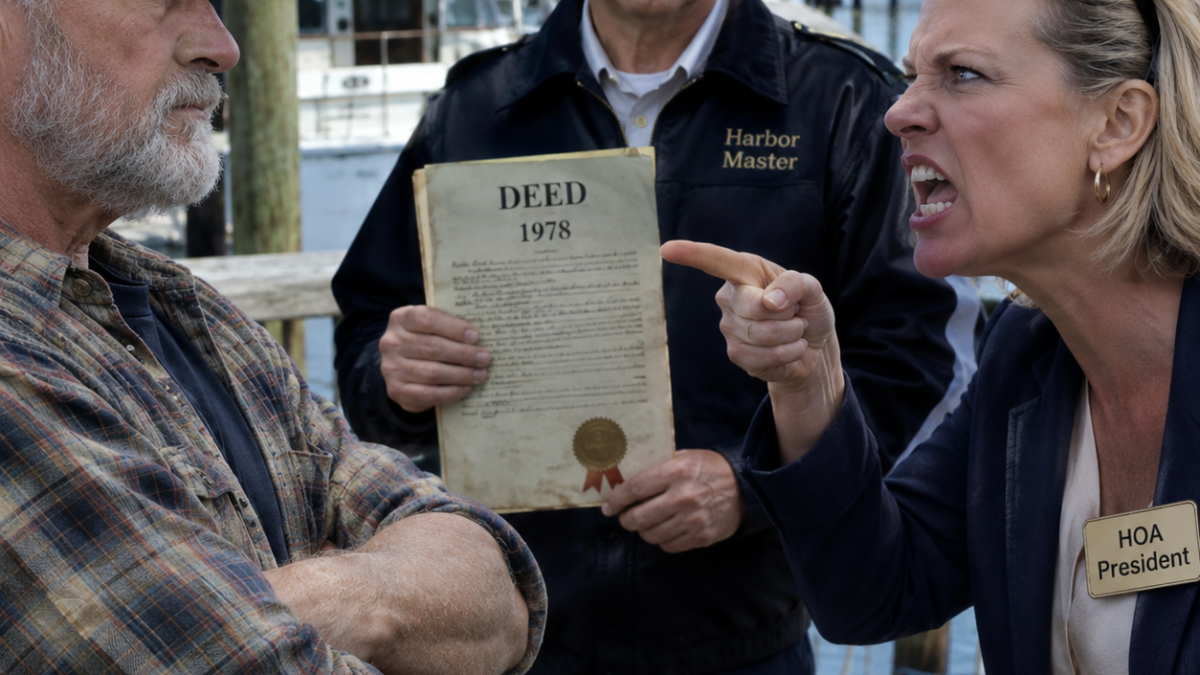
PART 2
The old ceiling fan clicked with every rotation. Outside, gulls screamed over the fuel dock, engines started, men laughed, somebody dropped a wrench on concrete.
Normal sounds.
That almost made things worse.
Because my entire life looked exactly the same as it had the day before, while one piece of paper on my desk insisted that none of it belonged to me.
I called the Blackwood Shores Association.
A cheerful receptionist answered.
“I need every document supporting the ownership claim delivered to me this morning.”
“May I ask who’s calling?”
“Nolan Mercer.”
There was a pause.
Not long.
But long enough.
“Oh. Mr. Mercer.”
“Yes.”
“I’ll forward your request.”
“To whom?”
“Our legal department.”
“I want the recorded deed.”
“I’ll let them know.”
“Not a map. Not a letter from your board. The deed.”
“I understand.”
Three hours passed.
Nothing.
I kept working because there wasn’t much else I could do.
A charter captain needed a fuel filter.
Walt Henderson, who had shrimped the Carolina coast longer than I’d been alive, needed help with a starter motor.
Around four, he watched me tighten a connection and said, “You look like somebody stole your dog.”
“Not yet.”
He frowned.
“Not yet?”
“Long story.”
Walt spat into the water.
“I got time.”
“I don’t.”
That was the closest I came to talking about it.
At 4:47 p.m., my phone chimed.
An email from Elliot Sterlingworth.
Attorney for Blackwood Shores.
The message contained five polite sentences and one attachment.
The attachment was labeled OFFICIAL WATERFRONT BOUNDARY MAP.
I opened it.
Most of Mercer Point Marina had been shaded blue.
BLACKWOOD COASTAL DEVELOPMENT ZONE.
I zoomed in.
The map looked impressive.
Professional lettering.
Survey lines.
Logos.
Coordinates.
A date.
Then I noticed the company name in the corner.
Private Coastal Planning Consultants.
Not Bell Haven County.
Not the registrar.
Not the state.
A private firm.
I printed the map, spread it over Dad’s desk, and began opening drawers.
Tax records.
Insurance.
Old surveys.
Repair permits.
Dock licenses.
Storm reconstruction paperwork.
I found maps dating back decades.
Not one contained the phrase Blackwood Coastal Development Zone.
By eight that night, the shop was dark except for my office.
I leaned back in Dad’s chair.
“A map is a picture,” I whispered.
That was something he had once told me when a customer argued over a boundary shown on a hand-drawn slip diagram.
“Anybody can draw a line, Nolan. The question is whether that line can survive daylight.”
I looked at Vivian’s beautiful blue shading.
Then at Dad’s battered green folder.
I didn’t know which one would survive.
The next morning answered a different question.
At 6:10, I drove into the marina and found a metal sign installed at the entrance to the main pier.
PRIVATE HOA PROPERTY.
NO UNAUTHORIZED ACCESS.
Russell Bain stood beside it.
Two Blackwood Shores security guards were blocking Marla Keen from reaching her charter boat.
Marla had rented a slip from us for eleven years.
She was five-foot-four, maybe one hundred twenty pounds, and possessed the temper of an Atlantic squall.
“You touch that toolbox,” she told a guard, “and you’ll be fishing your fingers out of the water.”
“Ma’am, we’re asking for your resident identification.”
“I’m not a resident.”
“Then you cannot access the pier.”
“I pay Nolan Mercer to access that pier.”
Russell spotted me.
“Good morning, Mr. Mercer.”
“Take down the sign.”
His smile barely moved.
“I’m afraid that won’t be possible.”
“You’re standing on my property.”
“Haven’t you read the notice?”
“I read a letter written by people who want my property. That is not the same thing.”
He stepped closer.
“We are preparing to take possession.”
“Do you have a court order?”
His jaw shifted.
“Your continued commercial activity is unauthorized.”
“Do you have a court order?”
“Mr. Mercer—”
“Yes or no?”
People were watching now.
Marla.
A retired dentist named Frank who kept a thirty-two-foot cruiser in Slip Seven.
Two mechanics.
A couple at the fuel pump.
Russell raised his voice.
“You have been profiting from community property for years.”
That one hit harder than I expected.
Not because I believed him.
Because I saw Frank glance toward me.
Just for a second.
Doubt.
I had rebuilt that man’s engine after Hurricane Simon. I had let him pay the bill over six months because his wife was sick.
Now some stranger in a security jacket had planted a question in his face.
Marla saw it too.
She stepped between Russell and me.
“My father tied his boat here before Blackwood Shores had a gate,” she said. “So you can stop acting like these docks dropped out of the sky last week.”
“Ma’am, stay out of this.”
“Make me.”
“Marla.”
She looked at me.
I shook my head.
Not because she was wrong.
Because I finally understood Russell’s role.
Provocation.
I pulled out my phone.
Started recording.
I filmed the sign.
The guards.
The blocked pier.
Russell’s face.
“What are you doing?” he asked.
“Building a memory.”
“For what?”
“In case anybody develops amnesia.”
He stared at me.
Then stepped aside.
Marla marched past him.
Frank followed.
By ten, the guards were gone.
The sign remained.
I left it there.
Not because I accepted it.
Because evidence works best when you don’t clean it up too early.
Vivian arrived alone that afternoon.
No convoy.
No guards.
She walked into my shop while I was rebuilding a carburetor.
“I dislike unpleasantness,” she said.
I didn’t look up.
“You have an interesting way of showing it.”
“I believe this situation can be resolved.”
“Great. Remove your sign.”
She ignored that.
“A company associated with our redevelopment effort is prepared to offer you one hundred fifty thousand dollars.”
I stopped turning the wrench.
“For what?”
“Your cooperation.”
“My cooperation doing what?”
“Transitioning operations.”
I set the tool down.
“Vivian, you spent two days calling me a trespasser.”
She smiled faintly.
“If you insist on using emotional language—”
“I’m using your language.”
I stepped around the bench.
“If I’m illegally occupying your land, why would you pay me one hundred fifty thousand dollars to leave it?”
Her expression changed.
Barely.
But enough.
A tiny pause.
The first crack.
“Consider it compensation for avoiding unnecessary litigation.”
“No.”
“You haven’t heard the terms.”
“I heard the number.”
“You should think carefully.”
“I did.”
“One hundred fifty thousand dollars is substantial money for a facility in this condition.”
I laughed once.
“Thirty-eight slips. Fuel. Repairs. Storage. Waterfront access. Full roster. You know exactly what this place is worth.”
She tilted her head.
“Sentimentality can be expensive.”
“So can greed.”
That wiped away her smile.
She picked up her purse.
“You’re making a mistake.”
“Then let me make it on my own land.”
She walked out.
That night, just after I locked the warehouse, my phone buzzed.
Unknown number.
One message.
DO NOT SIGN ANYTHING.
I stared at it.
A second message arrived.
THEY DO NOT WANT YOUR MARINA.
THEY WANT WHAT SITS UNDER YOUR OWNERSHIP OF IT.
I typed back.
Who is this?
No response.
I called.
Straight to voicemail.
No greeting.
I stood beneath the yellow lamp over the shop door while the tide pulled against the pilings.
What sits under ownership?
Oil?
Minerals?
Access?
Water rights?
A hidden easement?
For the first time, fear stopped feeling like something standing in front of me.
It felt like something beneath my feet.
I barely slept.
Around three in the morning, I climbed out of the bunk above the shop, made coffee, and started writing names on the back of a fuel invoice.
County registrar.
Surveyor.
Attorney.
Harbor office.
Dad’s old accountant.
Anybody who might remember how Mercer Point had been assembled.
By sunrise, my list filled two pages.
At the top was one name.
Tessa Whitam.
Tessa’s law office sat above a seafood restaurant downtown, which meant every legal consultation smelled faintly of fried shrimp.
She was thirty-nine, sharp-eyed, patient, and incapable of pretending she knew something before she had checked it.
That was why I trusted her.
She read Vivian’s notice.
Then read it again.
Then studied my deed.
Then the private map.
She pushed her glasses higher on her nose.
“Well?”
I asked.
She folded her hands.
“First, an HOA cannot declare that it owns land and then send security guards to remove the recorded owner.”
I exhaled.
“Good.”
“Second, don’t celebrate.”
I stopped exhaling.
“If they can establish a legitimate chain of title, we could have a real dispute.”
“You think they can?”
“I think lawyers get into trouble when they decide what documents say before they find the documents.”
“That sounds like a yes disguised as a lecture.”
“It means tomorrow morning we go to the registry.”
The Bell Haven Registry of Deeds had not changed much since I was a teenager.
Low brick building.
Cracked parking lot.
Old fluorescent lights.
A clerk named Mrs. Ogden who remembered my father and appeared mildly offended by computers.
Tessa and I spent hours digging through filings.
Modern records first.
Then older scans.
Then microfilm.
Then books thick enough to stop bullets.
We found the original Blackwood Shores development plan.
Then expansion documents.
Then a 2009 boundary adjustment referencing a planning drawing from 1998.
That drawing stopped me.
Mercer Point Marina appeared near the edge.
Beside it, in faded type:
FUTURE COMMON WATERFRONT.
“There.”
I pointed.
“That’s what they’re using.”
Tessa didn’t answer immediately.
She leaned closer.
“Maybe.”
“It says common waterfront.”
“It says future common waterfront.”
“What’s the difference?”
“The difference between wishing and owning.”
She traced the page.
“A planning drawing can show what a developer hopes to acquire. It does not automatically transfer title.”
“So this means nothing?”
“I didn’t say nothing. It tells us somebody planned to incorporate your marina.”
“But?”
“But we still need a conveyance.”
We kept searching.
Near the bottom of the 2009 filing, Tessa found a line in smaller type.
Subject to pre-existing 1978 waterfront conveyance and recorded exceptions.
She tapped it.
“What?”
I asked.
“Have you ever seen a 1978 conveyance?”
“No.”
“Your father bought this place around then?”
“I always thought so.”
“You thought?”
“I was a kid.”
She looked at me.
“Nolan, this may matter.”
“Why?”
“Because if the 1978 conveyance separated this parcel before Blackwood Shores existed, everything afterward could be subject to it.”
I leaned back.
The fluorescent lights buzzed overhead.
Dad had been thirty.
I pictured the old framed photograph in my office.
Howard Mercer standing beside the first dock.
Skinny.
Sunburned.
Hammer hanging from his belt.
That evening, I went back to the marina and stood in front of that photograph.
Dad had died six years earlier.
Cancer.
Fast.
Faster than either of us was ready for.
In his last months, we talked about engines.
Storm preparation.
Insurance.
Fuel contracts.
Which pilings needed replacing.
Anything practical.
Anything except death.
One afternoon, he had pressed the marina keys into my hand.
“Stay stubborn,” he told me.
I laughed.
“About what?”
“You’ll know.”
At the time, I thought he meant business.
Maybe life.
Standing in the office six years later, I suddenly hated myself for not asking.
My phone rang.
Gideon Harlow.
Bell Haven harbor master.
He had known Dad nearly forty years.
I answered.
“Nolan.”
His voice sounded rougher than usual.
“Gideon.”
“Before your father died, he left something in my keeping.”
Everything inside me went still.
“What?”
“I’d rather not discuss it over the phone.”
“Why not?”
“Because Howard made me promise not to.”
My grip tightened.
“What did he leave?”
“Come to my office tomorrow. Seven.”
“Gideon—”
“Seven, Nolan.”
He hung up.
I stared at the phone.
Then at Dad’s photograph.
For the first time since Vivian drove onto my property, I felt certain of one thing.
My father had known there would be a fight.
I just didn’t know whether he had left me a weapon…
or a warning.
Gideon’s harbor office was barely larger than my tool room.
Tide charts covered the walls. Brass instruments sat on shelves. An ancient coffee maker made something strong enough to remove paint.
He poured two mugs.
I didn’t touch mine.
“What did Dad leave?”
Gideon sat down.
“You remember Hurricane Amelia?”
“I was sixteen.”
“Your father lost half the southern dock.”
“I remember.”
“He also lost his fishing boat.”
“He sold it.”
Gideon nodded.
“To pay for the rebuild.”
I knew that story.
What I didn’t know was why Gideon was telling it now.
“After that storm,” he continued, “developers started buying waterfront around Bell Haven. People were tired. Broke. Some took offers because they had no choice.”
“And Dad?”
“Your father became obsessed with records.”
I almost smiled.
“That sounds like him.”
“No. You don’t understand.”
Gideon leaned forward.
“He believed weather was only the second-biggest danger to a working harbor.”
“What was the first?”
“Men who saw damaged land and imagined what they could build after the owner gave up.”
My smile disappeared.
“He started collecting certified copies. Surveys. easements. county references. Every transfer.”
“Where are they?”
Gideon looked toward a locked cabinet.
“Some are stored in the harbor technical archive.”
“Then show me.”
“Not yet.”
I stood.
“You called me here.”
“And I’m telling you I’m checking them against the registry.”
“I have an HOA trying to shut me down.”
“I know.”
“They blocked customers yesterday.”
“I know.”
“They’re going to court.”
“I know.”
That stopped me.
“What?”
My phone rang.
Tessa.
I answered.
Her first sentence tightened my chest.
“They filed for a temporary restraining order.”
I turned toward the window.
“What exactly are they asking for?”
“To stop your commercial operations while the property dispute is pending.”
“When?”
“Emergency hearing Friday.”
I closed my eyes.
Four days.
Vivian had spent less than a week turning a threat into a court date.
Tessa continued.
“They’re claiming your activity interferes with Blackwood Shores residents and development rights.”
“What development rights?”
“That’s one of the things I intend to ask.”
I hung up.
Gideon watched me.
“Now you understand why I want the records verified.”
“No. Now I understand why I need them.”
He opened a drawer.
Not the locked cabinet.
A smaller one.
He removed a photocopied sheet.
Old handwriting.
Dad’s handwriting.
One sentence had been underlined twice in blue ink.
The marina parcel shall remain outside the jurisdiction of any future residential association.
My throat tightened.
“That’s his writing.”
“Yes.”
“Is it part of the deed?”
“Not exactly.”
“What does ‘not exactly’ mean?”
“It’s a memo referencing the transaction.”
“So it won’t prove ownership.”
“By itself? No.”
I looked at him.
“Then why show me?”
“Because I want you to understand something.”
He tapped Dad’s sentence.
“Your father was thinking about this before Blackwood Shores existed.”
I swallowed.
“You think Vivian knows.”
“I think somebody does.”
Before I left, Gideon stopped me.
“Nolan.”
I turned.
“If you want to beat people who live on paper, bring better paper.”
“That a harbor-master saying?”
“No.”
His eyes moved toward Dad’s handwriting.
“Howard said it.”
Vivian did not wait for court.
Two days before the hearing, I was rewiring a cabin cruiser when Russell returned.
This time he brought her.
And two Bell Haven police officers.
I climbed out of the boat.
Vivian pointed at me.
“That’s the man.”
One officer looked tired already.
Vivian continued.
“He refuses to leave association property.”
I wiped my hands.
“Morning, officers.”
The older one nodded.
“Mr. Mercer?”
“Yes.”
“Do you have documentation showing ownership?”
“Inside.”
“And have you received a court order requiring you to vacate?”
“No.”
Vivian interrupted.
“We have filed for emergency relief.”
The officer looked at her.
“Has the judge granted it?”
“The hearing is Friday.”
“So no.”
Her face tightened.
I brought out my recorded deed.
The officer read it.
Vivian held up the blue planning map.
He studied that too.
For a painfully long moment, nobody spoke.
Finally, he handed it back.
“Ma’am, this appears to be a civil property dispute.”
“It is not a dispute. The association has jurisdiction.”
“I don’t have anything here authorizing me to remove Mr. Mercer.”
“Do you understand who I am?”
That sentence changed the air.
The younger officer glanced at his partner.
The older one’s voice remained calm.
“Yes, ma’am. You’re the president of a homeowners association.”
“You say that as though—”
“And that does not give you independent authority to evict a recorded property owner.”
Somebody coughed behind me.
I turned.
Three customers were watching.
Vivian flushed.
Russell stared at the ground.
The officer handed me my deed.
“If the court issues an order, follow it. Until then, we’re not removing anybody.”
For the first time in days, I felt air reach the bottom of my lungs.
Then Marla came running across the lot.
“Nolan!”
She had a tablet in one hand.
“What?”
“You need to see this.”
Security footage from the camera above her boat.
Time stamp: 2:13 a.m.
Two nights earlier.
Russell’s security crew.
Entering my warehouse area.
Taping notices onto equipment.
Dragging a chain toward the service gate.
One guard tested the lock.
Another pointed toward the camera.
The footage ended.
The police officers watched it twice.
Russell’s face turned gray.
“That was a misunderstanding.”
Marla barked a laugh.
“Were they misunderstanding the chain?”
“A junior employee misinterpreted instructions.”
“Interesting,” I said. “Because you appear in the first thirty seconds.”
He looked at me.
I saved three copies before lunch.
One went to Tessa.
One went to cloud storage.
One went onto a drive in my safe.
Vivian left without saying goodbye.
But before getting into her SUV, she leaned close enough that only I could hear.
“You won a morning, Mr. Mercer.”
I looked at her.
“You cannot afford the long war.”
She drove away.
And the worst part was this:
She was right.
Legal wars don’t have to defeat you in court.
Sometimes they defeat you in invoices.
Within a week, two customers delayed renewing their slips.
My fuel distributor asked whether I expected to remain in business.
A parts supplier switched me to cash on delivery.
One charter company called to ask whether boats might be locked behind HOA gates.
I gave the same answer every time.
“We are open.”
But every time I said it, the words felt more expensive.
At night I sat at Dad’s desk with the calculator.
Legal retainer.
Insurance.
Payroll.
Fuel.
Parts.
Taxes.
Dock maintenance.
Savings dropped.
Then dropped again.
Vivian’s one hundred fifty thousand dollars started looking less insulting at two in the morning.
One evening, I walked to the end of Pier Four.
Dad used to sit there in a wooden chair with a thermos.
He said it was the best place to see weather arrive.
I sat on the edge instead.
A million thoughts become simpler when the water is black.
Take the money.
Leave.
Sleep again.
Buy a smaller place inland.
Let somebody else fight rich people with lawyers.
Then I looked back toward the warehouse.
Dad had rebuilt it after two hurricanes.
I remembered being twelve, holding boards while he hammered.
Sixteen, pumping water after Amelia.
Twenty-three, rebuilding an outboard beside him.
Forty-six, standing at his funeral while half the harbor showed up.
I had thought inheritance meant receiving what somebody owned.
That week I learned inheritance could also mean receiving what somebody refused to surrender.
The next morning, Walt found me at the fuel dock.
He pressed an envelope into my hand.
“What’s this?”
“Slip fees.”
“You paid last month.”
“Three months ahead.”
I opened it.
Cash.
“Walt—”
“Don’t.”
“I’m not taking this.”
He folded his arms.
“Your father let me keep a leaking skiff here an entire winter when I had no money and a divorce lawyer trying to take the skin off my back.”
“That was Dad.”
“You’re his son.”
“That doesn’t mean—”
“It means shut up and put it in the register.”
I stared at him.
He looked away.
“People remember, Nolan.”
By noon, Frank renewed.
Then two more owners.
Marla taped a paper to the wall of her boat shed.
FRIENDS OF MERCER POINT.
Names appeared underneath.
Then phone numbers.
Then messages.
WE’RE STAYING.
DON’T LET THEM BULLY YOU.
YOUR DAD HELPED US AFTER AMELIA.
YOU KEPT MY BOAT HERE WHEN MY HUSBAND DIED.
I stood reading them longer than I want to admit.
Money still mattered.
Court still mattered.
But fear had changed shape again.
I was no longer afraid I was fighting alone.
Tessa called at 11:43 that night.
“Nolan, are you awake?”
“I own a marina somebody is trying to steal. Of course I’m awake.”
“I found the development application.”
“What application?”
Silence.
Then:
“The one that explains everything.”
I drove to her office before sunrise.
She had documents spread across the conference table.
Blackwood Shores Luxury Waterfront Expansion.
Projected value:
$85,000,000.
Hotel.
Restaurant.
Private harbor.
Guest docks.
Service road.
Resort entrance.
I moved through the pages.
Every proposed route eventually touched my land.
The main marina entrance sat almost exactly where my repair shed stood.
The guest pier extended through slips Marla and Walt had used for years.
A glossy rendering showed polished concrete and decorative palms where Dad’s warehouse should have been.
I stared at it.
“They erased us.”
“On a concept drawing,” Tessa said.
“They erased the whole marina.”
“Nolan.”
“What?”
“Stay focused.”
She slid another page toward me.
Investor presentation.
One phrase had been highlighted.
PROPERTY CONTROL PENDING FINAL CLEARANCE.
I read it twice.
“They told investors they controlled this?”
“Not exactly.”
“That’s what it says.”
“It says control is pending final clearance.”
“Which means?”
“It could mean several things.”
“You’re doing the lawyer thing again.”
“The lawyer thing is why you hired me.”
I rubbed my face.
“What does it mean to you?”
“It means they knew control was unresolved.”
That landed.
Hard.
“They came onto my property and told me I was trespassing.”
“Yes.”
“While telling investors ownership wasn’t cleared.”
“Possibly.”
“Possibly?”
“I need evidence they knew the HOA didn’t own it.”
I flipped further.
Then stopped.
ASHCROFT COASTAL HOLDINGS.
“What’s this?”
Tessa had already marked it.
“Financial participant.”
“Ashcroft.”
“Yes.”
“Vivian Ashcroft?”
“Her family company.”
I sat down.
The room suddenly seemed very quiet.
“She wasn’t protecting the neighborhood.”
“We don’t know her motivations.”
“Oh, come on.”
“We suspect.”
“Her family makes money if this hotel happens.”
“Yes.”
“And the hotel needs my property.”
“Yes.”
“And she used her position as HOA president to threaten me off it.”
“That is what we need to prove.”
I looked at the rendering again.
The clean lines.
The luxury marina.
The bright white hotel.
An eighty-five-million-dollar dream.
Built over my father’s life.
Suddenly Vivian’s offer made perfect sense.
One hundred fifty thousand dollars wasn’t generosity.
It was a discount.
They didn’t need to prove they owned Mercer Point if they could frighten me into selling it for a fraction of what it was worth.
I stood.
“I want to go public.”
“No.”
“Tessa—”
“No.”
“She told the entire neighborhood I’m a squatter.”
“And if you accuse her of fraud without evidence, she’ll make the conversation about your accusation instead of her documents.”
“So I do nothing?”
“You do exactly what we can prove.”
That week, a Blackwood Shores homeowner named Daniel Callaway invited me to the association meeting.
“Heard you found something,” he said.
“How?”
“Vivian isn’t as popular as she thinks.”
I showed up wearing clean jeans and the only jacket I owned that didn’t smell faintly of diesel.
The Blackwood Shores clubhouse looked like a wedding venue.
Crystal lights.
White chairs.
Fresh flowers.
I took a seat in the back.
Vivian noticed me almost immediately.
“Mr. Mercer,” she said from the stage. “This meeting is intended for homeowners with legitimate interests in Blackwood Shores.”
Every head turned.
I stood.
“I’ll be brief.”
“I’m asking you to leave.”
“Then answer one question first.”
She smiled tightly.
“This is not a courtroom.”
“I know.”
I held up the investor presentation.
“That’s why I’m asking the homeowners.”
The room shifted.
I walked toward the front.
“Why is a company connected to your family financially involved in an eighty-five-million-dollar waterfront project that requires control of my marina?”
Silence.
Not polite silence.
Shock.
Vivian’s face changed.
“You are making defamatory accusations.”
“I didn’t accuse you of anything.”
“You implied—”
“I asked a question.”
I placed the presentation on the table.
“Your attorney can explain the rest to mine.”
Then I walked out.
My legs were shaking by the time I reached the parking lot.
My phone rang.
Gideon.
“Nolan.”
His voice had changed.
“What?”
“I found the box.”
I stopped walking.
“What box?”
“The one your father left.”
My heart kicked once.
Hard.
“And?”
“I checked the records against the county registry.”
“Gideon.”
“There’s more than the deed.”
“What?”
“A road.”
I looked back at the glowing clubhouse.
“What road?”
“The only practical access road that resort plan needs.”
I said nothing.
Gideon’s next words came slowly.
“I think Howard saw this coming before any of us did.”
Tessa and I drove to the harbor office together.
Gideon had locked the door.
On his desk sat a dented gray metal box.
Nothing impressive.
No dramatic lock.
No polished wood.
Just scratched metal with rust around one hinge.
Gideon placed both hands on it.
“Your father gave me this years ago.”
“Why didn’t you tell me?”
“Because he asked me not to.”
“Dad’s dead.”
“I know.”
“Then why keep the promise?”
Gideon looked at me.
“Because promises don’t die when people do.”
That shut me up.
He opened the box.
Inside were folders wrapped in plastic.
A certified conveyance dated 1978.
Boundary descriptions.
Survey drawings.
A recorded easement agreement.
Letters.
Notes.
Book and page references.
Tessa put on her glasses.
For the next hour, she barely spoke.
She compared names.
Dates.
Recording numbers.
Property descriptions.
Then she looked at me.
“Nolan.”
I knew from her voice.
“What?”
“Your father bought Mercer Point as a separate waterfront parcel in 1978.”
I sat down.
“Outright?”
“Yes.”
“Before Blackwood Shores?”
“Years before it existed.”
She turned another page.
“And this clause is extremely important.”
She read the language.
The marina parcel remained separate from future residential governance unless voluntarily conveyed by the owner.
“Did Dad ever convey it?”
“I have found nothing showing that.”
“Neither have I,” Gideon said.
Tessa continued.
“The adjacent parcels do have limited crossing rights.”
“The road?”
“Yes.”
“How bad is that?”
“Not bad. The easement appears narrow.”
“In English.”
“Neighboring owners can cross under defined conditions.”
“So the HOA owns the road?”
“No.”
“The hotel can use it?”
“Not automatically.”
“Can they widen it?”
“Not under this document.”
“Run commercial resort traffic over it?”
“Not without serious questions and probably a new agreement.”
My knees weakened.
The hotel didn’t just need my marina.
It likely needed my cooperation for access.
All the power Vivian had pretended belonged to her…
had been sitting in a metal box.
I looked at Dad’s signature.
Howard Mercer.
His handwriting was younger.
Sharper.
I ran my thumb just above the ink, afraid to touch it directly.
“Why did he give this to you?”
Gideon removed his glasses.
“Howard believed that if developers knew exactly how important these documents were, somebody would eventually try to weaken them, reinterpret them, or make them disappear.”
“That sounds paranoid.”
“It sounded paranoid to me too.”
“And now?”
He glanced toward the resort documents.
“Now I wish I’d listened more carefully.”
At the bottom of the box was an envelope.
NOLAN.
Dad’s handwriting.
My hands shook as I opened it.
The letter was short.
Dad had never wasted words.
He wrote that a working waterfront survives only when somebody is willing to protect both the water and the paper beneath it.
Then came one line that broke something open inside me.
If anyone ever tells you they own the whole shoreline, son, ask them to show you exactly where that ownership begins.
I read it again.
Then again.
For six years, I had wanted one more conversation with my father.
One more hour.
One more stupid argument about tools.
One more morning coffee.
Instead, sitting inside Gideon’s cramped office, I received eight lines written years before his death.
I pressed the letter against my chest.
Tessa pretended to study the survey.
Gideon looked out the window.
Nobody embarrassed me by speaking.
Finally, I laughed through the tears.
“That stubborn old man.”
Gideon smiled.
“He said the same about you.”
Tessa looked up.
“We’re not done.”
I nodded.
“I know.”
“We need to verify every transfer from 1978 forward.”
“Okay.”
“Independent survey.”
“Fine.”
“Certified registry copies.”
“Whatever.”
“And, Nolan?”
“What?”
“Do not walk into court thinking this box wins automatically.”
I looked at Dad’s deed.
“What does?”
“The fact that the box matches the public record.”
That sounded exactly like something my father would have appreciated.
Not magic.
Not revenge.
Proof.
The hearing took place Friday morning.
Gray sky.
Cold rain.
County courthouse.
Vivian sat at the opposite table in another immaculate suit.
Elliot Sterlingworth beside her.
Russell behind them.
I sat with Tessa.
Gideon sat in the first row behind me.
Beside him was Patricia Doyle, an independent surveyor with silver hair, square glasses, and the calm expression of somebody who considered boundaries more trustworthy than people.
The gallery was almost full.
Blackwood Shores residents.
My slip holders.
Curious locals.
I saw Walt in the back.
Marla beside him.
She gave me a small nod.
The judge entered.
Everyone stood.
Then the war began.
Elliot spoke first.
He described Mercer Point as lying within the waterfront planning area of Blackwood Shores.
He described my commercial operations as disruptive.
He described the resort plan as legitimate community development.
He described me as though I were an obstacle.
Not a person.
Not an owner.
An obstacle.
I kept Dad’s letter folded inside my jacket.
Tessa rose.
She did not make a speech.
That was her strength.
She built a wall.
One document at a time.
1978 conveyance.
Recording number.
Boundary description.
Subsequent transfer.
Tax history.
My inheritance.
No gap in title.
No deed conveying Mercer Point to Blackwood Shores.
Then Patricia took the stand.
She explained the survey.
The old markers.
The later planning maps.
The developer’s line crossing a boundary marker established decades earlier.
“A planning map,” she said, “can show an intended future condition. It cannot by itself relocate a boundary fixed by a valid recorded deed.”
The judge studied the overlay.
Elliot stopped writing.
I looked at Vivian.
She scribbled something on a legal pad.
Slid it toward him.
He read it.
Shook his head once.
Slid it back.
Her lips tightened.
Tessa asked:
“Does Blackwood Shores possess a deed from Howard Mercer conveying the marina to the association?”
Elliot stood.
“The association relies upon development documentation, governing plans, and—”
“That wasn’t my question.”
He looked toward the judge.
The judge waited.
Elliot cleared his throat.
“No deed has been identified.”
“From Nolan Mercer?”
“No.”
“From any intervening owner?”
“There was no intervening owner relevant to—”
“So no?”
“No.”
Tessa walked back to our table.
Picked up the investor presentation.
“Your Honor, we also ask the court to consider this language.”
Elliot objected.
“Investment material is not evidence of title.”
“I agree,” Tessa said.
That surprised him.
She turned to the judge.
“That is precisely the point. Even the project’s own materials describe property control as pending final clearance.”
The judge allowed limited consideration.
Vivian’s jaw tightened.
Then Gideon stood.
The dented metal box looked almost comical in that courtroom.
Expensive suits.
Polished tables.
Legal pads.
A half-century-old box.
Gideon testified about Dad.
About the documents.
About the county references.
About why he had stored them.
About confirming them before giving them to me.
Tessa did not ask the judge to trust the box.
She asked the judge to compare it to the registry.
Same transaction.
Same recording information.
Same boundaries.
Same easement.
Same story.
When the judge finally spoke, my heartbeat sounded louder than the courtroom clock.
She denied the association’s request for emergency relief.
They had not established the ownership or possessory interest necessary to remove me or stop my business.
Any further title dispute would require proper proceedings.
That was it.
No dramatic gavel.
No shouting.
Just words.
But I watched Vivian’s face.
That was where the explosion happened.
For weeks, she had stood on my dock as though authority itself flowed through her.
Now a judge had dismantled the foundation beneath her argument in front of neighbors, customers, employees, and reporters.
Russell stopped looking at me.
Elliot whispered something.
Vivian stared straight ahead.
I should have felt triumphant.
Instead, I felt tired.
Deeply tired.
Then I felt a hand on my shoulder.
Gideon.
“You heard it,” he whispered.
I nodded.
“Better paper.”
His mouth twitched.
Outside the courtroom, Marla hugged me so hard I nearly dropped my folder.
Walt shook my hand.
Frank clapped my back.
A dozen customers surrounded us.
For several minutes I couldn’t speak.
Then a woman I didn’t recognize approached.
“I live on Juniper Lane in Blackwood Shores.”
I braced myself.
She lowered her voice.
“Half our street never wanted that hotel.”
I blinked.
“We thought the board had already secured the waterfront.”
“They hadn’t.”
“I know that now.”
She glanced back toward the courthouse.
“People were afraid to challenge Vivian.”
That sentence stayed with me.
The fight had never been me against an entire wealthy neighborhood.
It had been me against a few people who controlled the microphone.
Tessa appeared beside me.
“Don’t celebrate too hard.”
“You’re terrible at victories.”
“We proved they couldn’t throw you out.”
“That feels like a victory.”
“It is.”
“Then let me enjoy it.”
“For five minutes.”
“Ten.”
“Seven.”
I smiled.
Then she said:
“Now we find out why they tried.”
Two days later, Tessa received a letter.
Not from Vivian.
Not from Elliot.
From Linda Prescott, a Blackwood Shores board member.
She was the anonymous texter.
Tessa spent hours confirming the emails Linda had provided before letting me see them.
I sat across from her.
“Tell me.”
“You’re going to want to react.”
“That sounds promising.”
“I need you not to.”
“That sounds less promising.”
She turned the laptop around.
Internal messages.
Board discussions.
Legal concerns.
One adviser had written months earlier that the association had no recorded title to Mercer Point Marina.
Another warned that the 1998 planning designation did not establish ownership.
A third noted that the waterfront parcel required negotiated acquisition.
Then Vivian’s reply.
Keep pressure on Mercer until he accepts an exit. The project cannot afford further delay.
I stared at the screen.
Read it once.
Then again.
My hands became cold.
“She knew.”
Tessa remained careful.
“The email strongly indicates she had been warned.”
“She knew.”
“Nolan—”
“She stood in my shop and told me I was a trespasser.”
“I know.”
“She sent guards.”
“Yes.”
“She called police.”
“I know.”
“She told my customers I’d been profiting illegally.”
“I know.”
“And she knew.”
This time Tessa didn’t correct me.
That silence meant more than anything.
I pushed my chair back.
All the humiliation returned at once.
Frank’s doubtful look.
The sign.
The supplier demanding cash.
The sleepless nights.
Me sitting on Pier Four considering surrender.
Vivian had not been confidently enforcing ownership.
She had been manufacturing fear.
She needed me to believe she could ruin me before I discovered she had no right to take anything.
“I want to destroy her.”
The words came out before I thought about them.
Tessa watched me.
“No.”
I laughed bitterly.
“She tried to destroy me.”
“I know.”
“So now she gets protected?”
“No.”
“Sounds like it.”
“You don’t destroy Vivian.”
“Then who does?”
Tessa turned the laptop back toward herself.
“Vivian.”
I looked at her.
“We document what she did. We make lawful claims. We send the records where they belong. We let her decisions answer for her.”
“That’s not revenge.”
“No.”
She closed the laptop.
“It’s better.”
I didn’t believe her then.
I would.
Tessa sent a formal demand instructing the HOA to stop interfering with Mercer Point.
She documented lost renewals.
Supplier issues.
Security interference.
Unauthorized entry.
Business disruption.
Legal expenses.
We preserved the police report.
Marla’s footage.
Vivian’s notices.
The internal emails.
Then something happened inside Blackwood Shores.
Homeowners started asking questions.
Not about me.
About their money.
How much had the HOA spent on lawyers?
Who authorized the security operation?
Did the board know Vivian’s family company had a financial interest in the resort?
Had association funds been used to advance a project that might benefit the president personally?
A petition forced a special meeting.
Daniel Callaway called me.
“Come.”
“I’m not a homeowner.”
“You’re the reason we know what questions to ask.”
I attended.
This time Vivian did not control the room.
She sat at a long table with board members.
No white blazer.
Dark blue suit.
Beside her, an attorney I hadn’t seen before.
The room was full.
Standing room only.
Daniel raised his hand.
“Mr. Mercer is here. I move that we allow him five minutes.”
A vote.
Approved.
I walked to the front.
Vivian looked at me.
For one second, I remembered her standing in my shop.
Twenty-four hours.
Leave.
Trespasser.
Now she had to sit and listen.
I could have humiliated her.
I wanted to.
A part of me had rehearsed it.
I could have described the police.
The threats.
The one hundred fifty thousand dollars.
Her family’s financial interest.
I could have made the room angry.
Instead, I thought about Dad.
If anyone ever tells you they own the whole shoreline, ask them where that ownership begins.
So I told the story plainly.
“My father bought Mercer Point in 1978.”
I explained the deed.
The sign.
The guards.
The court hearing.
The project.
Then I asked one question.
“If this association exists to protect the residents who fund it, why was residents’ money used to pressure a neighboring landowner while the person directing that pressure held a private financial interest in the development that needed his property?”
The room erupted.
Vivian leaned toward her microphone.
“This is an outrageous distortion—”
A homeowner shouted:
“Did you disclose the financial interest?”
Another:
“How much did we spend?”
Another:
“Did counsel tell you the marina wasn’t ours?”
The board chairman hammered his hand on the table.
“Order!”
Nobody listened.
An elderly man stood.
“My dues paid those guards?”
A woman near the aisle shouted:
“My husband opposed this hotel from day one!”
Someone else:
“We want an audit!”
That phrase spread.
Audit.
Audit.
Audit.
Vivian tried to speak.
Nobody wanted her speech anymore.
For the first time since I met her, she was experiencing the weapon she had used on me.
Doubt.
Not because I lied about her.
Because I no longer had to.
The documents did the work.
The board voted that night to suspend Vivian from all matters involving waterfront development pending investigation.
Not remove her as president.
Not yet.
But the microphone was no longer entirely hers.
Within a week, the resort’s primary investor paused funding.
Title and access risk.
A contractor withdrew from the marina portion.
The project’s polished website quietly removed the waterfront completion timeline.
An eighty-five-million-dollar machine had hit something it could not bulldoze.
A deed signed in 1978.
Vivian came to see me alone.
Late afternoon.
Windy.
I was replacing a cleat on Pier Three.
Her white blazer was wrinkled.
First time I’d seen that.
“No security?” I asked.
She ignored it.
“You’re going to cost this town an extraordinary opportunity.”
I kept tightening the bolt.
“I didn’t design your project.”
“You know what I mean.”
“I don’t.”
“Jobs. Revenue. Tourism.”
“Sounds good.”
She stared.
“Then why are you fighting it?”
“I’m not.”
“You have blocked every path.”
“No.”
I stood.
“I blocked the path through my property.”
“You are allowing nostalgia to dictate economic reality.”
“Funny.”
“What?”
“You called my ownership irrelevant until you needed me to sell it.”
She looked toward the water.
“The town cannot survive forever on shrimp boats and repair yards.”
“Maybe not.”
“You agree?”
“I agree towns change.”
Her expression softened slightly.
Then I continued.
“But change doesn’t mean you get to erase people who were here first.”
Her jaw tightened.
“This marina is obsolete.”
“To you.”
“To economics.”
“Marla feeds her family from a boat tied here. Walt has docked here forty years. Frank brings his grandchildren every weekend. My mechanics have mortgages. That fuel dock keeps working boats moving.”
“Sentiment.”
“Lives.”
She took a breath.
Then she said:
“Two point four million.”
I honestly thought I had misheard her.
“What?”
“Two million four hundred thousand dollars for Mercer Point Marina.”
Wind snapped a halyard against a mast.
I stared at her.
“Cash acquisition, subject to ordinary closing terms.”
A week earlier, one hundred fifty thousand.
Now two point four million.
The difference told me everything.
“How long is the offer open?”
“Forty-eight hours.”
“Why the urgency?”
“You know why.”
“Say it.”
“The development timeline cannot tolerate indefinite delay.”
There it was.
Not community ownership.
Not unauthorized occupancy.
Need.
She needed my yes.
I could have said no immediately.
I didn’t.
Because two point four million dollars is real money.
Life-changing money.
Retirement money.
No more three-a.m. engine calls.
No more hurricane insurance.
No more crawling into bilges at fifty.
No more worrying whether the next storm takes the warehouse.
I thought about all of that.
Vivian saw hesitation.
“You could walk away from this place tomorrow.”
I looked at her.
“That what you would do?”
“For two point four million dollars?”
“Yes.”
“Without hesitation.”
I believed her.
That was the difference between us.
She left an offer letter.
I walked the marina all night.
Past Slip Nine.
Past the fuel dock.
Past Pier Four.
Past Dad’s old wooden chair.
I sat there around midnight.
“Two point four,” I whispered.
For years, Dad had warned me not to confuse stubbornness with stupidity.
Selling was not automatically surrender.
Businesses change hands.
People retire.
Properties become something else.
Maybe keeping Mercer Point forever wasn’t loyalty.
Maybe it was fear of letting Dad go.
That thought hurt.
Around two, I went inside.
Took his letter from my desk.
Read it again.
Dad had not written:
Never sell.
He had not written:
Keep every board exactly as I left it.
He wrote:
Ask them where ownership begins.
He was not protecting the marina from change.
He was protecting my right to choose that change.
And Vivian had spent weeks trying to steal that choice.
By dawn, I knew my answer.
I called Tessa.
“I’m not selling to Ashcroft Coastal.”
“You certain?”
“Yes.”
“You understand the number?”
“I understand it.”
“Good.”
“That’s it?”
“What did you expect?”
“A lecture.”
“You called before seven in the morning. I haven’t had enough coffee to lecture.”
I smiled.
“I’m not saying I’ll never sell.”
“That’s sensible.”
“If somebody comes one day with an honest offer that protects the people here, I’ll listen.”
“Also sensible.”
“But not her.”
“Why?”
I looked through the office window.
Sunlight was spreading over the docks.
“Because I refuse to reward somebody for trying to scare me into giving away what she later admitted was worth millions.”
Tessa was quiet.
Then:
“That is a reason I can work with.”
I sent the rejection.
Vivian never responded.
The independent audit took several weeks.
By then, the rumors inside Blackwood Shores had become open rebellion.
The findings were worse for Vivian than I expected.
Legal expenses related to Mercer Point had not been properly authorized in several instances.
Security spending had been charged to association operations.
Her conflict of interest had not been disclosed according to the association’s own rules.
Internal advice questioning the HOA’s ownership claim had not been fully shared with the membership.
The board called another meeting.
This time I didn’t attend.
I stayed at the marina.
Walt and Marla stayed too.
We listened to rain hit the warehouse roof.
At 8:17 p.m., Daniel texted.
SHE’S OUT.
I stared at the screen.
A second message.
REMOVED AS PRESIDENT.
Marla read it over my shoulder.
“That’s it?”
“That’s it.”
She threw both arms in the air.
Walt grinned.
“You buying beer?”
“No.”
“You just beat the woman who tried to steal your marina.”
“My fuel bill is due.”
“Fine. I’ll buy.”
We laughed.
Then, unexpectedly, I started crying.
Not dramatically.
Not loudly.
I sat down on an overturned bucket and covered my face.
Marla stopped laughing.
Walt looked away.
The weeks of fear came out all at once.
The nights I thought I might lose the marina.
The shame of being called a trespasser.
The bank balance.
Dad’s letter.
Court.
The offer.
Everything.
Marla put a hand on my shoulder.
“You okay?”
“No.”
She nodded.
“Good.”
I looked up.
“That makes no sense.”
“You’ve been pretending to be okay for two months. About time you stopped.”
Walt handed me a rag.
I laughed through the tears.
“This has grease on it.”
“Builds character.”
I wiped my face anyway.
The next morning, the harbor looked exactly the same.
That was the beautiful part.
Boats moved.
Lines creaked.
Coffee steamed.
Nobody arrived in black SUVs.
No guards stood on my dock.
No new signs appeared.
Vivian had spent weeks trying to convince me power was something visible.
Lawyers.
Security.
Money.
Titles.
Board votes.
But Dad’s version of power had been quieter.
Recorded documents.
Patience.
Neighbors who remembered.
A man like Gideon keeping a promise for years.
A charter captain refusing to be intimidated.
An old shrimper paying three months early because he remembered who helped him when he had nothing.
I finally understood why Vivian had lost.
She mistook quiet people for isolated people.
The HOA withdrew its property claims.
Tessa negotiated the settlement.
I won’t pretend it happened with a handshake.
There were letters.
Drafts.
Counteroffers.
Conference calls.
More legal bills.
More arguments over wording than I thought the English language could support.
But eventually, Blackwood Shores agreed to stop interfering with Mercer Point’s lawful operations.
Every unauthorized sign came down.
The association recognized that it had no right to block my customers.
Documented business losses and other damages were resolved through an agreed payment.
The exact number mattered less to me than the language.
No more pretending.
No more “future common waterfront.”
No more manufactured ownership.
Mercer Point was Mercer Point.
Separate.
Recorded.
Mine.
When the first settlement payment cleared, I did something Vivian never understood.
I spent it on the place she called obsolete.
Pier Four came first.
We replaced damaged boards.
Reinforced sections.
Installed new harbor lights.
Repainted the rails.
Upgraded wiring.
Marla showed up at six one morning with paintbrushes.
Then Walt.
Then Frank.
Then people I had not asked.
By nine, the pier looked like a community workday.
I stood with my hands on my hips.
“You all have jobs.”
Marla dipped a brush.
“This is more fun.”
“You hate painting.”
“I hate HOA presidents more.”
“Former president.”
“Even better.”
Someone laughed.
Walt was sanding a board near the end.
I walked toward him.
“You shouldn’t be on your knees.”
He looked up.
“I’m seventy-two, not dead.”
“Could’ve fooled me.”
He flipped me off.
For the first time in months, laughter felt easy.
We rebuilt Pier Four plank by plank.
The same way Dad had built the first dock.
By the end of the month, all thirty-eight slips were full again.
The two delayed renewals returned.
My parts supplier called.
“I may have overreacted.”
“You demanded cash because you thought I’d be bankrupt.”
Silence.
“Yes.”
“Better terms.”
“What?”
“You want my business? Better terms than before.”
Another silence.
Then a laugh.
“Fair.”
He gave them to me.
The fuel distributor stopped asking whether we would survive.
Russell Bain’s security guards never returned.
The PRIVATE HOA PROPERTY sign ended up in the scrap pile behind my warehouse.
For several weeks, I enjoyed walking past it.
Then one afternoon I cut it into pieces.
Not out of anger.
Because the metal was useful.
Dad would have approved.
Gideon visited a few months later.
Bright morning.
Calm water.
By then, I had hung a new wooden sign beside the office.
MERCER POINT MARINA
ESTABLISHED 1978
He stood looking at it.
“Subtle.”
“I considered adding ‘NOT HOA PROPERTY.’”
He laughed.
“Your father would have.”
“I know.”
I handed him coffee.
We sat on Pier Four.
The new boards were still lighter than the old ones.
For a while, neither of us spoke.
Then Gideon asked:
“You ever think about selling?”
I looked at him.
“Not you too.”
“I’m curious.”
“Maybe someday.”
He nodded.
“That surprise you?”
“A little.”
“I learned something.”
“What?”
“I thought keeping this place meant never changing anything.”
Gideon sipped his coffee.
“And?”
“Dad wasn’t protecting boards.”
“No.”
“He was protecting the right to decide what happened to them.”
Gideon smiled.
“That sounds like Howard.”
I watched Marla’s charter boat leave the harbor.
A child stood near the stern wearing an oversized life jacket.
The boat passed the end of the pier.
Marla lifted one hand.
I waved back.
“If I ever sell,” I said, “it’ll be because I decided the time was right.”
“Good.”
“Not because somebody arrived with guards and told me I didn’t belong.”
“Better.”
The original 1978 deed no longer lived in my office safe.
Tessa insisted on secure storage.
I kept a certified copy in a glass frame.
Beside it hung Dad’s letter.
Customers sometimes stopped to read it.
One afternoon, a teenager waiting for his grandfather asked:
“Was your dad a lawyer?”
I laughed.
“Not even close.”
“What was he?”
“Stubborn.”
The kid nodded seriously.
“Must run in the family.”
“Unfortunately.”
He walked away.
I looked at Dad’s handwriting.
For years after he died, I thought the things I missed most were his voice and his advice.
I was wrong.
What I missed most was knowing that somewhere nearby existed one person who had already seen every bad version of me and still trusted me to handle what came next.
The marina fight gave me that feeling one final time.
Dad had trusted me before I knew I would need it.
He had built something in 1978.
Not just docks.
Not just a business.
A line.
A legal line around a piece of shoreline.
A moral line too.
This is mine.
That is yours.
We can negotiate.
We can cooperate.
We can change.
But you do not get to cross the line simply because you have more money, louder lawyers, or better clothes.
I saw Vivian once more.
Almost a year after the first notice.
No blazer.
No SUV convoy.
I was buying hardware downtown.
She came out of a coffee shop as I approached.
We both stopped.
For a second, neither of us knew what to do.
She looked older.
Not ruined.
Not broken.
Life is rarely that theatrical.
Just smaller somehow.
Less surrounded.
She glanced toward my truck.
“I hear the marina is doing well.”
“It is.”
“I also heard the resort developers are considering a different parcel.”
“I heard that too.”
“They’ll build somewhere.”
“Probably.”
“You never understood what I was trying to do.”
I almost laughed.
Then I realized she believed that.
Maybe she always would.
“I understood eventually.”
“No. You reduced everything to greed.”
“You tried to remove me from property you knew your association might not own.”
Her eyes hardened.
“I believed the waterfront needed to move forward.”
“Then you should have made an offer.”
“I did.”
“After the threats.”
“You would never have listened otherwise.”
There it was.
The same logic.
Power justified because she believed she knew what outcome was best.
I shook my head.
“You still don’t get it.”
“What?”
“You think the mistake was that your plan failed.”
She said nothing.
“The mistake was thinking my answer didn’t matter.”
For once, Vivian had nothing ready.
I walked past her.
She called after me.
“You could have been a wealthy man.”
I turned.
“I am.”
Her eyes moved over my jeans.
My work boots.
The old truck.
I smiled.
“That’s the part you never understood.”
Then I left.
Maybe that was revenge.
Not watching her lose the presidency.
Not watching investors freeze their money.
Not seeing her legal strategy collapse in court.
Not refusing two point four million dollars.
It was standing in front of the woman who had tried to measure my life in acquisition cost and realizing she still had no idea what any of it was worth.
A year after the fight, a tropical storm came through Bell Haven.
Not a major hurricane.
Still enough wind to make people nervous.
I slept at the marina.
Around midnight, rain hammered the roof.
Lines groaned.
The tide climbed.
I walked every pier with a flashlight.
Pier One.
Good.
Pier Two.
Good.
Pier Three.
One line needed tightening.
Pier Four.
New boards slick under my boots.
I reached the end.
Lightning flashed over the sound.
For a moment, the entire harbor turned white.
I thought about something Dad used to say.
Most trouble makes noise first.
Vivian had made plenty of noise.
SUVs.
Notices.
Lawyers.
Security guards.
Court filings.
Investor promises.
Dad had left almost none.
A box.
A deed.
A letter.
A promise between two old friends.
And in the end, the quiet things lasted.
The storm passed before dawn.
At six, I made coffee.
The marina smelled like rain, diesel, salt, wet wood.
My favorite smell in the world.
I walked outside.
Nothing major damaged.
A few branches.
One loose fender.
Some debris.
The new sign beside the office was still standing.
MERCER POINT MARINA
ESTABLISHED 1978
I carried my coffee to Pier Four.
Sat in Dad’s old chair.
For the first time in a long time, the coffee stayed hot.
Sunlight slowly broke through the clouds.
Boats rocked against their lines.
A gull landed on a piling and stared at me as though I owed it money.
I laughed.
Then I looked toward the shoreline.
For most of my life, I thought hurricanes were the greatest threat a waterfront could face.
I know better now.
Some storms arrive under dark clouds.
Others arrive in expensive clothes carrying documents designed to make you doubt the ground beneath your own feet.
Both can tear things apart.
Both can convince people to abandon what they spent a lifetime building.
But my father had prepared me for the second kind without ever telling me he had.
He left me evidence.
He left me people.
He left me a question.
Where does their ownership begin?
That question saved the marina.
But the answer taught me something bigger.
Their ownership ended exactly where my fear did.
They could pressure me.
Embarrass me.
Drain my savings.
Threaten my business.
Offer me money.
Call me stubborn.
Call me obsolete.
Call me a trespasser.
But they could not make surrender become truth.
I finished the coffee.
Then I went back to work.
Because Mercer Point was still there.
Thirty-eight slips.
A repair yard.
A fuel dock.
One leaning warehouse.
One old chair.
One framed deed.
And a story that began in 1978 when Howard Mercer signed his name on a piece of paper and quietly made sure that almost fifty years later, his son would still have the right to say one simple word.
No.








