PART 2: HOA Tried to Steal My Family Farm for $200K—So My Lawyer Demanded Their Pool, Clubhouse, and Land in Return
PART 2
“What exactly are you proposing?” I asked.
Ben Carter didn’t answer immediately.
He kept one finger pressed against the laminated development map.
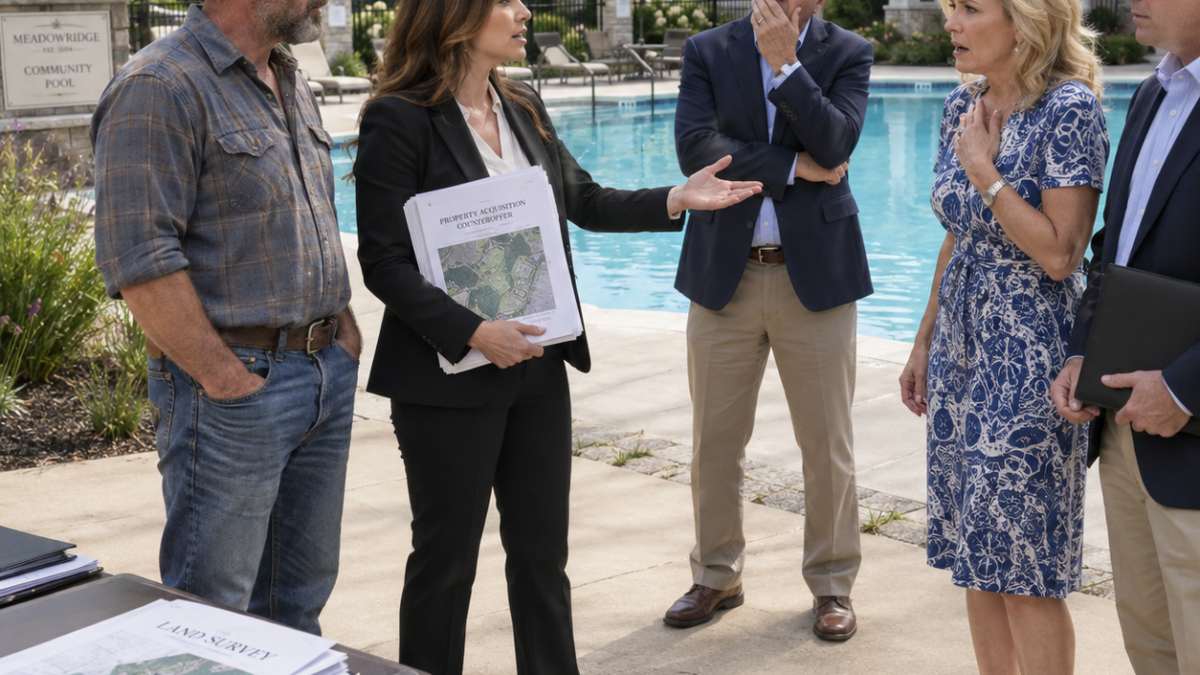
The blue rectangle beneath it contained the Harmony Creek pool, the clubhouse, two tennis courts, a playground, and roughly two acres of common property.
That complex was the heart of Karen’s world.
Every HOA meeting happened there.
Every summer party.
Every committee luncheon.
Every annual election.
Karen had an office inside the clubhouse with her name printed on a brass plate.
If Harmony Creek was her kingdom, that building was the palace.
Ben tapped the map again.
“They assigned a value to your property.”
“A ridiculous one.”
“Exactly.”
He leaned back.
“People like Karen love arbitrary valuations when they only hurt someone else.”
Sarah folded her arms.
“And?”
“And sometimes the fastest way to expose a ridiculous argument is to agree with it.”
I stared at him.
He smiled.
“They say ten acres of historic Virginia farmland surrounded by development is worth two hundred thousand dollars.”
“Yes.”
“So we accept their economic logic.”
I looked at the blue rectangle.
Then at Ben.
“No.”
His grin widened.
“Oh, yes.”
Sarah began laughing before I did.
“You want the pool?”
“Not just the pool.”
Ben started counting.
“The swimming pool. Clubhouse. Associated common parcel. Free and clear.”
I stared at him.
“You’re serious.”
“Completely.”
“They’ll never accept it.”
“I hope not.”
That stopped me.
“You hope not?”
“Jack, this counteroffer isn’t designed to buy a swimming pool.”
He leaned forward.
“It’s designed to force Karen to explain her own conduct.”
Then he walked to the whiteboard.
“Right now she controls the narrative. According to her, you’re the stubborn farmer refusing to follow reasonable community standards. She probably tells residents that your land is worth nothing and that the HOA is generously trying to solve an eyesore.”
He wrote three words.
MAKE HER EXPLAIN.
“The moment we counter with the clubhouse and pool, she has a problem.”
“How?”
“If she hides our letter from the board, she potentially breaches her fiduciary duty.”
He held up one finger.
“If she reveals it, homeowners will ask why we’re demanding their pool.”
Second finger.
“Then she has to explain her offer for your farm.”
Third finger.
“And once she explains that, people start asking how she arrived at two hundred thousand dollars.”
I could already see it.
Ben continued.
“They may also ask why the HOA is spending association resources trying to acquire property that isn’t part of the association.”
Sarah looked at me.
“And why they’ve been sending us fines.”
“Correct,” Ben said.
He pointed at her.
“That’s where this becomes dangerous for Karen.”
I looked through the glass wall of the conference room toward downtown Richmond.
For months, Karen had forced us to defend ourselves.
Every violation required an answer.
Every threat demanded another document.
Every letter made me prove something I already knew.
That the land was ours.
That we had done nothing wrong.
That I wasn’t crazy.
Ben was proposing something different.
Stop answering Karen’s questions.
Make her answer ours.
“When can you send it?” I asked.
Ben sat back down.
“I need two days.”
“Why two?”
“Because if we’re going to be ridiculous, I want to be ridiculous with impeccable legal drafting.”
Sarah laughed again.
For the first time in weeks, so did I.
But Ben’s expression became serious.
“One other thing.”
“What?”
“The pool is theater.”
He pulled my accordion folder toward him.
“This is the real war.”
He removed the county plat map.
“We need every document proving your exemption.”
He removed Karen’s offer.
“We need evidence showing motive.”
Then he removed the stack of fines.
“And we need evidence showing pattern.”
His eyes met mine.
“Because people who try this once have usually tried something before.”
That sentence changed everything.
Until that moment, I thought Karen’s obsession with my farm was personal.
I was wrong.
Over the next week, we began digging into Harmony Creek.
And what we found made the pool counteroffer look almost polite.
The first major discovery came from Maria, Ben’s paralegal.
Maria was maybe twenty-eight, wore sneakers with business clothes, and could retrieve a county document faster than most people could locate their car keys.
She called me three days after our first meeting.
“You need to come in.”
“Good news?”
“You’re going to enjoy this.”
Sarah and I drove to Richmond.
When we entered the conference room, Maria had a three-hundred-page development filing open on a laptop.
Beside it lay a printed page highlighted in yellow.
“Original Harmony Creek development prospectus,” she said.
She pointed to a section labeled EXCLUDED PARCELS.
Then she read my parcel number.
My stomach tightened.
The language was unmistakable.
My ten acres were wholly excluded from all future Harmony Creek covenants, restrictions, assessments, and homeowners association authority.
In perpetuity.
Sarah slowly sat down.
“In perpetuity?”
Maria nodded.
Ben looked delighted.
“Not ambiguous. Not debatable. Not a gray area.”
He slid the paper toward me.
“They didn’t forget your farm.”
“What do you mean?”
“The original developer specifically carved it out.”
I remembered Karen’s words at the HOA meeting.
Any neighboring property benefiting from our values can be governed by our standards.
“Her argument was nonsense.”
“Worse,” Ben said.
“If she had access to the governing records—and as president she should have—there is a strong argument she knew it was nonsense.”
Sarah looked at him.
“So why keep doing it?”
“That,” Ben said, “is now the interesting question.”
We found the first answer through former board members.
A private investigator named Fisher tracked down two people who had resigned from Harmony Creek’s board within the previous year.
Neither initially wanted to talk.
Then Fisher mentioned Karen.
Both changed their minds.
One was a retired accountant named Ron.
The other was a nurse practitioner named Denise.
Ben arranged separate interviews.
I attended Denise’s.
She arrived looking nervous.
Before sitting, she asked, “Will Karen know I talked to you?”
Ben shook his head.
“Not unless this becomes relevant evidence and you agree to provide a statement.”
Denise exhaled.
Then she began.
At first, she had liked Karen.
Karen was organized.
Assertive.
Always prepared.
The sort of person who volunteered when everyone else avoided responsibility.
But once she became president, everything changed.
“She wanted loyalty,” Denise said.
“Not agreement. Loyalty.”
She described secret conversations before meetings.
Votes decided in advance.
Violation notices used against residents who complained.
Friendly homeowners receiving exemptions.
Unfriendly ones receiving fines.
“Did Karen ever discuss my farm?” I asked.
Denise hesitated.
“Yes.”
Sarah’s hand tightened around mine beneath the table.
“What did she say?”
“She said your property was preventing Harmony Creek from reaching its full value.”
“What does that mean?”
“I asked the same thing.”
“And?”
“She said if your land could be acquired, the development could expand.”
There it was.
A small sentence.
But everything suddenly aligned.
The fines.
The pressure.
The offer.
This wasn’t about my barn.
It wasn’t about wildflowers.
It wasn’t about my truck.
Karen wanted the land.
“Who wanted the expansion?” Ben asked.
Denise shook her head.
“She never said.”
We found out soon enough.
Harmony Creek had been built by Prestige Homes.
Prestige had tried several times to buy my family’s acreage before construction began.
My grandfather had refused.
My father had refused.
When the land came to me, I refused too.
The company built around us.
Apparently, they never stopped wanting those ten acres.
Then Maria Garcia entered the story.
Maria was married to Luis Garcia, one of the Harmony Creek residents Karen had fined repeatedly because their Chihuahua barked at the mailman.
Maria’s sister worked for a competing development company.
Through office gossip, she had heard Prestige was considering a Phase Two expansion.
And there was another detail.
The CEO of Prestige regularly played golf with Karen’s husband.
I brought that information to Ben.
He didn’t celebrate.
He became very still.
“Be careful,” he said.
“With what?”
“Calling something a conspiracy before we prove it.”
“But—”
“I know what it looks like.”
He tapped the table.
“Our job is not to prove what it looks like.”
He looked at me.
“Our job is to prove what happened.”
That was Sarah’s philosophy too.
Facts, not fury.
So we started collecting facts.
While Ben handled records, I handled the neighborhood.
Karen had made one serious mistake.
She assumed everyone she had bullied was isolated.
They weren’t.
They just didn’t know about one another.
The first was Mr. Henderson.
Not the city official from another chapter of my life.
This Henderson was Walter Henderson, seventy-six years old, widowed, and surrounded by tiny ceramic garden gnomes.
His late wife, Mary, had collected them.
Karen hated them.
One afternoon, I found Walter staring at a community watch sign planted through one corner of his flower bed.
The landscaping crew had crushed a patch of zinnias while installing it.
I brought him a jar of Sarah’s peach preserves.
He looked surprised.
“My wife made too much.”
Walter smiled.
“Tell her thank you.”
We stood quietly.
Then I nodded toward the flattened flowers.
“Those yours?”
His face changed.
“Mary planted the first ones.”
He stared at the sign.
“They said that corner was common easement.”
“Was it?”
“I don’t know anymore.”
He looked exhausted.
Then he pointed toward his gnomes.
“She fined me two hundred dollars for those.”
“Karen?”
He nodded.
“Said they were excessive.”
His voice cracked slightly.
“My wife bought one every anniversary.”
There were thirty-eight gnomes.
I understood immediately.
Those ridiculous little statues were not decorations.
They were a marriage.
Karen had fined a grieving man for memories.
I felt heat rise in my chest.
But I remembered Ben.
Facts.
Not fury.
“I have a lawyer,” I said.
Walter looked at me.
“I’m fighting the HOA.”
He immediately glanced down the street.
“Keep your voice down.”
That told me everything.
“They can’t own your voice, Walter.”
He swallowed.
“You don’t understand.”
“I think I’m starting to.”
I gave him my number.
“No pressure.”
Three nights later, Walter appeared on my porch after dark.
Beside him stood Tom Miller.
Tom lived a few streets over with his wife Lisa and their two boys.
Karen hated their basketball hoop.
She also hated their cedar playset.
And apparently their welcome mat.
“They called it overly personalized,” Tom told me at our kitchen table.
I stared at him.
“What does that even mean?”
“It said ‘The Millers.’”
Sarah covered her mouth.
Walter started laughing.
Soon we all were.
Not because it was funny.
Because sometimes absurdity is so complete that laughter is the last rational response.
Tom pulled out his own folder.
“One thousand three hundred dollars.”
“For what?”
“Hoop. Playset. Trash bin visible for ninety minutes. Minivan supposedly parked at an improper angle.”
“Improper angle?”
“Apparently my driveway has geometry standards.”
Walter placed his notices beside Tom’s.
Then I brought mine.
Three households.
Three stacks of fear.
That was the night the Harmony Creek Homeowners Liberation Front was born.
Tom came up with the name.
Sarah said it sounded ridiculous.
That was why we kept it.
Within two weeks, there were nine families meeting at my farmhouse.
Then thirteen.
Then nineteen.
Every person brought paper.
Fines.
Warnings.
Photographs.
Letters.
Some were legitimate minor violations.
Most were petty.
Several seemed entirely invented.
But the pattern mattered more than any single notice.
People Karen liked received warnings.
People who challenged her received penalties.
People who attended meetings and questioned finances received multiple penalties.
I was not the first person she had tried to financially exhaust.
I was simply the first person outside the HOA she had tried to absorb.
Then Ben discovered the elderly couple.
Their names were Robert and Elaine Maddox.
They had lived in Harmony Creek almost since it opened.
Three years earlier, Karen began fining them.
Mailbox.
Fence color.
Landscaping.
Exterior lighting.
Their penalties climbed.
Robert had Parkinson’s disease.
Elaine was caring for him full time.
Eventually, they sold.
The buyer?
A cousin of Karen’s.
The sale price was well below comparable homes.
When Ben showed me the record, I felt sick.
Sarah read it silently.
“Did she force them?”
“We don’t know,” Ben said.
“Can we prove anything illegal?”
“Not yet.”
Again.
Not yet.
That phrase became our discipline.
We would not become Karen.
We would not turn suspicion into fact simply because it fit what we believed.
We documented.
We verified.
We waited.
Meanwhile, Karen kept sending fines to my farm.
One accused me of improper agricultural equipment storage because my tiller was visible through an open barn door.
Another cited noise from Lily laughing on the porch with two friends.
That one nearly broke my discipline.
I held the notice in my hand.
“Noise violation?”
Sarah read it.
Her face hardened.
“Our daughter?”
“Yes.”
Sarah had always been the calm one.
Not that night.
“She can come after the barn. She can come after the truck. She does not get to make Lily afraid to laugh at her own house.”
I watched her tear up.
Then something inside me settled.
No more reacting.
We were finishing this.
The fourteen-day deadline on the purchase offer approached.
Ben completed our counteroffer.
He called me into his office to read the final version.
It began politely.
That made it worse.
It established my legal exemption.
It demanded immediate cancellation of every fraudulent fine.
It demanded a written acknowledgment that Harmony Creek possessed no authority over my property.
Then came the rejection.
The HOA’s two-hundred-thousand-dollar valuation was characterized as commercially unreasonable and inconsistent with surrounding land values.
Ben referenced the apparent interest of Prestige Homes.
Carefully.
No accusation beyond what we could support.
Then he reached the part we had been waiting for.
My client nevertheless wishes to demonstrate the same spirit of compromise the Association has requested of him.
I looked at Sarah.
She smiled.
Ben continued reading.
Since Harmony Creek Estates has valued Mr. Davies’s ten-acre property at $200,000, my client is prepared to accept a non-cash exchange of assets that the Association may reasonably consider of comparable value.
He paused.
Sarah whispered, “Here we go.”
Ben read:
Harmony Creek Estates shall transfer, free and clear of liens, encumbrances, easements inconsistent with private ownership, or continuing association obligations, full title to the Harmony Creek community clubhouse, community swimming pool, and approximately two acres of associated common land.
I laughed.
I could not help it.
Then came the final line.
Upon successful transfer, Mr. Davies will convey his ten-acre farm to the purchaser designated by the Association, subject to independent confirmation of all legal and tax requirements.
Ben lowered the paper.
“Well?”
“It’s insane.”
“Yes.”
“I love it.”
Sarah leaned toward him.
“What happens now?”
“Karen receives it.”
“And then?”
Ben smiled.
“We learn whether she understands chess.”
The letter was delivered to the HOA office.
Karen personally signed for it.
Then nothing happened.
No fines.
No threatening calls.
No letters.
Harmony Creek went quiet.
That silence lasted seven days.
The next HOA meeting was Tuesday.
Our group decided to attend.
Not secretly.
Together.
Sarah wanted to come.
I hesitated.
She noticed.
“Don’t.”
“Don’t what?”
“Decide you have to protect me by leaving me home.”
“I wasn’t.”
“You were.”
I smiled.
“Married too long.”
“Long enough.”
So Sarah came.
Walter wore a blazer.
Tom and Lisa came together.
The Garcias sat beside them.
Others from our group filled two full rows.
When Karen entered, she saw us immediately.
For the first time since I had known her, she looked nervous before I spoke.
The meeting began.
Pool maintenance.
Landscaping.
A complaint about pet waste stations.
Nobody cared.
Every person in the room had heard rumors.
Somebody was suing.
I wanted their pool.
I planned to close the clubhouse.
I was apparently going to release cattle into the development.
That last one was new.
Karen kept deflecting questions.
Finally, new business arrived.
She picked up Ben’s letter.
Her hands shook.
“The board has received a communication from legal counsel representing Mr. Jack Davies.”
She looked directly at me.
“It is an extraordinary and, frankly, hostile document.”
Ben had warned me not to respond to insults.
So I sat.
Karen summarized the cease-and-desist language.
She dismissed my property exemption as disputed.
Then she arrived at the counteroffer.
Her face reddened.
“Mr. Davies has demanded that Harmony Creek deed him our community swimming pool, clubhouse, and the land surrounding them.”
The room went silent.
Then someone laughed.
One person.
Then another.
A nervous ripple spread through the chairs.
Karen slammed her palm on the table.
“This is not funny!”
That made more people laugh.
She had lost the emotional center of the room.
She knew it.
“The proposal is absurd,” she snapped. “It demonstrates Mr. Davies’s contempt for this community.”
That was my cue.
I stood.
“May I ask a question?”
“No.”
A woman shouted from the back.
“Let him speak!”
Then a man near the aisle.
“I want to hear why he wants the pool.”
Karen’s eyes flashed.
I turned toward the homeowners.
“I don’t want your pool.”
The laughter stopped.
“I never wanted your clubhouse.”
People leaned forward.
“My attorney’s offer was based on one thing.”
I lifted the HOA purchase letter.
“Your board says my ten-acre farm is worth two hundred thousand dollars.”
Murmurs started.
I continued.
“That land borders a major residential development. Developers have paid many times that price for comparable acreage nearby.”
Karen interrupted.
“Those claims are unsupported!”
I looked at her.
“You sent me the offer.”
“I’m talking about your valuation.”
“Good.”
I faced the crowd again.
“If two hundred thousand is fair for my ten acres, why is asking for your pool and two-acre common parcel insulting?”
Silence.
That question landed exactly as Ben predicted.
Tom stood.
“My family has paid over a thousand dollars in fines because my children leave a basketball hoop outside.”
Karen struck the gavel.
“Sit down.”
Tom didn’t.
“You told us those fines protect property values.”
“Mr. Miller—”
“But now the board wants to acquire ten acres for a fraction of market value.”
More murmurs.
“How does that protect property values?”
Walter Henderson slowly rose.
His hands trembled.
But his voice did not.
“I have a question too.”
Karen looked toward him.
“Walter, please—”
“My wife’s garden gnomes.”
The room quieted.
Karen’s expression changed.
Walter continued.
“You fined me two hundred dollars because Mary’s gnomes supposedly lowered community standards.”
Nobody laughed.
“She bought one every anniversary for thirty-eight years.”
A woman near him covered her mouth.
Walter looked at Karen.
“My wife died eighteen months ago.”
His voice cracked.
“You knew that.”
Karen looked away.
“I asked you for an exception.”
“Walter, this isn’t relevant—”
“You said rules were rules.”
He lifted one trembling hand.
“Are rules still rules when your husband’s friend wants Jack’s land?”
The room exploded.
Karen stood.
“That is defamatory!”
A woman in the back shouted.
“Is Prestige Homes involved?”
Another yelled.
“Does your husband know their CEO?”
Another:
“Why is the HOA buying land anyway?”
Another:
“How much have we spent on lawyers?”
Karen pounded the gavel.
“Order!”
Nobody listened.
One of the board members leaned toward her.
She shoved him away.
“This is an orchestrated attack!”
I remained standing.
Karen pointed at me.
“You poisoned these people against me.”
“No.”
“You came in here with your lawyer and your ridiculous pool demand—”
“No, Karen.”
My voice was quiet.
That made the room quiet too.
“You sent the first letter.”
Her finger remained pointed.
“You fined land you didn’t govern.”
I took another breath.
“You offered pennies on the dollar for property you knew Prestige wanted.”
Her face went pale.
“We have documents showing my parcel was excluded from Harmony Creek in perpetuity.”
I held them up.
“Your board should have had them.”
A member beside Karen turned sharply toward her.
“What documents?”
There.
The crack.
I watched it move through the board in real time.
Karen had not told all of them.
She looked toward the vice president.
“I explained the situation.”
“No,” he said.
“You told us his exemption was ambiguous.”
“It is!”
I walked toward the front.
Not aggressively.
Slowly.
I placed a copy of the original developer filing on the table.
“Read the highlighted paragraph.”
The vice president did.
His face changed.
Another board member reached for it.
Karen tried to pull the page away.
Too late.
“What the hell, Karen?” he whispered.
The room erupted again.
I looked at Sarah.
She had tears in her eyes.
Not fear.
Relief.
The spell was breaking.
For months, Karen had stood behind the board and spoken as if she represented everyone.
Now people saw something else.
She represented herself.
We left before the meeting ended.
I didn’t want the moment to become a mob scene.
On the steps outside, Walter stopped.
His eyes were wet.
“You okay?” I asked.
He nodded.
“I haven’t said Mary’s name in that room since she died.”
Sarah hugged him.
Behind us, shouting continued inside.
Tom stepped through the doors.
“Well.”
“What?”
“I think your lawyer’s pool idea worked.”
I looked toward the lit clubhouse windows.
“No.”
Tom frowned.
“What do you mean?”
“It opened the door.”
The real fight was still coming.
Two days later, Karen sued me.
The HOA filed an action seeking foreclosure based on nearly one hundred thousand dollars in alleged unpaid fines, fees, interest, and legal expenses.
She actually did it.
Even after the meeting.
Even after seeing the exemption document.
Even after her own board members questioned her.
Sarah read the lawsuit beside me in the kitchen.
Lily was upstairs.
We had not told her everything.
She knew “the neighborhood lady” didn’t like the farm.
She did not know someone was asking a court to force its sale.
Sarah’s hand shook.
“Could we lose?”
I hated that question.
Not because I doubted our case.
Because my wife had to ask.
“I don’t believe so.”
“That isn’t the same as no.”
“No.”
I reached for her.
She pulled away.
Not angrily.
She stood and walked toward the window.
Outside, the pasture rolled toward the stone wall.
Lily’s pony stood near the fence.
Sarah folded her arms around herself.
“What happens if a judge makes a mistake?”
“Ben—”
“What happens?”
I had no answer that would erase fear.
So I gave her the truth.
“We appeal.”
“And while we appeal?”
“We keep fighting.”
She turned.
“I’m tired, Jack.”
That hit me harder than Karen’s lawsuit.
I walked over.
“I know.”
“No. I don’t think you do.”
Her eyes filled.
“You know how to fight. You’ve spent your whole adult life knowing how to function when everything becomes a mission.”
I said nothing.
“I’m tired of our daughter asking why certified mail makes me sick.”
That broke something in me.
I held her.
She cried into my shirt.
“I don’t want them taking our home.”
“They won’t.”
“You can’t promise that.”
“No.”
I pulled back and looked at her.
“But I can promise I will not let fear make the decision for us.”
Sarah wiped her face.
Then she nodded.
“Call Ben.”
I did.
When I told him the HOA had filed, he laughed once.
Not because it was funny.
Because Karen had finally made the move he had prepared for.
“Good,” he said.
“Sarah doesn’t think it’s good.”
“Tell Sarah I apologize.”
“What happens now?”
“Now they have to prove your debt.”
“They can’t.”
“Correct.”
“And?”
“And we counterclaim.”
“How big?”
There was silence.
Then:
“Bigger than the pool.”
Ben’s response was more than one hundred pages.
He attacked the liens.
He challenged the HOA’s authority.
He alleged slander of title.
Abuse of process.
Harassment.
Breach of fiduciary duty.
Civil conspiracy.
Fraud-related conduct to the extent supported by evidence.
He named the HOA.
Then, based on the developing record, he named Karen and several board members individually.
The numbers were enormous.
But Ben warned me not to focus on them.
“Damage demands are not lottery tickets,” he said. “Our leverage is evidence.”
Discovery opened.
That was when Karen’s world began to collapse.
Emails.
Bank statements.
Board minutes.
Vendor records.
Texts.
Contracts.
The things powerful people write when they believe nobody will ever read them are extraordinary.
We discovered communications with Prestige Homes.
At first, they were vague.
Then they weren’t.
Karen had communicated directly with the CEO.
She complained that I was “stubborn.”
She described the farm as “the final obstacle.”
She discussed pressure tactics.
One message made my stomach turn.
If we make holding the parcel expensive enough, he’ll eventually take a number that works.
Another:
The violations create leverage. He doesn’t need to know they’re negotiable until closing.
I read that sentence twice.
Sarah read it once.
Then she left the room.
I found her on the porch.
She was staring toward the barn.
“They knew.”
“Yes.”
“All those nights we sat at that table wondering if maybe there was some rule we had misunderstood.”
“I know.”
“They knew.”
“Yes.”
She turned toward me.
“I want them to pay.”
It was the first time Sarah had said it.
Not defend ourselves.
Not stop them.
Pay.
I understood.
But I also remembered what revenge does when it becomes the objective.
“We let the process work.”
She almost laughed.
“You sound like Ben.”
“He’s rubbing off on me.”
Sarah wiped her eyes.
“I hate them.”
“I know.”
“No. I mean I really hate what they did to us.”
I took her hand.
“Then don’t let them take anything else.”
She looked at me.
“Not one more night. Not one more piece of you.”
Her breathing slowed.
Then she nodded.
The financial records revealed more.
Landscaping contracts awarded to Karen’s brother-in-law.
Charges above market rate.
HOA workers spending significant time maintaining Karen’s personal yard.
Association credit cards used for expensive meals.
Spa visits.
Travel categorized as “community outreach.”
Not every questionable charge was automatically criminal.
Ben reminded us of that constantly.
But the pattern was ugly.
Then came the worst evidence.
A potential side arrangement connected to acquisition of my property.
Communications suggested Karen expected compensation if the Prestige deal closed.
A finder’s fee.
I sat in Ben’s office when he showed me.
“You wanted motive,” he said.
I stared at the email.
“There it is.”
“Maybe.”
“What do you mean maybe?”
“Context matters.”
He pointed at me.
“Never outrun the evidence.”
I nodded.
But I knew.
So did he.
Then Richmond television got interested.
An investigative reporter named Sharon Price reviewed the documents.
Ben never handed her anything confidential or protected.
Only material he could lawfully provide.
She did her own work.
That was important.
She interviewed former board members.
Homeowners.
Walter.
Tom.
She verified public filings.
She confirmed the relationship between Prestige’s CEO and Karen’s husband.
She filmed my farm.
Then she interviewed me.
We stood near the barn my grandfather had worked in.
“What do you want people to understand?” she asked.
I looked at the camera.
“That this was never about refusing reasonable rules.”
I pointed toward Harmony Creek.
“My land is not part of that HOA.”
“So why do you believe you were targeted?”
“Because somebody wanted this property.”
“Who?”
“I’m going to let the documents answer that.”
Ben approved.
Facts.
Not fury.
The news segment aired Tuesday at six.
It began with aerial footage of my farm surrounded on three sides by Harmony Creek.
Then Sharon displayed the exclusion documents.
The fines.
The lowball offer.
The pool counteroffer.
Tom described his children’s basketball hoop fines.
Then Walter appeared.
He held one of Mary’s gnomes.
His voice broke when he explained what it meant.
Sarah cried watching him.
So did I.
Then the report addressed Prestige.
The emails.
The relationships.
The questions about contracts.
The story exploded.
By midnight, Harmony Creek’s private social media groups were in chaos.
By morning, two board members resigned.
By afternoon, another retained personal counsel.
Then came the insurance company.
The HOA had directors and officers liability coverage.
But intentional wrongdoing was potentially excluded.
Karen suddenly faced the possibility that her insurer might defend the HOA without paying a judgment for her own willful misconduct.
The walls were closing.
Then the homeowners organized.
Not me.
That mattered.
Tom.
Lisa.
Maria and Luis.
Walter.
People who had lived under Karen’s rule.
They circulated a recall petition.
The bylaws required twenty-five percent.
They passed that threshold in less than forty-eight hours.
By the special meeting, Karen looked transformed.
No floral pantsuit.
No triumphant smile.
No laminated badge.
She wore a dark blazer.
Her face was pale.
The clubhouse was packed.
I sat near the back with Sarah.
I did not speak.
This wasn’t my meeting anymore.
It belonged to them.
Karen stood at the microphone.
“For months, I have been the target of a coordinated smear campaign led by an outsider who openly despises our community.”
Nobody reacted.
She continued.
“I have made difficult decisions, but every one of those decisions was made to protect Harmony Creek.”
A man shouted:
“Then why were you trying to help Prestige buy Jack’s farm?”
Karen’s eyes flashed.
“That accusation is false.”
Another voice:
“What about the emails?”
“I have been advised not to discuss pending litigation.”
Tom stood.
“Then discuss the fines.”
Silence.
“My kids’ basketball hoop.”
Karen’s mouth tightened.
Walter rose beside him.
“My wife’s gnomes.”
Maria Garcia stood.
“Our dog.”
More people stood.
One by one.
Not shouting.
Standing.
A woman Karen had fined over curtains.
A family cited over a playhouse.
A retired teacher fined because her flower bed extended beyond an arbitrary line.
Soon almost half the room was standing.
Karen looked around.
This was her real verdict.
Not the court.
Not television.
The people she had ruled.
The recall vote was secret ballot.
One hundred eighty-seven voted to remove her.
Twelve voted to keep her.
When the number was read, Karen remained seated.
Nobody cheered at first.
Then Walter exhaled.
A sound almost like a laugh escaped him.
Someone clapped.
Then the room erupted.
Karen stood.
For a moment, I thought she would speak.
Instead, her eyes found mine.
I expected hatred.
What I saw was disbelief.
As if even then she could not understand how control had vanished.
She walked out alone.
Her last loyal board member resigned minutes later.
Harmony Creek elected an interim board.
Eleanor Price, a widow who had once been fined because she planted too many roses, became president.
Tom Miller became treasurer.
Walter Henderson was placed on the architectural committee.
When his name was announced, someone shouted:
“Gnomes for everyone!”
The room exploded in laughter.
Walter laughed too.
Then he cried.
I saw him press a hand against his eyes.
Sarah leaned against me.
“That,” she whispered, “might be the best thing I’ve seen in a year.”
The next morning, Eleanor called Ben.
The HOA withdrew the foreclosure suit.
Every alleged lien against my farm was released.
The fraudulent fines disappeared.
But our counterclaims remained.
Karen had spent months forcing us to respond.
Now she was the defendant.
The new board wanted settlement.
So did I.
Not because I wanted Karen protected.
Because I wanted Harmony Creek homeowners protected from paying endlessly for Karen’s decisions.
Eleanor met me at the farmhouse before formal negotiations began.
She brought no lawyer.
Just herself.
We sat on the porch.
“I owe you an apology,” she said.
“You don’t.”
“Yes.”
She looked toward the neighborhood.
“I knew some things were wrong.”
“Knowing isn’t the same as causing them.”
“No. But I stayed quiet because I didn’t want her attention.”
That was a confession I had heard from many people.
Eleanor looked at me.
“Silence helped her.”
I didn’t argue.
“What do you want, Jack?”
“My farm left alone.”
“Done.”
“Every homeowner told the truth about what happened.”
She nodded.
“Financial transparency.”
“Yes.”
“An independent audit.”
She hesitated.
Then nodded again.
“And reforms so this can’t happen to someone else.”
Eleanor smiled sadly.
“Anything for yourself?”
I thought about Sarah crying at the kitchen table.
Lily asking about certified letters.
The months of attorney meetings.
The damage to our name.
“Legal fees.”
“Of course.”
“And whatever Ben believes reasonably compensates my family for what we went through.”
She nodded.
“That’s fair.”
The eventual settlement paid our legal expenses.
Our family received seventy-five thousand dollars for the harassment and harm we had endured.
Former board members were required to contribute additional money into a community improvement fund.
Formal apologies were issued.
Most importantly, a forensic audit began.
The results were worse than almost anyone expected.
Overbilling.
Conflicts of interest.
Questionable credit card use.
No-bid deals.
Money spent without adequate board oversight.
Then investigators reached the Prestige communications.
At that point, the civil fight passed into a different world.
The audit report went to county authorities.
Ben warned me not to speculate publicly.
So I didn’t.
But eventually authorities announced a criminal investigation.
Karen and others became subjects of allegations involving fraud, conspiracy, misuse of HOA funds, and conduct related to the attempted acquisition of my land.
Whether every allegation would result in conviction was for prosecutors and courts to determine.
For me, the important part had already happened.
The farm was safe.
Then, months after Karen’s recall, a moving truck appeared outside her home.
Sarah noticed first.
“She’s leaving.”
I stood at the kitchen window.
Workers carried boxes toward the truck.
Part of me expected satisfaction.
Instead, I remembered the afternoon she had stood outside my stone wall.
Thirty days, Mr. Davies.
That felt like a lifetime ago.
I walked onto the porch.
Not because I wanted a confrontation.
Because I had fence hardware to repair near the road.
At least that was what I told myself.
Karen came out while I was near the mailbox.
She saw me.
We stood perhaps forty yards apart.
Then she walked toward the street.
Slowly.
Her hair was no longer stiffly styled.
She wore jeans.
No HOA badge.
No clipboard.
She stopped across the stone wall.
The same wall.
“This what you wanted?” she asked.
I set down the wrench.
“No.”
“Don’t lie.”
“I wanted you to leave my property alone.”
“You destroyed my life.”
I looked at her.
“No.”
Her face twisted.
“You put me on television.”
“A reporter investigated public records.”
“You organized everyone.”
“They organized themselves.”
“You sued me.”
“You sued first.”
She flinched.
I continued.
“You tried to foreclose on land you knew your HOA didn’t govern.”
“I was trying to protect the community.”
“From what?”
She looked toward my barn.
“That.”
For a second I almost laughed.
“A barn?”
“It doesn’t belong beside a neighborhood like Harmony Creek.”
I looked at the hundred-year-old oak siding.
“Karen, the barn was here first.”
“So what?”
There it was.
The entire conflict in two words.
So what?
History didn’t matter.
Boundaries didn’t matter.
People didn’t matter.
Only her vision.
“You never understood why I wouldn’t sell,” I said.
She crossed her arms.
“It was dirt.”
“No.”
“It’s ten acres.”
“No.”
“What is it then?”
I looked toward the house.
Sarah was standing in the doorway.
Lily had come behind her.
I looked toward the barn where my father had taught me to rebuild a carburetor.
Toward the pasture where my grandfather once raised cattle.
Toward the stone wall my great-grandfather had repaired by hand.
“It’s where my family remembers itself.”
Karen stared at me.
For once, she had no response.
Then she said quietly:
“You could have taken the money.”
“You could have taken no for an answer.”
The sentence seemed to hit her harder than anything else.
She looked down.
A horn sounded from the moving truck.
Karen stepped backward.
Then she looked at me one last time.
“What about the pool?”
I blinked.
For the first time in months, I laughed.
“The pool?”
“You demanded it.”
“I never wanted your pool.”
Her expression almost looked offended.
“Then why—”
“Because you valued my land at two hundred thousand dollars.”
I smiled.
“I wanted you to feel what your offer felt like.”
She stared at me.
Then something changed.
Maybe she finally understood.
Maybe she didn’t.
She turned.
Walked to her car.
And left Harmony Creek.
I never spoke to her again.
The new HOA board moved quickly.
They amended the governing documents.
The most important addition became known informally as the Davies Good Neighbor Clause.
It stated clearly that Harmony Creek could not impose covenants, assessments, fines, design standards, enforcement actions, or liens on any property outside the association’s legal boundaries.
No creative interpretation.
No aesthetic benefit theory.
No imaginary jurisdiction.
My farm was permanently recognized as independent.
The second major reform required competitive bidding for substantial vendor contracts.
The third required detailed financial statements to homeowners.
The fourth created an independent violation appeal process.
Walter insisted on one additional provision.
Reasonable personal garden ornaments could not be prohibited unless they created a genuine safety or nuisance issue.
At the next meeting, he brought one of Mary’s gnomes.
Placed it on the table.
And said:
“I’d like this entered into the minutes.”
Eleanor laughed so hard she had to sit down.
The basketball hoop returned to the Miller driveway.
The Garcias kept their Chihuahua.
Eleanor planted even more roses.
And something strange happened between our farm and Harmony Creek.
The wall stopped feeling like a border.
Children from the neighborhood occasionally came over to see Lily’s pony.
Tom helped me repair fencing one Saturday.
Walter began walking down every Sunday afternoon with coffee.
Sarah sent peach preserves back with him.
The same houses that once felt like an army surrounding us gradually became what they should have been all along.
Neighbors.
One Saturday, Eleanor walked up our driveway carrying an apple pie.
Walter was with her.
I met them on the porch.
“What’s this?” I asked.
“A bribe,” Walter said.
“For what?”
“Unlimited gnome expansion.”
Eleanor nudged him.
“Stop.”
She handed me the pie.
“We wanted to say thank you.”
I shook my head.
“You don’t owe me anything.”
“Yes, we do.”
“No.”
Eleanor looked toward Harmony Creek.
“Jack, we thought we had an HOA problem.”
“You did.”
“No.”
She turned back to me.
“We had a courage problem.”
Walter lowered his eyes.
“For years, everybody waited for somebody else to stand up.”
I looked at him.
“You stood up.”
“Eventually.”
“That’s what counts.”
Walter smiled.
“The gnomes helped.”
We stood overlooking the field.
The afternoon sun stretched long shadows across the grass.
A few cows grazed near the back fence.
Lily was working with her pony.
Sarah was in the garden.
Eleanor pointed toward the pool visible between the distant houses.
“You sure you don’t want it?”
I looked at her.
She was smiling.
“I’d have to maintain it.”
Walter nodded solemnly.
“Terrible investment.”
I laughed.
“No pool.”
That evening, Sarah cut the apple pie.
Lily took the first slice.
I sat by the kitchen window while the last sunlight disappeared across the farm.
For almost a year, every time I looked toward Harmony Creek, I had felt pressure.
Threat.
Encroachment.
Now the subdivision lights came on one by one.
Porches.
Kitchen windows.
Streetlamps.
They looked different.
Not because the houses had changed.
Because the fear had.
Sarah placed a plate in front of me.
“You’re staring again.”
“I’m thinking.”
“Dangerous.”
I took a bite of pie.
“What are you thinking about?”
“The offer.”
“Which one?”
“Theirs.”
She sat across from me.
“Two hundred thousand dollars.”
I nodded.
“If we had accepted it…”
“We didn’t.”
“I know.”
“But you almost wanted to.”
I looked at her.
That night came back immediately.
The mountain of violation letters.
The legal threat.
The exhaustion.
Maybe we should just sell.
I remembered saying it.
“I was tired.”
“So was I.”
“You stopped me.”
“No.”
Sarah shook her head.
“I reminded you what you already knew.”
I took her hand.
“Thank you.”
She smiled.
“For not selling the farm?”
“For not letting me surrender just because surrender looked easier.”
We sat quietly.
Then Lily appeared in the doorway.
“Dad?”
“Yes?”
“Can I paint the barn door blue?”
I stared at her.
Sarah covered her mouth.
“Blue?”
Lily nodded.
“A dark blue.”
I narrowed my eyes.
“Is that an approved HOA color?”
She smiled.
“We’re not in the HOA.”
Sarah burst out laughing.
So did I.
“Paint it whatever color you want.”
The next weekend, we painted one of the smaller barn doors blue.
Not because it needed paint.
Because we could.
Walter came over and supervised.
Tom brought beer.
The Miller boys painted more of themselves than the door.
The Garcias brought food.
By sunset, twenty people were sitting around folding tables beside the barn.
Harmony Creek residents.
Farm people.
Children.
Retirees.
Nobody measured the grass.
Nobody discussed acceptable welcome mats.
Nobody cared where Tom parked his minivan.
Walter had placed three garden gnomes beside the stone wall.
One wore a Marine-style helmet.
“That’s offensive,” I told him.
“To whom?”
“Marines.”
He laughed.
As darkness settled over the farm, I looked around the table.
These were people who once whispered about me.
People Karen had told I was unstable.
People who had believed my farm threatened their property values.
Now they were eating Sarah’s peach cobbler beneath lights hanging from the barn rafters.
Tom raised his drink.
“To Jack.”
I shook my head.
“No.”
He ignored me.
“To the man who tried to steal our pool.”
Everyone laughed.
I stood.
“First, your pool was vastly overvalued.”
More laughter.
“Second, I’d like the record to show that my attorney did the stealing.”
Ben had driven down from Richmond for the cookout.
He lifted his glass.
“I prefer ‘aggressive asset negotiation.’”
Even Sarah laughed at that.
Then Walter stood.
His movements were slow.
Everyone quieted.
He looked at me.
“When Mary died, I thought the worst part would be losing her.”
His voice trembled.
“But after a while, I realized there was another kind of losing.”
He glanced toward Harmony Creek.
“I started making myself smaller.”
Nobody moved.
“I stopped putting things in the yard because Karen complained.”
He swallowed.
“I stopped attending meetings because she embarrassed me.”
His eyes filled.
“I stopped talking about Mary because the things that reminded me of her became violations.”
Sarah lowered her head.
Walter continued.
“Jack didn’t save my gnomes.”
He looked at me.
“He reminded me I was still allowed to take up space in my own life.”
I felt my throat tighten.
That was the moment the entire fight changed meaning for me.
Not the pool.
Not the lawsuit.
Not Karen.
Not Prestige.
Walter.
An old man standing beside a century-old barn, telling a group of neighbors he had finally stopped apologizing for remembering his wife.
That was the victory.
Tom stood next.
“My boys leave their basketball hoop out overnight now.”
Laughter.
“Revolutionary.”
Maria Garcia raised her glass.
“Our Chihuahua still hates the mailman.”
More laughter.
Eleanor shook her head.
“I’m beginning to regret this new administration.”
I looked toward Sarah.
She was crying and smiling at the same time.
Lily leaned against her.
For years in the Marines, I had understood victory as something measured.
Ground held.
Objectives secured.
People brought home.
This was different.
There was no flag to plant.
No final order.
Just ordinary people becoming less afraid.
Ben came to stand beside me later.
“You know,” he said, “Karen made one mistake that doomed the entire plan.”
“Only one?”
“One central mistake.”
“What?”
“She assumed price and value were the same thing.”
I looked at him.
He nodded toward the farm.
“She thought if she could put a low enough number on this place, eventually you’d believe it.”
I looked toward the barn.
The blue door.
The stone wall.
My daughter laughing with the Miller boys.
Walter adjusting the Marine gnome.
Sarah passing dessert to Eleanor.
“She was never going to understand what this was worth.”
“No.”
Ben took a sip.
“But you did.”
The criminal matter involving Karen continued after our civil case ended.
I followed it only from a distance.
There were investigations into financial records, vendor contracts, and communications surrounding Prestige Homes.
Karen and her husband eventually sold their house.
Attorneys handled the rest.
I did not attend hearings unless asked.
I did not celebrate every new allegation.
By then, I had learned something.
Justice and revenge can start on the same road.
But they do not have to end at the same destination.
I wanted accountability.
I got it.
Anything beyond that belonged to the law.
My attention returned to the farm.
That fall, Lily helped me repair the south pasture fence.
She was twelve and determined to prove she could drive staples as well as I could.
She couldn’t.
But she refused to admit it.
“You’re bending them.”
“No, I’m not.”
“That one is sideways.”
“It’s artistic.”
I laughed.
“Your grandfather would have made you pull it.”
She looked toward the barn.
“Did Grandpa really work here?”
“My father?”
She nodded.
“All the time.”
“And your grandfather?”
“Yes.”
“And his dad?”
I paused.
“Yeah.”
She looked across the field.
“So this is really old.”
“Thanks.”
“I meant the farm.”
“I know.”
She smiled.
Then she asked:
“Were you scared they’d take it?”
Children know.
Even when you protect them from details, they know.
I leaned against the fence post.
“Yes.”
Her eyes widened slightly.
“You were?”
“Of course.”
“But you didn’t act scared.”
“That doesn’t mean I wasn’t.”
She studied me.
“What would we have done?”
“If we lost?”
She nodded.
I thought carefully.
“We would have stayed a family.”
“That’s not what I meant.”
“I know.”
I smiled.
“But that’s the important answer.”
She looked at the field.
“I don’t want to live anywhere else.”
“Neither do I.”
Then she drove another staple crooked.
I left that one.
Years from now, maybe I’ll point it out.
Maybe I’ll tell her that was the fall we almost lost the farm.
Maybe she’ll bring her children there.
Maybe the barn will still stand.
Maybe it won’t.
Land doesn’t last forever because of deeds.
It lasts because each generation decides it matters enough to protect.
Karen believed the farm was an obstacle to development.
Prestige saw acreage.
The HOA saw leverage.
I saw my great-grandfather coming home after war and spending his savings on dirt because he wanted somewhere permanent.
I saw my grandfather’s hands.
My father’s toolbox.
Sarah’s garden.
Lily’s pony.
That was the difference.
They were negotiating square footage.
I was defending memory.
Months after everything ended, I received one last letter from Harmony Creek.
For a moment, seeing the HOA logo still made my stomach tighten.
Old reflex.
I opened it at the kitchen table.
Inside was a formal recorded acknowledgment confirming that my property lay outside Harmony Creek jurisdiction and would remain beyond the association’s covenant authority.
Attached was the new Good Neighbor Clause.
At the bottom, Eleanor had written by hand:
No fines enclosed.
I laughed so loudly Sarah came in.
“What happened?”
I handed her the letter.
She read the note.
“Frame it.”
So we did.
Not the legal acknowledgment.
The handwritten note.
NO FINES ENCLOSED.
It hangs in the mudroom.
Walter says it should be in the clubhouse.
I told him the clubhouse should hang a picture of the swimming pool with a plaque:
ALMOST OWNED BY JACK DAVIES.
Eleanor threatened to fine me.
We all laughed.
That’s the difference now.
Rules still exist.
Harmony Creek still has an HOA.
People still argue about budgets, roofs, parking, and landscaping.
But nobody is afraid of the board.
When someone disagrees, they speak.
When the board makes a mistake, it corrects it.
When money is spent, homeowners can see where it went.
And when Walter adds another gnome, nobody measures it.
A community does not become healthy because conflict disappears.
It becomes healthy when conflict no longer requires fear.
One evening the following spring, I sat on the porch with Sarah.
Lily was riding near the back pasture.
Harmony Creek’s pool had opened for summer.
We could hear children shouting in the distance.
Sarah handed me lemonade.
“You ever wish we’d actually taken the pool?”
“No.”
“Really?”
“Chlorine.”
She laughed.
“Maintenance.”
“Liability.”
“Kids.”
“Exactly.”
She nudged me.
“You’re getting old.”
“I’ve been old.”
“No. You’ve been grumpy.”
“That too.”
We watched the sunset.
Then Sarah asked:
“If Karen had offered fair market value, would you have sold?”
I thought about it.
Two million.
Three million.
Maybe more someday.
Enough money to buy hundreds of acres farther out.
A newer house.
A bigger barn.
No subdivision.
No HOA.
No Karen.
I looked at the stone wall.
“No.”
Sarah smiled.
“I knew that.”
“Then why ask?”
“Wanted to make sure.”
I took her hand.
“You?”
“No.”
“Not even for the right number?”
She leaned against my shoulder.
“There was never a number.”
That was the truth Karen never understood.
Her entire strategy depended on the belief that everybody has a price.
Raise the pressure.
Increase the fines.
Threaten court.
Make staying painful enough.
Eventually, she assumed, we would reduce our definition of value to money.
But some things lose their meaning the moment you price them that way.
A family farm.
A widow’s garden.
Children playing basketball outside their own home.
The right to laugh on your porch.
The dignity of not asking permission from somebody who has no authority over you.
Karen thought control came from having the power to say no.
She learned too late that real power sometimes belongs to the person willing to say it back.
No.
No, you cannot fine land outside your jurisdiction.
No, you cannot manufacture debt and call it leverage.
No, you cannot use a community’s money to advance your private interests.
No, you cannot make people afraid forever.
And no, you cannot buy one hundred years of family history for two hundred thousand dollars just because you put the offer on expensive letterhead.
The irony still makes me smile.
Karen wanted my ten acres.
My lawyer asked for her pool.
Neither transaction ever happened.
But the ridiculous counteroffer accomplished exactly what Ben intended.
It forced the real deal into daylight.
Once people saw what Karen was trying to do to me, they started looking at what she had done to them.
Once one person spoke, another followed.
Then another.
Fear is powerful when everyone thinks they are alone.
It becomes surprisingly fragile when people start comparing notes.
One afternoon, almost a year after that first threat at my stone wall, Walter came walking up the driveway.
He carried something behind his back.
“What did you do?”
“Nothing.”
“That’s what Lily says before I find broken fencing.”
He revealed a ceramic gnome.
It wore tiny blue overalls.
In one hand was a miniature pitchfork.
In the other was a small sign.
MY LAND, MY RULES.
I stared at it.
“Absolutely not.”
Walter grinned.
“I’m putting it by your gate.”
“No.”
“Sarah already approved it.”
I looked toward the porch.
Sarah was laughing.
“Traitor!”
Walter walked toward the stone wall.
He placed the gnome precisely where Karen had stood when she gave me thirty days to surrender.
Then he stepped back.
“Perfect.”
I hated how much I liked it.
So the gnome stayed.
It is still there.
Every morning when I drive past it, I remember the ridiculous pool counteroffer.
I remember Karen’s face when she had to read it aloud.
I remember homeowners laughing.
Then asking questions.
Then standing up.
I remember Walter holding one of Mary’s gnomes.
I remember Sarah at the kitchen table telling me we weren’t going to run.
I remember Lily asking whether I had been scared.
Most of all, I remember the day I almost convinced myself leaving would be easier.
It would have been.
That does not mean it would have been right.
The farm remains ours.
The barn still stands.
The blue door is fading slightly now.
The wildflowers Karen once called unapproved landscaping return every spring.
My Ford still sits in the driveway.
Lily still laughs too loudly on the porch.
Walter’s gnome guards the stone wall.
And on hot summer afternoons, I can hear children splashing in the Harmony Creek pool.
Their pool.
Exactly where it belongs.
Sometimes Tom jokes that I should charge them rent because technically I once made an offer.
I tell him my attorney assures me the offer expired.
Ben says that is not remotely how it works.
Nobody cares.
The story has become neighborhood folklore.
New families hear about “the time Jack tried to take the pool.”
The older residents immediately correct them.
“No. The HOA tried to take Jack’s farm.”
That distinction matters.
Because beneath all the courtroom filings, television cameras, recall votes, financial audits, and ridiculous letters, that was always the story.
Somebody tried to convince my family that history could be erased because development had arrived around it.
Somebody tried to turn invented authority into real ownership.
Somebody looked at the place where four generations of my family had lived and saw only ten inconvenient acres.
They underestimated one thing.
We remembered exactly who we were before they arrived.
One evening, I took Lily out to the stone wall.
The sun was dropping behind Harmony Creek.
I showed her one of the oldest stones.
“My great-grandfather put that one there.”
“How do you know?”
“My grandfather told me.”
She touched it.
Then I pointed toward another section.
“My dad and I repaired that part when I was about your age.”
She looked at me.
“Will I have to repair it?”
“Probably.”
“That seems unfair.”
I laughed.
“Family tradition.”
She stood quietly for a moment.
Then she asked:
“When I’m old, will this farm be mine?”
The question caught me off guard.
“If you want it.”
“What if somebody tries to buy it?”
“Listen to the offer.”
She frowned.
“I thought we don’t sell.”
“We don’t let other people decide for us.”
That was the lesson.
Not stubbornness.
Choice.
Property rights were not about refusing every deal.
They were about having the right to decide.
Karen tried to remove that choice.
That was why I fought.
Lily looked toward Harmony Creek.
“What if they offer me the pool?”
I burst out laughing.
She smiled.
“I’m serious.”
“Then get a good lawyer.”
She leaned against the wall.
“I’ll call Ben.”
“Ben will be ninety.”
“He’ll still want the pool.”
She wasn’t wrong.
We walked back toward the house.
Behind us, the little gnome stood beside the wall.
Ahead, Sarah had turned on the porch lights.
The barn cast a long shadow across the field.
Everything looked ordinary.
That was the beauty of it.
After all the drama, all the threats, all the fear, we had returned to ordinary.
Ordinary dinner.
Ordinary chores.
Ordinary fence repairs.
Ordinary laughter.
I had spent fifteen years as a Marine believing peace was what existed between battles.
Now I understood something different.
Peace is not simply the absence of fighting.
Peace is knowing you can stop looking over your shoulder.
Karen’s letters stopped.
The liens disappeared.
The lawyers closed their files.
Prestige never acquired our land.
Harmony Creek stopped feeling like an invading force.
And the farm became quiet again.
One night, Sarah and I sat on the porch after Lily went to bed.
She looked toward the lights of the subdivision.
“You know what the strangest part is?”
“What?”
“I like them now.”
“The houses?”
“The people.”
I smiled.
“So do I.”
“That was Karen’s biggest failure.”
“What was?”
“She kept telling everyone they needed to protect the community from outsiders.”
Sarah looked at me.
“But she was the one preventing them from becoming a community.”
I thought about Walter.
Tom.
Eleanor.
The Garcias.
The cookout.
The blue door.
The gnome.
“Yeah.”
Sarah rested her head on my shoulder.
“Turns out the farmer wasn’t the problem.”
“Careful. Don’t ruin my reputation.”
She laughed.
We sat in silence.
A faint sound of children came from the pool.
I raised my glass toward it.
Sarah noticed.
“What are you doing?”
“Toasting my almost-property.”
She rolled her eyes.
“You are never going to let that go.”
“Absolutely not.”
“Didn’t think so.”
I took a drink.
Then I looked across the land my great-grandfather bought after returning from war.
The land my grandfather worked.
The land my father protected.
The land Sarah refused to let me abandon.
The land Lily might one day inherit.
Two hundred thousand dollars.
Karen called it generous.
Now that number feels almost funny.
Because she never understood what she was bidding on.
She saw dirt.
We saw roots.
She saw development potential.
We saw home.
She saw an obstacle.
We saw a legacy.
And when she tried to use fear to make us forget that difference, she discovered something every bully eventually learns.
A threat only works while the person hearing it believes surrender is cheaper than resistance.
For a moment, I almost believed it.
Then Sarah reminded me.
Ben weaponized the truth.
Walter found his voice.
The Millers stopped hiding their basketball hoop.
The Garcias stopped apologizing for their dog.
Eleanor turned roses into rebellion.
And hundreds of homeowners realized that the person they feared was only powerful because everyone feared her separately.
Karen wanted my land.
She lost her presidency.
Prestige wanted an easy acquisition.
They got an investigation.
The HOA wanted nearly a hundred thousand dollars in fraudulent fines.
They paid my legal fees instead.
And the community pool?
It stayed exactly where it had always been.
Full of laughing children who had no idea how close their swimming hole once came to becoming the most sarcastic real-estate transaction in Virginia history.
That was fine with me.
I never wanted the pool.
I wanted my home.
And in the end, I got something even better.
I got my home without enemies surrounding it.
Because the houses beyond my stone wall were no longer an HOA closing in around us.
They were homes too.
Filled with people who had finally remembered the difference between rules and power.
Between leadership and control.
Between price and value.
That night, before going inside, I looked toward Walter’s gnome beside the wall.
Its tiny sign caught the porch light.
MY LAND, MY RULES.
I shook my head and smiled.
Technically, the sign was too simplistic.
There were county rules.
State law.
Zoning regulations.
Environmental requirements.
Taxes.
Property rights have limits.
The Marine in me wanted accuracy.
But the neighbor in me let it go.
Because everybody knew what Walter meant.
This land was ours to protect.
Our decision to keep.
Our history to pass on.
And nobody with a clipboard, a manufactured lien, or a lowball offer would ever make that decision for us again.
I turned off the porch light.
Sarah waited inside.
Lily was asleep upstairs.
The barn stood dark beyond the window.
And somewhere over the wall, Harmony Creek’s pool lights shimmered blue beneath the Virginia night.
Their pool.
My farm.
Good neighbors.
Clear boundaries.
Exactly the way it should have been from the beginning.








