PART 2: HOA Tried to Shut Down My Father’s Auction—Then 600 Bidders Showed Up and Made County History
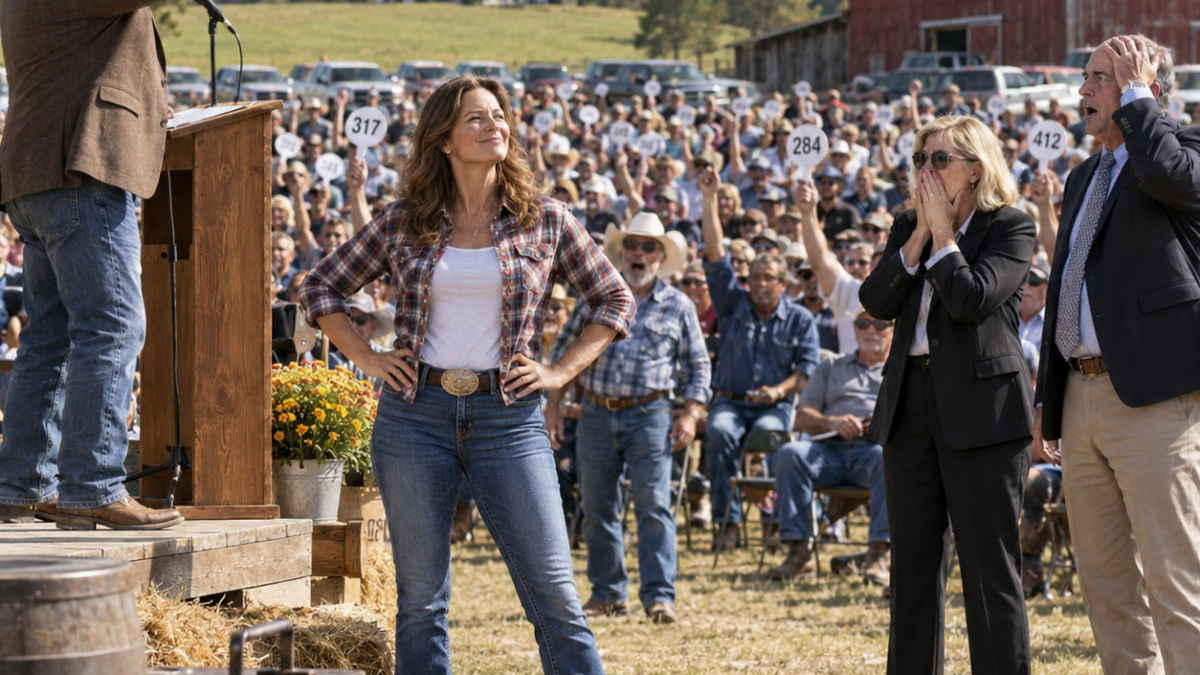
The HOA president slapped a $2,500 violation sticker across my late father’s restored bulldozer and told me the auction that was supposed to pay for my daughter’s college education was canceled.
She believed a three-inch binder of neighborhood rules gave her more authority over my family’s ten acres than fifty years of county records, business licenses, and the deed my father had protected until the day he died.
I didn’t argue with her that afternoon, because two weeks later she was going to discover what happens when you try to stop a legal auction and accidentally give an entire county a reason to attend it.
“That thing is not moving.”
Karen Peterson stood in front of my father’s 1968 Caterpillar D8H with a fluorescent orange violation sticker still stuck crookedly across the freshly painted blade.
I stared at it.
Then at her.
Then at Big John, the auctioneer who had known my father for almost thirty years.
John removed his cowboy hat.
“Ma’am,” he said, “that machine runs better than half the trucks parked in this neighborhood.”
Karen didn’t even look at him.
“The covenant prohibits inoperable industrial vehicles.”
“It is operable,” I said.
Her smile tightened.
“Then start it.”
I climbed onto the track.
Turned the key.
The old diesel coughed once.
Then the engine caught with a deep mechanical rumble that rolled across the yard.
Karen’s two board members stepped backward.
Big John grinned.
I shut it down.
Karen glanced at her clipboard.
“That changes nothing.”
I almost laughed.
That bulldozer had belonged to my father for forty-one years.
He had rebuilt the transmission twice.
Replaced the undercarriage.
Painted it himself every decade.
When I was ten, he let me sit in the cab and work the blade while he walked beside me through our equipment yard.
When I came home from my last Army deployment, he was still using that same machine to grade the back pasture.
Now he was gone.
And Karen was calling it junk.
My father had run Miller & Son Equipment from this property since 1971.
Ten acres.
Repair shop.
Equipment yard.
Rental business.
Every permit legal.
Every tax paid.
The land had been zoned for mixed residential and light commercial use long before Whispering Pines Estates existed.
But while I was away serving twenty-five years in the Army Corps of Engineers, developers swallowed the surrounding farmland.
Subdivisions appeared.
Then an HOA.
My father hated it.
“They think grass height is a religion,” he once told me.
I thought he was exaggerating.
He wasn’t.
After his funeral, I decided to hold one final auction.
Sell the loaders.
Excavators.
Graders.
Trenchers.
Tractors.
And Dad’s D8.
The money would secure my retirement.
More importantly, it would pay my daughter Sarah’s university tuition—the promise my father had talked about every time she brought home another good report card.
Big John had already begun preparing the catalog.
Then Karen arrived.
She handed me a cease-and-desist notice.
“No commercial auction activity is permitted inside Whispering Pines.”
“This property operated commercially before your first house was built.”
“You are now within the association.”
“That doesn’t erase county zoning.”
“We’ll let our attorney decide that.”
Then she pointed toward the equipment.
“You are prohibited from moving, operating, displaying, advertising, or selling any of these vehicles until all violations are cured.”
“And the auction?”
“Canceled.”
Big John let out a low breath.
Karen continued.
“The $2,500 fine doubles every seven days.”
I looked toward the house.
Sarah was standing on the porch.
She had come home from college every weekend for a month to help me catalog Grandpa’s equipment.
I could see the fear on her face.
Not fear of Karen.
Fear that everything we had planned was disappearing.
I turned back.
“Anything else?”
Karen blinked.
She had expected anger.
“You’ll receive additional notices.”
“Put everything in writing.”
“I intend to.”
“Good.”
Her smile vanished.
She marched back toward her SUV with the two board members behind her.
Big John waited until they were gone.
“Frank?”
“Yeah?”
“You planning to cancel?”
I looked at the orange sticker on my father’s bulldozer.
Then at the equipment yard he had spent half a century building.
“No.”
John smiled slowly.
“What are you planning?”
I peeled the sticker off the blade carefully.
Then stopped.
I pressed it back into place.
“Leave it.”
“Why?”
“Because when this is over, I want everybody to remember exactly what started it.”
PART 2
Big John stared at the sticker for another moment.
Then he put his hat back on.
“That woman thinks she just canceled an auction.”
“She thinks a lot of things.”
“You know what I think?”
“What?”
“I think your daddy would be laughing himself sick.”
That was probably true.
My father, Earl Miller, had never been impressed by titles.
County commissioner.
Bank president.
General contractor.
Army officer.
He treated everybody the same until they gave him a reason not to.
His philosophy was simple.
If a man knew what he was doing, listen.
If he didn’t, the title on his door wouldn’t save him.
Karen had a title.
President.
And she wore it like a sheriff’s badge.
The problem was, I had spent my entire adult life learning what actual authority looked like.
Authority came with jurisdiction.
Responsibility.
Procedure.
Documentation.
Limits.
What Karen had was confidence.
Those were not the same thing.
That night, my kitchen became a command center.
Sarah sat across from me while I opened the HOA binder.
She was twenty years old, halfway through her sophomore year, studying environmental engineering.
My father had been absurdly proud of that.
He used to introduce her to customers as “my granddaughter, the college engineer,” even when she was still taking freshman calculus.
Now she watched me turn page after page of HOA rules.
“You’re really reading all of it?”
“Yep.”
“That thing is like three hundred pages.”
“Two hundred eighty-six.”
She groaned.
“I would rather take thermodynamics again.”
“I thought you got an A.”
“That doesn’t mean I enjoyed it.”
I highlighted Covenant 7B.
The rule Karen cited.
It prohibited “inoperable vehicles, machinery, industrial equipment, or commercial apparatus inconsistent with the residential character of the community.”
There was the first problem.
My father’s machines weren’t inoperable.
There was another.
My property was not historically residential-only.
And then there was the biggest one.
I found it buried in an appendix.
A reference to “pre-existing lawful uses subject to applicable county grandfathering.”
I stopped.
Sarah noticed.
“What?”
“Maybe nothing.”
“That’s your ‘maybe something’ face.”
“You know I have a face?”
“You’ve been my dad for twenty years.”
I bookmarked the page.
“Grandpa ever keep old zoning papers?”
Sarah laughed.
“Grandpa kept receipts for spark plugs he bought in 1984.”
She was right.
The next morning I climbed into the attic.
My father’s filing system looked like chaos until you understood him.
Metal cabinets.
Years written in black marker.
County records in one drawer.
Tax documents in another.
Equipment titles filed by manufacturer.
I found the business license from 1971.
Then tax filings.
Permits.
A 1988 zoning-board packet.
That one got my attention.
Dad had petitioned the county to formally preserve mixed residential and light-commercial use on the entire ten-acre tract.
I remembered the fight vaguely.
I had been young.
He once told me he did it because developers were creeping closer.
“Someday,” he had said, “somebody’s gonna build fancy houses around us and decide they were here first.”
I sat on the attic floor holding that document.
“Dad,” I whispered, “you paranoid genius.”
I called Dave.
Dave Harper lived near the far end of Whispering Pines.
Retired corporate attorney.
Former Marine.
I had met him only once since returning home, at the funeral.
He had served with my father on a county veterans committee years earlier.
When I told him what happened, he said one thing.
“Bring everything.”
His study looked like a law library had collided with a bourbon collection.
I put the HOA notices on his desk.
Then Dad’s licenses.
The zoning packet.
Property deed.
Auction contract.
Dave read quietly.
After twenty minutes, he leaned back.
“Frank.”
“Yeah?”
“Did Karen actually tell you that you cannot sell the equipment?”
“Verbally and in writing.”
“She said you can’t operate it either?”
“Yep.”
“And she cited HOA covenant authority?”
“Yep.”
He smiled.
Not friendly.
“Excellent.”
“Why is everybody around me suddenly happy when I get threatened?”
“Because threats are useful when they’re made by people who don’t understand their jurisdiction.”
He picked up the 1988 zoning decision.
“Your father was smart.”
“I know.”
“No. Legally smart.”
“That would’ve annoyed him.”
Dave chuckled.
Then he opened his laptop.
For two hours we searched county ordinances.
Property-code provisions.
HOA formation documents.
Annexation records.
Whispering Pines declarations.
Eventually Dave stopped scrolling.
“There.”
I moved beside him.
County Ordinance 21A.
Protection of pre-existing lawful commercial uses.
The language was unusually clear.
A legally established commercial operation existing on a parcel of five acres or greater before creation or expansion of an adjoining residential association could continue according to its approved historic use regardless of subsequent private neighborhood restrictions.
Dave read the key paragraph aloud.
Then again.
I sat back.
“So Karen can’t stop the equipment business.”
“No.”
“The auction?”
“Almost certainly part of the lawful wind-down and disposition of business assets.”
“And her fines?”
“Very questionable.”
“What about the fact Dad’s parcel was supposedly brought inside the HOA?”
Dave grimaced.
“That may affect other covenants depending on how annexation occurred, but it doesn’t magically erase superior county land-use protections.”
He pointed at the ordinance.
“More importantly, the HOA documents themselves acknowledge grandfathered uses.”
I felt anger rising.
Not hot.
Cold.
Focused.
“So she either doesn’t know.”
“Or didn’t care to check.”
“What do we do?”
Dave tapped the threatening letter.
“First, we give her a chance to correct it.”
I hated that answer.
“She already had a chance.”
“You want to win or vent?”
“Win.”
“Then we document reasonableness.”
We drafted an appeal.
I explained the property’s history.
Included Dad’s original business license.
Zoning designation.
Proposed auction date.
Parking plan.
Traffic-control plan.
Hours.
Noise-management plan.
Auctioneer license.
Insurance.
I did not include Ordinance 21A.
Dave wanted to know whether Karen’s board would investigate before escalating.
They didn’t.
A week later, the response arrived.
Four new violations.
Unapproved commercial signage.
Improper landscaping.
Environmental contamination.
And “continuing storage of prohibited heavy industrial machinery.”
The faded Miller & Son Equipment sign my father had hung beside the road in 1973 was suddenly illegal.
My mother’s wildflowers were apparently weeds.
Oil stains on gravel Dad had used to repair machinery for half a century were now “environmental blight.”
The fines exceeded five thousand dollars.
More importantly, the board denied my hearing request until all outstanding fines were paid.
Sarah read the letter.
“That seems backward.”
“It is.”
“So if you think the fines are wrong, you have to pay them before they’ll let you argue they’re wrong?”
“Apparently.”
“That’s insane.”
“Legal systems have been built on stranger ideas.”
“What now?”
I called Dave.
He read the letter.
Then laughed.
“Frank, she is helping us.”
“I’m starting to dislike that sentence.”
“Come over.”
When I arrived, Dave already had coffee waiting.
“This is procedural nonsense.”
He held up the HOA letter.
“They’ve conditioned your appeal on surrendering the dispute.”
“Can they?”
“Depends on governing language, but it’s terrible optics and possibly inconsistent with their own procedures.”
“So now do we show the ordinance?”
“Not yet.”
I stared at him.
“Dave.”
“One more step.”
“You were a litigator too long.”
“Probably.”
He grinned.
“We ask for a temporary variance.”
“Why?”
“Because Karen thinks you’re weakening.”
“I’m not.”
“I know.”
“She doesn’t.”
Dave leaned forward.
“People reveal themselves when they think they’re winning.”
I understood.
We wrote another letter.
Professional.
Respectful.
Almost painfully conciliatory.
I stated that although I disputed the HOA’s interpretation, I wanted to avoid conflict with neighbors.
I requested one temporary variance for one day.
The auction would occur four weeks later.
Traffic would be controlled.
No equipment testing before 8 a.m.
No amplified sound beyond reasonable auction operations.
All bidders would park on my land.
Emergency lane clear.
Cleanup completed same day.
We gave Karen every reasonable accommodation.
Three days later, the HOA’s law firm delivered a ten-page rejection.
It was glorious.
Not because of what it denied.
Because of what it threatened.
The board had voted unanimously.
No variance.
All fines remained.
If I moved, operated, advertised, displayed, transferred, or sold any listed machinery, the HOA would seek emergency injunctive relief.
They would pursue a lien.
They would recover legal fees.
They would attempt to stop Big John from conducting the sale.
They even warned third-party purchasers that transfers could be “subject to dispute.”
Dave finished reading.
Then looked at me.
“There.”
“What?”
“That is your lawsuit.”
I reread the final page.
“Explain.”
“They have formally asserted the right to interfere with a commercial transaction protected under county law.”
“And they can’t.”
“Correct.”
“They threatened Big John.”
“Correct.”
“They threatened bidders.”
“Correct.”
Dave tapped the page.
“And unlike Karen yelling in your yard, this came through counsel. Formal position. Board-authorized.”
A slow smile spread across my face.
“Now?”
“Now we show them 21A.”
“No.”
I surprised myself.
Dave raised an eyebrow.
“What are you thinking?”
I looked at the auction contract.
“Dad wanted one last sale.”
“Yes.”
“Big John wanted an event.”
“Yes.”
“And Karen wants to stop it.”
“Very much.”
“Then let’s give everybody a reason to come.”
Dave started laughing before I finished.
Big John reacted exactly as expected.
“You want publicity?”
“I want bidders.”
“Same thing if I do my job.”
“I want the auction legal, safe, organized, and impossible to dismiss.”
“You called the right man.”
He arrived the next morning with three notebooks and the energy of a carnival promoter.
“This ain’t an estate sale anymore.”
“It is absolutely an estate sale.”
“Legacy auction.”
“Fine.”
“Historic legacy auction.”
“John.”
He ignored me.
“Your dad’s D8 is the centerpiece.”
“Of course.”
“Do not remove that orange sticker.”
“I wasn’t planning to.”
“Oh, this is gonna be beautiful.”
Sarah came out carrying coffee.
“What’s beautiful?”
Big John pointed at the bulldozer.
“That sticker.”
She laughed.
“I hate that sticker.”
“You will love it by auction day.”
The marketing campaign started modestly.
Equipment websites.
Auction calendars.
Farm publications.
Construction-company mailing lists.
Then Big John posted a photograph of my father standing beside the D8 in 1978.
Underneath:
FIFTY YEARS OF WORK. ONE FINAL AUCTION.
The story described Dad.
Not Karen.
Dad.
How he started with one used loader and a borrowed wrench set.
How he repaired equipment overnight so local farmers could keep working.
How he taught three generations of operators.
How the auction proceeds would help fund his granddaughter’s education.
At the very bottom, one line:
Despite a pending dispute with the local HOA, county records confirm the auction remains scheduled.
That was enough.
People asked questions.
Big John answered carefully.
Then somebody shared the HOA’s orange sticker photo.
Then a local equipment forum picked it up.
Then a veterans group.
Then a property-rights page.
Within five days, the auction listing had tens of thousands of views.
Sarah came into the kitchen one evening holding her phone.
“Dad.”
“What?”
“You’re a meme.”
“I refuse.”
She showed me.
A photo of Dad’s D8.
Orange violation sticker.
Caption:
WHEN THE HOA THINKS IT CAN TOW A BULLDOZER.
I stared.
“That is stupid.”
Sarah laughed so hard she had to sit down.
“Twenty-six thousand shares.”
“Society is collapsing.”
Big John loved it.
“We got people calling from Virginia.”
“To bid?”
“Some.”
“What do the others want?”
“To know if Karen’s coming.”
“This is an auction, not a wrestling match.”
“Same crowd psychology.”
Meanwhile, Dave insisted we prepare the legal foundation perfectly.
We obtained a county event permit.
Not because the HOA required one.
Because the county did for a large public event.
Traffic plan.
Temporary signage approval.
Insurance certificate.
Portable restrooms.
Food vendor permits.
Emergency access.
We hired an off-duty traffic-control company.
Then I called Marcus Hill.
Marcus had served with me during my last eight years in the Army.
Former Special Forces.
Now owned a private security company specializing in industrial sites and large events.
“I need parking and crowd management.”
“How many?”
“Big John thinks three hundred.”
“How many do you think?”
“Two hundred.”
Marcus laughed.
“So five hundred.”
“I hate you.”
“We’ll bring six people.”
“No tactical nonsense.”
“Frank.”
“I mean it.”
“Polo shirts. Radios. Friendly faces.”
“No weapons visible.”
“Of course.”
“This is a family auction.”
“Understood.”
Then Dave suggested contacting the sheriff.
I hesitated.
“Why?”
“Because Karen already threatened enforcement.”
“I don’t want police dragged into neighborhood drama.”
“Neither do they.”
“So?”
“Give them notice of a large legal event and potential traffic. Attach your permits and the HOA threat.”
That made sense.
I wrote a professional letter.
No insults.
No accusations.
Just facts.
Auction date.
Expected attendance.
Parking.
County ordinance.
Property zoning.
Potential HOA attempt to interfere.
A week before the sale, Deputy Michael Sutton called.
“Mr. Miller?”
“Yes.”
“I received your event packet.”
“Any problems?”
“Not with the county.”
“That’s good.”
“Mind if I stop by?”
“Anytime.”
He arrived Saturday afternoon before the auction.
Big John’s crew was setting up.
The equipment yard looked like a military formation.
Loaders in one row.
Trenchers.
Skid steers.
Backhoe.
Three excavators.
Two road graders.
Pickup trucks.
Tool lots.
Compressors.
Welders.
Dad’s D8 centered near the auction platform.
Deputy Sutton stepped out.
Mid-forties.
Calm.
Professional.
He looked around.
“This is organized.”
“That’s the plan.”
“You have documents?”
I took him to the registration tent.
Permit.
Insurance.
Zoning.
Ordinance 21A.
HOA documents.
Lawyer letter.
He read slowly.
Then pointed at the grandfather clause.
“Your family business predates the subdivision?”
“By decades.”
“And the county zoning confirms commercial use?”
“Yes.”
He shook his head.
“Then what exactly is the HOA trying to stop?”
“Ask Karen.”
“I may.”
He read the lawyer’s injunction threat.
His expression changed.
“This is civil.”
“I know.”
“But if someone comes tomorrow and physically disrupts the event, blocks access, or refuses to leave private property after being told…”
“That becomes your problem.”
“Potentially.”
He closed the folder.
“As long as you follow the permit conditions, we’re good.”
“Thank you.”
He paused.
“Traffic is my biggest concern.”
“Two acres parking.”
“Overflow?”
“Neighboring pasture owner agreed to another acre if needed.”
“Emergency lane?”
“Marked.”
“Good.”
He looked toward the D8.
“What’s the sticker?”
“Long story.”
“I have a feeling I’ll hear it tomorrow.”
He left.
Twenty minutes later, I saw his cruiser turn into Whispering Pines.
Sarah came beside me.
“He going to Karen’s?”
“Probably.”
“Should we be worried?”
“No.”
“You sound too calm.”
“I’m tired.”
That evening, Sarah and I sat on the front porch.
The sun dropped behind Dad’s equipment.
The machines looked enormous in silhouette.
Quiet.
Still.
Waiting.
Sarah rested her elbows on her knees.
“Dad?”
“Yeah?”
“Can I ask something?”
“Always.”
“Are you okay selling all of it?”
I knew what she meant.
Not financially.
Emotionally.
For weeks I had treated the auction like an operation.
Lists.
Permits.
Legal threats.
Marketing.
Parking.
But each machine contained memory.
Dad under a loader with oil dripping on his forehead.
Dad cursing a seized bearing.
Dad showing me how to listen to an engine.
Dad letting Sarah sit in a cab when she was six.
Dad’s hands.
Scarred knuckles.
Grease beneath his nails.
The yard without those machines would be empty.
“I don’t know.”
Sarah leaned against the chair.
“You don’t have to sell everything.”
“Yes, I do.”
“Why?”
“Because I’m not going to run his business.”
“You could keep the D8.”
I looked at it.
Orange sticker glowing even in low light.
“He loved that machine.”
“Exactly.”
“That’s why it should go to somebody who’ll love it too.”
Sarah looked down.
“Grandpa would’ve kept it.”
“No.”
“You sure?”
“He hated machines sitting.”
That was true.
Dad used to say iron dies when men polish it instead of working it.
“He’d want it running.”
Sarah nodded.
Then whispered, “I miss him.”
“Me too.”
That was the first time I cried since the funeral.
Not much.
Enough.
Sarah took my hand.
We sat there until dark.
The next morning, headlights began appearing at 5:52.
Auction registration opened at seven.
By 6:30, there were fifty vehicles lined along the entrance.
Marcus radioed me.
“Frank.”
“Yeah?”
“You underestimated.”
“How bad?”
“Good bad.”
By seven fifteen, both primary parking rows were filling.
Pickup trucks.
Flatbeds.
Gooseneck trailers.
Contractor vans.
SUVs.
Farm trucks.
People had driven from three states.
Some came to bid.
Some came because they had known Dad.
Some because they saw the story online.
Some because everybody loves watching bureaucracy get embarrassed before breakfast.
At 8:05, Big John found me beside the office.
“We passed three hundred registrations.”
“What?”
“Three hundred bidder numbers.”
“The auction starts at ten.”
“I know.”
“How many people?”
“Probably four hundred plus guests.”
“John.”
He grinned.
“County history, baby.”
“Do not say that yet.”
At 8:40, Marcus called.
“Overflow field open.”
“How many cars?”
“Don’t know.”
“That’s not reassuring.”
“My guy stopped counting at two-fifty vehicles.”
I walked toward the road.
People were everywhere.
Not chaotic.
Organized.
Marcus’s team directed traffic.
Big John’s staff handled registration.
Food trucks did business near the pasture.
Families wandered among machines.
Farmers inspected tracks.
Contractors opened engine panels.
Old men discussed horsepower.
Veterans shook my hand.
Neighbors arrived.
Mrs. Gable came carrying two trays of cookies.
“Those are not enough,” I told her.
“They’re for your table, not six hundred strangers.”
“Six hundred?”
“That’s what they’re saying.”
I looked toward registration.
Big John was waving.
When I reached him, he held up a clipboard.
“Six hundred twelve registered bidders.”
I thought I’d misheard.
“How many?”
“Six hundred twelve.”
“Bidders?”
“Registered.”
“Not attendees.”
“No, Frank. Actual bidder numbers.”
I stared at him.
He smiled.
“Biggest equipment auction this county’s seen in at least thirty years.”
“That verified?”
“No.”
“Then stop saying it.”
He laughed.
A local newspaper reporter arrived.
Then a radio station.
Then a regional TV crew.
Sarah came running toward me.
“Dad.”
“No.”
“You don’t even know.”
“Every time someone says Dad today, something gets worse.”
“There’s a helicopter.”
I looked up.
There was.
Not news.
A bidder.
Private helicopter landing in a neighboring field with permission from the owner.
Big John almost fainted from happiness.
At ten sharp, he climbed the auction stand.
The speakers clicked.
Conversation softened.
Then disappeared.
John looked across hundreds of people.
He removed his hat.
“Before we sell anything…”
Silence.
“This auction belongs to Earl Miller.”
My throat tightened.
John continued.
“Most of you know the story by now. Some of you knew Earl. Some only heard about him this month.”
He pointed toward the old shop.
“Earl Miller started repairing equipment on this dirt when Richard Nixon was president.”
Laughter.
“He worked until his hands didn’t work right anymore.”
A few older men nodded.
“He loaned machines when farmers couldn’t afford rent. Fixed school tractors for the county at cost. Pulled neighbors out of mud at two in the morning.”
I looked at Sarah.
She was crying.
“So today isn’t about fighting an HOA.”
John paused.
“It’s about sending Earl’s iron back to work.”
Applause started.
Then grew.
I had to look away.
John lifted his hand.
“And yes…”
The crowd laughed before he finished.
“The HOA did try to stop this.”
Cheers.
“But today, we’re going to do what Earl always did.”
He pointed toward the first loader.
“Get to work.”
The auction started.
Fast.
Big John was brilliant.
Lot one.
Air compressor.
Sold above estimate.
Welding rig.
Sold.
Generator.
Sold.
Then trailers.
Tools.
Small machinery.
Prices climbed.
Competition was intense.
Not reckless.
Enthusiastic.
A contractor from Tennessee bought Dad’s Case excavator.
A farmer from Virginia bought one grader.
An antique-equipment collector bought a 1950s crawler.
By noon, the gross had already surpassed Big John’s conservative estimate for the entire day.
Sarah found me.
“Dad.”
“What?”
“Grandpa’s paying for graduate school too.”
“Don’t get greedy.”
She laughed.
Then Marcus’s voice came through my radio.
“Frank.”
I knew the tone.
“Go.”
“HOA delegation at south entrance.”
My stomach tightened.
“How many?”
“Three.”
“Karen?”
“Yes.”
“Police?”
“No.”
“Let them approach if they remain peaceful.”
“You sure?”
“Yes.”
“Copy.”
I saw them moments later.
Karen.
Gerald.
Bob.
They had chosen formal clothes.
Karen wore a navy suit that looked miserable in the dust.
She held her phone up, recording.
Gerald photographed license plates.
Bob carried a folder.
People noticed.
Whispers spread.
Someone yelled:
“Karen!”
Laughter.
Another voice:
“Measure the bulldozer!”
More laughter.
I grabbed Marcus’s radio.
“No heckling from staff.”
“That isn’t staff.”
“I know.”
Karen walked to the property boundary.
Stopped.
Then deliberately stepped across.
Marcus approached.
“Ma’am.”
“I am HOA president.”
“Congratulations.”
I almost smiled.
“This property is subject to HOA authority.”
Marcus kept his voice polite.
“Are you here to bid?”
Her face turned red.
“No.”
“Then what business do you have?”
“I am documenting violations.”
“From public right-of-way you may document whatever you lawfully can. On private property, the owner controls access.”
“I am an officer of the association.”
“This is not association common property.”
“I need to speak to Mr. Miller.”
Marcus looked toward me.
I walked over.
Karen thrust a paper toward me.
“Final notice.”
I didn’t take it.
“Mail it.”
“This event is illegal.”
“No.”
“Our attorney has advised—”
“Your attorney knows about Ordinance 21A.”
That stopped her.
Only for a second.
“You keep hiding behind that ridiculous grandfather claim.”
“It’s county law.”
“Our covenants supersede it.”
“No.”
“Yes.”
“Karen.”
I kept my voice quiet.
“You were told yesterday by Deputy Sutton not to interfere.”
Her eyes flashed.
“That deputy misunderstood the situation.”
“No, he understood jurisdiction.”
“This auction is destroying neighborhood peace.”
“It ends today.”
“You’re operating industrial equipment.”
“Demonstration necessary for sale.”
“You’re conducting commerce.”
“Grandfathered lawful use.”
“You’re causing traffic.”
“County-approved plan.”
“Noise.”
“County permit.”
“Unauthorized signage.”
“Temporary event signs authorized by county.”
Each answer made her angrier.
She had built her authority on people not knowing which rules ranked above hers.
I knew.
Dave knew.
The county knew.
Now Karen was learning in public.
“You will regret this.”
“Maybe.”
“I mean it.”
“So do I.”
She stepped closer.
“I will lien this property.”
“No.”
“We have over twelve thousand dollars in fines.”
“Disputed and unenforceable under the grandfather exemption.”
“You don’t decide that.”
“Neither do you.”
People were watching.
I hated that.
This wasn’t why I wanted the auction.
“Karen, go home.”
“You cannot order me—”
“This is private property.”
She lifted the phone closer to my face.
“I’m documenting harassment.”
“No.”
“You’re threatening me.”
“No.”
“You’re intimidating an elected board president.”
“You are not elected by me.”
Her mouth opened.
Then Big John’s voice boomed from the auction platform.
“Next up, folks…”
I turned.
The D8.
Dad’s bulldozer.
The crowd began moving.
Karen saw it too.
She stepped past me.
“You cannot sell that.”
I blocked her path without touching her.
“Yes, I can.”
“It is under active violation.”
“Move back.”
“You sell it and we seek an injunction.”
“You already threatened that.”
“I mean today.”
“So call your lawyer.”
“I did.”
“Then listen to them.”
That sentence landed.
I saw uncertainty.
Maybe her lawyer had finally discovered 21A.
Maybe Dave had sent something that morning.
Maybe Deputy Sutton’s conversation had rattled them.
Then Karen did what she always did when uncertainty appeared.
She got louder.
“This auction is over!”
The speakers caught part of it.
The crowd turned.
Big John stopped.
Karen pushed past a cluster of bidders and marched toward the auction stand.
Marcus followed.
I followed.
Gerald and Bob trailed several steps behind.
Karen reached the platform.
“Stop this immediately!”
Big John lowered the microphone.
“Ma’am.”
“Turn that off.”
“No.”
“I am president of the Whispering Pines Estates Homeowners Association.”
Someone shouted:
“We know!”
Laughter.
Karen’s face darkened.
“This is an illegal industrial sales event.”
Big John glanced at me.
I climbed the small steps.
He handed me the microphone.
I did not want it.
But six hundred registered bidders were now staring at us.
So were my neighbors.
My daughter.
Dad’s customers.
The reporter.
The television camera.
I looked at Karen.
“Are you sure you want to do this here?”
“Yes.”
“All right.”
I turned toward the crowd.
“This is Karen Peterson, president of Whispering Pines HOA.”
Scattered boos started.
I raised my hand.
“No.”
The field quieted.
“Don’t boo her.”
Karen looked surprised.
“So everyone understands what’s happening…”
I held up the county document Dave had printed for me.
“This property operated as Miller & Son Equipment for more than fifty years before Whispering Pines existed.”
Applause.
I waited.
“In 1988, my father secured formal mixed residential and light-commercial zoning from the county.”
I held up another sheet.
“County Ordinance 21A protects long-standing lawful commercial operations on qualifying properties from later private restrictions attempting to eliminate those uses.”
I pointed toward Dad’s shop.
“This business is grandfathered.”
Karen shouted, “That interpretation is disputed!”
The microphone picked her up.
I looked at her.
“It was confirmed by the county.”
“You are not a lawyer.”
“No.”
I pointed to Dave.
“He is.”
Dave stood near the front.
“And yesterday the sheriff’s department reviewed our permits and zoning.”
Right on cue, a voice spoke behind Karen.
“Correct.”
Deputy Sutton.
I hadn’t seen him arrive.
Neither had Karen.
He walked through the crowd.
Not dramatic.
Just calm.
Karen turned.
“Deputy, thank God. Shut this down.”
Sutton stopped.
“No, ma’am.”
Her expression froze.
“This event has the required county approvals.”
“You don’t understand.”
“I reviewed them yesterday.”
“The HOA has jurisdiction.”
“HOA disputes are civil matters.”
“She is interfering with a valid enforcement action.”
Sutton looked toward the property line.
“Mrs. Peterson, Mr. Miller has asked you to leave.”
“I am not leaving.”
“Then I’m asking.”
She stared at him.
“I have authority here.”
“Not to remain on private property after the owner withdraws permission.”
People were silent.
Karen turned toward me.
“You called the sheriff on me?”
“No.”
Sutton answered.
“I’m here because this is a large permitted event and traffic detail is appropriate.”
She pointed at the bulldozer.
“That machine is in violation.”
Sutton looked at the D8.
“That is not a criminal matter.”
“I demand you stop the sale.”
“No.”
Her entire face changed.
For years, “I demand” had worked.
Not because she had unlimited authority.
Because most people wanted conflict to end.
Now she was standing in front of hundreds of people who had no reason to surrender their day to her comfort.
“You’re all complicit,” she said.
Someone laughed.
Then another.
Karen snapped.
“You think this is funny?”
Nobody answered.
Her anger exploded.
“You people are destroying this community!”
The reporter raised her camera.
Karen saw it.
That made everything worse.
“You come here with your trucks and your filthy equipment and your noise—”
Big John muttered, “Filthy?”
His machines looked cleaner than my kitchen.
Karen kept going.
“This is a residential neighborhood! We have standards! We have rules! We will not be bullied by some old military—”
She stopped.
Maybe she realized what she was about to say.
Too late.
The crowd reacted.
Not violently.
A low wave of anger.
Dave stepped forward.
“Karen.”
She ignored him.
“You people don’t live here!”
Several neighbors shouted:
“We do!”
Mrs. Gable raised her hand.
“I live here.”
Mark Thompson did too.
“So do I.”
Others.
“We do.”
“We do.”
Karen looked around.
The rebellion she had feared wasn’t six hundred outsiders.
It was her own neighbors standing among them.
Mrs. Gable walked forward.
Small woman.
White hair.
Garden-gnome victim.
Karen stared.
“Eleanor, this has nothing to do with you.”
“It has everything to do with us.”
“Go sit down.”
Mrs. Gable didn’t move.
“You fined me because my husband’s garden gnomes offended your standards.”
Somebody chuckled.
Eleanor turned toward the crowd.
“My husband collected them for twenty-eight years.”
Her voice shook.
“After he died, I kept them because they made the yard feel like he was still there.”
The field quieted.
“Karen told me they were a visual nuisance.”
She looked back at Karen.
“You made me feel ashamed of something that helped me grieve.”
Karen’s mouth tightened.
“This is not relevant.”
“It is to me.”
Mark Thompson joined her.
“You fined my family because my sons played basketball at four in the afternoon.”
“The hoop was—”
“It was portable.”
“Visible.”
“Children are visible too. You going to fine them?”
Laughter.
Karen shouted, “This is exactly the lawlessness I warned everyone about!”
That was when Deputy Sutton stepped closer.
“Ma’am.”
She turned.
“You need to leave.”
Her breathing was heavy.
She looked toward Gerald and Bob.
Neither moved.
“Back me up!”
Gerald stared at the ground.
Bob looked toward the crowd.
“Karen…”
“What?”
“I think we should go.”
She stared at him as if he had stabbed her.
“You coward.”
Bob flinched.
Karen turned back toward me.
“This isn’t over.”
“No.”
I handed Big John the microphone.
“But the auction is.”
She looked confused.
He grinned.
“Eventually.”
The crowd laughed.
Deputy Sutton gestured toward the driveway.
Karen left.
No handcuffs.
No dramatic arrest.
No physical confrontation.
Just a long walk.
Her two board members followed.
Nobody booed this time.
I asked them not to.
That mattered to me.
My father had hated bullies.
He had also hated mobs.
Those aren’t opposites if you’re not careful.
Big John waited until Karen disappeared.
Then lifted the microphone.
“Well.”
The crowd laughed.
“Now that the zoning seminar has concluded…”
Bigger laugh.
“We have a bulldozer to sell.”
He slapped the D8’s track.
“1968 Caterpillar D8H.”
The engine started.
The sound rolled across the field.
People cheered.
I closed my eyes.
For a second I heard Dad.
Not literally.
Memory.
Frank, listen to that idle. Smooth.
Big John began.
“Forty thousand.”
A hand rose.
“Forty!”
“Forty-five!”
Another.
“Fifty!”
The bidding accelerated.
Fifty-five.
Sixty.
Sixty-five.
A collector from Kentucky.
A contractor from Georgia.
An equipment museum representative.
Seventy.
Seventy-five.
My heart was hammering.
Sarah grabbed my arm.
“Dad.”
“Quiet.”
“Eighty!”
Big John’s voice became rhythm.
“Eighty-five!”
The Kentucky collector.
“Ninety!”
A man near the back.
The field reacted.
Nobody had expected ninety.
Big John leaned forward.
“Ninety thousand. Looking for ninety-two.”
Silence.
The collector raised his card.
“Ninety-two!”
Big John pointed.
“Ninety-two thousand dollars!”
He scanned.
“Ninety-four?”
Nothing.
“Ninety-two once!”
I looked at the D8.
Orange sticker.
Dad’s paint.
Dad’s machine.
“Ninety-two twice!”
I almost wanted somebody else to bid.
Just to delay goodbye.
Big John looked toward me.
Then brought down his hand.
“Sold!”
The crowd erupted.
The collector shook my hand.
“I’m not repainting the blade.”
I laughed through tears.
“What?”
“The sticker.”
“You’re kidding.”
“No.”
He looked at the orange violation notice.
“That stays.”
Sarah laughed.
“Grandpa would hate that.”
“No,” I said.
“He’d love it.”
The D8 sale became the story everyone told.
But the auction wasn’t close to finished.
By late afternoon, almost every major piece had sold.
Big John’s staff kept a running total.
I refused to look.
Finally, after the last equipment lot, he found Sarah and me.
“You want the number?”
“No.”
“Yes,” Sarah said.
Traitor.
John handed her the sheet.
Her mouth dropped open.
“Dad.”
“What?”
She gave it to me.
Gross proceeds were nearly twice the original conservative estimate.
Not because every bidder overpaid.
Most lots sold within defensible market ranges.
But attendance created competition.
Rare equipment brought collectors.
The story brought attention.
Attention brought bidders.
The bidders made the market.
I sat down.
Big John put his hand on my shoulder.
“Your daddy just paid for a lot of tuition.”
Sarah was crying.
“So am I.”
“Shut up.”
She hugged me.
The equipment yard emptied slowly over the next week.
Trailers arrived.
Machines loaded.
Engines started one last time.
Each departure left a patch of red clay.
The D8 left Thursday morning.
The collector drove down from Kentucky with a lowboy trailer.
Before loading, he found me near the shop.
“You want to do it?”
“What?”
“Drive her up.”
I climbed into Dad’s cab.
Hands on the levers.
The seat felt smaller than memory.
I started the engine.
Deep rumble.
I drove the D8 across the yard.
Turned.
Climbed the lowboy.
Stopped.
Shut down.
For several seconds I sat alone.
Then I touched the worn steering control.
“Go work,” I whispered.
I climbed down.
The collector pretended not to notice my face.
Good man.
The auction made local news.
Then regional news.
Not national.
Nothing absurd.
But enough.
HEADLINE:
VETERAN’S FAMILY AUCTION DRAWS RECORD CROWD AFTER HOA DISPUTE.
The county auctioneer’s association later confirmed Big John’s suspicion.
Based on their available records, our 612 registered bidders represented the largest documented single-day heavy-equipment auction attendance in county history.
Big John framed the certificate.
I told him he was unbearable.
He hung it in his office anyway.
But Karen’s problem had only begun.
Whispering Pines residents wanted answers.
Why had the board threatened a legally protected business?
How much money had been spent on lawyers?
Why were appeals denied until fines were paid?
Why were enforcement decisions inconsistent?
Why had Karen walked onto private property during a county-permitted auction after being advised not to interfere?
Dave filed suit on my behalf the following Monday.
We did not ask for some fantasy fortune.
Actual damages.
Attorney fees where appropriate.
Relief from fines.
Claims relating to interference with the auction.
Declaratory relief clarifying the grandfathered use.
The threatening letter from the HOA’s lawyer became central.
The insurer got involved fast.
Insurance companies dislike uncertainty.
They dislike board members ignoring jurisdiction even more.
The next HOA meeting was Tuesday night.
Normally fewer than twenty people attended.
Eighty-four came.
Sarah wanted to attend.
“You don’t live in Whispering Pines.”
“I’m on the deed eventually.”
“You are not.”
“Grandpa would’ve put me on.”
“Grandpa also let you drive a forklift at thirteen.”
“Best birthday ever.”
I finally agreed.
We stood near the back.
Karen’s seat was empty.
Gerald sat in the president’s place.
Bob beside him.
People murmured.
Gerald hit the gavel.
“Meeting will come to order.”
Someone shouted:
“Where’s Karen?”
Gerald looked toward his notes.
“Mrs. Peterson submitted her resignation this afternoon.”
The room erupted.
Not cheering exactly.
Shock.
Relief.
Someone clapped.
Then everyone.
I didn’t.
Sarah noticed.
“You okay?”
“Yeah.”
“You thought you’d be happier.”
I nodded.
I had imagined Karen being voted out.
Confronted.
Forced to sit through every neighbor’s story.
Instead, she simply quit.
That felt less satisfying.
Then Mrs. Gable stood.
“Good.”
One word.
Not triumphant.
Free.
That was enough.
Mark Thompson brought forward a petition.
Over one hundred homeowner signatures.
More than two-thirds of the development.
The petition demanded the remaining board resign and requested a special election.
Gerald read it.
His hands shook.
Bob leaned toward him.
They whispered.
Gerald returned to the microphone.
“In light of recent events…”
Someone groaned.
He swallowed.
“We tender our resignations effective tonight.”
Applause.
The old board was gone.
The bylaws required vacancies to be filled.
Dave had prepared.
Of course he had.
Nominations.
Temporary board.
Election procedures.
No shortcut.
No mob.
By the end of the evening, Dave Harper became interim president.
He hated every second of it.
“You did this to me,” he told me afterward.
“You volunteered.”
“I made the mistake of understanding the bylaws in public.”
The first board motion recognized every legally protected pre-existing property use covered by Ordinance 21A.
Passed unanimously.
Second:
Suspend and review all outstanding fines issued under the former board.
Passed.
Third:
Instruct association counsel and insurer to resolve my dispute promptly.
Passed.
Fourth:
Commission an independent governance and financial review.
Passed.
Then Mrs. Gable raised her hand.
Dave recognized her.
“I want my gnomes back.”
Laughter.
Dave smiled.
“Were they physically removed?”
“No. They’re in my garage because I was scared.”
“Then put them back tonight.”
The room applauded.
She did.
All twenty.
The next morning, I drove past.
There they were.
Fishing.
Sleeping.
Waving.
One holding a tiny shovel.
I honked.
Mrs. Gable came outside in her robe and waved.
The Thompson basketball hoop returned too.
Vegetable gardens reappeared.
The classic Mustang owner opened his garage door and worked without pretending he wasn’t home.
Nothing collapsed.
Property values did not crash.
No civilization-ending wave of individual expression swept the subdivision.
People simply lived.
The financial review found what we expected.
Not embezzlement.
That word gets thrown around too easily.
But bad governance.
Weak oversight.
Unnecessary legal expenses.
Inconsistent fines.
Contracts approved with insufficient documentation.
Discretionary spending concentrated in pet projects Karen favored.
The HOA had spent over eighteen thousand dollars in legal fees over two years dealing with enforcement fights that frequently could have been resolved through conversation.
Nearly six thousand related directly to my dispute.
Residents were furious.
Dave published the numbers.
Every invoice.
Every legal payment.
Every line.
Transparency became his obsession.
“You realize normal people don’t want to read fifty pages of invoices?”
“They asked.”
“They asked for transparency.”
“They’re getting transparency.”
“You’re going to punish them with spreadsheets.”
“Democracy requires suffering.”
The insurer eventually settled my lawsuit.
The HOA rescinded every fine against the equipment business.
Paid my reasonable legal expenses.
Contributed compensation toward documented disruption and losses caused by the interference attempts.
The association formally acknowledged the grandfathered status of my property.
Most importantly, the settlement included a permanent recorded agreement so no future board could restart the same fight after Dave retired.
I signed.
Dave signed.
Insurer’s counsel signed.
County land-use attorney reviewed.
Done.
I took the settlement check home.
Put it on the table beside the auction proceeds statement.
Sarah stared.
“That’s weird.”
“What?”
“Grandpa fought that HOA for years.”
“Mostly by yelling from his tractor.”
“And you ended it with paperwork.”
“He’d be disappointed.”
“No.”
She smiled.
“He’d tell everybody he taught you.”
Probably.
Sarah’s tuition went into a dedicated account.
Four years.
Covered.
Books.
Housing.
Everything reasonable.
I told her that did not include “educational spring break.”
She objected.
The remainder of the auction money funded my retirement.
I paid off the small mortgage on my own house.
Set aside investments.
Repaired Dad’s workshop.
Then I did something I hadn’t expected.
I kept the ten acres.
Big John assumed I would sell.
Developers started calling within weeks.
The land was extremely valuable now.
Whispering Pines surrounded most of it.
One company offered a number so large I read it twice.
Sarah looked over my shoulder.
“You could retire twice.”
“I’m already retired.”
“Retire harder.”
I laughed.
But I turned them down.
I couldn’t explain why at first.
The equipment was gone.
Dad was gone.
The business was over.
What was I protecting?
One morning, I walked the empty yard.
Red clay.
Oil-darkened patches.
Old concrete pad.
Shop doors.
For fifty years, this land had been noise.
Diesel.
Steel.
Impact wrenches.
Backup alarms.
Men shouting over engines.
Now birds.
I realized the quiet wasn’t emptiness.
It was inheritance.
Dad hadn’t left me machines.
Not really.
He left me the right to decide what happened next.
I planted grass.
Not HOA-perfect grass.
Regular Carolina grass.
I restored the fence.
Kept the shop.
Converted part of it into a woodworking space.
The old equipment sign stayed beside the mailbox.
MILLER & SON EQUIPMENT.
One afternoon Dave stopped.
“You know there is no son operating equipment anymore.”
“I’m the son.”
He nodded.
“Fair.”
We added a small brass plaque beneath it.
1971–2026.
FIFTY-FIVE YEARS OF WORK.
Sarah cried when she saw it.
“You’re getting sentimental.”
“Age.”
She hugged me.
“Grandpa would like it.”
“Grandpa would complain the plaque cost too much.”
“Then secretly polish it every week.”
Exactly.
Karen’s house went on the market two months after the auction.
She had disappeared from public meetings.
I heard she stayed with a sister while the house sold.
Then moved to another county.
I never saw her again.
For a while, that bothered me.
I had imagined one final confrontation.
Something movie-perfect.
She would admit she was wrong.
I would deliver some devastating sentence.
She would leave defeated.
Real life rarely cooperates.
People don’t always confess.
Sometimes they leave.
Eventually I realized her absence was better than an apology I would never fully believe.
One year later, Big John called.
“Busy Saturday?”
“Why?”
“County fair.”
“No.”
“They want the D8.”
I sat up.
“What?”
“The collector who bought it is bringing it back.”
“For what?”
“Historic equipment showcase.”
I laughed.
“You planned this.”
“Possibly.”
Sarah was home from school.
We went.
The fairgrounds were packed.
Near the antique-equipment section stood Dad’s D8.
Clean.
Running.
Orange HOA sticker still on the blade.
I stared.
The collector, Robert Ellis, walked over.
“Told you I’d keep it.”
“You actually did.”
“Best conversation starter I own.”
A small sign beside the machine read:
1968 CATERPILLAR D8H
FORMERLY MILLER & SON EQUIPMENT
CENTERPIECE OF THE 2026 MILLER LEGACY AUCTION
COUNTY RECORD: 612 REGISTERED BIDDERS
No mention of Karen.
I appreciated that.
The story was bigger without her.
A little boy climbed into the cab with permission.
His father lifted him.
The boy grabbed the controls.
For a second, I was ten again.
Dad beside the track.
“Easy, Frank.”
“Don’t jerk it.”
“Feel the machine.”
I turned away.
Sarah put her arm around me.
“You’re crying.”
“Dust.”
“Inside the fairgrounds?”
“Industrial dust.”
She let me lie.
Robert walked over.
“You want to start her?”
“No.”
“You sure?”
I looked at the cab.
Then climbed.
Turned the key.
The D8 came alive.
That sound.
Forty years collapsed.
Dad was everywhere.
The auction.
My childhood.
The shop.
Grief.
Sarah.
Karen’s ridiculous sticker.
Everything.
I let the engine idle.
Then shut it down.
When I climbed out, Big John stood there.
Hat in hand.
“You did him proud.”
“No.”
I looked at Sarah.
“We did.”
Years passed.
Whispering Pines changed.
Dave lasted eighteen months as president before resigning dramatically at a barbecue.
“I’m tired of discussing mulch.”
Residents elected Mark Thompson.
Firefighter.
Basketball dad.
Practical.
The bylaws were amended.
Objective enforcement standards.
Real appeals.
Conflict-of-interest disclosures.
Pre-enforcement mediation for minor issues.
Clear limitations on fines.
No appeal conditioned on payment.
Board-meeting records posted online.
Annual legal-budget disclosure.
And my personal favorite:
No HOA officer could enter private property for inspection without permission except where governing documents and law clearly authorized it.
Dave called it the Frank Miller Rule.
I told him not to.
He did anyway.
Mrs. Gable became unofficial queen of the landscaping committee.
Her gnomes multiplied.
Thirty-two last count.
One wore a firefighter helmet.
One held a basketball.
One looked suspiciously like Dave holding a law book.
I asked whether she had one of me.
“Not yet.”
“Good.”
“I can order bulldozer accessories.”
“Please don’t.”
The Thompson boys grew tall.
One made varsity basketball.
The classic Mustang guy eventually finished the restoration.
Red.
Beautiful.
He parked it at the neighborhood summer picnic with the hood up.
Nobody fined him.
Whispering Pines remained an HOA.
That surprises people when I tell the story.
They expect the association to be dissolved.
But the problem was never that neighbors pooled money for roads, landscaping, drainage, and common property.
The problem was forgetting that an HOA is supposed to administer community obligations, not become somebody’s personal government.
Tools aren’t evil.
Neither are bylaws.
Power without limits is the problem.
A few years after the auction, Sarah graduated.
Environmental engineering.
Honors.
My father’s photograph sat inside her cap during commencement.
She didn’t tell me until afterward.
We stood outside the stadium.
She handed me the cap.
Inside was a tiny picture of Dad standing beside the D8.
I couldn’t speak.
“Grandpa paid tuition,” she said.
“Your scholarships paid plenty.”
“He started it.”
I nodded.
“He did.”
She had a job offer from a civil-engineering firm.
Stormwater and land development.
I laughed when she told me.
“What?”
“You’re going to spend your career arguing about property lines.”
“Hopefully before pools get built across them.”
“Different story.”
“I know.”
She looked at me.
“Dad?”
“Yeah?”
“Thank you.”
“For what?”
“For not selling the land.”
I was surprised.
“You wanted me to?”
“At first.”
“What changed?”
She looked toward the parking lot.
“Grandpa left you more than money.”
I waited.
“So did the auction.”
That stayed with me.
I eventually placed part of the property into a conservation easement along the creek.
Not all ten acres.
Enough to protect the trees and water permanently.
The shop area remained flexible.
One day Sarah might want it.
Maybe grandchildren.
Maybe nobody.
That was okay.
Choice was the inheritance.
On the fifth anniversary of the auction, Big John showed up at my porch with a framed poster.
“Oh no.”
“Don’t start.”
He turned it around.
The original auction flyer.
Dad in black and white.
D8 behind him.
At the bottom, added later:
612 REGISTERED BIDDERS
A COUNTY RECORD
100% OF MAJOR EQUIPMENT SOLD
ONE FAMILY LEGACY CONTINUED
No Karen.
I smiled.
“You finally learned restraint.”
“Turn it over.”
I did.
On the back, under the frame glass, was the original orange violation sticker.
“You stole that?”
“I removed it before Robert hauled the D8.”
“You told me he kept it.”
“He kept a reproduction.”
“John.”
He was laughing.
“You criminal.”
“Statute of limitations.”
I held the sticker.
$2,500.
CLASS THREE VIOLATION.
INOPERABLE INDUSTRIAL EQUIPMENT.
The ridiculous little paper that started everything.
Sarah was visiting.
She saw it.
“That belongs in the shop.”
“No.”
“Absolutely.”
“Why would I display Karen’s violation?”
“Because Grandpa’s machine sold for ninety-two thousand dollars with that sticker on it.”
“That’s exactly why.”
She took the frame from me.
It hangs above the workbench now.
Not as a trophy over Karen.
As a reminder.
Authority can look impressive on paper.
So can a lie.
Neither survives contact with records, law, and people willing to question it.
Every once in a while, somebody recognizes my name.
Gas station.
Hardware store.
County fair.
“You’re the auction guy.”
I always say the same thing.
“My dad was.”
Because really, that day belonged to Earl Miller.
Karen accidentally advertised it.
Big John amplified it.
Dave protected it.
Marcus kept it orderly.
Deputy Sutton kept it lawful.
Neighbors gave it meaning.
Six hundred twelve bidders made history.
But Dad built the reason they came.
He spent fifty years creating value one repaired engine at a time.
No viral post can manufacture that.
Publicity can bring a crowd.
It can’t create legacy.
One autumn afternoon, Mrs. Gable called.
“Frank?”
“Yes?”
“Emergency.”
That word means something different after age seventy.
I stood.
“What happened?”
“The gnome.”
I sat back down.
“What gnome?”
“The bulldozer one.”
I closed my eyes.
“You actually bought it.”
“Come over.”
“No.”
“Frank.”
Ten minutes later, I was in her yard.
There it stood.
A ceramic gnome driving a tiny yellow bulldozer.
On the blade, she had painted an orange square.
I stared.
Mrs. Gable grinned.
“You hate it.”
“I deeply hate it.”
“Excellent.”
She placed it beside the others.
Mark Thompson arrived.
Then Dave.
Soon half the old group was laughing in her front yard.
That was when I understood the final part of what had happened.
Karen had tried to make the neighborhood uniform.
Quiet.
Controlled.
Predictable.
Her version of community was visual consistency.
What emerged after she left was messier.
Gnomes.
Basketball.
Mustangs.
Wildflowers.
Vegetable gardens.
Different people.
Different lives.
Actual community.
That night I walked home through Whispering Pines.
Kids were riding bikes.
Someone grilled.
A dog barked.
Music played softly from a garage.
Nothing was chaotic.
Nothing looked neglected.
It simply looked lived in.
When I reached my property, I stopped beside the old Miller & Son sign.
The shop light was on.
Sarah had left it that way while visiting.
I could smell sawdust inside.
The equipment yard was grass now.
Fireflies.
Crickets.
No graders.
No excavators.
No D8.
For years, I thought the empty yard would make me sad.
It didn’t.
It felt complete.
I sat on the porch.
Dad’s porch chair was still there.
Ugly aluminum thing.
Sarah keeps threatening to replace it.
I refuse.
The auction settlement had long been invested.
Her college was finished.
My retirement secure.
Dave’s HOA reforms had survived multiple boards.
No lawsuits.
No lien.
No Karen.
Just land.
I thought back to the afternoon she slapped that orange sticker onto Dad’s bulldozer.
“You will not move this thing.”
She sounded certain.
Certainty is powerful.
Especially when nobody checks it.
But Dad had checked.
Decades earlier.
He filed his licenses.
Protected his zoning.
Saved paperwork.
Paid taxes.
Kept records.
He had prepared for a fight he never knew would come.
That may have been his greatest lesson to me.
Not fight everything.
Prepare.
Know your ground.
Know what belongs to you.
Know what rules apply.
Know where somebody else’s authority ends.
Then, if you have to stand there, stand calmly.
Sarah called from the doorway.
“You coming inside?”
“In a minute.”
She walked out and sat beside me.
“Thinking about Grandpa?”
“Yeah.”
“Auction?”
“Yeah.”
She smiled.
“Six hundred twelve.”
“You memorized it.”
“Everybody in this county memorized it.”
“I still think Big John paid some of them.”
“He did not.”
“How’s work?”
“Good.”
“Any property disputes?”
“One.”
I groaned.
“What?”
“Developer put a drainage easement three feet wrong.”
“What did you do?”
“Stopped construction before they poured anything.”
I looked at her.
“Really?”
She nodded.
“Survey didn’t match field conditions.”
“So you checked.”
“Twice.”
I smiled.
“Your grandfather would be proud.”
“You too?”
“Especially me.”
She rested her head on my shoulder.
We sat in silence.
Eventually she asked:
“Do you ever wish Karen had never tried to stop it?”
I thought for a long time.
“Yes.”
She looked surprised.
“Really?”
“Of course.”
“Even though the auction got bigger because of her?”
“Yes.”
“Even though you won?”
“Yes.”
“Why?”
“Because winning a fight still costs you something.”
She waited.
“Time. Sleep. Trust. Energy.”
I looked toward the dark yard.
“And because I would rather Dad’s final auction be remembered only for him.”
Sarah squeezed my hand.
“But it is.”
“Not always.”
“To us.”
That was enough.
She was right.
The internet remembered Karen.
The newspaper remembered the crowd.
The auction industry remembered the record.
Big John remembered the prices.
Dave remembered the legal strategy.
But our family remembered Dad.
His tools.
His machines.
His hands.
The tuition he had dreamed of paying.
His land.
That was the ending I wanted.
Not Karen humiliated.
Not the HOA defeated.
Not even county history.
A promise fulfilled.
A father honored.
A daughter educated.
A neighborhood less afraid.
And a piece of ground still belonging to the family that had worked it long before anyone decided matching mailboxes were more important than history.
The next spring, Robert Ellis called from Kentucky.
The man who bought the D8.
“Frank.”
“Robert.”
“You sitting?”
“Should I be?”
“Maybe.”
“What happened?”
“D8 won best restored working crawler at the regional antique-equipment show.”
I laughed.
“You’re kidding.”
“No.”
“Still have the sticker?”
“The reproduction?”
“Yeah.”
“Absolutely.”
“What did the judges say?”
“They hated it.”
“Good.”
“The crowd loved it.”
“Of course.”
He paused.
“There’s more.”
“What?”
“I’m donating the machine eventually.”
“Where?”
“County agricultural museum.”
I became quiet.
“They want to build a working-equipment exhibit.”
“That’s good.”
“I told them Earl’s story.”
“Robert…”
“They want the Miller name on the display.”
I couldn’t speak.
He continued softly.
“I thought you should know.”
“Thank you.”
“They may call.”
They did.
Two months later, Sarah and I attended the dedication.
The D8 sat beneath an open-sided pavilion.
Not dead.
Preserved but operational.
A plaque stood beside it.
EARL MILLER
MILLER & SON EQUIPMENT
LOCAL CONTRACTOR, MECHANIC, AND COMMUNITY SERVANT
THIS 1968 CATERPILLAR D8H OPERATED IN THE COUNTY FOR MORE THAN FOUR DECADES.
Then a smaller line:
SOLD AT THE 2026 MILLER LEGACY AUCTION, WHICH DREW 612 REGISTERED BIDDERS—THE LARGEST DOCUMENTED SINGLE-DAY EQUIPMENT AUCTION IN COUNTY HISTORY.
That was it.
No HOA.
No Karen.
No feud.
Just Dad.
I stood there reading it.
Sarah cried first.
Then me.
A museum employee approached.
“Mr. Miller?”
“Yes.”
“We found something in the cab during restoration.”
He handed me a small metal object.
A worn brass key tag.
M&S-8.
Dad’s handwritten engraving.
I remembered it hanging in the shop.
Every machine had one.
I closed my hand around it.
“You want it displayed?”
“No.”
The answer came instantly.
I looked at Sarah.
“This one comes home.”
It hangs beside his photograph now.
Not the sticker.
Not the newspaper clipping.
Not the lawsuit settlement.
The key.
Because in the end, that mattered more.
The fight happened because Karen saw machinery and thought “blight.”
She saw an auction and thought “violation.”
She saw my father’s business and thought “something that doesn’t belong.”
She never bothered to ask what those machines meant.
They were tuition payments.
Mortgages.
Farmer livelihoods.
Construction jobs.
County roads.
A man’s entire working life.
That was her greatest mistake.
Not misreading Covenant 7B.
Misreading value.
She believed value was appearance.
Fresh paint.
Uniform lawns.
Nothing visible that challenged her idea of order.
Dad believed value was usefulness.
A machine that ran.
A promise kept.
Land worked honestly.
A neighbor helped when nobody was watching.
Six hundred twelve people showed up because something about that difference mattered to them.
Some came to bid.
Some came to make a point.
Some came for the spectacle.
Some came because they had known Dad.
But everybody left knowing one thing.
The auction had never been junk leaving a yard.
It was a lifetime changing hands.
One machine at a time.
Years later, I can still close my eyes and hear Big John.
“Ninety-two thousand once!”
“Ninety-two thousand twice!”
“Sold!”
Then the crowd.
Then the D8 engine.
Then Sarah crying.
Those sounds remain clearer than Karen’s shouting.
I’m grateful for that.
Because anger feels enormous while you’re inside it.
Memory eventually puts things in their proper size.
Karen became small.
Dad became bigger.
The county ordinance is still on file.
My property agreement is recorded.
The old equipment yard is green.
Sarah visits often.
Whispering Pines is no longer afraid of its own board.
Dave still complains about mulch even though he hasn’t served in years.
Mrs. Gable’s bulldozer gnome still exists despite my repeated objections.
And Dad’s Caterpillar still runs.
That is enough.
Sometimes justice is watching the person who bullied you lose power.
Sometimes it is winning a lawsuit.
Sometimes it is six hundred bidders ignoring a cease-and-desist letter.
But the kind of justice that lasts is quieter.
It is waking up years later and realizing the thing somebody tried to destroy became stronger because you defended it carefully instead of angrily.
Karen tried to stop my father’s final auction.
She failed.
The crowd came.
The bids climbed.
The county wrote it into history.
My daughter graduated without student debt.
My father’s machine ended up in a museum.
And the same land Karen once called an industrial blight is now one of the quietest pieces of ground in the neighborhood.
Sometimes I stand beside the old sign at sunset.
MILLER & SON EQUIPMENT.
The paint is fading again.
I could replace it.
I won’t.
Dad painted those letters.
My hand fits the same place his did on the post.
Behind me, ten acres settle into evening.
Ahead, Whispering Pines turns on porch lights one by one.
Somewhere in the subdivision, a basketball hits pavement.
Mrs. Gable’s ridiculous gnomes stand guard over her flowers.
Nobody measures them.
Nobody fines them.
Nobody is afraid.
And every once in a while, a truck slows beside my mailbox.
Someone leans out.
“Hey, are you the guy from that auction?”
I smile.
Then I give them the only answer that ever felt right.
“No.”
I point at the old sign.
“My father was.”








