PART 2: HOA Tried to Shut Down My Blacksmith Forge—Then I Revealed Who Forged the Gates on Every Brochure
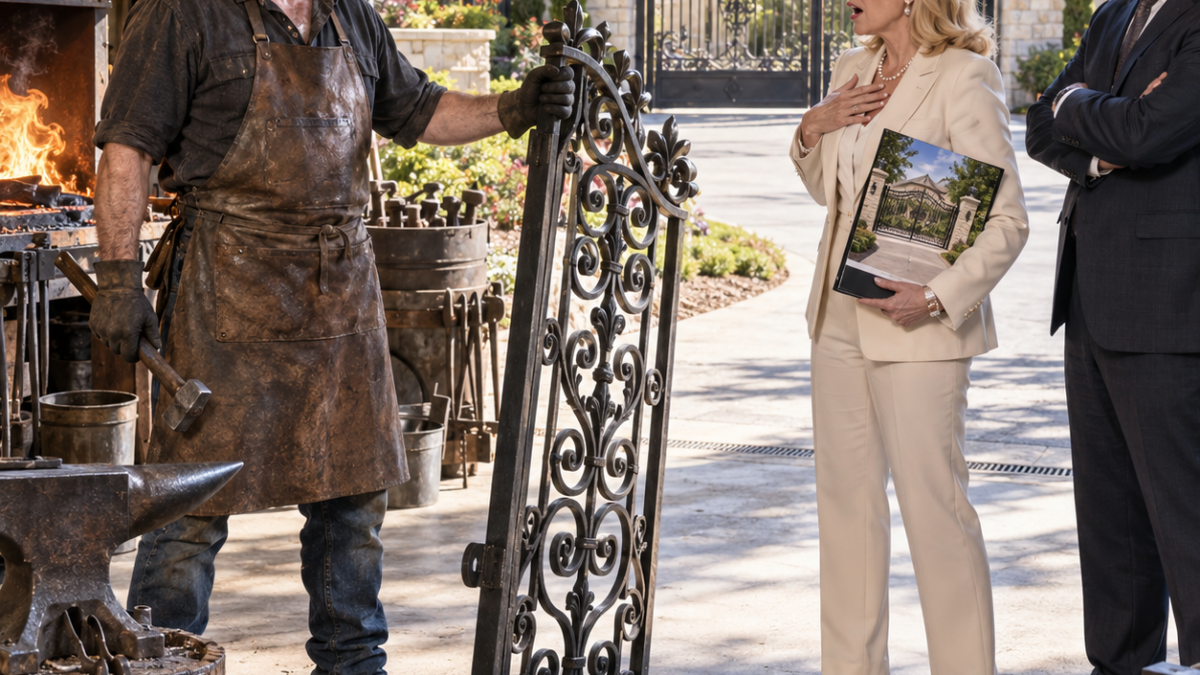
PART 2
The first thing I wrote at the top of the yellow legal pad was one word.
Procedure.
Not revenge.
Not Karen.
Not lawsuit.
Procedure.
I had learned a long time ago that panic makes people sloppy.
Karen wanted me angry.
An angry man with a hammer, an open flame, and a military background was exactly the story she wanted to tell Summit Creek.
So I gave her something else.
A homeowner with a binder.
I read every page of the governing documents.
Then I read them again.
By midnight I had three different colors of tabs sticking from the edges.
Yellow for architectural provisions.
Blue for enforcement procedures.
Red for anything Karen had already violated herself.
The section covering detached hobby workshops was exactly where I remembered it.
Section 7, paragraph C.
Detached workshops and studios were permitted when approved by the architectural review committee and compliant with applicable building and safety codes.
I had the approval.
Signed.
Dated.
Stamped.
The next section mattered even more.
Karen could not simply invent fines and declare them valid.
Formal penalties required notice, an opportunity to be heard, and board action.
Her five-hundred-dollar “emergency assessment” appeared nowhere.
Neither did her supposed authority to erase a prior architectural approval by announcing that “standards evolve.”
At 12:47 a.m., Sarah came downstairs in her robe.
“You’re still awake.”
“So are you.”
“I’m married to the problem.”
I leaned back.
She came behind my chair and looked at the highlighted pages.
“Tell me you found something.”
“I found several things.”
“Good things?”
“For us.”
She pulled out the chair beside mine.
I showed her the approval letter.
Then the enforcement section.
Then Karen’s violation notice.
Sarah read silently.
“Did she just make up this five hundred dollars?”
“Looks like it.”
“She threatened our house with a fee she invented?”
“Yes.”
Sarah’s mouth tightened.
That frightened me more than Karen’s shouting ever had.
Sarah almost never got angry quickly.
When she did, it was because somebody had crossed a line involving Lily or our home.
“What do we do?”
“We make her explain every line.”
The next morning I drove to the county offices and requested copies of my permits.
Building approval.
Fire inspection.
Occupancy clearance.
I visited the fire marshal’s office and obtained a certified copy of the final report.
The deputy fire marshal who pulled the record remembered my workshop.
“You’re the blacksmith.”
“That obvious?”
“You installed a suppression system in a private shop that’s better than some commercial garages.”
“HOA says I’m a fire hazard.”
He stared at me.
Then laughed.
“I’d enjoy watching them explain that.”
“I’m hoping nobody has to enjoy anything.”
He slid the report across the counter.
“Good luck with that.”
Next came noise.
Karen’s notice called my work a “continuous industrial disturbance.”
Continuous was an interesting word considering I rarely forged more than four or five hours a day.
Industrial was even more interesting considering the loudest equipment in my shop was probably the ventilation fan.
Still, I didn’t rely on opinion.
I rented a calibrated decibel meter.
Then, after thinking about it, I hired a certified acoustical consultant for an hour.
If this became a serious dispute, I wanted something Karen couldn’t dismiss as me holding a phone in my yard.
We tested at the property line while I worked.
Forge running.
Hammer striking.
Ventilation on.
Shop doors configured exactly as they normally were.
The measurements were low.
Low enough that ordinary neighborhood noises regularly exceeded them.
A garbage truck passing the front road was louder.
A lawn mower three houses away was louder.
A dog barking across the street was louder.
When George wandered over during the test, the consultant smiled.
“Your neighbor talking from ten feet away is technically producing more sound here than the hammer.”
George looked offended.
“You calling me loud?”
“Yes.”
“Mary’s been saying that for forty-two years.”
By late afternoon I had a written summary.
Then I photographed the shop.
Clean work areas.
Steel racks secured.
Propane stored properly.
Fire extinguishers.
Suppression equipment.
Ventilation.
Distances from property lines.
Nothing hidden.
Nothing staged.
Just facts.
That evening I drafted my response.
I addressed it to all five board members.
Not Karen alone.
That was deliberate.
If she wanted to pretend she was the association, I was going to remind the other four people that their names were attached to what she did.
I disputed every allegation.
For the workshop: prior written approval.
For fire risk: inspection report.
For noise: certified measurements.
For unauthorized commercial activity: the covenant provision allowing home-based professional activity that did not create prohibited traffic, signage, nuisance, or external storage.
My customers did not line the street.
There was no storefront.
No employees.
No delivery fleet.
No giant sign.
I made things with my hands and shipped most commissions.
Finally, I requested a formal hearing and copies of every board vote authorizing the fines.
Sarah read the letter before I mailed it.
“You sound very calm.”
“I am calm.”
“You reorganized the silverware drawer twice this morning.”
“I’m selectively calm.”
She smiled.
Then her expression softened.
“What happens if she keeps going?”
I looked through the window toward the forge.
“Then she keeps giving us evidence.”
I sent the package certified.
Then I waited.
The waiting was worse than I expected.
Not because I thought Karen would win.
Because the forge stayed cold.
Technically, I could have continued operating.
My attorney had not told me to stop.
No legitimate authority had ordered me closed.
But I knew Karen was looking for photographs.
Noise recordings.
Anything she could frame as open defiance.
So I finished paperwork instead.
I designed pieces at my desk.
Returned customer emails.
Updated sketches.
But I didn’t light the forge.
By the fourth day, Lily noticed.
She came into my office carrying a sheet of construction paper.
“Daddy?”
“Yeah, sweetheart?”
“Is the fire broken?”
I looked up.
“The forge?”
She nodded.
“No.”
“Then why don’t you use it?”
I set my pencil down.
“Some grown-ups are arguing about whether I’m allowed to.”
She frowned in the serious way only a seven-year-old can.
“But it’s yours.”
“Yes.”
“And you built it.”
“Yes.”
“And the fireman said it was safe.”
I smiled.
“You remember everything.”
“So what are they arguing about?”
“That’s a very good question.”
She climbed into the chair across from me.
“Is it the lady with the clipboard?”
I hesitated.
“Yes.”
“I don’t like her.”
“Lily.”
“I don’t.”
“You don’t have to like everyone. You do have to be fair.”
She thought about that.
“Is she being fair?”
I looked toward the dark shop again.
“No.”
Lily slid the construction paper across my desk.
She had drawn our house.
Sarah.
Me.
Herself.
And behind us, a black square with huge orange flames shooting from the roof.
I raised an eyebrow.
“That’s the forge?”
“Yes.”
“Those flames are concerning.”
“It’s artistic.”
I laughed for the first time that week.
Then she pointed to a black fence at the edge of the paper.
“The gate.”
The entrance gates.
I looked at them longer than she understood.
Dark wrought iron.
Two sweeping sections meeting beneath an arch.
Oak leaves.
Acorns.
Scrollwork.
They were crude in her drawing, but I knew every curve.
Every weld.
Every hammer mark.
Because I had made them.
Three years earlier, before Summit Creek was fully built out, the original developer, Robert Thompson, had contacted me after finding my portfolio.
He wanted the entrance to make a statement.
Not mass-produced aluminum pretending to be iron.
Not factory scrolls ordered from a catalog.
Real work.
Hand forged.
Something permanent.
For three months I had heated, bent, upset, punched, drifted, twisted, and welded nearly every visible decorative element.
The oak leaves alone had taken days.
Each one was slightly different.
That was intentional.
Nature repeats patterns.
It doesn’t photocopy them.
I remembered Thompson standing in my old shop while I fitted the final sections.
“This is what people will remember,” he had said.
I had laughed.
“They’re gates.”
“No,” he said. “They’re the handshake.”
The entrance became the centerpiece of Summit Creek’s marketing.
The gates appeared on sales brochures.
Community newsletters.
Real-estate listings.
Karen herself had posed in front of them twice for HOA publications.
I had never made a big deal about it.
Why would I?
I didn’t need neighbors knowing what commissions paid or what private projects I had done.
The developer knew.
The original committee knew.
Sarah knew.
That was enough.
Until now.
I looked at Lily’s drawing.
Then at the stack of violation papers beside it.
A strange thought settled in my mind.
Karen had called my work an affront to Summit Creek’s aesthetic values.
The community’s most photographed object was my work.
I smiled.
Not because I had found the weapon that would end the fight.
Not yet.
Because I had discovered something beautifully simple.
Karen hadn’t bothered to learn who she was attacking.
That kind of arrogance usually creates its own ending.
The certified mail receipt came back the following Monday.
Signed.
Two days later I began noticing the looks.
At the pool, conversations stopped when I walked past.
A woman who usually waved at Sarah suddenly became deeply interested in her phone.
A neighbor across the street pulled his garage door down while I was retrieving a package.
Then George came over.
He didn’t bring tea this time.
He brought irritation.
“Karen’s telling people your shop is basically a steel mill.”
“I wondered.”
“She says trucks are coming day and night.”
“You’ve lived beside me for a year.”
“I told her that.”
“What did she say?”
“That you probably behave when I’m around.”
I laughed.
George didn’t.
“She’s also saying you refused a fire inspection.”
I stood still.
“She said that?”
“At the pool committee meeting.”
My fire inspection was part of the record.
Karen knew it existed.
I walked into the office and pulled out a copy.
George read it.
His eyebrows lifted.
“She knows about this?”
“She has a copy.”
“Then she’s lying.”
“Maybe.”
“Maybe?”
“I wasn’t at the meeting. You were.”
“She lied.”
He tossed the paper onto my desk.
“You know what bothers me?”
“I have a list.”
“She does this to everyone.”
That got my attention.
“Everyone?”
George glanced toward his own house.
“Mary gets mad when I talk about it.”
“Talk about what?”
He sighed.
“Garden hose.”
I waited.
“She fined us seventy-five dollars because the hose wasn’t coiled correctly.”
I stared at him.
“You’re joking.”
“I wish.”
“What does correctly mean?”
“She wanted a ‘uniform circular presentation.’”
I looked at his face.
He was completely serious.
“I sent her a geometry diagram.”
That made me laugh.
George finally did too.
Then the laughter faded.
“She fined the Patels over their boy’s basketball hoop.”
“I’ve seen the hoop.”
“Not anymore.”
I looked across the road.
He was right.
The Patels’ driveway was empty.
“She said it encouraged loitering.”
“The kid is twelve.”
“Apparently twelve-year-olds are the first stage of social collapse.”
The next evening I knocked on the Patels’ door.
Ravi Patel answered.
I told him I wasn’t there to pull him into my dispute.
“I just wanted to ask about the basketball hoop.”
His face hardened.
“My son saved for it.”
“How long did he have it?”
“Two months.”
“What rule did she cite?”
Ravi called his wife, Priya.
She brought a folder.
People under pressure keep folders.
That became one of the great lessons of Summit Creek.
There was the notice.
Aesthetic incompatibility.
Street obstruction.
Potential nuisance.
The hoop had been on their driveway, not the street.
The covenants did not specifically prohibit portable basketball goals.
Karen had threatened escalating fines anyway.
“We didn’t want trouble,” Priya said.
“So you removed it.”
Ravi looked toward the stairs.
“Our son asked why his friends in other neighborhoods could play outside and he couldn’t.”
I gave the papers back.
“I’m sorry.”
“You didn’t do it.”
“No.”
But I was beginning to understand something.
The forge wasn’t an isolated fight.
Karen needed compliance.
Not with rules.
With her.
Once I saw that pattern, I started looking for people who had already challenged her.
That led me to David Chen.
David had served as HOA treasurer during the first few months after resident control began.
Then he resigned without explanation.
I found him washing his car on a Saturday morning.
“Mr. Chen?”
He looked up.
“Yes?”
“I’m Jack Caldwell.”
“I know.”
“That good or bad?”
“These days?”
He smiled faintly.
“Complicated.”
I told him I was fighting fines over my forge.
His smile disappeared.
“She picked you.”
“Apparently.”
“Then document everything.”
“I am.”
I showed him a copy of my response.
He read quietly.
When he reached the section requesting proof of board authorization, he looked at me.
“She won’t have it.”
“That’s my suspicion.”
“She operates first. Paperwork catches up later.”
“You know that from experience?”
He folded the letter.
“I used to be treasurer.”
“I know.”
“Then you know I resigned.”
“I don’t know why.”
David stared at his car for several seconds.
Then he opened the garage.
“Come inside.”
His office looked like an accountant’s office even though we were inside his house.
Clean desk.
Two monitors.
Labeled folders.
No clutter.
He closed the door.
“When Karen became president, spending changed.”
“How?”
“Not dramatically at first. Landscaping. Irrigation. Seasonal planting.”
“Normal HOA expenses.”
“Yes. Except one company started getting nearly everything.”
“Who?”
“Evergreen Solutions.”
I recognized the name from trucks around the entrance.
“Good company?”
David gave a humorless smile.
“Their bids were consistently high.”
“How high?”
“Fifteen to twenty-five percent.”
“Why choose them?”
“That was my question.”
He opened a drawer.
“I kept copies.”
He placed several bid sheets in front of me.
Different vendors.
Similar scopes.
Evergreen was often the highest.
“Board approved these?”
“Karen pushed them through.”
“With competitive bidding?”
“She claimed Evergreen was more reliable.”
“Any relationship?”
David leaned back.
“That took me a while.”
He turned one monitor toward me.
A state business registration page was open.
Evergreen Solutions.
Registered agent: Frank Miller.
“Karen’s maiden name is Miller,” he said.
I looked at him.
“Brother?”
“Cousin.”
“Did she disclose that?”
“Not to me.”
“Maybe to the board.”
“I was the treasurer.”
Point taken.
“What happened when you raised it?”
“She accused me of trying to sabotage improvements.”
“And the others?”
“They didn’t want conflict.”
“So you resigned.”
“I had a choice. Stay and sign financial reports I wasn’t comfortable with, or leave.”
He looked embarrassed.
“I left.”
“That doesn’t make you responsible for what she did.”
“Feels like it.”
He opened another folder.
Meeting notes.
Emails.
Bid comparisons.
“I kept these because I knew someday somebody might ask.”
I touched the edge of the stack.
“May I copy them?”
David looked at me.
“What are you planning?”
“I don’t know yet.”
“That answer worries me.”
“Me too.”
He thought for a long moment.
Then pushed the folder across.
“Take them.”
My binder grew.
So did Karen’s aggression.
The official response to my appeal arrived one week later.
She rejected everything.
My architectural approval was supposedly obsolete.
My fire marshal report was “not determinative.”
My sound measurements were “unverified.”
She called my workshop commercial industry.
Then came the number.
$4,300.
Accrued fines.
And a special hearing.
If I failed to comply, the letter warned, the board would consider recording a lien and pursuing additional remedies against our property.
Sarah read it twice.
Then sat at the kitchen table.
“She really means to go after the house.”
“I don’t know if she can.”
“That isn’t what I said.”
No.
It wasn’t.
Sarah wasn’t asking about Karen’s authority.
She was asking about her intent.
“Yes,” I said. “I think she means it.”
Lily was upstairs.
The house was quiet.
Sarah folded the letter carefully.
“This place was supposed to be where we started over.”
“I know.”
“Do you?”
I looked at her.
Tears were gathering in her eyes.
“You were gone for years, Jack. Not all at once. But deployment after deployment. Then you came home and sometimes you were still gone even when you were sitting beside me.”
I couldn’t speak.
“The forge brought you back.”
Her voice broke.
“Lily knows you in that shop. She knows the sound of that hammer means her dad is home.”
I reached for her hand.
Sarah gripped mine.
“So no. I don’t care about Karen’s stupid fines anymore. I care that she walked onto our property, looked at the thing that helped give my husband back to me, and decided she could destroy it because she didn’t like how it looked.”
There are moments when someone you love says the thing you have been avoiding.
This was one of them.
I had been calling the forge therapy.
Sanctuary.
Work.
Livelihood.
But Sarah understood its real place in our family.
It had been the bridge between who I was and whoever I was trying to become.
“I’m not letting her take it.”
Sarah nodded.
“Then stop treating this like it’s only about your workshop.”
The next morning I called David.
“I need everything.”
A pause.
“Everything what?”
“You found one contractor.”
“Yes.”
“What else bothered you?”
“Jack—”
“She’s threatening foreclosure.”
Silence.
Then David said, “Come over.”
For three hours we reconstructed nearly two years of spending.
Evergreen appeared everywhere.
Mulching.
Tree care.
Irrigation repairs.
Seasonal flowers.
Snow preparation.
Drainage inspections.
Jobs that should have gone to specialists.
Jobs that seemed strangely expensive.
David showed me minutes where another board member, Gerald Fleming, repeatedly requested multiple bids.
Each time Karen delayed.
Then later presented Evergreen as the preferred option.
Was that automatically criminal?
No.
Was it evidence of conflict and weak governance?
Absolutely.
I refused to call it anything more without proof.
That mattered.
Anger makes accusations easy.
Evidence makes them useful.
Then David showed me an invoice from a law firm.
Smith, Klein & Associates.
“For the revised violation code,” he said.
“The rules she’s using against me?”
“Yes.”
“What’s wrong with the firm?”
“Look at the partner list.”
Robert Klein.
I stared.
“Relationship?”
“Karen’s brother-in-law.”
I sat back.
Her cousin got landscaping business.
Her brother-in-law’s law firm was paid to review and help draft new enforcement standards.
Neither relationship appeared in the minutes David had retained.
“Could she have disclosed verbally somewhere else?”
“Maybe.”
“So we don’t claim she didn’t unless we can prove it.”
David smiled.
“You really are annoying.”
“I’ve been told.”
“We can say there’s no disclosure in the records we have.”
“Exactly.”
That afternoon I called an old friend.
Marcus Thorne had been an Army JAG officer when I knew him.
Sharp mind.
Terrible coffee.
Unfairly good poker face.
After leaving service, he opened a civil litigation practice in the city.
He answered his own phone.
“Thorne Law.”
“Marcus.”
Silence.
“Jack Caldwell?”
“Unfortunately.”
“You’re alive.”
“So far.”
“I heard you retired into the wilderness to hammer swords.”
“Garden gates.”
“That is substantially less exciting.”
“I need a lawyer.”
“That restores the excitement.”
I gave him the short version.
He stopped joking.
“How much are they threatening?”
“Over four thousand in fines. Possible lien. Possible foreclosure action.”
“Workshop approval?”
“In writing.”
“Fire inspection?”
“Clean.”
“Noise?”
“Measured.”
“Board procedure?”
“Questionable.”
“Any retaliation evidence?”
“Plenty.”
“And you said the president may have pushed contracts to relatives?”
“I have records showing contracts went to her cousin’s company and legal bills went to her brother-in-law’s firm. I’m not claiming crimes. I’m claiming conflicts that deserve explanation.”
Marcus was quiet.
Then he said, “You learned patience.”
“Age.”
“Sarah.”
“Mostly Sarah.”
“When’s the hearing?”
“Twelve days.”
“I’ll be there tomorrow.”
He arrived at eleven the next morning.
Lily opened the door and shouted, “Daddy, the lawyer is here.”
Marcus stepped inside.
“You’ve trained your security staff well.”
“She charges cookies.”
“Reasonable.”
We spent the next four hours at the dining table.
Marcus read everything.
Every notice.
Every approval.
Every sound report.
Every bid sheet.
Every minute.
He stopped at the developer’s original workshop approval.
“This is strong.”
“I thought so.”
“Not invincible. Associations sometimes amend rules. But revoking a prior approval after reliance is a much harder story than Karen makes it sound.”
He reached the fine procedure.
“This is stronger.”
“She skipped board approval?”
“Based on what you have, at minimum I want them proving they followed their own process.”
Then he reached the Evergreen documents.
His expression changed.
“Who is Frank Miller?”
“Her cousin.”
“Documented?”
“Business record plus people who know the family.”
“And Klein?”
“Brother-in-law.”
He leaned back.
“Interesting.”
“Illegal?”
“I didn’t say that.”
“Good.”
“I said interesting.”
He tapped the papers.
“Conflict of interest questions can destroy confidence even when conduct doesn’t meet a criminal threshold.”
“That’s enough for me.”
Marcus looked at me.
“No, it isn’t.”
“What?”
“You’re still thinking like this ends when your forge survives.”
“It doesn’t?”
“Look around.”
He gestured toward the stacks.
“You have evidence of procedural abuse affecting multiple homeowners. You have former officers. You have a president threatening drastic enforcement over an approved structure. If the community hears all of this and still wants her, that’s their decision.”
“And if they don’t?”
“Then your hearing may become something else.”
Sarah walked in carrying coffee.
“What kind of something else?”
Marcus smiled.
“The kind Karen isn’t planning.”
Our strategy was simple.
Let her speak.
No interruptions.
No anger.
No muttering.
No dramatic reactions.
If she exaggerated, we wrote it down.
If she lied, we preserved it.
Then we answered in sequence.
Workshop approval.
Safety.
Noise.
Procedure.
Financial conflicts.
And finally the gates.
Marcus loved the gates.
When I showed him the original invoice from Robert Thompson, he stared at me.
“You’ve been sitting on this?”
“It didn’t seem relevant.”
Marcus laughed.
“Jack, this is art.”
“It’s an invoice.”
“No. The invoice is paper. The irony is art.”
He stood.
“She’s calling your craftsmanship an aesthetic blight while using your craftsmanship as the visual identity of the community.”
“Yes.”
“Do you have photos of fabrication?”
“Hundreds.”
“Contract?”
“Yes.”
“Developer still reachable?”
“Yes.”
Marcus pointed at me.
“Call him.”
Robert Thompson remembered me immediately.
“Jack! How are the gates holding up?”
“Funny you ask.”
I explained.
He became quiet.
“The HOA is trying to ban your forge?”
“Yes.”
“The forge I approved?”
“Yes.”
“The guy currently running the HOA knows you made the gates?”
“Woman. And apparently not.”
A long pause.
Then Thompson laughed so hard I had to move the phone away from my ear.
When he recovered, he said, “Tell me what you need.”
“Written confirmation that you approved the workshop before closing and commissioned the gates.”
“You’ll have it tomorrow.”
“And Robert?”
“Yes?”
“Just facts.”
“I know.”
The signed statement arrived by overnight delivery.
One paragraph confirmed my workshop approval.
Another confirmed the gate commission.
No insults.
No speculation.
Perfect.
Then we needed people at the hearing.
Not a mob.
Witnesses.
George and Mary agreed.
David agreed.
The Patels agreed.
A few others did too.
Some were scared.
One woman told Sarah, “If Karen survives this, she’ll come after everyone who shows up.”
Sarah answered, “That’s why everyone has to show up.”
The woman came.
The evening before the hearing, I stood alone in the forge.
Still cold.
I ran my hand across my grandfather’s anvil.
He had been a blacksmith in West Virginia.
Not artistic ironwork.
Practical work.
Farm repairs.
Tools.
Hinges.
Equipment.
He taught me when I was young.
“Steel remembers bad heat,” he used to say.
Too cold, it cracks.
Too hot, you burn it.
The job is not to hit harder.
The job is to know when the metal is ready to move.
For weeks Karen had mistaken restraint for fear.
Tomorrow she would learn the difference.
The Summit Creek clubhouse held maybe seventy chairs.
Almost all of them were occupied.
Karen sat at the center of the board table in a red blazer.
Gerald sat two seats away.
Brenda Cole, the youngest board member, looked as though she wished she could become invisible.
Two other members, Tom Avery and Michael Reese, avoided eye contact with everyone.
Sarah sat beside me.
Marcus sat on my other side.
Lily stayed with Sarah’s sister.
I didn’t want our daughter watching adults try to take away her home.
Karen struck the gavel.
“This special enforcement hearing is called to order.”
Her voice was stronger than usual.
She had dressed for power.
Hair perfect.
Documents stacked.
Microphone positioned.
Then she looked directly at me.
“The sole purpose of tonight’s hearing is the repeated and intentional violation of community standards by Jack Caldwell of 112 Oak Hollow Lane.”
Sole purpose.
Marcus wrote those words down.
Karen began.
She showed photographs of my shop taken from a low angle through landscaping.
She called it “industrial.”
She displayed a photograph of my propane tanks.
Called them an “explosive hazard.”
She referred to “numerous resident complaints” about noise.
No names.
She described “noxious fumes.”
No measurements.
She claimed deliveries associated with my business were degrading roads.
I received a steel shipment perhaps once every two weeks.
Then she talked about fairness.
That was the part that nearly made me laugh.
“Every homeowner in Summit Creek agreed to follow shared standards,” she said. “One resident cannot simply decide he is special because he dislikes rules.”
People glanced at me.
I stayed still.
“The forge is visually incompatible with the modern residential character of Summit Creek.”
George shifted in his chair.
“The continued operation of an unapproved commercial metalworking enterprise poses liability to this association.”
Marcus wrote again.
“The board has attempted repeatedly to secure voluntary compliance.”
That was creative.
“My office has been met with hostility, obstruction, and refusal.”
Marcus looked at me.
I whispered, “I asked for documents.”
“I know.”
Karen continued.
“The current balance of penalties exceeds six thousand dollars.”
Sarah’s fingers tightened around mine.
Six thousand.
She had increased the amount again.
Karen looked down at her paper.
“Given Mr. Caldwell’s continued refusal to comply, I recommend the board authorize all lawful collection remedies, including the recording of a lien against the property and, if necessary, foreclosure proceedings.”
The room erupted in murmurs.
Gerald leaned toward his microphone.
“Karen.”
“Yes?”
“Foreclosure seems excessive.”
Her head snapped toward him.
“We have discussed this.”
“We discussed enforcement. I don’t remember agreeing to foreclosure.”
“We cannot have rules without consequences.”
“Yes, but—”
“Gerald.”
One word.
That was all she needed.
He leaned back.
And in that small moment, everyone saw how the board worked.
Not consensus.
Fear.
Karen turned to me.
“In the interest of fairness, Mr. Caldwell may respond.”
Marcus whispered, “Now.”
I stood.
Carried my binder to the front.
Placed it on the table.
The sound was louder than I intended.
“Thank you.”
Karen folded her arms.
I faced the room.
“My name is Jack Caldwell.”
I paused.
“I have lived in Summit Creek with my wife, Sarah, and our daughter for a little over a year.”
I looked at Karen.
“I’m going to begin by agreeing with one thing the president said.”
Her expression shifted.
“Rules matter.”
Several people looked surprised.
“They mattered to me in the Army. They matter in a neighborhood. They matter in contracts. They matter when people share roads, money, property, and responsibility.”
I opened the binder.
“But rules matter most when the people enforcing them follow them too.”
Marcus didn’t move.
Karen did.
I continued.
“The workshop you have been told is unauthorized was approved in writing before construction.”
I held up the developer approval.
Copies went to each board member.
Brenda read hers immediately.
Gerald looked from the signature to Karen.
“This is real?”
Karen answered before I could.
“Superseded.”
I looked at her.
“Please show me the provision that automatically voided this approval.”
“The board adopted modern standards.”
“Please show me the provision.”
She didn’t.
I let the silence sit.
Then I held up the fire marshal report.
“You were told my forge poses an extraordinary fire hazard.”
I read the inspection conclusion.
Not every word.
Only what mattered.
Approved ventilation.
Suppression.
Noncombustible materials.
Safe fuel installation.
Compliance.
“The county authority responsible for evaluating fire safety approved it.”
Karen interrupted.
“The HOA can impose higher aesthetic standards.”
“Aesthetics aren’t fire science.”
Someone in the audience said, “Exactly.”
Karen glared toward the voice.
I continued.
“You were told the forge creates constant deafening noise.”
I passed out the acoustical summary.
“Measurements were taken at my property line while I was actively forging.”
George raised his hand.
“Can I say something?”
Karen snapped, “No.”
Marcus stood.
“Madam President, as Mr. Caldwell’s counsel, I would request that a directly adjacent homeowner be permitted to testify regarding the alleged nuisance.”
“You have counsel?”
Marcus smiled.
“I’ve been sitting here for forty minutes.”
Laughter rippled through the room.
Karen’s face tightened.
“Fine.”
George stood.
“I live next door.”
He pointed in the direction of his house.
“My wife and I have never filed a noise complaint.”
“Mr. Henderson—”
“We can barely hear Jack’s shop from our porch.”
Karen interrupted.
“Other residents have complained.”
“Who?”
“I am not required to expose concerned homeowners to retaliation.”
George stared.
“Funny. I’ve heard more complaints about your leaf blower than his anvil.”
The room laughed.
Karen slammed the gavel.
“Order!”
I raised a hand toward George.
“Thank you.”
He sat.
I turned another page.
“Now the fines.”
Karen’s shoulders stiffened.
“The bylaws require a specific process before penalties become final.”
I read the relevant section.
Notice.
Opportunity to contest.
Board consideration.
Documentation.
“I asked for copies of the votes authorizing these penalties.”
I looked toward every board member.
“I have not received them.”
Gerald looked at Karen.
“Were there votes?”
“Administrative penalties do not require individual board votes.”
I slid the bylaw toward him.
Gerald read it.
Then Michael Reese leaned over.
Brenda did too.
Karen’s voice sharpened.
“We have always interpreted that provision differently.”
Marcus stood.
“Then perhaps the board can produce the written interpretation.”
Silence.
He stepped beside me.
“My name is Marcus Thorne. I represent Mr. Caldwell.”
He rested one hand lightly on the table.
“We could spend the evening arguing about whether Mr. Caldwell’s forge is attractive.”
Karen scoffed.
Marcus smiled.
“But that would be pointless.”
He picked up the Evergreen file.
“I am more interested in how this association makes decisions.”
The room changed.
Karen knew immediately.
I saw it in her face.
“What does landscaping have to do with this hearing?”
Marcus looked toward her.
“Perhaps nothing.”
Then to Gerald.
“Mr. Fleming, did you request competitive bids for landscaping contracts during the May fourth board meeting?”
Gerald swallowed.
“Yes.”
“Why?”
“Because Evergreen seemed expensive.”
“Did you receive three bids?”
“No.”
“What happened?”
Gerald glanced at Karen.
“She said she would handle it.”
“And the contract was awarded to Evergreen?”
“Yes.”
Marcus held up three comparative bid sheets David had retained.
“Were these figures presented to you?”
Gerald studied them.
“No.”
“Were you aware Evergreen was substantially higher on several scopes?”
“No.”
Karen hit the gavel.
“This is irrelevant.”
Marcus didn’t raise his voice.
“Madam President, you have threatened my client with loss of his home based on the integrity of this board’s enforcement process. Governance is not irrelevant.”
People murmured.
Then Marcus asked the question.
“Who owns Evergreen Solutions?”
Karen said nothing.
Marcus waited.
“Mrs. Peterson?”
“It is a private company.”
“Owned by?”
“That does not matter.”
David Chen stood from the audience.
“Frank Miller.”
Every head turned.
Karen’s eyes flashed.
“Sit down, David.”
Marcus looked at him.
“Mr. Chen, you served as treasurer?”
“Yes.”
“Who is Frank Miller?”
David looked at Karen.
“Her cousin.”
The room erupted.
Karen slammed the gavel repeatedly.
“This is outrageous! Family relationships do not prohibit vendors from working for the community.”
Marcus raised a hand.
“Correct.”
That surprised everyone.
Even Karen.
“A family relationship alone proves nothing improper.”
The noise softened.
“But conflicts should be disclosed and purchasing procedures should be followed.”
He held up the meeting minutes.
“I have reviewed the records provided to us. I have not located a documented disclosure of that relationship.”
Karen pointed at him.
“That does not mean there wasn’t one.”
“Correct again.”
Marcus was destroying her more effectively by being fair than he ever could have by exaggerating.
“So perhaps you can tell the membership when the relationship was disclosed.”
Karen stared at him.
No answer.
Marcus picked up another document.
“Next.”
Karen’s face drained.
“This association paid Smith, Klein & Associates to review and assist with drafting the expanded enforcement standards currently being applied against Mr. Caldwell.”
“So?”
“Who is Robert Klein?”
Karen’s mouth opened.
Closed.
Marcus waited.
Finally she said, “My brother-in-law.”
The reaction was louder than before.
Priya Patel stood.
“You paid your family to write the rules?”
Karen snapped, “A qualified law firm was retained.”
Marcus nodded.
“Again, a familial relationship alone does not prove the firm was unqualified.”
He looked around the room.
“But homeowners are entitled to ask whether conflicts were disclosed, whether contracts were reviewed appropriately, and whether the same enforcement structure was later used selectively.”
David raised his folder.
“I raised concerns.”
Karen’s face turned red.
“You resigned because you were incompetent.”
David flinched.
Then something changed.
He walked toward the front.
For a quiet accountant, that took more courage than most people in the room understood.
“I resigned because you told me to sign a financial report I could not verify.”
Karen went still.
David placed his papers beside Marcus.
“I should have told everybody then.”
He looked at the residents.
“I didn’t.”
His voice shook.
“I was afraid of what she would do to me.”
No one laughed.
No one whispered.
“I’m sorry.”
Mary Henderson stood.
“You’re telling us now.”
David nodded.
Marcus let the silence settle.
Then he looked at me.
“Jack.”
I knew what he meant.
The gates.
I had planned the reveal carefully.
Not because I wanted applause.
Because timing matters.
Steel too cold resists.
Steel at the right heat moves with one clean blow.
I pulled the last folder from my binder.
“Karen.”
She glared at me.
“You’ve repeatedly described my work as incompatible with Summit Creek.”
“It is.”
“You’ve called it ugly.”
“I called the workshop ugly.”
“You called the activity a blight.”
“I stand by that.”
I nodded.
“Fair enough.”
I looked toward the windows.
From the clubhouse, you could just see part of the main entrance if you stood at the right angle.
“I want to talk about aesthetic standards.”
Karen gave a bitter laugh.
“At last.”
“You’re proud of the front gates?”
Her expression changed.
“What?”
“The Summit Creek gates.”
“What about them?”
“They’re used in the brochures.”
“So?”
“Real-estate listings.”
“So?”
“HOA newsletters.”
She frowned.
“This is childish.”
“You posed in front of them for the spring newsletter.”
People started looking at one another.
Karen’s face tightened.
“They are part of our community branding.”
“Exactly.”
I removed a photograph.
It showed the unfinished gates inside my old shop.
Bare steel.
Clamps.
Chalk marks.
My hands visible beside one of the oak-leaf clusters.
I placed it on the table.
Then another.
A red-hot scroll emerging from the forge.
Another.
Me shaping an acorn under a power hammer.
Another.
The two gate sections laid out before finishing.
Karen stared.
“What is this?”
I placed the original invoice beside them.
“Your front gates.”
She looked at the invoice.
Then at me.
“No.”
“Yes.”
“You’re lying.”
I turned to the room.
“Three years ago, Robert Thompson commissioned me to design and forge the main entrance gates for Summit Creek Estates.”
Silence.
“You know those oak leaves?”
I held up the fabrication photograph.
“Made them one at a time.”
I lifted another.
“Those scrolls?”
Another.
“Forged and fitted by hand.”
I looked directly at Karen.
“The work you use on your brochures to represent Summit Creek came out of my forge.”
George began laughing.
Not cruelly.
He simply couldn’t help it.
Mary covered her mouth.
Ravi Patel shook his head.
Someone at the back said, “You have got to be kidding me.”
Karen grabbed the invoice.
“This proves nothing.”
Marcus removed the developer’s signed statement.
“Then perhaps this will.”
He read the relevant paragraph.
Robert Thompson confirmed that he had personally retained me.
Confirmed that I created the gates.
Confirmed that the work had been selected because of its craftsmanship and aesthetic character.
Then Marcus read the next paragraph.
The same developer had approved my workshop.
Before our home purchase.
Before construction.
In writing.
The paper trembled slightly in Karen’s hand.
I didn’t smile.
That mattered to me.
Because I had dreamed of this moment.
For weeks I had imagined satisfaction.
Triumph.
Watching her finally understand.
But standing there, I mostly felt tired.
“So,” I said quietly, “I have one question.”
Karen looked at me.
“If what comes from my forge is so ugly that you are willing to threaten my home over it…”
I pointed toward the entrance.
“…why have you spent years using my work as the symbol of everything beautiful about this community?”
No one spoke.
There was no answer.
There couldn’t be.
Karen’s argument had collapsed under its own contradiction.
Then Brenda, the youngest board member, spoke.
“I didn’t know.”
Karen turned on her.
“Know what?”
“Any of this.”
Brenda held up the Evergreen sheet.
“The family relationship.”
Then the law firm invoice.
“This either.”
“You approved those contracts.”
“Because you told us proper review had already been done.”
Karen’s eyes hardened.
“You are on this board because I asked you to run.”
Brenda stared at her.
“What is that supposed to mean?”
“It means show some loyalty.”
There it was.
Not service.
Not duty.
Loyalty.
Gerald leaned toward his microphone.
“This hearing needs to stop.”
Karen snapped, “No.”
“Yes.”
“I am the president.”
Gerald looked at the other board members.
“Does anyone believe we should vote tonight to place a lien on the Caldwell property?”
No hands.
Karen stared.
“Michael?”
Michael shook his head.
“Tom?”
“No.”
“Brenda?”
“Absolutely not.”
Gerald took a breath.
“I don’t either.”
Karen looked like she had been slapped.
“You cowards.”
The room gasped.
She stood.
“All of you.”
She pointed toward the board.
“You let these people manipulate you.”
Marcus stepped back.
He didn’t need to do anything.
Karen was finishing the case herself.
George stood.
“I move that the board suspend all fines against Jack pending review.”
Gerald nodded.
“As a member motion, we can take that under advisement—”
“I second,” another homeowner called.
Then someone else shouted, “Remove her.”
The room stirred.
Karen grabbed the gavel.
“This meeting is adjourned.”
Gerald reached for the microphone.
“No.”
Everyone froze.
Karen slowly turned.
“What did you say?”
Gerald’s hands trembled.
But his voice didn’t.
“I said no.”
“You do not have authority to override the chair.”
“Then I move for a vote of no confidence.”
Karen laughed.
“You can’t.”
Marcus glanced at the bylaws.
Gerald had apparently been reading too.
“I can move.”
Brenda said, “I second.”
Michael said, “I support it.”
Karen slammed the gavel.
“This meeting is over!”
Nobody moved.
Not one person.
Karen stood behind the table breathing hard.
The room had obeyed her for so long that she seemed genuinely unable to process what disobedience looked like.
Finally, Marcus spoke.
“Perhaps the association should follow its governing documents before taking action.”
Karen pointed at him.
“You stay out of this.”
“I would be delighted.”
He stepped away.
Gerald opened the bylaws.
There was argument over procedure.
Questions.
A short recess.
Homeowners crowded into little circles.
David explained financial documents.
Marcus quietly advised me to say nothing.
Karen stood near the front with her arms crossed.
Nobody approached her.
Twenty minutes later, Gerald reconvened the meeting.
The bylaws did not allow the spontaneous theatrical removal some people wanted.
A formal removal required member procedures.
But the board could reorganize its officers.
Gerald moved that Karen be removed as president pending investigation, while remaining a director until the membership process could occur.
Brenda seconded.
The vote was four to one.
Karen voted no.
Her own four board colleagues removed her as president.
The gavel remained on the table.
Karen stared at it.
Gerald reached across and picked it up.
“I suppose this is mine temporarily.”
Someone laughed nervously.
Karen looked at each board member.
Then at me.
“You did this.”
“No.”
“You came here to destroy me.”
“I came here because you threatened my home.”
“You dug through private affairs.”
“HOA contracts are not your private affairs.”
Her face twisted.
“You think you’re some hero because you were in the Army?”
Sarah stood.
That surprised everyone.
Including me.
“No.”
Karen looked at her.
Sarah’s voice was soft.
“He came home from the Army and spent years trying to feel normal again.”
“Sarah—”
She held up one hand toward me.
Then continued.
“That forge gave my daughter her father back.”
The room went silent.
“You saw a building you didn’t like.”
Sarah’s eyes filled.
“I saw the first place where my husband could spend an entire day without carrying everything he’d seen into our kitchen at night.”
Karen’s expression shifted.
Just briefly.
“You didn’t know that.”
Sarah nodded.
“No. You didn’t.”
Then her voice strengthened.
“But you also never asked.”
That was the moment that stayed with me.
Not the gate reveal.
Not the vote.
Sarah.
Because Karen had reduced every person to an infraction.
A hose.
A basketball hoop.
A workshop.
A mailbox.
She had stopped seeing the humans attached to them.
Sarah sat.
Karen gathered her papers.
Then she looked at Gerald.
“You will regret this.”
Gerald said nothing.
She turned toward me.
“And you will hear from my attorney.”
Marcus smiled slightly.
“Please have counsel contact me directly.”
That stopped her.
For the first time all evening, Karen had nowhere to direct the threat.
She left.
Nobody applauded.
I was grateful.
This wasn’t a football game.
A person had just lost something that mattered deeply to her.
She had created the situation.
But I didn’t need cheering.
The next morning, Gerald called.
“I didn’t sleep.”
“Neither did I.”
“We’re dismissing the forge fines.”
“All of them?”
“Board vote this morning. Unanimous.”
“Thank you.”
“We also want to issue a written acknowledgment that the prior approval remains valid.”
“That would help.”
He hesitated.
“There’s more.”
“I assumed.”
“We’re commissioning an independent audit.”
“Good.”
“David agreed to advise us.”
“Better.”
“And we’ve suspended new work under Evergreen until contracts are reviewed.”
I looked toward the forge.
“Sounds sensible.”
“Jack?”
“Yes?”
“I’m sorry.”
“For what?”
“I sat there.”
I understood.
“You’re fixing it now.”
“I should have asked questions sooner.”
“Yes.”
Silence.
That wasn’t the comforting answer.
But it was the true one.
Then I added, “So should a lot of people.”
Gerald exhaled.
“Fair.”
When the formal letter arrived, Sarah taped it to the refrigerator.
I laughed.
“What are you doing?”
“Displaying art.”
“It’s an HOA letter.”
“Exactly.”
The next morning I opened the forge.
The propane flame caught with a familiar rush.
Blue at the throat.
Orange where it heated the chamber.
I placed a piece of steel into the fire.
For several minutes I simply stood there.
Listening.
Ventilation.
Flame.
The faint ticking of expanding metal.
Then I removed the steel.
Set it on my grandfather’s anvil.
Raised the hammer.
The first strike rang through the shop.
I stopped.
Not because something was wrong.
Because I had missed the sound.
The second strike was stronger.
Then another.
And another.
By noon, George appeared with two iced teas.
He stood in the doorway.
“Noise complaint.”
I gave him a look.
“Too soon?”
“Much.”
He handed me a cup.
“What are you making?”
“Door pull.”
“For who?”
“Client in Oregon.”
He watched.
After a minute he said, “Sounds good.”
“What does?”
“The hammer.”
I nodded.
“Yeah.”
It did.
The independent audit took nearly two months.
And it found enough irregularities to make the entire neighborhood angry.
Some were administrative failures.
Missing disclosures.
Poor bidding documentation.
Incomplete records.
Invoices with vague descriptions.
Contracts renewed without meaningful comparison.
Others were harder to explain.
Evergreen had received large amounts of HOA money despite inconsistent performance.
Some invoices were substantially higher than comparable estimates.
The association’s attorney recommended further review by outside professionals.
The board terminated Evergreen.
Smith, Klein & Associates was replaced.
The revised violation rules were suspended pending legal review.
Residents demanded a formal membership meeting regarding Karen’s remaining board seat.
The vote wasn’t close.
She was removed.
David accepted an appointment to the finance committee but initially refused a board seat.
“I already failed once.”
Gerald shook his head.
“You resigned.”
“Same difference.”
“No.”
I was standing beside them when they had that conversation.
David looked at me.
“What do you think?”
“I think you’re asking the wrong question.”
“What’s the right one?”
“Will you ask uncomfortable questions next time?”
“Yes.”
“Then do it.”
He joined.
The district attorney’s office was eventually provided the audit materials and supporting records.
Investigators requested documents.
I was interviewed about my dispute because the forge enforcement had become part of the broader timeline.
Marcus handled everything.
He never promised dramatic criminal charges.
Real legal systems don’t operate like revenge fantasies.
Evidence gets reviewed.
Intent matters.
Documents matter.
Different conduct falls into different categories.
But Karen could no longer hide behind the title “HOA president.”
Every decision could be examined.
Every contract questioned.
Every disclosure checked.
Her power had depended on nobody looking closely.
Now everybody was looking.
One Saturday morning, I saw a FOR SALE sign on her lawn.
Sarah noticed it too.
“She’s leaving?”
“Looks that way.”
“How do you feel?”
I studied the sign.
“I don’t know.”
“Really?”
“I thought I’d feel more.”
“More happy?”
“Maybe.”
Sarah leaned against me.
“You wanted your life back.”
“Yes.”
“You have it.”
She nodded toward the forge.
“That’s probably why.”
Karen’s house sold quickly.
Ironically, the real-estate listing featured the entrance gates prominently.
I knew because George printed the listing and brought it to me.
“You need to see this.”
“No.”
“Yes.”
He unfolded the paper.
The lead photograph showed Summit Creek’s entrance.
My gates.
George tapped the page.
“Craftsmanship.”
“Go home.”
“Prestigious custom ironwork.”
“George.”
“Signature community entrance.”
I tried not to laugh.
Failed.
“Fine. That’s funny.”
“I knew it.”
Several weeks before Karen moved, the HOA contacted me.
Gerald and David came to the forge together.
Gerald carried a folder.
I looked at it.
“If that’s another violation, I charge consultation fees.”
David smiled.
“Commission.”
“For what?”
“The gates.”
My expression changed.
“What happened?”
“Evergreen.”
Of course.
Their crew had repainted sections without proper surface preparation.
Moisture had gotten underneath.
Rust was appearing around joints.
Cheap topcoat was peeling.
“The board wants them restored properly,” Gerald said.
“Get bids.”
He stared at me.
Then laughed.
“David said you’d say that.”
“Get bids.”
“We did.”
He handed me three.
My proposal wasn’t there.
“Why am I looking at competitors?”
“So you know we followed procedure.”
I looked at David.
He shrugged.
“Transparency.”
I reviewed the numbers.
“Reasonable.”
Gerald handed me another sheet.
“This is what we’re prepared to offer you.”
The amount was generous.
Not absurd.
Enough for the labor.
Materials.
On-site work.
And the fact that restoring someone else’s bad coating was harder than finishing clean steel the first time.
“You don’t owe me a symbolic contract.”
“It isn’t symbolic.”
David pointed to the gates visible in the old sales brochure pinned near my design desk.
“You built them.”
“We want the person who built them to restore them.”
I looked toward my forge.
“You know the sound might damage property values.”
Gerald smiled.
“We’re willing to risk it.”
I accepted.
The restoration took more than a week.
I worked at the entrance where everyone could see.
Stripping damaged coating.
Cleaning corrosion.
Treating exposed metal.
Repairing two small areas where moisture had gotten into joints.
Reapplying a finish suited to the iron.
People stopped.
Some brought coffee.
Kids watched from bicycles.
Ravi Patel’s son—whose basketball hoop had returned to the driveway almost immediately after Karen lost control—came over after school.
“You really made all of this?”
“Every piece.”
He touched an oak leaf.
“By hand?”
“Mostly.”
“How?”
“Heat.”
“That’s it?”
“Heat and persuasion.”
He laughed.
I showed him a photograph from the original fabrication.
He stared.
“That was flat metal?”
“Started that way.”
“Can you make a sword?”
Every kid eventually asks.
“Yes.”
His eyes widened.
“Have you?”
“Yes.”
“Can you make me one?”
“No.”
His disappointment was magnificent.
“Your parents will thank me.”
By the sixth day, most of the gates looked almost new.
That afternoon a moving truck came down the road from inside Summit Creek.
Behind it was Karen’s SUV.
I knew immediately.
Her final day.
The truck slowed at the entrance because of my work zone.
Karen’s SUV stopped beside me.
The window was up.
For several seconds we looked at each other through the glass.
She looked older.
Not dramatically.
Just tired.
The red anger was gone.
The certainty too.
I expected her to look away.
She lowered the window.
“You enjoying this?”
I set down the brush.
“The work?”
“This.”
She gestured toward the gates.
“My humiliation.”
I wiped my hands on a rag.
“No.”
She laughed bitterly.
“Please.”
“You want the truth?”
“I doubt you know what that is.”
I ignored it.
“I didn’t want your house. I didn’t want your job. I didn’t want people laughing at you.”
Her jaw tightened.
“You destroyed my reputation.”
“You threatened to foreclose on my home over an approved workshop.”
“I was enforcing standards.”
“You never came into my workshop to learn what it was.”
“I could see what it was.”
“No.”
I shook my head.
“You saw fire.”
She looked toward the gate.
“You saw steel.”
Then toward the neighborhood.
“You saw houses.”
I looked back at her.
“You stopped seeing people.”
Karen’s eyes flashed.
“You think you’re better than me?”
“No.”
That answer seemed to confuse her.
“I think I got lucky.”
“With what?”
“People stopped me when I was headed somewhere bad.”
Sarah.
My grandfather.
Marcus.
Men I served with.
People who told me when anger was making decisions for me.
“I think you stopped listening to anyone who disagreed with you.”
Karen looked straight ahead.
The moving truck had cleared the entrance.
A driver behind her honked lightly.
Karen put the SUV into gear.
Before she drove away, she said, “Summit Creek will regret getting rid of me.”
“Maybe.”
She looked at me.
I picked up the brush.
“But that gets to be their mistake now.”
Her window rose.
The SUV moved forward.
For one brief second the afternoon light caught her face in the mirror.
Then she turned onto the county road.
And she was gone.
I didn’t wave.
Didn’t smile.
Didn’t celebrate.
I returned to the iron.
There was still work to do.
That evening Lily came with Sarah.
I was finishing the last section.
The restored iron caught the sunset in soft highlights.
Lily ran toward me.
“Daddy!”
“Slow down around tools.”
She slowed approximately three percent.
“You fixed it!”
“I did.”
She touched one of the oak leaves.
“You made this one too?”
“Yep.”
“And that one?”
“Yep.”
“All of them?”
“All of them.”
She looked at the massive gates.
Then at my hands.
“You made a lot.”
Sarah laughed.
“That is the expert assessment.”
Lily pointed toward a small leaf near the center.
“That one is different.”
She was right.
One oak leaf had a slightly deeper curl.
I remembered it.
I had forged it after a phone call from Sarah during my original commission.
Lily had been sick with a fever.
Nothing serious.
But I was away in the old shop late at night, worried and tired.
I had hit the edge too sharply.
Instead of reheating and flattening it, I had worked the difference into the design.
I told Lily.
“That leaf was made when you were sick.”
She stared.
“You remember?”
“I remember a lot of things about these gates.”
Sarah came beside me.
“You okay?”
I nodded.
“Yeah.”
The truth was stranger.
I had spent years making objects for other people.
Railings.
Fireplace screens.
Sculptures.
Gates.
I rarely saw them again.
A craftsman sends pieces of himself into the world and learns not to expect them back.
But these had come back.
Damaged.
Neglected.
Covered badly.
And I had been given the chance to restore them.
There was something in that I understood too well.
Lily took my hand.
“You fixed the gates.”
“Yes.”
Sarah looked toward the houses beyond them.
“More than the gates.”
I knew what she meant.
But I also knew better than to claim that victory for myself.
“I helped.”
The new board changed slowly.
That mattered.
Fast revolutions are exciting.
Slow reform is useful.
They published spending.
Required competitive bids over a set threshold.
Documented conflicts.
Created a real appeals process.
Reduced vague aesthetic enforcement.
Kept rules residents still wanted.
Trash cans still had to come in.
Lawns still had maintenance requirements.
Nobody was suddenly allowed to park a junkyard on the front lawn.
The difference was proportionality.
A forgotten trash can didn’t become a moral failing.
A basketball hoop wasn’t treated like evidence of societal collapse.
A homeowner could question a decision without being marked as an enemy.
Gerald became surprisingly good at running meetings.
He never stopped looking nervous.
Maybe that helped.
People with absolute confidence are dangerous around gavels.
David made the financial reports so detailed that George complained they were putting him to sleep.
David took it as a compliment.
Brenda created a homeowner feedback committee.
The Patels joined.
Mary Henderson volunteered for landscaping.
George was forbidden by Mary from volunteering for anything involving hoses.
The basketball hoop returned.
That mattered to me more than I expected.
The first Saturday after it went back up, I heard the rhythmic bounce of a ball while working in the forge.
Bounce.
Bounce.
Metal ring.
Boy laughing.
Hammer.
Bounce.
Hammer.
It became part of the neighborhood soundtrack.
One evening Sarah came into the workshop holding two glasses of iced tea.
“You ever notice?”
“What?”
“You don’t close the doors anymore.”
I looked toward the open bay.
“I guess not.”
“When we first moved here, you kept them half shut.”
“Noise.”
“No.”
I stopped.
She leaned against the workbench.
“You liked having a wall.”
That was true.
The shop had been sanctuary partly because it separated me from people.
Now neighbors stopped by.
Not constantly.
Thankfully.
But enough.
George brought broken things.
Ravi asked me to repair an old garden bracket.
Mary commissioned two hooks.
Brenda wanted a small iron bird for her mother.
A teenager from down the street asked if I would teach him basic metalwork.
I said no.
Then he came back three times.
I eventually said yes.
His name was Tyler.
Sixteen.
Restless.
Always moving.
He had trouble finishing anything.
The first day, I gave him a piece of mild steel.
“What are we making?”
“Nothing.”
“What?”
“You’re learning hammer control.”
“That sounds boring.”
“It is.”
He lasted twenty minutes before complaining.
I sent him home.
He returned Saturday.
After three weeks he could draw a taper.
After six, he made his first wall hook.
It was ugly.
He loved it.
I remembered that feeling.
Making something permanent changes you.
You stop seeing objects as things that appear on shelves.
You begin seeing decisions.
Heat.
Force.
Mistakes.
Corrections.
Time.
Maybe communities are the same.
One afternoon Tyler looked toward the entrance.
“You really made those gates?”
“Yes.”
“My mom said some lady tried to get your shop shut down.”
“Yes.”
“Why?”
“Complicated.”
“She sounds stupid.”
“No.”
He looked disappointed.
“No?”
“Smart people can make terrible decisions.”
“So she was smart?”
“Probably.”
“Then why’d she do it?”
I set a hot bar back into the forge.
“Sometimes being certain feels better than being correct.”
He thought about that.
“That sounds like school.”
“It sounds like humans.”
Months passed.
The legal aftermath became less important to me.
The audit and investigation continued.
Karen’s former vendors had to answer questions.
The association recovered some money through negotiated resolutions and disputed invoices.
Other money was simply gone.
Attorneys advised the board on what claims were worth pursuing.
Nobody got the cinematic ending where cash flew out of Karen’s house in evidence bags.
Life is usually less theatrical.
But consequences existed.
Contracts ended.
Relationships were scrutinized.
Karen was no longer controlling residents.
The board had to explain its mistakes publicly.
Insurance carriers asked questions.
New controls were imposed.
And my fines disappeared permanently.
Marcus eventually closed my file.
He came by the forge carrying a bottle of bourbon.
“For you.”
“I thought lawyers sent invoices.”
“I sent one of those too.”
“There it is.”
He looked around.
“So this is the infamous industrial menace.”
“Careful. You’re inhaling aesthetic pollution.”
He laughed.
Then he noticed my grandfather’s anvil.
“Still the original?”
“Yes.”
“You hauled that thing through how many moves?”
“Enough.”
He ran a hand across the edge.
“You know what I liked about your case?”
“The easy billable hours?”
“That too.”
He leaned against the bench.
“You never actually needed me to save the forge.”
“That’s a terrible marketing statement.”
“You had the approval. Safety reports. Process defects. I helped organize pressure.”
“Then what did I need you for?”
“To stop you from doing something satisfying.”
I laughed.
He wasn’t wrong.
There had been moments I wanted to retaliate.
Build something deliberately obnoxious.
Hammer at the earliest legal hour.
Park steel deliveries where Karen could see them.
Put a giant forged dragon beside the driveway.
The dragon idea remained tempting.
But revenge has a hidden cost.
It keeps the other person at the center of your decisions.
I didn’t want to build my life around Karen.
I wanted to build iron.
Raise Lily.
Love Sarah.
Sleep.
For a man who had spent years letting external threats dictate his movements, that distinction mattered.
The greatest revenge wasn’t making Karen miserable.
It was reaching the point where Karen no longer mattered.
About a year after the hearing, Summit Creek held an anniversary picnic.
Not for Karen’s removal.
Nobody wanted a holiday named after conflict.
Just a neighborhood picnic.
Gerald asked whether I would demonstrate blacksmithing.
My immediate answer was no.
Sarah answered for me.
“He’d love to.”
I stared at her.
She smiled.
So I brought a small portable propane forge and an anvil.
Nothing dramatic.
I showed kids how steel changes under heat.
How a square bar becomes a leaf.
How repeated hammer blows can create a curve.
Lily stood beside me wearing oversized safety glasses.
“Tell them about temperature,” she whispered.
“I know.”
“You forgot last time.”
“I did not.”
She addressed the group.
“He sometimes forgets.”
Traitor.
I heated a short section of bar.
When it reached the right color, I placed it on the anvil.
“Steel isn’t shaped by hitting it as hard as possible.”
Tyler, now my unofficial assistant, grinned because he had heard this speech.
“It’s shaped by controlling heat and force.”
I struck.
Turned.
Struck.
The metal spread.
“Too cold and you can crack it.”
Another strike.
“Too hot and you damage it.”
Another.
“You work it when it’s ready.”
A little girl raised her hand.
“Does it hurt the metal?”
Adults laughed.
I considered the question.
“It changes it.”
“Does it remember?”
That stopped me.
My grandfather’s phrase came back.
Steel remembers bad heat.
“Yes,” I said.
“In a way.”
She seemed satisfied.
I finished the leaf and dropped it into a bucket.
Steam rose.
The children cheered.
George shouted, “Noise violation!”
Everyone laughed.
Including me.
Later, after the picnic, I walked to the entrance alone.
The gates were closed halfway because traffic was light.
I examined the finish.
Still holding.
No rust.
The oak leaves threw long shadows across the pavement.
Near the bottom corner was my maker’s mark.
Small.
Almost invisible.
J.C.
I hadn’t thought about it in years.
Karen had passed that mark every day.
Maybe hundreds of times.
She had never seen it.
That seemed fitting.
Arrogance rarely examines what it depends on.
It simply assumes things exist for its benefit.
Someone else designs the gate.
Someone else pours the road.
Someone else fixes the sprinkler.
Someone else maintains the trees.
Someone else serves on the committee.
Someone else follows the rules.
Karen believed the beauty of Summit Creek came from control.
Perfect lawns.
Hidden trash cans.
Matching paint.
No basketball hoops.
No visible mess.
But the gate proved the opposite.
Its beauty came from variation.
No two leaves were identical.
Hammer marks remained if you looked closely.
The scrolls weren’t mathematically perfect.
Hand work never is.
That imperfection was what gave it life.
I heard footsteps behind me.
Sarah.
“You disappeared.”
“Thinking.”
“Dangerous.”
She stood beside me.
“You know Lily tells everybody her dad made the gates.”
“That explains the autograph requests.”
“She’s proud.”
I looked at Sarah.
“You?”
“Of the gates?”
“Of all of it.”
She took my hand.
“I’m proud you didn’t become the man Karen was trying to make you into.”
I knew exactly what she meant.
Angry.
Reactive.
Obsessed.
“I came close.”
“I know.”
We stood beneath the ironwork as the sun dropped.
Cars passed.
Neighbors waved.
Nobody stopped to admire the gates.
That was fine.
Good craftsmanship often becomes invisible once it belongs.
Years later, people would probably forget who made them.
They might forget Karen.
Forget the hearing.
Forget the fines.
I hoped they would.
Communities shouldn’t have to remember every battle forever.
They should learn enough to avoid repeating them.
That winter, Gerald called me.
“We have an issue.”
“With what?”
“The gates.”
My stomach dropped.
“What happened?”
“Nothing.”
“Then why are you calling?”
“We’re updating the Summit Creek brochure.”
I groaned.
“No.”
“You don’t know what I’m asking.”
“Yes I do.”
“We want to include the gates.”
“You already include the gates.”
“And credit the craftsman.”
“No.”
“Jack.”
“No.”
“Why?”
“Because nobody buying a house cares who made a gate.”
“That isn’t the point.”
“What’s the point?”
He hesitated.
“Transparency.”
I laughed.
“You’ve become unbearable.”
“David is rubbing off on me.”
Eventually we compromised.
No giant profile.
No veteran hero story.
No retelling of the Karen conflict.
Just a small line in the community history section noting that the entrance gates were commissioned from local blacksmith Jack Caldwell during original development.
That was enough.
More than enough.
Lily found the brochure.
“You’re famous.”
“No.”
“You’re in a brochure.”
“That is the lowest possible definition of fame.”
She carried it to school anyway.
A month later she came home with an assignment.
Students had to write about someone who made something important.
She chose me.
I expected the gates.
Instead she wrote about the forge.
Her teacher sent us a copy.
The final paragraph nearly broke me.
My dad makes things out of metal, but I think the forge made something too. It made him peaceful. When I hear his hammer, I know he is home.
I read it in the workshop.
Then I sat down.
Just sat.
The forge was cooling.
Rain tapped the metal roof.
For years after the Army, I had worried about what Lily saw when she looked at me.
The absences.
The silence.
The moments when I was physically in the room but somewhere else in my head.
I had tried so hard to protect her from that part of me that I never considered she was watching the recovery too.
Sarah found me holding the paper.
“She’s right.”
I handed it to her.
She already knew what it said.
“She showed you?”
“I helped spell peaceful.”
I laughed through something dangerously close to tears.
Then Sarah sat beside me.
“Still think this fight was about a workshop?”
“No.”
Karen had threatened the wrong thing.
Not because I was a veteran.
Not because Marcus was a lawyer.
Not because I happened to have documents.
Not even because I had forged the famous gates.
She had threatened something whose value she could not measure.
A place where a husband had learned to come home.
A place where a father’s daughter knew where to find him.
A place where a frightened neighbor could eventually stand beside an anvil and talk honestly.
A place where a teenager could discover that making one ugly hook with his own hands felt better than scrolling through a thousand perfect pictures.
Karen saw square footage.
Propane.
Metal.
Noise.
I saw recovery.
That difference was why she never understood what she was fighting.
By the third year, Tyler graduated high school.
He surprised me by enrolling in a welding and fabrication program instead of going directly to a four-year college.
His parents had mixed feelings.
I stayed out of it.
Then his mother came to the forge.
“Did you tell him to do this?”
“No.”
“He says he wants to work with metal.”
“Could be worse.”
“He had scholarships.”
“He still has a brain.”
She sighed.
“I just want him to have opportunities.”
“So do I.”
“What if this limits him?”
I looked around the shop.
“A skill doesn’t have to be a cage.”
She stared at the anvil.
“Were your parents happy you joined the Army?”
“No.”
“Did that stop you?”
“No.”
She laughed despite herself.
Tyler eventually combined fabrication with design.
He became better with CAD than I would ever be.
He taught me things.
That is how trades survive.
Not by old men protecting secrets.
By handing skills forward until the student changes them.
George remained my most consistent nuisance.
One spring morning he came carrying a garden hose.
I stared.
“No.”
“You don’t even know why I’m here.”
“You’re carrying the symbol of tyranny.”
He dropped it onto my bench.
“I need a wall hook.”
“You can buy one.”
“I want forged.”
“Why?”
“So I can coil it in a perfect circle.”
I looked at him.
He grinned.
“Petty?”
“Incredibly.”
“You’ll make it?”
“Absolutely.”
I forged him the most unnecessarily elegant garden-hose bracket in the state.
Oak leaves.
Twisted bar.
Decorative scroll.
At the center, a perfect circular loop.
He installed it beside his garage.
Mary stood in the driveway shaking her head.
“You two are children.”
“Yes,” George said.
Karen would never see it.
That made it better.
We weren’t doing it to provoke her.
We were doing it because we could finally laugh.
That is the difference between revenge and freedom.
Revenge needs an audience.
Freedom doesn’t.
I thought about that often.
Especially when people asked what happened to Karen.
I honestly didn’t know much.
She moved.
There were legal and financial consequences from the investigations and disputes.
Some matters were resolved quietly.
Some became records I never bothered reading.
Once she left Summit Creek, I stopped following.
That surprised people.
“You don’t want to know whether she got punished?”
Not really.
The most meaningful consequence had already happened.
She lost the authority she had abused.
The neighborhood changed its systems.
The forge stayed open.
The gates stayed standing.
What else did I need?
Maybe that is not the satisfying revenge people imagine.
No dramatic prison door.
No mansion seized.
No television cameras.
But I learned something about revenge after years of thinking I understood conflict.
The punishment that feels biggest from outside is not always the one that matters.
Karen wanted control.
She lost it.
She wanted to define Summit Creek.
The community defined itself without her.
She wanted my forge gone.
It became more accepted than before.
She called my craftsmanship a blight.
The HOA paid me to restore its most visible example.
She tried to make neighbors afraid of me.
Some became friends.
She threatened my home.
Her own house became the one with the moving truck outside.
And I never had to do anything cruel.
That was enough.
More than enough.
On the fifth anniversary of our move, Sarah and I sat behind the house after Lily went to bed.
The forge doors were open.
Warm light spilled onto the grass.
“You staying out late?” she asked.
“Maybe another hour.”
“What are you making?”
I showed her the drawing.
A gate.
Smaller than Summit Creek’s.
Two leaves meeting in the center.
“For who?”
“Our backyard.”
Sarah smiled.
“We need a gate?”
“No.”
“Then why?”
“I want one.”
“Excellent justification.”
I started the forge.
She stayed beside me while it heated.
“You know what I like?” she asked.
“What?”
“You’re making something for us.”
I looked at the drawing again.
She was right.
Most of my work left.
This wouldn’t.
Over the next month I built that gate slowly.
No deadline.
No customer.
No committee.
Lily helped sketch a small flower motif.
Sarah chose the proportions.
I incorporated one oak leaf as a quiet reference to Summit Creek, but changed everything else.
The centerpiece was a simple branch reaching upward.
Not symmetrical.
Not formal.
Alive.
When it was finished, George helped me hang it.
He stepped back.
“Crooked.”
“It isn’t.”
“Little crooked.”
“I have a level.”
“Levels can lie.”
“Go home.”
He laughed.
That evening I stood beside the new gate alone.
My grandfather’s hammer marks were in some of the tools I still used.
My own hammer marks were in the iron.
Lily’s drawing was in the flower.
Sarah’s judgment was in the curve.
That was what craftsmanship really was.
Not one person imposing perfection.
Many lives leaving traces.
I thought about Summit Creek’s entrance.
Those gates had begun as a commission.
Then became a sales image.
Then a symbol of Karen’s hypocrisy.
Then evidence.
Then restoration work.
Now they were simply gates again.
Exactly as they should be.
The next morning, I drove Lily to school.
We passed the entrance.
Sunlight hit the iron leaves.
She pointed.
“Your gates.”
“Our gates,” I said.
“What?”
“Summit Creek’s.”
“But you made them.”
“Making something doesn’t mean it stays yours forever.”
She considered that.
“Then why put your name on it?”
I smiled.
“So people know somebody made it.”
We turned onto the county road.
In the rearview mirror, the gates grew smaller.
For the first time, I noticed I didn’t look back again.
I had spent years learning to shape steel.
Fire softens it.
Force moves it.
Patience keeps you from ruining it.
But the hardest material I ever had to reshape was my own idea of strength.
For a long time, strength meant meeting threats head-on.
Then strength meant enduring.
During the HOA fight, strength became something else.
Documentation.
Restraint.
Letting another person reveal themselves without helping them by losing control.
Listening to people who had been afraid longer than I had.
Admitting that Sarah understood parts of my recovery better than I did.
Allowing neighbors into the sanctuary I had built partly to keep the world out.
Karen believed power meant being the person nobody challenged.
I learned that real strength is building something that can survive challenge.
That is true of iron.
Families.
Communities.
People.
The forge is still there.
Some nights I work until the stars come out.
The propane roars.
The ventilation hums.
My hammer strikes my grandfather’s anvil.
Clang.
Turn.
Clang.
Reheat.
Clang.
Across the yard, the little gate I made for our family catches the workshop light.
Farther away, beyond the houses and trees, the big gates at Summit Creek stand at the entrance.
I know every curve even when I cannot see them.
Karen once called the sound of my hammer a violation.
Now nobody complains.
Sometimes George opens his window just to hear it.
Tyler still visits when he is home.
Ravi’s son became too old for the basketball hoop, and his younger sister took over.
David still publishes HOA financial reports long enough to qualify as bedtime medication.
Gerald still looks nervous every time he uses the gavel.
I hope he always does.
Lily is older now.
She no longer draws flames coming through the forge roof.
Thank God.
But she still comes out sometimes and sits on the stool near my workbench.
One night she asked me the question I had avoided answering when she was seven.
“Dad?”
“Yeah?”
“Did that HOA lady really try to make us lose our house?”
I stopped hammering.
She was old enough now.
“Yes.”
“Because of this place?”
“In part.”
“What happened to her?”
“She moved.”
“That’s all?”
“There was an investigation. Financial consequences. Other things.”
“But did she get what she deserved?”
I looked at the steel glowing on the anvil.
There are questions parents should answer carefully.
“I don’t know.”
She frowned.
“You don’t?”
“No.”
“Why?”
“Because I don’t think I get to decide everything another person deserves.”
She was quiet.
“Then what was the point?”
I smiled.
“The point was making sure she couldn’t decide what we deserved either.”
Lily thought about that.
Then she nodded.
I put the steel back into the forge.
The color deepened.
Orange.
Yellow.
Ready.
I pulled it out.
Raised the hammer.
The sound rang into the night.
Years earlier, Karen had stood in this same place and told me my forge was incompatible with Summit Creek.
She had threatened fines.
Liens.
My home.
She believed the fire behind me was evidence that I didn’t belong.
She never understood that the same fire had created the gates she used as proof that Summit Creek was special.
In the end, that contradiction exposed more than hypocrisy.
It exposed the danger of judging people only by the part of their lives you find inconvenient.
Karen saw a dirty apron.
She didn’t see the craftsman.
She saw hammer noise.
She didn’t hear recovery.
She saw propane flame.
She didn’t know it had helped warm a family that had spent years learning how to live together again.
She saw an opponent.
She never bothered to see a neighbor.
That was why she lost.
Not because I was tougher.
Not because I had a lawyer.
Not because I had an invoice with my name on it.
She lost because eventually people stopped accepting her version of reality without asking for proof.
And once they started asking questions, everything changed.
Who approved the forge?
The developer.
Was it safe?
Yes.
Was it excessively noisy?
No.
Were the fines authorized properly?
Questionable at best.
Who received HOA contracts?
People connected to her.
Were those relationships disclosed properly?
That required investigation.
Who forged the gates she praised?
The man she was trying to silence.
One question became another.
Then another.
Authoritarian little systems hate questions.
Questions turn fear into facts.
Facts turn isolated people into witnesses.
Witnesses become communities.
That was the real thing we forged during those months.
Not revenge.
Not victory.
Something stronger.
Accountability.
I struck the steel again.
Sparks scattered across the floor.
Lily watched.
“What are you making?”
“A hinge.”
“For what?”
“George’s garden gate.”
“He needs another gate?”
“No.”
“Then why?”
“He saw ours.”
She laughed.
“That sounds like Mr. George.”
“It does.”
I turned the metal.
The steel was beginning to cool.
Another lesson.
Know when to stop hitting.
I placed it back in the fire.
Outside, Summit Creek was quiet.
Not the artificial quiet Karen had tried to enforce.
Not the silence of children forbidden to play basketball or neighbors afraid to speak.
It was ordinary evening quiet.
A dog barked.
Somebody closed a garage door.
A basketball bounced twice down the street.
A lawn sprinkler clicked.
My forge roared.
Life.
Messy.
Imperfect.
Human.
Exactly the kind of neighborhood no brochure can manufacture.
And every time I drove through those restored iron gates, I remembered something my grandfather taught me long before I understood how far the lesson reached.
Good steel is not strong because it was never tested.
It is strong because it went through the fire, took the blows, and came out carrying a shape worth keeping.
So did I.
So did my family.
And, eventually, so did Summit Creek.
Karen tried to extinguish my forge.
Instead, she gave the entire neighborhood a reason to gather around the fire.
And when the smoke finally cleared, the gates were still standing.
My workshop was still standing.
My family was still standing.
The only thing that had disappeared was the fear that one person with a clipboard could decide what all of us were allowed to become.
That was the part worth remembering.
Not her downfall.
Our return.
I lifted the hammer one more time.
Steel met steel.
The sound carried across Summit Creek.
Nobody shut a window.
Nobody sent a violation notice.
And somewhere beyond the trees, the gates I had forged years earlier stood open beneath the evening sky.
This time, they weren’t guarding Karen’s idea of a perfect community.
They were welcoming people home.








