PART 2: HOA Tried to Seize My Driveway—Then a 70-Year-Old Deed Proved Their Entrance Road Was Mine
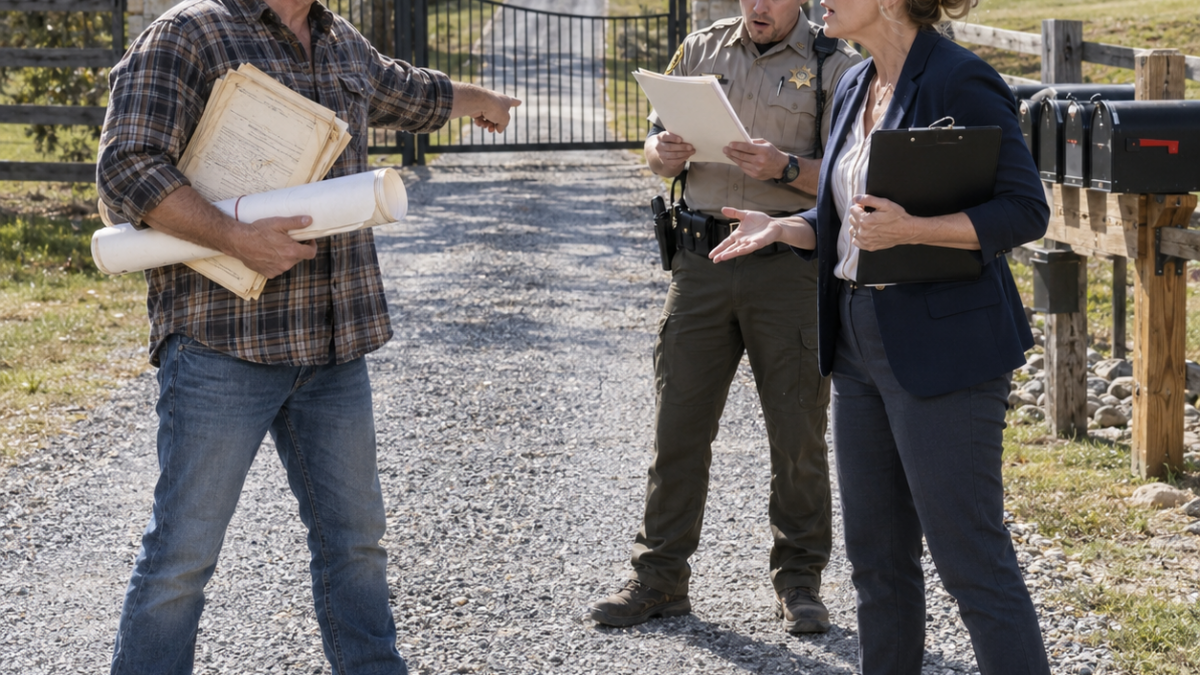
The HOA president walked onto my property with a clipboard and informed me that my private driveway would become the main entrance to fifty new homes whether I agreed or not.
She even told me I would be responsible for half the maintenance on the road she intended to take from me.
I almost laughed—because buried in a seventy-year-old deed was one line she hadn’t bothered to read, and once I found it, the entire fight changed.
“This isn’t a request, Mr. Miller.”
Karen Evans stood near the edge of my lawn like she had arrived to conduct an inspection of property she already owned.
Behind her, a nervous-looking HOA board member named Paul stared at the ground.
Karen held a clipboard against her chest.
“This is a formal notification of community integration. Your gravel driveway has been designated as the primary access route for Willow Creek Estates Phase Four.”
I stopped tightening the new cedar post on my porch.
For a second, I genuinely wondered whether I had heard her correctly.
“My driveway?”
“The developer determined it is the most practical route.”
I set my hammer on the porch rail.
The road behind her stretched almost three-quarters of a mile through the trees before reaching the county road.
I had graded that road.
I had cleared fallen trees from it.
I had spread gravel on it with my own tractor.
It crossed the ten acres my wife Sarah and I had bought seven years earlier after I retired from the Army.
It was the road my son Leo learned to ride his bicycle on.
The road where Sarah and I walked after dinner.
The road that had given us distance from the noise and subdivisions we had spent years trying to escape.
And Karen was talking about it like the HOA had ordered a new mailbox.
“You’re telling me,” I said slowly, “that an HOA I don’t belong to has decided to turn my private driveway into the entrance for its new subdivision?”
Karen smiled.
“Language like ‘take’ and ‘private’ isn’t helpful. We’re talking about shared community infrastructure.”
“It’s not community infrastructure.”
“It will be.”
Paul looked even more uncomfortable.
Karen continued.
“You’ll receive compensation.”
“How much?”
“We’re waiving your first year of road-maintenance fees.”
I stared at her.
“My what?”
“Maintenance fees.”
“For my own road?”
“Once the shared-access agreement takes effect, maintenance becomes a joint obligation.”
Something inside me went very still.
I had spent twenty years as an Army combat engineer.
I had learned that anger was useful only if you controlled it.
So instead of raising my voice, I asked one question.
“Do you have an easement?”
Karen’s smile thinned.
“Our attorneys have reviewed the situation.”
“That isn’t what I asked.”
“The developer requires access.”
“That still isn’t an easement.”
She shoved a document toward me.
“Sign this and we can avoid unnecessary conflict.”
I took it.
The agreement granted Willow Creek residents, contractors, emergency vehicles, guests, future phases, and essentially anyone approved by the HOA perpetual access over my driveway.
I would pay fifty percent of maintenance.
The HOA could determine landscaping standards along the road.
They could regulate vehicles visible from it.
They could even modify the roadway if future traffic required improvement.
They weren’t asking to share my driveway.
They were trying to annex it.
I folded the agreement.
Then I handed it back.
“No.”
Karen blinked.
“Excuse me?”
“No.”
“You may want to speak with an attorney before making an emotional decision.”
“I’m not emotional.”
Her face tightened.
“The subdivision needs that entrance.”
“Then the developer should build one.”
“That option is no longer practical.”
“That sounds like the developer’s problem.”
She stepped closer.
“You cannot stand in the way of progress because you’re attached to a gravel path.”
That sentence nearly did it.
Not because of the gravel.
Because Sarah had once stood halfway down that road beneath the oak trees, looked back toward the house we were building, and told me, “This finally feels like home.”
Karen saw thirty feet of dirt and stone.
I saw seven years of peace.
I picked up my hammer again.
“You’ve delivered your notice.”
Her eyes narrowed.
“Yes.”
“Now leave my property.”
Paul immediately stepped backward.
Karen didn’t.
“Our lawyers will contact you.”
“Good.”
“You are making a serious mistake.”
“Maybe.”
I looked directly at her.
“But I’m going to make it after reading my deed.”
She turned sharply and marched toward her SUV.
I watched until the taillights disappeared down my road.
That evening, after Sarah and Leo went upstairs, I opened the fireproof safe in our basement and carried every property document we owned to the dining-room table.
Deed.
Survey.
Title policy.
Old plats.
Closing records.
I already knew the driveway belonged to me.
What I didn’t know was why Willow Creek suddenly needed it badly enough to threaten me.
At 1:17 that morning, with the house completely silent, I unfolded the oldest survey in the file.
And for the first time, I noticed that one corner of my property line didn’t match the newer Willow Creek maps.
That tiny discrepancy was the first crack.
I had no idea yet that it would eventually split Karen’s entire plan wide open.
PART 2
I didn’t sleep much that night.
Not because I was afraid Karen could simply arrive the next morning with bulldozers and start widening my driveway.
Even she wasn’t that reckless.
What kept me awake was Sarah’s question.
She had asked it after Leo went upstairs.
“What if they actually can force an easement?”
She’d tried to sound calm, but I knew her too well.
Sarah worried quietly.
She didn’t pace.
She didn’t catastrophize.
She cleaned.
When she was truly nervous, she found something in the kitchen that did not need cleaning and cleaned it anyway.
That night she had wiped the same stretch of countertop three times.
“They can’t just take property because it’s convenient,” I had told her.
“You’re sure?”
“I’m sure they can’t just do it.”
“That’s not the same answer.”
No.
It wasn’t.
Property law has a way of turning simple questions into expensive ones.
I knew enough from twenty years in the Army Corps and combat engineering world to respect easements.
Access rights mattered.
Recorded roads mattered.
Historic use mattered.
Necessity mattered.
And Karen’s attorney had been careful enough not to claim outright ownership.
He was threatening to create a right of use.
That was different.
So at sunrise, I stopped trying to guess.
I started researching.
The first document on my dining-room table was the survey from when Sarah and I purchased the property.
Our ten acres were mostly rectangular, except for the southeastern corner, which clipped inward at an angle.
The driveway itself was marked clearly.
PRIVATE DRIVE — 30′ ACCESS STRIP.
The legal description incorporated it into our parcel.
That was good.
Very good.
But it did not automatically defeat a claim for an easement of necessity.
If Willow Creek Phase Four truly lacked another reasonable route, their attorney could still create a dispute.
Maybe they would lose.
But losing after two years and eighty thousand dollars in legal fees was not the kind of victory I wanted.
I needed to understand how the subdivision had ended up dependent on my road.
That meant going backward.
The next morning I drove to the county records office.
The building looked exactly the way a county records office should look.
Brown brick.
Fluorescent lights.
Metal shelving.
The faint smell of dust, old paper, toner, and coffee that had been sitting on a warmer too long.
A woman named Marge sat behind the counter.
She had silver hair, bright red glasses, and the demeanor of someone who had watched forty years of property disputes repeat themselves with different names.
“What can I pull for you?”
“Everything related to Willow Creek Estates.”
She raised an eyebrow.
“Everything?”
“Master plats. Original deeds. Phase amendments. Access easements. Road dedications. Zoning variances. Development agreements.”
She looked at me over the top of her glasses.
“You suing somebody?”
“Trying not to.”
“That usually means yes.”
I smiled.
She handed me a request sheet.
“What parcel?”
I gave her the adjoining numbers.
She started typing.
Ten minutes later she looked back at me.
“Willow Creek?”
“Yes.”
She made a small sound.
Not quite a laugh.
“Good luck.”
“You know them?”
“I know records.”
That was county-clerk language for I know more than I’m going to tell you.
I spent nearly seven hours there.
By the time I left, I had a banker’s box full of copies.
Sarah stared at it when I carried it into the dining room.
“That’s either very good or very bad.”
“Depends what’s inside.”
Leo came downstairs carrying a bowl of cereal.
He was twelve and had reached the age where every adult problem was interesting only if it might involve police, heavy machinery, explosions, or the internet going down.
“Is the HOA stealing our driveway?”
“Trying to use it.”
“Can we put up spikes?”
“No.”
“A gate?”
“Maybe eventually.”
“Tank traps?”
“Absolutely not.”
He nodded thoughtfully.
“Okay. But if circumstances change—”
“Go finish breakfast.”
He grinned and disappeared.
Sarah sat beside me.
“Where do we start?”
“Chronology.”
That was how I had been trained.
When a system failed, establish the sequence.
What existed first?
What changed?
Who approved it?
What did each person know at the time?
We started in the 1950s.
The entire area—our property, Willow Creek, woods, fields, and the strip near the highway—had once belonged to one farming family.
The first major division came in the late 1950s.
Then another in the 1970s.
Our ten-acre parcel separated from the larger farm long before anyone planned a subdivision.
The land that eventually became Willow Creek changed hands twice before a development company purchased it in the late 1990s.
Then I found the first important document.
1998 MASTER DEVELOPMENT PLAN — WILLOW CREEK ESTATES.
I unrolled the plat.
There it was.
A large landscaped boulevard coming directly off the main highway.
Two lanes.
Median.
Stone entrance monument.
The kind of road subdivisions put on brochures.
I called Sarah over.
“This is their entrance.”
“I thought they already had one.”
“For Phases One and Two.”
She followed my finger.
“What about Phase Four?”
“That’s the problem.”
The later phases were supposed to connect internally to the grand boulevard.
But Phase Three had changed the road layout.
Then Phase Four changed it again.
A creek buffer expanded.
A wetlands designation appeared.
Several lots were redesigned.
The developer had created more buildable lots by leaving a section of the planned internal connector unfinished.
Temporary construction access appeared on the plat instead.
Sarah leaned closer.
“Where does that temporary road go?”
“Give me a minute.”
I pulled our survey beside it.
Coordinates.
Bearings.
Measurements.
The habit came back naturally.
Engineering is translation.
Lines into ground.
Ground into distance.
Distance into consequence.
I compared the southeastern corner of our parcel.
Then I froze.
“What?”
Sarah asked.
I didn’t answer.
I measured again.
Then a third time.
The temporary road used by contractors to enter the rear portion of Willow Creek clipped across the corner of our property.
Not much.
Roughly fifty feet of roadway touched our land before curving back into the development.
“They’ve been crossing our property.”
Sarah stared at the maps.
“How long?”
“Looks like more than ten years.”
“We’ve owned it seven.”
“And nobody disclosed this.”
“What does that mean?”
“It means somebody didn’t survey very carefully.”
“Can they claim they’ve used it long enough to own rights?”
“Possibly. Depends on circumstances.”
Her face tightened.
“Jack.”
“I said possibly.”
“You hate that word.”
“I do.”
It still wasn’t enough.
Interesting.
Useful.
Not enough.
Then I opened the oldest deed in the county stack.
The legal language was archaic.
Calls to iron pins.
A large oak.
A stone pile.
A fence line that probably hadn’t existed for forty years.
I read it once.
Then again.
Then a third time.
Halfway through the description appeared the words:
**SAVE AND EXCEPTING**
I sat straighter.
Sarah saw it.
“What?”
I pointed.
“Read that.”
She leaned over.
The clause excluded a strip thirty feet wide running north from the county road along the western boundary for approximately three-quarters of a mile.
Roadway purposes.
Survey Book 12.
Page 45.
I stood so fast my chair scraped backward.
“Where are you going?”
“To find Survey Book 12.”
“You don’t have it?”
I dug through the county copies.
There.
An old hand-drawn plat.
Faded ink.
Survey stakes.
Tree markers.
And one narrow thirty-foot strip.
Our road.
Except it wasn’t merely shown as an easement across Willow Creek’s predecessor parcel.
It was expressly excluded from the land later conveyed into what became the development.
The developer never bought it.
Willow Creek never owned it.
The road had remained legally separate.
Over the years, title to that strip had become associated with the parcel we eventually purchased.
Sarah read the deed.
Then the old survey.
Then our deed.
“Are you saying…”
“Yes.”
“They never owned the road?”
“Not according to this.”
“But Karen wants to force us to share the road because they claim they need access.”
“Yes.”
“And the road they thought was basically theirs—”
“Never was.”
Sarah slowly sat down.
Then she started laughing.
Not because it was funny.
Because sometimes shock has nowhere else to go.
“Oh, she is going to hate you.”
“I didn’t write the deed.”
“She’ll still hate you.”
I looked again at the map.
Something bothered me.
The old road strip ran from the county road almost the same direction as my existing driveway.
But Willow Creek’s rear development configuration had treated that western edge like common access territory for years.
They had built landscaping near it.
Placed utility markers.
Allowed maintenance vehicles near it.
Possibly even represented access to residents.
This wasn’t just a disagreement over my driveway.
Their entire development history had been built on a bad assumption.
Karen had not walked onto my lawn asking permission.
She had walked onto land her HOA never owned and announced she was taking more.
That changed the leverage.
But leverage is dangerous.
Use too much and you become the bully.
I didn’t want that.
At least, not yet.
I needed an attorney.
Marge provided the path indirectly.
When I returned to the county office for certified copies, she looked at my stack.
“You found something.”
“That obvious?”
“You came in worried. Now you’re smiling.”
“I need an attorney who understands old deed language.”
She tapped her keyboard.
“I can’t recommend lawyers.”
“I understand.”
“But if someone wanted to review public zoning-hearing minutes from last year, they might notice a gentleman named Arthur Abernathy.”
“Attorney?”
“Retired.”
“Willow Creek resident?”
She smiled.
“I never said anything.”
That evening I walked into Willow Creek.
I had driven through before, but walking revealed things differently.
Every mailbox identical.
Every lawn cut within an inch of the next.
Decorative pears along the sidewalks.
Muted siding colors.
No trailers.
No boats.
No vegetable gardens visible from the street.
The neighborhood looked clean.
Orderly.
Expensive.
And strangely lifeless.
Arthur Abernathy lived at 112 Willow Way.
His house looked like every other house except for a beautiful bronze birdbath in the front yard.
I rang the bell.
A man in his late seventies answered.
White hair.
Sharp blue eyes.
Sweater vest.
He looked at me for two seconds.
“You’re Miller.”
“That depends.”
“The road guy.”
“That sounds worse.”
He smiled.
“Come in.”
Arthur’s office contained more books than furniture.
Law books.
Property treatises.
Corporate law.
Local histories.
He poured coffee and listened without interrupting.
When I explained the easement demand, he shook his head.
“They’re hoping litigation expense will scare you.”
“That was my guess.”
“An easement by necessity is not magic. Facts matter. Unity of ownership. Severance. True necessity. Alternative access. Self-created conditions.”
“I found something.”
I placed the certified deed on his table.
Then Survey Book 12, Page 45.
Arthur put on reading glasses.
He read the clause.
Then read it again.
He looked up.
“Where did you get this?”
“County archive.”
“You verify chain of title?”
“I’m still working through it.”
He bent back over the document.
“Jack.”
“Yes?”
“This changes everything.”
“How much?”
He took off his glasses.
“They’re demanding access across land their predecessor deed expressly excluded.”
“That was my reading.”
“It’s mine too.”
“And their temporary construction road crosses the corner of my parcel.”
I slid over the newer plat.
He whistled.
“That’s ugly.”
“For them?”
“For everyone.”
Arthur leaned back.
“You need title counsel before doing anything dramatic.”
“I agree.”
“But assuming the chain confirms what this appears to show, Karen’s easement argument is in serious trouble.”
I nodded.
“I want more than that.”
His eyes narrowed slightly.
“What do you want?”
“I want her to stop.”
“With your property?”
“With everyone.”
Arthur studied me.
Then smiled without humor.
“So you’ve noticed.”
“Tell me.”
For the next two hours, Arthur described Karen’s presidency.
A widow named June Patterson had been threatened over roses not included on the approved plant list.
A young couple had paid fines because their basketball hoop frame was the wrong shade.
Residents had been assessed for decorative entrance upgrades they did not request.
A family with a work van had received repeated penalties.
Arthur himself had challenged a special assessment involving gate maintenance despite Willow Creek not having the gate described in the expenditure.
“She survives because most people don’t want conflict,” he said.
“That’s how these systems work.”
“She also controls information.”
“Meaning?”
“Meeting minutes are minimal. Financial explanations are vague. She frames every objection as an attack on property values.”
Arthur tapped my deed.
“If you beat her privately, she tells everyone an unreasonable outsider exploited a technicality.”
“So what?”
“You beat the story before she tells it.”
I understood immediately.
“Public meeting.”
“Eventually.”
“Evidence first.”
His smile broadened.
“Now you’re talking like a lawyer.”
“Don’t insult me.”
For a week, we worked quietly.
I hired a title attorney recommended by Arthur.
She confirmed the chain.
The old roadway exclusion was real.
Our title encompassed the road strip through the relevant conveyances.
Willow Creek had no recorded ownership interest in it.
The title attorney also reviewed the threatened easement.
Her conclusion was careful.
No attorney promises outcomes.
But Willow Creek’s argument was significantly weaker than Karen’s letter suggested.
Especially because development choices appeared to have contributed to the access problem.
Next came the temporary road.
A licensed surveyor visited my southeastern corner.
He set stakes.
Fifty-two feet of the existing temporary travel path crossed onto my parcel at its widest point before turning away.
The encroachment had likely existed for years.
I had another fact.
Arthur found residents willing to talk.
June Patterson invited me into her kitchen and showed me photographs of her roses.
They were spectacular.
Deep red climbers.
White floribundas.
Yellow hybrids.
“My husband planted the first ones.”
“When?”
“Twenty-eight years ago.”
“Before Willow Creek?”
“Before Karen, thank God.”
She smiled.
Then handed me violation letters.
NONCOMPLIANT FRONT LANDSCAPE.
REPLACEMENT REQUIRED.
Potential fines.
“They wanted these removed?”
“Some of them. Approved palette doesn’t include three varieties.”
“Why didn’t you?”
“I ignored them.”
“Any fines?”
“Four hundred dollars.”
She said it matter-of-factly.
Then her mouth trembled.
“I paid because I didn’t want a lien.”
That hit me harder than I expected.
My mother had loved roses.
She used to say you could tell whether people cared about a place by whether they planted something they might never live long enough to see mature.
Karen saw violations.
June saw her husband.
I understood that language.
The couple with the basketball hoop were next.
Eric and Mia Sanders.
Two boys.
One hoop.
Wrong color.
The board had charged them $75 a week until they repainted the metal support.
“It was black,” Eric said.
“What did they require?”
“Charcoal.”
I stared at him.
He shrugged.
“Exactly.”
The stories accumulated.
I documented them.
Not because they would necessarily win my road dispute.
Because Karen’s power depended on each person thinking their problem was isolated.
Once people see a pattern, isolation ends.
Meanwhile, Karen grew impatient.
Her lawyer sent a second demand.
Fourteen days to sign.
Then they would seek judicial relief.
Arthur and I drafted a response.
My title attorney reviewed every line.
No insults.
No chest-thumping.
Just facts.
Section One:
PROPERTY OWNERSHIP.
Attached certified original deed.
Attached 1958 survey.
Attached current chain-of-title confirmation.
Quoted exclusion.
Section Two:
UNAUTHORIZED HISTORICAL USE.
Attached current survey demonstrating encroachment of temporary access route.
Section Three:
PROPOSED RESOLUTION.
That was Arthur’s favorite.
“Never just say no,” he told me. “Give unreasonable people a reasonable process. If they reject it, that becomes part of the story.”
My proposed terms were intentionally severe because Karen’s original demand had been severe.
I calculated past access value using commercial easement comparisons and long-term use assumptions.
The number came to $247,583.14.
Was I certain a court would award that?
Absolutely not.
That was not the purpose.
It established the economic value of the rights Karen had treated as free.
Then came future options.
Option A:
Stop using my property.
Develop lawful alternative access.
Resolve past unauthorized use.
Option B:
Negotiate a formal lease.
$15,000 per month.
HOA covers one hundred percent of maintenance.
Five-million-dollar liability coverage.
No expansion without written consent.
Would anybody accept those terms?
Of course not.
It was a go-away price.
But Karen had told me the road was so essential that I was obligated to surrender it.
If it was essential, it had value.
If it had value, she could no longer pretend she was doing me a favor by waiving my first-year maintenance fee.
We mailed the package certified.
Karen signed the receipt.
Then silence.
One day.
Two.
Three.
Arthur called.
“They’re panicking.”
“Source?”
“Attorney friend.”
“What does he know?”
“The old developer dissolved. Their title insurer does not appear enthusiastic about backing this fight.”
“Anything else?”
“They’re looking for a way to characterize the old exclusion as a surveying anomaly.”
“Can they?”
“They can characterize the moon as an abandoned golf ball. Doesn’t make it true.”
The next morning, Willow Creek residents received an emergency-meeting notice.
Arthur forwarded it.
**AGGRESSIVE ACTION BY ADJACENT LANDOWNER THREATENING COMMUNITY ACCESS**
I laughed.
Sarah didn’t.
“They’re making you the villain.”
“I expected it.”
“They’re telling people you’re threatening to trap them in their houses.”
“I’m not.”
“Doesn’t matter if people believe her.”
That was the first time I sensed she was genuinely frightened again.
Not of losing the driveway.
Of losing the neighborhood.
“What if they start coming after us?”
“They won’t.”
“You don’t know that.”
She was right.
So I took her hand.
“No. I don’t.”
Leo was upstairs.
The house was quiet.
“I’m sorry.”
“For what?”
“This was supposed to be our peaceful place.”
She looked at me.
“It still is.”
“Doesn’t feel like it.”
“Peace isn’t never having a fight, Jack.”
“What is it?”
“Knowing what you’re willing to defend.”
I smiled.
“Where did you get that?”
“I married a soldier. Some things rubbed off.”
The emergency meeting was Thursday.
I wore jeans.
Blue shirt.
Work boots.
Arthur wore tweed.
Top Rodriguez and five guys from my old unit arrived separately.
I had called Top earlier that week.
“What do you need?” he asked.
“Witnesses.”
“Legal?”
“Very.”
“Fighting?”
“No.”
“Boring.”
“Extremely.”
“We’re in.”
They sat behind us wearing VFW jackets.
Big men.
Quiet.
Nobody mistook their presence for random.
Karen sat at the front in a bright red suit.
She held a microphone.
The room was full.
More than a hundred people.
Karen opened with outrage.
“This community is under attack.”
There it was.
Not a property dispute.
An attack.
She described me as an opportunistic outsider.
A man attempting to exploit a developer’s historic mistake.
A man demanding nearly a quarter-million dollars.
A man threatening to deny families access to their homes.
She held up my letter.
“He wants fifteen thousand dollars every month for the privilege of driving to property we already own.”
Some residents murmured angrily.
I watched their faces.
Confusion.
Fear.
A few hostile looks toward me.
Karen saw them too.
Her confidence grew.
“We will not be bullied.”
Applause from perhaps fifteen people.
“We will defend our rights.”
More.
“Our attorney believes we have strong grounds to seek an easement.”
That sentence interested me.
Believes?
Strong grounds?
Not certainty.
Then came the real reason for the meeting.
“Litigation will require resources.”
Of course.
The board proposed a $500 special assessment per household.
Groans.
Karen raised her voice.
“This is the cost of protecting our community.”
A man shouted from the back.
“From what?”
“From losing access.”
“Whose mistake was the road?”
“The original developer is no longer available.”
“So we pay?”
“We stand together.”
Arthur rose.
He did not ask permission.
“Karen.”
She glared.
“This is not member-comment time.”
“You’re requesting five hundred dollars from every household.”
“Yes.”
“Then every household deserves both sides.”
“The adjacent landowner is not a member.”
“He is the subject of your proposed litigation.”
“That does not give him standing to disrupt—”
Arthur lifted a copy of the bylaws.
“Section nine, paragraph four.”
She stopped.
I almost smiled.
People who use rules as weapons hate discovering others can read.
Arthur continued.
“A person materially affected by proposed association action may be heard upon motion of a member. I move that Mr. Miller receive fifteen minutes.”
Several voices:
“Second.”
“Let him talk.”
“We want to hear.”
Karen stared across the room.
She knew refusing would look worse.
“Ten minutes.”
“Fifteen.”
“Ten.”
Arthur smiled.
“Fine.”
I walked forward.
I did not take the microphone.
“My name is Jack Miller.”
The room quieted.
“I’m the man Karen says is trying to steal your road.”
Karen shifted.
“I’m going to show you three maps.”
The projector came on.
First:
1998 MASTER PLAN.
I circled the original entrance.
“This is the access route Willow Creek was designed to use.”
People leaned forward.
“This boulevard was intended to connect the later phases.”
Next map.
Phase Four.
Temporary access.
“Instead of completing the internal connector as originally planned, later development relied on temporary routing.”
Next.
Current boundary survey.
Red highlight.
“The temporary road crosses my property here.”
Whispers.
Then the final image.
1958 deed and survey.
Thirty-foot strip.
I read the clause slowly.
“Save and excepting a strip of land thirty feet in width for purposes of roadway…”
I looked at the room.
“That strip is the road Karen told you I was taking away.”
I paused.
“It was never Willow Creek property.”
Silence.
Not ordinary silence.
The kind where everyone is recalculating the story they walked in believing.
Karen interrupted.
“That is his interpretation of ancient paperwork.”
Arthur stood.
“No.”
Every eye turned.
“I’m a retired corporate attorney. I reviewed the chain of title and the supporting survey.”
He looked around.
“The document says what Jack says it says.”
A woman asked, “So we don’t own the road?”
Arthur answered.
“You do not.”
Another voice.
“Did the board know this?”
I looked at Karen.
“She received certified copies eight days ago.”
The room changed.
People started looking toward her.
Karen’s face reddened.
“It remains legally complicated.”
“Then why,” I asked, “did you stand here ten minutes ago and describe my ownership as an aggressive attempt to take your property?”
She pointed at me.
“You sent us a quarter-million-dollar bill!”
“After your board demanded permanent access to my private road, fifty-percent maintenance charges, landscaping control, vehicle restrictions, and future expansion rights.”
People started murmuring again.
I held up her shared-access agreement.
“This is what Karen asked me to sign.”
I projected it.
Page one.
Perpetual access.
Page two.
Maintenance.
Page three.
HOA standards.
Page four.
Vehicle restrictions.
A man near the front turned toward Karen.
“You were going to make him pay half for a road we’d be using?”
Karen snapped.
“It was a draft.”
“It says formal agreement.”
“The terms were negotiable.”
“You told me it was mandatory,” I said.
She ignored me.
I turned back toward the residents.
“My $247,000 figure was based on past unauthorized use and valuation of access rights. My fifteen-thousand-dollar monthly proposal was intentionally expensive.”
That surprised them.
I continued.
“I expected them to reject it.”
Karen seized the opening.
“He admits it!”
“Yes.”
I looked directly at her.
“Because I wanted your board to understand what happens when you treat someone else’s property like it has no value.”
The room quieted again.
“I don’t want to block your families from their homes.”
That mattered.
I could see shoulders relax.
“My problem is not with the Sanders family.”
Eric looked up.
“Not with Mrs. Patterson.”
June smiled faintly.
“Not with your kids.”
I looked toward Karen.
“My problem is with a board that spent two years sending me fines despite knowing I wasn’t part of the HOA, then tried to force me to surrender permanent property rights because building a proper road became inconvenient.”
Karen slammed her hand on the table.
“This is grandstanding.”
Arthur answered.
“No, Karen.”
He held up the deed.
“This is due diligence.”
Someone laughed.
Then another.
The tension cracked.
A resident shouted:
“Why did we almost vote five hundred dollars each before seeing this?”
Another:
“Did our attorney tell you we could win?”
Karen raised the microphone.
“Our attorney believes—”
“What exactly did he say?”
No answer.
“Did title insurance deny coverage?”
Her face changed.
That told the room enough.
Arthur looked at me.
That detail had not come from us publicly.
Apparently somebody else knew.
The crowd erupted.
Karen kept banging the gavel.
It meant nothing.
A man near the back yelled, “No assessment!”
Someone else shouted, “Recall the board!”
Then June Patterson stood.
She was small.
Seventy-four.
White hair.
Green sweater.
But when she lifted one of her violation letters, the room quieted.
“While we are discussing property rights…”
Karen closed her eyes for half a second.
June continued.
“I was fined four hundred dollars because these people didn’t approve of my roses.”
She held up a photograph.
“My husband planted them before he died.”
Someone whispered, “Jesus.”
Eric Sanders stood next.
“We paid three hundred because our basketball hoop was black instead of charcoal.”
Mia raised her hand.
“Technically they called black ‘nonconforming dark gloss.’”
Laughter exploded.
Karen looked around wildly.
She had expected a war against me.
Instead, people were telling their own stories.
That was the moment she lost.
Not when I showed the deed.
When everybody realized their silence had been part of her authority.
Arthur circulated a petition for a recall meeting.
People signed before leaving.
Karen stayed at the front table, still striking the gavel occasionally.
Nobody listened.
Outside, Top Rodriguez handed me coffee.
“You always fight this boring?”
“Whenever possible.”
“I preferred Afghanistan.”
“No homeowners associations.”
“Exactly.”
Sarah was waiting when I got home.
Leo was pretending not to wait.
“Well?” she asked.
“No assessment.”
“And Karen?”
“Still president.”
“For how long?”
I held up my phone.
Arthur had texted.
**68 signatures. Need 47.**
I smiled.
“Not long.”
I thought the hard part was over.
I was wrong.
Karen’s power was collapsing.
And desperate people make dangerous decisions.
Two days later, I was in my workshop sharpening a chainsaw chain.
The sound came first.
Diesel.
Heavy.
Slow.
I stepped outside.
A tow truck was coming up my driveway.
Not a normal rollback.
A heavy-duty wrecker.
Behind it came Karen’s SUV.
I stared.
The wrecker stopped near my barn.
Karen climbed out holding papers.
The driver looked uncertain.
Then Karen pointed toward my 1968 Ford F-100.
My truck.
The truck I had spent five years restoring.
Blue body.
White roof.
Original-style chrome.
It had belonged to Sarah’s father.
When he died, she asked if I could bring it back.
“Not perfect,” she said.
“Just running.”
I rebuilt the engine.
Replaced rusted floor sections.
Rewired half the electrical system.
Tracked down factory trim from three states.
Leo had helped me install the bench seat.
That truck wasn’t transportation.
It was family history.
Karen was pointing at it.
“What are you doing?”
I walked toward them.
Karen turned.
“Enforcing a final vehicle violation.”
For a moment, I thought I had misunderstood again.
Then she held up a notice.
“Your vehicle is unlicensed and inoperable.”
“It’s registered.”
“It hasn’t moved in weeks.”
“I drive it on Sundays.”
“It is visible from the access corridor.”
“My access corridor.”
“The shared community corridor.”
“We do not have a shared corridor.”
Her eyes looked different.
The confidence was gone.
What remained was rage.
“The board still has authority until removed.”
“Not here.”
She turned to the driver.
“Hook it.”
He didn’t move.
“Ma’am, I need property authorization.”
“I am HOA president.”
“This address in the HOA?”
“It is subject to access-corridor regulations.”
I looked at the driver.
“It is not.”
He looked between us.
“I’m not touching the truck until somebody shows me proof.”
Karen exploded.
“You were hired to tow!”
“From HOA property.”
“This is HOA property!”
“No.”
I pulled out my phone.
Karen pointed at me.
“Don’t you dare.”
I dialed.
“Nine-one-one. What’s your emergency?”
“I’m reporting trespass and attempted unauthorized removal of a vehicle from private property.”
Karen laughed loudly.
“For heaven’s sake.”
The dispatcher asked if anyone had weapons.
“No.”
“Any threats?”
“No. But the parties have been asked to leave and are refusing.”
The tow driver immediately raised his hands.
“I’m not refusing. I’m waiting on police.”
Smart man.
Karen began pacing.
“This is ridiculous.”
I looked at her.
“You should leave.”
“I will not be intimidated.”
“This isn’t intimidation.”
“You think because of some ancient deed—”
“You drove here on that ancient deed.”
She stopped.
For ten minutes, the tow truck idled.
Birds chirped.
My heart hammered.
I kept thinking about Sarah’s father.
About the afternoon he had handed me the Ford keys and said, “She leaks oil and hates mornings, but treat her right.”
I had promised.
Karen was willing to take that away simply to prove she still could.
A sheriff’s cruiser finally appeared.
Deputy Miller stepped out.
No relation.
He surveyed everything.
Tow truck.
Ford.
Karen.
Me.
“Who called?”
“I did.”
Karen immediately stepped forward.
“Deputy, thank goodness. I’m Karen Evans, president of Willow Creek Estates. We are attempting lawful removal of a nuisance vehicle.”
The deputy took her notice.
“This property in Willow Creek?”
“It is subject to the association’s access regulations.”
“That wasn’t my question.”
I liked him immediately.
Karen hesitated.
“It’s adjacent.”
He turned to me.
“Sir?”
“Jack Miller. I own the ten acres, the truck, and this road.”
“HOA member?”
“No.”
“Easement?”
“No recorded HOA easement.”
Karen interrupted.
“That’s disputed.”
I went inside.
Returned with the certified deed and survey.
The deputy read them.
Then looked down my driveway.
Then at Karen.
“Ma’am.”
“Yes?”
“According to this deed, this road is private property associated with Mr. Miller’s parcel.”
Karen folded her arms.
“Our counsel disagrees.”
“Maybe counsel can argue it in civil court.”
He handed me the deed.
“But right now, you are standing on property that is not part of your HOA.”
“She has been told to leave,” I said.
He looked at Karen.
“Have you?”
“This is an official HOA enforcement action.”
“That doesn’t answer him.”
She stared.
The deputy’s voice hardened.
“Have you been told to leave?”
“Yes, but—”
“Then leave.”
Karen’s mouth opened.
Closed.
Then opened again.
“I am president of Willow Creek.”
“That doesn’t create police power.”
“This vehicle violates community standards.”
“It’s not in your community.”
“It’s visible from our road.”
“Which road?”
She pointed.
“This one.”
The deputy actually paused.
Then looked at me.
Then back at her.
“This is his road.”
The tow driver coughed to hide a laugh.
Karen snapped around.
“This isn’t funny.”
“No, ma’am,” he said quickly.
Deputy Miller stepped slightly closer.
“You have two choices. Leave voluntarily, or stay after a lawful trespass warning.”
Karen’s face went pale.
“Are you threatening me with arrest?”
“I’m explaining your options.”
For once, she had nothing to say.
The tow driver climbed into his cab.
Karen pointed at him.
“Where are you going?”
“Off private property.”
“You work for me!”
“Not enough for jail.”
He started the truck.
Karen looked at me.
Pure hatred.
“You think you’ve won.”
I looked at the Ford.
Then my house.
Then the road.
“I think you need to leave.”
She got into her SUV.
Deputy Miller followed both vehicles down the driveway.
I stood there until their engines faded.
Sarah came outside.
She had watched from the window.
She walked directly toward the Ford and put her hand on the hood.
“You okay?”
I nodded.
“You?”
She looked down the road.
“She came for Dad’s truck.”
“I know.”
That was the moment my anger changed.
Until then, I wanted Karen stopped.
Now I wanted accountability.
The story of the tow truck spread through Willow Creek before dinner.
By the next morning, Arthur’s recall petition had more than twice the signatures required.
Three board members resigned.
Karen refused.
Then, two days later, she resigned too.
Her letter cited “hostility and personal attacks.”
No mention of my road.
No mention of the tow truck.
No mention of the deed.
Arthur called.
“It’s over.”
“No.”
“What?”
“The road problem still exists.”
There was silence.
Then he laughed.
“Damn you.”
“What?”
“You’re right.”
Karen was gone.
But fifty families still needed dependable access to the rear phases.
They hadn’t created the title mess.
They had bought homes.
Paid mortgages.
Raised kids.
Went to work.
Some of them had supported Karen.
Some hadn’t.
Either way, I had no interest in waking up every morning wondering whether a school bus, ambulance, or family car could legally reach somebody’s house.
Three days after becoming interim president, Arthur came to my kitchen.
No suit.
No board entourage.
No clipboard.
He brought pastries.
“That’s bribery,” I said.
“Negotiation hospitality.”
Sarah put on coffee.
Arthur sat across from me.
“I owe you an apology on behalf of the association.”
“You personally don’t.”
“President speaks for the board.”
He slid over a letter.
Formal apology.
Harassment.
Unauthorized violation notices.
Improper access demand.
Tow-truck incident.
Clear.
Direct.
No excuses.
I appreciated that.
Arthur continued.
“We need a permanent road solution.”
“I know.”
“Your fifteen-thousand-dollar lease is going to bankrupt me before breakfast.”
“That was intentional.”
“I assumed.”
“I don’t want fifteen thousand.”
“What do you want?”
That was the question.
I could have made money.
A lot of money.
Willow Creek was vulnerable.
My deed gave me leverage.
Karen would have used every ounce of leverage.
That was precisely why I refused to.
“My road stays mine.”
Arthur nodded.
“Expected.”
“I’m willing to grant a permanent residential ingress-and-egress easement.”
His shoulders dropped slightly.
“Thank you.”
“Conditions.”
“Of course.”
“No construction traffic for new phases without separate written agreement.”
“Fair.”
“No HOA aesthetic jurisdiction over my property.”
“Obviously.”
“Emergency and service vehicles permitted.”
“Of course.”
“The HOA handles routine maintenance.”
“Fine.”
“I get approval over contractors and specifications so nobody destroys the drainage.”
Arthur smiled.
“Engineer.”
“Always.”
“What about payment?”
“Fifty thousand.”
His eyebrows rose.
“Better than quarter million.”
“It goes into a restricted road-maintenance trust.”
He leaned forward.
“Not to you?”
“No.”
“The HOA pays fifty thousand into the trust?”
“Yes.”
“For grading, drainage, snow, resurfacing.”
“Yes.”
“Joint oversight?”
“Me plus one HOA representative.”
Arthur stared.
“You’re giving residents permanent access and putting the payment into their road?”
“Our road.”
That word surprised me when I said it.
Not their road.
Not mine alone anymore.
Our road.
But legally mine.
That distinction mattered.
Arthur smiled.
“You’re a better man than I would be.”
“No.”
I shook my head.
“I just remember who the actual enemy was.”
“Karen.”
“Abuse.”
Arthur became quiet.
Then I added one final condition.
“Architectural committee.”
“What about it?”
“Get rid of it.”
He blinked.
“Entirely?”
“The version Karen created.”
“That’s a big ask.”
“Then change it.”
“How?”
“No regulation of gardens, paint shades, basketball hoops, ordinary play equipment, memorial plants, or similar aesthetics unless there’s a genuine safety issue.”
Arthur smiled slowly.
“You want liberation written into the road deal.”
“I want to know I’m not helping rebuild the same machine.”
“That’ll require membership approval.”
“Good.”
“Why good?”
“Because they should decide.”
Two weeks later, the terms went to a community vote.
I attended.
No veterans behind me.
No projector.
No trap.
Arthur explained the agreement.
Permanent residential access.
$50,000 restricted maintenance fund.
No expansion traffic.
No HOA jurisdiction over my ten acres.
Governance reforms.
June Patterson stood.
“What happens to my roses?”
Arthur smiled.
“You keep them.”
Applause.
Eric Sanders raised his hand.
“Basketball hoop?”
“Any color you want.”
His youngest son shouted:
“NEON GREEN!”
The room laughed.
The vote passed overwhelmingly.
The easement was recorded.
The trust funded.
Top Rodriguez’s construction company won the road-resurfacing contract through competitive bids.
I told him not to expect favoritism.
He stared at me.
“You called three bidders against me?”
“Yes.”
“You know me twenty-three years.”
“Yes.”
“I carried you out of a ditch outside Kandahar.”
“You were the low bidder.”
He started laughing.
“Fair enough.”
His crew rebuilt the drainage shoulders.
Added fresh base.
Corrected two soft spots.
Graded the crown properly.
Spread new gravel.
By the time they finished, the road looked better than it had when Sarah and I bought the property.
The first morning after completion, Leo rode his bike from the house to the county road and back.
Sarah and I stood on the porch.
“He’s going too fast,” she said.
“He’s twelve.”
“That’s not a defense.”
“It’s practically a diagnosis.”
She elbowed me.
Leo came racing around the bend.
“ROAD’S AWESOME!”
“Slow down!”
Sarah shouted.
He didn’t.
Normal life.
I had forgotten how much I missed it.
Willow Creek changed too.
Not overnight.
Communities don’t heal because one president leaves.
People still argued.
Budgets still annoyed everyone.
Some residents wanted stricter rules.
Others wanted almost none.
Arthur spent hours moderating meetings and discovered why sane people avoid HOA boards.
But fear disappeared.
That mattered.
June’s roses stayed.
The Sanders family painted their basketball hoop blue just to celebrate.
Another family planted vegetables in raised beds.
Someone put a bright yellow front door on a gray house.
No civilization collapsed.
Property values did not evaporate.
People simply started behaving like homeowners again.
One Saturday, June walked up our driveway carrying roses.
Sarah answered the door.
“These are for you.”
“For what?”
“For surviving all this.”
Sarah laughed.
“I mostly made coffee.”
June looked at me.
“That was probably important.”
She handed Sarah the bouquet.
Deep red.
White.
Yellow.
The same flowers Karen had tried to regulate.
I watched Sarah arrange them in a vase.
Something about that almost got me.
Not the legal victory.
Not Karen’s resignation.
Flowers.
Because that was the thing people like Karen never understood.
Rules look small from a clipboard.
A tree is a tree.
A basketball hoop is equipment.
A rose is landscaping.
A truck is a vehicle.
A gravel road is access infrastructure.
But to the person who owns it?
A tree can be a dead child.
A truck can be a father.
Roses can be a husband.
A road can be the first place your wife ever looked at ten acres of rough land and said:
“This feels like home.”
That was why property disputes become emotional.
People aren’t always protecting objects.
They’re protecting meaning.
The financial side of the old HOA administration was reviewed too.
Arthur discovered questionable spending decisions and weak controls, though nothing as dramatic as the rumors claimed.
Contracts had been approved without competitive bids.
Legal fees had grown.
Special assessments had been discussed without adequate disclosure.
The new board instituted procurement rules.
Three quotes above certain thresholds.
Published budgets.
Detailed minutes.
Open financial review periods.
Boring things.
Healthy things.
Karen sold her house later that year.
I heard about it from June.
“Moving truck came yesterday.”
“Okay.”
“You don’t want to know where?”
“No.”
She studied me.
“Really?”
“Really.”
That surprised even me.
For months, I had imagined how satisfying it would be to see Karen humiliated.
Then she was gone.
And it didn’t matter.
Because revenge turns out to have a short half-life.
Peace lasts longer.
One autumn morning, I woke before Sarah.
Made coffee.
Walked onto the porch.
Fog hung between the oak trees.
My road curved out of sight.
A Willow Creek resident drove past slowly.
He lifted two fingers from the steering wheel.
I waved back.
A year earlier, I would have resented seeing someone else on that road.
Now the sound of tires on gravel didn’t bother me.
Because permission had replaced entitlement.
That was the entire difference.
Ownership hadn’t changed.
Respect had.
Leo came outside wrapped in a blanket.
“Dad?”
“Morning.”
He sat beside me.
“Was this whole thing worth it?”
“What thing?”
“The HOA war.”
I looked at him.
“I hope you never call it that in front of your mother.”
“She calls it that.”
“Traitor.”
He smiled.
Then grew serious.
“If they’d asked nicely at the beginning, would you have said yes?”
That stopped me.
I thought back to Karen on my lawn.
Formal notification.
Mandatory fees.
Community integration.
No request.
No respect.
No curiosity about what the road meant to us.
“What do you think?”
Leo shrugged.
“I think you probably would’ve helped.”
He was right.
That was the strange part.
If Willow Creek had come to me honestly—
We have an access problem.
Could we negotiate?
Can we share costs?
How do we protect your privacy?
—I might have agreed before any of this happened.
Maybe not to the exact easement.
Maybe not to construction traffic.
But we could have found something.
Instead, Karen believed asking was weakness.
So she demanded.
And her demand cost her everything.
“I probably would’ve listened,” I said.
Leo nodded.
“So basically all of this happened because she was rude?”
I laughed.
“That is an aggressive simplification.”
“Is it wrong?”
I stared down the road.
“No.”
He grinned.
“Cool.”
Then he went inside.
Teenage jurisprudence.
Brutal but efficient.
The county eventually updated some access-review procedures after the Willow Creek mess.
Developers were required to provide clearer title documentation for phased road systems before later permits could be approved.
Marge called me when the policy changed.
“You caused paperwork.”
“I improved paperwork.”
“Government employee’s answer.”
“I’m retired.”
“Not from trouble.”
Arthur lasted two years as president.
Then he refused reelection.
At his final meeting, residents gave him a plaque.
He hated it.
Afterward, he stopped by my house.
We sat at the kitchen table.
Same chairs.
Same place where Karen’s access demand had once been spread out.
Arthur looked at the road through the window.
“You realize none of this would’ve happened if Karen had checked the deed.”
“I think about that sometimes.”
“Single clause.”
“Seven words that mattered.”
“Save and excepting a strip of land.”
He shook his head.
“Seventy years waiting for somebody to read it.”
“Paper is patient.”
Arthur smiled.
“That sounds like something a soldier would say.”
“Engineer.”
“Worse.”
We drank coffee.
Then he became serious.
“You know what I admire?”
“What?”
“You could have destroyed the association.”
“I nearly did.”
“No. You could have actually done it.”
He gestured toward the road.
“You had leverage to make access prohibitively expensive. You could have forced them into years of litigation.”
“Families lived there.”
“So?”
“They weren’t Karen.”
Arthur nodded.
“That’s the part she never understood.”
“What?”
“The difference between an opponent and everyone standing near the opponent.”
I thought about that.
Maybe he was right.
In the Army, you learn fast that indiscriminate force creates new problems.
Precision matters.
The objective matters.
Karen’s objective had become domination.
Mine had to remain protection.
Once my property was safe, punishment stopped being useful.
That lesson became more important as I got older.
Winning isn’t making the other person suffer.
Winning is achieving the thing worth fighting for.
My road.
My family.
My peace.
Years later, the gravel road remains legally mine.
The easement remains recorded.
Willow Creek residents use it.
The trust pays for maintenance.
Every spring, the HOA representative and I walk the drainage ditches together.
Every autumn, we review the gravel.
Top still bids on major work.
Sometimes he wins.
Sometimes he complains when he doesn’t.
The oak trees remain.
The house remains.
Leo is older now.
Too old for grasshoppers.
Still too fast on anything with wheels.
Sarah still pauses sometimes halfway down the driveway beneath the trees.
The first time she did it after the dispute, I knew exactly where we were.
Same bend.
Same old oak.
Same view toward the house.
She looked back.
“You remember?”
“Yes.”
“What did I say?”
“That this felt like home.”
She slipped her hand into mine.
“Still does.”
That was the ending I wanted.
Not Karen leaving.
Not the deputy threatening arrest.
Not the deed projected on the clubhouse wall while a hundred people realized their president had lied by omission.
Those moments were satisfying.
I won’t pretend otherwise.
But they weren’t the ending.
The ending was walking down that same road with my wife and feeling no anger.
No fear.
No urge to defend anything.
Just gravel under our shoes.
Wind in the trees.
A neighbor’s car passing slowly.
A wave.
Peace.
People occasionally ask me whether I really “owned the HOA’s entrance.”
Technically, the truth was even more embarrassing for them.
The thirty-foot strip they assumed they could absorb into their access system had been excluded from the Willow Creek property decades before the subdivision existed.
Their later development plans treated surrounding access as if historical title lines were somebody else’s problem.
When Karen tried to force my driveway into their expansion, she exposed that mistake.
The same deed she should have examined before threatening me proved the road was not hers to command.
And the old temporary road they had relied upon even crossed another piece of my property.
Her mistake wasn’t failing to find some clever loophole.
It was simpler.
She never checked whether she owned what she was trying to control.
That lesson stayed with Willow Creek.
The new board stopped treating bylaws as magic.
They checked deeds.
They asked lawyers.
They listened to homeowners.
They documented decisions.
They learned to say:
“We might be wrong.”
Strangely, those four words made them stronger than Karen had ever been.
Karen could never say them.
She thought authority meant certainty.
Real leadership requires doubt.
It requires asking whether your power actually reaches as far as you think it does.
Sometimes it doesn’t.
Sometimes the line is on a survey.
Sometimes it’s in a statute.
Sometimes it’s written in faded ink on a deed recorded before you were born.
And sometimes the person you’re trying to bully has enough patience to find it.
On the anniversary of the new road agreement, Willow Creek held a picnic near the front common area.
Sarah convinced me to attend.
I resisted because technically I still wasn’t a member.
Arthur told me that was exactly why everyone wanted me there.
When we arrived, June Patterson had roses on every picnic table.
Eric Sanders had brought a portable basketball hoop for the kids.
Blue.
Bright blue.
Someone had hung a small sign over the refreshments:
**WELCOME, NEIGHBORS.**
Not members.
Neighbors.
I noticed that immediately.
Arthur noticed me noticing.
“Better word,” he said.
“Much.”
Leo ran off.
Sarah joined June.
I stood near the edge of the lawn.
A man I didn’t recognize approached.
“You’re Jack?”
“Depends who’s asking.”
He laughed.
“New homeowner. Phase Four.”
I shook his hand.
“Welcome.”
He glanced toward the road through the trees.
“So you’re the guy who owns our entrance.”
“Careful.”
He smiled.
“Sorry. The guy who lets us use the entrance.”
“Better.”
He looked almost embarrassed.
“I read the old board minutes.”
“My condolences.”
“That whole thing really happened?”
“Most of it.”
“Tow truck?”
“Yes.”
“Sheriff?”
“Yes.”
“Quarter-million-dollar bill?”
“Also yes.”
He stared.
“You’re crazy.”
“Possibly.”
Then he said something I didn’t expect.
“Thanks.”
“For what?”
“My wife and I probably couldn’t have afforded this place if the HOA was still run like that.”
I looked around.
Kids.
Food.
June’s roses.
Neighbors wearing whatever colors they wanted.
“That wasn’t me.”
“Everybody says it started with your road.”
“No.”
I shook my head.
“It started when people stopped assuming they were alone.”
He nodded.
Maybe he understood.
Maybe he didn’t.
It was enough.
That evening, Sarah and I walked home instead of driving.
The road was smooth beneath our feet.
Recent rain had darkened the gravel.
Light filtered through the oak canopy.
Halfway up, Sarah stopped.
“What?”
“Nothing.”
She looked toward the house.
Then back toward Willow Creek.
“You know what’s funny?”
“What?”
“They tried to force us to share this road.”
“Yes.”
“And now we do.”
I smiled.
“On our terms.”
“No.”
She shook her head.
“On everyone’s terms.”
That was even better.
When Karen stood on my lawn that first afternoon, she believed property rights were an obstacle to be overcome.
A stubborn man.
An inconvenient deed.
A cheaper route.
She saw negotiation as something you did only after force failed.
That was why she lost.
Respect should have come first.
Had she asked, maybe there never would have been a battle.
Instead, she threatened.
Then lied.
Then escalated.
Then tried to tow my father-in-law’s truck from land she did not control.
Every escalation pushed me deeper into the records.
Every threat created another document.
Every act of arrogance invited more scrutiny.
Until eventually one forgotten sentence became more powerful than her entire board.
**Save and excepting a strip of land thirty feet in width for the purpose of a roadway.**
That sentence had sat quietly in a courthouse for decades.
No anger.
No ego.
No agenda.
Just fact.
Karen had a clipboard.
I had a deed.
The deed won.
But the thing I remember most clearly is not watching her SUV disappear while a sheriff’s cruiser followed.
It is one morning afterward.
I was repairing a small washout near the bend.
A Willow Creek resident I barely knew stopped his truck.
He rolled down the window.
“Need a hand?”
I almost said no.
Habit.
Then I looked at the shovel in my hand.
The ditch.
His truck.
“Sure.”
He parked.
We worked for twenty minutes.
Another neighbor stopped.
Then another.
By lunchtime, six of us were moving gravel.
Nobody had called a meeting.
Nobody passed a motion.
Nobody issued a directive.
Nobody threatened a fine.
The road simply needed work.
So neighbors worked on it.
Sarah came down carrying lemonade.
She stood at the edge watching us.
Later, after everyone left, she said:
“That’s what you wanted, isn’t it?”
“What?”
“A community without someone ordering everyone to be one.”
I looked down the road.
Fresh gravel.
Tire tracks.
Shovels resting against the fence.
Maybe she was right.
Maybe that was why the fight mattered so much.
After twenty years wearing a uniform, I understood legitimate authority.
Orders sometimes save lives.
Rules matter.
Standards matter.
But authority without legitimacy is just coercion wearing official language.
Karen never learned that distinction.
Willow Creek did.
So did I.
I had bought ten acres because I wanted distance.
Privacy.
Silence.
A place where I could stop carrying responsibility for other people.
Ironically, defending that privacy connected us to the people next door more than seven quiet years ever had.
June became Sarah’s friend.
Arthur became mine.
Eric helped Leo repair his first truck.
Top continued complaining about every road contract he didn’t win.
The subdivision I once thought of as a row of beige houses became a collection of names.
Families.
Stories.
Grief.
Annoyances.
Kindnesses.
Neighbors.
Karen tried to force a shared driveway.
Instead, she accidentally created something far more dangerous to her kind of power.
A shared community.
And years later, whenever someone asks how I defeated an HOA that tried to take my road, I tell them the same thing.
I didn’t defeat them.
I read the deed.
I documented the facts.
I refused to be frightened.
Then I gave the decent people inside that neighborhood enough information to make their own decision.
They did the rest.
The road still winds beneath the same oak trees.
The gravel still crunches beneath my tires.
The old Ford still sits by the workshop, fully registered, fully operational, and very much untowed.
And sometimes, early in the morning, I take a cup of coffee onto the porch and watch the first cars from Willow Creek pass through the trees.
They slow near the house.
Most drivers wave.
I wave back.
Because the road is still mine.
But the peace belongs to all of us.
And that is a far better ending than anything Karen ever planned.








