PART 2: HOA Tried to Seize My Acreage—Then They Learned Their Federal Lawsuit Had Just Landed on My Docket
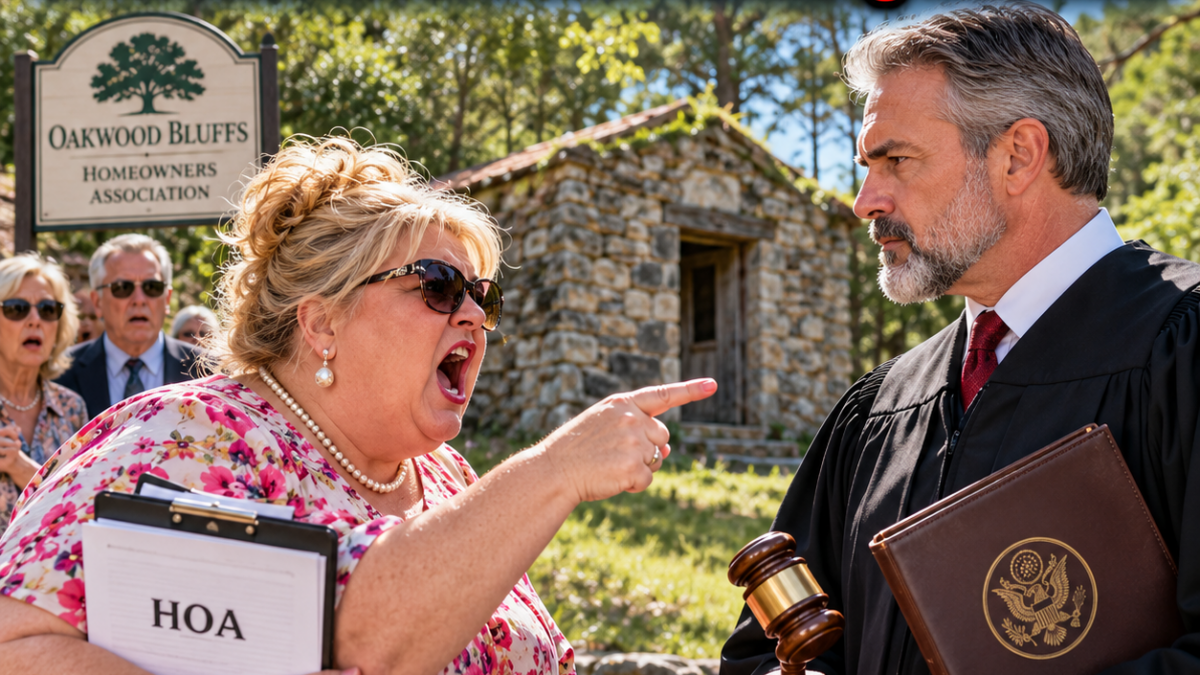
PART 2
The letter arrived seven days later.
Certified mail.
Heavy white envelope.
LAW OFFICES OF PIKE & STERLING embossed across the upper-left corner in dark blue.
I carried it into my study, set my coffee beside the lamp, and opened it with a letter knife my father had given me when I graduated law school.
The first page was exactly what I expected.
Formal language.
Manufactured seriousness.
References to covenants that did not apply to me.
Then I reached the amount.
$12,750.
I read it again.
According to Pike & Sterling, Crimson Ridge Estates had accumulated enough penalties against my property to record a lien.
They were demanding immediate payment.
Failure to comply, the letter warned, might result in “further remedies available to the association, including foreclosure where permitted by law.”
Foreclosure.
That word was not there by accident.
For most homeowners, a lien letter is terrifying.
It threatens more than money.
It threatens title.
Credit.
The ability to refinance.
The ability to sell.
Ultimately, it threatens the idea that the house you sleep in actually belongs to you.
I had spent decades reading filings designed to create pressure.
I knew the difference between a legitimate legal demand and intimidation wearing a necktie.
This was the latter.
Still, something about the letter bothered me beyond the obvious.
I stared at the firm’s name.
Pike & Sterling.
Sterling.
I had seen that name somewhere.
Not Sterling Homes, the original developer.
Something larger.
Something from court.
I leaned back in my chair and searched my memory.
Federal judges read more paper than most people can imagine.
Motions blend into briefs.
Case names blur.
But certain names stick because the allegations behind them are unusual.
Sterling.
Property management.
Liens.
Homeowners associations.
Then it came to me.
Sterling Management Solutions.
I stood so quickly my chair rolled backward.
“Son of a gun.”
I went to my computer.
Although I had taken senior status years earlier and had drastically reduced my caseload, I still retained access to the federal court’s electronic filing system and the legal research databases I had used most of my professional life.
I searched the name.
There it was.
O’Connell et al. v. Sterling Management Solutions.
A sprawling federal civil case involving homeowners from multiple developments.
The allegations were serious.
Aggressive fines.
Disputed liens.
Coordinated legal pressure.
Boundary challenges.
Claims that homeowners had been pushed toward settlements surrendering valuable property rights.
I stopped reading.
Then I went back to Karen’s notices.
Meadow.
Barn.
Stone wall.
Jeep.
Daily fines.
Refusal to recognize recorded exemptions.
Lien.
I returned to the federal pleadings.
The similarities were impossible to miss.
But similarity is not evidence.
That was something I had told lawyers for thirty years.
So I did what I had always expected them to do.
I began building facts.
The first fact was my deed.
My original ten-acre purchase was straightforward.
Years later, when Sterling Homes bought the surrounding farmland, they needed approximately two acres to create proper road access and utilities into what would eventually become Crimson Ridge.
I was willing to sell.
My attorney, a meticulous property lawyer named Ellen Brooks, was not willing to leave anything ambiguous.
She had predicted exactly the kind of future problem I was now facing.
“The development will change hands,” she had told me at closing.
“The builders will disappear. Management companies will come and go. Boards will be elected by people who weren’t in the room when this deal was signed. We make it permanent.”
She had.
The exemption clause was explicit.
The remaining parcel, all eight acres, was excluded from all existing and future restrictive covenants established for Crimson Ridge Estates.
The developer signed it.
The county recorded it.
The master plat referenced it.
There was nothing subtle about it.
Karen simply needed it not to exist.
My second fact came from a surveyor.
His name was Robert Wyatt, though everyone in the county called him Bob.
He was in his early seventies and had surveyed land in our area long enough to remember when several shopping centers were still soybean fields.
Bob arrived on a Tuesday morning with two assistants and enough equipment to track a mosquito across county lines.
I walked the property with him.
We found the stone wall.
The creek.
Two original iron pins.
A third buried near an old oak.
Bob cross-referenced everything.
By late afternoon, he stood beside his truck drinking water.
“Arthur?”
“What?”
“You’ve got the easiest boundary in the county.”
“That good?”
“That boring.”
“I like boring.”
He laughed.
Then he pointed toward the meadow near Crimson Ridge’s entrance.
“The corner they’re interested in?”
“Yes.”
“Yours.”
“How sure?”
“If I testified any harder, I’d have to raise my right hand.”
“Put it in writing.”
He raised an eyebrow.
“Trouble?”
“Maybe.”
Bob looked toward the subdivision.
“I charge extra for HOAs.”
“That a joke?”
“No.”
It was the first time I laughed in days.
His certified survey arrived three days later.
Every property line matched my deed.
The stone wall stood almost two feet inside my property.
The creek formed the eastern boundary exactly where the original plat placed it.
The contested triangle near the Crimson Ridge entrance belonged to me beyond reasonable dispute.
I filed the survey in a new binder.
Not the thin folder I had started with.
A three-inch black litigation binder.
Old habits return quickly.
TAB 1: DEED.
TAB 2: EXEMPTION.
TAB 3: SURVEY.
TAB 4: HOA NOTICES.
TAB 5: CORRESPONDENCE.
TAB 6: LIEN.
TAB 7: STERLING.
I began communicating only in writing.
Every envelope stayed intact.
Every email was downloaded as a PDF.
Every notice was scanned.
I installed a small security camera facing my driveway and mailbox.
I photographed my property daily.
Not because I expected vandals.
Because documentation eliminates arguments.
The more I documented Karen’s campaign, the clearer the pattern became.
She never answered the central question.
What gave Crimson Ridge legal authority over my eight acres?
I asked directly.
She responded with phrases such as community harmony.
Adjacent-property obligations.
Implied participation.
Collective property values.
None of those words appeared in my deed.
Then came the meeting.
I had attended once before, but this one felt different.
People were whispering before Karen called it to order.
The Garcias sat three rows ahead of me.
Miguel and Maria Garcia were in their early thirties with a five-year-old son named Leo.
I had met them while walking through the neighborhood.
They had been fined because Leo’s wooden playset was painted red, yellow, and blue.
Karen called the colors “visually aggressive.”
I wish I were inventing that.
The Hendersons sat nearby.
Tom and Evelyn Henderson had lived beside the old farmland before Crimson Ridge existed.
Tom grew tomatoes in the same backyard garden he had planted when his children were small.
Karen’s committee had recently classified it as an “unauthorized agricultural use.”
Tom had looked at me when telling the story and said, “Arthur, I’m seventy-eight years old. Apparently I’m running an illegal farm with fourteen tomato plants.”
I had helped both families draft written challenges.
I did not represent them.
I made that distinction clear.
I wasn’t practicing law.
I simply showed them the rules Karen hoped they would never read.
That alone changed things.
Fear thrives on isolation.
Once people compare notes, fear often becomes anger.
Karen called the meeting to order.
Jerry Watkins, the HOA treasurer, sat to her right.
He was an accountant who seemed to spend every meeting wishing for invisibility.
Brenda Cole sat to Karen’s left.
Brenda nodded at everything Karen said with a devotion I had rarely seen outside political conventions and family funerals.
Karen moved through routine business.
Landscaping.
Pool maintenance.
Garbage cans.
Then she looked at me.
“Mr. Vance has requested time regarding his outstanding violations.”
“I requested time regarding your fraudulent lien.”
The room shifted.
Karen’s smile froze.
“Please approach the microphone.”
I did.
I brought copies.
Not originals.
Never surrender originals.
“I’ll keep this short,” I said. “My property is legally exempt from Crimson Ridge Estates. The exemption is recorded. I have provided it to the board repeatedly.”
Karen interrupted.
“The board disputes your interpretation.”
“Recorded deeds are not interpreted by majority vote.”
A few residents smiled.
Karen ignored them.
“Our counsel has reviewed the matter.”
“Then I would like your counsel’s written legal opinion identifying the instrument that subjects my property to Crimson Ridge covenants.”
“We are not required to provide privileged communications.”
“Then provide the nonprivileged authority supporting your lien.”
Her face hardened.
“Your account is delinquent.”
“My account should not exist.”
Brenda leaned toward her microphone.
“Everyone living within the visual footprint of Crimson Ridge benefits from our property standards.”
I looked at her.
“My barn existed before your house.”
Someone laughed.
Brenda flushed.
Karen banged the gavel.
“This is exactly the hostility we have been dealing with.”
I turned toward the residents.
“No. What you’re witnessing is a property owner asking one question.”
I faced Karen again.
“Show me the legal document giving you jurisdiction.”
She had none.
We both knew it.
But Karen had something more useful in that room.
Confidence.
She leaned toward the microphone.
“Mr. Vance, communities cannot function when one individual decides the rules do not apply to him.”
There it was.
The pivot.
Not law.
Morality.
She addressed the residents instead of me.
“Everyone here makes sacrifices. You maintain your lawns. You submit renovation plans. You protect your neighbors’ investments. Mr. Vance believes he should receive all the benefits of living beside Crimson Ridge without accepting any responsibility.”
A few heads nodded.
It was skillful.
She had transformed a recorded property exemption into a character defect.
I watched her and remembered dozens of courtrooms.
When lawyers lack law, they often offer emotion.
When they lack evidence, they offer narrative.
Narrative is powerful.
But it still loses when documents are stronger.
“I don’t live in Crimson Ridge,” I said.
She smiled.
“Geographically, you practically do.”
“Property law does not use the word practically.”
Jerry looked down.
I noticed that.
Karen noticed me noticing.
The meeting ended without resolution.
But something important had happened.
People had listened.
Outside, Miguel Garcia caught up with me.
“You rattled her.”
“No.”
“She was angry.”
“Karen is always angry.”
Miguel laughed.
Then his wife joined us.
Maria lowered her voice.
“Can we ask you something?”
“Of course.”
“Why do you know so much about this?”
I hesitated.
I had never intentionally hidden my career.
I simply didn’t advertise it.
One advantage of retirement is discovering how little people care about your former title once you stop using it.
“I spent my career in law.”
“As an attorney?”
“For a while.”
She waited.
I smiled.
“Government work mostly.”
That was enough for the moment.
The next weeks changed the neighborhood.
I began walking every evening.
Not campaigning.
Listening.
A young nurse had received a violation because her work schedule forced her garbage cans to remain visible until 7 p.m.
A single father was fined because his daughter’s bicycle sat near the garage overnight.
A widow had been cited for peeling paint while recovering from surgery.
A family was fined because their satellite dish could be seen from a section of sidewalk approximately twenty feet long.
Meanwhile, Karen’s own backyard contained a large permanent gazebo that had apparently never received architectural approval.
Selective enforcement is dangerous for any governing body.
For an HOA, it can destroy credibility.
I started noticing another pattern.
The homeowners Karen targeted most aggressively were usually the ones least able to fight.
Young families.
Older residents.
People working two jobs.
People intimidated by legal letters.
People who would rather pay $150 than spend $2,000 fighting.
Karen understood that.
Maybe Sterling understood it better.
I created an anonymous community survey.
Neutral questions.
Had you received violations?
Did you believe rules were enforced consistently?
Did you understand how fine revenue was spent?
Had you been denied access to records?
More than half the neighborhood responded within forty-eight hours.
The results were devastating.
More than seventy percent reported receiving at least one violation during Karen’s six months in office.
Ninety-five percent of respondents believed enforcement was inconsistent.
Residents in Karen’s immediate social circle received dramatically fewer citations despite visible violations.
People began sending photographs.
Gazebos.
Nonconforming fences.
Decorations.
Parking arrangements.
It became impossible to argue that the rules themselves were Karen’s priority.
Control was.
Then I found the management contract.
One resident had requested a copy months earlier.
Karen refused him.
Jerry eventually released it after three written requests.
Sterling Management Solutions received a base monthly fee.
But it also received administrative revenue tied to enforcement activities.
Certain late charges.
Processing fees.
Collection expenses.
The more conflict Crimson Ridge generated, the more profitable management became.
That didn’t automatically make anything illegal.
But it created a powerful incentive.
And the federal lawsuit against Sterling described allegations involving exactly that incentive structure.
I spent an entire weekend reading the public filings.
I did not access anything confidential.
I did not call former clerks.
I did not use judicial databases unavailable to ordinary litigants.
Everything I reviewed was part of the public case docket.
The plaintiffs alleged that Sterling had encouraged aggressive enforcement across multiple communities.
In several cases, homeowners claimed disputed fines became liens.
Then liens became leverage.
In some disputes, questionable surveys or revised plats appeared.
Property changed hands.
Settlement agreements followed.
I printed the filings.
Then I stopped.
Because I had crossed into dangerous territory.
Not legally.
Ethically.
I was still a senior federal judge.
I carried a reduced caseload, but I was not merely a retired lawyer.
If Crimson Ridge’s conduct overlapped materially with a pending federal case in my district, I could not treat that information casually.
And if I became a witness, I could not sit in judgment of the dispute.
That mattered.
Maybe more than anything Karen was doing.
The law cannot become personal simply because someone deserves consequences.
I called Ellen Brooks.
The same lawyer who had drafted my exemption clause years earlier.
She answered on the fourth ring.
“Arthur?”
“Ellen.”
“You only call me when somebody has done something foolish with land.”
“You know me too well.”
She listened for twenty minutes.
Then she said nothing.
“Ellen?”
“I’m deciding how many different ways your HOA has annoyed me.”
“Not my HOA.”
“Good correction.”
I described Sterling.
The federal case.
The lien.
The similarities.
Her tone changed.
“Stop.”
“What?”
“From this moment forward, you are not handling your own dispute.”
“I can manage—”
“No.”
“Ellen.”
“Arthur, you taught federal ethics seminars.”
“That was a mistake.”
“You are a potential witness in a pending matter involving a company with litigation in your district.”
“I know.”
“And that company’s local client is attempting to seize part of your property.”
“I know.”
“Then act like the judge everybody else thinks you are.”
That shut me up.
“Retain counsel.”
“You.”
“Yes.”
“I thought you were retiring.”
“I was.”
“Sorry.”
“No, you’re not.”
She took over everything.
Our first step was a formal notice disputing the lien.
Our second was a demand that Crimson Ridge cease enforcement against exempt acreage.
Our third was preservation.
Every relevant email.
Survey.
Board communication.
Management message.
Legal instruction.
Financial record.
Do not delete anything.
Do not alter anything.
Do not destroy anything.
Ellen sent the letter to every board member separately.
That was deliberate.
Karen could ignore a letter addressed to “the association.”
Jerry could not easily ignore one bearing his own name.
Neither could Brenda.
Then Ellen contacted counsel involved in the federal Sterling litigation.
Not the judge.
Not prosecutors.
Counsel.
She explained that her client possessed potentially relevant factual information involving a current Sterling-managed association.
She offered to provide records through proper channels.
That is how the law is supposed to work.
Slowly.
Formally.
Without theatrics.
Unfortunately for Karen, she preferred theatrics.
The special meeting notice arrived the following week.
PROPOSED BOUNDARY CLARIFICATION AND COMMUNITY BEAUTIFICATION PROJECT.
I laughed when I read it.
Not because it was funny.
Because I knew exactly what was coming.
Two days later, I found pink survey flags on my meadow.
They traced a triangular section approximately thirty feet deep near the Crimson Ridge entrance road.
The precise area Sterling Homes had wanted years earlier.
The precise area I had refused to sell.
I walked to the nearest flag.
A new survey stake had been driven into the ground.
I did not remove it.
I photographed it.
Then another.
Then all of them.
My camera caught the survey crew arriving the previous afternoon.
I called Bob Wyatt.
He was there within an hour.
Bob studied the flags.
Then he produced his own certified map.
“Interesting.”
“What?”
“They moved your line.”
“How?”
“On paper.”
He pointed.
“This survey appears to treat the old entrance easement as though it extended west.”
“It doesn’t.”
“No.”
“How obvious?”
“To a surveyor?”
“Yes.”
“Painfully.”
“To a jury?”
Bob looked at me.
“Give me a marker board and ten minutes.”
The official notice came the next day.
According to Crimson Ridge’s newly commissioned survey, a “historical plat discrepancy” showed that the triangle of my meadow was actually common property belonging to the association.
The HOA proposed “reclaiming” the land.
The beautification project attached to the notice showed a massive brick entrance monument, decorative fountain, wrought-iron fencing, and manicured landscaping.
On my land.
The rendering even removed my stone wall.
I stared at it.
Then I noticed something else.
The proposed entrance feature would dramatically improve Crimson Ridge’s visibility from the county road.
Sterling had wanted that corner during original development.
Now the HOA wanted it for free.
My phone rang.
Ellen.
“Did you get the package?”
“I’m looking at it.”
“How angry are you?”
“Professionally?”
“No.”
“Very.”
“Good. Stay professional.”
“They fabricated a boundary.”
“Allegedly.”
“I have the original deed.”
“Arthur.”
“And Bob’s survey.”
“Arthur.”
“They put a fountain on my meadow.”
I heard her suppressing a laugh.
“Don’t touch anything.”
“I know.”
“Don’t confront the survey company.”
“I know.”
“Don’t write Karen.”
“I know.”
“And for God’s sake, do not start acting like your own judge.”
I leaned back.
“I have never done that.”
“You have spent forty years telling lawyers that.”
“Thirty-seven.”
“Not helping.”
We submitted the conflicting surveys through proper channels.
Then Ellen made another call.
The attorneys in O’Connell v. Sterling wanted copies.
The disputed lien.
The notices.
The exemption.
The Sterling management contract.
And now the boundary survey.
My private neighborhood dispute had become relevant to something much larger.
I understood what that meant.
I prepared a sworn declaration.
Not conclusions.
Facts.
My property history.
The exemption.
Violation notices.
The lien.
The survey.
Dates.
Documents.
Nothing more.
I also notified the chief judge’s chambers that circumstances might create a future conflict if the Sterling matter came anywhere near my docket.
I wanted no ambiguity.
The court’s ethics officer agreed.
If the case were ever reassigned to me, I would recuse.
Period.
At the time, I expected that to remain hypothetical.
Life has an odd sense of timing.
Before the special HOA meeting, I held a community information gathering in my barn.
Not an uprising.
Not a legal strategy session.
A meeting.
I set out folding chairs.
Maria Garcia brought cookies.
Tom Henderson brought tomatoes.
I told him tomatoes were prohibited.
He stared at me.
Then realized I was joking.
“Judge, don’t do that to an old man.”
It was the first time anybody in Crimson Ridge called me Judge.
Maria turned.
“Judge?”
I sighed.
Miguel stared at me.
“You were a judge?”
“Technically still am. Senior status.”
“Federal?”
“Yes.”
Silence.
Leo Garcia, five years old, looked up from a cookie.
“Do you put bad guys in jail?”
“No.”
“Then what kind of judge are you?”
Everybody laughed.
I crouched beside him.
“The kind that tells lawyers to stop talking.”
He nodded seriously.
“That sounds good.”
Once the laughter faded, I explained something important to the adults.
“My job has nothing to do with this meeting.”
They listened.
“I am not here as a judge. I have no judicial authority over Crimson Ridge. I am here because Karen is attempting to assert authority over my property just as many of you believe she has abused authority over yours.”
I showed them the survey results.
The violation statistics.
The management contract.
The public federal filings involving Sterling.
I did not say Sterling was guilty.
The allegations had not been adjudicated.
I did not say Karen had committed a crime.
That determination belonged elsewhere.
I told them what the evidence showed.
And what remained allegations.
That distinction matters.
Even when you are angry.
Especially when you are angry.
Then Tom Henderson stood.
“My tomatoes.”
Everyone looked at him.
“I know that sounds ridiculous compared with Arthur’s land.”
“It isn’t,” I said.
He shook his head.
“No. Listen.”
His wife Evelyn watched him.
“My wife had breast cancer six years ago.”
The room became quiet.
“That garden is where she sat during chemo because it was the only place she could stand the smell of food.”
Evelyn reached for his hand.
Tom continued.
“We grew tomatoes because she could eat tomato sandwiches when almost nothing else stayed down.”
His voice broke.
“After she got better, we kept planting them.”
Nobody moved.
“So when Karen called that garden an illegal agricultural operation, I should have told her to go to hell.”
Evelyn squeezed his hand.
“But I paid the fine.”
He looked around.
“Because I was scared they’d put a lien on the house.”
That sentence changed the room.
This wasn’t about tomatoes.
Or playsets.
Or paint.
Or my Jeep.
It was about what happens when people discover that bureaucracy can be used as a weapon because most ordinary families cannot afford to fight every envelope they receive.
Maria stood next.
She described repainting Leo’s playset after Karen threatened escalating fines.
“I cried while painting it gray,” she admitted.
People looked surprised.
“I know that sounds stupid.”
“It doesn’t,” Evelyn Henderson said.
Maria wiped at her cheek.
“It wasn’t the paint. It was knowing my son kept asking why his playground had to look sad because a lady he barely knew didn’t like red.”
She looked at me.
“That’s why we came tonight.”
Something inside me shifted.
Until then, part of me had treated Karen as an irritation.
A legal problem.
An arrogant woman who chose the wrong acreage.
That evening I saw the human cost.
Not dramatic enough for headlines.
But real.
People were changing the colors around their children.
Stopping traditions.
Destroying gardens.
Hiding bicycles.
Paying money they needed for groceries.
Not because the community required it.
Because resistance felt too expensive.
I turned on the projector.
“Then let’s discuss what your bylaws actually say.”
We found the recall provision.
Twenty-five percent of homeowners could petition for a special election.
By the time the meeting ended, we had nearly twice that number.
I never asked them to remove Karen.
I explained the mechanism.
They made the decision.
That distinction mattered to me too.
The following afternoon, Karen appeared at my gate.
Alone.
No tow truck.
No clipboard.
Just Karen.
I walked down.
“You held an unauthorized community meeting.”
“In my barn.”
“With Crimson Ridge residents.”
“Correct.”
“You are attempting to undermine the board.”
“I explained your bylaws.”
“You are organizing a recall.”
“Residents are.”
“Because of you.”
“Because of their experiences.”
She pointed toward my meadow.
“You think having been some federal judge makes you untouchable?”
“No.”
“I know your background now.”
“Congratulations.”
Her eyes narrowed.
“Don’t patronize me.”
“Then don’t come to my gate to threaten me.”
“I’m warning you.”
“About?”
“You keep escalating this, and you may lose more than that corner.”
That was the moment.
There are sentences people regret because they are emotional.
And then there are sentences they regret because they are evidence.
I did not react.
The camera above the gate captured everything.
“Are you threatening to take additional land?”
Karen’s expression changed.
She realized what she had said.
“I’m explaining that legal disputes have consequences.”
“Good.”
I pointed toward the camera.
“So do recorded statements.”
She looked up.
For the first time since this began, Karen appeared genuinely uncertain.
Then she recovered.
“The board meets Friday.”
“I’ll be there.”
She walked away.
Friday arrived with thunderclouds.
The Crimson Ridge clubhouse parking lot filled before six.
People parked along both sides of the street.
Families walked in together.
Tom and Evelyn Henderson arrived carrying a folder.
Miguel and Maria came without Leo.
Bob Wyatt sat near the back.
Ellen Brooks sat beside him.
“What are you doing here?” I whispered.
“Stopping you from enjoying yourself.”
“I never enjoy HOA meetings.”
“You have an expression.”
“What expression?”
“The one you used when attorneys were about to walk into their own trap.”
I sat down.
At the front, Karen had transformed the meeting into a sales presentation.
Large screen.
Architectural renderings.
Color diagrams.
The proposed entrance monument glowed dramatically against an illustrated sunset.
CRIMSON RIDGE ESTATES appeared in gold script over a fountain.
The problem was simple.
The fountain sat on my land.
Karen opened the meeting.
“Tonight represents an important step forward.”
People murmured.
She ignored them.
“For too long, our entrance has lacked the prestige appropriate for a community of our quality.”
I looked at Miguel.
He mouthed, “Prestige?”
I almost smiled.
Karen continued.
“A recent professional boundary review has identified an error in the historical plat.”
She displayed the survey.
There it was.
My property line moved west.
“This area has always belonged to Crimson Ridge.”
No qualification.
No uncertainty.
Always.
“Mr. Vance has occupied it under a misunderstanding.”
My hands remained folded.
“The board proposes reclaiming the common parcel and beginning construction immediately after legal confirmation.”
Ellen leaned toward me.
“Immediately?”
I whispered, “Apparently fountains are urgent.”
Karen opened the floor.
She called supporters first.
Brenda praised the project.
A homeowner named Curtis said the new entrance would improve values.
Then Tom Henderson raised his hand.
Karen ignored him.
Maria raised hers.
Ignored.
Finally, Karen looked at me.
“Mr. Vance.”
Every face turned.
“I assume you would like to object.”
I stood.
Ellen touched my sleeve.
“Facts.”
“Always.”
I carried one folder to the front.
Not the giant binder.
I didn’t need theater.
Karen already had enough.
“Thank you.”
I turned toward the screen.
“Your survey is wrong.”
Simple.
Karen smiled.
“Our licensed professionals disagree.”
“So does my licensed surveyor.”
I placed Bob’s certified report on the table.
“Mr. Robert Wyatt has surveyed this county for forty-two years. He located the original iron monuments referenced by the recorded deed. He cross-checked the master plat, entrance easement, creek boundary, and stone-wall line.”
Bob stood in the back.
I gestured toward him.
“He is here tonight.”
Karen’s smile weakened.
Bob said, “The property line shown on that screen does not match the recorded monuments.”
A murmur moved through the crowd.
Karen lifted her gavel.
“Mr. Wyatt was hired by Mr. Vance.”
Bob shrugged.
“So was your surveyor hired by you.”
Laughter.
Karen struck the gavel.
I continued.
“My deed also contains a permanent exemption excluding my remaining acreage from Crimson Ridge covenants.”
“I’ve already addressed that.”
“No. You’ve ignored it.”
“You interpret it differently.”
“Then produce your competing recorded instrument.”
She had none.
I removed another document.
“The lien filed against my property relies on violations under covenants that, according to the recorded deed, do not govern my property.”
Jerry looked uncomfortable.
Brenda stared straight ahead.
“And there is a larger issue.”
The Sterling representative in the front row looked up.
I recognized him from the management company’s website.
His name was Martin Keller.
Regional compliance director.
I faced him.
“Mr. Keller, correct?”
He hesitated.
“Yes.”
“Sterling Management Solutions?”
“Yes.”
Karen interrupted.
“He is here as our management representative.”
“I know.”
I looked at the homeowners.
“I want to be very precise about what I say next.”
The room quieted.
“Sterling Management Solutions is currently a defendant in federal civil litigation alleging systematic abuse of HOA fines, disputed liens, and property-enforcement procedures.”
Martin stood halfway.
“Those are unproven allegations.”
“Correct.”
That surprised him.
I nodded.
“They are allegations, not findings.”
He sat slowly.
“But the public filings describe practices similar enough to what is happening here that my attorney has preserved and transmitted relevant information to counsel through proper legal channels.”
Karen stared at me.
“What information?”
“The lien.”
Her mouth tightened.
“The enforcement notices.”
Brenda looked at Jerry.
“The management agreement.”
Martin stopped moving.
“And this survey.”
I pointed toward the screen.
Karen’s face reddened.
“This is intimidation.”
“No.”
“This is you using your former position to threaten us.”
“My position has nothing to do with your deed problem.”
“You keep saying that.”
“Because it’s true.”
Then Martin’s phone vibrated.
He looked down.
His expression changed.
Only slightly.
But I noticed.
Ellen noticed too.
He typed something.
Karen continued.
“Our attorneys have assured us—”
Martin whispered, “Karen.”
She ignored him.
“—that the association is entirely within its rights—”
“Karen.”
“What?”
Martin stood.
“We need to speak privately.”
“Sit down.”
His face tightened.
“We need to speak now.”
The room became silent.
Karen stared at him.
Then at me.
“What did you do?”
“Nothing tonight.”
That was true.
The thing Karen didn’t know had happened that morning.
At 9:12 a.m., I received an administrative notice from the district court.
The original judge assigned to O’Connell v. Sterling had taken unexpected medical retirement.
Several long-running cases were being redistributed among active and senior judges.
Through random administrative reassignment, the Sterling case had initially landed on my docket.
For approximately eleven minutes.
The moment I saw it, I contacted the chief judge.
I disclosed my property dispute.
My status as a potential witness.
My attorney’s evidence preservation.
My connection to the facts.
I recused immediately.
No hearing.
No substantive order.
No ruling.
No use of judicial power.
The case was reassigned to Judge Elizabeth Ryder.
But the reassignment created something else.
Formal disclosure.
My conflict was now documented.
My declaration and supporting evidence could no longer remain a distant side issue.
Judge Ryder’s chambers had directed counsel to address whether the Crimson Ridge materials were relevant to pending discovery.
That was the message Martin Keller had apparently just received from Sterling’s attorneys.
Karen still did not understand.
She pointed at me.
“You arranged this.”
“No.”
“You called somebody.”
“No.”
“You’re lying.”
Ellen stood.
“Mrs. Miller.”
Karen looked at her.
“My name is Ellen Brooks. I represent Mr. Vance regarding his property dispute.”
Karen’s expression changed again.
Ellen continued.
“He has taken exceptional steps to avoid exactly what you are accusing him of.”
“What does that mean?”
I answered.
“It means the federal Sterling case was reassigned this morning.”
Martin closed his eyes.
I could almost hear the thought moving through Karen’s head.
Then she laughed.
A small, contemptuous sound.
“So?”
“It was initially assigned to me.”
The room froze.
Not metaphorically.
People actually stopped moving.
Karen’s mouth opened.
No sound came.
I continued before anyone could turn the moment into something it wasn’t.
“I immediately recused because I am personally involved in facts potentially relevant to the litigation.”
Martin Keller looked as though he had swallowed ice.
“The case is now before Judge Elizabeth Ryder.”
Karen finally spoke.
“You’re a federal judge?”
“Senior federal judge.”
Tom Henderson whispered something that sounded suspiciously like, “Well, damn.”
Maria covered her mouth.
Karen looked around the room as if someone might explain how the old man with the wildflower meadow had suddenly transformed into something else.
“You never told me.”
“You never asked.”
“That’s convenient.”
“My title does not change my deed.”
Her hand trembled against the table.
“You’re trying to scare me.”
“No.”
I pointed toward the projected survey.
“That should scare you.”
Martin Keller closed his briefcase.
“We should adjourn.”
Karen snapped toward him.
“No.”
“Karen.”
“This community will not be bullied!”
A woman in the second row stood.
“We’re the ones being bullied!”
Another resident rose.
“Why was my fine sent to collections after I appealed it?”
Then Miguel stood.
“Why did my five-year-old’s playset cost us six hundred dollars?”
Tom rose next.
“Why did you fine me for tomatoes?”
The room erupted.
Karen slammed the gavel.
“Order!”
Nobody stopped.
“Order!”
Maria shouted over the noise.
“Why does your gazebo violate the rules and nobody fines you?”
People turned.
Brenda looked suddenly fascinated by her papers.
Jerry’s forehead glistened.
I stepped away from the front.
This was no longer my confrontation.
It belonged to them.
One by one, residents stood.
A nurse.
A widow.
A teacher.
A retired firefighter.
A single mother.
Small stories.
Accumulated humiliation.
Karen tried to answer.
Then tried to interrupt.
Then tried to command.
None worked.
Finally Jerry stood.
His voice shook.
“I want to say something.”
Karen stared at him.
“No.”
Jerry swallowed.
“I’m the treasurer.”
“Sit down.”
“I said I want to say something.”
The room quieted.
Jerry looked at the residents.
“I approved payments.”
Nobody moved.
“I approved management expenses because Karen told me they were contractually required.”
Karen’s face went white.
“Jerry.”
He kept going.
“I did not personally review several collection authorizations.”
“Stop talking.”
“I signed them.”
“Jerry!”
He looked at her.
“And I shouldn’t have.”
That was the first crack.
Brenda shifted.
Karen’s stare could have stripped paint.
Jerry continued.
“I told myself the president handled enforcement and I handled money.”
He looked toward Tom Henderson.
“But when the fines started increasing, I knew something wasn’t right.”
Tom crossed his arms.
Jerry’s voice fell.
“I didn’t ask questions.”
Karen slammed the gavel.
“This meeting is adjourned.”
“No.”
The voice came from behind me.
Evelyn Henderson.
Tiny woman.
Seventy-four.
Cancer survivor.
She stood beside her husband.
“No, Karen.”
Karen stared at her.
“You’ve been telling everybody to sit down for six months.”
Evelyn’s voice remained calm.
“Now you can listen.”
Nobody laughed.
That made it stronger.
“We have enough signatures for a recall.”
Maria lifted a folder.
Karen looked at it.
Then at the crowd.
“We collected ninety-one.”
Crimson Ridge had fewer than two hundred homes.
The bylaw threshold was twenty-five percent.
Ninety-one was overwhelming.
Ellen whispered, “That’ll do.”
Karen gripped the lectern.
“You can’t remove me tonight.”
Maria nodded.
“Fine.”
She held up the petition.
“Then we’ll do it exactly by the rules.”
Those words hurt Karen most.
Her rules.
Her procedures.
Her paperwork.
Now being used to remove her.
Martin Keller tried again to leave.
This time nobody blocked him.
I would not have permitted that.
He was free to go.
But as he reached the door, Ellen called his name.
“Mr. Keller.”
He stopped.
“You should remind your company that litigation preservation applies to everything associated with this property dispute.”
He stared at her.
“Emails, messages, internal instructions, survey communications, collection records.”
His jaw tightened.
“Our counsel knows our obligations.”
“I’m sure they do.”
He left.
Karen watched him go.
Something died in her expression.
For months, Sterling had been her armor.
The professional company.
The lawyers.
The letters.
The authority.
Now their representative was abandoning the room.
The special meeting ended without a vote on the land.
No beautification project.
No fountain.
No seizure.
But the fight was far from over.
Karen did what people like Karen often do when control starts slipping.
She escalated.
The next morning I received three violation notices.
One for the Jeep.
One for the barn.
One for “unauthorized assembly activity” related to the meeting I had held inside the barn.
The total claimed fines exceeded sixteen thousand dollars.
Ellen read them.
Then laughed.
“Why are you laughing?”
“Because rage has destroyed whatever judgment she had.”
“She filed another notice.”
“Good.”
“Good?”
“She is continuing disputed enforcement after receiving formal notice that your property is exempt.”
I stared at her.
“You lawyers are strange.”
“You were one.”
“I recovered.”
Then the first real retaliation hit.
Someone submitted a complaint to county zoning accusing me of operating an illegal event venue.
A second complaint claimed my barn was structurally dangerous.
A third alleged commercial vehicle storage.
County inspectors came.
I cooperated fully.
The barn was inspected.
No public events.
No commercial operation.
No zoning violations.
The Jeep was historically registered.
Complaint closed.
Then came animal-control allegations.
I didn’t own an animal.
Even the officer laughed.
“They said you have aggressive dogs.”
“I have aggressive squirrels.”
He looked toward the oak tree.
“I’m not citing them.”
More complaints followed.
Noise.
Trash.
Runoff.
Improper drainage.
Every complaint consumed public time.
Every one collapsed.
But Ellen remained firm.
“No assumptions.”
“It’s Karen.”
“Prove it.”
“I don’t need to.”
“You absolutely do.”
She was right.
Then a mistake appeared.
One county complaint included an attached photograph.
The photo showed my barn.
Metadata preserved in the county file identified the original filename.
KARENPHONE_4412.JPG.
Not proof by itself.
But interesting.
We requested the public complaint record through normal process.
The submission email had been partially redacted.
The domain was not.
crimsonridgehoa.org.
Now we had something.
Ellen sent a cease-and-desist notice regarding knowingly false administrative complaints.
The reports stopped.
Then the financial records surfaced.
Jerry called me one evening.
“I need help.”
“With what?”
“Understanding something.”
“I’m not your lawyer.”
“I know.”
“Then call one.”
“I did.”
Good.
He came to my porch with his attorney the following afternoon.
They carried boxes.
Not evidence for me.
Records Jerry was reviewing as treasurer.
The board’s payments to Sterling were worse than residents realized.
Collection fees.
Inspection fees.
Violation-processing charges.
Legal referral costs.
Expedited notice fees.
Administrative lien-preparation fees.
Every conflict created another invoice.
Then Jerry found payments for surveying.
The survey that moved my boundary had cost Crimson Ridge $8,400.
“Eight thousand four hundred?” I asked.
Jerry nodded.
“For that triangle?”
“Yes.”
“Who approved it?”
He looked miserable.
“The invoice says executive authorization.”
“Meaning Karen?”
“That’s what I’m trying to establish.”
His lawyer interrupted.
“We are not making that conclusion yet.”
Good lawyer.
Jerry produced meeting minutes.
No vote authorized the survey.
No budget amendment.
No recorded board discussion.
Just payment.
Then another invoice appeared.
“Strategic land recovery assessment.”
Sterling Management Solutions.
$3,750.
My stomach tightened.
“Land recovery?”
Jerry nodded.
“That’s what it says.”
The language echoed allegations in the federal case too closely to ignore.
Ellen transmitted the materials to the appropriate attorneys.
Not me.
I deliberately stopped reading filings in the Sterling case after that.
Judge Ryder had it.
I was a fact witness.
My place was outside the courtroom now.
That was harder than I expected.
Judges spend careers wanting complete records.
We want every filing.
Every argument.
Every relevant authority.
Now the most important litigation touching my life was something I intentionally avoided.
It was necessary.
But uncomfortable.
Karen apparently interpreted my silence as weakness.
Two weeks before the recall election, she came to my property again.
This time she stopped outside the gate.
Smart enough not to trespass.
I walked down.
She looked tired.
Not defeated.
Dangerous.
“Withdraw the complaints.”
“What complaints?”
“Against Sterling.”
“I filed no complaint against Sterling.”
“You gave them evidence.”
“I preserved evidence.”
“You know what you did.”
“Yes.”
Her lips tightened.
“You’re destroying people’s livelihoods.”
“No.”
“You think those employees deserve to lose jobs because you don’t like a survey?”
“This isn’t about whether I like it.”
She laughed bitterly.
“Everything is law to you.”
“Not everything.”
“What isn’t?”
I looked back toward the barn.
“The Jeep.”
She followed my eyes.
For the first time, her expression softened slightly.
“That ugly thing?”
“My father drove one.”
She said nothing.
“I restored it after he died.”
She looked at me.
“You never said.”
“You never asked.”
The same sentence again.
It seemed to bother her.
She leaned against the gate post.
“I built this community.”
“No. A developer built it.”
“You know what I mean.”
“I don’t.”
“I made people care about standards.”
“You made them afraid of envelopes.”
“That’s unfair.”
“Is it?”
She looked toward Crimson Ridge.
“I moved here after my divorce.”
I waited.
“My husband said I controlled everything.”
I almost smiled at the obviousness of the statement.
I didn’t.
“He said nothing could ever simply be good enough.”
Her voice hardened.
“So when I came here, people complained constantly. Lawns. Noise. Paint. Parking. Nobody wanted to make decisions.”
“And you did.”
“Somebody had to.”
“At first, maybe.”
She looked at me.
“You think I’m some monster.”
“No.”
That surprised her.
“I think you got addicted to being obeyed.”
Her face changed.
“Same thing.”
“No.”
I shook my head.
“Monsters are easy. People are harder.”
She looked away.
For a second I saw something human beneath the presidency.
Loneliness.
Pride.
Fear.
Then it vanished.
“I’m not losing my house because of you.”
“Why would you lose your house?”
“The lawyers.”
“Karen—”
“Sterling says the board may have exposure.”
There it was.
They were distancing themselves.
I understood immediately.
“What did they tell you?”
She looked at me.
“I shouldn’t be speaking to you.”
“Probably not.”
She straightened.
“Withdraw your evidence.”
“I can’t.”
“You can.”
“No.”
“Why?”
“Because it exists.”
Anger returned.
“You care more about documents than people.”
“No.”
I lowered my voice.
“I care about documents because people lie.”
She stared at me.
Then walked away.
The recall election happened twelve days later.
The clubhouse was packed again.
This time, no Sterling representative attended.
Karen arrived with Brenda.
Jerry sat with residents instead of at the board table.
That alone told the room everything.
The petition required a formal vote.
Ballots were distributed.
Ellen had insisted I stay out of election administration entirely.
I did.
People voted.
The count took twenty-three minutes.
I sat beside Tom Henderson.
He whispered, “I haven’t been this nervous since Evelyn’s biopsy.”
She elbowed him.
“Thomas.”
“What?”
“Some comparisons should stay in your head.”
He nodded.
“Fair.”
The election monitor approached the microphone.
“Total eligible ballots cast: 164.”
Silence.
“Votes to retain Karen Miller as president and director: 29.”
Karen stared forward.
“Votes to remove: 135.”
No cheering at first.
Just exhalation.
Then applause began.
Karen closed her eyes.
Brenda looked down.
The monitor continued.
“Karen Miller is removed from the Crimson Ridge Estates board effective immediately.”
Tom whispered, “My tomatoes are free.”
I laughed so loudly Evelyn slapped his arm.
Karen stood.
She gathered her purse.
Then she looked directly at me.
“You happy?”
Every camera in the room turned.
A year earlier, maybe I would have answered differently.
“No.”
She frowned.
“I’m relieved.”
“Same thing.”
“No.”
I stood.
“Happy would be getting the last six months back for everybody in this room.”
Her eyes shone.
Anger or tears.
Maybe both.
“I hope you enjoy what you built.”
“I didn’t build this.”
I gestured toward the homeowners.
“They did.”
She walked out.
That could have been the ending.
It would have been satisfying enough.
But power leaves records behind.
The new interim board elected Tom Henderson acting president.
He protested.
“I grow tomatoes.”
Maria laughed.
“That may be your strongest qualification.”
His first act was to suspend all disputed enforcement from Karen’s tenure.
Second: terminate the Sterling contract pending legal review.
Third: hire independent counsel.
Fourth: commission an audit.
The audit changed everything.
Sterling had certainly been paid according to many contractual provisions.
But auditors discovered expenses that required closer examination.
Survey fees.
Consulting charges.
Legal referrals.
Repeated administrative costs.
Most troubling were communications surrounding what Sterling called “land optimization opportunities.”
My triangle was not the only disputed parcel.
Two other homeowners had received boundary letters.
One elderly widow had been told that six feet of her side yard might actually belong to the association.
Another family had been pressured to grant a permanent access easement after accumulated fines.
The pattern mattered.
Judge Ryder’s court agreed that the Crimson Ridge material was relevant to discovery in the federal case.
Subpoenas followed.
Documents followed.
Depositions followed.
I testified once.
Under oath.
Not from the bench.
From a witness chair.
That was a strange experience.
For decades I had watched witnesses swear to tell the truth.
Now I raised my own right hand.
Counsel asked about my property.
My exemption.
Karen’s notices.
The lien.
The survey.
I answered narrowly.
Opposing counsel tried to suggest I had used judicial influence.
That allegation mattered deeply to me.
“Did you contact any judge assigned to this litigation before submitting your evidence?” he asked.
“No.”
“Did you ask the clerk to assign the case to you?”
“No.”
“Did you influence reassignment?”
“No.”
“Did you issue any substantive ruling while the matter briefly appeared on your docket?”
“No.”
“What was the first action you took after learning of the reassignment?”
“I disclosed the conflict.”
“And then?”
“I recused.”
The attorney paused.
“So you never presided over the merits?”
“Correct.”
That distinction entered the record.
I needed it there.
Not for Karen.
For myself.
A judge’s authority means nothing if the public cannot trust how it is used.
The federal litigation continued for months.
Then more than a year.
I will not pretend every dramatic allegation from the original complaints became a criminal conviction.
Real law does not work that neatly.
Some claims were dismissed.
Some narrowed.
Some settled.
Others survived.
Sterling Management Solutions eventually agreed to a substantial civil settlement involving disputed fees and lien practices across several communities without admitting every allegation plaintiffs had originally asserted.
Crimson Ridge received relief relating to certain management charges.
Several liens were released.
Homeowners were reimbursed through a combination of association funds, negotiated recoveries, and insurance.
Pike & Sterling withdrew from multiple HOA collection matters and later restructured its relationship with the management company.
Karen faced separate civil claims from Crimson Ridge.
The strongest were not about being mean.
Being mean is not a cause of action.
The strongest involved unauthorized expenditures, disputed enforcement decisions, and representations made during the boundary effort.
She ultimately entered a settlement.
She repaid part of the association’s losses.
She relinquished any claim to reimbursement for legal fees tied to certain board actions.
She agreed never again to serve on the Crimson Ridge board.
No dramatic handcuffs.
No federal agents bursting through the clubhouse door.
No judge sentencing Karen to twenty years because she hated wildflowers.
Reality was quieter.
And, in some ways, harsher.
Her authority disappeared.
Her allies disappeared.
Her management company disappeared.
The title she had built her identity around vanished.
For months, Karen lived in the same house while neighbors she once controlled walked past without fear.
I sometimes saw her at the mailbox.
We nodded.
Nothing more.
Then one October morning, a FOR SALE sign appeared in her yard.
I felt something when I saw it.
I wish I could say it was compassion.
At first, it was satisfaction.
She had threatened my land.
Tried to tow my father’s Jeep.
Put a lien against property outside her authority.
Supported a survey that would have taken part of my meadow.
Made elderly people fear losing their homes over tomatoes and paint colors.
Part of me thought, Good.
Then I remembered my father.
Not the Jeep.
Him.
He was not a lawyer.
He never went to college.
He spent most of his working life repairing heavy equipment.
When I became a judge, he came to my investiture wearing the same brown suit he had worn to my law-school graduation.
Afterward, everybody congratulated him.
He kept saying, “He’s still my boy.”
That night, over dinner, he gave me the only advice about judging I remember word for word.
“Don’t enjoy being powerful.”
I had laughed.
He didn’t.
“I mean it, Art.”
His hands were scarred from machinery.
“Power does something ugly to people when they start enjoying it.”
At the time, I thought he was talking about judges.
Years later, I understood he was talking about everyone.
Karen had enjoyed power.
That was how this began.
If I enjoyed her destruction, what exactly had I learned?
So when I saw the FOR SALE sign, satisfaction faded faster than I expected.
A week before she moved, Karen came to my farmhouse.
I saw her through the window.
She carried no clipboard.
No envelope.
She stood beside the Jeep.
I stepped outside.
“You selling?”
She nodded.
“Closing Friday.”
“Where are you going?”
“My sister has a place in North Carolina.”
“That’ll be a change.”
“Yes.”
We stood there awkwardly.
Then she touched the Jeep’s fender.
“Your father?”
“Yeah.”
She looked at the restoration.
“You did all this?”
“Most.”
“It’s actually beautiful.”
I laughed.
“That might be the nicest thing you’ve ever said to me.”
“I still think it’s ugly.”
“That sounds more familiar.”
She smiled.
Small.
Tired.
Then she looked toward my meadow.
“You know something?”
“What?”
“I never cared about that corner.”
I frowned.
“The entrance project?”
“Sterling pitched it.”
I said nothing.
“They said a grand entrance could raise values.”
“That doesn’t explain the survey.”
Her eyes dropped.
“They told me old developments have boundary mistakes all the time.”
“You believed them?”
“I wanted to.”
There was the truth.
Not deception.
Not innocence.
Something between.
“You wanted a win.”
She nodded.
“You kept saying no.”
“Because it was mine.”
“I know that now.”
“You knew it then.”
That hurt.
She looked away.
“Yes.”
We were quiet for a long time.
Then she said, “I’m sorry.”
Not dramatic.
No tears.
No speech.
Two words.
I had spent months imagining what I would say if Karen ever apologized.
Something sharp.
Something memorable.
Something a judge would deliver from a bench in a movie.
Instead I heard my father.
Don’t enjoy being powerful.
So I said the only thing that felt right.
“I accept that you said it.”
She looked at me.
Not forgiveness.
Not absolution.
Acknowledgment.
Her choices still had consequences.
But I did not need to punish her with a speech.
She nodded.
Then she reached into her purse.
“I brought something.”
An envelope.
I almost laughed.
“Another violation?”
“Open it.”
Inside was the original photograph Karen had taken of my Jeep the day this began.
Printed in color.
My M715 sat against the wildflower meadow.
Late-summer sun across the hood.
The barn in the background.
Despite Karen’s original purpose, it was one of the best photographs anyone had taken of the property.
On the back she had written:
I was wrong about what made this place beautiful.
I read it twice.
When I looked up, she was crying.
Quietly.
“I’m not asking you to forget anything,” she said.
“I won’t.”
“I know.”
She wiped her cheek.
“I just didn’t want the last thing between us to be that survey.”
“It isn’t.”
She nodded.
Then she walked down my driveway.
That was the last private conversation I ever had with Karen Miller.
She moved Friday.
No crowd watched.
No celebration.
A moving truck came.
Boxes disappeared.
Her car followed.
Life went on.
Crimson Ridge changed more quickly than anyone expected.
The new board rewrote the enforcement procedures.
No more anonymous aesthetic judgments.
No daily fines without notice and hearing.
Clear appeal rights.
Open financial records.
Independent review for liens.
Management contracts posted for residents.
Board members required to disclose conflicts.
The recall threshold stayed exactly where it was.
Tom insisted.
“Future tyrants should know where the trapdoor is.”
The playset changed first.
Miguel Garcia invited me over one Saturday.
Leo stood in the driveway with paint on his face.
The gray was gone.
The wooden structure was red.
Yellow.
Blue.
Green.
A shade of orange visible from orbit.
Maria folded her arms.
“What do you think?”
“Visually aggressive.”
Leo looked horrified.
Then I smiled.
“Perfect.”
He ran toward me.
“Judge Arthur, look!”
I spent ten minutes being shown every ladder, slide, and plastic telescope.
Tom Henderson’s garden came next.
The new board passed a resolution confirming ordinary residential gardening was permitted.
Tom framed the resolution.
Actually framed it.
He hung it inside his shed.
That summer, his tomato crop was absurd.
He brought bags to everybody.
Including me.
One afternoon he arrived carrying a basket.
“Illegal produce.”
“I can’t accept contraband.”
“You’ll risk it.”
I did.
The barn stayed silver-gray.
The meadow stayed wild.
Monarchs returned to the milkweed.
And the old stone wall remained exactly where farmers had stacked it decades before Karen Miller ever heard the words homeowners association.
Then there was the Jeep.
My father’s Jeep.
The entire story had begun because Karen tried to tow it.
For years I had treated the restoration almost like a private memorial.
I worked alone.
Drove it rarely.
Kept it polished.
Protected.
Then one Saturday Leo asked the question I had been avoiding.
“Can we ride in it?”
Maria immediately said, “Leo.”
“What?”
“You don’t invite yourself into somebody’s antique vehicle.”
I looked at him.
“You know why this truck matters?”
He nodded.
“Your dad.”
“Yes.”
“Was he a judge too?”
I laughed.
“No.”
“What was he?”
“Mechanic. Soldier for a while. Mostly a stubborn man who could repair anything.”
Leo considered that.
“So better than a judge?”
Miguel choked on his drink.
I opened the passenger door.
“Get in.”
Maria stared at me.
“Seriously?”
“Seriously.”
Miguel grinned.
“I’m coming.”
We loaded in.
The M715’s engine turned twice.
Then caught.
Deep mechanical rumble.
Old steel.
Oil.
Memory.
For a moment my hands rested on the steering wheel exactly where I imagined my father’s had rested decades earlier.
I thought I might feel sad.
Instead, I felt him.
Not literally.
Something simpler.
Continuity.
I backed out.
Leo shouted like we were entering combat.
“LET’S GO!”
Maria covered her face.
We drove down my gravel lane.
Past the wildflowers.
Past the stone wall.
Past the exact patch of meadow Karen had tried to claim.
Then onto the Crimson Ridge street.
People looked up.
Tom Henderson waved both arms from his garden.
A teenager shooting baskets stopped and saluted.
Someone yelled, “Nice commercial vehicle!”
I laughed.
Leo stood as high as the belt allowed and waved.
The neighborhood that once viewed my Jeep as evidence of noncompliance now treated it like a parade float.
We drove slowly.
No destination.
Just around.
The satisfaction I felt then was greater than watching Karen lose her election.
Greater than seeing the lien withdrawn.
Greater than winning the property dispute.
Because revenge had changed shape.
At first I wanted Karen embarrassed.
Then defeated.
Then removed.
But the longer the fight went on, the clearer something became.
If victory ends with another person broken, all you have done is rearrange the misery.
The better revenge was this.
Leo’s red playset.
Tom’s tomatoes.
The nurse leaving her garbage cans out until she returned from a twelve-hour shift without fearing a fine.
Families painting front doors colors they actually liked.
A community meeting where residents argued loudly without worrying that disagreement would trigger retaliation.
A weathered barn no longer described as a blight.
Wildflowers nobody had to defend.
And an Army Jeep carrying laughing children down a street where its very existence had once been considered offensive.
That was revenge I could live with.
Years passed.
Crimson Ridge became almost boring.
That is a compliment.
Boards changed.
Budgets were debated.
Somebody complained about pool hours every summer.
People argued about parking.
A fence dispute once consumed three meetings.
Normal civic friction.
No empire.
No fear.
Tom served one year as president and refused reelection.
“Why?”
I asked.
He pointed at the tomatoes.
“They complain less.”
Maria later served on the board.
She pushed for a rule requiring every violation notice to identify the actual evidence supporting it.
Miguel called it the Arthur Rule.
I objected.
They ignored me.
Ellen Brooks eventually retired for real.
At her retirement dinner, she raised a glass.
“To Arthur Vance.”
I groaned.
“Please don’t.”
“The only federal judge I know who nearly lost eight acres to a woman with a clipboard because he refused to hire a lawyer soon enough.”
Everyone laughed.
I stood.
“I hired you.”
“Eventually.”
“You were expensive.”
“Worth every penny.”
Unfortunately, she was.
Judge Ryder eventually closed the Sterling litigation after years of motions, settlements, compliance provisions, and related proceedings.
I never asked her for details outside the public record.
We saw each other at a courthouse ceremony after the case ended.
She shook my hand.
“You caused quite a mess.”
“I was mowing my meadow.”
“That’s what you call it?”
“That’s how it started.”
She smiled.
“You did the right thing recusing.”
That sentence meant more to me than she probably realized.
“Thank you.”
Then she added, “Your HOA sounds exhausting.”
“Not mine.”
She laughed.
I had learned that correction from repetition.
As for the corner Karen tried to seize, I never developed it.
No fence.
No sign.
No monument.
No fountain.
Just meadow.
One spring, Maria asked whether Crimson Ridge could plant a few native wildflowers along its side of the entrance road.
I agreed.
Residents came one Saturday morning.
Families.
Kids.
Tom brought tomato sandwiches.
Miguel brought shovels.
Leo, older now, drove the wheelbarrow like a demolition contractor.
We planted milkweed.
Black-eyed Susans.
Coneflowers.
Goldenrod.
Native grasses.
The exact sort of “wild flora” Karen had fined me for years earlier.
By late summer, the entrance to Crimson Ridge was surrounded by color.
Not beige.
Not controlled.
Alive.
A monarch landed on a milkweed plant beside the stone wall.
Maria noticed first.
“Arthur.”
I turned.
She pointed.
We watched it open and close its wings.
“You realize,” she said, “Karen started all this because she hated your meadow.”
“I remember.”
“And now the neighborhood planted one.”
“I noticed.”
Maria smiled.
“That has to feel good.”
It did.
I looked at the butterfly.
Then at the entrance road.
Then toward the barn.
My father’s Jeep sat outside in the sunlight.
A younger version of me would have called that justice.
The older version understood it differently.
Justice had happened in documents.
The lien was removed.
My title stayed clear.
The survey failed.
The board changed.
Money was repaid.
Rules were reformed.
This was something beyond justice.
Healing, maybe.
I had spent most of my adult life inside courtrooms.
Courts matter.
The rule of law matters.
Procedures matter.
But courts are not where communities heal.
That happens in gardens.
Driveways.
Barns.
Apologies.
Shared food.
Saturday mornings when people show up carrying shovels.
It happens when frightened neighbors discover they can speak.
It happens when somebody who stayed silent finally says, “No.”
My father had understood power better than most lawyers I knew.
Don’t enjoy being powerful.
Karen forgot that.
For a little while, maybe I almost did too.
The title Judge can change the temperature in a room.
I saw that the night Crimson Ridge learned who I was.
Faces changed.
Karen changed.
Even my neighbors looked at me differently.
But that title never made my deed more valid.
It never made Bob’s survey more accurate.
It never made Tom’s tomatoes more worthy.
It never made Maria’s anger more legitimate.
Facts did that.
Records did that.
People did that.
If I had learned anything after decades on the bench, it was that law works best when it protects ordinary people without requiring extraordinary people to rescue them.
Crimson Ridge had failed because too many residents believed Karen knew more than they did.
Because letters looked official.
Because legal language sounded frightening.
Because everybody assumed somebody else had checked.
Nobody had.
Not until they did.
That was the real turning point.
Not my judicial title.
The night Jerry admitted he had signed documents without asking questions.
The moment Maria circulated the recall petition.
The moment Evelyn Henderson told Karen she could listen for once.
The moment ninety-one homeowners signed their names.
By the time anyone learned about my federal career, Karen’s authority was already cracking.
The title only made the silence more dramatic.
These days, the original lien letter hangs in my workshop.
Not framed.
Pinned above the workbench.
Beside it is Karen’s photograph of the Jeep.
On the back are those words:
I was wrong about what made this place beautiful.
Sometimes Leo comes by.
He is older now.
Tall enough that I no longer have to help him into the M715.
He knows the story.
Or at least the neighborhood version.
“Is it true she tried to steal your land?”
“Seize.”
“Same thing.”
“Law school will ruin you.”
“I’m not going to law school.”
“Smart boy.”
“Did you really tell everybody you were the judge on their case?”
I shake my head every time.
“No.”
“But people say—”
“People improve stories.”
“What happened?”
“The case briefly landed on my docket. I recused immediately.”
“Why?”
“Because judges don’t decide cases involving themselves.”
He thinks about that.
“Even if the other side is wrong?”
“Especially then.”
He frowns.
“That doesn’t sound fun.”
“It isn’t supposed to be.”
Then he looks at the photograph.
“Did Karen ever come back?”
“No.”
“Do you hate her?”
That question surprised me the first time he asked.
I considered lying.
Adults often lie to children when the truth is complicated.
Instead I told him the truth.
“For a while, I did.”
“And now?”
“I think she made bad choices because power made her feel important.”
“That means no?”
“It means I don’t need to hate her anymore.”
Leo nodded.
Then pointed toward the Jeep.
“Can I drive?”
“No.”
“You said you don’t hate people anymore.”
“I still value property.”
He laughed.
My father would have liked him.
Sometimes I imagine Dad sitting beside me on the porch.
He would hate Crimson Ridge’s fancy entrance.
He would love Tom’s tomatoes.
He would complain that I spent too much money restoring the Jeep.
Then he would inspect every inch of it.
He would probably tell me my carburetor adjustment was wrong.
He would definitely tell me not to call it vintage because that made us both sound ancient.
But mostly, I think he would approve of how the story ended.
Not because Karen lost.
Because I kept the land.
Not because the acreage had monetary value.
Because it remained what I had bought it to be.
Mine.
Unmanicured.
Imperfect.
Quiet.
The meadow changes every season.
Wildflowers come and go.
The barn boards turn grayer.
The wall settles another fraction of an inch.
Some summers the creek nearly dries.
Other years spring storms push it against the bank.
Nothing matches.
Nothing is uniformly beige.
That is precisely why I love it.
One evening, not long ago, I drove the M715 to the end of the meadow.
I parked beside the corner Karen once tried to take.
The sun was dropping behind Crimson Ridge.
Children were playing somewhere beyond the trees.
A basketball bounced.
Somebody’s dog barked.
A lawn mower started.
Ordinary sounds.
I shut off the Jeep.
The sudden silence brought back something my father once said about machines.
“Sometimes you don’t appreciate an engine until it stops.”
Communities are like that.
You don’t always appreciate peace until you remember fear.
I sat on the hood.
A monarch moved among the milkweed.
Cars passed through the Crimson Ridge entrance.
No fountain.
No gold letters.
No massive brick monument.
Just a tasteful sign the residents chose years later after an actual vote.
Beside it, native flowers.
I thought about the afternoon Karen arrived with a tow truck.
Your private property ends where my authority begins.
She had believed that sentence.
That was the dangerous part.
Authority has boundaries.
So does government.
So do judges.
So do HOAs.
So do neighbors.
Civil society depends on people remembering where their power stops.
Karen forgot.
Sterling was accused of forgetting.
And for six months, Crimson Ridge residents were too intimidated to remind them.
Then one old Jeep, one wild meadow, one recorded deed, and one ridiculous attempt to redraw a property line forced everybody to look again.
People sometimes tell this story as though the dramatic moment was Karen discovering I was a federal judge.
It makes a good story.
I understand why.
But they misunderstand the lesson.
My title did not save my property.
Paper did.
The deed.
The survey.
The records.
The petition.
The signatures.
The management contract.
The emails.
Evidence ordinary people were fully capable of gathering.
The Garcias did not need a judge to paint Leo’s playset red again.
They needed neighbors willing to stand beside them.
Tom did not need a federal court order to grow tomatoes.
He needed a community willing to stop pretending intimidation was governance.
And I did not need revenge.
I needed boundaries respected.
Years on the bench had taught me that a courtroom victory often leaves both sides exhausted.
This victory gave something back.
A neighborhood rediscovered courage.
Families got money returned.
Rules became fairer.
An old man kept his land.
A child got his colors back.
A garden survived.
And my father’s Jeep finally stopped being only a memorial.
It became something alive again.
Something children climbed into.
Something neighbors waved at.
Something that carried laughter instead of memory alone.
That may have been the part I needed most.
For years after Dad died, restoration gave me a reason to keep returning to him.
Each repair preserved a fragment.
But preservation can become another kind of grief if you are afraid to use what you saved.
Karen tried to remove the Jeep because she thought it did not belong.
Ironically, fighting her taught me that belonging means more than protecting something behind a fence.
It means sharing what matters without surrendering what is yours.
So now, on warm Saturday mornings, I sometimes take the M715 through Crimson Ridge.
Slowly.
Tom usually waves.
Maria sometimes sends me home with food.
Leo no longer asks permission to admire the engine.
The playset remains brightly painted.
The meadow remains gloriously noncompliant.
And every time I drive past the spot where Karen planned her fountain, I remember the title she cared about more than anything.
President.
Then I remember the title everyone cared about when they finally learned mine.
Judge.
Neither mattered as much as one simpler word.
Neighbor.
Karen spent six months trying to rule Crimson Ridge.
It took the rest of us considerably longer to learn how to live there together.
But we did.
And if there is a final judgment in this story, it is not mine to issue.
The evidence speaks clearly enough.
Karen tried to make my father’s Jeep disappear.
Instead, it became a neighborhood favorite.
She tried to fine my wildflowers.
Now wildflowers welcome everyone into Crimson Ridge.
She tried to use a lien to control my land.
The lien was withdrawn.
She tried to redraw my boundary.
The old iron markers never moved.
She tried to isolate the people she targeted.
They became allies.
She tried to build power through fear.
The fear eventually built a movement strong enough to remove her.
And she tried to take the most visible corner of my acreage so Crimson Ridge could replace a meadow with a monument.
Years later, the meadow is still there.
No fountain.
No brick wall.
No gold lettering.
Just grass moving in the wind, milkweed, black-eyed Susans, and butterflies crossing freely between my land and the neighborhood beyond it.
Maybe that is why I never built a fence along that edge.
I could have.
After everything that happened, nobody would have blamed me.
But a survey line can protect ownership without becoming a wall.
That difference matters.
Sometimes I walk there at sunset.
I stop beside the old survey pin.
The one Karen’s contractor tried to ignore.
It is small.
Rusty.
Almost invisible beneath the grass.
Yet that little piece of iron survived every letter, fine, threat, lien, legal argument, and inflated claim of authority thrown at it.
It never moved.
Neither did I.
That is the ending I think my father would have appreciated.
Not because I crushed an enemy.
Because when someone powerful told me to surrender what was mine, I knew exactly where the line was.
And I stayed on my side of it until the truth forced everyone else to do the same.








