PART 2: HOA Tried to Demolish My Barn Too Bad I Own the Gravel Pit That Supplies Their Roads
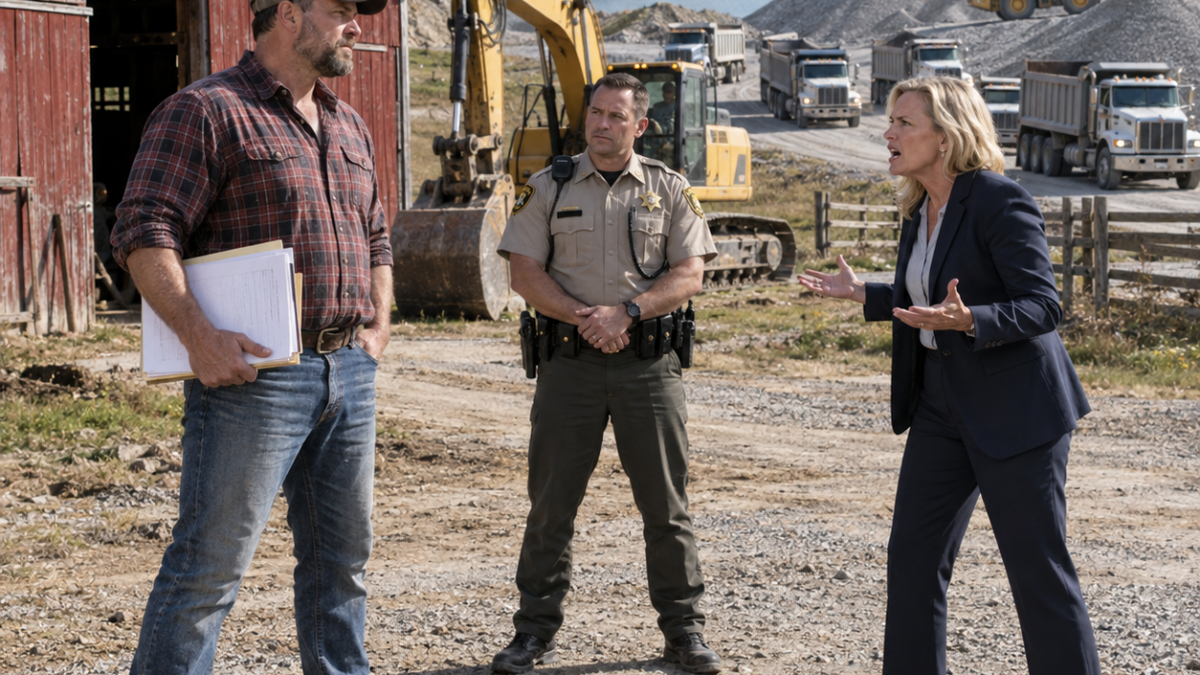
The HOA president stood at my fence and told me my grandfather’s barn would be gone by the next morning, whether I gave permission or not. She said it while my ten-year-old son was close enough to hear every word, as if destroying seventy-eight years of my family’s history was just another item on her clipboard. What Karen Miller didn’t understand was that the barn wasn’t the only Caldwell legacy buried in the ground beneath Whispering Pines.
“That structure is unauthorized, Mr. Caldwell.”
Karen’s voice carried across the old wire fence separating my thirty acres from the perfectly trimmed lawns of Whispering Pines Estates.
I wiped the sweat from my forehead and stared at her.
Behind me stood the barn my grandfather Elias had built in 1948.
Its boards were weathered silver. The roof had been patched more than once. Inside were hand tools with my grandfather’s initials carved into their handles, an old workbench my father had used as a teenager, and pencil marks showing my height when I was eight, eleven, and fourteen.
To Karen, it was an eyesore.
To me, it was family.
“My property isn’t part of your HOA,” I said.
She tightened her grip on the clipboard.
“That doesn’t mean your property doesn’t affect our community.”
My son Leo stopped working beside me.
We had been replacing a section of fence together. I had been teaching him how to set a post straight, something my father had taught me on almost the same patch of ground.
Karen pointed past me.
“The barn is visible from several premium homes. Residents have complained.”
“Which residents?”
“That’s confidential.”
“Then tell them they’re welcome to close their curtains.”
Leo tried not to smile.
Karen noticed.
Her face hardened.
“You think this is funny?”
“No,” I said. “I think you’re standing outside property you don’t own, quoting rules that don’t apply here.”
She lifted her phone and began recording.
That was Karen’s favorite weapon.
Paperwork first.
A camera second.
Authority—real or imagined—third.
I had spent twenty years in the Army Corps of Engineers before retiring and returning to the Caldwell farm with my wife Sarah and Leo. My professional life had taught me that boundaries mattered. Specifications mattered. Documents mattered.
And the survey marker thirty feet from Karen’s shoes mattered more than whatever title she had printed beneath her name on HOA stationery.
“This conversation is being documented,” she announced.
“Good,” I said. “Make sure you get the fence in the shot.”
She blinked.
“The fence?”
“The property line.”
For a second, neither of us spoke.
A breeze moved through the grass. Somewhere inside the barn, an old loose hinge tapped softly against wood.
Karen lowered her phone.
“I’ll give you one opportunity to cooperate voluntarily.”
“With what?”
“Removal.”
Leo looked at me.
“Dad?”
I saw fear replacing the smile on his face.
That changed something inside me.
I stepped closer to the fence.
Not across it.
Just close enough that Karen had to look directly at me.
“My grandfather built that barn before Whispering Pines existed. Before your clubhouse. Before your pool. Before the street you drove here on.”
Her lips tightened.
“Old doesn’t mean exempt.”
“No. Ownership does.”
She tore a sheet from her clipboard and pushed it through the wire.
I didn’t take it.
It fluttered into the grass between us.
At the top was the Whispering Pines HOA logo.
Below it, in bold letters, was a demand for structural remediation, beautification, and eventual removal if I refused to comply.
There were fines listed at one hundred dollars per day.
I almost laughed.
Then I saw Leo reading over my shoulder.
I didn’t laugh anymore.
Karen turned toward her silver SUV.
“Thirty days, Mr. Caldwell.”
I bent down and picked up the notice.
“Karen.”
She stopped.
“If anybody from your HOA crosses this fence without permission, they’ll be trespassing.”
She looked back at me.
The expression on her face wasn’t uncertainty.
It was insult.
She wasn’t used to hearing no.
And standing there that afternoon, watching her drive away while my son asked whether someone could really come destroy our barn, I realized this wasn’t going to end with one stupid letter.
Karen had decided my family’s history was standing in the way of her perfect neighborhood.
I just didn’t know yet how far she was willing to go to erase it.
Or what she was about to uncover when she tried.
PART 2
Leo waited until Karen’s SUV disappeared around the curve before speaking.
“Can she really do that?”
I looked down at the HOA notice in my hand.
The paper seemed ridiculous against everything surrounding us.
Thirty acres.
A farmhouse that had survived five generations of storms.
The barn.
The creek.
The oak trees my grandfather had planted before my father was born.
And one sheet of expensive paper printed by an organization I had never joined.
“No,” I said.
Leo searched my face.
“You’re sure?”
“I’m sure.”
I wanted to sound more confident than I felt.
Not because Karen had any legal claim over the barn.
She didn’t.
I knew that.
What worried me was the type of person who could be shown a clear boundary and still believe she had the right to cross it.
There was a difference between someone who misunderstood authority and someone who needed authority so badly that reality became negotiable.
Karen Miller, I would soon learn, belonged to the second category.
I folded the notice and put it in my back pocket.
“Come on,” I told Leo. “We still have three posts left.”
He looked toward the barn again.
“Grandpa Elias really built that?”
“Your great-grandpa.”
“With no machines?”
“He had a tractor eventually. But most of those beams went up with ropes, pulleys, and neighbors.”
Leo stared at the massive oak frame visible through the open barn doors.
“They couldn’t build that now.”
“Sure they could.”
He shook his head.
“Not like that.”
I smiled.
Maybe he understood more than I realized.
That evening Sarah found the notice on the kitchen counter.
She read it twice before looking at me.
“One hundred dollars a day?”
“Imaginary dollars.”
“Jack.”
“They can invoice me for a million dollars a day. It doesn’t make it enforceable.”
“That isn’t what I’m worried about.”
I knew.
Sarah had moved enough times during my military career to recognize conflict before it arrived. She had spent years making temporary houses feel permanent while I disappeared for training, assignments, deployments, and emergencies.
The farm was supposed to be different.
It was supposed to be the place where we finally stopped packing.
She sat across from me.
“What kind of person sends this to somebody who isn’t even in their HOA?”
“The kind who expects people to get scared and obey.”
“And when you don’t?”
I leaned back.
“That’s what we’re going to find out.”
The following morning, I drove to the county records office.
It had been years since I had been inside.
The place still smelled the same—dust, old paper, copier toner, and institutional coffee.
A clerk helped me pull the original Caldwell deed, subsequent surveys, county plat maps, and the subdivision documents for Whispering Pines.
I spent nearly four hours checking lines, dates, easements, covenants, and recorded restrictions.
There was no ambiguity.
The Caldwell property had never been incorporated into Whispering Pines.
No annexation.
No shared covenant.
No architectural easement.
No contractual authority.
Nothing.
The thick boundary line on the county plat might as well have been a brick wall.
I paid for certified copies.
Then I went home and drafted a response.
Not an angry response.
Angry letters feel good for fifteen minutes and become embarrassing exhibits for ten years.
I wrote the way I had written engineering memoranda when millions of dollars and lives could depend on three paragraphs being exact.
I identified the parcel.
I listed recording numbers.
I referenced the survey.
I stated that Whispering Pines HOA had no jurisdiction over the Caldwell property.
I rejected every fine.
I informed them that any continued attempts to exercise authority over my property could be documented as harassment.
Then I sent the response by certified mail with a return receipt.
Sarah watched me place my copy into a new binder.
On the spine I wrote one word.
KAREN.
She laughed despite herself.
“You actually labeled it that?”
“I like clear filing systems.”
“I married a strange man.”
“You knew that before the ceremony.”
For three days, nothing happened.
On the fourth, the return receipt arrived.
Karen had signed for the letter herself.
I thought that might end it.
It should have.
A rational HOA president, after receiving certified documentation proving that the land in question sat completely outside HOA jurisdiction, would have moved on.
Karen sent another letter.
This one was worse.
She acknowledged that my land was outside the association.
Then, in the same paragraph, she claimed that the “visual condition” of my barn negatively affected Whispering Pines property values.
She cited a county nuisance ordinance.
According to her, if I did not voluntarily submit a plan for the barn, she would report the structure as unsafe.
Sarah read the letter over my shoulder.
“She admitted we’re not in the HOA.”
“Yep.”
“And then kept going.”
“Yep.”
“Does that make sense?”
“Not legally.”
“I mean psychologically.”
I looked at her.
“That’s what worries me.”
I inspected the barn again that weekend.
Foundation.
Posts.
Rafters.
Roof connections.
Bracing.
I photographed everything.
The building was old, but old was not the same as unsafe.
My grandfather had overbuilt almost everything.
Some of the oak beams were so thick you could have parked a pickup on them.
I replaced two pieces of deteriorated siding and reinforced a section near the northwest corner.
Leo helped.
At one point he held up an old square we had found beneath the workbench.
The wooden handle was worn smooth.
Two initials had been carved into it.
E.C.
“Was this his?”
“Yeah.”
Leo ran his thumb over the letters.
“What was he like?”
I sat beside him on an overturned bucket.
“Stubborn.”
“Like you?”
“Worse.”
He grinned.
“He started the quarry with one crusher and a borrowed loader. Worked this farm, too. Your grandpa used to say Elias believed sleep was a conspiracy invented by lazy people.”
Leo laughed.
Then his expression turned serious.
“Would he let that woman tear this down?”
“No.”
The answer came faster than I intended.
Leo nodded.
“Then we shouldn’t either.”
That sentence stayed with me.
The weekly invoices started soon afterward.
Seven hundred dollars.
Then another seven hundred.
Then another.
Each invoice listed seven days of alleged noncompliance.
I never paid a cent.
I added each one to the binder.
Every envelope was dated.
Every certified letter saved.
Every interaction logged.
I installed a small security camera in an oak tree overlooking the property line.
Sarah saw me adjusting it one afternoon.
“You really think she might come onto the property?”
“I think she wants me to believe she will.”
“That wasn’t my question.”
I climbed down the ladder.
“No.”
She waited.
Then I corrected myself.
“I think she might.”
That night Sarah locked the back door earlier than usual.
Karen’s campaign changed after she realized the fines weren’t frightening me.
She stopped attacking only the barn.
She started attacking my reputation.
David Bennett was the first person to tell me.
He lived three streets inside Whispering Pines and had once received three violation notices because his mailbox was painted a shade Karen considered “insufficiently coordinated.”
He caught me near the community mailboxes one afternoon.
“Jack, can I talk to you?”
“Sure.”
He lowered his voice.
“Karen’s telling people you’re unstable.”
I stared at him.
“She’s saying you came back from the military angry. Says you’re intentionally keeping the farm looking rough because you hate the subdivision.”
I felt something cold settle in my stomach.
David continued.
“She says the barn has rot. Rats. Maybe structural problems.”
“It doesn’t.”
“I know.”
“How?”
“My dad was a carpenter. I’ve seen bad barns. Yours isn’t one.”
I appreciated that more than he knew.
“She’s also saying the association may have to take legal action.”
“Against land outside the association.”
David gave me a tired smile.
“You’re applying logic.”
That made me laugh.
Then he stopped smiling.
“She’s good at making people afraid of being the next target.”
I understood.
Fear doesn’t have to be dramatic.
Sometimes it’s just a homeowner deciding not to wave because the HOA president might notice.
Within two weeks, people who had once nodded when they drove past the farm started looking away.
At the hardware store, a woman I had spoken to several times suddenly became fascinated by a display of paint rollers when she saw me.
I could live with that.
Then Leo came home from school one afternoon and dropped his backpack harder than usual.
Sarah was making dinner.
I was at the kitchen table reviewing another ridiculous invoice.
“What happened?” I asked.
“Nothing.”
“Leo.”
He stared at the floor.
“Ethan’s mom says he can’t come over anymore.”
Ethan lived in Whispering Pines.
The two boys had spent half the summer riding bikes, fishing in the creek, and working on an elaborate fort that mostly consisted of three boards and a tarp.
“Why?”
Leo kicked one shoe against the other.
“She said our barn is dangerous.”
Sarah stopped chopping vegetables.
My hand closed around the HOA invoice.
“Did Ethan say that?”
“No. His mom did.”
“Anything else?”
Leo hesitated.
“She said you’re fighting everybody.”
That one landed.
Kids have a brutal talent for reducing adult manipulation to its simplest form.
You’re fighting everybody.
Karen had spent weeks making herself the community.
Therefore disagreeing with Karen meant fighting the community.
I pushed the invoice away.
“Come here.”
Leo sat beside me.
“Sometimes adults repeat things because they’re scared or because they haven’t checked whether those things are true.”
“Is Ethan’s mom scared of you?”
“I hope not.”
“Then why did she say that?”
I looked at Sarah.
She was watching me carefully.
“Because somebody told her a story,” I said, “and she believed it before hearing ours.”
Leo thought about that.
“Can we show her the barn?”
“Maybe someday.”
He nodded, but I could see the hurt remained.
That evening, after he went upstairs, Sarah found me in the barn.
I was standing under one of the main beams with my hands on my hips.
“You’re furious,” she said.
“Yes.”
“You’re doing that quiet thing.”
“What quiet thing?”
“The one where you act calm enough to make everybody around you nervous.”
I exhaled.
“She brought Leo into it.”
“I know.”
“She wants to call me stubborn? Fine. Uncooperative? Fine. But she doesn’t get to make our son feel like there’s something wrong with his home.”
Sarah came closer.
“What are you going to do?”
“Nothing stupid.”
“That was not sufficiently reassuring.”
I almost smiled.
Then I looked up at the beams.
“I’m going to let her keep talking.”
Sarah stared at me.
“That sounds like the opposite of a plan.”
“No. People like Karen make their biggest mistakes when they think nobody can stop them.”
“And?”
“And she thinks nobody can stop her.”
Three days later, David left a folded flyer in my mailbox.
SPECIAL COMMUNITY MEETING.
ADDRESSING THE CALDWELL PROPERTY.
PROTECTING OUR INVESTMENTS AND COMMUNITY STANDARDS.
“They’re holding a meeting about us?” Sarah asked.
“Apparently.”
“Were we invited?”
“No.”
She gave me a look.
“You’re going.”
“Absolutely.”
The clubhouse was packed.
I arrived after most people were seated and stood near the back.
Karen didn’t see me at first.
She had turned the front of the room into a presentation stage.
Projector.
Lectern.
Printed packets.
Even a slideshow.
The first photograph was my barn.
She had zoomed in so tightly that none of the surrounding maintained property was visible.
The sky in the picture was gray.
The contrast had been pushed so hard the wood looked black.
“As you all know,” Karen began, “we face a serious threat to property values along our western boundary.”
Threat.
Not neighbor.
Not farm.
Threat.
She spent twenty minutes transforming my grandfather’s barn into an enemy.
She talked about rodents she had never seen.
Structural deficiencies no engineer had documented.
Aesthetic degradation.
Potential liability.
Declining values.
Then she displayed copies of the invoices she had sent me.
“He has refused to pay a single dollar.”
People murmured.
What she did not mention was that I did not owe a single dollar.
She had created fake debt, then presented my refusal to pay it as evidence of bad character.
I felt my jaw tighten.
Then Karen made her mistake.
“I have spent countless hours,” she declared, “and significant association resources consulting legal experts about this matter.”
My anger disappeared.
Completely.
In its place came clarity.
I looked across the room at David.
He was already looking at me.
He understood too.
Association resources.
She had just admitted publicly that she was spending HOA money to pursue a non-member over property the association did not govern.
Karen kept speaking.
I barely heard her.
I was already building the next move in my head.
The following morning, I requested Whispering Pines’ publicly available incorporation documents and financial records.
When the budget arrived, Sarah and I spread it across the dining room table.
I ran a finger down the expense categories.
Landscaping.
Pool maintenance.
Clubhouse utilities.
Insurance.
Then I saw it.
LEGAL AND COMMUNITY STANDARDS CONTINGENCY—$15,000.
Sarah leaned closer.
“That’s convenient.”
“Very.”
“You think that’s what she’s using?”
“I think David can help us find out.”
That evening, I added a new tab to the binder.
FINANCES.
The binder had become thick enough that the rings strained when I closed it.
I stared at the cover.
KAREN.
For the first time since the dispute started, I felt less like I was defending the barn.
I felt like I was documenting the collapse of something much larger.
A few nights later, I was alone at the table after Sarah and Leo had gone upstairs.
The house was quiet.
I had the Whispering Pines documents spread in front of me.
The name kept bothering me.
Whispering Pines.
Something about it connected to a conversation with my father years earlier.
I closed my eyes.
Dad sitting on the porch.
Coffee.
Late afternoon.
He had been telling me about the family business.
Not the farm.
The other business.
Caldwell Aggregates.
My grandfather Elias had started it small, crushing stone for his own construction jobs before expanding into road base, sand, gravel, and asphalt aggregate.
My uncle still ran the operation.
Dad had mentioned the developer who purchased the land beside our farm.
Then something else.
A long-term supply arrangement.
I sat upright.
“No way.”
I pulled out my phone.
It was after ten.
I almost called my uncle anyway.
Instead, I waited until morning.
At seven-thirty I was driving toward the quarry.
The sound reached me before I reached the gate.
Crushers.
Loaders.
Backup alarms.
Diesel engines.
Conveyors carrying gray stone under a cloud of pale dust.
CALDWELL AGGREGATES was painted across the sides of the haul trucks.
My uncle Ray was in his office overlooking the pit.
He looked up when I walked in carrying the binder.
“That doesn’t look like a social visit.”
“It isn’t.”
I placed the binder on his desk.
For forty minutes, I told him everything.
The letters.
The fines.
The rumors.
Leo.
The town hall.
The money.
The demolition threats.
Ray listened without interrupting.
When I finished, he leaned back.
“So this woman is trying to tear down Dad’s barn.”
“Granddad’s barn, technically.”
“You know what I mean.”
“I do.”
“She actually thinks she can send a demolition crew onto your property?”
“She says she can.”
Ray stared through the office window at the quarry floor.
A loader dumped gravel into a truck.
Then he asked the question I had been waiting for.
“Does she know who supplies Whispering Pines?”
“No.”
He turned back slowly.
“Not even a clue?”
“I don’t think she’s ever connected the name.”
Ray stood.
He walked to a metal cabinet and pulled out an old contract binder.
WHISPERING PINES DEVELOPMENT.
He dropped it on the desk.
“Twenty-year exclusive supply agreement.”
I opened it.
Road base.
Drainage aggregate.
Asphalt stone.
Repair material.
Future road work.
Caldwell Aggregates.
Everywhere.
Ray tapped a paragraph.
“Good-faith cooperation.”
Then another.
“Delivery scheduling based on operational capacity.”
Another.
“Quality assurance before release.”
I read the sections twice.
Ray crossed his arms.
“Contract says we supply them.”
“Yes.”
“It does not say we ignore our own quality procedures.”
“No.”
“And we have the right to audit material.”
“Yes.”
His expression changed.
Not into a smile exactly.
Something harder.
“Jack.”
“Yeah?”
“I think that woman has been standing on our gravel while threatening our barn.”
For the first time in weeks, I laughed.
It wasn’t joy.
It was recognition.
The map had changed.
Karen believed the conflict was between her HOA and one retired man with an old building.
She had no idea that the road beneath her silver SUV existed because of the same family she was trying to push around.
But I also knew leverage used carelessly becomes a weapon against the person holding it.
So my next call was to Mark Jameson.
Mark and I had served together years earlier.
Back then he had been a JAG officer with an unnerving ability to remain cheerful while explaining exactly why someone’s position was legally disastrous.
Now he practiced civilian law.
I sent him the documents.
He called twenty minutes later.
“Jack.”
“Yeah.”
“Tell me the HOA president truly hired lawyers using association funds to pursue property outside the association.”
“She admitted it at the meeting.”
“Witnesses?”
“About fifty.”
“And your family business has the exclusive aggregate contract?”
“Correct.”
“And she’s threatening demolition?”
“Correct.”
There was a pause.
Then Mark laughed.
“This woman has built the scaffold, tied the rope, and asked you to check whether the knot is secure.”
“I assume that means you see options.”
“I see several. But we do this clean.”
“I know.”
“No cowboy stuff.”
“Mark.”
“I served with you. I’m entitled to say it.”
We agreed on one principle.
Karen would receive every opportunity to stop herself.
No threats.
No trespass.
No invented authority.
Just documentation.
Lawful resistance.
And consequences.
Two weeks later, she made stopping herself impossible.
Sarah discovered the demolition notice nailed to the barn door.
She came into the kitchen holding it with both hands.
Her face was pale.
“Jack.”
One look at her told me this was different.
I took the paper.
Karen’s HOA claimed my barn qualified as a nuisance under a county ordinance relating to abandoned commercial property.
My barn was neither abandoned nor commercial.
Nevertheless, the notice announced that Ace Demolition would arrive Friday at nine in the morning to “abate” the structure.
Seventy-two hours.
Sarah’s voice trembled.
“She actually hired somebody.”
“Yes.”
“You knew she might.”
“Yes.”
“And you’re standing there like this is good news.”
“It is.”
She stared at me as if I had lost my mind.
I lowered the paper.
“Sarah, listen to me. Up to now she’s been sending letters. Friday she’s planning to cross the property line. The moment she does that, the argument stops being about opinions.”
“What if the demolition crew doesn’t care?”
“They will when they see a deputy.”
Her eyebrows lifted.
I called Mark.
“We’re green.”
“When?”
“Friday. Nine.”
“I’ll file.”
Mark prepared an emergency request for an injunction barring Karen and the association from entering my property for demolition.
Meanwhile, I contacted the sheriff’s department.
I didn’t ask them to arrest anyone.
I explained that a contractor had been instructed to enter private property without my consent and that I wanted an officer present to prevent a confrontation.
I sent the deed.
Survey.
HOA notice.
Demolition paperwork.
The watch commander called back.
“We’ll have a deputy there.”
Thursday night, Leo stood in the barn doorway while I checked the cameras.
“Are they coming tomorrow?”
“Yes.”
“Are you going to fight them?”
“No.”
“What if they try to knock it down?”
“They won’t.”
“How do you know?”
“Because tomorrow there are going to be witnesses.”
He looked at the old beams above us.
I crouched beside him.
“Courage doesn’t always look like fighting, bud.”
“What does it look like?”
“Sometimes it looks like knowing exactly where the line is and refusing to move from it.”
He considered that.
“Like the fence?”
“Exactly like the fence.”
Friday morning was bright and cool.
At eight-thirty, a sheriff’s cruiser came up the drive.
Deputy Miller introduced himself.
No relation to Karen.
I gave him coffee and walked him through the property records.
He examined the fence line.
“This is the surveyed boundary?”
“Yes.”
“And you have not consented to entry?”
“No.”
“Understood.”
At 8:55, we heard diesel.
Leo and Sarah watched from the house.
I stood beside the fence.
A flatbed came around the curve carrying a yellow excavator fitted with a demolition claw.
ACE DEMOLITION.
Behind it came Karen’s silver SUV.
For one strange second, I felt grief rather than anger.
That machine was real.
Its steel tracks were caked with mud.
Its hydraulic claw was large enough to tear through the barn wall in seconds.
Karen had looked at photographs, deeds, history, my family, and a ten-year-old boy—and had still decided that machine belonged on my land.
The truck stopped.
A foreman climbed down.
Karen emerged behind him.
She wore sunglasses and carried the clipboard.
“Mr. Caldwell,” she called.
I didn’t answer.
The foreman approached.
“You Caldwell?”
“Yes.”
“We’re contracted to remove that structure.”
“You’re contracted by someone who doesn’t own it.”
He frowned.
Karen stepped forward.
“We have an abatement authorization.”
“You have an HOA notice.”
“It references county authority.”
“Where’s the court order?”
Her mouth tightened.
“The association has followed the proper process.”
The foreman looked from her to me.
I pointed past him.
“Before you unload that excavator, you might want to talk to the deputy.”
Karen turned.
Deputy Miller stepped from behind the oaks.
I will remember her face for the rest of my life.
Not because she looked frightened.
Because for the first time, she looked confused.
Reality had entered the scene without asking her permission.
She marched toward him.
“Officer, this man is obstructing a lawful nuisance-abatement action.”
Deputy Miller held out his hand.
“May I see the court order?”
Karen gave him her paperwork.
He read it.
Then he looked up.
“This isn’t a court order.”
“It’s an official association action supported by county ordinance.”
“That’s different.”
“This structure is unsafe.”
“Do you have a county condemnation order?”
“No, but—”
“An inspection declaring it unsafe?”
“The association has determined—”
“The association doesn’t own this parcel.”
Her face reddened.
Deputy Miller continued calmly.
“The documents Mr. Caldwell provided show that fence as the property boundary. He has denied entry. If your contractor crosses onto his land without lawful authorization, you could have a trespass issue.”
Karen pointed toward the barn.
“You’re telling me he can simply refuse?”
“Yes, ma’am.”
Two words.
That was all.
Yes, ma’am.
The entire structure of Karen’s authority seemed to collapse under them.
The demolition foreman removed his hard hat.
“Ma’am.”
She ignored him.
“Ma’am.”
“What?”
“We’re done.”
Her head snapped toward him.
“You haven’t started.”
“And we’re not going to.”
“I hired your company.”
“You hired us to perform a legal demolition. I’m looking at a deputy telling me we’d be trespassing.”
“I will assume liability.”
“No.”
“Excuse me?”
“I said no.”
I almost felt sorry for him.
He had apparently discovered in under five minutes what Whispering Pines residents had been learning for years.
Karen didn’t hear no gracefully.
The foreman continued.
“Our equipment stays on the truck.”
Her voice rose.
“I expect you to honor your contract.”
“We will. Which means you’re responsible for the mobilization charge.”
“How much?”
“Four thousand.”
Karen stared at him.
“You’re charging me four thousand dollars for doing nothing?”
“We hauled a thirty-ton excavator out here because you represented that you had authority to access the site.”
“I do!”
The deputy cleared his throat.
Karen stopped.
The foreman put his hard hat back on.
“Have a nice day.”
The flatbed pulled away ten minutes later.
Diesel smoke drifted across the road.
Karen remained beside her SUV.
I said nothing.
That made it worse.
She crossed her arms.
“You’re enjoying this.”
“No.”
“You think you embarrassed me.”
“You brought an excavator to my property. I didn’t invite an audience.”
“You’re going to regret making an enemy of this community.”
Before I could answer, another vehicle pulled up.
A process server stepped out.
“Karen Miller?”
Her expression changed.
“Yes.”
He handed her an envelope.
She opened it.
Emergency injunction.
Mark’s filing had been granted.
The court order prohibited the HOA and its agents from entering my property for demolition pending further proceedings.
Karen read the first page.
Then the second.
Her hands began shaking.
She looked at me.
I could have celebrated.
I didn’t.
I simply said, “Now you have an actual court order.”
She got into her SUV and drove away.
By Saturday, everyone in Whispering Pines knew about the excavator.
By Monday, they knew about the four-thousand-dollar bill.
Karen could control gossip.
She could not control the HOA financial summary.
ACE DEMOLITION—MOBILIZATION FEE: $4,000.
It appeared in black and white.
David came to my porch that evening.
I opened two beers.
“You saw it?” I asked.
“Everybody saw it.”
He sat down.
“People are furious.”
“Good.”
He glanced at me.
“You mean that?”
I thought about Leo.
About the rumors.
About Mrs. Henderson lowering her eyes at the mailbox because she was afraid of becoming Karen’s next target.
“I mean people should know what their money is buying.”
I carried the binder outside.
David spent nearly an hour reading.
The letters.
The fake fines.
My certified response.
The budget.
Legal expenses.
Photographs.
Demolition video.
He eventually leaned back and rubbed his face.
“She told us the legal fund was for emergencies.”
“So I heard.”
“Storm damage. Liability. Insurance disputes.”
He tapped one invoice.
“This is consultation about your barn.”
“Yes.”
“You aren’t even a member.”
“No.”
“Jack, she’s been using our dues to finance this.”
“That’s what it looks like.”
He stared toward Whispering Pines.
“I thought my mailbox thing was stupid.”
“What happened?”
David laughed without humor.
“My wife picked blue. Karen said it wasn’t an approved shade. We repainted it. Then she decided the post design wasn’t compliant.”
“How much did that cost you?”
“Money? Maybe three hundred.”
He paused.
“Peace? More.”
That was the first time I realized Karen’s real damage wasn’t measured only in fines.
It was measured in people deciding resistance wasn’t worth the anxiety.
David finished his beer.
“There are others.”
“I figured.”
“No, I mean a lot of others.”
The Hendersons were first.
They lived two blocks from the clubhouse.
Their basketball hoop stood beside the garage.
Portable.
Clean.
Ordinary.
Karen hated it.
Mrs. Henderson showed us a folder containing eleven notices.
“She says it’s visually intrusive.”
“Is that phrase in the covenants?” I asked.
“No.”
“Then where did it come from?”
Mrs. Henderson gave a bitter laugh.
“Karen.”
Her husband leaned against the counter.
“We almost took it down.”
“Why didn’t you?”
“Our son heard us talking about it.”
He looked toward the driveway.
“He asked why somebody he didn’t know got to decide whether he could play basketball at his own house.”
I understood exactly how that felt.
Next came Mrs. Gable.
Seventy-three.
Widowed.
Her backyard contained one of the most beautiful rose gardens I had ever seen.
Karen had ordered her to remove several beds.
“Bees,” Mrs. Gable said.
“Bees?”
“Apparently my roses attract an excessive number.”
David stared at her.
“Karen actually put that in writing?”
Mrs. Gable walked inside and returned with the letter.
There it was.
EXCESSIVE POLLINATOR ACTIVITY.
I laughed so suddenly I had to apologize.
Mrs. Gable smiled.
“Don’t apologize, dear. I laughed too. Then I cried.”
That silenced me.
“My husband planted the first rosebush the year we moved here,” she said. “After he died, caring for these became… something I could still do for both of us.”
She looked down.
“And that woman made me feel like grief needed architectural approval.”
My anger changed again.
Until then, revenge had meant protecting the barn and exposing Karen.
Now I understood there were dozens of private barns in Whispering Pines.
Not literal ones.
Things people loved.
A basketball hoop.
A rose garden.
A mailbox.
A porch color.
Small pieces of home.
Karen had spent years teaching people that those pieces belonged to her.
We began meeting residents quietly.
Not secretly.
Quietly.
There was a difference.
We never told anyone, “Help us destroy Karen.”
We said, “Look at the records.”
David, being an accountant, was perfect.
He could explain a budget without sounding dramatic.
The Hendersons spoke about selective enforcement.
Mrs. Gable brought copies of her notices.
I brought mine.
Soon people brought their own folders.
A retired teacher fined because wind knocked her trash can sideways.
A widower ordered to replace his porch light because the fixture had been discontinued and the replacement was technically different.
A family threatened over a child’s chalk drawings remaining on the driveway overnight.
One story alone sounded petty.
Fifty stories together looked like a system.
We called ourselves the Whispering Pines Homeowners for Responsible Governance.
The name was intentionally boring.
Boring names make nervous tyrants more nervous.
The bylaws allowed homeowners to demand a special meeting with signatures from ten percent of members.
Whispering Pines had roughly 150 homes.
We needed fifteen.
We collected sixty.
Nearly forty percent of the neighborhood.
David brought the petition to the board.
Karen refused to accept it.
“This contains irregular signatures.”
“What irregularities?”
“I’ll need to review them.”
“The bylaws say the secretary verifies signatures.”
“I am president.”
“And Cynthia is secretary.”
Karen stared at him.
David smiled politely.
“Would you like me to hand it to Cynthia?”
The meeting was scheduled two weeks later.
Karen responded with emails.
Lots of emails.
She described us as agitators.
A hostile faction.
Disgruntled residents manipulated by an outsider.
That outsider was me.
The amusing part was that the more she attacked us, the more homeowners forwarded her messages to David.
Her own words became campaign material.
Then I remembered the gravel.
Actually, I had never forgotten.
I had simply been waiting.
Whispering Pines Boulevard was scheduled for full resurfacing the same week as the special meeting.
Karen had promoted the project for months.
She had called it proof of her leadership.
The old asphalt would be milled away Monday.
Fresh road base would arrive Tuesday.
Paving would begin shortly afterward.
Caldwell Aggregates supplied the road base.
Monday morning, milling machines tore into Whispering Pines Boulevard.
By afternoon, the road looked like a dry riverbed.
Traffic was rerouted.
On Tuesday morning, the gravel trucks did not arrive.
At nine, the paving contractor called the quarry.
At ten, he called again.
At eleven, Karen called.
Ray had already prepared the answer.
Quality-assurance review.
Contractually permitted.
Material release pending verification.
Nothing illegal.
Nothing dramatic.
Nothing permanent.
Just precise enforcement of every provision Karen had assumed nobody would ever read.
By Tuesday afternoon, dust covered parked cars along the torn roadway.
Wednesday’s forecast threatened rain.
Residents grew furious.
I felt some guilt about the inconvenience.
Ray noticed.
“You want to release it?”
We were standing above the quarry floor.
“I don’t want innocent people punished.”
“Then remember who started the road project before confirming material release.”
“Karen.”
“And how long do we need?”
“Until tomorrow’s meeting.”
Ray nodded.
“Then tomorrow they get either a new road or a very educational conversation with their HOA president.”
Wednesday afternoon, my phone rang.
Blocked number.
“This is Jack.”
Silence.
Then Karen.
“Mr. Caldwell.”
Her voice was controlled so tightly each word sounded painful.
“Karen.”
“I have been attempting to contact Caldwell Aggregates.”
“I heard.”
“Our road material has not arrived.”
“I heard that too.”
“The contractor says there is some type of review.”
“Yes.”
“I want it resolved immediately.”
I leaned back in my chair.
“Why are you calling me?”
Another silence.
She knew.
That was the beautiful part.
She finally knew.
“You’re involved.”
“I’m a Caldwell.”
“What did you do?”
I chose my words carefully.
“Caldwell Aggregates has exercised its contractual right to review material and partnership conditions associated with the project.”
“This is retaliation.”
“It’s contract administration.”
“You stopped our road.”
“No. Your contractor removed your road. We haven’t released the next material shipment.”
“You know exactly what you’re doing.”
“Yes.”
The honesty stunned her.
“You can’t hold an entire neighborhood hostage because of a personal dispute.”
“You mean the way an HOA president tried to use one hundred fifty homeowners’ dues to destroy property she didn’t own?”
She inhaled sharply.
“This is blackmail.”
“No.”
“It absolutely is.”
“Then have your attorney read the contract.”
“I already have.”
That told me more than she intended.
“And?”
She didn’t answer.
I continued.
“The agreement requires good-faith cooperation between Caldwell Aggregates and the association. Your board spent association funds trying to demolish a Caldwell family structure on land you knew was outside your jurisdiction.”
“You’re twisting things.”
“You sent an excavator.”
“The barn is a nuisance.”
“The sheriff disagreed.”
“The sheriff said he couldn’t act without a court order.”
“And then you received one.”
Her breathing was audible.
I lowered my voice.
“Karen, tomorrow night the homeowners are going to ask you questions. Answer them.”
“You’re threatening me.”
“No. I’m giving you the same opportunity you gave me.”
“What opportunity?”
“To cooperate voluntarily.”
The words landed.
I heard her recognize them.
They were almost exactly what she had said beside my fence.
For a long moment, nothing came from the phone.
Then she said, “You think you’ve won.”
“This was never supposed to be a game.”
“You’re enjoying it.”
“No. I’m protecting what’s mine.”
“By hurting people who have nothing to do with this?”
“That’s why the review can end quickly.”
“How?”
“Stable leadership. Transparent finances. Good-faith conduct.”
“You want me to resign.”
“I want the homeowners to decide what they want.”
“And if they choose me?”
“Then our attorneys and your attorneys can continue reviewing the partnership.”
Her voice dropped.
“You planned this.”
“You planned a demolition.”
“That barn has cost this community thousands.”
“No, Karen. You cost them thousands.”
I let that sit between us.
“The meeting is tomorrow,” I said. “Maybe they deserve to hear the difference.”
I hung up.
Sarah had heard part of the call from the kitchen doorway.
She crossed her arms.
“That was cold.”
“Yes.”
“Necessary?”
I thought about it.
“I hope so.”
She walked over.
“Jack, I want her stopped too.”
“I know.”
“But don’t become somebody Leo needs protection from.”
That sentence cut deeper than anything Karen had said.
I looked at my wife.
“I won’t.”
“Promise me.”
“I promise.”
Thursday evening, the clubhouse parking lot filled before the meeting started.
Cars lined both sides of the street.
People walked around piles of construction cones and complained about dust.
The torn boulevard had become a physical representation of everything wrong with the HOA.
A project announced with confidence.
Poor coordination.
No transparency.
Residents absorbing the consequences.
Sarah sat beside me in the front row.
David sat on my other side.
Mrs. Gable wore a flowered blouse.
The Hendersons had brought a thick folder.
Mark sat near the aisle.
At seven, Karen struck the gavel.
“Meeting will come to order.”
Nobody quieted.
She struck it again.
“I said this meeting will come to order.”
Eventually the noise subsided.
Karen looked different.
Tired.
Pale.
Her hair was immaculate, but the confidence beneath it was cracking.
“We will follow the agenda distributed by the board.”
David stood.
“The petition requires discussion of financial governance and a confidence vote.”
Karen’s jaw tightened.
“That will occur at the appropriate time.”
“The bylaws specify it as the purpose of this special meeting.”
“I know what the bylaws say.”
Somebody behind us muttered, “First time for everything.”
A few people laughed.
Karen flushed.
David walked toward the projector.
“I’ll begin with the financial review.”
“No.”
The room went quiet.
David stopped.
Karen gripped the gavel.
“You do not have authority to commandeer association equipment.”
Cynthia, the board secretary, leaned toward her.
“He submitted the presentation yesterday. We approved it.”
Karen turned.
“You approved it?”
“The board did.”
Three members avoided her eyes.
For the first time, I saw the moment a ruler discovers that obedience was conditional.
Karen leaned back.
“Proceed.”
David displayed the annual budget.
No adjectives.
No accusations.
Just numbers.
“Legal and Community Standards Contingency,” he said. “Fifteen thousand dollars.”
Next slide.
Attorney invoices.
Caldwell property consultation.
Caldwell nuisance review.
Caldwell enforcement options.
Next slide.
Ace Demolition.
Four thousand dollars.
David faced the room.
“More than seven thousand dollars of association funds were spent pursuing a property that is not part of Whispering Pines.”
Karen grabbed the microphone.
“That is an oversimplification.”
David turned.
“Which amount is incorrect?”
Silence.
“Which invoice is incorrect?”
“You are ignoring the purpose.”
“What purpose?”
“Protecting property values.”
A man in the third row stood.
“Did we vote to spend money on his barn?”
“No homeowner vote was required.”
“Did the full board approve demolition?”
Karen hesitated.
Cynthia looked down.
David answered.
“The minutes show no formal board authorization for the Ace contract.”
The room erupted.
Karen struck the gavel.
“Order!”
Nobody listened.
Mrs. Henderson stood.
“My family received eleven violation notices over a basketball hoop.”
Karen closed her eyes briefly.
Mrs. Henderson continued.
“You told us you were enforcing written rules.”
“I was.”
“Show me the rule.”
“We have broad nuisance authority.”
“Show me the rule.”
Karen’s face tightened.
Mrs. Henderson’s voice shook.
“For six months, my son thought he was doing something wrong every time he played basketball in his driveway.”
The room became quiet.
“That isn’t governance,” she said. “That’s bullying.”
She sat.
Mrs. Gable stood next.
She held up Karen’s letter.
“I was told my roses attracted too many bees.”
Several people laughed.
Mrs. Gable did not.
“My husband planted those roses.”
The laughter stopped.
“He died four years ago.”
Karen shifted in her chair.
“I explained that to you, Karen.”
Mrs. Gable’s voice remained gentle.
“You knew.”
Something about the softness made the words heavier.
“You still sent three more notices.”
A woman near the back wiped her eyes.
Mrs. Gable folded the letter.
“I used to dread walking to my mailbox because I thought there would be another envelope from you.”
She looked around the room.
“Nobody should be afraid of their own mailbox.”
That was the moment the meeting changed.
Not because people became angrier.
Because they recognized themselves.
One after another, residents stood.
Trash cans.
Paint colors.
Holiday decorations.
Fence stains.
Porch lights.
Driveway chalk.
The details sounded absurd.
The anxiety did not.
Karen kept trying to respond.
Each defense made things worse.
“Standards matter.”
“Rules protect everyone.”
“Somebody has to maintain order.”
“You elected me to make difficult decisions.”
Finally, a man near the back shouted over the room.
“WHAT ABOUT THE ROAD?”
Everything stopped.
“My wife hit one of those detour potholes this morning. We’ve got dust covering our windows. When is the gravel coming?”
Heads turned toward Karen.
For the first time all evening, she had no prepared answer.
“There has been a vendor delay.”
“What vendor?”
“An aggregate supplier.”
“Which one?”
She looked at me.
I stood.
The room quieted.
“Caldwell Aggregates.”
People turned.
Someone whispered, “Caldwell?”
I walked toward the front.
Karen stared at me with open hatred.
“My grandfather started Caldwell Aggregates.”
The projector still displayed the demolition invoice behind me.
“The same grandfather who built the barn your HOA attempted to demolish.”
The room was silent.
“My family’s company has supplied the road base, gravel, drainage aggregate, and asphalt stone used throughout Whispering Pines under a long-term exclusive agreement.”
A man near the wall said, “You own the gravel company?”
“My family does.”
I looked at Karen.
“She knew that yesterday.”
Someone laughed.
Karen snapped, “He is deliberately withholding our material.”
I faced the room.
“Yes.”
The honesty created a ripple.
I raised one hand.
“Under the contract, Caldwell Aggregates controls release schedules subject to operational capacity and quality assurance. The contract also requires a good-faith working relationship.”
Karen spoke over me.
“This is extortion.”
Mark stood.
“No.”
Every head turned.
He identified himself as counsel familiar with the matter.
“The supplier is exercising written contractual rights. If the association disputes that interpretation, it has legal remedies.”
Karen glared at him.
Mark sat.
I continued.
“I don’t want your road torn up.”
A woman shouted, “Then release the gravel!”
“I intend to.”
“When?”
“When this association can demonstrate that the people managing the contract are operating in good faith.”
Voices rose.
I kept speaking.
“This is not about punishing homeowners.”
I pointed to the invoice behind me.
“You are already being punished.”
Then the attorney invoices.
“By this.”
Then the demolition invoice.
“And this.”
I turned toward Karen.
“Your money funded an attempt to enter land you do not own and tear down a building you have no authority over.”
Karen stood.
“That barn impacts us!”
“My son impacts you too. Does the HOA get to regulate him?”
The room went completely still.
Karen opened her mouth.
Nothing came out.
I lowered my voice.
“You told people I was dangerous.”
She looked away.
“You made families afraid to let their kids visit our farm.”
Sarah stared at Karen from the front row.
“You made my ten-year-old son ask whether there was something wrong with his home.”
Karen finally found her voice.
“I never targeted your child.”
“You targeted everything around him.”
That silenced her again.
“This stopped being about wood a long time ago,” I said. “That barn is where my grandfather worked. Where my father worked. Where I’m teaching my son the things they taught me. You didn’t have to like it. You didn’t have to think it was pretty. You only had to respect the fence.”
I pointed toward the windows.
Beyond them, somewhere in the darkness, lay the boundary Karen had refused to accept.
“You couldn’t.”
Nobody moved.
“So yes. Caldwell Aggregates is reviewing whether this remains a good-faith partnership.”
I looked at the homeowners.
“What happens next belongs to you.”
Then I sat down.
Karen’s authority ended quietly.
Not with shouting.
Not with a police officer.
Not with the gravel contract.
It ended when she looked toward the other four board members for support.
None of them met her eyes.
Cynthia pulled a sheet of paper from a folder.
She placed it in front of Karen.
“Resign.”
Karen stared at her.
“What?”
“Please.”
“You’re siding with him?”
“I’m siding with the homeowners.”
Karen laughed once.
A broken, disbelieving sound.
“After everything I’ve done for this community?”
A man called from the back.
“We didn’t ask you to spend seven thousand dollars on a barn!”
Another voice followed.
“Resign!”
Then another.
“Resign!”
The word spread.
Not everyone joined.
They didn’t need to.
Karen looked around the room at people who had once lowered their voices when she entered.
Now they were looking directly at her.
Her hand reached for the pen.
Then stopped.
“You’ll regret this.”
Cynthia replied quietly.
“Maybe. But it’ll be our mistake.”
That was the sentence that defeated Karen Miller.
Not mine.
Cynthia’s.
Because it returned ownership of the community to the people living in it.
Karen signed.
She dropped the pen.
For one second, her eyes met mine.
I saw rage.
Humiliation.
Disbelief.
But beneath all of it, I saw something else.
Loss.
She had confused control with belonging for so long that when the control disappeared, she had nothing left.
She walked out.
Nobody stopped her.
The door closed.
The room remained silent for several seconds.
Then David exhaled.
“All right.”
A few people laughed.
Someone clapped.
Then the applause spread.
I didn’t join immediately.
Sarah took my hand.
“It’s over,” she whispered.
“Not yet.”
She knew me too well.
“Jack.”
“The road.”
That made her smile.
The remaining board appointed David interim president.
His first statement was short.
“We owe several people apologies.”
He looked at me.
“The Caldwell family first.”
Then the Hendersons.
Mrs. Gable.
Others.
“All disputed fines associated with selective or unsupported enforcement will be suspended pending review.”
Applause.
“We will commission an independent financial audit.”
More applause.
“And until new safeguards are adopted, no single officer will have authority to engage outside counsel or contractors above a defined spending threshold without recorded board approval.”
That earned the loudest reaction.
By the time we walked outside, the air had changed.
The road was still torn up.
Dust still coated the parked cars.
Cones still blocked the boulevard.
But people were talking to one another.
Not whispering.
Talking.
A woman I recognized from the hardware store approached me.
“Mr. Caldwell?”
“Jack.”
She looked embarrassed.
“My daughter is Ethan’s mother.”
I understood immediately.
“I see.”
“She believed what Karen was saying.”
I waited.
“She shouldn’t have kept the boys apart.”
“No.”
“I’m sorry.”
I looked toward Leo, who had stayed home with a neighbor that evening.
“Tell her Leo would probably like to see Ethan.”
Her shoulders relaxed.
“I will.”
Friday morning, David called.
“The board met at six-thirty.”
“That sounds painful.”
“It was.”
“What happened?”
“All complaints against your property are withdrawn.”
“Good.”
“We’re sending a written apology.”
“Better.”
“The board unanimously adopted a temporary financial-control policy.”
“Best.”
He laughed.
Then his voice became serious.
“Jack, about the road.”
“I was waiting for that.”
“Can we get our gravel?”
I looked out the kitchen window.
The barn stood on the rise in morning sunlight.
“Give me an hour.”
I called Ray.
“How’s the audit?” I asked.
“Painstaking.”
“I hear management has changed.”
“So I’ve been told.”
“Think that affects the good-faith review?”
“Could.”
I could hear the smile in his voice.
“Release it.”
Ray became serious.
“You sure?”
“Yes.”
“All of it?”
“All of it.”
“Standard grade?”
I thought about the residents who had signed the petition.
Mrs. Gable’s roses.
The Henderson boy’s hoop.
David sitting on my porch.
“Better.”
Ray paused.
“Better?”
“Upgrade the asphalt aggregate.”
“That’ll cost us.”
“I know.”
“You’re paying the difference?”
“Put it against my share.”
“Jack.”
“They need a road that lasts longer than the memory of this mess.”
Ray chuckled.
“Granddad would call that terrible business.”
“Granddad gave materials away every time somebody’s barn burned.”
“Also true.”
“Send the trucks.”
At one-fifteen that afternoon, I heard the first diesel engine.
Leo ran outside.
“Dad!”
A Caldwell Aggregates truck came around the corner.
Then another.
Then another.
Gray gravel filled each bed.
Residents stepped onto lawns and porches.
The trucks rolled past Karen’s house.
I wondered whether she watched from inside.
I didn’t care.
The first truck turned toward the torn boulevard and raised its bed.
Stone poured onto the road.
The sound was enormous.
Thousands of pounds of crushed rock sliding into place.
Leo covered his ears and grinned.
I stood beside him.
“That’s ours?”
“The company’s.”
“But our family?”
“Yeah.”
He watched the loader spread the gravel.
“So the roads really come from Grandpa Elias’s quarry?”
“They do.”
He looked toward the barn.
“And he built that.”
“He did.”
Leo’s expression changed.
He was connecting something.
“Then she tried to tear down something he built while driving on something else he built.”
I laughed.
“That’s one way to put it.”
“That wasn’t very smart.”
“No.”
The road was completed faster than expected.
Caldwell Aggregates supplied a higher-grade asphalt mix.
The paving contractor worked long days to recover the lost schedule.
Within a week, Whispering Pines Boulevard was black, smooth, and clean.
Children rode bikes over it.
Cars stopped kicking up dust.
The detour signs disappeared.
Something else disappeared too.
The feeling that Karen was watching everything.
David later told me residents kept expecting violation letters.
For weeks, people opened their mailboxes cautiously.
Then they realized the envelopes weren’t coming.
Mrs. Henderson left the basketball hoop exactly where it had always been.
The first Saturday after the road reopened, I drove past and saw six kids playing.
Leo was one of them.
Mrs. Henderson waved.
I waved back.
Mrs. Gable invited us over when her roses reached peak bloom.
Sarah walked between the rows with her.
I found David near the fence drinking lemonade.
“Interim president treating you well?” I asked.
“I’ve developed a deep hatred of email.”
“That means you’re qualified.”
“I’m serious. Do you know how many people care about pool-chair policy?”
“No.”
“Everyone.”
I laughed.
He looked across the yard.
“We changed the financial controls.”
“I heard.”
“Two signatures above five hundred. Board vote above two thousand. Outside counsel requires recorded approval except genuine emergencies.”
“Good.”
“Term limits are going to a membership vote.”
“Better.”
“And we’re creating an appeal panel separate from the enforcement committee.”
I nodded.
David grew quiet.
“You know, I used to think Karen was the problem.”
“Wasn’t she?”
“She was.”
He looked toward the homes.
“But we helped create her.”
“How?”
“We stopped paying attention.”
That stayed with me.
“Every time she went after somebody else, the rest of us thought, at least it isn’t me.”
He shook his head.
“By the time she came after enough people, everybody was too intimidated to speak.”
“Until the barn.”
“Until the barn.”
I smiled.
“Granddad always said that thing caused trouble.”
David laughed.
Later that summer, the independent audit came back.
Some spending decisions were sloppy.
Several were poorly documented.
The demolition expenditure had never received proper full-board approval.
There was no dramatic criminal case.
No handcuffs.
No television cameras.
I preferred it that way.
Reality is usually less theatrical than revenge fantasies.
Karen lost the thing she valued most.
Control.
The association formally canceled every claimed fine against my property.
Residents with unsupported penalties received reversals or credits.
Policies were rewritten.
Meeting minutes were published promptly.
Budgets became easier to inspect.
Homeowners stopped treating HOA governance like weather—something happening above them that they simply had to endure.
They began showing up.
That was the real victory.
Not embarrassing Karen.
Not withholding gravel.
Not stopping an excavator.
People showed up.
Karen avoided me after the meeting.
For almost a month, I saw her silver SUV only occasionally.
Then a FOR SALE sign appeared in front of her house.
Sarah noticed first.
“She’s moving.”
I looked across the field.
“Apparently.”
“How do you feel?”
I thought about that.
“Relieved.”
“Nothing else?”
“A little sad.”
That surprised her.
“For Karen?”
“For how far somebody can go before realizing nobody asked them to.”
Sarah slipped her arm through mine.
“That’s almost compassionate.”
“Don’t spread it around.”
The house sold quickly.
On moving day, I was repairing the same section of fence where Karen and I had first argued.
There was something fitting about that.
The afternoon was warm.
Cicadas buzzed.
I was tightening a strand of wire when her SUV came slowly down the road.
Boxes were visible through the rear window.
A moving truck followed.
Karen slowed beside the fence.
I stood.
She stopped.
For a moment, neither of us spoke.
Then she lowered the window.
“You got what you wanted.”
Her voice had none of its old authority.
“I wanted you to leave my property alone.”
“You destroyed my reputation.”
“No.”
Her jaw tightened.
“You humiliated me in front of my neighbors.”
“You hired the excavator.”
“You manipulated the road project.”
“I enforced a contract.”
“You turned them against me.”
I set the pliers on the fence post.
“They told their own stories, Karen.”
She looked toward the barn.
“Do you know how much people complained about that thing?”
“Probably less than you said.”
She almost smiled.
Almost.
Then she shook her head.
“You always thought you were better than me.”
“No.”
“You stood there so calm every time I talked to you.”
“I spent twenty years around people who could ruin bridges by getting emotional around numbers. Calm is useful.”
For the first time, Karen looked tired rather than angry.
“I was trying to protect the neighborhood.”
“I believe you believed that.”
Her eyes moved back to me.
“That’s not an apology.”
“It wasn’t meant to be.”
She looked toward the barn again.
The gray boards glowed silver in the afternoon.
“You could paint it.”
I laughed before I could stop myself.
Karen actually smiled then.
A small, exhausted smile.
“Worth a try.”
“I’ll think about it.”
“No, you won’t.”
“No.”
Her smile vanished.
She rolled up the window.
Before the SUV moved, I stepped closer.
“Karen.”
She lowered it halfway.
“You didn’t lose because of the barn.”
She stared at me.
“You lost because eventually every disagreement became a threat to you.”
Her expression hardened.
I thought she might argue.
She didn’t.
She looked ahead.
Then she drove away.
I watched until the SUV disappeared.
No triumph.
No cheering.
Just an ending.
I picked up the pliers and went back to the fence.
That fall, Leo and I began restoring my 1978 F-150 inside the barn.
The truck had been one of Karen’s earliest complaints.
That made restoring it feel mildly satisfying.
We replaced plugs.
Cleaned the carburetor.
Changed cracked hoses.
Sandpapered rust.
Leo learned the difference between tightening a bolt and breaking one.
One Saturday afternoon, sunlight poured through the high windows.
Dust floated in the beams.
The barn smelled like old timber, oil, and sawdust.
Leo lay on a creeper beneath the truck.
“Dad?”
“Yeah?”
“Why didn’t you just tear the barn down when she started all that?”
I stopped sorting sockets.
“Because she told me to?”
“Yeah.”
I thought carefully.
“Because sometimes keeping the peace and surrendering are not the same thing.”
He rolled out.
“What’s that mean?”
“It means there are things not worth fighting over.”
“Like?”
“If somebody takes the parking space you wanted.”
He nodded.
“Or gets your order wrong at a restaurant.”
“Okay.”
“But there are other things where giving in teaches somebody they can keep taking.”
He looked around.
“The barn?”
“The barn.”
“Because Grandpa built it?”
“That was part of it.”
“What was the other part?”
I sat on the running board.
“You.”
His eyebrows lifted.
“Me?”
“Someday this place might be yours.”
He looked toward the open doors.
“I don’t know anything about farms.”
“Neither did I at ten.”
“I might live in a city.”
“You might.”
“So why fight for it if I might leave?”
That question stopped me.
Because it was smarter than the lesson I had prepared.
I looked at the barn.
“You don’t protect something because you know the next person will keep it forever.”
He waited.
“You protect it so the next person gets to choose.”
Leo looked down at his greasy hands.
“So you weren’t fighting to make me keep the barn.”
“No.”
“You were fighting so Karen couldn’t choose for me.”
“Exactly.”
He nodded slowly.
Then he crawled under the truck again.
“Okay.”
A moment later he called out.
“Dad?”
“Yeah?”
“I’m probably keeping it.”
I laughed.
“Good to know.”
Over the following months, Whispering Pines began changing in small ways.
Nothing dramatic.
That was what I liked most.
People left trash cans out an extra hour without panicking.
Kids played basketball.
Someone painted a front door dark green.
Nobody collapsed.
Mrs. Gable’s bees continued committing the terrible crime of pollinating flowers.
David won a proper election for president but agreed to serve only one term.
At his insistence, board meetings were streamed and financial statements posted online.
He called me once after a three-hour argument about landscaping contracts.
“I understand Karen now.”
“That sounds concerning.”
“No, I understand how power turns people insane.”
“Three hours?”
“Three hours about mulch.”
“Resign immediately.”
“I considered faking my death.”
Sarah and I laughed about that for days.
One spring morning, almost a year after the excavator arrived, I found an envelope in the mailbox.
For half a second my body reacted before my mind did.
White envelope.
Official-looking print.
My stomach tightened.
Then I saw the return address.
Whispering Pines HOA.
I opened it.
It was an invitation.
COMMUNITY HERITAGE DAY.
David wanted permission to include the Caldwell barn in a local-history walking tour.
I carried the letter inside.
Sarah read it.
Then she looked at me.
“Well?”
“No.”
She laughed.
“You’re impossible.”
“I’m kidding.”
“Are you?”
I looked toward the barn.
A year earlier that same association had paid four thousand dollars to send an excavator there.
Now they wanted children to learn who built it.
“Yes,” I said. “They can come.”
Heritage Day arrived bright and clear.
Families walked across the temporary opening I made in the fence.
Not Karen’s old side.
The gate near the creek.
My terms.
My invitation.
Leo stationed himself inside the barn like a museum curator.
“This beam is oak,” he informed anyone who would listen.
“My great-great-grandpa Elias put it here in 1948.”
“Great-grandpa,” I corrected.
“Same difference.”
“It definitely is not.”
Mrs. Gable brought roses for Sarah.
The Henderson boy and Leo climbed into the old Ford after I told them approximately fourteen times not to touch anything.
David stood near the workbench.
“Imagine telling us this a year ago.”
“That you’d willingly cross my fence?”
He smiled.
“That you’d let forty HOA residents inside the barn.”
“I have a deputy on standby.”
He laughed.
Then his expression softened.
“Thank you.”
“For what?”
“For not treating all of us like Karen.”
I looked around.
Families were examining old tools.
A little girl asked Sarah why one wall had pencil marks on it.
Sarah explained that they measured generations of Caldwell children.
“I came close,” I admitted.
“To blaming everyone?”
“Yes.”
“Wouldn’t have blamed you.”
“I would have.”
David nodded.
Outside, a Caldwell Aggregates truck passed on the boulevard.
Its brakes hissed at the intersection.
Several people turned.
One man laughed.
“There goes our road.”
Leo heard him.
“That’s our gravel!”
Everybody looked at him.
He pointed proudly toward me.
“My dad stopped it.”
“Leo.”
“What?”
The adults laughed.
I shook my head.
“Temporary quality review.”
Leo rolled his eyes.
“Dad stopped it.”
David raised his cup.
“To quality control.”
I raised mine.
“To responsible governance.”
Mrs. Gable lifted hers.
“To bees.”
That got the loudest cheer.
As the afternoon ended, I remained near the barn doors and watched people return to Whispering Pines.
Their homes were still neat.
Their lawns were still trimmed.
The road still gleamed black.
Nothing about the neighborhood had been destroyed by giving people more freedom.
If anything, it finally looked lived in.
Basketball hoops.
Flowers.
Different porch lights.
Bikes left in driveways.
Evidence of actual human beings.
Leo came beside me.
“You okay?”
“Yeah.”
“You look weird.”
“Thank you.”
“No, like happy weird.”
I put my hand on his shoulder.
“I am.”
He looked at the disappearing neighbors.
“Karen would hate this.”
I considered correcting him.
Then I laughed.
“She probably would.”
The barn creaked behind us.
Just wood responding to the cooling air.
I had heard that sound thousands of times growing up.
For a while during the dispute, every creak had made me inspect a beam, wondering whether Karen had found some weakness she could exploit.
Now it sounded like home again.
I realized that was what her campaign had nearly stolen.
Not the barn itself.
The feeling I had inside it.
The sense that this land was safe from someone else’s ambition.
After everyone left, Leo and I closed the big doors.
Before sliding the bolt, he stopped.
“Dad.”
“Yeah?”
“If Grandpa Elias was here, what would he say?”
I pictured the old photographs.
Elias Caldwell in work pants and suspenders.
Hands like stone.
A face that rarely smiled for cameras.
“He’d probably ask why it took us so long to fix the truck.”
Leo laughed.
“No, about Karen.”
I looked through the narrowing gap between the doors.
Across the fields, Whispering Pines Boulevard caught the last sunlight.
Gray rock from our quarry lay beneath the asphalt.
The barn stood behind us.
Two pieces of the same family history.
One visible.
One buried.
“I think he’d say a foundation matters.”
Leo frowned.
“That sounds like something old people say.”
“It does.”
“What does it mean?”
I slid the door closed.
“It means anything can look strong from the outside. A building. A road. A community. Even a person.”
I dropped the bolt into place.
“But if what’s underneath is weak, eventually the cracks show.”
Leo nodded toward the barn floor.
“This foundation’s strong.”
“Very.”
“And the road?”
“Very.”
“What about Whispering Pines?”
I looked toward the lights appearing beyond the trees.
“Stronger than it used to be.”
He smiled.
We walked back toward the farmhouse.
Halfway there, I turned around.
The barn stood against the darkening sky exactly where it had stood since 1948.
Karen had called it outdated.
Ugly.
Dangerous.
A nuisance.
She had mailed threats.
Invented fines.
Used lawyers.
Spread rumors.
Spent other people’s money.
Sent an excavator.
And still the barn stood.
But I no longer saw Karen’s defeat when I looked at it.
I saw my grandfather raising beams with neighbors.
My father teaching me to hold a wrench.
Leo discovering initials carved into an old tool.
Sarah standing beside me when the conflict followed us into our kitchen.
David deciding not to stay silent.
Mrs. Henderson defending her son.
Mrs. Gable defending her roses.
Cynthia sliding a resignation letter across a table.
Hundreds of tons of Caldwell gravel rolling back into Whispering Pines after the people living there reclaimed their community.
That was the part revenge stories usually miss.
The most satisfying consequence wasn’t watching Karen leave.
It was watching everyone else remain.
And watching them become better after she was gone.
Months later, I finished restoring the Ford.
Leo and I drove it down the new Whispering Pines Boulevard on a warm Saturday morning.
The engine coughed twice at the first stop sign.
“Dad.”
“It’s an old truck.”
“It sounds like it’s dying.”
“Show respect.”
We passed the Henderson house.
The basketball hoop was out.
Kids waved.
We passed Mrs. Gable’s street.
Her roses were visible above the fence.
At the clubhouse, David was taping a notice to the bulletin board.
He saw the truck and laughed.
“You restored the eyesore!”
“That’s Mr. Eyesore to you.”
Leo leaned across me.
“Dad says this truck bothered Karen too.”
David shook his head.
“Of course it did.”
We kept driving.
At the subdivision entrance, I slowed.
The monument sign read:
WHISPERING PINES.
The stone around the base had come from Caldwell Aggregates years earlier.
I had probably driven past it hundreds of times without thinking about that.
Now I stopped.
Leo looked at me.
“What?”
“Nothing.”
“You’re staring at the rocks.”
“I know.”
“That’s weird.”
“I’ve been told.”
I pulled onto the county road.
In the mirror, the subdivision entrance grew smaller.
For months, I had thought the story was about property rights.
Then I thought it was about Karen.
Then money.
Then revenge.
I had been wrong each time.
It was about inheritance.
Not inheritance in the legal sense.
Not acreage.
Not the quarry.
Not the barn.
The deeper inheritance was knowing where you came from well enough that somebody else couldn’t convince you it belonged to them.
Karen saw an old building.
I saw Elias Caldwell.
She saw gravel as a commodity.
I saw the same stubborn man breaking stone because he needed material and couldn’t afford to buy enough.
She saw association authority.
I saw paper that stopped at a surveyed line.
She saw obedience as community.
I learned community meant neighbors willing to stand beside one another when authority crossed that line.
I never planned to become the man who helped bring down an HOA president.
I wanted retirement.
A farm.
A restored truck.
Quiet evenings with Sarah.
Weekends teaching Leo things I barely remembered my father teaching me.
Karen brought the conflict to my fence.
She escalated it.
She funded it.
She sent the excavator.
And finally, without realizing it, she handed me the leverage that ended her own reign.
But in the end, I was grateful for one thing.
Leo saw everything.
He saw me angry.
He saw Sarah afraid.
He saw adults lie.
He saw neighbors stay silent.
Then he saw people speak.
He saw a deputy enforce a boundary without violence.
He saw documents beat intimidation.
He saw residents reclaim money and authority that had always belonged to them.
And he saw his father learn that winning did not mean keeping the gravel trucks parked forever.
Winning meant knowing when to release them.
Years from now, the asphalt on Whispering Pines Boulevard will crack.
It will need another layer.
The roses will be replanted.
The basketball hoop will rust.
The old Ford will probably break down somewhere inconvenient.
Even the barn will someday need more than repairs.
Nothing made by human hands lasts forever.
My grandfather knew that.
That was why he built things carefully.
Not because they would never fail.
Because good work gives the next person something worth maintaining.
That is what Karen never understood.
She thought power meant deciding what other people had to remove.
My grandfather taught us the opposite.
Power was building something strong enough to remain after you were gone.
That evening, after our drive, Leo and I parked the Ford in the barn.
He jumped out and ran toward the house.
I stayed behind.
The setting sun shone through the west window and turned the dust gold.
I walked over to one of the central beams.
Near shoulder height was a scar in the wood.
I remembered making it.
I had been twelve.
My father had told me not to swing a hammer near the finished beam.
Naturally, I had swung a hammer near the finished beam.
I ran my fingers across the dent.
Above it, barely visible, were initials.
My father’s.
Below those were mine.
I smiled.
The next day I handed Leo a pocketknife.
We stood beside the workbench.
“What’s this








