PART 2: HOA Tried to Cut a Road Through My Family Orchard—Then One Forgotten Boundary and a Tiny Moth Destroyed Their Expansion
PART 2
The next morning, I drove to the county records office.
I hadn’t worn a uniform in years, but I still approached bureaucracies the way the Army taught me to approach any operation.
Understand terrain.
Identify authority.
Find the paperwork everybody else hopes you won’t read.
The records building smelled like old carpet, dust, and coffee that had probably been burning since dawn.
A clerk named Mabel sat behind the counter.
She was somewhere north of sixty-five, wore silver-framed glasses on a chain, and had the expression of someone who had spent most of her adult life watching people discover that county documents didn’t care how important they thought they were.
“What do you need?”
“Historical title records for parcel 18-442-A.”
She typed.
Then looked up.
“The Davies orchard?”
“Yes.”
“That whole hundred acres?”
“Yes.”
She nodded.
“Been in the family forever.”
“Almost.”
“What are you looking for?”
“Any easement benefiting Prestwick Point.”
Her eyebrows rose.
“Ah.”
That one sound told me something.
“You know them?”
“I know paperwork.”
“Mabel.”
She smiled slightly.
“Prestwick Point generates paperwork.”
Fair enough.
I requested everything.
My deed.
Parent deeds.
Plat maps.
Subdivision approvals.
Recorded easements.
Planning minutes.
Development amendments.
Zoning maps.
Master plan.
It took more than an hour before the table in front of me disappeared beneath paper.
My grandfather’s original parcel description dated to 1938.
The boundaries were old but clear.
Witness trees.
Iron pins.
Road frontage.
Stream line.
No Prestwick Point.
Obviously.
Then came later deeds.
No subdivision easement.
No access-road easement.
No HOA covenant.
No annexation.
Nothing.
I moved to the Prestwick Point master plan.
Filed twelve years earlier.
Phase One.
Phase Two.
Clubhouse.
Pool.
Stormwater pond.
Main road.
Emergency connection.
Then I found their approved Phase Two access route.
It was entirely inside Prestwick Point.
North side.
A long curved road requiring grading down a slope, across a ravine, and back toward the county road.
Difficult.
Expensive.
Legal.
I traced it with my finger.
Then looked at the red route Karen had shown me.
Her route sliced across my orchard because it avoided the ravine.
Shorter.
Flatter.
Cheaper.
That explained motive.
Not authority.
I requested HOA-related planning correspondence.
Mabel disappeared.
Came back carrying another file.
“You didn’t get this from me.”
“It’s public record.”
“Then you got it from the public.”
I liked her.
The file contained meeting summaries between Prestwick Point representatives and Thorne Development.
Marcus Thorne.
I knew the name.
Regional developer.
Polished television commercials.
Luxury communities.
Words like *lifestyle*, *legacy*, and *elevated living* used so often they stopped meaning anything.
Karen and Thorne had held several “special planning sessions.”
The public minutes were vague.
But one planning submission included cost comparisons.
Approved northern route:
Expensive grading.
Retaining walls.
Drainage.
Culvert.
Estimated additional cost:
Roughly seven hundred thousand dollars.
Alternative eastern route through my land:
Shorter.
Cheaper.
Simpler.
One memo said:
**HOA leadership believes right-of-way issue can be resolved administratively.**
Administratively.
That word irritated me.
My family’s orchard had become an “administrative” obstacle.
Then I found another note.
Thorne Development would contribute funding toward an expanded clubhouse and pool project if the HOA successfully facilitated the alternate access solution.
There it was.
My land for Karen’s clubhouse.
I sat back.
Mabel approached.
“You find something?”
“They’re saving seven hundred thousand dollars by driving through my orchard.”
“That sounds about right.”
“And the HOA gets a clubhouse.”
“Also sounds about right.”
I looked at her.
“They claimed an easement.”
“Recorded?”
“No.”
“Then they don’t have one.”
“Could they force one?”
“I’m not a lawyer.”
“I know.”
She pointed toward my stack.
“But I can read indexes.”
Then she tapped the old zoning map.
“Your land’s still agricultural residential.”
“Yes.”
“Prestwick is planned-unit development.”
“Yes.”
“Separate worlds.”
Exactly.
I ordered certified copies.
Every relevant page.
Every map.
Every minute.
Then Mabel gave me the best advice anybody would give me during the entire fight.
“Don’t argue with Karen.”
I looked up.
“Why?”
“Because people like her enjoy arguments.”
“What do you recommend?”
“Make copies.”
She smiled.
“Paperwork outlives volume.”
I left carrying a binder thick enough to stop a small-caliber round.
My next call was Ben Carter.
Former Army JAG.
Now property attorney.
We’d met years earlier through a veterans’ assistance group.
Ben had the annoying habit of becoming cheerful when he discovered legally indefensible arrogance.
He opened my binder.
Read for almost an hour.
Then smiled.
“Oh, Frank.”
“That good?”
“For us?”
“Yes.
“For them?”
“Extremely educational.”
I leaned back.
“They have no easement?”
“None that I see.”
“Can they force one because Phase Two needs access?”
“They can negotiate.”
“They didn’t.”
“No.”
“They can petition through lawful eminent-domain mechanisms if a qualifying public purpose existed, but this is a private developer and a private HOA trying to save construction money.”
“So?”
“So Karen’s map is theater.”
That pleased me.
Ben turned another page.
“This clubhouse memo is particularly stupid.”
“I thought so.”
“Putting motive in writing saves everybody time.”
“What do we do?”
“Cease-and-desist.”
“Just a letter?”
He looked offended.
“Do you insult artillery because it’s technically just metal?”
“Fine.”
“We deliver it publicly.”
I frowned.
“Why?”
“Karen is using secrecy and confidence. She tells the residents county approval exists. She tells contractors you consented. She tells the board legal authority exists.”
“And?”
“Let’s correct the record in front of the people whose dues are funding her.”
Prestwick Point’s monthly HOA meeting was the following Tuesday.
Ben drafted the letter.
It demanded:
Immediate cessation of all claims to an easement across my land.
Removal of survey stakes.
No further entry.
No construction activity.
No representation to third parties that an easement existed.
Preservation of board and developer communications.
Failure would trigger litigation.
Trespass.
Slander of title.
Declaratory relief.
Damages.
I arrived at the clubhouse five minutes before the meeting.
Thirty residents.
Beige walls.
Folding chairs.
Coffee.
Karen at the podium.
She spent twenty minutes discussing approved seasonal flowers.
I’m not exaggerating.
Petunias.
Begonias.
Mailbox planters.
A grown woman controlling the color of flowers while planning to bulldoze seventy-year-old apple trees.
Eventually she opened the floor.
I stood.
Karen recognized me.
Her face tightened.
“This meeting is for Prestwick Point homeowners.”
“I’m here regarding Prestwick Point business.”
“You’re not a member.”
“Correct.”
Several heads turned.
I walked forward.
“My name is Frank Davies. I own the orchard bordering the eastern side of this development.”
Whispers.
I continued.
“Last week, Ms. Miller entered my property with surveyors and informed me Prestwick Point intended to construct its Phase Two access road through my orchard.”
Karen leaned toward the microphone.
“This is a private legal matter.”
“No.”
I held up the certified county master plan.
“This is public.”
Then their approved route.
“This is also public.”
Then the developer memo.
“And so is this.”
Residents began paying attention.
I handed Karen the cease-and-desist.
Her hand stayed on the podium.
She didn’t take it.
So I set it down.
“This letter formally places you, the board, and Thorne Development on notice that no access easement exists across my property.”
Karen’s voice sharpened.
“Our attorneys disagree.”
“Name the recorded instrument.”
“This is not a courtroom.”
“No.”
I turned toward the residents.
“But it may become one.”
A man in the second row stood.
Military haircut.
Straight posture.
“What road?”
Karen glared.
He ignored her.
“You told us the alternate access was already approved.”
Karen snapped:
“Colonel Reynolds, sit down.”
He didn’t.
I answered him.
“The county-approved Phase Two road is on Prestwick Point land north of the ravine.”
“What about the eastern route?”
“It crosses my orchard.”
“Did you agree?”
“No.”
Murmurs spread.
Karen raised her voice.
“This gentleman is intentionally obstructing progress and mischaracterizing a complicated right-of-way issue.”
I looked at her.
“Then show them the easement.”
Silence.
“Show them the deed clause.”
Nothing.
“Show them my signature.”
Her face reddened.
I turned toward the door.
Colonel Reynolds called:
“Mr. Davies.”
I stopped.
“Is it true the alternative saves the developer money?”
I looked at Karen.
Then at him.
“Approximately seven hundred thousand dollars according to documents filed with county planning.”
The room exploded.
Karen banged the gavel.
I left.
Ben called that night.
“How bad?”
“For her?”
“Yes.”
“I think the meeting is still going.”
“Excellent.”
“You enjoy this too much.”
“I bill by the hour. Drama is renewable energy.”
The first HOA fine arrived six days later.
Addressed to me.
**UNAPPROVED AGRICULTURAL BUSINESS ACTIVITY — $500**
I stared.
Then laughed.
My commercial orchard had operated before Prestwick Point existed.
Next:
**NONCONFORMING ACCESSORY STRUCTURE**
My barn.
Built in 1919.
Then:
**UNAPPROVED FENCE MATERIAL**
Split rail.
Then:
**UNCONTROLLED FOLIAGE**
Trees.
Then:
**VISUAL NUISANCE — AGRICULTURAL EQUIPMENT**
Tractor.
Each letter claimed daily penalties.
They were trying to enforce HOA rules against land that wasn’t in the HOA.
I called Ben.
“She’s sending fines.”
“Keep them.”
“That’s all?”
“Every one.”
“Shouldn’t we respond?”
“We will.”
“Now?”
“No.”
“Why?”
“Because I want to know whether her lawyer stops her.”
Apparently not.
More letters arrived.
Within weeks, the paper total exceeded several thousand dollars.
Then came the escalation.
I was on the tractor near the eastern fence when I noticed the black HOA SUV.
A man in a polo stepped toward my fence carrying a large sign and staple gun.
Another man remained near the vehicle.
I shut down the tractor.
Walked over.
The sign read:
**NOTICE OF LIEN**
**PROPERTY SUBJECT TO HOA COLLECTION AND FORECLOSURE**
My stomach turned cold.
“Don’t attach that.”
The man looked at me.
“We’re authorized.”
“By who?”
“Prestwick Point.”
“This isn’t Prestwick Point.”
“We’re posting legal notice.”
“Do you have a recorded lien?”
He hesitated.
“It’s being processed.”
“Court judgment?”
Silence.
“Recorded covenant binding this property?”
Nothing.
I pulled out my phone.
“You’re trespassing.”
His confidence weakened.
“We were told—”
“I don’t care.”
I called the sheriff.
The younger security employee was already backing toward the SUV.
The man with the staple gun ripped the sign down.
Too late.
Two staples had damaged the fence post.
They left before deputies arrived.
I photographed everything.
The deputy expected neighborhood drama.
Then saw the binder.
His expression changed.
“You’ve got all this?”
“Yes.”
“Every letter?”
“Yes.”
“County records?”
“Yes.”
“Lawyer?”
“Yes.”
He wrote longer than he’d planned.
“This isn’t normal HOA nonsense.”
“No.”
“Keep documenting.”
“Mabel said the same thing.”
“Who’s Mabel?”
“The smartest person in county government.”
The fake lien attempt changed something in me.
Until then, Karen was aggravating.
Now she was dangerous.
Agriculture was my livelihood.
Land title mattered.
Credit mattered.
Insurance mattered.
A fraudulent claim could create expensive complications even if eventually defeated.
The orchard stopped feeling peaceful.
Every SUV on the county road caught my attention.
Every unfamiliar person near the fence.
Every envelope.
I hated that.
This land had been the one place that quieted the noise I’d carried home from twenty-five years in uniform.
Three tours.
Enough memories I didn’t enjoy discussing.
Sarah understood the orchard better than anyone.
My wife had died six years earlier from cancer.
We had been married twenty-seven years.
The orchard had been our retirement plan.
Roadside stand.
Cider.
Maybe agritourism if we got ambitious.
After she died, I nearly sold.
Then one spring morning, the blossoms opened.
Whole hillsides white and pale pink.
I stood beneath the tree where I’d proposed and realized selling would feel like losing her twice.
So I stayed.
That was why Karen’s road hurt differently.
She didn’t see a twenty-foot strip.
She saw cheap access.
I saw my grandfather.
My father.
Sarah.
History has no market price until somebody wants to bulldoze it.
I needed control back.
So I began walking every inch of the eastern boundary.
Photographs.
Survey pins.
Fence.
Trees.
Drainage.
Vegetation.
Three days into that project, I reached a low section I hadn’t visited in years.
The apple trees grew poorly there.
Too wet.
Wild persimmon and hickory had taken over.
Behind them sat a shallow seasonal pool.
Grandfather called it the butterfly pond.
As a kid, I thought every wet hole in the woods had a magical name.
I stood near the edge.
Memory hit.
My grandfather’s hands.
Bent with arthritis.
Holding a small silver-patterned moth.
“You watch these little fellows, Frankie.”
I remembered laughing.
“They’re bugs.”
“Everything’s something when it’s almost gone.”
At the time, I didn’t understand.
Standing there decades later, I took out my phone.
Vernal pool.
Rare insects.
County species.
Moths.
Hours later, I found a photograph.
Silvery wings.
Distinct pattern.
Mariposa lily moth.
Critically endangered.
Habitat:
Seasonal vernal pools.
Specific host plants.
Mature hardwood forest.
Known colonies extremely rare.
I told myself not to get excited.
Childhood memory is unreliable.
Species identification from an online photograph is worse.
I called the state university.
Eventually reached Dr. Harris Thorne.
No relation to Marcus, thankfully.
Entomologist.
Distracted voice.
When I described the pool, he became alert.
“Where exactly?”
I told him.
“Undeveloped?”
“Yes.”
“Mature canopy?”
“Yes.”
“Seasonal hydrology?”
“Yes.”
“Host plants?”
“I don’t know.”
“I’d like to look.”
He arrived two days later in a dusty Subaru.
Gray hair everywhere.
Three bags of equipment.
We hiked to the pool.
For four hours he forgot I existed.
Plants.
Water.
Soil.
Larvae signs.
Non-lethal traps.
Photographs.
He crouched near a patch of milkweed.
“Interesting.”
“Good interesting?”
“Scientist interesting.”
“Meaning?”
“Don’t get excited.”
“I hate scientists.”
“Join the club.”
He stayed until evening.
Returned at dawn.
I was waiting.
He walked toward me carrying a small specimen container.
Smiling.
“Frank.”
“Yeah?”
“You remember your grandfather’s moth correctly.”
My heart started pounding.
Inside rested a tiny silver-winged insect.
Delicate.
Unimpressive if you didn’t know.
Beautiful if you did.
Dr. Thorne said:
“This is a confirmed breeding population.”
“How rare?”
“Very.”
“How protected?”
He looked toward the proposed road corridor.
“Enough that anyone intending to grade through this habitat needs to stop immediately until regulatory review.”
I exhaled.
“Karen is going to hate you.”
“Most people do eventually.”
I laughed.
Then he became serious.
“Don’t turn this into a weapon.”
That caught me.
“What?”
“This isn’t a loophole.”
He pointed toward the pool.
“It’s habitat.”
“I understand.”
“Do you?”
“Yes.”
I looked at the moth.
“My grandfather told me to protect them before I knew what they were.”
That satisfied him.
Ben reacted differently.
He stared at the report.
Then at me.
Then laughed for almost a full minute.
“This is absurd.”
“Helpful absurd?”
“Beautifully helpful.”
“Doctor says don’t weaponize it.”
“We won’t.”
“Ben.”
“We’ll protect habitat.”
He smiled.
“And if habitat protection destroys Karen’s road plan, nature has excellent timing.”
The official process began.
State wildlife authorities.
Federal consultation where applicable.
Temporary restrictions pending review.
No clearing.
No grading.
No construction inside the affected buffer.
Ben sent notice to:
Karen.
Every HOA director.
Marcus Thorne.
Thorne Development counsel.
County planning.
Contractors.
Insurance carriers.
The letters were calm.
Protected habitat identified.
Expert documentation attached.
Construction paused pending review.
No one could claim ignorance.
Three HOA directors contacted their own lawyers.
Within days, counsel representing several board members announced they would no longer support the eastern access route until environmental review concluded.
Karen was losing the board.
Marcus Thorne didn’t retreat.
His attorney responded aggressively.
They called the species issue “unverified environmental obstruction.”
Claimed we were manipulating habitat regulations to extract concessions.
Stated intent to move forward as lawfully permitted.
Ben read the letter twice.
Then placed it down.
“I love people who document their own notice.”
“Why?”
“Because if they proceed now, nobody can say they didn’t know.”
The residents’ rebellion was growing too.
Colonel Tom Reynolds—the man who spoke up at the first meeting—became my inside contact.
Retired Marine colonel.
We disagreed about almost everything military just enough to like each other.
He introduced me to more homeowners.
Garcias.
Their son’s cedar swing set had generated thousands in fines before they dismantled it.
Mrs. Gable.
Vegetable garden deemed aesthetically unacceptable.
David Lawson.
Combat medic.
Lost a leg in Afghanistan.
Karen’s architectural committee had objected to his aluminum wheelchair ramp.
That story made me physically angry.
“What did they want?” I asked.
“Custom wood.”
“Why?”
“Match shutters.”
David said it flatly.
No self-pity.
Just exhaustion.
“How much?”
“More than I could afford at the time.”
“So?”
“I borrowed.”
I looked toward Tom.
“This is insane.”
Tom nodded.
“That is why we need more than your road stopped.”
He was right.
My property dispute had opened a door.
Behind it were years of residents who had individually surrendered because fighting alone cost too much.
We began meeting in my barn.
Hay bales.
Folding chairs.
Coffee.
No secret handshakes.
No ridiculous militia fantasies.
Just documentation.
Violation letters.
Appeals.
Fines.
Board minutes.
Financial statements.
Patterns.
The Garcias created a private resident group.
Membership exploded.
People compared experiences.
Mrs. Gable gathered stories through the garden club.
David researched disability-accommodation issues with a local attorney.
Tom requested HOA financial records.
Karen resisted.
He cited state requirements.
She delayed.
He persisted.
Finally, financial documents arrived.
Messy.
Redacted.
Incomplete.
Tom loved that.
“I’ve spent thirty years reading budgets designed by people who hoped nobody would read them.”
He spread statements across my barn workbench.
Payments to a landscaping consultant.
Karen’s brother-in-law.
Inflated maintenance invoices.
Company connected to Marcus Thorne’s wife.
“Community enhancement” spending with vague descriptions.
Legal bills.
Restaurants.
Board retreats.
Consultants.
I asked:
“Embezzlement?”
Tom shook his head.
“Not yet.”
“What do you mean?”
“I mean don’t call something theft before you trace it.”
That discipline mattered.
Karen’s supporters called us liars.
We responded with documents.
Never overstate.
Never invent.
Never give them one false claim to hide behind.
Then Tom found something serious.
Certain expenses labeled as HOA business appeared to benefit Karen personally.
Legal consultations unrelated to formal board matters.
Meals.
Travel.
Payments to related parties without disclosed bidding.
Still not enough alone to say criminal.
Enough to demand an independent audit.
Residents signed.
Karen declared the petition invalid.
The bylaws disagreed.
The board voted.
Audit approved over her objection.
Meanwhile, environmental officials confirmed the vernal pool required protection pending formal designation.
Karen’s road plan was effectively frozen.
Any sane leader would’ve stopped.
Karen chose machinery.
Tom called Thursday morning.
“Frank.”
His voice was tight.
“What?”
“Two flatbeds just passed the south entrance.”
“And?”
“Bulldozers.”
I stood.
“Where?”
“Heading toward the orchard access.”
“Karen?”
“Behind them.”
Of course.
I called Ben.
“They’re moving.”
“Don’t confront physically.”
“I know.”
“I’m filing emergency papers now.”
Then wildlife enforcement.
Then sheriff.
Then Dr. Thorne.
Then the local reporter who had been following the dispute.
I did not call veterans to create a confrontation.
A few already knew.
News spread.
By the time the equipment reached my boundary, several friends had arrived.
Dave Morales.
Tom.
David Lawson.
Others.
They stood behind my fence.
Not armed.
Not threatening.
Witnesses.
The bulldozers stopped.
Engines idling.
Karen’s black SUV pulled up.
Marcus Thorne stepped out of a silver Range Rover.
Expensive suit.
Perfect hair.
He looked less like a developer and more like somebody auditioning to play one on television.
Karen marched toward me.
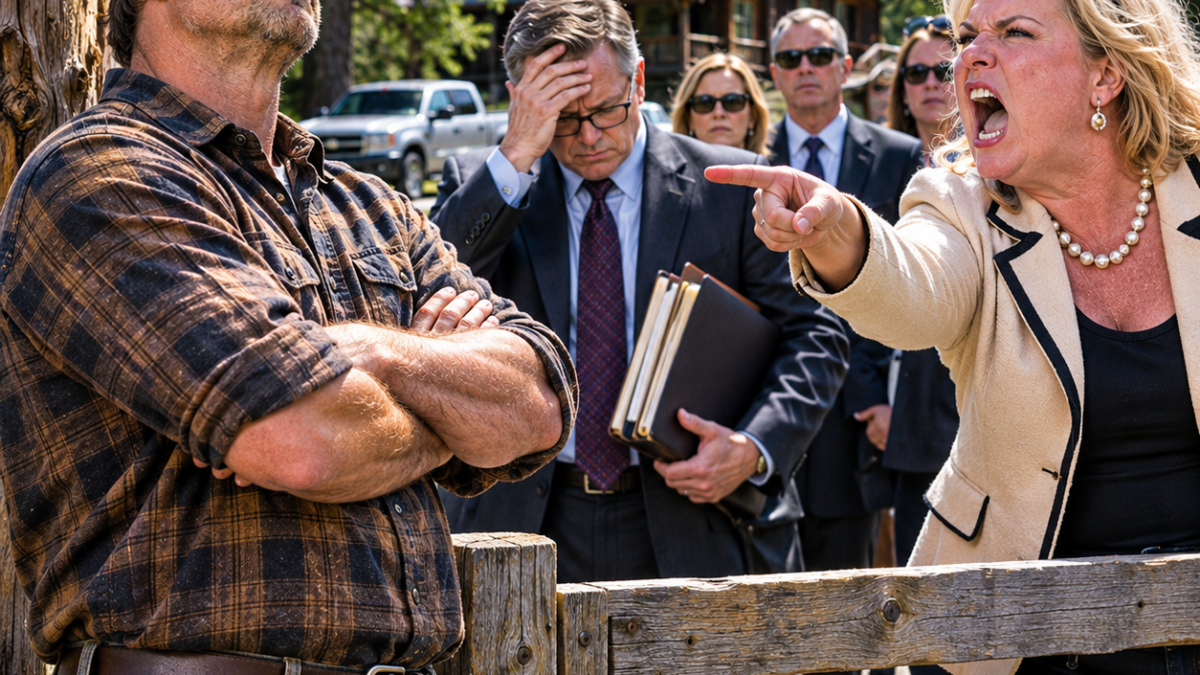
“Frank!”
She waved documents.
“This is your final opportunity.”
“To do what?”
“Remove the fence.”
“No.”
“Construction is authorized.”
“By who?”
“County planning.”
“Not across my property.”
“Your environmental stunt doesn’t change the access rights.”
“No access rights exist.”
Marcus stepped forward.
“Mr. Davies, let’s be adults.”
I looked at him.
“You brought bulldozers to my orchard.”
“We’re mobilizing equipment.”
“Across property you don’t own.”
“We have counsel.”
“So do I.”
He smiled.
“We can tie this up for years.”
There it was.
The real threat.
Not law.
Cost.
Delay.
Exhaustion.
Make the old farmer spend until he gives up.
I stepped closer to the fence.
“My grandfather survived the Depression on this land.”
Marcus looked bored.
“My father worked it forty years.”
Karen rolled her eyes.
“I buried my wife from this house.”
Marcus’ expression shifted slightly.
I continued.
“If you think I’ll trade those trees so you can save money on a ravine, you don’t understand the problem.”
Karen snapped:
“This is not sentimental hour.”
Then flashing lights appeared.
Wildlife enforcement truck.
Sheriff’s cruiser.
News van.
Marcus’ face changed.
Karen’s changed more.
Warden Sharp stepped out.
Tall.
Calm.
Uniform crisp.
He walked past Karen.
“Mr. Davies?”
“Yes.”
He showed identification.
Then turned toward the equipment operators.
“Shut the machines down.”
Engines died.
Silence rolled across the orchard.
Karen shouted:
“Who authorized you to stop a permitted project?”
Sharp looked at her.
“I’m investigating potential disturbance of protected habitat.”
“This is private property.”
I almost laughed.
She had finally said something true.
“Yes,” Sharp replied. “Mr. Davies’ private property.”
Reporter Jessica Lane approached with her cameraman.
Karen noticed.
That was when she lost control.
Warden Sharp produced documents.
“Pending review, no land clearing, grading, excavation, or equipment operation is permitted within the designated buffer.”
Marcus raised his hands.
“My counsel disputes jurisdiction.”
“Your counsel can dispute it through the appropriate process.”
“We have development permits.”
Sharp nodded.
“Then your attorneys can present them.”
Karen stepped forward.
“This is nonsense. He planted those bugs.”
Every camera caught it.
Dr. Thorne, who had just arrived behind the news van, froze.
Karen pointed toward me.
“This man is holding fifty families hostage over moths.”
Jessica raised the microphone.
“Mrs. Miller, are you saying you intend to continue construction despite notice of a potential endangered-species habitat?”
Karen stared at the camera.
Then made the worst possible decision.
“We have a right to progress.”
Sharp’s expression hardened.
“You have a right to due process.”
He pointed toward my fence.
“You do not have a right to bulldoze first and argue later.”
Marcus grabbed Karen’s arm.
“Enough.”
She pulled away.
“Don’t touch me.”
He lowered his voice.
“This is over for today.”
Karen looked around.
Bulldozers off.
Sheriff.
Warden.
News.
Residents.
Me.
For years she’d controlled rooms because nobody challenged the assumption that she belonged at the center.
Now every authority in sight had a jurisdiction stronger than hers.
She screamed:
“This is a conspiracy!”
The camera rolled.
I said nothing.
Didn’t need to.
That night’s news report destroyed Karen politically.
Jessica used no dramatic narration.
She didn’t need it.
Image:
My orchard.
Old trees.
Proposed road map.
Karen shouting.
Warden explaining habitat restrictions.
Dr. Thorne discussing the rare moth.
Residents describing HOA disputes.
My interview lasted twelve seconds.
“What do you want?”
Jessica asked.
“My land left alone.”
“Anything else?”
I looked at the trees.
“For the people who live in Prestwick Point to know what they’re paying for.”
That was enough.
The story spread.
County attention exploded.
Planning commission suspended Phase Two review.
Marcus Thorne released a statement blaming route selection on HOA representations.
Karen responded by blaming Thorne.
Alliances collapse quickly when liability appears.
The audit accelerated.
Tom received full records.
Independent accountants traced years of spending.
The results were uglier than expected.
Related-party contracts.
Personal expenses categorized as association costs.
Legal fees paid for matters that primarily benefited Karen.
Unauthorized reimbursements.
Payments without invoices.
The total questioned amount grew.
Then investigators became involved.
I stayed careful.
Rumor said seventy thousand stolen.
The auditors didn’t initially use that word.
They used:
Unsubstantiated expenditures.
Improper reimbursement.
Undisclosed conflicts.
Potential misappropriation.
Then evidence strengthened.
Bank records.
Receipts.
Signatures.
At that point, criminal authorities were notified.
Karen’s special meeting came before charges.
Prestwick Point clubhouse.
Packed.
Tom chaired because removal procedures prevented Karen from controlling the meeting.
She tried anyway.
“You have no authority.”
Tom calmly read the bylaw.
She sat.
Garcias spoke first.
Their son had cried while his father dismantled the cedar swing set his grandfather built.
Mrs. Gable held photographs of her vegetable garden.
“This was my husband’s garden.”
She looked directly at Karen.
“You called it visual clutter.”
David rolled to the front in his wheelchair.
The room became silent.
He didn’t raise his voice.
“I lost my left leg outside Kandahar.”
Karen looked down.
“When I came home, I thought the hard part was learning to live without it.”
He paused.
“Then I moved here.”
Nobody laughed.
“I installed a ramp because I needed to enter my own house.”
Karen shifted.
“You told me aluminum wasn’t architecturally appropriate.”
He looked at the residents.
“I fought harder for that ramp than I did for some military benefits.”
Karen said:
“We offered alternatives.”
“At my expense.”
Silence.
David continued.
“Rules that make a disabled man prove he deserves access to his own front door aren’t protecting property values.”
He turned toward Karen.
“They’re protecting somebody’s ego.”
Applause.
Then Tom presented finances.
No rhetoric.
Numbers.
Invoices.
Checks.
Contracts.
Karen interrupted repeatedly.
Tom kept going.
One landscaping contract:
Brother-in-law.
No competitive bid.
Clubhouse maintenance:
Company linked to Thorne family.
Board dinner reimbursements.
Personal legal fees.
Consultants.
Travel.
The room got angrier with every page.
Then came the access-road deal.
Projected saving to Thorne:
Roughly $700,000.
Thorne contribution toward Karen’s preferred clubhouse expansion if alternate route secured.
A resident shouted:
“You were trading his orchard for your clubhouse?”
Karen grabbed the microphone.
“No!”
Tom looked at her.
“Then explain the memo.”
“It was exploratory.”
“Did Frank agree?”
“No, but—”
“Did an easement exist?”
“We were working through—”
“Did one exist?”
Silence.
“No.”
The room erupted.
Karen slammed her hand on the table.
“You people have no idea what leadership requires!”
That sentence sealed it.
She continued.
“I made this neighborhood desirable.”
Someone shouted:
“You made it miserable!”
Another:
“You fined my kid’s chalk!”
Another:
“You threatened my mother!”
Karen lost composure.
“You’re all ungrateful!”
Tom waited.
Let her finish.
Then asked:
“Are we ready to vote?”
Yes.
Removal.
Nearly unanimous.
Even board members who had supported her raised their hands.
Karen sat frozen.
No gavel.
No title.
No automatic silence when she spoke.
Tom announced the result.
“Karen Miller is removed as president and director, effective immediately.”
She gathered her purse.
Nothing else.
Walked toward the door.
Nobody applauded.
Nobody shouted.
That silence was harsher.
She had ruled through fear.
Now people weren’t afraid enough even to hate her publicly.
They simply let her leave.
Marcus Thorne’s situation deteriorated too.
County investigators reviewed his relationships with planning officials.
Payments.
Gifts.
Consulting arrangements.
Two commission members came under scrutiny.
Then charges.
Bribery.
Public corruption.
Thorne Development suspended local projects.
His Phase Two plan died.
Not postponed.
Dead.
The northern legal access route remained possible on paper, but financing collapsed and the development expansion was shelved indefinitely.
The orchard stayed whole.
Environmental review continued.
Dr. Thorne’s team confirmed the moth population.
Not just one insect.
Breeding evidence.
Host plants.
Stable habitat.
The eastern five acres eventually received formal conservation protection.
I voluntarily placed additional restrictions on that area.
That mattered to me.
I didn’t want protection to exist only because it helped me win.
If the habitat was worth defending from Karen, it was worth defending from me too.
Ben said:
“You know this limits future use.”
“Yes.”
“Could affect sale value.”
“Yes.”
“Your heirs may curse you.”
“They already think I’m difficult.”
“Fair.”
The conservation agreement reduced some tax burden and provided habitat-maintenance support.
Money wasn’t huge.
Didn’t matter.
The land became permanently safer.
Grandfather’s butterfly pond would outlive the fight.
The criminal investigation into Karen took longer.
Real justice is slow.
No dramatic arrest during an HOA meeting.
No SWAT team.
Months of records.
Interviews.
Subpoenas.
Eventually, prosecutors alleged misappropriation exceeding seventy thousand dollars over several years.
Karen was charged.
Marcus faced his own cases related to public corruption and development practices.
I watched none of the court hearings.
People found that strange.
Tom asked:
“Don’t you want to see?”
“No.”
“Why?”
“I won my part.”
“You don’t want revenge?”
I looked toward the orchard.
“My trees are standing.”
That was revenge enough.
Prestwick Point elected a new board.
Tom became president reluctantly.
David joined an accessibility committee.
Garcias joined architectural review.
Mrs. Gable refused office.
“I’m too old for meetings.”
She expanded her garden instead.
One of the new board’s first actions was reviewing fines.
Many were rescinded.
Policies rewritten.
Specific.
Objective.
Appeals independent.
Disability accommodation procedures.
Conflict-of-interest rules.
Related-party contracts disclosed and competitively bid.
No president could control multiple committees.
No mystery enhancement fund.
No fines invented from adjectives like “unsightly.”
Prestwick Point became boring.
Wonderful.
My orchard became peaceful again.
At first, I didn’t trust it.
For months I still checked the eastern fence each morning.
Saw an unfamiliar truck?
Heart rate up.
Envelope?
Suspicion.
People don’t talk enough about what prolonged conflict does after it ends.
Winning doesn’t immediately tell your nervous system the war is over.
I’d spent years in real combat zones.
I knew that.
Still fell for it.
One evening, I found myself standing at the property line in the dark with binoculars.
Nothing happening.
No lights.
No vehicles.
No threat.
I lowered them.
“Frank.”
I could almost hear Sarah.
She would’ve laughed.
Then asked why I was still letting Karen occupy land inside my head after preventing her from occupying land outside it.
I went home.
Put the binoculars away.
Next morning, I pruned trees.
No photographs.
No evidence log.
Just farming.
That felt like victory.
The roadside stand reopened in August.
Honeycrisp.
Gala.
Cider.
Apple butter.
Families came from town.
A few Prestwick Point residents became regulars.
At first they apologized.
I stopped them.
Most hadn’t known.
A board can lie to its residents as easily as to outsiders.
One Saturday, the Garcias brought their son.
He was eight.
Held an apple.
“Mr. Davies?”
“Frank.”
“My dad says you beat the HOA.”
His father looked embarrassed.
I laughed.
“Your dad exaggerates.”
“Did you?”
“No.”
“Who did?”
I pointed toward his father.
“Everyone who finally read the paperwork.”
He looked disappointed.
Kids prefer heroes.
I gave him another apple.
Years passed.
The orchard changed slowly.
Old trees died.
New ones planted.
That’s agriculture.
Stewardship isn’t preserving every object forever.
It’s keeping the system alive.
One winter, the tree Karen had pointed at during that first confrontation split under snow.
I stood beside the broken trunk feeling ridiculous grief.
It had survived seventy years.
Karen.
Storms.
Drought.
Then physics.
Tom helped me cut it.
“You okay?”
“It’s a tree.”
“That’s not an answer.”
“My grandfather planted it.”
“Better.”
We saved some wood.
I dried it.
Later made a small bench.
Placed it near the vernal pool outside the protected buffer.
On the underside, where nobody would see, I carved:
**1938–2028**
No speech.
No plaque.
Just memory.
The moth population returned each year.
Dr. Thorne visited.
Eventually he retired.
A younger researcher took over monitoring.
One spring, a school group came with permission.
Kids carried notebooks.
They were told not to approach the pool edge.
One girl asked:
“Why is this place protected?”
The teacher began explaining endangered species.
The girl pointed toward the orchard.
“Did somebody almost build houses here?”
I said:
“A road.”
“Why?”
“To save money.”
She frowned.
“That seems dumb.”
Children have useful clarity.
“Yes.”
“Who stopped them?”
I looked toward the milkweed.
“Mostly a bug.”
She grinned.
The story became local legend.
It grew less accurate every year.
According to one version, I personally discovered a butterfly one hour before bulldozers arrived.
Another had federal agents rappelling from helicopters.
Tom claimed he heard someone say I released endangered moths from a jar.
That one almost made me angry.
Dr. Thorne laughed.
“Congratulations. You’re folklore.”
“I hate folklore.”
“You’re retired Army. You’ll adapt.”
Prestwick Point eventually revived Phase Two on a smaller scale years later.
Using the original northern route.
The expensive one.
Retaining walls.
Culvert.
Grading.
Entirely on their property.
When construction began, Tom called.
“Want to watch?”
“No.”
“They’re spending the seven hundred thousand.”
“Good.”
“You’re no fun.”
“I’ve aged.”
The road opened.
Nobody lost land.
Nobody bulldozed habitat.
Developers paid the cost their project actually required.
Funny how possible lawful development becomes when stealing isn’t part of the budget.
Tom served two terms.
Then stepped down.
David became president.
First HOA president I’d ever genuinely respect.
He ran meetings from his wheelchair.
Short agendas.
Clear votes.
Financial reports online.
One evening, he invited me.
“No.”
“You don’t know why.”
“Still no.”
“We want to thank you.”
“Absolutely no.”
He sent a formal invitation.
I ignored it.
Mrs. Gable called.
“If you don’t come, I’ll have them vote to put your photograph in the clubhouse.”
Blackmail.
I attended.
Prestwick Point presented a small plaque.
Not to me personally.
To the orchard.
**WITH GRATITUDE TO OUR NEIGHBOR, THE DAVIES FAMILY ORCHARD, FOR PRESERVING THE LAND THAT REMINDED OUR COMMUNITY THAT BOUNDARIES DESERVE RESPECT.**
I hated how much I liked it.
They didn’t ask to hang it on my barn.
Good.
I kept it in the farm office.
The most unexpected ending came with Karen.
Months after her criminal charges became public, I was working the roadside stand.
A worn sedan stopped.
Karen got out.
Not the white SUV.
No pink tracksuit.
Gray sweatpants.
Older.
Tired.
She walked toward the apples.
For a second, my body reacted before my mind did.
Shoulders tight.
Jaw set.
Then I noticed how small she looked without authority.
“Frank.”
“Karen.”
She picked up a bag.
“How much?”
“Eight dollars.”
She searched her purse.
Hands shaking slightly.
Then stopped.
“Did you know they froze some of my accounts?”
I said nothing.
“Of course you did.”
“No.”
She looked surprised.
“I don’t follow your case.”
“You don’t?”
“No.”
She stared.
“Why?”
“Because it isn’t mine anymore.”
Something moved in her face.
Shame maybe.
Anger.
Both.
She put the apples down.
“I lost everything.”
“I’m sorry.”
“You don’t mean that.”
“I do.”
She laughed bitterly.
“You destroyed me.”
There it was.
The version she needed.
I could’ve answered sharply.
Instead:
“No.”
She looked at me.
“You chose my orchard because it was cheaper.”
Silence.
“You sent surveyors.”
Silence.
“You mailed fines you knew didn’t apply.”
Her eyes lowered.
“You tried to claim a lien.”
Nothing.
“You ignored habitat warnings.”
She swallowed.
“You did those things.”
She looked at the apples.
“I was trying to finish the development.”
“For who?”
“The community.”
“Or Marcus?”
She flinched.
I continued.
“Or the clubhouse?”
“That wasn’t—”
“Karen.”
She stopped.
“You never needed my land.”
I pointed vaguely toward Prestwick Point.
“You needed a cheaper road.”
Silence.
She whispered:
“I thought you’d sell eventually.”
That was the first completely honest sentence she’d ever said to me.
“Why?”
“You were alone.”
My chest tightened.
“Old orchard. No children living there. Veteran. Widower.”
She stared at the road.
“Marcus said everybody has a number.”
“And you believed him.”
“Yes.”
I thought about Sarah.
Grandfather.
Father.
The moth.
The tree.
“My number wasn’t money.”
“I know that now.”
She took a breath.
“I didn’t then.”
For a moment, I saw not the tyrant.
Just a person who had spent too long confusing winning with leadership.
I pushed the apple bag toward her.
“No charge.”
She looked at me.
“What?”
“Take them.”
“Why?”
“Because I don’t need to beat you anymore.”
Her eyes filled.
She grabbed a ten-dollar bill.
Dropped it on the table.
“I don’t want your charity.”
“Then we’re even.”
She almost smiled.
Almost.
Then took the apples.
Walked away.
No apology.
No reconciliation.
That was fine.
Not every story needs one.
I kept the ten dollars in the cash box.
Spent it that evening on diesel.
Life moves.
Karen eventually accepted a plea agreement on some charges.
Marcus’ cases continued longer.
Two planning officials lost their positions and faced prosecution.
Prestwick Point survived.
The orchard survived.
The vernal pool survived.
That mattered most.
Years later, I updated my estate plan.
I don’t have children.
Sarah and I couldn’t.
My niece Emily loves the orchard but lives across the country.
I didn’t want the hundred acres sold to the next Marcus Thorne after I died.
So I separated future uses.
Working orchard acreage placed under an agricultural preservation framework.
Eastern habitat under permanent conservation.
Farmhouse and barn reserved for agricultural stewardship.
No dense subdivision.
No road carved through butterfly pond.
Ben reviewed everything.
“You realize you’re becoming your grandfather.”
“I hope not.”
“He left complicated paperwork too.”
“Good paperwork.”
“True.”
I signed.
That night, I walked to the old bench near the vernal pool.
A moth landed on milkweed.
Not dramatic.
No sunlight shining perfectly.
No symbolic orchestral music.
Just an insect.
Small enough Karen had called the whole problem stupid.
I watched it.
Grandfather’s voice returned.
“They’re older than these trees. They belong here.”
He had been right in ways neither of us understood.
The moth didn’t save my orchard by itself.
Deed records did.
County plans.
Witnesses.
Residents.
Lawyers.
Wildlife experts.
Auditors.
People who finally stopped being afraid.
But the moth changed the argument.
Karen saw twenty feet of cheap road.
The habitat forced everyone to look closer.
That’s what good laws sometimes do.
They make powerful people slow down long enough to notice what they’re about to destroy.
I sat there until dark.
The orchard was quiet.
No HOA SUVs.
No bulldozers.
No cameras.
No news crews.
I realized I could barely remember Karen’s voice.
That pleased me.
The battle had once filled every day.
Now it was a story.
Stories shrink.
Land stays.
One morning in spring, Emily visited with her daughter.
Little girl named Sarah.
After my wife.
We walked the orchard.
She asked endless questions.
“Who planted this?”
“Your great-great-grandfather.”
“This one?”
“Your great-grandfather.”
“Did you plant any?”
“Thousands.”
She seemed disappointed that mine weren’t old enough to be legendary.
Then we reached the eastern edge.
I showed her the pool from the marked observation boundary.
“Why can’t we go closer?”
“Protected habitat.”
“For the moth?”
“Yes.”
“Can I see one?”
“If you’re lucky.”
We waited.
Nothing.
Kids hate patience.
Then, just before she complained again, a silver-winged moth moved from one plant to another.
Her mouth opened.
“That?”
“That.”
“So tiny.”
“Yep.”
She thought.
“That stopped a bulldozer?”
I smiled.
“Eventually.”
“How?”
“Lots of paperwork.”
Her face collapsed.
I laughed.
“That’s the real secret to adulthood.”
She picked up a fallen apple branch.
“Can I keep this?”
“Sure.”
She held it like treasure.
That was legacy.
Not deeds.
Not fights.
A child wanting a piece of wood because it came from a place her family protected.
Prestwick Point’s new president later asked whether residents could create a walking trail connecting to the county agricultural heritage route.
Part would approach my western boundary.
He called first.
That mattered.
We met.
Maps.
Insurance.
Parking.
Hours.
No access to protected habitat.
No entitlement.
Negotiation.
I agreed to limited seasonal pedestrian access along an existing farm lane during the blossom festival.
People were shocked.
Tom said:
“After everything, you’re letting HOA people onto the orchard?”
“They asked.”
“That simple?”
“Yes.”
“So Karen’s mistake was manners?”
“Among other things.”
Access granted is not land surrendered.
That distinction became important to me.
For years, I had guarded every foot because someone tried to take it.
Eventually, ownership felt secure enough to share.
Every spring, families walked beneath apple blossoms.
Children bought cider.
Prestwick residents volunteered at the farm stand.
David brought accessibility improvements to the trail.
Mrs. Gable sat beneath the old bench yelling at children who picked flowers.
She outlived almost everybody’s expectations.
At ninety, she still gardened.
When she died, Prestwick Point planted a community vegetable garden in her honor.
No aesthetic restrictions.
She would’ve appreciated that.
Tom died three years later.
Cancer.
At his memorial, his son handed me a folder.
Inside were copies of every Prestwick Point financial record Tom had used against Karen.
“He wanted you to keep these.”
“I already have copies.”
“I told him.”
“And?”
“He said Army people lose things.”
“Marine arrogance.”
His son laughed.
I took the folder.
Stored it in the barn beside my old binder.
Historical evidence eventually becomes family junk unless somebody remembers why it mattered.
I wrote a note.
**PRESTWICK ACCESS ROAD DISPUTE — RETAIN**
Then another:
**IF FOUND AFTER MY DEATH, DO NOT PANIC. THE HOA LOST.**
Emily laughed when she read it.
“You’re impossible.”
“Inherited trait.”
The northern road the developer finally built worked perfectly.
Of course it did.
It cost more.
That’s what they had been trying to avoid.
Somebody once asked whether I felt guilty that future homeowners paid higher prices because construction cost increased.
No.
Development costs belong to development.
My grandfather didn’t owe Marcus Thorne cheaper access.
Neither did endangered habitat.
Neither did I.
Private property rights are easy to support in theory.
They become harder when somebody else sees profit on the other side.
That’s when paperwork matters.
The deed clause Karen hoped didn’t exist was simpler than any of her three-hundred-page covenants.
The property had remained a distinct agricultural parcel.
No Prestwick covenant.
No access easement.
No annexation.
No recorded right.
Nothing in her HOA documents could manufacture one after the fact.
That was the piece her attorney eventually couldn’t get around.
Ben told me months later about the conversation.
Karen’s lawyer had requested a conference.
They spread maps across a table.
He examined the chain of title.
Then asked:
“Where is the easement?”
Ben said:
“There isn’t one.”
“Prescriptive use?”
“No historical road.”
“Prior consent?”
“No.”
“Subdivision declaration?”
“Doesn’t bind the orchard.”
The lawyer leaned back.
Then Karen started arguing about community necessity.
Her attorney interrupted.
According to Ben, he said:
“Necessity does not create ownership.”
Karen insisted the county would support her.
He replied:
“Then the county can defend that position without me.”
And he walked away from representing the access-road claim.
I wish I had seen it.
Not because I wanted humiliation.
Because there is something satisfying about watching confidence finally meet a document it can’t intimidate.
But by then, the moth and bulldozer confrontation had made the lawyer’s retreat almost secondary.
Karen kept going long after competent counsel told her the ground was disappearing beneath her.
That was always her fatal flaw.
Backing down felt like weakness.
So every mistake demanded a larger mistake to defend it.
I learned the opposite in the Army.
Good leaders change plans when facts change.
Bad leaders sacrifice people to preserve the appearance that the original plan was brilliant.
Karen sacrificed money.
Neighbors.
Board members.
Eventually herself.
All because she couldn’t say:
I was wrong.
Marcus was worse.
He understood.
He just calculated that intimidation would work.
People like him don’t need emotional control.
They need odds.
He looked at me:
Retired.
Widower.
Old farm.
No children living there.
And calculated surrender.
He misjudged.
Not because I was tougher.
Because I had time.
Low debt.
Legal help.
Records.
Community.
And a grandfather who kept every deed straight.
Luck matters too.
The moth was luck.
Never pretend otherwise.
If the habitat hadn’t existed, I still believe we would’ve stopped the road through title litigation.
But it would’ve cost more.
Taken longer.
Been uglier.
The moth accelerated truth.
That is all.
Years later, I saw Marcus once at an airport hotel.
Couldn’t prove it was him at first.
Then he recognized me.
We stood near the elevator.
“Davies.”
“Thorne.”
He looked older.
Still expensive suit.
Less confidence.
“How’s the orchard?”
“Still there.”
His mouth tightened.
“Your road got built.”
“Not mine.”
“You know what I mean.”
“Northern route?”
“Yes.”
“Works well.”
He stared.
“Cost us a fortune.”
I shrugged.
“Development is expensive.”
He almost laughed.
“You always were an ass.”
“I met you twice.”
“Enough.”
Elevator arrived.
Before entering, he said:
“You could’ve made millions selling that strip.”
“I know.”
“Never understood that.”
“I know that too.”
Doors closed.
That conversation explained everything.
Some people genuinely can’t understand value that isn’t convertible to price.
Marcus saw twenty feet multiplied by savings.
Karen saw authority.
I saw apple trees.
Grandfather.
Sarah.
A moth.
No spreadsheet can reconcile those values.
That’s why property disputes become emotional.
They’re rarely just geometry.
Eventually, I stopped telling the Karen story unless someone asked.
For years, local media wanted anniversary interviews.
I declined.
Ten years later, Jessica called.
“Frank, we’re doing a piece on land conservation victories.”
“No.”
“You haven’t heard the question.”
“Still no.”
“What if we focus on the habitat?”
I considered.
Dr. Thorne had died by then.
His research deserved recognition.
I agreed.
Camera crew came.
No dramatic reenactments.
No Karen footage.
I insisted.
We talked about the vernal pool.
Agricultural conservation.
Development pressure.
Family land.
At the end Jessica asked:
“Do you still think about the confrontation?”
“Which one?”
“The bulldozers.”
“Not often.”
“What do you remember most?”
I looked toward the trees.
“The silence after the engines shut off.”
She waited.
“Why?”
“Because for months everything felt loud.”
Letters.
Threats.
Meetings.
Arguments.
“Then the machines stopped.”
I smiled.
“And I could hear the orchard again.”
That line aired.
People liked it.
I meant it literally.
Engines off.
Birds.
Wind.
Leaves.
Bees.
For years after military retirement, I thought peace meant absence of danger.
The orchard taught me something different.
Peace is noticing ordinary sounds.
Pruning shears.
Tractor.
Rain on barn roof.
Cider press.
A child laughing in the farm lane.
A tiny moth nobody hears at all.
Karen tried to turn my land into a battlefield.
For a while, I let her.
Then one day it became an orchard again.
That’s the ending I care about.
Not arrests.
Not votes.
Not headlines.
Peace.
One autumn, Emily asked whether I wanted to replace the old split-rail fence.
“Why?”
“It’s falling apart.”
“It’s eighty years old.”
“Exactly.”
We replaced sections.
Kept original posts where sound.
At the eastern edge, two staple marks remained from the fake lien sign.
Emily pointed.
“What are those?”
“History.”
“Helpful.”
“Karen’s people tried to post a lien notice.”
“Here?”
“Yes.”
“Did they have a lien?”
“No.”
“Then why?”
“Confidence.”
She stared.
“You’re weird.”
True.
I cut that damaged fence section out.
Almost burned it.
Instead, made it part of a frame for the old family orchard photograph.
Grandfather standing beside the first rows.
Father as a boy.
No Prestwick Point.
No subdivision.
No pool.
No clubhouse.
Just fields.
I hung the framed photograph in the roadside stand.
Customers asked.
I told them:
“That’s why we’re still here.”
No more needed.
As my eightieth birthday approached, people started asking whether I’d slow down.
I did.
Hired help.
Emily took over more management.
Her husband handled equipment.
Sarah—my grandniece—learned pruning.
The orchard shifted generations.
The conservation documents moved from my filing cabinet to Emily’s.
I made her read them all.
She complained.
I smiled.
“Mabel would approve.”
“Who is Mabel?”
“The reason this place still exists.”
“Not the moth?”
“Also the moth.”
“Not Ben?”
“Him too.”
“Not you?”
“Least important.”
She rolled her eyes.
Maybe exaggerated humility.
But nobody wins these fights alone.
That’s another lie revenge stories tell.
They create one hero.
Reality is networks.
Mabel finds records.
Ben reads law.
Dr. Thorne identifies habitat.
Tom organizes homeowners.
David speaks.
Garcias connect residents.
Warden Sharp enforces.
Reporter exposes.
Deputy documents.
Even Karen contributes by being arrogant enough to put things in writing.
Everybody moves the story.
I just refused to step aside.
The last time I personally harvested the eastern rows, I moved slowly.
Age.
Back.
Knees.
I filled half a crate.
Sat under the old oak.
A mariposa lily moth landed on a nearby plant.
Not on my sleeve.
Real life doesn’t always cooperate with symbolism.
I laughed.
“Could’ve tried harder.”
It flew away.
The pool shimmered through trees.
I thought about Grandfather.
His roadside cart.
Depression.
The way he saved pennies.
Father.
Tractor.
Sarah.
Proposal beneath blossoms.
My unit.
Friends gone.
Karen.
Marcus.
Tom.
All passing through.
The land remained.
Not unchanged.
Nothing living remains unchanged.
But intact enough.
Protected enough.
Remembered enough.
That’s what stewardship became for me.
Not freezing the orchard in 1938.
Making sure nobody who came after could destroy it cheaply.
Development will keep coming.
Roads.
Houses.
Needs change.
People need places to live.
I’m not anti-development.
Never was.
Prestwick Point residents weren’t villains.
Most just bought homes.
The developer wasn’t evil because he built houses.
The problem started when saving seven hundred thousand dollars became justification for pretending somebody else’s land was available.
The problem grew when Karen decided her title made objections irrelevant.
Then when challenged, she escalated instead of checking.
That pattern appears everywhere.
Power becomes dangerous when correction feels insulting.
The best leaders I knew in the Army could hear:
“Sergeant Major, that’s wrong.”
Then ask:
“Show me.”
Karen heard:
“That’s wrong.”
And answered:
“Punish him.”
That difference destroyed her.
If I have one lesson from everything, it’s simple.
Before you fight, verify.
Before you threaten, document.
Before you assume authority, read the boundary.
And before you bulldoze an old man’s orchard, maybe check whether the “mud puddle” beside your road contains one of the rarest moths in the state.
I admit I still enjoy that part.
I’m only human.
The sun was setting when Emily found me at the bench.
“You coming inside?”
“Soon.”
“You said that an hour ago.”
“Retirement privilege.”
“You’re not retired. You own a farm.”
“Semantics.”
She sat beside me.
“What are you thinking about?”
“Your great-great-grandfather.”
“Why?”
“His trees.”
She looked around.
“Most are gone.”
“Yes.”
“Does that bother you?”
“Used to.”
“And now?”
I pointed toward younger rows.
“He planted for people he would never meet.”
She followed my hand.
“I did too.”
She smiled.
Then:
“You know Prestwick asked about expanding the walking trail.”
“No.”
“David’s daughter is president now.”
“Good family business.”
“She wants to connect to the county route.”
“What do you think?”
Emily shrugged.
“Could be nice.”
“Your decision soon.”
She looked at me.
“That’s terrifying.”
“Good.”
“Good?”
“People who are terrified of power usually use it more carefully.”
She laughed.
“Where’d you hear that?”
“Experience.”
We sat until the light faded.
The vernal pool darkened.
No bulldozers.
No survey stakes.
No HOA SUV.
Just the orchard.
Karen once told me this wasn’t a discussion.
She was right about one thing.
Ownership wasn’t a discussion.
It was a fact.
The deed had said so before she arrived.
The county maps said so.
The survey pins said so.
The apple trees said so in their own way by simply being there long before Prestwick Point.
And when those weren’t enough for her, a tiny silver-winged moth said it too.
Not with anger.
Not with a lawyer.
Just by existing exactly where Karen wanted to build.
That might be my favorite part.
The loudest person in the fight believed power came from titles, threats, money, and machines.
In the end, one of the smallest creatures on my land carried more legal weight than her entire board.
But even that isn’t the real ending.
The ending is this:
The northern road was built where it was supposed to be.
Prestwick Point survived.
Families got houses.
The HOA learned to govern instead of rule.
The Garcias rebuilt their son’s swing set.
Mrs. Gable grew vegetables until the year she died.
David kept his ramp.
Tom got to watch transparent budgets replace Karen’s private kingdom.
The protected pool remained full every spring.
Apple trees still blossom around it.
And I never had to sell twenty feet of my family’s history so a developer could improve his margins.
Karen wanted to force my land into her plan.
Instead, her plan was forced to respect my land.
That is a much better ending.
The last page of my old binder contains a copy of the original cease-and-desist Ben delivered at that first HOA meeting.
Below it, I placed one newer document.
The recorded conservation agreement.
And underneath those, a photograph.
No Karen.
No bulldozers.
No lawyers.
Just the eastern orchard in spring.
White blossoms.
Green grass.
The old split-rail fence.
And somewhere beyond the trees, invisible in the photograph, the little pool my grandfather called the butterfly pond.
I wrote one sentence on the back.
**STILL HERE.**
That’s all that ever mattered.
[END OF STORY]








