PART 2: HOA Tried to Condemn My Root Cellar—Then the Inspector Shut Down Their Gazebo Instead
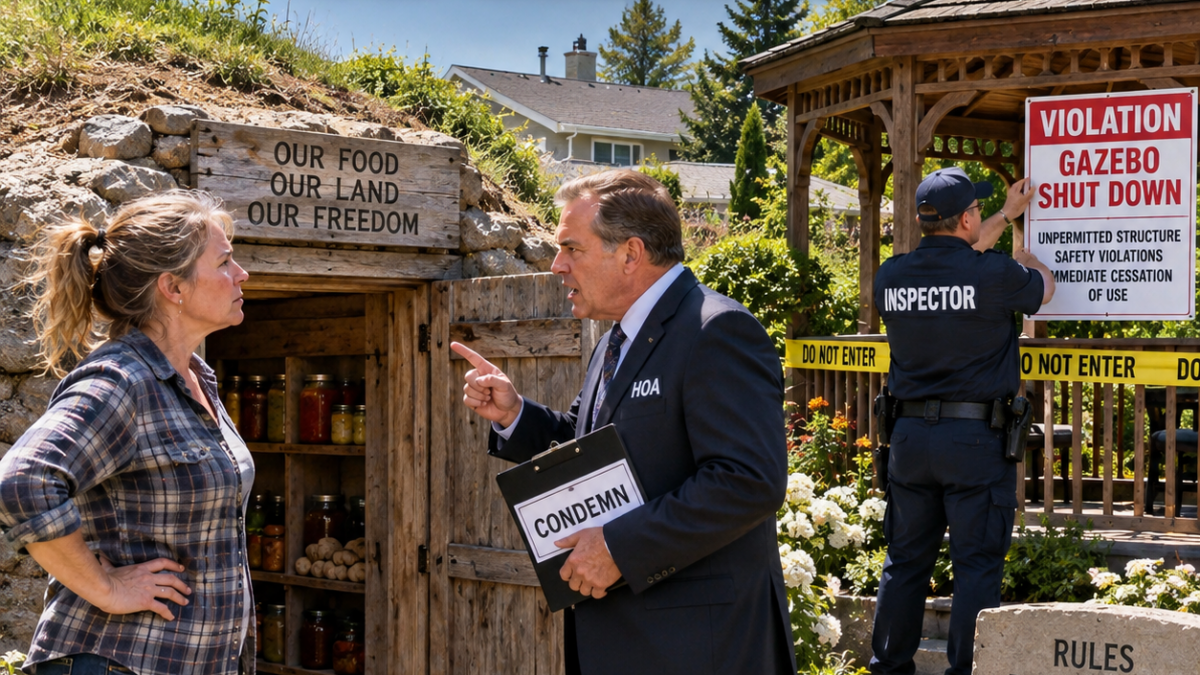
The HOA president stood on my lawn and told me she was going to fill my root cellar with concrete by Friday, even though the county had already approved every inch of it.
She called it an “illegal bunker,” threatened me with daily fines, and promised that if I refused to cooperate, the association would hire a contractor and send me the bill.
What she didn’t know was that the inspector she planned to use against me was about to discover something on HOA property that would turn fifty angry neighbors toward her instead.
My name is Mark Henderson.
I spent twenty years in the Army Corps of Engineers, so I’ve learned to respect two things most people find boring: solid construction and paperwork.
Both were about to save me.
The root cellar had started as a gift for my wife, Laura.
Laura could grow vegetables in soil that looked like it had been scraped from a construction site. Tomatoes, beans, carrots, onions, potatoes—our backyard became greener every year we lived in Oak Ridge.
The problem was storage.
By late summer, Mason jars covered half our garage shelves. Potatoes sat in crates. Canning supplies filled the pantry.
One evening Laura laughed and said, “My grandmother had a root cellar. Maybe we need to go backward a hundred years.”
That sentence stayed with me.
My grandfather had owned one too.
As a boy, I remembered following him through a wooden door built into a hillside and feeling the temperature drop ten degrees. Apples rested on wooden racks. Potatoes lay under straw. Rows of canned peaches glowed amber in the dim light.
So I decided to build one.
But I didn’t just dig a hole.
I designed it.
Reinforced concrete-block walls.
Waterproof membrane.
Ventilation.
Drainage.
A precast concrete roof covered with earth.
Structural calculations.
Setbacks.
Load requirements.
Before touching a shovel, I took the plans to the county.
Three weeks later, I had the permit.
Then I read every page of the Oak Ridge HOA covenants.
Sheds required approval.
Gazebos required approval.
Decks, fences and other above-ground structures required approval.
My root cellar was underground.
There was no rule covering it.
So I built.
Our son helped while home from college.
Laura planted lilacs beside the cedar entrance.
When we finished, almost the entire structure disappeared beneath the lawn.
Inside, white concrete walls stayed cool even on hot afternoons.
Laura walked through it for the first time and whispered, “Mark, this is perfect.”
For about three weeks, it was.
Then the envelope arrived.
NOTICE OF VIOLATION.
The HOA accused me of constructing an “unauthorized subterranean bunker.”
Fine: $100.
Daily penalties would follow.
I almost laughed.
Then I saw the signature.
Karen Miller.
HOA President.
I pulled out the bylaws.
Section 14.7 specifically applied to above-ground structures.
I wrote Karen a polite letter explaining that fact.
I attached my county permit.
My approved plans.
A photograph.
I sent everything certified mail.
A week later, she raised the fine to $250.
Now she claimed my cellar created a “soil stability hazard.”
That accusation irritated me more.
I had designed retaining systems for military facilities.
My cellar was overbuilt.
So I sent another letter.
This time I included structural calculations and the geological information from my permit package.
I invited Karen to provide an evaluation from a licensed engineer supporting her claim.
She never did.
Instead, she came to my house.
Laura and I were outside when Karen marched across the lawn holding a clipboard.
She stopped ten feet from me.
“That structure is coming out.”
“No.”
“You don’t have that choice.”
“I have a county permit.”
“You don’t have HOA approval.”
“I don’t need it under the rule you cited.”
Her face reddened.
“The board has determined your excavation is dangerous.”
“Which engineer made that determination?”
“I don’t need an engineer.”
That told me everything.
Karen pointed toward the cedar door.
“If you do not remove it voluntarily, we’ll have it filled.”
Laura stepped forward.
“With what?”
“Concrete.”
Laura stared at her.
“You’re going to pour concrete into something my husband legally built?”
Karen smiled.
“By Friday.”
Then she looked at me.
“And you will pay for it.”
I didn’t shout.
I didn’t threaten her.
I simply looked at that clipboard and said:
“Karen, before you bring a concrete truck onto my property, you’d better be absolutely certain every structure the HOA controls can survive the same level of inspection you’re demanding from mine.”
For the first time, her smile faltered.
She didn’t understand why.
Not yet.
But I already knew exactly which HOA structure I was going to investigate first.
And it was the one Karen was proudest of.
PART 2
The gazebo stood beside the community pond like a monument to Karen Miller’s ego.
Everyone in Oak Ridge knew that.
She had personally championed the project the previous spring, appearing in every newsletter photograph wearing a hard hat that had probably never touched a construction site before.
The gazebo was large.
Octagonal.
White columns.
Decorative railing.
Electrical outlets.
A ceiling fan.
Lantern-style lighting.
A small sound system for neighborhood events.
Karen called it “the jewel of Oak Ridge.”
I called it expensive.
Laura watched Karen walk away from our yard that afternoon.
Then she looked at me.
“What did you mean?”
“About what?”
“The structures the HOA controls.”
I picked up Karen’s latest violation notice.
“I mean if she wants county inspectors involved, we should make sure she’s comfortable with county inspectors looking everywhere.”
Laura narrowed her eyes.
“You know something.”
“Not yet.”
“That expression says otherwise.”
“I know construction.”
“And?”
“And people who spend all their time accusing everyone else of cutting corners often don’t like anyone examining their own work.”
Laura glanced toward the neighborhood pond.
“The gazebo?”
“Maybe.”
She folded her arms.
“Mark.”
“What?”
“Don’t turn this into revenge.”
That caught me.
I looked at her.
She was worried.
Not about Karen.
About me.
The fight had already consumed too many dinners.
Our dining room table looked like a legal archive.
Certified letters.
Permits.
Highlighted covenants.
Photographs.
Engineering sheets.
Receipts.
Every envelope from the HOA changed the mood inside our house.
Laura had stopped joking about her vegetable vault.
Instead, she checked the mailbox with the cautious expression of someone expecting bad news.
I hated that.
The root cellar had been built for joy.
Karen had turned it into a source of dread.
“I’m not looking for revenge,” I said.
Laura gave me a look that said she wasn’t sure I believed myself.
“I’m looking for leverage.”
“That sounds like revenge wearing a tie.”
Despite myself, I laughed.
She didn’t.
“Promise me something.”
“What?”
“If you find something petty, leave it alone.”
I nodded.
“If the gazebo railing is two inches too high, I don’t care.”
“And if it’s serious?”
“Then we make it serious.”
She studied me.
“Okay.”
That night I called Sarah Whitmore.
Sarah lived three houses down.
She and her husband had moved into Oak Ridge the previous year. At our barbecue she had mentioned she practiced property and contract law.
Until then, I had resisted calling an attorney.
My father had been one, and he taught me early that lawyers are useful when you have exhausted common sense.
Karen had now exhausted it thoroughly.
Sarah answered on the second ring.
“Mark?”
“I need professional advice.”
“That sounds expensive.”
“I’ll pay.”
“That sounds more interesting.”
I told her everything.
She already knew pieces.
Everyone did.
Karen had spent the previous two weeks describing my root cellar as everything from an environmental danger to a neighborhood bunker.
Sarah listened without interrupting.
When I finished, she asked:
“You have the county permit?”
“Yes.”
“Stamped plans?”
“Yes.”
“Engineering calculations?”
“Yes.”
“HOA language?”
“Section 14.7.”
“What does it actually say?”
I read it aloud.
Sarah stopped me at the phrase.
“Above-ground structures.”
“Exactly.”
“And she’s citing that section against an underground cellar?”
“Yes.”
“That’s weak.”
“She knows that.”
“Maybe.”
“What do you mean?”
“Never assume malice when arrogance can produce the same paperwork.”
I laughed.
Sarah didn’t.
“I’m serious. If she genuinely believes she can reinterpret the covenant however she wants, that can be more dangerous than someone who knows she’s bluffing.”
“So what do I do?”
“First, stop communicating casually.”
“I already use certified mail.”
“Good.”
“Second?”
“I’m sending a cease-and-desist letter.”
“To Karen?”
“To the whole board.”
That interested me.
“Why?”
“Because Karen acts powerful partly because the other board members believe her decisions are their decisions.”
Sarah’s voice sharpened.
“I’m going to explain exactly what selective enforcement and bad-faith action can mean for every board member who keeps approving these fines after seeing your permit and the actual covenant language.”
“Personal liability?”
“Potentially.”
“Will that scare them?”
“It should make them read before signing.”
That was enough.
Then I told Sarah about my idea involving the gazebo.
She became quiet.
“What exactly are you proposing?”
“Public-record review.”
“That I like.”
“No trespassing. No invasive inspection. Just pull the permit file.”
“Perfect.”
“Laura made me promise I wouldn’t go hunting for trivia.”
“Laura is smart.”
“I know.”
“If you find a crooked railing, forget it.”
“I told her the same.”
“But if you find public-safety issues…”
“Then?”
“Then you stop thinking about Karen and report them.”
That distinction mattered.
The next morning, I drove to the county building department.
Dave recognized me.
He had processed my root-cellar permit months earlier.
“Back again?”
“Public records this time.”
He leaned back.
“What are you after?”
“The Oak Ridge community gazebo.”
Dave’s eyebrows rose.
“That thing?”
“Yes.”
He looked around before lowering his voice.
“They pushed that project through pretty fast.”
“How fast?”
“Fast.”
“Meaning?”
“Meaning I remember seeing the paperwork move through quicker than most association projects.”
“Anything improper?”
Dave shook his head.
“I didn’t say that.”
Fair.
I filled out the request.
Permit application.
Blueprints.
Engineering details.
Contractor information.
Inspection records.
Electrical permits.
Invoices where available through association submissions.
Several days later, I collected a thick packet.
That night, our dining room became a command center again.
Laura carried in coffee.
“You’re enjoying this.”
“I enjoy plans.”
“You enjoy being right.”
“That too.”
She kissed my forehead.
“Remember the promise.”
“Only serious problems.”
“Exactly.”
For the first hour, nothing looked unusual.
Permit properly issued.
Contractor licensed.
Basic framing inspection complete.
Foundation inspection apparently recorded.
The project had cost significantly less than competing bids, but low bids were not illegal.
Then I started comparing material quantities.
The approved drawings specified four concrete piers extending four feet below grade.
That depth mattered because frost movement could shift the structure.
The invoice showed substantially less concrete than I would expect.
Not enough to prove anything.
Waste factors vary.
Soil conditions vary.
Billing records can omit supplemental purchases.
I made a note but kept going.
Then I reached the electrical documents.
The approved plan showed underground conduit running from the clubhouse feed to the gazebo.
That was normal.
Wet locations require proper wiring methods.
Buried electrical work is not a place for improvisation.
The supply invoice listed fixtures.
Weather-resistant outlets.
Switches.
Breaker hardware.
Interior cable.
I read the line twice.
Then a third time.
Laura noticed my expression.
“What?”
“This.”
She leaned over my shoulder.
“I don’t know what I’m looking at.”
“The plans specify underground conduit.”
“And?”
“This material list suggests standard interior cable.”
“That sounds bad.”
“If it was actually buried directly, yes.”
“How bad?”
“Potential shock hazard.”
Her face changed.
“Children use that gazebo.”
“I know.”
“Are you sure?”
“No.”
That word mattered.
Invoices are clues.
Not proof.
I continued through the inspection records.
Foundation.
Framing.
Roof.
Nothing final for electrical.
There was a request.
No completion record.
No final signoff.
Now I was concerned.
The gazebo had been powered for months.
Community movie night.
Summer cookout.
Graduation photographs.
Children playing near the pond during storms.
If the wiring was improper, this had stopped being about Karen.
I called Sarah.
She came over that evening.
I showed her everything.
She read slowly.
“You can prove the invoice?”
“It’s in the project file.”
“But you cannot prove this cable is actually underground.”
“Correct.”
“You can prove the missing final inspection?”
“I can prove there’s no final report in what the county produced.”
“Could there be another file?”
“Yes.”
“Good.”
She tapped the table.
“That’s exactly how you need to talk about it.”
“No accusations beyond evidence.”
“Correct.”
She looked at the plans.
“If this is wrong, who should know?”
“Building safety.”
“So tell them.”
“Now?”
Sarah thought.
“You could.”
“But?”
“But Karen is already escalating your cellar case.”
She slid another envelope across the table.
I recognized the HOA letterhead.
“What’s this?”
“Copy sent to me.”
Karen had scheduled a special community meeting.
Agenda:
UNAPPROVED STRUCTURE — 112 OAK DRIVE.
That was my house.
Then I saw the next line.
COUNTY BUILDING INSPECTOR DAVID EVANS WILL ATTEND TO PROVIDE PROFESSIONAL ASSESSMENT.
I looked at Sarah.
She smiled faintly.
“She invited the county herself.”
I read it again.
“Why?”
“She thinks Evans will condemn your cellar.”
“He won’t.”
“You sound confident.”
“He can inspect it tonight if he wants.”
Sarah tapped the gazebo file.
“And while he’s there…”
I looked at her.
“We hand him this.”
“Yes.”
Laura had been listening from the doorway.
“Is that legal?”
“Completely,” Sarah said. “Public documents. Public structure. Safety concern.”
Laura looked at me.
“This is the serious thing?”
“Yes.”
“Then do it.”
That was all the permission I needed.
The cease-and-desist letter went out the next morning.
Karen received hers by courier.
The other board members got certified copies.
Sarah did not use dramatic language.
That made it more effective.
The letter identified the county permit.
The covenant language.
The lack of any rule specifically prohibiting a subterranean root cellar.
The fines.
The threats.
The attempt to characterize a permitted structure as dangerous without expert evidence.
Then came the paragraph that changed everything.
The board had now been formally notified that continued enforcement could be viewed as knowing participation in selective or arbitrary enforcement.
Sarah demanded the fines be withdrawn.
The violation be rescinded.
No contractor enter my property.
No lien be attempted.
No destruction occur without lawful authority.
By the next evening, Oak Ridge rumor channels were on fire.
Tom Jenkins, my neighbor and a real-estate agent, called me.
“You broke the board.”
“I sent them a letter.”
“No. Your lawyer scared them to death.”
“She’s not technically my lawyer yet.”
“Whatever she is, Karen is furious.”
“What happened?”
“Emergency board meeting.”
“How do you know?”
“My wife plays pickleball with Cynthia.”
“Of course she does.”
Tom laughed.
“Apparently Gary asked Karen whether she had actually read the section she cited.”
“That’s progress.”
“Cynthia wants the whole matter dropped.”
“More progress.”
“The other two are worried about being sued individually.”
I leaned back.
“And Karen?”
Tom whistled.
“Karen called them cowards.”
Naturally.
“She says if they let you keep the bunker, everyone in Oak Ridge will start digging.”
“Digging what?”
“I don’t think she knows.”
The official letters stopped.
That should have relieved me.
Instead, things became uglier.
Laura found garbage dumped into one of her rose beds.
We had no proof who did it.
So we did not accuse anyone.
Then animal control came.
Anonymous complaint.
Neglected dog.
Buddy was a twelve-year-old golden retriever who spent most afternoons asleep in air conditioning and ate better than I did.
The officer took one look at him lying upside down in the kitchen and sighed.
“Looks terrifying.”
Buddy wagged.
Laura tried to laugh.
After the officer left, she sat at the table.
Her hands were shaking.
“I hate this.”
I sat beside her.
“I know.”
“No, Mark. I really hate this.”
She wiped her eyes angrily.
“I wanted a garden.”
Her voice cracked.
“I wanted you to build something because it reminded you of your grandfather.”
“I know.”
“And now every time a car slows down outside, I wonder if somebody is taking pictures.”
That hurt more than Karen’s letters.
I reached for her hand.
“We can walk away.”
Laura looked at me.
“You’d fill it?”
“If protecting you means filling it, yes.”
She stared at me for several seconds.
Then shook her head.
“No.”
“Laura.”
“No.”
She stood.
“You built that cellar legally.”
“I know.”
“You built it for me.”
“I know.”
“And if we destroy it because she frightened us enough…”
She looked toward the backyard.
“…then every time I stand over that patch of grass, I’ll know exactly why it’s empty.”
Her voice became steadier.
“Finish this.”
I nodded.
“But clean.”
“Clean.”
“No lies.”
“Never.”
“No humiliation just for fun.”
I hesitated.
She noticed.
“Mark.”
“Fine.”
That made her smile for the first time that night.
“Good.”
The special meeting arrived on Thursday.
Karen had made sure everyone knew about it.
Bright notices appeared on mailbox stations.
Email reminders.
A banner on the community portal.
She wanted an audience.
The clubhouse was nearly full when Laura and I entered.
George Gable waved us over.
George was a retired accountant who had become one of my unexpected allies.
Three years earlier, Karen had tried to force him to remove a four-inch decorative stone border around his rose garden by redefining it as a fence.
He had kept every letter.
Every photograph.
Every receipt.
When I saw his file, I realized Karen’s campaign against me was not unusual.
It was simply the latest.
George leaned toward me.
“You ready?”
“Yes.”
He nodded toward my leather portfolio.
“That it?”
“Everything.”
Tom sat on my other side.
Sarah was near the aisle.
Karen stood at the podium.
Purple blouse.
Gold necklace.
Hair sprayed into architectural certainty.
She looked delighted.
“Good evening.”
The conversations died.
“We are here to address a serious matter involving safety, community standards, and one homeowner’s continued refusal to follow established procedures.”
She never used my name at first.
Just one homeowner.
A classic tactic.
Turn a person into a problem.
She described the cellar as massive.
It wasn’t.
She called it structurally questionable.
It wasn’t.
She referred to “uncontrolled soil excavation.”
Permitted.
She suggested neighboring foundations might be at risk.
Nonsense.
Then she delivered the line she had clearly rehearsed.
“Rules mean nothing if any individual decides he is above them.”
I nearly admired the irony.
Karen continued for ten minutes.
Some residents nodded.
Others looked uncomfortable.
George whispered:
“She really believes herself.”
“That’s what makes her dangerous.”
Finally Karen smiled.
“Tonight, however, we do not need to rely on opinions.”
She gestured toward the back.
“Mr. David Evans from the county building and safety department has agreed to inspect the structure.”
Inspector Evans stood.
Late fifties.
Gray mustache.
County polo.
Clipboard.
He looked like a man who would rather be home eating dinner.
Karen beamed.
“Mr. Evans will explain whether the so-called root cellar meets proper construction standards.”
I stood.
Karen’s smile vanished.
“Mr. Henderson, sit down.”
“I’d like Mr. Evans to have my permit package first.”
“This is my meeting.”
Sarah spoke calmly.
“Then conducting it fairly should not be difficult.”
Several people murmured.
Karen glared at her.
I walked to Evans.
“Sir.”
He looked at me.
“Mark Henderson?”
“Yes.”
I handed him the first section of the portfolio.
“This includes the permit, approved plans, structural calculations, drainage plan, waterproofing specifications and county correspondence.”
Evans raised an eyebrow.
“You brought all this?”
“I assumed you’d want it.”
“I do.”
He began reading.
The room went silent.
Karen shifted.
Then shifted again.
Evans found the permit.
Checked the number.
Examined the stamp.
Turned several pages.
He looked at me.
“You prepared these structural sheets?”
“Yes.”
“Profession?”
“Civil engineer. Army Corps for twenty years.”
His eyebrows rose again.
“That explains the notes.”
A few people laughed.
Karen did not.
Evans continued.
Finally he closed the folder.
“Permit is valid.”
Karen interrupted.
“The issue is not paperwork. The issue is construction.”
Evans looked at her.
“That’s why I’m here.”
“Exactly.”
She smiled again.
“Let’s inspect it.”
The entire crowd followed us outside.
It felt ridiculous.
Fifty adults walking down Oak Drive to inspect a vegetable cellar.
The sun had nearly disappeared behind the houses.
Porch lights flickered on.
Laura walked beside me.
Her fingers found mine.
“You okay?”
“Ask me in twenty minutes.”
We reached the backyard.
The cedar door sat between the lilacs.
Evans stopped.
“This is the bunker?”
I heard someone chuckle.
Karen’s face tightened.
“Yes.”
Evans looked at the grass-covered mound.
Then at me.
“Open it.”
I did.
Cool air flowed out.
The lights came on.
Shelves lined the walls.
Laura’s canned peaches.
Tomatoes.
Jam.
Potatoes in ventilated bins.
Evans stepped inside.
“Anyone else?”
“Just you,” I said.
Karen started forward.
Evans raised a hand.
“I’d prefer to inspect without an audience.”
Ten minutes felt like an hour.
We heard tapping.
Flashlight beams passed across the ventilation pipes.
Evans came out.
He checked the exterior drainage.
Measured the door opening.
Examined the slope.
Then returned to the group.
Karen crossed her arms.
“Well?”
Evans looked at me first.
“Mr. Henderson, I have one criticism.”
My stomach tightened.
“What?”
“You used more concrete than necessary.”
Laughter rippled through the crowd.
Even Evans smiled.
Then he became serious.
“The structure is sound.”
Karen blinked.
“What?”
“Structurally, it’s exceptionally conservative.”
“But the excavation—”
“Proper drainage.”
“The soil pressure—”
“Accounted for.”
“The ceiling—”
“More than adequate.”
She looked around wildly.
“It could collapse!”
Evans shook his head.
“Everything can collapse under extreme circumstances, ma’am. I’m talking about reasonable code compliance.”
He held up my permit.
“This is a permitted structure.”
The room—or rather, the backyard—erupted into conversation.
Tom slapped my shoulder.
George smiled.
Laura closed her eyes.
Karen looked physically stunned.
She had brought the county to condemn me.
The county had complimented the work.
But the night was not over.
I waited until the noise dropped.
“Mr. Evans?”
He turned.
“Yes?”
“Since you’re here, there’s another structure I’d like to ask about.”
Karen’s head snapped toward me.
Sarah stood straighter.
I opened the portfolio.
Second section.
Evans watched.
“What structure?”
“The community gazebo.”
Karen spoke immediately.
“No.”
Everyone looked at her.
She recovered.
“I mean, that’s irrelevant.”
I kept my eyes on Evans.
“I reviewed the public permit records.”
I handed him the file.
“The approved plans specify four-foot concrete piers and protected underground electrical installation.”
Evans began reading.
“I found material records that raise questions about whether those specifications were followed.”
Karen rushed toward us.
“This is retaliation.”
Sarah stepped between her and the inspector.
“Let him read.”
“You stay out of this.”
Sarah smiled slightly.
“I’d love to.”
Evans found the electrical invoice.
His face changed.
“What exactly is your concern?”
“I cannot verify from paperwork alone.”
That mattered.
I wanted everyone to hear it.
“But the records appear to show standard interior cable purchased for the electrical feed.”
Evans looked up.
“Where is the final electrical inspection?”
“I couldn’t find one.”
His eyes moved down the page.
“Was final occupancy signed off?”
“Not in the records I received.”
Karen’s voice rose.
“The gazebo passed inspection.”
Evans looked at her.
“Do you have the final electrical signoff?”
“I don’t carry construction paperwork around.”
“Understandable.”
He closed the file.
“Who has access to the electrical panel?”
“Why?”
“Because I’d like the power shut off before I examine anything.”
That changed the mood instantly.
The crowd stopped whispering.
Karen’s face lost color.
“It’s perfectly safe.”
Evans looked at her.
“Then shutting it off temporarily won’t hurt anything.”
We walked toward the pond.
No longer a parade.
Something heavier.
Parents looked at one another.
Several people had children who spent evenings under that gazebo.
The lantern above it glowed warmly.
For months that light had been a symbol of Karen’s successful project.
Now people stared at it differently.
Evans stopped before entering.
He photographed the structure.
Then the permit number.
He examined the electrical box.
The power was disconnected.
He removed a cover.
His flashlight beam moved inside.
His mouth tightened.
“What?”
Karen asked.
Evans ignored her.
He followed the line down one support.
Then looked at the ground.
“Where’s the conduit transition?”
Nobody answered.
He crouched.
Moved decorative mulch.
Scraped soil.
A section of cable appeared.
No conduit.
Evans exposed a few more inches.
Orange-sheathed interior cable.
I felt no satisfaction.
Only a cold tightening in my chest.
I had hoped the invoice was misleading.
It wasn’t.
Evans stood.
“Everybody step away from the gazebo.”
The crowd moved instantly.
Karen didn’t.
“This is ridiculous.”
Evans pointed.
“That cable is not approved for direct burial.”
“It was installed by a licensed contractor.”
“That does not make the installation compliant.”
“It has worked for months.”
“That does not make it safe.”
Karen’s voice cracked.
“No one has been hurt.”
Evans stared at her.
“Ma’am, the purpose of inspections is to avoid waiting until someone gets hurt.”
That sentence ended every argument.
Evans walked around the structure.
He checked several supports.
Measured.
Photographed.
Then returned to the electrical box.
He attached a bright red notice.
UNSAFE — DO NOT OCCUPY.
Karen stared at it.
“You cannot condemn my gazebo based on one wire.”
Evans turned.
“Your gazebo?”
She froze.
“The HOA gazebo.”
He nodded.
“Good distinction.”
Then he addressed everyone.
“This structure is closed effective immediately pending a full inspection.”
Karen pointed at me.
“He orchestrated this!”
Evans’s patience ended.
“Mr. Henderson gave me public documents and identified a potential discrepancy.”
He tapped the exposed cable.
“This is not paperwork.”
He pointed at the wire.
“This is physically here.”
Karen’s eyes filled with rage.
“You’re humiliating me.”
Evans looked genuinely baffled.
“I’m preventing someone from getting shocked.”
Silence.
Then George said quietly:
“Karen, maybe for once this isn’t about you.”
That landed harder than anything I could have said.
The crowd broke apart slowly.
Nobody shouted.
That surprised me.
I expected anger.
Instead I saw something worse for Karen.
Disbelief.
People looked at her like they were seeing her clearly for the first time.
The woman who had called my inspected cellar dangerous had overseen a public project that had never received proper final electrical approval.
A project children used.
A project beside water.
A project everyone paid for.
Evans approached me before leaving.
“Your cellar paperwork is in good shape.”
“Thank you.”
“As for the gazebo, I’ll open a formal file tomorrow.”
“Understood.”
“You did the right thing bringing this forward.”
I looked at Karen standing alone near the pond.
“I hope so.”
Evans followed my eyes.
“Safety isn’t revenge, Mr. Henderson.”
That sounded almost exactly like Laura.
When we got home, Laura went directly to the root cellar.
I followed.
She switched on the light.
The cool air settled around us.
Rows of jars reflected softly from the shelves.
She touched one wall.
“You won.”
“Not yet.”
“The cellar is safe.”
“That part.”
She smiled.
Then tears filled her eyes.
“What?”
“I’m relieved.”
I pulled her close.
For weeks she had carried tension I hadn’t fully seen because I had been so focused on strategy.
She pressed her face against my chest.
“I hated thinking they could just come destroy this.”
“I know.”
“No, you didn’t.”
She pulled back.
“You were excited by the fight.”
I started to deny it.
Then stopped.
She was right.
Somewhere along the way, defending our home had become a campaign.
A puzzle.
A contest I intended to win.
Laura had simply wanted to stop being afraid.
“I’m sorry.”
She nodded.
“Just make sure the rest of this is about ending it.”
“It is.”
“No victory lap?”
“I make no promises about smiling.”
She laughed.
“I’ll allow smiling.”
The next morning, a recall petition appeared beside the neighborhood mail station.
George organized it.
Sarah reviewed the bylaws.
Tom printed copies.
I deliberately stayed out of the leadership.
That surprised people.
“You started all this,” Tom said.
“No.”
“Karen started it.”
“You know what I mean.”
“I don’t want anyone claiming I’m trying to seize the board because of my personal dispute.”
George nodded.
“Smart.”
The petition required thirty percent of homeowners to force a recall meeting.
We reached it before lunch.
By evening, nearly sixty percent had signed.
People who had avoided me now stopped to talk.
One woman brought a folder.
Karen had fined her because a welcome mat contained lettering larger than approved decorative dimensions.
I thought she was joking.
She wasn’t.
Another family had received three violation notices over a portable basketball hoop.
A widow had been threatened for leaving Christmas decorations up six days past the permitted season.
A retired teacher had paid hundreds in fines over a garden trellis.
The stories were almost absurd.
Then I realized absurdity had protected Karen.
Each individual complaint sounded too small to fight.
Who hires a lawyer over a welcome mat?
Who spends months arguing about a trellis?
Who risks thousands in legal fees over Christmas lights?
People paid.
Removed things.
Apologized.
Stayed quiet.
That was the system.
Karen never needed to be right.
She only needed fighting her to cost more than obeying.
The gazebo changed that equation.
Now her decisions were costing everyone.
The county’s formal report arrived nine days later.
The electrical system required complete replacement.
Several foundation elements required additional evaluation.
Portions of the gazebo had been built differently from the approved plan.
The structure could potentially be repaired, but until then it remained closed.
The HOA’s insurer requested records.
The contractor blamed an electrical subcontractor.
The electrical subcontractor claimed he had been told the project needed to stay under a strict budget.
Karen blamed everyone.
At an emergency board meeting, Gary presented the preliminary repair estimate.
The clubhouse was packed.
“Between demolition of affected components, electrical replacement, structural corrections, permits and inspection…”
He swallowed.
“…we’re looking at potentially forty-two to sixty thousand dollars.”
The room groaned.
Karen stood.
“The contractor will pay.”
Gary shook his head.
“Maybe.”
“What do you mean, maybe?”
“There’s a dispute over scope and warranty.”
“That’s what insurance is for.”
“Our deductible and coverage questions are part of the problem.”
A homeowner shouted:
“So we pay?”
Gary looked miserable.
“Potentially.”
The meeting exploded.
Karen grabbed the microphone.
“Everyone calm down!”
Nobody did.
A man near the aisle shouted:
“You wanted to spend association money filling Mark’s cellar!”
Another voice:
“His cellar passed!”
Another:
“What about the gazebo?”
Karen raised both hands.
“The gazebo is being used as a political weapon.”
George stood.
“No.”
The room quieted.
George held up the county notice.
“A political weapon did not bury unsafe cable.”
Applause.
Karen glared at him.
“You’ve always hated me.”
George seemed surprised.
“I barely think about you.”
Laughter.
Karen’s face went crimson.
Sarah stood next.
She carried several documents.
“I’d like the minutes to reflect something.”
Gary nodded.
Sarah continued.
“The association has now received written confirmation that Mr. Henderson’s root cellar is permitted and does not present the safety hazards alleged in prior enforcement letters.”
Karen tried to interrupt.
Gary stopped her.
“Let her finish.”
That shocked everyone.
Especially Karen.
Sarah continued.
“I move that all fines related to the Henderson root cellar be immediately rescinded.”
“I second,” Cynthia said.
Karen turned.
“Cynthia!”
The vote passed four to one.
Karen alone opposed.
Laura squeezed my hand.
Sarah continued.
“Second motion. The board issues written confirmation that no contractor, employee, officer or agent of the HOA has authority to enter the Henderson property to alter, fill, demolish or interfere with the root cellar.”
Seconded.
Four to one.
Karen stared at her board.
“You’re betraying me.”
Gary answered quietly.
“No.”
He looked exhausted.
“We’re doing our jobs.”
That might have been the exact second Karen lost the board.
The recall meeting happened twelve days later.
Turnout broke every association record.
Ballots were counted twice.
Karen lost by an enormous margin.
Gary resigned before the results were announced.
Cynthia resigned after voting.
The remaining members agreed to step aside when the new board formed.
George became interim president.
He fought the nomination for ten minutes.
Then his wife stood in the back and shouted:
“George, stop pretending you don’t want to fix this place!”
The room burst into laughter.
He surrendered.
Tom became vice president.
A retired school principal named Diane became secretary.
Sarah agreed to serve as outside legal counsel under a limited engagement so there would be no confusion between her role as homeowner and attorney.
They asked me to join.
I declined.
Karen heard that.
She approached me after the meeting.
It was the first time we had spoken directly since the gazebo inspection.
“You got what you wanted.”
I looked at her.
“What do you think I wanted?”
“My position.”
“If I wanted your position, I would have accepted the board seat.”
Her expression hardened.
“You humiliated me.”
“No.”
I shook my head.
“I defended my home.”
“You investigated me.”
“I investigated a public structure after you threatened to destroy a permitted one on my property.”
“You wanted to destroy my reputation.”
I thought about Laura’s warning.
Keep it clean.
So I answered carefully.
“Karen, I didn’t bury that wire.”
Her eyes narrowed.
“I didn’t skip the inspection.”
“You made it public.”
“You made my cellar public.”
“That was different.”
“Why?”
“Because yours violated community standards.”
“The county disagrees.”
“The county doesn’t run Oak Ridge.”
“And neither do you anymore.”
That stopped her.
For once, I regretted the sentence immediately.
Not because it was false.
Because I had enjoyed saying it.
Karen saw that.
Her face changed.
“There.”
She pointed at me.
“That’s what this was about.”
I almost argued.
Then I realized I owed myself more honesty.
“At first?”
I nodded.
“Partly.”
She looked surprised.
“You threatened my home. You frightened my wife. You tried to turn neighbors against me. Yes, I wanted you to lose.”
Karen crossed her arms.
“And now?”
I looked toward Laura.
She was across the clubhouse talking to Brenda.
“Now I want this finished.”
Karen laughed bitterly.
“How noble.”
“No.”
I shook my head.
“Just tired.”
For the first time, Karen’s posture softened.
Very slightly.
She looked toward the empty president’s chair.
“I gave six years to this community.”
“I believe you.”
Her eyes snapped back to me.
That answer had caught her off guard.
“I do.”
I continued.
“I think somewhere along the way, you started believing giving time entitled you to obedience.”
She said nothing.
“That’s where you lost people.”
Her mouth tightened.
“You think George will do better?”
“I think George knows he can be removed.”
That was the difference.
Karen walked away.
I never had another real argument with her.
The new board’s first major project was not the gazebo.
It was the rules.
George invited homeowners to a Saturday workshop.
Dozens attended.
They projected the bylaws onto a screen.
Line by line.
Anything vague was questioned.
“Appropriate appearance.”
What did that mean?
“Community harmony.”
According to whom?
“Acceptable decorative standards.”
Defined where?
Rules remained.
Oak Ridge did not become chaos.
Fences still had height limits.
Common spaces still required protection.
Commercial trailers could not live permanently in driveways.
Homeowners still needed approval for major visible additions.
But the language became clearer.
Appeals were added.
Deadlines.
Written reasons.
No fine could be imposed without citing the exact provision violated.
No single board officer could initiate legal action alone.
Anonymous complaints required independent verification before enforcement.
I loved that one.
Laura loved it more.
Animal control never returned.
The garbage in her roses stopped.
Whether Karen had been involved, we never proved.
We never needed to.
The gazebo ultimately had to be partially dismantled.
The electrical installation was removed completely.
Two piers were confirmed shallower than required.
The board considered repairing everything.
Then George asked the most obvious question.
“Do we even need this thing?”
Silence.
Everyone looked at one another.
Karen had sold the gazebo as the centerpiece of community life.
In reality, it was used for maybe six events a year.
Maintenance was expensive.
Insurance complicated.
The pond already had benches.
A homeowner suggested a smaller open pavilion built correctly.
Another suggested no structure at all.
The final vote chose a modest covered seating area with no electrical service.
Cost far less.
The unsafe gazebo came down.
I was in the root cellar when demolition began.
Laura was arranging jars of peaches.
We heard machinery in the distance.
She paused.
“What’s that?”
“The gazebo.”
She listened.
A saw whined.
Wood cracked.
Then silence.
Laura looked at me.
“Are you happy?”
I considered the question.
“Yes.”
She raised an eyebrow.
“You promised no victory lap.”
“I’m standing underground holding canned peaches.”
“Fair.”
I picked up one jar.
“August?”
“July.”
“Looks good.”
She placed it on the shelf.
“You know what I like most?”
“What?”
“That I don’t think about Karen every time I come down here anymore.”
That was the real victory.
The cellar became ours again.
Not evidence.
Not a battleground.
Not Exhibit A.
Ours.
By fall, Laura had filled almost every shelf.
Tomatoes.
Peaches.
Green beans.
Pickles.
Apple butter.
Potatoes.
Onions.
Our son came home for Thanksgiving and stood in the doorway.
“This place is packed.”
“Your mother has a problem.”
Laura pointed at me.
“He encouraged it.”
Our son laughed.
“Didn’t the HOA try to destroy this?”
Laura looked at me.
“They tried.”
“What happened?”
I shrugged.
“Their gazebo lost.”
Laura threw a dish towel at me.
“You promised.”
“That wasn’t a victory lap.”
“It absolutely was.”
Our son looked confused.
We told him the story over dinner.
Not the dramatic version.
The real version.
Letters.
Permits.
Stress.
Neighbors.
Inspection.
Recall.
When we finished, he said:
“You know what’s weird?”
“What?”
“If Karen had ignored the cellar, nobody would have looked at the gazebo.”
Laura and I exchanged a glance.
He was right.
Karen’s greatest mistake was not misunderstanding a bylaw.
It was demanding scrutiny she assumed would only travel in one direction.
She believed inspection was a weapon.
Something powerful people ordered against less powerful people.
She never considered that standards work both ways.
That principle changed Oak Ridge.
Over the next year, George’s board audited every major HOA contract.
Not to hunt scandals.
To understand obligations.
They discovered forgotten warranties.
Duplicate landscaping charges.
An insurance policy that had not been competitively reviewed in nine years.
None of it was criminal.
Most of it was simply sloppy governance.
Costs fell.
Reserve contributions stabilized.
The association actually became boring.
George considered that his greatest achievement.
At one annual meeting, only twenty-one people showed up.
He opened with:
“Attendance is terrible. I’m thrilled.”
Everyone laughed.
Tom asked why.
George replied:
“If people aren’t furious enough to spend Tuesday night in a clubhouse, maybe we’re finally doing our jobs.”
The root cellar became unexpectedly popular.
Brenda asked for a tour again.
Then Tom brought his brother.
Then Diane asked whether I would give a short presentation about traditional food storage.
I refused at first.
Laura volunteered me.
So one Saturday, twelve neighbors stood in our backyard while I explained earth temperatures, ventilation and humidity.
George raised his hand.
“Do we need HOA approval?”
Everyone laughed.
I pointed toward him.
“Get off my property.”
Even George laughed.
Later, two families built smaller permitted cellars of their own.
They submitted plans voluntarily.
Not because the HOA suddenly claimed authority over underground structures.
Because they wanted county inspections.
That distinction mattered.
One evening the following spring, I found Laura sitting on the bench beside the garden.
The lilacs around the cellar entrance had grown tall.
Their purple flowers nearly hid the cedar door.
“What are you looking at?”
She smiled.
“Nothing.”
“That seems suspicious.”
She pointed.
“Remember the day Karen stood right there?”
I did.
“She said concrete by Friday.”
“I remember.”
“I was terrified.”
“I know.”
“No.”
She shook her head.
“You know now.”
Fair.
“I thought if she could do that—just decide something we built had to disappear—then maybe we didn’t really own our home.”
I sat beside her.
“That’s what scared me.”
“I’m sorry.”
“For what?”
“For focusing so much on winning that I didn’t see what the fight was doing to you.”
Laura leaned against me.
“You saw eventually.”
We watched Buddy sleep near the garden.
He was older now.
Slower.
Still spoiled.
Laura said:
“Do you regret fighting?”
“No.”
“Anything?”
I thought.
“I regret letting Karen occupy so much space in my head.”
She smiled.
“That’s expensive property.”
“The rent was terrible.”
She laughed.
Then became serious.
“Do you think she learned anything?”
Karen had listed her house six months after the recall.
She sold in spring.
I had seen the moving truck once.
That was all.
“I don’t know.”
“Does that bother you?”
“Not anymore.”
That answer surprised me.
For months, I had wanted acknowledgment.
I wanted Karen to admit she had been wrong.
About the cellar.
About the fines.
About the gazebo.
About the people she bullied.
But eventually I understood something.
Accountability does not require understanding.
The fines were gone whether she understood or not.
The gazebo was closed whether she understood or not.
The board changed whether she understood or not.
Laura could walk into her cellar without fear whether Karen understood or not.
That was enough.
A year later, George invited me to the opening of the replacement pavilion.
It was small.
Simple.
Wood roof.
Open sides.
No electrical wiring.
No chandelier.
No decorative outlets.
No sound system.
Just shade beside the pond.
Inspector Evans attended the final inspection.
When he saw me, he smiled.
“Henderson.”
“Evans.”
“You inspecting my work?”
“Tempting.”
He laughed.
George overheard us.
“Please don’t encourage him.”
Evans checked the pavilion.
Passed it.
Signed the final approval.
Then George insisted on hanging the certificate inside a weatherproof frame.
“Everyone can see it.”
Tom teased him.
“You planning to frame every permit?”
“Yes.”
George pointed at me.
“Because apparently engineers roam the neighborhood at night reading invoices.”
“Public records,” I corrected.
“See?”
Evans laughed.
Laura stood beside the pond.
She looked happier than I had seen her at any HOA event.
As sunset approached, George made a short speech.
Very short.
“I promise not to govern longer than necessary.”
Applause.
He continued.
“This structure belongs to the association, which means it belongs to all of us collectively and none of us individually.”
He looked around.
“No president owns it.”
A few people glanced at me.
We all understood.
Then George added:
“And if anybody discovers we buried indoor electrical cable underneath it, please tell us before inviting fifty people to watch.”
The crowd erupted.
Even Evans laughed.
That evening, walking home with Laura, we passed the spot where Karen’s old gazebo had stood.
There was no trace of it.
The replacement pavilion sat twenty yards farther from the pond on better soil.
Our street was quiet.
Laura took my hand.
“Funny.”
“What?”
“She wanted your cellar erased.”
“Yeah.”
“And hers is the structure that disappeared.”
I smiled.
“You said no victory laps.”
“This is observation.”
“Of course.”
We reached our yard.
The cedar root-cellar door was barely visible behind lilacs.
Laura opened it.
Cool air met us.
She walked down the steps and flicked on the light.
The shelves were full.
Everything orderly.
Everything peaceful.
I stood in the doorway for a moment.
There was nothing impressive about the room if you didn’t understand what it represented.
Concrete blocks.
Wood shelving.
Ventilation pipes.
Jars.
Crates.
But to me, it had become more than the gift I originally intended.
It represented the difference between authority and intimidation.
Karen had confused those things.
She had a title.
A board.
Letterhead.
Fines.
She thought that combination gave her the right to redefine rules whenever somebody annoyed her.
My cellar taught Oak Ridge otherwise.
Not because I shouted louder.
Because I had a permit.
Plans.
Receipts.
Certified letters.
And neighbors who eventually stopped being afraid.
The gazebo taught the second lesson.
Rules mean very little if the people enforcing them exempt themselves.
Karen wanted my work inspected.
Fine.
Inspection happened.
Mine passed.
Hers did not.
That reversal was satisfying.
I won’t pretend it wasn’t.
But what stayed with me wasn’t the red notice on her gazebo.
It was Inspector Evans saying:
“The purpose of inspections is to avoid waiting until someone gets hurt.”
That applied to more than construction.
Communities need inspection too.
Not government inspectors.
People.
Homeowners willing to read budgets.
Ask questions.
Attend meetings occasionally.
Challenge vague authority.
Request records.
A board that never gets questioned can become dangerous even when everyone on it starts with good intentions.
Karen probably did.
I believe that now.
I think when she first became president, she genuinely wanted Oak Ridge to look good.
Then people thanked her.
Deferred to her.
Stopped challenging her.
Rules became habits.
Habits became control.
Control became identity.
Eventually disagreement felt like disrespect.
And once disagreement becomes disrespect in the mind of someone with power, every rule becomes a weapon.
That was what happened to my root cellar.
It wasn’t dangerous.
It embarrassed her.
I had built something without asking her permission because the rules did not require me to ask.
That fact threatened the world she had created.
So she tried to invent authority where none existed.
The irony was that her attack forced everyone to examine the authority she actually had.
And it turned out to be much smaller than she imagined.
Years later, the cellar is still there.
Laura’s lilacs almost cover the entrance every spring.
The shelves change with the seasons.
Summer means tomatoes and peaches.
Autumn means potatoes and onions.
Winter empties everything slowly.
Then spring starts again.
George eventually stepped down as president voluntarily.
Diane replaced him.
Her first act was to eliminate the president’s reserved parking space at the clubhouse.
George pretended to be offended.
Nobody believed him.
The HOA still sends letters sometimes.
Real ones.
Drainage notices.
Road closures.
Annual budgets.
Every time an envelope with the Oak Ridge logo arrives, Laura gives me a look.
“Should I be worried?”
“No.”
“Sure?”
“Probably the budget.”
“And if it isn’t?”
I smile.
“I still have the binder.”
She rolls her eyes.
One Sunday, our grandson visited.
He was six.
He had never heard the story.
He followed me through the cellar door and immediately whispered:
“Whoa.”
The cool air fascinated him.
So did the rows of jars.
“Grandpa, is this underground?”
“Yes.”
“Did you build it?”
“Yes.”
“With machines?”
“Some.”
“Why?”
I pointed at the shelves.
“To keep food cool.”
He considered that.
Then asked:
“Is it a bunker?”
I froze.
Laura burst out laughing upstairs.
She had obviously taught him that word.
I looked at him.
“No.”
“Mom said somebody called it one.”
I sighed.
“Your grandmother talks too much.”
Laura shouted from the garden:
“I heard that.”
My grandson looked serious.
“Did somebody try to break it?”
“A long time ago.”
“Why?”
I crouched beside him.
“Because sometimes people think being in charge means they’re always right.”
He thought about that.
“Were they?”
“No.”
“What happened?”
I looked around the cool room.
“People checked.”
That was the simplest explanation.
People checked.
They checked the rules.
Checked the permits.
Checked the construction.
Checked the invoices.
Checked the board.
Checked the gazebo.
And because they checked, a lie could not survive.
My grandson picked up an apple from a basket.
“Can I eat this?”
“Ask Grandma.”
He ran upstairs.
I remained in the cellar.
For a moment I could smell my grandfather’s old cellar again.
Earth.
Apples.
Wood.
Memory has strange architecture.
You think you build a room for vegetables and discover you’ve built a connection between generations.
That was what Karen never understood when she called it an illegal sinkhole.
To her, it was something she hadn’t approved.
To Laura, it was a place for the work of an entire summer.
To my son, it was something he helped his father build.
To me, it was my grandfather’s memory reconstructed in concrete and cedar.
That difference mattered.
And maybe that’s why her threat felt so personal.
She saw a violation.
I saw love.
The strongest satisfaction did not come from watching her gazebo demolished.
It came from realizing her threat had failed completely.
She said concrete by Friday.
Years passed.
The cellar remained.
She said it was unsafe.
County inspection proved otherwise.
She said I was endangering Oak Ridge.
The actual hazard was discovered in the project she had controlled.
She wanted the neighborhood watching when I was embarrassed.
Instead, the neighborhood watched the inspector hang a red closure notice on her gazebo.
She wanted the board to make an example of me.
Instead, the board learned to stop blindly following one person.
She wanted everyone afraid that challenging the HOA would cost too much.
Instead, homeowners learned that asking for the exact rule was often enough to change the conversation.
And in the end, the greatest punishment was not a lawsuit.
It wasn’t the recall vote.
It wasn’t the demolition crew.
It was irrelevance.
Karen left.
Oak Ridge continued.
Gardens grew.
Children played.
Budgets passed.
The replacement pavilion stood.
My cellar stayed cool.
People stopped talking about her.
That is what power built entirely around one person never understands.
A healthy community should survive its leaders.
The bad ones especially.
Sometimes, late in the afternoon, I sit outside while Laura works in the garden.
I can see the cellar door between the lilacs.
Beyond our fence, if the trees are thin enough, I can glimpse the roof of the replacement pavilion near the pond.
Two structures.
One private.
One community.
Both built legally.
Both inspected.
Both safe.
That is how it should have been from the beginning.
No war.
No threats.
No concrete trucks.
No recall.
Karen could have read the rule once and said:
“I don’t like it, but it’s permitted.”
That would have been the end.
Instead, she needed to win.
And when people need to win more than they need to be right, they usually start making mistakes.
Karen’s biggest mistake was thinking scrutiny belonged only to people beneath her.
She demanded an inspection because she believed inspection would prove her authority.
It proved something else.
Standards work both ways.
The night Inspector Evans declared my root cellar safe, Karen looked like she had lost.
She hadn’t.
Not yet.
Her real loss came five minutes later when he exposed the improper wiring beneath her gazebo and fifty homeowners realized the woman who had frightened them for years had never been as powerful as they imagined.
Fear left that neighborhood faster than any board vote could measure.
And once the fear disappeared, Karen’s authority went with it.
That is the part I remember.
Not her face.
Not the shouting.
Not the red notice.
The silence afterward.
Fifty people standing beside the pond, realizing at exactly the same moment:
She can be wrong.
That was all it took.
One fact.
One inspection.
One piece of buried wire.
Karen tried to bury my root cellar under concrete.
Instead, she buried her own presidency with a cable that should never have been underground in the first place.
And every time I open that cedar door and feel the cool air rise from the earth, I remember the lesson she accidentally taught all of us:
If someone uses rules to threaten your home, don’t just ask how powerful they are.
Read the rules.
Keep the records.
Ask for the inspection.
And make sure the person pointing at your foundation is prepared to have theirs examined too.
Years later, that lesson stayed with me far longer than the anger ever did.
At first, I thought the most satisfying memory would always be the night Inspector Evans walked across the grass, exposed that orange-sheathed wire beneath Karen’s gazebo, and ordered everyone to step back.
For weeks afterward, I could still picture Karen standing beside the pond.
The purple blouse.
The clipboard clutched against her chest.
The stunned expression on her face when the inspector fastened the red safety notice to the post of the structure she had spent months bragging about.
She had invited him there because she wanted fifty neighbors to watch my humiliation.
Instead, those same neighbors watched him close her project.
At the time, I thought that was justice.
Eventually, I realized it was only the beginning of it.
The real justice came much more quietly.
It came the following spring when Laura carried the first basket of potatoes into the cellar without glancing over her shoulder to see whether someone from the HOA was watching us.
It came when Buddy stretched himself across the cool concrete floor on a July afternoon, blocking the doorway while Laura complained that he had become “the laziest security system in Oak Ridge.”
It came when our son visited and saw the cellar shelves packed with jars again.
And it came when the neighborhood finally stopped talking about Karen.
For nearly a year after the recall, people still mentioned her at every HOA meeting.
“Karen used to do it this way.”
“Karen never allowed that.”
“Remember what Karen did to the Hendersons?”
George finally put an end to it.
We were at an annual meeting on a Tuesday night.
Only twenty-three people had shown up.
That was considered a success under the new board.
Nobody was furious.
Nobody had stacks of violation notices.
Nobody had come prepared for war.
George was halfway through the budget report when someone asked whether the board planned to continue one of Karen’s old landscaping restrictions.
George put down his glasses.
“I’m going to ask everyone for a favor.”
The room quieted.
“From this point forward, let’s stop governing Oak Ridge according to what Karen did or didn’t do.”
Someone chuckled.
George shook his head.
“I’m serious.”
He looked around the room.
“If a rule makes sense, we keep it because it makes sense.”
“If it doesn’t, we change it.”
“If a project is safe and legal, we evaluate it on the facts.”
“We are not building this community around one person anymore.”
Nobody applauded immediately.
They simply nodded.
That was more meaningful.
The next agenda item was the association reserve fund.
Boring.
Beautifully boring.
I drove home smiling.
Laura was waiting in the kitchen.
“How bad was it?”
“Terrible.”
Her eyes narrowed.
“George discussed insurance premiums for twenty minutes.”
She laughed.
“So civilization survived?”
“Barely.”
She handed me a bowl of tomato soup.
Most of the tomatoes had spent several weeks in our famous illegal bunker before becoming dinner.
I lifted the spoon.
“Careful. This soup may violate community standards.”
“Mark.”
“I’m done.”
“You’ve said that before.”
She was right.
But something had changed.
The joke no longer carried anger.
That mattered.
When the gazebo was demolished, I thought the sound of the saws would feel like victory forever.
It didn’t.
A few months later, I could barely remember the noise.
What I remembered instead was Laura crying in the kitchen because anonymous complaints had made her feel watched inside her own home.
That memory kept me honest.
Whenever someone congratulated me for “destroying Karen,” I corrected them.
“I didn’t destroy her.”
Some people thought I was being modest.
I wasn’t.
Karen destroyed her own credibility.
I only refused to surrender mine.
There was a difference.
Had she stopped after the first letter, none of the rest would have happened.
Had she read Section 14.7 carefully, she might have realized the rule did not support her position.
Had she accepted the county permit, she could have walked away with her title, her influence, and her gazebo untouched.
Instead, each time reality challenged her authority, she escalated.
First the fine.
Then the soil-stability accusation.
Then the threats.
Then the public meeting.
Every escalation widened the circle of people looking at what she was doing.
And eventually that scrutiny reached the gazebo.
That was the irony Laura and I talked about most.
Karen did not lose because I was stronger than she was.
She lost because she kept demanding more attention.
A bully survives best in small rooms.
Private conversations.
Letters sent to isolated homeowners.
Quiet threats people are embarrassed to discuss.
The moment the whole neighborhood started comparing documents, everything changed.
George showed us his rose-border file.
Brenda told us what Karen had said about the cellar.
Other residents produced letters about basketball hoops, welcome mats, trellises, garbage cans, and holiday decorations.
No single story sounded enormous.
Together, they revealed a system.
Karen had spent years making people believe their dispute was unique.
That was her greatest source of power.
Once people discovered they were not alone, the fear disappeared.
The new board understood that.
So they made one change I came to value more than any other.
Every enforcement decision had to be documented and reviewable.
No more vague phone calls.
No more “the president has determined.”
No more threats delivered while standing on someone’s lawn.
If a homeowner was cited, the letter had to identify the exact rule.
Photographs had to accompany the complaint when relevant.
The homeowner had time to respond.
Appeals went before multiple people.
It slowed enforcement down.
George considered that a feature.
“Government should move slowly when it is about to cost somebody money,” he liked to say.
Sarah usually corrected him.
“This isn’t government.”
George would shrug.
“Tell that to someone getting a lien notice.”
He had a point.
By the second year, complaints had dropped sharply.
Not because everyone became perfect.
Because board members learned that issuing a violation required work.
Actual work.
Reading.
Verification.
Responsibility.
That eliminated most of the petty nonsense.
One afternoon, George came by while I was replacing weather stripping around the root-cellar door.
He stood beside the lilacs watching me work.
“You know what’s funny?”
“That you’re president of an HOA after spending three years complaining about HOAs?”
“That too.”
He pointed at the cellar.
“Do you know how many people have asked whether they can build one?”
“Seven.”
“Eleven.”
I laughed.
“You’ve been counting?”
“I’m the president. Apparently I count things now.”
“What do you tell them?”
“Call the county.”
“Good answer.”
“Then I tell them to read the covenants.”
“Even better.”
He looked at the cedar door.
“Kinda ruined Karen’s apocalypse prediction.”
“What prediction?”
“That if we allowed yours, everybody would start digging unauthorized bunkers.”
I glanced across the neighborhood.
“I haven’t seen many machine-gun nests.”
“Not yet.”
George became serious.
“People aren’t asking because they want bunkers.”
“I know.”
“They saw Laura’s setup.”
He smiled.
“My wife wants one now.”
“That sounds like your problem.”
“You created this problem.”
“No. Laura grows vegetables. Blame her.”
We stood there laughing.
That was another sign the fight had truly ended.
We could talk about the cellar without Karen being the center of the conversation.
Years passed.
Buddy died one winter.
That hurt more than I expected.
He had been with us through the entire conflict.
He had sat beside Laura after the animal-control visit.
He had slept inside the cellar doorway every summer.
After we buried him beneath a maple at the back of the property, Laura placed his old water bowl on one of the lower cellar shelves.
I never moved it.
One evening she found me staring at it.
“He liked this place.”
“It was forty degrees cooler than the yard.”
“That wasn’t why.”
I looked at her.
“He knew we were here.”
That was Laura.
She could reduce a complicated emotion to one sentence.
The cellar had always been about that.
Not vegetables.
Not permits.
Not Karen.
Home.
A place where the people and animals I loved gathered around something we had built together.
That was why Karen’s threat had cut so deeply.
She wasn’t merely threatening concrete blocks.
She was threatening our right to decide what home meant.
Once I understood that, I also understood why the ending could never simply be Karen losing.
A satisfying ending required us to regain what the conflict had stolen.
Peace.
And peace returned gradually.
One ordinary day at a time.
The mailbox stopped feeling dangerous.
Cars slowing near the house stopped making Laura tense.
HOA emails became boring administrative messages.
I stopped checking the security camera every time my phone buzzed.
Eventually the enormous binder of documents left the dining room.
That may have been the clearest sign of all.
Laura carried it into my office one morning.
“You’re done.”
“I might need those.”
“You have digital copies.”
“Still.”
She put both hands on the binder.
“Mark.”
I surrendered.
The dining table became a dining table again.
That night our son and his wife came over.
We ate there.
No legal papers.
No certified-mail receipts.
No highlighted covenants.
Just dinner.
Halfway through dessert, our daughter-in-law mentioned that friends of theirs were thinking about moving into a neighborhood with an HOA.
Everybody turned toward me.
I put down my fork.
“What?”
Our son grinned.
“Come on.”
“You want advice?”
“Yes.”
I thought carefully.
“Read the documents before buying.”
“That’s it?”
“No.”
I held up one finger.
“Attend a meeting before buying if you can.”
Another.
“Ask about reserves and assessments.”
Another.
“Read the enforcement section.”
Another.
“And never assume the person with the loudest voice has the most authority.”
Laura smiled.
“That last one sounds familiar.”
“It cost me a lot of certified postage to learn.”
Years after Karen left Oak Ridge, I heard she had moved several towns away.
Someone claimed she joined another neighborhood committee.
Someone else said that was false.
I never checked.
That surprised people.
Once, Tom asked:
“You’re not curious?”
“No.”
“Not even a little?”
I thought about it.
“No.”
He looked disappointed.
Tom enjoys gossip.
I explained:
“If I go searching for Karen, then she still owns space in my life.”
He considered that.
“That’s annoyingly healthy.”
“Laura trained me.”
“Poor woman.”
The replacement pavilion near the pond weathered into a pleasant gray-brown.
No electricity.
No unnecessary features.
Just picnic tables beneath a roof.
Families actually used it more than the old gazebo.
Maybe because nobody worried about breaking something expensive.
Maybe because simple things invite people in.
One summer evening, Oak Ridge held a neighborhood potluck there.
Laura brought jars of pickles from the cellar.
George brought barbecue.
Sarah came with her husband.
Brenda brought pie.
Someone placed a small battery lantern on every table.
No hardwired electrical system required.
As dusk settled, I looked around and realized almost everyone present had somehow been connected to the original fight.
Not because they had chosen sides.
Because the conflict forced us to meet one another.
Before Karen attacked my cellar, I barely knew George.
I knew Tom casually.
I had spoken to Sarah maybe twice.
Brenda waved from her driveway.
That was it.
Karen tried to isolate me.
Instead, she accidentally introduced me to my community.
That might have been the greatest reversal of all.
Laura came and sat beside me.
“You’re doing it again.”
“What?”
“Staring into the distance like a man narrating the final scene of a movie.”
“I was thinking.”
“That’s what worries me.”
I pointed around the pavilion.
“Would any of this have happened without the cellar?”
She looked around.
“Probably not.”
“So maybe Karen did us a favor.”
Laura stared at me.
“Do not get carried away.”
I laughed.
“No?”
“No.”
“She tried to fill my vegetable storage with concrete.”
“Fair point.”
We sat together until the lanterns came on.
That night, walking home, we passed the pond.
The old gazebo had been gone for years.
There wasn’t even a scar where it stood.
Our root cellar, on the other hand, remained exactly where I built it.
That contrast still made me smile.
But the smile was different now.
Not revenge.
Perspective.
Karen had thought permanence came from authority.
She had the title.
The microphone.
The board letterhead.
The meeting agenda.
My cellar had none of those things.
It was just concrete, earth, cedar, engineering, and a legal permit.
Yet the cellar survived.
The presidency did not.
Her gazebo did not.
Her fear-based influence did not.
The thing she called an illegal sinkhole became part of our family.
The thing she called her legacy became demolition debris.
There was a lesson in that, but it wasn’t the one I expected.
The strongest things are not always the loudest.
Good foundations rarely announce themselves.
They just hold.
That was true of the cellar.
It was true of my marriage.
It became true of Oak Ridge after people finally decided that leadership should rest on rules, transparency, and trust rather than personality.
And it was true of me.
Karen came into my yard threatening concrete because she expected anger.
I gave her documentation.
She expected fear.
I gave her patience.
She demanded inspection.
I welcomed it.
Then the same standard she tried to use as a weapon exposed the danger inside her own project.
Years later, that is the only revenge I still feel comfortable claiming.
Not that Karen suffered.
Not that her gazebo came down.
Not that she lost an election.
The revenge was simpler.
We kept living well after she lost the power to make us afraid.
Laura kept gardening.
I kept building things.
Our family kept gathering around that dining table.
Neighbors kept meeting beneath a safer pavilion.
And the root cellar remained beneath the hill, cool and quiet, holding jars of peaches and potatoes exactly as it was meant to do.
Karen once stood twenty feet from that door and promised it would be full of concrete by Friday.
Friday came.
Then another.
Then hundreds more.
And every one of them proved the same thing.
She had been wrong.
The cellar stayed.
The fear didn’t.








