PART 2: HOA Tried to Condemn My Home While I Was in the Hospital—Then My Wife Walked Into Their Vote With a Lawyer
PART 2
Sarah told me everything.
The clubhouse had been almost exactly as I imagined it.
Cheap folding chairs.
Stale coffee.
A board table at the front.
Karen seated in the center.
Gary on one side.
Bob on the other.
Both men had been on the board long enough to stop functioning as independent adults around her.
Gary nodded whenever Karen spoke.
Bob usually repeated her last sentence using different words.
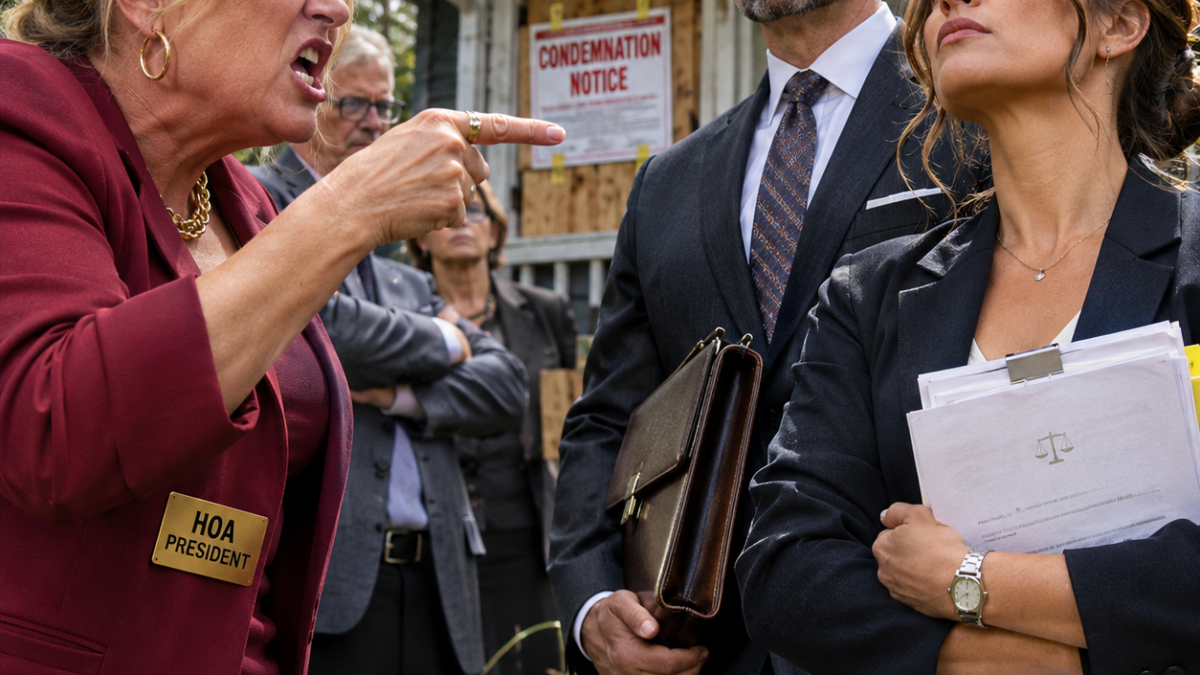
Sarah said Karen was already halfway through a speech when the door opened.
She had been describing our home as a “chronic compliance concern.”
Apparently my broken leg had not reduced her talent for vocabulary.
There were fewer than fifteen residents in the room.
Mostly Karen’s allies.
Just enough people to create the appearance that something legitimate was happening.
Sarah entered first.
Marcus walked behind her.
If you met Marcus Thorne in a grocery store, you would probably move your cart out of his way even if he had never said a word.
Six foot four.
Former Marine JAG officer.
Shaved head.
Dark suit.
Slow movements.
The kind of presence that made people lower their voices without knowing why.
Karen stopped midsentence.
Sarah took a front-row seat.
Marcus remained standing.
Karen recovered.
“This is a closed board session.”
Marcus said nothing.
“Only homeowners are permitted.”
That was when he smiled.
Sarah told me she had seen that smile maybe three times in her life.
None of them had ended well for the other side.
“Mrs. Jenkins is a homeowner.”
His voice was low.
Controlled.
“And I am her legal counsel.”
Nobody moved.
Marcus stepped inside.
“I am here because this board is apparently considering action against my clients’ home while Mr. Jenkins is hospitalized after a severe injury.”
Karen folded her arms.
“We are discussing covenant enforcement.”
“Good.”
Marcus set his briefcase on a chair.
“Then this should be easy.”
Karen’s expression changed.
“What is that supposed to mean?”
“It means we’ll begin with your own bylaws.”
He opened a folder.
“Article Four, Section Two.”
Karen stared.
“Special board meetings require seventy-two hours written notice.”
Gary looked down.
Bob shifted.
Marcus continued.
“My clients received an email approximately three hours ago.”
Karen said:
“This is an emergency.”
“What is the emergency?”
“The condition of their property.”
Marcus nodded.
“The same property that has been in substantially the same condition for several months?”
Karen’s mouth tightened.
“The situation has deteriorated.”
“In what measurable way?”
“The unfinished project.”
“Which project?”
“The construction materials.”
“The materials stacked under weatherproof covering?”
“They are unsightly.”
“Did they become structurally dangerous today?”
No answer.
“Did a building inspector declare them unsafe?”
No answer.
“Did the county issue any condemnation notice?”
Karen’s face darkened.
“This board has independent authority.”
“No.”
Marcus said it simply.
“You do not.”
That was the first real crack.
A few residents looked at one another.
Marcus removed another document.
“Second problem.”
He held it up.
“The alleged violation notice.”
Karen said:
“It was delivered.”
“It was put in their mailbox this morning.”
“Yes.”
“That is not the service process required by your own enforcement procedure.”
Karen began to speak.
Marcus raised one hand.
Sarah said even she almost stopped breathing.
“Third.”
He looked directly at Karen.
“You are proposing punitive action against property belonging to a homeowner you know is currently hospitalized with a serious injury.”
Karen scoffed.
“His medical condition has nothing to do with covenant enforcement.”
“That would be more convincing if you had not waited until after his accident to call this emergency meeting.”
The room went silent.
Marcus took one step closer.
“My clients have already documented prior disputes between Mr. Jenkins and this board concerning the same piece of land.”
Karen’s face had begun turning red.
Marcus continued.
“If this board attempts to use his temporary physical disability as an opportunity to deprive him of property rights or pressure his wife into transferring land, you may expose the association—and potentially yourselves individually—to substantial civil liability.”
Gary suddenly looked less interested in Karen’s beautification project.
Bob took out a handkerchief.
Karen stood.
“This is outrageous.”
“No.”
Marcus’s voice never changed.
“What is outrageous is holding a rushed meeting while the homeowner is lying in a hospital bed and pretending that three hours’ notice satisfies your governing documents.”
“We are not taking his property.”
“Then state on the record that no vote will occur tonight regarding condemnation or transfer.”
Karen froze.
Marcus waited.
That was the beautiful part.
He didn’t accuse.
He gave her a choice.
Say clearly that she wasn’t doing what Sarah had reported.
Or admit exactly what she was doing.
Karen looked toward Gary.
Gary suddenly found the tabletop fascinating.
She looked toward Bob.
Bob wiped his forehead.
Finally:
“We were simply exploring options.”
Marcus nodded.
“Then there is nothing to vote on.”
“This meeting has been called.”
“Improperly.”
“You cannot adjourn my meeting.”
Marcus smiled again.
“I don’t need to.”
He looked around the room.
“Any vote taken tonight will be challenged immediately.”
Then at Karen.
“If you contact my clients directly about transfer of their property, or attempt another emergency proceeding without proper notice and due process, I will seek immediate injunctive relief.”
He picked up his briefcase.
“And Mrs. Henderson?”
“Yes?”
“My client is currently recovering from a compound fracture and infection.”
His voice dropped slightly.
“You should hope his medical condition is the only serious problem your board has created for itself this week.”
Then he turned.
“Sarah.”
My wife stood.
She looked at Karen.
Did not insult her.
Did not threaten her.
Did not give her the satisfaction of anger.
She simply followed Marcus out.
The meeting died behind them.
No vote.
No condemnation.
No land transfer.
Nothing.
When Sarah finished telling me, I lay back against the hospital pillow.
“You okay?”
She asked.
“Yes.”
“Really?”
“No.”
She became quiet.
“I hate being here.”
“I know.”
“I hate that you had to handle this.”
“I know.”
“I should have been there.”
“You were.”
I frowned.
“What?”
Sarah said:
“You called Marcus.”
“You knew what to do.”
“You protected us from a hospital bed.”
I looked at my leg.
“That doesn’t feel very heroic.”
“It wasn’t supposed to.”
She laughed softly.
“You’re allowed to be hurt, Jack.”
That hit harder than I expected.
For twenty years, people had depended on me to know what to do.
Units.
Projects.
Crews.
Family.
Retirement had not changed that instinct.
Then a ladder collapsed and suddenly I couldn’t walk to the bathroom without help.
Physical helplessness did strange things to a man used to being useful.
Karen had sensed that weakness.
Sarah had sensed something else.
That dependence did not make me powerless.
We were a team.
I had forgotten that for a moment.
“I love you.”
“I love you too.”
Then her voice hardened.
“And when you come home, we’re destroying that woman.”
I laughed so hard my leg hurt.
“Metaphorically.”
“Of course.”
“Sarah.”
“Mostly.”
I came home seven days later.
Wheelchair.
Medication schedule.
Physical therapy instructions.
My leg elevated.
Marcus had already sent the HOA a formal letter directing all communications through him.
For the first time in months, no violation notices arrived.
No Karen golf cart.
No anonymous complaints.
The neighborhood became suspiciously quiet.
That worried me more than noise.
Bullies do not become reasonable because one ambush fails.
They regroup.
So did I.
Sarah had cleared my study.
Laptop.
Printer.
Scanner.
Legal pads.
Whiteboard.
A rolling cart beside the desk for files.
I looked around.
“You built me a command center.”
“You married an engineer.”
“Fair.”
I sat behind the desk in my wheelchair.
“First thing?”
“Rest.”
“Second?”
“Records.”
She sighed.
“I knew that was coming.”
I drafted a formal HOA records request.
Five years.
Board minutes.
Financial statements.
Vendor contracts.
Architectural review records.
Official correspondence.
Budgets.
Expense reports.
Email archives.
Everything homeowners were entitled to review under applicable governing rules.
Certified mail.
Copy to Marcus.
Copy retained.
Ten business days.
The tenth day arrived.
4:55 p.m.
A cardboard box landed on our porch.
Sarah opened the door.
“Subtle.”
“What?”
“They dumped it.”
The box contained loose papers.
Old binders.
Invoices.
Minutes.
A USB stick.
Almost no organization.
Document dump.
A classic technique.
Give someone so much paper they stop looking.
Unfortunately for Karen, this was my favorite kind of problem.
I spent part of my military career coordinating logistics for engineering units.
Hundreds of people.
Equipment.
Budgets.
Maintenance schedules.
Procurement.
If somebody gave me a cardboard box of badly organized records, I didn’t see chaos.
I saw a sorting problem.
Sarah and I covered the dining table.
Year.
Category.
Vendor.
Board action.
Architectural review.
Financial.
Email.
By midnight, piles had formed.
At twelve-thirty, Sarah stopped.
“Jack.”
“What?”
She held an invoice.
Ten thousand dollars.
Community fountain.
Decorative stone.
Landscaping.
I remembered the fountain.
Everybody did.
Large.
Three tiers.
Ugly.
Located in a common strip near Karen’s house.
Sarah said:
“Why does this address look familiar?”
I opened the plat map on my laptop.
Zoomed.
Then laughed once.
“What?”
“The common strip is an easement along Karen’s property.”
Sarah stared.
“So?”
“Depending on the placement…”
I measured.
Then checked photographs.
“The landscaping extends onto her parcel.”
Sarah leaned closer.
“The HOA paid ten thousand dollars to improve her front yard?”
“Partly.”
“Who was the contractor?”
I looked.
Henderson Landscaping.
Karen Henderson.
I searched the company.
Owner:
Michael Henderson.
Brother-in-law.
I sat back.
“That’s interesting.”
Sarah looked at me.
“You use that word when something is terrible.”
“Interesting first.”
“Terrible after proof.”
More records.
Emergency tree removal.
Five thousand dollars.
No corresponding storm.
No board discussion.
A tree near Karen’s home disappeared that month.
Same contractor.
Clubhouse roof repair.
Twice the market estimate.
Contractor owned by Gary’s son.
Holiday lighting.
Bob’s wife’s store.
The pattern became clearer.
Self-dealing may have explanations.
But it should be disclosed.
These records showed almost none.
Then the architectural review logs.
That section made me angrier than the money.
Karen’s friends:
Deck.
Approved in four days.
Pool.
Approved in nine.
Large shed.
Approved.
Fence.
Approved.
Families who challenged her:
Delay.
Revision.
Denial.
Delay.
Denial.
The Miller family had applied for a children’s playset.
Denied over wood color.
Resubmitted.
Denied over roofline.
Resubmitted.
Denied because it supposedly affected neighboring sightlines.
The neighboring house belonged to Karen.
The family eventually sold.
I stared at that file.
Sarah stood behind me.
“They left?”
“Yes.”
“Because of this?”
“Probably not only this.”
“But it helped.”
“Yes.”
Then Mr. Abernathy.
Seventy-eight.
Bird feeder.
Five hundred dollars in accumulated fines because it attracted “undesirable avian activity.”
Three nearly identical feeders existed on homes belonging to Karen’s friends.
No violations.
This was not governance.
It was reward and punishment.
Then the USB stick.
Email exports.
Most looked routine.
Snow removal.
Clubhouse rental.
Landscaping.
Then I noticed a deleted folder.
Not securely deleted.
Just moved.
Five minutes later, I restored the files.
Sarah stood beside me.
“Anything?”
I opened one.
Karen to Gary:
**Make sure you deny the Peterson fence request. I don’t like the look of them, and we need to send a message.**
Next.
Gary to Karen:
**Don’t worry. I’ll code the new patio furniture under common-area maintenance. No one will notice.**
Then I opened one dated the day after my accident.
I stopped breathing.
Sarah noticed.
“What?”
I printed it.
The printer hummed.
One page slid out.
I placed it on the table.
Sarah read.
**This is our chance. With Jenkins out of the picture, we can finally move on the beautification project. I’ll draft a condemnation notice. Let’s call an emergency meeting and get this done before he knows what’s happening.**
Sarah’s hand tightened around the paper.
“She planned it.”
“Yes.”
“Before she called me.”
“Yes.”
“She knew you were in the hospital.”
“Yes.”
“She actually wrote ‘with Jenkins out of the picture.’”
“Yes.”
I stared at the email.
Karen had done something I had seen inexperienced leaders do many times.
She confused private communication with safe communication.
People become careless when they believe everyone around them is loyal.
They put motive in writing.
Now we had it.
Not inference.
Not suspicion.
Her words.
I called Marcus.
He read the email.
Then said:
“Do not contact her.”
“I wasn’t planning to.”
“I mean it.”
“I know.”
“I want the original digital file preserved.”
“Done.”
“Metadata?”
“Preserved.”
“Backup?”
“Three copies.”
Marcus laughed softly.
“Of course.”
“What next?”
“Build the record.”
“That’s what I’m doing.”
“No.”
He paused.
“I mean build the people.”
That part I had not considered enough.
A stack of evidence can still be dismissed as one angry homeowner’s obsession.
But if the evidence connects dozens of people?
Different.
My first ally was Dave Miller.
No relation to the family Karen had driven away.
Retired Marine sergeant major.
Thirty-foot flagpole.
Marine Corps flag beneath the American flag.
Karen hated it.
I rolled up his driveway.
He was cleaning golf clubs.
“Jenkins.”
“Dave.”
“Heard you lost a fight with a ladder.”
“Ladder cheated.”
“And Karen tried to steal your yard.”
“Something like that.”
He pointed to my wheelchair.
“You armed?”
I held up the binder.
“Worse.”
That got his attention.
I showed him the invoices.
Emails.
Selective approvals.
Then the email Karen had written about his flagpole.
**We need to make an example of the sergeant major. We can’t have military paraphernalia dominating the skyline.**
Dave read it once.
Again.
His jaw moved.
“Military paraphernalia.”
“That’s what she wrote.”
He looked through the open garage door toward his American flag.
“What’s the plan, Major?”
That sentence meant he was in.
We visited the Abernathys.
Mrs. Abernathy was terrified.
“No.”
“We can’t.”
“She’ll retaliate.”
I didn’t pressure them.
I showed them the selective-enforcement photographs.
Then Karen’s email referring to Mr. Abernathy as:
**That senile old man who’s attracting rats with his birdseed.**
Mrs. Abernathy read it.
Her fear changed shape.
She disappeared into another room.
Returned carrying a shoebox.
Violation notices.
Checks.
Threats.
“You tell us what you need.”
Next, the Patels.
Fence denial.
Email:
**I don’t like the look of them.**
Identical fence approved for Gary’s relative.
Mrs. Patel stared at the paperwork.
Then looked at her husband.
He said:
“We’re done being quiet.”
Door after door.
Same transformation.
Fear.
Evidence.
Anger.
Then relief.
Because almost every victim had believed they were alone.
That is how petty systems survive.
Isolation.
You tell each person:
**You are the problem.**
Then nobody compares notes.
Once they do, the pattern appears.
Twelve households joined the core group.
We met in my garage.
I sat in the wheelchair.
Sarah took notes.
Dave stood near the whiteboard.
“What do we do?”
Someone asked.
“Sue?”
“Public meeting?”
“News?”
“Recall.”
I pointed to the bylaws.
Article Three.
Section Five.
A board member could be removed with or without cause by homeowner vote at a special meeting.
To force the meeting, we needed twenty-five percent of homeowners.
Willow Creek had 110 homes.
Twenty-eight signatures.
Dave smiled.
“We have twelve in this garage.”
“Yes.”
“So sixteen more.”
“Signatures are not enough.”
Everyone looked at me.
“We need residents to understand why they’re signing.”
“Not revenge.”
“Governance.”
I tapped the binder.
“Karen thinks the rules belong to her.”
“They don’t.”
“We use the rules.”
Over the next two weeks, Dave went door to door.
Not shouting.
Listening.
“Ever had trouble with the board?”
Most people had.
Trash can.
Shed.
Mailbox.
Fence.
Landscaping.
Parking.
Then he showed one relevant document.
Never everything.
One piece.
Enough.
Twenty-eight signatures.
Then thirty-two.
Thirty-seven.
Forty-two.
More than we needed.
Meanwhile, my recovery created the next conflict.
My orthopedic surgeon worried about mobility.
The backyard sloped.
Uneven ground.
Risk of reinjury.
Physical therapy recommended low-impact aquatic exercise and gradient walking.
That created a practical solution.
Small therapy pool.
Accessible ramp from the rear door.
Marcus told us something important.
“If you need this medically, document everything.”
So we did.
Engineer plans.
Ten-by-fifteen-foot therapy pool.
Drainage study.
Screening.
Setbacks.
Accessible ramp.
Handrails.
Non-slip surface.
Doctor’s letter.
Physical therapist letter.
Medical necessity.
Reasonable modification.
We submitted everything.
Certified mail.
The architectural committee had thirty days.
Twenty-nine days later, denial.
One page.
**The proposed construction is not in keeping with the aesthetic harmony of the community and represents a significant deviation from established landscape standards.**
Nothing about drainage.
Nothing about safety.
Nothing about engineering.
Nothing about medical documentation.
Sarah read it.
“They did it.”
“Yes.”
Marcus answered on the first ring.
“We got the denial.”
He was quiet.
Then:
“Send it.”
Ten minutes later, he called back.
“Do nothing.”
“That sounds familiar.”
“I am notifying the HOA’s attorney, management company, and D&O carrier.”
“Insurance?”
“Yes.”
“Why them?”
“Because board members enjoy pretending lawsuits are theoretical until the people paying defense costs start asking questions.”
His letter was brutal.
Timeline.
Injury.
Medical documentation.
Accommodation request.
Denial.
Prior condemnation email.
Pattern of harassment.
Individual exposure.
Five business days to reverse.
Karen refused.
According to the insurance attorney, she claimed I was pretending to need rehabilitation because I wanted a swimming pool.
That statement may have been the dumbest thing she had said yet.
Day five passed.
Marcus filed.
Federal court.
Jenkins v. Willow Creek Estates HOA, et al.
Karen Henderson.
Gary Smith.
Bob Jones.
Named individually where the claims allowed.
At the same time, Dave formally submitted our recall petition.
The annual meeting was three weeks away.
Then Sarah did something I had underestimated.
She created a private online group:
**Willow Creek Homeowners for Reform.**
Only verified homeowners.
We did not dump every record publicly.
Marcus would have killed us.
We posted carefully selected documents.
The fountain invoice.
The condemnation email.
The federal case cover sheet.
ARC examples.
The reaction was immediate.
Forty-two petition signers became fifty households.
Then sixty.
Then more.
People posted stories.
Violation letters.
Photographs.
Receipts.
One woman had been fined for leaving a child’s bicycle visible.
Another for a holiday wreath.
Another because their driveway stain color was allegedly inconsistent.
An elderly couple had spent thousands fighting a shed dispute.
Karen’s authority had always depended on controlling information.
She could not survive transparency.
The annual meeting arrived.
The clubhouse overflowed.
People stood in the hallway.
I rolled in beside Sarah.
Dave cleared space.
Karen sat at the board table.
Gary and Bob looked physically ill.
She struck the gavel.
“This meeting will come to order.”
Someone shouted:
“What about the lawsuit?”
Another:
“What about your fountain?”
Karen slammed the gavel again.
“That is not on the agenda.”
Dave stood.
“Madam President.”
Silence.
“Article Three, Section Five.”
Karen knew.
I saw it.
Her eyes changed.
“A properly certified recall petition has been filed.”
He held up the document.
“I move that the agenda be amended to proceed immediately to the recall matter.”
A paralegal in our group seconded.
Karen shouted:
“Out of order.”
The paralegal opened the bylaws.
“No.”
Vote to amend.
Hands rose.
Overwhelming.
Karen was forced to sit at the table while her own rules placed her presidency on trial.
Dave began.
Fountain invoice.
Screen.
Ten thousand dollars.
Property map.
Karen’s lot.
Henderson Landscaping.
Her brother-in-law.
Next.
Dave’s flagpole email.
**Make an example of the sergeant major.**
Murmurs.
Next.
Mr. Abernathy.
He stood slowly.
Spoke about the bird feeder.
His voice trembled.
Not fear anymore.
Age.
Anger.
Mrs. Patel spoke.
Fence denial.
Email.
Selective approval.
Then the condemnation email.
The entire room went silent when it appeared on the screen.
**This is our chance. With Jenkins out of the picture…**
I watched Karen.
For months she had called our interpretation a lie.
But her words were twenty feet tall behind her now.
Sarah wheeled me forward.
My turn.
I looked at the crowd.
“My name is Jack Jenkins.”
Most knew me.
“I want to start by saying something.”
“I did not begin this because I wanted Karen Henderson removed.”
Karen stared.
“I wanted to build a workshop.”
A few people laughed nervously.
“I followed the rules.”
“When that became a fight, I continued following the rules.”
“Then I fell.”
I looked down at my leg.
“While I was in the hospital, this board called an emergency meeting.”
I put the email on screen again.
“They believed my injury created an opportunity.”
No shouting.
No theatrics.
I didn’t need them.
“When my wife walked into that meeting with our attorney, the vote stopped.”
“After I came home, we requested records.”
I pointed toward the documents.
“This is what your records showed.”
“Not rumors.”
“Not Facebook accusations.”
“Your records.”
Then the therapy application.
Doctor’s letter.
Engineering plans.
Denial.
I put the denial on screen.
“This ramp exists because right now I cannot safely walk across my own backyard.”
I looked toward Karen.
“The pool was recommended for rehabilitation.”
“Twenty pages of documentation went to the committee.”
“The answer was one sentence.”
I read it.
Then showed the lawsuit.
“The HOA is now in federal litigation.”
Gary closed his eyes.
Bob looked toward the floor.
“I do not want this association bankrupted.”
That got attention.
“I live here too.”
“Those are my dues too.”
“Those property values are mine too.”
“This is not about destroying Willow Creek.”
“It is about deciding whether Willow Creek belongs to its homeowners—or whether one board president gets to use our money, our rules, and our fear as personal weapons.”
Karen shot up.
“He is faking this!”
The room froze.
Marcus had warned her.
Insurance counsel had warned her.
Her own lawyers had probably warned her.
Still she said it.
“Look at him!”
She pointed at me.
“He wants a luxury pool and expects all of you to pay for it.”
A woman shouted:
“He can’t even walk!”
Karen ignored her.
“This is a conspiracy.”
Then another voice:
“No.”
Mrs. Abernathy.
Small.
Quiet.
She stood.
“You made me afraid to put birdseed in my yard.”
Karen rolled her eyes.
Bad move.
Mrs. Abernathy continued.
“You called my husband senile.”
Someone gasped.
Karen said:
“That was private correspondence.”
Dave laughed once.
“That’s your defense?”
The room erupted.
“Vote!”
“Vote her out!”
“Enough!”
Paper ballots were distributed.
Karen watched.
For the first time, she could not control anything.
People marked boxes.
Folded papers.
Dropped them into a clear container.
Count.
Double-check.
Then the result.
Ninety-eight.
To five.
Karen Henderson was removed.
She didn’t speak.
Not at first.
She stared at the count.
Then at the crowd.
Then at me.
I thought she might explode.
Instead, she picked up her purse.
Walked toward the door.
Stopped beside my wheelchair.
For a second, I thought she would say something.
She didn’t.
She left.
Door slammed.
The applause started slowly.
Then grew.
It was not the sound of people celebrating another person’s destruction.
It sounded like relief.
Gary stood.
“I resign.”
Bob followed.
“Me too.”
More applause.
Interim elections began.
Dave became president.
A paralegal became secretary.
Ben Carter, an accountant who had also been targeted by Karen, became treasurer.
Dave’s first motion:
“Approve the Jenkins therapy ramp and pool.”
Unanimous.
Second:
“Direct legal counsel to pursue immediate good-faith settlement of the pending litigation.”
Unanimous.
Third:
“Commission a complete independent audit of the last five years.”
Unanimous.
Then Dave looked toward me.
“Anything else?”
I thought.
“Yes.”
Everyone waited.
“Can we stop holding meetings after eight?”
Laughter broke the tension.
Sarah leaned down.
“That’s your big reform?”
“I’m tired.”
“You’ve been tired for six months.”
“Exactly.”
The audit began.
It was worse than our spreadsheet.
Personal landscaping.
Catered gatherings.
Questionable discretionary spending.
Contracts involving relatives and allies.
Unclear fund transfers.
The new board posted summaries publicly.
That transparency changed the neighborhood faster than any lawsuit.
People finally understood where their money had gone.
Then the new board did something I respected.
They did not try to punish every former Karen supporter.
They changed procedures.
Competitive bids.
Conflict-of-interest disclosures.
Clear ARC criteria.
Written reasons for denials.
Appeals.
Meeting notice enforcement.
Open records.
Fine amnesty for a large number of questionable cases from Karen’s tenure.
That last one mattered.
Mr. Abernathy’s bird feeder fines disappeared.
Dave’s flagpole fight ended.
Fence cases reopened.
Residents who had simply given up started asking questions again.
The lawsuit settled.
The HOA’s insurance carrier covered the ramp and therapeutic pool construction along with legal fees and damages as part of the resolution.
Karen faced separate action from the insurer over conduct it claimed fell outside normal protected board decision-making.
I did not follow every detail.
People assume revenge means you want front-row seats for the other person’s collapse.
I didn’t.
By then, I had something more important.
Physical therapy.
Recovery.
Walking.
The first time I stood without parallel bars, Sarah cried.
I pretended not to see.
The first time I crossed the kitchen with a walker, she photographed me.
“Delete that.”
“No.”
“I look ninety.”
“You look alive.”
That ended the argument.
Recovery was slow.
Painful.
Humiliating sometimes.
My leg had forgotten how to belong to me.
Muscles shrank.
Balance disappeared.
Every small movement required concentration.
The ramp construction began before I could use it.
Then something happened that I didn’t expect.
Saturday morning.
Truck doors.
Voices.
Sarah looked through the window.
“Jack.”
“What?”
“You need to see this.”
A dozen neighbors stood in our backyard.
Shovels.
Wheelbarrows.
Levels.
Work gloves.
Cooler.
Dave.
The Abernathys’ grandson.
The Patels.
Ben.
People I barely knew six months earlier.
Dave saw me in the doorway.
“Don’t get sentimental.”
“I’m not.”
“You look sentimental.”
“My leg hurts.”
“Sure.”
“What are you doing?”
“Site prep.”
“We hired a contractor.”
“Contractor isn’t pouring until Monday.”
He pointed toward the future therapy area.
“We can clear.”
Sarah smiled.
“Apparently we’re feeding them.”
“You planned this?”
“No.”
“Yes.”
“No.”
She was lying.
People worked all weekend.
Brush removed.
Ground cleared.
Forms prepared under the contractor’s guidance.
Sarah made sandwiches.
Mrs. Abernathy brought pie.
Someone brought music.
For months, Karen had described community as uniformity.
Same trim.
Same fences.
Same approved decorations.
That weekend I finally saw what community actually looked like.
Mud.
Sweat.
Bad sandwiches.
Neighbors lifting something because one of them couldn’t.
The pool was modest.
Exactly what the plans showed.
The ramp extended from our back door to the patio.
Gentle slope.
Handrails.
Non-slip surface.
When it was finished, my physical therapist came out.
First session.
Sarah stood nearby.
I descended the ramp using my walker.
Every step deliberate.
At the bottom, I stopped.
Looked back.
It was not beautiful in any dramatic way.
Functional.
Strong.
Safe.
My favorite kind of construction.
“Ready?”
The therapist asked.
I looked toward the water.
“Yes.”
Warm water took weight off my leg.
For the first time since the accident, I moved without fear.
Slow steps.
Resistance exercise.
Balance.
Pain.
Progress.
Weeks became months.
Wheelchair.
Walker.
Cane.
Then one morning, I walked down the ramp with only the handrail.
Sarah stood at the bottom.
I reached the last step.
She smiled.
“You did it.”
“Looks that way.”
She put her arms around me.
I held her.
The backyard smelled like turned soil.
Sarah had finally planted the garden.
Tomatoes.
Peppers.
Herbs.
Flowers along the fence.
For one strange second, I remembered Karen calling this property a blight.
I looked around.
The garden.
Pool.
Workshop plans finally moving again.
Neighbors talking over the fence.
Nothing about it felt like blight.
The workshop was approved under the new review system.
Same basic building.
Same location.
Same dimensions.
Funny how a one-degree roof pitch stopped threatening civilization once Karen was gone.
Construction took two months.
I insisted on doing what I safely could.
Sarah caught me carrying lumber.
“Absolutely not.”
“It weighs twelve pounds.”
“You have a healing leg.”
“I am cleared.”
“You are retired.”
“That is unrelated.”
She took the board from me.
I let her.
Growth.
The old Karen records stayed in my study.
Three-inch binder.
Whiteboard gone.
File folders reduced.
Marcus asked once:
“Why keep it?”
“Reminder.”
“Of her?”
“No.”
“Of what happens when everyone stays quiet.”
He nodded.
That was the real lesson.
Karen had not become powerful overnight.
Homeowners had surrendered power slowly.
One fine.
One bad meeting.
One ignored conflict.
One neighbor deciding it was easier not to get involved.
Gary and Bob had not created her.
But they enabled her.
People who knew something was wrong kept telling themselves:
**Not my problem.**
Until eventually it was.
That changed Willow Creek.
Attendance improved.
Not forever.
Human beings still hate meetings.
But enough people paid attention.
Budgets were posted.
Questions answered.
Dave served one term.
Then refused another.
“Why?”
I asked.
“Because anyone who wants this job forever should not have it.”
Fair.
The board adopted term limits later.
One of the most popular amendments Willow Creek ever passed.
The infamous fountain near Karen’s old house remained.
Nobody wanted to spend more money removing it.
The new board placed a bench beside it.
Kids threw pennies.
Someone joked we should rename it the Accountability Fountain.
Dave suggested:
“The Karen Memorial.”
Sarah said:
“She’s not dead.”
“Fine.”
“The Karen Warning.”
We did not officially adopt that.
Unofficially?
Everyone called it that.
Karen sold her house months after the recall.
I never saw her leave.
No dramatic moving truck confrontation.
No final speech.
No grocery-store encounter.
One morning her house had curtains.
A few weeks later, empty windows.
Then a new family moved in.
Young couple.
Two kids.
They knew almost nothing about the history.
The father introduced himself while walking the dog.
“Beautiful neighborhood.”
I looked around.
“It can be.”
He laughed.
“That sounds ominous.”
“It’s gotten better.”
That was enough.
I did not need Karen to remain the neighborhood’s ghost.
A community cannot heal if everyone keeps building identity around the person who hurt it.
Years later, Sarah and I sat beside the therapy pool one morning.
My limp was barely visible.
Some days worse than others.
Rain reminded me.
Cold reminded me.
Stairs reminded me.
But I could walk.
That was enough.
She handed me coffee.
“Do you remember the hospital call?”
“Yes.”
“What were you thinking?”
“That I wanted to kill Karen.”
Sarah nearly spit out her coffee.
“Jack.”
“Metaphorically.”
“You never say that part.”
“You asked.”
“What else?”
I thought.
“I was scared.”
Her expression softened.
“Of Karen?”
“No.”
“Of what?”
I looked toward my leg.
“Being useless.”
Sarah’s eyes filled.
I continued.
“The house fight was almost easier than the injury.”
“Because you knew how to fight.”
“Yes.”
“You didn’t know how to heal.”
“No.”
She took my hand.
“You were never useless.”
“I know that now.”
That was the emotional part I had missed during the war.
Karen believed she could exploit my injury because it made me weak.
For a while, I believed part of that too.
Not politically.
Personally.
I could not drive.
Could not walk.
Could not fix things.
Could not carry groceries.
Could not even shower safely without help.
My identity had always been tied to competence.
Then injury stripped competence down to its smallest components.
Sarah taught me the difference between needing help and being helpless.
Marcus carried the legal part.
Neighbors carried the physical part.
Sarah carried more than anyone.
And somehow accepting that support made me stronger than pretending I didn’t need it.
One afternoon, Mrs. Abernathy visited.
She carried birdseed.
“Is that legal?”
I asked.
She smiled.
“I checked.”
“Good.”
She looked toward the new feeder in our yard.
“I bought you one.”
“You’re trying to attract undesirable avian elements.”
“I am.”
“Scandalous.”
She hung the feeder.
Birds came within a week.
I left it there.
Dave Miller eventually took his flagpole dispute to the new board.
Not because the board wanted it gone.
He wanted the violation formally rescinded.
It was.
At the meeting, he read Karen’s old email aloud.
**Military paraphernalia.**
Then looked toward the American flag visible outside.
“Anybody still think that’s a useful description?”
Nobody did.
His fine balance was zeroed.
The Patels received fence approval.
Ben’s shed approved.
Other families had records corrected.
The point was not to approve everything.
Some applications were still denied.
But now the denial letter contained objective reasons.
Setback.
Drainage.
Safety.
Actual rules.
Applicants could appeal.
That distinction mattered.
A good system sometimes says no.
A corrupt system says no depending on who asks.
The years passed.
Sarah’s garden expanded.
The workshop became my favorite room.
I built furniture badly at first.
Then less badly.
I restored old tools.
Helped neighbors repair things.
One Saturday, the new HOA president knocked.
“Jack?”
“Yes?”
“We need advice.”
“That sounds dangerous.”
“Drainage near the clubhouse.”
“Hire an engineer.”
“We did.”
“He suggested we ask about the old grading maps.”
I had copies.
Somewhere along the way, I became useful to the HOA.
Not powerful.
Useful.
That suited me.
I never ran for the board.
People asked.
I always said no.
“You’d be good.”
“That’s why I’m refusing.”
They laughed.
I wasn’t entirely joking.
Authority is healthiest when people are reluctant to possess it.
One spring, the association held a neighborhood clean-up day.
The community garden Karen had wanted to build partly on my land eventually existed.
Just not on my land.
The HOA redesigned it entirely within common property.
Smaller.
Better.
No condemnation.
No property seizure.
People volunteered.
Sarah planted herbs there.
I stood at the edge watching.
Dave approached.
“You angry?”
“About what?”
“The garden.”
“No.”
“Karen wanted one.”
“The garden wasn’t the problem.”
He nodded.
“The taking was.”
“Exactly.”
That distinction mattered.
Karen’s ideas were not all evil.
Her methods were.
A community garden could be good.
A fountain could be pleasant.
Architectural standards could protect shared value.
Board leadership could be useful.
Almost every tool she abused had a legitimate purpose.
That was why her abuse had survived so long.
Tyranny rarely announces itself as tyranny.
It arrives labeled:
**Order.**
**Standards.**
**Beautification.**
**Property values.**
**Community interest.**
You judge it by what it does to people when they say no.
The garden opened in May.
No dramatic ceremony.
Kids planted sunflowers.
Mrs. Abernathy planted basil.
Sarah claimed two tomato beds.
Dave refused to garden but spent three hours fixing the irrigation timer.
I sat on a bench.
My leg ached.
Sarah brought me lemonade.
“You look pleased.”
“I am.”
“Karen wanted this.”
“Not like this.”
“No.”
She looked around.
“No one had to lose their home.”
Exactly.
The federal case became a distant memory.
So did the condemnation attempt.
But every year on the anniversary of my fall, I remembered the hospital ceiling.
Beep.
Beep.
Beep.
Sarah’s voice.
**They’re voting tonight.**
For a long time, that memory triggered anger.
Then anxiety.
Eventually gratitude.
Not gratitude for Karen.
Never confuse forgiveness with rewriting history.
Gratitude for what I learned about Sarah.
About Marcus.
About the neighbors.
About myself.
The moment Karen believed I was weakest became the moment the community finally began seeing what she was.
That irony never stopped satisfying me.
One evening, years later, Marcus came over for dinner.
Sarah asked:
“Did you really tell the board you’d personally bankrupt them?”
Marcus coughed.
“I may have used colorful language.”
“You terrified Gary.”
“That was not difficult.”
I laughed.
“Was all of it legally perfect?”
Marcus pointed his fork at me.
“Never ask a lawyer that after the statute of limitations has become your friend.”
Sarah laughed.
Then Marcus became serious.
“You know what saved you that night?”
“What?”
“Documentation?”
“Partly.”
“Law?”
“Partly.”
“What?”
“Sarah called before responding.”
I looked at her.
Marcus continued.
“Most people get a threatening notice and immediately send a ten-paragraph emotional email.”
“They create admissions.”
“Threats.”
“Bad facts.”
“Sarah stopped.”
“She called you.”
“Yes.”
“And you called me.”
“Yes.”
“Sometimes the smartest move in a fight is not making the first angry move.”
That sounded simple.
It wasn’t.
Karen counted on reaction.
If Sarah had screamed at the board—
If she had threatened—
If I had called Karen from my hospital bed and lost control—
the story would have changed.
Instead, Karen had to own her actions without distraction.
That became our pattern.
Evidence first.
Reaction second.
It worked.
One summer, a new resident asked me why the bylaws contained unusually detailed requirements for special-meeting notice.
I laughed.
“History.”
“What happened?”
“Someone once tried to condemn my home while I was hospitalized.”
He stared.
“You’re joking.”
“No.”
“Here?”
“Yes.”
“This HOA?”
“Yes.”
He looked toward the clubhouse.
“No way.”
“That is exactly the reaction you want.”
“What do you mean?”
“If the current organization is so reasonable that the old story sounds impossible, then the reforms worked.”
He thought about that.
“Fair.”
Sometimes success means the next generation cannot imagine why the rules were necessary.
That is fine.
As long as someone keeps the record.
My binder eventually moved from the study shelf into a storage cabinet.
I did not need to see it every day.
But I never threw it away.
On the first page I eventually wrote:
**THE RULES ARE NOT THE ENEMY. UNACCOUNTABLE POWER IS.**
It sounded slightly dramatic.
Retired officers are allowed one dramatic binder.
Sarah approved.
The therapy pool remained too.
Even after I no longer medically needed it.
Grandchildren eventually splashed in it.
That felt like the perfect insult to the old denial.
Something Karen tried to block because she thought it was an aesthetic offense became a place where my granddaughter learned to swim.
One afternoon, she sat on the edge.
“Grandpa?”
“Yes?”
“Why is the ramp so long?”
“Because I used to need it.”
“Why?”
“I hurt my leg.”
“How?”
“Ladder.”
“Did you fall?”
“Yes.”
“Did it hurt?”
“A lot.”
She looked toward the house.
“Grandma says a mean lady tried to take your house.”
I stared toward the garden.
“Grandma tells detailed stories.”
“Did she?”
“Try?”
“Yes.”
“What did you do?”
“I called a lawyer.”
My granddaughter looked disappointed.
“That’s boring.”
“It was very effective.”
She kicked water.
“Did you fight her?”
“Not like you mean.”
“Did Grandma?”
I smiled.
“Your grandmother walked into a meeting with the lawyer.”
Her eyes widened.
“She fought her.”
“In her own way.”
That answer seemed satisfying.
For me too.
Because although people often told the story as mine, Sarah had been the person standing in that clubhouse while I was stuck under hospital lights.
She faced Karen.
She sorted records beside me.
She delivered copies.
Made calls.
Managed medication.
Cooked meals.
Took me to physical therapy.
Helped me shower.
Helped me dress.
Then spent weekends helping neighbors organize.
When people thanked me for saving Willow Creek, I always corrected them.
I didn’t.
We did.
And Sarah did more than most.
On our anniversary one year, I gave her a framed copy of the old condemnation email.
She stared.
“Jack.”
“What?”
“This is the least romantic gift you have ever given me.”
“Read the bottom.”
I had added a small brass plate.
**SHE THOUGHT I WAS OUT OF THE PICTURE. SHE FORGOT ABOUT MY WIFE.**
Sarah burst out laughing.
Then cried.
Then hit me with a pillow.
The frame hangs in my workshop.
Not the living room.
She has standards.
Karen became less relevant every year.
That was probably the healthiest ending available.
I heard she had moved out of state.
I heard the insurer pursued claims.
I heard rumors of other financial consequences.
I never verified most of them.
They were no longer my concern.
I had learned an important distinction.
Justice requires facts.
Gossip requires appetite.
I had enough facts.
No appetite.
The satisfaction came from what Willow Creek became afterward.
The annual budget stopped being mysterious.
Meetings became dull.
ARC decisions became predictable.
The garden thrived.
The fountain remained ugly.
Dave’s flag flew.
The Abernathys fed birds.
Kids played.
Neighbors complained occasionally, because neighbors always will.
But disagreements stopped feeling like threats.
That is what peace actually looks like.
Not everybody agreeing.
Everybody knowing the rules cannot be secretly rewritten to punish one person.
Six months after the accident, I walked from our back door to the garden without the cane.
Sarah watched from the patio.
I reached the tomato beds.
Turned.
She was crying again.
“You cry too much.”
“You almost died.”
“I broke a leg.”
“You had an infection.”
“Technicality.”
“You are impossible.”
She came over.
We stood beneath the morning sun.
The workshop roof visible beyond the pines.
Pool water moving gently.
Flowers blooming.
The back quarter acre Karen wanted to take was still ours.
Not because land itself was more important than people.
Because consent mattered.
Boundary mattered.
Home mattered.
I looked toward the exact place Karen had imagined her beautification project extending.
Sarah had planted sunflowers there.
Tall.
Bright.
Alive.
I laughed.
“What?”
She asked.
“Nothing.”
“Tell me.”
“Karen wanted beautification.”
Sarah followed my eyes.
Then smiled.
“Looks pretty beautiful to me.”
It did.
That became my ending.
Not Karen leaving.
Not the recall vote.
Not the lawsuit.
Not the insurance settlement.
Sunflowers.
My wife beside me.
My leg holding my weight.
Our home still ours.
Sometimes revenge is loud.
Sometimes someone loses an election ninety-eight to five.
Sometimes lawyers file enough paper to make a bully understand consequences.
But the revenge that stays satisfying is simpler.
Karen waited until I was injured because she believed weakness meant opportunity.
She believed my wife would fold.
She believed neighbors were too afraid to speak.
She believed records could stay buried forever.
She believed the rules belonged to whoever held the gavel.
Every assumption failed.
My injury healed.
Sarah fought.
The records surfaced.
The neighbors united.
The rules removed her.
And the land she wanted?
Still behind my house.
Still ours.
If there is one thing twenty years in the Army taught me, it is that you do not measure strength only by what someone can do alone.
Strength is also knowing when to call for support.
Knowing when to trust the person beside you.
Knowing when the battle belongs to a lawyer, an accountant, a neighbor, a spouse, or a room full of homeowners who finally decide fear has lasted long enough.
Karen saw one man in a hospital bed.
She thought that meant I had nobody standing.
She was wrong.
Sarah stood.
Marcus stood.
Dave stood.
The Abernathys stood.
The Patels stood.
Eventually almost the entire neighborhood stood.
And once that happened, Karen’s power disappeared faster than any of us expected.
Years later, I still sometimes wake with pain in the leg.
Cold weather.
Old scar tissue.
I get up.
Walk through the house.
Make coffee.
Step down the ramp.
No wheelchair.
No walker.
No cane.
The morning air hits my face.
Sarah’s garden stretches across the yard.
Birds crowd the feeder.
The workshop door waits beyond the pines.
And on the far edge of the property sits the strip of land Karen once believed she could take because I was too injured to stop her.
I stop there sometimes.
Not because I’m angry.
Because I remember.
Peace feels different after somebody tries to take it.
You notice it.
You protect it.
You stop assuming it will always exist without effort.
Then I turn toward the house.
Sarah usually appears at the door.
“Coffee getting cold.”
“I’m coming.”
And I walk back.
That is the part Karen never understood.
A home is not just a lot number.
Not just resale value.
Not just landscaping standards.
Not something a board can treat like space on a planning map.
A home is where your wife walks into a room you cannot reach and fights for you.
It is where frightened neighbors become allies.
Where injury becomes recovery.
Where a garden finally grows after years of delay.
Where people who once stayed silent discover their voices.
Karen tried to condemn my home while I was lying helpless in a hospital bed.
Instead, she condemned her own presidency.
And when everything was finally over, the thing she tried hardest to take from us became the place where Sarah and I learned just how much a home was worth protecting.
Not because of its price.
Because it was ours.








