PART 2: HOA Tried to Bulldoze My Disabled Veterans’ Workshop for a Pipeline—Then I Bought the Water Company Behind It
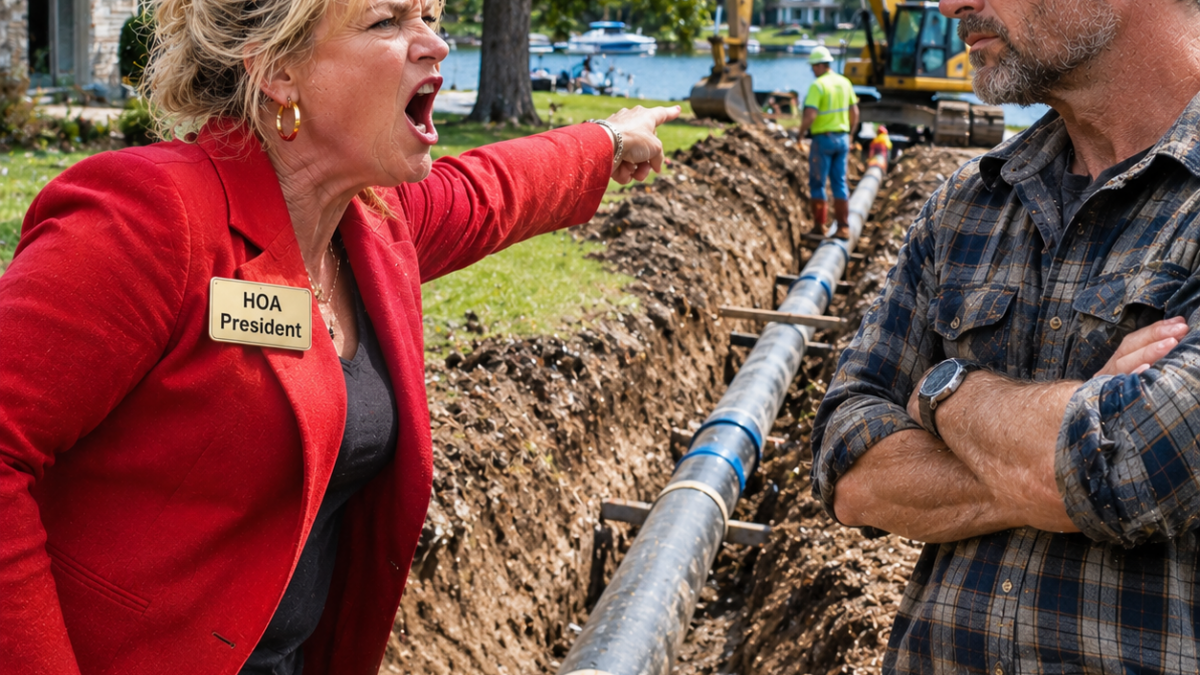
PART 2
I stared at the red line.
At first, I thought I was reading the map wrong.
That happens.
Engineering drawings can look simple until you start matching them to actual ground.
So I turned the page ninety degrees.
Found County Road 47.
Found Rose’s farmhouse.
Found the barn.
Same result.
The proposed pipeline entered my western boundary, crossed through the area under the workshop foundation, passed within a short distance of Rose’s well, then continued east toward Willowbrook.
I looked at Vivian.
“This route goes through my barn.”
“Yes.”
“Not beside it.”
“No.”
“Through it.”
She gave me a small smile.
“The route is non-negotiable.”
From inside the workshop came the sound of a drill stopping.
Then another.
The men had heard us.
I picked up the document she’d brought.
The easement was old.
1963.
I recognized the language immediately.
Telephone infrastructure.
Pole access.
Maintenance rights.
Nothing about a modern water pipeline.
“This is for telephone service.”
Vivian crossed her arms.
“Utility easements cover utilities.”
“Sometimes.”
Her smile disappeared slightly.
“Not automatically.”
“My attorneys disagree.”
“Then your attorneys can send me their interpretation.”
“They already have.”
She tapped the portfolio.
“You have seventy-two hours to prepare the property for construction access.”
I laughed.
Actually laughed.
Not because she was funny.
Because sometimes absurdity triggers the same response.
“You’re giving me seventy-two hours to prepare my own property for somebody else to tear it apart?”
“Mr. Holloway, Willowbrook has infrastructure needs.”
“So reroute it.”
“That would increase costs.”
“How much?”
“That’s not relevant.”
“It becomes relevant when your savings require demolishing my workshop.”
She glanced toward the open barn doors.
Danny stood there now.
Tool belt around his waist.
His prosthetic hanging naturally at his side.
Vivian looked at him for half a second.
Then back at me.
“This structure appears to be operating as some kind of informal club.”
“It isn’t a club.”
“What is it?”
“A veterans workshop.”
“For profit?”
“No.”
“Licensed therapy facility?”
“No.”
“Then what exactly is it?”
I felt Danny watching.
“It’s a place where guys who came home with fewer pieces than they left with build things and spend time together.”
Vivian’s mouth tightened.
“That sounds admirable.”
The tone told me the word meant the opposite.
“But essential community infrastructure cannot be blocked by private recreational activities.”
Danny stepped outside.
“Recreational?”
Vivian barely turned.
Danny’s voice stayed calm.
“We build furniture for veterans’ families. Park benches. Wheelchair-accessible tables.”
Vivian looked at his missing arm.
No softness.
Nothing.
“These men might be better served focusing on actual employment.”
I felt something shift inside me.
Danny went still.
So did the barn.
Even the birds seemed quieter for a second.
I had spent twenty years around men whose tempers had been trained, tested and broken in places where bad decisions had permanent consequences.
I knew that silence.
I stepped between Danny and Vivian.
“You should leave.”
She blinked.
“Excuse me?”
“You delivered your paperwork.”
“This discussion isn’t finished.”
“It is today.”
Her voice turned colder.
“Mr. Holloway, what’s some disabled veteran going to do about a legally authorized utility project?”
There are sentences you hear once and never forget.
That was one.
I leaned toward her just enough that she stopped smiling.
“You have no idea what you just started.”
“Is that a threat?”
“No.”
I looked at the map.
“It’s a promise that I’m going to read every line of this.”
Then I handed it back.
She drove away in a cloud of red Georgia dust.
Danny stayed outside.
For a while neither of us spoke.
Finally he said:
“Sarge.”
I hated when they called me that.
Mostly because I secretly didn’t.
“Yeah?”
“If they tear this place down…”
“They’re not.”
“You don’t know that.”
“No.”
I looked at the barn.
“But neither does she.”
The next seventy-two hours were some of the longest of my life.
I called a JAG friend.
Then a property attorney.
Then the county clerk.
Pulled the recorded easement.
Read it.
Again.
Again.
Again.
The language was not nearly as broad as Vivian had suggested.
But that didn’t mean she had no argument.
Old easements get interpreted.
Utility rights evolve.
Courts look at scope, intent, burden, use.
I wasn’t going to pretend the case was simple just because I hated the other side.
By Thursday, a preliminary injunction request had been filed against me.
Public necessity.
Essential infrastructure.
Community health and safety.
Strong words.
The sort designed to make a judge feel irresponsible for saying no.
I sat on Rose’s porch at five-thirty that morning reading the paperwork.
Coffee cooling beside me.
Mockingbirds screaming from the oaks.
The sun had barely cleared the tree line.
Danny pulled into the drive.
“You sleep?”
“No.”
“Good.”
“What?”
“I didn’t either.”
He sat beside me.
For several minutes he said nothing.
Then:
“My daughter asked if the table’s still going to be finished.”
The coffee table.
Walnut top.
Rounded corners.
The guys had been building it for her first apartment.
“When’s she moving?”
“Three weeks.”
“We’ll finish it.”
He looked at the injunction notice.
“You sure?”
“No.”
That honesty hurt him.
I could see it.
“I can fight Vivian,” I said.
“But?”
“But I’m not promising things a court controls.”
Danny nodded.
Combat teaches you to distrust promises based on variables you don’t own.
Then the newsletter arrived.
**SELFISH NEIGHBOR BLOCKS ESSENTIAL WATER INFRASTRUCTURE**
Willowbrook residents received it before some of my own legal paperwork reached me.
The article claimed households were facing inadequate pressure and future health risks because one adjacent landowner refused to cooperate.
No mention of the workshop.
No mention of the easement language.
No mention that the pipeline route crossed my private land.
Just me.
Obstacle.
Threat.
Problem.
I checked county water-pressure data.
Normal.
Service records.
No emergency trend.
No widespread outages.
Whatever Vivian was building, urgency was part of the sales pitch.
Reality didn’t match.
Saturday morning, I heard metal on metal.
Ping.
Ping.
Ping.
Bright orange survey stakes appeared along the property edge.
I was showing Tommy how to use a sanding jig from his chair.
He stopped.
“What’s that?”
“Trouble.”
Outside, a survey crew worked near the fence line.
Vivian stood behind them.
Of course.
Heels.
On frozen ground.
I walked out.
“Morning.”
The surveyor looked uncomfortable.
“Morning, sir.”
“What’s your scope?”
“Preliminary alignment.”
“On whose authorization?”
He pointed toward Vivian.
Wrong answer.
Vivian approached.
“Mr. Holloway, preliminary assessment is lawful.”
“My easement challenge is active.”
“Which does not suspend our planning.”
I took out my phone.
Started recording.
“For the record, October fifteenth, eight forty-seven a.m. Willowbrook HOA personnel and contractors are conducting utility survey activity on disputed private property while easement scope remains under legal challenge.”
Vivian’s face changed.
“You cannot record me.”
“I’m part of the conversation.”
“You need consent.”
“No.”
Her confidence flickered.
One thing divorce had taught me—aside from the market price of peace—was to know my state’s recording rules before assuming anything.
Vivian recovered.
“You may want to worry less about me and more about your own violations.”
“What violations?”
She smiled.
“There have been questions about the workshop.”
I looked back toward the barn.
“Questions from whom?”
“County officials.”
“What kind?”
“Commercial activity.”
“It isn’t commercial.”
“Regular gatherings.”
“Veterans.”
“Manufacturing.”
“Woodworking.”
“Electrical modifications.”
“Code-compliant.”
“Are you licensed?”
“As what?”
“That will be for inspectors to determine.”
There it was.
Not law.
Pressure.
She couldn’t immediately win the pipeline fight, so she was going to make the rest of my property expensive to defend.
“You’re threatening the workshop.”
“I’m informing you that nobody is above regulation.”
Then she turned toward the BMW.
I kept recording.
She made a phone call as she walked.
I couldn’t hear everything.
But I caught enough.
“County inspector.”
“Tomorrow morning.”
She wasn’t bluffing.
Monday brought Dale Hoffman.
County Building and Safety.
White pickup.
Clipboard.
Vivian behind him.
I watched both vehicles come down Rose’s drive and felt my stomach tighten.
The men kept working.
Danny and Pete were assembling corner brackets.
Tommy was finishing a bench.
I told them:
“Don’t engage.”
Tommy grinned.
“You worried we’ll scare him?”
“I’m worried you’ll enjoy it.”
Dale entered the workshop like he expected criminal evidence to jump out of a drawer.
“Commercial operation?”
“No.”
“How many employees?”
“None.”
“Then who are these people?”
“Friends.”
“Regular schedule?”
“Yes.”
“Products manufactured?”
“Furniture.”
“For sale?”
“Sometimes donated. Sometimes made for family.”
He scribbled.
“Electrical work done by?”
“Me.”
“Licensed electrician?”
“No.”
“I’ve been a military engineer for twenty years.”
“Not the question.”
He wasn’t entirely wrong.
Military qualification isn’t automatically civilian licensure.
But he wasn’t inspecting neutrally either.
He looked at outlets.
Panels.
Benches.
Fire extinguishers.
Exits.
Everything became suspicious simply because it existed.
Then he announced:
“Immediate cessation pending review.”
Danny lowered his drill.
The sound bothered me more than Hoffman’s words.
I asked:
“Appeal?”
“Thirty to sixty days.”
“For what?”
“Unsafe conditions. Unlicensed commercial use. Possible zoning conflicts.”
I looked at him.
Then at Vivian.
Then I remembered something my platoon sergeant used to say.
When somebody pushes too hard, stop watching the hand in front of you and check the hand you can’t see.
I opened the county payment database on my phone.
Public vendor records.
Searched Hoffman.
There.
Three weeks earlier.
**HOA Services LLC – Safety Consulting – $5,000.**
HOA Services LLC was tied to Willowbrook management.
I turned the screen toward him.
“Interesting.”
His eyes dropped.
“What?”
“Five thousand dollars.”
Vivian moved closer.
“What are you doing?”
“Reading.”
I looked at Hoffman.
“You did consulting for Willowbrook management?”
“Unrelated.”
“When?”
“No bearing on this inspection.”
“Three weeks ago.”
He stiffened.
“Mr. Holloway—”
“What safety consulting?”
“Private contractual work.”
“While inspecting a property after a complaint from the same HOA?”
Vivian snapped:
“Careful.”
I looked at her.
“About reading a public payment entry?”
“This is defamatory.”
“I haven’t accused anyone of anything.”
Then Danny spoke.
“That’s him.”
Hoffman turned.
Danny’s face had lost color.
“My cousin Elena.”
“What?”
“The garage.”
He looked at me.
“Sarge, that’s the inspector who shut Elena’s cabinet shop.”
Hoffman’s pen stopped.
Elena Rodriguez had lost her home after a chain of code problems and foreclosure pressure.
Danny had mentioned it months before.
I hadn’t connected the name.
“How many workshops have you closed this year?” I asked.
Hoffman shoved the notice toward me.
“This inspection is complete.”
He walked out.
Vivian followed.
Not smiling.
For the first time.
The barn went silent after they left.
Twelve men.
Tools idle.
A place that had survived bad knees, prosthetic adjustments, nightmares, divorces, panic attacks and everything else civilian life had thrown at them had been stopped by a clipboard.
Pete sat down hard.
“So that’s it?”
“No.”
Danny stared at the floor.
“That’s what happened to Elena.”
Tommy started laughing.
Everyone looked at him.
Pete frowned.
“What exactly is funny?”
Tommy leaned back in his chair.
“They made the classic mistake.”
“What mistake?”
“They think we’re broken.”
Nobody laughed with him.
He continued.
“They look at us and see missing parts.”
Then at me.
“They forgot Sarge spent twenty years building infrastructure while people tried to blow it up.”
I sighed.
“Stop calling me Sarge.”
“See? Still giving orders.”
A few men smiled.
Small.
Enough.
I went into the farmhouse and started researching Willowbrook’s water system.
If the pipeline truly represented an emergency, there should be evidence.
Supply records.
Utility plans.
Connection agreements.
Pressure reports.
Capital improvement budgets.
I searched until after midnight.
Something was wrong.
Willowbrook’s documents described municipal service.
But the actual network references didn’t match the city’s system the way they should have.
I found a private entity repeatedly appearing in older records.
**Clearwater Municipal Services.**
The next morning, more legal papers arrived.
Vivian claimed I’d threatened her.
A restraining order required distance.
The sheriff who delivered it looked embarrassed.
“I’ve got the recording.”
“I figured.”
“Want to hear it?”
“Not my job to retry it on your porch.”
He lowered his voice.
“Just watch yourself.”
Wednesday, heavy equipment arrived.
The pipeline contractors had moved forward with test work.
A crew boss named Kowalski knocked.
“Orders to dig test holes.”
“Property dispute remains active.”
“Talk to county.”
An excavator rolled near my boundary.
The operator was young.
Too young to be relaxed around that much machine.
I watched from the farmhouse.
Then the bucket swung.
Hit something.
Metallic crack.
A second later, water burst through the red clay.
My water line.
“Kill it!” Kowalski shouted.
Workers scrambled.
The ground turned muddy.
Red clay liquefied around the trench.
Then the washed-out soil exposed something underneath.
Concrete.
Old concrete.
Not a footing.
Not random debris.
Engineered.
Channels.
A buried structure.
I moved closer.
Kowalski blocked me.
“Stay back.”
I stopped.
Did not need to get closer.
Military engineering changes the way you see earthworks.
The geometry was obvious.
This was water infrastructure.
Old.
Large.
Deliberate.
Nothing like what I’d seen on modern county maps.
Kowalski stared into the exposed cut.
“What the hell is that?”
Good question.
My phone rang.
Danny.
“Sarge, you sitting down?”
“No.”
“You need to.”
“What happened?”
“Elena’s at the VA.”
“And?”
“She remembers documents her grandmother had.”
“What documents?”
“Water rights.”
I looked into the excavation.
“How old?”
“Forties.”
The back of my neck prickled.
“I’m coming.”
At the VA, Elena Rodriguez sat between Danny and Tommy.
She looked exhausted.
Foreclosure will do that.
Especially when you believe the system that took your house was never playing by the same rules.
“My grandmother always said the property came with water rights,” she told me.
“What kind?”
“Primary access. That’s what she called it.”
“Any paperwork?”
“I tried finding it.”
“When?”
“Before the foreclosure.”
“What happened?”
“County said old originals had been digitized.”
“And?”
“Then they couldn’t find the scans.”
She reached into a folder.
Old photograph.
Black-and-white.
Her grandmother beside a concrete wellhead.
I stared.
Same shape.
Same construction.
Same system I’d just seen exposed in Rose’s field.
Tommy leaned over.
“That’s what we saw.”
“Yes.”
Elena’s eyes met mine.
“Marcus.”
She rarely used my first name.
“If those structures are connected…”
“They probably are.”
“To what?”
“I don’t know yet.”
But I knew where to look.
County courthouse.
That evening, Elena and I requested historical water-rights records.
The storage room smelled like dust, paper and the inside of old filing cabinets.
Boxes.
Maps.
Microfilm.
Things modern databases forget existed.
Three hours later, Elena pulled out a 1947 geological survey.
“Marcus.”
I came over.
She spread the map.
Aquifer system.
Collection points.
Historic supply lines.
Then one notation.
**HOLLOWAY FARM – PRIMARY SPRING COLLECTION POINT**
I sat down.
Rose’s farm.
My three acres.
Not merely beside the water system.
At the heart of the original one.
We kept searching.
Willowbrook development permits.
1985.
Approved on the basis of municipal water connection.
Then hookup records.
Missing.
Private system instead.
Clearwater Municipal Services.
We followed corporate filings.
Ownership.
Subsidiaries.
Shell entities.
Then:
VB Holdings LLC.
Vivian Blackthorne.
Elena stared at the page.
“You’ve got to be kidding me.”
“No.”
“She owns the water company?”
“According to this.”
The room suddenly felt smaller.
We found billing records.
Willowbrook residents had been paying rates comparable to municipal service.
Clearwater collected the revenue.
But historic water-right compensation tied to the collection area?
Nothing we could find.
Elena’s hands began shaking.
“My grandmother lost her land.”
“I know.”
“They said her well was contaminated.”
I looked at her.
“What happened afterward?”
“They forced connection.”
“To municipal water?”
“That was what we were told.”
I turned back to the records.
But Willowbrook had never properly connected to the municipal system described in the development approvals.
The more we pulled, the uglier it became.
Families with old claims.
Condemnations.
Foreclosures.
Private control expanding.
Clearwater’s infrastructure benefiting.
I stopped.
“Don’t jump ahead.”
Elena looked furious.
“Marcus—”
“We have evidence of irregularities.”
“They stole it.”
“Maybe.”
She slammed her palm on the table.
“Maybe?”
I kept my voice low.
“I’m not defending them.”
“Then what?”
“I’m making sure the thing we can prove survives the thing we feel.”
She stared at me.
Then nodded.
Slowly.
We continued.
Clearwater’s finances presented another surprise.
Debt.
Huge debt.
Infrastructure old.
Maintenance expensive.
Customer base no longer as captive as it once had been.
Some new developments had moved to actual city connections.
Clearwater had been losing ground.
Debt:
approximately $2.8 million.
Liquidity deteriorating.
Potential bankruptcy within months.
Elena sat back.
For the first time since I’d known her, hope entered her face.
Not happiness.
Possibility.
“What are you thinking?”
I looked at the balance sheet.
Then the corporate ownership.
Then the historic water system beneath Rose’s property.
I called Jake Morrison.
Not Tommy.
Jake.
Civil and utility work.
Someone I trusted.
“Hypothetically.”
He sighed.
“I hate when you say that.”
“If somebody wanted to acquire a failing private water utility—”
“How failing?”
“Two-point-eight million in debt.”
“Great start.”
“Substantial infrastructure.”
“Customer base?”
“Five hundred plus homes.”
“Legal problems.”
“How many?”
“Yes.”
He laughed.
“You want to buy it?”
I looked at Elena.
“What would that take?”
“Lawyers.”
“How much money?”
“A lot less than the face value if it’s genuinely distressed.”
“How much?”
“Could be around a million liquid depending on debt restructuring and regulatory terms.”
Elena’s eyes widened.
After I hung up, she said:
“You’re serious.”
“No.”
“Yes, you are.”
“I don’t have a million dollars sitting around.”
“You have assets.”
“I have a farm.”
“Pension.”
“Yes.”
“VA benefits.”
“Some.”
“Life insurance proceeds from Rose?”
I looked at her.
“You’ve been reading my finances?”
“You talk.”
I stared at the Clearwater statement.
“What if we don’t sue Vivian just to stop the pipeline?”
Elena leaned forward.
“What if we buy the company?”
For a few seconds she didn’t react.
Then she smiled.
A real smile.
The first one I’d seen from her.
“Oh.”
“Exactly.”
“Oh, that is mean.”
“Legal.”
“Still mean.”
I almost smiled.
Then reality returned.
Buying a utility isn’t buying a used truck.
Regulatory approvals.
Debt.
Environmental responsibilities.
Service obligations.
Employees.
Infrastructure.
Customers who need water every day.
You don’t buy that to make a point.
You buy it only if you’re willing to run it.
That night I sat on Rose’s porch.
The old well pump cycled.
Steady.
Reliable.
The same source that had fed this land for decades.
Could I do it?
Take everything I had built after the Army and put it into a failing utility tied to a corrupt fight?
It sounded insane.
Then I thought of Danny’s unfinished coffee table.
Tommy’s empty wheelchair station.
Elena’s lost home.
Vivian’s red line across Rose’s land.
The pipeline.
The buried collection system.
Maybe the fight had never been about a pipe.
The pipe was simply where the old system had surfaced.
The next two weeks were brutal.
I sold things.
Truck.
Motorcycles.
Antique furniture.
Anything nonessential.
My beautiful pickup became a battered Honda Civic that made a noise at forty-five miles per hour nobody could identify.
Tommy loved it.
“You look humble.”
“I will run over your chair.”
“Threat on record.”
“Shut up.”
Elena became the numbers person.
Years of trying to save her home had taught her accounting through necessity.
She could read statements the way I read utility maps.
Late nights at my kitchen table.
Coffee.
Highlighters.
Debt schedules.
Maintenance costs.
Revenue.
Customer counts.
She pointed at a page one night.
“Clearwater isn’t dying because the system has no value.”
“Why?”
“Management.”
“Explain.”
“Old equipment.”
“Yes.”
“Deferred maintenance.”
“Yes.”
“Legal expenses.”
“Yes.”
“Money moving out through connected entities.”
I looked closer.
She continued.
“If the underlying rights can be cleaned up and debt restructured, this thing works.”
Jake introduced us to Marcus Bellamy.
Corporate attorney specializing in utility acquisitions.
I disliked him immediately because his name was also Marcus.
He disliked me because I pointed that out.
Then he read our files.
His attitude changed.
“This is a disaster.”
“Good disaster or bad disaster?”
“For current ownership? Bad.”
“For us?”
“Potentially useful.”
He went through regulatory filings.
“Clearwater appears to have been operating with serious oversight problems.”
Elena crossed her arms.
“Fraud?”
“I’m not using that word yet.”
I smiled.
“Thank you.”
She glared at me.
Bellamy continued.
“The state doesn’t want five hundred homes waking up without service if this company collapses.”
“So?”
“If you can demonstrate operational capacity, adequate financing, and a lawful plan for rights and infrastructure, regulators may prefer an orderly acquisition to bankruptcy chaos.”
“How much?”
“Depends on the proceeding.”
“Ballpark.”
He named a figure well below the utility’s historical value.
Still enormous to me.
I swallowed.
Then Elena found her own leverage.
Her grandmother’s property records separated certain subsurface and water interests from the surface title.
Those interests had not necessarily vanished in foreclosure.
Bellamy reviewed them.
Then again.
“There’s a claim here.”
“How much?” Elena asked.
“Potentially significant.”
“Significant isn’t a number.”
He smiled.
“You two are exhausting.”
Preliminary estimate:
Hundreds of thousands.
Combined with the assets I liquidated and a veteran small-business financing package Jake helped arrange, we had enough to submit a serious acquisition proposal.
The night before filing, Elena and I sat on Rose’s porch.
Mockingbirds yelling at each other.
The smell of honeysuckle.
Farm quiet.
She said:
“Vivian has no idea.”
“No.”
“Does that bother you?”
“What?”
“That we’re doing this without confronting her.”
“No.”
She smiled.
“Why?”
“Because this isn’t an HOA meeting.”
I looked toward Willowbrook’s lights.
“She doesn’t get a vote on my business filing.”
Three days after the acquisition paperwork reached the state utility commission, Vivian learned.
I knew because she arrived with deputies.
Not a pipeline crew.
Deputies.
One held paperwork for an involuntary psychiatric evaluation based on allegations that I was making paranoid threats and displaying dangerous behavior.
I stared at the order.
Then at Vivian.
Then at the deputy.
“What exactly is the alleged behavior?”
The deputy read.
Claims of hidden water theft.
County corruption.
Threats against community infrastructure.
Business activity intended to seize essential services.
I almost laughed.
“All of that refers to legal filings.”
Vivian spoke.
“Marcus has become increasingly unstable.”
I turned on my phone recording.
“I have an active acquisition petition at the State Utility Commission.”
The deputy looked at Vivian.
“Is that true?”
She hesitated.
“That doesn’t mean his other claims are rational.”
“My attorney has the records.”
The deputy’s expression changed.
Not taking my side.
Simply becoming skeptical.
“These threatening behaviors…”
He looked at the paperwork.
“They mostly read like business and legal activity.”
Vivian stepped closer.
“He’s obsessed.”
I said:
“I am literally trying to buy the company.”
The deputy rubbed his forehead.
There are moments when bureaucracy becomes embarrassed by itself.
This was one.
The psychiatric maneuver did not end the acquisition.
So the next move came fast.
County officials declared Clearwater’s infrastructure an essential municipal service subject to emergency intervention.
An eminent-domain strategy appeared.
The proposed solution?
Transfer the private utility assets into a newly created Willowbrook Municipal Water District.
Interim administrator:
Vivian Blackthorne.
I stared at the filing.
Elena paced my kitchen.
“She is trying to take the company before we can buy it.”
“Yes.”
“She gets to run the district?”
“According to this.”
“This is insane.”
Bellamy arrived that evening.
He had the report supporting the emergency declaration.
Author:
Dale Hoffman.
The same inspector who had shut my workshop.
The same man connected to the five-thousand-dollar HOA payment.
I read the assessment.
Aging infrastructure.
Failure risk.
Public safety emergency.
Then the date.
Three days before our acquisition filing became public.
“They knew.”
Bellamy nodded.
“Someone knew movement was coming.”
Elena had been tracing financial flows.
She slid another folder onto the table.
“Look.”
Payments.
Consulting fees.
Multiple county administrators.
Approximately forty-seven thousand dollars over several weeks.
Entities connected to Vivian.
People involved in the water-district maneuver.
Bellamy stopped smiling.
“This changes things.”
“How?”
“If these are legitimate consulting fees, they’ll have contracts and deliverables.”
“And if not?”
He looked at me.
“Then we’re outside HOA law.”
“How far outside?”
“Potential public corruption.”
That night, after Bellamy left, I called the FBI’s Atlanta field office.
I did not say:
Arrest Vivian.
I said:
“I want to report possible public corruption connected to utility regulation, county actions and property rights.”
Then I gave them the documents.
The response was not instant.
Real investigations aren’t television.
People review.
Verify.
Ask questions.
But from that point forward, Vivian’s situation had changed.
She didn’t seem to know it.
The intimidation escalated.
Elena’s car was tampered with.
My workshop received another condemnation action.
Bellamy’s office had an attempted break-in.
We documented everything.
No theories.
Dates.
Reports.
Security footage.
Physical evidence.
I looked at Elena one evening.
“This is no longer about buying a company.”
“It never was.”
“What was it?”
She looked toward the dark farmhouse window.
“My grandmother.”
Then toward the barn.
“Your guys.”
Then at me.
“People like us who assume official paper means somebody checked whether it was true.”
Federal investigators finally arrived.
Special Agent Sarah Rodriguez led the team.
Professional.
Quiet.
Almost aggressively unimpressed by drama.
She sat at a workshop table surrounded by sawdust.
Danny had cleaned it three times.
Still sawdust.
She listened to the full sequence.
Pipeline.
Easement.
Workshop inspection.
Hoffman payment.
Buried infrastructure.
Historical records.
Clearwater ownership.
County payments.
Emergency water district.
Acquisition.
Then she said:
“I’m going to tell you something important.”
I waited.
“Stop investigating people.”
“I haven’t—”
“You have.”
Fair.
“From now on, preserve what you already have. Forward new information through counsel. Don’t confront anyone.”
“Understood.”
“Don’t trespass.”
“I haven’t.”
“Don’t access systems you don’t own.”
“I won’t.”
“Don’t do anything cute.”
Tommy whispered from across the barn:
“That one’s for you, Sarge.”
Agent Rodriguez looked at him.
Tommy immediately became fascinated by a piece of sandpaper.
Federal subpoenas followed.
County computer records.
Financial accounts.
Contracts.
The atmosphere changed.
People who had ignored our calls suddenly wanted to clarify their involvement.
Then a black SUV came down my drive.
Two men.
Expensive suits.
Elena was there.
She recognized the older one.
Thomas Krueger.
Attorney connected to her foreclosure.
He approached the porch.
“Mr. Holloway.”
“Yes?”
“I represent business interests affected by recent developments.”
“Which interests?”
“Confidential.”
“Then this will be short.”
He smiled.
“My clients would prefer a negotiated resolution.”
“What kind?”
“Withdrawal of your acquisition efforts.”
“No.”
“Withdrawal of certain complaints.”
“No.”
“And a confidentiality agreement.”
“No.”
His partner opened a briefcase.
Cash.
A lot.
Enough that my first thought wasn’t greed.
It was disbelief.
Elena whispered:
“You’ve got to be kidding me.”
Krueger remained calm.
“This is compensation.”
“For what?”
“Your cooperation.”
I took out my phone.
“Who exactly is paying?”
“I’ve already said that information is confidential.”
Elena stepped closer.
“How many families did you do this to?”
“Ms. Rodriguez—”
“How many?”
His younger partner turned toward her.
“Lady, you should think carefully about your own safety and future.”
Everything stopped.
Even Krueger looked irritated with him.
Elena pointed at my phone.
“Did you just threaten me while he’s recording?”
The partner’s face changed.
Krueger moved immediately.
“My colleague misspoke.”
“No,” Elena said.
“He spoke perfectly clearly.”
Krueger tried to recover.
“Federal matters create uncertainty. Business solutions can protect everyone.”
I looked at him.
“Take the money.”
His smile returned.
“And leave.”
It vanished.
“You are making a serious mistake.”
“No.”
I looked toward the workshop.
“I made my serious mistakes years ago.”
Then I called Agent Rodriguez.
The encounter became additional evidence.
I did not need to understand every federal statute involved.
That was her job.
Mine was to stay alive, stay lawful, and finish the utility acquisition.
The call from the State Utility Commission came two days later.
Judge Patricia Morrison.
The acquisition had received preliminary approval subject to final conditions and the ongoing federal investigation.
I sat down.
Elena stood across from me.
“Well?”
I covered the phone.
“We got it.”
Her hand went to her mouth.
After the call ended, she cried.
Not loudly.
Just tears.
I didn’t know what to say.
Finally:
“We still have to run it.”
She laughed through tears.
“Of course that’s what you say.”
“What?”
“We just bought the company built on stolen water, and your first thought is maintenance.”
“Somebody has to keep pressure up.”
She hugged me.
The Willowbrook HOA meeting that month drew more than three hundred people.
Usually twelve showed up.
That tells you everything.
News crews.
County officials.
Residents.
Federal investigators observing.
Vivian stood at the podium.
Professional slides.
Water shortages.
Pressure concerns.
Aging infrastructure.
The message was simple.
Marcus Holloway was selfishly blocking the pipeline Willowbrook needed.
People murmured.
Some believed her.
Why wouldn’t they?
Most residents knew nothing about the documents Elena and I had spent months uncovering.
Vivian had years of credibility.
I had become the man from the angry newsletter.
Then she said:
“I’m pleased to announce that we have secured alternative solutions ensuring uninterrupted water service despite individual obstruction.”
That was my cue.
I stood.
Walked forward.
Bellamy had coordinated the next part with regulators and Clearwater operations staff.
This wasn’t some reckless stunt that endangered residents.
For a brief, controlled interval, after operational checks and official coordination, service pressure to Willowbrook was interrupted long enough for one fact to become impossible to ignore.
Sprinklers stopped.
Fountains quieted.
The room noticed.
Then service was restored.
No damage.
No mystery.
I faced the crowd.
“My name is Marcus Holloway.”
Somebody shouted:
“We know.”
Fair.
I continued.
“As of the approved acquisition effective today, Elena Rodriguez and I control Clearwater Municipal Services.”
Silence.
Then chaos.
“What?”
“How?”
“That’s our water company!”
“What does that mean?”
Vivian stared at me.
For the first time since the morning on Rose’s porch, she looked genuinely unprepared.
I continued.
“Your service is not being terminated.”
That mattered.
People quieted a little.
“Rates will be honored during the transition.”
More quiet.
“Operations will continue.”
Then:
“But you deserve to know where your water has actually been coming from.”
Elena stood.
Agent Rodriguez moved forward next.
Not to perform for the room.
To state what could be stated.
“There is an active federal investigation concerning Clearwater Municipal Services, certain county officials, and allegations involving fraud, bribery and property-rights violations.”
The room erupted again.
Vivian grabbed the microphone.
“This is ridiculous.”
Her lawyer whispered urgently.
She ignored him.
“I have served this community for fifteen years.”
No one interrupted.
“I protected property values.”
Her voice rose.
“I protected families.”
Elena walked forward.
“What about mine?”
Vivian stopped.
Elena’s hands shook.
“My grandmother lost her property after officials told her our well was unsafe.”
She looked around the room.
“We were told we’d be connected to municipal water.”
She held up a record.
“But the system supplying this area wasn’t what families were told.”
Vivian snapped:
“Those are complicated historical transactions.”
“Not to my grandmother.”
Elena’s voice cracked.
“She died believing she’d failed us.”
The room changed.
The story was no longer Marcus versus HOA.
People looked at Vivian differently.
I put historical maps on the screen.
1947 survey.
Holloway Farm primary collection point.
Old rights.
Clearwater’s network.
Corporate filings tying Vivian to VB Holdings.
Customer payments.
Debt.
Then Hoffman.
Five-thousand-dollar consulting payment.
Then the wider county payment trail under federal review.
Vivian’s lawyer tried to stop her from speaking.
She shook him off.
“You people don’t understand what it takes to build a community.”
There it was.
Same belief as the day she stood on my porch.
She looked at me.
“Property technicalities don’t keep water flowing.”
I answered:
“Property rights aren’t technicalities when they’re somebody else’s property.”
She turned toward the residents.
“I did what was necessary.”
Agent Rodriguez stepped closer.
“Mrs. Blackthorne, I recommend you stop speaking.”
Vivian ignored her.
“I don’t care what some federal bureaucrat says.”
A sound moved through the room.
Not loud.
Recognition.
She kept going.
“This is my community.”
Her lawyer closed his eyes.
“These are my residents.”
People began looking at each other.
“And I will do what I have to do to protect what I built.”
Agent Rodriguez spoke again.
“Vivian Blackthorne.”
The room went silent.
Federal agents moved.
The arrest did not feel triumphant.
Maybe I had imagined it would.
Handcuffs.
Cameras.
Gasps.
Vivian looking suddenly smaller than the person who had filled every room for months.
She turned once toward me.
Not hatred.
Disbelief.
As if she still couldn’t understand how the man she dismissed as one disabled veteran on a farm had become the person standing between her and the door.
Then she was gone.
I took the microphone.
No speech prepared.
Just one thing mattered.
“Your water stays on.”
The room quieted.
“Let me repeat that.”
I looked around.
“Your water stays on.”
People needed that before anything else.
“Clearwater will continue operating. We will review rates, infrastructure and rights lawfully. Nobody is losing service because of this investigation.”
A woman near the front raised her hand.
“Are you going to punish us?”
“No.”
“For supporting Vivian?”
“No.”
“Why not?”
I looked toward Elena.
Because that question belonged to both of us.
She answered.
“Because you were customers.”
Then:
“Not the people who did this.”
Six months changed Willowbrook.
The federal investigation spread beyond one HOA and one water company.
According to the final outcomes in the source story, multiple officials were implicated across several counties.
Vivian ultimately received a federal prison sentence.
Dale Hoffman and others faced consequences of their own.
I didn’t attend sentencing.
Elena did.
When she came back, she sat on Rose’s porch.
“How do you feel?”
She thought for a long time.
“Tired.”
“Not happy?”
“No.”
“Me neither.”
She looked toward the barn.
“My grandmother’s still gone.”
“I know.”
“My house is still gone.”
“I know.”
“Then why did I think this would fix it?”
I didn’t answer immediately.
Because I had thought the same thing.
Finally:
“Maybe justice stops the next one.”
She nodded.
“That’ll have to be enough.”
Clearwater Municipal Services became our real work.
And real work is where revenge stories either grow up or fall apart.
Anybody can enjoy watching an enemy lose.
Running a water system for five hundred families?
Different.
Pressure pumps don’t care about your moral victory.
Broken valves don’t care who went to prison.
A family with a sick child still needs water at two in the morning.
We invested in maintenance.
Replaced aging equipment.
Reviewed billing.
Cut unnecessary costs.
Rates came down roughly thirty percent over time.
Not overnight.
Not magically.
We had debt.
Repairs.
Compliance expenses.
But we stopped treating customers like captive revenue.
We created a customer service function.
Danny Rodriguez became unexpectedly good at it.
The man who barely spoke around civilians when he first came to my workshop could calm an angry homeowner faster than anyone I’d ever met.
One Monday morning he walked into the utility office.
“Sarge.”
“Don’t.”
“Mrs. Patterson called.”
“The roses woman?”
“Same.”
“What now?”
“Low pressure in guest bathroom.”
“Utility problem?”
“Probably aerator.”
“Why are we going?”
“Because she baked cookies.”
I stared.
Danny grinned.
“The woman used to avoid looking at us.”
“I remember.”
“Now she asks about my daughter’s school.”
He paused.
“People can change.”
That hit harder than I expected.
Tommy became lead maintenance supervisor.
His missing legs did nothing to reduce his ability to diagnose pumps.
If anything, years of adapting made him better at seeing mechanical systems differently.
Pete handled inventory.
Others trained in meter work, pipe maintenance, water-quality sampling, customer response.
The workshop expanded.
Not replaced.
Expanded.
Woodworking still happened.
But we added classrooms and technical training.
The Holloway-Rodriguez Veterans Water Initiative.
Twelve men who had once come because they needed somewhere to spend three afternoons a week now had jobs maintaining essential infrastructure.
Benefits.
Schedules.
Responsibility.
Purpose.
One afternoon I found Tommy teaching a younger veteran how to inspect a pump assembly.
He looked at me.
“What?”
“Nothing.”
“You’re doing that face.”
“What face?”
“Proud dad.”
“I will fire you.”
“You can’t. I’m essential infrastructure.”
Fair.
Elena’s story changed too.
The federal restitution process helped address families affected by the underlying fraud.
Her grandmother’s property came back into her family’s control.
The first day she returned, she asked me to go with her.
The farmhouse needed work.
Paint peeling.
Porch sagging.
Weeds everywhere.
Elena stood in the front yard.
Didn’t move.
“You okay?”
“No.”
We stayed there.
Finally she walked to the porch.
Touched one column.
“My grandmother sat here every morning.”
I thought of Rose.
Different women.
Same generation.
Same kind of land.
“She would’ve wanted you back.”
Elena shook her head.
“She would’ve wanted none of this to happen.”
“Yeah.”
That was more honest.
She kept the farmhouse.
Rented part of the surrounding property to veterans’ families below market rates.
Seven other families received compensation in the broader restitution process.
Money could not restore decades.
But it could return choices.
The pipeline route through Rose’s land was abandoned.
Instead, after all the investigations, new system improvements followed legitimate rights-of-way and engineering review.
The exact strip Vivian wanted to cut through became something else.
A memorial garden.
Native Georgia plants.
Stone path.
A monument honoring families who had lost land or rights during the years of fraud.
At the top:
**RODRIGUEZ FAMILY MEMORIAL GARDEN**
Below it:
**Water flows to those who protect it.**
I wasn’t sure about the wording.
Elena loved it.
Her vote mattered more.
The first evening after the garden opened, I walked there alone.
Honeysuckle.
Red clay.
Children laughing from one of the nearby veteran families.
No excavator.
No stakes.
No pipeline.
I stood where the red line on Vivian’s map would have crossed.
Through the barn.
Past Rose’s well.
Across everything.
Then I understood something.
Had Vivian chosen a different route, none of this might have happened.
Had she negotiated honestly, none of this might have happened.
Had she respected the original easement, none of this might have happened.
Her need to control one more piece of land exposed the system she had spent years protecting.
The pipeline was supposed to secure her power.
Instead it dug up its foundation.
Literally.
Agent Rodriguez visited months later.
No federal convoy.
No dramatic entrance.
Just a sedan.
Coffee on Rose’s porch.
She looked at the workshop.
“You’ve been busy.”
“You told me to stop investigating.”
“I didn’t tell you to stop working.”
“Fair.”
She watched Danny and Pete loading supplies.
“You know what I like about this case?”
“That it’s over?”
“That too.”
She looked toward Willowbrook.
“People always say the system is corrupt.”
“Sometimes it is.”
“Yes.”
“But systems are also made of people.”
She sipped coffee.
“Your county had corrupt people.”
“Clearly.”
“Then other people pulled records.”
“Yep.”
“Other people issued subpoenas.”
“Yep.”
“Other people testified.”
“Yep.”
“Other people refused bribes.”
I smiled.
“Trying to make a point?”
“The system worked because enough people stopped acting like corruption was inevitable.”
I thought about that.
Then looked at the old well.
Rose’s water still running.
“Maybe.”
She frowned.
“That is the most enthusiasm I get?”
“I’m retired military.”
“Unfortunately, I noticed.”
The annual Willowbrook community festival changed too.
Vivian’s old version had been controlled.
Agenda.
Approved vendors.
Board table.
Perfect landscaping.
The new one was messy.
Kids.
Barbecue.
Local booths.
Water-rights information.
Veterans selling woodworking projects.
Elena and I gave short talks.
Not about revenge.
About records.
“Before you assume a utility company has a right,” I’d say, “find the easement.”
“Before you assume a county action is legitimate, read the order.”
“Before you accuse anyone of corruption, verify the payment.”
“Before you buy a failing utility because you’re angry—”
Elena would interrupt:
“Definitely don’t do that.”
People laughed.
I continued.
“She’s right.”
That part never made the dramatic versions.
Buying Clearwater almost broke me financially.
I sold things I loved.
Risked Rose’s legacy.
Took on obligations I barely slept under for the first year.
If the regulatory deal had failed, I could have lost everything.
That doesn’t make what I did heroic.
It makes it dangerous.
The only reason it became worthwhile was because we turned the company into something stable enough to serve the people depending on it.
The acquisition itself wasn’t the victory.
Running it responsibly was.
One afternoon a reporter asked:
“When did you know you had beaten Vivian?”
I thought she wanted:
The arrest.
The HOA meeting.
The utility approval.
The federal case.
I told her:
“The first Monday none of our crews missed a service call.”
She looked disappointed.
“Seriously?”
“Yes.”
“Why?”
“Because that’s when Clearwater stopped being her weapon and became a water company.”
That was the truth.
The old business had treated customers as leverage.
We treated them as customers.
Boring.
Essential.
Human.
Mrs. Patterson, the neighbor who used to avoid me at the hardware store, eventually came to the workshop with two trays of cookies.
She looked embarrassed.
“Mr. Holloway.”
“Marcus.”
“I owe you an apology.”
“You don’t owe me cookies.”
“I disagree.”
I accepted the trays.
“What for?”
She looked through the barn door.
Danny was helping a veteran adjust a clamp.
“When the newsletter called you selfish…”
“You believed it.”
“Yes.”
“Why?”
She sighed.
“Vivian had been president forever.”
“That’s not a reason.”
“No.”
She nodded.
“But it felt like one.”
That stayed with me.
Authority becomes invisible when it lasts long enough.
People stop asking whether it is legitimate.
It simply feels familiar.
Vivian had become familiar.
Her emails.
Her BMW.
Her meetings.
Her certainty.
I was new.
New people have to prove themselves.
Old power rarely does.
Until something cracks.
Mrs. Patterson said:
“I saw Danny at my house last week.”
“Low pressure?”
She laughed.
“Clogged aerator.”
“He told me.”
“He fixed it anyway.”
“He’s nice.”
She looked toward him.
“I didn’t know.”
“What?”
“What the workshop was.”
I didn’t say anything.
“I thought you were just a bunch of men hanging around.”
“Sometimes we are.”
She smiled.
“I was wrong.”
“That’s allowed.”
She looked surprised.
“Really?”
“Being wrong is cheap.”
I picked up the cookies.
“Staying wrong after you know better gets expensive.”
The workshop eventually received grants from veterans organizations.
Not because we had become famous.
Because the model worked.
Woodworking for community.
Technical training.
Water-system maintenance.
Peer support without forcing people to call it therapy if they didn’t want to.
A congressman’s office visited.
Tommy made me promise not to swear.
I lasted eleven minutes.
Personal record.
Danny’s daughter got her coffee table.
That mattered to me more than the grant.
Three weeks late.
Walnut.
Rounded corners.
One small mistake under the edge where Danny over-sanded.
He refused to fix it.
“Why?”
He ran his hand across it.
“Because I did that.”
“Yes.”
“Then it’s mine.”
His daughter cried when he delivered it.
So did Danny.
Then he denied it for six months.
The old barn survived.
That was the part I never stopped appreciating.
Every morning, I still walked from Rose’s farmhouse through dew and red clay.
Opened the doors.
Smelled sawdust.
Coffee.
Pine.
The same place Vivian had called a hobby club.
Now part workshop.
Part veterans center.
Part utility training facility.
Some days twelve men.
Some days twenty.
Some days nobody wanted to talk.
Still useful.
Vivian’s prison sentence appeared in the paper.
Seven years, according to the outcome in the original story.
Hoffman and other officials received sentences of their own.
I clipped the article.
Then threw it away.
Elena noticed.
“You don’t want to keep it?”
“No.”
“Why?”
“I already know what happened.”
“You kept everything else.”
“Documents that mattered.”
She understood.
I didn’t want Vivian framed on my wall.
Rose belonged there.
My unit photo.
Danny’s daughter’s table.
The water-system map.
The first group of veterans completing utility certification.
Those were worth remembering.
Punishment closes a file.
Building something better gives you something to wake up for.
One evening, I sat on Rose’s porch with Elena.
Mockingbirds fighting in the oak trees.
The air warm.
Willowbrook lights in the distance.
She asked:
“Do you ever miss your truck?”
“Yes.”
“The motorcycles?”
“Yes.”
“The furniture?”
“No.”
She laughed.
“You hated that furniture.”
“Rose didn’t.”
“She would haunt you.”
“Probably.”
We sat quietly.
Then she said:
“Eight hundred fifty thousand dollars.”
“What?”
“What the company cost us.”
“I remember.”
“Still think it was worth it?”
I looked toward the barn.
Danny’s truck parked outside.
Tommy’s modified van.
Utility service vehicle.
Light on inside the training room.
Then Willowbrook.
Five hundred homes.
People turning on faucets without thinking about us.
That was success.
“Ask me in ten years.”
She smiled.
“Coward.”
“Accountant.”
“Engineer.”
“Foreclosure survivor.”
She went quiet.
I regretted it instantly.
But she smiled.
“Damn right.”
The Holloway-Rodriguez Veterans Water Initiative expanded.
We didn’t become national heroes.
The source story likes to tell it that way.
Reality, even inside a dramatic story, is smaller.
A man gets a paycheck.
A veteran learns a trade.
A family doesn’t worry about medical benefits.
A customer gets a clear bill.
A pump gets maintained before it fails.
Those are the things that matter after cameras leave.
Tommy trained new hires.
He’d roll up beside a pump assembly.
Tap the housing.
“What do you hear?”
A trainee would say:
“Nothing.”
Tommy:
“Exactly. Listen harder.”
He taught vibration by touch.
Sound by resonance.
Failure signatures.
He knew machines.
One trainee once asked:
“How’d you learn all this?”
Tommy pointed toward me.
“Bad leadership.”
I threw a rag at him.
He ducked.
“See? Hostile work environment.”
Danny became supervisor of customer relations.
The shyest man in the barn.
Nobody predicted that.
Especially Danny.
“I hate people.”
“No, you hate crowds.”
“Same.”
“Not same.”
He eventually understood.
One person at a time, Danny was extraordinary.
He listened.
Didn’t interrupt.
Didn’t make promises he couldn’t keep.
People trusted him.
Maybe because he’d learned what it felt like when institutions stopped listening.
Elena handled finance and rights compliance.
Every easement digitized.
Every source documented.
Every property agreement checked.
One day she brought me a binder.
“What’s this?”
“Water-rights chain.”
“How many pages?”
“Four hundred.”
“Why?”
“So nobody ever has to dig through a courthouse basement again.”
I looked at her.
“That’s the best thing we’ve done.”
“I know.”
Not the rate cut.
Not the acquisition.
Not the press coverage.
A clear record.
Because what Vivian’s system had depended on most wasn’t engineering.
It was forgetting.
Old rights buried.
Old maps missing.
Families too tired to fight.
Records separated across offices.
Everybody knowing one piece.
Nobody seeing the whole system.
We fixed that.
The irony was that my military engineering background prepared me perfectly.
Every infrastructure project begins with the same question.
What exists?
Not what the latest drawing claims exists.
What actually exists.
Where?
Who owns it?
What condition?
What rights?
What liabilities?
Then build.
Vivian had reversed the sequence.
Decide first.
Force later.
Paper over the gaps.
That works until someone checks.
The Rodriguez Memorial Garden became a place veterans sometimes sat when the workshop was too loud.
Native grasses.
Coneflowers.
Oak saplings.
Stone.
No pipeline.
One afternoon I found Danny there.
He was staring at Elena’s grandmother’s name.
“You okay?”
“Yeah.”
“You sure?”
“No.”
I sat.
He said:
“If Elena’s cousin hadn’t lost the workshop…”
“Yeah.”
“If Vivian hadn’t sent Hoffman…”
“Yeah.”
“If that excavator hadn’t hit your line…”
“Yeah.”
“We’d never have found any of this.”
“Probably not.”
He looked at me.
“So something good came from it?”
I hated the question.
Because people like turning suffering into meaning too quickly.
“No.”
Danny frowned.
“What?”
“I said something good happened after.”
“Difference?”
“Yes.”
I pointed at the monument.
“The bad thing didn’t have to happen for the good thing to matter.”
He thought.
“You’ve gotten philosophical.”
“Don’t tell Tommy.”
“Too late.”
We sat there.
Sometimes that’s all veterans need from each other.
Not answers.
Company.
A year after Clearwater changed hands, the state reviewed our operations.
I barely slept for a week.
Elena did.
Because she is a monster.
The inspector spent two days checking everything.
Sampling.
Records.
Maintenance.
Billing.
Rights.
At the closing meeting he said:
“Your documentation is excessive.”
I looked at Elena.
She smiled.
“Is that a violation?”
“No.”
“Then we’ll survive.”
He laughed.
We passed.
That night I opened a beer on Rose’s porch.
The first time since the pipeline fight started that I felt something like completion.
Not victory.
Completion.
The system worked.
The workshop survived.
Elena recovered something stolen from her family.
The veterans had jobs.
Willowbrook had water.
Vivian couldn’t hurt anyone from an HOA office anymore.
I thought that would be the end.
Then my phone rang.
Another community.
Different county.
HOA.
Private utility problem.
“Mr. Holloway, we heard what happened in Willowbrook.”
I closed my eyes.
Elena laughed from across the porch.
“No.”
I told the caller:
“I’m not an investigator.”
“We just need advice.”
“No.”
“Ten minutes.”
I looked at Elena.
She mouthed:
**Do it.**
I sighed.
“What documents do you have?”
That is how it started.
We eventually helped three communities identify serious utility or property-rights problems.
Not always corruption.
Sometimes bad records.
Sometimes old easements.
Sometimes simple misunderstanding.
The media started calling our approach the Holloway Method.
I hated the name.
Tommy loved it.
“What is the Holloway Method?” a reporter asked.
“Read.”
She waited.
“That’s it?”
“Read the deed.”
“Then?”
“Read the easement.”
“Then?”
“Read the payment records.”
“Then?”
“Read the permit.”
She frowned.
“That doesn’t sound very dramatic.”
“Exactly.”
The dramatic part usually happens because somebody didn’t.
At the annual Willowbrook festival, we eventually put up an information booth.
Water rights.
HOA accountability.
Public records.
Utility basics.
Elena handled most questions because she had infinite patience for confused homeowners.
I did not.
One man came up furious.
“My HOA fined me for a shed.”
“Okay.”
“They’re corrupt.”
“Maybe.”
“Can you help expose them?”
“Is the shed allowed?”
He stopped.
“I don’t know.”
“Start there.”
He looked disappointed.
People sometimes want a weapon.
Documentation isn’t a weapon.
It is a mirror.
Sometimes the reflection supports you.
Sometimes it doesn’t.
You have to be willing to accept both.
Vivian’s downfall wasn’t that documents automatically favored me.
It was that she’d spent years acting as though nobody would ever put them all together.
The 1963 easement.
The old water maps.
The Clearwater filings.
The company debt.
The county payments.
The emergency district.
Every piece on its own could be explained.
Together?
Pattern.
That’s engineering too.
One failure doesn’t always tell you the cause.
A system does.
My grandmother’s well stayed in service.
I had it professionally tested after everything.
Clean.
Safe.
Good mineral profile.
The technician said:
“Old wells surprise you.”
I smiled.
“Old women too.”
Rose had left me three acres.
At first, I thought the inheritance was land.
Then the barn.
Then the well.
By the end, I realized she’d left me position.
A place that had survived long enough for history to remain physically connected to it.
The buried collection structures.
The spring point.
The paper trail.
Had Rose sold decades earlier, maybe everything would have vanished into another subdivision.
Instead, her stubborn little farm remained.
Blue-collar sandwich.
County road on one side.
Willowbrook on the other.
Vivian thought it was the weakest piece.
Old house.
Veteran owner.
Barn full of men she assumed had no power.
She was wrong.
Not because we were stronger.
Because the land remembered.
One fall morning, I was drinking coffee on the porch when a new Willowbrook HOA president drove up.
Not BMW.
Pickup truck.
Older guy named Ferris Dalton.
He got out slowly.
“Marcus?”
“Yes.”
“Got a minute?”
“Depends.”
He held a folder.
I smiled.
“Good start.”
He sat.
“We’re reviewing road access near the utility corridor.”
“Okay.”
“County map shows a potential easement near your eastern boundary.”
“Okay.”
“I wanted to ask before anyone assumes.”
I stared at him.
He looked nervous.
“What?”
“Nothing.”
“You’re smiling.”
“I know.”
“You going to make this difficult?”
“No.”
I took the folder.
“Let’s read it.”
That was change.
Not a festival.
Not a federal case.
An HOA president driving to the actual landowner before drawing a red line through somebody’s property.
We reviewed it.
Different easement.
Legitimate.
Narrow.
No conflict with the workshop.
We agreed on maintenance access terms.
Signed a simple written acknowledgement.
Took forty minutes.
Ferris stood.
“That easy?”
“When nobody lies.”
He laughed.
“Fair.”
As he left, I thought of Vivian’s first morning.
How different everything could have been.
She could have driven up.
Shown me the easement.
Asked whether we could survey alternatives.
Explained the water issue honestly.
Listened when I said the barn mattered.
Even if we’d disagreed, we might have solved it.
Instead she needed obedience.
That is the danger of small power.
Not that every HOA president becomes a criminal mastermind.
Most don’t.
The danger is subtler.
People get used to being obeyed.
Then disagreement feels like insubordination.
Questions feel hostile.
Documents feel inconvenient.
And once your identity depends on always being the authority, admitting one mistake threatens all of it.
So you make another.
Then another.
Vivian could have stopped at the pipeline.
Then the workshop complaint.
Then Hoffman.
Then the psychiatric allegation.
Then the county takeover.
Every stage offered an exit.
She chose escalation.
That is why she lost everything.
Not because I was smarter.
Because she could not tolerate being told no.
One evening, Danny brought his daughter back to the workshop.
She was older.
The walnut coffee table was still in her apartment.
She showed me a photo.
Scratched.
Coffee ring.
Small dent.
“Looks terrible,” I said.
Danny glared.
“She loves it.”
She smiled.
“I do.”
I ran my hand across the workbench.
For a moment, I saw Vivian’s red pipeline line again.
Straight through this floor.
Through the benches.
Through everything.
“Glad we finished it.”
Danny looked at me.
“Three weeks late.”
“Details.”
“You promised.”
“I said we’d finish.”
“After you told me not to make promises courts control.”
“That was different.”
His daughter laughed.
The workshop filled with that sound.
And suddenly all the legal victories felt distant.
This was the thing that almost disappeared.
Not a building.
Not property value.
A room where damaged people could make something solid.
Vivian had called it a hobby.
She wasn’t entirely wrong.
Woodworking was a hobby.
But healing can hide inside hobbies.
Dignity can hide inside a paycheck.
Community can hide inside a barn.
Important things don’t always arrive with official labels.
That was another lesson.
The veterans initiative eventually trained men and women who never touched a piece of woodworking equipment.
Water systems.
Field maintenance.
Mapping.
Customer service.
Some moved on to other utilities.
Good.
We weren’t building a cult.
We were building exits.
One veteran named Sarah completed the program and took a county water job.
At her graduation she told me:
“I haven’t needed anyone to call me broken in three years.”
I didn’t know what to say.
So I said:
“Good.”
She laughed.
“That’s it?”
“I’m military.”
“Unfortunately.”
Tommy had infected everyone.
The restitution process eventually closed.
Millions distributed among affected families according to the source’s outcome.
Not enough.
Never enough.
Elena once told me:
“People hear three-point-two million and think everyone got rich.”
“Did you?”
“No.”
“Exactly.”
What they got was some restoration.
Back taxes.
Legal costs.
Lost equity.
Property.
Some dignity.
Money is a crude tool.
Useful.
Limited.
The people who lost years didn’t get them back.
Elena’s grandmother didn’t see her family’s land restored.
Rose didn’t see the workshop survive.
Justice arrives late more often than people admit.
That doesn’t make it worthless.
It makes prevention more important.
At the memorial garden, Elena added a small second stone years later.
No names.
Just:
**ASK WHO OWNS THE WATER.**
I laughed when I saw it.
“You did this?”
“Yes.”
“Subtle.”
“Learned from you.”
“Obviously not.”
She stood beside me.
“You know, Vivian thought water was power.”
“It is.”
“Not like that.”
“No.”
She looked toward Willowbrook.
“She thought if she controlled the source, she controlled everyone.”
I considered.
“And?”
“She forgot people can follow the source backward.”
That was good.
I told her she should write speeches.
She threatened me with accounting work.
I withdrew the suggestion.
Ten years from the first pipeline fight, Rose’s farm still looked mostly the same.
Farmhouse older.
Oak trees bigger.
Workshop expanded.
Well pump replaced once.
County Road 47 louder.
Willowbrook more mature.
I sat on the porch one morning.
Coffee.
Mockingbirds.
Sawdust from the barn.
Honeysuckle.
That smell I had called peace before Vivian arrived.
It was peace again.
Different.
Not innocent.
Earned.
Tommy rolled up the ramp.
“Sarge.”
“You are retired enough to stop saying that.”
“Never.”
“What do you want?”
“Pump three’s vibration changed.”
“How much?”
“Enough.”
“Bearing?”
“Probably.”
“Shut it down and inspect.”
“Already did.”
I looked at him.
“Why are you telling me?”
“Because I enjoy making you think you’re still in charge.”
He rolled away.
I smiled.
The best system is one that no longer requires its founder to save it.
Clearwater had become that.
Elena could run finance without me.
Tommy could run maintenance.
Danny could handle customers.
Supervisors knew emergency procedures.
Records were clear.
Regulators knew us.
Customers had representation.
The company didn’t need Marcus Holloway to press a button and prove anything.
That was the real end of Vivian’s power.
Not prison.
Irrelevance.
The system no longer depended on one person’s personality.
Including mine.
Especially mine.
I eventually stepped back.
Not completely.
Engineers never completely step back.
We lurk.
But enough.
One morning I watched a maintenance crew leave without asking me anything.
Years earlier that would have bothered me.
Now it felt perfect.
I walked into the workshop.
Danny’s original coffee table plans were still pinned to a board.
Below them:
Training certifications.
Veterans program photos.
One old orange survey stake.
The same kind Vivian’s crew had driven into Rose’s land.
Tommy had mounted it there as a joke.
A small plaque:
**STARTED HERE.**
I stared at it.
He came up behind me.
“You like it?”
“No.”
“You’re emotional.”
“Shut up.”
“Want me to take it down?”
“No.”
He grinned.
Thought so.
The stake wasn’t a trophy.
It was a reminder that systems often reveal themselves at pressure points.
Vivian thought she was marking the route of a pipeline.
She was actually marking the line we would follow backward.
From my property.
To the workshop inspection.
To Hoffman.
To Clearwater.
To the courthouse.
To 1947.
To Elena’s family.
To VB Holdings.
To county payments.
To the federal investigation.
To the acquisition.
One orange stake.
One thread.
Pull long enough and the whole thing unraveled.
That is why, when people ask me how I beat an HOA, I correct them.
I didn’t.
I fought one HOA president.
Then discovered the HOA wasn’t the real system.
The water company was.
Then discovered the water company wasn’t the whole system.
The rights were.
The records were.
The officials were.
The customers were.
The land was.
Every time I thought I had reached the center, another layer appeared.
That is how corruption survives.
Complexity exhausts people.
Most homeowners have jobs.
Children.
Bills.
Health problems.
They don’t have three weeks to sit in courthouse basements comparing maps from 1947.
They shouldn’t have to.
So we changed that too.
Clearwater digitized its rights archive.
Public summaries.
Source maps.
Customer disclosures.
Infrastructure reports.
Not every detail public for security reasons.
But enough that ownership and authority weren’t mysteries.
Willowbrook rewrote its governance procedures.
Vendor conflicts disclosed.
Payments reviewed.
Independent audits.
No HOA officer could privately control a company selling essential services to residents without disclosure.
Obvious reforms.
Usually reforms become obvious after somebody gets hurt.
I wish we’d learned them cheaper.
At Rose’s well, I installed a small brass plate.
Not visible from the road.
Just for me.
**1947 SURVEY – PRIMARY SPRING COLLECTION POINT**
Under it:
**ROSE HOLLOWAY FARM**
No revenge slogan.
No Vivian.
Rose deserved the space.
One day Danny saw it.
“Nice.”
“Thanks.”
“Rose know what she had?”
“I don’t know.”
“Think she would’ve sold?”
I laughed.
“Rose?”
“No.”
“Exactly.”
He looked toward Willowbrook.
“Good thing.”
Maybe.
Or maybe one stubborn woman simply kept land because it was home, and decades later that accident mattered.
Not every good outcome was planned.
You do what you can with what people before you leave behind.
Rose left land.
Elena’s grandmother left a story.
County clerks left boxes.
Someone in 1947 left a survey.
Those fragments became enough.
That’s another reason I stopped believing powerful people when they said:
“There is no record.”
Maybe.
Or maybe the record is in the wrong room.
Wrong database.
Wrong family attic.
Wrong box.
Wrong generation.
Absence in one system is not proof of absence everywhere.
That lesson helped three other communities later.
Not by finding massive conspiracies.
One found an old drainage easement.
Another found that an HOA had been paying to maintain land actually owned by the county.
A third discovered a utility contract had expired years earlier and could be renegotiated.
Boring victories.
Excellent victories.
Nobody arrested.
Nobody bankrupted.
No news cameras.
That is what success should look like.
The final time I saw Vivian was not dramatic.
Years after release-related proceedings began, after prison had taken its share of time, after Willowbrook had moved on, I saw her in a courthouse hallway while I was there for an unrelated records hearing.
Older.
Hair gray.
No corporate armor.
She recognized me.
I recognized her.
We stopped.
I expected anger.
Didn’t get it.
She said:
“Marcus.”
“Vivian.”
Silence.
Then:
“Is the workshop still there?”
I was surprised.
“Yes.”
“The veterans?”
“Program’s bigger.”
She nodded.
“Good.”
I didn’t know what to do with that.
Then she asked:
“Do you still own Clearwater?”
“Partly. It’s structured differently now.”
“Rates?”
“Lower.”
She almost smiled.
“You always were good at making a point.”
“That wasn’t the point.”
Her smile disappeared.
“I know.”
I waited.
She looked toward the courthouse doors.
“I thought everything would fall apart if I stopped controlling it.”
That was the first truly vulnerable thing I’d ever heard her say.
“And?”
“It fell apart because I wouldn’t.”
I said nothing.
There was nothing useful to add.
She looked at me.
“I was cruel to those men.”
“Yes.”
No softening.
No:
We all make mistakes.
She had been.
“I know.”
She swallowed.
“I’ve thought about that more than the money.”
I believed her.
Maybe I wanted to.
She said:
“I’m sorry.”
I nodded.
“Thank you.”
That was all.
No forgiveness speech.
No hug.
No redemption arc tied with ribbon.
She walked one direction.
I walked the other.
Some endings don’t need reconciliation.
Recognition is enough.
Back at Rose’s farm that evening, Tommy was cursing a drawer slide.
Danny was arguing with a customer on the phone in the gentlest voice imaginable.
Elena had left a stack of financial reports on my porch.
The water utility hummed quietly beyond the trees.
Everything Vivian had once claimed required her personal control now worked without her.
That might have been the harshest consequence.
And the healthiest one.
The annual Willowbrook festival eventually stopped mentioning the scandal entirely.
New families moved in.
Children who hadn’t been born when Vivian ran the board played near the memorial garden.
They knew the water system as something ordinary.
Good.
Trauma should become history, not identity.
The veterans booth remained.
So did the water-rights table.
But the story shifted.
Less:
Look what Vivian did.
More:
Here’s how to read your records.
Here’s who to call.
Here’s what an easement means.
Here’s why independent inspections matter.
Here’s how to question a board without turning every disagreement into war.
That last one was important.
Because after everything, it would’ve been easy for Willowbrook to swing too far.
Distrust every board.
Attack every contractor.
Assume every official is bought.
That’s not healthy either.
The goal isn’t permanent suspicion.
It’s accountable trust.
Trust, but records exist.
Trust, but audits happen.
Trust, but conflicts are disclosed.
Trust, but no person is exempt.
That is what the community learned.
That is what I learned too.
I had spent months assuming justice required me to stay in combat mode.
Always alert.
Always preparing.
Always one more file.
One more call.
One more threat.
Eventually Lenora—no, not Lenora. Rose was gone, and I was living alone—eventually Elena noticed before I did.
“You still walk the property at night?”
“Sometimes.”
“Why?”
“Habit.”
“Checking for contractors?”
“No.”
“Vivian?”
“No.”
“Then what?”
I didn’t know.
Combat leaves patterns.
So does prolonged conflict.
Your body keeps guarding a gate after the enemy stops coming.
Elena told me:
“You can stand down.”
I looked at the barn.
The old well.
The memorial garden.
Willowbrook beyond.
That may have been the hardest order anyone ever gave me.
But slowly, I did.
I went fishing.
Badly.
Tried gardening.
Worse.
Built another Adirondack chair.
Tommy called it structurally overbuilt.
I told him he was structurally annoying.
The porch became a porch again.
Not a command post.
Coffee tasted like coffee instead of fuel.
Mockingbirds became birds instead of sounds I registered for movement.
Peace returned.
Not the same peace.
A deeper one.
When I think about the day Vivian first came up my drive, I remember the red line.
Pipeline straight through the workshop.
She believed that line was power.
A route already decided.
Authority already granted.
My job was simply to move.
But lines on paper only mean what the rights beneath them support.
The 1963 easement didn’t magically become whatever Vivian needed.
The county inspector’s clipboard didn’t make a conflicted inspection neutral.
An HOA newsletter didn’t make a water emergency real.
A company invoice didn’t make stolen rights legitimate.
A title doesn’t create authority beyond its boundaries.
That is where people like Vivian go wrong.
They mistake confidence for jurisdiction.
Repetition for truth.
Compliance for consent.
For a while, it works.
Then someone reads.
The best revenge in the source story was never the moment Vivian was arrested.
Not really.
It wasn’t the acquisition either.
It wasn’t even the public meeting where residents discovered the company supplying their water was now controlled by the man she had tried to bulldoze.
The best revenge came months later.
Monday morning.
Workshop doors open.
Fresh sawdust.
Coffee.
Tommy complaining.
Danny answering service calls.
Veterans learning pumps and pipes.
Water flowing through Willowbrook at lower rates.
Elena standing on land her family had recovered.
The memorial garden growing where the pipeline should have gone.
That is revenge worth keeping.
Not destruction.
Replacement.
You build something better in the space where somebody tried to break you.
Years after Vivian drew her red line across Rose’s farm, I pulled the original site map from a drawer.
Faded now.
Pipeline route still visible.
I spread it across the porch railing.
Exactly where she’d done it.
Then I took a pencil.
Followed the line.
Workshop.
Old well.
Boundary.
Willowbrook.
Then I turned the page over.
Blank back.
I wrote four things.
**The workshop survived.**
**The water stayed on.**
**The families got their records back.**
**The men found work.**
That was the final map.
Not where the pipeline went.
Where the damage stopped.
I folded the page.
Put it away.
And walked toward the barn.
Danny had the doors open.
Tommy was already arguing with somebody.
Coffee smelled terrible.
Pine dust floated in the morning light.
Outside, Rose’s well pump clicked on.
Cold water moved through a system older than Willowbrook, older than Vivian’s presidency, older than every legal threat that had tried to make me believe I had no choice.
I listened to it.
Steady.
Quiet.
Still ours.
And for the first time since Vivian Blackthorne drove up my grandmother’s gravel road and told me her pipeline would cut through everything I loved, I realized I no longer needed her to regret what she had done.
The neighborhood had changed.
The records had changed.
The water company had changed.
The lives of twelve veterans had changed.
That was enough.
Because the best revenge was never buying Vivian’s water company just so I could say I owned the source she depended on.
It was taking a system built on secrecy, fear, and stolen rights and turning it into something that served the very people it had once been used to control.
Vivian wanted a pipeline through my land.
Instead, she led me straight to the source.
And once we found it, we made sure nobody could steal it again.








