PART 2: HOA Tried to Block My Well Permit—Then Learned I Helped Map the Aquifer Beneath Their Homes
PART 2
The certified letter arrived the following afternoon.
Karen had technically complied with my request.
She had just avoided answering the question.
There was no covenant citation saying wells were prohibited because no such covenant existed.
Instead, the HOA demanded what appeared to be every technical document Karen could find while searching the internet for reasons a well might be dangerous.
Environmental impact assessment.
Ground-subsidence evaluation.
Noise modeling.
Aquifer drawdown projection.
Construction-management plan.
Soil-displacement estimate.
Water-quality testing plan.
Letters of consent from every adjoining property owner.
The letter was nine pages.
Most homeowners would have read it and quit.
That was clearly the point.
I sat in my office staring at the list.
Then I laughed.
For twenty years, I’d been paid to do exactly the kind of work Karen had just demanded.
Some people retaliate with anger.
Karen had retaliated by assigning me my old job.
I made coffee.
Turned on both monitors.
And started working.
The environmental section came first.
I pulled county GIS layers.
USGS groundwater records.
State environmental databases.
Developer geotechnical reports filed when Whispering Pines was built.
Regional recharge studies.
Historical well logs.
Surface-water drainage data.
I built a simple model of the proposed well’s influence.
The result was exactly what I already knew.
Negligible.
A single residential well serving one house and garden would not meaningfully affect the regional aquifer.
It wouldn’t drain ponds.
It wouldn’t lower neighbors’ wells.
It wouldn’t create a sinkhole.
It certainly wouldn’t make the clubhouse vanish into the earth, though Karen’s social-media posts would later suggest something close to that.
The geology beneath my property consisted primarily of stable clay over sedimentary formations with a productive water-bearing layer at depth.
Not karst.
Not cavernous limestone.
Not unstable fill.
The developer’s own original engineering records confirmed it.
That part made me smile.
Karen’s “geological stability” argument was contradicted by the documents used to build her own neighborhood.
I built a three-dimensional subsurface model.
Cross sections.
Depths.
Strata.
Expected drilling profile.
Potential drawdown.
Recharge estimate.
Then came noise.
I called Patriot Drilling.
Veteran-owned.
Good crew.
Modern hydraulic rig.
I’d worked with them years earlier during a state groundwater project.
The owner, James “Gunny” Peterson, answered.
“Marcus?”
“Gunny.”
“Haven’t heard from you in forever.”
“I’m retired.”
“So am I.”
“You’re answering the company phone.”
“Retirement is complicated.”
“I need equipment noise specifications.”
Pause.
“For what?”
“My HOA thinks I’m going to destroy civilization with a residential well.”
Longer pause.
Then laughter so loud I had to hold the phone away.
“You’re serious?”
“Unfortunately.”
“What do they want?”
“Decibel projections at fifty-foot intervals.”
“That’s adorable.”
“Gunny.”
“I’ll send everything.”
He did.
Rig model.
Operating range.
Sound data.
Expected two-day drilling schedule.
I ran standard attenuation calculations.
At neighboring homes, drilling noise would be comparable to ordinary daytime landscaping equipment.
Temporary.
Legal.
Manageable.
Then letters from adjacent owners.
That required something science couldn’t replace.
Trust.
To my left lived Carlos and Elena Garcia.
Late seventies.
Original owners.
I brought vegetables from my garden.
Carlos opened the door cautiously.
“Yes?”
“I’m Marcus Thorne. Next door.”
“I know.”
I held up the basket.
“Bribery.”
That earned half a smile.
Elena appeared behind him.
“What did Karen do to you?”
Direct woman.
“I want to drill a well.”
Elena’s face changed immediately.
“She hates that.”
“I noticed.”
They invited me in.
One hour later, my well was barely the subject.
Instead, I learned about their shutters.
They had repainted them using a color code from the approved HOA palette.
Eggshell beige.
Karen arrived days later and declared the shade wrong.
They showed her the approval sheet.
The paint can.
The manufacturer code.
Karen said sunlight changed how the color appeared and therefore the result was noncompliant.
Fifty dollars per day.
Appeal denied.
Threatened lien.
By the time a lawyer got the fines dismissed, the Garcias had spent more than five thousand dollars from their retirement savings.
Elena brought out the folder.
Letters.
Photographs.
Invoices.
I felt anger moving up my spine.
“Why didn’t the board stop her?”
Carlos looked embarrassed.
“They support her.”
“Everybody?”
“Enough.”
“Can I copy these?”
Elena looked at her husband.
Then at me.
“Yes.”
Before I left, I showed them my well analysis.
Not because I needed to impress them.
Because I wanted them to understand what they were signing.
Noise.
Depth.
Setback.
Water use.
No effect on their foundation.
No meaningful aquifer impact.
Carlos signed.
Then Elena.
As I was leaving, she touched my arm.
“Don’t let her frighten you.”
“I won’t.”
She looked at me for several seconds.
“Good.”
Two houses farther lived Tim and Rachel Wilson.
Young couple.
Two children.
Their seven-year-old son, Leo, had muscular dystrophy.
His wheelchair sat near the kitchen door.
Tim and Rachel had requested approval for a ramp.
Karen denied the design.
Not because of engineering.
Not because of safety.
Because aluminum looked “too medical.”
She recommended they use the garage until they submitted something more compatible with the community’s farmhouse aesthetic.
Tim’s voice shook while telling me.
“My son is seven.”
I looked toward Leo playing a video game.
“He knows they don’t want the ramp?”
Tim swallowed.
“He heard Karen call it ugly.”
That one went into a new folder.
**RESIDENT COMPLAINTS.**
The well still mattered.
But Karen had accidentally opened a door into something much larger.
Over the next week I heard more.
Basketball hoop.
Memorial bench.
Sidewalk chalk.
Work van.
Satellite dish.
Garden trellis.
Some violations were technically supported by the covenants.
Others were invented from vague language.
The pattern was what mattered.
People close to Karen received warnings.
People who challenged her received fines.
Appeals went to committees Karen controlled.
Residents paid because fighting cost more.
The same strategy she was using on me.
Except she’d chosen the wrong target.
My technical package grew.
Forty pages became eighty.
Then 130.
Appendices.
Maps.
Raw data.
References.
At 218 pages, I stopped.
Not because I had run out of material.
Because at some point documentation becomes cruelty.
I professionally bound it into three volumes.
Volume I:
Environmental and groundwater assessment.
Volume II:
Geotechnical and subsidence analysis.
Volume III:
Noise, construction, adjacent-owner consent, supporting records.
The cover letter was one page.
Polite.
Professional.
No sarcasm.
I identified my background:
Twenty years as a senior hydrogeologist with the Army Corps of Engineers.
Groundwater-resource management.
Aquifer characterization.
Regional water modeling.
Field drilling.
Advisory work.
Then:
**The enclosed material responds to every technical concern raised by the board and exceeds the scope typically required for a residential well application.**
I sent the HOA hard copies.
Digital copies.
Certified receipt.
Then I emailed the entire package to David Chen.
David ran the county water-resources department.
We had served together on a state advisory panel.
My message was short.
**Dave,**
**Apparently retirement has become complicated. My HOA requested technical support for a residential well. Attached is the result. Thought you’d appreciate the bedtime reading.**
He called two days later.
“Marcus.”
“Dave.”
“What in God’s name did you send me?”
“Residential well application.”
“This is a dissertation.”
“They asked.”
“I read the executive summary.”
“Coward.”
He laughed.
Then became serious.
“County side looks excellent.”
“Good.”
“More than excellent.”
“Better.”
“We could approve this technically tomorrow.”
I waited.
“But?”
“You know the procedure.”
I did.
Whispering Pines’ development agreement required HOA architectural signoff before the county issued certain residential permits.
Not because the HOA controlled geology.
Because county process respected private covenant review.
Karen didn’t need a scientific argument to delay me.
She needed a signature.
“I need their approval or court order,” David said.
“I know.”
“I’m sorry.”
“Don’t be.”
“You planning to fight?”
“Yes.”
He chuckled.
“I figured.”
Karen’s response arrived before sunset.
Email.
She acknowledged receipt of the reports.
Then rejected them because I had written them myself.
Conflict of interest.
Self-serving.
Not independent.
I reread it twice.
She didn’t challenge a calculation.
Didn’t identify faulty data.
Didn’t produce competing science.
Didn’t hire a hydrogeologist.
She attacked authorship.
Then added:
**Application remains under review pending an independent assessment commissioned at the homeowner’s expense.**
I called Gunny.
“Still retired?”
“Unfortunately.”
“How much would you charge me for a second hydrogeologist to repeat work I already did?”
“Depends how much I like you.”
“Assume very little.”
“Five to fifteen grand depending scope.”
Exactly what Karen wanted.
Make resistance expensive.
Then she escalated publicly.
Whispering Pines had a private Facebook group.
Karen administered it.
Her post described my planned well as “industrial-style.”
She claimed unidentified experts warned it could destabilize foundations, contaminate municipal pipes, and drain the community aquifer.
I took screenshots.
Timestamped.
Saved.
Then the comments appeared.
Rachel Wilson:
**What experts? Marcus showed us his report. Can the board provide the studies supporting these claims?**
Carlos Garcia:
**We signed the neighbor consent after reviewing the technical data. We have lived here thirty years and would like to see the board’s evidence.**
Another homeowner:
**How deep is the well?**
Another:
**Why would a private well contaminate city pipes if systems aren’t connected?**
Karen deleted two comments.
People noticed.
More questions appeared.
For years, she’d controlled information because residents assumed nobody else was being targeted.
Now they were talking.
That terrified her more than my well.
The next official action was almost comical.
A cease-and-desist.
It ordered me to stop “unauthorized land modification.”
The modification?
Soil samples I had collected on my own property.
That finally pushed me toward Ben Carter.
Ben was forty-eight, compact, impatient, and specialized in homeowner-association disputes.
His office walls were covered with framed articles about cases he’d won.
I put my folders on his desk.
He looked at the stack.
“Are you suing a country?”
“HOA.”
“Worse.”
He spent an hour reading.
When he reached the 218-page report, he stopped.
“You wrote this?”
“Yes.”
“What do you do?”
“Retired hydrogeologist.”
His eyes moved toward me.
Then back to Karen’s letter accusing me of having no independent expertise.
A slow smile appeared.
“Oh, this is beautiful.”
“That’s what people keep saying about my problems.”
“Your problem isn’t legal.”
“What is it?”
“Administrative vanity.”
He picked up the CC&Rs.
“There is no explicit well prohibition.”
“I know.”
“They can exercise review authority.”
“I know.”
“But it needs a rational connection to legitimate community interests.”
He tapped my reports.
“You gave them evidence.”
Then Karen’s rejection.
“She gave you nothing.”
“So sue?”
“Eventually.”
I frowned.
Ben smiled.
“You military guys always want artillery.”
“Depends on target.”
“Right now we need rope.”
“For Karen?”
“Lots.”
His strategy had two fronts.
Legal pressure.
Community pressure.
First, he sent a certified demand asking the HOA to identify concrete, evidence-based reasons for denying my application.
Not vague standards.
Not speculation.
Specific harm.
He gave them a deadline.
Second, we used the bylaws.
A certain percentage of owners could demand a special meeting.
The topic wouldn’t be “Marcus’ well.”
It would be:
Administrative conduct.
Financial transparency.
Fair enforcement.
The Garcias signed first.
Wilsons second.
Then door to door.
We didn’t campaign with revenge.
We asked one question:
“Do you believe the board is operating transparently and applying rules fairly?”
People answered with stories.
Petty fines.
Denied appeals.
Selective waivers.
Threats.
We collected enough signatures in two days.
The meeting was scheduled.
Before that meeting, I started reviewing finances.
HOA documents weren’t fully public county records the way government budgets are, but incorporation filings, vendor registrations, and resident-provided financial statements gave me plenty to begin with.
A line item caught my attention.
**Administrative Consulting — $20,000**
Vendor:
Suburban Solutions LLC.
State corporate lookup:
Owner, Robert Fletcher.
Karen’s brother-in-law.
Company address:
P.O. box.
No obvious employees.
No meaningful client presence beyond Whispering Pines that I could locate.
Then landscaping.
$45,000 per year.
Common areas weren’t large enough to justify what I was seeing.
I compared invoices residents had obtained with dated aerial and satellite imagery.
Karen’s property showed major improvements during the same periods.
Stone patio.
Retaining wall.
Water feature.
Extensive plantings.
Did that prove HOA funds paid for her yard?
Not by itself.
But it justified questions.
Ben made me promise not to call it embezzlement.
“Evidence first.”
“I know.”
“No, Marcus. You know geology. Lawyers know how one careless word becomes a defamation counterclaim.”
“Fine.”
“Say related-party transactions.”
“Boring.”
“Boring wins.”
The special meeting arrived.
Clubhouse.
Thirty-some residents.
Karen in navy blue.
Gary on one side.
Brenda on the other.
Gavel.
She tried to control the narrative immediately.
“This special meeting has been called because one homeowner is dissatisfied with a routine architectural decision.”
Rachel Wilson stood.
“No.”
Karen froze.
Rachel continued.
“This meeting was petitioned to discuss board conduct.”
Karen banged the gavel.
“Sit down.”
Elena Garcia rose instead.
Small woman.
Seventy-eight.
Hands shaking.
Voice clear.
“Before Mr. Thorne’s well, I want to discuss my shutters.”
Karen’s mouth tightened.
“Mrs. Garcia, that matter was resolved.”
“After five thousand dollars in attorney fees.”
The room changed.
Elena held up her folder.
“You fined us more than seven thousand dollars.”
“Those fines were ultimately withdrawn.”
“Because you were wrong.”
Karen’s eyes narrowed.
“We reached a resolution.”
Carlos stood beside his wife.
“You threatened our home.”
“That’s an exaggeration.”
He held up a lien-warning letter.
“No.”
Silence.
Then Tim Wilson stood.
His son wasn’t there.
I was glad.
Tim looked at Karen.
“You told my wife my son’s wheelchair ramp looked too medical.”
Karen immediately shifted into procedural language.
“The committee denied a specific design, not an accommodation.”
“You suggested we carry him through the garage.”
“That isn’t what I said.”
Rachel spoke.
“It is exactly what you said.”
Karen banged the gavel.
“Order.”
But now other residents were standing.
Chalk drawings.
Memorial bench.
Work vehicle.
Satellite dish.
Garden hose.
Holiday decorations.
Every story had lived alone before.
That night they became a pattern.
Karen’s gavel got louder.
Her authority got smaller.
After almost an hour, Ben nodded toward me.
My turn.
I carried one binder.
Not 218 pages.
One.
I stood beside the board table instead of behind the podium.
“My name is Marcus Thorne.”
Everyone knew by then.
“I did not call this meeting because I need thirty people to agree with my well.”
I looked around.
“County engineers understand the well.”
A few people smiled.
“I called it because when Karen blocked my application, I started documenting how the board makes decisions.”
I projected the consulting line item.
Twenty thousand dollars.
Then Robert Fletcher’s corporate registration.
“Robert Fletcher is President Miller’s brother-in-law.”
Murmurs.
Karen shot up.
“My family relationship is public knowledge.”
“Was it disclosed when this contract was approved?”
“It didn’t need to be.”
“That isn’t an answer.”
Gary looked toward her.
That interested me.
I continued.
“Suburban Solutions appears to have very limited operations outside this association.”
Karen shouted:
“You’re not a forensic accountant.”
“No.”
I advanced the slide.
Landscaping invoices.
“That’s why I’m asking questions rather than making accusations.”
Next.
Karen’s property improvement timeline.
The room went quiet.
“This correlation does not prove HOA funds paid for private improvements.”
I deliberately said it.
Karen seemed momentarily relieved.
“It does justify an independent audit.”
Now she wasn’t relieved.
Gary whispered something to Brenda.
I continued.
“Then there’s my well.”
Karen folded her arms.
“Finally.”
I looked at her.
“You told residents experts warned my well could destabilize Whispering Pines.”
“Yes.”
“Name one.”
Silence.
“Provide one report.”
Her face reddened.
“Your report is biased.”
“Maybe.”
That answer surprised her.
“So hire someone qualified to refute it.”
“The homeowner bears—”
“No.”
I opened the covenant.
“The HOA may request reasonable supporting information.”
I held up my technical submission.
“You received 218 pages.”
Laughter.
I continued.
“If the board believes my analysis is scientifically wrong, the board needs evidence.”
Then I clicked to the final slide.
A regional groundwater map.
Colored contours.
Recharge areas.
Aquifer boundaries.
Monitoring points.
Karen looked at it.
Then at me.
I said:
“I spent twenty years as a hydrogeologist.”
The room quieted.
“Six of those years included work with a state advisory panel responsible for regional groundwater characterization and long-term water-resource planning.”
I pointed at the map.
“The aquifer beneath Whispering Pines is not something I discovered last month.”
I paused.
“I helped build the technical model used to map it.”
Even Ben smiled.
Karen stared.
I continued.
“When I say my well will not destabilize your foundations, drain the neighborhood, or contaminate municipal pipes, I am not asking you to trust a hobbyist.”
I pointed toward the supporting data.
“I’m showing you the same science your county uses.”
Carlos said from the back:
“Then why is she blocking it?”
I looked at Karen.
“That’s a question for the board.”
For the first time, nobody looked at me.
They looked at her.
She stood.
“This isn’t about science.”
There it was.
“What is it about?”
I asked.
“Standards.”
“Which standard?”
“Uniformity.”
“So wells are prohibited?”
“They should be.”
“That’s different.”
She raised her voice.
“One homeowner cannot simply decide he’s special.”
I nodded.
“Correct.”
Then pointed to the covenant.
“That’s why rules have to exist before you punish people for violating them.”
Applause.
Karen shouted:
“You people don’t understand what I’m protecting!”
Tim Wilson responded:
“My son?”
The room went silent again.
Karen looked at him.
No answer.
Then Mr. Garcia stood.
“I move for a vote of no confidence in President Karen Miller and removal of the current board.”
Tim immediately:
“Second.”
Karen went white.
“You cannot do that.”
An elderly woman named Dorothy Pike spoke from the third row.
“Article Four, Section Five.”
Karen stared.
Dorothy continued.
“Special meeting. Quorum present. Two-thirds vote of homeowners attending.”
Karen grabbed the bylaws.
Dorothy smiled.
“Page thirty-seven.”
Beautiful.
Ben leaned toward me.
“Never underestimate retired librarians.”
Paper ballots were requested.
Good decision.
People could vote without staring at Karen.
Ballots went into an empty water pitcher.
Counted publicly.
Twenty-eight in favor.
Two against.
Karen and Brenda.
Gary abstained.
Karen didn’t move.
Then she swept her hand across the board table.
Papers hit the floor.
Water bottle.
Gavel.
“You’ll regret this!”
Nobody answered.
“This community is nothing without me!”
Still nothing.
She stormed out.
The door slammed.
And for the first time since I moved into Whispering Pines, the clubhouse became completely silent without Karen controlling it.
Then Carlos Garcia exhaled.
“Okay.”
Laughter broke the tension.
Interim board elections happened immediately.
Carlos was nominated.
He protested.
Elena told him to stop complaining.
He became president.
Rachel Wilson joined.
Dorothy Pike—the woman who knew the bylaw page number—joined.
Their first order of business:
My permit.
Carlos looked at me.
“Mr. Thorne.”
“Yes?”
“The interim board will consider the residential well application.”
Rachel raised her hand.
“Approve.”
Dorothy:
“Second.”
“All in favor?”
Three hands.
Carlos smiled.
“Approved unanimously.”
It was almost anticlimactic.
Months of obstruction.
Thousands of pages.
Meetings.
Letters.
And in less than thirty seconds, the signature existed.
I drove to David Chen’s office the following morning.
He looked at the meeting minutes.
Then at me.
“You toppled a government over a residential well.”
“HOA.”
“Same difference.”
“Can you issue my permit?”
He smiled.
“By this afternoon.”
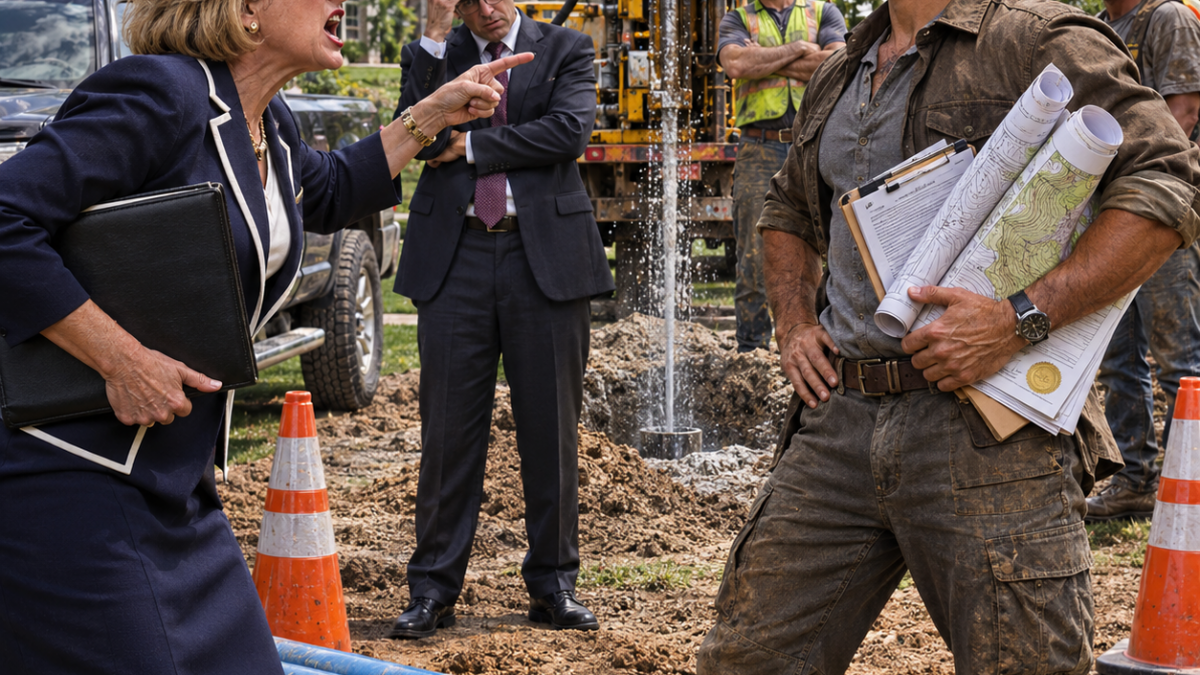
Three days later, Patriot Drilling arrived.
The truck was large enough to make Karen’s warnings look briefly plausible.
Derrick.
Hydraulic rig.
Support trailer.
Mud-control equipment.
Gunny stepped down.
“Doc.”
“Gunny.”
He looked along the cul-de-sac.
“Where’s the dictator?”
“Removed.”
“Damn.”
“You wanted to meet her?”
“I brought ear protection.”
Neighbors came outside.
Not angry.
Curious.
Carlos stood on his porch.
Thumbs-up.
Rachel and Tim brought Leo to the window.
He waved.
I waved back.
The drill began.
Yes, it was loud.
Karen had been correct about one thing.
Drilling isn’t delicate.
Steel turns.
Mud circulates.
Rock fragments come up.
Engines run.
For two days my yard looked like a small industrial site.
But exactly as my report predicted, the disruption remained contained.
No sinkholes.
No cracked houses.
No contaminated municipal pipes.
No collapsing clubhouse.
By afternoon on the second day, the drill reached the formation I expected.
Gunny watched returns.
Then smiled.
“We’re there.”
The sound changed.
Every driller knows that moment.
Water.
Good production.
Strong.
Clear after development.
I stood beside the rig with my hands in my pockets.
Twenty years finding water in places where it was difficult.
And somehow this one felt more personal.
Gunny shouted:
“Good well, Doc!”
I laughed.
Pump testing followed.
Yield excellent for residential use.
Water chemistry clean.
Mineral profile manageable.
No contamination.
No surprise.
But seeing numbers confirm prediction never gets old.
Within a week:
Casing complete.
Pump installed.
Pressure tank.
Treatment only where useful.
Connection to irrigation.
Separate plumbing configuration according to code.
Backflow protections.
Everything inspected.
Everything legal.
I opened the first exterior faucet.
Water ran cold over my hand.
I tasted it.
Gunny watched.
“Well?”
“Good.”
“You sound disappointed.”
“I predicted good.”
He shook his head.
“Scientists.”
The fight could have ended there.
It didn’t.
The new board immediately hired a forensic accountant.
Carlos called me two weeks later.
“You should come over.”
“Why?”
“Karen.”
I sighed.
“I thought we were done.”
“We might need your records.”
The audit had found much more than related-party awkwardness.
Suburban Solutions.
Questionable consulting payments.
Landscaping bills.
Reimbursements.
Missing documentation.
Payments with no legitimate association purpose identified.
The amount under review grew.
Twenty thousand.
Forty.
Seventy.
Eventually more than one hundred thousand dollars over several years was questioned.
The board referred the findings to appropriate authorities.
I stayed careful.
I did not tell neighbors Karen had stolen one hundred thousand dollars.
I said:
“The audit identified expenditures requiring investigation.”
Ben approved.
“Boring.”
“Exactly.”
The legal process moved slowly.
Investigators reviewed.
Karen’s brother-in-law was questioned.
Vendors produced records.
Some payments had legitimate explanations.
Others did not.
Eventually charges followed.
By then, Karen had listed her house.
About a month after drilling, a moving truck appeared.
I was outside watering a flower bed.
With my well water.
The flowers were a deliberately chaotic mix.
Purple coneflower.
Black-eyed Susan.
Salvia.
Lavender.
Several varieties Karen would have hated.
I didn’t plant them to annoy her.
Not entirely.
She walked out of her house as movers carried furniture.
She looked different.
No navy suit.
No oversized sunglasses.
No clipboard.
Sweatshirt.
Jeans.
Tired.
She saw me.
Then the hose.
Then the flowers.
The symbolism was almost embarrassing.
I didn’t smile.
She stared.
I nodded once.
Not triumph.
Acknowledgment.
She looked away.
Went back inside.
That should have been the final confrontation.
Real life gave me another.
Several weeks later, I stopped at a local coffee shop.
Karen sat alone.
I considered leaving.
Then she saw me.
“Marcus.”
“Karen.”
I ordered coffee.
She surprised me.
“Can we talk?”
I sat across from her.
“About what?”
She looked at her cup.
“Why did you do all this?”
I almost laughed.
“I wanted a well.”
“No.”
She shook her head.
“The meeting. Finances. Neighbors.”
“You blocked my permit.”
“That doesn’t explain destroying me.”
I studied her.
“You think I destroyed you?”
“Don’t play innocent.”
“I’m not.”
I leaned back.
“I started documenting because you were threatening me.”
She stared.
“Then I met the Garcias.”
Nothing.
“The Wilsons.”
Her jaw tightened.
“Karen, you told the parents of a disabled seven-year-old that his wheelchair ramp looked too medical.”
“It didn’t comply.”
“It was a ramp.”
“There were approved alternatives.”
“They couldn’t afford them.”
She looked away.
I continued.
“You charged retired people thousands because sunlight made their approved paint color look wrong.”
“They should have appealed.”
“They did.”
Silence.
“You denied them.”
She touched the coffee cup.
“I was trying to maintain consistency.”
“That word did a lot of work for you.”
Her eyes sharpened.
“You think rules don’t matter?”
“No.”
That surprised her.
“Rules matter.”
I leaned forward.
“But rules need boundaries.”
“You didn’t want to follow ours.”
“There was no well prohibition.”
“You exploited a loophole.”
“No.”
I shook my head.
“You tried to invent a rule after I applied.”
She didn’t answer.
I continued.
“You could have proposed a covenant amendment.”
“That would’ve taken a community vote.”
“Exactly.”
She stared at me.
There it was.
The thing she never understood.
The difficulty was the safeguard.
If Karen wanted to ban wells, she needed residents to agree.
Instead, she tried to create a ban through interpretation because interpretation let her keep control.
After a long silence she asked:
“Did you really map the aquifer?”
“Yes.”
Her mouth tightened.
“You could’ve told me that the first day.”
“I asked you for the rule.”
“That wasn’t the same.”
“No.”
“It would’ve changed my approach.”
I considered that.
“Would it?”
She looked at me.
I let the question sit.
Finally she said:
“Maybe.”
Then:
“I thought you were testing me.”
“I was applying for a well.”
“You were calm.”
I almost smiled.
“That offended you?”
“It made me think you didn’t respect the board.”
“I respected the process.”
“Not me.”
“No.”
Her face hardened.
At least that part was honest.
“You expected respect because of your title.”
“I earned that position.”
“You won a neighborhood election.”
She flinched.
I softened.
“That isn’t nothing.”
“Sounds like it.”
“No. Community leadership matters.”
I looked at her.
“That’s why abusing it matters too.”
She didn’t speak.
When we left, there was no apology.
But something had shifted.
Months later, I heard she entered a plea related to financial misconduct.
Details were more complicated than neighborhood gossip.
They always are.
Some expenditures were recoverable.
Some disputed.
Some criminally charged.
Her brother-in-law faced his own investigation.
The HOA pursued restitution through civil channels where appropriate.
Karen sold.
Moved.
Whispering Pines remained.
That’s important.
People talk about “destroying the HOA” as if the organization itself was the enemy.
It wasn’t.
An HOA is paperwork.
People.
Budget.
Maintenance.
Rules.
It becomes good or bad depending on governance.
The new board proved that quickly.
Carlos published monthly financial reports.
Every vendor contract above a threshold required competing bids.
Related parties had to disclose relationships.
Appeals were heard by members who hadn’t issued the original violation.
Fine schedules became clear.
No invented daily penalties.
No retaliation through architectural review.
Then the Wilson ramp.
Rachel submitted updated drawings.
The board approved them in one meeting.
Not only that.
Carlos proposed using a community accessibility fund to help cover construction.
Approved.
A local carpenter volunteered part of the labor.
I helped with site drainage.
When the ramp was finished, Leo came outside by himself.
No garage workaround.
No parent lifting him over steps.
He rolled onto the front porch.
Stopped.
Then turned in a circle.
Tim looked away so nobody would see him cry.
I saw.
So did Carlos.
Nobody said anything.
That’s what victory looked like.
Not my well.
That ramp.
The Garcias repainted their shutters.
Same exact color Karen had fined.
The new board reviewed the manufacturer code.
Approved.
Elena invited half the neighborhood over just to watch the paint dry.
She served cake.
I told her that was excessive.
She said:
“So were seven thousand dollars in fines.”
Fair.
The widow’s memorial bench returned.
Children drew chalk pictures.
Basketball hoop stayed.
Rules still existed.
People couldn’t abandon vehicles.
Couldn’t build dangerous structures.
Couldn’t dump garbage.
Property standards remained.
But “I don’t like it” was no longer enough.
My well became boring too.
Exactly what I wanted.
Pump cycles.
Pressure tank.
Annual testing.
Filter change.
I installed a rain-sensitive irrigation controller.
Garden improved.
Water bills dropped.
Then municipal rates increased.
Not 300 percent overnight like rumor turned my projection into.
But steadily.
Infrastructure upgrades.
Treatment requirements.
Energy.
Whispering Pines started discussing whether community irrigation should use alternative sources.
Carlos called.
“You’re going to enjoy this.”
“No.”
“We’re considering a shared irrigation well.”
I laughed.
“You’re kidding.”
“No.”
“What does the HOA say?”
“Marcus.”
“What?”
“I am the HOA.”
“Terrifying.”
He invited me to consult.
I refused payment.
Did the hydrogeology.
Different location.
Different draw.
Larger system.
Real analysis.
Unlike Karen, Carlos never assumed one residential well proved unlimited capacity.
We modeled it properly.
County reviewed.
Residents voted.
Approved.
The community installed a common irrigation well for landscaped common areas.
Water costs dropped.
David Chen called.
“I heard Whispering Pines likes wells now.”
“History is cruel.”
“Did they name it after you?”
“They better not.”
They didn’t.
Smart.
Years passed.
Carlos eventually stepped down.
Rachel Wilson became president.
Leo was a teenager by then.
His wheelchair had changed.
His independence had grown.
One afternoon he rolled into my driveway while I worked on the pump house.
“Mr. Thorne?”
“Marcus.”
“My mom says you helped with my ramp.”
“Lots of people did.”
“You’re the water guy?”
“Apparently.”
He grinned.
“I want to study engineering.”
“What kind?”
“Mechanical.”
“Wrong answer.”
He laughed.
“Mom said you’d say that.”
He looked at the well house.
“Is groundwater engineering hard?”
“Everything useful is hard sometimes.”
“Did you really work in war zones?”
“Yes.”
“Scary?”
“Sometimes.”
He thought.
“Was Karen scary?”
I laughed.
“Different kind.”
He smiled.
Then became serious.
“Why didn’t people stop her earlier?”
Best question anybody had asked.
“Because most people thought they were the only one having trouble.”
He nodded.
“And?”
“Because fighting costs energy.”
“And?”
“Because authority looks official even when it’s wrong.”
He looked toward his house.
“My mom says meetings matter.”
“Your mother is correct.”
He groaned.
“Don’t tell her.”
The older I got, the more I thought about that.
Karen didn’t become powerful because every resident loved her.
She became powerful because most residents had better things to do.
Jobs.
Children.
Medical problems.
Retirement.
Life.
Nobody wants to spend Tuesday night reading Article Eleven.
Karen did.
She learned process.
Then used everyone else’s disinterest against them.
The solution wasn’t to make every homeowner obsessed with HOA governance.
It was to create systems that didn’t depend on one person’s personality.
Transparency.
Independent review.
Clear standards.
Term limits.
Financial controls.
Rules for conflicts.
Boring structures.
Boring is underrated.
My own life became boring again too.
Good boring.
Morning coffee.
Garden.
Consulting occasionally.
County water advisory work when David guilted me.
I taught a few university seminars.
Hydrogeology students loved the HOA story.
Mostly because professors rarely include petty suburban dictators in lectures on groundwater.
I used it to teach uncertainty.
“Never say zero impact,” I told them.
One student raised her hand.
“But in your HOA presentation, you said the well would have zero negative impact.”
“I was angry.”
Laughter.
“Professionally, we say no measurable adverse impact under expected operating conditions.”
More laughter.
“But isn’t that less dramatic?”
“Yes.”
“Then why use it?”
“Because science isn’t there to entertain you.”
I thought about Karen’s Facebook post.
*Drain our precious aquifer.*
*Destabilize the community.*
Fear loves dramatic certainty.
Science usually sounds boring because it includes scope.
Conditions.
Probability.
Magnitude.
Karen weaponized uncertainty.
I countered with data.
But I also learned that expertise can become its own arrogance.
After winning, residents started treating me like every water question needed my answer.
One man asked whether his basement moisture meant an aquifer was rising.
Another wanted me to identify a wet patch by photograph.
A woman blamed hard water on the new community irrigation well.
I started saying:
“I don’t know.”
People were surprised.
That matters too.
Experts need boundaries.
Knowing a regional aquifer doesn’t mean knowing every pipe.
Karen’s greatest mistake was certainty without expertise.
I didn’t want the opposite mistake:
Expertise turning into certainty about everything.
David Chen retired.
At his retirement dinner, he told the well story.
“He sent me 218 pages.”
Everybody laughed.
“I asked for none of them.”
More laughter.
“That’s Marcus. If you ask him whether it’s going to rain, he’ll send precipitation normals back to 1940.”
I stood.
“Hydrologic records matter.”
He pointed.
“See?”
Afterward he handed me a small framed copy of the regional aquifer map.
At the bottom he’d written:
**FOR THE MAN WHO WOULD LIKE EVERYONE TO KNOW HE HELPED MAP THIS.**
I protested.
He reminded me I’d announced it to an entire HOA meeting.
Fair.
The map hangs in my office.
Not as a trophy.
Mostly.
Karen’s old house sold to a young family.
The first year, the new owner knocked on my door.
Name was Daniel.
“Sorry to bother you.”
“No problem.”
“We’re thinking of planting a tree near the property line.”
“Okay.”
“Do we need HOA approval?”
“Probably for species or placement, depending rules.”
He looked nervous.
“I heard stories.”
I understood.
“Karen stories?”
“Yes.”
I smiled.
“Current board isn’t Karen.”
“That good?”
“Yes.”
“Should I ask Rachel?”
“Absolutely.”
He did.
Tree approved.
Nothing dramatic happened.
That’s healthy governance.
Eventually, even Karen’s name stopped being shorthand for everything.
New families moved in who never knew her.
The Garcias aged.
Carlos died at eighty-six.
At his funeral Elena hugged me.
“He liked you.”
“I liked him.”
“He complained about your technical reports.”
“Reasonable.”
“He said nobody needs 218 pages for one hole.”
“Also reasonable.”
Elena laughed through tears.
Then she looked toward the community.
“He was proud.”
“Of what?”
“People stopped being afraid.”
That stayed with me.
The Garcias had lost thousands because one woman decided eggshell beige wasn’t beige enough.
Years later, Carlos had served as interim president and helped build a system where nobody could do that so easily again.
That’s more satisfying than revenge.
It’s repair.
Elena remained in the house.
Her shutters faded.
When repainting time came, Rachel offered to help file the approval.
Elena refused.
“I know the form now.”
She submitted it herself.
Approved in two days.
Same eggshell.
Some wounds deserve boring endings.
The Wilson family moved when Leo started college.
Engineering.
Mechanical, despite my efforts.
Before leaving, Tim came over.
“Remember the garage?”
“Yes.”
“We’re selling the house to another family with a disabled daughter.”
“That seems fitting.”
“They loved the ramp.”
I looked toward it.
Good design.
Wood.
Wide landing.
Gentle slope.
Not “medical.”
Just useful.
Tim said:
“Thank you.”
I shook my head.
“You built it.”
“You helped change the people who said no.”
“They changed themselves.”
He didn’t believe that.
Maybe neither did I completely.
The HOA’s shared irrigation well ran smoothly.
Then one summer drought hit.
People panicked.
Old Karen language resurfaced in a new form.
“Wells are draining the aquifer.”
I went to a community meeting voluntarily.
First time in years.
Rachel smiled.
“I didn’t even have to subpoena you.”
“Don’t get excited.”
I presented actual monitoring data.
Aquifer level lower seasonally.
Within historic drought range.
Community irrigation system contributing some drawdown but not remotely responsible for regional conditions.
Recommended conservation.
Reduced watering days.
Monitoring.
Residents listened.
Nobody shouted.
Nobody accused anybody of destroying property values.
They voted to reduce irrigation.
Two months later, levels stabilized with rains.
That meeting meant more to me than the one where Karen was removed.
Same community.
Same subject.
Water.
Completely different culture.
Evidence discussed.
Questions asked.
Decision made.
No villain needed.
That’s progress.
When I turned seventy, I began planning to leave Whispering Pines eventually.
Not because I disliked it.
Because the two-acre property was more than I needed.
Garden too large.
House too large.
Well maintenance easy, but everything else less so.
Rachel heard.
“You can’t move.”
“That’s not how property works.”
“Do you know what this will do to neighborhood mythology?”
“I hope destroy it.”
I sold to a couple named Erin and Matt.
Before closing, I showed them everything.
House.
Well.
Pump.
Pressure system.
Test history.
Setbacks.
Maintenance.
Then HOA documents.
Matt looked alarmed.
“I heard this HOA was terrible.”
“It was.”
“And now?”
“Annoyingly functional.”
Erin pointed at the well.
“Can the board make us disconnect it?”
“No.”
“Because you won?”
“Because it was approved legally and recorded properly.”
“Did you put that in writing?”
I handed them the file.
She laughed.
“That’s a lot.”
“You should have seen the original report.”
I kept one copy.
Of course.
On moving day, I stood near the hose bib.
Turned it on.
Water flowed.
Same clear stream I’d watched after drilling.
The well had become so ordinary I hadn’t thought about the fight in years.
That’s what I wanted.
Infrastructure should disappear into daily life.
You notice water when it stops.
You notice governance when it fails.
Good systems work quietly.
Rachel came over.
“You’re really going.”
“Yes.”
“Any final advice?”
“For the HOA?”
“Yes.”
“Don’t make me come back.”
She laughed.
Then:
“Seriously.”
I thought.
“When somebody tells you no, ask why.”
She waited.
“When somebody tells you yes, ask why too.”
“That’s it?”
“And publish the budget.”
“Already do.”
“Then you’ll survive.”
I drove away from Whispering Pines with fewer emotions than expected.
Not sad.
Not triumphant.
Complete.
Years later, I received a photograph from Erin.
The well house.
Fresh paint.
Garden exploding with tomatoes.
She wrote:
**Still running beautifully. HOA approved a rain garden too. Thought you’d appreciate that.**
I did.
Then another photo.
Regional water-conservation workshop in the clubhouse.
A speaker stood beside the old aquifer map.
My map.
The one David had framed.
Rachel had apparently borrowed a public version for education.
The caption:
**KNOW WHAT’S UNDER YOUR FEET.**
That made me smile.
Karen once used fear of groundwater to keep control.
Now the same community was teaching residents how groundwater actually worked.
No revenge could beat that.
I don’t know much about Karen’s life after she left.
I heard pieces.
Legal proceedings.
Financial restitution.
Family trouble.
Then nothing.
That’s fine.
For a long time, I imagined justice as seeing the person who hurt you suffer an equal amount.
Age changes the arithmetic.
Justice isn’t symmetry.
Sometimes it’s simply stopping harm.
Repairing what can be repaired.
Building guardrails.
Moving forward.
Karen lost her office.
Faced consequences.
Left.
The Garcias got peace.
Leo got his ramp.
The community got transparent books.
I got my well.
Years after everything, I attended a groundwater conference.
Young hydrologist approached me.
“Are you Marcus Thorne?”
“Yes.”
“I heard the HOA story.”
I sighed.
“Of course.”
“My professor uses it.”
“Why?”
“As an example of public communication.”
“God help us.”
She laughed.
Then asked:
“What was the hardest part?”
I expected her to mean modeling.
Permit.
Politics.
I thought for a moment.
“Not becoming Karen.”
She looked confused.
I explained.
“When you know you’re right technically, it’s easy to start believing you’re right about everything.”
She listened.
“Karen thought authority made her expertise universal.”
I pointed toward the conference room.
“Experts can do the same thing in reverse.”
“So how do you avoid it?”
“Keep asking what evidence would change your mind.”
She wrote that down.
I laughed.
“Don’t quote me.”
She probably did.
That became my final lesson from Whispering Pines.
The well fight started because Karen refused to accept limits.
Limits on HOA power.
Limits on her knowledge.
Limits on her right to control neighbors.
I won because the documents defined those limits.
The science defined limits too.
Aquifer capacity isn’t infinite.
Wells aren’t harmless by definition.
Groundwater can be overdrawn.
Bad drilling can contaminate supplies.
Subsidence is real in the right geology.
Karen’s claims weren’t absurd because those things never happen.
They were absurd because she had no evidence they would happen there.
Context matters.
Evidence matters.
Scale matters.
Those are scientific principles.
They happen to be good principles for living around other people too.
The last time I drove past Whispering Pines, I didn’t stop.
I slowed.
Saw Carlos’ old house.
Eggshell shutters.
Wilson ramp still there.
Community landscaping.
No Karen.
Couldn’t see the well from the road.
Perfect.
I kept driving.
Somewhere beneath those houses, water moved slowly through rock.
It had been there before Whispering Pines.
Before Karen.
Before me.
Before the county road.
Groundwater does not care about HOA elections.
It follows gradient.
Pressure.
Permeability.
Gravity.
Rules much older than any covenant.
Maybe that’s why I spent my career studying it.
There is comfort in systems that cannot be bullied.
Karen could reject my form.
She could invent fees.
She could delete Facebook comments.
She could hold a gavel.
She could not make water flow uphill because the board voted for it.
Reality has boundaries.
Eventually, even powerful people have to meet them.
My first well at Whispering Pines still operates.
Erin sends a test report occasionally because she knows I’ll read it.
Last one:
Good yield.
Stable chemistry.
No unusual decline.
I replied:
**Looks good. Don’t overpump. Test annually.**
She wrote back:
**Yes, Professor.**
Fair.
Sometimes I think about that first afternoon.
Karen standing on my lawn.
My permit crumpled in her hand.
Flowers.
Garden hose.
Mailbox.
She wanted me to feel small.
Instead she forced me to remember exactly who I was.
Not because hydrogeologist is an impressive title.
Because expertise gave me confidence to ask for evidence instead of permission.
And once one person started asking:
**Where is that rule?**
Other residents started asking:
**Where did our money go?**
**Why was our appeal denied?**
**Why can’t Leo have a ramp?**
**Why are approved shutters suddenly illegal?**
Questions did what anger couldn’t.
They broke the illusion that Karen’s opinion was the same thing as authority.
That’s how her power ended.
Not with a fist.
Not with a threat.
With documents.
Votes.
Data.
Neighbors.
A permit.
And finally, a drilling rig turning slowly through the ground toward water that had been there the entire time.
I can still remember the first cold stream running across my hand.
After months of fighting, it felt almost absurdly simple.
Water doesn’t look like victory.
It’s clear.
Quiet.
Ordinary.
But maybe the best victories are like that.
They stop feeling like battles and start feeling like normal life.
Karen had tried to make my well a symbol of defiance.
For years afterward, it was just how I watered tomatoes.
That’s the ending I wanted.
Not her humiliation.
Not my reputation.
Not even the story people told.
A faucet.
A garden.
A child rolling safely down his own front ramp.
An elderly couple no longer afraid of a paint inspection.
Neighbors who could attend meetings without wondering which petty violation would arrive afterward.
And water moving quietly beneath all of us.
Karen believed leadership meant controlling the surface.
The right flowers.
The right mailbox.
The right shutters.
The right hose.
The right ramp.
The right source of water.
I had spent my career looking underground.
Maybe that’s why I saw the problem differently.
What keeps something alive is rarely the surface appearance.
It’s what flows underneath.
Trust.
Fairness.
Competence.
Respect.
Those were the real resources Whispering Pines had depleted.
The well didn’t restore them.
The people did.
I simply drilled the first hole.
And when the water finally came up clear and cold from the aquifer I had helped map years earlier, I understood exactly what I had won.
Not permission.
Not revenge.
Something better.
The right to live peacefully under rules that applied to everyone—including the people who wrote them.
[END OF STORY]








