PART 2: HOA Tried to Ban My Outdoor Furnace—Then 30 Freezing Neighbors Ended Up at My Door
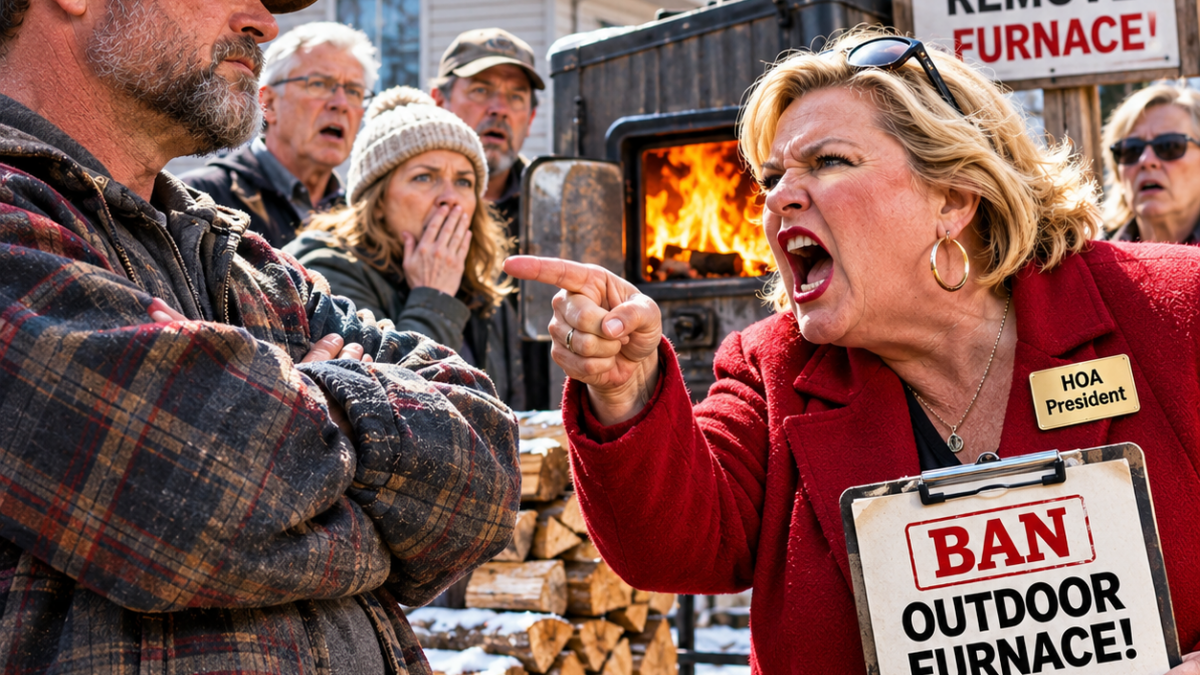
PART 2
The morning after Karen’s ultimatum, I woke before sunrise.
Sarah was already in the kitchen.
She had always been better than I was at detecting the difference between anger and silence.
“You’re doing the quiet thing,” she said.
I poured coffee.
“What quiet thing?”
“The one you used to do when somebody at the base had made a serious mistake and you were about to spend three days proving it.”
“That is a very specific quiet thing.”
“I lived with you through fourteen inspections.”
She slid a plate toward me.
“Eat.”
I sat.
Outside, the furnace circulated heat through the house.
The floor beneath my feet was warm.
Sarah looked toward the window.
“Are we going to lose the house?”
“No.”
“You know that?”
“No.”
She stared at me.
“That was not reassuring.”
I put down my coffee.
“The fines are based on a bylaw amendment passed after the furnace was approved.”
“Okay.”
“The approval is written.”
“Yes.”
“The amendment was clearly targeted.”
“Yes.”
“And their lien threat may give us grounds to fight much more aggressively.”
“May?”
“I’m not a lawyer.”
“Then please get one.”
“I will.”
She exhaled.
“Thank you.”
I reached across the table.
“I’m not gambling with our home.”
“I know.”
She squeezed my hand.
“I also know that when somebody tells you something is impossible, you treat it like a personal invitation.”
“That is unfair.”
“It is extremely fair.”
I smiled despite myself.
The first thing I bought that morning was not legal advice.
It was a binder.
Heavy-duty.
Three-inch spine.
Dividers.
Plastic sleeves.
Yellow tabs.
Red tabs.
Green tabs.
Sarah watched me unload everything onto the dining-room table.
“Oh no.”
“What?”
“You bought office supplies.”
“Yes.”
“Karen is doomed.”
I ignored her.
I labeled the binder.
**WILLOW CREEK HOA — FURNACE / ENFORCEMENT / FINANCIAL**
Then I started filling it.
Approval letter.
My original application.
Manufacturer information.
Emissions certification.
Video log.
First complaint.
My response.
Second complaint.
New bylaw.
Meeting notice.
Fine notices.
Certified-mail receipts.
Every page dated.
Every envelope preserved.
Then I sent a formal records request to the HOA management company.
Five years of:
meeting minutes,
board votes,
financial reports,
contracts,
budgets,
reserve-fund statements,
violation records where legally available,
and correspondence regarding the new furnace amendment.
Karen called me the day the request arrived.
“What are you doing?”
“Requesting records.”
“Why?”
“I’m a homeowner.”
“That doesn’t answer the question.”
“I’m entitled to review association records.”
“Jack, this constant escalation is unnecessary.”
I nearly laughed.
“I’m escalating?”
“You could end all of this by removing the furnace.”
“I could also end it by selling the house.”
Silence.
“Are you threatening to leave?”
“No.”
“Then what is your point?”
“That your preferred solution isn’t automatically mine.”
She lowered her voice.
“You have made yourself very unpopular.”
“That sounds difficult to measure.”
“It’s not.”
“I’m sorry to hear it.”
“You think this is funny?”
“No.”
“Then take it seriously.”
“I am.”
That was the truth.
Karen just didn’t understand what serious looked like when it wasn’t loud.
While I waited for the records, I started walking the neighborhood.
I had spent years inspecting aircraft.
You learn to notice deviations.
Missing fastener.
Uneven panel.
Fluid stain.
Hairline crack.
Willow Creek had deviations too.
Basketball hoop left beside a driveway.
Fence one shade off approved color.
Mailbox slightly tilted.
Garden ornaments.
Children’s playset.
Work van parked overnight.
Nothing serious.
But Karen had fined people for less.
I started noticing who looked nervous when her white SUV drove past.
Those were the people I wanted to talk to.
Mrs. Gable was first.
She was a widow in her seventies who lived on a corner lot.
Her yard was impossible not to like.
Roses.
Birdhouses.
Wind chimes.
Colorful ceramic animals.
And seven garden gnomes.
I found her pruning roses.
“Afternoon.”
She looked up.
“Hello, Jack.”
“I like the gnome.”
She stared toward the one holding a fishing rod.
“Don’t let Karen hear you.”
I smiled.
“I’m serious.”
She lowered her voice.
“She fines me for him.”
“For the gnome?”
“One hundred dollars.”
“Once?”
“Every month he stays.”
I thought she was joking.
She wasn’t.
“Why not remove him?”
Mrs. Gable straightened.
“His name is General Norman.”
“That doesn’t answer my question.”
“My husband gave him to me before he died.”
That answered everything.
She looked toward the street.
“Karen says he violates the approved ornament guidelines.”
“How many letters?”
Mrs. Gable laughed bitterly.
“How much time do you have?”
Inside her house was a shoebox.
Dozens of violation letters.
Bird feeder too close to property line.
Hose improperly stored.
Gnome.
Flower border.
Decorative bench.
Seasonal wreath displayed past deadline.
It was ridiculous.
Then I looked at the checks.
She had paid.
Not because she agreed.
Because she was scared.
“I can’t afford lawyers,” she said.
“So I pay the hundred dollars.”
“Then the next one comes.”
I felt my anger change.
Until then, Karen’s campaign had been personal.
My furnace.
My home.
Now I saw the system.
One frightened homeowner at a time.
I asked Mrs. Gable’s permission to copy everything.
She hesitated.
“Will Karen know?”
“Not unless we use it.”
“Use it for what?”
“I don’t know yet.”
She looked toward General Norman through the window.
Then back at me.
“Copy them.”
That afternoon, General Norman became Tab Four in my binder.
The HOA records arrived several days later.
I expected resistance.
Instead, the management company apparently understood its legal obligation better than Karen did and sent a thick envelope.
I worked until two in the morning for three straight nights.
Meeting minutes first.
Then budgets.
Then contracts.
Then expenditure reports.
Patterns emerged.
Some votes occurred without proper quorum.
Several expensive projects exceeded thresholds that should have required homeowner approval.
Landscaping contracts repeatedly went to Davis Lawn & Garden.
Karen’s brother-in-law.
Rates substantially above competing local companies.
Then the beautification fund.
Fine revenue went in.
Large vague expenses came out.
**Seasonal Enhancement.**
**Entrance Improvement.**
**Landscape Refresh.**
**Community Aesthetic Upgrade.**
Thousands.
Then tens of thousands.
Sarah found me staring at the spreadsheet.
“What?”
I pointed.
“Look.”
She leaned down.
“What am I looking at?”
“Fine revenue.”
“Okay.”
“Now look here.”
“Landscaping.”
“Same quarter.”
She frowned.
“Again?”
“Every year.”
“What does that mean?”
“I don’t know yet.”
She looked at me.
“You definitely think you know.”
“I think Karen fines people aggressively and a large amount of that money flows into projects awarded to her brother-in-law.”
“That sounds terrible.”
“It sounds suspicious.”
“Difference?”
“Evidence.”
Sarah kissed the top of my head.
“Please sleep.”
Then came the geothermal issue.
Three years earlier, another homeowner requested rooftop solar.
Karen personally argued against it.
Aesthetic disruption.
Visual harmony.
Potential effect on property values.
Request denied.
That same quarter, the HOA paid five thousand dollars to a green-energy consultant.
I searched the company.
Geothermal installations.
The following spring, Karen’s home had a geothermal system installed.
I couldn’t prove the HOA had paid for her system.
I didn’t claim that.
But now I had a pattern of conflicts that deserved scrutiny.
The binder was no longer about one furnace.
I called an old Air Force friend.
Dave Johnson.
Everyone called him Bulldog.
He had spent years as a paralegal before retirement.
He also had survived his own HOA war involving a flagpole.
I explained everything.
He listened.
When I finished, he said:
“You’re making one mistake.”
“What?”
“You still think this is about your furnace.”
“It started there.”
“No.”
“It started wherever she learned nobody would challenge her.”
That landed.
“What do I do?”
“Lawyer.”
“Working on it.”
“Good lawyer.”
“That seems obvious.”
“No.”
He laughed.
“Find somebody who hates procedural abuse.”
“That’s specific.”
“Also build allies.”
“I’ve talked to Mrs. Gable.”
“Perfect.”
“Don’t build a mob.”
“Build witnesses.”
“People with documents.”
“People with different injuries.”
“Show a pattern.”
I wrote everything down.
Then Bulldog said:
“And don’t show Karen your whole hand.”
“I wasn’t planning to.”
“Good.”
“She thinks you’re one angry homeowner.”
“Let her keep thinking that.”
My lawyer was Maria Sanchez.
Former Army JAG.
Property litigation.
Small firm.
Sharp eyes.
Zero patience for nonsense.
I put the binder on her desk.
She looked at it.
“How long have you been retired?”
“Two years.”
“You miss paperwork?”
“No.”
“Could’ve fooled me.”
She opened the first section.
Read my furnace application.
Then Karen’s approval.
Then the new bylaw.
Maria looked up.
“She signed this approval?”
“Yes.”
“And later presided over a rule specifically banning the category she approved?”
“Yes.”
“After complaints she couldn’t substantiate?”
“Yes.”
“Then fined you retroactively?”
“Yes.”
“Threatened lien?”
“Yes.”
Maria leaned back.
“That’s interesting.”
I showed her Mrs. Gable.
Financials.
Contracts.
By the time I reached the brother-in-law landscaping company, she held up one hand.
“Stop.”
“What?”
“You have two different cases trying to emerge from one binder.”
“What do you mean?”
“One is your furnace.”
She tapped the approval.
“Targeted enforcement.”
“Retaliation.”
“Potential improper lien.”
“Procedural defects.”
Then she tapped the financial section.
“The other is governance.”
“Conflict of interest.”
“Selective enforcement.”
“Possible fiduciary breaches.”
“Potential financial misconduct.”
“Do not mix speculation with facts.”
“I haven’t.”
“Good.”
She smiled faintly.
“That discipline is going to annoy Karen more than anger ever could.”
Maria sent the HOA’s registered agent a formal response.
The new bylaw was challenged.
The fines disputed.
Any lien would be contested.
Board members were warned that knowingly pursuing retaliatory enforcement could expose them personally depending on the circumstances.
Karen answered herself.
That was a mistake.
Her letter read:
**Your client’s attempts at intimidation are noted and dismissed.**
She called me a disgruntled homeowner.
Said the rules were not subject to individual whims.
Then wrote:
**Perhaps Mr. Miller would be happier living in a less civilized community.**
Maria called.
“Please tell me you still have the envelope.”
“Yes.”
“Keep it.”
“Why?”
“Because she just made your argument easier.”
The daily fines accelerated.
Five hundred.
One thousand.
Fifteen hundred.
Ten thousand.
Twenty thousand.
Every notice went into the binder.
I stopped feeling anxiety when they arrived.
They were no longer threats.
They were exhibits.
Meanwhile, I quietly talked to more neighbors.
The Millers—no relation to me—had two children and a cedar playset Karen said used an unauthorized wood species.
Tom Miller was an accountant.
Quiet.
Exact.
When I showed him the financial records, he became even quieter.
That worried me more than anger would have.
“Can I borrow copies?”
“Yes.”
“Why?”
“I want to reconcile these numbers.”
“For what?”
“Because something is wrong.”
Three days later, Tom returned with spreadsheets.
Charts.
Contract comparisons.
Fine revenue.
Beautification expenditures.
Payments to Davis Lawn & Garden.
He sat at my kitchen table.
Sarah gave him coffee.
Tom pointed.
“See this?”
“Yes.”
“Fine income goes up.”
“Beautification spending goes up almost immediately.”
“Okay.”
“And here.”
He pointed again.
“Landscaping contract amount.”
“Almost double market comparison.”
“Yes.”
“This doesn’t prove theft.”
“No.”
Tom nodded.
“But it proves we need a professional audit.”
“Exactly.”
Mrs. Gable began talking to other residents through her garden club.
Not rebellion.
Conversation.
Turns out gardeners know everything.
Within weeks, I had copies of violation letters from families across Willow Creek.
Different houses.
Different complaints.
Same pattern.
People Karen disliked got hammered.
People close to her were ignored.
Then the certified packet came.
**NOTICE OF LIEN.**
I read it once.
Then called Maria.
“She did it.”
“Did what?”
“Lien.”
Silence.
Then:
“Send it.”
I scanned every page.
Maria called twenty minutes later.
Her voice was controlled.
Almost cheerful.
“This changes the posture.”
“How?”
“Before this, we were fighting fines and an amendment.”
“Now she has created a recorded claim against your property.”
“So?”
“So now we challenge the lien directly.”
“We also examine slander-of-title claims and damages.”
“And we put the broader governance issues into litigation where discovery becomes available.”
“That sounds expensive.”
“It may be.”
Sarah was listening from across the table.
I looked at her.
Maria continued.
“But you asked me before whether we had enough to go on offense.”
“Yes.”
“We do now.”
Within forty-eight hours, the complaint was filed.
The HOA named.
Karen named individually where legally appropriate.
Improper lien.
Retaliatory enforcement.
Breach-of-duty allegations.
Procedural violations.
Damages.
Injunctive relief.
Legal fees.
Maria included enough of the financial pattern to make clear this wasn’t one homeowner throwing a tantrum.
Then Karen was served.
At the HOA meeting.
I didn’t arrange the timing for spectacle.
Maria did.
I attended.
Karen called the meeting to order.
Gavel.
Agenda.
Her voice booming.
Then the doors opened.
A process server walked in.
Former Marine.
Tall.
Stoic.
He approached the board table.
“Karen Davis?”
Her face changed.
“Yes?”
“You’ve been served.”
He placed the complaint in front of her.
Nobody moved.
Karen opened the top page.
Read.
Found her name.
Then found mine.
Her eyes locked onto me.
I didn’t smile.
That mattered.
This wasn’t a prank.
This was the moment she realized the man she had been fining was no longer asking her to be reasonable.
The legal system had entered the room.
Autumn turned into winter.
Motions.
Responses.
Discovery.
Emails.
Insurance questions.
Karen hired personal counsel.
The furnace kept working.
And that winter began getting colder.
Forecasters started using words people hate.
**Polar vortex.**
**Record lows.**
**Extended freeze.**
Then came the refinery fire.
At first, it was a small news alert.
Regional propane facility damaged.
Possible temporary disruption.
Then more details.
The refinery supplied a massive portion of the state.
Repairs would take weeks.
Maybe months.
Propane prices jumped.
People rushed to refill.
Suppliers rationed.
Willow Creek depended heavily on propane.
Nearly every house.
Except mine.
Karen’s house used geothermal.
Mine used wood.
Then the first blizzard arrived.
Two feet.
Wet heavy snow.
Roads closed.
Delivery trucks stopped.
Temperatures dropped.
Ten degrees.
Five.
Zero.
Wind chill twenty below.
State emergency warnings filled the television.
Conserve fuel.
Lower thermostats.
Check elderly neighbors.
Don’t use unvented heaters.
Protect pipes.
I loaded another armful of oak into the furnace.
Inside our house?
Seventy-two degrees.
Hot water.
Warm floors.
Workshop heated.
Sarah stood at the window.
“This is weird.”
“What?”
“Knowing everybody’s panicking about heat.”
I nodded.
“We’re okay.”
“Are we?”
“We have about three winter’s worth of seasoned wood if we burn carefully.”
She looked toward the woodshed.
“You planned for the apocalypse?”
“I planned for February.”
“Same thing where you grew up?”
“Pretty much.”
The first knock came late afternoon.
Bob.
The asthma guy.
The man who had stood at Karen’s town hall and claimed my furnace harmed his wife.
He stood on the porch in a thin fleece.
His face was pale.
“Jack.”
“Bob.”
He didn’t look at me.
“I need to ask something.”
I waited.
“Our tank is empty.”
That changed everything.
“When?”
“This morning.”
“House temperature?”
“Forty-four.”
“Kids?”
He finally looked up.
“They’re under blankets.”
His eyes were wet.
“I’ve called everybody.”
“No delivery for at least a week.”
Maybe more.
He swallowed.
“I know what I said at the meeting.”
“Yes.”
“I was an ass.”
“Yes.”
He almost smiled.
Then it disappeared.
“My daughter’s six.”
That was all he needed to say.
I opened the door.
“Bring them over.”
He stared.
“What?”
“Now.”
“Jack—”
“Bob.”
“Go get your family.”
An hour later, his wife and two kids were in our living room.
Sarah made hot chocolate.
The little girl sat near a floor vent.
Held both hands over it.
Closed her eyes.
“It’s so warm.”
Something about those four words destroyed every ounce of revenge I thought I wanted.
Bob sat across the room.
Ashamed.
I sat beside him.
“You don’t owe me anything tonight.”
He looked at me.
“I lied.”
“Later.”
“About the asthma.”
“I know.”
“I’m sorry.”
“Later.”
He nodded.
“Kids first.”
The next knock came before dark.
Tom Miller.
His propane tank was nearly empty.
Then another family.
Then Mrs. Gable.
Her furnace had stopped because her tank pressure fell too low.
Sarah took one look at her and said:
“Your room is the guest room.”
Mrs. Gable protested.
“Absolutely not.”
Sarah pointed.
“Guest room.”
Mrs. Gable obeyed.
By bedtime, fifteen people were in our house.
Children on sleeping bags.
Adults on couches.
Coffee constantly brewing.
Boots everywhere.
Wet gloves drying near the mudroom.
And outside?
The supposedly dangerous outdoor furnace ran steadily.
The machine Karen had described as a neighborhood menace had become the safest heating system on the street.
The irony was not lost on anyone.
But I refused to weaponize it.
No speeches.
No:
**I told you so.**
People were frightened.
That mattered more.
Day two got colder.
More neighbors arrived.
Twenty.
Then twenty-five.
Then nearly thirty during the daytime, some sleeping at relatives’ homes and returning because our house was warmer.
Sarah ran the kitchen like an emergency operations center.
Soup.
Coffee.
Oatmeal.
Hot chocolate.
Tom created a bathroom schedule.
Bob helped haul firewood.
Kids built forts.
Mrs. Gable taught them card games.
General Norman the Gnome even came over.
Her grandson carried him under one arm.
I stared.
“Why is he here?”
Mrs. Gable looked offended.
“He was cold.”
“He’s ceramic.”
“He has feelings.”
I put him beside the fireplace.
By the second evening, something strange happened.
People stopped dividing themselves by sides.
Karen supporter.
Anti-Karen.
Board critic.
Quiet homeowner.
None of it mattered when everybody’s hands were cold.
Bob and Tom split wood together.
Two women who had argued over landscaping rules cooked soup side by side.
Children from different streets slept in the same blanket fort.
Sarah caught me watching.
“What?”
“Nothing.”
“You’re emotional.”
“No.”
“You’re doing the face.”
“What face?”
“The one where you pretend you’ve got wood smoke in your eyes.”
“We’re nowhere near the chimney.”
“Exactly.”
That afternoon, a white news van pulled up.
Local station.
A producer knocked.
“Jack Miller?”
“Yes.”
“We heard you have an outdoor wood furnace.”
My first reaction was suspicion.
“Who told you?”
“Several people.”
She looked through the doorway.
Children.
Sleeping bags.
Neighbors.
“Is this a warming center?”
“Unofficially.”
Her name was Jessica Reed.
She asked permission to film.
I told everyone inside.
Nobody was pressured.
Several agreed.
Bob’s wife volunteered first.
On camera, she described waking up to a forty-degree house.
Watching her children shiver.
Calling every propane supplier.
Then walking across the street to the home of the man her husband had publicly criticized.
Her voice broke.
“He didn’t ask us to apologize.”
She looked toward me.
“He just opened the door.”
Tom explained the propane shortage.
Sarah described the household routine.
Then Jessica interviewed me at the kitchen table.
“Why did you install this furnace?”
“Reliability.”
“Cost?”
“That too.”
“Independence from one fuel source.”
“Did the HOA approve it?”
I put the laminated letter on the table.
Jessica read it.
“This is Karen Davis’s signature?”
“Yes.”
“And she later fined you for the same furnace?”
“Yes.”
“How much?”
“Tens of thousands claimed.”
“Lien?”
I slid that document over.
“Yes.”
Jessica stared.
“So the HOA is trying to remove the furnace currently keeping its residents warm?”
“Yes.”
“Why?”
“You’d need to ask them.”
Then I brought out the binder.
I did not accuse Karen of crimes.
I did not speculate.
I showed records.
Mrs. Gable joined us.
Jessica asked about the gnome.
Mrs. Gable straightened.
“His name is General Norman.”
That made the cameraman smile.
Then she described the monthly fines.
The garden hose.
Bird feeder.
Fear.
She looked directly into the camera.
“I’m too old to be scared of a woman with a clipboard.”
That line became the emotional center of the report.
The crew filmed outside.
The furnace.
Clean exhaust.
Woodshed.
Snow.
Then the warm house against the blue winter darkness.
They called Karen for comment.
She responded.
Her statement was spectacularly bad.
She called me a troublemaker.
Said the furnace was illegal.
Dangerous.
An eyesore.
Said the HOA would continue pursuing removal for the “safety and well-being of residents.”
The report aired at six.
Jessica closed it standing outside my house.
Her final line was simple:
“The furnace the HOA wants removed is currently helping keep roughly thirty Willow Creek residents warm during the region’s propane emergency.”
The story exploded.
Not nationally.
But statewide.
Then online.
People shared it.
Other stations called.
HOA board members’ phones rang nonstop.
Karen’s problem was no longer my binder.
It was reality.
You could argue bylaws.
You could spin budgets.
You could insult me.
You could not easily explain why the machine you called a danger was keeping children warm during a fuel shortage.
The board scheduled an emergency meeting.
Two nights later.
By then, limited propane deliveries had begun.
Some residents returned home.
Others still used our house during the day.
But the anger remained.
The clubhouse was packed.
Standing room only.
Karen entered.
No swagger.
Still defiant.
But tired.
She called the meeting to order.
“This emergency session has been called because of recent misleading media attention—”
A man stood.
“My family was in Jack’s house.”
Karen froze.
“What exactly was misleading?”
Applause.
She banged the gavel.
“Please sit down.”
Another voice:
“My mother was there.”
Then:
“Why are you trying to remove the only backup heat system in the neighborhood?”
Someone shouted:
“Resign!”
A second voice joined.
Then more.
“Resign!”
“Resign!”
Karen slammed the gavel.
“This meeting will not become a mob.”
I stood.
Maria beside me.
“If we’re going to discuss this, everyone should see the records.”
The room quieted enough.
Tom helped tape large poster boards to the wall.
Karen’s original signed furnace approval.
The later targeted amendment.
Fine notices.
Lien.
Quorum violations.
Financial charts.
Payments to Davis Lawn & Garden.
Fine revenue.
Beautification spending.
Mrs. Gable’s letters.
Then Tom stood.
He wasn’t theatrical.
That made him devastating.
“I’m an accountant.”
He pointed toward the chart.
“I’m not saying tonight that anyone committed a crime.”
He looked around.
“I am saying these numbers require an independent audit.”
Then he explained.
Fine income.
Contracts.
Conflicts.
Expenses.
Residents understood.
Money is a universal language.
Mrs. Gable stood next.
She held General Norman.
People laughed.
Then she spoke.
Not angrily.
That made it worse for Karen.
“I paid a hundred dollars every month because I was afraid.”
The room quieted.
“My husband gave me this silly little gnome.”
She held it up.
“He died six years ago.”
“I kept paying because I didn’t want trouble.”
She looked toward Karen.
“You knew that.”
Karen’s face tightened.
“You received multiple lawful notices.”
Mrs. Gable nodded.
“I know.”
“And every month you knew I was scared.”
Nobody laughed now.
Maria stepped forward.
She didn’t grandstand.
“My client’s case is already in court.”
She nodded toward me.
“So I will not argue litigation here.”
Then toward the posters.
“But every homeowner in this room has a right to ask whether board procedures were followed.”
“Whether conflicts were disclosed.”
“And whether association money was handled according to governing documents.”
Karen stood.
“This is a coordinated attack.”
Nobody responded.
“A conspiracy.”
Still nothing.
“Jack Miller believes rules do not apply to him.”
Bob stood.
That surprised everyone.
Especially Karen.
“No.”
He looked around.
“I said that once too.”
Then toward me.
“I stood right there and lied about his furnace.”
Karen stared.
Bob continued.
“I did it because I wanted you on my side over another issue.”
A murmur.
“My family would have spent the night in a forty-degree house if Jack had treated me the way I treated him.”
His voice cracked.
“He didn’t.”
Then Bob looked directly at Karen.
“You keep saying this is about community.”
He shook his head.
“It isn’t.”
“That man showed me what community is.”
Karen had no answer.
One of her fellow board members shifted in his chair.
He had always nodded with her.
Tonight he looked terrified.
Finally:
“I think…”
He swallowed.
“I think a vote of no confidence may be appropriate.”
Karen turned.
“You what?”
The other board member immediately seconded.
Not courage.
Survival.
But I accepted it.
The bylaws required two-thirds of homeowners present.
Hands rose.
Row after row.
Almost unanimous.
Karen looked around.
For years, her authority had existed because everybody agreed to behave as if it were absolute.
Now they didn’t.
Just like that, the power disappeared.
She gathered her purse.
No speech.
No apology.
She walked out.
The room erupted.
Applause.
Some people cried.
Mrs. Gable hugged Tom.
Bob hugged me before either of us had time to decide whether we were men who hugged.
Then the interim board was selected.
Tom was nominated president.
He tried to refuse.
His wife yelled:
“Do it!”
Everybody laughed.
He accepted.
His first motion:
“Rescind the amendment banning external auxiliary heating systems.”
Unanimous.
Second:
“Withdraw the lien against Jack Miller immediately.”
Unanimous.
Third:
“Commission an independent forensic audit of Willow Creek HOA finances.”
Unanimous.
Fourth:
“Issue a written apology to the Miller family.”
I raised a hand.
Tom looked at me.
“Jack?”
“Make it simple.”
“What?”
“No twelve-page lawyer language.”
A few people laughed.
“Just say what happened.”
Tom nodded.
“Deal.”
The lien was released.
The fines were voided.
The furnace remained.
But Karen’s problems continued.
The forensic audit went back five years.
Professionals handled it.
Not me.
That mattered.
Tom had found warning signs.
The auditors determined the real picture.
Contracts.
Payments.
Reserve funds.
Potential kickbacks.
Unapproved expenditures.
Records connected to Karen’s family.
The findings were referred to law enforcement.
I stayed out of the criminal side.
I had no interest in becoming prosecutor, judge, and jury.
Maria handled my civil case.
Karen’s lawyer approached settlement.
My legal fees.
Damages.
Lien expungement.
Full withdrawal of furnace enforcement.
Written acknowledgment that my original approval remained valid.
The dispute ended.
Karen eventually sold her house and left Willow Creek.
The last I heard, prosecutors were evaluating or pursuing serious financial charges arising from the audit.
I never saw her again.
For months afterward, neighbors kept asking if I felt victorious.
At first I said yes.
Then I realized that wasn’t quite right.
Victory had been the meeting.
Justice was the lien release.
Vindication was the news story.
But the moment I remembered most happened before all of that.
A six-year-old girl sitting beside a heating vent.
Hands extended.
Eyes closed.
Whispering:
“It’s so warm.”
That was when the entire fight changed for me.
The furnace stopped being a symbol of defiance.
It became a responsibility.
The following summer, several homeowners asked about installing backup heating.
Not all wood furnaces.
Pellet stoves.
Heat pumps.
Generators.
Solar battery systems.
Different options.
The new board created sensible standards.
Safety.
Setbacks.
Emissions.
Professional installation.
No arbitrary bans based purely on appearance.
Tom asked me to join the committee.
“No.”
“You know more about this than anyone.”
“That is exactly why I don’t want to attend HOA meetings.”
“Jack.”
“No.”
“I’ll buy beer.”
“What kind?”
He smiled.
I ended up helping.
Not as a board member.
Technical advisor.
We wrote rules with a simple principle:
If a restriction exists, it should protect something real.
Safety.
Noise.
Environmental impact.
Fire hazard.
Not one person’s taste.
Mrs. Gable became something of a neighborhood celebrity.
The news station returned months later for a follow-up.
General Norman appeared on television again.
After that, someone left a tiny Air Force helmet beside him.
Mrs. Gable kept it.
She also stopped receiving gnome fines.
Obviously.
The gazebo Karen built with so much beautification money was repurposed.
Potlucks.
Veterans Day gathering.
Summer movie nights.
Christmas cocoa.
People actually used it.
That amused me.
Her monument to control became a place where neighbors voluntarily spent time together.
Bob changed too.
One afternoon, I was splitting oak when he walked over.
He carried two beers.
“Peace offering?”
“Continuing apology.”
“You’re going to need more beer.”
He laughed.
We sat on my truck tailgate.
For a while, neither of us mentioned the HOA.
Then he said:
“My daughter still talks about your house.”
“The warm one?”
“The hot chocolate.”
“Sarah gets credit.”
“She says she wants a wood furnace when she grows up.”
I laughed.
“Tell her to hire a professional.”
Bob looked toward mine.
“I was terrible to you.”
“Yes.”
“I keep thinking about it.”
“Stop.”
He looked surprised.
“You apologized.”
“I know.”
“You helped during the storm.”
“Yes.”
“You testified publicly.”
“Yes.”
“Then stop making me punish you forever.”
He stared.
“That easy?”
“No.”
I took a drink.
“But resentment is work.”
“I have enough work.”
He smiled.
That became one of the best things the furnace gave me.
Not revenge.
A neighbor.
That winter, propane supply normalized.
Prices fell.
Nobody crowded our living room.
Still, before the first hard freeze, Sarah bought extra cocoa.
“What’s that for?”
“Preparation.”
“You’re making fun of me.”
“A little.”
“Good.”
I stacked wood.
Oak.
Maple.
Ash.
The woodshed smelled sweet and dry.
Tom walked over one afternoon carrying a six-pack.
President now.
Reluctantly competent.
“How’s dictatorship?”
“Exhausting.”
“Good.”
“I received six emails today about mailbox colors.”
“Delete them.”
“I can’t.”
“You can.”
“The bylaws—”
“Careful.”
He laughed.
“That word gives you hives now?”
“Pretty much.”
We sat.
Sunset behind bare trees.
Furnace humming.
A faint wisp of vapor disappeared into the cold air.
Tom looked at it.
“You know what’s funny?”
“What?”
“People keep calling it the community furnace.”
“No.”
“Yes.”
“It’s mine.”
“I know.”
“Make that clear.”
“I will issue a formal resolution.”
“Don’t you dare.”
He laughed.
Then became serious.
“What you did changed the neighborhood.”
“No.”
“Karen did that.”
“You exposed it.”
“The storm exposed it.”
Tom shook his head.
“You let people in.”
That stopped me.
“If you had shut your door…”
He looked toward Bob’s house.
“Everything might have gone differently.”
Maybe.
I had spent months preparing a legal counterattack.
Binders.
Charts.
Lawyers.
Procedures.
Then winter did in forty-eight hours what documents had not managed in months.
It made everybody vulnerable at once.
People who were scared alone became brave together.
Karen’s authority depended on isolation.
Each homeowner believed:
**It’s only me.**
Mrs. Gable thought only she was being harassed.
The Millers thought only their playset was targeted.
I thought the furnace battle was mine.
The storm put everyone under one roof.
Then they compared stories.
That was Karen’s real defeat.
Not the lawsuit.
Not television.
People talked.
Years passed.
Willow Creek became boring.
I mean that as the highest compliment possible.
Meetings dealt with actual shared issues.
Snow contracts.
Road repair.
Pool maintenance.
Budget reserves.
No hundred-dollar gnome wars.
No retroactive heater bans.
No board president driving around measuring garden hoses.
The furnace outlasted every argument.
I maintained it obsessively.
Annual inspection.
Chimney cleaning.
Pump service.
Water treatment.
Combustion chamber checks.
Every time I opened a panel, I remembered Karen calling it scrap metal.
Sometimes I smiled.
One December, a new family moved into the neighborhood.
Young couple.
Baby.
They knew nothing about the old fight.
The husband walked over while I was loading wood.
“Is that the famous furnace?”
I stopped.
“Famous?”
“The realtor told us.”
“That was irresponsible.”
He laughed.
“Said it saved half the neighborhood.”
“Not half.”
“How many?”
“About thirty people at peak.”
He stared.
“Seriously?”
“Yes.”
“And the HOA tried to ban it?”
“Yes.”
“Why?”
I thought about that.
There were many answers.
Control.
Aesthetics.
Ego.
Retaliation.
But I said:
“Because somebody decided looking different meant being wrong.”
He nodded.
Then looked at the chimney.
“Can I ask you about backup heat systems?”
“Sure.”
We spent an hour talking.
That became another legacy.
Preparedness spread.
Not paranoia.
Resilience.
Several families installed heat pumps with cold-weather capability.
Others upgraded insulation.
Two bought generators.
The HOA negotiated a group emergency plan.
Elderly residents got check-in lists.
A warming-center agreement was established with the clubhouse.
Ironically, the clubhouse eventually received a large backup generator.
Tom called me when installation was approved.
“You’re going to love this.”
“What?”
“We have emergency heat now.”
“At the clubhouse?”
“Yes.”
“So nobody needs my living room next disaster.”
“That’s the idea.”
“Excellent.”
“You sound disappointed.”
“I like my furniture.”
The first time the generator was tested, Mrs. Gable attended.
General Norman too.
Naturally.
She placed him near the thermostat.
I asked why.
“Quality control.”
I stopped asking questions.
The legal chapter faded.
Karen became a name people mentioned less.
That was healthy.
For a while, some residents wanted to talk about her constantly.
Every problem:
“Karen would’ve…”
Every meeting:
“Remember when Karen…”
Eventually Tom said something important.
“We cannot build a good board by organizing everything around how much we hate the old one.”
That was right.
Reform is not revenge with nicer paperwork.
The goal was to create a community where another Karen could not easily happen.
Transparent budgets.
Conflict disclosures.
Open records.
Clear appeal procedures.
Independent review for fines.
Term limits.
Attendance requirements.
No president holding the same position indefinitely.
Mrs. Gable proposed the term limit.
Passed almost unanimously.
She looked at me afterward.
“Five terms.”
“What?”
“She had five.”
“Yes.”
“No human being should enjoy HOA presidency that much.”
I couldn’t argue.
Years after the propane crisis, Jessica Reed—the reporter—contacted me.
She was producing a winter-preparedness special.
“Do you still have the furnace?”
“Yes.”
“Still legal?”
“Yes.”
“Still hated?”
“Mostly by squirrels.”
She laughed.
“Can we interview you?”
I agreed.
This time, the story was not about Karen.
Good.
Jessica asked what I learned.
I looked toward the woodshed.
Then the house.
“Redundancy matters.”
“Meaning?”
“Don’t depend on one system if failure has serious consequences.”
“Propane.”
“Electricity.”
“Water.”
“Access.”
“Information.”
She smiled.
“That sounds like the Air Force answer.”
“It is.”
“What about the community answer?”
I thought longer.
“Know your neighbors before you need them.”
That line aired.
I meant it.
Preparedness is not only fuel and equipment.
It is relationships.
Bob had lied about me.
When his kids were cold, none of that mattered for the first hour.
Afterward?
We dealt with it.
But survival came first.
That experience changed me.
I became less interested in winning arguments and more interested in building systems where one disagreement could not become catastrophe.
Sarah noticed.
“You’re softer.”
“No.”
“You are.”
“Older.”
“That too.”
One evening, we sat in the sunroom.
Her plants everywhere.
Frost outside.
Warm glass.
She asked:
“If you could go back, would you buy here again?”
I laughed.
“That’s cruel.”
“I’m serious.”
I looked toward the neighborhood.
Mrs. Gable’s lights.
Bob’s driveway.
Tom walking his dog.
Clubhouse roof beyond the trees.
“Yes.”
She looked surprised.
“Even knowing Karen?”
“Yes.”
“Why?”
“Because Karen left.”
“And?”
“The neighbors stayed.”
That was the truth.
A bad leader can distort a place.
That doesn’t mean the place belongs to them.
For years, people talked about Willow Creek as Karen’s community.
It never was.
It belonged to every person who lived there.
The mistake had been allowing one title to become bigger than everyone else’s voice.
Another winter arrived.
Cold.
Not historic.
Normal.
I was outside stacking the final cord when Tom came over.
He had two beers again.
“You developing a pattern?”
“Yes.”
We sat on the tailgate.
The furnace cycled.
A quiet fan.
Then silence.
Tom said:
“Do you ever miss the fight?”
“No.”
“That was fast.”
“I miss being younger.”
“Fair.”
“But the fight?”
“No.”
He nodded.
“Me either.”
We talked about oak versus maple.
Football.
Kids.
Taxes.
Normal things.
That was the ending I had wanted all along.
Not courtroom victory.
Not public humiliation.
Normal.
The right to stand in my yard without seeing a white HOA SUV creeping down the street.
The right to heat my home with equipment I had lawfully installed.
The right for Mrs. Gable to keep General Norman.
The right for Tom’s children to use their cedar playset.
The right for Bob to apologize and become more than the worst thing he had said at a meeting.
Peace is underrated because it doesn’t make good headlines.
But after living through constant letters, fines, lawyers, meetings, a lien, a lawsuit, a blizzard, and thirty neighbors sleeping in my house, boring felt luxurious.
One Christmas Eve, Sarah and I hosted a neighborhood gathering.
Not an official HOA event.
Just food.
People.
Children.
Mrs. Gable brought pie.
Bob brought wine.
Tom brought beer.
Someone put a tiny Santa hat on General Norman.
The temperature outside was eleven degrees.
Inside?
Warm.
At some point, a little boy asked:
“Mr. Miller, can we see the furnace?”
His mother apologized.
“He’s obsessed with machines.”
“So am I.”
I took a group of kids outside.
Coats.
Hats.
Boots.
We walked to the furnace.
I showed them the insulated lines.
Chimney.
Firebox.
One boy asked:
“Does it really heat the whole house?”
“Yes.”
“Even when propane runs out?”
“Yes.”
“Did the bad lady really try to destroy it?”
His mother went pale.
“Evan.”
I laughed.
“That is a complicated way to say it.”
“Was she bad?”
I looked at him.
Children want simple categories.
Good.
Bad.
Hero.
Villain.
Life is harder.
“She made bad decisions.”
“Did she know they were bad?”
“Sometimes probably.”
“Why?”
I thought about power.
Fear.
Ego.
Self-justification.
Then said:
“Sometimes people get so used to being in charge that they stop checking whether they’re right.”
The boy nodded.
“That’s dumb.”
“Yes.”
That answer was easier.
We went back inside.
Later, I stood alone near the window.
Snow had started.
Small flakes.
Outdoor lights reflected on the lawn.
The furnace hummed beyond the glass.
Sarah joined me.
“You okay?”
“Yes.”
“Thinking about Karen?”
“No.”
That surprised me.
I realized it was true.
I had gone through an entire evening telling the story without feeling anger.
That meant something.
I looked around the room.
Bob laughing with Tom.
Mrs. Gable correcting a child’s card-game strategy.
Neighbors eating.
Children running.
General Norman wearing a Santa hat.
This was what Willow Creek looked like when nobody was afraid.
The furnace had started as a machine.
Then became a target.
Then evidence.
Then emergency equipment.
Then symbol.
Eventually it became a furnace again.
That may have been the final victory.
Years later, when the original unit finally reached the end of its service life, I replaced it.
Better model.
Cleaner.
More efficient.
I submitted the application to the HOA.
Sarah laughed for five minutes.
“What?”
“You’re applying?”
“Of course.”
“After everything?”
“Yes.”
“What if they deny it?”
“They won’t.”
Tom called after receiving the application.
“You’re joking.”
“No.”
“You know you technically already have grandfathered approval.”
“I’m replacing equipment.”
“Yes.”
“Different model.”
“Yes.”
“So I applied.”
Silence.
Then:
“You are the most irritatingly procedural man I know.”
“Thank you.”
The board approved it.
Unanimously.
Written.
Signed.
I laminated that one too.
Some habits survive wars.
The new furnace arrived in early autumn.
Bob helped move firewood.
Tom helped with a trench.
A licensed installer handled the system.
Mrs. Gable supervised from a lawn chair.
“What are you doing?”
“Making sure you don’t violate community aesthetics.”
“Go home.”
“No.”
When the furnace started for the first time, a thin white wisp rose.
Mrs. Gable pointed.
“Smoke!”
“Startup.”
“I’m filing a complaint.”
“You do that.”
She smiled.
“General Norman will testify.”
That was community.
Not perfect agreement.
Not identical opinions.
Enough trust to joke about the things that once hurt.
I sometimes think about the original approval letter.
The first one.
Karen’s signature.
It is still in the fireproof safe.
The lawsuit is closed.
Lien long gone.
No legal need to keep it.
But I do.
Not because of Karen.
Because the letter represents something larger.
Rules can protect you.
Documents matter.
Process matters.
But only when people respect what they mean.
Karen believed paperwork was powerful because she controlled the letterhead.
I learned paperwork is powerful because it preserves truth after people start changing their stories.
The furnace taught me something similar.
Technology isn’t resilience by itself.
A machine only matters if people know why they built it, maintain it, and use it responsibly.
My furnace didn’t defeat Karen.
The storm didn’t defeat Karen.
The media didn’t defeat Karen.
The lawsuit didn’t defeat Karen.
Karen defeated herself every time she chose control over fairness.
Every fine.
Every ignored document.
Every targeted rule.
Every threat.
Every questionable contract.
Every attempt to silence somebody smaller.
Eventually those choices accumulated into something no gavel could hold back.
All I had to do was refuse to disappear under them.
That distinction matters.
People sometimes ask:
“So you got revenge?”
I understand why.
The story sounds like revenge.
Woman tries to ban furnace.
Fuel shortage hits.
Her supporters freeze.
They end up at furnace owner’s house.
News exposes hypocrisy.
President removed.
Audit.
Legal consequences.
Perfect revenge structure.
But standing at the center of it didn’t feel like revenge.
Not when Bob’s daughter was shivering.
Not when Mrs. Gable was scared.
Not when thirty people were wondering whether their pipes would freeze.
Those moments strip away the fantasy.
Cold doesn’t care who voted for Karen.
A six-year-old doesn’t deserve to suffer because her father lied at an HOA meeting.
I could have closed my door.
Legally, morally, nobody would have forced me to house those neighbors.
And maybe Karen would have fallen faster if families had suffered more publicly.
But then I would have needed to live with that.
No victory was worth it.
The choice to open the door became the thing I am proudest of.
Not because it made me heroic.
It simply kept me from becoming what I was fighting.
Karen used power to punish people who inconvenienced her.
I had power for one cold week.
Heat.
Space.
Wood.
Safety.
I used it to help.
That is the difference I remember.
One winter evening, long after the lawsuit, Bob and I were splitting wood.
He stopped.
“Jack?”
“Yeah?”
“I never asked.”
“What?”
“That night I came over.”
“What about it?”
“Did you consider telling me no?”
I leaned on the maul.
“About three seconds.”
He laughed.
“Seriously?”
“Yes.”
“What changed your mind?”
“Your daughter.”
He looked toward his house.
“She was in the window.”
“I saw her.”
His expression tightened.
“I don’t deserve how decent you were.”
“Stop.”
“I mean it.”
“Bob.”
He looked at me.
“You made one bad choice at a meeting.”
“More than one.”
“Fine.”
“Several bad choices.”
“But if I require you to be permanently ashamed, then what’s the point of an apology?”
He stared at the woodpile.
“I wish Karen had understood that.”
“Maybe eventually she did.”
“Think so?”
“I don’t know.”
And I didn’t.
I never heard from her again.
That was okay.
Some relationships do not need reconciliation.
Only boundaries.
The next year, Willow Creek installed an engraved emergency-preparedness board inside the clubhouse.
Not my idea.
It listed:
Emergency contacts.
Warming-center procedures.
Generator instructions.
Medical check-in list.
Snow response.
Fuel conservation.
At the bottom:
**CHECK YOUR NEIGHBORS.**
No names.
No credit.
Perfect.
That was the lesson worth keeping.
Not:
**Remember when Jack beat Karen.**
Not:
**Remember the furnace fight.**
Check your neighbors.
Because one winter, everybody learned that the difference between safe and cold might be the person across the street you spent months refusing to understand.
I grew older.
Retirement finally started feeling like retirement.
Sarah expanded the sunroom plants until I accused her of running a jungle.
She accused me of operating a lumber yard in the backyard.
We were both right.
Mrs. Gable eventually moved closer to her daughter.
The neighborhood threw a farewell party.
General Norman went with her.
Before leaving, she handed me another gnome.
Smaller.
Military helmet.
“What is this?”
“General Norman’s replacement.”
“I do not want a gnome.”
“He’s already approved.”
She showed me a printed HOA approval form.
Tom’s signature.
I stared.
“You people are impossible.”
She hugged me.
“Don’t let them scare anybody again.”
That hit harder than expected.
“I won’t.”
She smiled.
“You’re not president.”
“Exactly.”
“Best position.”
Years after that, I found the little gnome half-buried in snow near the furnace.
Sarah had placed him there.
I left him.
Technically, he may have violated the setback rule.
Nobody fined me.
The best reforms sometimes look like people learning which rules do not need to exist.
Another Christmas came.
Family visiting.
Grandkids now.
One of them asked why Grandpa had a metal furnace outside instead of a normal heater.
I told the short version.
Then the longer version.
My grandson listened with wide eyes.
“So the lady wanted you to take it away?”
“Yes.”
“And then everybody got cold?”
“Yes.”
“And you let them come here?”
“Yes.”
“Even the mean people?”
I smiled.
“Especially the cold people.”
He thought about that.
“Why?”
“Because being right doesn’t keep somebody warm.”
He nodded slowly.
Then ran away to play.
I stood near the window.
The furnace chimney released a faint wisp.
Snow.
Lights.
Warm house.
I remembered Karen’s first words.
**That monstrous smoke-belching scrap heap…**
She had seen ugliness.
I had seen redundancy.
Preparedness.
Independence.
Years later, the neighborhood saw something else.
Safety.
But even that wasn’t the whole lesson.
The furnace mattered because the propane system failed.
The community mattered because the furnace could only hold so many people.
Every resilient system needs backups.
Fuel.
Power.
Money.
Institutions.
Leadership.
Neighbors.
If one person becomes the only source of authority, that is a single point of failure too.
Willow Creek nearly learned that the hard way.
Tom eventually finished his term and refused reelection.
Good.
Another resident became president.
Then another.
No one built a kingdom.
Meetings stayed dull.
Budgets stayed public.
That pleased me more than any courtroom result.
One cold evening, I sat on the tailgate beside Tom.
Same tradition.
Beer.
Sunset.
We were both grayer.
He looked toward the furnace.
“You know they still tell new residents about this thing.”
“Unfortunately.”
“They call it the furnace rebellion.”
“That is terrible.”
“Better than Furnacegate.”
“Who calls it that?”
“Me.”
“Stop.”
He laughed.
Then went quiet.
“We got lucky.”
“With the propane?”
“With you.”
I looked at him.
“You had the approval letter.”
“Maria.”
“The records.”
“Bulldog.”
“Mrs. Gable.”
“Bob.”
“Sarah.”
“The reporter.”
He shook his head.
“No.”
“You opened the door.”
I didn’t answer.
Tom lifted his beer.
“To boring HOA meetings.”
I raised mine.
“To boring HOA meetings.”
That may have been the most satisfying toast of my life.
Because after everything, the ending wasn’t dramatic.
No gavel.
No television crew.
No lawsuit packet.
No screaming president.
Just two neighbors.
A warm house.
A furnace running as designed.
Children safe in their own homes.
An HOA doing paperwork instead of waging war.
And a community that finally understood the difference between conformity and cooperation.
Karen had once threatened to bankrupt me unless I removed the furnace.
She believed enough fines could turn her preference into reality.
Instead, that same furnace became the place where her own supporters found warmth when the system they depended on failed.
I never needed to gloat about that.
The storm made the point better than I ever could.
The audit handled the money.
The court handled the lien.
The homeowners handled Karen.
Time handled the anger.
And I kept stacking wood.
That was enough.
On the coldest nights, when the temperature drops below zero and the wind moves through Willow Creek, I still step outside before bed.
I check the fire.
Listen to the pumps.
Look across the neighborhood.
Porch lights.
Warm windows.
Quiet streets.
Then I remember the night those same houses went dark and their doors opened toward mine.
I remember Bob’s daughter holding her hands over the vent.
Mrs. Gable sleeping in our guest room.
Kids building blanket forts.
Sarah making soup for thirty people.
The reporter standing in our kitchen.
And a machine Karen wanted destroyed pumping heat through every room.
People tell stories about revenge because revenge is satisfying.
But survival taught me something better.
The strongest answer to cruelty is not always punishment.
Sometimes it is becoming useful when the person who hated you needs help.
Sometimes it is refusing to let their behavior decide your character.
And sometimes the thing everyone calls ugly turns out to be exactly what keeps the whole neighborhood alive when winter finally tests what matters.
My furnace never cared about Karen’s bylaws.
It never cared who voted against me.
It never cared who apologized.
It did one thing.
It produced heat.
Reliable.
Steady.
Enough to keep a house warm.
Enough, for one brutal week, to keep a community together.
And after everything that happened, that is the part of the story I still care about most.








