PART 2: HOA Tried to Ban My Beehives Didn’t Realize I’m the Agricultural Commissioner Who Wrote Law
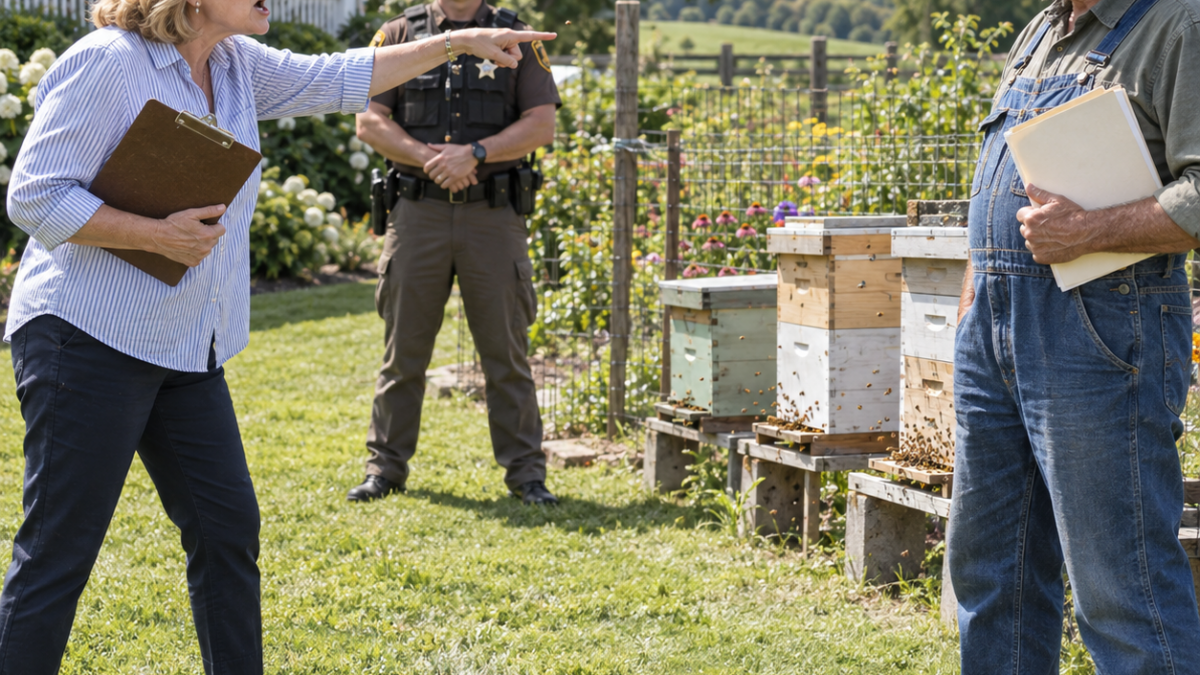
PART 2
Sarah followed me into the kitchen.
She knew that tone.
Twenty-three years of marriage had taught her that when I got quieter instead of louder, something serious was happening.
I opened the cabinet beneath the bookshelf and pulled out a thick binder.
Not the HOA binder.
The other one.
Sarah stared at the county seal embossed on the front.
Then she looked at me.
“Oh,” she said.
“Exactly.”
Five years earlier, when we first moved to Crestwood Hills, I had been newly retired from the Marines.
For two decades I had worked logistics.
That sounds boring until you understand what military logistics actually means.
You move food, fuel, equipment, ammunition, vehicles, medical supplies, personnel, and information across enormous distances while people are actively trying to disrupt every part of the system.
You learn something quickly.
Courage matters.
Skill matters.
But documentation can decide whether anything works at all.
A missing signature can hold up a convoy.
A wrong inventory number can strand equipment.
A regulation nobody bothered to read can destroy months of planning.
I became obsessive about details because details had consequences.
When I retired as a lieutenant colonel, I expected never to need that part of myself again.
Sarah and I bought our house in Crestwood Hills because the subdivision sat far enough outside the city to feel rural without actually being isolated.
Half-acre lots.
Mature trees.
A greenbelt.
Families walking dogs in the evenings.
Children riding bicycles.
The kind of place where I thought I could finally stop thinking three steps ahead of everybody around me.
I started gardening.
Then I became interested in bees.
The first colony changed something in me.
A hive looks chaotic from the outside.
Thousands of insects moving constantly.
But the closer you look, the more order you see.
Nurse bees.
Foragers.
Guard bees.
Workers building comb.
Bees regulating temperature.
Others bringing pollen.
Everything interconnected.
Nobody giving speeches.
Nobody demanding credit.
The colony survived because each member did its job.
After years inside institutions where rank and ego could sometimes complicate the simplest mission, I found the bees almost beautiful in their honesty.
One hive became two.
Then four.
I planted lavender, salvia, rosemary, and sunflowers.
Sarah laughed when I began talking about nectar flows like weather systems.
“You retired from the Marines to become a bee nerd,” she told me one morning.
“Strategic pollination specialist.”
“Bee nerd.”
She won that argument.
Around the same time, I took a civilian position in the county planning department.
I had intended it to be quiet.
The county had different plans.
When the longtime agricultural commissioner retired, several supervisors encouraged me to apply.
I resisted at first.
I wasn’t a farmer.
I had no interest in becoming another bureaucrat who thought a title automatically made him an expert.
But my background in logistics and planning interested them, and by then I had become deeply involved with small-scale agriculture.
Vegetable gardens.
Backyard chickens.
Community orchards.
Apiaries.
I had watched subdivisions expand into areas that had once been farmland.
The cultural collision was becoming obvious.
People wanted a small connection to food production, but many HOA covenants had been written decades earlier using vague terms like livestock, nuisance agriculture, or commercial animal keeping.
The result was conflict.
A family would install two beehives.
An HOA would call them livestock.
Someone would keep six hens.
A board would claim they were operating a farm.
Arguments that should have been simple became expensive legal battles.
When I accepted the agricultural commissioner position, one of my first projects was modernizing the county rules.
I assembled a working group.
Entomologists.
Attorneys.
Urban farming advocates.
Public health representatives.
HOA lawyers.
Professional beekeepers.
Ordinary homeowners.
We spent six months arguing over definitions.
It was not glamorous work.
But definitions matter.
Especially when enforcement is involved.
Eventually, we produced County Ordinance 7.14B, the Urban Agriculture and Apiary Act.
I had personally drafted large portions of it.
Livestock was defined using specific categories.
Cattle.
Horses.
Swine.
Sheep.
Goats.
Other traditional farm animals.
Apiaries were classified separately.
The ordinance defined an apiary as the responsible keeping of Apis mellifera, the western honeybee, in movable-frame hives.
We included registration requirements.
Hive-density limits based on lot size.
Minimum setbacks.
Water-source requirements.
Flyway barriers where necessary.
Disease reporting.
Basic management standards.
And one provision that had caused weeks of debate.
Preemption.
The final language provided that compliant apiaries protected under county law could not be prohibited outright by a conflicting private HOA covenant.
HOAs could adopt reasonable safety regulations consistent with the ordinance.
They could not simply ban bees.
The supervisors approved it unanimously.
At the time, I was proud of the ordinance because I thought it would prevent exactly the type of unnecessary conflict now sitting on my kitchen table.
I never imagined I would be the homeowner using it.
Sarah sat down across from me.
“So what happens now?”
“We answer.”
“You’re not calling Karen?”
“No.”
“Good.”
“I’m calling nobody.”
That surprised her.
I opened the HOA covenants beside the county ordinance.
Karen had cited Bylaw 12.4.
No animals, livestock, or poultry could be raised or kept on a property except household pets.
She was relying on the argument that honeybees were animals maintained for a partially commercial purpose because I occasionally sold extra honey at the farmers market.
It was weak.
But I understood how she arrived there.
Then I opened the county ordinance.
Definitions.
Registration.
Compliance.
Preemption.
My four hives sat fifteen feet from the rear property line.
More than twenty-five feet from the sides.
I maintained a permanent water source twelve feet away.
The lot size allowed more hives than I actually kept.
I had voluntarily planted a tall vegetative barrier even though the greenbelt location meant one was not legally necessary.
There was no possible good-faith question about compliance.
I began typing.
Sarah watched me for several minutes.
“You’re enjoying this.”
“No.”
She raised an eyebrow.
“Maybe a little.”
The letter took ninety minutes.
I kept the language dry.
That was intentional.
Emotion gives people something to attack.
Documentation gives them something to answer.
I acknowledged receipt of the violation notice.
Then I stated that Bylaw 12.4 did not apply to my apiary under the controlling county ordinance.
I cited the definition separating apiaries from livestock.
I cited my registration number.
I listed my setback measurements.
I identified my water source.
Then I quoted the preemption provision.
I attached a certified copy of the ordinance.
Finally, I requested three things.
Immediate withdrawal of the violation.
Cancellation of the $500 fine.
Written confirmation that the association recognized my apiary as lawful and compliant.
Sarah read the draft.
“That’s it?”
“That’s it.”
“You’re not mentioning that you wrote the ordinance?”
“No reason.”
Her mouth curled into a smile.
“You want them to discover that part themselves.”
“I want them to read the law.”
“That wasn’t what I asked.”
I smiled.
The next morning, I sent everything certified mail with return receipt requested.
Then I waited.
I genuinely expected the matter to end.
Not because I believed Karen would apologize.
Karen would rather chew gravel than apologize.
But the law was painfully clear.
Any competent attorney should have looked at the ordinance and told the board to withdraw the violation.
Ten days later, an envelope arrived from the HOA’s law firm.
I opened it at the kitchen counter.
Sarah was making coffee.
“Well?”
I read the first paragraph.
Then the second.
Then I laughed.
Sarah turned around.
“That bad?”
“That stupid.”
The attorney claimed the association maintained the right to enforce private covenants regardless of the county ordinance.
No serious analysis.
No discussion of preemption.
No acknowledgment of the definition of apiaries.
The letter simply asserted that Crestwood Hills remained entitled to enforce its livestock restriction.
My fine had been doubled to $1,000.
Daily fines were accruing.
Failure to remove the hives could result in additional enforcement, including a lien.
Sarah set the coffee mug down.
“They’re really doing this.”
“Yes.”
“Even after you sent them the ordinance.”
“Yes.”
“Now what?”
I folded the letter.
“Now I assume it isn’t a misunderstanding.”
That distinction mattered.
A misunderstanding can be corrected.
A power struggle behaves differently.
Karen had been shown clear evidence.
Instead of reconsidering, she escalated.
That meant the bees were no longer the real issue.
The issue was whether somebody in Crestwood Hills could tell Karen no.
I started walking in the evenings.
Not canvassing.
Not campaigning.
Walking.
I had spent five years in the neighborhood, but like a lot of adults, I knew only a small circle of people well.
A wave at the mailbox.
A quick conversation during trash pickup.
Occasional cookouts.
Now I paid attention.
The first person I spoke with was Art Delgado.
Art lived two houses down and had been in Crestwood Hills nearly thirty years.
He was a retired mechanic who could rebuild almost anything with an engine and distrusted anything involving an app.
I found him in his garage working on a lawn mower that looked older than my son.
“Heard Queen Karen came after your bees,” he said before I could explain why I had stopped.
“News travels.”
“Karen travels. Usually with a clipboard.”
I leaned against his workbench.
“Has she always been this bad?”
Art snorted.
“No. Used to be just annoying.”
“What changed?”
“Got elected.”
That answer sounded familiar.
He wiped his hands.
“You going to fight her?”
“I’m figuring out what I’m fighting.”
Art stared at me for a moment.
Then he nodded slowly.
“Come inside.”
His wife was watching television in the den.
Art led me to a desk and opened a drawer filled with HOA notices.
“Keep these.”
I flipped through them.
Fence stain.
Trash bin.
Trailer parking.
Landscape edging.
One caught my attention.
ACCESSIBILITY MODIFICATION COLOR VIOLATION.
“What is this?”
Art’s expression changed.
“That’s the Millers.”
They lived four streets over.
Their teenage son used a wheelchair.
The family had installed a ramp at the front entrance.
Karen’s board cited them because the material did not match the approved color palette.
“You’re kidding.”
“Wish I was.”
“What happened?”
“Mr. Miller is a lawyer.”
Art smiled.
“He explained the Americans with Disabilities Act and fair housing law to them in language even Karen could understand.”
“She backed down?”
“Immediately.”
That told me something important.
Karen was aggressive where she believed resistance would be weak.
I kept reading.
Art told me about a young couple named the Garcias.
They had planted a Japanese maple after losing a baby late in pregnancy.
It was a memorial tree.
Karen cited them because the species did not appear on the approved front-yard landscaping list.
“They moved it?”
“She made them.”
“Made?”
“They couldn’t afford a lawyer. She threatened daily fines.”
I looked at Art.
“What happened to the tree?”
“Died after they transplanted it.”
I sat there for a moment holding the violation notice.
This wasn’t funny anymore.
Art watched me.
“There’s something else.”
“What?”
“The money.”
I looked up.
He leaned closer.
“Our dues keep going up.”
“I noticed.”
“Pool looks worse every year. Playground’s rusting. Gate breaks every other month.”
He pointed toward the subdivision entrance.
“But suddenly there’s twenty thousand dollars’ worth of stonework and landscaping near the front.”
“That area is association property.”
“Sure is.”
“Who did the work?”
Art smiled without humor.
“Green Thumb Landscapers.”
“Know them?”
“I know who owns them.”
I waited.
“Karen’s brother-in-law.”
That changed the entire shape of the problem.
I asked Art how certain he was.
“Hundred percent. He bragged about getting the contract.”
“Was it bid?”
“Not that anyone remembers.”
“Do you have proof?”
“Not me.”
Then he grinned.
“But the HOA does.”
I went home thinking about contracts.
The bees were still there.
Karen’s fines were still increasing.
But now there was another question.
What exactly had the board been doing with everyone’s money?
The following morning, I called David Chen.
David and I had met as young officers.
He later transferred into military legal work and eventually left active service to practice real-estate and corporate law.
He answered on the second ring.
“Colonel Riley.”
“Don’t call me that.”
“You’ll always be Colonel Riley to me.”
“You outranked nobody when we met.”
“I outranked you intellectually.”
“That explains why you once locked yourself out of your barracks room in your underwear.”
Silence.
“Why are you calling, Jack?”
I laughed and explained everything.
The bees.
The ordinance.
Karen.
The lawyer’s letter.
The potential related-party landscaping contract.
When I finished, David was quiet.
Then he said, “Please tell me you kept every document.”
“Obviously.”
“I love you.”
“Sarah might object.”
“You understand what she’s done, right?”
“Which part?”
“The HOA president decided to challenge the author of the county ordinance governing the exact thing she wants to prohibit.”
“Yes.”
“And then ignored the ordinance in writing.”
“Yes.”
“And there may be undisclosed family contracts.”
“Yes.”
David breathed out slowly.
“This is the most HOA story I have ever heard.”
“What do I do?”
“We stop talking about bees for a minute.”
“I’m listening.”
“You’re an association member. State law and your governing documents provide inspection rights for certain records.”
“Financial?”
“Exactly.”
“How far back?”
“Let me review your documents.”
I emailed him the HOA covenants, bylaws, management agreement, annual budgets, and correspondence.
Two hours later, he called.
“Three years.”
“All financial records?”
“Enough to make Karen regret learning your name.”
“David.”
“I’m serious. Contracts. Invoices. Ledgers. Minutes. Bank information permitted under the statute. Vendor relationships.”
“You think they’ll comply?”
“No.”
“Why?”
“Because competent people would have withdrawn the bee violation ten days ago.”
That afternoon, David drafted a formal demand.
It was beautifully boring.
He cited the applicable state statutes and HOA provisions.
He requested inspection of financial statements, vendor contracts, payment records, expense reimbursements, board minutes, and related documentation for the previous three fiscal years.
He gave them ten business days.
He also explained potential legal consequences for improper obstruction.
I mailed it certified.
Karen responded exactly the way David predicted.
Silence.
Ten business days passed.
On day eleven, the management company emailed me.
They claimed my request was unusually broad and would require extensive staff research.
They demanded $2,500 in advance for administrative and copying costs.
I forwarded the email to David.
His reply came four minutes later.
CALL ME.
I did.
He answered laughing.
“What?”
“They admitted the records exist.”
“That was never really in doubt.”
“No, but now they’ve put their obstruction in writing.”
“What about the fee?”
“Absurd.”
He drafted another letter.
This one was addressed not only to the association but to each director individually.
Karen.
Tim.
Three others.
David cited the statutory limits on copying costs.
He distinguished copying from inspection.
He described the $2,500 demand as an improper barrier to a homeowner exercising record-access rights.
Then he explained something Karen had apparently never considered.
Board members could potentially face personal consequences for willfully violating their duties.
The letter gave them forty-eight hours to provide a reasonable inspection date.
The next afternoon, my phone rang.
Tim.
I answered.
“Mr. Riley?”
“Jack is fine.”
He sounded like he had not slept.
“The board has authorized your inspection.”
“Good.”
“Friday afternoon. Management office.”
“I’ll be there.”
“There won’t be a fee.”
“Good.”
A pause.
Then he said, “Can you ask your lawyer not to sue us personally?”
I felt almost sorry for him.
“Tim, nobody is trying to sue you.”
“His letter—”
“His letter told you to follow the law.”
“I didn’t know Karen was refusing the records.”
“You’re on the board.”
“I know.”
His voice dropped.
“She handles most things.”
“That isn’t how a board works.”
“I’m starting to understand that.”
That sentence would matter later.
Friday afternoon, Sarah came with me.
She had worked as an accountant before our son was born and still possessed the strange ability to look at a stack of financial statements without immediately wanting to escape through a window.
The management company placed five boxes in a conference room.
The office manager gave us a tight smile.
“Everything responsive to your request is here.”
“Everything?”
“To the best of our ability.”
Sarah looked at the boxes.
“Are they indexed?”
“No.”
“Chronological?”
“Some.”
“Digital copies?”
“Not available.”
She looked at me after he left.
“Document dump.”
“Yep.”
“You look happy.”
“I’ve spent my life in document dumps.”
For the next three hours, we sorted.
Contracts in one pile.
Invoices in another.
Credit-card statements.
Minutes.
Expense reports.
Budgets.
Vendor records.
At home, the dining-room table vanished beneath paper.
For three nights, we worked.
Sarah built spreadsheets.
I cross-referenced approvals against board minutes.
Some expenses were perfectly ordinary.
Pool chemicals.
Insurance.
Gate repairs.
Grounds maintenance.
Others made no sense.
Green Thumb Landscapers had an evergreen contract at rates far above comparable local vendors.
The contract renewed automatically.
No competitive-bid documentation was included.
No conflict-of-interest disclosure.
The company owner was Karen’s brother-in-law.
Then we found emergency tree-removal invoices.
One supposedly covered storm damage on a day when weather records showed no significant storm.
Another listed a location adjacent to Karen’s property.
Then came the HOA credit card.
Restaurant charges.
Expensive restaurant charges.
Categorized as board-planning dinners.
No corresponding meeting minutes.
No agendas.
No business purpose described.
A $1,200 purchase at a home-decor store appeared under clubhouse refurbishment.
Sarah stared at the charge.
“When was the clubhouse refurbished?”
“It wasn’t.”
“The chairs are older than our marriage.”
“I know.”
She created another spreadsheet column.
Supporting documentation.
Blank.
We found equipment rentals nobody remembered seeing.
Landscape materials delivered to unclear locations.
Decor.
Meals.
Reimbursements.
Not every item proved wrongdoing.
We were careful about that.
But together they revealed something more important.
A pattern demanding explanation.
I was highlighting another transaction when Sarah leaned back.
“You realize what she did wrong.”
“A lot of things.”
“She assumed nobody would ever look.”
Exactly.
Karen’s power depended on inconvenience.
People were busy.
Parents had jobs.
Retirees wanted peace.
Nobody wanted to spend a weekend reading invoices.
She had turned that reluctance into protection.
Meanwhile, she had not forgotten the bees.
In fact, the financial-record request seemed to make her more determined to defeat me publicly.
Maybe she believed that if she humiliated me over the hives, everything else would disappear.
So she called county code enforcement.
I was in the backyard Tuesday morning when a white county truck stopped outside.
I recognized the department logo immediately.
A young officer stepped out.
Officer Miller.
I had met him once at a training session but doubted he remembered me.
Karen’s blinds moved across the street.
Of course she was watching.
I met Miller at the side gate.
“Morning.”
“Mr. Riley?”
“Yes.”
“We received a complaint involving an unpermitted commercial apiary and livestock violation.”
“I figured.”
He looked relieved that I wasn’t angry.
“I need to inspect the site.”
“Absolutely.”
We walked into the backyard.
My bees were active but calm.
Miller looked at the four hives.
Then his tablet.
“Complaint says there may be a safety issue related to setbacks.”
I took my apiary registration card from my wallet.
“Here.”
He scanned it.
My name appeared.
Status: active.
No violations.
“Okay,” he said. “Registration is current.”
“Yes.”
“We still need measurements.”
“Of course.”
Then I pulled out my work credentials.
He read them.
Then read them again.
His head came up.
“You’re Commissioner Riley?”
“I am.”
“The agricultural commissioner?”
“Yes.”
He looked toward the hives.
Then back at me.
“You wrote the apiary ordinance.”
“Most of it.”
His expression was priceless.
“Oh.”
I almost felt bad for him.
“Don’t worry. You received a complaint. Inspect it.”
“Yes, sir.”
“And don’t call me sir.”
“Yes, sir.”
I laughed.
We started with setbacks.
The ordinance required ten feet from certain property lines for hive openings.
Mine exceeded that.
The rear location measured fifteen feet.
Sides were farther.
Then the water source.
Birdbath.
Twelve feet away.
Filled daily.
Then hive density.
Four colonies.
Well below the allowable number for my lot.
Flyway barrier.
Not legally required because the rear greenbelt was private and not an immediate pedestrian corridor, but my tall plantings already encouraged the bees upward.
Miller photographed everything.
He asked whether I sold honey.
“Occasionally.”
“Does that change anything under the ordinance?”
“No. Small incidental sales do not convert a compliant residential apiary into prohibited livestock use.”
He nodded.
“I thought so.”
We finished after about thirty minutes.
Miller stood beside his truck entering notes.
“Well, Commissioner, I can’t find a violation.”
“I’d be disappointed if you did.”
He smiled.
“Honestly, this is textbook.”
“Please write exactly what you found.”
“I will.”
“And nothing about who I am needs to influence it.”
He understood.
“You want the report to stand on the property alone.”
“Exactly.”
He nodded.
“It does.”
Two days later, I received the closure report.
Complaint unfounded.
Registered apiary.
Full compliance.
No observed nuisance.
No safety violation.
The report also noted that the complaint appeared inconsistent with readily verifiable registration information and could represent misuse of enforcement channels in an ongoing private dispute.
I read that line twice.
Then printed three copies.
Karen had tried to weaponize the county.
Instead, she had handed me an independent government finding.
The next day, neon-pink flyers appeared throughout Crestwood Hills.
EMERGENCY HOA MEETING.
THE BEE MENACE IN OUR COMMUNITY.
I stood at my mailbox reading it while Art walked over.
“What in the hell is this?”
“Karen.”
“She made bees sound like armed drones.”
The flyer warned of aggressive swarms.
Children in danger.
Possible allergic emergencies.
Commercial activity.
Threats to property values.
Anonymous frightened neighbors.
It was written like the neighborhood was under siege.
Art shook his head.
“She’s lost it.”
“No.”
“What do you mean?”
“She knows exactly what she’s doing.”
Fear had always been Karen’s strongest tool.
If the law would not help her, she would turn the community against me.
She wanted a room full of frightened parents demanding that my hives disappear.
Sarah read the flyer at home.
“What are we going to do?”
“We’re going to help Karen fill the room.”
She blinked.
“You want people to attend?”
“Every person we can get.”
Then I began preparing.
One page.
THE FACTS ABOUT RESIDENTIAL BEEKEEPING IN CRESTWOOD HILLS.
No insults.
No mention of Karen’s personality.
Just facts.
County ordinance.
Registration.
Setbacks.
Water requirements.
Inspection result.
Complaint: unfounded.
Property: fully compliant.
I included the county case number so anyone could verify the report.
Then Sarah and I prepared a second page.
QUESTIONS FOR THE CRESTWOOD HILLS HOA BOARD.
Question one:
Why was a multi-year landscaping contract awarded without competitive bidding to a company owned by a relative of the HOA president?
Question two:
Where are the minutes documenting approval of that contract and any conflict-of-interest disclosure?
Question three:
What clubhouse refurbishment corresponds to the $1,200 home-decor purchase charged to the association?
Question four:
What association business was conducted during several expensive restaurant charges labeled board planning?
Question five:
Why had dues increased significantly while the pool, gate, and playground showed visible deferred maintenance?
We made one hundred copies.
Then Sarah, Art, and I knocked on doors.
Not mailboxes.
Doors.
Face to face.
At the first house, I was nervous.
That surprised me.
I had briefed generals.
Spoken before county supervisors.
Testified in hearings.
But knocking on a neighbor’s door to say the HOA president was misleading them felt oddly personal.
A man named Greg opened.
He held Karen’s pink flyer.
“I was wondering when you’d come by.”
“That bad?”
He laughed.
“Jack, my daughter did a school project on bees last year. Karen’s flyer makes them sound like velociraptors.”
I handed him the fact sheet.
“This is the county ordinance and inspection report.”
He read.
“She called code enforcement?”
“Yes.”
“They cleared you?”
“Yes.”
“Then why are we having a meeting?”
I handed him the second page.
“That’s one question.”
He read the financial questions.
His expression changed.
“Where did you get this?”
“HOA records.”
“Actual records?”
“Yes.”
“I’ll be there.”
So would many others.
A mother named Christine invited us into her kitchen.
Her son was the teenager who used a wheelchair.
When she saw the financial questions, her face hardened.
“She tried to fine us over the ramp.”
“I heard.”
“My husband scared them off legally. But I always wondered how many people didn’t have a lawyer in the family.”
“That’s what I’m trying to find out.”
Christine took five copies.
“I know exactly who needs these.”
At the Garcias’ house, Elena Garcia listened quietly while her husband read the fact sheet.
Their front yard still had an empty section where the memorial tree had once stood.
Elena looked at me.
“Is this really going to change anything?”
“I don’t know.”
She gave a sad smile.
“Karen always wins.”
“Only because most fights happen one house at a time.”
That stayed with her.
“We’ll come.”
By the night of the meeting, the clubhouse parking lot was full.
Cars lined both sides of the street.
I had never seen that many homeowners at one association meeting.
Karen sat at the front behind the board table.
Tim was beside her.
He looked pale.
She looked delighted.
That told me everything.
She genuinely believed the crowd had come because of her flyer.
She thought fear belonged to her.
Sarah sat near the projector.
Art took an aisle seat.
I sat in the middle of the room.
Not front row.
Not beside Karen.
Among my neighbors.
At seven o’clock, she slammed the gavel down.
“This emergency meeting of the Crestwood Hills Homeowners Association is now in session.”
Silence.
“We are here because one resident has chosen to place his personal hobby and commercial interests above the safety of our families.”
She never looked at me.
She didn’t need to.
Everybody knew.
Karen began describing my apiary.
Aggressive insects.
Swarming risk.
Allergic children.
Potential attacks.
She referred repeatedly to “illegal livestock.”
Then she held up the HOA violation notice.
“This homeowner has refused every reasonable request for compliance.”
Tim looked down at the table.
Karen continued.
“He believes county bureaucrats should dictate how our private community operates.”
That almost made me laugh.
She had no idea.
Then she asked the membership to support “all necessary legal action,” including liens and court proceedings, to force removal of the hives.
She finished.
Waited.
Nothing.
No applause.
No angry parents.
No chorus demanding my bees disappear.
Just silence.
Karen’s expression shifted.
She looked at the audience.
People were holding my fact sheets.
Some had them highlighted.
She saw them.
That was the exact moment she understood the meeting had changed.
I stood.
Karen pointed her gavel.
“You are not recognized.”
“Then recognize me.”
“I control the floor.”
Christine Miller called from the front.
“Let him speak.”
Someone else said, “We came to hear both sides.”
Then Art’s voice boomed from the back.
“You called the meeting about his bees, Karen. Seems fair to let the man talk.”
Murmurs of agreement.
Karen’s eyes moved across the room.
She had no choice.
“Three minutes.”
I stayed where I was.
“My name is Jack Riley.”
Several people smiled.
“I keep four registered honeybee colonies on my property.”
I held up the fact sheet.
“Mrs. Albbright has repeatedly described them tonight as illegal livestock. That is incorrect.”
Karen interrupted.
“According to our covenants—”
I raised the county ordinance.
“This is County Ordinance 7.14B.”
People turned pages.
“It legally distinguishes apiaries from livestock.”
Karen shook her head.
“Our private restrictions take priority.”
“No.”
Her face reddened.
“Excuse me?”
“The ordinance includes an express provision preventing an HOA from outright prohibiting a compliant residential apiary.”
“You’re interpreting it to benefit yourself.”
“No.”
I raised the code-enforcement report.
“You filed a complaint with the county.”
A murmur moved through the room.
Karen froze.
“You didn’t mention that part.”
She grabbed her microphone.
“That investigation is irrelevant.”
“Then why did you request it?”
No answer.
I continued.
“An officer inspected my property.”
I read the conclusion.
“Registered apiary. Full compliance. Complaint unfounded.”
Several people started whispering.
I held up another page.
“The report also documented concern that enforcement channels were being used as part of an ongoing private dispute.”
Karen’s face went crimson.
“You’re twisting government language!”
“I’m reading it.”
“You think being a county employee gives you special privileges.”
That was the opening she gave me herself.
I looked directly at her.
“No.”
Then I removed my county identification.
“It gives me responsibilities.”
The room quieted.
“My position is County Agricultural Commissioner.”
Karen stared.
A few people already knew.
Most didn’t.
I continued.
“Ordinance 7.14B was developed by my office.”
Her mouth opened.
“I personally drafted much of the language we are discussing.”
The room erupted.
Not shouting.
At first, laughter.
Disbelief.
Someone behind me said, “You have got to be kidding.”
Art slapped his knee.
Karen looked at Tim.
Tim looked like he wanted to crawl under the table.
I waited.
Then I continued.
“I did not mention my position to the HOA because it should not matter. The ordinance protects every compliant homeowner, not just me.”
The laughter stopped.
“That is the point.”
I looked around the room.
“If Karen can disregard the law because she dislikes my bees, she can disregard it when she dislikes something you are legally entitled to do.”
Christine nodded.
Elena Garcia looked toward Karen.
I continued.
“But I agree with Mrs. Albbright on one thing.”
Karen blinked.
“This meeting is about governance.”
Sarah turned on the projector.
The screen behind the board lit up.
A copy of Green Thumb Landscapers’ contract appeared.
Karen turned around.
Her face changed.
“This contract,” I said, “was produced in response to a homeowner records request.”
Tim stared at the screen.
One of the other directors whispered something.
I continued.
“The vendor is owned by a relative of the HOA president.”
Noise moved through the room.
Karen shot to her feet.
“This has nothing to do with bees!”
“No.”
I looked at her.
“It has to do with trust.”
The room became silent again.
I advanced the slide.
Contract value.
Renewal terms.
Market comparisons Sarah had obtained.
“Can the board explain why this contract was awarded without evidence of competitive bidding at rates substantially above comparable local vendors?”
Karen slammed the gavel.
“Out of order!”
Art stood.
“It’s our money.”
Applause exploded.
I advanced again.
HOA credit-card statement.
Restaurant charges highlighted.
“Can the board identify the association business conducted during these meals?”
Another slide.
Home-decor purchase.
“Can the board show homeowners what clubhouse improvements correspond to this charge?”
Karen was no longer banging the gavel.
She was staring at the other directors.
Tim’s face had gone white.
One board member turned toward her.
“You told us the clubhouse purchase was furniture.”
“It was!”
“What furniture?”
Karen snapped.
“We are not conducting an audit in public!”
Sarah spoke for the first time.
“Then where is the furniture?”
People laughed.
Karen glared at her.
I almost smiled.
Never underestimate an accountant who has spent three nights sorting someone else’s receipts.
The questions came from everywhere.
“Why is your brother-in-law getting paid?”
“Why did our dues go up?”
“Where did the money go?”
“What happened to the playground fund?”
“Why won’t you answer?”
Karen started shouting.
“You people have no idea how much work I do for this community!”
Nobody was listening anymore.
The fear was gone.
That was what she had not understood.
You can intimidate people individually for years.
But once they compare experiences, intimidation becomes evidence.
Art pushed through the noise.
“I make a motion!”
The room quieted enough to hear him.
“I move that the association commission an independent forensic audit of the last three years of financial records.”
Someone shouted, “Second!”
“I further move,” Art continued, “that the membership formally demand a vote of no confidence in Karen Albbright as president.”
The room erupted.
Karen stood so quickly her chair fell backward.
“You cannot do this!”
Tim looked at her.
Actually looked at her.
Not down.
Not away.
At her.
“Karen.”
She wheeled around.
“What?”
“We need an audit.”
I saw the betrayal hit her.
“You ungrateful little coward.”
Tim flinched.
Then something hardened in his face.
“I’m on the board. I should have asked more questions.”
“You signed everything!”
“I trusted you.”
“That is not my fault!”
He stared at her.
“No. Signing without reading was my fault.”
That may have been the bravest thing Tim ever said.
Karen grabbed her purse.
She pointed at me.
“This is a setup.”
I didn’t answer.
“You’ve been planning this from the beginning.”
“No.”
“You wanted to destroy me.”
“No.”
“Liar!”
I stepped closer, but kept my voice low.
“I wanted to keep four beehives.”
For one second, nobody said anything.
Then the room laughed.
Karen looked around.
Not one ally came to her defense.
She pushed through the crowd and left.
The meeting collapsed into chaos after that.
Technically, Art’s vote of no confidence needed proper notice and procedure.
David had warned me about that.
We were not going to defeat Karen by ignoring the same rules we accused her of abusing.
So nothing final happened that night.
But politically, her presidency ended before she reached the parking lot.
After the room cleared, Tim and three other directors approached me.
They looked shell-shocked.
Tim spoke first.
“We didn’t know.”
I shook my head.
“You didn’t ask.”
His shoulders dropped.
“I know.”
One of the others said, “Karen brought contracts. Told us they had been vetted.”
“Did you read them?”
“No.”
“Did you ask about family relationships?”
“No.”
“Did you review credit-card statements?”
Silence.
I looked at all four.
“You have fiduciary duties. ‘Karen told us’ is not governance.”
Tim swallowed.
“What do we do?”
I could have humiliated them.
Part of me wanted to.
For months they had allowed Karen to threaten my property.
They had signed fines.
They had helped create the system she used.
But angry people make bad institutions.
I wanted the neighborhood fixed, not merely reversed.
“Call an emergency board session tomorrow.”
They listened.
“Remove Karen from the presidency according to the bylaws if you have the votes.”
Tim nodded.
“Freeze nonessential discretionary spending.”
Another nod.
“Hire an independent forensic accountant.”
“Yes.”
“Preserve every financial record.”
“Yes.”
“And stop enforcement against my apiary.”
Tim almost laughed.
“That one’s obvious now.”
“It should have been obvious before.”
The next afternoon, they did everything.
Karen was removed as HOA president by the remaining directors pending the membership process.
An independent forensic auditor was retained.
Nonessential spending was frozen.
The bee violations were suspended.
I should have felt victorious.
Instead, I felt tired.
Sarah found me behind the hives that evening.
“You okay?”
“Yeah.”
“That sounded convincing.”
I watched a bee land at the entrance carrying bright yellow pollen.
“I keep thinking about Tim.”
“What about him?”
“He really didn’t know.”
“He should have.”
“I know.”
Sarah sat beside me.
“But?”
“But Karen needed people who wouldn’t ask questions.”
“And she found them.”
“Yes.”
“That doesn’t make them innocent.”
“No.”
She rested her head against my shoulder.
“But it makes the lesson bigger than Karen.”
Exactly.
Systems fail when one bad person gets power.
They fail even faster when good or ordinary people stop paying attention.
Karen did not appreciate the lesson.
Two days later, a courier delivered a thick envelope.
Cease and desist.
Her personal attorney accused me of defamation.
Libel.
Slander.
Intentional interference with business relationships.
Emotional distress.
The letter demanded a public retraction.
An apology.
Withdrawal of all allegations.
It threatened a lawsuit seeking millions of dollars.
Sarah read it.
Then looked at me.
“Are you worried?”
“No.”
“You answered too fast.”
“I’m annoyed.”
“Different emotion.”
I scanned the letter and emailed it to David.
He called within ten minutes.
“Please tell me you didn’t respond.”
“I’m not stupid.”
“Correct answer.”
“What do you think?”
“I think somebody found Karen a lawyer who enjoys letterhead.”
“Can she sue?”
“Anyone can file something.”
“That isn’t what I asked.”
“She has a problem.”
“Truth?”
“Several problems. Truth. Documents. Public-interest speech. And depending on exactly what she files, anti-SLAPP protections may become extremely unpleasant for her.”
David paused.
“Want me to answer?”
“Please.”
His response was four pages.
No jokes.
No anger.
That meant he was serious.
He explained that statements made at the meeting were based on association records.
He identified the exact supporting documents.
He noted that I had repeatedly framed financial matters as questions rather than criminal conclusions.
Then he turned to her threats.
Truth and documented fact were not defamatory merely because they were embarrassing.
Good-faith discussion of association governance was protected in significant ways.
Any meritless lawsuit designed to silence homeowner participation could expose Karen to legal-fee consequences.
Then he ended with the part I knew would matter.
If Karen chose litigation, discovery would require examination of the same contracts, payments, conflicts, communications, and financial records now being reviewed by the forensic auditor.
In other words, suing me would put her own documents under oath.
He sent the letter.
The next morning, her attorney emailed.
He no longer represented Karen Albbright.
Sarah read the message over my shoulder.
“That was fast.”
“He looked at the documents.”
“And?”
“And decided he enjoyed practicing law.”
The forensic audit began the following week.
The auditor’s name was Rachel Bennett.
She had spent fifteen years investigating nonprofit and community-association finances.
Rachel did not care about neighborhood gossip.
She did not care whether Karen was rude.
She did not care about my bees.
She wanted receipts.
Contracts.
Checks.
Electronic transfers.
Minutes.
Authorizations.
Disclosures.
For three weeks, she reconstructed the books.
The numbers were not catastrophic.
They were worse in another way.
They were personal.
Thousands of dollars had been wasted or redirected through questionable transactions.
Related-party landscaping.
Meals.
Decor.
Reimbursements.
Unclear purchases.
Rates far above market.
Invoices with vague descriptions.
Some spending might have been technically legitimate but irresponsible.
Other items raised more serious questions.
Rachel’s preliminary report identified over $40,000 in potentially misappropriated or unsupported association funds across three years.
Forty thousand dollars.
For some corporations, that would be noise.
For Crestwood Hills, it represented playground repairs.
Pool maintenance.
Gate upgrades.
Reduced dues.
Money taken from ordinary families.
Money paid by retirees.
Money Karen had collected while fining people for tree species and wheelchair-ramp colors.
Art read the report at my kitchen table.
“She made Elena remove that memorial tree while this was happening.”
I said nothing.
Sarah looked at me.
“You’re thinking about the district attorney.”
“Yes.”
David had already prepared a legal summary.
I compiled the audit.
Financial records.
Contracts.
Karen’s threat letters.
Code-enforcement report.
Witness statements.
Board minutes.
A timeline.
Tabs.
Index.
Cross-references.
Sarah watched me assemble everything.
“Twenty years of Marine logistics for this.”
“I’ve trained my whole life to annoy exactly this type of person.”
She laughed.
The completed packet went to the county district attorney’s public-integrity unit.
Then we waited.
That part was difficult.
People expect justice to move like television.
Evidence arrives Monday.
Arrest Tuesday.
Trial Thursday.
Verdict Friday.
Reality is slower.
Investigators review.
Subpoena.
Interview.
Verify.
Compare.
Follow money.
Ask more questions.
Weeks passed.
Karen remained in Crestwood Hills.
She no longer had the presidency, but she still owned her house.
For a while she seemed determined to act as if nothing had happened.
Then people stopped answering her calls.
Former allies avoided her.
Her pink meeting flyers became a neighborhood joke.
Tim resigned from the board.
Before doing so, he came to my house.
I was checking the hives.
He stood at the gate.
“Can I come in?”
“Sure.”
He kept a cautious distance from the bees.
“Are they safe?”
“They’re calmer than most board meetings.”
He laughed nervously.
Then his expression turned serious.
“I wanted to apologize.”
“For what?”
“All of it.”
I waited.
“I signed your violation.”
“Yes.”
“I didn’t read the county ordinance.”
“I know.”
“I thought Karen knew what she was doing.”
“She did.”
He looked confused.
“She knew how to get people to let her decide.”
Tim nodded slowly.
“That’s worse.”
“Yes.”
He looked at the nearest hive.
“I keep replaying the meeting.”
“Don’t.”
“How do I not?”
“You learned something.”
“I could have lost money personally.”
“Yes.”
“You could have lost your house eventually.”
“Probably not.”
“But we threatened it.”
“Yes.”
He looked ashamed.
“I’m sorry.”
I believed him.
“Then do better next time someone asks you to sign something.”
“I will.”
He left.
I never became friends with Tim.
But I respected that he came.
A month after the emergency meeting, Karen listed her house.
No announcement.
No goodbye.
A FOR SALE sign appeared in her yard Tuesday morning.
By Friday, people were openly discussing it.
Art came over.
“Think she’s running?”
“I think she’s leaving.”
“Same thing.”
“Not necessarily.”
“Jack, nobody sells a house that fast because they suddenly discovered Montana.”
The house sold within weeks.
Karen moved at night.
At least that was how everyone described it.
I did not watch.
I did not photograph the truck.
I did not stand at the curb.
The next morning, her house was empty.
The woman who had spent years monitoring everybody else’s properties disappeared without saying goodbye to the community she claimed to protect.
The interim HOA board asked Art to serve as president.
He refused.
Then everybody asked again.
He finally agreed on one condition.
“I’m doing this for six months.”
He lasted three years.
His first meeting looked nothing like Karen’s.
No gavel pounding.
No speeches.
No intimidation.
Financial statements were projected on the wall.
Homeowners could ask questions.
Contracts above a defined amount required multiple bids.
Related-party transactions required disclosure and independent review.
Meeting minutes were posted promptly.
And the first substantive item on the agenda was my bees.
Art looked at me.
“Jack Riley, apparently the association has been harassing you over some livestock.”
Everybody laughed.
I folded my arms.
“My attorneys are standing by.”
More laughter.
Art became serious.
“I move that every fine and violation issued against Mr. Riley’s registered apiary be rescinded in full.”
Seconded.
Unanimous.
Then he introduced a bylaw amendment.
Where a specific county or state law governed an activity, the HOA rules had to be interpreted consistently with that law.
No board president would again get to pretend Crestwood Hills existed outside government simply because she had a clipboard.
That amendment passed too.
But something more interesting happened afterward.
People changed.
The Millers repainted their son’s wheelchair ramp bright blue.
Nobody complained.
The Garcias planted another Japanese maple.
This time, neighbors showed up to help.
I brought mulch.
Art brought a shovel.
Sarah brought lemonade.
Elena stood beside the small tree with both hands pressed together.
For years, I had known intellectually that the first tree was a memorial.
Watching her plant the replacement made the harm real.
She touched one of the red leaves.
“Our daughter’s name was Sofia.”
I had never known.
“I’m sorry.”
She smiled through tears.
“She would be eight now.”
Her husband put an arm around her.
“We stopped talking about the first tree because the whole thing became painful.”
Art looked down.
“I should’ve helped you fight.”
Elena shook her head.
“Everybody was afraid.”
That was the truth of Crestwood Hills.
Karen had not merely enforced rules.
She had trained neighbors to avoid one another’s problems.
If it wasn’t your fine, stay quiet.
If it wasn’t your house, stay quiet.
If it wasn’t your tree, ramp, mailbox, bees, or money, stay quiet.
The moment people stopped doing that, her power collapsed.
A month later, the playground became a neighborhood project.
The audit had shown that maintenance had been delayed despite rising dues.
Instead of waiting six months for bids, Art organized a volunteer repair weekend for the cosmetic work that homeowners could legally handle.
Fathers.
Mothers.
Teenagers.
Retirees.
We sanded benches.
Replaced safe hardware.
Repainted surfaces.
Spread fresh wood chips.
Contractors handled anything structural.
Sarah painted a picnic table with Christine.
I repaired a storage cabinet with Art.
At noon, somebody ordered pizza.
Children ran everywhere.
No enforcement letter.
No approved volunteer-shirt color.
No clipboard.
Just neighbors fixing something together.
That afternoon, Art sat beside me eating a slice.
“You know what Karen never understood?”
“What?”
“People actually like standards.”
I looked at him.
“They just don’t like being treated like prisoners.”
Exactly.
Most homeowners were not against rules.
They wanted clean common areas.
Reasonable maintenance.
Safe roads.
Responsible budgets.
They simply wanted rules that served the neighborhood rather than someone’s ego.
My bees became part of that rebuilding.
At first, several parents were still nervous.
Karen’s fear campaign had been dramatic enough to leave residue.
So I invited the neighborhood over.
MEET THE BEES.
Not an HOA event.
My backyard.
Saturday afternoon.
I borrowed an observation hive with glass panels.
I set up signs explaining colony behavior.
Queen.
Workers.
Drones.
Pollination.
Honey production.
I showed people protective equipment.
I explained what causes defensive behavior and why properly managed colonies are usually uninterested in humans standing away from the entrance.
Children watched bees moving behind glass.
One boy pressed his face so close to the observation hive that his mother had to pull him back.
“Can they see me?”
“Probably.”
“Do they know I’m looking?”
“Maybe.”
His eyes widened.
“Cool.”
Madison, the girl Karen had originally claimed was supposedly terrified of my bees, arrived with her parents.
Her mother looked embarrassed.
“I heard she used Madison’s name.”
“She did.”
“We never complained.”
“I know.”
Madison pointed at a frame.
“Is that honey?”
“Yes.”
“Can I try it?”
Her father laughed.
“She’s terrified.”
I gave Madison a small tasting spoon.
She closed her eyes dramatically.
“This is better than store honey.”
“High praise.”
By the end of the afternoon, more than forty neighbors had visited.
Two asked about starting hives of their own.
I promised to mentor them.
The following spring, Crestwood Hills had six legal apiaries.
Karen would have hated it.
That thought made Art unreasonably happy.
The district attorney’s investigation continued.
Investigators contacted Sarah and me.
Then Art.
Former directors.
Management staff.
Vendors.
They requested original records.
Bank information.
Emails.
The landscaping relationship received particular attention.
Karen had moved out of state by then.
Rumors spread about where she had gone.
Arizona.
Florida.
Nevada.
I ignored them.
Rumors were what had fueled her power in the first place.
I was interested in documents.
Months later, the district attorney announced charges related to the handling of association funds.
Karen was named.
The case became complicated because she was living outside the state.
A warrant remained active while authorities worked through the process.
Some neighbors wanted a celebration.
Art refused.
“No party over somebody getting charged.”
A homeowner complained.
“She deserves everything coming to her.”
“Maybe,” Art said. “But we’re not Karen.”
That ended it.
I liked him even more after that.
The HOA’s insurance eventually covered much of the financial loss after a long dispute.
Some questionable spending could never be recovered.
But between insurance proceeds, contract changes, and better budgeting, the association stabilized.
The next annual budget meeting lasted almost three hours.
It was painfully boring.
It was wonderful.
Maria Chen, our new treasurer, explained every major line item.
People asked tedious questions about pool pumps and landscaping.
Art nearly fell asleep.
I kicked his chair.
At the end, Maria announced that dues would decrease for the first time in nearly a decade.
The applause was louder than anything at one of Karen’s meetings.
Not because the decrease was huge.
Because it proved something.
The money had always belonged to the homeowners.
The board had simply forgotten.
Or been encouraged to forget.
Life returned to normal.
A better normal.
People left trash bins out too long sometimes.
Nobody collapsed.
Christmas decorations appeared early.
Western civilization survived.
The Millers’ blue ramp became one of the most recognizable features in the neighborhood.
The Garcia maple grew.
The playground filled with children again.
Green Thumb Landscapers lost its contract.
A new company won through competitive bids at significantly lower cost.
The entrance landscaping looked just as good.
Maybe better.
One afternoon, Art stopped beside my driveway.
“Jack.”
“What?”
“I have a complaint.”
“File it properly.”
“Your bees are stealing pollen from my flowers.”
I nodded.
“Serious allegation.”
“I want compensation.”
“How much?”
“One jar of honey.”
“Extortion.”
“Call your lawyer.”
I gave him two jars.
Months after the emergency meeting, Sarah and I sat behind the hives one warm evening.
Lavender was blooming.
Bees moved among purple flowers in slow golden light.
She handed me iced tea sweetened with our honey.
For the first time since Karen had approached me with that violation notice, there was nothing pending.
No fine.
No lawyer’s letter.
No hearing.
No emergency meeting.
No records request.
No investigation appointment on my calendar.
Just bees.
Sarah took a sip.
“You know what’s funny?”
“What?”
“You wanted a quiet retirement.”
“I still do.”
“You became agricultural commissioner.”
“Temporary miscalculation.”
“You rewrote county agricultural law.”
“Public service.”
“You dismantled an HOA presidency.”
“I kept bees.”
She laughed.
Then she became quiet.
“I was scared when the lien threat arrived.”
“I know.”
“I didn’t tell you.”
“I knew anyway.”
She looked at the hives.
“It wasn’t the money.”
“No.”
“It was the idea that somebody could reach into our home because she was angry.”
I understood.
Home is supposed to be the place where your shoulders come down.
Where you stop scanning.
Where you stop preparing for the next confrontation.
After twenty years in uniform, that mattered to me more than most people realized.
Karen had threatened that.
Not because the bees harmed anyone.
Because I told her no.
“I’m sorry,” I said.
“For what?”
“That it got this far.”
“You didn’t make it go this far.”
“No, but I chose to keep fighting.”
Sarah looked at me.
“I’m glad you did.”
A bee landed on the rim of my glass.
Neither of us moved.
After a moment, it flew away.
Sarah smiled.
“This honey tastes different.”
“Different good or different bad?”
“Good.”
“How?”
She considered it.
“Like victory.”
I laughed.
“That is unbearably dramatic.”
“You married me.”
“Fair.”
But later, after she went inside, I stayed behind the hives.
The sun dropped toward the greenbelt.
Thousands of bees were returning from the fields.
Each one carrying something tiny.
Pollen.
Nectar.
Water.
One bee alone could accomplish almost nothing.
A colony could survive storms.
Heat.
Cold.
Predators.
Loss.
Disease.
Not because every bee was powerful.
Because they functioned together.
I thought about Crestwood Hills.
About Christine and the blue wheelchair ramp.
About Elena planting Sofia’s tree.
About Art standing in the clubhouse demanding an audit.
About Tim admitting he had signed documents without reading them.
About neighbors showing up with shovels and paintbrushes.
About one hundred people holding fact sheets while Karen tried to frighten them.
For months, everybody called what happened a fight between Karen and me.
They were wrong.
I was only the person who happened to be standing beside the first hive she targeted.
Karen’s real mistake was believing every homeowner would always stand alone.
That had been the foundation of her power.
One frightened family.
One embarrassed retiree.
One busy parent.
One person deciding that five hundred dollars was cheaper than conflict.
One neighbor watching another get bullied and thinking, Thank God it isn’t me.
Then the pattern broke.
We talked.
We compared notices.
We read documents.
We asked questions.
And Karen discovered the thing every petty tyrant eventually learns if people become brave enough to look at each other.
A title is not authority by itself.
A gavel is not respect.
A fine is not truth.
And fear is not loyalty.
The following spring, I harvested honey with two new neighborhood beekeepers.
Greg had installed one hive.
Christine and her son kept another.
Both were registered.
Both complied with the ordinance.
On inspection day, Officer Miller came by.
He saw me and started laughing.
“Please tell me you’re not inspecting your own neighborhood.”
“I’m supervising education.”
“Sure.”
He checked Greg’s hive.
Perfect.
Then Christine’s.
Perfect.
Her son watched from the blue ramp while wearing a bee veil.
Officer Miller completed the paperwork.
“Three compliant apiaries.”
I looked at him.
“Terrifying.”
“Public menace.”
“Someone should call the county.”
He laughed.
As he drove away, Art came down the sidewalk carrying an empty jar.
“No.”
“I didn’t say anything.”
“You don’t have to.”
“My flowers were robbed again.”
“Go home, Art.”
“Justice demands restitution.”
I handed him a jar.
That evening, the new board held its annual meeting.
Attendance had dropped.
At first, Art worried.
Then Maria smiled.
“That’s a good thing.”
“How?”
“People only packed the room because they were afraid.”
She was right.
Healthy governance was boring enough that people trusted it without attending every meeting.
The board posted records.
Explained contracts.
Accepted questions.
Followed procedures.
Nobody had to organize a resistance movement over lawn edging.
Near the end, Art announced one last piece of business.
“The county confirmed that Crestwood Hills now has more registered residential apiaries than any other subdivision in our district.”
The room laughed.
He looked at me.
“I assume this is your fault.”
“Community engagement.”
“Bee propaganda.”
Then he held up a small plaque.
I frowned.
“What is that?”
“Come up here.”
“No.”
“Jack.”
“I hate plaques.”
“Everybody knows.”
I walked forward anyway.
The plaque read:
CRESTWOOD HILLS COMMUNITY SERVICE AWARD
For defending transparent governance, lawful property rights, and responsible community agriculture.
I stared at it.
Art leaned toward me.
“We wanted to put Queen Bee on it, but Sarah vetoed us.”
I turned toward her.
She was laughing.
“I saved you.”
“Barely.”
People applauded.
I accepted the plaque.
Then I carried it home and put it in the garage.
Not beside my Marine decorations.
Not beside the county certificates.
On a shelf above my bee equipment.
The original violation notice went behind it.
Five hundred dollars.
Seven days to remove the “offending animals.”
I kept that too.
Not because I enjoyed remembering Karen.
Because I enjoyed remembering how close I came to doing what everybody else had done.
Paying.
Complying.
Deciding peace was easier than principle.
Sometimes it is.
Not every disagreement deserves a war.
Not every bad rule deserves years of your life.
But there are moments when surrender teaches the wrong person the wrong lesson.
Karen believed that if she made resistance painful enough, nobody would resist.
For years, she had been right.
Then she came after four white boxes in my backyard.
She chose bees because she assumed they were small.
She chose me because she assumed I was just another homeowner.
She cited a law she had not read.
She called an agency she did not understand.
She challenged an ordinance without knowing who wrote it.
And when all of that failed, she tried to frighten an entire community into doing what the law would not.
That was when the bees stopped being the story.
The real story became the neighbors.
Years later, the hives are still there.
So is the blue wheelchair ramp.
So is Sofia’s Japanese maple.
It is tall enough now that its branches throw shade across part of the Garcias’ front walk.
The playground has been repaired twice since then, both times properly budgeted.
Our HOA dues remain lower than they were during Karen’s last year.
Art finally stepped down as president.
He lasted three years and six months longer than promised.
At his final meeting, he announced he was retiring because, in his words, “There aren’t enough dictators left to make this interesting.”
Tim attended.
He had moved away for work but came back specifically for Art’s last meeting.
Afterward, he found me outside.
“Still have the bees?”
“Six hives now.”
He laughed.
“Karen would have a stroke.”
“Probably shouldn’t joke about that.”
“You’re right.”
He looked toward the clubhouse.
“I joined my new neighborhood board.”
I stared at him.
“You learned nothing.”
“No, I learned exactly enough.”
“What’s your rule?”
“Read everything before I sign it.”
I shook his hand.
“Good rule.”
Sarah and I still sit behind the hives in the evenings.
Sometimes the neighborhood is noisy.
Lawn mowers.
Children.
Dogs.
Someone working on a motorcycle.
Art yelling about stolen pollen.
That noise does not bother me.
I spent years believing peace meant silence.
I was wrong.
Peace is not silence.
Peace is knowing the sound outside your window belongs to ordinary life rather than somebody coming to threaten it.
It is neighbors who can disagree without becoming enemies.
It is rules clear enough that people understand them.
It is leaders who remember they are temporary.
It is a family planting a memorial tree without asking permission from somebody’s ego.
It is a teenager using a bright blue wheelchair ramp nobody dares call aesthetically inappropriate.
It is a child watching bees through glass and asking whether they can see him.
It is honey shared across a fence.
One summer evening, years after Karen left, Madison came by.
She was older.
Almost ready for college.
She held a small jar.
“Mr. Riley?”
“What’s up?”
“My mom said you might help me.”
“With what?”
She handed me the jar.
Honey.
Darker than mine.
“My first harvest.”
I stared at her.
“You have bees?”
“One hive.”
“Registered?”
She rolled her eyes.
“Yes, Commissioner.”
“Setbacks?”
“Twelve feet.”
“Water?”
“Ten.”
“Flyway?”
“Hedge.”
I smiled.
“Then what do you need from me?”
She looked at the honey.
“I wanted you to try it.”
I opened the jar.
Fresh summer honey.
Warm.
Floral.
Excellent.
“That’s good.”
“Really?”
“Really.”
She grinned.
“My mom says Karen used to tell everyone I was scared of your bees.”
“She did.”
“I barely remember that.”
“That’s probably for the best.”
Madison looked toward my hives.
“It’s weird.”
“What?”
“If she hadn’t tried to ban them, maybe nobody else here would have started keeping bees.”
I considered that.
“Maybe.”
She smiled.
“So she accidentally created more bees.”
I laughed.
“That would make her furious.”
“Good.”
Madison headed home carrying her jar.
I watched her walk down the street.
Then I looked toward the hives.
Six white boxes now.
Lavender moving in the wind.
Bees rising above the fence exactly the way the ordinance intended.
Exactly the way Karen had once insisted should never be allowed.
I thought about the first violation notice.
The five-hundred-dollar fine.
The lien threat.
The words offensive animals.
I thought about the emergency meeting.
The audit.
The pink flyers.
The lawsuit threat.
The district attorney’s investigation.
All of it because one woman could not tolerate hearing the word no.
Sarah stepped outside.
“What are you smiling about?”
“Madison has bees.”
She laughed.
“Of course she does.”
“She brought me honey.”
“Better than yours?”
“Watch yourself.”
She sat beside me.
For a while, neither of us spoke.
The colony entrances were busy.
Workers returned.
Others departed.
No single bee looked important.
Yet together they created something astonishing.
That was the lesson Karen never understood.
Communities are not strong because one person controls them.
They are strong because ordinary people contribute, question, protect, cooperate, and occasionally refuse.
Karen believed leadership meant standing above everyone else.
The bees taught the opposite.
A healthy colony survives because everything serves something larger than itself.
The same is true of neighborhoods.
The same is true of law.
The same is true of public service.
I lifted my glass.
Sarah looked at me.
“What are we drinking to?”
I considered several answers.
Justice.
Victory.
Bees.
Then I looked toward the street where Sofia’s maple could just be seen beyond the rooftops.
“To people finally reading the fine print.”
Sarah laughed and touched her glass to mine.
The bees kept humming.
And this time, nobody was coming to make them stop.








