PART 2: HOA Tried to Annex My 200-Acre Family Ranch—One County Records Visit Cost Them Their Tax-Exempt Empire
PART 2
The county courthouse had been standing longer than Whispering Pines had existed, and I appreciated that immediately.
Limestone exterior.
Wide steps worn smooth in the center.
Heavy wooden doors.
Government buildings are rarely beautiful because someone planned them to be beautiful.
They become beautiful because they survive.
That mattered to me that morning.
I parked the F-250 beneath a pecan tree, shut off the engine, and sat for a moment with both hands resting on the steering wheel.
Karen’s notice lay on the passenger seat.
My deed was inside a fireproof document case beside it.
I looked at the two pieces of paper.
Her document was six days old.
Mine was over a century old.
She believed hers had erased mine.
There was something almost impressive about that level of arrogance.
Almost.
My daughter had called me again before I left the ranch.
“Listen carefully, Dad.”
“I’m listening.”
“You want the original master plat for Whispering Pines. Every amendment. Every replat. The declarations. CC&Rs. Articles of incorporation. Anything attached to Section D.”
“There is no Section D.”
“I know.”
“Just making sure.”
“And get a freshly certified copy of your deed.”
“I have the original.”
“I said freshly certified.”
“Bossy.”
“You raised me.”
Fair point.
Sarah had been a paralegal in Austin for fourteen years.
When she was a teenager, she could find a contradiction in anything I said before I finished the sentence.
At sixteen, it was exhausting.
At thirty-eight, it made her extremely good at her job.
I climbed the courthouse steps carrying my folder.
The county clerk’s office was on the first floor.
It smelled like copier toner, dust, and old paper.
Behind the counter sat a silver-haired woman wearing bifocals low on her nose.
Her nameplate read:
BRENDA HOLLIS
LAND RECORDS
I waited while she finished explaining a homestead exemption form to a young couple.
Then she looked at me.
“Morning.”
“Morning, ma’am.”
“What can I find for you?”
“I need everything recorded for Whispering Pines Estates.”
She stared over her glasses.
“That could mean a lot of paper.”
“I’ve got time.”
“What section?”
“All of it.”
That got her attention.
I explained that I owned the two hundred acres west of the subdivision.
Her expression changed.
“The Miller place?”
“My family’s place, yes.”
“You Jack Miller?”
“Yes, ma’am.”
She leaned back.
“Well, I’ll be.”
“You know it?”
“I know every parcel that’s caused this office headaches.”
“That doesn’t sound promising.”
“Whispering Pines causes more headaches than most.”
Then she noticed the military identification card that had slipped from my wallet when I handed her my driver’s license.
Her eyes stopped on it.
“Colonel?”
“Retired.”
“My brother did twenty years Air Force.”
“Then I won’t hold it against you.”
She smiled.
“Good answer.”
That was the beginning of an alliance I hadn’t expected.
For the next hour, Brenda dug.
Not casually.
She attacked the records.
Digital searches.
Old plat books.
Microfilm.
Scanned declarations.
Amendments.
Recorder indexes.
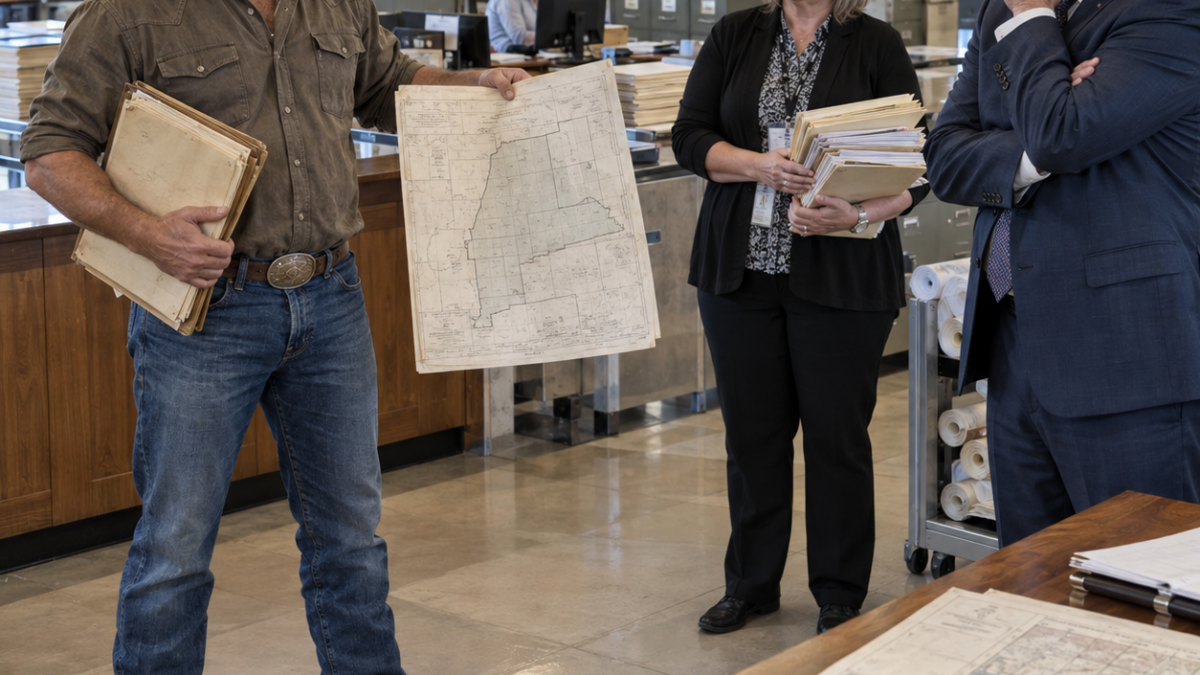
The original subdivision plat appeared first.
Filed in 2005.
Whispering Pines Estates, Section A.
Then Section B.
Then C.
My land sat along the western side.
Two hundred acres outlined in thick black.
The label was clear.
MILLER FAMILY TRACT
NOT INCLUDED.
I pointed at it.
“There.”
Brenda nodded.
“Foundational plat.”
“That ends this?”
“It should.”
“Should?”
“People can amend plats.”
“Without the owner?”
“Not legitimately.”
She kept reading.
“If they wanted to bring your parcel into a subdivision, they’d need proper legal process and your participation.”
“I never signed anything.”
“Then let’s keep digging.”
We did.
The original declarations acknowledged neighboring agricultural property.
Another document specifically disclosed potential farming noise and dust from adjacent land.
I laughed when I read it.
“So people bought these houses after signing a notice that farms make farm noises.”
“Apparently.”
“And now they’re fining me because a tractor is loud.”
Brenda gave me a look.
“Logic isn’t always recorded.”
Then she found the amendment.
Six months old.
The paper itself didn’t look remarkable.
A survey attachment.
A few legal descriptions.
Approval signatures from the HOA board.
But when Brenda enlarged the survey on her monitor, both of us went quiet.
The original western boundary had moved.
My entire ranch was inside it.
SECTION D – FUTURE DEVELOPMENT / GREENBELT.
The ponds.
Barn.
Hayfield.
House.
Everything.
On paper, someone had swallowed two hundred acres with a line.
“Who filed this?” I asked.
Brenda scrolled.
“Whispering Pines Estates HOA.”
“Surveyor?”
She zoomed again.
Then frowned.
“That stamp looks wrong.”
“How?”
“See the signature?”
“Yes.”
“Looks reproduced.”
“Meaning?”
“Could be a digital copy. But this kind of filing should have proper certification.”
She enlarged the notary block.
Then she stopped completely.
“Oh.”
“What?”
She leaned closer.
“Well, that is interesting.”
The notary was Karen Miller.
HOA president.
Beneficiary of the amendment.
The same woman claiming authority over the land.
Brenda shook her head.
“A notary isn’t supposed to notarize a transaction where she has a direct beneficial interest.”
“Illegal?”
“Potentially invalid. Potentially worse depending on what happened.”
She printed the page.
Then compared the surveyor information against licensing records.
The registration number belonged to a legitimate surveyor.
But the surveyor’s office had no obvious connection to the filing.
Brenda looked at me.
“I’d have an attorney contact him.”
“Why?”
“Because I’d be very interested to know if he drew this.”
My pulse changed.
This wasn’t just bureaucratic incompetence anymore.
Somebody had altered a recorded land map.
“What happens if he didn’t?”
Brenda removed her glasses.
“Then somebody attached a professional surveyor’s credentials to a document he didn’t prepare.”
“Fraud.”
“I didn’t say that.”
“You didn’t have to.”
She studied me.
“You’re not going to do anything stupid, are you?”
“Depends on your definition.”
“Don’t confront anybody.”
“Wasn’t planning to.”
“Good.”
I thought of Sarah saying exactly the same thing.
Brenda went back through the HOA’s organizational filings.
Then she pointed to something else.
“They’re organized as a nonprofit social welfare corporation.”
“What does that mean for this?”
“It means they claim tax-exempt treatment.”
I read the language.
“What would threaten that?”
Brenda shrugged.
“I’m a records clerk, Colonel, not the IRS.”
“Understood.”
“But if a nonprofit organization is being operated for insiders instead of its stated purpose…”
She let the sentence hang.
I finished it mentally.
Problems.
Serious ones.
I spent another hour purchasing certified copies.
Original plat.
All amendments.
The questionable filing.
My deed.
The subdivision declarations.
Corporate filings.
When Brenda handed me the envelope, it was nearly two inches thick.
She tapped it.
“Facts first.”
“Yes, ma’am.”
“And get a lawyer.”
“My daughter said the same thing.”
“Smart girl.”
“She gets it from her mother.”
I stepped outside into the Texas sun.
The courthouse square was busy.
Cars.
Pickup trucks.
People carrying folders.
Nothing dramatic had happened.
No shouting.
No deputies.
No gavels.
Just a clerk opening records.
Yet standing there with that envelope, I understood the entire conflict differently.
Karen hadn’t simply invented an interpretation of HOA authority.
Someone had created paperwork designed to make her interpretation look official.
There is a difference between arrogance and fraud.
The first is irritating.
The second leaves fingerprints.
I called Sarah before I reached the truck.
“You were right.”
“That sounded painful for you.”
“Enjoy it.”
“What did you find?”
“An amended plat.”
Silence.
“My land is inside it.”
“What?”
“Filed six months ago.”
“Did you sign anything?”
“No.”
“Who notarized?”
“Karen.”
Sarah stopped breathing for a second.
“You’re kidding.”
“No.”
“Dad, photograph every page.”
“I bought certified copies.”
“I love you.”
“First time you’ve said that because of paperwork.”
“Get home. Scan everything. Do not contact her.”
“Yes, counselor.”
“I’m serious.”
“So am I.”
I drove back to the ranch.
For most of the trip, I thought about my grandfather.
Not the deed.
Him.
Granddad used to say land only belonged to you temporarily.
“You don’t own dirt, Jackie,” he’d tell me. “You borrow responsibility for it.”
As a boy I thought that sounded like something old men said because they enjoyed hearing themselves talk.
At sixty-seven, I understood.
My great-grandfather came home from the First World War carrying injuries he never discussed.
He saved money.
Bought acreage.
Worked it.
Then my grandfather carried it.
Then my father.
Now me.
The property wasn’t valuable because it was large.
It was valuable because four generations had kept a promise.
Karen saw undeveloped land.
I saw responsibility.
The paper war started three days later.
Certified envelope.
Whispering Pines logo.
Karen’s signature.
Amount due:
$55,417.62.
Apparently my failure to pay fifty-two thousand dollars had generated several thousand dollars in additional penalties almost overnight.
I sat at the dining room table and read the violations.
Historic barn: unapproved agricultural structure.
Hayfield: landscape maintenance failure.
Ford F-250: commercial vehicle.
Mailbox: nonconforming style.
Canoe beside pond: visible recreational equipment.
My favorite:
Roof color.
The tin roof on my house was not an approved earth tone.
I called Sarah.
“They’ve fined the roof.”
“What?”
“Wrong color.”
“What color is it?”
“Metal.”
She groaned.
“Don’t laugh.”
“I’m not.”
“You’re laughing.”
“A little.”
I photographed every page.
Logged the date.
Scanned the envelope.
Filed it.
Then I wrote one letter.
Not emotional.
Not threatening.
The ranch parcel was not part of Whispering Pines.
The recorded 2005 plat established that fact.
Any attempt to assess fines, dues, or restrictions was unauthorized.
Cease and desist.
Certified mail.
Return receipt.
Karen signed for it.
A week later another fine arrived.
Then another.
Then another.
The notices became stranger.
Noise.
Hay harvesting.
Unapproved equipment.
Visible utility trailer.
Excessive vegetation.
I kept everything.
The binder grew.
Sarah came home one weekend and found me adding colored tabs.
“Dad.”
“What?”
“You’ve color-coded the harassment.”
“Red for monetary demand. Blue for property violation. Yellow for trespass.”
“You’re enjoying this too much.”
“Absolutely not.”
“You alphabetized Karen.”
“I alphabetized exhibits.”
She sat across from me.
“You know this could still get ugly.”
“I know.”
“If they file a lien, we respond immediately.”
“They won’t get that far.”
“How do you know?”
“Because once a real lawyer sees their plat, somebody will panic.”
“You’re assuming they use a real lawyer.”
Fair.
I had cameras installed anyway.
Four.
Driveway.
House.
Barn.
Fence.
That turned out to be useful almost immediately.
Three days later a white sedan entered my driveway.
HOA logo.
A man got out.
Board member.
I recognized him from the fence confrontation.
He walked toward the barn taking pictures.
I stepped out of the workshop.
“You’re trespassing.”
He almost dropped his phone.
“I’m conducting a compliance inspection.”
“No, you’re not.”
“We have authority.”
“Show me.”
He held up his phone.
“I’m documenting violations.”
“I’m documenting you.”
I pointed toward the camera mounted under the barn eave.
His face changed.
“The sheriff’s substation is ten minutes away.”
He walked backward.
“You’re being unnecessarily hostile.”
“I’m standing on my land.”
“You don’t need to threaten me.”
“I didn’t.”
He got into his car.
Backed out fast enough to spray gravel.
I logged the time.
Saved the video.
Printed two stills.
Yellow tab.
Trespass.
That evening I sat on the porch watching the sun lower over the hayfield.
The whole fight felt ridiculous.
Then I remembered Karen threatening a lien.
Ridiculous things become dangerous when people put them inside official processes.
You don’t ignore them because they’re absurd.
You document them because they’re absurd.
My next ally came from the hayfield.
Tom Alvarez leased sixty acres from me.
His family ran dairy cattle west of town.
When I showed him the HOA notice citing “excessive agricultural noise,” he stared for a while.
Then looked toward his tractor.
“They fined you because I cut hay?”
“Yes.”
“At seven in the morning?”
“Yes.”
“That woman called the county on me last year.”
“For what?”
“Noise.”
“What happened?”
“Deputy asked me if tractors were capable of whispering.”
I laughed.
Tom didn’t.
“She’s been trying to turn this entire road residential.”
“Why?”
“People in those houses complain about everything. Smell. Dust. Trucks. Roosters.”
He spat into the dirt.
“They bought houses next to farms and decided the farms were the problem.”
That was when I started asking questions beyond my property.
Not publicly.
Quietly.
Karen’s problem wasn’t only me.
I was simply the largest obstacle.
I noticed it every morning.
A white HOA sedan drove slowly through Whispering Pines.
People moved trash cans immediately.
One resident trimmed a hedge while the compliance vehicle watched.
Another scrubbed oil from a driveway.
Fear doesn’t always look dramatic.
Sometimes it looks like ordinary people reorganizing their lives because they don’t want another envelope.
My first real contact inside the subdivision happened accidentally.
Or mostly accidentally.
A young couple was repainting the trim around their front door.
I could see them from the road.
The man stood on a ladder.
His wife held two paint cards and looked close to tears.
I parked near my fence while checking posts.
They eventually drove out.
I waved.
The husband stopped.
“Hot day for painting.”
He gave a bitter laugh.
“Not by choice.”
“What happened?”
“Our trim is Arctic White.”
I waited.
He sighed.
“Approved color is Whisper White.”
I stared.
“Different?”
“My wife says yes.”
His wife leaned across him.
“The samples are basically identical.”
“Fine?”
“One thousand if it’s not fixed by Monday.”
I introduced myself.
The husband was David Parker.
His wife, Emily.
When they heard my name, both reacted.
“You’re the ranch guy.”
“Apparently.”
David looked embarrassed.
“Karen talked about you at the meeting.”
“What’d she say?”
“That you’re refusing to contribute to greenbelt maintenance after getting annexed.”
I pointed through the trees.
“You see that barn?”
“Yes.”
“My family built it before this subdivision existed.”
Emily frowned.
“She said Section D had always been planned.”
I opened my truck.
The evidence binder stayed behind the seat.
I showed them only three things.
Original plat.
Questionable amendment.
Fine total.
Emily covered her mouth.
“Fifty-five thousand?”
“More now.”
David read the plat.
“Your land isn’t inside.”
“Correct.”
“And this new one just moved the boundary?”
“Correct.”
“Can they do that?”
“That’s the question.”
Emily looked toward Whispering Pines.
“She does this to everyone.”
I closed the binder.
“Then everyone should save their paperwork.”
That night, David emailed.
Two neighbors wanted to talk.
Then five.
Then eleven.
One was Mrs. Gable.
Seventy-four.
Widowed.
Fined for garden gnomes her husband had collected before he died.
“They’re ugly,” she admitted.
I smiled.
“I won’t argue.”
“But Harold loved them.”
Karen had ordered removal.
Another family had a basketball hoop violation.
A nurse had been fined because her trash bin remained curbside while she worked a double shift.
A teacher had been threatened over a classroom fundraiser sign displayed in her yard one day beyond the allowed period.
None of these alone proved corruption.
Together, they proved a style of government.
Punish first.
Question later.
Keep people isolated.
So we stopped being isolated.
Private email group.
No social media posts.
No public attacks.
Just documents.
Receipts.
Notices.
Minutes.
Contracts.
Bank statements available to members.
It was Emily who first mentioned Pristine Properties Management.
“They handle everything.”
“What is everything?”
“Billing. Compliance. Contractors. Security.”
“HOA employees?”
“No. Outside company.”
“Who owns it?”
She didn’t know.
That question stayed with me.
By then Sarah had already decided we needed counsel.
Not a general practitioner.
Real-estate litigation.
She recommended Arthur Davies.
He was fifty-eight, white-haired, expensive-looking, and calmer than any attorney with a reputation for aggression had a right to be.
I walked into his office carrying the binder.
Placed it on the desk.
It landed with a heavy thud.
Davies looked at it.
“What’s that?”
“Opening statement.”
He smiled.
“Colonel, I think I’m going to like you.”
I told him everything.
Fence confrontation.
Original plat.
Amended plat.
Karen’s notary.
Survey stamp.
Fines.
Certified warning.
Trespass video.
Resident documents.
He read silently.
When he reached the questionable plat amendment, he stopped.
“Who notarized this?”
“Karen.”
“She benefits from the transaction?”
“She claims the annexation gives her association jurisdiction over two hundred acres.”
“Then yes.”
He leaned back.
“This is spectacularly reckless.”
“Fraud?”
“Potentially.”
He tapped the surveyor’s stamp.
“First thing I do is contact this surveyor.”
He did.
Two days later, the answer arrived.
The surveyor had never prepared the map.
His seal had been copied from an unrelated document.
Davies called me.
“Now we have a different case.”
“How different?”
“Forgery different.”
I sat quietly.
“Karen?”
“We don’t know who created it yet.”
“But she notarized it.”
“Yes.”
“And filed it?”
“Her HOA did.”
He paused.
“Jack, don’t contact her.”
“Everyone keeps telling me that.”
“Because you look like a man who could make a bad decision politely.”
I laughed.
Davies sent his cease-and-desist.
Heavy stationery.
Statutes.
Demand to withdraw claims.
Demand to remove the false amendment.
Warning regarding trespass, harassment, false filing, and potential damages.
Karen signed for it.
Two days later, she fined me $2,500.
Reason:
Failure to comply with legal HOA correspondence.
I stared at it for almost a minute.
Then emailed it to Davies.
Subject:
SHE RESPONDED.
His reply:
Excellent.
I called him.
“Excellent?”
“She just demonstrated willfulness.”
“You sound happy.”
“I’m a litigator.”
That explained a lot.
But Davies wasn’t satisfied with the plat.
“There’s a reason she’s pushing this hard.”
“Power.”
“Maybe.”
“Ego.”
“Probably.”
“But?”
“Money.”
He asked the residents to exercise inspection rights over the HOA’s books.
Karen ignored the request.
Davies escalated.
A court filing followed.
Suddenly the HOA produced records.
Not neatly.
Boxes.
Hundreds of pages.
Receipts mixed with contracts.
Bank statements out of order.
Invoices duplicated.
Minutes missing attachments.
Classic document dump.
I took one box home.
Sarah arrived Friday evening.
She looked at my dining room.
“No.”
“What?”
“You’ve turned Grandpa’s table into an audit room.”
“He’d approve.”
“He built it for dinner.”
“We can still eat.”
“Where?”
I pointed at one clear corner.
She sighed.
Then sat.
For three days, we worked.
Management fee.
Monthly.
High.
Pristine Properties Management LLC.
Vendor coordination.
Compliance administration.
Legal intake.
Landscaping.
Security.
Pool maintenance.
Invoices flowed through Pristine.
I searched state corporate records.
Registered agent:
Gary Miller.
The surname didn’t prove anything.
So Sarah searched public records.
Family references.
Wedding announcements.
Archived social media.
Then she turned the laptop toward me.
Photograph.
Karen standing beside Gary at a family Christmas party.
Caption:
Best brother-in-law in Texas.
Sarah looked at me.
“Well.”
I stared at it.
“Could be innocent.”
She nodded.
“Could be.”
Then we matched payments.
Pristine’s management fees were nearly double comparable associations.
Landscaping subcontract.
Thirty-five percent markup.
Pool contractor.
Forty percent.
Security.
Another markup.
Karen’s signatures appeared repeatedly on authorizations.
No meaningful conflict-of-interest disclosures in the minutes we could find.
Sarah stopped highlighting.
“Dad.”
“Yeah.”
“This isn’t about your ranch.”
I knew.
My land wasn’t merely something Karen wanted controlled.
It was more revenue.
Two hundred acres.
Potential future lots.
Greenbelt budgets.
Compliance.
Management fees.
Power and money had found each other.
That combination rarely ends well.
I drove the financial binder to Davies.
Opened it to the corporate registry.
Then the invoices.
Then Karen’s signatures.
He didn’t speak for almost a minute.
Finally:
“That’s ugly.”
“Illegal?”
“Potentially self-dealing. Maybe fraud. We need accountants and investigators before using stronger language.”
“Fair.”
“But the nonprofit issue just became serious.”
He explained it.
Whispering Pines claimed social-welfare tax treatment.
Organizations with tax privileges have obligations.
They cannot simply become pipelines for insiders.
If the management arrangement existed primarily to enrich Karen’s relatives, regulators could care.
A lot.
“What happens if they revoke status?”
“Depends on years involved.”
“Worst case?”
“Back taxes. Penalties. Interest.”
“How much?”
He looked at the financials.
“Enough that nobody in Whispering Pines should sleep comfortably until we know.”
I didn’t enjoy that.
The residents weren’t Karen.
Most were victims too.
“I don’t want to bankrupt families.”
Davies nodded.
“Good.”
“So what’s the objective?”
“Exposure first.”
“And then?”
“Let regulators separate the guilty from everyone else.”
That mattered.
Revenge is easy when you imagine your enemy alone.
Harder when innocent people stand around them.
I didn’t want Whispering Pines destroyed.
I wanted Karen stopped.
But Karen’s organization had become the weapon.
You don’t leave a loaded weapon in place because dismantling it is inconvenient.
Davies secured us a place on the agenda at a county commissioners meeting.
Topic:
PLATTING AND ZONING IRREGULARITIES – WHISPERING PINES ESTATES.
Boring title.
Perfect.
Local reporter attendance was common.
The meetings were recorded.
Open public comment.
Official record.
Karen apparently assumed it was another property-boundary fight.
She attended with two board members.
I brought Sarah.
Davies.
David and Emily.
Mrs. Gable.
Tom.
Several residents.
When I walked into the commission chamber, Karen saw us.
The confidence left her face for half a second.
That half second told me she understood something was different.
Judge Harris chaired the session.
Stern man.
Former prosecutor.
Our agenda item came after road resurfacing contracts.
He looked down.
“Colonel Jack Miller?”
I stood.
“Yes, sir.”
“You requested time regarding Whispering Pines?”
“Yes.”
“Proceed.”
I walked to the podium.
I had worn my old service jacket.
Not full uniform.
I wasn’t pretending this was military.
The jacket reminded me to act like the officer I’d spent thirty years becoming.
Calm.
Specific.
No theatrics.
I looked at the commissioners.
“My name is Jack Miller. My family has owned two hundred acres adjacent to Whispering Pines for more than one hundred years.”
First slide.
1919 deed.
Second.
2005 plat.
Third.
The questionable amendment.
I explained.
No consent.
No sale.
No annexation agreement.
No signature.
Then I displayed the surveyor statement.
He did not prepare the map.
The room changed.
Judge Harris leaned forward.
“Who filed this amendment?”
I pointed to the recording information.
“Whispering Pines HOA.”
Karen stood.
“This is outrageous.”
Harris didn’t raise his voice.
“Mrs. Miller, sit down.”
“I have a right—”
“You will have a right to respond when Colonel Miller is finished.”
She sat.
I showed her notary block.
Explained the conflict.
Not accused.
Documents first.
Conclusions later.
Then fines.
$55,000.
Barn.
Hayfield.
Mailbox.
Truck.
Roof.
Canoe.
People laughed at the roof violation.
I didn’t.
Then came security video.
Board member entering my property.
Photographing the barn.
Leaving after being told to stop.
I shifted.
“This would be concerning if I were the only person experiencing it.”
Next slide.
Arctic White versus Whisper White.
David and Emily.
Then Mrs. Gable’s garden gnomes.
Basketball hoop.
Trash bin.
Harassment notices.
I watched residents in the audience nod.
Karen stared at them.
Until then, she’d probably believed every victim remained separate.
Now they sat together.
Then I said:
“But petty enforcement isn’t the most serious issue.”
Financial flowchart.
HOA dues.
Pristine Properties Management LLC.
Vendor payments.
Management charges.
Markup.
Next slide.
Registered agent.
Gary Miller.
Next.
Relationship to Karen.
Then checks.
Karen’s signatures.
The room erupted.
Not immediately.
First came silence.
People processing.
Then whispers.
Then voices.
David stood.
“That’s her brother-in-law.”
Emily grabbed his arm.
Mrs. Gable said something I couldn’t hear.
Karen stood again.
“You’re twisting everything!”
Judge Harris hit the gavel.
“Sit down.”
“This is slander!”
“Sit down, Mrs. Miller.”
Davies stepped beside me.
He spoke for the first time.
“We are not asking this body tonight to determine criminal guilt.”
Good lawyer.
“We are asking that the questionable plat filing be formally reviewed and that evidence concerning the nonprofit’s financial operations be referred to appropriate state authorities.”
Harris looked at the clerk.
“Has the surveyor’s affidavit been submitted?”
“Yes, Judge.”
“And the original recorded plat?”
“Yes.”
“And the disputed amendment?”
“Yes.”
Harris turned toward Karen.
“Mrs. Miller, did you notarize this amendment?”
Karen swallowed.
“Yes.”
“Were you president of the HOA at that time?”
“Yes.”
“Did the amendment add the Miller property?”
“It corrected the community boundary.”
“Did Colonel Miller consent?”
“He didn’t need—”
“Did he consent?”
“No.”
“Did the surveyor whose seal appears here prepare the drawing?”
“I was told—”
“Yes or no?”
“I don’t know.”
Harris leaned back.
That was the moment.
Not the fines.
Not the flowchart.
Not the crowd.
The official record had trapped her inside questions with answers.
I finished.
“For months, Mrs. Miller has described my property as undeveloped green space waiting to be absorbed.”
I looked at the commission.
“My father worked that land until his hands could no longer close around tools.”
My voice tightened.
“My grandfather bought the Ford tractor still sitting in my barn.”
I hadn’t planned to mention him.
But once I started, I couldn’t stop.
“My family buried dogs beneath the oak trees. My daughter learned to ride a bicycle on our driveway. My wife and I raised children there.”
Sarah looked down.
“This isn’t vacant land.”
The room was completely silent.
“It is somebody’s home.”
I turned toward Karen.
“She was entitled to dislike my barn.”
Karen stared at me.
“She was entitled to hate the sound of tractors.”
No expression.
“She was even entitled to think my mailbox was ugly.”
A few people laughed.
“But she was never entitled to manufacture authority she did not possess.”
I faced the commission again.
“I am asking that my recorded boundary be restored and that these records be investigated.”
I stepped away.
Karen finally received her turn.
She approached the podium.
Her hands shook.
She began with procedure.
Said the boundary update had been prepared by consultants.
Said she relied on advice.
Said Pristine Properties was selected for quality.
Said Gary’s relationship had been publicly known.
People interrupted.
Harris stopped them.
Then he asked Karen one question.
“Where in your board minutes is the conflict of interest disclosed?”
She couldn’t answer.
Davies had searched.
Sarah had searched.
I had searched.
Nothing.
The meeting ended with three actions.
Immediate referral of the plat issue to the county attorney.
Notice to the state nonprofit regulator.
Referral of the financial materials to the state attorney general.
Karen walked out through a corridor of her own neighbors.
Nobody shouted.
That was more powerful.
David watched her pass.
Then he said:
“She looks smaller.”
She did.
Power makes people look larger than they are.
The next morning, the local news aired the meeting.
HOA PRESIDENT ACCUSED OF FILING IRREGULAR PLAT.
I hated the word “accused” even though technically correct.
It made the situation sound like entertainment.
But reporters started digging.
Within days, the county invalidated the amendment.
Not metaphorically.
Officially.
It was struck from the record as defective.
A certified notice arrived.
The Miller ranch remained outside Whispering Pines.
Always had.
I held that letter standing at the mailbox.
For months I’d imagined that moment.
Thought I would feel triumphant.
Instead, I sat on the porch.
Read it again.
Then called Sarah.
“It’s official.”
She didn’t ask what I meant.
“They removed it?”
“Yes.”
“Dad.”
Her voice cracked.
That surprised me.
“You okay?”
“I’ve been scared.”
“You never said.”
“I didn’t want you more worried.”
“Sarah.”
“I know.”
She inhaled.
“What if they had found some way to tie everything up? What if you spent years in court? That’s home.”
I looked across the pasture.
“I know.”
“Mom loved that place.”
That did it.
I stared at the porch boards.
My wife, Ellen, had died five years earlier.
Cancer.
Fast.
Fourteen months from diagnosis to funeral.
Afterward, the ranch became the only place where grief wasn’t an intruder.
Every room carried her.
Kitchen window.
Garden bench.
The patch of irises by the pump house.
Karen’s threat had touched something deeper than acreage.
It threatened the place where my marriage still existed in physical memory.
“I wasn’t going anywhere,” I told Sarah.
“I know.”
“No one takes this from us.”
“I know.”
We stayed on the phone without talking for a while.
The plat was resolved.
The rest wasn’t.
The attorney general announced an investigation.
Then the IRS became involved.
Davies explained that tax-exempt status wouldn’t vanish because of one angry meeting.
Investigators would examine records.
Transactions.
Purpose.
Private benefit.
Governance.
Years.
That’s what they did.
Subpoenas.
Bank records.
Contracts.
Tax returns.
Pristine Properties records.
Gary Miller’s accounts.
Karen’s communications.
HOA minutes.
Former board members started talking.
One admitted Karen pushed Pristine as a “full-service solution.”
Another said conflict questions were dismissed because “everybody knew everybody.”
Former treasurer claimed invoices often arrived already approved by Karen.
The amount of money grew.
Not millions.
This wasn’t Wall Street.
But to families paying annual assessments, it mattered.
Excess management charges.
Inflated vendor bills.
Questionable reimbursements.
The investigators focused heavily on whether Pristine had been used to funnel money to insiders.
Karen stopped attending HOA meetings.
David and Emily told me residents had begun gathering signatures for her removal.
She refused to resign.
Then she made her last mistake.
My grandfather’s Ford 8N tractor.
It was a 1952.
Gray body.
Red wheels.
Restored almost completely.
He bought it new.
When he died, it passed to my father.
Then to me.
For a year, I’d rebuilt it.
Carburetor.
Wiring.
Hydraulics.
Seat.
Paint.
It was probably worth less than Karen’s SUV.
To me, it was priceless.
One Saturday I used it to pull brush from a drainage area.
When I finished, I parked it fifty feet inside the fence.
Visible from the road.
Apparently Karen saw it.
Around ten the next morning, a tow truck appeared.
I watched from the porch.
At first I assumed someone had broken down.
Then I saw Karen.
She pointed through my gate.
Tow driver pulled onto the shoulder.
I stood.
For a few seconds I simply couldn’t believe it.
The county had already confirmed my ranch was not part of Whispering Pines.
She was under investigation.
There was a cease-and-desist.
Davies was pursuing restraining relief.
And still—
she came for the tractor.
Not because it mattered legally.
Because it mattered to me.
That’s when I finally understood Karen completely.
She wasn’t making a governance decision.
She was trying to hurt me.
I called Davies.
“She has a tow truck.”
Long silence.
“For what?”
“Granddad’s Ford.”
“You’re joking.”
“No.”
“Do not engage.”
“Calling sheriff.”
“Good.”
The second call got a faster response once I provided the ongoing case information.
Two cruisers arrived.
The tow driver hadn’t entered yet.
Smart man.
Karen stood near the gate waving paperwork.
Deputy Harris—not related to Judge Harris—walked up.
“Morning.”
Karen immediately pointed.
“That vehicle is in violation.”
He looked at the tractor.
Then at my property.
“Violation of what?”
“Whispering Pines restrictions.”
The deputy looked at me.
“This Whispering Pines?”
“No.”
Karen snapped.
“It has been part of an ongoing dispute.”
“County resolved that.”
“They’re wrong.”
Deputy Harris turned back.
“You have a court order?”
“I have enforcement authority.”
“No.”
“You don’t understand HOA law.”
He smiled slightly.
“Probably not.”
Then his partner called him toward the cruiser.
They spoke quietly.
Harris returned holding an envelope.
His expression changed.
“Mrs. Miller?”
“Yes.”
“You’re Karen Miller?”
“I am president of Whispering Pines Estates.”
He looked at the envelope.
“Not relevant.”
He handed it to her.
“You’ve been served with a temporary restraining order. You are prohibited from entering or approaching Colonel Miller’s property as described here.”
Karen stared.
Then he produced another notice.
“This is notice requiring your appearance relating to the district attorney’s criminal investigation.”
Her face drained.
“This is because of him.”
The deputy shook his head.
“This is because of an investigation.”
She looked toward me.
I stayed on the porch.
Did not smile.
Did not wave.
The tow driver walked back to his truck.
Karen spun.
“Where are you going?”
He opened the door.
“Home.”
“I hired you.”
“Lady, I’m not towing a tractor with two cops and a restraining order standing here.”
He left.
Neighbors had gathered near the entrance.
No one said anything.
Karen stood holding the documents.
For the first time since this started, there was no clipboard.
No board.
No golf cart.
No cronies.
Just her.
She shouted toward me.
“You ruined everything!”
I could have ignored her.
Probably should have.
Instead I walked halfway down the drive.
Not close enough to violate anything.
“Karen.”
“You destroyed this community.”
“No.”
“Because you couldn’t follow rules!”
“This wasn’t about rules.”
“You think you’re better than everyone.”
“No.”
“You used your military status. Your lawyer. The county. The state.”
I looked at her.
“You forged authority over my land.”
“I didn’t forge anything!”
“You signed it.”
“I relied on people.”
“You fined families to exhaustion.”
“They violated covenants.”
“You paid your brother-in-law’s company inflated fees.”
Her mouth opened.
I stopped her.
“And after all of that, when the county told you the ranch was mine, you came for my grandfather’s tractor.”
She stared.
“That tractor is junk.”
That sentence removed the last piece of anger from me.
Strangely.
I almost felt sorry for her.
“That’s why you lost.”
“What?”
“You never understood what things mean to other people.”
She looked confused.
“My barn is ugly to you.”
Silence.
“My field is unkempt.”
She shifted.
“My tractor is junk.”
I pointed toward Whispering Pines.
“David’s front door was the wrong white. Mrs. Gable’s gnomes were tacky. A child’s basketball hoop stayed out too long.”
Her jaw tightened.
“You reduced everybody’s life to whether you approved of it.”
“That is what standards are.”
“No.”
I shook my head.
“Standards protect communities. You used them to own people.”
Her shoulders lowered.
Behind her, the deputy waited.
I turned away.
“I’m done, Karen.”
That was our final conversation.
The criminal case moved slowly.
Reality is not television.
Investigators don’t solve five years of financial records in an afternoon.
Accountants reviewed contracts.
Prosecutors negotiated.
Attorneys argued.
Months passed.
Eventually Karen and Gary accepted plea agreements connected to fraudulent financial practices.
The exact legal language was less dramatic than the neighborhood rumors.
But the consequences were real.
Restitution.
Probation.
Restrictions on nonprofit and board service.
More than two hundred thousand dollars had to be returned or accounted for under the settlement terms described to residents.
Then came the tax decision.
Whispering Pines’s old organization lost its claimed tax-exempt status retroactively for multiple years after investigators determined its operations failed the standards required for the benefit it had been receiving.
The resulting tax assessment, interest, and penalties climbed past half a million dollars.
That nearly destroyed the association.
When Davies told me, I didn’t celebrate.
“I wanted Karen stopped.”
“She is.”
“I didn’t want two hundred families holding this bill.”
“They won’t necessarily bear all of it.”
“How?”
“Receiver.”
The state and courts worked through the financial mess.
Restitution recovered from Karen and Gary covered part.
Assets were reviewed.
Contracts canceled.
The white compliance sedan was sold.
Pristine Properties disappeared from HOA operations.
The old association entered restructuring and dissolution procedures.
Residents had meetings.
Lots of them.
For once, meetings where people actually spoke.
David Parker called me one evening.
“We’re forming something new.”
“Do you have to?”
“Shared roads. Entrance maintenance. Pool.”
“Fair.”
“But we don’t want another Karen.”
“Nobody does.”
“What would you do?”
I laughed.
“I live behind barbed wire for a reason.”
“Seriously.”
I thought about it.
“Make rules boring.”
“What?”
“If your rules are interesting, you probably have too many.”
He laughed.
I continued.
“Spend rules on real shared problems. Roads. Insurance. Safety. Common property.”
“What about paint colors?”
“People own eyes.”
“Gnomes?”
“National security threat.”
He laughed harder.
“Basketball hoops?”
“Require children to miss fifty percent of free throws.”
“Jack.”
“You asked.”
The new association became smaller in authority.
Transparent budgets.
Competitive bids.
Conflict disclosures.
Limits on fines.
Clear appeal rights.
No compliance patrol vehicle.
David joined the board.
Emily too.
Mrs. Gable declined.
“I’ve already fought one dictatorship,” she told me. “I’m retired.”
Her gnomes remained.
All fourteen.
One wore a cowboy hat.
A few months later, David and Emily drove to the ranch.
Emily carried an envelope.
I eyed it.
“Violation?”
“Trauma response?”
“Probably.”
She handed it over.
Formal apology from the new board.
Not legal boilerplate.
Human.
It acknowledged that residents had benefited from my willingness to challenge actions that harmed both my family and theirs.
Inside was a gift card.
Steakhouse.
“For two,” David said.
“I’m single.”
“Take Sarah.”
“She’s vegetarian half the time.”
“Then eat both steaks.”
Good advice.
Sarah visited the following month.
We sat on the porch at sunset.
The sky turned orange behind the hayfield.
Granddad’s tractor stood inside the barn opening.
Restored.
Clean.
Sarah handed me iced tea.
“You realize you’re impossible.”
“Yes.”
“You could’ve just hired Davies on day one.”
“I eventually did.”
“You could’ve avoided half the stress.”
“Maybe.”
“You let Karen keep escalating.”
“Yes.”
“Why?”
I took a drink.
“That bothers you?”
“It terrified me.”
I looked at her.
She stared toward the pasture.
“Every week there was something new.”
“I had it controlled.”
“No, Dad.”
She turned.
“You believed you had it controlled.”
Fair.
I didn’t answer.
She continued.
“You were treating it like a campaign because that’s how you survived your whole career.”
“That isn’t—”
“It is.”
Her eyes filled.
“Mom used to tell me that when you get scared, you become organized.”
I laughed softly.
“Sounds like her.”
“She said you make lists because lists are easier than admitting something can hurt you.”
That landed.
I looked toward the barn.
“When Karen said lien…”
Sarah waited.
“I pictured strangers standing here.”
My voice became quieter.
“A realtor sign.”
Sarah touched my arm.
“I pictured losing the house.”
“You wouldn’t have.”
“I know that now.”
“No.”
She squeezed.
“You knew legally.”
I looked at her.
“But emotionally?”
That was different.
After Ellen died, I had convinced myself the ranch was enough.
Not enough to replace her.
Nothing could.
Enough to hold what remained.
Her garden.
Coffee mug.
Quilt.
Wind chimes.
The oak where she wanted her ashes scattered.
When Karen threatened the land, she threatened memory.
I had hidden that behind tactics.
Plat numbers.
Certified mail.
Binders.
It was easier to wage war against paperwork than admit I was afraid of losing the last place where my wife still felt present.
“I miss her,” I said.
Sarah leaned against my shoulder.
“I know.”
“She would’ve hated Karen.”
“She would have invited her inside.”
“No.”
“Yes.”
“For tea?”
“And then calmly destroyed every argument she made.”
I smiled.
“That sounds like your mother.”
Sarah looked at the field.
“Do you think all of this was worth it?”
The question surprised me.
“The fight?”
“Everything.”
I considered.
“No.”
She looked at me.
“No?”
“The damage wasn’t worth it.”
I pointed toward Whispering Pines.
“People lost money. Families were afraid. Karen wrecked her own life. The HOA nearly collapsed.”
“But you won.”
“Winning doesn’t make the bad parts good.”
She nodded.
“Then what was worth it?”
“The part after.”
“What part?”
“People stopped being afraid.”
Children played in the street again.
Basketball hoops stayed visible.
People painted doors colors chosen at stores without comparing approved shades under fluorescent lights.
Mrs. Gable’s gnomes multiplied.
Tom still cut hay at seven.
No one sent letters.
The new board’s first annual financial report was five pages long and understandable.
No unexplained management company.
No family contractor.
No secret amendments.
Boring.
Wonderful.
My relationship with the neighborhood changed too.
For years, I’d treated Whispering Pines as an intrusion.
A suburb encroaching on rural land.
They treated me as the old rancher.
After everything, we became neighbors.
Real neighbors.
David helped repair fence after a storm.
Emily brought food when I had knee surgery.
Mrs. Gable came over once with three gnomes she was trying to get rid of.
I refused.
She left one anyway.
It now sits behind the barn.
I named it Karen.
Sarah thinks that’s petty.
She’s correct.
Tom nearly fell off his tractor laughing when he saw it.
A year after the county meeting, Judge Harris invited me to speak briefly at a public property-records workshop.
I declined.
Then Sarah convinced me.
“Why?”
“Because most people don’t know how much public record matters.”
So I went.
Room full of landowners.
Retirees.
Small business owners.
A few HOA board members who avoided eye contact when they heard my name.
I told them the truth.
Not the dramatic version.
The useful version.
Keep your deed.
Understand your boundaries.
Read recorded plats.
Don’t assume a logo makes a document authoritative.
Send important disputes in writing.
Keep copies.
Ask qualified professionals before escalating.
And most importantly:
Don’t confuse being quiet with giving permission.
Afterward a young farmer approached me.
“My family land borders a new development.”
I smiled.
“Congratulations.”
He laughed nervously.
“Should I be worried?”
“No.”
“Really?”
“Most people are reasonable.”
“What should I do?”
“Know your records before you need them.”
That became my lesson.
Preparation isn’t paranoia.
It’s maintenance.
You change oil before the engine seizes.
You inspect bridges before they fail.
You preserve deeds before someone challenges boundaries.
Good engineering doesn’t wait for collapse.
Neither should property owners.
Davies eventually closed my file.
His final bill was painful.
But fair.
When I went to his office, the first binder sat on his shelf.
“Why is that here?”
“Souvenir.”
“That’s my evidence.”
“Copy.”
I looked at the label.
MILLER v. WHISPERING PINES.
“You enjoyed this case.”
He smiled.
“More than professionally appropriate.”
“What happens to Karen now?”
“Probation. Restitution. Restrictions.”
“And Gary?”
“Same general direction.”
“You think she learned anything?”
Davies looked at me.
“You’re asking the wrong question.”
“What should I ask?”
“Whether the system learned anything.”
I waited.
“The new board did.”
“Maybe.”
“The county did.”
“They tightened amendment verification.”
“The residents did.”
He nodded.
“That matters more.”
I stood.
Davies extended his hand.
“You know, Jack, most clients come to me wanting revenge.”
“I did too.”
“At first.”
“Yes.”
“What changed?”
I thought about Sarah.
Ellen.
Mrs. Gable.
David and Emily.
The kids playing under basketball hoops.
“Revenge ends with someone losing.”
Davies raised an eyebrow.
“And justice?”
“Should leave something better standing.”
He smiled.
“I may steal that.”
“Billable rate?”
“Always.”
We shook hands.
When I got home, I put the binder on a shelf.
For months, I’d opened it every day.
Now I didn’t need to.
The ranch returned to routine.
Hay.
Fence repair.
Pond maintenance.
Knee complaining.
Coffee.
One Saturday morning, I drove Granddad’s Ford 8N out to the exact spot near the fence where Karen had tried to have it towed.
I shut off the engine.
Whispering Pines sat beyond.
Same houses.
Different atmosphere.
David saw me and walked over.
“You breaking HOA rules?”
“Constantly.”
He leaned against the fence.
“You know, Karen wanted your land labeled greenbelt.”
“I remember.”
“We actually created a greenbelt.”
“Where?”
He pointed to a strip of HOA land between the houses and road.
“Native grasses. Walking trail.”
“Good.”
“No plastic fencing.”
“Better.”
“Residents voted.”
“Dangerous precedent.”
He smiled.
“Emily wants to ask something.”
“That sounds expensive.”
“She wants you to let us build a footpath connection near the pond.”
“No.”
“I haven’t explained.”
“No.”
“For community nature walks.”
“No.”
He laughed.
“Okay.”
“Private property.”
“Understood.”
That exchange mattered.
He asked.
I said no.
He accepted it.
That’s what Karen never understood.
Respecting boundaries doesn’t destroy community.
It makes community possible.
Six months later, I changed my mind.
Not completely.
I offered the school environmental club permission to visit the pond twice a year.
Supervised.
Written agreement.
No permanent easement.
Sarah drafted it.
“You’re getting soft.”
“Controlled access.”
“Soft.”
“Risk management.”
“Soft.”
The first visit brought twenty children.
Most had never stood beside a working hayfield.
One boy stared at the tractor.
“Is that the one?”
“What one?”
“The one the bad HOA lady tried to steal.”
I looked at his teacher.
She looked embarrassed.
“Stories travel.”
I crouched beside him.
“She didn’t try to steal it exactly.”
“My dad said cops came.”
“Your dad exaggerates.”
“Did they?”
“Yes.”
“So she did.”
Hard to argue with children.
I showed them the engine.
Explained how implements connected.
A girl asked how old the tractor was.
“Older than your grandparents.”
She gasped.
“Does it have Bluetooth?”
“No.”
“How does it work?”
“Better.”
Their teacher laughed.
The children walked the pond.
Saw herons.
Found tracks.
Asked about cattle.
That afternoon, after they left, I sat alone near the barn.
Maybe my grandfather’s idea of land was right.
Borrow responsibility.
Not possession.
Protecting land doesn’t mean locking everyone out.
It means deciding responsibly who enters and why.
Karen tried to remove that decision from me.
That’s what made the fight necessary.
Not property value.
Agency.
Years later, I still keep a certified copy of the 2005 Whispering Pines plat in my office.
My land is outside the boundary.
Thick line.
Clear.
Sometimes visitors see it framed.
“Why hang a plat map?”
“Artwork.”
Nobody believes me.
Beside it hangs my great-grandfather’s 1919 deed.
Two documents.
Different eras.
Same message.
This land is here.
These are the boundaries.
Respect them.
Karen tried to alter that with one dishonest amendment.
The irony is that the trip she forced me to make—the visit she never expected—didn’t just protect my ranch.
It exposed everything beneath her administration.
Without Karen’s fake annexation, I probably never would have searched the county files.
Without the county files, no suspicious amendment.
Without the amendment, no lawyer.
Without the lawyer, no financial requests.
Without the financial records, no Pristine Properties trail.
Without that trail, residents might still be paying inflated fees while being fined over paint colors.
Karen created the investigation that destroyed her authority.
That’s the strangest part.
She believed escalation meant strength.
Every time I resisted, she increased pressure.
Higher fines.
More letters.
Trespass.
False filings.
Public threats.
The tractor.
But every escalation created evidence.
Every paper became another page in my binder.
Every lie created another fact we could verify.
Every victim she intimidated became another witness when they finally realized they weren’t alone.
She built the case against herself.
I only organized it.
One evening, years after the whole thing ended, Sarah sat with me on the porch.
She had brought her teenage daughter, my granddaughter Lily.
Lily was sixteen and bored by everything older than six months.
Until she found the binder.
“Grandpa.”
“What?”
“Why do you have like five hundred pages about an HOA?”
“Long story.”
Sarah shouted from the kitchen.
“Do not ask him unless you have three hours.”
Lily opened the binder.
“Fifty-five thousand dollars?”
“Fake.”
She flipped.
“They fined your roof?”
“Yes.”
“That’s insane.”
“Yes.”
“Who’s Karen?”
Sarah appeared.
“Villain.”
“Your mother is oversimplifying.”
“Dad.”
Lily found the questionable plat.
“Wait.”
She looked toward the pasture.
“They just drew your land into their neighborhood?”
“Basically.”
“That can’t be legal.”
I smiled.
“Correct.”
“What happened?”
Sarah groaned.
“Here we go.”
I told Lily the story.
Short version.
County.
Fake survey.
Financials.
Meeting.
Investigation.
Tax status.
Tractor.
She listened.
Teenagers pretend not to care until they do.
When I finished, she asked:
“Were you scared?”
Same question Sarah eventually forced me to answer.
I decided not to hide this time.
“Yes.”
Lily looked surprised.
“But you were a colonel.”
“Colonels get scared.”
“You didn’t look scared in the video.”
She’d found clips online.
“I didn’t want Karen to see it.”
“Why?”
“Because fear is information.”
She thought about that.
Then Sarah interrupted.
“Don’t teach my daughter emotional repression.”
“I said fear is information.”
“You also spent six months pretending you weren’t afraid.”
“Operational security.”
Lily laughed.
Then she closed the binder.
“If I inherit this place, does the HOA get to try again?”
“No.”
“Good.”
“You planning to keep it?”
She looked through the porch rail toward the field.
“Maybe.”
That word pleased me.
Not because I expected her to ranch.
Maybe she would.
Maybe she wouldn’t.
The point was the option survived.
My great-grandfather protected an option for people he never met.
My grandfather preserved it.
My father preserved it.
I preserved it.
One day Sarah and Lily would decide what came next.
That’s what legacy actually is.
Not forcing future generations to repeat your life.
Giving them something intact enough that they have a choice.
Karen called the ranch undeveloped.
She didn’t understand that land can be fully developed into memory without a single subdivision lot.
Every fence post mattered.
Every oak.
Every bend of the creek.
The barn was built by men whose names are carved into our family Bible.
The pond was dug after a drought in the 1950s.
My father proposed to my mother near the north pasture gate.
Ellen and I held our thirtieth anniversary picnic beneath the cottonwoods.
Sarah buried her first dog behind the barn.
No master plan could measure any of that.
No HOA board could vote it into existence.
Therefore no HOA board had the right to vote it away.
Whispering Pines became healthier after the collapse.
Not perfect.
Never perfect.
People still argued.
One resident wanted purple siding.
Another hated it.
A family put up holiday lights in October.
Somebody complained.
David sent me a screenshot.
“Need expert opinion.”
I replied:
LET THEM FIGHT.
He sent a laughing emoji.
The new board resolved it without fines.
Imagine that.
Adults speaking.
Compromise.
Karen’s old compliance system had depended on constant enforcement because rules became an identity.
The new association treated rules like tools.
Use only when necessary.
That philosophy changed everything.
Annual dues dropped after Pristine was removed.
Competitive bids saved thousands.
The pool survived.
Roads survived.
Property values survived.
The sky didn’t fall because children left basketball hoops outside.
Mrs. Gable’s gnomes became locally famous.
Someone put Santa hats on them every December.
She accused me.
I denied involvement.
Truthfully, it was Tom.
The state eventually finished the Karen matter.
Davies sent me the final documents.
I read them once.
Then closed them.
No champagne.
No victory dinner.
I drove the tractor to the back field.
Ellen’s favorite place was a rise overlooking the pond.
I parked there.
Sat on the grass.
Wind through mesquite.
Birds near water.
I talked to her sometimes.
Still do.
“You would’ve told me not to fight so long,” I said.
The grass moved.
No answer.
“You would’ve been right.”
A hawk circled above.
“But we kept it.”
That mattered.
“I kept the place.”
For the first time in months, I cried.
Not because of Karen.
Because every battle ends eventually, and after adrenaline leaves, grief returns to collect what you postponed.
I had spent so much energy protecting Ellen’s home that I hadn’t noticed how often the fight let me avoid missing her.
War gives you tasks.
Loss gives you silence.
I sat until sunset.
Then drove home.
The Ford 8N rattled exactly the way it always had.
No Bluetooth.
Lily would hate that.
At the barn, I shut it down.
Quiet returned.
Good quiet.
Earned quiet.
Years earlier, when Karen stood at my fence with $52,840.17 printed on cheap paper, she believed I faced two choices.
Pay.
Or lose.
She was wrong.
There was always a third choice.
Verify.
That’s what ended her reign.
Not rage.
Not military rank.
Not intimidation.
One visit to a rec








