PART 2: HOA Tore Down My Grandfather’s 60-Year-Old Bridge—Then Learned the Only Road to Their 42 Homes Ran Across My Land
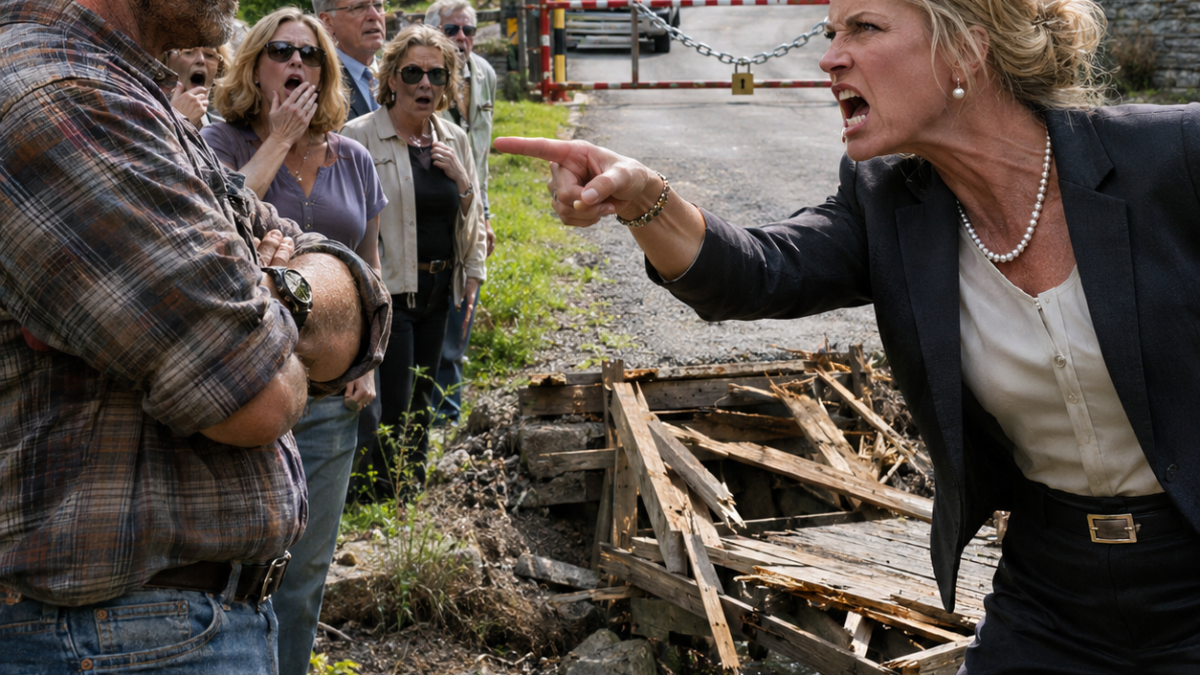
At 6:03 on a Tuesday morning, I stood in the wet Kentucky grass with a mug of coffee cooling in my hand and watched an HOA work crew send chainsaws through the white-oak bridge my grandfather had built in 1962, every crack of sixty-year-old timber sounding like a gunshot while the woman who ordered it destroyed stood twenty yards away with her arms folded as if she were supervising the removal of somebody else’s trash.
When the final support beam dropped into the creek and Darlene Fitch looked straight at me without the slightest hint of regret and said, “It was an eyesore, Garrett—nobody’s going to miss it,” she had no idea that she had just destroyed the one structure on my forty-seven acres that still carried my grandfather’s fingerprints, or that I had spent twenty-two years as a civil engineer learning exactly what happens when arrogant people act first and read property records later.
What Darlene couldn’t possibly understand that morning was that I wasn’t going to scream, threaten her, or chase her crew down the road, because men in my profession learn early that the strongest response to a reckless decision usually begins with silence, measurements, old documents, and enough patience to let the person who caused the failure keep adding weight until the entire structure collapses under them.
My name is Garrett Crutchfield.
I’m fifty-three years old, retired from civil engineering, and I live on forty-seven acres in rural Harland County, Kentucky.
The land belonged to my grandfather before it belonged to me.
Virgil Crutchfield.
If you had met him, you probably wouldn’t have remembered his clothes.
He wore the same work shirts until the elbows gave out, patched his own boots, and believed owning more than two neckties meant you had become too important for honest work.
But you’d remember his hands.
Big hands.
Scarred hands.
Hands that could set a fence post straight without a level and make a gate close properly on the first try.
He bought the property when most of that hillside was scrub pine and rock.
Built the farmhouse in 1958.
Dug the well.
Ran the fencing.
Cut drainage channels.
Then, in 1962, the seasonal creek behind the house began flooding the path to his back pasture every spring.
Grandpa didn’t call a contractor.
He built a bridge.
White oak decking.
Heavy treated supports.
Steel cable stays.
Nothing decorative.
Nothing designed for photographs.
It existed because cattle needed to get from one side of the creek to the other and because Virgil Crutchfield believed that if a problem stood between a man and his work, the proper response was to solve it.
As a boy, I crossed that bridge thousands of times.
I rode across it on the fender of Grandpa’s old tractor.
I sat on its railing with a fishing pole.
I dropped rocks into the water and watched the current carry them underneath.
Years later, after I became an engineer, I reinforced it with galvanized steel cross members and documented the load capacity.
Twelve thousand pounds.
Inspected.
Maintained.
Sound.
Grandpa was already gone by then, but I remember standing there after the work was finished and wishing he could see that I hadn’t replaced what he’d built.
I’d strengthened it.
That mattered to me.
For most of my adult life, I designed drainage and transportation infrastructure for county governments.
Culverts.
Stormwater channels.
Low-water crossings.
Road grades.
Retaining systems.
The work teaches you humility.
Water does not care about confidence.
Gravity does not care about politics.
A bad assumption doesn’t become safe because somebody put it on letterhead.
Six years before Darlene destroyed the bridge, forty acres south of me were purchased by a developer.
Consolidated Ridge Partners.
They built Ridgerest Estates.
Forty-two homes.
Neat lawns.
Colonial facades.
Private HOA.
And one road serving the entire neighborhood.
Sycamore Ridge Drive.
At first, I barely noticed them.
Their land was theirs.
Mine was mine.
Then Darlene Fitch became HOA president.
Mid-fifties.
Blonde.
White Cadillac Escalade.
Certified letters for problems normal adults would solve with a conversation.
Our first serious dispute wasn’t even about the bridge.
It was about the creek.
I applied for a routine county permit to remove accumulated silt.
Darlene appeared at the planning meeting and claimed my maintenance work could threaten Ridgerest property values.
My permit was delayed fourteen months.
I eventually got it.
But I remembered the interference.
Then one afternoon she drove onto my property, stopped beside the bridge, and stared at it.
“That needs to go.”
I laughed because I genuinely thought she was joking.
She wasn’t.
“It can be seen from two homes in Ridgerest.”
“So?”
“It doesn’t meet our community aesthetic.”
“This isn’t your community.”
Her smile disappeared.
“It affects ours.”
“The bridge was here before your subdivision existed.”
“That doesn’t make it attractive.”
“It doesn’t need to be attractive.”
She looked at me as if I’d failed an intelligence test.
“I’m formally asking you to remove it.”
“And I’m formally declining.”
She smiled again.
Cold this time.
“We’ll see about that.”
Then she drove away.
And for the first time, I wondered how far she was willing to go.
PART 2
Eleven days later, I found out.
The certified letter arrived in a white envelope carrying the Ridgerest Estates logo.
A little mountain ridge.
A little house.
And, absurdly, something that looked like a crown above it.
I opened it at the kitchen table.
Read the first paragraph.
Then read it again.
The HOA alleged that my bridge constituted a:
**“Structural encroachment upon the HOA-adjacent visual easement corridor.”**
I stared at the sentence.
Twenty-two years working with county engineers, surveyors, utility companies, right-of-way attorneys, state inspectors and transportation departments—
I had never encountered a “visual easement corridor” created by an HOA over somebody else’s private property.
I called Cecilia Drummond.
Cecilia had handled Grandpa’s estate.
She knew the deeds.
Knew the land.
Knew me well enough to understand that when I called before eight in the morning, something was irritating me.
I read the sentence.
Silence.
Then:
“Garrett?”
“Yeah?”
“That’s not a thing.”
“I thought maybe retirement had made me forget engineering law.”
“No.”
“So I ignore it?”
“Yes.”
“Gladly.”
For three weeks, nothing happened.
Then came letter number two.
This one had been copied to the county zoning board.
Different argument.
The bridge was now allegedly an eyesore under a county nuisance ordinance covering structures visible from public or private roads.
That ordinance actually existed.
The problem was what it had been written for.
Abandoned vehicles.
Collapsed sheds.
Unsafe outbuildings.
Not maintained agricultural bridges.
But bad laws aren’t always necessary to cause trouble.
Sometimes all you need is a vague law and a person willing to stretch it.
The county zoning officer was Dwight Hoss.
Dwight had been in the job for years.
His son-in-law had recently bought a house in Ridgerest.
That didn’t automatically mean corruption.
People are allowed to have relatives.
But then Dwight appeared on my property without calling.
Exterior inspections allowed it.
I happened to be in the back pasture.
My neighbor Burl Tatham saw him.
Burl was sixty-eight.
Retired coal foreman.
A human security camera before human security cameras became popular.
Later, he told me:
“Fella looked at your bridge about four minutes.”
“Four?”
“Maybe five if you count him scratching his ass.”
“What did he do?”
“Wrote something.”
The notice arrived Friday.
**Potentially non-compliant structure.**
County Code 14.7B.
Thirty days to apply for a variance or remove the bridge.
I sat at the kitchen table.
Angry.
Then something more useful happened.
I stopped being angry enough to react.
I called Cecilia.
“Full representation.”
“You sure?”
“Yes.”
“Good.”
“First thing?”
“Variance.”
“Second?”
“Records.”
That was why I liked Cecilia.
No speeches.
No drama.
We filed for the variance.
Then requested Dwight’s inspection notes, internal communications, emails and any correspondence involving Ridgerest Estates.
Open records.
Governments create paper.
People forget that.
They say stupid things in email because they imagine email disappears into an office somewhere.
It doesn’t.
While we waited, I called a state environmental contact.
The creek beneath Grandpa’s bridge fed into a designated warm-water habitat.
I asked a simple question.
“Would demolition of a crossing structure over that tributary require environmental review?”
The answer was basically:
Almost certainly.
I thanked them.
Wrote it down.
Then waited.
Two weeks before the hearing, the records arrived.
Cecilia called.
“You sitting?”
“No.”
“Sit.”
I sat.
“What?”
“I found an email.”
From Darlene.
To Dwight.
Sent the morning before his surprise inspection.
Cecilia read it:
**Dwight, I think it’s time we move on the Crutchfield situation. Let me know when you’ve had a look.**
I didn’t speak.
“Garrett?”
“I’m here.”
“That doesn’t prove everything.”
“No.”
“But it proves contact before inspection.”
“Yes.”
“And it makes his supposedly independent action look less independent.”
“Yes.”
She paused.
“You sound happy.”
“I’m not happy.”
“What are you?”
“Interested.”
That was the engineer in me.
A structure had developed a visible crack.
Now I wanted to know where the load was coming from.
The variance hearing was scheduled for Wednesday.
Tuesday morning, at six, I woke to machinery.
At first I assumed a neighbor was moving equipment.
Then I heard a chainsaw.
Close.
Very close.
I got out of bed.
Looked through the window.
Saw a Bobcat.
Flatbed trailer.
Three workers.
At the bridge.
I didn’t even put on socks.
Boots.
Jeans.
Coffee still in my hand.
By the time I reached the slope, one cable stay had already been cut.
“STOP!”
The chainsaw stopped for maybe two seconds.
Then started again.
I ran downhill.
“What the hell are you doing?”
A young guy in a hard hat turned.
He couldn’t have been thirty.
“Emergency abatement.”
“Ordered by who?”
He pointed.
Darlene stood near the access path.
Arms folded.
White Escalade behind her.
“You ordered this?”
“The county identified a hazard.”
“No, it didn’t.”
“Garrett, stay clear of the equipment.”
“This is private property.”
“We have authority.”
“Show me.”
The young foreman came over.
His name was Tyler.
He handed me a paper.
Ridgerest HOA letterhead.
**EMERGENCY HAZARD ABATEMENT NOTICE.**
Structural danger.
Public safety.
Immediate removal authorized.
Signed:
**Darlene Fitch, HOA President.**
I looked for an engineer’s stamp.
Nothing.
County signature.
Nothing.
Building official.
Nothing.
“Who determined the bridge was structurally unsafe?”
Darlene answered.
“It was obvious.”
I looked at her.
“You’re a structural engineer now?”
“You don’t need an engineering degree to recognize rotten wood.”
“The bridge isn’t rotten.”
She rolled her eyes.
“It’s sixty years old.”
“So are plenty of buildings.”
Another cable snapped.
My grandfather’s bridge shifted.
I felt something in my chest I don’t know how to describe.
Not just anger.
Grief can be strange when it’s attached to wood.
I knew Grandpa wasn’t inside that bridge.
I knew cutting oak didn’t hurt a dead man.
But those beams had been shaped by his hands.
I knew the bolt holes he had drilled.
The marks where his drawknife had slipped.
The notch where, according to family legend, he threw a hammer into the creek after smashing his thumb.
You can’t replace history by ordering the same dimensions from a lumber yard.
“Darlene.”
She looked at me.
“You need to stop them.”
“No.”
“If you continue, I’ll hold the HOA and you personally responsible.”
Her expression barely changed.
“Call your lawyer.”
So I did.
Right in front of her.
Cecilia answered.
“They’re tearing it down.”
A pause.
Then her voice became very quiet.
“They’re what?”
“Chainsaws. Bobcat. Darlene signed an emergency abatement.”
“County signature?”
“No.”
“Engineer?”
“No.”
“Photograph everything.”
“I am.”
“Video.”
“Running.”
“Do not touch the workers.”
“I won’t.”
“Do not block equipment.”
“I won’t.”
“Do not threaten anyone.”
“I know.”
Another beam cracked.
Then fell.
Splash.
I closed my eyes.
Cecilia said:
“Garrett?”
“Yeah.”
“They just made this much easier.”
That didn’t make me feel better.
Within twelve minutes, the bridge was gone.
The crew loaded the timber.
Tyler looked increasingly uncomfortable.
Before leaving, he approached.
“Sir?”
“What?”
“I was told county approved it.”
“I believe you.”
“You do?”
“You’re not the one who signed this.”
His shoulders dropped slightly.
“I’m sorry.”
I looked at the empty creek crossing.
“So am I.”
Darlene remained.
She watched the last beam leave.
Then said:
“It was an eyesore, Garrett.”
I didn’t answer.
“Nobody’s going to miss it.”
That time I looked at her.
“My grandfather built that.”
She shrugged.
“Your grandfather isn’t running a modern community.”
“No.”
I took a photograph of her standing beside the demolished crossing.
“But neither are you.”
I walked away.
Forty-eight hours later, Cecilia had opened three fronts.
Civil trespass.
Complaint concerning the coordination between Darlene and zoning.
Professional licensing complaint over the unsupported structural determination.
Then we contacted the environmental authorities.
Darlene had demolished a structure over a regulated tributary without confirming the required environmental process.
One morning.
One signature.
Four different problems.
This is what arrogance does.
It makes a person feel efficient while they’re actually multiplying liabilities.
Darlene responded the only way she knew how.
She attacked harder.
Mass email.
Forty-two homeowners.
I obtained a copy through Burl’s daughter.
According to Darlene, I was now:
A hostile neighboring landowner.
Abusing the court system.
Interfering with public-safety enforcement.
Defending a structurally condemned bridge.
Creating flood risks.
The phrase **structurally condemned** interested Cecilia.
“Condemned by who?”
“Darlene.”
“Not a thing.”
“I know.”
We recovered the bridge timbers from the county equipment yard before they could be disposed of.
A licensed structural engineer inspected them.
He reviewed the 2009 reinforcement records.
Load calculations.
Maintenance logs.
Physical condition.
His conclusion was uncomplicated.
The bridge had been structurally sound.
Normal weathering.
No imminent hazard.
No evidence justifying emergency demolition.
Cecilia called after receiving the report.
“You know what this does to Dwight’s affidavit?”
“He called it deteriorated.”
“Significantly.”
“He looked at it four minutes.”
“From a distance.”
“Through trees.”
“Yes.”
I leaned back.
“That’s unfortunate.”
“For him.”
Darlene still didn’t know about the road.
I had discovered it while reviewing everything within a quarter mile of my property.
Sycamore Ridge Drive.
The only way into Ridgerest.
It crossed the southeast corner of my land.
People had treated it as HOA access for so long that nobody questioned it.
The road ran over a forty-inch corrugated steel culvert.
My culvert.
My soil.
My boundary.
The easement supporting their access dated to 1987.
The listed beneficiary was Blue Sky Land Partners LLC.
The company had disappeared years earlier.
I carried the paperwork to Cecilia.
She read it.
Then read it again.
“How many homes?”
“Forty-two.”
“One road?”
“One.”
“No secondary emergency access?”
“Not that I can find.”
She took off her glasses.
“Do you understand what this could mean?”
“I think I do.”
“You might have the right to close Sycamore Ridge.”
“I know.”
Her eyes narrowed.
“Don’t enjoy that sentence too much.”
“I’m not.”
“You’re smiling.”
“I am absolutely not smiling.”
“You’re an awful liar.”
The original road easement was messy.
Very messy.
So we did not assume.
We ordered full title research.
In the meantime, something else happened.
Ridgerest homeowners began asking questions.
Legal bills were climbing.
The HOA reserve fund had dropped sharply.
One resident, Wallace Puit, contacted me.
Retired schoolteacher.
No interest in HOA politics until HOA politics started draining his money.
His email was polite.
**Mr. Crutchfield, some of us believe we have not been given the full story. Would you be willing to meet?**
I said yes.
Public library.
No discussion of privileged litigation.
Documents only.
Wallace brought four homeowners.
Douglas Hart.
Heavy-equipment operator.
Francis Overton.
Retired nurse.
Two others.
I laid everything out.
Darlene’s email to Dwight.
The timing.
The unsupported abatement.
The engineer’s report.
The invoices.
The road easement issue.
Nobody spoke for almost a minute.
Then Douglas asked:
“She didn’t get a vote?”
I looked at him.
“For what?”
“The demolition.”
“I don’t know.”
Wallace had the bylaws.
He opened them.
“Any expenditure above two thousand requires board authorization.”
The abatement invoice?
$6,400.
“Meeting minutes?”
I asked.
Wallace shook his head.
“No vote.”
Francis frowned.
“Then how did she spend our money?”
Nobody answered.
Douglas looked at the photographs of my bridge.
“I drove past that thing.”
“When?”
“Plenty of times.”
“Did it look unsafe?”
“No.”
He rubbed his jaw.
“She did this because she didn’t like looking at it?”
“As far as I can tell.”
Wallace asked:
“What do you want from Ridgerest?”
That was the question that mattered.
I could’ve said money.
Revenge.
Darlene’s resignation.
Instead:
“My bridge rebuilt.”
He nodded.
“Anything else?”
“Accountability.”
“And the road?”
Everyone became still.
I looked at the map.
“I don’t want forty-two families unable to reach their homes.”
Francis’s shoulders relaxed.
“But?”
“But somebody needs to fix the legal access.”
Douglas looked at me.
“You could close it.”
“If the title research says what we think.”
He stared at the table.
“You going to?”
“No.”
“Why not?”
“Because you didn’t tear down my bridge.”
That changed the room.
Until then, they had seen me as Darlene’s enemy.
Now they understood I wasn’t trying to become theirs.
The title report arrived two weeks later.
Sixty-three pages.
I read every page twice.
The 1987 instrument granted access rights to Blue Sky Land Partners LLC.
Named entity.
No successor clause.
No general assignment language.
The company was dissolved in 2003.
Consolidated Ridge bought the development property years later and assumed the old access right remained effective.
Its title company had flagged the document.
Somebody had apparently shrugged and moved on.
Cecilia explained it at my kitchen table.
“This isn’t an ordinary permanent access easement tied cleanly to the property.”
“So?”
“So there is a serious argument that the right ended with the entity.”
“Meaning?”
“Ridgerest may have no valid recorded easement across your corner.”
I looked toward the window.
Beyond the pasture, through the trees, you could just see the entrance to Sycamore Ridge.
Cars passed.
Parents.
Workers.
Teenagers.
Delivery drivers.
Forty-two households.
“They bought houses without legal road access.”
“They bought houses believing their developer had secured it.”
“That’s insane.”
“It happens more often than you’d like.”
“What could I claim?”
“Potential continuing trespass.”
“How much?”
She told me theoretical damages could become enormous depending on use, duration and how the court treated each instance.
I shook my head.
“No.”
“No?”
“I’m not suing forty-two families.”
“I didn’t recommend that.”
“I won’t strand them.”
“I know.”
I looked at her.
“So what’s the leverage?”
Cecilia smiled.
“Now you’re asking the right question.”
We didn’t close the road.
We didn’t install a gate.
Didn’t block a school bus.
Didn’t make an ambulance wonder whether it had lawful access.
We built the case.
First, I hired Harmon Peek.
Licensed surveyor.
Thirty years in Harland County.
Meticulous enough to measure things twice when nobody was watching.
He surveyed the southeast boundary.
The result confirmed the road and culvert crossed my parcel.
He found something else.
Six inches of the retaining wall sat across my line.
He called me.
“You want the funny news?”
“Is it expensive?”
“For somebody eventually.”
“Go ahead.”
“Six-inch encroachment.”
I laughed.
“All this over my bridge and they’re literally on my land?”
“Six inches.”
“Document it.”
“Already did.”
Second, environmental documentation.
The Division of Water opened a formal inquiry into the demolition.
Photographs.
Creek classification.
Historic crossing.
No prior notice.
No permit.
Third, homeowners.
Quietly.
Wallace talked to fourteen families.
Then more.
They began reading their own HOA minutes.
Darlene had signed multiple contracts exceeding the amount she was authorized to approve alone.
Demolition.
Landscaping.
Legal representation.
Four of five board members suddenly became very interested in something called personal liability.
It’s amazing how fast principles appear when somebody realizes their own bank account might be involved.
Three demanded a special board meeting.
One defended Darlene.
Clint Meadow.
Her brother-in-law.
Of course.
Douglas contacted the county road engineer.
Not Dwight.
The actual engineer.
Sycamore Ridge’s connection to the county road had its own paperwork problem.
No properly documented private-road access approval could be found.
Another crack.
Another load path.
Cecilia drafted the notice.
Not:
**PAY ME OR I CLOSE YOUR ROAD.**
That would’ve been stupid.
It said, in professional language:
The current access instrument appeared invalid.
The road crossed Crutchfield property.
Continued access required a properly recorded agreement.
I was willing to grant one.
Permanent.
Secure.
Fair market value.
In return, we demanded:
Accounting of the bridge demolition.
Settlement of trespass.
Bridge replacement.
Written apology.
Negotiation of lawful road access.
Forty-five days.
Then we waited for timing.
Ridgerest’s annual meeting was in forty-one days.
Cecilia looked at me.
“You thinking what I’m thinking?”
“Serve it four days before.”
“Exactly.”
I ordered white oak.
Same species Grandpa used.
The lumber arrived stacked in the barn.
Every morning, I smelled fresh-cut oak.
It smelled like memory without pretending to be the past.
I would rebuild the bridge.
Whether Ridgerest paid for it or I did.
That decision helped.
Revenge can trap you into waiting for somebody else to repair what they broke.
Sometimes you need to start rebuilding before they apologize.
Four days before the annual meeting, we served the notice.
Certified mail.
All board members.
Homeowner distribution list.
Thirty-eight addresses.
My phone rang twenty minutes later.
Darlene.
Voicemail.
Again.
Again.
Fourth call, I answered.
“Garrett.”
Her voice was controlled.
“I received your notice.”
“I assumed.”
“I think you and I need to discuss this privately.”
“Have your attorney call Cecilia.”
“Lawyers are why this became so ugly.”
I actually laughed.
“Darlene, your crew arrived at my house at six in the morning with a chainsaw.”
“I was protecting the community.”
“From a bridge on my property?”
“It was unsafe.”
“A licensed engineer disagrees.”
She paused.
“The road issue is outrageous.”
“No.”
“You’re threatening innocent families.”
“No.”
“You’re threatening to cut off their only access.”
“I offered a permanent recorded easement.”
“For twenty-two thousand dollars.”
“Fair-market valuation.”
“You’re extorting us.”
“Then don’t take it.”
Silence.
“What happens?”
“You can ask a judge whether your current easement is valid.”
Another silence.
“What do you want?”
I looked toward the barn.
White oak stacked inside.
“Read the notice.”
“Garrett—”
“We stopped being neighbors the morning you sent chainsaws.”
I hung up.
Darlene could have negotiated.
Instead, she called the newspaper.
The Harland County Courier published her story.
Neighbor threatens to block Ridgerest road.
She named me.
Called it retaliation.
Described herself as protecting forty-two families from a hostile landowner.
That was her next mistake.
The reporter was Georgia Sims.
Georgia didn’t like narratives with missing documents.
She called me.
“Mr. Crutchfield?”
“Yes.”
“Darlene Fitch says you’re planning to shut the only road to Ridgerest.”
“No.”
“Do you own the road?”
“Part crosses my land.”
“Do they have an easement?”
“That is disputed.”
“Would you close it?”
“I’ve offered permanent access.”
Pause.
“Can I see the documents?”
“Yes.”
I gave her everything nonprivileged.
Open-record email.
Engineer report.
Survey.
Division of Water inquiry.
HOA invoice.
Title research conclusions.
Georgia called everybody.
County attorney.
State agency.
Licensing board.
Surveyor.
Darlene.
Darlene declined comment.
The next article was devastating.
Not because Georgia insulted anyone.
She didn’t.
Facts are more dangerous when written calmly.
**PROPERTY DISPUTE RAISES QUESTIONS ABOUT HOA AUTHORITY AND RIDGEREST ROAD ACCESS**
The story explained:
Darlene contacted zoning before Dwight’s inspection.
The bridge was removed without licensed structural findings.
Post-removal examination found it sound.
HOA spending lacked clear authorization.
The only access road might cross private land without valid recorded rights.
The Division of Water was investigating.
Suddenly Darlene wasn’t the HOA president protecting families from me.
She was the person whose decisions had potentially jeopardized their only road.
Public anger changed direction overnight.
That weekend, someone from Ridgerest drove slowly past my property.
Then another.
I expected hostility.
Instead one man stopped.
Middle-aged.
Minivan.
He stayed inside.
Rolled the window down.
“You Garrett?”
“Yes.”
“My daughter’s bus uses that road.”
“I know.”
“You really going to close it?”
“No.”
He exhaled.
“You promise?”
“I promise I won’t punish your daughter for something your HOA president did.”
He stared at me.
“Thank you.”
Then he drove away.
That moment mattered more than Darlene’s panic.
Those families weren’t chess pieces.
They were people.
I had the leverage to make them terrified.
That didn’t mean I had the right to enjoy it.
The evening before the annual meeting, I sat on my porch.
Ridgerest lights appeared through the trees.
Forty-two houses.
Maybe a hundred forty people.
Children doing homework.
People making dinner.
Somebody arguing about bedtime.
Somebody paying bills.
Normal lives.
All dependent on a road nobody had properly checked.
Grandpa used to say:
“Just because you own the gate doesn’t mean you ought to close it.”
He’d been talking about cattle.
Still applied.
The annual meeting was packed.
Forty-one of forty-two homeowners attended.
Cecilia and I went.
Harmon carried the stamped survey.
We sat in the back.
Darlene entered eight minutes late.
New attorney beside her.
Clint behind.
She saw me.
I nodded.
Her jaw tightened.
The first agenda item was finances.
Peggy Talbot, HOA treasurer, stood at the front.
She looked like she would rather undergo dental surgery.
“Reserve fund ending balance,” she said, “approximately eighteen thousand.”
Murmurs.
A year earlier it had been forty-two thousand.
“Legal expenses: twenty-six thousand four hundred.”
Louder murmurs.
“Emergency abatement: six thousand four hundred.”
Wallace raised his hand.
“Question.”
Darlene stiffened.
Peggy nodded.
“What board vote authorized the abatement?”
Silence.
Darlene leaned toward the microphone.
“Emergency expenditures do not require ordinary authorization.”
Wallace opened the bylaws.
“Under what section?”
Silence again.
Darlene’s attorney whispered to her.
She said:
“We’ll provide an accounting within thirty days.”
Francis stood.
“I move that all discretionary spending be suspended pending independent financial review.”
“Second,” Douglas said.
Vote.
Twenty-nine to seven.
Darlene stared at the room.
That was when I knew her presidency was over.
Not officially.
But structurally.
A support had failed.
The load had shifted.
Cecilia stood.
“My name is Cecilia Drummond. I represent Garrett Crutchfield.”
The room quieted.
“We are not here tonight to threaten your homes.”
She paused deliberately.
“My client has no interest in preventing any resident of Ridgerest Estates from accessing his or her property.”
Shoulders relaxed.
“What we have identified is a title defect affecting Sycamore Ridge Drive.”
Harmon unrolled the survey.
Big map.
Red boundary.
Road corridor.
Culvert.
Cecilia explained the 1987 instrument.
Blue Sky.
Dissolution.
No successor language.
Current developer.
No replacement easement.
Then the sentence that changed everything:
“Your neighborhood’s only road crosses land owned by Mr. Crutchfield without a currently secure recorded access right.”
Nobody spoke.
One woman whispered:
“Oh my God.”
Cecilia continued.
“That is not good for Mr. Crutchfield.”
She looked around.
“And it is not good for you.”
People nodded.
“So he is offering a permanent solution.”
She explained the easement.
Recorded.
Perpetual.
Clear.
Transferable with the homes.
No future ambiguity.
No buyer of my property could suddenly challenge their access.
“This is what should have been done when the development was constructed.”
Then:
“The question is not whether Mr. Crutchfield wishes to harm Ridgerest.”
She looked directly at Darlene.
“He does not.”
“The question is whether the current leadership can responsibly resolve a problem its own actions helped expose.”
Cecilia sat.
Darlene stood.
Her voice trembled.
“This is a negotiating tactic.”
Douglas turned.
“Darlene.”
She glared.
“Sit down.”
It was quiet.
“You don’t speak to me like—”
“Sit down.”
He didn’t raise his voice.
Didn’t need to.
“You spent our money without a vote.”
Darlene looked around.
Nobody defended her.
She sat.
Francis moved to create an independent homeowner committee to negotiate the road easement.
Vote:
Thirty-one to six.
Darlene voted no.
Clint voted no.
Four loyalists joined them.
Everyone else?
Yes.
Afterward, Wallace found me in the parking lot.
Cold air.
Pine.
Car exhaust.
He held out his hand.
“I’m sorry about your bridge.”
I shook it.
“Thank you.”
“I didn’t know.”
“I know.”
“We should’ve known what our HOA was doing.”
“Most people have jobs and families.”
He looked down.
“Still.”
“Wallace.”
He looked up.
“Fix it now.”
He nodded.
“We will.”
Things moved quickly after that.
The independent committee hired counsel.
Separate from Darlene’s attorney.
Negotiations lasted twelve days.
My terms stayed simple.
Permanent road easement.
$22,000 fair-market easement payment.
Bridge replacement at HOA cost.
Materials and specifications approved by me.
$14,000 trespass settlement.
Written apology.
Release of related civil claims once performance was complete.
The HOA attorney tried to eliminate the bridge replacement.
Wallace refused.
Douglas refused harder.
Francis reportedly said:
“You tore down the man’s bridge. Build it back.”
I wish I’d been there for that.
The committee accepted.
Darlene resigned on Thursday.
Personal reasons.
Of course.
Nobody ever resigns because:
**I made a series of increasingly stupid decisions and the homeowners finally read their own bylaws.**
Wallace forwarded me her email.
I stood by the kitchen window.
Looked toward the barn.
White oak waiting.
I expected satisfaction.
What I felt was relief.
Then the other dominoes fell.
County review found improper coordination involving Dwight.
He resigned before termination proceedings finished.
The county settled my related claim.
The Division of Water fined the HOA for the unpermitted demolition near the regulated waterway.
The licensing board warned Darlene regarding unsupported structural representations.
And for the first time in months, my phone stopped ringing every day.
No certified letters.
No attorneys.
No reporters.
Quiet.
I had forgotten what quiet felt like.
Then we rebuilt.
That was the part I cared about.
Georgia Sims asked to come when the first beam was placed.
I agreed.
Douglas volunteered his equipment.
Burl’s son Donnie helped with rigging.
Harmon came out even though surveying was finished.
Wallace brought coffee.
I had redesigned the crossing.
Not because Grandpa’s design was bad.
Because if I was rebuilding in 2026, I was going to build it right.
Galvanized steel frame.
Pressure-treated white oak deck.
Improved abutments.
Better water clearance.
Eighteen-thousand-pound rating.
The first beam hung from the crane.
White oak.
Clean edges.
Sunlight catching the grain.
I put my hand on it before we lowered it.
For a second, I remembered Grandpa’s hand on my shoulder.
I was maybe twelve.
He’d been explaining why the bridge wasn’t perfectly level.
“Creek don’t care what looks straight,” he’d said.
“It cares where water goes.”
I hadn’t understood the lesson then.
I did now.
“Ready?” Douglas called.
I stepped back.
“Lower.”
The beam settled into the galvanized bracket.
Solid.
I knelt.
Put the first bolt through.
Impact wrench in my hand.
Pulled the trigger.
The sound echoed across the creek.
One hard mechanical burst.
Then silence.
Georgia’s photographer captured it.
Me kneeling.
Wrench.
Beam.
Creek underneath.
The photo ran on the front page.
I keep a copy.
Not because I like seeing myself in newspapers.
I don’t.
Because you can see the difference between destruction and construction in one image.
Destruction took twelve minutes.
Rebuilding took planning.
Measurement.
Cooperation.
Time.
That’s usually how life works.
The final bridge was better.
I won’t lie for sentiment.
Grandpa’s bridge was meaningful.
The new one was stronger.
Both things can be true.
I installed a small plaque on the western rail.
Nothing dramatic.
**VIRGIL CRUTCHFIELD CROSSING**
**Original structure built 1962**
**Rebuilt 2026**
Underneath:
**Measure twice.**
That would’ve made him laugh.
At the bottom of the hill, Sycamore Ridge Drive now had what it should’ve had from the beginning.
A real easement.
Recorded at the county clerk’s office.
Permanent.
Legally defined.
The forty-two families no longer relied on an old corporate ghost.
Their road was safe.
Not physically.
Legally.
And I never closed it.
That’s the part people sometimes find disappointing when they hear the story.
They want me to say I dropped a gate across Sycamore Ridge.
They want school buses lined up.
Darlene screaming.
Residents begging.
Maybe it would make a better revenge story.
But forty-two families hadn’t destroyed my bridge.
Darlene had.
Punishing innocent people just because you finally hold the stronger position isn’t justice.
It’s how people become the bully they claimed to hate.
The real revenge was better.
Darlene woke up one morning believing she could remove a bridge because she didn’t like looking at it.
Months later, the HOA she controlled had to pay me for the road it depended on.
Pay to rebuild the bridge.
Settle the trespass.
Pay environmental penalties.
Audit its finances.
Replace its leadership.
And permanently record rights over land everyone had wrongly assumed they already controlled.
I didn’t have to close the road.
They knew I could challenge it.
That was enough.
Darlene passed my place once after the bridge was finished.
White Escalade.
I was repairing fence near the road.
She slowed.
I looked up.
Her vanity plate was gone.
The one announcing her HOA presidency.
She stared toward the bridge.
Then toward me.
For half a second, I wondered if she would stop.
She didn’t.
She accelerated.
Dust rose behind her.
I watched until she disappeared.
Didn’t wave.
Didn’t smile.
Didn’t need to.
The total settlement value came to roughly sixty-six thousand dollars when the easement payment, bridge reconstruction, trespass settlement and county claim were counted together.
Lawyers took their share.
Surveyors cost money.
Engineering cost money.
Time cost something nobody reimburses.
Nobody truly “wins” by spending months fixing a problem that never needed to exist.
But Grandpa’s bridge stood again.
The land records were clean.
The road access was clean.
The creek survived.
And Darlene’s authority over my property was finished.
Wallace became HOA president.
Francis became treasurer.
Douglas joined the board.
The following year, Ridgerest legal spending dropped more than ninety percent.
Turns out an HOA can save enormous amounts of money when it stops invading neighboring property.
Burl held a cookout in October.
He called it a bridge party.
I told him that sounded ridiculous.
He did it anyway.
Ribs.
Potato salad.
Sweet tea.
Half the county.
Kids stood along the new railing dropping leaves into the creek and racing downstream to see whose leaf came out first.
I watched one boy lean too far.
His mother grabbed the back of his shirt.
For a moment, I was twelve again.
Grandpa yelling:
“Garrett, get your fool head back over that rail!”
Memory does that.
It collapses time.
Wallace stood beside me.
“Good bridge.”
“Better than the old one.”
He looked surprised.
“You admit that?”
“I’m an engineer.”
“You’re sentimental.”
“Don’t spread that around.”
He smiled.
Then looked toward Ridgerest.
“You know what bothers me?”
“What?”
“We all assumed somebody had checked that road.”
“Most people would’ve.”
“I bought a four-hundred-thousand-dollar house.”
“Yeah.”
“And nobody made sure I had permanent legal access?”
“Somebody assumed.”
He shook his head.
“That scares me.”
“It should.”
“You think developers do that often?”
“Assume?”
“Yes.”
“All the time.”
He looked toward the bridge.
“What saved us?”
I thought.
“Darlene.”
He laughed.
“No, seriously.”
“I am serious.”
He stared.
“If she hadn’t torn down my bridge, I probably never would’ve reviewed your road easement.”
His smile disappeared.
“That is terrifying.”
“Life has a sense of humor.”
We drank coffee.
The environmental inquiry created something else.
The creek mattered more than I’d realized.
Native darters.
Aquatic insects.
Mussel habitat farther downstream.
Nothing glamorous.
No bald eagles.
No dramatic waterfalls.
Just a healthy Kentucky tributary doing what healthy tributaries do.
I worked with the Kentucky Land Trust to place part of my creek corridor under conservation protection.
Natural buffer.
No future development.
Native plantings.
Bank restoration.
We removed an old tire pile somebody had dumped years earlier.
It took a Saturday and more profanity than environmental conservation brochures usually advertise.
Douglas helped.
So did Wallace.
At one point Douglas held up a tire full of black creek water.
“Think Darlene did this too?”
“Probably before she was born.”
“Still blaming her.”
“Fair.”
Part of the settlement funded a small scholarship.
Five hundred dollars annually.
Not huge.
But real.
**The Virgil Crutchfield Memorial Scholarship.**
For a Harland County student studying civil engineering, environmental science or land management.
The first year, we received seven applications.
One came from a girl named Mia Collins.
Seventeen.
Her essay was about rural bridges.
Of course.
She wrote that infrastructure is easy to ignore because when it works, nobody notices it.
I read that sentence three times.
Grandpa would’ve liked her.
She won.
At the scholarship ceremony, Mia’s father shook my hand.
“Virgil your grandfather?”
“Yes.”
“My dad knew him.”
“Good or bad?”
He laughed.
“Said he was stubborn.”
“Accurate.”
“He helped rebuild a barn after a fire.”
I didn’t know that.
That’s the strange thing about dead people.
You think you know their whole life because they were part of yours.
Then somebody tells you about a Tuesday afternoon in 1974 when they showed up with a hammer and never mentioned it afterward.
The scholarship gave me pieces of Grandpa I hadn’t known existed.
Over the next year, the bridge became ordinary again.
Which was perfect.
Hay wagon.
Tractor.
Pickup.
Boots.
Mud.
Rain.
It stopped being evidence.
Stopped being a symbol.
Became infrastructure.
Grandpa would’ve preferred that.
One spring morning, I stood in the creek checking riprap after a storm.
Douglas waved from his side.
“Bridge still there?”
“Unfortunately.”
“Darlene would’ve been disappointed.”
“Get to work.”
He laughed.
We became friends.
Not because we agreed on everything.
We didn’t.
Douglas thought I overengineered everything.
I thought he treated maintenance schedules as suggestions.
Healthy relationship.
One afternoon, he asked something nobody else had.
“If Darlene had apologized right after the demolition, what would’ve happened?”
I thought.
“Immediately?”
“Yeah.”
“Before lawyers?”
“Yep.”
“If she’d rebuilt it?”
“Yeah.”
“Probably would’ve ended.”
Douglas stared.
“Really?”
“Probably.”
“All of this?”
I nodded toward Ridgerest.
“Road easement still needed fixing eventually.”
“But you wouldn’t have gone looking?”
“Maybe not.”
He whistled.
“So she destroyed herself because she couldn’t say sorry.”
“That’s simplistic.”
“But wrong?”
“No.”
He shook his head.
“Expensive personality trait.”
That stayed with me.
Darlene had several opportunities.
After the first letter.
After the inspection records.
After demolition.
After the engineer’s report.
After homeowners questioned spending.
After the road notice.
At every point, she could have stopped.
Instead, each challenge became proof in her mind that she needed more control.
People imagine bullies are fearless.
I don’t think so.
I think control is often what frightened people use instead of trust.
If everyone obeys, nothing surprises them.
If nobody questions them, they never have to admit they could be wrong.
Darlene’s real problem wasn’t that she hated my bridge.
It was that my word **no** existed outside her authority.
She couldn’t tolerate it.
Years later, I saw her at the county hardware store.
Not dramatic.
I needed bolts.
She needed paint.
We turned into the same aisle.
Stopped.
For a moment, neither of us spoke.
She looked older.
So did I, probably.
“Garrett.”
“Darlene.”
Her eyes moved toward the box in my hand.
“Still building?”
“Always.”
Silence.
Then:
“I saw the bridge.”
“I assumed.”
“It looks good.”
“Thank you.”
Her mouth tightened.
“I never thought the old one was safe.”
There it was.
Still defending the premise.
I could’ve argued.
Engineer report.
Documentation.
Inspection.
No point.
“You didn’t check.”
She looked at me.
“No.”
That was the first honest sentence I’d ever heard from her.
“You should have.”
“I know.”
We stood beneath fluorescent lights.
Some teenage employee stocked screws nearby.
Nobody knew they were witnessing the anticlimactic reunion of the Great Harland County Bridge War.
Finally, Darlene said:
“I lost a lot.”
I nodded.
“So did I.”
“That bridge was rebuilt.”
“The old one wasn’t.”
She looked away.
“My father built things.”
I didn’t know that.
“Carpenter?”
“Cabinetmaker.”
She picked up a paint sample.
“When I was little, he hated when people touched his tools.”
I almost smiled.
“Sounds familiar.”
She gave a small laugh.
Then:
“I didn’t understand.”
“The bridge?”
“What it meant.”
I considered that.
“It was still my property even if it meant nothing.”
“I know.”
Another silence.
“I’m sorry.”
There it was.
Years late.
Thousands of dollars late.
A bridge late.
But real.
At least it sounded real.
I could’ve punished her.
Made her repeat it.
Asked whether she was sorry before or after losing the presidency.
Instead:
“Thank you.”
Her eyes lifted.
“That doesn’t mean what you did was okay.”
“I know.”
“And I’m not pretending it didn’t happen.”
“I understand.”
“But thank you.”
She nodded.
We walked opposite directions.
That was it.
No friendship.
No hug.
No miracle.
An apology isn’t a time machine.
But I left the store lighter.
Maybe she did too.
Back home, I crossed the bridge.
Stopped halfway.
Water below.
Same creek.
Different bridge.
I rested my arms on the rail.
For years, I had framed the story as something Darlene destroyed.
Then something I won.
Neither was quite right.
The bridge had become part of a larger lesson about ownership.
People think owning land means you can do whatever you want.
That’s not true.
I own property.
But creeks connect.
Roads connect.
Water moves downstream.
Neighbors depend on each other whether they like it or not.
Ridgerest depended on my land.
My watershed depended partly on their drainage.
Their road crossed my corner.
My view included their rooftops.
Property lines matter.
So does what happens across them.
The problem begins when dependence gets mistaken for entitlement.
Darlene saw my bridge from Ridgerest and decided visibility gave her authority.
It didn’t.
Consolidated Ridge saw an old road easement and assumed historic use guaranteed permanent rights.
It didn’t.
I discovered I could challenge the only road and could have mistaken leverage for moral permission.
I didn’t.
That distinction matters most.
People ask:
“Why didn’t you close the road for one day?”
Because a nurse could’ve been going to work.
A parent picking up a child.
An ambulance entering.
A teenager coming home.
I wanted Darlene accountable.
I didn’t need strangers frightened.
You can possess a legal weapon and still decide not to fire it.
Sometimes that is the most complete form of control.
Grandpa taught me something similar once.
I was fourteen.
Neighbor’s cattle broke through our fence.
Trampled part of the garden.
I was furious.
Wanted Grandpa to demand money immediately.
He repaired the fence first.
Then helped the neighbor round up cattle.
I asked:
“Why are we helping him?”
Grandpa said:
“Because cows don’t know whose fence they broke.”
Then later, he settled the damage with the neighbor.
Fairly.
No screaming.
No feud.
At fourteen, I thought that was weakness.
At fifty-three, I finally understood.
Solve the danger.
Then solve the blame.
In that order.
The Ridgerest road dispute could’ve become a feud lasting decades.
Instead, those families now have better legal access than they had before.
My bridge is stronger.
The creek is protected.
Their HOA is transparent.
My land records are clean.
Dwight is gone.
Darlene is gone from leadership.
And children who weren’t alive when Grandpa built the first bridge cross the new one during the annual creek clean-up.
Every October, Burl still holds the cookout.
He is getting older.
So am I.
Last year, Mia—the first scholarship recipient—came back.
College sophomore.
Civil engineering.
She stood on the bridge with me.
“I understand your load calculations now.”
“Dangerous.”
She laughed.
“You used a higher factor of safety than required.”
“I know.”
“Why?”
“Because I own the bridge.”
“That’s not engineering.”
“It’s Kentucky engineering.”
She rolled her eyes.
Then looked downstream.
“I want to do water infrastructure.”
“County work?”
“Maybe.”
“Prepare to be yelled at over culverts.”
“Sounds exciting.”
“It isn’t.”
“You did it twenty-two years.”
“Exactly.”
She smiled.
Then asked:
“Was your grandfather an engineer?”
“No.”
“But he built this?”
“The original.”
“How did he know?”
“He paid attention.”
That answer surprised me even as I said it.
Grandpa didn’t have formulas for everything.
But he watched the creek.
Knew where water rose.
Knew how soil moved.
Knew oak.
Knew weight.
Knowledge isn’t always written in equations.
Engineering gave me language for things he understood through experience.
That’s part of why destroying his bridge hurt.
It wasn’t just lumber.
It was proof that intelligence existed before somebody issued a credential.
Darlene saw old timber.
I saw an old man’s solution that worked for sixty years.
Those are different ways of looking at the world.
The settlement money is mostly gone now.
Lawyers.
Bridge.
Conservation.
Scholarship.
No regret.
If I wanted maximum revenge, I could’ve pursued more aggressive damages.
Cecilia told me so.
We had arguments available.
Continuing trespass.
Individual liability.
More litigation.
I declined.
One afternoon, she asked:
“You sure?”
“Yes.”
“You have leverage.”
“I know.”
“People rarely give it up willingly.”
“I don’t want to spend three more years thinking about Darlene Fitch.”
Cecilia smiled.
“That may be the healthiest legal strategy you’ve proposed.”
“Put it in a textbook.”
“No.”
We closed the file.
That mattered.
Some people win a conflict and then continue living inside it.
Every conversation becomes about the enemy.
Every success measured against what the other side lost.
That’s another kind of defeat.
I wanted my land back.
My bridge.
My mornings.
I wanted to walk outside without wondering which certified letter was next.
So I finished.
That’s the word I use.
Not won.
Finished.
Winning implies somebody else’s loss is the point.
Finishing means the problem is over.
There’s a difference.
Last fall, I found one of Grandpa’s old notebooks.
Feed calculations.
Fence lengths.
Cattle records.
Weather.
On one page from 1962, he had written:
**Bridge done. Garrett’s dad helped with deck boards. Creek low. Should hold.**
That was all.
No ceremony.
No photograph.
No speech.
A bridge that would outlive him recorded in one line.
**Should hold.**
I laughed until my eyes watered.
Then I carried the notebook down to the new crossing.
Sat on the rail.
Read it again.
The new bridge will probably outlive me too.
Maybe someday somebody replaces it.
I hope they do if it needs replacing.
That’s what structures are for.
They serve.
Then somebody maintains them.
Improves them.
Rebuilds them.
What matters is not freezing every board in history.
What matters is respecting what came before enough to understand it before tearing it apart.
Darlene never did that.
That’s why the whole mess happened.
One Tuesday morning, she looked at sixty-year-old oak and decided age meant worthless.
She saw private land and decided proximity meant jurisdiction.
She saw an unsigned structural opinion and called it an emergency.
She saw forty-two households behind her and assumed their dependence gave her power.
She never checked the road beneath them.
Never checked the easement.
Never checked who owned the culvert.
Never checked whether her board had voted.
Never checked whether environmental permits were required.
Never checked whether I kept maintenance records.
Never checked whether the man she was bullying had spent twenty-two years reading infrastructure contracts.
That’s the part I sometimes smile about.
Not her resignation.
Not the money.
Not the newspaper story.
The assumptions.
She moved fast because she thought speed was power.
But infrastructure doesn’t reward speed.
It rewards accuracy.
So do property records.
The person who knows where the boundary actually lies will eventually beat the person who merely speaks as though they own everything.
Today, when I stand at the southeast corner of my property, I can see Sycamore Ridge Drive crossing the culvert.
Cars go by.
Nobody thinks about it.
That’s good.
Legal access should be boring.
Wallace once told me:
“You realize half our neighborhood owes you.”
“No.”
“Yes.”
“You paid me twenty-two thousand dollars.”
He laughed.
“Still.”
“You don’t owe me.”
“You could’ve closed the road.”
“But I didn’t.”
“Exactly.”
I looked toward the cars.
“What would Grandpa have done?”
Wallace asked.
I thought about cattle in the garden.
Fences.
Creeks.
His old notebook.
“He would’ve charged you for the easement.”
Wallace laughed.
“That’s reassuring.”
“He wasn’t stupid.”
Then I added:
“But he wouldn’t have stranded your families.”
That, I’m sure of.
The bridge is not identical to his.
It doesn’t need to be.
His fingerprints aren’t on these beams.
Mine are.
Douglas’s.
Donnie’s.
Harmon’s measurements.
Cecilia’s paperwork indirectly.
Wallace’s coffee stains probably qualify as structural components.
It’s a different bridge carrying the same purpose forward.
That’s what inheritance should be.
Not worshiping what your family left untouched.
Taking responsibility for it.
Protecting it.
Improving it.
Passing it forward without surrendering the story of where it came from.
Sometimes on cold mornings, fog settles over the creek.
The bridge disappears at the far end.
All you can see are the first few white-oak boards.
I walk across anyway.
I’ve known that crossing my whole life.
Step.
Step.
Step.
Then the other side appears.
That feels appropriate.
Because during the months after Darlene demolished the bridge, I couldn’t see the end either.
I saw lawsuits.
Bills.
Anger.
A neighborhood that thought I was threatening them.
An HOA president who seemed to have friends inside county government.
All I could do was take the next step.
Get the records.
Get the survey.
Get the engineer.
Read the easement.
Talk to the homeowners.
Wait.
Don’t overreact.
Don’t punish innocent people.
Build the case.
Then build the bridge.
One board at a time.
Darlene thought tearing down Grandpa’s bridge would teach me that the HOA had power.
Instead, it taught forty-two families that their only road home depended on a legal document nobody had bothered to read.
She tried to make my land submit to her community standards.
Instead, her community had to negotiate with me for the legal right to keep crossing my property.
She spent HOA money to destroy something that wasn’t hers.
The HOA paid to rebuild it stronger.
She called me hostile.
Her own homeowners eventually sat across a table from me and secured permanent access because I refused to use their families as ammunition.
She tried to erase sixty years of history in twelve minutes.
Now my grandfather’s name is bolted permanently to the replacement bridge, attached to an environmental corridor that will remain protected long after both Darlene and I are gone.
That is revenge enough.
Better than revenge, actually.
Because revenge ends when the other person suffers.
This didn’t.
It kept becoming useful.
The road became secure.
The creek became protected.
A student went to engineering school.
The HOA became accountable.
The bridge came back.
And I got my mornings back.
This morning, I walked down there with coffee.
Same kind of mug I was holding the day they demolished the old one.
The creek was high from overnight rain.
Water pushed around the rocks.
No drama.
No flooding.
No emergency.
Just a creek doing what a creek has done longer than any Crutchfield or Fitch ever lived here.
I leaned against the rail.
White oak cold beneath my hand.
A truck turned onto Sycamore Ridge in the distance.
Then a school bus.
Then somebody’s SUV.
Forty-two families going to work and school over a road that finally has the paperwork it always should have had.
Behind me, the farmhouse roof caught the morning light.
Grandpa built that too.
For a moment, I imagined him standing beside me.
Hands in his pockets.
Looking over the new steel frame.
He would probably complain that I’d spent too much.
Then he’d kick one of the posts.
Test it.
Ask the load rating.
“Eighteen thousand pounds,” I’d tell him.
He’d grunt.
“Seems excessive.”
“You built yours to last sixty years.”
“Didn’t mean to.”
I’d laugh.
Then he’d look at the plaque.
His name.
1962.
He’d hate that.
“Waste of brass.”
“Probably.”
Then maybe he’d look down at the creek.
And say the only thing that ever really mattered to him about something he’d built.
“Should hold.”
Yeah, Grandpa.
It holds.
The bridge holds.
The road holds.
The agreements hold.
And after everything Darlene tore apart trying to prove how powerful she was, the thing that survived wasn’t her authority.
It was the work.
That’s the part I carry with me.
She showed up with chainsaws.
I answered with deeds.
She used a fake emergency.
I used an engineer’s report.
She used HOA money.
I used the bylaws.
She used county connections.
I used open records.
She destroyed a bridge.
I found the road.
And when I finally had enough leverage to shut down the only entrance her entire neighborhood depended on, I chose something she had never offered me.
A lawful solution.
A permanent one.
One that didn’t require destroying somebody else’s home to protect my own.
Because the most satisfying kind of power isn’t proving you can close the road.
It’s making everyone understand that you could—
then using that power to build a better bridge instead.








