PART 2: HOA Stole My Pigeon Yard for 60 VIP Cars—Then 2,000 Birds Came Home and Turned Her Perfect Gala Into a Nightmare
PART 2
“Is that supposed to scare me?”
“No.”
I looked up at the wooden rails over our heads.
“It’s supposed to make you stop.”
She followed my eyes.
“What am I looking at?”
“The reason this is the worst place on the entire property to park a car.”
She laughed.
Not because anything was funny.
Because she believed I was beneath her.
I had dealt with Dana before. Everybody around Silvercrest had.
She was fifty-one, polished, wealthy enough to make people assume she knew what she was doing, and she carried the title of HOA president like it was a government office.
If someone left their garbage bin out twelve hours too long, Dana knew.
If a homeowner painted a door a shade she didn’t like, Dana knew.
If a contractor parked on the wrong side of a street, Dana somehow knew before the truck engine cooled.
But my farm wasn’t inside Silvercrest.
That was what she had never been able to accept.
My property sat directly beside the development, and because the farm was older than the subdivision, I wasn’t subject to their rules.
Dana hated that.
I walked back toward my office.
She called after me.
“Where are you going?”
“To get something you apparently forgot exists.”
Ten minutes later, I returned holding my deed and the most recent survey map.
I unfolded the survey across the hood of the foreman’s truck.
“This line is Silvercrest.”
Dana glanced down.
“This line is my property.”
She didn’t answer.
“Your HOA stops there. My farm starts here. There’s no easement. No shared access agreement. No HOA jurisdiction.”
Dana lifted one shoulder.
“Property boundaries aren’t always the only consideration.”
I looked at her.
“They are when you’re parking sixty cars on somebody else’s land.”
“The Founders Gala benefits property values across the entire area.”
“My farm isn’t for sale.”
“Nobody said it was.”
“You tore out my fence.”
“For temporary access.”
I tapped the work order.
“Then why does this say permanent steel access fence?”
For the first time, Dana’s face shifted.
Just slightly.
Her eyes went toward the foreman.
The foreman looked away.
I caught it.
So did my farm manager, Travis Bellamy, who had just walked over from the lofts.
Travis was fifty-eight and had been working with my family for nearly thirty years. He had known me since I was a teenager.
He saw the trucks.
He saw the white lines.
He saw the fence.
Then he looked at me.
“What the hell happened?”
“Silvercrest happened.”
Dana smiled tightly.
“Mr. Bellamy, I’m sure Evan has given you a very dramatic version.”
Travis looked at her.
“No. Mostly I’m wondering who parks cars under pigeon rails.”
Dana frowned.
“What?”
Travis pointed up.
“These.”
Dana looked again.
I said, “Two thousand homing pigeons use this yard.”
Her eyebrows lifted.
“Two thousand?”
“Approximately.”
“And?”
Travis answered this time.
“And they return here.”
“I understand how birds work.”
“No,” he said. “You understand how sparrows work. These are homing pigeons.”
Dana exhaled.
“I don’t have time for an agricultural lecture.”
“You might want one.”
She ignored him.
“Our event lasts three days. Keep the birds contained.”
I shook my head.
“That’s not how training works.”
“Cancel the flights.”
“Some groups are already scheduled at release stations.”
“Then change the schedule.”
“They’re animals, Dana. Not valet drivers.”
She smiled.
“Then teach them some manners.”
Travis actually laughed.
Dana’s expression hardened.
She turned back to me.
“I’m willing to compromise.”
“There’s nothing to compromise. Leave.”
“I can give you a complimentary ticket to the Founders Gala.”
I stared at her.
She continued.
“Premium admission.”
“You tore down my fence and you’re offering me dinner?”
“There will be excellent catering.”
“Dana.”
My voice dropped.
“Get off my property.”
The workers had gone quiet again.
She glanced around.
Then her smile disappeared.
“Continue working.”
The foreman hesitated.
Dana repeated it.
“Continue.”
I stepped in front of the nearest loader.
“No.”
She raised her hand toward one of the private security guards.
“You.”
The guard approached.
“Yes, ma’am?”
“Put Mr. Lockridge on the restricted list.”
I thought I had misheard her.
“The what?”
“He is not authorized inside the active event zone.”
I stared at her.
“You’re banning me from my own land?”
“Until the gala is concluded.”
The guard looked deeply uncomfortable.
“Ma’am, does he own—”
“Write his name.”
The guard pulled out a notepad.
I watched him write.
Evan Lockridge.
Restricted.
I looked back at Dana.
“Do you understand what you’re doing?”
“I understand exactly what I’m doing.”
At the time, I believed her.
Later, I would realize that was the biggest lie she told all week.
Because Dana didn’t understand the birds.
She didn’t understand the land.
She didn’t understand the paperwork she was relying on.
And most importantly, she didn’t understand how many people she was about to drag into her scheme.
The next morning, Travis and I started documenting everything.
Every removed fence panel.
Every parking line.
Every tire rut.
Every barrier.
The crew had also moved three large water troughs away from the landing zone.
They had taken down sections of guide fencing that funneled returning birds toward the loft entrances.
Worst of all, they had placed portable barricades across the exact stretch of ground where our training groups normally touched down.
Travis crouched beside one of the empty trough marks.
“This could get ugly.”
“I know.”
“No, I mean for the birds.”
He looked toward the western sky.
“If they come back in large groups and the approach is blocked, some will circle. Some will stack on the beams. Young ones could panic.”
I clenched my jaw.
“Can we redirect them?”
“Not cleanly.”
“Can we delay releases?”
“Some. Not all.”
He stood.
“The return instinct is the whole point of homing pigeons. You can’t send them a memo saying the HOA changed the parking plan.”
I almost smiled.
Almost.
Instead, I took another photograph.
That afternoon, I drafted a formal written demand.
Stop all construction.
Remove the VIP parking sign.
Restore the east fence.
Return all troughs.
Restore the landing lane.
Cease unauthorized entry.
Then I drove to the Silvercrest clubhouse.
Dana was sitting at the end of a long conference table.
Three board members were with her.
So were event planners and catering representatives.
I stood in the doorway.
She saw me.
Then deliberately continued talking about napkin colors.
White.
Ivory.
Champagne.
For nearly ten minutes, I stood there holding paperwork while Dana debated cloth napkins.
Finally, she turned.
“Oh. The bird man.”
A few people smiled nervously.
I didn’t.
“My name is Evan Lockridge.”
“Yes, everyone knows.”
I walked to the table.
“Good.”
I set the written demand in front of her.
“Then everyone can hear this.”
The room quieted.
“Silvercrest is occupying my property without permission. I am formally demanding that construction stop, the VIP parking installation be removed, and full access to my farm be restored.”
Dana pushed the paper away.
“Rejected.”
“You haven’t read it.”
“I don’t need to.”
A dark-haired woman seated two chairs away watched us carefully.
I later learned she was Miriam Decker, director of the event company hired to run the gala.
At that moment, she looked confused.
I said, “You are interfering with an agricultural operation.”
Dana leaned back.
“Speaking of agriculture, perhaps it’s time somebody reviewed the sanitation conditions on that property.”
The room changed.
It was subtle.
But everybody understood the threat.
I asked, “What does that mean?”
“It means Silvercrest residents have complained about feathers, noise, odor, and general cleanliness.”
“My farm existed before the first Silvercrest house was built.”
“And neighborhoods change.”
“So do laws?”
She smiled.
“If you continue obstructing an event that benefits this community, the HOA is prepared to file complaints with whatever agencies are appropriate.”
“Zoning?”
“If necessary.”
“Health department?”
“If necessary.”
“Livestock inspection?”
“If necessary.”
I stared at her.
“This isn’t about parking anymore, is it?”
Dana tapped one manicured finger on the table.
“This is about cooperation.”
I laughed once.
“No. Cooperation requires two people agreeing.”
I leaned toward her.
“You removed ninety feet of my fence.”
Dana’s voice sharpened.
“Then stop making this difficult.”
“Two thousand birds are coming back through that yard.”
She slapped her palm on the table.
“If one bird touches one guest vehicle, I will personally make sure you pay for every scratch.”
The room went silent.
Miriam looked from Dana to me.
I picked up my copy of the demand.
“Put that in writing.”
Then I left.
That night, I called Grant Hollowell.
Grant was fifty-five and had handled property matters for my family for years.
He came to the farm after dinner.
We sat at my kitchen table with the deed, survey, work order, photographs, and HOA notices spread between us.
He read everything twice.
Then he removed his glasses.
“They have nothing.”
“I know.”
“No easement. No lease. No covenant. No license. Your parcel is completely outside Silvercrest.”
“So I move their barriers.”
Grant pointed his pen at me.
“No.”
“They tore my fence down.”
“I know.”
“They locked me out.”
“I know.”
“They’re threatening my farm.”
“I know.”
I stood.
“Then why am I the one who has to sit still?”
“Because Dana wants you angry.”
“I am angry.”
“Exactly.”
Grant leaned forward.
“You take a tractor over there and rip out those barricades, what happens?”
“I get my yard back.”
“No. Somebody records twenty seconds of video. Tomorrow the story becomes ‘angry pigeon farmer destroys luxury charity event.’”
“It isn’t a charity event.”
“Facts don’t matter if you give her better footage.”
I hated that sentence.
Mostly because it was true.
“So what do I do?”
“Document everything.”
“I am.”
“Send every warning in writing.”
“Already started.”
“Preserve schedules showing the birds’ normal routine.”
“Okay.”
“And if she blocks access to livestock or creates a safety problem, call the proper authorities.”
I stared toward the dark window.
“What if she just ignores everything?”
Grant put his glasses back on.
“Then let her ignore documented warnings.”
That night, we emailed Dana.
Survey map.
Photographs.
Training schedule.
Loft diagram.
Landing route.
A written explanation of exactly what could happen if hundreds of homing pigeons returned to a blocked approach.
Her reply came fifty-three minutes later.
One line.
Your objection has been rejected.
The next morning, a Silvercrest homeowner sent me a picture of a bulletin Dana had distributed.
There was my farm.
My pigeon yard.
My grandfather’s rails.
Underneath it, bold text described how the HOA was transforming a “filthy eyesore” into premium VIP parking.
I sat at my desk staring at those words.
Filthy eyesore.
My grandfather had built the original loft in 1968.
My father had spent half his life keeping those buildings standing.
When I was nine, he taught me how to clean a loft without frightening the birds.
When I was twelve, I learned to recognize respiratory trouble by sound.
When I was sixteen, I managed my first training release.
When my grandfather died, we scattered part of his ashes near the old oak behind Loft Two because he always said he wanted to stay close enough to hear the birds return.
Filthy eyesore.
That was what all of it became when someone wealthy needed parking.
Travis walked in carrying something.
He placed it on my desk.
A small white sign.
NO BIRDS ALLOWED IN VIP PARKING.
I stared at it.
Travis kept a completely straight face.
“What?”
“You think they’ll comply?”
I looked at him.
“Who?”
“The pigeons.”
Despite everything, I laughed.
A real laugh.
It lasted maybe five seconds.
Then my phone buzzed.
An email.
No name I recognized.
The sender said they worked with the event crew.
The message contained one sentence.
You need to see the full site plan.
I opened the attachment.
My stomach went cold.
The pigeon yard wasn’t labeled temporary parking.
It was labeled:
PERMANENT FUTURE VIP ACCESS.
I called Grant.
His name was already flashing on my screen.
He spoke first.
“I was about to call you.”
“What happened?”
“The HOA produced a land-use agreement.”
“What agreement?”
“One that supposedly gives them commercial parking rights on your property.”
“I never signed anything.”
“There’s a signature.”
“I didn’t sign it.”
“I believe you.”
I looked again at the site plan.
“Grant.”
“What?”
“They’re planning something permanent.”
There was a pause.
“Send me everything.”
The next morning, Miriam Decker came to the farm.
She carried a folder against her chest like it weighed fifty pounds.
“I think we need to talk.”
I invited her into the office.
She sat across from me.
“I was told you had agreed to rent the property.”
“I didn’t.”
“Dana said you were demanding more money after learning who was attending.”
“I never asked for money.”
Miriam frowned.
“She told us the dispute was financial.”
“She lied.”
I slid the deed toward her.
“My land. My farm. No agreement.”
Miriam opened her folder.
“Then what is this?”
She placed a document on the desk.
There was my name.
There was language authorizing commercial event parking.
And there was my signature.
For one terrible second, I doubted myself.
It looked perfect.
Then I leaned closer.
My heart started beating faster.
“I know that signature.”
Miriam watched me.
“What do you mean?”
“That exact signature already exists on another document.”
“Which document?”
“County irrigation inspection authorization. Four years ago.”
She looked down.
“You’re sure?”
“I remember signing it.”
Grant arrived shortly afterward.
He studied the paper.
Then asked Miriam for the original digital file and transmission history.
She hesitated.
“My company has already paid vendors.”
“I understand,” Grant said.
“If this collapses, I could lose hundreds of thousands.”
“I understand.”
“Catering. Lighting. Valets. Stage. Rentals.”
Grant nodded.
“But if your company relied on false authorization, continuing after being notified creates a different problem.”
Miriam looked sick.
I said, “I’m not trying to destroy your company.”
She looked at me.
“Then what do you want?”
“My land back.”
“That’s it?”
“That’s everything.”
She looked down at the document again.
“I’ll speak with Dana.”
Dana responded by bringing six more security guards to my property.
They installed additional barricades.
They marked traffic lanes.
Then they replaced the lock on my east gate.
A formal notice appeared on my office door.
NOTICE OF EVENT RESTRICTION.
It said I could not enter the active event area without HOA authorization.
It also warned that touching event equipment could result in police involvement.
I read it twice.
Then handed it to Travis.
He whistled.
“She really likes paperwork.”
“She likes paper when she thinks it belongs to her.”
That night, Travis spread an old loft diagram across my kitchen table.
He pointed at the western side.
“This is where it gets ugly.”
The oldest and heaviest crossbeams ran directly over the flattest part of the yard.
Dana had placed the largest concentration of VIP stalls beneath them.
“Why there?” I asked.
“Shade.”
I stared at the map.
“That’s where the flock stacks before entering.”
“Exactly.”
“How many at once?”
“Could be a few hundred. Could be more depending on arrival timing.”
I rubbed my face.
“She has sixty luxury cars beneath a pigeon roost.”
“Pretty much.”
We sent another warning.
This one included the diagram.
Miriam called me.
“I’m trying to move twenty cars to the service road.”
“Move all of them.”
“I can’t redesign everything.”
“You can move twenty?”
“Yes.”
“Then do twenty.”
“I need Dana’s approval.”
I closed my eyes.
“Miriam, that yard belongs to me.”
“I know that now.”
“Then why do you need her approval?”
“Because she controls the event contract.”
I understood.
Everybody was trapped inside Dana’s version of reality.
Miriam called back an hour later.
“She refused.”
“Why?”
“She said last-minute overflow parking would make Silvercrest look amateurish.”
I looked out the office window at two thousand dollars’ worth of temporary landscaping being installed around a stolen parking lot.
“Right.”
The next afternoon, Dana stood among the white lines taking photographs.
I was on the far side of the barricade.
I called out.
“You can lock my gate, Dana.”
She turned.
“You can’t lock the sky.”
She laughed.
Then waved two guards over.
“Walk him back.”
As they approached, she called after me.
“Not one bird is ruining my gala.”
I looked up at the rails.
“We’ll see.”
An hour later, Miriam sent me another file.
The developer investment packet.
Page six contained the sentence that finally connected everything.
PROPOSED CONVERSION OF EXISTING PIGEON YARD INTO PERMANENT PRIVATE GATEWAY ACCESS.
There was even a rendering.
A road.
Stone columns.
Decorative lights.
Landscaping.
Running straight through the middle of my farm.
I sat back.
The parking lot wasn’t the project.
It was a demonstration.
Dana wanted investors to arrive through my property.
She wanted pictures of luxury vehicles using the space.
She wanted to prove Silvercrest already controlled it.
Then later, the temporary parking could become a permanent entrance.
Suddenly, the sanitation threats made sense.
If the farm became a “problem,” removing it became part of the solution.
I called Grant.
He listened.
Then said, “Do not confront her tonight.”
“Why?”
“Because tomorrow is the gala.”
“So?”
“So she’s committed.”
“I know.”
“Committed people make mistakes.”
The day of the gala started before noon.
Trucks rolled through Silvercrest carrying flowers, catering equipment, lights, tables, and sound gear.
My pigeon yard transformed into a luxury event entrance.
Red carpet.
White ropes.
Silver stanchions.
Champagne stations.
Valets in black uniforms.
The giant VIP PARKING sign stood where my fence used to be.
I watched from my office.
It felt surreal.
Like somebody had broken into my house and then invited sixty people over for dinner.
Meanwhile, our birds were already in the air.
The training flights had been scheduled weeks earlier.
Different groups had been released from stations miles away.
Travis checked his log.
“First arrivals around five-thirty.”
I looked toward the gate.
“I’m clearing the lane.”
We walked over.
Two guards stepped in front of us.
“Sorry.”
I held up my deed.
“I own the property.”
“We have instructions.”
“I have livestock returning.”
“Talk to Mrs. Pritchard.”
As if summoned, Dana appeared.
Silver cocktail dress.
Diamond earrings.
Perfect makeup.
She looked like she was about to host an awards show.
“What are you doing here?”
I almost laughed.
“This is my farm.”
“Not today.”
“Dana, open the landing lane.”
“No.”
“The birds are already in the air.”
“I told you to control them.”
“I cannot control where homing pigeons return. That’s the entire point.”
“You are not entering the VIP area.”
“Move the cars.”
“No.”
“Move twenty.”
“No.”
“Open the bird gate.”
“No.”
“Remove the barricades.”
“No.”
She lifted her phone.
“What are you doing?”
“Calling the sheriff.”
“For what?”
“Harassment.”
I stared at her.
“You tore out my fence.”
“You are disrupting a private event.”
“On my land.”
Twenty minutes later, a sheriff’s deputy arrived.
He reviewed my deed.
Then Dana’s agreement.
Then the county property information.
He looked toward the new lock.
“Who installed that?”
Dana said, “The association.”
“On his property?”
“We have permission.”
I said, “No, you don’t.”
Dana waved the agreement.
“He signed this.”
“I did not.”
The deputy studied it.
“This document will need to be verified.”
Dana folded her arms.
“He is interfering with our contracted use.”
The deputy looked at me.
“Have you threatened anyone?”
“No.”
“Damaged equipment?”
“No.”
“Entered after being warned?”
“No.”
He turned to Dana.
“I’m not arresting a property owner for objecting to a parking lot on land county records say he owns.”
Dana’s face tightened.
“But he’s causing a disturbance.”
“He’s standing outside a locked gate.”
The deputy wrote something in his report.
I said, “Please document that two thousand homing pigeons are returning here today and the landing lane has been blocked.”
The deputy nodded.
“I’ll note the animal safety concern.”
Dana rolled her eyes.
“They’re pigeons.”
The deputy looked at her.
“Still animals.”
He couldn’t resolve the entire civil dispute at the gate.
But he recorded it.
That mattered.
Dana acted like she had won.
The second he left, she smiled at me.
“See?”
“See what?”
“You lost.”
I looked at her.
“You think because he didn’t drag you off my land, you won?”
“You can go home now.”
“I am home.”
For the first time, she had no answer.
I made one final attempt.
“Dana, listen to me.”
She started walking away.
I raised my voice.
“Move the cars away from the western rails.”
She stopped.
“Those beams will fill first.”
“I don’t care.”
“Use the service road.”
“No.”
“It costs you nothing.”
“It makes the event look disorganized.”
“Unlock the bird lane.”
“No.”
“You’re choosing this.”
She turned.
Then jabbed one manicured finger toward my chest.
“If those birds ruin my gala, I will ruin your farm.”
Behind her, the guard closed the chain.
Metal snapped shut inches from my face.
At five o’clock, the cars started arriving.
The first was a black Porsche.
It rolled directly beneath the western rails.
Then came a white Bentley.
Mercedes.
BMW.
Range Rover.
Luxury SUVs.
Sports cars.
Custom paint.
Mirror-polished finishes.
Vehicles worth more than some houses.
One after another, the valets parked them beneath the beams.
Sixty cars.
Perfect rows.
Dana stood at the edge of the red carpet greeting guests.
Air kisses.
Handshakes.
Champagne.
Laughter.
Music.
Outside the fence, Travis checked his watch.
5:23.
5:31.
5:37.
I scanned the horizon.
Travis said quietly, “Every bird is still out.”
“I know.”
5:42.
He lifted one hand.
“There.”
At first, I saw nothing.
Then tiny dark specks appeared against the western sky.
Dozens.
Then more.
I called Miriam.
“They’re coming.”
“How long?”
“Minutes.”
“What do you need?”
“Open the lane and move the cars.”
“I’ll tell Dana.”
I watched Miriam hurry across the yard.
She spoke to Dana.
Dana looked toward me.
Then rolled her eyes.
Her voice carried.
“I don’t care if there are twenty birds or two hundred. Keep the cars where they are.”
Travis looked upward.
The separate groups were beginning to join.
One flock became three.
Three became five.
The dark specks thickened.
He whispered,
“She has no idea what’s coming.”
At 5:47, Dana stepped onto a small podium near the champagne tables.
A young valet looked toward the sky.
Then another guest did.
The sound arrived before the birds.
Soft at first.
Like distant applause.
Then louder.
A rushing.
A beating.
A rolling thunder of wings.
Conversations faded.
People looked up.
Several hundred pigeons swept over the lofts.
They circled.
Once.
Twice.
Three times.
Their normal low approach lane was gone.
Instead of open dirt, troughs, and guide fencing, they saw cars.
Metal.
Glass.
People.
Barricades.
They widened the circle.
Then the first pigeon dropped onto a western rail.
A second followed.
Then ten.
Then fifty.
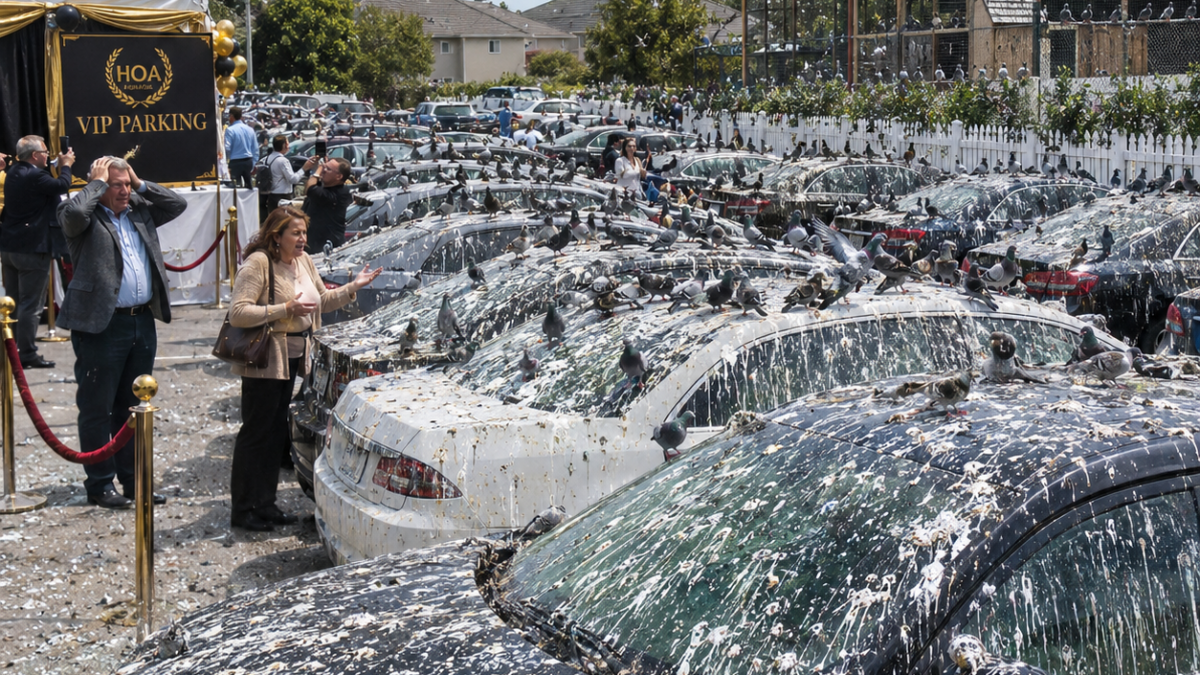
A tiny white streak hit the windshield of the Bentley.
The chauffeur frowned.
He pulled out a cloth.
Another landed on the Mercedes roof.
Then the BMW.
A woman in a sequined dress looked upward.
Her mouth opened.
“Oh my God.”
The rails filled.
Dana saw the first marks.
Her face twisted.
“Get those birds off there!”
A security guard stared at her.
“How?”
“Chase them!”
He waved his arms.
The pigeons lifted.
Circled once.
And landed on the exact same rails.
Because that rail wasn’t a random perch.
It was home.
Then the second wave arrived.
Hundreds more.
Guests began backing toward the reception tent.
One man held his champagne glass over his head.
A woman screamed when something landed on her shoulder.
Valets rushed toward the cars.
But Dana had packed them too tightly.
One car couldn’t move until another moved.
A Bentley blocked a Mercedes.
A Porsche blocked two SUVs.
Keys had to be found.
Owners identified.
Rows cleared in order.
Then another flock appeared.
And another.
The sky over my farm turned dark with wings.
Dana grabbed a radio.
“Move the cars!”
A valet shouted back.
“We can’t move sixty at once!”
“Then move faster!”
Another wave settled on the rails.
White splatters hit black paint.
Windshields.
Roofs.
Side mirrors.
Door handles.
The darker cars looked the worst.
Against mirror-polished black paint, every mark stood out.
My phone rang.
Dana.
I answered.
“Make them stop!”
I looked at Travis.
He shook his head slowly.
I said, “Make what stop?”
“Your birds!”
“They’re coming home.”
“They’re destroying my parking lot!”
I looked through the fence at the chaos.
“No, Dana.”
My voice stayed calm.
“They aren’t invading your parking lot.”
Another hundred birds settled overhead.
“You put your parking lot inside their home.”
Silence.
Then she screamed.
“You are paying for every single car!”
I ended the call.
By the time the final training groups arrived, nearly all two thousand pigeons were clustered around the lofts.
Some circled.
Some landed on roofs.
Hundreds gathered on the crossbeams.
And beneath them sat sixty VIP vehicles.
The droppings didn’t fall all at once.
They didn’t need to.
It was steady.
Relentless.
A black SUV that had looked freshly detailed an hour earlier now carried white streaks across the windshield.
The Bentley roof was covered.
The cars directly beneath the western beams took the worst of it.
A silver-haired man walked toward his Porsche.
He stopped halfway.
His expression changed.
The roof.
Rear glass.
Hood.
All spotted.
Another splatter hit the windshield while he was staring at it.
He turned toward a valet.
“Who is in charge here?”
The valet pointed toward Dana.
That may have been the moment her perfect gala truly ended.
Guests began leaving the reception area.
Some were furious.
Some laughed because the situation was too absurd to process.
Others pulled out their phones.
The entire disaster became a video event.
Dana pushed through the crowd.
“This was unforeseeable!”
A man in a navy suit pointed toward the wooden rails.
“Unforeseeable?”
Another pigeon landed overhead.
“You parked us underneath a bird farm.”
Someone behind him shouted,
“Who approved this?”
Dana didn’t answer.
Her eyes found me outside the gate.
Then I watched the idea form in her mind.
Blame me.
She grabbed a microphone.
“Ladies and gentlemen, please remain calm.”
People kept shouting.
“The owner of the neighboring pigeon operation has deliberately released these birds in an attempt to sabotage this event.”
Neighboring.
I nearly laughed.
She was standing on my property calling me the neighbor.
Then a guest raised his phone.
“I recorded you earlier.”
Dana stopped.
The man pressed play.
My voice came through the speaker.
Then Dana’s.
Clear as day.
“I don’t care if there are twenty birds or two hundred.”
A murmur spread through the tent.
Miriam looked toward me.
I held out a folder.
Every warning.
Every email.
Every diagram.
Every photograph.
The sheriff’s report reference.
She took it.
Dana was still talking.
Still blaming.
Still trying to control the story.
But I wasn’t listening anymore.
I was watching the birds.
Some younger pigeons were agitated.
The landing lane had been blocked too long.
I called toward the guards.
“Open the bird gate.”
One guard looked at Dana.
Then at the disaster.
Then back at me.
For the first time that day, he ignored her.
He unlocked the chain.
Travis walked into the yard carrying an old dented grain can.
He shook it.
Rattle.
Rattle.
Then gave the low whistle the birds knew.
Immediately, dozens lifted from the rails.
Then hundreds.
Not in panic.
In familiar groups.
They descended toward the restored path.
Farm staff opened the loft entrances.
Bird after bird moved inside.
Guests watched.
So did the security guards.
So did the valets.
Within minutes, the sky began clearing.
Dana stood near the podium.
Silent.
She had spent the entire day ordering everyone around.
Now everybody was following me.
By nightfall, the footage was everywhere locally.
The image people loved most wasn’t even the cars.
It was the massive SILVERCREST VIP PARKING sign beneath rails crowded with pigeons.
Several sponsors demanded explanations before dinner ended.
Miriam suspended all new arrivals.
Dana finally snapped.
She crossed the yard toward me.
“You are going to regret this.”
“Regret what?”
“Embarrassing me.”
I looked around.
At the cars.
At the videos.
At the torn fence.
At my birds finally safe inside their lofts.
“You did this yourself.”
Her face flushed.
Then she yanked folded papers from her purse.
“You signed this.”
“No.”
“You gave Silvercrest access.”
“No.”
“You’re liable.”
“No.”
“I’ll destroy you.”
Grant stepped beside me.
“No, Mrs. Pritchard.”
She looked at him.
He held out his hand.
“You’re going to preserve that document.”
The next morning, Dana called an emergency board meeting.
One of the homeowners phoned me afterward.
“She says you engineered the whole thing.”
“Of course.”
“She wants the HOA to file sanitation complaints.”
I sat up straighter.
“What else?”
“County inspection. Livestock review. Zoning. She said she’s going to make the farm incompatible with the neighborhood.”
There it was.
Not parking.
Not cars.
The farm.
“She wants you gone,” the homeowner said.
“I know.”
For the first time, I truly understood the scale of the fight.
Dana wasn’t trying to borrow my land anymore.
She wanted to erase Lockridge Pigeon Farm.
Within days, cleaning bills began arriving.
Professional detailing.
Paint inspections.
Transportation.
Some vehicle owners had legitimate expenses.
Dana forwarded every request directly to me.
PAYMENT REQUIRED.
Grant answered on my behalf.
His letter was short.
The central questions are not whether vehicle owners incurred cleaning expenses. The questions are who organized unauthorized parking on private agricultural land, who exercised exclusive control over the site during the event, and who ignored repeated written warnings regarding the known presence and normal behavior of livestock.
Then he sent preservation letters.
Every email had to be kept.
Every contract.
Every video.
Every payment record.
Every version of Dana’s alleged land agreement.
We brought in Dr. Owen Keating, an avian veterinarian.
He examined the flock.
He reviewed feed.
Health records.
Release schedules.
Training logs.
There was no unusual feed.
No chemical stimulus.
No attempt to train the birds to target vehicles.
No last-minute release designed to disrupt the gala.
The birds had followed the same training schedule established before Dana ever entered my property.
His report said exactly what I needed it to say.
The pigeons behaved like pigeons.
The only abnormal thing that day was the parking lot.
Then Grant obtained my old irrigation authorization from the county.
He called me into his office.
The two signatures were displayed side by side.
One on the legitimate document.
One on Dana’s agreement.
I stared.
“Same.”
“Not just similar.”
He enlarged them.
There was a tiny break in the ink near the end of my last name.
The same break appeared on both.
Same length.
Same angle.
Same microscopic flaw.
Grant said quietly,
“Nobody signs their name exactly the same twice.”
“So somebody copied it.”
“It appears somebody did.”
“Dana?”
He shook his head.
“We do not accuse a specific person until the evidence supports it.”
I looked at him.
“You always ruin the fun.”
“That’s why you pay me.”
Then he opened the file history.
His expression changed.
“What?”
“The agreement file was created after your first written objection.”
I leaned closer.
“After?”
“Yes.”
“So according to them, I sent a formal letter saying they had no permission, then later signed a secret agreement giving them permission?”
Grant sat back.
“That appears to be the chronology.”
I smiled.
Not because I thought the situation was funny.
Because arrogance had finally left fingerprints.
At the next HOA meeting, Grant projected both signatures onto the wall.
Dana sat with her arms crossed.
Board members watched.
He showed the original irrigation permit.
Then the disputed parking agreement.
Dana said,
“Evan signed both.”
I asked,
“Dana, what was the original document?”
She looked at me.
“What?”
“The document my signature first appeared on.”
“I don’t know what you mean.”
“The county document.”
She glanced toward Grant.
“What was it for?”
Silence.
I continued.
“If I signed your agreement legitimately, why does my signature match a four-year-old irrigation form down to the same broken ink stroke?”
Dana stood.
“This is ridiculous.”
That was when HOA treasurer Celia Barlow spoke.
“Sit down.”
Dana turned.
Everyone did.
Celia had been quiet throughout most of the dispute.
She was forty-seven, detail-oriented, and normally avoided confrontation.
Now she looked directly at Dana.
“I said sit down.”
Dana slowly returned to her chair.
Celia continued.
“I have a question.”
Dana’s voice went cold.
“This is not a financial meeting.”
“It is now.”
Celia opened a folder.
“Where is the parking revenue?”
The room became silent.
Dana blinked.
“What revenue?”
“The sponsor payment connected to VIP parking.”
Dana’s jaw tightened.
“That’s event accounting.”
“I’m the treasurer.”
“We’ll discuss it privately.”
“No.”
Another no.
Dana seemed almost offended by the word.
Celia leaned forward.
“You told the board parking expenses were contained within the gala budget. But I found a payment that never entered the HOA account.”
Dana snapped,
“This meeting is adjourned.”
Celia didn’t move.
“You can leave.”
Dana froze.
“I’m still reviewing the records.”
Two days later, Celia called Grant.
She had found $52,000.
The gala’s main sponsor had transferred the money to a private company linked to Dana.
The description referenced VIP parking and event access.
Yet the official HOA budget reflected only modest parking costs.
I sat in Grant’s office looking at the records.
“She rented my property.”
Grant said nothing.
“For fifty-two thousand dollars.”
“We need to verify the contracts.”
“She took land she didn’t own and sold access to it.”
“That is what the records may indicate.”
“Say it.”
“I prefer judges saying things.”
I stood and paced.
“Dana called my farm filthy.”
Grant watched me.
“She threatened inspections.”
“I know.”
“She forged—”
“We don’t know who altered the document.”
“Fine. Somebody produced a fake agreement.”
“That’s safer.”
“She locked me out of my land.”
“Yes.”
“And she got fifty-two thousand dollars?”
Grant closed the folder.
“Evan.”
I stopped.
“What?”
“This stopped being an HOA argument days ago.”
I knew.
Then Warren Fisk came to the farm.
Warren represented the development company Dana had been courting.
His own luxury coupe had been parked in the pigeon yard during the gala.
He didn’t complain about the cleaning.
Instead, he carried a long cardboard tube.
He unrolled architectural drawings across my desk.
“I need to understand something.”
“Go ahead.”
“Did you ever agree to this?”
The drawing showed a wide private entrance.
Stone columns.
Landscaping.
Lights.
A smooth access road from the highway directly into Silvercrest.
Straight through my pigeon yard.
“No.”
“Not in writing?”
“No.”
“Verbally?”
“No.”
“Conditionally?”
“No.”
“Have you discussed selling?”
“No.”
Warren stared at me.
“Nobody approached you?”
“Not once.”
He looked disturbed.
“Dana represented this land as controlled.”
“She lied.”
“She said the HOA had secured development rights.”
“She lied.”
“She said your livestock operation was temporary.”
That stopped me.
“What?”
Warren pulled out another document.
An appendix referred to future conversion once the agricultural use was deemed incompatible with surrounding residential development.
I read the line.
Then read it again.
Everything snapped into place.
The sanitation threats.
The complaints.
The “filthy eyesore” bulletin.
The pressure.
The permanent fence.
Dana needed the farm to become a problem.
Because if the farm was a problem, she could argue that removing it was a solution.
The gala wasn’t just a party.
The parking lot was a demonstration.
Sixty luxury cars on my land.
Investors walking across my yard.
Photographs showing Silvercrest using the property openly.
Dana was creating the appearance of control.
Then she planned to build on that appearance.
I looked at Warren.
“She never wanted three days.”
He didn’t answer.
“She wanted the road.”
Warren exhaled.
“That appears to have been the proposal.”
That night, I walked the farm alone.
The air was cool.
The lofts were quiet.
I passed the old oak behind Loft Two.
My grandfather’s tree.
I remembered being ten years old and following him through this same yard.
He had hands like worn leather.
He could catch a frightened pigeon without hurting a feather.
He taught me that animals didn’t care about money.
They cared about routine.
Safety.
Home.
He used to say,
“If you want a pigeon to trust you, don’t make home unpredictable.”
Dana had made my entire farm unpredictable.
And for the first time since this began, anger wasn’t what I felt.
I felt afraid.
Not of Dana personally.
Of losing the place.
My grandfather had spent decades protecting it.
My father had inherited it.
Then I had.
The idea that someone could take it through paperwork, pressure, and lies frightened me more than I wanted to admit.
I rested my hand against an old fence post.
The wood was smooth from years of weather.
“You’re not taking this.”
I said it quietly.
No one heard me.
Except maybe the birds.
The next morning, Grant called.
“Your grandfather did something smart.”
“That narrows it down very little.”
“Do you know about the agricultural conservation easement?”
I remembered hearing the phrase.
Not the details.
Grant explained.
Decades earlier, my grandfather had recorded restrictions designed to preserve the property’s agricultural use.
The easement limited commercial conversion inconsistent with protected farming.
“What does that mean for the road?”
“It means Dana has two problems.”
“Only two?”
“First, she does not own the land.”
“Good start.”
“Second, even if she somehow acquired it, the proposed commercial road faces another layer of legal review and potentially a direct conflict with the easement.”
I leaned back.
“My grandfather hated developers.”
Grant smiled.
“I’m starting to like him.”
County planning inspector Rachel Finn took over the land-use review.
She received the maps.
Event records.
Temporary parking plans.
My deed.
The disputed agreement.
The investor materials.
Her office confirmed Silvercrest had shown no legal right to convert my pigeon yard into a commercial parking facility.
The documents that appeared suspicious were referred to the proper authorities.
Dana called Rachel directly.
I learned later that she tried to “explain the situation.”
Rachel’s response was simple.
Submit everything in writing.
No private persuasion.
No special treatment.
Meanwhile, Warren demanded that Dana prove her right to the land.
A valid original agreement.
She couldn’t.
His company suspended gateway negotiations.
That news hit Silvercrest hard.
Dana had promised residents that a grand entrance would raise property values.
She had promised developers access.
She had promised sponsors control.
Now everyone wanted proof.
And she had none.
Then Celia called a special full-board session.
The clubhouse filled.
Board members.
Homeowners.
Attorneys.
Miriam and event representatives.
Several VIP guests whose cars had been in the yard.
Warren.
Grant.
Me.
Dana entered with her head high.
For a moment, she looked exactly like the woman who had stepped out of that black SUV days earlier.
Confident.
Controlled.
Certain that if she spoke firmly enough, reality would rearrange itself.
She took her seat.
“This entire controversy,” she began, “was engineered by Mr. Lockridge to damage Silvercrest.”
I didn’t respond.
Grant stood.
He displayed the deed.
The survey.
The boundary line.
“My client owns the pigeon yard.”
Next slide.
Photographs of my missing fence.
The trucks.
The parking lines.
The steel-fence work order.
Next.
My warnings.
Dates.
Times.
Emails.
The flock schedule.
The return map.
The rail diagram.
Next.
Video.
Me at the gate.
Dana refusing to open it.
Dana ordering cars to remain.
Dana saying,
“I don’t care if there are twenty birds or two hundred.”
Then footage of the gala.
Pigeons.
Cars.
Guests.
Chaos.
One board member looked at Dana.
“Why didn’t you move the cars?”
“I didn’t believe there were two thousand birds.”
I finally spoke.
“You didn’t have to believe me.”
She turned.
“You only had to stop trespassing.”
Nobody laughed.
Grant continued.
He displayed the signatures.
Then the file history.
Then Celia stood.
She presented the $52,000 payment.
Dana interrupted.
“That was consulting revenue.”
Celia asked,
“Why was the payment labeled VIP parking and event access?”
“Administrative coding.”
“Why wasn’t it disclosed to the board?”
“It didn’t need to be.”
“You used HOA resources.”
Dana looked angry now.
“I was improving the community.”
Celia’s voice stayed calm.
“Then why was the money paid to your company?”
Silence.
Miriam stood.
“My company was told Mr. Lockridge had granted permission.”
She held up the disputed agreement.
“We relied on this.”
Warren stood next.
“My company was told Silvercrest controlled the proposed gateway corridor.”
Dana turned toward him.
“Warren, we should discuss this privately.”
“No.”
The room became still.
He continued.
“We attended the gala believing the HOA had lawful rights to the land.”
“The project was preliminary.”
“You provided renderings.”
“Concept renderings.”
“You provided access projections.”
“Planning documents.”
“You sold us access to land you never owned.”
Dana’s face lost color.
“I did not sell you anything.”
Warren looked toward the payment evidence.
“Then perhaps the investigation will clarify that.”
Dana pushed her chair back.
“This is a coordinated attack.”
I stood.
She looked at me.
I said,
“You made me stand in that doorway while you discussed napkins.”
Her mouth tightened.
“You called me the bird man.”
“Evan—”
“You tore down my fence.”
“I had authority.”
“No.”
“You changed my locks.”
“The agreement—”
“No.”
“You threatened to shut down my farm.”
“For sanitation—”
“No.”
My voice stayed calm.
That seemed to bother her more than anger would have.
“I’m not here to negotiate a lease.”
She stared at me.
“I’m not here to ask for better money.”
Grant looked at me but didn’t interrupt.
“I will never give Silvercrest the pigeon yard for your gateway road.”
Dana’s face hardened.
I looked toward the board.
“I want every unauthorized lock removed.”
A board member nodded.
“Every barricade removed.”
Another note was made.
“Every damaged fence repaired.”
I continued.
“The landing lane restored. The troughs returned. The soil inspected. The loft access repaired.”
Then I looked directly at Dana.
“And I want written confirmation that this HOA has no authority over Lockridge Pigeon Farm.”
Grant stood beside me.
“We are prepared to seek injunctive relief if necessary.”
For the first time since this started, Dana seemed to understand something.
I didn’t want her money.
I wanted her hands off my home.
The board asked Dana to recuse herself from all matters involving the farm.
She refused.
So they voted.
Her delegated authority over event planning was suspended.
Her contractor authority was suspended.
Celia was tasked with a full audit.
The event company was instructed not to accept new directions from Dana.
Dana looked around.
“No.”
Nobody moved.
“I am still president.”
Nobody answered.
“Do you hear me?”
Celia said quietly,
“We hear you.”
That was the problem.
Everybody finally did.
Warren rose again.
“Our company is withdrawing from the proposed gateway project.”
Dana spun toward him.
“You cannot make that decision based on this circus.”
“I already did.”
“You’ll reconsider.”
“No.”
Another no.
The word had become poison to her.
The meeting ended soon afterward.
Dana grabbed her purse and stormed out.
Grant and I stayed behind.
People came up to me.
Some apologized.
Some asked questions.
One man whose Porsche had been covered shook my hand.
“I was furious at you that night.”
“I understand.”
“Then I saw the video.”
I nodded.
He smiled slightly.
“For what it’s worth, the car cleaned up fine.”
“That’s good.”
“Still the worst valet experience of my life.”
I laughed.
“So far.”
When I got back to the farm, workers were already dismantling the giant VIP PARKING sign.
Dana’s SUV was there.
She stood near the foreman.
“Stop!”
The man kept working.
“I said stop!”
He climbed down.
“Mrs. Pritchard, we have instructions to remove the event installation.”
“From who?”
“The parties responsible for the restoration.”
“I am the HOA president.”
He paused.
Then said carefully,
“I was told you no longer control this project.”
Travis turned away so Dana wouldn’t see him smiling.
She spotted me.
“This isn’t over.”
I walked toward her.
“Yes.”
“No.”
“Yes.”
“One board meeting changes nothing.”
I looked toward the rebuilt boundary.
“The deed didn’t change.”
Her jaw tightened.
“You’re going to regret humiliating Silvercrest.”
“I didn’t humiliate Silvercrest.”
I nodded toward the parking sign coming down.
“You did.”
She walked back to her SUV.
For once, nobody opened the gate for her.
The restoration took several days.
Ground mats came up.
White lines disappeared.
Portable barriers were removed.
Fence posts went back into the soil.
The bird guide lanes were rebuilt.
The troughs returned.
I watched every step.
Not because I distrusted the workers.
Because I needed to see the farm coming back.
Then Silvercrest held the formal membership vote.
Dana Pritchard was removed as HOA president under the association’s bylaws.
The financial findings were forwarded to the HOA attorney and appropriate authorities.
The suspicious land agreement remained under separate review.
I didn’t celebrate when Grant told me.
He seemed surprised.
“No champagne?”
“I’m a pigeon farmer.”
“Fair.”
“I just want my gate back.”
“You have your gate.”
“I want to be able to use it without six guards asking for Dana’s permission.”
“That part is over.”
I looked toward the lofts.
“Good.”
But Dana still had one hope.
The gateway road.
Even after losing the presidency, she apparently told several homeowners the new board could revive the project.
Maybe in a year.
Maybe two.
She believed developers would eventually return.
Grant heard about it.
A week later, he came into my office carrying a letter.
“You’re going to like this.”
“What?”
“The land trust completed its review.”
I read the letter.
The agricultural conservation easement was clear enough that the proposed conversion into commercial gateway access was considered inconsistent with the property protections.
Warren’s development firm followed with its own notice.
The route was abandoned.
Not postponed.
Not redesigned.
Abandoned.
I read the word several times.
Dana had spent all that effort trying to prove she controlled my land.
Instead, she had drawn so much legal attention to it that the restrictions protecting the farm became stronger and more visible than ever.
She had tried to make the farm vulnerable.
She ended up making it harder to touch.
There was something almost poetic about that.
The vehicle-cleaning disputes were handled among the parties responsible.
Nobody was allowed to simply throw every bill at me because I owned the birds.
Miriam’s company survived.
She had made mistakes.
But once she realized Dana’s story was falling apart, she preserved evidence and cooperated.
Celia became one of the people leading Silvercrest through the cleanup.
Financially.
Politically.
Reputationally.
Several homeowners came to the farm to apologize.
One older couple brought birdseed.
A tiny bag.
Travis looked at it and whispered,
“That’ll feed maybe twelve pigeons.”
I elbowed him.
The woman smiled.
“We didn’t know what else to bring.”
I accepted it.
“Thank you.”
Her husband looked toward the lofts.
“We believed Dana.”
“A lot of people did.”
“She said you were blocking community improvements because you wanted money.”
I nodded.
“That sounds like Dana.”
“I’m sorry.”
That apology mattered more than I expected.
For weeks, she had reduced me to a character.
Dirty farmer.
Bird man.
Obstructionist.
The unreasonable neighbor standing in the way of progress.
But the truth was much simpler.
I wanted people to stop taking what wasn’t theirs.
One afternoon, Travis and I installed a new wooden sign at the east gate.
LOCKRIDGE PIGEON FARM
PRIVATE AGRICULTURAL PROPERTY
He stepped back.
“Straight?”
I tilted my head.
“No.”
“Oh, come on.”
“Little left.”
“You say that every time I hang anything.”
“Because you hang everything crooked.”
“I’ve been fixing this farm longer than you’ve been running it.”
“Exactly. Decades of crooked signs.”
He adjusted it.
“There.”
“Perfect.”
We stood there looking at it.
The evening flock was returning.
Birds swept across the sky in long arcs.
They circled once.
Then descended.
No luxury cars.
No red carpet.
No guards.
No barricades.
No white lines.
Just open ground.
Water troughs.
Old rails.
Home.
Travis leaned against the fence.
“Quiet.”
“Yeah.”
“I almost forgot what that sounded like.”
I smiled.
“So did I.”
Then an engine slowed on the outer road.
Black SUV.
Dana.
She stopped near the gate.
For several seconds, she sat behind the wheel.
Looking.
The repaired fence.
The new sign.
The open landing lane.
The birds.
Months earlier, she had driven through that gate as if the land belonged to her.
She had torn things down.
Ordered people around.
Locked me out.
Promised pieces of my farm to investors.
Now she sat outside.
On the public road.
Nobody approached her.
Nobody opened anything.
No guard stood ready for orders.
No event worker carried her clipboard.
No board member waited for instructions.
Travis watched the SUV.
Then smiled.
“She wanted sixty parking spaces.”
I knew where he was going.
I looked at him.
“How many did she get?”
He grinned.
“Not one.”
I laughed.
Dana’s SUV rolled away.
No confrontation.
No final speech.
No dramatic threat.
Just tires on pavement.
Then she disappeared past the trees.
I watched until I couldn’t see the vehicle anymore.
Afterward, I looked up.
The last flock was approaching.
Forty or fifty birds.
They moved together against the orange sky.
Beautiful.
Effortless.
Certain.
They circled the farm once.
Then came down toward the western rails.
The same rails Dana had parked her luxury cars beneath.
The same rails she called ugly.
The same rails that had existed before Silvercrest.
The same rails that would probably still be standing when nobody remembered who Dana Pritchard was.
One by one, the pigeons landed.
Travis shook the grain can.
The familiar metallic rattle spread through the yard.
Birds lifted from the beams and moved toward the loft doors.
I watched the final pigeon disappear inside.
Then I closed my gate.
For weeks, people had called what happened at the gala revenge.
Two thousand pigeons against sixty luxury cars.
The farmer getting even with the HOA president.
I understood why people liked that version.
It was funny.
Simple.
Satisfying.
But it wasn’t true.
I never ordered those birds to hit a single car.
I never changed their schedule to punish Dana.
I never trained them to attack anything.
I warned her.
Again.
And again.
And again.
I showed her the rails.
I gave her the schedule.
I sent diagrams.
My attorney warned her.
Miriam warned her.
I begged her to move the cars.
I asked her to unlock the landing lane.
I asked her to use the service road.
She laughed.
That was the truth.
The pigeons didn’t take revenge.
They came home.
Dana was the one who put sixty cars in their way.
She believed power meant reality would move around her.
If she printed a sign saying NO BIRDS, then birds should disappear.
If she hired guards, then my deed should stop mattering.
If she called my farm an eyesore, then decades of family history should become worthless.
If she promised developers a road, then land she didn’t own should somehow become available.
If she copied a signature onto a document, then permission should magically exist.
If she threatened enough people, nobody would ask questions.
For a while, it worked.
That was the frightening part.
Workers followed her orders.
Security changed my locks.
Event planners trusted her paperwork.
Sponsors paid money.
Investors accepted presentations.
Homeowners believed bulletins.
Power didn’t make her right.
But it made her wrong decisions move faster.
Until the birds came home.
Then the cars drew attention.
The videos drew questions.
The questions uncovered documents.
The documents uncovered money.
The money uncovered the larger plan.
And the larger plan finally exposed what the parking lot had really been.
A test run.
A performance.
Dana wanted sixty luxury vehicles sitting on my property so investors would see Silvercrest using the land as if it already belonged to them.
Instead, those sixty cars became the evidence everybody remembered.
She wanted a glamorous photograph.
She got viral footage of two thousand pigeons covering her VIP lot.
She wanted investors impressed.
They withdrew.
She wanted my farm investigated.
Her own paperwork was investigated.
She wanted the land converted.
The conservation easement blocked her road.
She wanted to remove me.
Her own homeowners removed her.
There are some kinds of revenge you plan.
And then there are consequences.
Consequences are better.
Because you don’t have to become the person who hurt you.
You only have to stop saving them from their own decisions.
That was what I learned.
I didn’t have to destroy Dana.
I didn’t have to lie about her.
I didn’t have to threaten her home.
I didn’t have to copy signatures.
I didn’t have to manipulate neighbors.
I documented.
I waited.
I protected my birds.
I protected my land.
And every time she pushed harder, she created another piece of evidence against herself.
The final thing I demanded wasn’t money.
It was restoration.
That surprised people.
Some assumed I would sue for some massive payout.
Maybe I could have pursued more.
Maybe not.
Grant explained every option.
But the number in my bank account wasn’t what I cared about when I walked outside every morning.
I wanted the fence back.
I wanted the water troughs back.
I wanted the landing lane clear.
I wanted the white parking lines gone.
I wanted the soil repaired.
I wanted the lofts safe.
I wanted to stand at the east gate without somebody wearing a security badge telling me I needed permission from Dana Pritchard.
That was justice to me.
My father once told me something when I was young.
I had lost a bird during a training exercise.
I was devastated.
I kept blaming myself.
He told me,
“Evan, home only means something if you keep it worth returning to.”
At the time, I thought he was talking about pigeons.
Maybe he was.
But standing beside that repaired fence years later, I understood something different.
My grandfather had protected this place.
My father had protected it.
Then it became my turn.
Dana saw seventeen acres.
I saw my grandfather hammering together the first loft.
She saw unused dirt.
I saw myself at twelve years old carrying grain buckets before school.
She saw a convenient strip for sixty cars.
I saw my father teaching me how to hold a frightened bird gently enough that it would stop struggling.
She saw development potential.
I saw the oak where we scattered my grandfather’s ashes.
That was why she never understood me.
She thought everybody wanted the same thing she wanted.
Money.
Status.
Influence.
A bigger entrance.
A more expensive neighborhood.
A more impressive gala.
A title.
But some things become valuable because you refuse to convert them into money.
The farm was one of those things.
A few months after the gala, life settled into its old rhythm.
Morning feed.
Loft cleaning.
Training.
Repairs.
Recordkeeping.
Release days.
Return days.
Travis complained about his knees.
I complained about his crooked signs.
Birds ignored both of us.
Silvercrest elected new leadership.
The new board sent me a formal letter acknowledging the property boundary and agreeing that association contractors would not enter Lockridge Farm without written permission.
I framed it.
Not because it was beautiful.
Because it made Travis laugh.
“You framed an HOA letter?”
“Absolutely.”
“Why?”
I hung it beside my office door.
“So the next president doesn’t forget.”
One Saturday, a group of Silvercrest families visited the farm.
Children watched the pigeons return from a short training release.
One little boy asked,
“How do they know where home is?”
I looked toward the flock circling above us.
“That’s the big question.”
“GPS?”
His father laughed.
I shook my head.
“No GPS.”
“Magic?”
I smiled.
“Closer.”
The boy stared upward.
I explained as simply as I could that homing pigeons use several natural cues—sun position, landscape, smell, magnetic sensing, experience.
He listened.
Then asked,
“So they always come home?”
“Most of the time, if they’re healthy and trained.”
He thought about that.
Then pointed toward Silvercrest.
“What if somebody puts cars here again?”
His father looked embarrassed.
Travis nearly choked.
I smiled.
“They won’t.”
“How do you know?”
I looked at the new fence.
The sign.
The open yard.
“Because sometimes adults learn things the hard way.”
Travis turned away, laughing.
That evening, after everyone left, I sat on the porch outside my office.
The farm was quiet.
Not silent.
Pigeon farms are never silent.
Soft coos.
Wingbeats.
The scrape of claws on wood.
Water moving in the troughs.
Familiar sounds.
Sounds I almost lost.
I thought about Dana.
Not with anger.
Not anymore.
Mostly with sadness.
Because somewhere along the way, she had become convinced that winning meant making sure everybody else lost.
She wanted control so badly that she didn’t notice when control became the thing controlling her.
She could have asked.
That was the strange part.
If Silvercrest had come to me months earlier and said,
“We have a major event. Can we discuss temporary overflow somewhere safe?”
Maybe I would have helped.
Not in the pigeon yard.
But seventeen acres gives you options.
I might have identified another section.
Maybe we could have arranged temporary parking near the service road.
Maybe we could have worked something out.
But Dana never asked.
Asking would have required acknowledging that the answer belonged to me.
She preferred taking.
And taking created the entire disaster.
That thought stayed with me.
People often imagine huge conflicts begin with huge decisions.
They don’t.
Sometimes they begin with one person deciding they don’t need permission.
Dana tore out the fence because asking seemed unnecessary.
She installed the parking because my objection seemed inconvenient.
She locked the gate because my ownership seemed less important than her event.
She threatened the farm because my refusal embarrassed her.
She supported a false document because reality wouldn’t cooperate.
Every step made the next one easier.
Until sixty cars were sitting beneath two thousand pigeons and everybody was asking the same question.
How did anyone think this was a good idea?
The answer was simple.
Nobody had been allowed to tell Dana no.
Not until that week.
And by then, “no” had become the one word she couldn’t survive hearing.
I sometimes still see the gala video.
People send it to me.
Someone edited dramatic music over the birds arriving.
Another version zoomed in on Dana’s VIP sign.
One video freezes right before the first flock lands and adds the words:
SHE SHOULD HAVE LISTENED.
Travis loves that one.
I don’t watch them often.
The funniest part isn’t captured on video anyway.
It happened the morning after the final restoration inspection.
Travis and I were standing under the western rails.
He looked up.
Then looked at the empty ground beneath them.
“No Porsche.”
“No Bentley.”
“No Mercedes.”
He nodded.
“Beautiful.”
I laughed.
“You hate luxury cars now?”
“No.”
He kicked the dirt lightly.
“I just like them better somewhere else.”
So do I.
There are no VIP signs at Lockridge Farm now.
No painted stalls.
No private security.
Only one sign.
PRIVATE AGRICULTURAL PROPERTY.
Simple.
Clear.
Enough.
Sometimes people stop outside to photograph the birds.
I don’t mind.
Some Silvercrest residents wave when they pass.
I wave back.
Life went on.
That might be the part Dana never understood either.
She wanted everything to become a monument to her importance.
But after she left, the farm didn’t need a monument.
It needed normal life.
That was enough.
Spring became summer.
Young pigeons learned the landing pattern.
Older birds returned from longer flights.
The western rails filled every evening.
The grass grew back where truck tires had scarred the earth.
The last traces of parking paint faded.
And eventually, if you didn’t know what had happened, you could stand in the yard and never guess sixty luxury cars had once been lined up there beneath a glittering VIP banner.
Except I knew.
Travis knew.
Silvercrest knew.
And Dana knew.
One evening near sunset, I walked along the east fence by myself.
The same spot where the original panels had been ripped out.
I ran my hand along the new timber.
Solid.
Straight.
Probably the straightest fence Travis had ever supervised.
I heard wings overhead.
I looked up.
The flock was coming.
Two thousand birds don’t look like much when they’re scattered across miles of sky.
But when they converge near home, they become something else.
A moving cloud.
A living shadow.
A sound you feel in your chest.
They swept over the lofts.
Turned together.
And dropped toward the landing lane.
I stood there watching.
No one blocked them.
No one waved them away.
No one told them they didn’t belong.
One bird landed on the western rail.
Then another.
Then dozens.
Hundreds.
Exactly where they had landed before Dana.
Exactly where they landed during Dana’s gala.
Exactly where they would land after everybody stopped talking about her.
And that was the final truth.
Dana Pritchard believed authority came from a title.
She believed ownership could be blurred if she spoke confidently enough.
She believed ordinary people could be pushed aside if the event was expensive enough and the guests important enough.
She believed my family history was less valuable than her development plan.
She was wrong.
Those pigeons had been coming home before Silvercrest existed.
My family had been caring for that land before anybody drew the first subdivision map.
And when Dana tried to turn our home into a stage for her ambition, the truth didn’t need a speech.
It arrived at 5:47 in the afternoon.
On two thousand pairs of wings.
She wanted sixty parking spaces.
She ended up with none.
She wanted a private gateway.
The route was abandoned.
She wanted my farm gone.
The farm became more protected than before.
She wanted the entire room to obey her.
The same board removed her.
And she wanted me standing outside my own gate asking permission.
In the end, she was the one sitting outside that gate with nobody left to open it.
I watched the final pigeon disappear into the loft.
Then I slid the gate closed.
The lock clicked.
A small sound.
But after everything we had been through, it felt enormous.
That lock belonged to me.
That gate belonged to me.
That dirt belonged to me.
Those weathered rails belonged to the farm.
And the birds coming home needed no permission from Dana, Silvercrest, or anyone else.
I looked across the yard as the sun disappeared behind the trees.
For the first time in weeks, there were no threats waiting for tomorrow.
No lawyers calling.
No contractors.
No security guards.
No VIPs.
Only the smell of grain.
The low sound of pigeons settling for the night.
And the place my grandfather had spent his life protecting.
I finally understood why he had cared so much about preserving it.
Land isn’t only measured in acres.
Sometimes it is measured in memories.
In mornings.
In scars on old wooden beams.
In generations of work.
In the sound of wings returning at sunset.
Dana saw a shortcut to Silvercrest.
I saw home.
And after everything she tried to take from me, home was exactly what remained.
That was enough.
More than enough.
Because the best revenge wasn’t watching sixty luxury cars get covered beneath my pigeon rails.
It wasn’t watching Dana lose her title.
It wasn’t watching her development deal collapse.
It wasn’t even watching workers tear down the giant VIP sign she had planted on my property.
The best revenge was standing inside my repaired fence months later while two thousand birds crossed the evening sky, knowing the woman who had tried to erase my farm had failed to move a single permanent boundary.
She had brought money.
Lawyers.
Security.
Influence.
A forged-looking agreement.
Developers.
Sponsors.
And sixty luxury cars.
My family had brought one thing to that land.
Roots.
And in the end, roots were harder to move.
The flock settled.
The yard grew quiet.
I switched off the office light and started toward the house.
Behind me, the new wooden sign stood beside the gate.
LOCKRIDGE PIGEON FARM.
PRIVATE AGRICULTURAL PROPERTY.
I smiled.
Then I went home.
Without asking anyone’s permission.








