PART 2: HOA Spent $2 Million Building a Gate on My Family’s Private Bridge—So I Shut Their Only Road Overnight
PART 2:
I didn’t close it that afternoon.
That matters.
For everything that happened afterward, that matters more than people realized.
I could have walked to my truck, called my lawyer, revoked the license, and told Paula Renner that every vehicle entering Hollow Creek Estates would have to find another route.
The paper gave me that power.
But power and wisdom are not the same thing.
My grandfather understood that.
My father did too.
So instead of making a scene in front of Paula’s ribbon-cutting crowd, I stood there holding the recorded plat while people took pictures beneath the wrought-iron arch she had planted beside my family’s bridge.
Some residents stared at me.
Others whispered.
Most had no idea what was actually happening.
To them, Paula was unveiling something beautiful.
Two enormous stone-faced columns.
Black wrought-iron gates.
Decorative lighting.
A small guardhouse.
Landscaping.
A gold-lettered sign reading:
HOLLOW CREEK ESTATES.
It looked expensive because it was.
Almost two million dollars, according to the number Paula herself had bragged about during the ceremony.
She called it an investment in security, prestige, and property values.
I called it a structure built where she had no right to put it.
But I didn’t say that into a microphone.
I drove home.
My house sat on the near side of Cane Creek, less than five hundred yards from the bridge.
I parked in the garage, opened the old metal filing cabinet, and pulled out the folder marked ACCESS—1978.
The paper inside was yellow at the edges.
My father’s signature still looked strong.
I read the language again.
The developer and his successors could cross the Coleman bridge for residential access.
Permission could be terminated.
The document created no permanent easement.
No transfer of ownership.
No dedication of the bridge to the public.
No common interest in the land.
Revocable.
Revocable.
Revocable.
Revocable.
Four times.
My father had known somebody might someday try this.
Maybe not Paula.
Maybe not a $2 million gate.
But he had understood something simple.
Neighborliness can last for generations.
Memory usually doesn’t.
Eventually somebody asks, “Who actually owns this?”
And if the answer isn’t written down, people start inventing one.
My father wrote it down.
I picked up my phone and called my attorney.
His name was Daniel Mercer.
Dan had handled property work for me for years.
He answered with, “You calling about the circus?”
“You saw it?”
“My wife sent me a picture. Nice gate.”
“It’s on my property.”
“I assumed.”
“They cut a ribbon.”
“I saw.”
“She says the bridge is a common element.”
Silence.
Then Dan said, “Bring me everything.”
I was at his office forty-five minutes later.
He reviewed the deed.
The recorded license.
The plats.
Then Paula’s earlier HOA letter declaring the bridge common property.
He leaned back.
“This is unusually clean.”
“That good?”
“For you.”
“What about them claiming decades of use?”
“They’ll probably argue prescriptive easement.”
That phrase bothered me.
I knew enough to understand the concept but not enough to relax.
“Could they win?”
Dan folded his hands.
“Prescriptive use generally depends on adverse use—use without permission. Your father recorded permission.”
“So?”
“So it’s very difficult to claim you earned a right by using something against the owner when the owner expressly authorized your use.”
I let out a breath I hadn’t realized I was holding.
Dan tapped the document.
“This is why people pay lawyers to write things down.”
“My father would enjoy hearing that.”
“Smart man.”
“He was.”
Dan looked at me.
“What do you want?”
It was a harder question than it sounded.
I didn’t want Hollow Creek destroyed.
I didn’t want families trapped.
I didn’t want banks questioning mortgages or parents wondering whether an ambulance could reach their children.
For thirty years, those people had crossed our bridge without trouble.
Most had bought their homes believing the access was secure.
Their mistake was trusting paperwork presented to them by developers and the HOA.
That didn’t make them enemies.
“I want the bridge recognized as mine,” I said.
“And the gate?”
“Removed from my land unless we reach an agreement.”
“Anything else?”
“Yes.”
I thought about the houses across the creek.
“If they want permanent access, I’ll negotiate an easement.”
Dan raised an eyebrow.
“You’d give them one?”
“Fair terms. Properly recorded. Permanent.”
“Then why fight?”
“Because Paula doesn’t get to steal it first and negotiate later.”
Dan nodded.
“That distinction is going to matter.”
The next morning he sent a formal letter.
Ownership of the bridge was disputed by nobody with a deed.
The HOA had no legal authority to designate private Coleman property as a common element.
Their assessment against me was rejected.
Construction on my land was to cease.
And, importantly, I remained willing to discuss a permanent easement for Hollow Creek residents.
That last sentence was mine.
I insisted on it.
If this ever reached a judge, a jury, or simply the neighbors, I wanted one thing absolutely clear.
I had never wanted to trap anybody.
Paula responded through the HOA attorney.
They claimed Hollow Creek had acquired a prescriptive easement through decades of continuous use.
They claimed the community’s reliance on the bridge created rights beyond the original license.
They claimed the gate project represented an improvement to existing common access.
Dan read the letter.
Then he put it down.
“They’re going to make you spend money.”
“I figured.”
“They may also try to make this political inside the neighborhood.”
That part I underestimated.
Within two weeks, people stopped waving when they crossed the bridge.
Then came the letters.
Anonymous at first.
HOW CAN YOU DO THIS TO FAMILIES?
YOU CAN’T OWN A ROAD USED BY 200 HOMES.
GREEDY OLD MAN.
SELL THE BRIDGE.
One envelope contained no message.
Just a photograph of my house.
That one I gave to the sheriff.
The deputy who took the report looked uncomfortable.
“You planning to close access?”
“No.”
“People are saying you are.”
“I’m offering them permanent legal access.”
“That’s not what they’re hearing.”
“What are they hearing?”
“That you want millions.”
I laughed.
It wasn’t funny.
“I’ve never named a price.”
He shrugged.
“That’s what’s going around.”
I found out why at the next Hollow Creek meeting.
Or rather, I found out about the meeting afterward.
Paula had called it without inviting me.
She stood before residents and told them I was threatening the only road to their homes.
She said I wanted to extort the community.
She warned that if I prevailed, mortgages could become unstable.
Property values could collapse.
Homes might become difficult to sell.
Parents might find themselves living behind a creek controlled by one bitter widower.
Bitter widower.
That phrase made its way back to me.
It bothered me more than greedy.
Because it dragged Nora into something Paula knew nothing about.
For the first time, I became angry enough to consider doing exactly what she accused me of.
Closing everything.
One phone call.
One letter.
One chain.
Done.
Then I remembered my father in 1989.
Cane Creek flooded higher than anyone expected that spring.
A county crossing downstream disappeared underwater.
Roads washed out.
For nearly three days, our private bridge became the only reliable way across that part of the valley.
My father stood on the deck in a yellow raincoat at midnight directing an ambulance.
He let utility crews through.
Neighbors.
County trucks.
Anybody who needed safe passage.
He didn’t charge them.
He didn’t wave the deed.
He simply understood that owning something creates responsibilities too.
So I did nothing impulsive.
Paula interpreted restraint as weakness.
That was her next mistake.
The graffiti appeared on a Saturday morning.
I walked toward the bridge carrying coffee and saw black spray paint across the north abutment.
Right over my grandfather’s stamp.
A word I won’t repeat.
Four letters.
Ugly.
I stood there staring.
For almost a minute, I couldn’t move.
Then I set down my coffee.
Got solvent.
A brush.
Rags.
And spent three hours on my knees cleaning eighty-year-old concrete.
The paint came off slowly.
My grandfather’s name emerged a little at a time.
A.
Then Coleman.
Then the date.
1953.
My hands hurt by the end.
My knees were worse.
But the stamp was clean.
I sat beside it.
That was when Marlene found me.
She was a retired schoolteacher in her seventies who had lived in Hollow Creek since the early days.
She had taught both of my children.
Nora had liked her.
Marlene stood several feet away.
“Oh, Wade.”
I looked at the blackened rags.
“You heard?”
“Everybody heard.”
“Did Paula condemn it?”
Marlene didn’t answer quickly enough.
That told me everything.
She sat beside me.
“I don’t know what to believe.”
“Believe the deed.”
“It’s not that simple.”
“It is legally.”
“I’m not talking legally.”
She looked across the bridge toward Hollow Creek.
“My daughter lives over there.”
“I know.”
“My grandbabies sleep over there.”
“I know.”
“And Paula says you can revoke access whenever you want.”
“That’s what the document says.”
“So she isn’t lying about that.”
“No.”
Marlene looked frightened.
“Then how are people supposed to feel?”
“Like they were sold houses whose access should have been formalized forty years ago.”
“That doesn’t help them now.”
“I offered to formalize it.”
“She says you want a fortune.”
“I haven’t asked for a dollar.”
Marlene searched my face.
“You’d give them an easement?”
“On fair terms.”
“Permanent?”
“Yes.”
“Then why not sign whatever Paula put in front of you?”
“Because she’s trying to convert permission into ownership.”
“Does it matter if everybody still gets across?”
I looked at my grandfather’s stamp.
“It matters when someone lies about what they own.”
Marlene shook her head.
“I wish Nora were here.”
So did I.
More than she knew.
“Nora would tell you to stop being stubborn.”
I smiled faintly.
“Nora would tell me I’m being stubborn while helping me organize the evidence.”
Marlene laughed.
Then her eyes filled.
“I miss her.”
“Me too.”
She squeezed my shoulder.
But when she walked back across the bridge, I could tell I hadn’t convinced her.
That night someone threw a brick through my front window.
It landed on the kitchen floor less than ten feet from the table where Nora and I had eaten thirty-eight years of dinners.
I stood looking at broken glass.
Then at the empty chair across from me.
That was the closest I came to surrendering.
I made tea.
Sat down.
And spoke aloud to a dead woman.
“This isn’t worth it.”
The house answered with silence.
“I could sign it.”
Silence.
“Let Paula have the damn thing.”
Still silence.
I looked at Nora’s photograph.
She was laughing in it.
One of my favorites.
Taken near Cane Creek years before she became sick.
“I’m tired.”
That was the truth.
Not afraid.
Not beaten.
Tired.
There’s a difference.
Being hated by strangers exhausts you.
Especially when you understand their fear.
That was the hardest part.
The young father who came to my driveway wasn’t evil.
He was terrified.
He had two children.
A mortgage.
Everything he owned depended on a home he had been told came with permanent road access.
He believed I was threatening that.
“Do you sleep at night?” he asked me.
“Mostly.”
“You think this is funny?”
“No.”
“My daughter has asthma.”
“I’m sorry.”
“If there’s an emergency and you lock that bridge—”
“I have never blocked emergency access.”
“But you could.”
“Your HOA could solve that permanently tomorrow.”
“How?”
“Sign a lawful easement.”
He stared.
“That’s not what Paula says you want.”
“What does Paula say?”
“That you want control.”
I looked toward the bridge.
“No. I already have control.”
He had no answer.
Neither did I.
Because the truth sounded arrogant even when it wasn’t.
The deed gave me control.
That was the legal reality.
The question was what kind of man I would be with it.
I nearly called Dan that night and told him to settle on any terms.
Then Paula saved me from making that mistake.
She sent construction equipment onto the bridge.
I was at a medical appointment forty minutes away.
When I turned onto my road coming home, I saw a cement truck where no cement truck belonged.
Then another.
A tracked excavator sat near the south approach.
Workers had erected temporary barriers.
Fresh concrete footings had been poured beside Paula’s new gate structure.
I parked in the road.
Walked forward.
A foreman wearing an orange vest approached.
“Can I help you?”
“Who authorized this?”
“Hollow Creek HOA.”
“Who specifically?”
He hesitated.
“Mrs. Renner.”
“What are you pouring?”
“Gatehouse foundation. Some monument work. Drainage.”
“On this parcel?”
He looked confused.
“We were told it belonged to the development.”
I took out my phone.
“Tell me that again.”
He looked at the camera.
“We were told this is HOA property.”
“By?”
“Mrs. Renner’s office.”
I thanked him.
Then I walked beneath the bridge.
That was when everything changed.
There are cracks most people never notice.
Shrinkage.
Surface checking.
Old cosmetic lines.
Then there are cracks that make an engineer’s stomach tighten.
Fresh fractures radiated from the bearing areas.
Fine at first.
Then wider.
I touched one.
Clean edge.
New dust.
The cement trucks had crossed loaded.
So had tracked equipment.
Amos built that bridge well.
But he built it in 1953.
For farm trucks and residential traffic.
Not repeated construction loads many times heavier than normal vehicles.
I walked the full underside.
Took photographs.
Measurements.
Marked crack locations.
Then I climbed back up.
The foreman approached.
“Problem?”
“Yes.”
“How bad?”
“I don’t know yet.”
“Can we keep working?”
“No heavy equipment crosses this bridge again.”
“I need that from whoever owns it.”
“You just got it.”
He studied me.
I handed him my card.
WADE COLEMAN, P.E.
His face changed.
“You’re the engineer?”
“And the owner.”
Work stopped.
Credit to that foreman, he didn’t argue.
He called his company.
I called nobody for almost an hour.
Instead, I went home and sat in Nora’s chair.
The anger inside me felt different this time.
Not hot.
Cold.
Precise.
Paula had argued.
That was one thing.
She had lied about me.
That was another.
She had let people vandalize my property without correcting the lie.
I could survive all of it.
But she had overloaded a seventy-three-year-old bridge I was legally responsible for.
Families would drive across that structure that evening.
School buses.
Delivery vans.
Parents carrying children.
If I knew it might be compromised and let traffic continue, then whatever happened next belonged partly to me.
I opened my engineering notebook.
Inspected every photograph.
Reviewed the prior report.
Then I made the decision.
Bridge closed pending structural evaluation and repair.
But I wasn’t going to strand Hollow Creek.
Before touching a lock, I called the county emergency management office.
Then the sheriff.
Then the fire department.
Then EMS.
I explained that I was closing a privately owned bridge due to documented structural damage following unauthorized heavy-equipment use.
Emergency access would remain available through controlled entry.
Law enforcement and fire officials would have keys.
A lane would remain unobstructed.
I wrote everything down.
Times.
Names.
Instructions.
I sent emails confirming every conversation.
Then I called Dan.
“I’m closing it.”
He didn’t argue.
“Engineering closure?”
“Yes.”
“Documented?”
“Photos. Measurements. Inspection notes.”
“Emergency access?”
“Arranged.”
“Revoking the residential license too?”
I looked toward Cane Creek through my kitchen window.
“Yes.”
Long silence.
“You understand what tomorrow will look like?”
“Yes.”
“You sure?”
“Paula wanted ownership tested.”
I closed the file.
“Let’s test it.”
At 6:00 that evening, Dan sent formal notice revoking the 1978 access license because of unauthorized construction, structural damage, and the HOA’s repeated assertion of ownership inconsistent with the terms of the license.
At 8:00, I drove steel posts into my own ground at the north approach.
At 9:15, I installed a heavy farm gate.
At 10:00, I posted engineering closure notices on both sides.
STRUCTURE CLOSED TO ORDINARY TRAFFIC PENDING SAFETY REVIEW.
Underneath:
Wade Coleman, P.E.
Engineer of Record.
I attached the license-revocation notice in weatherproof sleeves.
At 11:30, a sheriff’s deputy arrived.
I gave him emergency keys.
We reviewed access procedure.
At 12:15, the fire chief came personally.
We walked the bridge together.
“You really think it could fail?”
“I think I can’t certify it until I know.”
“Fair enough.”
“Your trucks get through anytime.”
He nodded.
“Appreciate that.”
“I’m not punishing residents.”
He looked toward Paula’s enormous entrance gate on the opposite side.
“That going to be an interesting view tomorrow.”
It already was.
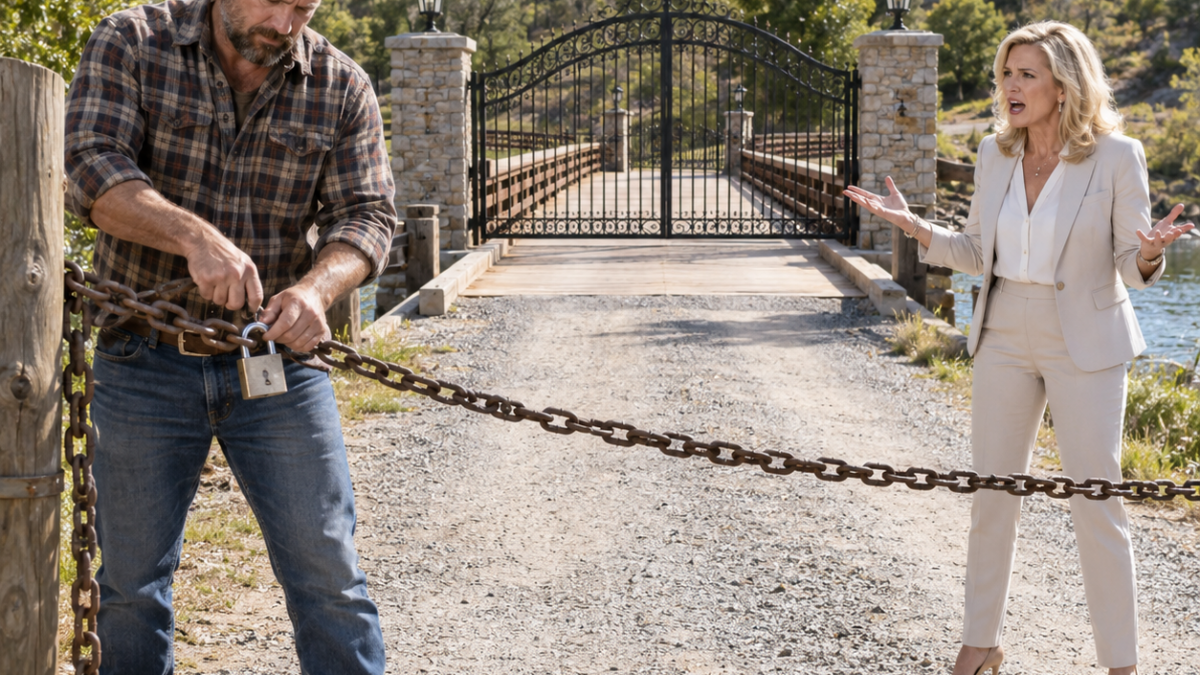
The $2 million wrought-iron entrance to Hollow Creek now led directly to my steel farm gate.
Paula’s stone columns.
Her gold lettering.
Her decorative lighting.
All of it opened onto a chain and padlock.
I finished around 1:40 in the morning.
My back hurt.
My hands were filthy.
I walked to the north abutment.
Ran my fingers over the stamp.
1953.
A. Coleman.
Then I looked down toward the water.
“Nora,” I whispered, “I hope I’m doing this right.”
The creek answered the way it always did.
By moving.
I went inside.
And slept better than I had in months.
My phone started ringing at 6:40.
By 7:00, there were twenty cars backed up inside Hollow Creek.
By 7:30, Paula was at the gate.
I watched from my side.
She wore a red jacket.
Perfect hair.
No patience.
“WADE!”
I carried coffee down the road.
She grabbed the bars.
“Open this gate.”
“No.”
“You cannot imprison an entire neighborhood!”
“Nobody is imprisoned.”
“This is the only paved access!”
“The bridge is structurally closed.”
“You damaged it!”
“No.”
“Open it!”
“Emergency vehicles have access.”
“You’re proving everything I told them about you.”
I handed her a copy of the engineering notice.
She slapped it away.
“This is retaliation.”
“This is an unsafe bridge.”
“My attorney will destroy you.”
“Tell him to call mine.”
People stood behind Paula.
Some shouted.
Others recorded.
I didn’t argue.
Around 8:15, a woman pushed through the crowd.
“My son has a medical appointment.”
“There’s an alternate county route.”
“That takes forty minutes!”
“I know.”
“This is insane!”
“I know.”
That part hurt.
Because she was right about the inconvenience.
Hollow Creek had an old gravel secondary route technically capable of carrying traffic, but it added a long detour.
For decades, nobody used it except occasionally for maintenance access.
People would not be trapped.
But they would be furious.
And Paula had built her entire argument around that fury.
At 9:00, sheriff’s deputies arrived to keep the peace.
At 9:20, county engineers came.
That mattered more.
They inspected the cracks.
Reviewed my photographs.
Looked at the equipment tracks.
One of them stood beside me under the bridge.
“You’re right to close it.”
Those six words changed everything.
By noon, the county issued its own support for the temporary closure pending evaluation.
Paula’s argument that I was simply a spiteful old man became harder to sustain.
Then reporters arrived.
I refused most interviews.
I gave one statement.
“The bridge is privately owned. Heavy construction equipment crossed it without my authorization and caused visible damage. As engineer of record, I closed it for safety. Emergency access remains available. I remain willing to provide Hollow Creek with a permanent legal easement once ownership and repairs are properly resolved.”
That was it.
No insults.
No victory speech.
No mention of the ridiculous gate.
Even though every camera showed it.
A two-million-dollar entrance terminating at a farm gate became the image that went everywhere.
By the next day, people began asking a new question.
Not:
Why did Wade close the bridge?
But:
Who owns it?
That question ruined Paula.
Because answers lived at the courthouse.
And courthouse records don’t care who gives better speeches.
Hollow Creek residents began pulling deeds.
The recorded license.
The subdivision documents.
The plats.
The more they read, the quieter Paula became.
Then the Hadleys came to my door.
I had never met them.
Young couple.
Late twenties maybe.
Mr. Hadley carried a folder.
His wife waited in the truck with a baby.
He looked exhausted.
“Mr. Coleman?”
“Wade.”
“I’m Evan Hadley.”
“Come in.”
“I’d rather talk here.”
“All right.”
He opened the folder.
Mortgage documents.
Title papers.
HOA disclosure packet.
One page stated that access to Hollow Creek Estates was provided through permanent common elements owned and maintained by the association.
He pointed.
“Is this false?”
“Yes.”
His face drained.
“You’re sure?”
“I own the bridge.”
“Could my house actually not have permanent legal access?”
“Today?”
He nodded.
“Not through my bridge.”
He stared across the creek.
“My wife and I put everything into that house.”
“I understand.”
“No, I don’t think you do.”
He caught himself.
“I’m sorry.”
“You don’t have to apologize.”
“Our baby is six months old.”
“I saw.”
“If we had known—”
“I know.”
“Paula told us access was guaranteed.”
“When did you close?”
“Eight months ago.”
I felt something cold move through me.
“Eight months.”
“Yes.”
“When did you receive the HOA disclosure?”
“Before closing.”
“Can I see the date?”
He handed me the page.
I knew the date instantly.
Paula had received my certified ownership letter more than a year before the Hadleys bought their house.
The letter that included the deed.
The recorded license.
The plats.
Proof.
I looked at Evan.
“Keep every document.”
“Why?”
“Because Paula knew.”
His eyes narrowed.
“Knew what?”
“That the HOA didn’t own the bridge.”
“How do you know she knew?”
“I sent her the deed.”
“When?”
I told him.
He whispered something I won’t repeat.
Then he looked at his wife and baby in the truck.
“Why would she sell us a house like this?”
I had no answer that made sense.
Because Paula didn’t think she was lying.
Not completely.
I think somewhere in her mind, the bridge belonged to Hollow Creek because she believed it should.
And once she believed that strongly enough, facts became inconveniences.
Roy Renner was different.
Roy was Paula’s husband.
He handled financial paperwork for the family development company.
He dealt with banks.
Loans.
Refinancing.
Lot sales.
The more homeowners investigated, the more his name appeared.
A resident named Thomas Penn worked in commercial banking.
He began looking at public filings.
Another resident had worked in title insurance.
Marlene knew practically everybody.
Within days, people who had spent months treating me as the enemy started comparing documents with one another.
Then Dan called.
“Wade.”
“What?”
“You need to sit down.”
“I’m sitting.”
“The HOA refinanced debt last year.”
“So?”
“They represented the access road and bridge as association-controlled permanent common property.”
I closed my eyes.
“In writing?”
“In writing.”
“After my letter?”
“Long after.”
That was the point where the property dispute became something else.
If Paula and Roy had made statements to banks about ownership they knew was disputed—and had received records directly contradicting those statements—then prosecutors might care.
Dan told me not to speculate publicly.
So I didn’t.
I gave documents to the sheriff’s fraud unit.
The certified letter.
Delivery confirmation.
The deed.
The license.
Paula’s common-element declaration.
Copies of gate-construction contracts on my land.
The engineering reports.
Then I went home.
Marlene arrived that Sunday.
She carried the same uncertainty she had before.
But something had changed.
She wasn’t defending Paula.
She was angry with herself.
“Can I see the letter?”
“What letter?”
“The one you sent Paula.”
I brought her a copy.
Marlene read it standing in my kitchen.
Halfway down the page, her hand began shaking.
“This is two years old.”
“Yes.”
“She knew.”
“She received it.”
“She told us you had never produced proof.”
“I produced it immediately.”
Marlene sat.
“Oh, God.”
I made coffee.
She didn’t touch hers.
“I repeated what she said.”
“I know.”
“I told people you were trying to extort us.”
“I know.”
“I told my own daughter you were dangerous.”
I sat across from her.
“Marlene.”
“No. Let me say it.”
Her eyes filled.
“You and Nora were good to me.”
“This isn’t about Nora.”
“It is to me.”
She wiped her face.
“I should have come to you sooner.”
“You were scared for your family.”
“So were the people who threw the brick.”
“That’s different.”
“Is it?”
“Yes.”
She nodded slowly.
Then she asked, “What are you going to do to us?”
“Nothing.”
She looked up.
“Nothing?”
“I’m going to fix my bridge.”
“And access?”
“When Paula is out of the way and ownership is settled, I’ll give Hollow Creek a permanent easement.”
Marlene stared.
“You still will?”
“Yes.”
“After everything?”
“The Hadleys didn’t spray-paint my grandfather’s concrete.”
“Somebody did.”
“Then that person can answer for it.”
“What about everyone else?”
“They need a road.”
She covered her mouth.
For a few seconds, neither of us spoke.
Then she stood.
“I owe you something.”
“No.”
“Yes.”
She picked up the copy of my certified letter.
“I owe you the truth.”
By Monday, almost every house in Hollow Creek had seen it.
I gave copies to three residents.
That was enough.
The story changed fast.
The bitter old widower became the man who had offered a permanent solution from the beginning.
Paula became the president who had received proof, ignored it, built anyway, and continued telling buyers the access was secure.
The Hadleys became the face of what her lie had endangered.
Their mortgage.
Their savings.
Their baby.
Suddenly the fear Paula had aimed at me turned around.
Residents demanded an emergency HOA meeting.
Paula resisted.
Then the board members around her began resigning.
One claimed he had never seen the deed.
Another said Paula handled the legal side.
A third hired his own attorney.
The bank sent formal inquiries.
The development company’s lawyer stopped returning Paula’s public calls.
County building officials issued violations over the gate construction.
No permit authorizing work on my parcel.
No structural review for the heavy bridge loads.
No valid property interest supporting their construction.
A stop-work order went up on the $2 million entrance.
I took a picture.
Not because I wanted to gloat.
Because after months of being told I was imagining ownership, a county notice now stood beside Paula’s monument.
Reality had arrived.
The emergency community meeting was scheduled for Thursday night.
Hollow Creek’s clubhouse held maybe a hundred and fifty comfortably.
Nearly two hundred showed.
I wasn’t sure whether to attend.
Dan said I should.
“You don’t need to speak.”
“Then why go?”
“Because for two years Paula has described you to them. Let them see you.”
So I went.
Flannel shirt.
Jeans.
Nothing dramatic.
In my jacket pocket was a piece of concrete that had broken from near one damaged bearing.
I had picked it up during inspection.
For some reason, I wanted it with me.
Maybe because it reminded me this wasn’t theoretical.
Paula’s decisions had physically damaged something my grandfather built.
The clubhouse was packed.
People stood along the walls.
Evan Hadley held his baby near the center aisle.
His wife sat beside him.
Marlene stood near the front.
Paula entered through the side door.
Roy sat at the board table.
He looked terrible.
Paula looked furious.
That difference told me everything about their personalities.
Roy understood consequences.
Paula still believed consequences could be ordered to leave.
She struck the gavel.
“This meeting will come to order.”
Nobody quieted.
Again.
“Order!”
The room settled enough.
Paula began.
“What has happened over the last week is the result of one man’s vindictive campaign—”
Marlene stood.
Paula stopped.
“Marlene, you are out of order.”
“I have a question.”
“You will have an opportunity later.”
“I’ve waited two years.”
People murmured.
Paula tightened her jaw.
“Fine.”
Marlene held up my certified letter.
“Did you receive this?”
Paula didn’t answer immediately.
“What is that?”
“You know what it is.”
“Marlene—”
“It is a letter from Wade Coleman dated two years ago.”
Silence.
“It includes the recorded license.”
More silence.
“And the deed.”
Paula looked toward Roy.
Marlene continued.
“It says the bridge is private and the access is revocable. It offers to negotiate a permanent easement.”
Someone in the back shouted, “Answer her!”
Paula raised the gavel.
“I will not conduct this meeting through mob intimidation.”
Marlene’s voice shook.
“Did you receive it?”
“Yes.”
One word.
Everything changed.
A gasp rolled through the room.
Paula rushed forward verbally.
“Our attorneys advised us that the association possessed superior rights under prescriptive-use principles—”
Evan Hadley stood.
He was still holding the baby.
“Before or after you sold me my house?”
Paula froze.
Evan stepped into the aisle.
“Look at me.”
She did.
“Did you know Wade claimed the bridge was private when you gave me paperwork saying the HOA owned permanent access?”
“Our legal position was—”
“That’s not what I asked.”
His baby fussed.
Evan bounced him gently.
“Did you know?”
“Mr. Hadley, these are complicated property issues.”
“My mortgage isn’t complicated.”
The room erupted.
People shouted questions.
When did the bank know?
What did Roy submit?
Why was the gate built before ownership was resolved?
Who approved spending two million dollars?
Were reserve funds used?
Was the development company involved?
Why had Paula told everyone I refused an easement when my letter offered one?
Paula struck the gavel.
Again.
Again.
Again.
Nobody cared.
Finally, she did what she had done from the beginning.
She pointed at me.
“There!”
Two hundred heads turned.
“That man locked you out!”
The old current moved through the room.
I felt it.
For a second, I was the villain again.
The gate.
The detour.
The inconvenience.
Paula raised her voice.
“He condemned a bridge he owns and locked a gate because he wanted revenge! He wants control over your homes! Every problem you’re facing is because Wade Coleman decided one old deed mattered more than two hundred families!”
I stood.
Didn’t move forward.
Didn’t raise my voice.
Evan Hadley looked at me.
Then back at Paula.
“He didn’t lie to my bank.”
The room went silent.
Evan tightened one arm around his child.
“You did.”
Paula stared at him.
And that was the exact moment her presidency ended.
Not when a vote happened.
Not when lawyers arrived.
Not when police came.
Right there.
Because fear only works while people agree who they’re supposed to fear.
For two years, Paula pointed at me.
That night, the neighborhood turned around and looked at her.
Roy leaned toward her.
Whispered something.
She pushed him away.
Then the clubhouse doors opened.
Two sheriff’s deputies entered.
Behind them came a plainclothes investigator I recognized from the fraud unit.
Another investigator followed.
Nobody spoke.
Paula watched them walk down the center aisle.
The investigator stopped in front of the board table.
“Paula Renner?”
She swallowed.
“Yes.”
“Roy Renner?”
Roy closed his eyes.
“Yes.”
The investigator asked them to step away from the table.
Paula’s face changed.
“No.”
“Ma’am.”
“This is an HOA meeting.”
“I understand.”
“You cannot interrupt an official—”
“Mrs. Renner.”
He displayed paperwork.
“We have warrants.”
You could hear someone breathing near me.
Nothing else.
Paula looked around the room like she expected someone to stand.
Nobody did.
The investigator told her she was being taken into custody in connection with an ongoing investigation involving fraud, property filings, and financial representations connected to Hollow Creek development transactions.
Roy stood first.
He looked defeated.
Paula remained seated.
The investigator repeated his instruction.
She grabbed the gavel.
“I am president of this association.”
Marlene whispered, “Not anymore.”
Paula heard her.
For one second, their eyes met.
Then Paula stood.
A deputy took the gavel from her hand and placed it on the table.
Small sound.
Wood touching wood.
That sound stayed with me.
Handcuffs went on Roy.
Then Paula.
Nobody cheered.
I’m glad they didn’t.
Whatever satisfaction existed in that room was buried beneath something heavier.
People had mortgages tied to her decisions.
Savings.
Homes.
Retirement plans.
Families.
The Hadleys weren’t celebrating.
Evan held his wife.
Marlene cried.
As Paula walked down the aisle, she saw me.
She stopped.
“This is what you wanted.”
I shook my head.
“No.”
“You destroyed everything.”
“No, Paula.”
I touched the piece of broken bridge in my pocket.
“I told you how to fix it two years ago.”
A deputy guided her forward.
She walked out.
The doors closed.
And after years of Paula telling Hollow Creek what to think, the room had no leader.
For several minutes, nobody knew what to do.
Then Marlene looked toward me.
“What happens now?”
That was the question I had been waiting for.
I stepped into the aisle.
“Now we make sure nobody loses access to their home.”
People stared.
Some looked suspicious.
Others relieved.
Evan said, “You mean that?”
“Yes.”
“Even after this?”
“Especially after this.”
I turned toward everyone.
“The bridge stays closed until the structure is safe. That isn’t punishment. That’s engineering.”
A few people nodded.
“After repairs, I’m willing to sign a permanent easement guaranteeing residential access.”
Someone called, “What will it cost?”
“Lawyers will work out fair terms.”
Groans.
I raised a hand.
“I’m not asking anyone to buy my bridge.”
People quieted.
“I keep ownership. Hollow Creek gets permanent recorded crossing rights. Maintenance responsibility gets defined. Load limits get defined. Emergency access stays protected.”
Marlene asked, “Forever?”
“As long as the bridge exists, subject to the agreement.”
Evan sat slowly.
His wife started crying.
That reaction hit me harder than Paula’s arrest.
Because it reminded me who the fight was actually for.
Not me.
Not Paula.
Not even Amos.
People who had done nothing wrong were carrying the consequences.
The criminal case unfolded over the following months.
Investigators found more than I ever knew.
Loan documents represented the bridge and access road as permanent community assets.
Property disclosures relied on that representation.
Recorded documents had been altered and referenced in ways prosecutors challenged.
Financial transactions connected to the gate project came under scrutiny.
Roy had handled much of the paperwork.
Paula had signed enough of it that her attorney faced a brutal problem.
My certified letter existed.
Signed receipt.
Date.
Deed attached.
License attached.
My offer to negotiate a permanent easement attached.
Whatever Paula believed before that letter, after receiving it she could not plausibly claim nobody had informed her.
A paper trail has no temper.
No political allegiance.
No personal grudge.
It simply waits.
The criminal charges included fraud-related offenses, forgery allegations connected to property records, and theft-by-deception counts arising from financial representations.
Eventually both Paula and Roy accepted plea agreements.
Neither walked away untouched.
There were convictions.
Restitution obligations.
Financial judgments.
Restrictions.
Paula served actual time.
Roy received his own sentence.
Their development business collapsed under the combined weight of criminal exposure, civil claims, and lender action.
But none of that fixed my bridge.
That part mattered more to me.
The civil court formally confirmed ownership.
The Cane Creek bridge belonged to me.
The Hollow Creek prescriptive-easement claim failed.
The original use had been permissive from the start.
My father’s recorded license had done exactly what he intended.
Protected neighborly use without surrendering ownership.
The court ordered responsibility for damage caused by unauthorized construction addressed through the defendants and related parties.
Paula’s $2 million gate had a shorter life than some kitchen appliances.
Crews dismantled it.
Wrought iron came down.
Stone facing came off.
The guardhouse disappeared.
Concrete footings were excavated from my property.
The gold-lettered Hollow Creek Estates sign was removed.
I watched none of it.
People asked why.
Because I didn’t need to.
Destroying Paula’s monument wasn’t the ending I wanted.
Repairing Amos’s bridge was.
I worked with structural crews I trusted.
We opened damaged areas.
Repaired bearings.
Strengthened portions of the approach.
Improved drainage.
Replaced deteriorated material that had nothing to do with Paula but needed attention anyway.
If we were going to fix it, we were going to do it right.
My grandfather had poured his footings deeper than necessary.
I honored him by doing the same kind of thing.
Better materials.
Modern reinforcement.
Updated barriers.
New load calculations.
My engineering stamp went on the final report.
When the bridge was ready, I stood at the north abutment alone.
Ran my thumb over:
1953.
A. COLEMAN.
The letters were faint but intact.
“Still here,” I whispered.
Then came the harder part.
The easement.
The new Hollow Creek board sat across from me and Dan in a conference room.
Marlene had been elected.
So had Evan Hadley.
He looked exhausted but determined.
The new board’s attorney slid documents across the table.
Permanent residential access.
Emergency access.
Utility access.
Maintenance-sharing formula.
Load restrictions.
Insurance.
Repair responsibilities.
Procedures if the bridge ever needed closure.
Most importantly, the document clearly said what Paula had tried to erase.
Ownership remained with Coleman.
Access belonged to Hollow Creek under the recorded easement.
Two different things.
Both protected.
I read every page.
Then I looked at Evan.
“You comfortable?”
He laughed nervously.
“I’ve read it six times.”
“Only six?”
Marlene smiled.
“Nora would tell you to sign the damn paper.”
That got me.
I looked away for a second.
Then signed.
Wade Coleman.
The Hollow Creek representatives signed.
The attorneys notarized everything.
The easement was recorded at the courthouse.
Permanent.
Real.
For the first time since the subdivision was built, Hollow Creek families had exactly what Paula had spent years pretending they already possessed.
Secure legal access.
Nobody could wake up one morning and discover their home depended on permission.
Including permission from me.
That was intentional.
Power should have limits even when you trust the person holding it.
Especially then.
The bridge reopened on a Saturday.
There was no giant ribbon.
No two-million-dollar monument.
No television campaign.
Just neighbors.
Maybe a hundred people showed up anyway.
The Hadleys brought their baby.
The young father who once came to my driveway accusing me of trapping his children stood near the front.
He approached before we opened.
“Mr. Coleman.”
“Wade.”
He looked embarrassed.
“I owe you an apology.”
“You were protecting your kids.”
“I threw words at you I shouldn’t have.”
“You didn’t throw the brick.”
“No.”
“Then we’re okay.”
He shook my hand.
“My daughter still has asthma.”
“I remember.”
“Thank you for making the emergency-access language strong.”
“That was never negotiable.”
His eyes filled.
He nodded and walked back to his family.
Marlene stood beside me.
“What now?”
“I unlock the gate.”
“You keeping it?”
“The farm gate?”
“Yes.”
I smiled.
“Definitely.”
“Why?”
“To remind people paperwork matters.”
She laughed.
I opened the padlock.
Removed the chain.
Swung the gate wide.
Cars didn’t rush through.
People walked first.
Families crossed together.
Kids ran.
Evan carried his baby halfway across before his wife made him slow down.
The little boy reached for the concrete railing.
I nearly warned them.
Then stopped myself.
This bridge had carried families long before Paula.
It would carry them after me too.
At the center of the span, I felt Nora everywhere.
The evenings in her wheelchair.
Her hand on mine.
The water beneath us.
Her voice telling me not to overthink things.
Marlene came alongside.
“She’d be proud.”
I looked at the creek.
“She’d say I made everything harder than necessary.”
“She’d be right.”
“Probably.”
We stood there while neighbors crossed.
Then I remembered another promise.
Years earlier, Nora and I had talked about doing something with the swimming hole.
She had taught elementary school.
Loved children.
She believed every kid should know how to swim.
Especially children growing up near water.
That summer, I opened the Coleman side of Cane Creek for a community program.
Free.
Swimming lessons.
Fishing days.
Basic water safety.
The fire department participated.
For older kids, I added what Marlene called “Wade’s Concrete School.”
I taught them how bridges carry weight.
Compression.
Tension.
Bearings.
Loads.
Why cracks matter.
Why engineers are boring right up until you need one.
One Saturday, I took twelve teenagers beneath the bridge.
I pointed at the old footings.
“My grandfather built those.”
A boy asked, “Was he an engineer?”
“No.”
“Then how’d he know how deep?”
“He spent his life building roads.”
“So experience?”
“Experience and fear.”
They laughed.
“I’m serious. Good builders respect what can go wrong.”
I showed them the 1953 stamp.
One girl ran her fingers over it.
“Your grandpa wrote that?”
“Stamped it.”
“That’s cool.”
“Yeah.”
She looked up at the repaired bridge.
“You think it’ll still be here when we’re old?”
I smiled.
“If you people stop driving excavators across it.”
They laughed.
I didn’t tell them how much that question meant.
Later that year, we installed a small plaque beside Amos’s stamp.
I argued against it.
Marlene ignored me.
The new Hollow Creek board paid for it.
It read:
CANE CREEK BRIDGE
BUILT BY AMOS COLEMAN, 1953
PRESERVED BY THE COLEMAN FAMILY
PERMANENT ACCESS ESTABLISHED FOR HOLLOW CREEK
A BRIDGE ENDURES WHEN BOTH SIDES CARRY THEIR SHARE.
I stood looking at it for a long time.
“What?” Marlene asked.
“Too many words.”
“You complain about everything.”
“I’m consistent.”
She pointed toward the last line.
“Whose idea was that?”
“Yours?”
“Yours.”
“I don’t remember saying it.”
“You said something longer. We improved it.”
“That sounds like theft.”
“Call a lawyer.”
I laughed.
That was the first time in years I laughed on that bridge without something heavy behind it.
The Hadleys stayed in Hollow Creek.
Once permanent access was recorded, their title issues were resolved.
Their baby became a toddler.
Then a little boy who loved throwing rocks into Cane Creek.
His mother apologized every time.
I told her rocks were part of creek maintenance.
He learned to walk properly on the bridge.
At least that is what Evan claimed.
Marlene crossed most Sundays for coffee.
Sometimes she brought her daughter.
Sometimes grandkids.
The young father with the asthmatic daughter started volunteering at the swimming program.
He never mentioned our first confrontation.
Neither did I.
Forgiveness gets easier when nobody demands credit for it.
The most surprising change happened inside Hollow Creek.
People stopped treating the HOA as a kingdom.
Meetings became boring.
Which is exactly what HOA meetings should be.
Budgets were posted.
Contracts were bid.
Major property representations required legal verification.
Residents asked questions.
Board members answered them.
Nobody served eleven consecutive years as president.
Marlene pushed through term limits.
“Any objections?” she asked me.
“I don’t live in Hollow Creek.”
“You have opinions.”
“Strong support.”
“Thought so.”
There were disagreements.
Of course.
One family wanted oversized driveway lights.
Someone else hated them.
A resident wanted chickens.
Half the neighborhood imagined fresh eggs.
The other half imagined civilization ending.
They argued.
Then voted.
Nobody got arrested.
Progress.
The county also improved the old secondary road.
That recommendation came from me.
Evan asked why we needed it once the easement was secure.
“Because no community of two hundred homes should depend on one bridge.”
He stared.
“You’re telling us not to depend on you?”
“I’m telling you not to depend on one structure.”
“What if it never fails?”
“All structures fail eventually.”
“That cheerful engineer thing again.”
“Exactly.”
They upgraded the gravel route enough for reliable emergency use.
Redundancy.
Engineers love redundancy.
So do people who have once woken up to a locked bridge.
A year after the arrest, I received a letter from Paula.
Prison stationery.
I almost threw it away unopened.
Then I remembered how angry I had been when she ignored facts.
So I read it.
It wasn’t an apology.
Not exactly.
Paula still believed portions of what she had done were justified.
She wrote that Hollow Creek had been her life.
That she had believed permanent access was essential.
That she believed I had forced her into impossible choices.
She blamed Roy for some financial filings.
Lawyers for others.
Me for escalating.
Residents for abandoning her.
The county for overreacting.
Near the end, though, there was one paragraph different from the rest.
She said she had recently thought about the Hadleys.
Their baby.
The fact that she had looked them in the eye at closing and promised their home was secure.
She wrote:
I should have fixed the access before I promised them it was fixed.
That sentence was the closest thing to truth in four pages.
I folded the letter.
Put it in the property file.
I never responded.
Some people might call that cold.
Maybe.
But forgiveness does not require reopening every door.
Paula had enough people helping her through the consequences of her choices.
I had a bridge to maintain.
A few months later, on what would have been Nora’s birthday, I carried flowers down to the swimming hole.
I sat near the place where I had asked her to marry me.
Cane Creek was low.
Clear.
Kids from the summer program had left smooth stones stacked beside the bank.
I talked to Nora.
I still do that sometimes.
I told her about the easement.
The Hadleys.
Marlene becoming unbearable in local government.
The swimming lessons.
The plaque.
I told her about Paula’s letter.
Then I said, “I think we’re done.”
A breeze moved through the trees.
No answer.
I smiled.
“You’d say we were done a year ago.”
Water moved around the bridge pilings.
Above me, tires crossed the deck.
One car.
Then another.
Normal traffic.
People going home.
That sound used to bother me during the fight.
Every crossing felt like somebody using something that was mine while Paula told the world it belonged to her.
Now it sounded different.
Because permission was no longer confused with ownership.
And ownership was no longer confused with domination.
The paperwork was honest.
The burden was shared.
The families were safe.
That was enough.
Years from now, Hollow Creek residents may forget Paula Renner.
Children born after everything happened won’t know why there was once a giant ornamental gate near Cane Creek.
They won’t remember television cameras.
Lawyers.
Sheriff’s deputies.
A padlock shining under moonlight.
They’ll just know that the bridge is how they get home.
That is probably the best ending.
A bridge shouldn’t be famous.
My grandfather understood that.
Good infrastructure disappears into ordinary life.
Nobody thinks about a bridge when it works.
They just cross.
One summer afternoon, I was teaching a group of teenagers underneath the north span when Evan’s son—older now—pointed toward Amos’s stamp.
“Mr. Wade?”
“Yeah?”
“Who owns the bridge?”
I looked up.
Technically, the answer was easy.
“I do.”
He frowned.
“But we can use it forever?”
“Yes.”
“So it’s kind of ours too?”
The engineer in me wanted to explain title, easements, servient estates, dominant estates, maintenance covenants, and recorded rights.
Then I looked at a ten-year-old standing ankle-deep in Cane Creek.
I gave him the simpler answer.
“It connects your side and mine.”
He shrugged.
“So yes?”
I smiled.
“In the way that matters to you, yes.”
He ran back to the other kids.
Marlene, sitting nearby, had heard me.
“Careful.”
“What?”
“You’re getting sentimental.”
“Never.”
“Nora would be shocked.”
I looked at the bridge.
Amos built it because his family needed to cross water.
My father preserved it because he understood ownership.
I fought for it because Paula tried to turn generosity into entitlement.
And in the end, I gave permanent access because ownership without responsibility would have made me no better than the person I fought.
That was the lesson Paula never understood.
She believed power came from putting your name on the gate.
From telling everyone where they could drive.
From calling something yours loudly enough that people stopped questioning it.
My grandfather believed something different.
If you own the bridge, you maintain it.
If the creek floods, you stand in the rain and guide the ambulance across.
If neighbors need help, you carry some of the cost.
You don’t own something simply because you control it.
You earn the right to decide what happens to it by accepting responsibility when that decision becomes difficult.
Paula wanted the say without the cost.
My family had carried both for seventy years.
That was why, when the time finally came, the bridge was ours to give access to.
A few years after the fight, Hollow Creek held a community picnic beside Cane Creek.
No security gate.
No grand entrance.
Folding tables.
Barbecue.
Kids swimming.
Old people in camp chairs.
Somebody convinced me to tell the story.
I refused.
Marlene told it instead.
Badly.
According to her version, I emerged from my house at midnight holding a chain in one hand and the deed in the other like Moses descending the mountain.
“That did not happen.”
“It’s better this way.”
“You’ve added thunder.”
“Atmosphere.”
“There was no thunder.”
“People prefer thunder.”
Evan laughed.
His son yelled from the creek.
For the first time, the story felt far away.
Not forgotten.
Just finished.
At sunset, people packed up.
Cars crossed home.
I remained beside the north abutment.
My hand found Amos’s stamp out of habit.
1953.
A. Coleman.
Seventy-three years earlier, my grandfather pressed those letters into wet concrete.
He had no idea Hollow Creek would exist.
No idea his son would record a license.
No idea his grandson would one day fight an HOA president over ownership.
No idea a two-million-dollar gate would rise and fall beside his bridge.
He simply built something correctly.
Deep footings.
Good concrete.
Honest work.
That was enough to outlast Paula.
It outlasted her gate.
Her presidency.
Her development company.
Her lies.
And one day it will outlast me.
I like that.
People sometimes ask whether shutting the bridge overnight was revenge.
At the time, part of me probably wanted it to feel like revenge.
I wanted Paula to wake up and see her grand entrance opening onto my padlock.
I wanted her to understand what “private” meant.
But that isn’t the part I’m proud of now.
I’m proud that before I locked anything, I called the fire department.
I’m proud emergency services had keys.
I’m proud I documented the safety problem instead of using a bridge closure as punishment.
I’m proud I gave the Hadleys permanent access after they learned how badly they had been misled.
I’m proud we turned two sides of Cane Creek that Paula had spent years convincing were enemies back into neighbors.
That is the difference between revenge and justice.
Revenge leaves somebody trapped.
Justice fixes what allowed the harm to happen.
Paula built a gate because she wanted to prove Hollow Creek belonged to her.
I locked a gate because she damaged a bridge that never did.
Then, once the truth was established, I opened it again.
Permanently.
Fairly.
Legally.
For everybody.
These days, when I sit on my porch in the evening, I can hear cars crossing Cane Creek.
Sometimes Marlene arrives with coffee.
Sometimes Evan’s boy rides his bike over.
Sometimes firefighters use the bridge heading toward a call.
Every so often I walk down and inspect the repaired bearing points.
Engineer habit.
Then I touch my grandfather’s stamp.
And if the light is right, I can see both plaques.
His name.
And the newer one about carrying the cost.
The creek still moves beneath them exactly as it always has.
It doesn’t know about HOAs.
Property lines.
Prescriptive easements.
Fraud investigations.
Two-million-dollar gates.
It just separates two pieces of land.
A bridge is what makes the separation temporary.
Paula spent eleven years telling people they needed her gate to protect their community.
What they actually needed was something much older and simpler.
A truthful deed.
A fair agreement.
A safe bridge.
And neighbors willing to meet in the middle.
That is what remained after everything else was gone.








